US20160195992A1 - Mobile terminal and method for processing signals generated from touching virtual keys - Google Patents
Mobile terminal and method for processing signals generated from touching virtual keys Download PDFInfo
- Publication number
- US20160195992A1 US20160195992A1 US15/065,142 US201615065142A US2016195992A1 US 20160195992 A1 US20160195992 A1 US 20160195992A1 US 201615065142 A US201615065142 A US 201615065142A US 2016195992 A1 US2016195992 A1 US 2016195992A1
- Authority
- US
- United States
- Prior art keywords
- touch
- virtual keys
- virtual
- key
- sensing area
- Prior art date
- Legal status (The legal status is an assumption and is not a legal conclusion. Google has not performed a legal analysis and makes no representation as to the accuracy of the status listed.)
- Abandoned
Links
Images



Classifications
-
- G—PHYSICS
- G06—COMPUTING OR CALCULATING; COUNTING
- G06F—ELECTRIC DIGITAL DATA PROCESSING
- G06F3/00—Input arrangements for transferring data to be processed into a form capable of being handled by the computer; Output arrangements for transferring data from processing unit to output unit, e.g. interface arrangements
- G06F3/01—Input arrangements or combined input and output arrangements for interaction between user and computer
- G06F3/03—Arrangements for converting the position or the displacement of a member into a coded form
- G06F3/041—Digitisers, e.g. for touch screens or touch pads, characterised by the transducing means
- G06F3/0416—Control or interface arrangements specially adapted for digitisers
-
- G—PHYSICS
- G06—COMPUTING OR CALCULATING; COUNTING
- G06F—ELECTRIC DIGITAL DATA PROCESSING
- G06F1/00—Details not covered by groups G06F3/00 - G06F13/00 and G06F21/00
- G06F1/16—Constructional details or arrangements
- G06F1/1613—Constructional details or arrangements for portable computers
- G06F1/1626—Constructional details or arrangements for portable computers with a single-body enclosure integrating a flat display, e.g. Personal Digital Assistants [PDAs]
-
- G—PHYSICS
- G06—COMPUTING OR CALCULATING; COUNTING
- G06F—ELECTRIC DIGITAL DATA PROCESSING
- G06F1/00—Details not covered by groups G06F3/00 - G06F13/00 and G06F21/00
- G06F1/16—Constructional details or arrangements
- G06F1/1613—Constructional details or arrangements for portable computers
- G06F1/1633—Constructional details or arrangements of portable computers not specific to the type of enclosures covered by groups G06F1/1615 - G06F1/1626
- G06F1/1684—Constructional details or arrangements related to integrated I/O peripherals not covered by groups G06F1/1635 - G06F1/1675
- G06F1/169—Constructional details or arrangements related to integrated I/O peripherals not covered by groups G06F1/1635 - G06F1/1675 the I/O peripheral being an integrated pointing device, e.g. trackball in the palm rest area, mini-joystick integrated between keyboard keys, touch pads or touch stripes
-
- G—PHYSICS
- G06—COMPUTING OR CALCULATING; COUNTING
- G06F—ELECTRIC DIGITAL DATA PROCESSING
- G06F1/00—Details not covered by groups G06F3/00 - G06F13/00 and G06F21/00
- G06F1/16—Constructional details or arrangements
- G06F1/1613—Constructional details or arrangements for portable computers
- G06F1/1633—Constructional details or arrangements of portable computers not specific to the type of enclosures covered by groups G06F1/1615 - G06F1/1626
- G06F1/1684—Constructional details or arrangements related to integrated I/O peripherals not covered by groups G06F1/1635 - G06F1/1675
- G06F1/169—Constructional details or arrangements related to integrated I/O peripherals not covered by groups G06F1/1635 - G06F1/1675 the I/O peripheral being an integrated pointing device, e.g. trackball in the palm rest area, mini-joystick integrated between keyboard keys, touch pads or touch stripes
- G06F1/1692—Constructional details or arrangements related to integrated I/O peripherals not covered by groups G06F1/1635 - G06F1/1675 the I/O peripheral being an integrated pointing device, e.g. trackball in the palm rest area, mini-joystick integrated between keyboard keys, touch pads or touch stripes the I/O peripheral being a secondary touch screen used as control interface, e.g. virtual buttons or sliders
-
- G—PHYSICS
- G06—COMPUTING OR CALCULATING; COUNTING
- G06F—ELECTRIC DIGITAL DATA PROCESSING
- G06F3/00—Input arrangements for transferring data to be processed into a form capable of being handled by the computer; Output arrangements for transferring data from processing unit to output unit, e.g. interface arrangements
- G06F3/01—Input arrangements or combined input and output arrangements for interaction between user and computer
- G06F3/048—Interaction techniques based on graphical user interfaces [GUI]
- G06F3/0481—Interaction techniques based on graphical user interfaces [GUI] based on specific properties of the displayed interaction object or a metaphor-based environment, e.g. interaction with desktop elements like windows or icons, or assisted by a cursor's changing behaviour or appearance
- G06F3/0482—Interaction with lists of selectable items, e.g. menus
-
- G—PHYSICS
- G06—COMPUTING OR CALCULATING; COUNTING
- G06F—ELECTRIC DIGITAL DATA PROCESSING
- G06F3/00—Input arrangements for transferring data to be processed into a form capable of being handled by the computer; Output arrangements for transferring data from processing unit to output unit, e.g. interface arrangements
- G06F3/01—Input arrangements or combined input and output arrangements for interaction between user and computer
- G06F3/048—Interaction techniques based on graphical user interfaces [GUI]
- G06F3/0484—Interaction techniques based on graphical user interfaces [GUI] for the control of specific functions or operations, e.g. selecting or manipulating an object, an image or a displayed text element, setting a parameter value or selecting a range
- G06F3/04842—Selection of displayed objects or displayed text elements
-
- G—PHYSICS
- G06—COMPUTING OR CALCULATING; COUNTING
- G06F—ELECTRIC DIGITAL DATA PROCESSING
- G06F3/00—Input arrangements for transferring data to be processed into a form capable of being handled by the computer; Output arrangements for transferring data from processing unit to output unit, e.g. interface arrangements
- G06F3/01—Input arrangements or combined input and output arrangements for interaction between user and computer
- G06F3/048—Interaction techniques based on graphical user interfaces [GUI]
- G06F3/0487—Interaction techniques based on graphical user interfaces [GUI] using specific features provided by the input device, e.g. functions controlled by the rotation of a mouse with dual sensing arrangements, or of the nature of the input device, e.g. tap gestures based on pressure sensed by a digitiser
- G06F3/0488—Interaction techniques based on graphical user interfaces [GUI] using specific features provided by the input device, e.g. functions controlled by the rotation of a mouse with dual sensing arrangements, or of the nature of the input device, e.g. tap gestures based on pressure sensed by a digitiser using a touch-screen or digitiser, e.g. input of commands through traced gestures
- G06F3/04883—Interaction techniques based on graphical user interfaces [GUI] using specific features provided by the input device, e.g. functions controlled by the rotation of a mouse with dual sensing arrangements, or of the nature of the input device, e.g. tap gestures based on pressure sensed by a digitiser using a touch-screen or digitiser, e.g. input of commands through traced gestures for inputting data by handwriting, e.g. gesture or text
-
- G—PHYSICS
- G06—COMPUTING OR CALCULATING; COUNTING
- G06F—ELECTRIC DIGITAL DATA PROCESSING
- G06F3/00—Input arrangements for transferring data to be processed into a form capable of being handled by the computer; Output arrangements for transferring data from processing unit to output unit, e.g. interface arrangements
- G06F3/01—Input arrangements or combined input and output arrangements for interaction between user and computer
- G06F3/048—Interaction techniques based on graphical user interfaces [GUI]
- G06F3/0487—Interaction techniques based on graphical user interfaces [GUI] using specific features provided by the input device, e.g. functions controlled by the rotation of a mouse with dual sensing arrangements, or of the nature of the input device, e.g. tap gestures based on pressure sensed by a digitiser
- G06F3/0488—Interaction techniques based on graphical user interfaces [GUI] using specific features provided by the input device, e.g. functions controlled by the rotation of a mouse with dual sensing arrangements, or of the nature of the input device, e.g. tap gestures based on pressure sensed by a digitiser using a touch-screen or digitiser, e.g. input of commands through traced gestures
- G06F3/04886—Interaction techniques based on graphical user interfaces [GUI] using specific features provided by the input device, e.g. functions controlled by the rotation of a mouse with dual sensing arrangements, or of the nature of the input device, e.g. tap gestures based on pressure sensed by a digitiser using a touch-screen or digitiser, e.g. input of commands through traced gestures by partitioning the display area of the touch-screen or the surface of the digitising tablet into independently controllable areas, e.g. virtual keyboards or menus
-
- H—ELECTRICITY
- H04—ELECTRIC COMMUNICATION TECHNIQUE
- H04M—TELEPHONIC COMMUNICATION
- H04M1/00—Substation equipment, e.g. for use by subscribers
- H04M1/72—Mobile telephones; Cordless telephones, i.e. devices for establishing wireless links to base stations without route selection
- H04M1/724—User interfaces specially adapted for cordless or mobile telephones
- H04M1/72466—User interfaces specially adapted for cordless or mobile telephones with selection means, e.g. keys, having functions defined by the mode or the status of the device
-
- G—PHYSICS
- G06—COMPUTING OR CALCULATING; COUNTING
- G06F—ELECTRIC DIGITAL DATA PROCESSING
- G06F2203/00—Indexing scheme relating to G06F3/00 - G06F3/048
- G06F2203/041—Indexing scheme relating to G06F3/041 - G06F3/045
- G06F2203/04104—Multi-touch detection in digitiser, i.e. details about the simultaneous detection of a plurality of touching locations, e.g. multiple fingers or pen and finger
-
- G—PHYSICS
- G06—COMPUTING OR CALCULATING; COUNTING
- G06F—ELECTRIC DIGITAL DATA PROCESSING
- G06F3/00—Input arrangements for transferring data to be processed into a form capable of being handled by the computer; Output arrangements for transferring data from processing unit to output unit, e.g. interface arrangements
- G06F3/01—Input arrangements or combined input and output arrangements for interaction between user and computer
- G06F3/03—Arrangements for converting the position or the displacement of a member into a coded form
- G06F3/041—Digitisers, e.g. for touch screens or touch pads, characterised by the transducing means
-
- G—PHYSICS
- G06—COMPUTING OR CALCULATING; COUNTING
- G06F—ELECTRIC DIGITAL DATA PROCESSING
- G06F3/00—Input arrangements for transferring data to be processed into a form capable of being handled by the computer; Output arrangements for transferring data from processing unit to output unit, e.g. interface arrangements
- G06F3/01—Input arrangements or combined input and output arrangements for interaction between user and computer
- G06F3/048—Interaction techniques based on graphical user interfaces [GUI]
- G06F3/0487—Interaction techniques based on graphical user interfaces [GUI] using specific features provided by the input device, e.g. functions controlled by the rotation of a mouse with dual sensing arrangements, or of the nature of the input device, e.g. tap gestures based on pressure sensed by a digitiser
- G06F3/0488—Interaction techniques based on graphical user interfaces [GUI] using specific features provided by the input device, e.g. functions controlled by the rotation of a mouse with dual sensing arrangements, or of the nature of the input device, e.g. tap gestures based on pressure sensed by a digitiser using a touch-screen or digitiser, e.g. input of commands through traced gestures
-
- H—ELECTRICITY
- H04—ELECTRIC COMMUNICATION TECHNIQUE
- H04M—TELEPHONIC COMMUNICATION
- H04M1/00—Substation equipment, e.g. for use by subscribers
- H04M1/02—Constructional features of telephone sets
- H04M1/0202—Portable telephone sets, e.g. cordless phones, mobile phones or bar type handsets
- H04M1/0279—Improving the user comfort or ergonomics
- H04M1/0281—Improving the user comfort or ergonomics for providing single handed use or left/right hand conversion
-
- H—ELECTRICITY
- H04—ELECTRIC COMMUNICATION TECHNIQUE
- H04M—TELEPHONIC COMMUNICATION
- H04M2250/00—Details of telephonic subscriber devices
- H04M2250/22—Details of telephonic subscriber devices including a touch pad, a touch sensor or a touch detector
Definitions
- the present disclosure relates to the field of computer processing, and more particularly, to a mobile terminal and a method for processing signals generated from touching virtual keys.
- a mobile terminal Due to the development of electronic technology, mobile terminals have been widely used and upgraded quickly. Conventionally, a mobile terminal is provided with a keyboard as an input apparatus. Recently, a mobile terminal is provided with a touch screen or a more advanced full touch screen as an input apparatus, and becomes more and more intelligent. A lot of functions of physical keys may be realized by the virtual keys in the touch screen of a mobile terminal. The user may perform operations on the mobile terminal via touching the virtual keys or applying other gestures on the virtual keys.
- a mobile terminal includes: a touch panel including a plurality of virtual keys and a first auxiliary sensing area, wherein the first auxiliary sensing area is located on one side of the touch panel; and a touch processing circuit coupled to the touch panel, the touch processing circuit being configured to receive triggers of at least two virtual keys and the first auxiliary sensing area and process a trigger of a first one of the at least two virtual keys that is located farther away from the first auxiliary sensing area.
- a method for processing signals generated from touching virtual keys of a touch panel includes: acquiring triggers of at least two virtual keys and an auxiliary sensing area of the touch panel; and processing a trigger of a first one of the at least two virtual keys that is located farther away from the auxiliary sensing area.
- a device for processing signals generated from touching virtual keys of a touch panel includes a processor, and a memory for storing instructions executable by the processor.
- the processor is configured to: acquire triggers of at least two virtual keys and an auxiliary sensing area of the touch panel; and process a trigger of a first one of the at least two virtual keys that is located farther away from the auxiliary sensing area.
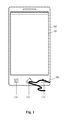
- FIG. 1 shows a mobile terminal in the related art.
- FIG. 2 shows a mobile terminal according to an exemplary embodiment of the present disclosure.
- FIG. 3 shows another mobile terminal according to an exemplary embodiment of the present disclosure.
- FIG. 4 shows yet another mobile terminal according to an exemplary embodiment of the present disclosure.
- FIG. 5A is a flow chart showing a method for processing a signal generated from touching a virtual key according to an exemplary embodiment of the present disclosure.
- FIG. 5B is a flow chart showing details of step 501 shown in FIG. 5A , according to an exemplary embodiment of the present disclosure.
- FIG. 6A is a block diagram showing a device for processing a signal generated from a virtual key according to an exemplary embodiment of the present disclosure.
- FIG. 6B is a block diagram showing details of the acquiring module shown in FIG. 6A according to an exemplary embodiment of the present disclosure.
- FIG. 7 is a block diagram showing a device according to an exemplary embodiment of the present disclosure.
- FIG. 1 shows a mobile terminal 100 including a touch screen 102 and left, middle, and right virtual keys 110 , 120 , and 130 disposed on the touch screen 102 .
- the mobile terminal 100 may process the incorrect selection of the key 120 or the key 130 .
- a touch panel consistent with embodiments of the present disclosure may be provided with an auxiliary touch-sensing area.
- the processing priority of triggers on the virtual keys may be adjusted by sensing a touch on the auxiliary touch-sensing area, which reduces the possibility of incorrect processing.
- the virtual keys may include virtual keys for a display interface, menu keys in a control area, a home key, and a back key. Further, the present disclosure contemplates all virtual keys that are capable of receiving input from a user by sensing a touch.
- FIG. 2 shows a mobile terminal 200 according to an example embodiment of the present disclosure.
- the mobile terminal 200 includes a touch panel 201 and a touch processing circuit 202 , such as a touch processing chip.
- the touch panel 201 includes a plurality of virtual keys 203 and an auxiliary sensing area 204 .
- the virtual keys 203 include a left key 203 - 1 , a middle key 203 - 2 , and a right key 203 - 3 .
- the present disclosure is not limited to a touch panel having three virtual keys. The number of virtual keys may be more or less than three.
- the auxiliary sensing area 204 is located at one side of the touch panel 201 . In the illustrated embodiment, the auxiliary sensing area 204 is disposed to the further right of the right key 203 - 3 .
- the touch processing circuit 202 is coupled with the touch panel 201 and configured to process triggers of the virtual keys 203 and the auxiliary sensing area 204 .
- the touch processing circuit 202 processes triggers of the virtual keys 203 - 2 and 203 - 3 and the auxiliary sensing area 204 when they are touched in a single track or gesture motion of a user.
- the touch processing circuit 202 may be a dedicated electronic chip for processing signals generated from touching the virtual keys 203 , or may be a general-purpose processing chip, such as a CPU of the mobile terminal 200 .
- the touch processing circuit 202 may be integrated with other electronic chips of the mobile terminal 200 . For illustrative purposes only, the touch processing circuit 202 is shown in FIG. 2 to be outside of the mobile terminal 200 .
- the auxiliary sensing area 204 is located on the right side of the virtual keys 203 . If the user uses his/her right hand to hold the mobile terminal 200 and wishes to touch the middle key 203 - 2 using a finger of his/her right hand, it is likely that all of the middle key 203 - 2 , the right key 203 - 3 , and the auxiliary sensing area 204 are touched and triggered.
- the touch processing circuit 202 receives three triggering signals respectively from the middle key 203 - 2 , the right key 203 - 3 , and the auxiliary sensing area 204 .
- the touch processing circuit 202 is configured to process the selection of a key that is touched and located the farthest from the auxiliary sensing area 204 .
- the auxiliary sensing area 204 processes the selection of the middle key 203 - 2 first because a distance between the middle key 203 - 2 and the auxiliary sensing area 204 is greater than a distance between the right key 203 - 3 and the auxiliary sensing area 204 .
- This configuration may reduce incorrect processing caused by incorrectly touching a key. Therefore, the selection of the virtual keys may be processed more accurately.
- FIG. 3 shows another exemplary mobile terminal 300 consistent with embodiments of the present disclosure.
- the mobile terminal 300 has the same configuration as the mobile terminal 200 , except that the touch panel 201 of mobile terminal 300 includes an interface area 2011 and a control area 2012 .
- the virtual keys 203 and the auxiliary sensing area 204 are located in the control area 2012 .
- the virtual keys 203 may include menu keys, a home key, a back key, etc.
- the auxiliary sensing area 204 may assist a selection in the interface area 2011 as well as in the control area 2012 of the touch panel 201 . For example, multiple locations in the interface areas 2011 are touched in one track of user's finger movement.
- the touch processing circuit 202 is configured to process the selection of a location in the interface area 2011 that is located the farthest from the auxiliary sensing area 204 . In one embodiment, processing by the touch processing circuit 202 is more effective if the triggering events come from the control area 2012 .
- FIG. 4 shows yet another exemplary mobile terminal 400 consistent with embodiments of the present disclosure.
- the configuration of the mobile terminal 400 is the same as that of the mobile terminal 300 , except that mobile terminal 400 includes two auxiliary sensing areas 204 - 1 and 204 - 2 .
- the auxiliary sensing areas 204 - 1 and 204 - 2 are located on the far left and far right in the control area 2012 .
- the auxiliary sensing area 204 - 1 is disposed to the left of the left key 203 - 1 and the auxiliary sensing area 204 - 2 is disposed to the right of the right key 203 - 3 .
- the auxiliary sensing areas 204 - 1 and 204 - 2 are disposed to be aligned with the virtual keys 203 .
- the mobile terminal 400 may be particularly useful since a user may be left-handed or right-handed. A user may be accustomed to hold a mobile terminal with his/her left hand, and another user may be accustomed to hold a mobile terminal with his/her right hand. For example, if the user holds the mobile terminal 400 with his/her left hand and touches the virtual keys using a finger of his/her left hand, the auxiliary sensing area 204 - 1 located on the left side of the control area 2012 is activated. When a finger of the user's left hand is intended to touch the middle key 203 - 2 , both the left key 203 - 1 and the auxiliary sensing area 204 - 1 located on the left side may be touched.
- the touch processing circuit 202 may ignore signals generated from touching the left key 203 - 1 and directly process the trigger of the middle key 203 - 2 . Such a configuration not only reduces the possibility of processing the incorrect triggering but also the time required to process the user selection.
- the auxiliary sensing area 204 - 2 located on the right side of the control area 2012 is activated.
- both the right key 203 - 3 and the auxiliary sensing area 204 - 2 located on the right side may be touched.
- the touch processing circuit 202 may ignore signals generated from touching the right key 203 - 3 and directly process the trigger of the middle key 203 - 2 .
- the priority of the virtual keys from high to low is: the right key 203 - 3 , the middle key 203 - 2 , and the left key 203 - 1 . That is, the signals generated from touching the virtual keys 203 are processed in an order according to how far a virtual key is located relative to the location of the auxiliary induction area 204 - 1 located at the left side. Thus, the triggering of a virtual key located farthest from the activated auxiliary sensing area takes priority of triggering of other keys located closer to the auxiliary sensing area.
- the priority of the virtual keys from high to low is: the left key 203 - 1 , the middle key 203 - 2 , and the right key 203 - 3 .
- the triggering of the left virtual key 203 - 1 located farthest from the activated auxiliary sensing area 204 - 2 takes priority of triggering of the other keys. In some embodiments, only the signal from the highest priority virtual key is processed. Signal(s) from the other low priority virtual keys may be ignored and not processed.
- the mobile device 400 thus may accommodate the users with different handedness.
- one or more auxiliary sensing areas may be added to the touch panel according to different needs, so as to process the selection on virtual keys more accurately.
- one or more auxiliary sensing areas may be added to the interface area 2011 to facilitate processing of selection from the interface area 2011 .
- the touch processing circuit 202 may include one or more comparators 202 - 1 .
- Each comparator 202 - 1 is configured to receive a touch sensing signal for one virtual key and determine whether an intensity of the touch sensing signal is greater than a predetermined intensity threshold. If the intensity of the touch sensing signal is greater than the predetermined intensity threshold, the comparator 202 - 1 determines that the touch corresponding to the touch sensing signal constitutes a trigger. If the intensity of the touch sensing signal is not greater than the intensity threshold, the comparator 202 - 1 determines that the touch corresponding to the touch sensing signal does not constitute a trigger of the virtual key and is ignored.
- the illustrated configuration may identify the trigger of the touch sensing signal more accurately via the use of the comparators, such that the incorrect processing caused by the false touching may be reduced.
- FIG. 5A is a flow chart showing a method 500 for processing signals from touching virtual keys according to an exemplary embodiment of the present disclosure.
- the method 500 may be performed by a mobile terminal, such as mobile terminals 200 , 300 , and 400 shown in FIGS. 2, 3, and 4 , respectively.
- the method 500 includes the following steps.
- step 501 triggers of at least two virtual keys and an auxiliary sensing area are simultaneously acquired.
- the triggers are acquired within a short, predetermined period of time.
- step 502 a trigger of a virtual key of the at least two virtual keys that is located farthest from the auxiliary sensing area is processed.
- the trigger from the other virtual key(s) is ignored and not processed.
- the step 501 includes steps 5011 - 5013 .
- a touch sensing signal corresponding to a virtual key is acquired.
- Step 5012 whether an intensity of the touch sensing signal is greater than a predetermined intensity threshold is determined.
- step 5013 if the intensity of the touch sensing signal acquired for the virtual key is greater than the predetermined intensity threshold, it is determined that the touch on the virtual key constitutes a trigger of the virtual key.
- FIG. 6A is a block diagram showing a device 600 for processing signals generated from touching virtual keys according to an example embodiment of the present disclosure.
- the device 600 may be a mobile terminal, such as the mobile terminal 200 , 300 , or 400 .
- the device 600 includes an acquiring module 601 and a processing module 602 .
- the acquiring module 601 is configured to simultaneously acquire triggers of at least two virtual keys and an auxiliary sensing area of a touch panel. For example, the triggers are acquired within a short, predetermined period of time.
- the processing module 602 is configured to process a trigger of a virtual key of the at least two virtual keys that is located farthest from the auxiliary sensing area. In some embodiments, the processing module 602 ignores and does not process the trigger from the other virtual key that is located closer to the auxiliary sensing area.
- the acquiring module 601 includes an acquiring sub-module 6011 , a determining sub-module 6012 , and a trigger-determining sub-module 6013 .
- the acquiring sub-module 6011 is configured to acquire a touch sensing signal for a virtual key.
- the determining sub-module 6012 is configured to determine whether an intensity of the touch sensing signal is greater than a predetermined intensity threshold.
- the trigger-determining sub-module 6013 is configured to determine that the touch on the virtual key constitutes a trigger of the virtual key if the intensity of the touch sensing signal obtained for the virtual key is greater than the predetermined intensity threshold.
- FIG. 7 is a block diagram showing a mobile terminal 700 according to an exemplary embodiment of the present disclosure.
- the mobile terminal 700 may be a mobile phone, a computer, a digital broadcast terminal, a messaging device, a gaming console, a tablet, a medical device, exercise equipment, a personal digital assistant, and the like.
- the device 700 may include one or more of the following components: a processing component 702 , a memory 704 , a power component 706 , a multimedia component 708 , an audio component 710 , an input/output (I/O) interface 712 , a sensor component 714 and a communication component 716 .
- a processing component 702 a memory 704 , a power component 706 , a multimedia component 708 , an audio component 710 , an input/output (I/O) interface 712 , a sensor component 714 and a communication component 716 .
- the processing component 702 typically controls overall operations of the device 700 , such as the operations associated with display, telephone calls, data communications, camera operations, and recording operations.
- the processing component 702 may include one or more processors 720 to execute instructions so as to perform all or a part of the steps in the above described methods.
- the processing component 702 may include one or more modules which facilitate the interaction between the processing component 702 and other components.
- the processing component 702 may include a multimedia module to facilitate the interaction between the multimedia component 708 and the processing component 702 .
- the memory 704 is configured to store various types of data to support the operation of the device 700 . Examples of such data include instructions for any applications or methods operated on the device 700 , contact data, phonebook data, messages, pictures, videos, etc.
- the memory 704 may be implemented using any type of volatile or non-volatile memory devices, or a combination thereof, such as a static random access memory (SRAM), an electrically erasable programmable read-only memory (EEPROM), an erasable programmable read-only memory (EPROM), a programmable read-only memory (PROM), a read-only memory (ROM), a magnetic memory, a flash memory, a magnetic or optical disk.
- SRAM static random access memory
- EEPROM electrically erasable programmable read-only memory
- EPROM erasable programmable read-only memory
- PROM programmable read-only memory
- ROM read-only memory
- magnetic memory a magnetic memory
- flash memory a flash memory
- magnetic or optical disk a magnetic
- the power component 706 is configured to provide power to various components of the device 700 .
- the power component 706 may include a power management system, one or more power sources, and other components associated with the generation, control, and distribution of power in the device 700 .
- the multimedia component 708 includes a screen configured to provide an output interface between the device 700 and the user.
- the screen may include a liquid crystal display (LCD) and a touch panel (TP). If the screen includes the touch panel, the screen may be implemented as a touch screen to receive input signals from the user.
- the touch panel includes one or more touch sensors to sense touches, swipes, and gestures on the touch panel. The touch sensors may not only sense a boundary of a touch or swipe action, but also sense a period of time and a pressure associated with the touch or swipe action.
- the multimedia component 708 includes a front camera and/or a rear camera. The front camera and the rear camera may receive an external multimedia datum when the device 700 is in an operation mode such as a photographing mode or a video mode. Each of the front camera and the rear camera may be a fixed optical lens system or have focus and optical zoom capability.
- the audio component 710 is configured to output and/or input audio signals.
- the audio component 710 includes a microphone (“MIC”) configured to receive an external audio signal when the device 700 is in an operation mode, such as a call mode, a recording mode, and a voice recognition mode.
- the received audio signal may be further stored in the memory 704 or transmitted via the communication component 716 .
- the audio component 710 further includes a loud speaker to output audio signals.
- the I/O interface 712 is configured to provide an interface between the processing component 702 and peripheral interface modules, such as a keyboard, a click wheel, keys, and the like.
- peripheral interface modules such as a keyboard, a click wheel, keys, and the like.
- the keys may include, but are not limited to, a home key, a volume key, a starting key, and a locking key.
- the sensor component 714 includes one or more sensors to provide status assessments of various aspects of the device 700 .
- the sensor component 714 may detect an on/off status of the device 700 , relative positioning of components (e.g., a display screen and a keypad) of the device 700 .
- the sensor component 714 may further detect a change in position of the device 700 or a component of the device 700 , a presence or absence of user contact with the device 700 , an orientation or an acceleration/deceleration of the device 700 , and a change in temperature of the device 700 .
- the sensor component 714 may include a proximity sensor configured to detect the presence of nearby objects without any physical contact.
- the sensor component 714 may further include a light sensor, such as a CMOS or CCD image sensor, for use in imaging applications.
- the sensor component 714 may also include an accelerometer sensor, a gyroscope sensor, a magnetic sensor, a pressure sensor, or a temperature sensor.
- the communication component 716 is configured to facilitate a wired or wireless communication between the device 700 and other terminals.
- the device 700 can access a wireless network based on a communication standard, such as WiFi, 2G, or 3G, or a combination thereof.
- the communication component 716 receives a broadcast signal or broadcast associated information from an external broadcast control system via a broadcast channel.
- the communication component 716 further includes a near field communication (NFC) module to facilitate short-range communications.
- the NFC module may be implemented based on a radio frequency identification (RFID) technology, an infrared data association (IrDA) technology, an ultra-wideband (UWB) technology, a Bluetooth (BT) technology, or other technologies.
- RFID radio frequency identification
- IrDA infrared data association
- UWB ultra-wideband
- BT Bluetooth
- the device 700 may be implemented with one or more electronic elements such as application specific integrated circuits (ASICs), digital signal processors (DSPs), digital signal processing devices (DSPDs), programmable logic devices (PLDs), field programmable gate arrays (FPGAs), controllers, micro-controllers, microprocessors, or other electronic components, for performing the above described methods.
- ASICs application specific integrated circuits
- DSPs digital signal processors
- DSPDs digital signal processing devices
- PLDs programmable logic devices
- FPGAs field programmable gate arrays
- controllers micro-controllers, microprocessors, or other electronic components, for performing the above described methods.
- non-transitory computer readable storage medium including instructions, such as the memory 704 including instructions executable by the processor 720 in the device 700 to perform the above-described methods.
- the non-transitory computer-readable storage medium may be a ROM, a RAM, a CD-ROM, a magnetic tape, a floppy disc, an optical data storage device, and the like.
- modules can each be implemented by hardware, or software, or a combination of hardware and software.
- One of ordinary skill in the art will also understand that multiple ones of the above described modules may be combined as one module, and each of the above described modules may be further divided into a plurality of sub-modules.
Landscapes
- Engineering & Computer Science (AREA)
- Theoretical Computer Science (AREA)
- General Engineering & Computer Science (AREA)
- Human Computer Interaction (AREA)
- Physics & Mathematics (AREA)
- General Physics & Mathematics (AREA)
- Computer Hardware Design (AREA)
- Computer Networks & Wireless Communication (AREA)
- Signal Processing (AREA)
- User Interface Of Digital Computer (AREA)
- Telephone Function (AREA)
- Position Input By Displaying (AREA)
- Input From Keyboards Or The Like (AREA)
Applications Claiming Priority (5)
| Application Number | Priority Date | Filing Date | Title |
|---|---|---|---|
| CN201510008097 | 2015-01-07 | ||
| CN201510008097.5 | 2015-01-07 | ||
| CN201510025615.4A CN104571709B (zh) | 2015-01-07 | 2015-01-19 | 移动终端及虚拟按键的处理方法 |
| CN201510025615.4 | 2015-01-19 | ||
| PCT/CN2015/093409 WO2016110146A1 (fr) | 2015-01-07 | 2015-10-30 | Terminal mobile et procédé de traitement de touches virtuelles |
Related Parent Applications (1)
| Application Number | Title | Priority Date | Filing Date |
|---|---|---|---|
| PCT/CN2015/093409 Continuation WO2016110146A1 (fr) | 2015-01-07 | 2015-10-30 | Terminal mobile et procédé de traitement de touches virtuelles |
Publications (1)
| Publication Number | Publication Date |
|---|---|
| US20160195992A1 true US20160195992A1 (en) | 2016-07-07 |
Family
ID=53087953
Family Applications (1)
| Application Number | Title | Priority Date | Filing Date |
|---|---|---|---|
| US15/065,142 Abandoned US20160195992A1 (en) | 2015-01-07 | 2016-03-09 | Mobile terminal and method for processing signals generated from touching virtual keys |
Country Status (8)
| Country | Link |
|---|---|
| US (1) | US20160195992A1 (fr) |
| EP (1) | EP3232301B1 (fr) |
| JP (1) | JP6229069B2 (fr) |
| KR (1) | KR101843447B1 (fr) |
| CN (1) | CN104571709B (fr) |
| MX (1) | MX358467B (fr) |
| RU (1) | RU2642375C2 (fr) |
| WO (1) | WO2016110146A1 (fr) |
Cited By (2)
| Publication number | Priority date | Publication date | Assignee | Title |
|---|---|---|---|---|
| WO2018105908A1 (fr) * | 2016-12-07 | 2018-06-14 | Lg Electronics Inc. | Terminal mobile et procédé de commande associé |
| US10739854B2 (en) | 2016-08-08 | 2020-08-11 | Beijing Xiaomi Mobile Software Co., Ltd. | Terminal and touch response method and device |
Families Citing this family (6)
| Publication number | Priority date | Publication date | Assignee | Title |
|---|---|---|---|---|
| CN104571709B (zh) * | 2015-01-07 | 2017-10-13 | 小米科技有限责任公司 | 移动终端及虚拟按键的处理方法 |
| CN106325724B (zh) * | 2015-06-24 | 2020-02-07 | 小米科技有限责任公司 | 触控响应方法及装置 |
| CN106325621B (zh) * | 2015-06-24 | 2019-05-14 | 小米科技有限责任公司 | 移动终端及触摸响应方法 |
| CN106775084B (zh) * | 2016-12-16 | 2019-04-16 | Oppo广东移动通信有限公司 | 一种触摸屏的防误触方法、装置及移动终端 |
| CN106774668A (zh) * | 2016-12-19 | 2017-05-31 | 北京小米移动软件有限公司 | 移动终端及触摸按键模块的控制方法 |
| KR20190021774A (ko) * | 2017-08-23 | 2019-03-06 | 삼성전자주식회사 | 터치 이벤트를 처리하는 전자 장치 및 그 제어 방법 |
Citations (7)
| Publication number | Priority date | Publication date | Assignee | Title |
|---|---|---|---|---|
| US20100013443A1 (en) * | 2008-07-15 | 2010-01-21 | David Hodge | Regulation control for variable frequency generators |
| US20100033353A1 (en) * | 2008-08-08 | 2010-02-11 | Chi Mei Communication Systems, Inc. | Electronic device and anti-misoperation method for key module |
| US20110057903A1 (en) * | 2009-09-07 | 2011-03-10 | Ikuo Yamano | Input Apparatus, Input Method and Program |
| CN103258171A (zh) * | 2012-02-20 | 2013-08-21 | 中国移动通信集团公司 | 防止移动终端触摸屏误触控的方法、装置以及移动终端 |
| US20130215060A1 (en) * | 2010-10-13 | 2013-08-22 | Nec Casio Mobile Communications Ltd. | Mobile terminal apparatus and display method for touch panel in mobile terminal apparatus |
| US20140145978A1 (en) * | 2012-11-23 | 2014-05-29 | Elan Microelectronics Corporation | Touch panel having virtual function button, method of manufacturing the same, and method of identifying touch conflict on the same |
| US20140240252A1 (en) * | 2013-02-25 | 2014-08-28 | Samsung Electronics Co., Ltd. | Electronic apparatus, method of controlling the same, and computer-readable recording medium |
Family Cites Families (11)
| Publication number | Priority date | Publication date | Assignee | Title |
|---|---|---|---|---|
| JPH08221202A (ja) * | 1995-02-15 | 1996-08-30 | Brother Ind Ltd | 情報表示装置 |
| JP4450783B2 (ja) * | 2005-09-28 | 2010-04-14 | 富士フイルム株式会社 | 撮影装置 |
| CN101715020A (zh) * | 2008-10-08 | 2010-05-26 | 深圳富泰宏精密工业有限公司 | 通话防误触方法及使用该方法的触控式手机 |
| JP5251463B2 (ja) * | 2008-12-03 | 2013-07-31 | ソニー株式会社 | 撮像装置 |
| KR20110014040A (ko) * | 2009-08-04 | 2011-02-10 | 엘지전자 주식회사 | 이동 단말기 및 그의 아이콘 충돌 제어방법 |
| CN102298479A (zh) * | 2010-06-28 | 2011-12-28 | 精元电脑股份有限公司 | 键盘装置的触控面积量化感测系统及方法 |
| CN102411441A (zh) * | 2010-09-21 | 2012-04-11 | 义隆电子股份有限公司 | 防止误触的触控板、防止方法及其应用方法 |
| CN102455806B (zh) * | 2010-10-15 | 2013-12-18 | 中国移动通信有限公司 | 一种带有触摸屏的终端运行方法及终端 |
| TWM432086U (en) * | 2011-10-31 | 2012-06-21 | Yi-Ta Chen | Proximity sensing device having keyboard function |
| KR102047865B1 (ko) * | 2013-01-04 | 2020-01-22 | 삼성전자주식회사 | 터치 키 입력 유효성을 판별하는 단말 장치와 이에 이용되는 터치 키 입력 유효성 판별 방법 및 장치 |
| CN104571709B (zh) * | 2015-01-07 | 2017-10-13 | 小米科技有限责任公司 | 移动终端及虚拟按键的处理方法 |
-
2015
- 2015-01-19 CN CN201510025615.4A patent/CN104571709B/zh active Active
- 2015-10-30 JP JP2016546092A patent/JP6229069B2/ja active Active
- 2015-10-30 MX MX2016007139A patent/MX358467B/es active IP Right Grant
- 2015-10-30 KR KR1020167016515A patent/KR101843447B1/ko active Active
- 2015-10-30 RU RU2016125116A patent/RU2642375C2/ru active
- 2015-10-30 EP EP15832786.6A patent/EP3232301B1/fr active Active
- 2015-10-30 WO PCT/CN2015/093409 patent/WO2016110146A1/fr not_active Ceased
-
2016
- 2016-03-09 US US15/065,142 patent/US20160195992A1/en not_active Abandoned
Patent Citations (7)
| Publication number | Priority date | Publication date | Assignee | Title |
|---|---|---|---|---|
| US20100013443A1 (en) * | 2008-07-15 | 2010-01-21 | David Hodge | Regulation control for variable frequency generators |
| US20100033353A1 (en) * | 2008-08-08 | 2010-02-11 | Chi Mei Communication Systems, Inc. | Electronic device and anti-misoperation method for key module |
| US20110057903A1 (en) * | 2009-09-07 | 2011-03-10 | Ikuo Yamano | Input Apparatus, Input Method and Program |
| US20130215060A1 (en) * | 2010-10-13 | 2013-08-22 | Nec Casio Mobile Communications Ltd. | Mobile terminal apparatus and display method for touch panel in mobile terminal apparatus |
| CN103258171A (zh) * | 2012-02-20 | 2013-08-21 | 中国移动通信集团公司 | 防止移动终端触摸屏误触控的方法、装置以及移动终端 |
| US20140145978A1 (en) * | 2012-11-23 | 2014-05-29 | Elan Microelectronics Corporation | Touch panel having virtual function button, method of manufacturing the same, and method of identifying touch conflict on the same |
| US20140240252A1 (en) * | 2013-02-25 | 2014-08-28 | Samsung Electronics Co., Ltd. | Electronic apparatus, method of controlling the same, and computer-readable recording medium |
Cited By (2)
| Publication number | Priority date | Publication date | Assignee | Title |
|---|---|---|---|---|
| US10739854B2 (en) | 2016-08-08 | 2020-08-11 | Beijing Xiaomi Mobile Software Co., Ltd. | Terminal and touch response method and device |
| WO2018105908A1 (fr) * | 2016-12-07 | 2018-06-14 | Lg Electronics Inc. | Terminal mobile et procédé de commande associé |
Also Published As
| Publication number | Publication date |
|---|---|
| KR20160097225A (ko) | 2016-08-17 |
| RU2016125116A (ru) | 2017-12-28 |
| JP6229069B2 (ja) | 2017-11-08 |
| JP2017506381A (ja) | 2017-03-02 |
| MX358467B (es) | 2018-08-22 |
| WO2016110146A1 (fr) | 2016-07-14 |
| EP3232301A4 (fr) | 2018-01-17 |
| CN104571709B (zh) | 2017-10-13 |
| MX2016007139A (es) | 2016-08-26 |
| EP3232301A1 (fr) | 2017-10-18 |
| EP3232301B1 (fr) | 2020-04-22 |
| RU2642375C2 (ru) | 2018-01-24 |
| KR101843447B1 (ko) | 2018-03-29 |
| CN104571709A (zh) | 2015-04-29 |
Similar Documents
| Publication | Publication Date | Title |
|---|---|---|
| US10721196B2 (en) | Method and device for message reading | |
| KR102045232B1 (ko) | 제스처 식별 방법, 장치, 프로그램 및 기록매체 | |
| US20160195992A1 (en) | Mobile terminal and method for processing signals generated from touching virtual keys | |
| EP3163404B1 (fr) | Procédé et dispositif de prévention de toucher accidentel d'un terminal à écran tactile | |
| US20160202834A1 (en) | Unlocking method and terminal device using the same | |
| US20170031557A1 (en) | Method and apparatus for adjusting shooting function | |
| US20170060320A1 (en) | Method for controlling a mobile terminal using a side touch panel | |
| CN106873834B (zh) | 识别按键被触发的方法及装置和移动终端 | |
| JP2017534086A (ja) | 指紋識別方法および装置 | |
| US20170344177A1 (en) | Method and device for determining operation mode of terminal | |
| EP3109741B1 (fr) | Procédé et dispositif de détermination de personnage | |
| EP3249505B1 (fr) | Procédé et dispositif électronique de commande d'état d'écran tactile | |
| CN109992946A (zh) | 解锁应用程序的方法、装置及计算机可读存储介质 | |
| US20190370584A1 (en) | Collecting fingerprints | |
| KR20170038178A (ko) | 지문 인식 방법, 장치, 이동 단말기, 프로그램 및 컴퓨터 판독가능한 기록매체 | |
| CN112905136A (zh) | 投屏控制方法、装置以及存储介质 | |
| WO2016095395A1 (fr) | Procédé et dispositif pour activer l'état d'utilisation d'un terminal mobile | |
| US10671827B2 (en) | Method and device for fingerprint verification | |
| CN112286392B (zh) | 触控屏的触控检测方法及装置、存储介质 | |
| US20220147244A1 (en) | Method and device for touch operation, and storage medium | |
| CN112445363A (zh) | 电子设备、电子设备的控制方法及装置、存储介质 | |
| US20160173668A1 (en) | Method and device for activating an operating state of a mobile terminal | |
| US12164763B1 (en) | Screen split control method and apparatus, and storage medium | |
| US11402994B2 (en) | Method and apparatus for calling shortcut function, and storage medium | |
| CN115373532B (zh) | 一种触控处理方法、装置及介质 |
Legal Events
| Date | Code | Title | Description |
|---|---|---|---|
| AS | Assignment |
Owner name: XIAOMI INC., CHINA Free format text: ASSIGNMENT OF ASSIGNORS INTEREST;ASSIGNORS:JIANG, ZHONGSHENG;YANG, KUN;TAO, JUN;REEL/FRAME:037936/0144 Effective date: 20160225 |
|
| STPP | Information on status: patent application and granting procedure in general |
Free format text: RESPONSE TO NON-FINAL OFFICE ACTION ENTERED AND FORWARDED TO EXAMINER |
|
| STPP | Information on status: patent application and granting procedure in general |
Free format text: FINAL REJECTION MAILED |
|
| STCB | Information on status: application discontinuation |
Free format text: ABANDONED -- FAILURE TO RESPOND TO AN OFFICE ACTION |