US20200123796A1 - Impregnated nest with additives - Google Patents
Impregnated nest with additives Download PDFInfo
- Publication number
- US20200123796A1 US20200123796A1 US16/655,611 US201916655611A US2020123796A1 US 20200123796 A1 US20200123796 A1 US 20200123796A1 US 201916655611 A US201916655611 A US 201916655611A US 2020123796 A1 US2020123796 A1 US 2020123796A1
- Authority
- US
- United States
- Prior art keywords
- nest
- textile reinforcement
- impregnation
- reinforcement
- thread
- Prior art date
- Legal status (The legal status is an assumption and is not a legal conclusion. Google has not performed a legal analysis and makes no representation as to the accuracy of the status listed.)
- Abandoned
Links
- 239000000654 additive Substances 0.000 title claims abstract description 18
- 230000002787 reinforcement Effects 0.000 claims abstract description 38
- 239000004753 textile Substances 0.000 claims abstract description 28
- 238000005470 impregnation Methods 0.000 claims abstract description 24
- 239000000463 material Substances 0.000 claims abstract description 15
- 238000004519 manufacturing process Methods 0.000 claims abstract description 10
- 230000000996 additive effect Effects 0.000 claims abstract description 8
- 238000000034 method Methods 0.000 claims description 21
- 239000011248 coating agent Substances 0.000 claims description 17
- 238000000576 coating method Methods 0.000 claims description 17
- 230000008569 process Effects 0.000 claims description 8
- 239000000178 monomer Substances 0.000 claims description 5
- 239000007858 starting material Substances 0.000 claims description 5
- 229920003229 poly(methyl methacrylate) Polymers 0.000 claims description 3
- 239000004926 polymethyl methacrylate Substances 0.000 claims description 2
- 238000010526 radical polymerization reaction Methods 0.000 claims description 2
- 239000007921 spray Substances 0.000 claims description 2
- OKTJSMMVPCPJKN-UHFFFAOYSA-N Carbon Chemical compound [C] OKTJSMMVPCPJKN-UHFFFAOYSA-N 0.000 description 20
- 229910052799 carbon Inorganic materials 0.000 description 17
- 239000004567 concrete Substances 0.000 description 12
- 238000005536 corrosion prevention Methods 0.000 description 10
- 239000002245 particle Substances 0.000 description 10
- 239000004570 mortar (masonry) Substances 0.000 description 7
- 230000008901 benefit Effects 0.000 description 6
- 229910000831 Steel Inorganic materials 0.000 description 5
- 238000005260 corrosion Methods 0.000 description 5
- 230000007797 corrosion Effects 0.000 description 5
- 230000008439 repair process Effects 0.000 description 5
- 150000003839 salts Chemical class 0.000 description 5
- 239000007787 solid Substances 0.000 description 5
- 239000010959 steel Substances 0.000 description 5
- 239000003822 epoxy resin Substances 0.000 description 4
- 229920000647 polyepoxide Polymers 0.000 description 4
- 239000011150 reinforced concrete Substances 0.000 description 4
- 229920003048 styrene butadiene rubber Polymers 0.000 description 4
- 229920000049 Carbon (fiber) Polymers 0.000 description 3
- 239000004917 carbon fiber Substances 0.000 description 3
- 239000004020 conductor Substances 0.000 description 3
- 239000000835 fiber Substances 0.000 description 3
- 238000009958 sewing Methods 0.000 description 3
- 230000007704 transition Effects 0.000 description 3
- 239000004568 cement Substances 0.000 description 2
- 230000007613 environmental effect Effects 0.000 description 2
- 239000010439 graphite Substances 0.000 description 2
- 229910002804 graphite Inorganic materials 0.000 description 2
- 150000008040 ionic compounds Chemical class 0.000 description 2
- 230000004048 modification Effects 0.000 description 2
- 238000012986 modification Methods 0.000 description 2
- 239000004014 plasticizer Substances 0.000 description 2
- 230000010287 polarization Effects 0.000 description 2
- 238000010008 shearing Methods 0.000 description 2
- 235000012239 silicon dioxide Nutrition 0.000 description 2
- 239000000126 substance Substances 0.000 description 2
- VEXZGXHMUGYJMC-UHFFFAOYSA-M Chloride anion Chemical compound [Cl-] VEXZGXHMUGYJMC-UHFFFAOYSA-M 0.000 description 1
- 241000446313 Lamella Species 0.000 description 1
- 229910001294 Reinforcing steel Inorganic materials 0.000 description 1
- XUIMIQQOPSSXEZ-UHFFFAOYSA-N Silicon Chemical compound [Si] XUIMIQQOPSSXEZ-UHFFFAOYSA-N 0.000 description 1
- 150000001252 acrylic acid derivatives Chemical class 0.000 description 1
- 230000004913 activation Effects 0.000 description 1
- 230000001154 acute effect Effects 0.000 description 1
- 239000010426 asphalt Substances 0.000 description 1
- 230000015572 biosynthetic process Effects 0.000 description 1
- 239000002041 carbon nanotube Substances 0.000 description 1
- 229910021393 carbon nanotube Inorganic materials 0.000 description 1
- 239000000919 ceramic Substances 0.000 description 1
- 238000006243 chemical reaction Methods 0.000 description 1
- 239000002131 composite material Substances 0.000 description 1
- 230000003247 decreasing effect Effects 0.000 description 1
- 230000002950 deficient Effects 0.000 description 1
- 230000000694 effects Effects 0.000 description 1
- 239000004744 fabric Substances 0.000 description 1
- 239000011521 glass Substances 0.000 description 1
- 239000003365 glass fiber Substances 0.000 description 1
- 239000010438 granite Substances 0.000 description 1
- LNEPOXFFQSENCJ-UHFFFAOYSA-N haloperidol Chemical compound C1CC(O)(C=2C=CC(Cl)=CC=2)CCN1CCCC(=O)C1=CC=C(F)C=C1 LNEPOXFFQSENCJ-UHFFFAOYSA-N 0.000 description 1
- 238000010348 incorporation Methods 0.000 description 1
- 239000010416 ion conductor Substances 0.000 description 1
- 230000007774 longterm Effects 0.000 description 1
- 229910052751 metal Inorganic materials 0.000 description 1
- 239000002184 metal Substances 0.000 description 1
- 239000002923 metal particle Substances 0.000 description 1
- 150000002739 metals Chemical class 0.000 description 1
- 239000000203 mixture Substances 0.000 description 1
- 230000035515 penetration Effects 0.000 description 1
- 229920000642 polymer Polymers 0.000 description 1
- 229920002635 polyurethane Polymers 0.000 description 1
- 239000004814 polyurethane Substances 0.000 description 1
- 239000000843 powder Substances 0.000 description 1
- 239000010453 quartz Substances 0.000 description 1
- 230000003014 reinforcing effect Effects 0.000 description 1
- 229910021487 silica fume Inorganic materials 0.000 description 1
- 229910052710 silicon Inorganic materials 0.000 description 1
- 239000010703 silicon Substances 0.000 description 1
- VYPSYNLAJGMNEJ-UHFFFAOYSA-N silicon dioxide Inorganic materials O=[Si]=O VYPSYNLAJGMNEJ-UHFFFAOYSA-N 0.000 description 1
- 230000007480 spreading Effects 0.000 description 1
- 238000003892 spreading Methods 0.000 description 1
- 230000003068 static effect Effects 0.000 description 1
- 239000013589 supplement Substances 0.000 description 1
- 239000000725 suspension Substances 0.000 description 1
- 239000002562 thickening agent Substances 0.000 description 1
- XLYOFNOQVPJJNP-UHFFFAOYSA-N water Substances O XLYOFNOQVPJJNP-UHFFFAOYSA-N 0.000 description 1
Images


Classifications
-
- E—FIXED CONSTRUCTIONS
- E04—BUILDING
- E04G—SCAFFOLDING; FORMS; SHUTTERING; BUILDING IMPLEMENTS OR AIDS, OR THEIR USE; HANDLING BUILDING MATERIALS ON THE SITE; REPAIRING, BREAKING-UP OR OTHER WORK ON EXISTING BUILDINGS
- E04G23/00—Working measures on existing buildings
- E04G23/02—Repairing, e.g. filling cracks; Restoring; Altering; Enlarging
- E04G23/0218—Increasing or restoring the load-bearing capacity of building construction elements
-
- E—FIXED CONSTRUCTIONS
- E04—BUILDING
- E04C—STRUCTURAL ELEMENTS; BUILDING MATERIALS
- E04C5/00—Reinforcing elements, e.g. for concrete; Auxiliary elements therefor
- E04C5/07—Reinforcing elements of material other than metal, e.g. of glass, of plastics, or not exclusively made of metal
-
- D—TEXTILES; PAPER
- D06—TREATMENT OF TEXTILES OR THE LIKE; LAUNDERING; FLEXIBLE MATERIALS NOT OTHERWISE PROVIDED FOR
- D06M—TREATMENT, NOT PROVIDED FOR ELSEWHERE IN CLASS D06, OF FIBRES, THREADS, YARNS, FABRICS, FEATHERS OR FIBROUS GOODS MADE FROM SUCH MATERIALS
- D06M15/00—Treating fibres, threads, yarns, fabrics, or fibrous goods made from such materials, with macromolecular compounds; Such treatment combined with mechanical treatment
- D06M15/19—Treating fibres, threads, yarns, fabrics, or fibrous goods made from such materials, with macromolecular compounds; Such treatment combined with mechanical treatment with synthetic macromolecular compounds
- D06M15/21—Macromolecular compounds obtained by reactions only involving carbon-to-carbon unsaturated bonds
- D06M15/263—Macromolecular compounds obtained by reactions only involving carbon-to-carbon unsaturated bonds of unsaturated carboxylic acids; Salts or esters thereof
Definitions
- the invention relates a method for producing a textile reinforcement from a nest, wherein an impregnation onto a thread or a string of the nest or onto the nest. Furthermore, the invention relates to such a textile reinforcement.
- FIG. 1 is a cross-sectional view of a thread of the nest
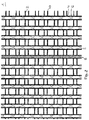
- FIG. 2 shows a nest with a primary anode sewn in.
- the contaminated covering concrete is removed, the reinforcing steel is cleaned and provided with a new corrosion prevention (e.g. based on polymer or cement).
- a new corrosion prevention e.g. based on polymer or cement.
- CCP cathodic corrosion prevention
- the present textile carbon reinforcements only fulfill the function of building reinforcement or of corrosion prevention. Attempts are, however, already made to impregnate the carbon fibers in epoxy resin or styrene-butadiene rubber, in order to obtain a stable nest. Nests with epoxy-resin impregnation possess a high bond strength, whereas nests with styrene-butadiene rubber are characterized in particular by their good processability, ductility and, in particular, sufficient polarization properties. However, at present, no impregnation is available which would possess a marked mechanical bond and at the same time a good processability/ductility as well as advantageous polarization properties.
- the invention is, therefore, based on the problem to provide a method for producing a textile reinforcement, and a textile reinforcement, which allows a mechanical reinforcement for freely weathered and trafficked buildings and is easy to lay.
- the textile reinforcement can, for example, also comprise glass. If within the framework of the mechanical reinforcement, a cathodic corrosion prevention shall be possible, the use of a carbon nest or of a nest formed at least partially by carbon fibers offers itself for this purpose.
- nest By nest, one understands within the framework of the present application a surface body consisting of several layers of substantially parallel stretched threads. The individual layers are placed one on top of the other and fixed to each other in the crossing points. If the threads of different layers are oriented in two different directions, a biaxial nest is given, if several layers with several orientations are provided, a multiaxial nest is given. Within the framework of the present application, one also understands, therefore, by the term “nest” a grid which also has a corresponding structure.
- This thread may consist of a number of carbon multifilaments forming together a thread or string.
- the invention starts out on the consideration that the provision of a sufficient mechanical reinforcement and possibly a sufficiently high conductivity for the cathodic corrosion prevention can be achieved by a suitable choice of an impregnation medium. It has turned out that the nest of the textile reinforcement can be adapted to the environmental conditions prevailing on the site of application in a particularly easy manner if the impregnation and, there, the basic medium used for the impregnation, is modified by admixing additives to increase the electrical, mechanical and thermal properties.
- the solidity of the mortar is particularly high in the area of the nest, while it is relatively low on the surface. This solidity gradient, decreasing in the direction facing away from the nest, allows a particularly flexible use of the nest.
- the basic material is, in a preferred embodiment, synthesized by radical polymerization from a monomer and a starter.
- the additive it is possible to admix the additive to the monomer and/or the starter already prior to the synthesization. This enables a modification of the impregnation already prior to the synthesization of the basic material.
- the starter is applied in a first process on the nest and the monomer is only applied afterwards, so that the synthesization of the basic material is effected directly on the nest.
- polymethylmethacrylate As a basic material for the impregnation because due to its low density, this basic material can be introduced particularly well into the interspaces of the nest, but also into the interspaces of the fiber strings.
- polymethylmethacrylates As basic material, it is, however, also imaginable in general to use the above-mentioned epoxy resins, styrene-butadiene rubbers and acrylates or polyurethanes.
- the surface of the impregnated carbon nest is, in a preferred embodiment, roughened and thus enlarged.
- additives are admixed to the coating medium in the form of particles which cause such an enlargement of the surface.
- granite, quartz powder, hydrated cement or conductive particles can be used.
- the enlarged surface results in a force and form-locking bond (reinforcing effect).
- ionic compounds, concrete admixtures, mixtures of salts and microsilica (as suspension or also in solid form) or pozzolanic reactives can be used. They can influence the kinetics of the hardening reaction, in order to increase, in case of using salts, the conductivity in the border area, on the one hand, and the solidity of the mortar in the environment of the nest, on the other hand.
- the impregnation or else the coating can be applied in particular by the immersion-bath method, an emulation process, a spray process or may also be painted or rolled on.
- the advantages achieved with the invention consist in particular in that through use of an impregnation of the nest, in case of a carbon nest, in particular of the carbon fibers, carbon threads or the entire nest containing carbon, which is adapted to the application range in question and modified by an additive, it is possible to influence the properties of the reinforcement, but also of the mortar, in the immediate environment of the reinforcement. In this way, it is possible to protect, in addition to plane surfaces, also curved, freely weathered and trafficked buildings permanently against steel corrosion and, at the same time, to mechanically reinforce them.
- the carbon nest used in this case being a thin-layer textile concrete, can provide a sufficient load-bearing capacity or a load increase even without the combination with a cathodic corrosion prevention.
- this may, therefore, reduce the load, increase the load-bearing capacity and enlarge the overhead clearances in parking blocks.
- the increase of solidity in the vicinity of the fibers leads to an improved performance without causing an excessive formation of cracks due to shrinkage. Furthermore, the admixture of plasticisers on the fiber can improve the penetration into the fabric.
- the essential advantages of the coating medium used lie in improving the electrical, chemical and mechanical properties of the entire system, in particular the high mechanical load-bearing or load-carrying capacity of the materials used (e.g. in case of static and dynamic tensile, adhesive-pull and shearing stresses), the long-term resistance against environmental influences, i.e. chemical inertia as well as thermal stability in a temperature range of ⁇ 20° C. to 80° C.
- the load-carrying behavior in a larger temperature range can also be improved.
- the advantages lie in the flexible processability and ductility (drapability) and, at the same time, sufficient rigidity for laying the textile reinforcement. Connections over corners and edges can be produced in a force-locking and electrically conductive manner.
- the rigidity enables an easy application in the laying process. Further advantages are the high bond strength between the concrete and the textile reinforcement (possibly due to the additional use of a coating) and the optimized conductivity in the “metallic” conductor (carbon, conductor of 1st order) and the good charge transition to the ionic conductor (concrete; conductor of 2nd order).
- FIG. 1 is a cross-sectional view of a thread 2 of a nest.
- the thread 2 comprises a multitude of individual carbon multifilaments 12 , each of which includes between several 1,000 and up to 100,000 individual filaments.
- the thread 2 is provided, in the exemplary embodiment according to FIG. 1 , with an impregnation 10 to which one or several additives 14 have been admixed in the impregnation process to improve the electrical, mechanical or also thermal properties.
- the thread 2 has been coated with a coating medium 16 .
- a sanding took place, so that the coating 16 serves as a carrier medium for the particles 18 .
- the sanding increases the surface of the thread 2 , which results in better bonding properties with the mortar.
- the nest 1 according to FIG. 2 comprises a multitude of threads 2 or strings, arranged in two planes.
- Each plane comprises a number of threads 2 , which are spaced from each other and substantially parallel to each other.
- Each of these threads 2 comprises a number of carbon multifilaments, which in the present exemplary embodiment have been glued together to form a long stretched string. It is, however, also imaginable to sew these carbon multifilaments together to a string or connect them with each other in another manner.
- the threads 2 of two planes lie substantially orthogonal to each other, so that a grid structure with rectangular interspaces is formed.
- the threads 2 are fixed in the crossing points 4 with a continuous sewing thread 6 , but they can also be glued together or connected with each other in another manner.
- the planes of the nest 1 need not necessarily be arranged orthogonal to each other, but can also be arranged, depending on the intended application, at another angle. It is also imaginable to provide more than two planes.
- a band-shaped primary anode 8 is sewn onto a thread 2 along the entire length, so that the anode system, contrary to a contacting in one single point, can be supplied with current over the entire length.
- the primary anode 8 is sewn into a thread 2 and is thus substantially completely surrounded by carbon multifilaments.
- an impregnation 10 and afterwards, a coating according to the above explanations is applied on the nest 1 .
- the recipe of the impregnation and the coating and by admixing corresponding additives it is possible in this case to provide a nest 1 for an anode system, which possesses optimum mechanical, electrical and thermal properties for the application and operating site in question.
Landscapes
- Engineering & Computer Science (AREA)
- Architecture (AREA)
- Chemical & Material Sciences (AREA)
- Chemical Kinetics & Catalysis (AREA)
- Civil Engineering (AREA)
- Structural Engineering (AREA)
- Electrochemistry (AREA)
- Mechanical Engineering (AREA)
- Textile Engineering (AREA)
- Chemical Or Physical Treatment Of Fibers (AREA)
- Working Measures On Existing Buildindgs (AREA)
- Reinforcement Elements For Buildings (AREA)
- Prevention Of Electric Corrosion (AREA)
Applications Claiming Priority (2)
| Application Number | Priority Date | Filing Date | Title |
|---|---|---|---|
| EP18200952.2A EP3640407B1 (de) | 2018-10-17 | 2018-10-17 | Getränktes gelege mit additiven |
| EP18200952.2 | 2018-10-17 |
Publications (1)
| Publication Number | Publication Date |
|---|---|
| US20200123796A1 true US20200123796A1 (en) | 2020-04-23 |
Family
ID=63878525
Family Applications (1)
| Application Number | Title | Priority Date | Filing Date |
|---|---|---|---|
| US16/655,611 Abandoned US20200123796A1 (en) | 2018-10-17 | 2019-10-17 | Impregnated nest with additives |
Country Status (2)
| Country | Link |
|---|---|
| US (1) | US20200123796A1 (de) |
| EP (1) | EP3640407B1 (de) |
Family Cites Families (3)
| Publication number | Priority date | Publication date | Assignee | Title |
|---|---|---|---|---|
| US5218810A (en) * | 1992-02-25 | 1993-06-15 | Hexcel Corporation | Fabric reinforced concrete columns |
| CA2192567C (en) * | 1994-06-10 | 2006-04-25 | Frederick P. Isley, Jr. | High strength fabric reinforced walls |
| RU177233U1 (ru) * | 2016-08-03 | 2018-02-14 | Общество с ограниченной ответственностью "Знаменский Композитный Завод" | Сетка армирующая полимерно-композитная преднапряженная с нанодобавками |
-
2018
- 2018-10-17 EP EP18200952.2A patent/EP3640407B1/de active Active
-
2019
- 2019-10-17 US US16/655,611 patent/US20200123796A1/en not_active Abandoned
Also Published As
| Publication number | Publication date |
|---|---|
| EP3640407B1 (de) | 2023-12-06 |
| EP3640407A1 (de) | 2020-04-22 |
| EP3640407C0 (de) | 2023-12-06 |
Similar Documents
| Publication | Publication Date | Title |
|---|---|---|
| Huang et al. | Properties and potential for application of steel reinforced polymer and steel reinforced grout composites | |
| Cusson et al. | Durability of repair materials | |
| Bernat-Maso et al. | Experimental assessment of Textile Reinforced Sprayed Mortar strengthening system for brickwork wallettes | |
| US20130199715A1 (en) | System for reinforcing structure using site-customized materials | |
| JP6992544B2 (ja) | 超高強度繊維補強コンクリート複合プレキャストpc床版 | |
| US7946088B1 (en) | System for reinforcing structure using site-customized materials | |
| KR100784493B1 (ko) | 경량 하이브리드 보수 모르타르 조성물 | |
| Shamseldein et al. | Tensile behavior of basalt textile-reinforced mortar (BTRM) | |
| KR101912667B1 (ko) | 환경 친화적인 현무암섬유를 가공한 내진 내력 보강재 및 내진 모르타르를 이용한 콘크리트 구조체 내진 보강공법 | |
| CN100487216C (zh) | 杆件及其生产方法 | |
| KR101151395B1 (ko) | 콘크리트 구조물용 고강도 보강재 | |
| KR100403076B1 (ko) | 시트부재를 이용한 콘크리트구조물의 보수/보강공법과 그 시트부재 | |
| JP2002129754A (ja) | コンクリート構造物の補強方法 | |
| US6824607B2 (en) | Cement-bound active substance | |
| US7682993B2 (en) | Insulated composite reinforcement material | |
| KR100313599B1 (ko) | 불투수성 교량표면 포장용 개질 콘크리트 | |
| US20200123666A1 (en) | Nest with primary anode | |
| Mahmood et al. | An overview of strengthening concrete members with textile reinforced mortar | |
| JP4763313B2 (ja) | 鉄筋コンクリート構造物の防食方法 | |
| KR102171659B1 (ko) | 하이테크 장비의 기초 구조물 및 이의 시공방법 | |
| EP3640407B1 (de) | Getränktes gelege mit additiven | |
| del Rey Castillo et al. | Tensile strength of straight Frp anchors in Rc structures | |
| Aljazaeri et al. | Strengthening of reinforced concrete one-way slabs for flexure using composite materials: evaluation of different composite materials | |
| JPH10249844A (ja) | 繊維補強ポリマーセメント組成物とその形成方法 | |
| Hussein | Effect of Different Factors and Loadings Conditions on the RC Element Strengthened with Externally Bonded (EB) and Near Surface Mounted (NSM) Methods (Doctoral dissertation, Faculty of Engineering, Zagazig University, Zagazig, Egypt) |
Legal Events
| Date | Code | Title | Description |
|---|---|---|---|
| STPP | Information on status: patent application and granting procedure in general |
Free format text: NON FINAL ACTION MAILED |
|
| STPP | Information on status: patent application and granting procedure in general |
Free format text: RESPONSE TO NON-FINAL OFFICE ACTION ENTERED AND FORWARDED TO EXAMINER |
|
| STPP | Information on status: patent application and granting procedure in general |
Free format text: NON FINAL ACTION MAILED |
|
| STCB | Information on status: application discontinuation |
Free format text: ABANDONED -- FAILURE TO RESPOND TO AN OFFICE ACTION |