US20210371663A1 - Bio-electrode composition, bio-electrode, and method for manufacturing bio-electrode - Google Patents
Bio-electrode composition, bio-electrode, and method for manufacturing bio-electrode Download PDFInfo
- Publication number
- US20210371663A1 US20210371663A1 US17/195,004 US202117195004A US2021371663A1 US 20210371663 A1 US20210371663 A1 US 20210371663A1 US 202117195004 A US202117195004 A US 202117195004A US 2021371663 A1 US2021371663 A1 US 2021371663A1
- Authority
- US
- United States
- Prior art keywords
- group
- bio
- electrode
- living body
- contact layer
- Prior art date
- Legal status (The legal status is an assumption and is not a legal conclusion. Google has not performed a legal analysis and makes no representation as to the accuracy of the status listed.)
- Granted
Links
- 239000000203 mixture Substances 0.000 title claims abstract description 192
- 238000000034 method Methods 0.000 title claims abstract description 30
- 238000004519 manufacturing process Methods 0.000 title claims abstract description 23
- 229920000831 ionic polymer Polymers 0.000 claims abstract description 71
- 239000002861 polymer material Substances 0.000 claims abstract description 36
- -1 fluorosulfonimide Chemical compound 0.000 claims abstract description 34
- NIXOWILDQLNWCW-UHFFFAOYSA-M Acrylate Chemical compound [O-]C(=O)C=C NIXOWILDQLNWCW-UHFFFAOYSA-M 0.000 claims abstract description 28
- 150000001875 compounds Chemical class 0.000 claims abstract description 27
- 229920000642 polymer Polymers 0.000 claims abstract description 27
- 150000003839 salts Chemical class 0.000 claims abstract description 24
- BQCADISMDOOEFD-UHFFFAOYSA-N Silver Chemical class [Ag] BQCADISMDOOEFD-UHFFFAOYSA-N 0.000 claims abstract description 21
- QGZKDVFQNNGYKY-UHFFFAOYSA-O Ammonium Chemical class [NH4+] QGZKDVFQNNGYKY-UHFFFAOYSA-O 0.000 claims abstract description 19
- PPBRXRYQALVLMV-UHFFFAOYSA-N Styrene Chemical compound C=CC1=CC=CC=C1 PPBRXRYQALVLMV-UHFFFAOYSA-N 0.000 claims abstract description 16
- 229910052709 silver Chemical class 0.000 claims abstract description 16
- 239000004332 silver Chemical class 0.000 claims abstract description 16
- 239000011591 potassium Chemical class 0.000 claims abstract description 10
- 229910052700 potassium Inorganic materials 0.000 claims abstract description 10
- 229910052708 sodium Inorganic materials 0.000 claims abstract description 10
- 239000011734 sodium Chemical class 0.000 claims abstract description 10
- DGAQECJNVWCQMB-PUAWFVPOSA-M Ilexoside XXIX Chemical class C[C@@H]1CC[C@@]2(CC[C@@]3(C(=CC[C@H]4[C@]3(CC[C@@H]5[C@@]4(CC[C@@H](C5(C)C)OS(=O)(=O)[O-])C)C)[C@@H]2[C@]1(C)O)C)C(=O)O[C@H]6[C@@H]([C@H]([C@@H]([C@H](O6)CO)O)O)O.[Na+] DGAQECJNVWCQMB-PUAWFVPOSA-M 0.000 claims abstract description 9
- ZLMJMSJWJFRBEC-UHFFFAOYSA-N Potassium Chemical class [K] ZLMJMSJWJFRBEC-UHFFFAOYSA-N 0.000 claims abstract description 9
- QYKIQEUNHZKYBP-UHFFFAOYSA-N Vinyl ether Chemical compound C=COC=C QYKIQEUNHZKYBP-UHFFFAOYSA-N 0.000 claims abstract description 7
- UQSQSQZYBQSBJZ-UHFFFAOYSA-N fluorosulfonic acid Chemical compound OS(F)(=O)=O UQSQSQZYBQSBJZ-UHFFFAOYSA-N 0.000 claims abstract description 7
- RQIMPDXRFCFBGC-UHFFFAOYSA-N n-(oxomethylidene)sulfamoyl fluoride Chemical compound FS(=O)(=O)N=C=O RQIMPDXRFCFBGC-UHFFFAOYSA-N 0.000 claims abstract description 7
- 239000000463 material Substances 0.000 claims description 69
- 229920005989 resin Polymers 0.000 claims description 69
- 239000011347 resin Substances 0.000 claims description 69
- 229920001296 polysiloxane Polymers 0.000 claims description 47
- 125000004432 carbon atom Chemical group C* 0.000 claims description 35
- BASFCYQUMIYNBI-UHFFFAOYSA-N platinum Chemical compound [Pt] BASFCYQUMIYNBI-UHFFFAOYSA-N 0.000 claims description 35
- 150000002500 ions Chemical class 0.000 claims description 32
- 239000000843 powder Substances 0.000 claims description 28
- XLYOFNOQVPJJNP-UHFFFAOYSA-N water Substances O XLYOFNOQVPJJNP-UHFFFAOYSA-N 0.000 claims description 28
- 125000001153 fluoro group Chemical group F* 0.000 claims description 27
- JOYRKODLDBILNP-UHFFFAOYSA-N urethane group Chemical group NC(=O)OCC JOYRKODLDBILNP-UHFFFAOYSA-N 0.000 claims description 25
- 125000004435 hydrogen atom Chemical group [H]* 0.000 claims description 24
- 125000004185 ester group Chemical group 0.000 claims description 23
- 229910052731 fluorine Inorganic materials 0.000 claims description 23
- RTAQQCXQSZGOHL-UHFFFAOYSA-N Titanium Chemical compound [Ti] RTAQQCXQSZGOHL-UHFFFAOYSA-N 0.000 claims description 21
- 125000001033 ether group Chemical group 0.000 claims description 21
- XUIMIQQOPSSXEZ-UHFFFAOYSA-N Silicon Chemical compound [Si] XUIMIQQOPSSXEZ-UHFFFAOYSA-N 0.000 claims description 20
- OKTJSMMVPCPJKN-UHFFFAOYSA-N Carbon Chemical compound [C] OKTJSMMVPCPJKN-UHFFFAOYSA-N 0.000 claims description 18
- 239000003960 organic solvent Substances 0.000 claims description 17
- 229910052697 platinum Inorganic materials 0.000 claims description 17
- 125000002887 hydroxy group Chemical group [H]O* 0.000 claims description 15
- WHXSMMKQMYFTQS-UHFFFAOYSA-N Lithium Chemical compound [Li] WHXSMMKQMYFTQS-UHFFFAOYSA-N 0.000 claims description 14
- PXHVJJICTQNCMI-UHFFFAOYSA-N Nickel Chemical compound [Ni] PXHVJJICTQNCMI-UHFFFAOYSA-N 0.000 claims description 14
- 229910052744 lithium Inorganic materials 0.000 claims description 14
- 125000002496 methyl group Chemical group [H]C([H])([H])* 0.000 claims description 13
- 125000002947 alkylene group Chemical group 0.000 claims description 12
- 125000004430 oxygen atom Chemical group O* 0.000 claims description 12
- 125000002023 trifluoromethyl group Chemical group FC(F)(F)* 0.000 claims description 12
- XEEYBQQBJWHFJM-UHFFFAOYSA-N Iron Chemical compound [Fe] XEEYBQQBJWHFJM-UHFFFAOYSA-N 0.000 claims description 10
- 229910052799 carbon Inorganic materials 0.000 claims description 10
- 125000003342 alkenyl group Chemical group 0.000 claims description 9
- 125000000217 alkyl group Chemical group 0.000 claims description 9
- 125000003368 amide group Chemical group 0.000 claims description 9
- 125000003277 amino group Chemical group 0.000 claims description 9
- 239000003575 carbonaceous material Substances 0.000 claims description 9
- 125000000843 phenylene group Chemical group C1(=C(C=CC=C1)*)* 0.000 claims description 9
- 229920002635 polyurethane Polymers 0.000 claims description 9
- 239000004814 polyurethane Substances 0.000 claims description 9
- 239000011863 silicon-based powder Substances 0.000 claims description 9
- RYGMFSIKBFXOCR-UHFFFAOYSA-N Copper Chemical compound [Cu] RYGMFSIKBFXOCR-UHFFFAOYSA-N 0.000 claims description 8
- 125000003118 aryl group Chemical group 0.000 claims description 8
- 229910052802 copper Inorganic materials 0.000 claims description 8
- 239000010949 copper Substances 0.000 claims description 8
- VYZAMTAEIAYCRO-UHFFFAOYSA-N Chromium Chemical compound [Cr] VYZAMTAEIAYCRO-UHFFFAOYSA-N 0.000 claims description 7
- NPYPAHLBTDXSSS-UHFFFAOYSA-N Potassium ion Chemical compound [K+] NPYPAHLBTDXSSS-UHFFFAOYSA-N 0.000 claims description 7
- FKNQFGJONOIPTF-UHFFFAOYSA-N Sodium cation Chemical compound [Na+] FKNQFGJONOIPTF-UHFFFAOYSA-N 0.000 claims description 7
- ATJFFYVFTNAWJD-UHFFFAOYSA-N Tin Chemical compound [Sn] ATJFFYVFTNAWJD-UHFFFAOYSA-N 0.000 claims description 7
- 229910052782 aluminium Inorganic materials 0.000 claims description 7
- XAGFODPZIPBFFR-UHFFFAOYSA-N aluminium Chemical compound [Al] XAGFODPZIPBFFR-UHFFFAOYSA-N 0.000 claims description 7
- 229910052804 chromium Inorganic materials 0.000 claims description 7
- 239000011651 chromium Substances 0.000 claims description 7
- PCHJSUWPFVWCPO-UHFFFAOYSA-N gold Chemical compound [Au] PCHJSUWPFVWCPO-UHFFFAOYSA-N 0.000 claims description 7
- 229910052737 gold Inorganic materials 0.000 claims description 7
- 239000010931 gold Substances 0.000 claims description 7
- 229910052759 nickel Inorganic materials 0.000 claims description 7
- 229910052757 nitrogen Inorganic materials 0.000 claims description 7
- 229920000058 polyacrylate Polymers 0.000 claims description 7
- 229910001414 potassium ion Inorganic materials 0.000 claims description 7
- 229910001415 sodium ion Inorganic materials 0.000 claims description 7
- 229910052718 tin Inorganic materials 0.000 claims description 7
- 239000011135 tin Substances 0.000 claims description 7
- 239000010936 titanium Substances 0.000 claims description 7
- 229910052719 titanium Inorganic materials 0.000 claims description 7
- WFKWXMTUELFFGS-UHFFFAOYSA-N tungsten Chemical compound [W] WFKWXMTUELFFGS-UHFFFAOYSA-N 0.000 claims description 7
- 229910052721 tungsten Inorganic materials 0.000 claims description 7
- 239000010937 tungsten Substances 0.000 claims description 7
- FOIXSVOLVBLSDH-UHFFFAOYSA-N Silver ion Chemical compound [Ag+] FOIXSVOLVBLSDH-UHFFFAOYSA-N 0.000 claims description 6
- 125000002915 carbonyl group Chemical group [*:2]C([*:1])=O 0.000 claims description 6
- 125000004122 cyclic group Chemical group 0.000 claims description 6
- 125000004957 naphthylene group Chemical group 0.000 claims description 6
- 125000004433 nitrogen atom Chemical group N* 0.000 claims description 6
- 229910001220 stainless steel Inorganic materials 0.000 claims description 6
- 239000010935 stainless steel Substances 0.000 claims description 6
- FYYHWMGAXLPEAU-UHFFFAOYSA-N Magnesium Chemical compound [Mg] FYYHWMGAXLPEAU-UHFFFAOYSA-N 0.000 claims description 5
- 229910021607 Silver chloride Inorganic materials 0.000 claims description 5
- 150000002430 hydrocarbons Chemical group 0.000 claims description 5
- 229910052742 iron Inorganic materials 0.000 claims description 5
- 229910052749 magnesium Inorganic materials 0.000 claims description 5
- 239000011777 magnesium Substances 0.000 claims description 5
- HKZLPVFGJNLROG-UHFFFAOYSA-M silver monochloride Chemical compound [Cl-].[Ag+] HKZLPVFGJNLROG-UHFFFAOYSA-M 0.000 claims description 5
- 239000011029 spinel Substances 0.000 claims description 5
- 229910052596 spinel Inorganic materials 0.000 claims description 5
- 125000003545 alkoxy group Chemical group 0.000 claims description 3
- 125000004453 alkoxycarbonyl group Chemical group 0.000 claims description 3
- 125000000304 alkynyl group Chemical group 0.000 claims description 3
- 150000001721 carbon Chemical group 0.000 claims description 3
- 125000005587 carbonate group Chemical group 0.000 claims description 3
- 125000006165 cyclic alkyl group Chemical group 0.000 claims description 3
- 125000000753 cycloalkyl group Chemical group 0.000 claims description 3
- 125000005843 halogen group Chemical group 0.000 claims description 3
- 125000001072 heteroaryl group Chemical group 0.000 claims description 3
- 125000000449 nitro group Chemical group [O-][N+](*)=O 0.000 claims description 3
- 125000000475 sulfinyl group Chemical group [*:2]S([*:1])=O 0.000 claims description 3
- 125000000472 sulfonyl group Chemical group *S(*)(=O)=O 0.000 claims description 3
- 229910052717 sulfur Inorganic materials 0.000 claims description 3
- 125000004434 sulfur atom Chemical group 0.000 claims description 3
- 230000002265 prevention Effects 0.000 abstract description 8
- 0 C*(C)C(*)(*)C(OCCOCCOC(NCCOC(C(*)=C)=O)=O)=O Chemical compound C*(C)C(*)(*)C(OCCOCCOC(NCCOC(C(*)=C)=O)=O)=O 0.000 description 132
- 239000010410 layer Substances 0.000 description 82
- 239000000243 solution Substances 0.000 description 79
- BGTOWKSIORTVQH-UHFFFAOYSA-N cyclopentanone Chemical compound O=C1CCCC1 BGTOWKSIORTVQH-UHFFFAOYSA-N 0.000 description 34
- 239000000178 monomer Substances 0.000 description 30
- VFHVQBAGLAREND-UHFFFAOYSA-N diphenylphosphoryl-(2,4,6-trimethylphenyl)methanone Chemical compound CC1=CC(C)=CC(C)=C1C(=O)P(=O)(C=1C=CC=CC=1)C1=CC=CC=C1 VFHVQBAGLAREND-UHFFFAOYSA-N 0.000 description 28
- 235000002639 sodium chloride Nutrition 0.000 description 25
- 239000010408 film Substances 0.000 description 23
- KPUWHANPEXNPJT-UHFFFAOYSA-N disiloxane Chemical class [SiH3]O[SiH3] KPUWHANPEXNPJT-UHFFFAOYSA-N 0.000 description 22
- YXFVVABEGXRONW-UHFFFAOYSA-N Toluene Chemical compound CC1=CC=CC=C1 YXFVVABEGXRONW-UHFFFAOYSA-N 0.000 description 21
- 229910052751 metal Inorganic materials 0.000 description 18
- 239000002184 metal Substances 0.000 description 18
- 150000003254 radicals Chemical class 0.000 description 18
- 239000000654 additive Substances 0.000 description 17
- 239000003054 catalyst Substances 0.000 description 17
- 230000000052 comparative effect Effects 0.000 description 16
- 239000002904 solvent Substances 0.000 description 16
- 230000000996 additive effect Effects 0.000 description 14
- LZCLXQDLBQLTDK-UHFFFAOYSA-N ethyl 2-hydroxypropanoate Chemical compound CCOC(=O)C(C)O LZCLXQDLBQLTDK-UHFFFAOYSA-N 0.000 description 14
- 238000004132 cross linking Methods 0.000 description 13
- VYPSYNLAJGMNEJ-UHFFFAOYSA-N Silicium dioxide Chemical group O=[Si]=O VYPSYNLAJGMNEJ-UHFFFAOYSA-N 0.000 description 12
- 229910052710 silicon Inorganic materials 0.000 description 11
- WYURNTSHIVDZCO-UHFFFAOYSA-N Tetrahydrofuran Chemical compound C1CCOC1 WYURNTSHIVDZCO-UHFFFAOYSA-N 0.000 description 10
- 238000001723 curing Methods 0.000 description 10
- OZAIFHULBGXAKX-UHFFFAOYSA-N 2-(2-cyanopropan-2-yldiazenyl)-2-methylpropanenitrile Chemical compound N#CC(C)(C)N=NC(C)(C)C#N OZAIFHULBGXAKX-UHFFFAOYSA-N 0.000 description 9
- 239000002253 acid Substances 0.000 description 9
- 230000001464 adherent effect Effects 0.000 description 9
- 239000000853 adhesive Substances 0.000 description 9
- 230000001070 adhesive effect Effects 0.000 description 9
- 238000006243 chemical reaction Methods 0.000 description 9
- 238000010438 heat treatment Methods 0.000 description 9
- 230000035945 sensitivity Effects 0.000 description 9
- 239000006229 carbon black Substances 0.000 description 8
- 125000003178 carboxy group Chemical group [H]OC(*)=O 0.000 description 8
- 239000011248 coating agent Substances 0.000 description 8
- 238000000576 coating method Methods 0.000 description 8
- CATSNJVOTSVZJV-UHFFFAOYSA-N heptan-2-one Chemical compound CCCCCC(C)=O CATSNJVOTSVZJV-UHFFFAOYSA-N 0.000 description 8
- 230000009467 reduction Effects 0.000 description 8
- 229920002050 silicone resin Polymers 0.000 description 8
- LFQSCWFLJHTTHZ-UHFFFAOYSA-N Ethanol Chemical compound CCO LFQSCWFLJHTTHZ-UHFFFAOYSA-N 0.000 description 7
- 229910004674 SiO0.5 Inorganic materials 0.000 description 7
- 229910021393 carbon nanotube Inorganic materials 0.000 description 7
- 239000002041 carbon nanotube Substances 0.000 description 7
- 229940126214 compound 3 Drugs 0.000 description 7
- 229940116333 ethyl lactate Drugs 0.000 description 7
- TVMXDCGIABBOFY-UHFFFAOYSA-N octane Chemical compound CCCCCCCC TVMXDCGIABBOFY-UHFFFAOYSA-N 0.000 description 7
- 125000003566 oxetanyl group Chemical group 0.000 description 7
- 238000006116 polymerization reaction Methods 0.000 description 7
- RTZKZFJDLAIYFH-UHFFFAOYSA-N Diethyl ether Chemical compound CCOCC RTZKZFJDLAIYFH-UHFFFAOYSA-N 0.000 description 6
- 239000004721 Polyphenylene oxide Substances 0.000 description 6
- WCUXLLCKKVVCTQ-UHFFFAOYSA-M Potassium chloride Chemical compound [Cl-].[K+] WCUXLLCKKVVCTQ-UHFFFAOYSA-M 0.000 description 6
- FAPWRFPIFSIZLT-UHFFFAOYSA-M Sodium chloride Chemical compound [Na+].[Cl-] FAPWRFPIFSIZLT-UHFFFAOYSA-M 0.000 description 6
- NIXOWILDQLNWCW-UHFFFAOYSA-N acrylic acid group Chemical group C(C=C)(=O)O NIXOWILDQLNWCW-UHFFFAOYSA-N 0.000 description 6
- 238000007259 addition reaction Methods 0.000 description 6
- 239000003431 cross linking reagent Substances 0.000 description 6
- DIOQZVSQGTUSAI-UHFFFAOYSA-N decane Chemical compound CCCCCCCCCC DIOQZVSQGTUSAI-UHFFFAOYSA-N 0.000 description 6
- 230000007423 decrease Effects 0.000 description 6
- 230000001747 exhibiting effect Effects 0.000 description 6
- IQPQWNKOIGAROB-UHFFFAOYSA-N isocyanate group Chemical group [N-]=C=O IQPQWNKOIGAROB-UHFFFAOYSA-N 0.000 description 6
- 229920000570 polyether Polymers 0.000 description 6
- 239000000758 substrate Substances 0.000 description 6
- 230000015572 biosynthetic process Effects 0.000 description 5
- 229920001940 conductive polymer Polymers 0.000 description 5
- 125000003700 epoxy group Chemical group 0.000 description 5
- 230000007794 irritation Effects 0.000 description 5
- 238000005259 measurement Methods 0.000 description 5
- 239000002245 particle Substances 0.000 description 5
- 239000002683 reaction inhibitor Substances 0.000 description 5
- YLQBMQCUIZJEEH-UHFFFAOYSA-N tetrahydrofuran Natural products C=1C=COC=1 YLQBMQCUIZJEEH-UHFFFAOYSA-N 0.000 description 5
- 238000011282 treatment Methods 0.000 description 5
- 125000000391 vinyl group Chemical group [H]C([*])=C([H])[H] 0.000 description 5
- 201000004624 Dermatitis Diseases 0.000 description 4
- 206010020751 Hypersensitivity Diseases 0.000 description 4
- 239000011575 calcium Substances 0.000 description 4
- 229910052791 calcium Inorganic materials 0.000 description 4
- 239000003792 electrolyte Substances 0.000 description 4
- 238000005227 gel permeation chromatography Methods 0.000 description 4
- 150000002596 lactones Chemical group 0.000 description 4
- BKIMMITUMNQMOS-UHFFFAOYSA-N nonane Chemical compound CCCCCCCCC BKIMMITUMNQMOS-UHFFFAOYSA-N 0.000 description 4
- 125000000466 oxiranyl group Chemical group 0.000 description 4
- 229920001721 polyimide Polymers 0.000 description 4
- 125000003396 thiol group Chemical group [H]S* 0.000 description 4
- ARXJGSRGQADJSQ-UHFFFAOYSA-N 1-methoxypropan-2-ol Chemical compound COCC(C)O ARXJGSRGQADJSQ-UHFFFAOYSA-N 0.000 description 3
- WGECXQBGLLYSFP-UHFFFAOYSA-N 2,3-dimethylpentane Chemical compound CCC(C)C(C)C WGECXQBGLLYSFP-UHFFFAOYSA-N 0.000 description 3
- 239000004925 Acrylic resin Substances 0.000 description 3
- UHOVQNZJYSORNB-UHFFFAOYSA-N Benzene Chemical compound C1=CC=CC=C1 UHOVQNZJYSORNB-UHFFFAOYSA-N 0.000 description 3
- YHZAAYHJSFMLOG-UHFFFAOYSA-M CC.CC(=O)[N-]S(=O)(=O)[Rf][Rf][Rf][Rf][Rf][Rf][Rf].CC([Rf])([Rf][Rf])C([Rf][Rf][Rf])([Rf][Rf][Rf][Rf])S(=O)(=O)[O-].CC1=CC=C(S(=O)(=O)[O-])C=C1.CS(=O)(=O)[N-]S(=O)(=O)[Rf][Rf][Rf][Rf][Rf][Rf].[CH3+].[CH3+].[CH3+].[CH3+] Chemical compound CC.CC(=O)[N-]S(=O)(=O)[Rf][Rf][Rf][Rf][Rf][Rf][Rf].CC([Rf])([Rf][Rf])C([Rf][Rf][Rf])([Rf][Rf][Rf][Rf])S(=O)(=O)[O-].CC1=CC=C(S(=O)(=O)[O-])C=C1.CS(=O)(=O)[N-]S(=O)(=O)[Rf][Rf][Rf][Rf][Rf][Rf].[CH3+].[CH3+].[CH3+].[CH3+] YHZAAYHJSFMLOG-UHFFFAOYSA-M 0.000 description 3
- OYPRJOBELJOOCE-UHFFFAOYSA-N Calcium Chemical compound [Ca] OYPRJOBELJOOCE-UHFFFAOYSA-N 0.000 description 3
- XTHFKEDIFFGKHM-UHFFFAOYSA-N Dimethoxyethane Chemical group COCCOC XTHFKEDIFFGKHM-UHFFFAOYSA-N 0.000 description 3
- IMNFDUFMRHMDMM-UHFFFAOYSA-N N-Heptane Chemical compound CCCCCCC IMNFDUFMRHMDMM-UHFFFAOYSA-N 0.000 description 3
- 208000026935 allergic disease Diseases 0.000 description 3
- 230000007815 allergy Effects 0.000 description 3
- 150000001244 carboxylic acid anhydrides Chemical group 0.000 description 3
- 239000007795 chemical reaction product Substances 0.000 description 3
- 239000002131 composite material Substances 0.000 description 3
- 229940125904 compound 1 Drugs 0.000 description 3
- 229940125782 compound 2 Drugs 0.000 description 3
- 239000004020 conductor Substances 0.000 description 3
- 230000000694 effects Effects 0.000 description 3
- 239000004744 fabric Substances 0.000 description 3
- PLZDDPSCZHRBOY-UHFFFAOYSA-N inaktives 3-Methyl-nonan Natural products CCCCCCC(C)CC PLZDDPSCZHRBOY-UHFFFAOYSA-N 0.000 description 3
- 150000008040 ionic compounds Chemical class 0.000 description 3
- UAEPNZWRGJTJPN-UHFFFAOYSA-N methylcyclohexane Chemical compound CC1CCCCC1 UAEPNZWRGJTJPN-UHFFFAOYSA-N 0.000 description 3
- 238000002156 mixing Methods 0.000 description 3
- 238000012544 monitoring process Methods 0.000 description 3
- 239000002070 nanowire Substances 0.000 description 3
- 229910000510 noble metal Inorganic materials 0.000 description 3
- JRZJOMJEPLMPRA-UHFFFAOYSA-N olefin Natural products CCCCCCCC=C JRZJOMJEPLMPRA-UHFFFAOYSA-N 0.000 description 3
- 229920006136 organohydrogenpolysiloxane Polymers 0.000 description 3
- QRMPKOFEUHIBNM-UHFFFAOYSA-N p-dimethylcyclohexane Natural products CC1CCC(C)CC1 QRMPKOFEUHIBNM-UHFFFAOYSA-N 0.000 description 3
- 230000035699 permeability Effects 0.000 description 3
- 239000009719 polyimide resin Substances 0.000 description 3
- 239000001103 potassium chloride Substances 0.000 description 3
- 235000011164 potassium chloride Nutrition 0.000 description 3
- 239000002243 precursor Substances 0.000 description 3
- 238000007650 screen-printing Methods 0.000 description 3
- 239000010703 silicon Substances 0.000 description 3
- 239000011780 sodium chloride Substances 0.000 description 3
- 159000000000 sodium salts Chemical class 0.000 description 3
- 241000894007 species Species 0.000 description 3
- BDHFUVZGWQCTTF-UHFFFAOYSA-M sulfonate Chemical compound [O-]S(=O)=O BDHFUVZGWQCTTF-UHFFFAOYSA-M 0.000 description 3
- 229920002803 thermoplastic polyurethane Polymers 0.000 description 3
- PYOLJOJPIPCRDP-UHFFFAOYSA-N 1,1,3-trimethylcyclohexane Chemical compound CC1CCCC(C)(C)C1 PYOLJOJPIPCRDP-UHFFFAOYSA-N 0.000 description 2
- FYGHSUNMUKGBRK-UHFFFAOYSA-N 1,2,3-trimethylbenzene Chemical compound CC1=CC=CC(C)=C1C FYGHSUNMUKGBRK-UHFFFAOYSA-N 0.000 description 2
- DQTVJLHNWPRPPH-UHFFFAOYSA-N 1,2,3-trimethylcyclohexane Chemical compound CC1CCCC(C)C1C DQTVJLHNWPRPPH-UHFFFAOYSA-N 0.000 description 2
- GWHJZXXIDMPWGX-UHFFFAOYSA-N 1,2,4-trimethylbenzene Chemical compound CC1=CC=C(C)C(C)=C1 GWHJZXXIDMPWGX-UHFFFAOYSA-N 0.000 description 2
- VCJPCEVERINRSG-UHFFFAOYSA-N 1,2,4-trimethylcyclohexane Chemical compound CC1CCC(C)C(C)C1 VCJPCEVERINRSG-UHFFFAOYSA-N 0.000 description 2
- KVNYFPKFSJIPBJ-UHFFFAOYSA-N 1,2-diethylbenzene Chemical compound CCC1=CC=CC=C1CC KVNYFPKFSJIPBJ-UHFFFAOYSA-N 0.000 description 2
- KVZJLSYJROEPSQ-UHFFFAOYSA-N 1,2-dimethylcyclohexane Chemical compound CC1CCCCC1C KVZJLSYJROEPSQ-UHFFFAOYSA-N 0.000 description 2
- AUHZEENZYGFFBQ-UHFFFAOYSA-N 1,3,5-trimethylbenzene Chemical compound CC1=CC(C)=CC(C)=C1 AUHZEENZYGFFBQ-UHFFFAOYSA-N 0.000 description 2
- ODNRTOSCFYDTKF-UHFFFAOYSA-N 1,3,5-trimethylcyclohexane Chemical compound CC1CC(C)CC(C)C1 ODNRTOSCFYDTKF-UHFFFAOYSA-N 0.000 description 2
- RMKJTYPFCFNTGQ-UHFFFAOYSA-N 1,3-dimethyl-5-propan-2-ylbenzene Chemical group CC(C)C1=CC(C)=CC(C)=C1 RMKJTYPFCFNTGQ-UHFFFAOYSA-N 0.000 description 2
- SGVUHPSBDNVHKL-UHFFFAOYSA-N 1,3-dimethylcyclohexane Chemical compound CC1CCCC(C)C1 SGVUHPSBDNVHKL-UHFFFAOYSA-N 0.000 description 2
- XWJBRBSPAODJER-UHFFFAOYSA-N 1,7-octadiene Chemical compound C=CCCCCC=C XWJBRBSPAODJER-UHFFFAOYSA-N 0.000 description 2
- ZGEGCLOFRBLKSE-UHFFFAOYSA-N 1-Heptene Chemical compound CCCCCC=C ZGEGCLOFRBLKSE-UHFFFAOYSA-N 0.000 description 2
- AFFLGGQVNFXPEV-UHFFFAOYSA-N 1-decene Chemical compound CCCCCCCCC=C AFFLGGQVNFXPEV-UHFFFAOYSA-N 0.000 description 2
- RRQYJINTUHWNHW-UHFFFAOYSA-N 1-ethoxy-2-(2-ethoxyethoxy)ethane Chemical compound CCOCCOCCOCC RRQYJINTUHWNHW-UHFFFAOYSA-N 0.000 description 2
- JOLQKTGDSGKSKJ-UHFFFAOYSA-N 1-ethoxypropan-2-ol Chemical compound CCOCC(C)O JOLQKTGDSGKSKJ-UHFFFAOYSA-N 0.000 description 2
- XARGIVYWQPXRTC-UHFFFAOYSA-N 1-ethyl-2-methylcyclohexane Chemical compound CCC1CCCCC1C XARGIVYWQPXRTC-UHFFFAOYSA-N 0.000 description 2
- UDDVMPHNQKRNNS-UHFFFAOYSA-N 1-ethyl-3-methylcyclohexane Chemical compound CCC1CCCC(C)C1 UDDVMPHNQKRNNS-UHFFFAOYSA-N 0.000 description 2
- CYISMTMRBPPERU-UHFFFAOYSA-N 1-ethyl-4-methylcyclohexane Chemical compound CCC1CCC(C)CC1 CYISMTMRBPPERU-UHFFFAOYSA-N 0.000 description 2
- CTMHWPIWNRWQEG-UHFFFAOYSA-N 1-methylcyclohexene Chemical compound CC1=CCCCC1 CTMHWPIWNRWQEG-UHFFFAOYSA-N 0.000 description 2
- KWKAKUADMBZCLK-UHFFFAOYSA-N 1-octene Chemical compound CCCCCCC=C KWKAKUADMBZCLK-UHFFFAOYSA-N 0.000 description 2
- JTIAYWZZZOZUTK-UHFFFAOYSA-N 1-tert-butyl-3-methylbenzene Chemical compound CC1=CC=CC(C(C)(C)C)=C1 JTIAYWZZZOZUTK-UHFFFAOYSA-N 0.000 description 2
- DCTOHCCUXLBQMS-UHFFFAOYSA-N 1-undecene Chemical compound CCCCCCCCCC=C DCTOHCCUXLBQMS-UHFFFAOYSA-N 0.000 description 2
- VKPSKYDESGTTFR-UHFFFAOYSA-N 2,2,4,6,6-pentamethylheptane Chemical compound CC(C)(C)CC(C)CC(C)(C)C VKPSKYDESGTTFR-UHFFFAOYSA-N 0.000 description 2
- FLTJDUOFAQWHDF-UHFFFAOYSA-N 2,2-dimethylhexane Chemical compound CCCCC(C)(C)C FLTJDUOFAQWHDF-UHFFFAOYSA-N 0.000 description 2
- WBRFDUJXCLCKPX-UHFFFAOYSA-N 2,3-dimethylheptane Chemical compound CCCCC(C)C(C)C WBRFDUJXCLCKPX-UHFFFAOYSA-N 0.000 description 2
- HDGQICNBXPAKLR-UHFFFAOYSA-N 2,4-dimethylhexane Chemical compound CCC(C)CC(C)C HDGQICNBXPAKLR-UHFFFAOYSA-N 0.000 description 2
- UWNADWZGEHDQAB-UHFFFAOYSA-N 2,5-dimethylhexane Chemical compound CC(C)CCC(C)C UWNADWZGEHDQAB-UHFFFAOYSA-N 0.000 description 2
- JVSWJIKNEAIKJW-UHFFFAOYSA-N 2-Methylheptane Chemical compound CCCCCC(C)C JVSWJIKNEAIKJW-UHFFFAOYSA-N 0.000 description 2
- QQZOPKMRPOGIEB-UHFFFAOYSA-N 2-Oxohexane Chemical compound CCCCC(C)=O QQZOPKMRPOGIEB-UHFFFAOYSA-N 0.000 description 2
- WYGWHHGCAGTUCH-UHFFFAOYSA-N 2-[(2-cyano-4-methylpentan-2-yl)diazenyl]-2,4-dimethylpentanenitrile Chemical compound CC(C)CC(C)(C#N)N=NC(C)(C#N)CC(C)C WYGWHHGCAGTUCH-UHFFFAOYSA-N 0.000 description 2
- SZNYYWIUQFZLLT-UHFFFAOYSA-N 2-methyl-1-(2-methylpropoxy)propane Chemical compound CC(C)COCC(C)C SZNYYWIUQFZLLT-UHFFFAOYSA-N 0.000 description 2
- GXDHCNNESPLIKD-UHFFFAOYSA-N 2-methylhexane Natural products CCCCC(C)C GXDHCNNESPLIKD-UHFFFAOYSA-N 0.000 description 2
- SGVYKUFIHHTIFL-UHFFFAOYSA-N 2-methylnonane Chemical compound CCCCCCCC(C)C SGVYKUFIHHTIFL-UHFFFAOYSA-N 0.000 description 2
- ZPVFWPFBNIEHGJ-UHFFFAOYSA-N 2-octanone Chemical compound CCCCCCC(C)=O ZPVFWPFBNIEHGJ-UHFFFAOYSA-N 0.000 description 2
- KUMXLFIBWFCMOJ-UHFFFAOYSA-N 3,3-dimethylhexane Chemical compound CCCC(C)(C)CC KUMXLFIBWFCMOJ-UHFFFAOYSA-N 0.000 description 2
- MAKRYGRRIKSDES-UHFFFAOYSA-N 3,4-dimethylheptane Chemical compound CCCC(C)C(C)CC MAKRYGRRIKSDES-UHFFFAOYSA-N 0.000 description 2
- RNTWWGNZUXGTAX-UHFFFAOYSA-N 3,4-dimethylhexane Chemical compound CCC(C)C(C)CC RNTWWGNZUXGTAX-UHFFFAOYSA-N 0.000 description 2
- DZJTZGHZAWTWGA-UHFFFAOYSA-N 3,5-dimethylheptane Chemical compound CCC(C)CC(C)CC DZJTZGHZAWTWGA-UHFFFAOYSA-N 0.000 description 2
- LAIUFBWHERIJIH-UHFFFAOYSA-N 3-Methylheptane Chemical compound CCCCC(C)CC LAIUFBWHERIJIH-UHFFFAOYSA-N 0.000 description 2
- DUPUVYJQZSLSJB-UHFFFAOYSA-N 3-ethyl-2-methylpentane Chemical compound CCC(CC)C(C)C DUPUVYJQZSLSJB-UHFFFAOYSA-N 0.000 description 2
- AORMDLNPRGXHHL-UHFFFAOYSA-N 3-ethylpentane Chemical compound CCC(CC)CC AORMDLNPRGXHHL-UHFFFAOYSA-N 0.000 description 2
- VLJXXKKOSFGPHI-UHFFFAOYSA-N 3-methylhexane Chemical compound CCCC(C)CC VLJXXKKOSFGPHI-UHFFFAOYSA-N 0.000 description 2
- SEEOMASXHIJCDV-UHFFFAOYSA-N 3-methyloctane Chemical compound CCCCCC(C)CC SEEOMASXHIJCDV-UHFFFAOYSA-N 0.000 description 2
- VVBLNCFGVYUYGU-UHFFFAOYSA-N 4,4'-Bis(dimethylamino)benzophenone Chemical compound C1=CC(N(C)C)=CC=C1C(=O)C1=CC=C(N(C)C)C=C1 VVBLNCFGVYUYGU-UHFFFAOYSA-N 0.000 description 2
- YEJRWHAVMIAJKC-UHFFFAOYSA-N 4-Butyrolactone Chemical compound O=C1CCCO1 YEJRWHAVMIAJKC-UHFFFAOYSA-N 0.000 description 2
- HCFAJYNVAYBARA-UHFFFAOYSA-N 4-heptanone Chemical compound CCCC(=O)CCC HCFAJYNVAYBARA-UHFFFAOYSA-N 0.000 description 2
- FSWCCQWDVGZMRD-UHFFFAOYSA-N 4-methylcyclohexene Chemical compound CC1CCC=CC1 FSWCCQWDVGZMRD-UHFFFAOYSA-N 0.000 description 2
- CHBAWFGIXDBEBT-UHFFFAOYSA-N 4-methylheptane Chemical compound CCCC(C)CCC CHBAWFGIXDBEBT-UHFFFAOYSA-N 0.000 description 2
- DOGIHOCMZJUJNR-UHFFFAOYSA-N 4-methyloctane Chemical compound CCCCC(C)CCC DOGIHOCMZJUJNR-UHFFFAOYSA-N 0.000 description 2
- WBZFUFAFFUEMEI-UHFFFAOYSA-M Acesulfame k Chemical compound [K+].CC1=CC(=O)[N-]S(=O)(=O)O1 WBZFUFAFFUEMEI-UHFFFAOYSA-M 0.000 description 2
- KWOLFJPFCHCOCG-UHFFFAOYSA-N Acetophenone Chemical compound CC(=O)C1=CC=CC=C1 KWOLFJPFCHCOCG-UHFFFAOYSA-N 0.000 description 2
- IJGRMHOSHXDMSA-UHFFFAOYSA-N Atomic nitrogen Chemical compound N#N IJGRMHOSHXDMSA-UHFFFAOYSA-N 0.000 description 2
- 239000004342 Benzoyl peroxide Substances 0.000 description 2
- OMPJBNCRMGITSC-UHFFFAOYSA-N Benzoylperoxide Chemical compound C=1C=CC=CC=1C(=O)OOC(=O)C1=CC=CC=C1 OMPJBNCRMGITSC-UHFFFAOYSA-N 0.000 description 2
- LSNNMFCWUKXFEE-UHFFFAOYSA-M Bisulfite Chemical compound OS([O-])=O LSNNMFCWUKXFEE-UHFFFAOYSA-M 0.000 description 2
- UXVMQQNJUSDDNG-UHFFFAOYSA-L Calcium chloride Chemical compound [Cl-].[Cl-].[Ca+2] UXVMQQNJUSDDNG-UHFFFAOYSA-L 0.000 description 2
- IFTRQJLVEBNKJK-UHFFFAOYSA-N Ethylcyclopentane Chemical compound CCC1CCCC1 IFTRQJLVEBNKJK-UHFFFAOYSA-N 0.000 description 2
- YCKRFDGAMUMZLT-UHFFFAOYSA-N Fluorine atom Chemical compound [F] YCKRFDGAMUMZLT-UHFFFAOYSA-N 0.000 description 2
- PEDCQBHIVMGVHV-UHFFFAOYSA-N Glycerine Chemical compound OCC(O)CO PEDCQBHIVMGVHV-UHFFFAOYSA-N 0.000 description 2
- LTEQMZWBSYACLV-UHFFFAOYSA-N Hexylbenzene Chemical compound CCCCCCC1=CC=CC=C1 LTEQMZWBSYACLV-UHFFFAOYSA-N 0.000 description 2
- GWESVXSMPKAFAS-UHFFFAOYSA-N Isopropylcyclohexane Chemical compound CC(C)C1CCCCC1 GWESVXSMPKAFAS-UHFFFAOYSA-N 0.000 description 2
- ZOKXTWBITQBERF-UHFFFAOYSA-N Molybdenum Chemical compound [Mo] ZOKXTWBITQBERF-UHFFFAOYSA-N 0.000 description 2
- PWATWSYOIIXYMA-UHFFFAOYSA-N Pentylbenzene Chemical compound CCCCCC1=CC=CC=C1 PWATWSYOIIXYMA-UHFFFAOYSA-N 0.000 description 2
- NBIIXXVUZAFLBC-UHFFFAOYSA-N Phosphoric acid Chemical compound OP(O)(O)=O NBIIXXVUZAFLBC-UHFFFAOYSA-N 0.000 description 2
- 239000004952 Polyamide Substances 0.000 description 2
- KJTLSVCANCCWHF-UHFFFAOYSA-N Ruthenium Chemical compound [Ru] KJTLSVCANCCWHF-UHFFFAOYSA-N 0.000 description 2
- 239000000619 acesulfame-K Substances 0.000 description 2
- 229920006223 adhesive resin Polymers 0.000 description 2
- RDOXTESZEPMUJZ-UHFFFAOYSA-N anisole Chemical compound COC1=CC=CC=C1 RDOXTESZEPMUJZ-UHFFFAOYSA-N 0.000 description 2
- 239000007864 aqueous solution Substances 0.000 description 2
- 125000003710 aryl alkyl group Chemical group 0.000 description 2
- ISAOCJYIOMOJEB-UHFFFAOYSA-N benzoin Chemical compound C=1C=CC=CC=1C(O)C(=O)C1=CC=CC=C1 ISAOCJYIOMOJEB-UHFFFAOYSA-N 0.000 description 2
- 235000019400 benzoyl peroxide Nutrition 0.000 description 2
- UAHWPYUMFXYFJY-UHFFFAOYSA-N beta-myrcene Chemical compound CC(C)=CCCC(=C)C=C UAHWPYUMFXYFJY-UHFFFAOYSA-N 0.000 description 2
- OCKPCBLVNKHBMX-UHFFFAOYSA-N butylbenzene Chemical compound CCCCC1=CC=CC=C1 OCKPCBLVNKHBMX-UHFFFAOYSA-N 0.000 description 2
- GGBJHURWWWLEQH-UHFFFAOYSA-N butylcyclohexane Chemical compound CCCCC1CCCCC1 GGBJHURWWWLEQH-UHFFFAOYSA-N 0.000 description 2
- 239000001110 calcium chloride Substances 0.000 description 2
- 229910001628 calcium chloride Inorganic materials 0.000 description 2
- 229960002713 calcium chloride Drugs 0.000 description 2
- 235000011148 calcium chloride Nutrition 0.000 description 2
- 159000000007 calcium salts Chemical class 0.000 description 2
- JHRWWRDRBPCWTF-OLQVQODUSA-N captafol Chemical compound C1C=CC[C@H]2C(=O)N(SC(Cl)(Cl)C(Cl)Cl)C(=O)[C@H]21 JHRWWRDRBPCWTF-OLQVQODUSA-N 0.000 description 2
- 229910052681 coesite Inorganic materials 0.000 description 2
- 238000007334 copolymerization reaction Methods 0.000 description 2
- 229910052906 cristobalite Inorganic materials 0.000 description 2
- RWGFKTVRMDUZSP-UHFFFAOYSA-N cumene Chemical compound CC(C)C1=CC=CC=C1 RWGFKTVRMDUZSP-UHFFFAOYSA-N 0.000 description 2
- DMEGYFMYUHOHGS-UHFFFAOYSA-N cycloheptane Chemical compound C1CCCCCC1 DMEGYFMYUHOHGS-UHFFFAOYSA-N 0.000 description 2
- JHIVVAPYMSGYDF-UHFFFAOYSA-N cyclohexanone Chemical compound O=C1CCCCC1 JHIVVAPYMSGYDF-UHFFFAOYSA-N 0.000 description 2
- NNBZCPXTIHJBJL-UHFFFAOYSA-N decalin Chemical compound C1CCCC2CCCCC21 NNBZCPXTIHJBJL-UHFFFAOYSA-N 0.000 description 2
- 238000011161 development Methods 0.000 description 2
- 229940019778 diethylene glycol diethyl ether Drugs 0.000 description 2
- 239000004205 dimethyl polysiloxane Substances 0.000 description 2
- 239000003814 drug Substances 0.000 description 2
- 238000001035 drying Methods 0.000 description 2
- 230000005611 electricity Effects 0.000 description 2
- 239000007772 electrode material Substances 0.000 description 2
- 238000010828 elution Methods 0.000 description 2
- IIEWJVIFRVWJOD-UHFFFAOYSA-N ethylcyclohexane Chemical compound CCC1CCCCC1 IIEWJVIFRVWJOD-UHFFFAOYSA-N 0.000 description 2
- 238000011156 evaluation Methods 0.000 description 2
- 239000000835 fiber Substances 0.000 description 2
- 239000011737 fluorine Substances 0.000 description 2
- KWIUHFFTVRNATP-UHFFFAOYSA-N glycine betaine Chemical compound C[N+](C)(C)CC([O-])=O KWIUHFFTVRNATP-UHFFFAOYSA-N 0.000 description 2
- NGAZZOYFWWSOGK-UHFFFAOYSA-N heptan-3-one Chemical compound CCCCC(=O)CC NGAZZOYFWWSOGK-UHFFFAOYSA-N 0.000 description 2
- 230000002209 hydrophobic effect Effects 0.000 description 2
- ZUBZATZOEPUUQF-UHFFFAOYSA-N isononane Chemical compound CCCCCCC(C)C ZUBZATZOEPUUQF-UHFFFAOYSA-N 0.000 description 2
- XMGQYMWWDOXHJM-UHFFFAOYSA-N limonene Chemical compound CC(=C)C1CCC(C)=CC1 XMGQYMWWDOXHJM-UHFFFAOYSA-N 0.000 description 2
- 125000005641 methacryl group Chemical group 0.000 description 2
- ZQMHJBXHRFJKOT-UHFFFAOYSA-N methyl 2-[(1-methoxy-2-methyl-1-oxopropan-2-yl)diazenyl]-2-methylpropanoate Chemical compound COC(=O)C(C)(C)N=NC(C)(C)C(=O)OC ZQMHJBXHRFJKOT-UHFFFAOYSA-N 0.000 description 2
- 239000003595 mist Substances 0.000 description 2
- 229910052750 molybdenum Inorganic materials 0.000 description 2
- 239000011733 molybdenum Substances 0.000 description 2
- 239000012299 nitrogen atmosphere Substances 0.000 description 2
- VJHGSLHHMIELQD-UHFFFAOYSA-N nona-1,8-diene Chemical compound C=CCCCCCC=C VJHGSLHHMIELQD-UHFFFAOYSA-N 0.000 description 2
- VKCYHJWLYTUGCC-UHFFFAOYSA-N nonan-2-one Chemical compound CCCCCCCC(C)=O VKCYHJWLYTUGCC-UHFFFAOYSA-N 0.000 description 2
- ISWSIDIOOBJBQZ-UHFFFAOYSA-N phenol group Chemical group C1(=CC=CC=C1)O ISWSIDIOOBJBQZ-UHFFFAOYSA-N 0.000 description 2
- 229920005575 poly(amic acid) Polymers 0.000 description 2
- 229920000435 poly(dimethylsiloxane) Polymers 0.000 description 2
- 229920001467 poly(styrenesulfonates) Polymers 0.000 description 2
- 229920002647 polyamide Polymers 0.000 description 2
- 229920006122 polyamide resin Polymers 0.000 description 2
- 229920000139 polyethylene terephthalate Polymers 0.000 description 2
- 239000005020 polyethylene terephthalate Substances 0.000 description 2
- 239000003505 polymerization initiator Substances 0.000 description 2
- 229920002578 polythiourethane polymer Polymers 0.000 description 2
- 229920005749 polyurethane resin Polymers 0.000 description 2
- 229960002816 potassium chloride Drugs 0.000 description 2
- 159000000001 potassium salts Chemical class 0.000 description 2
- 238000002360 preparation method Methods 0.000 description 2
- 238000007639 printing Methods 0.000 description 2
- 239000000047 product Substances 0.000 description 2
- TVSBRLGQVHJIKT-UHFFFAOYSA-N propan-2-ylcyclopentane Chemical compound CC(C)C1CCCC1 TVSBRLGQVHJIKT-UHFFFAOYSA-N 0.000 description 2
- DEDZSLCZHWTGOR-UHFFFAOYSA-N propylcyclohexane Chemical compound CCCC1CCCCC1 DEDZSLCZHWTGOR-UHFFFAOYSA-N 0.000 description 2
- 229910052707 ruthenium Inorganic materials 0.000 description 2
- CVHZOJJKTDOEJC-UHFFFAOYSA-N saccharin Chemical compound C1=CC=C2C(=O)NS(=O)(=O)C2=C1 CVHZOJJKTDOEJC-UHFFFAOYSA-N 0.000 description 2
- 229940081974 saccharin Drugs 0.000 description 2
- 235000019204 saccharin Nutrition 0.000 description 2
- 239000000901 saccharin and its Na,K and Ca salt Substances 0.000 description 2
- 125000005372 silanol group Chemical group 0.000 description 2
- 239000000377 silicon dioxide Substances 0.000 description 2
- LIVNPJMFVYWSIS-UHFFFAOYSA-N silicon monoxide Chemical compound [Si-]#[O+] LIVNPJMFVYWSIS-UHFFFAOYSA-N 0.000 description 2
- 239000013464 silicone adhesive Substances 0.000 description 2
- 229960002668 sodium chloride Drugs 0.000 description 2
- 229910052682 stishovite Inorganic materials 0.000 description 2
- 150000005846 sugar alcohols Polymers 0.000 description 2
- CIHOLLKRGTVIJN-UHFFFAOYSA-N tert‐butyl hydroperoxide Chemical compound CC(C)(C)OO CIHOLLKRGTVIJN-UHFFFAOYSA-N 0.000 description 2
- 229910052905 tridymite Inorganic materials 0.000 description 2
- 239000004520 water soluble gel Substances 0.000 description 2
- JXPOLSKBTUYKJB-UHFFFAOYSA-N xi-2,3-Dimethylhexane Chemical compound CCCC(C)C(C)C JXPOLSKBTUYKJB-UHFFFAOYSA-N 0.000 description 2
- OGLDWXZKYODSOB-UHFFFAOYSA-N α-phellandrene Chemical compound CC(C)C1CC=C(C)C=C1 OGLDWXZKYODSOB-UHFFFAOYSA-N 0.000 description 2
- KJDMMCYMVUTZSN-UHFFFAOYSA-N (1-ethynylcyclohexyl)oxy-trimethylsilane Chemical compound C[Si](C)(C)OC1(C#C)CCCCC1 KJDMMCYMVUTZSN-UHFFFAOYSA-N 0.000 description 1
- DLDWUFCUUXXYTB-UHFFFAOYSA-N (2-oxo-1,2-diphenylethyl) 4-methylbenzenesulfonate Chemical compound C1=CC(C)=CC=C1S(=O)(=O)OC(C=1C=CC=CC=1)C(=O)C1=CC=CC=C1 DLDWUFCUUXXYTB-UHFFFAOYSA-N 0.000 description 1
- YPINLRNGSGGJJT-JXMROGBWSA-N (2e)-2-hydroxyimino-1-phenylpropan-1-one Chemical compound O\N=C(/C)C(=O)C1=CC=CC=C1 YPINLRNGSGGJJT-JXMROGBWSA-N 0.000 description 1
- NPENBPVOAXERED-UHFFFAOYSA-N (4-benzoylphenyl)-phenylmethanone Chemical compound C=1C=C(C(=O)C=2C=CC=CC=2)C=CC=1C(=O)C1=CC=CC=C1 NPENBPVOAXERED-UHFFFAOYSA-N 0.000 description 1
- GQVMHMFBVWSSPF-SOYUKNQTSA-N (4E,6E)-2,6-dimethylocta-2,4,6-triene Chemical compound C\C=C(/C)\C=C\C=C(C)C GQVMHMFBVWSSPF-SOYUKNQTSA-N 0.000 description 1
- GMGYODAMPOELNZ-MDZDMXLPSA-N (5e)-deca-1,5,9-triene Chemical compound C=CCC\C=C\CCC=C GMGYODAMPOELNZ-MDZDMXLPSA-N 0.000 description 1
- YCTDZYMMFQCTEO-FNORWQNLSA-N (E)-3-octene Chemical compound CCCC\C=C\CC YCTDZYMMFQCTEO-FNORWQNLSA-N 0.000 description 1
- ULPMRIXXHGUZFA-UHFFFAOYSA-N (R)-4-Methyl-3-hexanone Natural products CCC(C)C(=O)CC ULPMRIXXHGUZFA-UHFFFAOYSA-N 0.000 description 1
- BQOCYCICSYUPRF-BQYQJAHWSA-N (e)-2,2-dimethylhept-3-ene Chemical compound CCC\C=C\C(C)(C)C BQOCYCICSYUPRF-BQYQJAHWSA-N 0.000 description 1
- JPLZSSHKQZJYTJ-VOTSOKGWSA-N (e)-2,2-dimethylhex-3-ene Chemical compound CC\C=C\C(C)(C)C JPLZSSHKQZJYTJ-VOTSOKGWSA-N 0.000 description 1
- DGWZUHXBELPHMZ-VQHVLOKHSA-N (e)-2,3-dimethylhept-3-ene Chemical compound CCC\C=C(/C)C(C)C DGWZUHXBELPHMZ-VQHVLOKHSA-N 0.000 description 1
- KDISTZUHDQPXDE-AATRIKPKSA-N (e)-2,6-dimethylhept-3-ene Chemical compound CC(C)C\C=C\C(C)C KDISTZUHDQPXDE-AATRIKPKSA-N 0.000 description 1
- GVRWIAHBVAYKIZ-FNORWQNLSA-N (e)-dec-3-ene Chemical compound CCCCCC\C=C\CC GVRWIAHBVAYKIZ-FNORWQNLSA-N 0.000 description 1
- SOVOPSCRHKEUNJ-VQHVLOKHSA-N (e)-dec-4-ene Chemical compound CCCCC\C=C\CCC SOVOPSCRHKEUNJ-VQHVLOKHSA-N 0.000 description 1
- IICQZTQZQSBHBY-HWKANZROSA-N (e)-non-2-ene Chemical compound CCCCCC\C=C\C IICQZTQZQSBHBY-HWKANZROSA-N 0.000 description 1
- WOJSMJIXPQLESQ-UHFFFAOYSA-N 1,1,3,5-tetramethylcyclohexane Chemical compound CC1CC(C)CC(C)(C)C1 WOJSMJIXPQLESQ-UHFFFAOYSA-N 0.000 description 1
- UIWORXHEVNIOJG-UHFFFAOYSA-N 1,1,4-trimethylcyclohexane Chemical compound CC1CCC(C)(C)CC1 UIWORXHEVNIOJG-UHFFFAOYSA-N 0.000 description 1
- VOSLXTGMYNYCPW-UHFFFAOYSA-N 1,10-Undecadiene Chemical compound C=CCCCCCCCC=C VOSLXTGMYNYCPW-UHFFFAOYSA-N 0.000 description 1
- KTRQRAQRHBLCSQ-UHFFFAOYSA-N 1,2,4-tris(ethenyl)cyclohexane Chemical compound C=CC1CCC(C=C)C(C=C)C1 KTRQRAQRHBLCSQ-UHFFFAOYSA-N 0.000 description 1
- OKIRBHVFJGXOIS-UHFFFAOYSA-N 1,2-di(propan-2-yl)benzene Chemical compound CC(C)C1=CC=CC=C1C(C)C OKIRBHVFJGXOIS-UHFFFAOYSA-N 0.000 description 1
- LEEANUDEDHYDTG-UHFFFAOYSA-N 1,2-dimethoxypropane Chemical compound COCC(C)OC LEEANUDEDHYDTG-UHFFFAOYSA-N 0.000 description 1
- MSAHTMIQULFMRG-UHFFFAOYSA-N 1,2-diphenyl-2-propan-2-yloxyethanone Chemical compound C=1C=CC=CC=1C(OC(C)C)C(=O)C1=CC=CC=C1 MSAHTMIQULFMRG-UHFFFAOYSA-N 0.000 description 1
- VPHBYBUYWBZLEX-UHFFFAOYSA-N 1,2-dipropylbenzene Chemical compound CCCC1=CC=CC=C1CCC VPHBYBUYWBZLEX-UHFFFAOYSA-N 0.000 description 1
- WJYMPXJVHNDZHD-UHFFFAOYSA-N 1,3,5-triethylbenzene Chemical compound CCC1=CC(CC)=CC(CC)=C1 WJYMPXJVHNDZHD-UHFFFAOYSA-N 0.000 description 1
- UNEATYXSUBPPKP-UHFFFAOYSA-N 1,3-Diisopropylbenzene Chemical compound CC(C)C1=CC=CC(C(C)C)=C1 UNEATYXSUBPPKP-UHFFFAOYSA-N 0.000 description 1
- CWNOIUTVJRWADX-UHFFFAOYSA-N 1,3-dimethyladamantane Chemical compound C1C(C2)CC3CC1(C)CC2(C)C3 CWNOIUTVJRWADX-UHFFFAOYSA-N 0.000 description 1
- XAZKFISIRYLAEE-UHFFFAOYSA-N 1,3-dimethylcyclopentane Chemical compound CC1CCC(C)C1 XAZKFISIRYLAEE-UHFFFAOYSA-N 0.000 description 1
- RYHBNJHYFVUHQT-UHFFFAOYSA-N 1,4-Dioxane Chemical compound C1COCCO1 RYHBNJHYFVUHQT-UHFFFAOYSA-N 0.000 description 1
- SPPWGCYEYAMHDT-UHFFFAOYSA-N 1,4-di(propan-2-yl)benzene Chemical compound CC(C)C1=CC=C(C(C)C)C=C1 SPPWGCYEYAMHDT-UHFFFAOYSA-N 0.000 description 1
- DKEGCUDAFWNSSO-UHFFFAOYSA-N 1,8-dibromooctane Chemical compound BrCCCCCCCCBr DKEGCUDAFWNSSO-UHFFFAOYSA-N 0.000 description 1
- YQZBFMJOASEONC-UHFFFAOYSA-N 1-Methyl-2-propylbenzene Chemical compound CCCC1=CC=CC=C1C YQZBFMJOASEONC-UHFFFAOYSA-N 0.000 description 1
- JEIHSRORUWXJGF-UHFFFAOYSA-N 1-[(2-methylpropan-2-yl)oxy]propan-2-yl acetate Chemical compound CC(=O)OC(C)COC(C)(C)C JEIHSRORUWXJGF-UHFFFAOYSA-N 0.000 description 1
- BOGFHOWTVGAYFK-UHFFFAOYSA-N 1-[2-(2-propoxyethoxy)ethoxy]propane Chemical compound CCCOCCOCCOCCC BOGFHOWTVGAYFK-UHFFFAOYSA-N 0.000 description 1
- DURPTKYDGMDSBL-UHFFFAOYSA-N 1-butoxybutane Chemical compound CCCCOCCCC DURPTKYDGMDSBL-UHFFFAOYSA-N 0.000 description 1
- PAOHAQSLJSMLAT-UHFFFAOYSA-N 1-butylperoxybutane Chemical compound CCCCOOCCCC PAOHAQSLJSMLAT-UHFFFAOYSA-N 0.000 description 1
- LIPRQQHINVWJCH-UHFFFAOYSA-N 1-ethoxypropan-2-yl acetate Chemical compound CCOCC(C)OC(C)=O LIPRQQHINVWJCH-UHFFFAOYSA-N 0.000 description 1
- LXTHCCWEYOKFSR-UHFFFAOYSA-N 1-ethyladamantane Chemical compound C1C(C2)CC3CC2CC1(CC)C3 LXTHCCWEYOKFSR-UHFFFAOYSA-N 0.000 description 1
- QYLFHLNFIHBCPR-UHFFFAOYSA-N 1-ethynylcyclohexan-1-ol Chemical compound C#CC1(O)CCCCC1 QYLFHLNFIHBCPR-UHFFFAOYSA-N 0.000 description 1
- BPIUIOXAFBGMNB-UHFFFAOYSA-N 1-hexoxyhexane Chemical compound CCCCCCOCCCCCC BPIUIOXAFBGMNB-UHFFFAOYSA-N 0.000 description 1
- 239000012956 1-hydroxycyclohexylphenyl-ketone Substances 0.000 description 1
- JXFVMNFKABWTHD-UHFFFAOYSA-N 1-methyl-4-propylbenzene Chemical compound CCCC1=CC=C(C)C=C1 JXFVMNFKABWTHD-UHFFFAOYSA-N 0.000 description 1
- QDXQAOGNBCOEQX-UHFFFAOYSA-N 1-methylcyclohexa-1,4-diene Chemical compound CC1=CCC=CC1 QDXQAOGNBCOEQX-UHFFFAOYSA-N 0.000 description 1
- AOPDRZXCEAKHHW-UHFFFAOYSA-N 1-pentoxypentane Chemical compound CCCCCOCCCCC AOPDRZXCEAKHHW-UHFFFAOYSA-N 0.000 description 1
- AXHVNJGQOJFMHT-UHFFFAOYSA-N 1-tert-butyl-2-methylbenzene Chemical compound CC1=CC=CC=C1C(C)(C)C AXHVNJGQOJFMHT-UHFFFAOYSA-N 0.000 description 1
- FZSPYHREEHYLCB-UHFFFAOYSA-N 1-tert-butyl-3,5-dimethylbenzene Chemical group CC1=CC(C)=CC(C(C)(C)C)=C1 FZSPYHREEHYLCB-UHFFFAOYSA-N 0.000 description 1
- MUJPTTGNHRHIPH-UHFFFAOYSA-N 1-tert-butyl-3-ethylbenzene Chemical compound CCC1=CC=CC(C(C)(C)C)=C1 MUJPTTGNHRHIPH-UHFFFAOYSA-N 0.000 description 1
- QCWXDVFBZVHKLV-UHFFFAOYSA-N 1-tert-butyl-4-methylbenzene Chemical compound CC1=CC=C(C(C)(C)C)C=C1 QCWXDVFBZVHKLV-UHFFFAOYSA-N 0.000 description 1
- YVSFLVNWJIEJRV-UHFFFAOYSA-N 1-undecyne Chemical compound CCCCCCCCCC#C YVSFLVNWJIEJRV-UHFFFAOYSA-N 0.000 description 1
- HECLRDQVFMWTQS-RGOKHQFPSA-N 1755-01-7 Chemical compound C1[C@H]2[C@@H]3CC=C[C@@H]3[C@@H]1C=C2 HECLRDQVFMWTQS-RGOKHQFPSA-N 0.000 description 1
- 238000005160 1H NMR spectroscopy Methods 0.000 description 1
- XTDQDBVBDLYELW-UHFFFAOYSA-N 2,2,3-trimethylpentane Chemical compound CCC(C)C(C)(C)C XTDQDBVBDLYELW-UHFFFAOYSA-N 0.000 description 1
- GUMULFRCHLJNDY-UHFFFAOYSA-N 2,2,4,4-tetramethylpentane Chemical compound CC(C)(C)CC(C)(C)C GUMULFRCHLJNDY-UHFFFAOYSA-N 0.000 description 1
- AFTPEBDOGXRMNQ-UHFFFAOYSA-N 2,2,4-Trimethylhexane Chemical compound CCC(C)CC(C)(C)C AFTPEBDOGXRMNQ-UHFFFAOYSA-N 0.000 description 1
- HHOSMYBYIHNXNO-UHFFFAOYSA-N 2,2,5-trimethylhexane Chemical compound CC(C)CCC(C)(C)C HHOSMYBYIHNXNO-UHFFFAOYSA-N 0.000 description 1
- PIZHFBODNLEQBL-UHFFFAOYSA-N 2,2-diethoxy-1-phenylethanone Chemical compound CCOC(OCC)C(=O)C1=CC=CC=C1 PIZHFBODNLEQBL-UHFFFAOYSA-N 0.000 description 1
- KWVGIHKZDCUPEU-UHFFFAOYSA-N 2,2-dimethoxy-2-phenylacetophenone Chemical compound C=1C=CC=CC=1C(OC)(OC)C(=O)C1=CC=CC=C1 KWVGIHKZDCUPEU-UHFFFAOYSA-N 0.000 description 1
- GWLXULPLRCIJJI-UHFFFAOYSA-N 2,3,5,5,6-pentamethylcyclohexa-1,3-diene Chemical compound CC1(C(C=C(C(=C1)C)C)C)C GWLXULPLRCIJJI-UHFFFAOYSA-N 0.000 description 1
- BZHMBWZPUJHVEE-UHFFFAOYSA-N 2,3-dimethylpentane Natural products CC(C)CC(C)C BZHMBWZPUJHVEE-UHFFFAOYSA-N 0.000 description 1
- AVKVJWFFVHGHLJ-UHFFFAOYSA-N 2,4,4-trimethylhex-1-ene Chemical compound CCC(C)(C)CC(C)=C AVKVJWFFVHGHLJ-UHFFFAOYSA-N 0.000 description 1
- VMAWODUEPLAHOE-UHFFFAOYSA-N 2,4,6,8-tetrakis(ethenyl)-2,4,6,8-tetramethyl-1,3,5,7,2,4,6,8-tetraoxatetrasilocane Chemical compound C=C[Si]1(C)O[Si](C)(C=C)O[Si](C)(C=C)O[Si](C)(C=C)O1 VMAWODUEPLAHOE-UHFFFAOYSA-N 0.000 description 1
- BTJPUDCSZVCXFQ-UHFFFAOYSA-N 2,4-diethylthioxanthen-9-one Chemical compound C1=CC=C2C(=O)C3=CC(CC)=CC(CC)=C3SC2=C1 BTJPUDCSZVCXFQ-UHFFFAOYSA-N 0.000 description 1
- CZGAOHSMVSIJJZ-UHFFFAOYSA-N 2,4-dimethyl-1-heptene Chemical compound CCCC(C)CC(C)=C CZGAOHSMVSIJJZ-UHFFFAOYSA-N 0.000 description 1
- AUKVIBNBLXQNIZ-UHFFFAOYSA-N 2,4-dimethylheptane Chemical compound CCCC(C)CC(C)C AUKVIBNBLXQNIZ-UHFFFAOYSA-N 0.000 description 1
- PKVDGQHNRICJLA-UHFFFAOYSA-N 2,4-dimethylhex-1-ene Chemical compound CCC(C)CC(C)=C PKVDGQHNRICJLA-UHFFFAOYSA-N 0.000 description 1
- HQZHQNKZOYIKQC-UHFFFAOYSA-N 2,5-dimethylheptane Chemical compound CCC(C)CCC(C)C HQZHQNKZOYIKQC-UHFFFAOYSA-N 0.000 description 1
- ISZWTVCVSJVEOL-UHFFFAOYSA-N 2,5-dimethylhex-1-ene Chemical compound CC(C)CCC(C)=C ISZWTVCVSJVEOL-UHFFFAOYSA-N 0.000 description 1
- VFZIUYUUQFYZBR-UHFFFAOYSA-N 2,5-dimethylhex-2-ene Chemical compound CC(C)CC=C(C)C VFZIUYUUQFYZBR-UHFFFAOYSA-N 0.000 description 1
- JUUMAEXLYIMEOD-UHFFFAOYSA-N 2,6-dimethylhept-1-ene Chemical compound CC(C)CCCC(C)=C JUUMAEXLYIMEOD-UHFFFAOYSA-N 0.000 description 1
- BFQFFNWLTHFJOZ-UHFFFAOYSA-N 2-(1,3-benzodioxol-5-yl)-4,6-bis(trichloromethyl)-1,3,5-triazine Chemical compound ClC(Cl)(Cl)C1=NC(C(Cl)(Cl)Cl)=NC(C=2C=C3OCOC3=CC=2)=N1 BFQFFNWLTHFJOZ-UHFFFAOYSA-N 0.000 description 1
- OAYXUHPQHDHDDZ-UHFFFAOYSA-N 2-(2-butoxyethoxy)ethanol Chemical compound CCCCOCCOCCO OAYXUHPQHDHDDZ-UHFFFAOYSA-N 0.000 description 1
- MHDULSOPQSUKBQ-UHFFFAOYSA-N 2-(2-chlorophenyl)-1-[2-(2-chlorophenyl)-4,5-diphenylimidazol-2-yl]-4,5-diphenylimidazole Chemical compound ClC1=CC=CC=C1C(N1C2(N=C(C(=N2)C=2C=CC=CC=2)C=2C=CC=CC=2)C=2C(=CC=CC=2)Cl)=NC(C=2C=CC=CC=2)=C1C1=CC=CC=C1 MHDULSOPQSUKBQ-UHFFFAOYSA-N 0.000 description 1
- AVTLBBWTUPQRAY-UHFFFAOYSA-N 2-(2-cyanobutan-2-yldiazenyl)-2-methylbutanenitrile Chemical compound CCC(C)(C#N)N=NC(C)(CC)C#N AVTLBBWTUPQRAY-UHFFFAOYSA-N 0.000 description 1
- OVPQPMTZOLCPHB-UHFFFAOYSA-N 2-(2-heptoxyethoxy)ethanol Chemical compound CCCCCCCOCCOCCO OVPQPMTZOLCPHB-UHFFFAOYSA-N 0.000 description 1
- SBASXUCJHJRPEV-UHFFFAOYSA-N 2-(2-methoxyethoxy)ethanol Chemical compound COCCOCCO SBASXUCJHJRPEV-UHFFFAOYSA-N 0.000 description 1
- PWTNRNHDJZLBCD-UHFFFAOYSA-N 2-(2-pentoxyethoxy)ethanol Chemical compound CCCCCOCCOCCO PWTNRNHDJZLBCD-UHFFFAOYSA-N 0.000 description 1
- XMNIXWIUMCBBBL-UHFFFAOYSA-N 2-(2-phenylpropan-2-ylperoxy)propan-2-ylbenzene Chemical compound C=1C=CC=CC=1C(C)(C)OOC(C)(C)C1=CC=CC=C1 XMNIXWIUMCBBBL-UHFFFAOYSA-N 0.000 description 1
- DJCYDDALXPHSHR-UHFFFAOYSA-N 2-(2-propoxyethoxy)ethanol Chemical compound CCCOCCOCCO DJCYDDALXPHSHR-UHFFFAOYSA-N 0.000 description 1
- OTTZHAVKAVGASB-HYXAFXHYSA-N 2-Heptene Chemical compound CCCC\C=C/C OTTZHAVKAVGASB-HYXAFXHYSA-N 0.000 description 1
- GJKGAPPUXSSCFI-UHFFFAOYSA-N 2-Hydroxy-4'-(2-hydroxyethoxy)-2-methylpropiophenone Chemical compound CC(C)(O)C(=O)C1=CC=C(OCCO)C=C1 GJKGAPPUXSSCFI-UHFFFAOYSA-N 0.000 description 1
- XNWFRZJHXBZDAG-UHFFFAOYSA-N 2-METHOXYETHANOL Chemical compound COCCO XNWFRZJHXBZDAG-UHFFFAOYSA-N 0.000 description 1
- PTTPXKJBFFKCEK-UHFFFAOYSA-N 2-Methyl-4-heptanone Chemical compound CC(C)CC(=O)CC(C)C PTTPXKJBFFKCEK-UHFFFAOYSA-N 0.000 description 1
- QMYCJCOPYOPWTI-UHFFFAOYSA-N 2-[(1-amino-1-imino-2-methylpropan-2-yl)diazenyl]-2-methylpropanimidamide;hydron;chloride Chemical compound Cl.NC(=N)C(C)(C)N=NC(C)(C)C(N)=N QMYCJCOPYOPWTI-UHFFFAOYSA-N 0.000 description 1
- PFHOSZAOXCYAGJ-UHFFFAOYSA-N 2-[(2-cyano-4-methoxy-4-methylpentan-2-yl)diazenyl]-4-methoxy-2,4-dimethylpentanenitrile Chemical compound COC(C)(C)CC(C)(C#N)N=NC(C)(C#N)CC(C)(C)OC PFHOSZAOXCYAGJ-UHFFFAOYSA-N 0.000 description 1
- MZHBJMCGUSCOJN-UHFFFAOYSA-N 2-[(2-cyanocyclohexyl)diazenyl]cyclohexane-1-carbonitrile Chemical compound N#CC1CCCCC1N=NC1C(C#N)CCCC1 MZHBJMCGUSCOJN-UHFFFAOYSA-N 0.000 description 1
- FGTYTUFKXYPTML-UHFFFAOYSA-N 2-benzoylbenzoic acid Chemical compound OC(=O)C1=CC=CC=C1C(=O)C1=CC=CC=C1 FGTYTUFKXYPTML-UHFFFAOYSA-N 0.000 description 1
- UHFFVFAKEGKNAQ-UHFFFAOYSA-N 2-benzyl-2-(dimethylamino)-1-(4-morpholin-4-ylphenyl)butan-1-one Chemical compound C=1C=C(N2CCOCC2)C=CC=1C(=O)C(CC)(N(C)C)CC1=CC=CC=C1 UHFFVFAKEGKNAQ-UHFFFAOYSA-N 0.000 description 1
- HHBZZTKMMLDNDN-UHFFFAOYSA-N 2-butan-2-yloxybutane Chemical compound CCC(C)OC(C)CC HHBZZTKMMLDNDN-UHFFFAOYSA-N 0.000 description 1
- DZZAHLOABNWIFA-UHFFFAOYSA-N 2-butoxy-1,2-diphenylethanone Chemical compound C=1C=CC=CC=1C(OCCCC)C(=O)C1=CC=CC=C1 DZZAHLOABNWIFA-UHFFFAOYSA-N 0.000 description 1
- CKSAKVMRQYOFBC-UHFFFAOYSA-N 2-cyanopropan-2-yliminourea Chemical compound N#CC(C)(C)N=NC(N)=O CKSAKVMRQYOFBC-UHFFFAOYSA-N 0.000 description 1
- KMNCBSZOIQAUFX-UHFFFAOYSA-N 2-ethoxy-1,2-diphenylethanone Chemical compound C=1C=CC=CC=1C(OCC)C(=O)C1=CC=CC=C1 KMNCBSZOIQAUFX-UHFFFAOYSA-N 0.000 description 1
- ZNQVEEAIQZEUHB-UHFFFAOYSA-N 2-ethoxyethanol Chemical compound CCOCCO ZNQVEEAIQZEUHB-UHFFFAOYSA-N 0.000 description 1
- AXIUBBVSOWPLDA-UHFFFAOYSA-N 2-ethyl-p-xylene Chemical group CCC1=CC(C)=CC=C1C AXIUBBVSOWPLDA-UHFFFAOYSA-N 0.000 description 1
- SJEBAWHUJDUKQK-UHFFFAOYSA-N 2-ethylanthraquinone Chemical compound C1=CC=C2C(=O)C3=CC(CC)=CC=C3C(=O)C2=C1 SJEBAWHUJDUKQK-UHFFFAOYSA-N 0.000 description 1
- OTTZHAVKAVGASB-UHFFFAOYSA-N 2-heptene Natural products CCCCC=CC OTTZHAVKAVGASB-UHFFFAOYSA-N 0.000 description 1
- XMLYCEVDHLAQEL-UHFFFAOYSA-N 2-hydroxy-2-methyl-1-phenylpropan-1-one Chemical compound CC(C)(O)C(=O)C1=CC=CC=C1 XMLYCEVDHLAQEL-UHFFFAOYSA-N 0.000 description 1
- BQZJOQXSCSZQPS-UHFFFAOYSA-N 2-methoxy-1,2-diphenylethanone Chemical compound C=1C=CC=CC=1C(OC)C(=O)C1=CC=CC=C1 BQZJOQXSCSZQPS-UHFFFAOYSA-N 0.000 description 1
- BUWXUSLQPDDDSD-UHFFFAOYSA-N 2-methyl-2-(2-methylbutan-2-yloxy)butane Chemical compound CCC(C)(C)OC(C)(C)CC BUWXUSLQPDDDSD-UHFFFAOYSA-N 0.000 description 1
- JJRDRFZYKKFYMO-UHFFFAOYSA-N 2-methyl-2-(2-methylbutan-2-ylperoxy)butane Chemical compound CCC(C)(C)OOC(C)(C)CC JJRDRFZYKKFYMO-UHFFFAOYSA-N 0.000 description 1
- LYPGJGCIPQYQBW-UHFFFAOYSA-N 2-methyl-2-[[2-methyl-1-oxo-1-(prop-2-enylamino)propan-2-yl]diazenyl]-n-prop-2-enylpropanamide Chemical compound C=CCNC(=O)C(C)(C)N=NC(C)(C)C(=O)NCC=C LYPGJGCIPQYQBW-UHFFFAOYSA-N 0.000 description 1
- CRWNQZTZTZWPOF-UHFFFAOYSA-N 2-methyl-4-phenylpyridine Chemical compound C1=NC(C)=CC(C=2C=CC=CC=2)=C1 CRWNQZTZTZWPOF-UHFFFAOYSA-N 0.000 description 1
- CEBKHWWANWSNTI-UHFFFAOYSA-N 2-methylbut-3-yn-2-ol Chemical compound CC(C)(O)C#C CEBKHWWANWSNTI-UHFFFAOYSA-N 0.000 description 1
- QHTJSSMHBLGUHV-UHFFFAOYSA-N 2-methylbutan-2-ylbenzene Chemical compound CCC(C)(C)C1=CC=CC=C1 QHTJSSMHBLGUHV-UHFFFAOYSA-N 0.000 description 1
- RCBGGJURENJHKV-UHFFFAOYSA-N 2-methylhept-1-ene Chemical compound CCCCCC(C)=C RCBGGJURENJHKV-UHFFFAOYSA-N 0.000 description 1
- IRUDSQHLKGNCGF-UHFFFAOYSA-N 2-methylhex-1-ene Chemical compound CCCCC(C)=C IRUDSQHLKGNCGF-UHFFFAOYSA-N 0.000 description 1
- BWEKDYGHDCHWEN-UHFFFAOYSA-N 2-methylhex-2-ene Chemical compound CCCC=C(C)C BWEKDYGHDCHWEN-UHFFFAOYSA-N 0.000 description 1
- FFROMNOQCNVNIH-UHFFFAOYSA-N 2-methylpropylcyclohexane Chemical compound CC(C)CC1CCCCC1 FFROMNOQCNVNIH-UHFFFAOYSA-N 0.000 description 1
- GTJOHISYCKPIMT-UHFFFAOYSA-N 2-methylundecane Chemical compound CCCCCCCCCC(C)C GTJOHISYCKPIMT-UHFFFAOYSA-N 0.000 description 1
- ILPBINAXDRFYPL-UHFFFAOYSA-N 2-octene Chemical compound CCCCCC=CC ILPBINAXDRFYPL-UHFFFAOYSA-N 0.000 description 1
- UVEFRWMGQRNNDB-UHFFFAOYSA-N 2-pentan-2-yloxypentane Chemical compound CCCC(C)OC(C)CCC UVEFRWMGQRNNDB-UHFFFAOYSA-N 0.000 description 1
- IRMLULIFOFYBTI-UHFFFAOYSA-N 2-tert-butyl-1,4-dimethylbenzene Chemical group CC1=CC=C(C)C(C(C)(C)C)=C1 IRMLULIFOFYBTI-UHFFFAOYSA-N 0.000 description 1
- IICQZTQZQSBHBY-UHFFFAOYSA-N 2t-nonene Natural products CCCCCCC=CC IICQZTQZQSBHBY-UHFFFAOYSA-N 0.000 description 1
- BVAKDOXCVSMKHE-UHFFFAOYSA-N 3,3-dimethylheptane Chemical compound CCCCC(C)(C)CC BVAKDOXCVSMKHE-UHFFFAOYSA-N 0.000 description 1
- RXYYKIMRVXDSFR-UHFFFAOYSA-N 3,3-dimethylhex-1-ene Chemical compound CCCC(C)(C)C=C RXYYKIMRVXDSFR-UHFFFAOYSA-N 0.000 description 1
- DBULLUBYDONGLT-UHFFFAOYSA-N 3,3-dimethyloctane Chemical compound CCCCCC(C)(C)CC DBULLUBYDONGLT-UHFFFAOYSA-N 0.000 description 1
- OWWRMMIWAOBBFK-UHFFFAOYSA-N 3,4-dimethylhex-1-ene Chemical compound CCC(C)C(C)C=C OWWRMMIWAOBBFK-UHFFFAOYSA-N 0.000 description 1
- JTXUVHFRSRTSAT-UHFFFAOYSA-N 3,5,5-trimethylhex-1-ene Chemical compound C=CC(C)CC(C)(C)C JTXUVHFRSRTSAT-UHFFFAOYSA-N 0.000 description 1
- OXOLZWHOQAEIAW-UHFFFAOYSA-N 3,5-dimethylhept-3-ene Chemical compound CCC(C)C=C(C)CC OXOLZWHOQAEIAW-UHFFFAOYSA-N 0.000 description 1
- NECRQCBKTGZNMH-UHFFFAOYSA-N 3,5-dimethylhex-1-yn-3-ol Chemical compound CC(C)CC(C)(O)C#C NECRQCBKTGZNMH-UHFFFAOYSA-N 0.000 description 1
- ZCTILCZSUSTVHT-UHFFFAOYSA-N 3,5-dimethylhex-1-yn-3-yloxy(trimethyl)silane Chemical compound CC(C)CC(C)(C#C)O[Si](C)(C)C ZCTILCZSUSTVHT-UHFFFAOYSA-N 0.000 description 1
- VRHRGVJOUHJULC-UHFFFAOYSA-N 3,5-dimethyloctane Chemical compound CCCC(C)CC(C)CC VRHRGVJOUHJULC-UHFFFAOYSA-N 0.000 description 1
- FRIBMENBGGCKPD-UHFFFAOYSA-N 3-(2,3-dimethoxyphenyl)prop-2-enal Chemical compound COC1=CC=CC(C=CC=O)=C1OC FRIBMENBGGCKPD-UHFFFAOYSA-N 0.000 description 1
- HSOMNBKXPGCNBH-UHFFFAOYSA-N 3-ethyl-3-methylheptane Chemical compound CCCCC(C)(CC)CC HSOMNBKXPGCNBH-UHFFFAOYSA-N 0.000 description 1
- GIEZWIDCIFCQPS-UHFFFAOYSA-N 3-ethyl-3-methylpentane Chemical compound CCC(C)(CC)CC GIEZWIDCIFCQPS-UHFFFAOYSA-N 0.000 description 1
- ZLCSFXXPPANWQY-UHFFFAOYSA-N 3-ethyltoluene Chemical compound CCC1=CC=CC(C)=C1 ZLCSFXXPPANWQY-UHFFFAOYSA-N 0.000 description 1
- PFCHFHIRKBAQGU-UHFFFAOYSA-N 3-hexanone Chemical compound CCCC(=O)CC PFCHFHIRKBAQGU-UHFFFAOYSA-N 0.000 description 1
- JSGVZVOGOQILFM-UHFFFAOYSA-N 3-methoxy-1-butanol Chemical compound COC(C)CCO JSGVZVOGOQILFM-UHFFFAOYSA-N 0.000 description 1
- MFKRHJVUCZRDTF-UHFFFAOYSA-N 3-methoxy-3-methylbutan-1-ol Chemical compound COC(C)(C)CCO MFKRHJVUCZRDTF-UHFFFAOYSA-N 0.000 description 1
- UZPWKTCMUADILM-UHFFFAOYSA-N 3-methylcyclohexene Chemical compound CC1CCCC=C1 UZPWKTCMUADILM-UHFFFAOYSA-N 0.000 description 1
- XTVRLCUJHGUXCP-UHFFFAOYSA-N 3-methyleneheptane Chemical compound CCCCC(=C)CC XTVRLCUJHGUXCP-UHFFFAOYSA-N 0.000 description 1
- HTZWVZNRDDOFEI-UHFFFAOYSA-N 3-methylundecane Chemical compound CCCCCCCCC(C)CC HTZWVZNRDDOFEI-UHFFFAOYSA-N 0.000 description 1
- VFXXTYGQYWRHJP-UHFFFAOYSA-N 4,4'-azobis(4-cyanopentanoic acid) Chemical compound OC(=O)CCC(C)(C#N)N=NC(C)(CCC(O)=O)C#N VFXXTYGQYWRHJP-UHFFFAOYSA-N 0.000 description 1
- OKISUZLXOYGIFP-UHFFFAOYSA-N 4,4'-dichlorobenzophenone Chemical compound C1=CC(Cl)=CC=C1C(=O)C1=CC=C(Cl)C=C1 OKISUZLXOYGIFP-UHFFFAOYSA-N 0.000 description 1
- SUJVAMIXNUAJEY-UHFFFAOYSA-N 4,4-dimethylhex-1-ene Chemical compound CCC(C)(C)CC=C SUJVAMIXNUAJEY-UHFFFAOYSA-N 0.000 description 1
- ZMEDGZAGMLTROM-UHFFFAOYSA-N 4,4-dimethyloctane Chemical compound CCCCC(C)(C)CCC ZMEDGZAGMLTROM-UHFFFAOYSA-N 0.000 description 1
- IALRSQMWHFKJJA-UHFFFAOYSA-N 4-Methylnonane Natural products CCCCCC(C)CCC IALRSQMWHFKJJA-UHFFFAOYSA-N 0.000 description 1
- IFQUPKAISSPFTE-UHFFFAOYSA-N 4-benzoylbenzoic acid Chemical compound C1=CC(C(=O)O)=CC=C1C(=O)C1=CC=CC=C1 IFQUPKAISSPFTE-UHFFFAOYSA-N 0.000 description 1
- XMROPFQWHHUFFS-UHFFFAOYSA-N 4-ethylheptane Chemical compound CCCC(CC)CCC XMROPFQWHHUFFS-UHFFFAOYSA-N 0.000 description 1
- VGVHNLRUAMRIEW-UHFFFAOYSA-N 4-methylcyclohexan-1-one Chemical compound CC1CCC(=O)CC1 VGVHNLRUAMRIEW-UHFFFAOYSA-N 0.000 description 1
- KNMXZGDUJVOTOC-UHFFFAOYSA-N 4-methylundecane Chemical compound CCCCCCCC(C)CCC KNMXZGDUJVOTOC-UHFFFAOYSA-N 0.000 description 1
- QRPPSTNABSMSCS-UHFFFAOYSA-N 4-tert-butyl-1,2-dimethylbenzene Chemical group CC1=CC=C(C(C)(C)C)C=C1C QRPPSTNABSMSCS-UHFFFAOYSA-N 0.000 description 1
- HKNANEMUCJGPMS-UHFFFAOYSA-N 5-methylhex-1-yne Chemical compound CC(C)CCC#C HKNANEMUCJGPMS-UHFFFAOYSA-N 0.000 description 1
- QULNVKABFWNUCW-UHFFFAOYSA-N 5-methylundecane Chemical compound CCCCCCC(C)CCCC QULNVKABFWNUCW-UHFFFAOYSA-N 0.000 description 1
- YPOHZFOZYNRWKX-UHFFFAOYSA-N 91465-71-3 Chemical compound C12CC=CCC2C2CCC1C2 YPOHZFOZYNRWKX-UHFFFAOYSA-N 0.000 description 1
- DKPFZGUDAPQIHT-UHFFFAOYSA-N Butyl acetate Natural products CCCCOC(C)=O DKPFZGUDAPQIHT-UHFFFAOYSA-N 0.000 description 1
- KGNMQGGPPDJVNW-UHFFFAOYSA-N C#CC(=O)OCC[N+](C)(C)C.C#CC(=O)OCC[N+](CC)(CC)CC.C#CC(=O)OCC[N+](CC)(CCC)CCC.C#CC(=O)OCC[N+](CC)(CCC)CCCC.CC#CC(=O)OCC[N+](C)(C)C.CC#CC(=O)OCC[N+](CC)(CC)CC.CC#CC(=O)OCC[N+](CC)(CCC)CCC.CC#CC(=O)OCC[N+](CC)(CCC)CCCC Chemical compound C#CC(=O)OCC[N+](C)(C)C.C#CC(=O)OCC[N+](CC)(CC)CC.C#CC(=O)OCC[N+](CC)(CCC)CCC.C#CC(=O)OCC[N+](CC)(CCC)CCCC.CC#CC(=O)OCC[N+](C)(C)C.CC#CC(=O)OCC[N+](CC)(CC)CC.CC#CC(=O)OCC[N+](CC)(CCC)CCC.CC#CC(=O)OCC[N+](CC)(CCC)CCCC KGNMQGGPPDJVNW-UHFFFAOYSA-N 0.000 description 1
- JLUXCNYIERRQCS-HOUOZFIDSA-P C#CC(=O)SCC[N+](C)(C)C.C#CC(=O)SCC[N+](CC)(CC)CC.C#CC(=O)SCC[N+](CC)(CCC)CCC.C#CC(=O)SCC[N+](CC)(CCC)CCCC.C/C=C/C(=O)SCC[N+](C)(C)C.C/C=C/C(=O)SCC[N+](CC)(CC)CC.C/C=C/C(=O)SCC[N+](CC)(CCC)CCC.C/C=C/C(=O)SCC[N+](CC)(CCC)CCCC.C=C(C)C(=O)SCC[N+](CC)(CCC)CCCC.CC[N+](CC)(CC)CCOC(N)=O.C[N+](C)(C)CCOC(N)=O Chemical compound C#CC(=O)SCC[N+](C)(C)C.C#CC(=O)SCC[N+](CC)(CC)CC.C#CC(=O)SCC[N+](CC)(CCC)CCC.C#CC(=O)SCC[N+](CC)(CCC)CCCC.C/C=C/C(=O)SCC[N+](C)(C)C.C/C=C/C(=O)SCC[N+](CC)(CC)CC.C/C=C/C(=O)SCC[N+](CC)(CCC)CCC.C/C=C/C(=O)SCC[N+](CC)(CCC)CCCC.C=C(C)C(=O)SCC[N+](CC)(CCC)CCCC.CC[N+](CC)(CC)CCOC(N)=O.C[N+](C)(C)CCOC(N)=O JLUXCNYIERRQCS-HOUOZFIDSA-P 0.000 description 1
- YDSHVCCFKYEJKX-UHFFFAOYSA-N C#CC1=CC=C(C[N+](C)(C)C)C=C1.CC(=O)C1=CC=C(C[N+](C)(C)C)C=C1.CC(=O)C1=CC=CC(C[N+](C)(C)C)=C1.CC(=O)C1=CC=CC=C1C[N+](C)(C)C.CCC(=O)C1=CC=C(C[N+](C)(C)C)C=C1.CCC(=O)C1=CC=CC(C[N+](C)(C)C)=C1.CCC(=O)C1=CC=CC=C1C[N+](C)(C)C.CCCC[N+](CC)(CCC)CCOC.CCC[N+](CC)(CCC)CCOC.CCOCC[N+](C)(C)C.CCOCC[N+](CC)(CC)CC.CC[N+](CC)(CC)CCOC.COC(=O)C1=CC=C(C[N+](C)(C)C)C=C1.COC(=O)C1=CC=CC(C[N+](C)(C)C)=C1.COC(=O)C1=CC=CC=C1C[N+](C)(C)C.COCC[N+](C)(C)C Chemical compound C#CC1=CC=C(C[N+](C)(C)C)C=C1.CC(=O)C1=CC=C(C[N+](C)(C)C)C=C1.CC(=O)C1=CC=CC(C[N+](C)(C)C)=C1.CC(=O)C1=CC=CC=C1C[N+](C)(C)C.CCC(=O)C1=CC=C(C[N+](C)(C)C)C=C1.CCC(=O)C1=CC=CC(C[N+](C)(C)C)=C1.CCC(=O)C1=CC=CC=C1C[N+](C)(C)C.CCCC[N+](CC)(CCC)CCOC.CCC[N+](CC)(CCC)CCOC.CCOCC[N+](C)(C)C.CCOCC[N+](CC)(CC)CC.CC[N+](CC)(CC)CCOC.COC(=O)C1=CC=C(C[N+](C)(C)C)C=C1.COC(=O)C1=CC=CC(C[N+](C)(C)C)=C1.COC(=O)C1=CC=CC=C1C[N+](C)(C)C.COCC[N+](C)(C)C YDSHVCCFKYEJKX-UHFFFAOYSA-N 0.000 description 1
- KTJDPKZDCMVTEF-ZXKFVQRCSA-N C#CCOC(=O)C(=C)C.C=C(C)C(=O)OC.C=C(C)C(=O)OC/C=C/C.C=C(C)C(=O)OC12CC3CC(CC(C3)C1)C2.C=C(C)C(=O)OC1=C2C=CC=CC2=CC=C1.C=C(C)C(=O)OC1=CC=CC=C1.C=C(C)C(=O)OC1=CCCCC1.C=C(C)C(=O)OC1C=CCCC1.C=C(C)C(=O)OC1CC2CC1C1C=CCC21.C=C(C)C(=O)OC1CC2CC1C1CCCC21.C=C(C)C(=O)OC1CC2CCC1C2.C=C(C)C(=O)OC1CC=CCC1.C=C(C)C(=O)OC1CCCCCC1.C=C(C)C(=O)OC1CCCCCCC1.C=C(C)C(=O)OCC#CC.C=CC(=O)OC.C=CCOC(=O)C(=C)C Chemical compound C#CCOC(=O)C(=C)C.C=C(C)C(=O)OC.C=C(C)C(=O)OC/C=C/C.C=C(C)C(=O)OC12CC3CC(CC(C3)C1)C2.C=C(C)C(=O)OC1=C2C=CC=CC2=CC=C1.C=C(C)C(=O)OC1=CC=CC=C1.C=C(C)C(=O)OC1=CCCCC1.C=C(C)C(=O)OC1C=CCCC1.C=C(C)C(=O)OC1CC2CC1C1C=CCC21.C=C(C)C(=O)OC1CC2CC1C1CCCC21.C=C(C)C(=O)OC1CC2CCC1C2.C=C(C)C(=O)OC1CC=CCC1.C=C(C)C(=O)OC1CCCCCC1.C=C(C)C(=O)OC1CCCCCCC1.C=C(C)C(=O)OCC#CC.C=CC(=O)OC.C=CCOC(=O)C(=C)C KTJDPKZDCMVTEF-ZXKFVQRCSA-N 0.000 description 1
- WJYYOOCTMVQGNI-UHFFFAOYSA-N C#COCC[N+](C)(C)C.C#COCC[N+](CC)(CC)CC.C#COCC[N+](CC)(CCC)CCC.C#COCC[N+](CC)(CCC)CCCC.C=COCC[N+](C)(C)C.C=COCC[N+](CC)(CC)CC.C=COCC[N+](CC)(CCC)CCC.C=COCC[N+](CC)(CCC)CCCC.CCCC[N+](CC)(CCC)CCOC1=CC=CC=C1.CCCC[N+](CC)(CCC)CCOC1CCCCC1.CCC[N+](CC)(CCC)CCOC1=CC=CC=C1.CC[N+](CC)(CC)CCOC1=CC=CC=C1.C[N+](C)(C)CCOC1=CC=CC=C1 Chemical compound C#COCC[N+](C)(C)C.C#COCC[N+](CC)(CC)CC.C#COCC[N+](CC)(CCC)CCC.C#COCC[N+](CC)(CCC)CCCC.C=COCC[N+](C)(C)C.C=COCC[N+](CC)(CC)CC.C=COCC[N+](CC)(CCC)CCC.C=COCC[N+](CC)(CCC)CCCC.CCCC[N+](CC)(CCC)CCOC1=CC=CC=C1.CCCC[N+](CC)(CCC)CCOC1CCCCC1.CCC[N+](CC)(CCC)CCOC1=CC=CC=C1.CC[N+](CC)(CC)CCOC1=CC=CC=C1.C[N+](C)(C)CCOC1=CC=CC=C1 WJYYOOCTMVQGNI-UHFFFAOYSA-N 0.000 description 1
- JLZNCRZEXGKKPY-RGIUNHRUSA-N C#C[N+]1(C)CCCC1.C/C=C/[N+]1(C)CCCC1.C/C=C/[N+]1(C)CCCCC1.C=C(C)C(=O)OC1CC(C)(C)[N+](C)(C)C(C)(C)C1.C=C(C)C(=O)OC1CC(C)[N+](C)(C)C(C)C1.C=C(C)C(=O)OC1CC[N+](C)(C)CC1.C=C[N+]1(C)CCCC1.C=C[N+]1(C)CCCCC1.CC#C[N+]1(C)CCCC1.CC(C)(C)C[N+]1(C)CCCCC1.CC(C)(C)[N+]1(C)CCCCC1.CC(C)C[N+]1(C)CCCCC1.CC(C)[N+]1(C)CCCCC1.CC/C=C/[N+]1(C)CCCC1.CC/C=C/[N+]1(C)CCCCC1.CCC#C[N+]1(C)CCCC1.CCCCCC[N+]1(C)CCCCC1.CCCCC[N+]1(C)CCCCC1.CCCC[N+]1(C)CCCCC1.CCCC[N+]1(CCC)CCCC1.CCCC[N+]1(CCCC)CCCC1.CCC[N+]1(C)CCCCC1.CC[N+]1(C)CCCCC1.C[N+]1(C)CCCCC1.C[N+]1(C)CCNCC1.C[N+]1(C)CCOCC1.C[N+]1(C)CCSCC1.C[N+]1(CC2=CC=CC=C2)CCCC1.C[N+]1(CCC2=CC=CC=C2)CCCC1.C[N+]1(CCCC2=CC=CC=C2)CCCC1 Chemical compound C#C[N+]1(C)CCCC1.C/C=C/[N+]1(C)CCCC1.C/C=C/[N+]1(C)CCCCC1.C=C(C)C(=O)OC1CC(C)(C)[N+](C)(C)C(C)(C)C1.C=C(C)C(=O)OC1CC(C)[N+](C)(C)C(C)C1.C=C(C)C(=O)OC1CC[N+](C)(C)CC1.C=C[N+]1(C)CCCC1.C=C[N+]1(C)CCCCC1.CC#C[N+]1(C)CCCC1.CC(C)(C)C[N+]1(C)CCCCC1.CC(C)(C)[N+]1(C)CCCCC1.CC(C)C[N+]1(C)CCCCC1.CC(C)[N+]1(C)CCCCC1.CC/C=C/[N+]1(C)CCCC1.CC/C=C/[N+]1(C)CCCCC1.CCC#C[N+]1(C)CCCC1.CCCCCC[N+]1(C)CCCCC1.CCCCC[N+]1(C)CCCCC1.CCCC[N+]1(C)CCCCC1.CCCC[N+]1(CCC)CCCC1.CCCC[N+]1(CCCC)CCCC1.CCC[N+]1(C)CCCCC1.CC[N+]1(C)CCCCC1.C[N+]1(C)CCCCC1.C[N+]1(C)CCNCC1.C[N+]1(C)CCOCC1.C[N+]1(C)CCSCC1.C[N+]1(CC2=CC=CC=C2)CCCC1.C[N+]1(CCC2=CC=CC=C2)CCCC1.C[N+]1(CCCC2=CC=CC=C2)CCCC1 JLZNCRZEXGKKPY-RGIUNHRUSA-N 0.000 description 1
- DHYIHJIIHKJJET-UHFFFAOYSA-N C#C[N+]1(C)CCCCC1.CC.CC.CC.CC.CC.CC.CC#C[N+]1(C)CCCCC1.CC(C)C.CC1=C(C)C(C)=C(C(=O)OCC[N+](C)(C)C)C(C)=C1C.CCC.CCC#C[N+]1(C)CCCCC1.CCCC.CCCCC.C[N+](C)(C)CCOC(=O)C1=CC=CC=C1.C[N+](C)(C)CCOC(=O)C1=CC=CC=C1.C[N+](C)(C)CCOC(=O)C1=CC=CC=C1.C[N+](C)(C)CCOC(=O)C1=CC=CC=C1.C[N+](C)(C)CCOC(=O)C1=CC=CC=C1.C[N+](C)(C)CCOC(=O)C1=CC=CC=C1.C[N+](C)(C)CCOC(=O)C1=CC=CC=C1.C[N+]1(CC2=CC=CC=C2)CCCCC1.C[N+]1(CCC2=CC=CC=C2)CCCCC1.C[N+]1(CCCC2=CC=CC=C2)CCCCC1 Chemical compound C#C[N+]1(C)CCCCC1.CC.CC.CC.CC.CC.CC.CC#C[N+]1(C)CCCCC1.CC(C)C.CC1=C(C)C(C)=C(C(=O)OCC[N+](C)(C)C)C(C)=C1C.CCC.CCC#C[N+]1(C)CCCCC1.CCCC.CCCCC.C[N+](C)(C)CCOC(=O)C1=CC=CC=C1.C[N+](C)(C)CCOC(=O)C1=CC=CC=C1.C[N+](C)(C)CCOC(=O)C1=CC=CC=C1.C[N+](C)(C)CCOC(=O)C1=CC=CC=C1.C[N+](C)(C)CCOC(=O)C1=CC=CC=C1.C[N+](C)(C)CCOC(=O)C1=CC=CC=C1.C[N+](C)(C)CCOC(=O)C1=CC=CC=C1.C[N+]1(CC2=CC=CC=C2)CCCCC1.C[N+]1(CCC2=CC=CC=C2)CCCCC1.C[N+]1(CCCC2=CC=CC=C2)CCCCC1 DHYIHJIIHKJJET-UHFFFAOYSA-N 0.000 description 1
- IWHTULSRNOTXRX-UHFFFAOYSA-N C.C.C.C.C.C.C.C.C.C.C.C.C.C=C(C)C(=O)OCCC[Si](C)(C)O[Si](C)(C)C.C=C(C)C(=O)OCCC[Si](C)(CC)CC.C=C(C)C(=O)OCCC[Si](O[Si](C)(C)C)(O[Si](C)(C)C)O[Si](C)(C)C.C=C(C)C(=O)OCCC[Si]([Si](C)(C)C)([Si](C)(C)C)[Si](C)(C)C.C=C(C)C(=O)OCCC[Si]1(C)O[Si](C)(C)O[Si](C)(C)O[Si](C)(C)O1.C=C(C)C(=O)OCCNC(=O)OCCC[Si](C)(C)O[Si](C)(C)C.C=C(C)C(=O)OCCOC(=O)NCCC[Si](C)(C)O[Si](C)(C)C.C=C(C)C(=O)OCC[Si]([Si](C)(C)C)([Si](C)(C)C)[Si](C)(C)C.C=C(C)C(=O)O[Si](C)(C)C.C=CC(=O)OCCC[Si](C)(C)O[Si](C)(C)C.C=CC(=O)OCCNC(=O)OCCC[Si](C)(C)O[Si](C)(C)C.C=CC(=O)OCCOC(=O)NCCC[Si](C)(C)O[Si](C)(C)C Chemical compound C.C.C.C.C.C.C.C.C.C.C.C.C.C=C(C)C(=O)OCCC[Si](C)(C)O[Si](C)(C)C.C=C(C)C(=O)OCCC[Si](C)(CC)CC.C=C(C)C(=O)OCCC[Si](O[Si](C)(C)C)(O[Si](C)(C)C)O[Si](C)(C)C.C=C(C)C(=O)OCCC[Si]([Si](C)(C)C)([Si](C)(C)C)[Si](C)(C)C.C=C(C)C(=O)OCCC[Si]1(C)O[Si](C)(C)O[Si](C)(C)O[Si](C)(C)O1.C=C(C)C(=O)OCCNC(=O)OCCC[Si](C)(C)O[Si](C)(C)C.C=C(C)C(=O)OCCOC(=O)NCCC[Si](C)(C)O[Si](C)(C)C.C=C(C)C(=O)OCC[Si]([Si](C)(C)C)([Si](C)(C)C)[Si](C)(C)C.C=C(C)C(=O)O[Si](C)(C)C.C=CC(=O)OCCC[Si](C)(C)O[Si](C)(C)C.C=CC(=O)OCCNC(=O)OCCC[Si](C)(C)O[Si](C)(C)C.C=CC(=O)OCCOC(=O)NCCC[Si](C)(C)O[Si](C)(C)C IWHTULSRNOTXRX-UHFFFAOYSA-N 0.000 description 1
- PVLICSDBHFSGGK-UHFFFAOYSA-N C.C.C.C.C.C=C(C)C(=O)NCCC[Si](O[Si](C)(C)C)(O[Si](C)(C)C)O[Si](C)(C)C.C=C(C)C(=O)NCCC[Si]1(C)O[Si](C)(C)O[Si](C)(C)O[Si](C)(C)O1.C=C(C)C(=O)OCCC[Si](C)(C)O[Si](C)(C)CCCC.C=C(C)C(=O)OCCC[Si]12O[Si]3(CC(C)C)O[Si]4(CC(C)C)O[Si](CC(C)C)(O1)O[Si]1(CC(C)C)O[Si](CC(C)C)(O2)O[Si](CC(C)C)(O3)O[Si](CC(C)C)(O4)O1.C=CC(=O)OCCC[Si](C)(C)O[Si](C)(C)CCCC.C=CC1=CC=C([Si](C)(C)C)C=C1.C=CC1=CC=C([Si](C)(C)C[Si](C)(C)C)C=C1.C=CC1=CC=C([Si](C)(C)O[Si](C)(C)C)C=C1.C=CC1=CC=C([Si](C)(C)[Si](C)(C)C)C=C1.C=CC1=CC=C([Si](C[Si](C)(C)C)(C[Si](C)(C)C)C[Si](C)(C)C)C=C1.C=CC1=CC=C([Si](O[Si](C)(C)C)(O[Si](C)(C)C)O[Si](C)(C)C)C=C1 Chemical compound C.C.C.C.C.C=C(C)C(=O)NCCC[Si](O[Si](C)(C)C)(O[Si](C)(C)C)O[Si](C)(C)C.C=C(C)C(=O)NCCC[Si]1(C)O[Si](C)(C)O[Si](C)(C)O[Si](C)(C)O1.C=C(C)C(=O)OCCC[Si](C)(C)O[Si](C)(C)CCCC.C=C(C)C(=O)OCCC[Si]12O[Si]3(CC(C)C)O[Si]4(CC(C)C)O[Si](CC(C)C)(O1)O[Si]1(CC(C)C)O[Si](CC(C)C)(O2)O[Si](CC(C)C)(O3)O[Si](CC(C)C)(O4)O1.C=CC(=O)OCCC[Si](C)(C)O[Si](C)(C)CCCC.C=CC1=CC=C([Si](C)(C)C)C=C1.C=CC1=CC=C([Si](C)(C)C[Si](C)(C)C)C=C1.C=CC1=CC=C([Si](C)(C)O[Si](C)(C)C)C=C1.C=CC1=CC=C([Si](C)(C)[Si](C)(C)C)C=C1.C=CC1=CC=C([Si](C[Si](C)(C)C)(C[Si](C)(C)C)C[Si](C)(C)C)C=C1.C=CC1=CC=C([Si](O[Si](C)(C)C)(O[Si](C)(C)C)O[Si](C)(C)C)C=C1 PVLICSDBHFSGGK-UHFFFAOYSA-N 0.000 description 1
- OSTZBHOSAOYZHF-UHFFFAOYSA-N C.C.C=C(C)C(=O)OCCOC(=O)NCCOC(=O)C(C)(C)CC.CCC(C)(C)C(=O)OCCCS(=O)(=O)[N-]S(=O)(=O)C(F)(F)F.CCC(C)C(=O)OCCOCCOCCOC.CCCC[Si](C)(C)O[Si](C)(C)CCCOC(=O)C(C)(C)CC.[K+] Chemical compound C.C.C=C(C)C(=O)OCCOC(=O)NCCOC(=O)C(C)(C)CC.CCC(C)(C)C(=O)OCCCS(=O)(=O)[N-]S(=O)(=O)C(F)(F)F.CCC(C)C(=O)OCCOCCOCCOC.CCCC[Si](C)(C)O[Si](C)(C)CCCOC(=O)C(C)(C)CC.[K+] OSTZBHOSAOYZHF-UHFFFAOYSA-N 0.000 description 1
- ZVHZWGBSRSRJIA-UHFFFAOYSA-M C.C.C=CC(=O)OCCNC(=O)OCCOC(=O)C(C)(C)CC.CCC(C)(C)C(=O)OC1=CC=C(C(=O)[N-]S(=O)(=O)C(F)(F)F)C=C1.CCC(C)C(=O)OCCOCCOCCOCCOCCOCCOCCOCCOCCOCCOCCOCCOCCOC.CCCC[Si](C)(C)O[Si](C)(C)CCCOC(=O)C(C)(C)CC.[K+] Chemical compound C.C.C=CC(=O)OCCNC(=O)OCCOC(=O)C(C)(C)CC.CCC(C)(C)C(=O)OC1=CC=C(C(=O)[N-]S(=O)(=O)C(F)(F)F)C=C1.CCC(C)C(=O)OCCOCCOCCOCCOCCOCCOCCOCCOCCOCCOCCOCCOCCOC.CCCC[Si](C)(C)O[Si](C)(C)CCCOC(=O)C(C)(C)CC.[K+] ZVHZWGBSRSRJIA-UHFFFAOYSA-M 0.000 description 1
- YBPWONDYPSQGAM-UHFFFAOYSA-N C.CCCC[N+](CC)(CCC)CCOC(=O)C1=C2C=CC=CC2=CC2=C1C=CC=C2.CCC[N+](CC)(CCC)CCOC(=O)C1=C2C=CC=CC2=CC2=C1C=CC=C2.CC[N+](CC)(CC)CCOC(=O)C1=C2C=CC=CC2=CC2=C1C=CC=C2.CC[N+](CC)(CC)CCOC(=O)C1=CCC2=C1C=CC=C2.C[N+](C)(C)CCOC(=O)C1=C2C=CC=CC2=CC2=C1C=CC=C2.C[N+](C)(C)CCOC(=O)C1=CCC2=C1C=CC=C2 Chemical compound C.CCCC[N+](CC)(CCC)CCOC(=O)C1=C2C=CC=CC2=CC2=C1C=CC=C2.CCC[N+](CC)(CCC)CCOC(=O)C1=C2C=CC=CC2=CC2=C1C=CC=C2.CC[N+](CC)(CC)CCOC(=O)C1=C2C=CC=CC2=CC2=C1C=CC=C2.CC[N+](CC)(CC)CCOC(=O)C1=CCC2=C1C=CC=C2.C[N+](C)(C)CCOC(=O)C1=C2C=CC=CC2=CC2=C1C=CC=C2.C[N+](C)(C)CCOC(=O)C1=CCC2=C1C=CC=C2 YBPWONDYPSQGAM-UHFFFAOYSA-N 0.000 description 1
- GHFPSYRDMVLROE-UHFFFAOYSA-N C.CCCC[N+](CC)(CCC)CCOC(=O)C1=CC=CC2=C1C=CC=C2.CCC[N+](CC)(CCC)CCOC(=O)C1=CC=CC2=C1C=CC=C2.CCC[N+](CC)(CCC)CCOC(=O)C1CCC2=C1C=CC=C2.CC[N+](CC)(CC)CCOC(=O)C1=CC=CC2=C1C=CC=C2.CC[N+](CC)(CC)CCOC(=O)C1CCC2=C1C=CC=C2.C[N+](C)(C)CCOC(=O)C1=CC=CC2=C1C=CC=C2.C[N+](C)(C)CCOC(=O)C1CCC2=C1C=CC=C2 Chemical compound C.CCCC[N+](CC)(CCC)CCOC(=O)C1=CC=CC2=C1C=CC=C2.CCC[N+](CC)(CCC)CCOC(=O)C1=CC=CC2=C1C=CC=C2.CCC[N+](CC)(CCC)CCOC(=O)C1CCC2=C1C=CC=C2.CC[N+](CC)(CC)CCOC(=O)C1=CC=CC2=C1C=CC=C2.CC[N+](CC)(CC)CCOC(=O)C1CCC2=C1C=CC=C2.C[N+](C)(C)CCOC(=O)C1=CC=CC2=C1C=CC=C2.C[N+](C)(C)CCOC(=O)C1CCC2=C1C=CC=C2 GHFPSYRDMVLROE-UHFFFAOYSA-N 0.000 description 1
- FTVYYSIXOCNQSH-KDEMFKOKSA-N C/C=C/C(=O)OCC[N+](C)(C)C.C/C=C/C(=O)OCC[N+](CC)(CC)CC.C/C=C/C(=O)OCC[N+](CC)(CCC)CCC.C=C(C)C(=O)OCC[N+](C)(C)C.C=C(C)C(=O)OCC[N+](CC)(CC)CC.C=C(C)C(=O)OCC[N+](CC)(CCC)CCC.C=C(C)C(=O)OCC[N+](CC)(CCC)CCCC.C=CC(=O)OCC[N+](C)(C)C.C=CC(=O)OCC[N+](CC)(CC)CC.C=CC(=O)OCC[N+](CC)(CCC)CCC.C=CC(=O)OCC[N+](CC)(CCC)CCCC Chemical compound C/C=C/C(=O)OCC[N+](C)(C)C.C/C=C/C(=O)OCC[N+](CC)(CC)CC.C/C=C/C(=O)OCC[N+](CC)(CCC)CCC.C=C(C)C(=O)OCC[N+](C)(C)C.C=C(C)C(=O)OCC[N+](CC)(CC)CC.C=C(C)C(=O)OCC[N+](CC)(CCC)CCC.C=C(C)C(=O)OCC[N+](CC)(CCC)CCCC.C=CC(=O)OCC[N+](C)(C)C.C=CC(=O)OCC[N+](CC)(CC)CC.C=CC(=O)OCC[N+](CC)(CCC)CCC.C=CC(=O)OCC[N+](CC)(CCC)CCCC FTVYYSIXOCNQSH-KDEMFKOKSA-N 0.000 description 1
- PAOKLIXRXHMBMY-QCDYZUQFSA-N C/C=C/C(=O)OCC[N+](CC)(CCC)CCCC.CCCC[N+](CC)(CCC)CCOC(=O)/C=C/C1=CC=CC=C1.CCC[N+](CC)(CCC)CCOC(=O)/C=C/C1=CC=CC=C1.CC[N+](CC)(CC)CCOC(=O)/C=C/C1=CC=CC=C1.C[N+](C)(C)CCOC(=O)/C=C/C1=CC=CC=C1 Chemical compound C/C=C/C(=O)OCC[N+](CC)(CCC)CCCC.CCCC[N+](CC)(CCC)CCOC(=O)/C=C/C1=CC=CC=C1.CCC[N+](CC)(CCC)CCOC(=O)/C=C/C1=CC=CC=C1.CC[N+](CC)(CC)CCOC(=O)/C=C/C1=CC=CC=C1.C[N+](C)(C)CCOC(=O)/C=C/C1=CC=CC=C1 PAOKLIXRXHMBMY-QCDYZUQFSA-N 0.000 description 1
- MICNKUVELRTAEF-BKIHRSNISA-N C/C=C/OCC[N+](C)(C)C.C/C=C/OCC[N+](CC)(CC)CC.C/C=C/OCC[N+](CC)(CCC)CCC.C/C=C/OCC[N+](CC)(CCC)CCCC.CC#COCC[N+](C)(C)C.CC#COCC[N+](CC)(CC)CC.CC#COCC[N+](CC)(CCC)CCC.CC#COCC[N+](CC)(CCC)CCCC.CC(=O)OCC[N+](C)(C)C.CCCC[N+](CC)(CCC)CCOC(C)=O.CCC[N+](CC)(CCC)CCOC(C)=O.CC[N+](CC)(CC)CCOC(C)=O Chemical compound C/C=C/OCC[N+](C)(C)C.C/C=C/OCC[N+](CC)(CC)CC.C/C=C/OCC[N+](CC)(CCC)CCC.C/C=C/OCC[N+](CC)(CCC)CCCC.CC#COCC[N+](C)(C)C.CC#COCC[N+](CC)(CC)CC.CC#COCC[N+](CC)(CCC)CCC.CC#COCC[N+](CC)(CCC)CCCC.CC(=O)OCC[N+](C)(C)C.CCCC[N+](CC)(CCC)CCOC(C)=O.CCC[N+](CC)(CCC)CCOC(C)=O.CC[N+](CC)(CC)CCOC(C)=O MICNKUVELRTAEF-BKIHRSNISA-N 0.000 description 1
- YELHROMCZVJIKG-UHFFFAOYSA-A C1CCNCC1.CC(=O)OCC[NH+]1CCOCC1.CCC(=O)OCC[NH+]1CCOCC1.CCOC(COC)OCC[NH+]1CCOCC1.COCCOCC(OCCOC)OCC[NH+]1CCOCC1.COCCOCCOCC(OCCOCCOC)OCC[NH+]1CCOCC1.COCCOCCOCCOCCOCC[NH+]1CCOCC1.COCCOCCOCCOCC[NH+]1CCOCC1.COCCOCC[NH+]1CCOCC1.COCOCC[NH+]1CCOCC1.COCOCC[NH+]1CCS(=O)(=O)CC1.O=S1(=O)CC[NH+](CCCO)CC1.OCC(O)OCC[NH+]1CCOCC1.OCCC[NH+]1CCOCC1.OCCOCC[NH+]1CCOCC1 Chemical compound C1CCNCC1.CC(=O)OCC[NH+]1CCOCC1.CCC(=O)OCC[NH+]1CCOCC1.CCOC(COC)OCC[NH+]1CCOCC1.COCCOCC(OCCOC)OCC[NH+]1CCOCC1.COCCOCCOCC(OCCOCCOC)OCC[NH+]1CCOCC1.COCCOCCOCCOCCOCC[NH+]1CCOCC1.COCCOCCOCCOCC[NH+]1CCOCC1.COCCOCC[NH+]1CCOCC1.COCOCC[NH+]1CCOCC1.COCOCC[NH+]1CCS(=O)(=O)CC1.O=S1(=O)CC[NH+](CCCO)CC1.OCC(O)OCC[NH+]1CCOCC1.OCCC[NH+]1CCOCC1.OCCOCC[NH+]1CCOCC1 YELHROMCZVJIKG-UHFFFAOYSA-A 0.000 description 1
- COEGXJCEZDACGF-UHFFFAOYSA-A C1COCCN1.CCOCC[NH+](CCOCC)CCOCC.COCCOCCOCC[NH+](CCOCCOCCOC)CCOCCOCCOC.COCCOCCOCC[NH+]1CCOCC1.COCCOCOCC[NH+](CCOCOCCOC)CCOCOCCOC.COCC[NH+]1CCOCC1.COCC[NH+]1CCS(=O)(=O)CC1.COCOCC[NH+](CCOCOC)CCOCOC.C[NH+]1CCOCC1.O=S1(=O)CC[NH+](CCO)CC1.OCCOCCOCC[NH+](CCOCCOCCO)CCOCCOCCO.OCCOCC[NH+](CCOCCO)CCOCCO.OCC[NH+]1CCOCC1.OCC[NH+]1CCSCC1 Chemical compound C1COCCN1.CCOCC[NH+](CCOCC)CCOCC.COCCOCCOCC[NH+](CCOCCOCCOC)CCOCCOCCOC.COCCOCCOCC[NH+]1CCOCC1.COCCOCOCC[NH+](CCOCOCCOC)CCOCOCCOC.COCC[NH+]1CCOCC1.COCC[NH+]1CCS(=O)(=O)CC1.COCOCC[NH+](CCOCOC)CCOCOC.C[NH+]1CCOCC1.O=S1(=O)CC[NH+](CCO)CC1.OCCOCCOCC[NH+](CCOCCOCCO)CCOCCOCCO.OCCOCC[NH+](CCOCCO)CCOCCO.OCC[NH+]1CCOCC1.OCC[NH+]1CCSCC1 COEGXJCEZDACGF-UHFFFAOYSA-A 0.000 description 1
- CREMQDWKZKPMIC-IHZQMJSWSA-N C=C(/C=C/C(=O)OCCOC(=O)C(=C)C)CCCCC.C=C(C)C(=O)OCCOC(=O)CCCCCCC/C=C/C/C=C/C/C=C\CC.C=C(C)C(=O)OCCOC(=O)CCCCCCC/C=C/CCCCCCCC.C=CC(C#CC)CC(=O)OCCOC(=O)C(=C)C Chemical compound C=C(/C=C/C(=O)OCCOC(=O)C(=C)C)CCCCC.C=C(C)C(=O)OCCOC(=O)CCCCCCC/C=C/C/C=C/C/C=C\CC.C=C(C)C(=O)OCCOC(=O)CCCCCCC/C=C/CCCCCCCC.C=CC(C#CC)CC(=O)OCCOC(=O)C(=C)C CREMQDWKZKPMIC-IHZQMJSWSA-N 0.000 description 1
- XDPZTHWXUDRVCN-UHFFFAOYSA-M C=C(C)C(=O)COC(O)COC(=O)C(C)(C)CC.C=CC(=O)OCCOC(=O)C(C)(C)CC.C=CC1=CC=C(C(=O)OCCOC(=O)C(C)(C)CC)C=C1.CCC(C)(C)C(=O)OC12CC3CC(C1)CC(C(=O)OC(CS(=O)(=O)[O-])C(F)(F)F)(C3)C2.CCC(C)(C)C(=O)OCCOCCOCCOC.CCC(C)(C)C(=O)OCCOS(=O)(=O)[N-]S(=O)(=O)C(F)(F)F.CCC(C)C1=CC=C(S(=O)(=O)[N-]S(=O)(=O)C(F)(F)F)C=C1.CCCCC(CC)COC(=O)C(C)(C)CC.CCCCC(CC)COC(=O)C(C)CC.CCCCCCCCCOC(=O)C(C)CC.[Ag+].[K+].[Na+] Chemical compound C=C(C)C(=O)COC(O)COC(=O)C(C)(C)CC.C=CC(=O)OCCOC(=O)C(C)(C)CC.C=CC1=CC=C(C(=O)OCCOC(=O)C(C)(C)CC)C=C1.CCC(C)(C)C(=O)OC12CC3CC(C1)CC(C(=O)OC(CS(=O)(=O)[O-])C(F)(F)F)(C3)C2.CCC(C)(C)C(=O)OCCOCCOCCOC.CCC(C)(C)C(=O)OCCOS(=O)(=O)[N-]S(=O)(=O)C(F)(F)F.CCC(C)C1=CC=C(S(=O)(=O)[N-]S(=O)(=O)C(F)(F)F)C=C1.CCCCC(CC)COC(=O)C(C)(C)CC.CCCCC(CC)COC(=O)C(C)CC.CCCCCCCCCOC(=O)C(C)CC.[Ag+].[K+].[Na+] XDPZTHWXUDRVCN-UHFFFAOYSA-M 0.000 description 1
- QHQLQJRHMFEHOI-UHFFFAOYSA-S C=C(C)C(=O)NCCC[N+](C)(C)C.C=C(C)C(=O)NCC[N+](C)(C)C.C=CC(=O)NCCC[N+](C)(C)C.C=CC(=O)NCC[N+](C)(C)C.C=CC(=O)OCCC[N+](C)(C)C.CC(C)(C)C.C[N+](C)(C)CCOC(=O)COC(=O)C12CC3CC(CC(C3)C1)C2.C[N+](C)(C)CCOC(=O)COC(=O)C1=CC=CC=C1.C[N+](C)(C)CCOC(=O)COC(=O)C1CCCCC1.C[NH+](C)CCOC(=O)C1=CC=CC=C1 Chemical compound C=C(C)C(=O)NCCC[N+](C)(C)C.C=C(C)C(=O)NCC[N+](C)(C)C.C=CC(=O)NCCC[N+](C)(C)C.C=CC(=O)NCC[N+](C)(C)C.C=CC(=O)OCCC[N+](C)(C)C.CC(C)(C)C.C[N+](C)(C)CCOC(=O)COC(=O)C12CC3CC(CC(C3)C1)C2.C[N+](C)(C)CCOC(=O)COC(=O)C1=CC=CC=C1.C[N+](C)(C)CCOC(=O)COC(=O)C1CCCCC1.C[NH+](C)CCOC(=O)C1=CC=CC=C1 QHQLQJRHMFEHOI-UHFFFAOYSA-S 0.000 description 1
- KOYHOZYTSZCERN-UHFFFAOYSA-J C=C(C)C(=O)NCCNCC(O)COC(=O)C(C)(C)CC.C=CC(=O)OCC(O)CNCCOC(=O)C(C)(C)CC.C=CC(=O)OCC(O)COC(=O)C(C)(C)CC.C=CC(=O)OCCNCC(O)COC(=O)C(C)(C)CC.CCC(C)C(=O)OCCC[N+](C)(C)CCCS(=O)(=O)[O-].CCC(C)C1=CC=C(C(=O)[N-]S(=O)(=O)C(F)(F)F)C=C1.CCC(C)C1=CC=C(C(=O)[N-]S(=O)(=O)C(F)(F)F)C=C1.CCC(C)C1=CC=C(C(=O)[N-]S(=O)(=O)C(F)(F)F)C=C1.CCC(C)C1=CC=C(C(=O)[N-]S(=O)(=O)C(F)(F)F)C=C1.CCCC[Si](C)(C)O[Si](C)(C)CCCOC(=O)C(C)(C)CC.CCCC[Si](C)(C)O[Si](C)(C)CCCOC(=O)C(C)(C)CC.CCCC[Si](C)(C)O[Si](C)(C)CCCOC(=O)C(C)(C)CC.CCCC[Si](C)(C)O[Si](C)(C)CCCOC(=O)C(C)(C)CC.CCOCCOCCOC(=O)C(C)CC.CCOCCOCCOC(=O)C(C)CC.CCOCCOCCOC(=O)C(C)CC.[K+].[K+].[K+].[K+] Chemical compound C=C(C)C(=O)NCCNCC(O)COC(=O)C(C)(C)CC.C=CC(=O)OCC(O)CNCCOC(=O)C(C)(C)CC.C=CC(=O)OCC(O)COC(=O)C(C)(C)CC.C=CC(=O)OCCNCC(O)COC(=O)C(C)(C)CC.CCC(C)C(=O)OCCC[N+](C)(C)CCCS(=O)(=O)[O-].CCC(C)C1=CC=C(C(=O)[N-]S(=O)(=O)C(F)(F)F)C=C1.CCC(C)C1=CC=C(C(=O)[N-]S(=O)(=O)C(F)(F)F)C=C1.CCC(C)C1=CC=C(C(=O)[N-]S(=O)(=O)C(F)(F)F)C=C1.CCC(C)C1=CC=C(C(=O)[N-]S(=O)(=O)C(F)(F)F)C=C1.CCCC[Si](C)(C)O[Si](C)(C)CCCOC(=O)C(C)(C)CC.CCCC[Si](C)(C)O[Si](C)(C)CCCOC(=O)C(C)(C)CC.CCCC[Si](C)(C)O[Si](C)(C)CCCOC(=O)C(C)(C)CC.CCCC[Si](C)(C)O[Si](C)(C)CCCOC(=O)C(C)(C)CC.CCOCCOCCOC(=O)C(C)CC.CCOCCOCCOC(=O)C(C)CC.CCOCCOCCOC(=O)C(C)CC.[K+].[K+].[K+].[K+] KOYHOZYTSZCERN-UHFFFAOYSA-J 0.000 description 1
- VITZISVERMEBRP-UHFFFAOYSA-N C=C(C)C(=O)OC(C)(C)C.C=C(C)C(=O)OC(C)(C)CC.C=C(C)C(=O)OC(C)C.C=C(C)C(=O)OC1CCCC1.C=C(C)C(=O)OC1CCCCC1.C=C(C)C(=O)OCC.C=C(C)C(=O)OCC(CC)CCCC.C=C(C)C(=O)OCCCC.C=C(C)C(=O)OCCCCCCCCC.C=CC(=O)OCC(CC)CCCC.C=CC(=O)OCCCC.C=CC(=O)OCCCCCCCCC Chemical compound C=C(C)C(=O)OC(C)(C)C.C=C(C)C(=O)OC(C)(C)CC.C=C(C)C(=O)OC(C)C.C=C(C)C(=O)OC1CCCC1.C=C(C)C(=O)OC1CCCCC1.C=C(C)C(=O)OCC.C=C(C)C(=O)OCC(CC)CCCC.C=C(C)C(=O)OCCCC.C=C(C)C(=O)OCCCCCCCCC.C=CC(=O)OCC(CC)CCCC.C=CC(=O)OCCCC.C=CC(=O)OCCCCCCCCC VITZISVERMEBRP-UHFFFAOYSA-N 0.000 description 1
- RIDWOVMITRNALZ-UHFFFAOYSA-N C=C(C)C(=O)OCC(C)(C)C.C=C(C)C(=O)OCC(C)C.C=C(C)C(=O)OCCC.C=C(C)C(=O)OCCCC.C=C(C)C(=O)OCCCCCCCCC.C=C(C)C(=O)OCCCCCCCCCC.C=C(C)C(=O)OCCCCCCCCCCC.C=C(C)C(=O)OCCCCCCCCCCCC.C=C(C)C(=O)OCCCCCCCCCCCCC.C=C(C)C(=O)OCCCCCCCCCCCCCC.C=CC(=O)OC1CC2CCC1(C)C2(C)C.C=CC(=O)OC1CC2CCC1(C)C2(C)C Chemical compound C=C(C)C(=O)OCC(C)(C)C.C=C(C)C(=O)OCC(C)C.C=C(C)C(=O)OCCC.C=C(C)C(=O)OCCCC.C=C(C)C(=O)OCCCCCCCCC.C=C(C)C(=O)OCCCCCCCCCC.C=C(C)C(=O)OCCCCCCCCCCC.C=C(C)C(=O)OCCCCCCCCCCCC.C=C(C)C(=O)OCCCCCCCCCCCCC.C=C(C)C(=O)OCCCCCCCCCCCCCC.C=CC(=O)OC1CC2CCC1(C)C2(C)C.C=CC(=O)OC1CC2CCC1(C)C2(C)C RIDWOVMITRNALZ-UHFFFAOYSA-N 0.000 description 1
- QNGSXGJQCYLVGJ-UHFFFAOYSA-L C=C(C)C(=O)OCC(O)CCOCCOCCOC(=O)C(C)CC.C=C(C)C(=O)OCC(O)COC(=O)C(C)(C)CC.C=CC(=O)OCC(O)COC(=O)C(C)(C)CC.C=CC(=O)OCC(O)COC(=O)C(C)(C)CC.CCC(C)(C)C(=O)OCC(O)CO.CCC(C)(C)C(=O)[N-]S(=O)(=O)C(F)(F)F.CCC(C)C(=O)OCCOCCOCCOCCOC.CCC(C)C1=CC=C(C(=O)[N-]S(=O)(=O)C(F)(F)F)C=C1.CCC(C)C1=CC=C(C(=O)[N-]S(=O)(=O)C(F)(F)F)C=C1.CCC(C)C1=CC=C(S(=O)(=O)[NH2+]S(=O)(=[U])C(F)(F)F)C=C1.CCCCC(CC)COC(=O)C(C)CC.CCCCCCCCCOC(=O)C(C)CC.CCCCCCCCCOC(=O)C(C)CC.CCCC[Si](C)(C)O[Si](C)(C)CCCOC(=O)C(C)(C)CC.CCOCCOCCOC(=O)C(C)CC.CCOCCOCCOC(=O)C(C)CC.[K+].[K+].[K+].[Na+] Chemical compound C=C(C)C(=O)OCC(O)CCOCCOCCOC(=O)C(C)CC.C=C(C)C(=O)OCC(O)COC(=O)C(C)(C)CC.C=CC(=O)OCC(O)COC(=O)C(C)(C)CC.C=CC(=O)OCC(O)COC(=O)C(C)(C)CC.CCC(C)(C)C(=O)OCC(O)CO.CCC(C)(C)C(=O)[N-]S(=O)(=O)C(F)(F)F.CCC(C)C(=O)OCCOCCOCCOCCOC.CCC(C)C1=CC=C(C(=O)[N-]S(=O)(=O)C(F)(F)F)C=C1.CCC(C)C1=CC=C(C(=O)[N-]S(=O)(=O)C(F)(F)F)C=C1.CCC(C)C1=CC=C(S(=O)(=O)[NH2+]S(=O)(=[U])C(F)(F)F)C=C1.CCCCC(CC)COC(=O)C(C)CC.CCCCCCCCCOC(=O)C(C)CC.CCCCCCCCCOC(=O)C(C)CC.CCCC[Si](C)(C)O[Si](C)(C)CCCOC(=O)C(C)(C)CC.CCOCCOCCOC(=O)C(C)CC.CCOCCOCCOC(=O)C(C)CC.[K+].[K+].[K+].[Na+] QNGSXGJQCYLVGJ-UHFFFAOYSA-L 0.000 description 1
- UANHRYPRYVEGJP-UHFFFAOYSA-M C=C(C)C(=O)OCC(O)COC(=O)C(C)CC.CCC(C)(C)C(=O)[O-].CCCCC(CC)COC(=O)C(C)CC.[Na+] Chemical compound C=C(C)C(=O)OCC(O)COC(=O)C(C)CC.CCC(C)(C)C(=O)[O-].CCCCC(CC)COC(=O)C(C)CC.[Na+] UANHRYPRYVEGJP-UHFFFAOYSA-M 0.000 description 1
- HDHWFAYZASQMLE-UHFFFAOYSA-N C=C(C)C(=O)OCCCCCCCCCCCCCCC.C=C(C)C(=O)OCCCCCCCCCCCCCCCC.C=C(C)C(=O)OCCCCCCCCCCCCCCCCC.C=C(C)C(=O)OCCCCCCCCCCCCCCCCCC.C=C(C)C(=O)OCCCCCCCCCCCCCCCCCCC Chemical compound C=C(C)C(=O)OCCCCCCCCCCCCCCC.C=C(C)C(=O)OCCCCCCCCCCCCCCCC.C=C(C)C(=O)OCCCCCCCCCCCCCCCCC.C=C(C)C(=O)OCCCCCCCCCCCCCCCCCC.C=C(C)C(=O)OCCCCCCCCCCCCCCCCCCC HDHWFAYZASQMLE-UHFFFAOYSA-N 0.000 description 1
- FGAWWVIEWQHGRE-UHFFFAOYSA-N C=C(C)C(=O)OCCCCCCCCCCCCCCC.C=C(C)C(=O)OCCCCCCCCCCCCCCCC.C=C(C)C(=O)OCCCCCCCCCCCCCCCCC.C=C(C)C(=O)OCCCCCCCCCCCCCCCCCC.C=C(C)C(=O)OCCCCCCCCCCCCCCCCCCC.C=CC(=O)OCCCCCCCCC.C=CC(=O)OCCCCCCCCCC.C=CC(=O)OCCCCCCCCCCC.C=CC(=O)OCCCCCCCCCCCC.C=CC(=O)OCCCCCCCCCCCCC.C=CC(=O)OCCCCCCCCCCCCCC Chemical compound C=C(C)C(=O)OCCCCCCCCCCCCCCC.C=C(C)C(=O)OCCCCCCCCCCCCCCCC.C=C(C)C(=O)OCCCCCCCCCCCCCCCCC.C=C(C)C(=O)OCCCCCCCCCCCCCCCCCC.C=C(C)C(=O)OCCCCCCCCCCCCCCCCCCC.C=CC(=O)OCCCCCCCCC.C=CC(=O)OCCCCCCCCCC.C=CC(=O)OCCCCCCCCCCC.C=CC(=O)OCCCCCCCCCCCC.C=CC(=O)OCCCCCCCCCCCCC.C=CC(=O)OCCCCCCCCCCCCCC FGAWWVIEWQHGRE-UHFFFAOYSA-N 0.000 description 1
- OSOBDGKFUYEXTN-UHFFFAOYSA-N C=C(C)C(=O)OCCCCCCCCCCCCCCCCCCCC.C=C(C)C(=O)OCCCCCCCCCCCCCCCCCCCCC.C=C(C)C(=O)OCCCCCCCCCCCCCCCCCCCCCC.C=C(C)C(=O)OCCCCCCCCCCCCCCCCCCCCCCC Chemical compound C=C(C)C(=O)OCCCCCCCCCCCCCCCCCCCC.C=C(C)C(=O)OCCCCCCCCCCCCCCCCCCCCC.C=C(C)C(=O)OCCCCCCCCCCCCCCCCCCCCCC.C=C(C)C(=O)OCCCCCCCCCCCCCCCCCCCCCCC OSOBDGKFUYEXTN-UHFFFAOYSA-N 0.000 description 1
- TUMDKXZHTHJPJN-UHFFFAOYSA-N C=C(C)C(=O)OCCCCCCCCCCCCCCCCCCCCCCC.C=CC(=O)OCCCCCCCCCCCCCCCCCCCC.C=CC(=O)OCCCCCCCCCCCCCCCCCCCCC.C=CC(=O)OCCCCCCCCCCCCCCCCCCCCCC Chemical compound C=C(C)C(=O)OCCCCCCCCCCCCCCCCCCCCCCC.C=CC(=O)OCCCCCCCCCCCCCCCCCCCC.C=CC(=O)OCCCCCCCCCCCCCCCCCCCCC.C=CC(=O)OCCCCCCCCCCCCCCCCCCCCCC TUMDKXZHTHJPJN-UHFFFAOYSA-N 0.000 description 1
- RCRYEKNBGDXYTG-UHFFFAOYSA-N C=C(C)C(=O)OCCCCCCCCCCCCCCCCCCCCCCCC.C=C(C)C(=O)OCCCCCCCCCCCCCCCCCCCCCCCCC.C=C(C)C(=O)OCCCCCCCCCCCCCCCCCCCCCCCCCC.C=C(C)C(=O)OCCCCCCCCCCCCCCCCCCCCCCCCCCC Chemical compound C=C(C)C(=O)OCCCCCCCCCCCCCCCCCCCCCCCC.C=C(C)C(=O)OCCCCCCCCCCCCCCCCCCCCCCCCC.C=C(C)C(=O)OCCCCCCCCCCCCCCCCCCCCCCCCCC.C=C(C)C(=O)OCCCCCCCCCCCCCCCCCCCCCCCCCCC RCRYEKNBGDXYTG-UHFFFAOYSA-N 0.000 description 1
- VQKSQBRLPJIBMV-UHFFFAOYSA-N C=C(C)C(=O)OCCCCCCCCCCCCCCCCCCCCCCCC.C=C(C)C(=O)OCCCCCCCCCCCCCCCCCCCCCCCCC.C=C(C)C(=O)OCCCCCCCCCCCCCCCCCCCCCCCCCC.C=C(C)C(=O)OCCCCCCCCCCCCCCCCCCCCCCCCCCC.C=C(C)C(=O)OCCCCCCCCCCCCCCCCCCCCCCCCCCCC.C=C(C)C(=O)OCCCCCCCCCCCCCCCCCCCCCCCCCCCCC.C=C(C)C(=O)OCCCCCCCCCCCCCCCCCCCCCCCCCCCCCC Chemical compound C=C(C)C(=O)OCCCCCCCCCCCCCCCCCCCCCCCC.C=C(C)C(=O)OCCCCCCCCCCCCCCCCCCCCCCCCC.C=C(C)C(=O)OCCCCCCCCCCCCCCCCCCCCCCCCCC.C=C(C)C(=O)OCCCCCCCCCCCCCCCCCCCCCCCCCCC.C=C(C)C(=O)OCCCCCCCCCCCCCCCCCCCCCCCCCCCC.C=C(C)C(=O)OCCCCCCCCCCCCCCCCCCCCCCCCCCCCC.C=C(C)C(=O)OCCCCCCCCCCCCCCCCCCCCCCCCCCCCCC VQKSQBRLPJIBMV-UHFFFAOYSA-N 0.000 description 1
- LWBSUGDWJKVFJC-UHFFFAOYSA-N C=C(C)C(=O)OCCCCCCCCCCCCCCCCCCCCCCCCCCCC.C=C(C)C(=O)OCCCCCCCCCCCCCCCCCCCCCCCCCCCCC.C=C(C)C(=O)OCCCCCCCCCCCCCCCCCCCCCCCCCCCCCC Chemical compound C=C(C)C(=O)OCCCCCCCCCCCCCCCCCCCCCCCCCCCC.C=C(C)C(=O)OCCCCCCCCCCCCCCCCCCCCCCCCCCCCC.C=C(C)C(=O)OCCCCCCCCCCCCCCCCCCCCCCCCCCCCCC LWBSUGDWJKVFJC-UHFFFAOYSA-N 0.000 description 1
- YSGQNXTVADOTMO-UHFFFAOYSA-K C=C(C)C(=O)OCCCCOC(=O)C(C)(C)CC.C=C(C)C(=O)OCCNC(=O)C(C)(C)CC.C=C(C)C(=O)OCCOC(C)CC.C=CC1=CC=C(C(=O)OCCOC(=O)C(C)(C)CC)C=C1.CCC(C)(C)C(=O)OC12CC3CC(C1)CC(C(=O)[N-]S(=O)(=O)C(F)(F)F)(C3)C2.CCC(C)(C)C(=O)OC1=C(F)C(F)=C(S(=O)(=O)[O-])C(F)=C1F.CCC(C)(C)C(=O)OCCC[Si]12O[Si]3(CC(C)C)O[Si]4(CC(C)C)O[Si](CC(C)C)(O1)O[Si]1(CC(C)C)O[Si](CC(C)C)(O2)O[Si](CC(C)C)(O3)O[Si](CC(C)C)(O4)O1.CCC(C)(C)C(=O)OCCOCCOC.CCC(C)C(=O)OC(C)C(F)(F)S(=O)(=O)[O-].CCC(C)C1=CC=C(C(=O)[N-]S(=O)(=O)C(F)(F)F)C=C1.CCC(C)OCCOCCOC.CCCC[Si](C)(C)O[Si](C)(C)CCCOC(=O)C(C)(C)CC.CCCC[Si](C)(C)O[Si](C)(C)CCCOC(=O)C(C)(C)CC.CCCC[Si](C)(C)O[Si](C)(C)CCCOC(=O)C(C)(C)CC.CCOCCOCCOC(=O)C(C)CC.CCOCCOCCOC(=O)C(C)CC.COCCOCC[NH+](CCOCCOC)CCOCCOC.[K+].[K+] Chemical compound C=C(C)C(=O)OCCCCOC(=O)C(C)(C)CC.C=C(C)C(=O)OCCNC(=O)C(C)(C)CC.C=C(C)C(=O)OCCOC(C)CC.C=CC1=CC=C(C(=O)OCCOC(=O)C(C)(C)CC)C=C1.CCC(C)(C)C(=O)OC12CC3CC(C1)CC(C(=O)[N-]S(=O)(=O)C(F)(F)F)(C3)C2.CCC(C)(C)C(=O)OC1=C(F)C(F)=C(S(=O)(=O)[O-])C(F)=C1F.CCC(C)(C)C(=O)OCCC[Si]12O[Si]3(CC(C)C)O[Si]4(CC(C)C)O[Si](CC(C)C)(O1)O[Si]1(CC(C)C)O[Si](CC(C)C)(O2)O[Si](CC(C)C)(O3)O[Si](CC(C)C)(O4)O1.CCC(C)(C)C(=O)OCCOCCOC.CCC(C)C(=O)OC(C)C(F)(F)S(=O)(=O)[O-].CCC(C)C1=CC=C(C(=O)[N-]S(=O)(=O)C(F)(F)F)C=C1.CCC(C)OCCOCCOC.CCCC[Si](C)(C)O[Si](C)(C)CCCOC(=O)C(C)(C)CC.CCCC[Si](C)(C)O[Si](C)(C)CCCOC(=O)C(C)(C)CC.CCCC[Si](C)(C)O[Si](C)(C)CCCOC(=O)C(C)(C)CC.CCOCCOCCOC(=O)C(C)CC.CCOCCOCCOC(=O)C(C)CC.COCCOCC[NH+](CCOCCOC)CCOCCOC.[K+].[K+] YSGQNXTVADOTMO-UHFFFAOYSA-K 0.000 description 1
- SYDQACOSIIYRLW-UHFFFAOYSA-N C=C(C)C(=O)OCCC[N+](C)(C)C.CCCC[N+](CC)(CCC)CCOCC1=CC=CC=C1.CCC[N+](CC)(CCC)CCOCC1=CC=CC=C1.CC[N+](CC)(CC)CCOCC1=CC=CC=C1.CC[N+](CC)(CC)CCOCCC1=CC=CC=C1.C[N+](C)(C)CCOCC1=CC=CC=C1.C[N+](C)(C)CCOCCC1=CC=CC=C1 Chemical compound C=C(C)C(=O)OCCC[N+](C)(C)C.CCCC[N+](CC)(CCC)CCOCC1=CC=CC=C1.CCC[N+](CC)(CCC)CCOCC1=CC=CC=C1.CC[N+](CC)(CC)CCOCC1=CC=CC=C1.CC[N+](CC)(CC)CCOCCC1=CC=CC=C1.C[N+](C)(C)CCOCC1=CC=CC=C1.C[N+](C)(C)CCOCCC1=CC=CC=C1 SYDQACOSIIYRLW-UHFFFAOYSA-N 0.000 description 1
- NOYALLFZDOYXCZ-UHFFFAOYSA-N C=C(C)C(=O)OCCC[Si]12O[Si]3(C4CCCC4)O[Si]4(C5CCCC5)O[Si](C5CCCC5)(O1)O[Si]1(C5CCCC5)O[Si](C5CCCC5)(O2)O[Si](C2CCCC2)(O3)O[Si](C2CCCC2)(O4)O1.C=C(C)C(=O)OCCC[Si]12O[Si]3(C4CCCCC4)O[Si]4(C5CCCCC5)O[Si](C5CCCCC5)(O1)O[Si]1(C5CCCCC5)O[Si](C5CCCCC5)(O2)O[Si](C2CCCCC2)(O3)O[Si](C2CCCCC2)(O4)O1 Chemical compound C=C(C)C(=O)OCCC[Si]12O[Si]3(C4CCCC4)O[Si]4(C5CCCC5)O[Si](C5CCCC5)(O1)O[Si]1(C5CCCC5)O[Si](C5CCCC5)(O2)O[Si](C2CCCC2)(O3)O[Si](C2CCCC2)(O4)O1.C=C(C)C(=O)OCCC[Si]12O[Si]3(C4CCCCC4)O[Si]4(C5CCCCC5)O[Si](C5CCCCC5)(O1)O[Si]1(C5CCCCC5)O[Si](C5CCCCC5)(O2)O[Si](C2CCCCC2)(O3)O[Si](C2CCCCC2)(O4)O1 NOYALLFZDOYXCZ-UHFFFAOYSA-N 0.000 description 1
- WTVXHQYMQQBQRC-OZETUZFUSA-N C=C(C)C(=O)OCCOC(=O)/C=C/C=C/C.C=C(C)C(=O)OCCOC(=O)/C=C/CCCCCCCCCC.C=C(C)C(=O)OCCOC(=O)CCCCCCC/C=C/C/C=C/CCCCC.C=C(C)C(=O)OCCOC(=O)CCCCCCCC/C=C/CCCCCCCC.C=C(C)C(=O)OCCOC(=O)CCCCCCCCCCC/C=C\CCCCCCCC.C=C(C)C(=O)OCCOC(=O)CCCCCCCCCCCCCCCCCCCCCCCCCCCC.C=C(C)C(=O)OCCOC(=O)CCCCCCCCCCCCCCCCCCCCCCCCCCCCC Chemical compound C=C(C)C(=O)OCCOC(=O)/C=C/C=C/C.C=C(C)C(=O)OCCOC(=O)/C=C/CCCCCCCCCC.C=C(C)C(=O)OCCOC(=O)CCCCCCC/C=C/C/C=C/CCCCC.C=C(C)C(=O)OCCOC(=O)CCCCCCCC/C=C/CCCCCCCC.C=C(C)C(=O)OCCOC(=O)CCCCCCCCCCC/C=C\CCCCCCCC.C=C(C)C(=O)OCCOC(=O)CCCCCCCCCCCCCCCCCCCCCCCCCCCC.C=C(C)C(=O)OCCOC(=O)CCCCCCCCCCCCCCCCCCCCCCCCCCCCC WTVXHQYMQQBQRC-OZETUZFUSA-N 0.000 description 1
- UUWSHHULTQMLSY-HKGDAERGSA-N C=C(C)C(=O)OCCOC(=O)/C=C/CC.C=C(C)C(=O)OCCOC(=O)CCCCCCCCCCCCCCCCCCCCC.C=C/C=C/C=C/C(=O)OCCOC(=O)C(=C)C.C=CC/C=C/C(=O)OCCOC(=O)C(=C)C.C=CCCCCCCCCCCCOC(=O)C=C.C=CCCCCCCCCCCOC(=O)C=C.C=CCCCCCCCCCOC(=O)C=C.C=CCCCCCCCCOC(=O)C=C.C=CCCCCCCCOC(=O)C=C Chemical compound C=C(C)C(=O)OCCOC(=O)/C=C/CC.C=C(C)C(=O)OCCOC(=O)CCCCCCCCCCCCCCCCCCCCC.C=C/C=C/C=C/C(=O)OCCOC(=O)C(=C)C.C=CC/C=C/C(=O)OCCOC(=O)C(=C)C.C=CCCCCCCCCCCCOC(=O)C=C.C=CCCCCCCCCCCOC(=O)C=C.C=CCCCCCCCCCOC(=O)C=C.C=CCCCCCCCCOC(=O)C=C.C=CCCCCCCCOC(=O)C=C UUWSHHULTQMLSY-HKGDAERGSA-N 0.000 description 1
- DPJYSMSHQRSSIH-UHFFFAOYSA-N C=C(C)C(=O)OCCOC(=O)CCC.C=C(C)C(=O)OCCOC(=O)CCCC.C=C(C)C(=O)OCCOC(=O)CCCCC.C=C(C)C(=O)OCCOC(=O)CCCCCC.C=C(C)C(=O)OCCOC(=O)CCCCCCC.C=C(C)C(=O)OCCOC(=O)CCCCCCCC.C=C(C)C(=O)OCCOC(=O)CCCCCCCCC.C=C(C)C(=O)OCCOC(=O)CCCCCCCCCC.C=C(C)C(=O)OCCOC(=O)CCCCCCCCCCC.C=C(C)C(=O)OCCOC(=O)CCCCCCCCCCCC Chemical compound C=C(C)C(=O)OCCOC(=O)CCC.C=C(C)C(=O)OCCOC(=O)CCCC.C=C(C)C(=O)OCCOC(=O)CCCCC.C=C(C)C(=O)OCCOC(=O)CCCCCC.C=C(C)C(=O)OCCOC(=O)CCCCCCC.C=C(C)C(=O)OCCOC(=O)CCCCCCCC.C=C(C)C(=O)OCCOC(=O)CCCCCCCCC.C=C(C)C(=O)OCCOC(=O)CCCCCCCCCC.C=C(C)C(=O)OCCOC(=O)CCCCCCCCCCC.C=C(C)C(=O)OCCOC(=O)CCCCCCCCCCCC DPJYSMSHQRSSIH-UHFFFAOYSA-N 0.000 description 1
- DERXVJAKKQITEJ-UHFFFAOYSA-N C=C(C)C(=O)OCCOC(=O)CCCCCCCCCCCCC.C=C(C)C(=O)OCCOC(=O)CCCCCCCCCCCCCC.C=C(C)C(=O)OCCOC(=O)CCCCCCCCCCCCCCC.C=C(C)C(=O)OCCOC(=O)CCCCCCCCCCCCCCCC.C=C(C)C(=O)OCCOC(=O)CCCCCCCCCCCCCCCCC.C=C(C)C(=O)OCCOC(=O)CCCCCCCCCCCCCCCCCC.C=C(C)C(=O)OCCOC(=O)CCCCCCCCCCCCCCCCCCC.C=C(C)C(=O)OCCOC(=O)CCCCCCCCCCCCCCCCCCCC Chemical compound C=C(C)C(=O)OCCOC(=O)CCCCCCCCCCCCC.C=C(C)C(=O)OCCOC(=O)CCCCCCCCCCCCCC.C=C(C)C(=O)OCCOC(=O)CCCCCCCCCCCCCCC.C=C(C)C(=O)OCCOC(=O)CCCCCCCCCCCCCCCC.C=C(C)C(=O)OCCOC(=O)CCCCCCCCCCCCCCCCC.C=C(C)C(=O)OCCOC(=O)CCCCCCCCCCCCCCCCCC.C=C(C)C(=O)OCCOC(=O)CCCCCCCCCCCCCCCCCCC.C=C(C)C(=O)OCCOC(=O)CCCCCCCCCCCCCCCCCCCC DERXVJAKKQITEJ-UHFFFAOYSA-N 0.000 description 1
- RMPAPVXHKKEXBB-UHFFFAOYSA-N C=C(C)C(=O)OCCOC(=O)CCCCCCCCCCCCCCCCCCCCCC.C=C(C)C(=O)OCCOC(=O)CCCCCCCCCCCCCCCCCCCCCCC.C=C(C)C(=O)OCCOC(=O)CCCCCCCCCCCCCCCCCCCCCCCC.C=C(C)C(=O)OCCOC(=O)CCCCCCCCCCCCCCCCCCCCCCCCC.C=C(C)C(=O)OCCOC(=O)CCCCCCCCCCCCCCCCCCCCCCCCCC.C=C(C)C(=O)OCCOC(=O)CCCCCCCCCCCCCCCCCCCCCCCCCCC Chemical compound C=C(C)C(=O)OCCOC(=O)CCCCCCCCCCCCCCCCCCCCCC.C=C(C)C(=O)OCCOC(=O)CCCCCCCCCCCCCCCCCCCCCCC.C=C(C)C(=O)OCCOC(=O)CCCCCCCCCCCCCCCCCCCCCCCC.C=C(C)C(=O)OCCOC(=O)CCCCCCCCCCCCCCCCCCCCCCCCC.C=C(C)C(=O)OCCOC(=O)CCCCCCCCCCCCCCCCCCCCCCCCCC.C=C(C)C(=O)OCCOC(=O)CCCCCCCCCCCCCCCCCCCCCCCCCCC RMPAPVXHKKEXBB-UHFFFAOYSA-N 0.000 description 1
- BFIREELSSMZOPO-UHFFFAOYSA-N C=C(C)C(=O)SCC[N+](C)(C)C.C=C(C)C(=O)SCC[N+](CC)(CC)CC.C=C(C)C(=O)SCC[N+](CC)(CCC)CCC.C=CC(=O)SCC[N+](C)(C)C.C=CC(=O)SCC[N+](CC)(CC)CC.C=CC(=O)SCC[N+](CC)(CCC)CCC.C=CC(=O)SCC[N+](CC)(CCC)CCCC.CC(C)(C)C(=O)SCC[N+](C)(C)C.CCCC[N+](CC)(CCC)CCSC(=O)C(C)(C)C.CCCC[N+](CC)(CCC)CCSC(=O)C(C)C.CCC[N+](CC)(CCC)CCSC(=O)C(C)(C)C.CCC[N+](CC)(CCC)CCSC(=O)C(C)C.CC[N+](CC)(CC)CCSC(=O)C(C)(C)C Chemical compound C=C(C)C(=O)SCC[N+](C)(C)C.C=C(C)C(=O)SCC[N+](CC)(CC)CC.C=C(C)C(=O)SCC[N+](CC)(CCC)CCC.C=CC(=O)SCC[N+](C)(C)C.C=CC(=O)SCC[N+](CC)(CC)CC.C=CC(=O)SCC[N+](CC)(CCC)CCC.C=CC(=O)SCC[N+](CC)(CCC)CCCC.CC(C)(C)C(=O)SCC[N+](C)(C)C.CCCC[N+](CC)(CCC)CCSC(=O)C(C)(C)C.CCCC[N+](CC)(CCC)CCSC(=O)C(C)C.CCC[N+](CC)(CCC)CCSC(=O)C(C)(C)C.CCC[N+](CC)(CCC)CCSC(=O)C(C)C.CC[N+](CC)(CC)CCSC(=O)C(C)(C)C BFIREELSSMZOPO-UHFFFAOYSA-N 0.000 description 1
- LZHGOVYBTXKTTG-UHFFFAOYSA-J C=CC(=O)OCC(O)COC(=O)C(C)(C)CC.C=CC(=O)OCC(O)COC(=O)C(C)(C)CC.C=CC(=O)OCC(O)COC(=O)C(C)(C)CC.CCC(=O)OCC(O)COCC(O)COC(=O)C(C)(C)CC.CCC(C)(C)C(=O)OCC(O)COCC(O)CO.CCC(C)(C)C(=O)ON1C(=O)CCC1=O.CCC(C)C(=O)OCCC[N+](C)(C)CCC(=O)[O-].CCC(C)C(=O)OCCOP(=O)([O-])OCC[N+](C)(C)C.CCC(C)C1=CC=C(C(=O)[N-]S(=O)(=O)C(F)(F)F)C=C1.CCC(C)C1=CC=C(C(=O)[N-]S(=O)(=O)C(F)(F)F)C=C1.CCC(C)C1=CC=C(C(=O)[N-]S(=O)(=O)C(F)(F)F)C=C1.CCC(C)C1=CC=C(C(=O)[N-]S(=O)(=O)C(F)(F)F)C=C1.CCCC[Si](C)(C)O[Si](C)(C)CCCOC(=O)C(C)(C)CC.CCCC[Si](C)(C)O[Si](C)(C)CCCOC(=O)C(C)(C)CC.CCCC[Si](C)(C)O[Si](C)(C)CCCOC(=O)C(C)(C)CC.CCCC[Si](C)(C)O[Si](C)(C)CCCOC(=O)C(C)(C)CC.CCOCCOCCOC(=O)C(C)CC.CCOCCOCCOC(=O)C(C)CC.[K+].[K+].[K+].[K+] Chemical compound C=CC(=O)OCC(O)COC(=O)C(C)(C)CC.C=CC(=O)OCC(O)COC(=O)C(C)(C)CC.C=CC(=O)OCC(O)COC(=O)C(C)(C)CC.CCC(=O)OCC(O)COCC(O)COC(=O)C(C)(C)CC.CCC(C)(C)C(=O)OCC(O)COCC(O)CO.CCC(C)(C)C(=O)ON1C(=O)CCC1=O.CCC(C)C(=O)OCCC[N+](C)(C)CCC(=O)[O-].CCC(C)C(=O)OCCOP(=O)([O-])OCC[N+](C)(C)C.CCC(C)C1=CC=C(C(=O)[N-]S(=O)(=O)C(F)(F)F)C=C1.CCC(C)C1=CC=C(C(=O)[N-]S(=O)(=O)C(F)(F)F)C=C1.CCC(C)C1=CC=C(C(=O)[N-]S(=O)(=O)C(F)(F)F)C=C1.CCC(C)C1=CC=C(C(=O)[N-]S(=O)(=O)C(F)(F)F)C=C1.CCCC[Si](C)(C)O[Si](C)(C)CCCOC(=O)C(C)(C)CC.CCCC[Si](C)(C)O[Si](C)(C)CCCOC(=O)C(C)(C)CC.CCCC[Si](C)(C)O[Si](C)(C)CCCOC(=O)C(C)(C)CC.CCCC[Si](C)(C)O[Si](C)(C)CCCOC(=O)C(C)(C)CC.CCOCCOCCOC(=O)C(C)CC.CCOCCOCCOC(=O)C(C)CC.[K+].[K+].[K+].[K+] LZHGOVYBTXKTTG-UHFFFAOYSA-J 0.000 description 1
- IALZSIBKLFMCDJ-UHFFFAOYSA-N C=CC(=O)OCCCCOCCOC(=O)CCC1(C)CC(NC(=O)OCC(C)OC(=O)CCC2(C)CC(NC(=O)OCCCCOC(=O)C=C)CC(C)(C)C2)CC(C)(C)C1.C=CC(=O)OCCOC(=O)CC1CCC(CC2CCC(CC(=O)OC(COCCC[Si](C)(O[Si](C)(C)C)O[Si](C)(C)C)COC(=O)NC3CCC(CC4CCC(NC(=O)OC(C)COC(=O)CC5CCC(CC6CCC(NC(=O)OCCOC(=O)C=C)CC6)CC5)CC4)CC3)CC2)CC1.C=CC(=O)OCCOC(=O)NCC1CC2CCC1C2.C=CC(=O)OCCOC(=O)NCC1CC2CCC1C2.C=CC(=O)OCCOCCOC(=O)CCC1(C)CC(NC(=O)OCC(C)OC(=O)CCC2(C)CC(NC(=O)OCCOC)CC(C)(C)C2)CC(C)(C)C1.C=CC(=O)OCCOCCOC(=O)NC1CC(C)(C)CC(C)(CCC(=O)OC(COCCC[Si](C)(C)O[Si](C)(C)O[Si](C)(C)O[Si](C)(C)O[Si](C)(C)CCCC)COC(=O)NC2CC(C)(C)CC(C)(CCC(C)=O)C2)C1.CCCC(=O)OCCCCOC(=O)NCC.CCNC(=O)OCC(CC)(COCCC[Si](C)(O[Si](C)(C)C)O[Si](C)(C)C)COC(=O)NCC1CC2CCC1C2 Chemical compound C=CC(=O)OCCCCOCCOC(=O)CCC1(C)CC(NC(=O)OCC(C)OC(=O)CCC2(C)CC(NC(=O)OCCCCOC(=O)C=C)CC(C)(C)C2)CC(C)(C)C1.C=CC(=O)OCCOC(=O)CC1CCC(CC2CCC(CC(=O)OC(COCCC[Si](C)(O[Si](C)(C)C)O[Si](C)(C)C)COC(=O)NC3CCC(CC4CCC(NC(=O)OC(C)COC(=O)CC5CCC(CC6CCC(NC(=O)OCCOC(=O)C=C)CC6)CC5)CC4)CC3)CC2)CC1.C=CC(=O)OCCOC(=O)NCC1CC2CCC1C2.C=CC(=O)OCCOC(=O)NCC1CC2CCC1C2.C=CC(=O)OCCOCCOC(=O)CCC1(C)CC(NC(=O)OCC(C)OC(=O)CCC2(C)CC(NC(=O)OCCOC)CC(C)(C)C2)CC(C)(C)C1.C=CC(=O)OCCOCCOC(=O)NC1CC(C)(C)CC(C)(CCC(=O)OC(COCCC[Si](C)(C)O[Si](C)(C)O[Si](C)(C)O[Si](C)(C)O[Si](C)(C)CCCC)COC(=O)NC2CC(C)(C)CC(C)(CCC(C)=O)C2)C1.CCCC(=O)OCCCCOC(=O)NCC.CCNC(=O)OCC(CC)(COCCC[Si](C)(O[Si](C)(C)C)O[Si](C)(C)C)COC(=O)NCC1CC2CCC1C2 IALZSIBKLFMCDJ-UHFFFAOYSA-N 0.000 description 1
- FSMWZPOQIZQJPK-UHFFFAOYSA-N C=CC1=CC(F)=C(O)C(F)=C1.C=CC1=CC=C(F)C(O)=C1.C=CC1=CC=C(O)C(F)=C1F Chemical compound C=CC1=CC(F)=C(O)C(F)=C1.C=CC1=CC=C(F)C(O)=C1.C=CC1=CC=C(O)C(F)=C1F FSMWZPOQIZQJPK-UHFFFAOYSA-N 0.000 description 1
- YFLJOZNLOHDIBW-UHFFFAOYSA-N C=CC1=CC=C(C(=O)OCCOC)C=C1.C=CC1=CC=C(C(=O)OCCOCCOC)C=C1.C=CC1=CC=C(C(=O)OCCOCCOCCOC)C=C1.C=CC1=CC=C(C(=O)OCCOCCOCCOCCOC)C=C1.C=CC1=CC=C(C(=O)OCCOCCOCCOCCOCCCC)C=C1.C=CC1=CC=C(C(=O)OCCOCCOCCOCCOCCOCCOC)C=C1.C=CC1=CC=C(C(=O)OCOC)C=C1.C=CC1=CC=C(OCCOCCOCCOCCOCCOCCOCCOC)C=C1.C=CC1=CC=C(OCCOCCOCCOCCOCCOCCOCCOCCOC)C=C1 Chemical compound C=CC1=CC=C(C(=O)OCCOC)C=C1.C=CC1=CC=C(C(=O)OCCOCCOC)C=C1.C=CC1=CC=C(C(=O)OCCOCCOCCOC)C=C1.C=CC1=CC=C(C(=O)OCCOCCOCCOCCOC)C=C1.C=CC1=CC=C(C(=O)OCCOCCOCCOCCOCCCC)C=C1.C=CC1=CC=C(C(=O)OCCOCCOCCOCCOCCOCCOC)C=C1.C=CC1=CC=C(C(=O)OCOC)C=C1.C=CC1=CC=C(OCCOCCOCCOCCOCCOCCOCCOC)C=C1.C=CC1=CC=C(OCCOCCOCCOCCOCCOCCOCCOCCOC)C=C1 YFLJOZNLOHDIBW-UHFFFAOYSA-N 0.000 description 1
- YTIIYODYNHIKDT-UHFFFAOYSA-N C=CC1=CC=C(C(=O)OCCOCCOCCOCCOCCOCCOCCOC)C=C1.C=CC1=CC=C(C(=O)OCCOCCOCCOCCOCCOCCOCCOCCOC)C=C1 Chemical compound C=CC1=CC=C(C(=O)OCCOCCOCCOCCOCCOCCOCCOC)C=C1.C=CC1=CC=C(C(=O)OCCOCCOCCOCCOCCOCCOCCOCCOC)C=C1 YTIIYODYNHIKDT-UHFFFAOYSA-N 0.000 description 1
- DJYVPBXWBNJCLC-UHFFFAOYSA-N C=CC1=CC=C(C[N+](C)(C)C)C=C1.CC(=O)OC1=CC=C(C[N+](C)(C)C)C=C1.CC(C)(C)C(=O)OC1=CC=C(C[N+](C)(C)C)C=C1.CC(C)(C)OC1=CC=C(C[N+](C)(C)C)C=C1.CC(C)C(=O)OC1=CC=C(C[N+](C)(C)C)C=C1.CCC(=O)OC1=CC=C(C[N+](C)(C)C)C=C1.CCOC1=CC=C(C[N+](C)(C)C)C=C1.COC1=CC=C(C[N+](C)(C)C)C=C1.C[N+](C)(C)CC1=CC=C(C2=CC=CC=C2)C=C1.C[N+](C)(C)CC1=CC=C(C2CCCC2)C=C1.C[N+](C)(C)CC1=CC=C(C2CCCCC2)C=C1 Chemical compound C=CC1=CC=C(C[N+](C)(C)C)C=C1.CC(=O)OC1=CC=C(C[N+](C)(C)C)C=C1.CC(C)(C)C(=O)OC1=CC=C(C[N+](C)(C)C)C=C1.CC(C)(C)OC1=CC=C(C[N+](C)(C)C)C=C1.CC(C)C(=O)OC1=CC=C(C[N+](C)(C)C)C=C1.CCC(=O)OC1=CC=C(C[N+](C)(C)C)C=C1.CCOC1=CC=C(C[N+](C)(C)C)C=C1.COC1=CC=C(C[N+](C)(C)C)C=C1.C[N+](C)(C)CC1=CC=C(C2=CC=CC=C2)C=C1.C[N+](C)(C)CC1=CC=C(C2CCCC2)C=C1.C[N+](C)(C)CC1=CC=C(C2CCCCC2)C=C1 DJYVPBXWBNJCLC-UHFFFAOYSA-N 0.000 description 1
- PBHCXMFVFMXYEA-UHFFFAOYSA-N C=CC1=CC=C(OC)C=C1.C=CC1=CC=C(OCCOC)C=C1.C=CC1=CC=C(OCCOCCOC)C=C1.C=CC1=CC=C(OCCOCCOCCOC)C=C1.C=CC1=CC=C(OCCOCCOCCOCCOC)C=C1.C=CC1=CC=C(OCCOCCOCCOCCOCCOC)C=C1.C=CC1=CC=C(OCCOCCOCCOCCOCCOCCOC)C=C1.C=CC1=CC=C(OCOC)C=C1.C=COCCOCCOCCOCCOCCOCCOCCOCCOCCOCCOCCOCCOCCOCCOCCOCCOCCOCCOCCOC Chemical compound C=CC1=CC=C(OC)C=C1.C=CC1=CC=C(OCCOC)C=C1.C=CC1=CC=C(OCCOCCOC)C=C1.C=CC1=CC=C(OCCOCCOCCOC)C=C1.C=CC1=CC=C(OCCOCCOCCOCCOC)C=C1.C=CC1=CC=C(OCCOCCOCCOCCOCCOC)C=C1.C=CC1=CC=C(OCCOCCOCCOCCOCCOCCOC)C=C1.C=CC1=CC=C(OCOC)C=C1.C=COCCOCCOCCOCCOCCOCCOCCOCCOCCOCCOCCOCCOCCOCCOCCOCCOCCOCCOCCOC PBHCXMFVFMXYEA-UHFFFAOYSA-N 0.000 description 1
- LRRWZQHGOFTEMD-UHFFFAOYSA-N C=COCCOCCOCCOCCOCCOCCOCCOCCOC.C=COCCOCCOCCOCCOCCOCCOCCOCCOCCOC.C=COCCOCCOCCOCCOCCOCCOCCOCCOCCOCCOC.C=COCCOCCOCCOCCOCCOCCOCCOCCOCCOCCOCCOC.C=COCCOCCOCCOCCOCCOCCOCCOCCOCCOCCOCCOCCOC.C=COCCOCCOCCOCCOCCOCCOCCOCCOCCOCCOCCOCCOCCOC Chemical compound C=COCCOCCOCCOCCOCCOCCOCCOCCOC.C=COCCOCCOCCOCCOCCOCCOCCOCCOCCOC.C=COCCOCCOCCOCCOCCOCCOCCOCCOCCOCCOC.C=COCCOCCOCCOCCOCCOCCOCCOCCOCCOCCOCCOC.C=COCCOCCOCCOCCOCCOCCOCCOCCOCCOCCOCCOCCOC.C=COCCOCCOCCOCCOCCOCCOCCOCCOCCOCCOCCOCCOCCOC LRRWZQHGOFTEMD-UHFFFAOYSA-N 0.000 description 1
- OCYORAFCMRNQJD-UHFFFAOYSA-N C=COCCOCCOCCOCCOCCOCCOCCOCCOCCOCCOCCOCCOCCOCCOC.C=COCCOCCOCCOCCOCCOCCOCCOCCOCCOCCOCCOCCOCCOCCOCCOC.C=COCCOCCOCCOCCOCCOCCOCCOCCOCCOCCOCCOCCOCCOCCOCCOCCOC.C=COCCOCCOCCOCCOCCOCCOCCOCCOCCOCCOCCOCCOCCOCCOCCOCCOCCOC.C=COCCOCCOCCOCCOCCOCCOCCOCCOCCOCCOCCOCCOCCOCCOCCOCCOCCOCCOC Chemical compound C=COCCOCCOCCOCCOCCOCCOCCOCCOCCOCCOCCOCCOCCOCCOC.C=COCCOCCOCCOCCOCCOCCOCCOCCOCCOCCOCCOCCOCCOCCOCCOC.C=COCCOCCOCCOCCOCCOCCOCCOCCOCCOCCOCCOCCOCCOCCOCCOCCOC.C=COCCOCCOCCOCCOCCOCCOCCOCCOCCOCCOCCOCCOCCOCCOCCOCCOCCOC.C=COCCOCCOCCOCCOCCOCCOCCOCCOCCOCCOCCOCCOCCOCCOCCOCCOCCOCCOC OCYORAFCMRNQJD-UHFFFAOYSA-N 0.000 description 1
- IGMFBGMZDJQHMF-UHFFFAOYSA-N CBr.CBr.CBr.CCBr.CCCC[N+](CC)(CCC)CCOC(=O)C1=CC=CC=C1.CCC[N+](CC)(CCC)CCOC(=O)C1=CC=CC=C1.CC[N+](CC)(CC)CCOC(=O)C1=CC=CC=C1.C[N+](C)(C)CCOC(=O)C1=CC=CC=C1 Chemical compound CBr.CBr.CBr.CCBr.CCCC[N+](CC)(CCC)CCOC(=O)C1=CC=CC=C1.CCC[N+](CC)(CCC)CCOC(=O)C1=CC=CC=C1.CC[N+](CC)(CC)CCOC(=O)C1=CC=CC=C1.C[N+](C)(C)CCOC(=O)C1=CC=CC=C1 IGMFBGMZDJQHMF-UHFFFAOYSA-N 0.000 description 1
- BJGWCTWTEVWPQK-UHFFFAOYSA-N CC(=O)OC(C)C[N+](C)(C)C.CC(C[N+](C)(C)C)OC(=O)C1=CC=CC=C1.CCCC[N+](CC)(CCC)CC(C)OC(C)=O.CCCC[N+](CC)(CCC)CCOC(=O)C1=CC=CC=C1.CCC[N+](CC)(CCC)CC(C)OC(C)=O.CCC[N+](CC)(CCC)CCOC(=O)C1=CC=CC=C1.CC[N+](CC)(CC)CC(C)OC(=O)C1=CC=CC=C1.CC[N+](CC)(CC)CC(C)OC(C)=O.COC(C)=O.COC(C)=O Chemical compound CC(=O)OC(C)C[N+](C)(C)C.CC(C[N+](C)(C)C)OC(=O)C1=CC=CC=C1.CCCC[N+](CC)(CCC)CC(C)OC(C)=O.CCCC[N+](CC)(CCC)CCOC(=O)C1=CC=CC=C1.CCC[N+](CC)(CCC)CC(C)OC(C)=O.CCC[N+](CC)(CCC)CCOC(=O)C1=CC=CC=C1.CC[N+](CC)(CC)CC(C)OC(=O)C1=CC=CC=C1.CC[N+](CC)(CC)CC(C)OC(C)=O.COC(C)=O.COC(C)=O BJGWCTWTEVWPQK-UHFFFAOYSA-N 0.000 description 1
- LTRXGQQQQUKOLY-UHFFFAOYSA-N CC(=O)OC(C)C[N+](C)(C)C.CCCC[N+](CC)(CCC)CC(C)OC(C)=O.CCCC[N+](CC)(CCC)CCOC(=O)C1=CC=CC=C1.CCC[N+](CC)(CCC)CC(C)OC(C)=O.CCC[N+](CC)(CCC)CCOC(=O)C1=CC=CC=C1.CCF.CC[N+](CC)(CC)CC(C)OC(C)=O.CC[N+](CC)(CC)CCOC(=O)C1=CC=CC=C1.CF.CF.CF.C[N+](C)(C)CCOC(=O)C1=CC=CC=C1 Chemical compound CC(=O)OC(C)C[N+](C)(C)C.CCCC[N+](CC)(CCC)CC(C)OC(C)=O.CCCC[N+](CC)(CCC)CCOC(=O)C1=CC=CC=C1.CCC[N+](CC)(CCC)CC(C)OC(C)=O.CCC[N+](CC)(CCC)CCOC(=O)C1=CC=CC=C1.CCF.CC[N+](CC)(CC)CC(C)OC(C)=O.CC[N+](CC)(CC)CCOC(=O)C1=CC=CC=C1.CF.CF.CF.C[N+](C)(C)CCOC(=O)C1=CC=CC=C1 LTRXGQQQQUKOLY-UHFFFAOYSA-N 0.000 description 1
- BNPXRFKHJYOVNK-UHFFFAOYSA-Q CC(=O)OCC[N+](C)(C)CC1=CC=CC=C1.CC(C)(C)C(=O)OCC[N+](C)(C)CC1=CC=CC=C1.CC(C)(C)C(C)(C)C1=CC=C(OCCOCC[N+](C)(C)CC2=CC=CC=C2)C=C1.CCCC(=O)OCC[N+](C)(C)CC1=CC=CC=C1.CCCC[N+](CC)(CCC)CCSCCC1=CC=CC=C1.CCC[N+](CC)(CCC)CCSCCC1=CC=CC=C1.CCOCC[NH+](CCOCC)CCOCC.COCC[NH+](CCOC)CCOC.C[N+](C)(CCOC(=O)CC1=CC=CC=C1)CC1=CC=CC=C1.OCC[NH+](CCO)CCO Chemical compound CC(=O)OCC[N+](C)(C)CC1=CC=CC=C1.CC(C)(C)C(=O)OCC[N+](C)(C)CC1=CC=CC=C1.CC(C)(C)C(C)(C)C1=CC=C(OCCOCC[N+](C)(C)CC2=CC=CC=C2)C=C1.CCCC(=O)OCC[N+](C)(C)CC1=CC=CC=C1.CCCC[N+](CC)(CCC)CCSCCC1=CC=CC=C1.CCC[N+](CC)(CCC)CCSCCC1=CC=CC=C1.CCOCC[NH+](CCOCC)CCOCC.COCC[NH+](CCOC)CCOC.C[N+](C)(CCOC(=O)CC1=CC=CC=C1)CC1=CC=CC=C1.OCC[NH+](CCO)CCO BNPXRFKHJYOVNK-UHFFFAOYSA-Q 0.000 description 1
- SHQYHJXUTYGIMT-UHFFFAOYSA-T CC(=O)OCC[NH+](CCOC(C)=O)CCOC(C)=O.CC(C)(C)C(=O)OCC[NH+](CCOC(=O)C(C)(C)C)CCOC(=O)C(C)(C)C.O=C(OCC[NH+](CCOC(=O)C12CC3CC(CC(C3)C1)C2)CCOC(=O)C12CC3CC(CC(C3)C1)C2)C12CC3CC(CC(C3)C1)C2.O=C(OCC[NH+](CCOC(=O)C1=CC=CC=C1)CCOC(=O)C1=CC=CC=C1)C1=CC=CC=C1.O=C(OCC[NH+](CCOC(=O)C1CCCC1)CCOC(=O)C1CCCC1)C1CCCC1.O=C(OCC[NH+](CCOC(=O)C1CCCCC1)CCOC(=O)C1CCCCC1)C1CCCCC1 Chemical compound CC(=O)OCC[NH+](CCOC(C)=O)CCOC(C)=O.CC(C)(C)C(=O)OCC[NH+](CCOC(=O)C(C)(C)C)CCOC(=O)C(C)(C)C.O=C(OCC[NH+](CCOC(=O)C12CC3CC(CC(C3)C1)C2)CCOC(=O)C12CC3CC(CC(C3)C1)C2)C12CC3CC(CC(C3)C1)C2.O=C(OCC[NH+](CCOC(=O)C1=CC=CC=C1)CCOC(=O)C1=CC=CC=C1)C1=CC=CC=C1.O=C(OCC[NH+](CCOC(=O)C1CCCC1)CCOC(=O)C1CCCC1)C1CCCC1.O=C(OCC[NH+](CCOC(=O)C1CCCCC1)CCOC(=O)C1CCCCC1)C1CCCCC1 SHQYHJXUTYGIMT-UHFFFAOYSA-T 0.000 description 1
- GRKLQVQVBZSIBW-UHFFFAOYSA-N CC(=O)SC(C)C[N+](C)(C)C.CCC(=O)SCC[N+](C)(C)C.CCC(=O)SCC[N+](CC)(CC)CC.CCCC(=O)SCC[N+](C)(C)C.CCCC(=O)SCC[N+](CC)(CC)CC.CCCC[N+](CC)(CCC)CC(C)SC(C)=O.CCCC[N+](CC)(CCC)CCSC(=O)C1=CC=CC=C1.CCCC[N+](CC)(CCC)CCSC(=O)CC.CCC[N+](CC)(CCC)CC(C)SC(C)=O.CCC[N+](CC)(CCC)CCSC(=O)C1=CC=CC=C1.CCC[N+](CC)(CCC)CCSC(=O)CC.CC[N+](CC)(CC)CC(C)SC(C)=O Chemical compound CC(=O)SC(C)C[N+](C)(C)C.CCC(=O)SCC[N+](C)(C)C.CCC(=O)SCC[N+](CC)(CC)CC.CCCC(=O)SCC[N+](C)(C)C.CCCC(=O)SCC[N+](CC)(CC)CC.CCCC[N+](CC)(CCC)CC(C)SC(C)=O.CCCC[N+](CC)(CCC)CCSC(=O)C1=CC=CC=C1.CCCC[N+](CC)(CCC)CCSC(=O)CC.CCC[N+](CC)(CCC)CC(C)SC(C)=O.CCC[N+](CC)(CCC)CCSC(=O)C1=CC=CC=C1.CCC[N+](CC)(CCC)CCSC(=O)CC.CC[N+](CC)(CC)CC(C)SC(C)=O GRKLQVQVBZSIBW-UHFFFAOYSA-N 0.000 description 1
- IDZFHVZBQBBFTR-UHFFFAOYSA-N CC(=O)SCC[N+](C)(C)C.CCCC[N+](CC)(CCC)CC(C)OC(=O)C1=CC=CC=C1.CCCC[N+](CC)(CCC)CCSC(C)=O.CCC[N+](CC)(CCC)CC(C)OC(=O)C1=CC=CC=C1.CCC[N+](CC)(CCC)CCSC(C)=O.CC[N+](CC)(CC)CCSC(=O)C1=CC=CC=C1.CC[N+](CC)(CC)CCSC(C)=O.C[N+](C)(C)CCSC(=O)C1=CC=CC=C1 Chemical compound CC(=O)SCC[N+](C)(C)C.CCCC[N+](CC)(CCC)CC(C)OC(=O)C1=CC=CC=C1.CCCC[N+](CC)(CCC)CCSC(C)=O.CCC[N+](CC)(CCC)CC(C)OC(=O)C1=CC=CC=C1.CCC[N+](CC)(CCC)CCSC(C)=O.CC[N+](CC)(CC)CCSC(=O)C1=CC=CC=C1.CC[N+](CC)(CC)CCSC(C)=O.C[N+](C)(C)CCSC(=O)C1=CC=CC=C1 IDZFHVZBQBBFTR-UHFFFAOYSA-N 0.000 description 1
- OQOGFBXIGKQGNY-UHFFFAOYSA-N CC(C)(C)C(=O)OCC[N+](C)(C)C.CCCC[N+](CC)(CCC)CCOC(=O)C(C)(C)C.CCCC[N+](CC)(CCC)CCOC(=O)C1CCCC1.CCC[N+](CC)(CCC)CCOC(=O)C(C)(C)C.CCC[N+](CC)(CCC)CCOC(=O)C1CCCC1.CC[N+](CC)(CC)CCOC(=O)C(C)(C)C.CC[N+](CC)(CC)CCOC(=O)C1CCCC1.C[N+](C)(C)CCOC(=O)C1CCCC1 Chemical compound CC(C)(C)C(=O)OCC[N+](C)(C)C.CCCC[N+](CC)(CCC)CCOC(=O)C(C)(C)C.CCCC[N+](CC)(CCC)CCOC(=O)C1CCCC1.CCC[N+](CC)(CCC)CCOC(=O)C(C)(C)C.CCC[N+](CC)(CCC)CCOC(=O)C1CCCC1.CC[N+](CC)(CC)CCOC(=O)C(C)(C)C.CC[N+](CC)(CC)CCOC(=O)C1CCCC1.C[N+](C)(C)CCOC(=O)C1CCCC1 OQOGFBXIGKQGNY-UHFFFAOYSA-N 0.000 description 1
- XTNRSQBHFBSIBO-UHFFFAOYSA-O CC(C)(C)C1=CC=C(C[N+](C)(C)C)C=C1.CC(C)(C)[N+](C)(C)C.CC(C)C1=CC=C(C[N+](C)(C)C)C=C1.CC(C)[N+](C)(C)C.CC1=C(C[N+](C)(C)C)C=CC=C1.CC1=CC=C(C[N+](C)(C)C)C=C1.CC1=CC=CC(C[N+](C)(C)C)=C1.CCC1=CC=C(C[N+](C)(C)C)C=C1.CCCC1=CC=C(C[N+](C)(C)C)C=C1.CCCC[N+](C)(C)C.CCCC[N+](C)(CCCC)CCCC.CCCC[N+](CCCC)(CCCC)CC1=CC=CC=C1.CCC[N+](C)(C)C.CCC[N+](CCC)(CCC)CC1=CC=CC=C1.CC[N+](C)(C)C.CC[N+](CC)(CC)CC1=CC=CC=C1.C[N+](C)(C)C12CC3CC(CC(C3)C1)C2.C[N+](C)(C)C1=CC=CC=C1.C[N+](C)(C)C1CC2CCC1C2.C[N+](C)(C)C1CCCC1.C[N+](C)(C)CC1=CC=C(O)C=C1.C[N+](C)(C)CC1=CC=CC=C1 Chemical compound CC(C)(C)C1=CC=C(C[N+](C)(C)C)C=C1.CC(C)(C)[N+](C)(C)C.CC(C)C1=CC=C(C[N+](C)(C)C)C=C1.CC(C)[N+](C)(C)C.CC1=C(C[N+](C)(C)C)C=CC=C1.CC1=CC=C(C[N+](C)(C)C)C=C1.CC1=CC=CC(C[N+](C)(C)C)=C1.CCC1=CC=C(C[N+](C)(C)C)C=C1.CCCC1=CC=C(C[N+](C)(C)C)C=C1.CCCC[N+](C)(C)C.CCCC[N+](C)(CCCC)CCCC.CCCC[N+](CCCC)(CCCC)CC1=CC=CC=C1.CCC[N+](C)(C)C.CCC[N+](CCC)(CCC)CC1=CC=CC=C1.CC[N+](C)(C)C.CC[N+](CC)(CC)CC1=CC=CC=C1.C[N+](C)(C)C12CC3CC(CC(C3)C1)C2.C[N+](C)(C)C1=CC=CC=C1.C[N+](C)(C)C1CC2CCC1C2.C[N+](C)(C)C1CCCC1.C[N+](C)(C)CC1=CC=C(O)C=C1.C[N+](C)(C)CC1=CC=CC=C1 XTNRSQBHFBSIBO-UHFFFAOYSA-O 0.000 description 1
- XVPCNJNYPCCURJ-UHFFFAOYSA-S CC(C)(C)C[N+]1(C)CCCC1.CC(C)(C)[N+]1(C)CCCC1.CC(C)C[N+]1(C)CCCC1.CC(C)[N+]1(C)CCCC1.CCCCCC[N+]1(C)CCCC1.CCCCC[N+]1(C)CCCC1.CCCC[N+](CC)(CCC)CCSC(=O)N(C)C.CCCC[N+](CC)(CCC)CCSC(=O)NC.CCCC[N+](CC)(CCC)CCSC(N)=O.CCCC[N+]1(C)CCCC1.CCCC[N+]1(CC)CCCC1.CCC[N+](CC)(CCC)CCSC(=O)N(C)C.CCC[N+](CC)(CCC)CCSC(=O)NC.CCC[N+]1(C)CCCC1.CCC[N+]1(CC)CCCC1.CCC[N+]1(CCC)CCCC1.CC[N+](CC)(CC)CCSC(=O)N(C)C.CC[N+](CC)(CC)CCSC(=O)NC.CC[N+]1(C)CCCC1.CC[N+]1(CC)CCCC1.CN(C)C(=O)SCC[N+](C)(C)C.CNC(=O)SCC[N+](C)(C)C.C[N+]1(C)CCCC1 Chemical compound CC(C)(C)C[N+]1(C)CCCC1.CC(C)(C)[N+]1(C)CCCC1.CC(C)C[N+]1(C)CCCC1.CC(C)[N+]1(C)CCCC1.CCCCCC[N+]1(C)CCCC1.CCCCC[N+]1(C)CCCC1.CCCC[N+](CC)(CCC)CCSC(=O)N(C)C.CCCC[N+](CC)(CCC)CCSC(=O)NC.CCCC[N+](CC)(CCC)CCSC(N)=O.CCCC[N+]1(C)CCCC1.CCCC[N+]1(CC)CCCC1.CCC[N+](CC)(CCC)CCSC(=O)N(C)C.CCC[N+](CC)(CCC)CCSC(=O)NC.CCC[N+]1(C)CCCC1.CCC[N+]1(CC)CCCC1.CCC[N+]1(CCC)CCCC1.CC[N+](CC)(CC)CCSC(=O)N(C)C.CC[N+](CC)(CC)CCSC(=O)NC.CC[N+]1(C)CCCC1.CC[N+]1(CC)CCCC1.CN(C)C(=O)SCC[N+](C)(C)C.CNC(=O)SCC[N+](C)(C)C.C[N+]1(C)CCCC1 XVPCNJNYPCCURJ-UHFFFAOYSA-S 0.000 description 1
- LRBVKFWLILYBGG-UHFFFAOYSA-N CC(C)(C)OCC[N+](C)(C)C.CCCC[N+](CC)(CCC)CCOC(C)(C)C.CCCC[N+](CC)(CCC)CCOC(C)C.CCCC[N+](CC)(CCC)CCOC1CCCC1.CCC[N+](CC)(CCC)CCOC(C)(C)C.CCC[N+](CC)(CCC)CCOC1CCCC1.CCC[N+](CC)(CCC)CCOC1CCCCC1.CC[N+](CC)(CC)CCOC(C)(C)C.CC[N+](CC)(CC)CCOC1CCCC1.CC[N+](CC)(CC)CCOC1CCCCC1.C[N+](C)(C)CCOC1CCCC1.C[N+](C)(C)CCOC1CCCCC1 Chemical compound CC(C)(C)OCC[N+](C)(C)C.CCCC[N+](CC)(CCC)CCOC(C)(C)C.CCCC[N+](CC)(CCC)CCOC(C)C.CCCC[N+](CC)(CCC)CCOC1CCCC1.CCC[N+](CC)(CCC)CCOC(C)(C)C.CCC[N+](CC)(CCC)CCOC1CCCC1.CCC[N+](CC)(CCC)CCOC1CCCCC1.CC[N+](CC)(CC)CCOC(C)(C)C.CC[N+](CC)(CC)CCOC1CCCC1.CC[N+](CC)(CC)CCOC1CCCCC1.C[N+](C)(C)CCOC1CCCC1.C[N+](C)(C)CCOC1CCCCC1 LRBVKFWLILYBGG-UHFFFAOYSA-N 0.000 description 1
- SFHCPUIFNPYSON-UHFFFAOYSA-N CC(C)C(=O)OCC[N+](C)(C)C.CCCCC(=O)OCC[N+](C)(C)C.CCCCC(=O)OCC[N+](CC)(CC)CC.CCCCC(=O)OCC[N+](CC)(CCC)CCC.CCCCC(=O)OCC[N+](CC)(CCC)CCCC.CCCC[N+](CC)(CCC)CCOC(=O)C(C)C.CCC[N+](CC)(CCC)CCOC(=O)C(C)C.CC[N+](CC)(CC)CCOC(=O)C(C)C Chemical compound CC(C)C(=O)OCC[N+](C)(C)C.CCCCC(=O)OCC[N+](C)(C)C.CCCCC(=O)OCC[N+](CC)(CC)CC.CCCCC(=O)OCC[N+](CC)(CCC)CCC.CCCCC(=O)OCC[N+](CC)(CCC)CCCC.CCCC[N+](CC)(CCC)CCOC(=O)C(C)C.CCC[N+](CC)(CCC)CCOC(=O)C(C)C.CC[N+](CC)(CC)CCOC(=O)C(C)C SFHCPUIFNPYSON-UHFFFAOYSA-N 0.000 description 1
- YUHCZFUTTFINKA-UHFFFAOYSA-N CC(C)C(=O)SCC[N+](C)(C)C.CCCC(=O)SCC[N+](CC)(CCC)CCC.CCCC(=O)SCC[N+](CC)(CCC)CCC.CCCCC(=O)SCC[N+](C)(C)C.CCCCC(=O)SCC[N+](CC)(CC)CC.CCCCC(=O)SCC[N+](CC)(CCC)CCC.CCCCC(=O)SCC[N+](CC)(CCC)CCCC.CC[N+](CC)(CC)CCSC(=O)C(C)C Chemical compound CC(C)C(=O)SCC[N+](C)(C)C.CCCC(=O)SCC[N+](CC)(CCC)CCC.CCCC(=O)SCC[N+](CC)(CCC)CCC.CCCCC(=O)SCC[N+](C)(C)C.CCCCC(=O)SCC[N+](CC)(CC)CC.CCCCC(=O)SCC[N+](CC)(CCC)CCC.CCCCC(=O)SCC[N+](CC)(CCC)CCCC.CC[N+](CC)(CC)CCSC(=O)C(C)C YUHCZFUTTFINKA-UHFFFAOYSA-N 0.000 description 1
- RZMZYDYSQPWBGM-UHFFFAOYSA-N CC(C)OCC[N+](C)(C)C.CCCCOCC[N+](C)(C)C.CCCCOCC[N+](CC)(CC)CC.CCCCOCC[N+](CC)(CCC)CCC.CCCCOCC[N+](CC)(CCC)CCCC.CCCC[N+](CC)(CCC)CCOCC.CCCC[N+](CC)(CCC)CCOCCC.CCCOCC[N+](C)(C)C.CCCOCC[N+](CC)(CC)CC.CCCOCC[N+](CC)(CCC)CCC.CCC[N+](CC)(CCC)CCOC(C)C.CCC[N+](CC)(CCC)CCOCC.CC[N+](CC)(CC)CCOC(C)C Chemical compound CC(C)OCC[N+](C)(C)C.CCCCOCC[N+](C)(C)C.CCCCOCC[N+](CC)(CC)CC.CCCCOCC[N+](CC)(CCC)CCC.CCCCOCC[N+](CC)(CCC)CCCC.CCCC[N+](CC)(CCC)CCOCC.CCCC[N+](CC)(CCC)CCOCCC.CCCOCC[N+](C)(C)C.CCCOCC[N+](CC)(CC)CC.CCCOCC[N+](CC)(CCC)CCC.CCC[N+](CC)(CCC)CCOC(C)C.CCC[N+](CC)(CCC)CCOCC.CC[N+](CC)(CC)CCOC(C)C RZMZYDYSQPWBGM-UHFFFAOYSA-N 0.000 description 1
- BSTPVUFHLUMLFY-UHFFFAOYSA-N CC1(C(C(=CC(=C1)C)C)C)C Chemical compound CC1(C(C(=CC(=C1)C)C)C)C BSTPVUFHLUMLFY-UHFFFAOYSA-N 0.000 description 1
- MLDCAWQRFUYQMU-UHFFFAOYSA-N CCC(=O)OCC[N+](C)(C)C.CCC(=O)OCC[N+](CC)(CC)CC.CCCC(=O)OCC[N+](C)(C)C.CCCC(=O)OCC[N+](CC)(CC)CC.CCCC(=O)OCC[N+](CC)(CCC)CCC.CCCC[N+](CC)(CCC)CCOC(=O)CC.CCCC[N+](CC)(CCC)CCOC(=O)CCC.CCC[N+](CC)(CCC)CCOC(=O)CC Chemical compound CCC(=O)OCC[N+](C)(C)C.CCC(=O)OCC[N+](CC)(CC)CC.CCCC(=O)OCC[N+](C)(C)C.CCCC(=O)OCC[N+](CC)(CC)CC.CCCC(=O)OCC[N+](CC)(CCC)CCC.CCCC[N+](CC)(CCC)CCOC(=O)CC.CCCC[N+](CC)(CCC)CCOC(=O)CCC.CCC[N+](CC)(CCC)CCOC(=O)CC MLDCAWQRFUYQMU-UHFFFAOYSA-N 0.000 description 1
- IYTAIYNLFXKWDU-UHFFFAOYSA-N CCC(C)(C)C(=O)OCCOS(=O)(=O)[N-]S(=O)(=O)C(F)(F)F.CCCCCCCCCOC(=O)C(C)CC.[K+] Chemical compound CCC(C)(C)C(=O)OCCOS(=O)(=O)[N-]S(=O)(=O)C(F)(F)F.CCCCCCCCCOC(=O)C(C)CC.[K+] IYTAIYNLFXKWDU-UHFFFAOYSA-N 0.000 description 1
- HKJDASHYMLSQBH-UHFFFAOYSA-N CCCCC(CC)COC(=O)C(C)CC.CCCC[Si](C)(C)O[Si](C)(C)CCCOC(=O)C(C)(C)CC.CCOCCOCCOC(=O)C(C)CC Chemical compound CCCCC(CC)COC(=O)C(C)CC.CCCC[Si](C)(C)O[Si](C)(C)CCCOC(=O)C(C)(C)CC.CCOCCOCCOC(=O)C(C)CC HKJDASHYMLSQBH-UHFFFAOYSA-N 0.000 description 1
- AFOAOBRGKKONBH-UHFFFAOYSA-N CCCCCCCC[N+](C)(CCCCCCCC)CCCCCCCC.CCCCCCCC[N+](CCCCCCCC)(CCCCCCCC)CCCCCCCC.CCCCCCC[N+](CCCCCCC)(CCCCCCC)CCCCCCC.CCCCCC[N+](CCCCCC)(CCCCCC)CCCCCC.CCCCC[N+](CCCCC)(CCCCC)CCCCC.CCCC[N+](CCCC)(CCCC)CCCC.CCC[N+](CCC)(CCC)CCC.CC[N+](CC)(CC)CC.C[N+](C)(C)C.C[N+](C)(C)C1CCCCC1 Chemical compound CCCCCCCC[N+](C)(CCCCCCCC)CCCCCCCC.CCCCCCCC[N+](CCCCCCCC)(CCCCCCCC)CCCCCCCC.CCCCCCC[N+](CCCCCCC)(CCCCCCC)CCCCCCC.CCCCCC[N+](CCCCCC)(CCCCCC)CCCCCC.CCCCC[N+](CCCCC)(CCCCC)CCCCC.CCCC[N+](CCCC)(CCCC)CCCC.CCC[N+](CCC)(CCC)CCC.CC[N+](CC)(CC)CC.C[N+](C)(C)C.C[N+](C)(C)C1CCCCC1 AFOAOBRGKKONBH-UHFFFAOYSA-N 0.000 description 1
- HQLJETXLFBRQFC-UHFFFAOYSA-N CCCC[N+](CC)(CCC)CCOC(=O)C12CC3CC(CC(C3)C1)C2.CCC[N+](CC)(CCC)CCOC(=O)C12CC3CC(CC(C3)C1)C2.CCC[N+](CC)(CCC)CCOC(=O)C1=CC=CC=C1.CC[N+](CC)(CC)CCOC(=O)C12CC3CC(CC(C3)C1)C2.CC[N+](CC)(CC)CCOC(=O)C1=CC=CC=C1.C[N+](C)(C)CCOC(=O)C12CC3CC(CC(C3)C1)C2.C[N+](C)(C)CCOC(=O)C1=CC=CC=C1 Chemical compound CCCC[N+](CC)(CCC)CCOC(=O)C12CC3CC(CC(C3)C1)C2.CCC[N+](CC)(CCC)CCOC(=O)C12CC3CC(CC(C3)C1)C2.CCC[N+](CC)(CCC)CCOC(=O)C1=CC=CC=C1.CC[N+](CC)(CC)CCOC(=O)C12CC3CC(CC(C3)C1)C2.CC[N+](CC)(CC)CCOC(=O)C1=CC=CC=C1.C[N+](C)(C)CCOC(=O)C12CC3CC(CC(C3)C1)C2.C[N+](C)(C)CCOC(=O)C1=CC=CC=C1 HQLJETXLFBRQFC-UHFFFAOYSA-N 0.000 description 1
- KYMBOUOGOSOIAI-UHFFFAOYSA-N CCCC[N+](CC)(CCC)CCOC(=O)C1=CC=C2C=CC=CC2=C1.CCCC[N+](CC)(CCC)CCOC(=O)C1=CC=CC=C1.CCC[N+](CC)(CCC)CCOC(=O)C1=CC=C2C=CC=CC2=C1.CC[N+](CC)(CC)CCOC(=O)C1=CC=C2C=CC=CC2=C1.C[N+](C)(C)CCOC(=O)C1=CC=C2C=CC=CC2=C1 Chemical compound CCCC[N+](CC)(CCC)CCOC(=O)C1=CC=C2C=CC=CC2=C1.CCCC[N+](CC)(CCC)CCOC(=O)C1=CC=CC=C1.CCC[N+](CC)(CCC)CCOC(=O)C1=CC=C2C=CC=CC2=C1.CC[N+](CC)(CC)CCOC(=O)C1=CC=C2C=CC=CC2=C1.C[N+](C)(C)CCOC(=O)C1=CC=C2C=CC=CC2=C1 KYMBOUOGOSOIAI-UHFFFAOYSA-N 0.000 description 1
- VQFJLUYLVIZGPO-UHFFFAOYSA-N CCCC[N+](CC)(CCC)CCOC(=O)C1=CC=CC=C1.CCC[N+](CC)(CCC)CCOC(=O)C1=CC=CC=C1.CCCl.CC[N+](CC)(CC)CCOC(=O)C1=CC=CC=C1.CCl.CCl.CCl.C[N+](C)(C)CCOC(=O)C1=CC=CC=C1 Chemical compound CCCC[N+](CC)(CCC)CCOC(=O)C1=CC=CC=C1.CCC[N+](CC)(CCC)CCOC(=O)C1=CC=CC=C1.CCCl.CC[N+](CC)(CC)CCOC(=O)C1=CC=CC=C1.CCl.CCl.CCl.C[N+](C)(C)CCOC(=O)C1=CC=CC=C1 VQFJLUYLVIZGPO-UHFFFAOYSA-N 0.000 description 1
- BAKCKHJQRZZCPT-UHFFFAOYSA-N CCCC[N+](CC)(CCC)CCOC(=O)C1=CC=CC=C1.CCC[N+](CC)(CCC)CCOC(=O)C1=CC=CC=C1.CCN.CC[N+](CC)(CC)CCOC(=O)C1=CC=CC=C1.CN.CN.CN.C[N+](C)(C)CCOC(=O)C1=CC=CC=C1 Chemical compound CCCC[N+](CC)(CCC)CCOC(=O)C1=CC=CC=C1.CCC[N+](CC)(CCC)CCOC(=O)C1=CC=CC=C1.CCN.CC[N+](CC)(CC)CCOC(=O)C1=CC=CC=C1.CN.CN.CN.C[N+](C)(C)CCOC(=O)C1=CC=CC=C1 BAKCKHJQRZZCPT-UHFFFAOYSA-N 0.000 description 1
- JDQANGWLDVGTPH-UHFFFAOYSA-N CCCC[N+](CC)(CCC)CCOC(=O)C1=CC=CC=C1.CCC[N+](CC)(CCC)CCOC(=O)C1=CC=CC=C1.CCO.CC[N+](CC)(CC)CCOC(=O)C1=CC=CC=C1.CO.CO.CO.C[N+](C)(C)CCOC(=O)C1=CC=CC=C1 Chemical compound CCCC[N+](CC)(CCC)CCOC(=O)C1=CC=CC=C1.CCC[N+](CC)(CCC)CCOC(=O)C1=CC=CC=C1.CCO.CC[N+](CC)(CC)CCOC(=O)C1=CC=CC=C1.CO.CO.CO.C[N+](C)(C)CCOC(=O)C1=CC=CC=C1 JDQANGWLDVGTPH-UHFFFAOYSA-N 0.000 description 1
- JURHWJSAJSHIKU-UHFFFAOYSA-N CCCC[N+](CC)(CCC)CCOC(=O)C1=CC=CC=C1.CCC[N+](CC)(CCC)CCOC(=O)C1=CC=CC=C1.CCOC.CC[N+](CC)(CC)CCOC(=O)C1=CC=CC=C1.COC.COC.COC.C[N+](C)(C)CCOC(=O)C1=CC=CC=C1 Chemical compound CCCC[N+](CC)(CCC)CCOC(=O)C1=CC=CC=C1.CCC[N+](CC)(CCC)CCOC(=O)C1=CC=CC=C1.CCOC.CC[N+](CC)(CC)CCOC(=O)C1=CC=CC=C1.COC.COC.COC.C[N+](C)(C)CCOC(=O)C1=CC=CC=C1 JURHWJSAJSHIKU-UHFFFAOYSA-N 0.000 description 1
- PJTQJUQWSHXLEM-UHFFFAOYSA-N CCCC[N+](CC)(CCC)CCOC(=O)C1=CC=CC=C1.CCC[N+](CC)(CCC)CCOC(=O)C1=CC=CC=C1.CC[N+](=O)[O-].CC[N+](CC)(CC)CCOC(=O)C1=CC=CC=C1.C[N+](=O)[O-].C[N+](=O)[O-].C[N+](=O)[O-].C[N+](C)(C)CCOC(=O)C1=CC=CC=C1 Chemical compound CCCC[N+](CC)(CCC)CCOC(=O)C1=CC=CC=C1.CCC[N+](CC)(CCC)CCOC(=O)C1=CC=CC=C1.CC[N+](=O)[O-].CC[N+](CC)(CC)CCOC(=O)C1=CC=CC=C1.C[N+](=O)[O-].C[N+](=O)[O-].C[N+](=O)[O-].C[N+](C)(C)CCOC(=O)C1=CC=CC=C1 PJTQJUQWSHXLEM-UHFFFAOYSA-N 0.000 description 1
- JZOFRBZWVACKSV-UHFFFAOYSA-N CCCC[N+](CC)(CCC)CCOC(=O)C1=CC=CC=C1.CCC[N+](CC)(CCC)CCOC(=O)C1=CC=CC=C1.CC[N+](CC)(CC)CCOC(=O)C1=CC=CC=C1.CC[N+](CC)(CC)CCOC(=O)C1=CC=CC=C1.COC(C)=O.COC(C)=O.COC(C)=O.COC(C)=O.COC(C)=O.COC(C)=O.C[N+](C)(C)CCOC(=O)C1=CC=CC=C1.C[N+](C)(C)CCOC(=O)C1=CC=CC=C1 Chemical compound CCCC[N+](CC)(CCC)CCOC(=O)C1=CC=CC=C1.CCC[N+](CC)(CCC)CCOC(=O)C1=CC=CC=C1.CC[N+](CC)(CC)CCOC(=O)C1=CC=CC=C1.CC[N+](CC)(CC)CCOC(=O)C1=CC=CC=C1.COC(C)=O.COC(C)=O.COC(C)=O.COC(C)=O.COC(C)=O.COC(C)=O.C[N+](C)(C)CCOC(=O)C1=CC=CC=C1.C[N+](C)(C)CCOC(=O)C1=CC=CC=C1 JZOFRBZWVACKSV-UHFFFAOYSA-N 0.000 description 1
- CGTOATLBZGYOIS-UHFFFAOYSA-R CCCC[N+](CC)(CCC)CCOC(=O)C1=CC=CN1.CCCC[N+](CC)(CCC)CCOC(=O)C1=CC=CO1.CCC[N+](CC)(CCC)CCOC(=O)C1=CC=CN1.CCC[N+](CC)(CCC)CCOC(=O)C1=CC=CO1.CC[N+](CC)(CC)CCOC(=O)C1=CC=CN1.CC[N+](CC)(CC)CCOC(=O)C1=CC=CO1.C[N+](C)(C)CCOC(=O)C1=CC=CN1.C[N+](C)(C)CCOC(=O)C1=CC=CO1 Chemical compound CCCC[N+](CC)(CCC)CCOC(=O)C1=CC=CN1.CCCC[N+](CC)(CCC)CCOC(=O)C1=CC=CO1.CCC[N+](CC)(CCC)CCOC(=O)C1=CC=CN1.CCC[N+](CC)(CCC)CCOC(=O)C1=CC=CO1.CC[N+](CC)(CC)CCOC(=O)C1=CC=CN1.CC[N+](CC)(CC)CCOC(=O)C1=CC=CO1.C[N+](C)(C)CCOC(=O)C1=CC=CN1.C[N+](C)(C)CCOC(=O)C1=CC=CO1 CGTOATLBZGYOIS-UHFFFAOYSA-R 0.000 description 1
- DNFJSZIVCBJTBI-UHFFFAOYSA-N CCCC[N+](CC)(CCC)CCOC(=O)C1=CC=CS1.CCCC[N+](CC)(CCC)CCOC(=O)C1=CC=NC=C1.CCC[N+](CC)(CCC)CCOC(=O)C1=CC=CS1.CCC[N+](CC)(CCC)CCOC(=O)C1=CC=NC=C1.CC[N+](CC)(CC)CCOC(=O)C1=CC=CS1.CC[N+](CC)(CC)CCOC(=O)C1=CC=NC=C1.C[N+](C)(C)CCOC(=O)C1=CC=CS1.C[N+](C)(C)CCOC(=O)C1=CC=NC=C1 Chemical compound CCCC[N+](CC)(CCC)CCOC(=O)C1=CC=CS1.CCCC[N+](CC)(CCC)CCOC(=O)C1=CC=NC=C1.CCC[N+](CC)(CCC)CCOC(=O)C1=CC=CS1.CCC[N+](CC)(CCC)CCOC(=O)C1=CC=NC=C1.CC[N+](CC)(CC)CCOC(=O)C1=CC=CS1.CC[N+](CC)(CC)CCOC(=O)C1=CC=NC=C1.C[N+](C)(C)CCOC(=O)C1=CC=CS1.C[N+](C)(C)CCOC(=O)C1=CC=NC=C1 DNFJSZIVCBJTBI-UHFFFAOYSA-N 0.000 description 1
- SLIRRFRFHVVAEJ-UHFFFAOYSA-N CCCC[N+](CC)(CCC)CCOC(=O)C1=CCC2=C1C=CC=C2.CCCC[N+](CC)(CCC)CCOC(=O)C1C=CC2=C1C=CC=C2.CCC[N+](CC)(CCC)CCOC(=O)C1=CCC2=C1C=CC=C2.CCC[N+](CC)(CCC)CCOC(=O)C1C=CC2=C1C=CC=C2.CC[N+](CC)(CC)CCOC(=O)C1C=CC2=C1C=CC=C2.C[N+](C)(C)CCOC(=O)C1C=CC2=C1C=CC=C2 Chemical compound CCCC[N+](CC)(CCC)CCOC(=O)C1=CCC2=C1C=CC=C2.CCCC[N+](CC)(CCC)CCOC(=O)C1C=CC2=C1C=CC=C2.CCC[N+](CC)(CCC)CCOC(=O)C1=CCC2=C1C=CC=C2.CCC[N+](CC)(CCC)CCOC(=O)C1C=CC2=C1C=CC=C2.CC[N+](CC)(CC)CCOC(=O)C1C=CC2=C1C=CC=C2.C[N+](C)(C)CCOC(=O)C1C=CC2=C1C=CC=C2 SLIRRFRFHVVAEJ-UHFFFAOYSA-N 0.000 description 1
- FZASBUOWRYDMHZ-UHFFFAOYSA-N CCCC[N+](CC)(CCC)CCOC(=O)C1C2=C(C=CC=C2)C2=C1C=CC=C2.CCCC[N+](CC)(CCC)CCOC(=O)C1CCC2=C1C=CC=C2.CCC[N+](CC)(CCC)CCOC(=O)C1C2=C(C=CC=C2)C2=C1C=CC=C2.CC[N+](CC)(CC)CCOC(=O)C1C2=C(C=CC=C2)C2=C1C=CC=C2.C[N+](C)(C)CCOC(=O)C1C2=C(C=CC=C2)C2=C1C=CC=C2 Chemical compound CCCC[N+](CC)(CCC)CCOC(=O)C1C2=C(C=CC=C2)C2=C1C=CC=C2.CCCC[N+](CC)(CCC)CCOC(=O)C1CCC2=C1C=CC=C2.CCC[N+](CC)(CCC)CCOC(=O)C1C2=C(C=CC=C2)C2=C1C=CC=C2.CC[N+](CC)(CC)CCOC(=O)C1C2=C(C=CC=C2)C2=C1C=CC=C2.C[N+](C)(C)CCOC(=O)C1C2=C(C=CC=C2)C2=C1C=CC=C2 FZASBUOWRYDMHZ-UHFFFAOYSA-N 0.000 description 1
- AJFQDNMHVBRXBS-UHFFFAOYSA-N CCCC[N+](CC)(CCC)CCOC(=O)C1CC2CCC1C2.CCCC[N+](CC)(CCC)CCOC(=O)C1CCCCC1.CCC[N+](CC)(CCC)CCOC(=O)C1CC2CCC1C2.CCC[N+](CC)(CCC)CCOC(=O)C1CCCCC1.CC[N+](CC)(CC)CCOC(=O)C1CC2CCC1C2.CC[N+](CC)(CC)CCOC(=O)C1CCCCC1.C[N+](C)(C)CCOC(=O)C1CC2CCC1C2.C[N+](C)(C)CCOC(=O)C1CCCCC1 Chemical compound CCCC[N+](CC)(CCC)CCOC(=O)C1CC2CCC1C2.CCCC[N+](CC)(CCC)CCOC(=O)C1CCCCC1.CCC[N+](CC)(CCC)CCOC(=O)C1CC2CCC1C2.CCC[N+](CC)(CCC)CCOC(=O)C1CCCCC1.CC[N+](CC)(CC)CCOC(=O)C1CC2CCC1C2.CC[N+](CC)(CC)CCOC(=O)C1CCCCC1.C[N+](C)(C)CCOC(=O)C1CC2CCC1C2.C[N+](C)(C)CCOC(=O)C1CCCCC1 AJFQDNMHVBRXBS-UHFFFAOYSA-N 0.000 description 1
- WHLNUPFZIVWHIL-UHFFFAOYSA-W CCCC[N+](CC)(CCC)CCOC(=O)N(C)C.CCCC[N+](CC)(CCC)CCOC(=O)NC.CCCC[N+](CC)(CCC)CCOC(N)=O.CCC[N+](CC)(CCC)CCOC(=O)N(C)C.CCC[N+](CC)(CCC)CCOC(=O)NC.CCC[N+](CC)(CCC)CCOC(N)=O.CCC[N+](CC)(CCC)CCSC(N)=O.CC[N+](CC)(CC)CCOC(=O)N(C)C.CC[N+](CC)(CC)CCOC(=O)NC.CC[N+](CC)(CC)CCSC(N)=O.CN(C)C(=O)OCC[N+](C)(C)C.CNC(=O)OCC[N+](C)(C)C.C[N+](C)(C)CCSC(N)=O Chemical compound CCCC[N+](CC)(CCC)CCOC(=O)N(C)C.CCCC[N+](CC)(CCC)CCOC(=O)NC.CCCC[N+](CC)(CCC)CCOC(N)=O.CCC[N+](CC)(CCC)CCOC(=O)N(C)C.CCC[N+](CC)(CCC)CCOC(=O)NC.CCC[N+](CC)(CCC)CCOC(N)=O.CCC[N+](CC)(CCC)CCSC(N)=O.CC[N+](CC)(CC)CCOC(=O)N(C)C.CC[N+](CC)(CC)CCOC(=O)NC.CC[N+](CC)(CC)CCSC(N)=O.CN(C)C(=O)OCC[N+](C)(C)C.CNC(=O)OCC[N+](C)(C)C.C[N+](C)(C)CCSC(N)=O WHLNUPFZIVWHIL-UHFFFAOYSA-W 0.000 description 1
- RJJFCIKDFQYFTE-UHFFFAOYSA-N CCCC[N+](CC)(CCC)CCOCCC1=CC=CC=C1.CCCC[N+](CC)(CCC)CCSCC1=CC=CC=C1.CCC[N+](CC)(CCC)CCOCCC1=CC=CC=C1.CCC[N+](CC)(CCC)CCSCC1=CC=CC=C1.CC[N+](CC)(CC)CCSCC1=CC=CC=C1.CC[N+](CC)(CC)CCSCCC1=CC=CC=C1.C[N+](C)(C)CCSCC1=CC=CC=C1.C[N+](C)(C)CCSCCC1=CC=CC=C1 Chemical compound CCCC[N+](CC)(CCC)CCOCCC1=CC=CC=C1.CCCC[N+](CC)(CCC)CCSCC1=CC=CC=C1.CCC[N+](CC)(CCC)CCOCCC1=CC=CC=C1.CCC[N+](CC)(CCC)CCSCC1=CC=CC=C1.CC[N+](CC)(CC)CCSCC1=CC=CC=C1.CC[N+](CC)(CC)CCSCCC1=CC=CC=C1.C[N+](C)(C)CCSCC1=CC=CC=C1.C[N+](C)(C)CCSCCC1=CC=CC=C1 RJJFCIKDFQYFTE-UHFFFAOYSA-N 0.000 description 1
- KUOXKCZKNRYZHK-UHFFFAOYSA-S COCCC(=O)OCC[NH+]1CCOCC1.COCCOCCC(=O)OCC[NH+]1CCOCC1.COCCOCCOCCC(=O)OCC[NH+]1CCOCC1.O=C(OCC[NH+]1CCOCC1)C1CCCC1.O=C(OCC[NH+]1CCOCC1)C1CCCCC1 Chemical compound COCCC(=O)OCC[NH+]1CCOCC1.COCCOCCC(=O)OCC[NH+]1CCOCC1.COCCOCCOCCC(=O)OCC[NH+]1CCOCC1.O=C(OCC[NH+]1CCOCC1)C1CCCC1.O=C(OCC[NH+]1CCOCC1)C1CCCCC1 KUOXKCZKNRYZHK-UHFFFAOYSA-S 0.000 description 1
- GAWIXWVDTYZWAW-UHFFFAOYSA-N C[CH]O Chemical group C[CH]O GAWIXWVDTYZWAW-UHFFFAOYSA-N 0.000 description 1
- BHPQYMZQTOCNFJ-UHFFFAOYSA-N Calcium cation Chemical compound [Ca+2] BHPQYMZQTOCNFJ-UHFFFAOYSA-N 0.000 description 1
- 229920000049 Carbon (fiber) Polymers 0.000 description 1
- 239000004215 Carbon black (E152) Substances 0.000 description 1
- VEXZGXHMUGYJMC-UHFFFAOYSA-M Chloride anion Chemical compound [Cl-] VEXZGXHMUGYJMC-UHFFFAOYSA-M 0.000 description 1
- AQZGPSLYZOOYQP-UHFFFAOYSA-N Diisoamyl ether Chemical compound CC(C)CCOCCC(C)C AQZGPSLYZOOYQP-UHFFFAOYSA-N 0.000 description 1
- ZAFNJMIOTHYJRJ-UHFFFAOYSA-N Diisopropyl ether Chemical compound CC(C)OC(C)C ZAFNJMIOTHYJRJ-UHFFFAOYSA-N 0.000 description 1
- 239000004593 Epoxy Substances 0.000 description 1
- XXRCUYVCPSWGCC-UHFFFAOYSA-N Ethyl pyruvate Chemical compound CCOC(=O)C(C)=O XXRCUYVCPSWGCC-UHFFFAOYSA-N 0.000 description 1
- 208000010201 Exanthema Diseases 0.000 description 1
- VEXZGXHMUGYJMC-UHFFFAOYSA-N Hydrochloric acid Chemical compound Cl VEXZGXHMUGYJMC-UHFFFAOYSA-N 0.000 description 1
- NHTMVDHEPJAVLT-UHFFFAOYSA-N Isooctane Chemical compound CC(C)CC(C)(C)C NHTMVDHEPJAVLT-UHFFFAOYSA-N 0.000 description 1
- YIVJZNGAASQVEM-UHFFFAOYSA-N Lauroyl peroxide Chemical compound CCCCCCCCCCCC(=O)OOC(=O)CCCCCCCCCCC YIVJZNGAASQVEM-UHFFFAOYSA-N 0.000 description 1
- 229910007848 Li2TiO3 Inorganic materials 0.000 description 1
- 229910002986 Li4Ti5O12 Inorganic materials 0.000 description 1
- 229910012675 LiTiO2 Inorganic materials 0.000 description 1
- HBBGRARXTFLTSG-UHFFFAOYSA-N Lithium ion Chemical compound [Li+] HBBGRARXTFLTSG-UHFFFAOYSA-N 0.000 description 1
- NQSMEZJWJJVYOI-UHFFFAOYSA-N Methyl 2-benzoylbenzoate Chemical compound COC(=O)C1=CC=CC=C1C(=O)C1=CC=CC=C1 NQSMEZJWJJVYOI-UHFFFAOYSA-N 0.000 description 1
- IALRSQMWHFKJJA-JTQLQIEISA-N Nonane, 4-methyl- Chemical compound CCCCC[C@@H](C)CCC IALRSQMWHFKJJA-JTQLQIEISA-N 0.000 description 1
- CTQNGGLPUBDAKN-UHFFFAOYSA-N O-Xylene Chemical compound CC1=CC=CC=C1C CTQNGGLPUBDAKN-UHFFFAOYSA-N 0.000 description 1
- 229920000144 PEDOT:PSS Polymers 0.000 description 1
- 239000002202 Polyethylene glycol Substances 0.000 description 1
- 239000004642 Polyimide Substances 0.000 description 1
- KVOZXXSUSRZIKD-UHFFFAOYSA-N Prop-2-enylcyclohexane Chemical compound C=CCC1CCCCC1 KVOZXXSUSRZIKD-UHFFFAOYSA-N 0.000 description 1
- 239000012327 Ruthenium complex Substances 0.000 description 1
- 244000028419 Styrax benzoin Species 0.000 description 1
- 235000000126 Styrax benzoin Nutrition 0.000 description 1
- 235000008411 Sumatra benzointree Nutrition 0.000 description 1
- 239000004809 Teflon Substances 0.000 description 1
- 229920006362 Teflon® Polymers 0.000 description 1
- 239000003377 acid catalyst Substances 0.000 description 1
- 230000002378 acidificating effect Effects 0.000 description 1
- 150000007513 acids Chemical class 0.000 description 1
- 150000001252 acrylic acid derivatives Chemical class 0.000 description 1
- 230000009471 action Effects 0.000 description 1
- 239000012790 adhesive layer Substances 0.000 description 1
- 239000004840 adhesive resin Substances 0.000 description 1
- 238000007605 air drying Methods 0.000 description 1
- 150000001338 aliphatic hydrocarbons Chemical class 0.000 description 1
- 208000030961 allergic reaction Diseases 0.000 description 1
- XYLMUPLGERFSHI-UHFFFAOYSA-N alpha-Methylstyrene Chemical compound CC(=C)C1=CC=CC=C1 XYLMUPLGERFSHI-UHFFFAOYSA-N 0.000 description 1
- VYBREYKSZAROCT-UHFFFAOYSA-N alpha-myrcene Natural products CC(=C)CCCC(=C)C=C VYBREYKSZAROCT-UHFFFAOYSA-N 0.000 description 1
- OGLDWXZKYODSOB-SNVBAGLBSA-N alpha-phellandrene Natural products CC(C)[C@H]1CC=C(C)C=C1 OGLDWXZKYODSOB-SNVBAGLBSA-N 0.000 description 1
- 229910000147 aluminium phosphate Inorganic materials 0.000 description 1
- 150000001412 amines Chemical class 0.000 description 1
- 150000003863 ammonium salts Chemical class 0.000 description 1
- 150000004945 aromatic hydrocarbons Chemical class 0.000 description 1
- QVGXLLKOCUKJST-UHFFFAOYSA-N atomic oxygen Chemical compound [O] QVGXLLKOCUKJST-UHFFFAOYSA-N 0.000 description 1
- 230000008901 benefit Effects 0.000 description 1
- 229960002130 benzoin Drugs 0.000 description 1
- RWCCWEUUXYIKHB-UHFFFAOYSA-N benzophenone Chemical compound C=1C=CC=CC=1C(=O)C1=CC=CC=C1 RWCCWEUUXYIKHB-UHFFFAOYSA-N 0.000 description 1
- 239000012965 benzophenone Substances 0.000 description 1
- 125000001797 benzyl group Chemical group [H]C1=C([H])C([H])=C(C([H])=C1[H])C([H])([H])* 0.000 description 1
- 229960003237 betaine Drugs 0.000 description 1
- NFCHUEIPYPEHNE-UHFFFAOYSA-N bis(2,2-dimethylbut-3-ynoxy)-dimethylsilane Chemical compound C#CC(C)(C)CO[Si](C)(C)OCC(C)(C)C#C NFCHUEIPYPEHNE-UHFFFAOYSA-N 0.000 description 1
- UQWLFOMXECTXNQ-UHFFFAOYSA-N bis(trifluoromethylsulfonyl)methylsulfonyl-trifluoromethane Chemical compound FC(F)(F)S(=O)(=O)[C-](S(=O)(=O)C(F)(F)F)S(=O)(=O)C(F)(F)F UQWLFOMXECTXNQ-UHFFFAOYSA-N 0.000 description 1
- MQDJYUACMFCOFT-UHFFFAOYSA-N bis[2-(1-hydroxycyclohexyl)phenyl]methanone Chemical compound C=1C=CC=C(C(=O)C=2C(=CC=CC=2)C2(O)CCCCC2)C=1C1(O)CCCCC1 MQDJYUACMFCOFT-UHFFFAOYSA-N 0.000 description 1
- LWMFAFLIWMPZSX-UHFFFAOYSA-N bis[2-(4,5-dihydro-1h-imidazol-2-yl)propan-2-yl]diazene Chemical compound N=1CCNC=1C(C)(C)N=NC(C)(C)C1=NCCN1 LWMFAFLIWMPZSX-UHFFFAOYSA-N 0.000 description 1
- VYHBFRJRBHMIQZ-UHFFFAOYSA-N bis[4-(diethylamino)phenyl]methanone Chemical compound C1=CC(N(CC)CC)=CC=C1C(=O)C1=CC=C(N(CC)CC)C=C1 VYHBFRJRBHMIQZ-UHFFFAOYSA-N 0.000 description 1
- 238000007664 blowing Methods 0.000 description 1
- PBGVMIDTGGTBFS-UHFFFAOYSA-N but-3-enylbenzene Chemical compound C=CCCC1=CC=CC=C1 PBGVMIDTGGTBFS-UHFFFAOYSA-N 0.000 description 1
- 229940043232 butyl acetate Drugs 0.000 description 1
- 229910001424 calcium ion Inorganic materials 0.000 description 1
- 239000004917 carbon fiber Substances 0.000 description 1
- GQVMHMFBVWSSPF-UHFFFAOYSA-N cis-alloocimene Natural products CC=C(C)C=CC=C(C)C GQVMHMFBVWSSPF-UHFFFAOYSA-N 0.000 description 1
- 238000006482 condensation reaction Methods 0.000 description 1
- 238000001816 cooling Methods 0.000 description 1
- 230000010485 coping Effects 0.000 description 1
- 229920001577 copolymer Polymers 0.000 description 1
- DDTBPAQBQHZRDW-UHFFFAOYSA-N cyclododecane Chemical compound C1CCCCCCCCCCC1 DDTBPAQBQHZRDW-UHFFFAOYSA-N 0.000 description 1
- ZOLLIQAKMYWTBR-RYMQXAEESA-N cyclododecatriene Chemical compound C/1C\C=C\CC\C=C/CC\C=C\1 ZOLLIQAKMYWTBR-RYMQXAEESA-N 0.000 description 1
- ZXIJMRYMVAMXQP-UHFFFAOYSA-N cycloheptene Chemical compound C1CCC=CCC1 ZXIJMRYMVAMXQP-UHFFFAOYSA-N 0.000 description 1
- WJTCGQSWYFHTAC-UHFFFAOYSA-N cyclooctane Chemical compound C1CCCCCCC1 WJTCGQSWYFHTAC-UHFFFAOYSA-N 0.000 description 1
- 239000004914 cyclooctane Substances 0.000 description 1
- URYYVOIYTNXXBN-UPHRSURJSA-N cyclooctene Chemical compound C1CCC\C=C/CC1 URYYVOIYTNXXBN-UPHRSURJSA-N 0.000 description 1
- 239000004913 cyclooctene Substances 0.000 description 1
- 229930007927 cymene Natural products 0.000 description 1
- ILLHQJIJCRNRCJ-UHFFFAOYSA-N dec-1-yne Chemical compound CCCCCCCCC#C ILLHQJIJCRNRCJ-UHFFFAOYSA-N 0.000 description 1
- YKNMBTZOEVIJCM-UHFFFAOYSA-N dec-2-ene Chemical compound CCCCCCCC=CC YKNMBTZOEVIJCM-UHFFFAOYSA-N 0.000 description 1
- RWDDSTHSVISBEA-UHFFFAOYSA-N dec-2-yne Chemical compound CCCCCCCC#CC RWDDSTHSVISBEA-UHFFFAOYSA-N 0.000 description 1
- JUWXVJKQNKKRLD-UHFFFAOYSA-N dec-3-yne Chemical compound CCCCCCC#CCC JUWXVJKQNKKRLD-UHFFFAOYSA-N 0.000 description 1
- KVUNBQMRRNMQIZ-UHFFFAOYSA-N dec-4-yne Chemical compound CCCCCC#CCCC KVUNBQMRRNMQIZ-UHFFFAOYSA-N 0.000 description 1
- UURSXESKOOOTOV-UHFFFAOYSA-N dec-5-ene Chemical compound CCCCC=CCCCC UURSXESKOOOTOV-UHFFFAOYSA-N 0.000 description 1
- JWBQJUFCNOLNNC-UHFFFAOYSA-N dec-5-yne Chemical compound CCCCC#CCCCC JWBQJUFCNOLNNC-UHFFFAOYSA-N 0.000 description 1
- PITHRTPWTQFONM-UHFFFAOYSA-N deca-1,4-diyne Chemical compound CCCCCC#CCC#C PITHRTPWTQFONM-UHFFFAOYSA-N 0.000 description 1
- IWIDILFDSIIOSB-UHFFFAOYSA-N deca-1,5-diyne Chemical compound CCCCC#CCCC#C IWIDILFDSIIOSB-UHFFFAOYSA-N 0.000 description 1
- NLDGJRWPPOSWLC-UHFFFAOYSA-N deca-1,9-diene Chemical compound C=CCCCCCCC=C NLDGJRWPPOSWLC-UHFFFAOYSA-N 0.000 description 1
- ILVDYAGPHFWNQI-UHFFFAOYSA-N deca-1,9-diyne Chemical compound C#CCCCCCCC#C ILVDYAGPHFWNQI-UHFFFAOYSA-N 0.000 description 1
- KORPQWPYEOSKGV-UHFFFAOYSA-N deca-2,8-diyne Chemical compound CC#CCCCCC#CC KORPQWPYEOSKGV-UHFFFAOYSA-N 0.000 description 1
- LIWZSNTUMSGWTF-UHFFFAOYSA-N deca-4,6-diyne Chemical compound CCCC#CC#CCCC LIWZSNTUMSGWTF-UHFFFAOYSA-N 0.000 description 1
- 238000000354 decomposition reaction Methods 0.000 description 1
- 230000003247 decreasing effect Effects 0.000 description 1
- LSXWFXONGKSEMY-UHFFFAOYSA-N di-tert-butyl peroxide Chemical compound CC(C)(C)OOC(C)(C)C LSXWFXONGKSEMY-UHFFFAOYSA-N 0.000 description 1
- 229940028356 diethylene glycol monobutyl ether Drugs 0.000 description 1
- XXJWXESWEXIICW-UHFFFAOYSA-N diethylene glycol monoethyl ether Chemical compound CCOCCOCCO XXJWXESWEXIICW-UHFFFAOYSA-N 0.000 description 1
- 229940075557 diethylene glycol monoethyl ether Drugs 0.000 description 1
- HANKSFAYJLDDKP-UHFFFAOYSA-N dihydrodicyclopentadiene Chemical compound C12CC=CC2C2CCC1C2 HANKSFAYJLDDKP-UHFFFAOYSA-N 0.000 description 1
- 229920005645 diorganopolysiloxane polymer Polymers 0.000 description 1
- 238000003618 dip coating Methods 0.000 description 1
- SNRUBQQJIBEYMU-UHFFFAOYSA-N dodecane Chemical compound CCCCCCCCCCCC SNRUBQQJIBEYMU-UHFFFAOYSA-N 0.000 description 1
- 230000002500 effect on skin Effects 0.000 description 1
- 239000012789 electroconductive film Substances 0.000 description 1
- BITPLIXHRASDQB-UHFFFAOYSA-N ethenyl-[ethenyl(dimethyl)silyl]oxy-dimethylsilane Chemical compound C=C[Si](C)(C)O[Si](C)(C)C=C BITPLIXHRASDQB-UHFFFAOYSA-N 0.000 description 1
- LDLDYFCCDKENPD-UHFFFAOYSA-N ethenylcyclohexane Chemical compound C=CC1CCCCC1 LDLDYFCCDKENPD-UHFFFAOYSA-N 0.000 description 1
- BHXIWUJLHYHGSJ-UHFFFAOYSA-N ethyl 3-ethoxypropanoate Chemical compound CCOCCC(=O)OCC BHXIWUJLHYHGSJ-UHFFFAOYSA-N 0.000 description 1
- JBTWLSYIZRCDFO-UHFFFAOYSA-N ethyl methyl carbonate Chemical compound CCOC(=O)OC JBTWLSYIZRCDFO-UHFFFAOYSA-N 0.000 description 1
- 229940117360 ethyl pyruvate Drugs 0.000 description 1
- 238000001704 evaporation Methods 0.000 description 1
- 230000008020 evaporation Effects 0.000 description 1
- 201000005884 exanthem Diseases 0.000 description 1
- 230000002349 favourable effect Effects 0.000 description 1
- 125000000524 functional group Chemical group 0.000 description 1
- 239000011521 glass Substances 0.000 description 1
- 235000011187 glycerol Nutrition 0.000 description 1
- 229910002804 graphite Inorganic materials 0.000 description 1
- 239000010439 graphite Substances 0.000 description 1
- 238000007646 gravure printing Methods 0.000 description 1
- 235000019382 gum benzoic Nutrition 0.000 description 1
- 230000036541 health Effects 0.000 description 1
- 238000013007 heat curing Methods 0.000 description 1
- YVXHZKKCZYLQOP-UHFFFAOYSA-N hept-1-yne Chemical compound CCCCCC#C YVXHZKKCZYLQOP-UHFFFAOYSA-N 0.000 description 1
- AMSFEMSYKQQCHL-UHFFFAOYSA-N hept-2-yne Chemical compound CCCCC#CC AMSFEMSYKQQCHL-UHFFFAOYSA-N 0.000 description 1
- WZHKDGJSXCTSCK-UHFFFAOYSA-N hept-3-ene Chemical compound CCCC=CCC WZHKDGJSXCTSCK-UHFFFAOYSA-N 0.000 description 1
- GEAWFZNTIFJMHR-UHFFFAOYSA-N hepta-1,6-diene Chemical compound C=CCCCC=C GEAWFZNTIFJMHR-UHFFFAOYSA-N 0.000 description 1
- YUWFEBAXEOLKSG-UHFFFAOYSA-N hexamethylbenzene Chemical compound CC1=C(C)C(C)=C(C)C(C)=C1C YUWFEBAXEOLKSG-UHFFFAOYSA-N 0.000 description 1
- FUZZWVXGSFPDMH-UHFFFAOYSA-M hexanoate Chemical compound CCCCCC([O-])=O FUZZWVXGSFPDMH-UHFFFAOYSA-M 0.000 description 1
- BNRNAKTVFSZAFA-UHFFFAOYSA-N hydrindane Chemical compound C1CCCC2CCCC21 BNRNAKTVFSZAFA-UHFFFAOYSA-N 0.000 description 1
- 229930195733 hydrocarbon Natural products 0.000 description 1
- 230000005660 hydrophilic surface Effects 0.000 description 1
- 230000006872 improvement Effects 0.000 description 1
- 229910052738 indium Inorganic materials 0.000 description 1
- APFVFJFRJDLVQX-UHFFFAOYSA-N indium atom Chemical compound [In] APFVFJFRJDLVQX-UHFFFAOYSA-N 0.000 description 1
- 238000007641 inkjet printing Methods 0.000 description 1
- 239000012212 insulator Substances 0.000 description 1
- ZXEKIIBDNHEJCQ-UHFFFAOYSA-N isobutanol Chemical compound CC(C)CO ZXEKIIBDNHEJCQ-UHFFFAOYSA-N 0.000 description 1
- KXUHSQYYJYAXGZ-UHFFFAOYSA-N isobutylbenzene Chemical compound CC(C)CC1=CC=CC=C1 KXUHSQYYJYAXGZ-UHFFFAOYSA-N 0.000 description 1
- 150000002576 ketones Chemical class 0.000 description 1
- 150000003951 lactams Chemical group 0.000 description 1
- 229940087305 limonene Drugs 0.000 description 1
- 235000001510 limonene Nutrition 0.000 description 1
- 229910001416 lithium ion Inorganic materials 0.000 description 1
- 229910003002 lithium salt Inorganic materials 0.000 description 1
- 159000000002 lithium salts Chemical class 0.000 description 1
- QUEBYVKXYIKVSO-UHFFFAOYSA-N m-propyltoluene Chemical compound CCCC1=CC=CC(C)=C1 QUEBYVKXYIKVSO-UHFFFAOYSA-N 0.000 description 1
- 150000002739 metals Chemical class 0.000 description 1
- VNWKTOKETHGBQD-UHFFFAOYSA-N methane Chemical compound C VNWKTOKETHGBQD-UHFFFAOYSA-N 0.000 description 1
- UZKWTJUDCOPSNM-UHFFFAOYSA-N methoxybenzene Substances CCCCOC=C UZKWTJUDCOPSNM-UHFFFAOYSA-N 0.000 description 1
- GHDIHPNJQVDFBL-UHFFFAOYSA-N methoxycyclohexane Chemical compound COC1CCCCC1 GHDIHPNJQVDFBL-UHFFFAOYSA-N 0.000 description 1
- SKTCDJAMAYNROS-UHFFFAOYSA-N methoxycyclopentane Chemical compound COC1CCCC1 SKTCDJAMAYNROS-UHFFFAOYSA-N 0.000 description 1
- BDJSOPWXYLFTNW-UHFFFAOYSA-N methyl 3-methoxypropanoate Chemical compound COCCC(=O)OC BDJSOPWXYLFTNW-UHFFFAOYSA-N 0.000 description 1
- GYNNXHKOJHMOHS-UHFFFAOYSA-N methyl-cycloheptane Natural products CC1CCCCCC1 GYNNXHKOJHMOHS-UHFFFAOYSA-N 0.000 description 1
- YULMNMJFAZWLLN-UHFFFAOYSA-N methylenecyclohexane Chemical compound C=C1CCCCC1 YULMNMJFAZWLLN-UHFFFAOYSA-N 0.000 description 1
- WPHGSKGZRAQSGP-UHFFFAOYSA-N methylenecyclohexane Natural products C1CCCC2CC21 WPHGSKGZRAQSGP-UHFFFAOYSA-N 0.000 description 1
- QXLPXWSKPNOQLE-UHFFFAOYSA-N methylpentynol Chemical compound CCC(C)(O)C#C QXLPXWSKPNOQLE-UHFFFAOYSA-N 0.000 description 1
- WVFLGSMUPMVNTQ-UHFFFAOYSA-N n-(2-hydroxyethyl)-2-[[1-(2-hydroxyethylamino)-2-methyl-1-oxopropan-2-yl]diazenyl]-2-methylpropanamide Chemical compound OCCNC(=O)C(C)(C)N=NC(C)(C)C(=O)NCCO WVFLGSMUPMVNTQ-UHFFFAOYSA-N 0.000 description 1
- SFLRURCEBYIKSS-UHFFFAOYSA-N n-butyl-2-[[1-(butylamino)-2-methyl-1-oxopropan-2-yl]diazenyl]-2-methylpropanamide Chemical compound CCCCNC(=O)C(C)(C)N=NC(C)(C)C(=O)NCCCC SFLRURCEBYIKSS-UHFFFAOYSA-N 0.000 description 1
- 229940094933 n-dodecane Drugs 0.000 description 1
- 239000002071 nanotube Substances 0.000 description 1
- OSSQSXOTMIGBCF-UHFFFAOYSA-N non-1-yne Chemical compound CCCCCCCC#C OSSQSXOTMIGBCF-UHFFFAOYSA-N 0.000 description 1
- LXKRETAGISZJAD-UHFFFAOYSA-N non-2-yne Chemical compound CCCCCCC#CC LXKRETAGISZJAD-UHFFFAOYSA-N 0.000 description 1
- YCBSHDKATAPNIA-UHFFFAOYSA-N non-3-ene Chemical compound CCCCCC=CCC YCBSHDKATAPNIA-UHFFFAOYSA-N 0.000 description 1
- SRRDSRCWRHKEKU-UHFFFAOYSA-N non-3-yne Chemical compound CCCCCC#CCC SRRDSRCWRHKEKU-UHFFFAOYSA-N 0.000 description 1
- KPADFPAILITQBG-UHFFFAOYSA-N non-4-ene Chemical compound CCCCC=CCCC KPADFPAILITQBG-UHFFFAOYSA-N 0.000 description 1
- RAYTXPDVKZFUEI-UHFFFAOYSA-N non-4-yne Chemical compound CCCCC#CCCC RAYTXPDVKZFUEI-UHFFFAOYSA-N 0.000 description 1
- 239000004745 nonwoven fabric Substances 0.000 description 1
- UMRZSTCPUPJPOJ-KNVOCYPGSA-N norbornane Chemical compound C1C[C@H]2CC[C@@H]1C2 UMRZSTCPUPJPOJ-KNVOCYPGSA-N 0.000 description 1
- JFNLZVQOOSMTJK-KNVOCYPGSA-N norbornene Chemical compound C1[C@@H]2CC[C@H]1C=C2 JFNLZVQOOSMTJK-KNVOCYPGSA-N 0.000 description 1
- UMIPWJGWASORKV-UHFFFAOYSA-N oct-1-yne Chemical compound CCCCCCC#C UMIPWJGWASORKV-UHFFFAOYSA-N 0.000 description 1
- QCQALVMFTWRCFI-UHFFFAOYSA-N oct-2-yne Chemical compound CCCCCC#CC QCQALVMFTWRCFI-UHFFFAOYSA-N 0.000 description 1
- UDEISTCPVNLKRJ-UHFFFAOYSA-N oct-3-yne Chemical compound CCCCC#CCC UDEISTCPVNLKRJ-UHFFFAOYSA-N 0.000 description 1
- IRUCBBFNLDIMIK-UHFFFAOYSA-N oct-4-ene Chemical compound CCCC=CCCC IRUCBBFNLDIMIK-UHFFFAOYSA-N 0.000 description 1
- GZTNBKQTTZSQNS-UHFFFAOYSA-N oct-4-yne Chemical compound CCCC#CCCC GZTNBKQTTZSQNS-UHFFFAOYSA-N 0.000 description 1
- 239000003921 oil Substances 0.000 description 1
- 210000000056 organ Anatomy 0.000 description 1
- 125000000962 organic group Chemical group 0.000 description 1
- 150000001451 organic peroxides Chemical class 0.000 description 1
- AHHWIHXENZJRFG-UHFFFAOYSA-N oxetane Chemical compound C1COC1 AHHWIHXENZJRFG-UHFFFAOYSA-N 0.000 description 1
- JCGNDDUYTRNOFT-UHFFFAOYSA-N oxolane-2,4-dione Chemical compound O=C1COC(=O)C1 JCGNDDUYTRNOFT-UHFFFAOYSA-N 0.000 description 1
- 239000001301 oxygen Substances 0.000 description 1
- 229910052760 oxygen Inorganic materials 0.000 description 1
- HFPZCAJZSCWRBC-UHFFFAOYSA-N p-cymene Chemical compound CC(C)C1=CC=C(C)C=C1 HFPZCAJZSCWRBC-UHFFFAOYSA-N 0.000 description 1
- CFJYNSNXFXLKNS-UHFFFAOYSA-N p-menthane Chemical compound CC(C)C1CCC(C)CC1 CFJYNSNXFXLKNS-UHFFFAOYSA-N 0.000 description 1
- BEZDDPMMPIDMGJ-UHFFFAOYSA-N pentamethylbenzene Chemical compound CC1=CC(C)=C(C)C(C)=C1C BEZDDPMMPIDMGJ-UHFFFAOYSA-N 0.000 description 1
- WQIQNKQYEUMPBM-UHFFFAOYSA-N pentamethylcyclopentadiene Chemical compound CC1C(C)=C(C)C(C)=C1C WQIQNKQYEUMPBM-UHFFFAOYSA-N 0.000 description 1
- HLTMUYBTNSVOFY-UHFFFAOYSA-N pentylcyclohexane Chemical compound CCCCCC1CCCCC1 HLTMUYBTNSVOFY-UHFFFAOYSA-N 0.000 description 1
- HPQURZRDYMUHJI-UHFFFAOYSA-N pentylcyclopentane Chemical compound CCCCCC1CCCC1 HPQURZRDYMUHJI-UHFFFAOYSA-N 0.000 description 1
- 239000012466 permeate Substances 0.000 description 1
- 229920003023 plastic Polymers 0.000 description 1
- 239000004033 plastic Substances 0.000 description 1
- 231100000614 poison Toxicity 0.000 description 1
- 230000007096 poisonous effect Effects 0.000 description 1
- 239000004417 polycarbonate Substances 0.000 description 1
- 229920000515 polycarbonate Polymers 0.000 description 1
- 229920000728 polyester Polymers 0.000 description 1
- 229920001223 polyethylene glycol Polymers 0.000 description 1
- 230000000379 polymerizing effect Effects 0.000 description 1
- 229920001451 polypropylene glycol Polymers 0.000 description 1
- XAEFZNCEHLXOMS-UHFFFAOYSA-M potassium benzoate Chemical compound [K+].[O-]C(=O)C1=CC=CC=C1 XAEFZNCEHLXOMS-UHFFFAOYSA-M 0.000 description 1
- 230000008569 process Effects 0.000 description 1
- LLHKCFNBLRBOGN-UHFFFAOYSA-N propylene glycol methyl ether acetate Chemical compound COCC(C)OC(C)=O LLHKCFNBLRBOGN-UHFFFAOYSA-N 0.000 description 1
- HNJBEVLQSNELDL-UHFFFAOYSA-N pyrrolidin-2-one Chemical compound O=C1CCCN1 HNJBEVLQSNELDL-UHFFFAOYSA-N 0.000 description 1
- 125000001453 quaternary ammonium group Chemical group 0.000 description 1
- 239000007870 radical polymerization initiator Substances 0.000 description 1
- 238000010526 radical polymerization reaction Methods 0.000 description 1
- 206010037844 rash Diseases 0.000 description 1
- 239000002994 raw material Substances 0.000 description 1
- 230000035484 reaction time Effects 0.000 description 1
- 238000010992 reflux Methods 0.000 description 1
- 230000002940 repellent Effects 0.000 description 1
- 239000005871 repellent Substances 0.000 description 1
- 230000029058 respiratory gaseous exchange Effects 0.000 description 1
- 229910052703 rhodium Inorganic materials 0.000 description 1
- 239000010948 rhodium Substances 0.000 description 1
- MHOVAHRLVXNVSD-UHFFFAOYSA-N rhodium atom Chemical compound [Rh] MHOVAHRLVXNVSD-UHFFFAOYSA-N 0.000 description 1
- 238000007363 ring formation reaction Methods 0.000 description 1
- 229920006395 saturated elastomer Polymers 0.000 description 1
- ZJMWRROPUADPEA-UHFFFAOYSA-N sec-butylbenzene Chemical compound CCC(C)C1=CC=CC=C1 ZJMWRROPUADPEA-UHFFFAOYSA-N 0.000 description 1
- SCPYDCQAZCOKTP-UHFFFAOYSA-N silanol Chemical compound [SiH3]O SCPYDCQAZCOKTP-UHFFFAOYSA-N 0.000 description 1
- 150000004819 silanols Chemical class 0.000 description 1
- HBMJWWWQQXIZIP-UHFFFAOYSA-N silicon carbide Chemical compound [Si+]#[C-] HBMJWWWQQXIZIP-UHFFFAOYSA-N 0.000 description 1
- 229910010271 silicon carbide Inorganic materials 0.000 description 1
- 239000002356 single layer Substances 0.000 description 1
- 238000004528 spin coating Methods 0.000 description 1
- 238000005507 spraying Methods 0.000 description 1
- 230000000638 stimulation Effects 0.000 description 1
- 239000000126 substance Substances 0.000 description 1
- 150000008053 sultones Chemical group 0.000 description 1
- 210000004243 sweat Anatomy 0.000 description 1
- 238000001308 synthesis method Methods 0.000 description 1
- 238000003786 synthesis reaction Methods 0.000 description 1
- 230000002194 synthesizing effect Effects 0.000 description 1
- 229930006978 terpinene Natural products 0.000 description 1
- 150000003507 terpinene derivatives Chemical class 0.000 description 1
- WMOVHXAZOJBABW-UHFFFAOYSA-N tert-butyl acetate Chemical compound CC(=O)OC(C)(C)C WMOVHXAZOJBABW-UHFFFAOYSA-N 0.000 description 1
- JAELLLITIZHOGQ-UHFFFAOYSA-N tert-butyl propanoate Chemical compound CCC(=O)OC(C)(C)C JAELLLITIZHOGQ-UHFFFAOYSA-N 0.000 description 1
- XTVMZZBLCLWBPM-UHFFFAOYSA-N tert-butylcyclohexane Chemical compound CC(C)(C)C1CCCCC1 XTVMZZBLCLWBPM-UHFFFAOYSA-N 0.000 description 1
- 238000012360 testing method Methods 0.000 description 1
- LPSXSORODABQKT-UHFFFAOYSA-N tetrahydrodicyclopentadiene Chemical compound C1C2CCC1C1C2CCC1 LPSXSORODABQKT-UHFFFAOYSA-N 0.000 description 1
- CXWXQJXEFPUFDZ-UHFFFAOYSA-N tetralin Chemical compound C1=CC=C2CCCCC2=C1 CXWXQJXEFPUFDZ-UHFFFAOYSA-N 0.000 description 1
- 229920001187 thermosetting polymer Polymers 0.000 description 1
- JNRUXZIXAXHXTN-UHFFFAOYSA-N trimethyl(2-methylbut-3-yn-2-yloxy)silane Chemical compound C#CC(C)(C)O[Si](C)(C)C JNRUXZIXAXHXTN-UHFFFAOYSA-N 0.000 description 1
- NWMVPLQDJXJDEW-UHFFFAOYSA-N trimethyl(3-methylpent-1-yn-3-yloxy)silane Chemical compound CCC(C)(C#C)O[Si](C)(C)C NWMVPLQDJXJDEW-UHFFFAOYSA-N 0.000 description 1
- DPWGJNPCPLQVKQ-UHFFFAOYSA-N undec-3-yne Chemical compound CCCCCCCC#CCC DPWGJNPCPLQVKQ-UHFFFAOYSA-N 0.000 description 1
- VRQLDBSWBBKOCR-UHFFFAOYSA-N undec-5-yne Chemical compound CCCCCC#CCCCC VRQLDBSWBBKOCR-UHFFFAOYSA-N 0.000 description 1
- RSJKGSCJYJTIGS-UHFFFAOYSA-N undecane Chemical compound CCCCCCCCCCC RSJKGSCJYJTIGS-UHFFFAOYSA-N 0.000 description 1
- 238000009849 vacuum degassing Methods 0.000 description 1
- 238000005406 washing Methods 0.000 description 1
- 229920003169 water-soluble polymer Polymers 0.000 description 1
- 229910052724 xenon Inorganic materials 0.000 description 1
- FHNFHKCVQCLJFQ-UHFFFAOYSA-N xenon atom Chemical compound [Xe] FHNFHKCVQCLJFQ-UHFFFAOYSA-N 0.000 description 1
- 239000008096 xylene Substances 0.000 description 1
Images


Classifications
-
- C—CHEMISTRY; METALLURGY
- C08—ORGANIC MACROMOLECULAR COMPOUNDS; THEIR PREPARATION OR CHEMICAL WORKING-UP; COMPOSITIONS BASED THEREON
- C08L—COMPOSITIONS OF MACROMOLECULAR COMPOUNDS
- C08L87/00—Compositions of unspecified macromolecular compounds, obtained otherwise than by polymerisation reactions only involving unsaturated carbon-to-carbon bonds
- C08L87/005—Block or graft polymers not provided for in groups C08L1/00 - C08L85/04
-
- A—HUMAN NECESSITIES
- A61—MEDICAL OR VETERINARY SCIENCE; HYGIENE
- A61B—DIAGNOSIS; SURGERY; IDENTIFICATION
- A61B5/00—Measuring for diagnostic purposes; Identification of persons
- A61B5/24—Detecting, measuring or recording bioelectric or biomagnetic signals of the body or parts thereof
- A61B5/25—Bioelectric electrodes therefor
- A61B5/263—Bioelectric electrodes therefor characterised by the electrode materials
- A61B5/268—Bioelectric electrodes therefor characterised by the electrode materials containing conductive polymers, e.g. PEDOT:PSS polymers
-
- A—HUMAN NECESSITIES
- A61—MEDICAL OR VETERINARY SCIENCE; HYGIENE
- A61B—DIAGNOSIS; SURGERY; IDENTIFICATION
- A61B5/00—Measuring for diagnostic purposes; Identification of persons
- A61B5/24—Detecting, measuring or recording bioelectric or biomagnetic signals of the body or parts thereof
- A61B5/25—Bioelectric electrodes therefor
- A61B5/279—Bioelectric electrodes therefor specially adapted for particular uses
- A61B5/28—Bioelectric electrodes therefor specially adapted for particular uses for electrocardiography [ECG]
-
- C—CHEMISTRY; METALLURGY
- C08—ORGANIC MACROMOLECULAR COMPOUNDS; THEIR PREPARATION OR CHEMICAL WORKING-UP; COMPOSITIONS BASED THEREON
- C08F—MACROMOLECULAR COMPOUNDS OBTAINED BY REACTIONS ONLY INVOLVING CARBON-TO-CARBON UNSATURATED BONDS
- C08F212/00—Copolymers of compounds having one or more unsaturated aliphatic radicals, each having only one carbon-to-carbon double bond, and at least one being terminated by an aromatic carbocyclic ring
- C08F212/02—Monomers containing only one unsaturated aliphatic radical
- C08F212/04—Monomers containing only one unsaturated aliphatic radical containing one ring
- C08F212/14—Monomers containing only one unsaturated aliphatic radical containing one ring substituted by heteroatoms or groups containing heteroatoms
- C08F212/30—Sulfur
-
- C—CHEMISTRY; METALLURGY
- C08—ORGANIC MACROMOLECULAR COMPOUNDS; THEIR PREPARATION OR CHEMICAL WORKING-UP; COMPOSITIONS BASED THEREON
- C08F—MACROMOLECULAR COMPOUNDS OBTAINED BY REACTIONS ONLY INVOLVING CARBON-TO-CARBON UNSATURATED BONDS
- C08F220/00—Copolymers of compounds having one or more unsaturated aliphatic radicals, each having only one carbon-to-carbon double bond, and only one being terminated by only one carboxyl radical or a salt, anhydride ester, amide, imide or nitrile thereof
- C08F220/02—Monocarboxylic acids having less than ten carbon atoms; Derivatives thereof
- C08F220/10—Esters
- C08F220/12—Esters of monohydric alcohols or phenols
- C08F220/16—Esters of monohydric alcohols or phenols of phenols or of alcohols containing two or more carbon atoms
- C08F220/18—Esters of monohydric alcohols or phenols of phenols or of alcohols containing two or more carbon atoms with acrylic or methacrylic acids
- C08F220/1808—C8-(meth)acrylate, e.g. isooctyl (meth)acrylate or 2-ethylhexyl (meth)acrylate
-
- C—CHEMISTRY; METALLURGY
- C08—ORGANIC MACROMOLECULAR COMPOUNDS; THEIR PREPARATION OR CHEMICAL WORKING-UP; COMPOSITIONS BASED THEREON
- C08F—MACROMOLECULAR COMPOUNDS OBTAINED BY REACTIONS ONLY INVOLVING CARBON-TO-CARBON UNSATURATED BONDS
- C08F220/00—Copolymers of compounds having one or more unsaturated aliphatic radicals, each having only one carbon-to-carbon double bond, and only one being terminated by only one carboxyl radical or a salt, anhydride ester, amide, imide or nitrile thereof
- C08F220/02—Monocarboxylic acids having less than ten carbon atoms; Derivatives thereof
- C08F220/10—Esters
- C08F220/12—Esters of monohydric alcohols or phenols
- C08F220/16—Esters of monohydric alcohols or phenols of phenols or of alcohols containing two or more carbon atoms
- C08F220/18—Esters of monohydric alcohols or phenols of phenols or of alcohols containing two or more carbon atoms with acrylic or methacrylic acids
- C08F220/1809—C9-(meth)acrylate
-
- C—CHEMISTRY; METALLURGY
- C08—ORGANIC MACROMOLECULAR COMPOUNDS; THEIR PREPARATION OR CHEMICAL WORKING-UP; COMPOSITIONS BASED THEREON
- C08F—MACROMOLECULAR COMPOUNDS OBTAINED BY REACTIONS ONLY INVOLVING CARBON-TO-CARBON UNSATURATED BONDS
- C08F220/00—Copolymers of compounds having one or more unsaturated aliphatic radicals, each having only one carbon-to-carbon double bond, and only one being terminated by only one carboxyl radical or a salt, anhydride ester, amide, imide or nitrile thereof
- C08F220/02—Monocarboxylic acids having less than ten carbon atoms; Derivatives thereof
- C08F220/10—Esters
- C08F220/38—Esters containing sulfur
- C08F220/382—Esters containing sulfur and containing oxygen, e.g. 2-sulfoethyl (meth)acrylate
-
- C—CHEMISTRY; METALLURGY
- C08—ORGANIC MACROMOLECULAR COMPOUNDS; THEIR PREPARATION OR CHEMICAL WORKING-UP; COMPOSITIONS BASED THEREON
- C08F—MACROMOLECULAR COMPOUNDS OBTAINED BY REACTIONS ONLY INVOLVING CARBON-TO-CARBON UNSATURATED BONDS
- C08F220/00—Copolymers of compounds having one or more unsaturated aliphatic radicals, each having only one carbon-to-carbon double bond, and only one being terminated by only one carboxyl radical or a salt, anhydride ester, amide, imide or nitrile thereof
- C08F220/02—Monocarboxylic acids having less than ten carbon atoms; Derivatives thereof
- C08F220/10—Esters
- C08F220/38—Esters containing sulfur
- C08F220/387—Esters containing sulfur and containing nitrogen and oxygen
-
- C—CHEMISTRY; METALLURGY
- C08—ORGANIC MACROMOLECULAR COMPOUNDS; THEIR PREPARATION OR CHEMICAL WORKING-UP; COMPOSITIONS BASED THEREON
- C08F—MACROMOLECULAR COMPOUNDS OBTAINED BY REACTIONS ONLY INVOLVING CARBON-TO-CARBON UNSATURATED BONDS
- C08F265/00—Macromolecular compounds obtained by polymerising monomers on to polymers of unsaturated monocarboxylic acids or derivatives thereof as defined in group C08F20/00
- C08F265/04—Macromolecular compounds obtained by polymerising monomers on to polymers of unsaturated monocarboxylic acids or derivatives thereof as defined in group C08F20/00 on to polymers of esters
- C08F265/06—Polymerisation of acrylate or methacrylate esters on to polymers thereof
-
- C—CHEMISTRY; METALLURGY
- C08—ORGANIC MACROMOLECULAR COMPOUNDS; THEIR PREPARATION OR CHEMICAL WORKING-UP; COMPOSITIONS BASED THEREON
- C08L—COMPOSITIONS OF MACROMOLECULAR COMPOUNDS
- C08L101/00—Compositions of unspecified macromolecular compounds
- C08L101/02—Compositions of unspecified macromolecular compounds characterised by the presence of specified groups, e.g. terminal or pendant functional groups
-
- C—CHEMISTRY; METALLURGY
- C09—DYES; PAINTS; POLISHES; NATURAL RESINS; ADHESIVES; COMPOSITIONS NOT OTHERWISE PROVIDED FOR; APPLICATIONS OF MATERIALS NOT OTHERWISE PROVIDED FOR
- C09D—COATING COMPOSITIONS, e.g. PAINTS, VARNISHES OR LACQUERS; FILLING PASTES; CHEMICAL PAINT OR INK REMOVERS; INKS; CORRECTING FLUIDS; WOODSTAINS; PASTES OR SOLIDS FOR COLOURING OR PRINTING; USE OF MATERIALS THEREFOR
- C09D187/00—Coating compositions based on unspecified macromolecular compounds, obtained otherwise than by polymerisation reactions only involving unsaturated carbon-to-carbon bonds
- C09D187/005—Block or graft polymers not provided for in groups C09D101/00 - C09D185/04
-
- C—CHEMISTRY; METALLURGY
- C09—DYES; PAINTS; POLISHES; NATURAL RESINS; ADHESIVES; COMPOSITIONS NOT OTHERWISE PROVIDED FOR; APPLICATIONS OF MATERIALS NOT OTHERWISE PROVIDED FOR
- C09D—COATING COMPOSITIONS, e.g. PAINTS, VARNISHES OR LACQUERS; FILLING PASTES; CHEMICAL PAINT OR INK REMOVERS; INKS; CORRECTING FLUIDS; WOODSTAINS; PASTES OR SOLIDS FOR COLOURING OR PRINTING; USE OF MATERIALS THEREFOR
- C09D4/00—Coating compositions, e.g. paints, varnishes or lacquers, based on organic non-macromolecular compounds having at least one polymerisable carbon-to-carbon unsaturated bond ; Coating compositions, based on monomers of macromolecular compounds of groups C09D183/00 - C09D183/16
- C09D4/06—Organic non-macromolecular compounds having at least one polymerisable carbon-to-carbon unsaturated bond in combination with a macromolecular compound other than an unsaturated polymer of groups C09D159/00 - C09D187/00
-
- C—CHEMISTRY; METALLURGY
- C09—DYES; PAINTS; POLISHES; NATURAL RESINS; ADHESIVES; COMPOSITIONS NOT OTHERWISE PROVIDED FOR; APPLICATIONS OF MATERIALS NOT OTHERWISE PROVIDED FOR
- C09D—COATING COMPOSITIONS, e.g. PAINTS, VARNISHES OR LACQUERS; FILLING PASTES; CHEMICAL PAINT OR INK REMOVERS; INKS; CORRECTING FLUIDS; WOODSTAINS; PASTES OR SOLIDS FOR COLOURING OR PRINTING; USE OF MATERIALS THEREFOR
- C09D5/00—Coating compositions, e.g. paints, varnishes or lacquers, characterised by their physical nature or the effects produced; Filling pastes
- C09D5/24—Electrically-conducting paints
-
- A—HUMAN NECESSITIES
- A61—MEDICAL OR VETERINARY SCIENCE; HYGIENE
- A61B—DIAGNOSIS; SURGERY; IDENTIFICATION
- A61B2562/00—Details of sensors; Constructional details of sensor housings or probes; Accessories for sensors
- A61B2562/02—Details of sensors specially adapted for in-vivo measurements
- A61B2562/0209—Special features of electrodes classified in A61B5/24, A61B5/25, A61B5/283, A61B5/291, A61B5/296, A61B5/053
-
- A—HUMAN NECESSITIES
- A61—MEDICAL OR VETERINARY SCIENCE; HYGIENE
- A61B—DIAGNOSIS; SURGERY; IDENTIFICATION
- A61B2562/00—Details of sensors; Constructional details of sensor housings or probes; Accessories for sensors
- A61B2562/12—Manufacturing methods specially adapted for producing sensors for in-vivo measurements
- A61B2562/125—Manufacturing methods specially adapted for producing sensors for in-vivo measurements characterised by the manufacture of electrodes
-
- C—CHEMISTRY; METALLURGY
- C08—ORGANIC MACROMOLECULAR COMPOUNDS; THEIR PREPARATION OR CHEMICAL WORKING-UP; COMPOSITIONS BASED THEREON
- C08L—COMPOSITIONS OF MACROMOLECULAR COMPOUNDS
- C08L2203/00—Applications
- C08L2203/02—Applications for biomedical use
-
- C—CHEMISTRY; METALLURGY
- C08—ORGANIC MACROMOLECULAR COMPOUNDS; THEIR PREPARATION OR CHEMICAL WORKING-UP; COMPOSITIONS BASED THEREON
- C08L—COMPOSITIONS OF MACROMOLECULAR COMPOUNDS
- C08L2203/00—Applications
- C08L2203/20—Applications use in electrical or conductive gadgets
-
- Y—GENERAL TAGGING OF NEW TECHNOLOGICAL DEVELOPMENTS; GENERAL TAGGING OF CROSS-SECTIONAL TECHNOLOGIES SPANNING OVER SEVERAL SECTIONS OF THE IPC; TECHNICAL SUBJECTS COVERED BY FORMER USPC CROSS-REFERENCE ART COLLECTIONS [XRACs] AND DIGESTS
- Y02—TECHNOLOGIES OR APPLICATIONS FOR MITIGATION OR ADAPTATION AGAINST CLIMATE CHANGE
- Y02E—REDUCTION OF GREENHOUSE GAS [GHG] EMISSIONS, RELATED TO ENERGY GENERATION, TRANSMISSION OR DISTRIBUTION
- Y02E60/00—Enabling technologies; Technologies with a potential or indirect contribution to GHG emissions mitigation
- Y02E60/30—Hydrogen technology
- Y02E60/50—Fuel cells
Definitions
- the present invention relates to a bio-electrode that is used in contact with the skin of a living body and capable of detecting physical conditions such as heart rate by an electric signal transmitted from the skin, a method for manufacturing the bio-electrode, and a bio-electrode composition desirably used for a bio-electrode.
- IoT Internet of Things
- Medical wearable devices are classified into two types: a type in which a device is directly attached to body and a type in which a device is incorporated into clothes.
- a bio-electrode using water soluble gel containing water and electrolyte which are materials of the foregoing electro-conductive paste (Patent Document 1).
- the water soluble gel contains sodium, potassium, or calcium as the electrolyte in a water soluble polymer for retaining water, and converts changes of ion concentration from skin into electricity.
- the use of the hydrophilic gel containing water and electrolytes unfortunately brings about loss of electric conductivity due to water evaporation in drying process. Meanwhile, the use of a higher-ionization-tendency metal such as copper can cause some users to suffer from skin allergy.
- the use of an electro-conductive polymer such as PEDOT-PSS can also cause skin allergy due to the strong acidity of the electro-conductive polymer, as well as peeling of the electro-conductive polymer from fibers during washing.
- Patent Documents 3, 4, and 5 By taking advantage of excellent electric conductivity, the use of metal nanowire, carbon black, carbon nanotube, and the like as electrode materials has been examined (Patent Documents 3, 4, and 5). With higher contact probability among metal nanowires, the wires can conduct electricity even when added in small quantities. The metal nanowire, however, can cause skin allergies since they are thin material with sharp tips. The carbon nanotubes can stimulate (irritate) a living body by the same reason. Although the carbon black is not as poisonous as carbon nanotube, it also stimulates the skin to a certain degree. Accordingly, even if these electrode materials themselves cause no allergic reaction, the biocompatibility may be degraded depending on the shape of a material and its inherent stimulation, thereby making it hard to satisfy both electric conductivity and biocompatibility.
- metal films seem to function as an excellent bio-electrode thanks to extremely high electric conductivity, this is not always the case.
- the human skin Upon heartbeat, the human skin releases not only extremely weak current, but also a sodium ion, a potassium ion, and a calcium ion. It is thus necessary to convert changes in ion concentration into current.
- Noble metals however, are difficult to ionize and are inefficient in converting ions from skin to current. Therefore, the resulting bio-electrode using the noble metal is characterized by high impedance and high resistance to the skin during electrical conduction.
- bio-electrodes in each of which an ionic polymer (hereinafter, ionic polymer material) is added (Patent Documents 6, 7, 8).
- ionic polymer material an ionic polymer
- a bio-electrode obtained by mixing a silicone adhesive with an ionic polymer material and a carbon powder added thereto has adhesion and high water repellency so that biological signals can be stably collected even while taking a shower or when the bio-electrode is attached to the skin for a long time in a wet state by sweat.
- Ionic polymer materials do not permeate to the skin and hence do not stimulate the skin, and the biocompatibility is high. From these aspects, the bio-electrode enables long-time attachment.
- silicones are inherently insulators, the ionic conductivity is improved by the combination with an ionic polymer material and a carbon powder, and thus the function as a bio-electrode is obtained. Nevertheless, it has been desired to improve the performance by further improving the ionic conductivity.
- ionic conductivity For improvement of the ionic conductivity, increasing the proportion of the ionic polymer material is effective.
- ionic polymer materials are poor in adhesion, and increasing the proportion thereof lowers the adhesive strength, or after the bio-electrode is peeled off, the component may remain sticking to the skin. Adhesion is necessary to obtain stable biological signals even when skin is stretched back and forth in human activities.
- Bio-electrodes are required to collect signals immediately after attached to skin.
- a gel electrode has ion concentrations equivalent to those of skin, and ions move in and out smoothly.
- ions move so fast that signals can be detected immediately after attachment to the skin.
- the present invention has been made to solve the above problems and has an object to provide: a bio-electrode composition capable of forming a living body contact layer for a bio-electrode to enable signal collection immediately after attachment to skin and prevention of residue on the skin after peeling from the skin; a bio-electrode including a living body contact layer formed of the bio-electrode composition; and a method for manufacturing the bio-electrode.
- the present invention provides a bio-electrode composition comprising
- the component (A) is a polymer compound comprising:
- the inventive bio-electrode composition contains the component (A) that is an ionic polymer material containing the ionic repeating unit-a and the repeating unit-b having a side chain with a radical-polymerizable double bond.
- This makes it possible to provide a living body contact layer for a bio-electrode capable of exhibiting excellent ionic conductivity, and also capable of preventing residue on skin even when the bio-electrode is peeled from the skin after long-time attachment to the skin. Since the living body contact layer formed from the inventive bio-electrode composition is capable of exhibiting excellent ionic conductivity, this enables the signal collection immediately after attachment to skin. Accordingly, the inventive bio-electrode composition is capable of forming a living body contact layer for a bio-electrode to enable signal collection immediately after attachment to skin and prevention of residue on the skin after peeling from the skin.
- the component (A) incorporated in the inventive bio-electrode composition is a polymer material, it is possible to exhibit low permeability to skin, thereby causing less irritation to a body.
- the inventive bio-electrode composition can form a living body contact layer for a bio-electrode capable of exhibiting not only excellent ionic conductivity but also excellent biocompatibility.
- inventive bio-electrode composition enables low-cost formation of a living body contact layer for a light-weight bio-electrode.
- the living body contact layer for a bio-electrode formed from the inventive bio-electrode composition is capable of preventing significant reduction in electric conductivity (ionic conductivity) even when wetted with water or dried.
- the repeating unit-a is preferably shown by any of the following general formulae (1)-1 to (1)-4,
- Rf 1 and Rf 2 each represent a hydrogen atom, a fluorine atom, an oxygen atom, a methyl group, or a trifluoromethyl group, provided that when Rf 1 and Rf 2 represent an oxygen atom, the single oxygen atom represented by Rf 1 and Rf 2 bonds to a single carbon atom to form a carbonyl group; and Rf 3 and Rf 4 each represent a hydrogen atom, a fluorine atom, or a trifluoromethyl group, provided that at least one of Rf 1 to Rf 4 is a fluorine atom or a trifluoromethyl group;
- Rf 5 , Rf 6 , and Rf 7 each represent a fluorine atom, or a linear or branched alkyl group having 1 to 4 carbon atoms and at least one or more fluorine atoms;
- M + represents an ion selected from the group consisting of an ammonium ion, a sodium ion, a potassium ion, and a silver ion;
- m represents an integer of 1 to 4.
- the repeating unit-a having such structures enables the bio-electrode composition to form a living body contact layer for a bio-electrode that is more excellent in electric conductivity and biocompatibility.
- the repeating unit-a further preferably comprises at least one repeating unit selected from the group consisting of repeating units-a1 to -a7 shown by the following general formula (2),
- R 1 , R 3 , R 5 , R 8 , R 10 , R 11 , and R 13 each independently represent a hydrogen atom or a methyl group
- R 2 , R 4 , R 6 , R 9 , and R 12 each independently represent a single bond, or a linear, branched, or cyclic hydrocarbon group having 1 to 12 carbon atoms, the hydrocarbon group optionally having either or both of an ester group and an ether group
- R 7 represents a linear or branched alkylene group having 1 to 4 carbon atoms, and one or two hydrogen atoms in R 7 are optionally substituted with a fluorine atom
- X 1 , X 2 , X 3 , X 4 , X 6 , and X 7 each independently represent any of a single bond, a phenylene group, a naphthylene group, an ether group, an ester group, and an amide group
- X 5 represents any of a single bond, an ether group
- the repeating unit-a having such structures enables the bio-electrode composition to form a living body contact layer for a bio-electrode that is further excellent in electric conductivity and biocompatibility.
- the component (A) preferably comprises an ammonium ion shown by the following general formula (3) as the M + ,
- R 101d , R 101e , R 101f , and R 101g each represent a hydrogen atom, a linear, branched, or cyclic alkyl group having 1 to 12 carbon atoms, a linear, branched, or cyclic alkenyl group or alkynyl group having 2 to 12 carbon atoms, or an aromatic group having 4 to 20 carbon atoms, and optionally have one or more selected from the group consisting of an ether group, a carbonyl group, an ester group, a hydroxy group, an amino group, a nitro group, a sulfonyl group, a sulfinyl group, a halogen atom, and a sulfur atom; and R 101d and R 101e , or R 101d , R 101e , and R 101f , are optionally bonded to each other together with a nitrogen atom bonded therewith to form a ring in which R 101d and R 101e , or R 101d , R 101g
- the component (A) containing such an ammonium ion enables the bio-electrode composition to form a living body contact layer for a bio-electrode that is further excellent in electric conductivity and biocompatibility.
- the repeating unit-b is preferably shown by the following general formula (4),
- R 14 and R 17 each represent a hydrogen atom or a methyl group
- X 8 represents any of a single bond, a phenylene group, a naphthylene group, an ether group, an ester group, and an amide group
- R 15 represents a single bond, a linear, branched, or cyclic alkylene group having 1 to 20 carbon atoms, or an aryl group having 6 to 10 carbon atoms, the alkylene group optionally having an ether group, an ester group, a hydroxy group, an alkoxy group, an alkoxycarbonyl group, a urethane group, a carbonate group, or an amino group
- R 16 represents an ether group, an ester group, or a phenylene group
- “p” represents an integer of 1 to 3
- b represents a number satisfying 0 ⁇ b ⁇ 1.0.
- the repeating unit-b having such a structure enables the bio-electrode composition to form a living body contact layer for a bio-electrode that can further suppress residue when the bio-electrode is peeled from skin.
- the bio-electrode composition preferably comprises (B) a component which is a resin containing any one or more of silicone, polyacrylate, and polyurethane.
- the bio-electrode composition further containing such a component (B) is a bio-electrode composition capable of forming a living body contact layer for a bio-electrode that constantly adheres to skin and enables stable electric-signal collection for a long time.
- the resin containing any one or more of silicone, polyacrylate, and polyurethane as the component (B) preferably has adhesion.
- the component (B) can be such an adhesive resin.
- the inventive bio-electrode composition may further comprise a radical generator.
- the inventive bio-electrode composition may further comprise an organic solvent.
- the bio-electrode composition containing an organic solvent can exhibit high coating properties.
- the inventive bio-electrode composition may further comprise any one or more of a carbon material, a silicon powder, a silver powder, and a lithium titanate powder having a spinel structure.
- a carbon material and a silver powder function as electric conductivity improvers, and can impart more excellent electric conductivity to the living body contact layer formed from the bio-electrode composition.
- a silicon powder and a lithium titanate powder can further enhance the ion reception sensitivity of the living body contact layer formed from the bio-electrode composition.
- the present invention also provides a bio-electrode comprising an electro-conductive base material and a living body contact layer formed on the electro-conductive base material, wherein
- the living body contact layer is a cured material of the inventive bio-electrode composition.
- the inventive bio-electrode has the living body contact layer that is a cured material of the inventive bio-electrode composition, the inventive bio-electrode enables signal collection immediately after attachment to skin and prevention of residue on the skin after peeling from the skin. Moreover, the inventive bio-electrode is capable of exhibiting excellent ionic conductivity as well as excellent biocompatibility.
- inventive bio-electrode is light-weight and manufacturable at low cost. Additionally, the living body contact layer of the inventive bio-electrode is capable of preventing significant reduction in electric conductivity (ionic conductivity) even when wetted with water or dried.
- the electro-conductive base material can comprise one or more species selected from the group consisting of gold, silver, silver chloride, platinum, aluminum, magnesium, tin, tungsten, iron, copper, nickel, stainless steel, chromium, titanium, and carbon.
- the inventive bio-electrode can include various electro-conductive base materials as described above.
- the present invention provides a method for manufacturing a bio-electrode having an electro-conductive base material and a living body contact layer formed on the electro-conductive base material, comprising:
- inventive bio-electrode can be manufactured according to inventive method for manufacturing a bio-electrode.
- the living body contact layer can be formed by curing the bio-electrode composition through light irradiation.
- light irradiation may be performed to cure the inventive bio-electrode composition to thus obtain the living body contact layer.
- the living body contact layer is immersed in water, or the living body contact layer is humidified.
- Such a treatment improves the compatibility with skin, and it is possible to manufacture a bio-electrode having a living body contact layer that is capable of obtaining biological signals more quickly.
- the electro-conductive base material can comprise one or more species selected from the group consisting of gold, silver, silver chloride, platinum, aluminum, magnesium, tin, tungsten, iron, copper, nickel, stainless steel, chromium, titanium, and carbon.
- various electro-conductive base materials can be used as described above.
- the inventive bio-electrode composition makes it possible to form a living body contact layer for a bio-electrode that enables signal collection immediately after attachment to skin and prevention of residue on the skin after peeling from the skin.
- the inventive bio-electrode composition can form a living body contact layer for a bio-electrode that is capable of exhibiting excellent ionic conductivity and excellent biocompatibility.
- the inventive bio-electrode composition enables formation of a living body contact layer for a light-weight bio-electrode at low cost.
- the living body contact layer for a bio-electrode formed from the inventive bio-electrode composition is capable of preventing significant reduction in the electric conductivity (ionic conductivity) even when the bio-electrode is wetted with water or dried.
- the inventive bio-electrode is capable of collecting signals immediately after attachment to skin and preventing residue on the skin after peeling from the skin. Moreover, the inventive bio-electrode is capable of exhibiting not only excellent ionic conductivity but also excellent biocompatibility. Further, the inventive bio-electrode is light-weight and manufacturable at low cost. Additionally, the living body contact layer of the inventive bio-electrode is capable of preventing significant reduction in the electric conductivity (ionic conductivity) even when wetted with water or dried.
- the inventive bio-electrode can be manufactured.
- FIG. 1 is a schematic sectional view showing an example of the inventive bio-electrode
- FIG. 2 is a schematic sectional view showing an example of the inventive bio-electrode worn on a living body
- FIG. 3 is a schematic view of printed bio-electrodes prepared in Examples of the present invention.
- FIG. 4 is a schematic view of one of the bio-electrodes prepared in Examples of the present invention, the bio-electrode being cut out and provided with an adhesive layer thereon;
- FIG. 5 is a view showing locations where electrodes and earth are attached on a human body in measuring biological signals in Examples of the present invention.
- FIG. 6 shows one of electrocardiogram waveforms obtained using the bio-electrodes in Examples of the present invention.
- a bio-electrode composition capable of forming a living body contact layer for a bio-electrode which is excellent in electric conductivity and biocompatibility, light-weight, and manufacturable at low cost, and which prevents significant reduction in the electric conductivity even when wetted with water or dried and prevents residue from remaining on skin after peeling from the skin; a bio-electrode including a living body contact layer formed of the bio-electrode composition; and a method for manufacturing the bio-electrode.
- the surface of skin releases ions of sodium, potassium, and calcium in accordance with heartbeat.
- a bio-electrode has to convert the increase and decrease of these ions released from skin to electric signals. Accordingly, the bio-electrode requires a material that is excellent in ionic conductivity to transmit the increase and decrease of ions.
- a bio-electrode film needs to have adhesion. Meanwhile, if a residue remains on skin when a bio-electrode is peeled after long-time attachment, the residue may cause rash or rough skin. To prevent such residue, the bio-electrode needs to be formed from crosslinkable ion polymer.
- the combination of an epoxy group, a hydroxy group and an isocyanate group as crosslinking groups is not preferable because if unreacted groups are present after the crosslinking reaction, these cause rough skin.
- radical reactive groups for example, a (meth)acrylate group
- a (meth)acrylate group have a low possibility of causing rough skin even when the unreacted groups are present. This finding has led to the present invention.
- the ionic compound is preferably a polymer type with higher molecular weight.
- the present inventors have conceived that such an ionic compound is prepared into a form having a polymerizable double bond and polymerized to form a polymer, and also that a radical crosslinking group is attached to this polymerized ionic polymer material and crosslinked during the curing reaction in the bio-electrode film formation process. Then, the present inventors have found that when this bio-electrode film is peeled after long-time attachment, no residue remains on skin.
- a bio-electrode composition that contains a radical-crosslinkable ionic polymer material; and a bio-electrode having a living body contact layer that is a cured material of the bio-electrode composition.
- this ionic polymer material salt
- a silicone, acrylic, or urethane based adhesive resin
- a polyurethane acrylate resin particularly a polyurethane acrylate resin
- the present inventors have found that it is preferable to enhance electron conductivity in addition to ionic conductivity so as to obtain a highly sensitive bio-electrode.
- To enhance electron conductivity for example, adding a carbon material or a metal powder such as silver powder is effective.
- ion receptivity can be enhanced by adding a silicon powder or a lithium titanate powder.
- the present invention is a bio-electrode composition
- a bio-electrode composition comprising
- the component (A) is a polymer compound comprising:
- the inventive bio-electrode composition contains (A) an ionic polymer material.
- the inventive bio-electrode composition can further contain any one or more optional components such as (B) a resin other than the component (A), a radical generator, an additive, and an organic solvent.
- a salt to be incorporated into the inventive bio-electrode composition as (A) the ionic polymer material (conductive material) is a polymer compound containing:
- a repeating unit-a having a structure selected from the group consisting of salts of ammonium, sodium, potassium, and silver formed with any of fluorosulfonic acid, fluorosulfonimide, and N-carbonyl-fluorosulfonamide;
- a repeating unit-b having a side chain with a radical-polymerizable double bond in a structure selected from the group consisting of (meth)acrylate, vinyl ether, and styrene.
- the repeating unit-a can be shown by any of the following general formulae (1)-1 to (1)-4.
- Rf 1 and Rf 2 each represent a hydrogen atom, a fluorine atom, an oxygen atom, a methyl group, or a trifluoromethyl group.
- Rf 1 and Rf 2 represent an oxygen atom
- the single oxygen atom represented by Rf 1 and Rf 2 bonds to a single carbon atom to form a carbonyl group.
- Rf 3 and Rf 4 each represent a hydrogen atom, a fluorine atom, or a trifluoromethyl group. At least one of Rf 1 to Rf 4 is a fluorine atom or a trifluoromethyl group.
- Rf 5 , Rf 6 , and Rf 7 each represent a fluorine atom, or a linear or branched alkyl group having 1 to 4 carbon atoms and at least one or more fluorine atoms.
- M + represents an ion selected from the group consisting of an ammonium ion, a sodium ion, a potassium ion, and a silver ion.
- the resulting bio-electrode composition is capable of forming a living body contact layer for a bio-electrode that is more excellent in electric conductivity and biocompatibility.
- One or more repeating units-a selected from the group consisting of salts of ammonium, sodium, potassium, and silver formed with any of fluorosulfonic acid as shown by the general formula (1)-1 or (1)-2, sulfonimide as shown by (1)-3, and N-carbonyl-fluorosulfonamide as shown by (1)-4 are preferably at least one repeating unit selected from the group consisting of repeating units-a1 to -a7 shown by the following general formula (2).
- R 1 , R 3 , R 5 , R 8 , R 10 , R 11 , and R 13 each independently represent a hydrogen atom or a methyl group.
- R 2 , R 4 , R 6 , R 9 , and R 12 each independently represent a single bond, or a linear, branched, or cyclic hydrocarbon group having 1 to 12 carbon atoms.
- the hydrocarbon group optionally has either or both of an ester group and an ether group.
- R 7 represents a linear or branched alkylene group having 1 to 4 carbon atoms, and one or two hydrogen atoms in R 7 are optionally substituted with a fluorine atom.
- X 1 , X 2 , X 3 , X 4 , X 6 , and X 7 each independently represent any of a single bond, a phenylene group, a naphthylene group, an ether group, an ester group, and an amide group.
- X represents any of a single bond, an ether group, and an ester group.
- Y represents an oxygen atom or a —NR 19 — group.
- R 19 represents a hydrogen atom, or a linear or branched alkyl group having 1 to 4 carbon atoms.
- Rf 1′ represents a fluorine atom or a trifluoromethyl group.
- Rf 5 ′ represents a fluorine atom, or a linear or branched alkyl group having 1 to 4 carbon atoms and at least one or more fluorine atoms.
- “m” represents an integer of 1 to 4. a1, a2, a3, a4, a5, a6, and a7 satisfy 0 ⁇ a1 ⁇ 1.0, 0 ⁇ a2 ⁇ 1.0, 0 ⁇ a3 ⁇ 1.0, 0 ⁇ a4 ⁇ 1.0, 0 ⁇ a5 ⁇ 1.0, 0 ⁇ a6 ⁇ 1.0, 0 ⁇ a7 ⁇ 1.0, and 0 ⁇ a1+a2+a3+a4+a5+a6+a7 ⁇ 1.0.
- M + represents an ion selected from the group consisting of an ammonium ion, a sodium ion, a potassium ion, and a silver ion.
- the resulting bio-electrode composition is capable of forming a living body contact layer for a bio-electrode that is further excellent in electric conductivity and biocompatibility.
- a1, a2, a3, a4, a5, a6, and a7 are symbols to identify the respective repeating units, and also represent the proportions of the respective repeating units in the ionic polymer material (A).
- the formula (2) specifically illustrates: the repeating units-a1, -a2, -a3, -a4, and -a5 in this order from left to right at the top; and the repeating units-a6 and -a7 in this order from left to right at the bottom.
- repeating units-a1 to -a7 shown by the general formula (2) the repeating units-a1 to -a5 can be obtained from fluorosulfonic acid salt monomers specifically exemplified below.
- R 1 , R 3 , R 5 , R 8 , and R 10 are as defined above.
- sulfonimide salt monomer to give the repeating unit-a6 in the above general formula include the following.
- R 1 is as defined above.
- N-carbonyl-fluorosulfonamide salt monomer to give the repeating unit-a7 in the above general formula include the following.
- R 13 is as defined above.
- the component (A) preferably contains an ammonium ion (ammonium cation) shown by the following general formula (3) as M + in the repeating unit-a (e.g., the repeating units-a1 to -a7).
- R 101d , R 101e , R 101f , and R 101g each represent a hydrogen atom, a linear, branched, or cyclic alkyl group having 1 to 12 carbon atoms, a linear, branched, or cyclic alkenyl group or alkynyl group having 2 to 12 carbon atoms, or an aromatic group having 4 to 20 carbon atoms, and optionally have one or more selected from the group consisting of an ether group, a carbonyl group, an ester group, a hydroxy group, an amino group, a nitro group, a sulfonyl group, a sulfinyl group, a halogen atom, and a sulfur atom.
- R 101d and R 101e , or R 101d , R 101e , and R 101f are optionally bonded to each other together with a nitrogen atom bonded therewith to form a ring in which R 101d and R 101e , or R 101d , R 101e , and R 101f , represent an alkylene group having 3 to 10 carbon atoms, or to form a heteroaromatic ring having the nitrogen atom in the formula (3) within the ring.
- ammonium ion shown by the general formula (3) include the following.
- ammonium ion shown by the general formula (3) is particularly preferably a tertiary or quaternary ammonium ion.
- the inventive ionic polymer material essentially contains a repeating unit-b having a side chain with a radical-polymerizable double bond in a structure selected from the group consisting of (meth)acrylate, vinyl ether, and styrene.
- the repeating unit-b can be shown by the following general formula (4), for example.
- R 14 and R 17 each represent a hydrogen atom or a methyl group.
- X 8 represents any of a single bond, a phenylene group, a naphthylene group, an ether group, an ester group, and an amide group.
- R 15 represents a single bond, a linear, branched, or cyclic alkylene group having 1 to 20 carbon atoms, or an aryl group having 6 to 10 carbon atoms.
- the alkylene group optionally has an ether group, an ester group, a hydroxy group, an alkoxy group, an alkoxycarbonyl group, a urethane group, a carbonate group, or an amino group.
- R 16 represents an ether group, an ester group, or a phenylene group.
- “p” represents an integer of 1 to 3.
- b represents a number satisfying 0 ⁇ b ⁇ 1.0.
- the repeating unit-b can be obtained by: polymerizing a precursor monomer thereof with the monomer(s), which are to give the repeating unit-a, and another optional monomer(s); and then attaching, to a side chain of the resulting polymerization product, a radical-polymerizable double bond of a structure selected from the group consisting of (meth)acrylate, vinyl ether, and styrene.
- repeating unit shown by the general formula (4) include the following.
- a repeating unit-c having a glyme chain can also be copolymerized in addition to the repeating unit-a (e.g., the repeating units-a1 to -a7) and the repeating unit-b in order to improve the electric conductivity.
- a monomer to give the repeating unit-c having a glyme chain include the following.
- the copolymerization with a repeating unit having a glyme chain facilitates the movement of ions released from skin in the dry electrode film, and thus can increase the sensitivity of the dry electrode.
- R represents a hydrogen atom or a methyl group.
- a hydrophilic repeating unit-d having a hydroxy group, a carboxyl group, an ammonium salt, a betaine, an amide group, pyrrolidone, a lactone ring, a lactam ring, a sultone ring, a sodium salt of sulfonic acid or phosphoric acid, or a potassium salt of sulfonic acid can also be copolymerized with the repeating unit-a (e.g., the repeating units-a1 to -a7), the repeating unit-b, and the optional repeating unit-c, in order to improve the electric conductivity.
- the repeating unit-a e.g., the repeating units-a1 to -a7
- the repeating unit-b e.g., the repeating unit-b, and the optional repeating unit-c
- hydrophilic repeating unit-d Specific examples include the following.
- the copolymerization with repeating units containing such hydrophilic groups can increase the sensitivity of the dry electrode by increasing the sensitivity to ions released from skin.
- the polymer compound (A) in the inventive bio-electrode composition can contain a repeating unit-e to give adhesion properties.
- a monomer to give the repeating unit-e include the following.
- crosslinkable repeating unit-f examples include repeating units having an oxirane ring or an oxetane ring.
- monomers to give the repeating unit-f having an oxirane ring or an oxetane ring include the following.
- R represents a methyl group or a hydrogen atom.
- the component (A) of the inventive bio-electrode composition can contain a repeating unit-g having silicon, in addition to the repeating unit-a (e.g., a1 to a7), the repeating unit-b, and the optional repeating unit(s) selected from the group consisting of the repeating units-c to -f.
- a monomer to give the repeating unit-g include the following.
- n represents the number from 0 to 100.
- the component (A) of the inventive bio-electrode composition can contain a repeating unit-h having fluorine, in addition to the repeating unit-a (e.g., a1 to a7), the repeating unit-b, and the optional repeating unit(s) selected from the group consisting of the repeating units-c to -g.
- a repeating unit-h having fluorine in addition to the repeating unit-a (e.g., a1 to a7), the repeating unit-b, and the optional repeating unit(s) selected from the group consisting of the repeating units-c to -g.
- a monomer to give the repeating unit-h having fluorine include the following.
- R represents a hydrogen atom or a methyl group.
- a copolymer compound can be obtained, for example, by a method in which the monomer to give the repeating unit-a (e.g., the repeating units-a1 to -a7) and the monomer to give the repeating unit-b as well as desired monomer(s) among the monomers to give the repeating units-c, -d, -e, -f, -g, and -h undergo heat polymerization in an organic solvent to which a radical polymerization initiator is added.
- the monomer to give the repeating unit-a e.g., the repeating units-a1 to -a7
- the monomer to give the repeating unit-b as well as desired monomer(s) among the monomers to give the repeating units-c, -d, -e, -f, -g, and -h undergo heat polymerization in an organic solvent to which a radical polymerization initiator is added.
- Examples of the organic solvent used in the polymerization include toluene, benzene, tetrahydrofuran, diethyl ether, dioxane, etc.
- Examples of the polymerization initiator include 2,2′-azobisisobutyronitrile (AIBN), 2,2′-azobis(2,4-dimethylvaleronitrile), dimethyl 2,2-azobis(2-methylpropionate), benzoyl peroxide, lauroyl peroxide, etc.
- the heating temperature is preferably 50 to 80° C., and the reaction time is preferably 2 to 100 hours, more preferably 5 to 20 hours.
- the ratios of the repeating units-a1 to -a7, -b, -c, -d, -e, -f, -g, and -h in the ionic polymer material (polymer) (A) can be 0 ⁇ a1 ⁇ 1.0, 0 ⁇ a2 ⁇ 1.0, 0 ⁇ a3 ⁇ 1.0, 0 ⁇ a4 ⁇ 1.0, 0 ⁇ a5 ⁇ 1.0, 0 ⁇ a6 ⁇ 1.0, 0 ⁇ a7 ⁇ 1.0, 0 ⁇ a1+a2+a3+a4+a5+a6+a7 ⁇ 1.0, 0 ⁇ b ⁇ 1.0, 0 ⁇ c ⁇ 1.0, 0 ⁇ d ⁇ 1.0, 0 ⁇ e ⁇ 0.9, 0 ⁇ f ⁇ 0.9, 0 ⁇ g ⁇ 0.9, and 0 ⁇ h ⁇ 0.9; preferably 0 ⁇ a1 ⁇ 0.9, 0 ⁇ a2 ⁇ 0.9, 0 ⁇ a3 ⁇ 0.9, 0 ⁇ a4 ⁇ 0.9, 0 ⁇ a5 ⁇ 0.9, 0 ⁇ a6 ⁇ 0.9, 0 ⁇ a7 ⁇ 0.9,
- the repeating unit-b there is a method in which, for example, a precursor monomer thereof is polymerized with another monomer(s), and after the polymerization, the polymer is allowed to react at the portion corresponding to the repeating unit-b with a compound having a double bond, so that the repeating unit having the double bond can be obtained at the end of the side chain.
- the precursor monomer is a monomer having a hydroxy group, a carboxyl group, an epoxy group, an oxetane group, or an isocyanate group. After the polymerization, this portion of the polymer is allowed to react with a compound having a double bond and a carboxyl group, an epoxy group, a hydroxy group, or an isocyanate group.
- the weight-average molecular weight is preferably 500 or more, more preferably 1,000 or more and 1,000,000 or less, further preferably 2,000 or more and 500,000 or less.
- the ionic monomer (residual monomer) that is not incorporated into the component (A) after the polymerization if the amount is small, the residual monomer can be prevented from permeating to skin in a biocompatibility test to cause allergy. Accordingly, it is preferable to decrease the amount of residual monomer(s).
- the amount of residual monomer(s) is preferably 10 parts by mass or less on the basis of 100 parts by mass of the whole component (A).
- One kind of the component (A) may be used singly, or there can be used a mixture of two or more kinds which differ in molecular weight, dispersity, and constitutive polymerizable monomer.
- the weight-average molecular weight of the polymer material can be determined by gel permeation chromatography (GPC) using tetrahydrofuran (THF) as a solvent.
- a resin (B), which is blended into the inventive bio-electrode composition, is a component for: preventing elution of the ionic polymer material (salt) (A) by being compatibilized with the salt; holding an optional component, for example, an electric conductivity improver such as a metal powder and a carbon powder, and an ion receptivity improver such as a silicon powder and a lithium titanate powder; and for achieving adhesion.
- an electric conductivity improver such as a metal powder and a carbon powder
- an ion receptivity improver such as a silicon powder and a lithium titanate powder
- the resin (B) is not necessarily essential.
- this resin may be any resin other than the component (A), and is preferably either or both of a thermosetting resin and a photo-curable resin, particularly preferably one or more resins selected from the group consisting of silicone based, acrylic based, and urethane based resins.
- the inventive bio-electrode composition preferably contains, as the component (B), a resin containing any one or more of silicone, polyacrylate, and polyurethane.
- the adherent (adhesive) silicone based resin include an addition-curable (addition reaction-curable) type and a radical curable (radical crosslinking reaction-curable) type.
- an addition-curable type it is possible to use one that contains diorganosiloxane having an alkenyl group(s), an MQ resin having R 3 SiO 0.5 and SiO 2 units, organohydrogenpolysiloxane having a plurality of SiH groups, a platinum catalyst, an addition reaction inhibitor, and an organic solvent, for example, described in JP 2015-193803A.
- radical curable type it is possible to use one that contains diorganopolysiloxane with or without an alkenyl group, an MQ resin having R 3 SiO 0.5 and SiO 2 units, organic peroxide, and an organic solvent, for example, described in JP 2015-193803A.
- R represents a substituted or unsubstituted monovalent hydrocarbon group having 1 to 10 carbon atoms.
- a polysiloxane-resin integrated compound that is formed by condensation reaction of an MQ resin and polysiloxane having silanol at the terminal or the side chain of the polymer.
- the MQ resin contains many silanols, and improves adhesive strength by addition of it, but does not bind to the polysiloxane in molecular level because it is not crosslinkable.
- the adhesive strength can be increased by integrating the polysiloxane and the resin as described above.
- the silicone resin may contain modified siloxane that has a group selected from the group consisting of an amino group, an oxirane group, an oxetane group, a polyether group, a hydroxy group, a carboxyl group, a mercapto group, a methacryl group, an acryl group, a phenol group, a silanol group, a carboxylic anhydride group, an aryl group, an aralkyl group, an amide group, an ester group, and a lactone ring.
- the addition of the modified siloxane improves dispersibility of the component (A) in the silicone resin.
- the modified siloxane may be modified at any part such as one terminal, both terminals, or a side chain of the siloxane.
- adherent acrylic based resin it is possible to use one having hydrophilic (meth)acrylic ester and hydrophobic long chain (meth)acrylic ester as the repeating units described in JP 2016-011338A, for example. In some cases, it is also possible to copolymerize (meth)acrylic ester having a functional group or (meth)acrylic ester having a siloxane bond.
- adherent urethane based resin it is possible to use one having a urethane bond with a polyether bond, a polyester bond, a polycarbonate bond, or a siloxane bond described in JP 2016-065238A, for example.
- the resin (B) preferably has high compatibility with the component (A) to prevent lowering of the electric conductivity due to elution of the component (A) from the living body contact layer.
- the resin (B) preferably has high adhesion to the electro-conductive base material (substrate) of the bio-electrode to prevent peeling of the living body contact layer from the electro-conductive base material.
- a use of a resin with high polarity as the resin (B) is effective.
- the resin (B) preferably has high repellency and is hardly hydrolyzed. To make the resin be highly repellent and hardly hydrolyzed, the use of a silicon-containing resin is effective.
- the silicon atom-containing polyacrylic resin includes a polymer that has a silicone main chain and a polymer that has a silicon atom(s) on the side chain, either of which can be suitably used.
- a polymer that has a silicone main chain silsesquioxane, siloxane having a (meth)acrylpropyl group, or the like can be used.
- an addition of a photoradical generator allows the (meth)acryl moiety to polymerize to cure.
- polyamide silicone resins described in JP 2011-079946A and U.S. Pat. No. 5,981,680B, for example.
- Such polyamide silicone resins can be synthesized by combining, for example, a silicone or non-silicone compound having amino groups at both terminals and a non-silicone or silicone compound having carboxyl groups at both terminals.
- polyamic acid before cyclization thereof, which is obtained by reacting carboxylic anhydride and amine.
- the carboxyl group of the polyamic acid may be crosslinked by using a crosslinking agent such as an epoxy type and an oxetane type. It is also possible to esterify the carboxyl group with hydroxyethyl (meth)acrylate to perform photoradical crosslinking of the (meth)acrylate moiety.
- silicon atom-containing polyimide resin it is possible to suitably use polyimide silicone resins described in JP 2002-332305A, for example.
- polyimide resins have very high viscosity, the viscosity can be decreased by blending a (meth)acrylic monomer as a solvent and a crosslinking agent.
- silicon atom-containing polyurethane resin examples include polyurethane silicone resins.
- Such polyurethane silicone resins can be crosslinked through urethane bond by blending a compound having isocyanate groups at both terminals and a compound having a hydroxy group(s) at the terminal(s), followed by heating thereof.
- a silicon atom(s) (siloxane bond) have to be contained in either or both of the compound having isocyanate groups at both terminals and the compound having a hydroxy group(s) at the terminal(s).
- polysiloxane and a urethane (meth)acrylate monomer can be blended and photo-crosslinked as described in JP 2005-320418A.
- a polyurethane main chain having a silicone chain on a side chain as described in JP 2018-123304A and JP 2019-70109A is preferable because of the properties of high strength and high stretchability.
- the silicon atom-containing polythiourethane resin can be obtained by reaction of a compound having a thiol group(s) and a compound having an isocyanate group(s), provided that either of them contains a silicon atom(s). It can also be photo-cured if (meth)acrylate groups are contained at the terminals.
- the silicone based resin can be improved in compatibility with the foregoing salt by adding modified siloxane that has a group selected from the group consisting of an amino group, an oxirane group, an oxetane group, a polyether group, a hydroxy group, a carboxyl group, a mercapto group, a methacryl group, an acryl group, a phenol group, a silanol group, a carboxylic anhydride group, an aryl group, an aralkyl group, an amide group, an ester group, and a lactone ring, in addition to the diorganosiloxane having an alkenyl group(s), the MQ resin having R 3 SiO 0.5 and SiO 2 units, and the organohydrogenpolysiloxane having multiple SiH groups.
- modified siloxane that has a group selected from the group consisting of an amino group, an oxirane group, an oxetane group, a polyether
- the diorganosiloxane having an alkenyl group(s) and the organohydrogenpolysiloxane having multiple SiH groups can be crosslinked through an addition reaction with a platinum catalyst.
- platinum catalyst examples include platinum-based catalysts such as chloroplatinic acid, alcohol solution of chloroplatinic acid, reaction product of chloroplatinic acid and alcohol, reaction product of chloroplatinic acid and an olefin compound, reaction product of platinic chloride and vinyl group-containing siloxane, a platinum-olefin complex, and a complex of platinum and vinyl group-containing siloxane; platinum group metal-based catalysts such as a rhodium complex and a ruthenium complex; etc. These catalysts may be used after dissolved or dispersed in alcohol solvent, hydrocarbon solvent, or siloxane solvent.
- platinum-based catalysts such as chloroplatinic acid, alcohol solution of chloroplatinic acid, reaction product of chloroplatinic acid and alcohol, reaction product of chloroplatinic acid and an olefin compound, reaction product of platinic chloride and vinyl group-containing siloxane, a platinum-olefin complex, and a complex of platinum and vinyl group-containing si
- the amount of the platinum catalyst added is preferably in a range of 5 to 2,000 ppm, particularly preferably 10 to 500 ppm, on the basis of 100 parts by mass of the resin including (A) and (B).
- the component (B) is blended in an amount of preferably 0 to 2000 parts by mass, more preferably 10 to 1000 parts by mass, on the basis of 100 parts by mass of the ion polymer (A).
- One kind of each of the components (A) and (B) may be used singly or mixture of two or more kinds may be used.
- an addition-reaction inhibitor may be added. This addition-reaction inhibitor is added as a quencher to prevent the action of the platinum catalyst in the solution and under a low temperature circumstance after forming the coating film and before heat curing.
- addition-reaction inhibitor examples include 3-methyl-1-butyn-3-ol, 3-methyl-1-pentyn-3-ol, 3,5-dimethyl-1-hexyn-3-ol, 1-ethynylcyclohexanol, 3-methyl-3-trimethylsiloxy-1-butyne, 3-methyl-3-trimethylsiloxy-1-pentyne, 3,5-dimethyl-3-trimethylsiloxy-1-hexyne, 1-ethynyl-1-trimethylsiloxycyclohexane, bis(2,2-dimethyl-3-butynoxy)dimethylsilane, 1,3,5,7-tetramethyl-1,3,5,7-tetravinylcyclotetrasiloxane, 1,1,3,3-tetramethyl-1,3-divinyldisiloxane, etc.
- the amount of the addition-reaction inhibitor added is preferably in a range of 0 to 10 parts by mass, particularly preferably 0.05 to 3 parts by mass, on the basis of 100 parts by mass of the resin.
- a radical generator includes a photoradical generator and a thermal radical generator.
- photoradical generator examples include acetophenone, 4,4′-dimethoxybenzyl, benzyl, benzoin, benzophenone, 2-benzoylbenzoic acid, 4,4′-bis(dimethylamino)benzophenone, 4,4′-bis(diethylamino)benzophenone, benzoin methyl ether, benzoin ethyl ether, benzoin isopropyl ether, benzoin butyl ether, benzoin isobutyl ether, 4-benzoylbenzoic acid, 2,2′-bis(2-chlorophenyl)-4,4′,5,5′-tetraphenyl-1,2′-biimidazole, methyl 2-benzoylbenzoate, 2-(1,3-benzodioxole-5-yl)-4,6-bis(trichloromethyl)-1,3,5-triazine, 2-benzyl-2-(dimethylamino)-4′-(
- the curing can also be performed by adding a radical generator of a heat decomposition type.
- the thermal radical generator include 2,2′-azobis(isobutyronitrile), 2,2′-azobis(2,4-dimethylvaleronitrile), 2,2′-azobis(2-methylbutyronitrile), 2,2′-azobis(methylpropionamidine) hydrochloride, 2,2′-azobis[2-(2-imidazolin-2-yl)propane]hydrochloride, 2,2′-azobis(4-methoxy-2,4-dimethylvaleronitrile), 2,2′-azobis(cyclohexane-1-carbonitrile), 1[(1-cyano-1-methylethyl)azo]formamide, 2,2′-azobis[2-methyl-N-(2-hydroxyethyl)propionamide], 2,2′-azobis[N-(2-propenyl)-2-methylpropionamide], 2,2′-azobis(N-butyl-2-methylpropionamide
- the amount of radical generator added is preferably in a range of 0.1 to 50 parts by mass on the basis of 100 parts by mass of the resin including the components (A) and (B).
- the living body contact layer of the inventive bio-electrode is a cured material (cured product) of the inventive bio-electrode composition.
- the curing improves the adhesion of the living body contact layer to both of skin and the electro-conductive base material.
- the curing means is not particularly limited, and common means can be used, including crosslinking reaction by either or both of heat and light, or with an acid catalyst or a base catalyst, for example.
- the crosslinking reaction can be performed, for example, by appropriately selecting methods described in “Kakyou han-nou handbook (handbook of crosslinking reaction)”, Chapter 2, pages 51-371, Yasuharu Nakayama, Maruzen Publishing Co., Ltd. (2013).
- the inventive bio-electrode composition can also contain a metal powder selected from the group consisting of gold, silver, platinum, copper, tin, titanium, nickel, aluminum, tungsten, molybdenum, ruthenium, chromium, and indium in order to improve electron conductivity.
- the amount of the metal powder added is preferably in a range of 1 to 50 parts by mass on the basis of 100 parts by mass of the resin.
- gold, silver, and platinum are preferable in view of electric conductivity; and silver, copper, tin, titanium, nickel, aluminum, tungsten, molybdenum, ruthenium, and chromium are preferable in view of cost.
- noble metals are preferable. On the whole of these viewpoints, silver is most preferable.
- the metal powder may have any shape, such as a spherical shape, a disk shape, a flaky shape, and a needle shape.
- the addition of flaky powder brings highest electric conductivity and is preferable thereby.
- the metal powder is preferably a flake having relatively lower density and larger specific surface area with a size of 100 ⁇ m or less, a tapped density of not more than 5 g/cm 3 , and a specific surface area of not less than 0.5 m 2 /g.
- a carbon material can be added as an electric conductivity improver.
- the carbon material include carbon black, graphite, carbon nanotube, carbon fiber, etc.
- the carbon nanotube may be either single layer or multilayer, and the surface may be modified with an organic group(s).
- the amount of the carbon material added is preferably in a range of 1 to 50 parts by mass on the basis of 100 parts by mass of the resin.
- the inventive bio-electrode composition may contain a silicon powder to enhance ion reception sensitivity.
- Examples of the silicon powder include powders of silicon, silicon monoxide, or silicon carbide.
- the particle diameter of the powder is preferably smaller than 100 ⁇ m, more preferably 1 ⁇ m or less.
- the amount of the silicon powder added is preferably in a range of 1 to 50 parts by mass on the basis of 100 parts by mass of the resin.
- the inventive bio-electrode composition may contain a lithium titanate powder to enhance ion reception sensitivity.
- lithium titanate powder examples include powders containing a compound shown by molecular formulae Li 2 TiO 3 , LiTiO 2 , or Li 4 Ti 5 O 12 with a spinel structure. Lithium titanate having a spinel structure is preferable. It is also possible to use carbon-incorporated lithium titanate particles.
- the particle diameter of the powder is preferably smaller than 100 ⁇ m, more preferably 1 ⁇ m or less.
- the bio-electrode can receive a larger amount of ions, and has higher sensitivity.
- the aforementioned powders may be composite powders with carbon.
- the amount of the lithium titanate powder added is preferably in a range of 1 to 50 parts by mass on the basis of 100 parts by mass of the resin.
- the inventive bio-electrode composition may contain an epoxy-type crosslinking agent.
- This crosslinking agent is a compound having multiple epoxy groups or oxetane groups in one molecule.
- the amount of the crosslinking agent added is preferably 1 to 30 parts by mass on the basis of 100 parts by mass of the resin.
- the inventive bio-electrode composition may also contain a catalyst for crosslinking the epoxy groups or the oxetane groups.
- a catalyst for crosslinking the epoxy groups or the oxetane groups As this catalyst, ones described in paragraphs 0027 to 0029 of JP 2019-503406A can be used.
- the amount of the catalyst added is preferably 0.01 to 10 parts by mass on the basis of 100 parts by mass of the resin.
- the inventive bio-electrode composition may contain an ionic additive to increase ionic conductivity.
- the ionic additive include sodium chloride, potassium chloride, calcium chloride, saccharin, acesulfame K, and salts disclosed in JP 2018-44147A, JP 2018-59050A, JP 2018-59052A, and JP 2018-130534A.
- the inventive bio-electrode composition may contain an organic solvent.
- the organic solvent include aromatic hydrocarbon solvent such as toluene, xylene, cumene, 1,2,3-trimethylbenzene, 1,2,4-trimethylbenzene, 1,3,5-trimethylbenzene, styrene, ⁇ -methylstyrene, butylbenzene, sec-butylbenzene, isobutylbenzene, cymene, diethylbenzene, 2-ethyl-p-xylene, 2-propyltoluene, 3-propyltoluene, 4-propyltoluene, 1,2,3,5-tetramethyltoluene, 1,2,4,5-tetramethyltoluene, tetrahydronaphthalene, 4-phenyl-1-butene, tert-amylbenzene, amylbenzene, 2-tert-butyltoluene, 3-
- the amount of the organic solvent added is preferably in a range of 10 to 50,000 parts by mass on the basis of 100 parts by mass of the resin.
- the inventive bio-electrode composition can be mixed with silica particles, polyether silicone, or polyglycerin silicone.
- Silica particles have hydrophilic surfaces and favorable compatibility with the hydrophilic ion polymer, polyether silicone, and polyglycerin silicone, and can improve the dispersibility of the ion polymer, polyether silicone, and polyglycerin silicone in the hydrophobic silicone adhesive.
- the silica particles may be either dry type or wet type both of which are preferably usable.
- the inventive bio-electrode composition makes it possible to form a living body contact layer for a bio-electrode that is capable of efficiently conducting electric signals from skin to a device (i.e., excellent in electric conductivity), and preventing residue on the skin even when peeled from the skin after long-time attachment to the skin.
- the inventive bio-electrode composition is capable of forming a living body contact layer for a bio-electrode to enable signal collection immediately after attachment to skin and prevention of residue on the skin after peeling from the skin.
- the inventive bio-electrode composition can form a living body contact layer for a bio-electrode which does not cause allergy even when attached to skin for a long time (i.e., excellent in biocompatibility), which is light-weight and manufacturable at low cost, and which prevents significant reduction in the electric conductivity even when wetted with water or dried.
- the stretchability and adhesion to skin can be improved with an additive and so forth.
- the stretchability and adhesion can also be controlled by appropriately adjusting the composition of the resin and the thickness of the living body contact layer.
- the present invention also provides a bio-electrode comprising an electro-conductive base material and a living body contact layer formed on the electro-conductive base material, wherein the living body contact layer is a cured material of the inventive bio-electrode composition described above.
- FIG. 1 is a schematic sectional view showing an example of the inventive bio-electrode.
- a bio-electrode 1 has an electro-conductive base material 2 and a living body contact layer 3 formed on the electro-conductive base material 2 .
- the living body contact layer 3 is a cured material as one example of the inventive bio-electrode composition described above. More specifically, the living body contact layer 3 is a layer in which an ionic polymer material (ionic polymer) 4 and an additive 5 are dispersed in a resin 6 .
- the living body contact layer 3 i.e., the layer in which the ionic polymer material 4 and the additive 5 are dispersed in the resin 6
- the living body contact layer 3 i.e., the layer in which the ionic polymer material 4 and the additive 5 are dispersed in the resin 6
- Electric signals are picked from the living body 7 through the ionic polymer 4 and the additive 5 , and then conducted to a sensor device etc. (not shown) via the electro-conductive base material 2 .
- the inventive bio-electrode is capable of coping with both electric conductivity and biocompatibility by using the ionic polymer material (ionic polymer) described above, and obtaining electric signals from skin stably in high sensitivity because the contact area with skin is kept constant due to the adhesion thereof.
- the inventive bio-electrode has the living body contact layer formed from the cured material of the inventive bio-electrode composition described above, this enables signal collection immediately after attachment to skin and prevention of residue on the skin after peeling from the skin.
- the inventive bio-electrode has an electro-conductive base material.
- This electro-conductive base material is usually connected electrically with a sensor device and so on, and conducts electrical signals picked from a living body through the living body contact layer to the sensor device and so on.
- any electro-conductive material can be used without being limited to particular ones. However, it is preferable to comprise one or more species selected from the group consisting of gold, silver, silver chloride, platinum, aluminum, magnesium, tin, tungsten, iron, copper, nickel, stainless steel, chromium, titanium, and carbon, for example.
- the electro-conductive base material may be a hard electro-conductive substrate, an electro-conductive film having flexibility, a cloth with the surface being coated with electro-conductive paste, a cloth into which electro-conductive polymer is kneaded, or the like without being limited to particular substrates.
- the electro-conductive base material may be flat, uneven, or mesh-form of woven metal wires, which can be appropriately selected in accordance with the use of the bio-electrode, and so forth.
- the inventive bio-electrode includes a living body contact layer formed on the electro-conductive base material.
- This living body contact layer is a part to be actually in contact with a living body when using the bio-electrode, and has electric conductivity and adhesion.
- the living body contact layer is a cured material of the inventive bio-electrode composition described above; that is, a resin layer containing: the ionic polymer material (salt) (A), and optional additive(s) such as the resin (B).
- the living body contact layer is for example an adherent resin layer.
- the living body contact layer preferably has adhesive strength in a range of 0.5 N/25 mm or more and 20 N/25 mm or less.
- the adhesive strength is commonly measured by the method shown in JIS Z 0237, in which a metal substrate such as a stainless steel (SUS) substrate or a polyethylene terephthalate (PET) substrate can be used as a base material.
- a metal substrate such as a stainless steel (SUS) substrate or a polyethylene terephthalate (PET) substrate
- PET polyethylene terephthalate
- human skin can be used for measuring. Human skin has lower surface energy than metals and various plastics, and as low as that of Teflon (registered trademark). Human skin is hard to adhere.
- the living body contact layer of the bio-electrode has a thickness of preferably 1 ⁇ m or more and 5 mm or less, more preferably 2 ⁇ m or more and 3 mm or less. As the living body contact layer is thinner, the adhesive strength lowers, but the flexibility is improved, the weight decreases and the compatibility with skin is improved.
- the thickness of the living body contact layer can be selected based on the balance of adhesion and texture to the skin.
- the inventive bio-electrode may be provided with an adherent film separately on the living body contact layer as in conventional bio-electrodes (e.g., the bio-electrode described in JP 2004-033468A) in order to prevent peeling off of the bio-electrode from a living body during the use.
- the adherent film may be formed by using a raw material for the adherent film such as an acrylic type, a urethane type, and a silicone type.
- the silicone type is suitable because of: the high oxygen permeability, which enables dermal respiration while the electrode is attached to the skin, the high water repellency, which decreases lowering of adhesion due to perspiration, and the low irritation to skin.
- the inventive bio-electrode does not necessarily require this adherent film that is provided separately, because peeling off from a living body can be prevented by adding a tackifier to the bio-electrode composition or using a resin having good adhesion to a living body as described above.
- wiring between the bio-electrode and a sensor device, and other components are not limited to particular ones.
- the inventive bio-electrode includes the living body contact layer formed from the cured material of the aforementioned inventive bio-electrode composition
- the inventive bio-electrode is capable of efficiently conducting electric signals from skin to a device (i.e., excellent in electric conductivity), collecting signals immediately after attachment to the skin, and preventing residue on the skin after peeling from the skin.
- the living body contact layer is formed from the cured material of the inventive bio-electrode composition, the inventive bio-electrode does not cause allergy even when attached to skin for a long time (i.e., excellent in biocompatibility), and is light-weight and manufacturable at low cost.
- the bio-electrode prevents significant reduction in the electric conductivity even when wetted with water or dried.
- the stretchability and adhesion to skin can be improved with an additive and so forth.
- the stretchability and adhesion can also be controlled by appropriately adjusting the composition of the resin and the thickness of the living body contact layer. Accordingly, the inventive bio-electrode described above is particularly suitable as a bio-electrode used for a medical wearable device.
- the present invention also provides a method for manufacturing a bio-electrode having an electro-conductive base material and a living body contact layer formed on the electro-conductive base material, the method including: applying the inventive bio-electrode composition onto the electro-conductive base material; and curing the bio-electrode composition to form the living body contact layer.
- the electro-conductive base material, the bio-electrode composition, etc. used for the inventive method for manufacturing a bio-electrode may be the same as those described above.
- the method for applying the bio-electrode composition onto the electro-conductive base material is not limited to particular ones.
- suitable method include dip coating, spray coating, spin coating, roll coating, flow coating, doctor coating, screen printing, flexographic printing, gravure printing, stencil printing, inkjet printing, etc.
- the method for curing the resin can be appropriately selected based on the kind of the ionic polymer material (A) used for the bio-electrode composition without being limited to particular methods.
- the bio-electrode composition is preferably cured by either or both of heat and light.
- the foregoing bio-electrode composition can also be cured by adding a catalyst in advance to generate acid or base to the bio-electrode composition, which causes a crosslinking reaction.
- the curing is particularly preferably performed under a condition where radical polymerization takes place on the repeating unit-b of the ionic polymer material (A).
- the heating temperature is not particularly limited and may be appropriately selected based on the kind of the ionic polymer material (A) used for the bio-electrode composition, but is preferably about 50 to 250° C., for example.
- the heating and light irradiation When the heating and light irradiation are combined, it is possible to perform the heating and the light irradiation simultaneously, to perform the light irradiation and then the heating, or to perform the heating and then the light irradiation. It is also possible to perform air-drying to evaporate the solvent before heating the coating film.
- Water droplets may be attached to the surface of the cured film (living body contact layer); alternatively, the film may be immersed in water; alternatively, the surface of the cured film may be sprayed with water vapor or mist. These treatments improve the compatibility with skin, and the resulting film can obtain biological signals quickly. Water mixed with alcohol can be used to reduce size of water vapor or mist.
- the aqueous solution to be sprayed as the water vapor etc. may contain a salt selected from the group consisting of sodium salts, potassium salts, and calcium salts.
- the salt selected from the group consisting of sodium salts, potassium salts, and calcium salts is preferably a salt selected from the group consisting of sodium chloride, potassium chloride, calcium chloride, saccharin, acesulfame K, sodium carboxylate, potassium carboxylate, calcium carboxylate, sodium sulfonate, potassium sulfonate, and calcium sulfonate.
- the aqueous solution to be sprayed as the water vapor etc. may contain a monohydric alcohol or polyhydric alcohol having 1 to 4 carbon atoms.
- polyhydric alcohol it is possible to use glycerin, polyethylene glycol, polypropylene glycol, polyglycerin, or a silicone compound having a polyglycerin structure.
- the skin to which the bio-electrode is attached may be wiped with a nonwoven fabric, such as gauze, impregnated with water or alcohol to thus remove the oily substance on the skin to freshen and moisturize the outermost skin layer simultaneously.
- a nonwoven fabric such as gauze
- Such treatment is effective in collecting biological signals immediately after the attachment.
- the inventive method for manufacturing a bio-electrode makes it possible to manufacture the inventive bio-electrode easily at low cost, with the bio-electrode enabling signal collection immediately after attachment to skin and prevention of residue on the skin after peeling from the skin.
- the manufactured bio-electrode is light-weight and excellent in electric conductivity and biocompatibility, and prevents significant reduction in the electric conductivity even when wetted with water or dried.
- Ionic polymers 1 to 21 which were blended as the ionic polymer material (conductive material) to bio-electrode composition solutions, were synthesized as follows.
- the repeating number in each formula shows the average value.
- the repeating number in each formula shows the average value.
- Comparative salts 1, 2 (Comparative ionic polymers), which were each blended as an ionic material to bio-electrode composition solutions of Comparative Examples, are shown below.
- Siloxane compounds 1 to 4 which were each blended as a silicone based resin to the bio-electrode composition solutions, are shown below.
- Me represents a methyl group
- Vi represents a vinyl group.
- Siloxane compound 1 was vinyl group-containing polydimethylsiloxane having an alkenyl group-content of 0.007 mol/100 g in which the terminals of molecular chain were capped with SiMe 2 Vi groups, with the 30% solution in toluene having a viscosity of 27,000 mPa s.
- a solution composed of 40 parts by mass of vinyl group-containing polydimethylsiloxane having an alkenyl group-content of 0.007 mol/100 g in which the terminals of molecular chain were capped with
- Silicone pendant urethane (meth)acrylates 1 to 3 and Urethane (meth)acrylate 1, which were blended to the bio-electrode composition solutions, are shown below.
- the repeating number in each formula shows the average value.
- Acrylic polymer blended as an acrylic based resin into the bio-electrode composition solutions is shown below.
- the repeating number in each formula shows the average value.
- EDE diethylene glycol diethyl ether
- a lithium titanate powder, a radical generator, a platinum catalyst, and electric conductivity improvers carbon black, carbon nanotube, which were blended into the bio-electrode composition solutions as additives, are shown below.
- Lithium titanate powder, spinel manufactured by Sigma-Aldrich Co. LLC., with the size of 200 nm or less
- Platinum catalyst CAT-PL-50T manufactured by Shin-Etsu Chemical Co., Ltd.
- Carbon black DENKA BLACK Li-400 manufactured by Denka Co., Ltd.
- Multilayer carbon nanotube manufactured by Sigma-Aldrich Co. LLC., with the diameter of 110 to 170 nm and length of 5 to 9 ⁇ m
- the ionic polymer material salt
- the resin the organic solvent
- the additives radical generator, platinum catalyst, electric conductivity improver, ion receptivity improver, ionic additive
- Bio-electrode Ionic polymer composition material Resin Organic solvent Additive solution (parts by mass) (parts by mass) (parts by mass) (parts by mass) Bio-electrode Ionic polymer — BE(60) IRGACURE TPO(1) composition 1 (100) cyclopentanone(70) solution 1 Bio-electrode Ionic polymer — BE(60) IRGACURE TPO(1) composition 2 (100) cyclopentanone(70) solution 2 Bio-electrode Ionic polymer — BE(60) IRGACURE TPO(1) composition 3 (100) cyclopentanone(70) solution 3 Bio-electrode Ionic polymer Siloxane compound 1(40) ISOPAR G(60) CAT-PL-50T(0.7) composition 4 (40) Siloxane compound 2(100) cyclopentanone(70) lithium titanate solution 4 Siloxane compound 4(3) powder(12) silver flake(8) IRGACURE TPO(1) Bio-electrode
- Bio-electrode Ionic polymer composition material Resin Organic solvent Additive solution (parts by mass) (parts by mass) (parts by mass) (parts by mass) (parts by mass) Comparative Comparative — BE(60) IRGACURE TPO(1) bio-electrode ionic polymer cyclopentanone(70) composition 1(100) solution 1 Comparative Comparative — BE(60) IRGACURE TPO(1) bio-electrode ionic polymer cyclopentanone(70) composition 2(100) solution 2
- thermoplastic urethane (TPU) film ST-604 (manufactured by Bemis Associates Inc.) was coated with an electro-conductive paste DOTITE FA-333 (manufactured by Fujikura Kasei Co., Ltd.) by screen printing.
- the coating film was baked in an oven at 120° C. for 10 minutes to print a keyhole-shaped electro-conductive pattern including a circular portion with a diameter of 2 cm and a rectangular portion.
- one of the bio-electrode composition solutions shown in Tables 1 to 3 was applied onto the circular portion of the printed electro-conductive pattern by screen printing. After air-dried at room temperature for 10 minutes, the coating film was baked using an oven at 125° C. for 10 minutes to evaporate the solvent and cure the film.
- the resulting films were further cured by irradiation with a xenon lamp at a radiant exposure level of 200 mJ/cm 2 under a nitrogen atmosphere.
- cured materials of the bio-electrode compositions were obtained as living body contact layers.
- the cured bio-electrodes respectively prepared in Examples 1, 4, and 12 were left standing in a 30° C. and 90%-humidity environment for 1 hour to perform humidification treatment.
- FIG. 3 is a schematic view of the printed bio-electrodes prepared in each Example. As shown in FIG. 3 , multiple bio-electrodes 1 were prepared on the thermoplastic urethane film 20 .
- the bio-electrodes 1 each include the keyhole-shaped electro-conductive pattern 2 as the electro-conductive base material, and the living body contact layer 3 formed to cover the circular portion of the electro-conductive pattern 2 .
- the urethane film 20 with the printed bio-electrodes 1 was cut out and pasted on a double-sided tape 21 .
- three bio-electrode samples 10 were prepared for each of the composition solutions.
- the electro-conductive wiring pattern formed from the electro-conductive paste of each bio-electrode was connected to a portable electrocardiograph HCG-901 (manufactured by OMRON HEALTHCARE Co., Ltd.) through an electro-conductive wire.
- a positive electrode of the electrocardiograph was attached to a location LA in FIG. 5 on a human body, a negative electrode was attached to a location LL, and an earth was attached to a location RA.
- the electrocardiogram measurement was started to measure the time until an electrocardiogram waveform including P, Q, R, S, and T waves appeared as shown in FIG. 6 . Further, whether or not a residue remained on the skin was checked after the electrodes were peeled. Tables 4 and 5 show the results.
- the bio-electrodes were capable of obtaining biological signals within shorter time after the attachment to the body, and no residue remained on the skin after the peeling, as well.
- Comparative Example 1 in which the living body contact layer was formed using the bio-electrode composition including the ionic polymer compound not containing the repeating unit having a crosslinkable double bond, residue was observed on the skin after the peeling.
- Comparative Example 2 in which the living body contact layer was formed using the bio-electrode composition including the ionic polymer compound not containing an ionic component having a particular structure, no biological signal was obtained.
Landscapes
- Chemical & Material Sciences (AREA)
- Health & Medical Sciences (AREA)
- Life Sciences & Earth Sciences (AREA)
- Organic Chemistry (AREA)
- Chemical Kinetics & Catalysis (AREA)
- Medicinal Chemistry (AREA)
- Polymers & Plastics (AREA)
- Engineering & Computer Science (AREA)
- Pathology (AREA)
- Surgery (AREA)
- Physics & Mathematics (AREA)
- Biophysics (AREA)
- Materials Engineering (AREA)
- Biomedical Technology (AREA)
- Heart & Thoracic Surgery (AREA)
- Medical Informatics (AREA)
- Molecular Biology (AREA)
- Wood Science & Technology (AREA)
- Animal Behavior & Ethology (AREA)
- General Health & Medical Sciences (AREA)
- Public Health (AREA)
- Veterinary Medicine (AREA)
- Cardiology (AREA)
- Measurement And Recording Of Electrical Phenomena And Electrical Characteristics Of The Living Body (AREA)
- Addition Polymer Or Copolymer, Post-Treatments, Or Chemical Modifications (AREA)
Abstract
Description
- The present invention relates to a bio-electrode that is used in contact with the skin of a living body and capable of detecting physical conditions such as heart rate by an electric signal transmitted from the skin, a method for manufacturing the bio-electrode, and a bio-electrode composition desirably used for a bio-electrode.
- A recent growing popularity of Internet of Things (IoT) has accelerated the development of such major wearable devices as watches and eye-glasses that allow for Internet access. Even in the fields of medicine and sports, wearable devices for constantly monitoring the user's physical state are increasingly demanded, and such technological development is expected to be further encouraged.
- In the field of medicine, use of wearable devices has been examined for monitoring the state of human organs by sensing extremely weak current, such as an electrocardiogram which detect an electric signal to measure the motion of the heart. The electrocardiogram measurement is conducted by attaching an electrode coated with an electro-conductive paste to a body, but this is a single (not continuous), short-time measurement. On the other hand, the above medical wearable device is aimed at continuously monitoring the condition of health for a few weeks. Accordingly, a bio-electrode used in a medical wearable device is required to make no changes in electric conductivity even in long-time use and cause no skin allergy. In addition to these, it is required that a bio-electrodes is light-weight and can be produced at low cost.
- Medical wearable devices are classified into two types: a type in which a device is directly attached to body and a type in which a device is incorporated into clothes. As the type in which a device is attached to a body, it has been proposed a bio-electrode using water soluble gel containing water and electrolyte, which are materials of the foregoing electro-conductive paste (Patent Document 1). The water soluble gel contains sodium, potassium, or calcium as the electrolyte in a water soluble polymer for retaining water, and converts changes of ion concentration from skin into electricity. On the other hand, as the type in which a device is incorporated into clothes, it has been proposed a means to use cloth in which an electro-conductive polymer such as PEDOT-PSS (poly-3,4-ethylenedioxythiophene-polystyrenesulfonate) or silver paste is incorporated into the fibers for electrodes (Patent Document 2).
- However, the use of the hydrophilic gel containing water and electrolytes unfortunately brings about loss of electric conductivity due to water evaporation in drying process. Meanwhile, the use of a higher-ionization-tendency metal such as copper can cause some users to suffer from skin allergy. The use of an electro-conductive polymer such as PEDOT-PSS can also cause skin allergy due to the strong acidity of the electro-conductive polymer, as well as peeling of the electro-conductive polymer from fibers during washing.
- By taking advantage of excellent electric conductivity, the use of metal nanowire, carbon black, carbon nanotube, and the like as electrode materials has been examined (
Patent Documents - Although metal films seem to function as an excellent bio-electrode thanks to extremely high electric conductivity, this is not always the case. Upon heartbeat, the human skin releases not only extremely weak current, but also a sodium ion, a potassium ion, and a calcium ion. It is thus necessary to convert changes in ion concentration into current. Noble metals, however, are difficult to ionize and are inefficient in converting ions from skin to current. Therefore, the resulting bio-electrode using the noble metal is characterized by high impedance and high resistance to the skin during electrical conduction.
- There have been proposed bio-electrodes in each of which an ionic polymer (hereinafter, ionic polymer material) is added (
Patent Documents 6, 7, 8). A bio-electrode obtained by mixing a silicone adhesive with an ionic polymer material and a carbon powder added thereto has adhesion and high water repellency so that biological signals can be stably collected even while taking a shower or when the bio-electrode is attached to the skin for a long time in a wet state by sweat. Ionic polymer materials do not permeate to the skin and hence do not stimulate the skin, and the biocompatibility is high. From these aspects, the bio-electrode enables long-time attachment. - Although silicones are inherently insulators, the ionic conductivity is improved by the combination with an ionic polymer material and a carbon powder, and thus the function as a bio-electrode is obtained. Nevertheless, it has been desired to improve the performance by further improving the ionic conductivity.
- For improvement of the ionic conductivity, increasing the proportion of the ionic polymer material is effective. However, ionic polymer materials are poor in adhesion, and increasing the proportion thereof lowers the adhesive strength, or after the bio-electrode is peeled off, the component may remain sticking to the skin. Adhesion is necessary to obtain stable biological signals even when skin is stretched back and forth in human activities.
- Bio-electrodes are required to collect signals immediately after attached to skin. A gel electrode has ion concentrations equivalent to those of skin, and ions move in and out smoothly. In a water-containing gel, ions move so fast that signals can be detected immediately after attachment to the skin. Meanwhile, it takes long time for a dry electrode to detect signals after attachment to skin. This is presumably because no signal is found until the dry electrode surface is saturated with ions released from skin.
-
- Patent Document 1: WO 2013-039151 A1
- Patent Document 2: JP 2015-100673 A
- Patent Document 3: JP H05-095924 A
- Patent Document 4: JP 2003-225217 A
- Patent Document 5: JP 2015-019806 A
- Patent Document 6: JP 2018-99504 A
- Patent Document 7: JP 2018-126496 A
- Patent Document 8: JP 2018-130533 A
- The present invention has been made to solve the above problems and has an object to provide: a bio-electrode composition capable of forming a living body contact layer for a bio-electrode to enable signal collection immediately after attachment to skin and prevention of residue on the skin after peeling from the skin; a bio-electrode including a living body contact layer formed of the bio-electrode composition; and a method for manufacturing the bio-electrode.
- To achieve the object, the present invention provides a bio-electrode composition comprising
- (A) an ionic polymer material, wherein
- the component (A) is a polymer compound comprising:
-
- a repeating unit-a having a structure selected from the group consisting of salts of ammonium, sodium, potassium, and silver formed with any of fluorosulfonic acid, fluorosulfonimide, and N-carbonyl-fluorosulfonamide; and
- a repeating unit-b having a side chain with a radical-polymerizable double bond in a structure selected from the group consisting of (meth)acrylate, vinyl ether, and styrene.
- The inventive bio-electrode composition contains the component (A) that is an ionic polymer material containing the ionic repeating unit-a and the repeating unit-b having a side chain with a radical-polymerizable double bond. This makes it possible to provide a living body contact layer for a bio-electrode capable of exhibiting excellent ionic conductivity, and also capable of preventing residue on skin even when the bio-electrode is peeled from the skin after long-time attachment to the skin. Since the living body contact layer formed from the inventive bio-electrode composition is capable of exhibiting excellent ionic conductivity, this enables the signal collection immediately after attachment to skin. Accordingly, the inventive bio-electrode composition is capable of forming a living body contact layer for a bio-electrode to enable signal collection immediately after attachment to skin and prevention of residue on the skin after peeling from the skin.
- Moreover, since the component (A) incorporated in the inventive bio-electrode composition is a polymer material, it is possible to exhibit low permeability to skin, thereby causing less irritation to a body. Thus, the inventive bio-electrode composition can form a living body contact layer for a bio-electrode capable of exhibiting not only excellent ionic conductivity but also excellent biocompatibility.
- Further, the inventive bio-electrode composition enables low-cost formation of a living body contact layer for a light-weight bio-electrode. In addition, the living body contact layer for a bio-electrode formed from the inventive bio-electrode composition is capable of preventing significant reduction in electric conductivity (ionic conductivity) even when wetted with water or dried.
- The repeating unit-a is preferably shown by any of the following general formulae (1)-1 to (1)-4,
-

- wherein Rf1 and Rf2 each represent a hydrogen atom, a fluorine atom, an oxygen atom, a methyl group, or a trifluoromethyl group, provided that when Rf1 and Rf2 represent an oxygen atom, the single oxygen atom represented by Rf1 and Rf2 bonds to a single carbon atom to form a carbonyl group; and Rf3 and Rf4 each represent a hydrogen atom, a fluorine atom, or a trifluoromethyl group, provided that at least one of Rf1 to Rf4 is a fluorine atom or a trifluoromethyl group;
- Rf5, Rf6, and Rf7 each represent a fluorine atom, or a linear or branched alkyl group having 1 to 4 carbon atoms and at least one or more fluorine atoms;
- M+ represents an ion selected from the group consisting of an ammonium ion, a sodium ion, a potassium ion, and a silver ion; and
- “m” represents an integer of 1 to 4.
- The repeating unit-a having such structures enables the bio-electrode composition to form a living body contact layer for a bio-electrode that is more excellent in electric conductivity and biocompatibility.
- The repeating unit-a further preferably comprises at least one repeating unit selected from the group consisting of repeating units-a1 to -a7 shown by the following general formula (2),
-

- wherein R1, R3, R5, R8, R10, R11, and R13 each independently represent a hydrogen atom or a methyl group; R2, R4, R6, R9, and R12 each independently represent a single bond, or a linear, branched, or cyclic hydrocarbon group having 1 to 12 carbon atoms, the hydrocarbon group optionally having either or both of an ester group and an ether group; R7 represents a linear or branched alkylene group having 1 to 4 carbon atoms, and one or two hydrogen atoms in R7 are optionally substituted with a fluorine atom; X1, X2, X3, X4, X6, and X7, each independently represent any of a single bond, a phenylene group, a naphthylene group, an ether group, an ester group, and an amide group; X5 represents any of a single bond, an ether group, and an ester group; Y represents an oxygen atom or a —NR19— group; R19 represents a hydrogen atom, or a linear or branched alkyl group having 1 to 4 carbon atoms; Rf1′ represents a fluorine atom or a trifluoromethyl group; Rf5′ represents a fluorine atom, or a linear or branched alkyl group having 1 to 4 carbon atoms and at least one or more fluorine atoms; “m” represents an integer of 1 to 4; a1, a2, a3, a4, a5, a6, and a7 satisfy 0≤a1<1.0, 0≤a2<1.0, 0≤a3<1.0, 0≤a4<1.0, 0≤a5<1.0, 0≤a6<1.0, 0≤a7<1.0, and 0<a1+a2+a3+a4+a5+a6+a7<1.0; and M+ represents an ion selected from the group consisting of an ammonium ion, a sodium ion, a potassium ion, and a silver ion.
- The repeating unit-a having such structures enables the bio-electrode composition to form a living body contact layer for a bio-electrode that is further excellent in electric conductivity and biocompatibility.
- The component (A) preferably comprises an ammonium ion shown by the following general formula (3) as the M+,
-

- wherein R101d, R101e, R101f, and R101g each represent a hydrogen atom, a linear, branched, or cyclic alkyl group having 1 to 12 carbon atoms, a linear, branched, or cyclic alkenyl group or alkynyl group having 2 to 12 carbon atoms, or an aromatic group having 4 to 20 carbon atoms, and optionally have one or more selected from the group consisting of an ether group, a carbonyl group, an ester group, a hydroxy group, an amino group, a nitro group, a sulfonyl group, a sulfinyl group, a halogen atom, and a sulfur atom; and R101d and R101e, or R101d, R101e, and R101f, are optionally bonded to each other together with a nitrogen atom bonded therewith to form a ring in which R101d and R101e, or R101d, R101e, and R101f, represent an alkylene group having 3 to 10 carbon atoms, or to form a heteroaromatic ring having the nitrogen atom in the formula (3) within the ring.
- The component (A) containing such an ammonium ion enables the bio-electrode composition to form a living body contact layer for a bio-electrode that is further excellent in electric conductivity and biocompatibility.
- The repeating unit-b is preferably shown by the following general formula (4),
-

- wherein R14 and R17 each represent a hydrogen atom or a methyl group; X8 represents any of a single bond, a phenylene group, a naphthylene group, an ether group, an ester group, and an amide group; R15 represents a single bond, a linear, branched, or cyclic alkylene group having 1 to 20 carbon atoms, or an aryl group having 6 to 10 carbon atoms, the alkylene group optionally having an ether group, an ester group, a hydroxy group, an alkoxy group, an alkoxycarbonyl group, a urethane group, a carbonate group, or an amino group; R16 represents an ether group, an ester group, or a phenylene group; “p” represents an integer of 1 to 3; and “b” represents a number satisfying 0<b<1.0.
- The repeating unit-b having such a structure enables the bio-electrode composition to form a living body contact layer for a bio-electrode that can further suppress residue when the bio-electrode is peeled from skin.
- In addition to the component (A), the bio-electrode composition preferably comprises (B) a component which is a resin containing any one or more of silicone, polyacrylate, and polyurethane.
- The bio-electrode composition further containing such a component (B) is a bio-electrode composition capable of forming a living body contact layer for a bio-electrode that constantly adheres to skin and enables stable electric-signal collection for a long time.
- The resin containing any one or more of silicone, polyacrylate, and polyurethane as the component (B) preferably has adhesion.
- The component (B) can be such an adhesive resin.
- The inventive bio-electrode composition may further comprise a radical generator.
- Incorporating a radical generator allows effective crosslinking at the radical-crosslinkable moiety in the component (A).
- The inventive bio-electrode composition may further comprise an organic solvent.
- The bio-electrode composition containing an organic solvent can exhibit high coating properties.
- The inventive bio-electrode composition may further comprise any one or more of a carbon material, a silicon powder, a silver powder, and a lithium titanate powder having a spinel structure.
- A carbon material and a silver powder function as electric conductivity improvers, and can impart more excellent electric conductivity to the living body contact layer formed from the bio-electrode composition. A silicon powder and a lithium titanate powder can further enhance the ion reception sensitivity of the living body contact layer formed from the bio-electrode composition.
- The present invention also provides a bio-electrode comprising an electro-conductive base material and a living body contact layer formed on the electro-conductive base material, wherein
- the living body contact layer is a cured material of the inventive bio-electrode composition.
- Since the inventive bio-electrode has the living body contact layer that is a cured material of the inventive bio-electrode composition, the inventive bio-electrode enables signal collection immediately after attachment to skin and prevention of residue on the skin after peeling from the skin. Moreover, the inventive bio-electrode is capable of exhibiting excellent ionic conductivity as well as excellent biocompatibility.
- Further, the inventive bio-electrode is light-weight and manufacturable at low cost. Additionally, the living body contact layer of the inventive bio-electrode is capable of preventing significant reduction in electric conductivity (ionic conductivity) even when wetted with water or dried.
- The electro-conductive base material can comprise one or more species selected from the group consisting of gold, silver, silver chloride, platinum, aluminum, magnesium, tin, tungsten, iron, copper, nickel, stainless steel, chromium, titanium, and carbon.
- The inventive bio-electrode can include various electro-conductive base materials as described above.
- Further, the present invention provides a method for manufacturing a bio-electrode having an electro-conductive base material and a living body contact layer formed on the electro-conductive base material, comprising:
- applying the inventive bio-electrode composition onto the electro-conductive base material; and
- curing the bio-electrode composition to form the living body contact layer.
- The inventive bio-electrode can be manufactured according to inventive method for manufacturing a bio-electrode.
- The living body contact layer can be formed by curing the bio-electrode composition through light irradiation.
- In this manner, for example, light irradiation may be performed to cure the inventive bio-electrode composition to thus obtain the living body contact layer.
- Preferably, after the living body contact layer is formed, the living body contact layer is immersed in water, or the living body contact layer is humidified.
- Such a treatment improves the compatibility with skin, and it is possible to manufacture a bio-electrode having a living body contact layer that is capable of obtaining biological signals more quickly.
- The electro-conductive base material can comprise one or more species selected from the group consisting of gold, silver, silver chloride, platinum, aluminum, magnesium, tin, tungsten, iron, copper, nickel, stainless steel, chromium, titanium, and carbon.
- In the inventive method for manufacturing a bio-electrode, various electro-conductive base materials can be used as described above.
- As described above, the inventive bio-electrode composition makes it possible to form a living body contact layer for a bio-electrode that enables signal collection immediately after attachment to skin and prevention of residue on the skin after peeling from the skin. Moreover, the inventive bio-electrode composition can form a living body contact layer for a bio-electrode that is capable of exhibiting excellent ionic conductivity and excellent biocompatibility. Further, the inventive bio-electrode composition enables formation of a living body contact layer for a light-weight bio-electrode at low cost. Additionally, the living body contact layer for a bio-electrode formed from the inventive bio-electrode composition is capable of preventing significant reduction in the electric conductivity (ionic conductivity) even when the bio-electrode is wetted with water or dried.
- Furthermore, the inventive bio-electrode is capable of collecting signals immediately after attachment to skin and preventing residue on the skin after peeling from the skin. Moreover, the inventive bio-electrode is capable of exhibiting not only excellent ionic conductivity but also excellent biocompatibility. Further, the inventive bio-electrode is light-weight and manufacturable at low cost. Additionally, the living body contact layer of the inventive bio-electrode is capable of preventing significant reduction in the electric conductivity (ionic conductivity) even when wetted with water or dried.
- Furthermore, according to the inventive method for manufacturing a bio-electrode, the inventive bio-electrode can be manufactured.
-
FIG. 1 is a schematic sectional view showing an example of the inventive bio-electrode; -
FIG. 2 is a schematic sectional view showing an example of the inventive bio-electrode worn on a living body; -
FIG. 3 is a schematic view of printed bio-electrodes prepared in Examples of the present invention; -
FIG. 4 is a schematic view of one of the bio-electrodes prepared in Examples of the present invention, the bio-electrode being cut out and provided with an adhesive layer thereon; -
FIG. 5 is a view showing locations where electrodes and earth are attached on a human body in measuring biological signals in Examples of the present invention; and -
FIG. 6 shows one of electrocardiogram waveforms obtained using the bio-electrodes in Examples of the present invention. - As described above, it has been desired to develop: a bio-electrode composition capable of forming a living body contact layer for a bio-electrode which is excellent in electric conductivity and biocompatibility, light-weight, and manufacturable at low cost, and which prevents significant reduction in the electric conductivity even when wetted with water or dried and prevents residue from remaining on skin after peeling from the skin; a bio-electrode including a living body contact layer formed of the bio-electrode composition; and a method for manufacturing the bio-electrode.
- The surface of skin releases ions of sodium, potassium, and calcium in accordance with heartbeat. A bio-electrode has to convert the increase and decrease of these ions released from skin to electric signals. Accordingly, the bio-electrode requires a material that is excellent in ionic conductivity to transmit the increase and decrease of ions.
- To stably obtain biological signals after attachment to skin, a bio-electrode film needs to have adhesion. Meanwhile, if a residue remains on skin when a bio-electrode is peeled after long-time attachment, the residue may cause rash or rough skin. To prevent such residue, the bio-electrode needs to be formed from crosslinkable ion polymer. The combination of an epoxy group, a hydroxy group and an isocyanate group as crosslinking groups is not preferable because if unreacted groups are present after the crosslinking reaction, these cause rough skin.
- On the other hand, radical reactive groups, for example, a (meth)acrylate group, have a low possibility of causing rough skin even when the unreacted groups are present. This finding has led to the present invention.
- In neutralized salts formed from highly acidic acids, the ions are strongly polarized, so that the ionic conductivity is improved. This is why lithium salts of bis(trifluoromethanesulfonyl)imidic acid and tris(trifluoromethanesulfonyl)methide acid show high ionic conductivity as electrolytes of a lithium ion battery. On the other hand, before the formation of the neutralized salt, the higher acidity of the acid makes the salt have stronger irritation to a body. That is, ionic conductivity and irritation to a body are in relation of trade-off. In a salt applied to a bio-electrode, however, higher ionic conductivity and lower irritation to a body have to be combined.
- As the molecular weight of ionic compound increases, the permeability and the stimulus to skin tend to decrease. Accordingly, the ionic compound is preferably a polymer type with higher molecular weight.
- Thus, the present inventors have conceived that such an ionic compound is prepared into a form having a polymerizable double bond and polymerized to form a polymer, and also that a radical crosslinking group is attached to this polymerized ionic polymer material and crosslinked during the curing reaction in the bio-electrode film formation process. Then, the present inventors have found that when this bio-electrode film is peeled after long-time attachment, no residue remains on skin.
- Based on these discoveries, the present inventors propose: a bio-electrode composition that contains a radical-crosslinkable ionic polymer material; and a bio-electrode having a living body contact layer that is a cured material of the bio-electrode composition.
- Further, the present inventors have found that when this ionic polymer material (salt) is mixed with, for example, a silicone, acrylic, or urethane based adhesive (resin), particularly a polyurethane acrylate resin, the use of this mixture enables the resulting bio-electrode to constantly adhere to skin and obtain stably electric signals for a long time.
- Furthermore, the present inventors have found that it is preferable to enhance electron conductivity in addition to ionic conductivity so as to obtain a highly sensitive bio-electrode. To enhance electron conductivity, for example, adding a carbon material or a metal powder such as silver powder is effective. Moreover, ion receptivity can be enhanced by adding a silicon powder or a lithium titanate powder.
- In sum, the present invention is a bio-electrode composition comprising
- (A) an ionic polymer material, wherein
- the component (A) is a polymer compound comprising:
-
- a repeating unit-a having a structure selected from the group consisting of salts of ammonium, sodium, potassium, and silver formed with any of fluorosulfonic acid, fluorosulfonimide, and N-carbonyl-fluorosulfonamide; and
- a repeating unit-b having a side chain with a radical-polymerizable double bond in a structure selected from the group consisting of (meth)acrylate, vinyl ether, and styrene.
- Hereinafter, the present invention will be described in detail, but the present invention is not limited thereto.
- The inventive bio-electrode composition contains (A) an ionic polymer material. In addition to the component (A), the inventive bio-electrode composition can further contain any one or more optional components such as (B) a resin other than the component (A), a radical generator, an additive, and an organic solvent.
- Hereinafter, each component will be further described in detail.
- A salt to be incorporated into the inventive bio-electrode composition as (A) the ionic polymer material (conductive material) is a polymer compound containing:
- a repeating unit-a having a structure selected from the group consisting of salts of ammonium, sodium, potassium, and silver formed with any of fluorosulfonic acid, fluorosulfonimide, and N-carbonyl-fluorosulfonamide; and
- a repeating unit-b having a side chain with a radical-polymerizable double bond in a structure selected from the group consisting of (meth)acrylate, vinyl ether, and styrene.
- The repeating unit-a can be shown by any of the following general formulae (1)-1 to (1)-4.
-

- In the formula (1)-1, Rf1 and Rf2 each represent a hydrogen atom, a fluorine atom, an oxygen atom, a methyl group, or a trifluoromethyl group. When Rf1 and Rf2 represent an oxygen atom, the single oxygen atom represented by Rf1 and Rf2 bonds to a single carbon atom to form a carbonyl group. Rf3 and Rf4 each represent a hydrogen atom, a fluorine atom, or a trifluoromethyl group. At least one of Rf1 to Rf4 is a fluorine atom or a trifluoromethyl group.
- In the formulae (1)-2, (l)-3, and (1)-4, Rf5, Rf6, and Rf7 each represent a fluorine atom, or a linear or branched alkyl group having 1 to 4 carbon atoms and at least one or more fluorine atoms.
- In the formulae (1)-1 to (1)-4, M+ represents an ion selected from the group consisting of an ammonium ion, a sodium ion, a potassium ion, and a silver ion.
- In the formula (1)-2, “m” represents an integer of 1 to 4.
- When the repeating unit-a has such structures, the resulting bio-electrode composition is capable of forming a living body contact layer for a bio-electrode that is more excellent in electric conductivity and biocompatibility.
- One or more repeating units-a selected from the group consisting of salts of ammonium, sodium, potassium, and silver formed with any of fluorosulfonic acid as shown by the general formula (1)-1 or (1)-2, sulfonimide as shown by (1)-3, and N-carbonyl-fluorosulfonamide as shown by (1)-4 are preferably at least one repeating unit selected from the group consisting of repeating units-a1 to -a7 shown by the following general formula (2).
-

- In the formula (2), R1, R3, R5, R8, R10, R11, and R13 each independently represent a hydrogen atom or a methyl group. R2, R4, R6, R9, and R12 each independently represent a single bond, or a linear, branched, or cyclic hydrocarbon group having 1 to 12 carbon atoms. The hydrocarbon group optionally has either or both of an ester group and an ether group. R7 represents a linear or branched alkylene group having 1 to 4 carbon atoms, and one or two hydrogen atoms in R7 are optionally substituted with a fluorine atom. X1, X2, X3, X4, X6, and X7 each independently represent any of a single bond, a phenylene group, a naphthylene group, an ether group, an ester group, and an amide group. X represents any of a single bond, an ether group, and an ester group. Y represents an oxygen atom or a —NR19— group. R19 represents a hydrogen atom, or a linear or branched alkyl group having 1 to 4 carbon atoms. Rf1′ represents a fluorine atom or a trifluoromethyl group. Rf5′ represents a fluorine atom, or a linear or branched alkyl group having 1 to 4 carbon atoms and at least one or more fluorine atoms. “m” represents an integer of 1 to 4. a1, a2, a3, a4, a5, a6, and a7 satisfy 0≤a1<1.0, 0≤a2<1.0, 0≤a3<1.0, 0≤a4<1.0, 0≤a5<1.0, 0≤a6<1.0, 0≤a7<1.0, and 0<a1+a2+a3+a4+a5+a6+a7<1.0. M+ represents an ion selected from the group consisting of an ammonium ion, a sodium ion, a potassium ion, and a silver ion.
- When the repeating unit-a has such structures, the resulting bio-electrode composition is capable of forming a living body contact layer for a bio-electrode that is further excellent in electric conductivity and biocompatibility.
- Note that a1, a2, a3, a4, a5, a6, and a7 are symbols to identify the respective repeating units, and also represent the proportions of the respective repeating units in the ionic polymer material (A). The formula (2) specifically illustrates: the repeating units-a1, -a2, -a3, -a4, and -a5 in this order from left to right at the top; and the repeating units-a6 and -a7 in this order from left to right at the bottom.
- Among the repeating units-a1 to -a7 shown by the general formula (2), the repeating units-a1 to -a5 can be obtained from fluorosulfonic acid salt monomers specifically exemplified below.
-


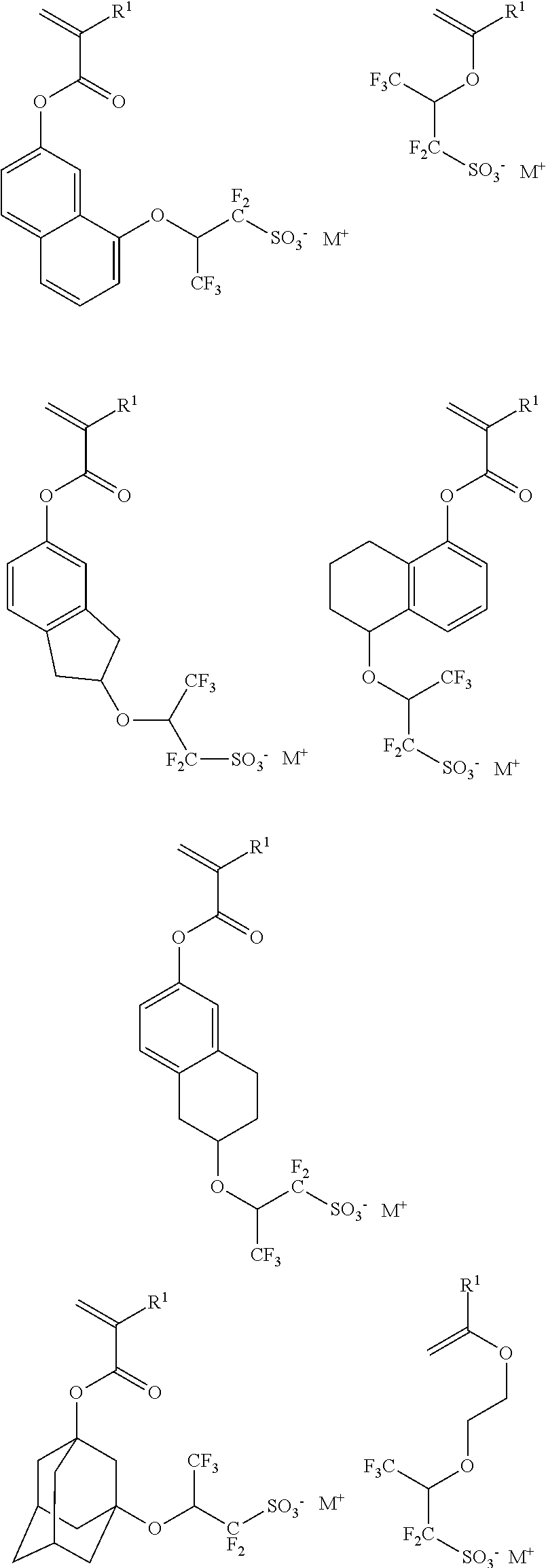


-


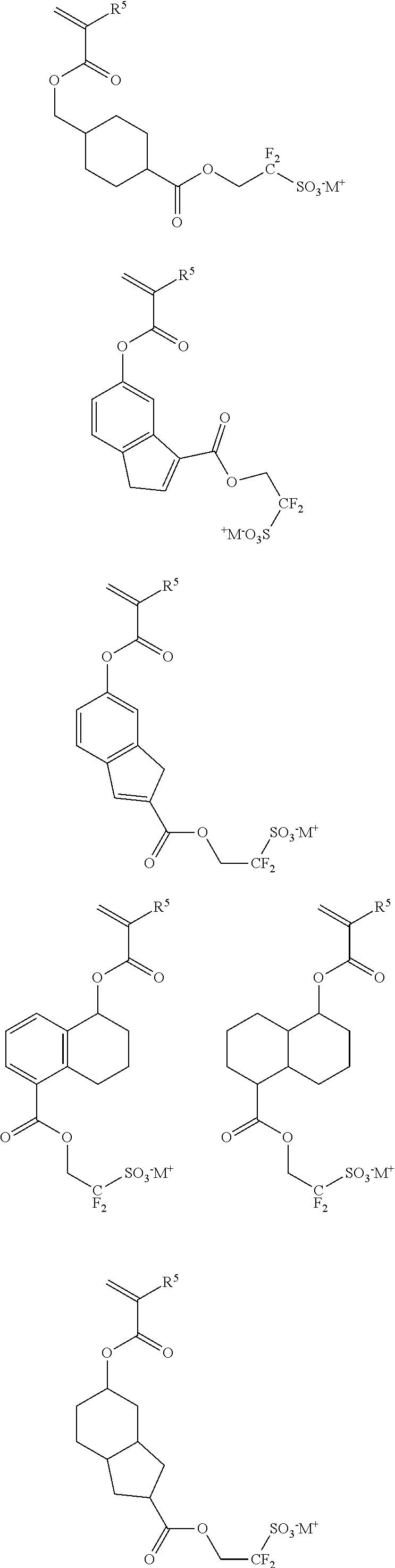


- In the formulae, R1, R3, R5, R8, and R10 are as defined above.
- Specific examples of sulfonimide salt monomer to give the repeating unit-a6 in the above general formula include the following.
-


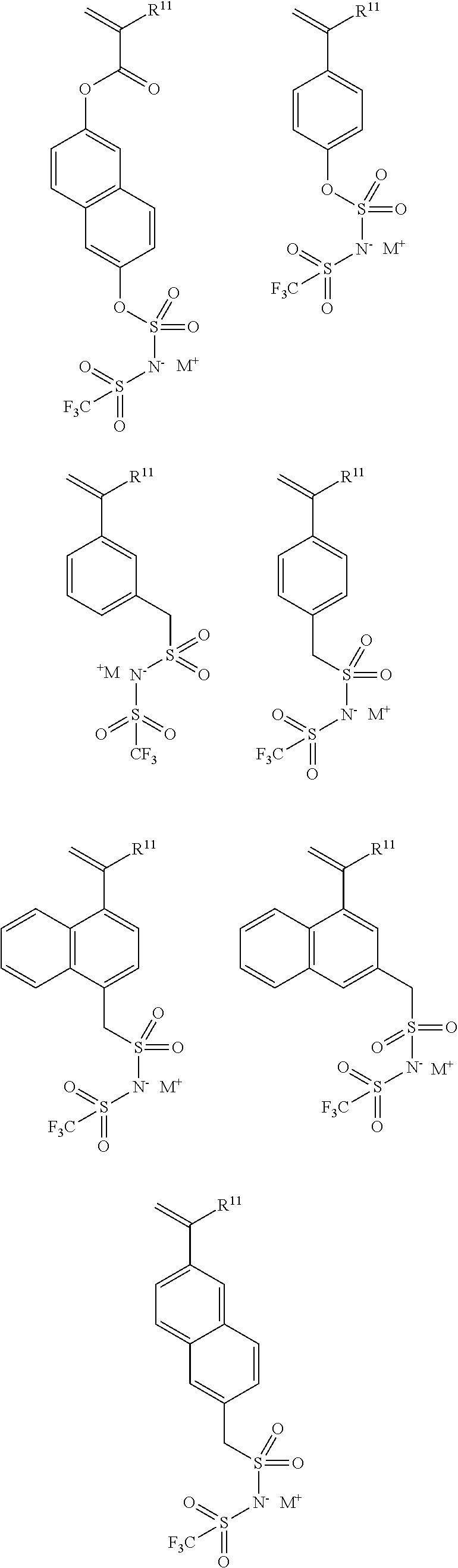


- In the formulae, R1 is as defined above.
- Specific examples of N-carbonyl-fluorosulfonamide salt monomer to give the repeating unit-a7 in the above general formula include the following.
-


- In the formulae, R13 is as defined above.
- The component (A) preferably contains an ammonium ion (ammonium cation) shown by the following general formula (3) as M+ in the repeating unit-a (e.g., the repeating units-a1 to -a7).
-

- In the formula, R101d, R101e, R101f, and R101g each represent a hydrogen atom, a linear, branched, or cyclic alkyl group having 1 to 12 carbon atoms, a linear, branched, or cyclic alkenyl group or alkynyl group having 2 to 12 carbon atoms, or an aromatic group having 4 to 20 carbon atoms, and optionally have one or more selected from the group consisting of an ether group, a carbonyl group, an ester group, a hydroxy group, an amino group, a nitro group, a sulfonyl group, a sulfinyl group, a halogen atom, and a sulfur atom. R101d and R101e, or R101d, R101e, and R101f, are optionally bonded to each other together with a nitrogen atom bonded therewith to form a ring in which R101d and R101e, or R101d, R101e, and R101f, represent an alkylene group having 3 to 10 carbon atoms, or to form a heteroaromatic ring having the nitrogen atom in the formula (3) within the ring.
- Specific examples of the ammonium ion shown by the general formula (3) include the following.
-


-


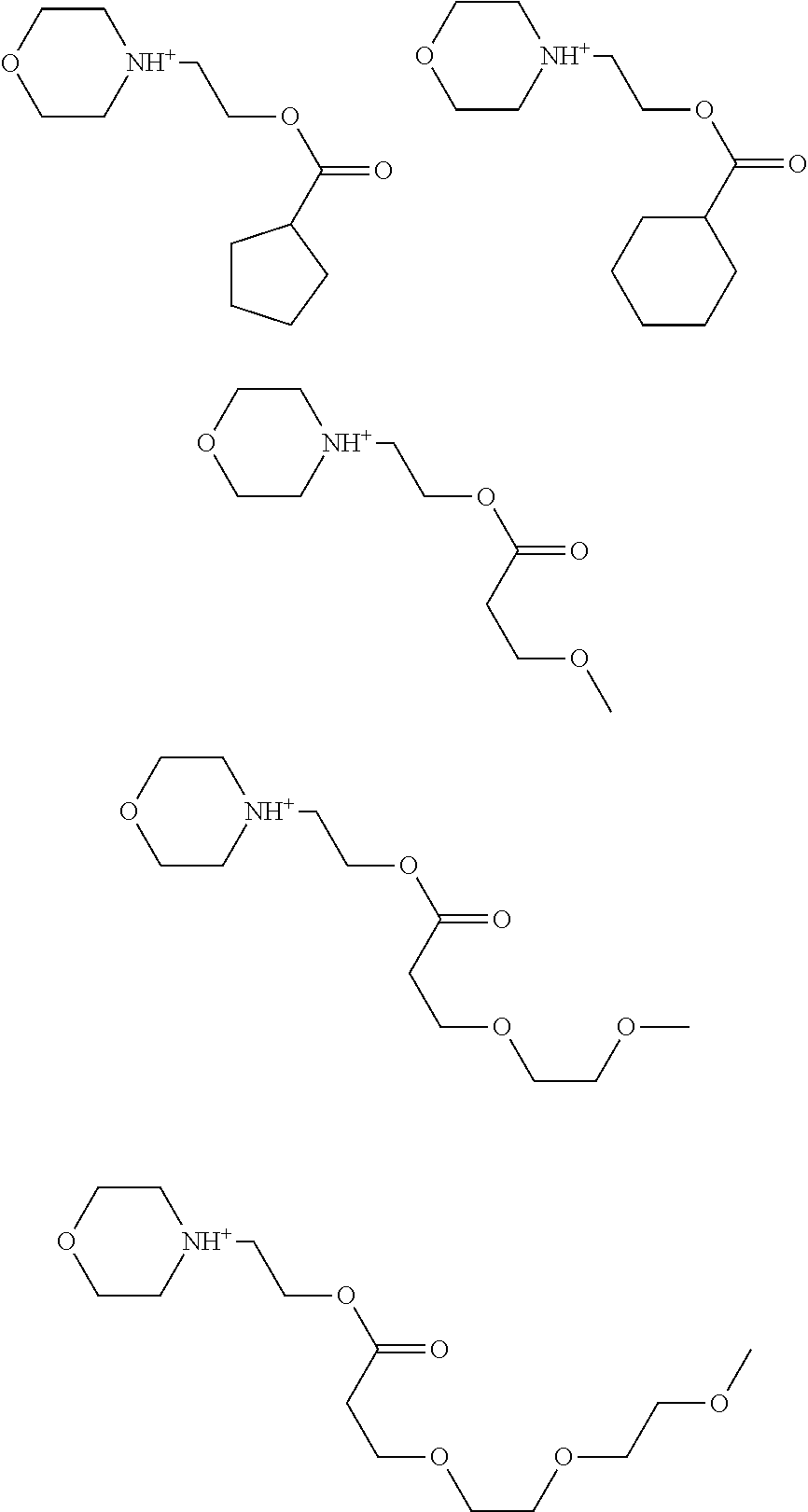
- The ammonium ion shown by the general formula (3) is particularly preferably a tertiary or quaternary ammonium ion.
- In addition to the repeating unit-a (e.g., the repeating units-a1 to -a7), the inventive ionic polymer material (ion polymer) essentially contains a repeating unit-b having a side chain with a radical-polymerizable double bond in a structure selected from the group consisting of (meth)acrylate, vinyl ether, and styrene. The repeating unit-b can be shown by the following general formula (4), for example.
-

- In the formula, R14 and R17 each represent a hydrogen atom or a methyl group. X8 represents any of a single bond, a phenylene group, a naphthylene group, an ether group, an ester group, and an amide group. R15 represents a single bond, a linear, branched, or cyclic alkylene group having 1 to 20 carbon atoms, or an aryl group having 6 to 10 carbon atoms. The alkylene group optionally has an ether group, an ester group, a hydroxy group, an alkoxy group, an alkoxycarbonyl group, a urethane group, a carbonate group, or an amino group. R16 represents an ether group, an ester group, or a phenylene group. “p” represents an integer of 1 to 3. “b” represents a number satisfying 0<b<1.0.
- The repeating unit-b can be obtained by: polymerizing a precursor monomer thereof with the monomer(s), which are to give the repeating unit-a, and another optional monomer(s); and then attaching, to a side chain of the resulting polymerization product, a radical-polymerizable double bond of a structure selected from the group consisting of (meth)acrylate, vinyl ether, and styrene.
- Specific examples of the repeating unit shown by the general formula (4) include the following.
-


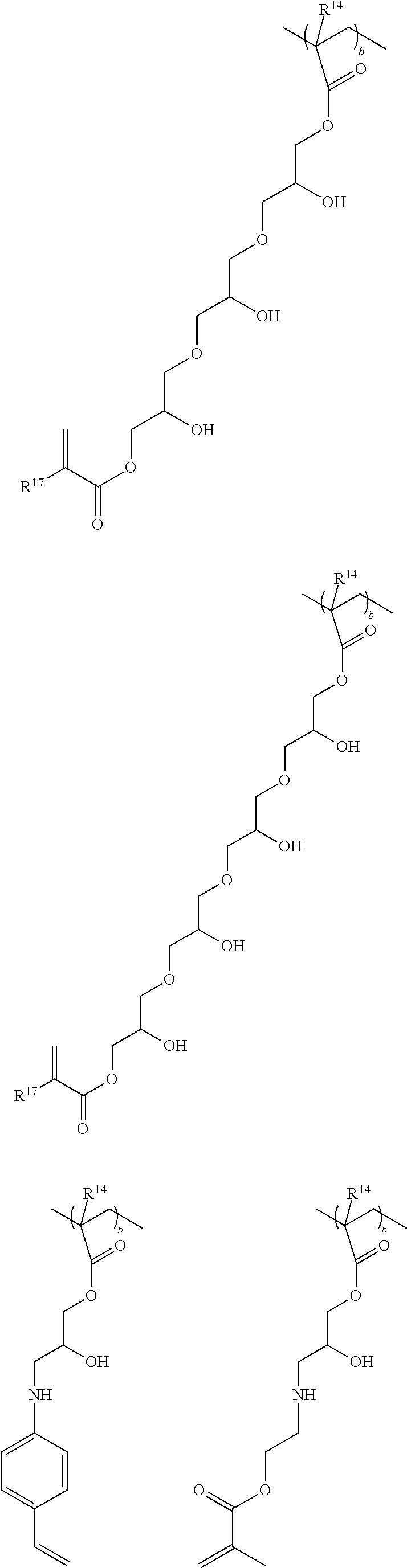

- in the component (A) of the inventive bio-electrode composition, a repeating unit-c having a glyme chain can also be copolymerized in addition to the repeating unit-a (e.g., the repeating units-a1 to -a7) and the repeating unit-b in order to improve the electric conductivity.
- Specific examples of a monomer to give the repeating unit-c having a glyme chain include the following. The copolymerization with a repeating unit having a glyme chain facilitates the movement of ions released from skin in the dry electrode film, and thus can increase the sensitivity of the dry electrode.
-


- R represents a hydrogen atom or a methyl group.
- In the component (A) of the inventive bio-electrode composition, a hydrophilic repeating unit-d having a hydroxy group, a carboxyl group, an ammonium salt, a betaine, an amide group, pyrrolidone, a lactone ring, a lactam ring, a sultone ring, a sodium salt of sulfonic acid or phosphoric acid, or a potassium salt of sulfonic acid can also be copolymerized with the repeating unit-a (e.g., the repeating units-a1 to -a7), the repeating unit-b, and the optional repeating unit-c, in order to improve the electric conductivity.
- Specific examples of a monomer to give the hydrophilic repeating unit-d include the following. The copolymerization with repeating units containing such hydrophilic groups can increase the sensitivity of the dry electrode by increasing the sensitivity to ions released from skin.
-


- The polymer compound (A) in the inventive bio-electrode composition can contain a repeating unit-e to give adhesion properties.
- Specific examples of a monomer to give the repeating unit-e include the following.
-


- Further, it is also possible to copolymerize a crosslinkable repeating unit-f. Examples of the crosslinkable repeating unit include repeating units having an oxirane ring or an oxetane ring.
- Specific examples of monomers to give the repeating unit-f having an oxirane ring or an oxetane ring include the following.
-


- In these formulae, R represents a methyl group or a hydrogen atom.
- The component (A) of the inventive bio-electrode composition can contain a repeating unit-g having silicon, in addition to the repeating unit-a (e.g., a1 to a7), the repeating unit-b, and the optional repeating unit(s) selected from the group consisting of the repeating units-c to -f. Specific examples of a monomer to give the repeating unit-g include the following.
-


- in the above formulae, “n” represents the number from 0 to 100.
- The component (A) of the inventive bio-electrode composition can contain a repeating unit-h having fluorine, in addition to the repeating unit-a (e.g., a1 to a7), the repeating unit-b, and the optional repeating unit(s) selected from the group consisting of the repeating units-c to -g.
- Specific examples of a monomer to give the repeating unit-h having fluorine include the following.
-


- In these formulae, R represents a hydrogen atom or a methyl group.
- As one of the method for synthesizing the component (A) that is the ionic polymer material (polymer compound), a copolymer compound can be obtained, for example, by a method in which the monomer to give the repeating unit-a (e.g., the repeating units-a1 to -a7) and the monomer to give the repeating unit-b as well as desired monomer(s) among the monomers to give the repeating units-c, -d, -e, -f, -g, and -h undergo heat polymerization in an organic solvent to which a radical polymerization initiator is added.
- Examples of the organic solvent used in the polymerization include toluene, benzene, tetrahydrofuran, diethyl ether, dioxane, etc. Examples of the polymerization initiator include 2,2′-azobisisobutyronitrile (AIBN), 2,2′-azobis(2,4-dimethylvaleronitrile),
dimethyl 2,2-azobis(2-methylpropionate), benzoyl peroxide, lauroyl peroxide, etc. The heating temperature is preferably 50 to 80° C., and the reaction time is preferably 2 to 100 hours, more preferably 5 to 20 hours. - Here, the ratios of the repeating units-a1 to -a7, -b, -c, -d, -e, -f, -g, and -h in the ionic polymer material (polymer) (A) can be 0≤a1<1.0, 0≤a2<1.0, 0≤a3<1.0, 0≤a4<1.0, 0≤a5<1.0, 0≤a6<1.0, 0≤a7<1.0, 0<a1+a2+a3+a4+a5+a6+a7<1.0, 0<b<1.0, 0≤c<1.0, 0≤d<1.0, 0≤e<0.9, 0≤f<0.9, 0≤g<0.9, and 0≤h<0.9; preferably 0≤a1≤0.9, 0≤a2≤0.9, 0≤a3≤0.9, 0≤a4≤0.9, 0≤a5≤0.9, 0≤a6≤0.9, 0≤a7≤0.9, 0.01≤a1+a2+a3+a4+a5+a6+a7≤0.9, 0.001≤b≤0.8, 0≤c≤0.8, 0≤d≤0.8, 0≤e<0.8, 0≤f<0.8, 0≤g<0.8, and 0≤h<0.8; more preferably 0≤a1≤0.8, 0≤a2≤0.8, 0≤a3≤0.8, 0≤a4≤0.8, 0≤a5≤0.8, 0≤a6≤0.8, 0≤a7≤0.8, 0.02≤a1+a2+a3+a4+a5+a6+a7≤0.8, 0.01≤b≤0.7, 0≤c≤0.7, 0≤d≤0.5, 0≤e<0.3, 0≤f<0.7, 0≤g<0.7, and 0≤h<0.7.
- Incidentally, for example, a1+a2+a3+a4+a5+a6+a7+b+c+d+e+f+g+h=1 means that the total amount of the repeating units-a1, -a2, -a3, -a4, -a5, -a6, -a7, -b, -c, -d, -e, -f, -g, and -h is 100 mol % on the basis of the total amount of the whole repeating units in the polymer compound containing the repeating units-a1, -a2, -a3, -a4, -a5, -a6, -a7, -b, -c, -d, -e, -f, -g, and -h; and a1+a2+a3+a4+a5+a6+a7+b+c+d+e+f+g+h<1 means that the total amount of the repeating units-a1, -a2, -a3, -a4, -a5, -a6, -a7, -b, -c, -d, -e, -f, -g, and -h is less than 100 mol % on the basis of the total amount of the whole repeating units, which indicates that the polymer compound contains another repeating unit(s) besides the repeating units-a1, -a2, -a3, -a4, -a5, -a6, -a7, -b, -c, -d, -e, -f, -g, and -h.
- To obtain the repeating unit-b, there is a method in which, for example, a precursor monomer thereof is polymerized with another monomer(s), and after the polymerization, the polymer is allowed to react at the portion corresponding to the repeating unit-b with a compound having a double bond, so that the repeating unit having the double bond can be obtained at the end of the side chain.
- The precursor monomer is a monomer having a hydroxy group, a carboxyl group, an epoxy group, an oxetane group, or an isocyanate group. After the polymerization, this portion of the polymer is allowed to react with a compound having a double bond and a carboxyl group, an epoxy group, a hydroxy group, or an isocyanate group.
- Regarding the molecular weight of the component (A), the weight-average molecular weight is preferably 500 or more, more preferably 1,000 or more and 1,000,000 or less, further preferably 2,000 or more and 500,000 or less. Regarding the ionic monomer (residual monomer) that is not incorporated into the component (A) after the polymerization, if the amount is small, the residual monomer can be prevented from permeating to skin in a biocompatibility test to cause allergy. Accordingly, it is preferable to decrease the amount of residual monomer(s). The amount of residual monomer(s) is preferably 10 parts by mass or less on the basis of 100 parts by mass of the whole component (A). One kind of the component (A) may be used singly, or there can be used a mixture of two or more kinds which differ in molecular weight, dispersity, and constitutive polymerizable monomer.
- The weight-average molecular weight of the polymer material can be determined by gel permeation chromatography (GPC) using tetrahydrofuran (THF) as a solvent.
- A resin (B), which is blended into the inventive bio-electrode composition, is a component for: preventing elution of the ionic polymer material (salt) (A) by being compatibilized with the salt; holding an optional component, for example, an electric conductivity improver such as a metal powder and a carbon powder, and an ion receptivity improver such as a silicon powder and a lithium titanate powder; and for achieving adhesion. When the ionic polymer material (A) has adhesion, the resin (B) is not necessarily essential. It should be noted that this resin may be any resin other than the component (A), and is preferably either or both of a thermosetting resin and a photo-curable resin, particularly preferably one or more resins selected from the group consisting of silicone based, acrylic based, and urethane based resins. In other words, the inventive bio-electrode composition preferably contains, as the component (B), a resin containing any one or more of silicone, polyacrylate, and polyurethane.
- The adherent (adhesive) silicone based resin include an addition-curable (addition reaction-curable) type and a radical curable (radical crosslinking reaction-curable) type. As the addition-curable type, it is possible to use one that contains diorganosiloxane having an alkenyl group(s), an MQ resin having R3SiO0.5 and SiO2 units, organohydrogenpolysiloxane having a plurality of SiH groups, a platinum catalyst, an addition reaction inhibitor, and an organic solvent, for example, described in JP 2015-193803A. As the radical curable type, it is possible to use one that contains diorganopolysiloxane with or without an alkenyl group, an MQ resin having R3SiO0.5 and SiO2 units, organic peroxide, and an organic solvent, for example, described in JP 2015-193803A. Here, R represents a substituted or unsubstituted monovalent hydrocarbon group having 1 to 10 carbon atoms.
- It is also possible to use a polysiloxane-resin integrated compound that is formed by condensation reaction of an MQ resin and polysiloxane having silanol at the terminal or the side chain of the polymer. The MQ resin contains many silanols, and improves adhesive strength by addition of it, but does not bind to the polysiloxane in molecular level because it is not crosslinkable. The adhesive strength can be increased by integrating the polysiloxane and the resin as described above.
- The silicone resin may contain modified siloxane that has a group selected from the group consisting of an amino group, an oxirane group, an oxetane group, a polyether group, a hydroxy group, a carboxyl group, a mercapto group, a methacryl group, an acryl group, a phenol group, a silanol group, a carboxylic anhydride group, an aryl group, an aralkyl group, an amide group, an ester group, and a lactone ring. The addition of the modified siloxane improves dispersibility of the component (A) in the silicone resin. The modified siloxane may be modified at any part such as one terminal, both terminals, or a side chain of the siloxane.
- As the adherent acrylic based resin, it is possible to use one having hydrophilic (meth)acrylic ester and hydrophobic long chain (meth)acrylic ester as the repeating units described in JP 2016-011338A, for example. In some cases, it is also possible to copolymerize (meth)acrylic ester having a functional group or (meth)acrylic ester having a siloxane bond.
- As the adherent urethane based resin, it is possible to use one having a urethane bond with a polyether bond, a polyester bond, a polycarbonate bond, or a siloxane bond described in JP 2016-065238A, for example.
- In the inventive bio-electrode composition, the resin (B) preferably has high compatibility with the component (A) to prevent lowering of the electric conductivity due to elution of the component (A) from the living body contact layer. In the inventive bio-electrode composition, the resin (B) preferably has high adhesion to the electro-conductive base material (substrate) of the bio-electrode to prevent peeling of the living body contact layer from the electro-conductive base material. In order to increase the adhesion to the electro-conductive base material and the compatibility with the salt, a use of a resin with high polarity as the resin (B) is effective. Examples of such a resin include resin having one or more moieties selected from an ether bond, an ester bond, an amide bond, an imide bond, a urethane bond, a thiourethane bond, and a thiol group; a polyacrylic resin, a polyamide resin, a polyimide resin, a polyurethane resin, a polythiourethane resin; etc. On the other hand, the living body contact layer is to be contacted with a living body, thereby being susceptible to perspiration. Accordingly, in the inventive bio-electrode composition, the resin (B) preferably has high repellency and is hardly hydrolyzed. To make the resin be highly repellent and hardly hydrolyzed, the use of a silicon-containing resin is effective.
- The silicon atom-containing polyacrylic resin includes a polymer that has a silicone main chain and a polymer that has a silicon atom(s) on the side chain, either of which can be suitably used. As the polymer that has a silicone main chain, silsesquioxane, siloxane having a (meth)acrylpropyl group, or the like can be used. In this case, an addition of a photoradical generator allows the (meth)acryl moiety to polymerize to cure.
- As the silicon atom-containing polyamide resin, it is possible to suitably use polyamide silicone resins described in JP 2011-079946A and U.S. Pat. No. 5,981,680B, for example. Such polyamide silicone resins can be synthesized by combining, for example, a silicone or non-silicone compound having amino groups at both terminals and a non-silicone or silicone compound having carboxyl groups at both terminals.
- It is also possible to use polyamic acid before cyclization thereof, which is obtained by reacting carboxylic anhydride and amine. The carboxyl group of the polyamic acid may be crosslinked by using a crosslinking agent such as an epoxy type and an oxetane type. It is also possible to esterify the carboxyl group with hydroxyethyl (meth)acrylate to perform photoradical crosslinking of the (meth)acrylate moiety.
- As the silicon atom-containing polyimide resin, it is possible to suitably use polyimide silicone resins described in JP 2002-332305A, for example. Although polyimide resins have very high viscosity, the viscosity can be decreased by blending a (meth)acrylic monomer as a solvent and a crosslinking agent.
- Examples of the silicon atom-containing polyurethane resin include polyurethane silicone resins. Such polyurethane silicone resins can be crosslinked through urethane bond by blending a compound having isocyanate groups at both terminals and a compound having a hydroxy group(s) at the terminal(s), followed by heating thereof. In this case, a silicon atom(s) (siloxane bond) have to be contained in either or both of the compound having isocyanate groups at both terminals and the compound having a hydroxy group(s) at the terminal(s). Alternatively, polysiloxane and a urethane (meth)acrylate monomer can be blended and photo-crosslinked as described in JP 2005-320418A. It is also possible to photo-crosslink a polymer having both of a siloxane bond(s) and a urethane bond(s), with the terminal having a (meth)acrylate group(s). Particularly, a polyurethane main chain having a silicone chain on a side chain as described in JP 2018-123304A and JP 2019-70109A is preferable because of the properties of high strength and high stretchability.
- The silicon atom-containing polythiourethane resin can be obtained by reaction of a compound having a thiol group(s) and a compound having an isocyanate group(s), provided that either of them contains a silicon atom(s). It can also be photo-cured if (meth)acrylate groups are contained at the terminals.
- The silicone based resin can be improved in compatibility with the foregoing salt by adding modified siloxane that has a group selected from the group consisting of an amino group, an oxirane group, an oxetane group, a polyether group, a hydroxy group, a carboxyl group, a mercapto group, a methacryl group, an acryl group, a phenol group, a silanol group, a carboxylic anhydride group, an aryl group, an aralkyl group, an amide group, an ester group, and a lactone ring, in addition to the diorganosiloxane having an alkenyl group(s), the MQ resin having R3SiO0.5 and SiO2 units, and the organohydrogenpolysiloxane having multiple SiH groups.
- The diorganosiloxane having an alkenyl group(s) and the organohydrogenpolysiloxane having multiple SiH groups can be crosslinked through an addition reaction with a platinum catalyst.
- Examples of the platinum catalyst include platinum-based catalysts such as chloroplatinic acid, alcohol solution of chloroplatinic acid, reaction product of chloroplatinic acid and alcohol, reaction product of chloroplatinic acid and an olefin compound, reaction product of platinic chloride and vinyl group-containing siloxane, a platinum-olefin complex, and a complex of platinum and vinyl group-containing siloxane; platinum group metal-based catalysts such as a rhodium complex and a ruthenium complex; etc. These catalysts may be used after dissolved or dispersed in alcohol solvent, hydrocarbon solvent, or siloxane solvent.
- The amount of the platinum catalyst added is preferably in a range of 5 to 2,000 ppm, particularly preferably 10 to 500 ppm, on the basis of 100 parts by mass of the resin including (A) and (B).
- In the inventive bio-electrode composition, the component (B) is blended in an amount of preferably 0 to 2000 parts by mass, more preferably 10 to 1000 parts by mass, on the basis of 100 parts by mass of the ion polymer (A). One kind of each of the components (A) and (B) may be used singly or mixture of two or more kinds may be used.
- When the addition curable silicone resin is used, an addition-reaction inhibitor may be added. This addition-reaction inhibitor is added as a quencher to prevent the action of the platinum catalyst in the solution and under a low temperature circumstance after forming the coating film and before heat curing. Specific examples of the addition-reaction inhibitor include 3-methyl-1-butyn-3-ol, 3-methyl-1-pentyn-3-ol, 3,5-dimethyl-1-hexyn-3-ol, 1-ethynylcyclohexanol, 3-methyl-3-trimethylsiloxy-1-butyne, 3-methyl-3-trimethylsiloxy-1-pentyne, 3,5-dimethyl-3-trimethylsiloxy-1-hexyne, 1-ethynyl-1-trimethylsiloxycyclohexane, bis(2,2-dimethyl-3-butynoxy)dimethylsilane, 1,3,5,7-tetramethyl-1,3,5,7-tetravinylcyclotetrasiloxane, 1,1,3,3-tetramethyl-1,3-divinyldisiloxane, etc.
- The amount of the addition-reaction inhibitor added is preferably in a range of 0 to 10 parts by mass, particularly preferably 0.05 to 3 parts by mass, on the basis of 100 parts by mass of the resin.
- In crosslinking the radical-crosslinkable group in the component (A) in the present invention, it is effective to add a radical generator. Such a radical generator includes a photoradical generator and a thermal radical generator.
- Examples of the photoradical generator include acetophenone, 4,4′-dimethoxybenzyl, benzyl, benzoin, benzophenone, 2-benzoylbenzoic acid, 4,4′-bis(dimethylamino)benzophenone, 4,4′-bis(diethylamino)benzophenone, benzoin methyl ether, benzoin ethyl ether, benzoin isopropyl ether, benzoin butyl ether, benzoin isobutyl ether, 4-benzoylbenzoic acid, 2,2′-bis(2-chlorophenyl)-4,4′,5,5′-tetraphenyl-1,2′-biimidazole, methyl 2-benzoylbenzoate, 2-(1,3-benzodioxole-5-yl)-4,6-bis(trichloromethyl)-1,3,5-triazine, 2-benzyl-2-(dimethylamino)-4′-morpholinobutyrophenone, 4,4′-dichlorobenzophenone, 2,2-diethoxyacetophenone, 2,2-dimethoxy-2-phenylacetophenone, 2,4-diethylthioxanthene-9-one, diphenyl(2,4,6-trimethylbenzoyl)phosphine oxide (BAPO), 1,4-dibenzoylbenzene, 2-ethylanthraquinone, 1-hydroxycyclohexyl phenyl ketone, 2-hydroxy-2-methylpropiophenone, 2-hydroxy-4′-(2-hydroxyethoxy)-2-methylpropiophenone, 2-isonitrosopropiophenone, and 2-phenyl-2-(p-toluenesulfonyloxy)acetophenone.
- The curing can also be performed by adding a radical generator of a heat decomposition type. Examples of the thermal radical generator include 2,2′-azobis(isobutyronitrile), 2,2′-azobis(2,4-dimethylvaleronitrile), 2,2′-azobis(2-methylbutyronitrile), 2,2′-azobis(methylpropionamidine) hydrochloride, 2,2′-azobis[2-(2-imidazolin-2-yl)propane]hydrochloride, 2,2′-azobis(4-methoxy-2,4-dimethylvaleronitrile), 2,2′-azobis(cyclohexane-1-carbonitrile), 1[(1-cyano-1-methylethyl)azo]formamide, 2,2′-azobis[2-methyl-N-(2-hydroxyethyl)propionamide], 2,2′-azobis[N-(2-propenyl)-2-methylpropionamide], 2,2′-azobis(N-butyl-2-methylpropionamide), dimethyl-2,2′-azobis(isobutylate), 4,4′-azobis(4-cyanopentanoic acid), dimethyl-2,2′-azobis(2-methylpropionate), benzoyl peroxide, tert-butyl hydroperoxide, cumene hydroperoxide, di-tert-butyl peroxide, di-tert-amyl peroxide, di-n-butyl peroxide, dicumyl peroxide, etc.
- The amount of radical generator added is preferably in a range of 0.1 to 50 parts by mass on the basis of 100 parts by mass of the resin including the components (A) and (B).
- As will be described later, the living body contact layer of the inventive bio-electrode is a cured material (cured product) of the inventive bio-electrode composition. The curing improves the adhesion of the living body contact layer to both of skin and the electro-conductive base material. The curing means is not particularly limited, and common means can be used, including crosslinking reaction by either or both of heat and light, or with an acid catalyst or a base catalyst, for example. The crosslinking reaction can be performed, for example, by appropriately selecting methods described in “Kakyou han-nou handbook (handbook of crosslinking reaction)”,
Chapter 2, pages 51-371, Yasuharu Nakayama, Maruzen Publishing Co., Ltd. (2013). - The inventive bio-electrode composition can also contain a metal powder selected from the group consisting of gold, silver, platinum, copper, tin, titanium, nickel, aluminum, tungsten, molybdenum, ruthenium, chromium, and indium in order to improve electron conductivity. The amount of the metal powder added is preferably in a range of 1 to 50 parts by mass on the basis of 100 parts by mass of the resin.
- As the kind of the metal powder, gold, silver, and platinum are preferable in view of electric conductivity; and silver, copper, tin, titanium, nickel, aluminum, tungsten, molybdenum, ruthenium, and chromium are preferable in view of cost.
- In view of biocompatibility, noble metals are preferable. On the whole of these viewpoints, silver is most preferable.
- The metal powder may have any shape, such as a spherical shape, a disk shape, a flaky shape, and a needle shape. The addition of flaky powder brings highest electric conductivity and is preferable thereby. The metal powder is preferably a flake having relatively lower density and larger specific surface area with a size of 100 μm or less, a tapped density of not more than 5 g/cm3, and a specific surface area of not less than 0.5 m2/g.
- A carbon material can be added as an electric conductivity improver. Examples of the carbon material include carbon black, graphite, carbon nanotube, carbon fiber, etc. The carbon nanotube may be either single layer or multilayer, and the surface may be modified with an organic group(s). The amount of the carbon material added is preferably in a range of 1 to 50 parts by mass on the basis of 100 parts by mass of the resin.
- The inventive bio-electrode composition may contain a silicon powder to enhance ion reception sensitivity.
- Examples of the silicon powder include powders of silicon, silicon monoxide, or silicon carbide. The particle diameter of the powder is preferably smaller than 100 μm, more preferably 1 μm or less.
- Since finer particles have a larger surface area, the resulting bio-electrode can receive a larger amount of ions and has higher sensitivity. The amount of the silicon powder added is preferably in a range of 1 to 50 parts by mass on the basis of 100 parts by mass of the resin.
- The inventive bio-electrode composition may contain a lithium titanate powder to enhance ion reception sensitivity.
- Examples of the lithium titanate powder include powders containing a compound shown by molecular formulae Li2TiO3, LiTiO2, or Li4Ti5O12 with a spinel structure. Lithium titanate having a spinel structure is preferable. It is also possible to use carbon-incorporated lithium titanate particles. The particle diameter of the powder is preferably smaller than 100 μm, more preferably 1 μm or less.
- Since finer particles have a larger surface area, the bio-electrode can receive a larger amount of ions, and has higher sensitivity. The aforementioned powders may be composite powders with carbon. The amount of the lithium titanate powder added is preferably in a range of 1 to 50 parts by mass on the basis of 100 parts by mass of the resin.
- The inventive bio-electrode composition may contain an epoxy-type crosslinking agent. This crosslinking agent is a compound having multiple epoxy groups or oxetane groups in one molecule. The amount of the crosslinking agent added is preferably 1 to 30 parts by mass on the basis of 100 parts by mass of the resin.
- The inventive bio-electrode composition may also contain a catalyst for crosslinking the epoxy groups or the oxetane groups. As this catalyst, ones described in paragraphs 0027 to 0029 of JP 2019-503406A can be used. The amount of the catalyst added is preferably 0.01 to 10 parts by mass on the basis of 100 parts by mass of the resin.
- The inventive bio-electrode composition may contain an ionic additive to increase ionic conductivity. In consideration of biocompatibility, examples of the ionic additive include sodium chloride, potassium chloride, calcium chloride, saccharin, acesulfame K, and salts disclosed in JP 2018-44147A, JP 2018-59050A, JP 2018-59052A, and JP 2018-130534A.
- Further, the inventive bio-electrode composition may contain an organic solvent. Specific examples of the organic solvent include aromatic hydrocarbon solvent such as toluene, xylene, cumene, 1,2,3-trimethylbenzene, 1,2,4-trimethylbenzene, 1,3,5-trimethylbenzene, styrene, α-methylstyrene, butylbenzene, sec-butylbenzene, isobutylbenzene, cymene, diethylbenzene, 2-ethyl-p-xylene, 2-propyltoluene, 3-propyltoluene, 4-propyltoluene, 1,2,3,5-tetramethyltoluene, 1,2,4,5-tetramethyltoluene, tetrahydronaphthalene, 4-phenyl-1-butene, tert-amylbenzene, amylbenzene, 2-tert-butyltoluene, 3-tert-butyltoluene, 4-tert-butyltoluene, 5-isopropyl-m-xylene, 3-methylethylbenzene, tert-butyl-3-ethylbenzene, 4-tert-butyl-o-xylene, 5-tert-butyl-m-xylene, tert-butyl-p-xylene, 1,2-diisopropylbenzene, 1,3-diisopropylbenzene, 1,4-diisopropylbenzene, dipropylbenzene, pentamethylbenzene, hexamethylbenzene, hexylbenzene, and 1,3,5-triethylbenzene; aliphatic hydrocarbon solvent such as n-heptane, isoheptane, 3-methylhexane, 2,3-dimethylpentane, 3-ethylpentane, 1,6-heptadiene, 5-methyl-1-hexyne, norbornane, norbornene, dicyclopentadiene, 1-methyl-1,4-cyclohexadiene, 1-heptyne, 2-heptyne, cycloheptane, cycloheptene, 1,3-dimethylcyclopentane, ethylcyclopentane, methylcyclohexane, 1-methyl-1-cyclohexene, 3-methyl-1-cyclohexene, methylenecyclohexane, 4-methyl-1-cyclohexene, 2-methyl-1-hexene, 2-methyl-2-hexene, 1-heptene, 2-heptene, 3-heptene, n-octane, 2,2-dimethylhexane, 2,3-dimethylhexane, 2,4-dimethylhexane, 2,5-dimethylhexane, 3,3-dimethylhexane, 3,4-dimethylhexane, 3-ethyl-2-methylpentane, 3-ethyl-3-methylpentane, 2-methylheptane, 3-methylheptane, 4-methylheptane, 2,2,3-trimethylpentane, 2,2,4-trimethylpentane, cyclooctane, cyclooctene, 1,2-dimethylcyclohexane, 1,3-dimethylcyclohexane, 1,4-dimethylcyclohexane, ethylcyclohexane, vinylcyclohexane, isopropylcyclopentane, 2,2-dimethyl-3-hexene, 2,4-dimethyl-1-hexene, 2,5-dimethyl-1-hexene, 2,5-dimethyl-2-hexene, 3,3-dimethyl-1-hexene, 3,4-dimethyl-1-hexene, 4,4-dimethyl-1-hexene, 2-ethyl-1-hexene, 2-methyl-1-heptene, 1-octene, 2-octene, 3-octene, 4-octene, 1,7-octadiene, 1-octyne, 2-octyne, 3-octyne, 4-octyne, n-nonane, 2,3-dimethylheptane, 2,4-dimethylheptane, 2,5-dimethylheptane, 3,3-dimethylheptane, 3,4-dimethylheptane, 3,5-dimethylheptane, 4-ethylheptane, 2-methyloctane, 3-methyloctane, 4-methyloctane, 2,2,4,4-tetramethylpentane, 2,2,4-trimethylhexane, 2,2,5-trimethylhexane, 2,2-dimethyl-3-heptene, 2,3-dimethyl-3-heptene, 2,4-dimethyl-1-heptene, 2,6-dimethyl-1-heptene, 2,6-dimethyl-3-heptene, 3,5-dimethyl-3-heptene, 2,4,4-trimethyl-1-hexene, 3,5,5-trimethyl-1-hexene, 1-ethyl-2-methylcyclohexane, 1-ethyl-3-methylcyclohexane, 1-ethyl-4-methylcyclohexane, propylcyclohexane, isopropylcyclohexane, 1,1,3-trimethylcyclohexane, 1,1,4-trimethylcyclohexane, 1,2,3-trimethylcyclohexane, 1,2,4-trimethylcyclohexane, 1,3,5-trimethylcyclohexane, allylcyclohexane, hydrindane, 1,8-nonadiene, 1-nonyne, 2-nonyne, 3-nonyne, 4-nonyne, 1-nonene, 2-nonene, 3-nonene, 4-nonene, n-decane, 3,3-dimethyloctane, 3,5-dimethyloctane, 4,4-dimethyloctane, 3-ethyl-3-methylheptane, 2-methylnonane, 3-methylnonane, 4-methylnonane, tert-butylcyclohexane, butylcyclohexane, isobutylcyclohexane, 4-isopropyl-1-methylcyclohexane, pentylcyclopentane, 1,1,3,5-tetramethylcyclohexane, cyclododecane, 1-decene, 2-decene, 3-decene, 4-decene, 5-decene, 1,9-decadiene, decahydronaphthalene, 1-decyne, 2-decyne, 3-decyne, 4-decyne, 5-decyne, 1,5,9-decatriene, 2,6-dimethyl-2,4,6-octatriene, limonene, myrcene, 1,2,3,4,5-pentamethylcyclopentadiene, α-phellandrene, pinene, terpinene, tetrahydrodicyclopentadiene, 5,6-dihydrodicyclopentadiene, 1,4-decadiyne, 1,5-decadiyne, 1,9-decadiyne, 2,8-decadiyne, 4,6-decadiyne, n-undecane, amylcyclohexane, 1-undecene, 1,10-undecadiene, 1-undecyne, 3-undecyne, 5-undecyne, tricyclo[6.2.1.02,7]undeca-4-ene, n-dodecane, 2-methylundecane, 3-methylundecane, 4-methylundecane, 5-methylundecane, 2,2,4,6,6-pentamethylheptane, 1,3-dimethyladamantane, 1-ethyladamantane, 1,5,9-cyclododecatriene, 1,2,4-trivinylcyclohexane, and isoparaffin; ketone solvent such as cyclohexanone, cyclopentanone, 2-octanone, 2-nonanone, 2-heptanone, 3-heptanone, 4-heptanone, 2-hexanone, 3-hexanone, diisobutyl ketone, methylcyclohexanone, and methyl n-pentyl ketone; alcohol solvent such as 3-methoxybutanol, 3-methyl-3-methoxybutanol, 1-methoxy-2-propanol, and 1-ethoxy-2-propanol; ether solvent such as propylene glycol monomethyl ether, ethylene glycol monomethyl ether, propylene glycol monoethyl ether, ethylene glycol monoethyl ether, propylene glycol dimethyl ether, diethylene glycol monomethyl ether, diethylene glycol monoethyl ether, diethylene glycol monopropyl ether, diethylene glycol monobutyl ether, diethylene glycol monopentyl ether, diethylene glycol monoheptyl ether, diethylene glycol diethyl ether, diethylene glycol dipropyl ether, diethylene glycol dibutyl ether, diisopropyl ether, diisobutyl ether, diisopentyl ether, di-n-pentyl ether, methyl cyclopentyl ether, methyl cyclohexyl ether, di-n-butyl ether, di-sec-butyl ether, di-sec-pentyl ether, di-tert-amyl ether, di-n-hexyl ether, and anisole; ester solvent such as propylene glycol monomethyl ether acetate, propylene glycol monoethyl ether acetate, ethyl lactate, ethyl pyruvate, butyl acetate, methyl 3-methoxypropionate, ethyl 3-ethoxypropionate, tert-butyl acetate, tert-butyl propionate, and propylene glycol mono-tert-butyl ether acetate; lactone solvent such as γ-butyrolactone; water; etc.
- The amount of the organic solvent added is preferably in a range of 10 to 50,000 parts by mass on the basis of 100 parts by mass of the resin.
- The inventive bio-electrode composition can be mixed with silica particles, polyether silicone, or polyglycerin silicone. Silica particles have hydrophilic surfaces and favorable compatibility with the hydrophilic ion polymer, polyether silicone, and polyglycerin silicone, and can improve the dispersibility of the ion polymer, polyether silicone, and polyglycerin silicone in the hydrophobic silicone adhesive. The silica particles may be either dry type or wet type both of which are preferably usable.
- As has been described above, the inventive bio-electrode composition makes it possible to form a living body contact layer for a bio-electrode that is capable of efficiently conducting electric signals from skin to a device (i.e., excellent in electric conductivity), and preventing residue on the skin even when peeled from the skin after long-time attachment to the skin. Thus, the inventive bio-electrode composition is capable of forming a living body contact layer for a bio-electrode to enable signal collection immediately after attachment to skin and prevention of residue on the skin after peeling from the skin. Moreover, the inventive bio-electrode composition can form a living body contact layer for a bio-electrode which does not cause allergy even when attached to skin for a long time (i.e., excellent in biocompatibility), which is light-weight and manufacturable at low cost, and which prevents significant reduction in the electric conductivity even when wetted with water or dried. In addition, it is possible to further improve the electric conductivity by adding a carbon material, and it is possible to manufacture a bio-electrode with particularly high adhesive strength and high stretchability by combining the inventive bio-electrode composition with a resin having adhesion and stretchability. Further, the stretchability and adhesion to skin can be improved with an additive and so forth. The stretchability and adhesion can also be controlled by appropriately adjusting the composition of the resin and the thickness of the living body contact layer.
- The present invention also provides a bio-electrode comprising an electro-conductive base material and a living body contact layer formed on the electro-conductive base material, wherein the living body contact layer is a cured material of the inventive bio-electrode composition described above.
- Hereinafter, the inventive bio-electrode will be described in detail with reference to the drawings, but the present invention is not limited thereto.
-
FIG. 1 is a schematic sectional view showing an example of the inventive bio-electrode. InFIG. 1 , abio-electrode 1 has an electro-conductive base material 2 and a livingbody contact layer 3 formed on the electro-conductive base material 2. The livingbody contact layer 3 is a cured material as one example of the inventive bio-electrode composition described above. More specifically, the livingbody contact layer 3 is a layer in which an ionic polymer material (ionic polymer) 4 and anadditive 5 are dispersed in a resin 6. - When the bio-electrode 1 as shown in
FIG. 1 is used, the living body contact layer 3 (i.e., the layer in which theionic polymer material 4 and theadditive 5 are dispersed in the resin 6) is brought into contact with a livingbody 7 as shown inFIG. 2 . Electric signals are picked from the livingbody 7 through theionic polymer 4 and theadditive 5, and then conducted to a sensor device etc. (not shown) via the electro-conductive base material 2. - As described above, the inventive bio-electrode is capable of coping with both electric conductivity and biocompatibility by using the ionic polymer material (ionic polymer) described above, and obtaining electric signals from skin stably in high sensitivity because the contact area with skin is kept constant due to the adhesion thereof.
- Moreover, since the inventive bio-electrode has the living body contact layer formed from the cured material of the inventive bio-electrode composition described above, this enables signal collection immediately after attachment to skin and prevention of residue on the skin after peeling from the skin.
- Hereinafter, each component of the inventive bio-electrode will be described more specifically.
- The inventive bio-electrode has an electro-conductive base material. This electro-conductive base material is usually connected electrically with a sensor device and so on, and conducts electrical signals picked from a living body through the living body contact layer to the sensor device and so on.
- As the electro-conductive base material, any electro-conductive material can be used without being limited to particular ones. However, it is preferable to comprise one or more species selected from the group consisting of gold, silver, silver chloride, platinum, aluminum, magnesium, tin, tungsten, iron, copper, nickel, stainless steel, chromium, titanium, and carbon, for example.
- The electro-conductive base material may be a hard electro-conductive substrate, an electro-conductive film having flexibility, a cloth with the surface being coated with electro-conductive paste, a cloth into which electro-conductive polymer is kneaded, or the like without being limited to particular substrates. The electro-conductive base material may be flat, uneven, or mesh-form of woven metal wires, which can be appropriately selected in accordance with the use of the bio-electrode, and so forth.
- The inventive bio-electrode includes a living body contact layer formed on the electro-conductive base material. This living body contact layer is a part to be actually in contact with a living body when using the bio-electrode, and has electric conductivity and adhesion. The living body contact layer is a cured material of the inventive bio-electrode composition described above; that is, a resin layer containing: the ionic polymer material (salt) (A), and optional additive(s) such as the resin (B). The living body contact layer is for example an adherent resin layer.
- The living body contact layer preferably has adhesive strength in a range of 0.5 N/25 mm or more and 20 N/25 mm or less. The adhesive strength is commonly measured by the method shown in JIS Z 0237, in which a metal substrate such as a stainless steel (SUS) substrate or a polyethylene terephthalate (PET) substrate can be used as a base material. Alternatively, human skin can be used for measuring. Human skin has lower surface energy than metals and various plastics, and as low as that of Teflon (registered trademark). Human skin is hard to adhere.
- The living body contact layer of the bio-electrode has a thickness of preferably 1 μm or more and 5 mm or less, more preferably 2 μm or more and 3 mm or less. As the living body contact layer is thinner, the adhesive strength lowers, but the flexibility is improved, the weight decreases and the compatibility with skin is improved. The thickness of the living body contact layer can be selected based on the balance of adhesion and texture to the skin.
- The inventive bio-electrode may be provided with an adherent film separately on the living body contact layer as in conventional bio-electrodes (e.g., the bio-electrode described in JP 2004-033468A) in order to prevent peeling off of the bio-electrode from a living body during the use. When the adherent film is provided separately, the adherent film may be formed by using a raw material for the adherent film such as an acrylic type, a urethane type, and a silicone type. Particularly, the silicone type is suitable because of: the high oxygen permeability, which enables dermal respiration while the electrode is attached to the skin, the high water repellency, which decreases lowering of adhesion due to perspiration, and the low irritation to skin. It is to be noted that the inventive bio-electrode does not necessarily require this adherent film that is provided separately, because peeling off from a living body can be prevented by adding a tackifier to the bio-electrode composition or using a resin having good adhesion to a living body as described above.
- When the inventive bio-electrode is used as a wearable device, wiring between the bio-electrode and a sensor device, and other components are not limited to particular ones. For example, it is possible to employ the ones described in JP 2004-033468A.
- As described above, since the inventive bio-electrode includes the living body contact layer formed from the cured material of the aforementioned inventive bio-electrode composition, the inventive bio-electrode is capable of efficiently conducting electric signals from skin to a device (i.e., excellent in electric conductivity), collecting signals immediately after attachment to the skin, and preventing residue on the skin after peeling from the skin. Moreover, since the living body contact layer is formed from the cured material of the inventive bio-electrode composition, the inventive bio-electrode does not cause allergy even when attached to skin for a long time (i.e., excellent in biocompatibility), and is light-weight and manufacturable at low cost. The bio-electrode prevents significant reduction in the electric conductivity even when wetted with water or dried. In addition, it is possible to further improve the electric conductivity by adding a metal powder, and it is possible to manufacture a bio-electrode with particularly high adhesive strength and high stretchability by combining the inventive bio-electrode composition with a resin having adhesion and stretchability. Further, the stretchability and adhesion to skin can be improved with an additive and so forth. The stretchability and adhesion can also be controlled by appropriately adjusting the composition of the resin and the thickness of the living body contact layer. Accordingly, the inventive bio-electrode described above is particularly suitable as a bio-electrode used for a medical wearable device.
- The present invention also provides a method for manufacturing a bio-electrode having an electro-conductive base material and a living body contact layer formed on the electro-conductive base material, the method including: applying the inventive bio-electrode composition onto the electro-conductive base material; and curing the bio-electrode composition to form the living body contact layer.
- The electro-conductive base material, the bio-electrode composition, etc. used for the inventive method for manufacturing a bio-electrode may be the same as those described above.
- The method for applying the bio-electrode composition onto the electro-conductive base material is not limited to particular ones. Examples of the suitable method include dip coating, spray coating, spin coating, roll coating, flow coating, doctor coating, screen printing, flexographic printing, gravure printing, stencil printing, inkjet printing, etc.
- The method for curing the resin can be appropriately selected based on the kind of the ionic polymer material (A) used for the bio-electrode composition without being limited to particular methods. For example, the bio-electrode composition is preferably cured by either or both of heat and light. The foregoing bio-electrode composition can also be cured by adding a catalyst in advance to generate acid or base to the bio-electrode composition, which causes a crosslinking reaction.
- The curing is particularly preferably performed under a condition where radical polymerization takes place on the repeating unit-b of the ionic polymer material (A).
- The heating temperature is not particularly limited and may be appropriately selected based on the kind of the ionic polymer material (A) used for the bio-electrode composition, but is preferably about 50 to 250° C., for example.
- When the heating and light irradiation are combined, it is possible to perform the heating and the light irradiation simultaneously, to perform the light irradiation and then the heating, or to perform the heating and then the light irradiation. It is also possible to perform air-drying to evaporate the solvent before heating the coating film.
- Water droplets may be attached to the surface of the cured film (living body contact layer); alternatively, the film may be immersed in water; alternatively, the surface of the cured film may be sprayed with water vapor or mist. These treatments improve the compatibility with skin, and the resulting film can obtain biological signals quickly. Water mixed with alcohol can be used to reduce size of water vapor or mist.
- The aqueous solution to be sprayed as the water vapor etc. may contain a salt selected from the group consisting of sodium salts, potassium salts, and calcium salts.
- The salt selected from the group consisting of sodium salts, potassium salts, and calcium salts is preferably a salt selected from the group consisting of sodium chloride, potassium chloride, calcium chloride, saccharin, acesulfame K, sodium carboxylate, potassium carboxylate, calcium carboxylate, sodium sulfonate, potassium sulfonate, and calcium sulfonate.
- The aqueous solution to be sprayed as the water vapor etc. may contain a monohydric alcohol or polyhydric alcohol having 1 to 4 carbon atoms.
- As the polyhydric alcohol, it is possible to use glycerin, polyethylene glycol, polypropylene glycol, polyglycerin, or a silicone compound having a polyglycerin structure.
- The skin to which the bio-electrode is attached may be wiped with a nonwoven fabric, such as gauze, impregnated with water or alcohol to thus remove the oily substance on the skin to freshen and moisturize the outermost skin layer simultaneously. Such treatment is effective in collecting biological signals immediately after the attachment.
- As described above, the inventive method for manufacturing a bio-electrode makes it possible to manufacture the inventive bio-electrode easily at low cost, with the bio-electrode enabling signal collection immediately after attachment to skin and prevention of residue on the skin after peeling from the skin. Moreover, the manufactured bio-electrode is light-weight and excellent in electric conductivity and biocompatibility, and prevents significant reduction in the electric conductivity even when wetted with water or dried.
- Hereinafter, the present invention will be specifically described by giving Examples and Comparative Examples, but the present invention is not limited thereto.
-
Ionic polymers 1 to 21, which were blended as the ionic polymer material (conductive material) to bio-electrode composition solutions, were synthesized as follows. - First, 30 mass % solution of each monomer in cyclopentanone was introduced into a reaction vessel and mixed. The reaction vessel was cooled to −70° C. under a nitrogen atmosphere, and subjected to vacuum degassing and nitrogen blowing, which were repeated three times. After raising the temperature to room temperature, azobisisobutyronitrile (AIBN) was added thereto as a polymerization initiator in an amount of 0.01 moles per 1 mole of the whole monomers. This was warmed to a temperature of 60° C. and then allowed to react for 15 hours. After the polymerization, the polymer solution was allowed to react with a compound having a double bond, and thereby a polymerizable unit as the repeating unit-b was formed. After drying the solvent, the composition of the resulting polymer was identified by 1H-NMR. The molecular weight (Mw) and the dispersity (Mw/Mn) of the obtained polymer were determined by gel permeation chromatography (GPC) using tetrahydrofuran (THF) as a solvent. Thus synthesized
Ionic polymers 1 to 21 are shown below. -

- The repeating number in each formula shows the average value.
-

- The repeating number in each formula shows the average value.
-

- The repeating number in each formula shows the average value. The same shall apply hereinafter.
-


-
Comparative salts 1, 2 (Comparative ionic polymers), which were each blended as an ionic material to bio-electrode composition solutions of Comparative Examples, are shown below. -

-

-
Siloxane compounds 1 to 4, which were each blended as a silicone based resin to the bio-electrode composition solutions, are shown below. Hereinbelow, Me represents a methyl group, and Vi represents a vinyl group. -
Siloxane compound 1 was vinyl group-containing polydimethylsiloxane having an alkenyl group-content of 0.007 mol/100 g in which the terminals of molecular chain were capped with SiMe2Vi groups, with the 30% solution in toluene having a viscosity of 27,000 mPa s. -
Siloxane compound 2 was a 60% solution of polysiloxane of MQ resin composed of an Me3SiO0.5 unit and an SiO2 unit (Me3SiO0.5 unit/SiO2 unit=0.8) in toluene. - (Siloxane compound 3)
-
Siloxane compound 3 was polydimethylsiloxane-bonded MQ resin obtained by heating a solution (composed of 40 parts by mass of vinyl group-containing polydimethylsiloxane having an alkenyl group-content of 0.007 mol/100 g in which the terminals of molecular chain were capped with OH groups, with the 30% solution in toluene having a viscosity of 42,000 mPa-s; 100 parts by mass of 60% solution of polysiloxane of MQ resin composed of an Me3SiO0.5 unit and an SiO2 unit (Me3SiO0.5 unit/SiO2 unit=0.8) in toluene; and 26.7 parts by mass of toluene) with refluxing for 4 hours, followed by cooling. - As methylhydrogensilicone oil (Siloxane compound 4), KF-99 manufactured by Shin-Etsu Chemical Co., Ltd. was used.
- Silicone pendant urethane (meth)
acrylates 1 to 3 and Urethane (meth)acrylate 1, which were blended to the bio-electrode composition solutions, are shown below. -

- The repeating number in each formula shows the average value.
- Acrylic polymer blended as an acrylic based resin into the bio-electrode composition solutions is shown below.
-

- The repeating number in each formula shows the average value.
- Organic solvents blended into the bio-electrode composition solutions are shown below. Specific names of the other solvents used are shown in Tables 1 to 3.
- EDE: diethylene glycol diethyl ether
- BE: diethylene glycol butyl ether
- ISOPAR G (manufactured by Exxon Mobile Corporation): isoparaffin
- A lithium titanate powder, a radical generator, a platinum catalyst, and electric conductivity improvers (carbon black, carbon nanotube), which were blended into the bio-electrode composition solutions as additives, are shown below.
- Lithium titanate powder, spinel: manufactured by Sigma-Aldrich Co. LLC., with the size of 200 nm or less
- Radical generator: IRGACURE TPO manufactured by BASF SE
- Platinum catalyst: CAT-PL-50T manufactured by Shin-Etsu Chemical Co., Ltd.
- Carbon black: DENKA BLACK Li-400 manufactured by Denka Co., Ltd.
- Multilayer carbon nanotube: manufactured by Sigma-Aldrich Co. LLC., with the diameter of 110 to 170 nm and length of 5 to 9 μm
- On the basis of the compositions shown in Tables 1 to 3, the ionic polymer material (salt), the resin, the organic solvent, and the additives (radical generator, platinum catalyst, electric conductivity improver, ion receptivity improver, ionic additive) were blended to prepare bio-electrode compositions (
Bio-electrode composition solutions 1 to 24, Comparativebio-electrode composition solutions 1, 2). -
TABLE 1 Bio-electrode Ionic polymer composition material Resin Organic solvent Additive solution (parts by mass) (parts by mass) (parts by mass) (parts by mass) Bio-electrode Ionic polymer — BE(60) IRGACURE TPO(1) composition 1 (100) cyclopentanone(70) solution 1 Bio-electrode Ionic polymer — BE(60) IRGACURE TPO(1) composition 2 (100) cyclopentanone(70) solution 2 Bio-electrode Ionic polymer — BE(60) IRGACURE TPO(1) composition 3 (100) cyclopentanone(70) solution 3 Bio-electrode Ionic polymer Siloxane compound 1(40) ISOPAR G(60) CAT-PL-50T(0.7) composition 4 (40) Siloxane compound 2(100) cyclopentanone(70) lithium titanate solution 4 Siloxane compound 4(3) powder(12) silver flake(8) IRGACURE TPO(1) Bio-electrode Ionic polymer Siloxane compound 3(126) n-octane(40) CAT-PL-50T(1.5) composition 5 (40) Siloxane compound 4(3) n-decane(20) carbon black(5) solution 5 cyclopentanone(70) IRGACURE TPO(1) Bio-electrode Ionic polymer Siloxane compound 3(126) n-nonane(60) CAT-PL-50T(1.5) composition 6 (40) Siloxane compound 4(3) 2-heptanone(14) carbon black(5) solution 6 IRGACURE TPO(1) Bio-electrode Ionic polymer Siloxane compound 3(126) ISOPAR G(60) CAT-PL-50T(1.5) composition 7 (40) Siloxane compound 4(3) cyclopentanone(60) carbon black(6) solution 7 IRGACURE TPO(1) Bio-electrode Ionic polymer Siloxane compound 3(126) n-decane(30) CAT-PL-50T (1.5) composition 8 (40) Siloxane compound 4(3) n-octane(30) IRGACURE TPO(1) solution 8 2-heptanone(14) Bio-electrode Ionic polymer Siloxane compound 3(126) ISOPAR G(60) CAT-PL-50T(1.5) composition 9 (40) Siloxane compound 4(3) cyclopentanone(70) multilayer carbon solution 9 nanotube(3) IRGACURE TPO(1) Bio-electrode Ionic polymer Acrylic polymer 1(40) EDE(60) IRGACURE TPO(1) composition 10 (60) cyclopentanone(70) solution 10 Bio-electrode Ionic polymer Silicone pendant EDE(60) IRGACURE TPO(1) composition 11 (60) urethane (meth)acrylate cyclepentanone(70) solution 11 1(40) Bio-electrode Ionic polymer Silicone pendant EDE(60) IRGACURE TPO(1) composition 12 (60) urethane (meth)acrylate cyclopentanone(70) solution 12 2(40) Bio-electrode Ionic polymer Silicone pendant EDE(60) IRGACURE TPO(1) composition 12 (60) urethane (meth)acrylate cyclopentanone(70) solution 13 3(40) Bio-electrode Ionic polymer Urethane (meth)acrylate BE(120) IRGACURE TPO(1) composition 12 (60) 1(40) water(10) sodium chloride(2) solution 14 Bio-electrode Ionic polymer Silicone pendant BE(120) IRGACURE TPO(1) composition 12 (60) urethane (meth)acrylate water(10) potassium chloride(2) solution 15 1(40) -
TABLE 2 Bio-electrode composition Ionic material Resin Organic solvent Additive solution (parts by mass) (parts by mass) (parts by mass) (parts by mass) Bio-electrode Ionic polymer Silicone pendant EDE(60) IRGACURE TPO(1) composition 13(60) urethane cyclopentanone(70) solution 16 (meth)acrylate 2(40) Bio-electrode Ionic polymer Silicone pendant EDE(60) IRGACURE TPO(1) composition 14(60) urethane cyclopentanone(70) solution 17 (meth)acrylate 3(40) Bio-electrode Ionic polymer Silicone pendant EDE(60) IRGACURE TPO(1) composition 15(60) urethane cyclopentanone(70) solution 18 (meth)acrylate 3(40) Bio-electrode Ionic polymer Silicone pendant EDE(60) IRGACURE TPO(1) composition 16(60) urethane ethyl lactate(70) solution 19 (meth)acrylate 3(40) Bio-electrode Ionic polymer Silicone pendant EDE(60) IRGACURE TPO(1) composition 17(60) urethane ethyl lactate(70) solution 20 (meth)acrylate 3(40) Bio-electrode Ionic polymer Silicone pendant EDE(60) IRGACURE TPO(1) composition 18(60) urethane ethyl lactate(70) solution 21 (meth)acrylate 3(40) Bio-electrode Ionic polymer Silicone pendant EDE(60) IRGACURE TPO(1) composition 19(60) urethane ethyl lactate(70) solution 22 (meth)acrylate 3(40) Bio-electrode Ionic polymer Silicone pendant EDE(60) IRGACURE TPO(1) composition 20(60) urethane ethyl lactate(70) solution 23 (meth)acrylate 3(40) Bio-electrode Ionic polymer Silicone pendant EDE(60) IRGACURE TPO(1) composition 21(60) urethane ethyl lactate(70) solution 24 (meth)acrylate 3(40) -
TABLE 3 Bio-electrode Ionic polymer composition material Resin Organic solvent Additive solution (parts by mass) (parts by mass) (parts by mass) (parts by mass) Comparative Comparative — BE(60) IRGACURE TPO(1) bio-electrode ionic polymer cyclopentanone(70) composition 1(100) solution 1Comparative Comparative — BE(60) IRGACURE TPO(1) bio-electrode ionic polymer cyclopentanone(70) composition 2(100) solution 2 - A thermoplastic urethane (TPU) film ST-604 (manufactured by Bemis Associates Inc.) was coated with an electro-conductive paste DOTITE FA-333 (manufactured by Fujikura Kasei Co., Ltd.) by screen printing. The coating film was baked in an oven at 120° C. for 10 minutes to print a keyhole-shaped electro-conductive pattern including a circular portion with a diameter of 2 cm and a rectangular portion. Then, one of the bio-electrode composition solutions shown in Tables 1 to 3 was applied onto the circular portion of the printed electro-conductive pattern by screen printing. After air-dried at room temperature for 10 minutes, the coating film was baked using an oven at 125° C. for 10 minutes to evaporate the solvent and cure the film. The resulting films were further cured by irradiation with a xenon lamp at a radiant exposure level of 200 mJ/cm2 under a nitrogen atmosphere. By the curing, cured materials of the bio-electrode compositions were obtained as living body contact layers. In Examples 16 and 18, the cured bio-electrodes respectively prepared in Examples 1, 4, and 12 were left standing in a 30° C. and 90%-humidity environment for 1 hour to perform humidification treatment.
-
FIG. 3 is a schematic view of the printed bio-electrodes prepared in each Example. As shown inFIG. 3 ,multiple bio-electrodes 1 were prepared on thethermoplastic urethane film 20. Thebio-electrodes 1 each include the keyhole-shaped electro-conductive pattern 2 as the electro-conductive base material, and the livingbody contact layer 3 formed to cover the circular portion of the electro-conductive pattern 2. - Then, as shown in
FIG. 4 , theurethane film 20 with the printedbio-electrodes 1 was cut out and pasted on a double-sided tape 21. In this manner, three bio-electrode samples 10 (samples for biological signal evaluation) were prepared for each of the composition solutions. - The thickness of the living body contact layer of each bio-electrode sample prepared as described above was measured with a micrometer. Tables 4 and 5 show the result.
- The electro-conductive wiring pattern formed from the electro-conductive paste of each bio-electrode was connected to a portable electrocardiograph HCG-901 (manufactured by OMRON HEALTHCARE Co., Ltd.) through an electro-conductive wire. A positive electrode of the electrocardiograph was attached to a location LA in
FIG. 5 on a human body, a negative electrode was attached to a location LL, and an earth was attached to a location RA. Immediately after the attachments, the electrocardiogram measurement was started to measure the time until an electrocardiogram waveform including P, Q, R, S, and T waves appeared as shown inFIG. 6 . Further, whether or not a residue remained on the skin was checked after the electrodes were peeled. Tables 4 and 5 show the results. -
TABLE 4 Time (min.) Presence/absence Bio-electrode Resin until ECG of residue on skin composition thickness signal after peeling of Example solution (μm) appeared bio-electrode Example 1 Bio-electrode 22 1.5 absent composition solution 1 Example 2 Bio-electrode 22 2 absent composition solution 2 Example 3 Bio-electrode 25 2 absent composition solution 3 Example 4 Bio-electrode 33 1.3 absent composition solution 4 Example 5 Bio-e1ectrode 32 1.5 absent composition so1ution 5 Example 6 Bio-electrode 39 1.8 absent composition solution 6 Example 7 Bio-e1ectrode 31 1.6 absent composition solution 7 Example 8 Bio-electrode 36 1.8 absent composition solution 8 Example 9 Bio-electrode 33 2 absent composition solution 9 Example 10 Bio-electrode 29 2 absent composition solution 10 Example 11 Bio-electrode 26 2 absent composition solution 11 Example 12 Bio-electrode 28 2 absent composition solution 12 Example 13 Bio-electrode 29 2 absent composition solution 13 Example 14 Bio-electrode 31 2 absent composition solution 14 Example 15 Bio-electrode 36 2 absent composition solution 15 Example 16 Bio-electrode 23 0.1 absent composition solution 1 Example 17 Bio-electrode 31 0.1 absent composition solution 4 Example 18 Bio-electrode 29 0.1 absent composition solution 12 Comparative Comparative 20 2 present Example 1 bio-electrode composition solution 1 Comparative Comparative 21 N/A absent Example 2 bio-electrode composition solution 2 -
TABLE 5 Time (min.) Presence/absence Bio-electrode Resin until ECG of residue on skin composition thickness signal after peeling of Example solution (μm) appeared bio-electrode Example 19 Bio-electrode 22 1.5 absent composition solution 16 Example 20 Bio-electrode 21 1.0 absent composition solution 17 Example 21 Bio-electrode 22 1.5 absent composition solution 18 Example 22 Bio-electrode 24 1.5 absent composition so1ution 19 Example 23 Bio-electrode 25 1.4 absent composition solution 20 Example 24 Bio-electrode 24 1.2 absent composition solution 21 Example 25 Bio-electrode 25 1.0 absent composition solution 22 Example 26 Bio-electrode 24 1.0 absent composition solution 23 Example 27 Bio-electrode 21 1.0 absent composition solution 24 - As shown in Tables 4 and 5, in Examples 1 to 27 in each of which the living body contact layer was formed using the inventive bio-electrode composition including the ionic polymer material containing the ionic repeating unit-a having a particular structure and the repeating unit-b having a radical-polymerizable (crosslinkable) double bond, biological signals (ECG signals) were detected within short times after the attachment to the body, and no residue remained on the skin after the peeling.
- Particularly, in Examples 16 to 18 where the humidification treatment was performed, the bio-electrodes were capable of obtaining biological signals within shorter time after the attachment to the body, and no residue remained on the skin after the peeling, as well.
- In contrast, in Comparative Example 1 in which the living body contact layer was formed using the bio-electrode composition including the ionic polymer compound not containing the repeating unit having a crosslinkable double bond, residue was observed on the skin after the peeling. Meanwhile, in Comparative Example 2 in which the living body contact layer was formed using the bio-electrode composition including the ionic polymer compound not containing an ionic component having a particular structure, no biological signal was obtained.
- It should be noted that the present invention is not limited to the above-described embodiments. The embodiments are just examples, and any examples that have substantially the same feature and demonstrate the same functions and effects as those in the technical concept disclosed in claims of the present invention are included in the technical scope of the present invention.
Claims (20)


Applications Claiming Priority (2)
| Application Number | Priority Date | Filing Date | Title |
|---|---|---|---|
| JP2020-65962 | 2020-04-01 | ||
| JP2020065962 | 2020-04-01 |
Publications (2)
| Publication Number | Publication Date |
|---|---|
| US20210371663A1 true US20210371663A1 (en) | 2021-12-02 |
| US11965095B2 US11965095B2 (en) | 2024-04-23 |
Family
ID=78021349
Family Applications (1)
| Application Number | Title | Priority Date | Filing Date |
|---|---|---|---|
| US17/195,004 Active 2042-12-04 US11965095B2 (en) | 2020-04-01 | 2021-03-08 | Bio-electrode composition, bio-electrode, and method for manufacturing bio-electrode |
Country Status (2)
| Country | Link |
|---|---|
| US (1) | US11965095B2 (en) |
| JP (1) | JP7406516B2 (en) |
Cited By (1)
| Publication number | Priority date | Publication date | Assignee | Title |
|---|---|---|---|---|
| US12578296B2 (en) | 2023-01-25 | 2026-03-17 | Shin-Etsu Chemical Co., Ltd. | Bio-electrode, and method for manufacturing the same |
Families Citing this family (2)
| Publication number | Priority date | Publication date | Assignee | Title |
|---|---|---|---|---|
| JP2024159544A (en) | 2023-04-26 | 2024-11-08 | 信越化学工業株式会社 | Bioelectrode and method for manufacturing bioelectrode |
| WO2025220314A1 (en) * | 2024-04-16 | 2025-10-23 | 株式会社朝日ラバー | Copolymer, resin composition, hydrophilizing agent, and article |
Citations (3)
| Publication number | Priority date | Publication date | Assignee | Title |
|---|---|---|---|---|
| US20180168470A1 (en) * | 2016-12-21 | 2018-06-21 | Shin-Etsu Chemical Co., Ltd. | Bio-electrode composition, bio-electrode, and method for manufacturing bio-electrode |
| US20180240564A1 (en) * | 2017-02-22 | 2018-08-23 | Shin-Etsu Chemical Co., Ltd. | Conductive polymer composite and substrate |
| US10734132B2 (en) * | 2017-02-06 | 2020-08-04 | Shin-Etsu Chemical Co., Ltd. | Bio-electrode composition, bio-electrode, method for manufacturing the bio-electrode, and polymer compound |
Family Cites Families (23)
| Publication number | Priority date | Publication date | Assignee | Title |
|---|---|---|---|---|
| JPH07106197B2 (en) | 1991-10-09 | 1995-11-15 | 日本メクトロン株式会社 | Conductive millable urethane rubber electrode |
| US5981680A (en) | 1998-07-13 | 1999-11-09 | Dow Corning Corporation | Method of making siloxane-based polyamides |
| JP3865046B2 (en) | 2001-05-08 | 2007-01-10 | 信越化学工業株式会社 | Solvent-free polyimide silicone resin composition |
| JP2003225217A (en) | 2002-02-01 | 2003-08-12 | Shin Etsu Chem Co Ltd | Silicone rubber composition for bioelectrode and bioelectrode |
| JP3923861B2 (en) | 2002-07-03 | 2007-06-06 | フクダ電子株式会社 | Biological electrode |
| JP2005320418A (en) | 2004-05-07 | 2005-11-17 | Shin Etsu Chem Co Ltd | UV curable organopolysiloxane composition |
| US20080008734A1 (en) * | 2006-07-05 | 2008-01-10 | Perrault James J | Reduction of skin irritation caused by biomedical electrodes |
| JP5646153B2 (en) | 2009-10-06 | 2014-12-24 | 東レ・ダウコーニング株式会社 | Method for producing polyamide silicone copolymer |
| WO2013039151A1 (en) | 2011-09-15 | 2013-03-21 | 積水化成品工業株式会社 | Biomedical electrode coating pad |
| JP6296530B2 (en) | 2013-07-18 | 2018-03-20 | 国立研究開発法人科学技術振興機構 | Biocompatible electrode structure and manufacturing method thereof, and device and manufacturing method thereof |
| JP6073776B2 (en) | 2013-11-28 | 2017-02-01 | 日本電信電話株式会社 | Bioelectric signal monitor clothing |
| JP6348434B2 (en) | 2014-03-28 | 2018-06-27 | 信越化学工業株式会社 | Silicone pressure-sensitive adhesive composition, production method thereof, and pressure-sensitive adhesive film |
| JP6358874B2 (en) | 2014-06-27 | 2018-07-18 | ニチバン株式会社 | Acrylic adhesive composition and adhesive tape or sheet |
| US20170275510A1 (en) | 2014-09-19 | 2017-09-28 | Cosmed Pharmaceutical Co., Ltd. | Urethane-based adhesive composition |
| EP3170877B1 (en) | 2015-11-19 | 2020-11-18 | 3M Innovative Properties Company | Structural adhesive with improved failure mode |
| JP6744848B2 (en) * | 2016-09-13 | 2020-08-19 | 信越化学工業株式会社 | Adhesive composition, bioelectrode, and method for producing bioelectrode |
| JP6761384B2 (en) | 2016-09-29 | 2020-09-23 | 信越化学工業株式会社 | Adhesive composition, bioelectrode, and method for manufacturing bioelectrode |
| JP6761386B2 (en) | 2016-09-29 | 2020-09-23 | 信越化学工業株式会社 | Adhesive composition, bioelectrode, method for producing bioelectrode, and salt |
| JP6919992B2 (en) | 2017-01-30 | 2021-08-18 | 信越化学工業株式会社 | Elastic film and its formation method |
| JP6892376B2 (en) | 2017-02-14 | 2021-06-23 | 信越化学工業株式会社 | Bioelectrode composition, bioelectrode, method for producing bioelectrode, and polymer compound |
| JP6836520B2 (en) | 2017-02-14 | 2021-03-03 | 信越化学工業株式会社 | Bioelectrode composition, bioelectrode, and method for producing bioelectrode |
| JP6882236B2 (en) | 2017-10-10 | 2021-06-02 | 信越化学工業株式会社 | Silicon-containing compounds, urethane resins, elastic films, and methods for forming them |
| JP6966389B2 (en) * | 2018-07-12 | 2021-11-17 | 信越化学工業株式会社 | Bioelectrode composition, bioelectrode, and method for manufacturing bioelectrode |
-
2021
- 2021-02-10 JP JP2021019678A patent/JP7406516B2/en active Active
- 2021-03-08 US US17/195,004 patent/US11965095B2/en active Active
Patent Citations (3)
| Publication number | Priority date | Publication date | Assignee | Title |
|---|---|---|---|---|
| US20180168470A1 (en) * | 2016-12-21 | 2018-06-21 | Shin-Etsu Chemical Co., Ltd. | Bio-electrode composition, bio-electrode, and method for manufacturing bio-electrode |
| US10734132B2 (en) * | 2017-02-06 | 2020-08-04 | Shin-Etsu Chemical Co., Ltd. | Bio-electrode composition, bio-electrode, method for manufacturing the bio-electrode, and polymer compound |
| US20180240564A1 (en) * | 2017-02-22 | 2018-08-23 | Shin-Etsu Chemical Co., Ltd. | Conductive polymer composite and substrate |
Cited By (1)
| Publication number | Priority date | Publication date | Assignee | Title |
|---|---|---|---|---|
| US12578296B2 (en) | 2023-01-25 | 2026-03-17 | Shin-Etsu Chemical Co., Ltd. | Bio-electrode, and method for manufacturing the same |
Also Published As
| Publication number | Publication date |
|---|---|
| JP7406516B2 (en) | 2023-12-27 |
| JP2021164630A (en) | 2021-10-14 |
| US11965095B2 (en) | 2024-04-23 |
Similar Documents
| Publication | Publication Date | Title |
|---|---|---|
| US11998339B2 (en) | Bio-electrode composition, bio-electrode, and method for manufacturing bio-electrode | |
| US11801333B2 (en) | Bio-electrode composition, bio-electrode, and method for manufacturing a bio-electrode | |
| US10734132B2 (en) | Bio-electrode composition, bio-electrode, method for manufacturing the bio-electrode, and polymer compound | |
| US11643492B2 (en) | Bio-electrode composition, bio-electrode, and method for manufacturing bio-electrode | |
| US12324667B2 (en) | Bio-electrode composition, bio-electrode, method for manufacturing bio-electrode, polymer compound, and composite | |
| US20220220313A1 (en) | Bio-electrode composition, bio-electrode, and method for manufacturing bio-electrode | |
| US11896377B2 (en) | Bio-electrode | |
| US12036025B2 (en) | Bio-electrode, method for manufacturing bio-electrode, and method for measuring biological signal | |
| US11612347B2 (en) | Bio-electrode composition, bio-electrode, and method for manufacturing a bio-electrode | |
| US20220135763A1 (en) | Bio-electrode composition, bio-electrode, method for manufacturing bio-electrode, and reaction composite | |
| US11607162B2 (en) | Bio-electrode composition, bio-electrode, and method for manufacturing a bio-electrode | |
| US11965095B2 (en) | Bio-electrode composition, bio-electrode, and method for manufacturing bio-electrode | |
| US11926766B2 (en) | Bio-electrode composition, bio-electrode, and method for manufacturing bio-electrode | |
| US20200060565A1 (en) | Bio-electrode composition, bio-electrode, and method for manufacturing a bio-electrode | |
| US11369299B2 (en) | Bio-electrode composition, bio-electrode, and method for manufacturing bio-electrode | |
| US12453501B2 (en) | Bio-electrode composition, bio-electrode, method for manufacturing bio-electrode, and reaction composite | |
| US11234606B2 (en) | Bio-electrode composition, bio-electrode, and method for manufacturing a bio-electrode | |
| US12262980B2 (en) | Bio-electrode composition, bio-electrode, method for manufacturing bio-electrode, and silicon material particle | |
| US20220087559A1 (en) | Bio-electrode composition, bio-electrode, method for manufacturing bio-electrode, and silicon material particle | |
| US20240032838A1 (en) | Bio-Electrode Composition, Bio-Electrode, And Method For Manufacturing The Same | |
| US20250352110A1 (en) | Bio-electrode composition, bio-electrode, and method for producing bio-electrode | |
| US20250032026A1 (en) | Bio-Electrode Composition, Bio-Electrode, Method For Manufacturing Bio-Electrode |
Legal Events
| Date | Code | Title | Description |
|---|---|---|---|
| AS | Assignment |
Owner name: SHIN-ETSU CHEMICAL CO., LTD., JAPAN Free format text: ASSIGNMENT OF ASSIGNORS INTEREST;ASSIGNORS:HATAKEYAMA, JUN;IWABUCHI, MOTOAKI;WATANABE, OSAMU;AND OTHERS;REEL/FRAME:055522/0752 Effective date: 20210204 |
|
| FEPP | Fee payment procedure |
Free format text: ENTITY STATUS SET TO UNDISCOUNTED (ORIGINAL EVENT CODE: BIG.); ENTITY STATUS OF PATENT OWNER: LARGE ENTITY |
|
| STPP | Information on status: patent application and granting procedure in general |
Free format text: DOCKETED NEW CASE - READY FOR EXAMINATION |
|
| STPP | Information on status: patent application and granting procedure in general |
Free format text: NOTICE OF ALLOWANCE MAILED -- APPLICATION RECEIVED IN OFFICE OF PUBLICATIONS |
|
| ZAAB | Notice of allowance mailed |
Free format text: ORIGINAL CODE: MN/=. |
|
| STPP | Information on status: patent application and granting procedure in general |
Free format text: PUBLICATIONS -- ISSUE FEE PAYMENT VERIFIED |
|
| STCF | Information on status: patent grant |
Free format text: PATENTED CASE |