US20230051663A1 - Lawnmower including electrostatic discharge - Google Patents
Lawnmower including electrostatic discharge Download PDFInfo
- Publication number
- US20230051663A1 US20230051663A1 US17/885,457 US202217885457A US2023051663A1 US 20230051663 A1 US20230051663 A1 US 20230051663A1 US 202217885457 A US202217885457 A US 202217885457A US 2023051663 A1 US2023051663 A1 US 2023051663A1
- Authority
- US
- United States
- Prior art keywords
- conductive path
- skirt
- walk
- housing
- lawnmower
- Prior art date
- Legal status (The legal status is an assumption and is not a legal conclusion. Google has not performed a legal analysis and makes no representation as to the accuracy of the status listed.)
- Granted
Links
Images




Classifications
-
- A—HUMAN NECESSITIES
- A01—AGRICULTURE; FORESTRY; ANIMAL HUSBANDRY; HUNTING; TRAPPING; FISHING
- A01D—HARVESTING; MOWING
- A01D34/00—Mowers; Mowing apparatus of harvesters
- A01D34/01—Mowers; Mowing apparatus of harvesters characterised by features relating to the type of cutting apparatus
- A01D34/412—Mowers; Mowing apparatus of harvesters characterised by features relating to the type of cutting apparatus having rotating cutters
- A01D34/63—Mowers; Mowing apparatus of harvesters characterised by features relating to the type of cutting apparatus having rotating cutters having cutters rotating about a vertical axis
- A01D34/82—Other details
- A01D34/828—Safety devices
-
- A—HUMAN NECESSITIES
- A01—AGRICULTURE; FORESTRY; ANIMAL HUSBANDRY; HUNTING; TRAPPING; FISHING
- A01D—HARVESTING; MOWING
- A01D34/00—Mowers; Mowing apparatus of harvesters
- A01D34/01—Mowers; Mowing apparatus of harvesters characterised by features relating to the type of cutting apparatus
- A01D34/412—Mowers; Mowing apparatus of harvesters characterised by features relating to the type of cutting apparatus having rotating cutters
- A01D34/63—Mowers; Mowing apparatus of harvesters characterised by features relating to the type of cutting apparatus having rotating cutters having cutters rotating about a vertical axis
- A01D34/81—Casings; Housings
-
- A—HUMAN NECESSITIES
- A01—AGRICULTURE; FORESTRY; ANIMAL HUSBANDRY; HUNTING; TRAPPING; FISHING
- A01D—HARVESTING; MOWING
- A01D34/00—Mowers; Mowing apparatus of harvesters
- A01D34/01—Mowers; Mowing apparatus of harvesters characterised by features relating to the type of cutting apparatus
- A01D34/412—Mowers; Mowing apparatus of harvesters characterised by features relating to the type of cutting apparatus having rotating cutters
- A01D34/63—Mowers; Mowing apparatus of harvesters characterised by features relating to the type of cutting apparatus having rotating cutters having cutters rotating about a vertical axis
- A01D34/82—Other details
- A01D34/824—Handle arrangements
-
- B—PERFORMING OPERATIONS; TRANSPORTING
- B60—VEHICLES IN GENERAL
- B60R—VEHICLES, VEHICLE FITTINGS, OR VEHICLE PARTS, NOT OTHERWISE PROVIDED FOR
- B60R16/00—Electric or fluid circuits specially adapted for vehicles and not otherwise provided for; Arrangement of elements of electric or fluid circuits specially adapted for vehicles and not otherwise provided for
- B60R16/02—Electric or fluid circuits specially adapted for vehicles and not otherwise provided for; Arrangement of elements of electric or fluid circuits specially adapted for vehicles and not otherwise provided for electric constitutive elements
- B60R16/06—Electric or fluid circuits specially adapted for vehicles and not otherwise provided for; Arrangement of elements of electric or fluid circuits specially adapted for vehicles and not otherwise provided for electric constitutive elements for removing electrostatic charges
-
- A—HUMAN NECESSITIES
- A01—AGRICULTURE; FORESTRY; ANIMAL HUSBANDRY; HUNTING; TRAPPING; FISHING
- A01D—HARVESTING; MOWING
- A01D34/00—Mowers; Mowing apparatus of harvesters
- A01D34/01—Mowers; Mowing apparatus of harvesters characterised by features relating to the type of cutting apparatus
- A01D34/412—Mowers; Mowing apparatus of harvesters characterised by features relating to the type of cutting apparatus having rotating cutters
- A01D34/63—Mowers; Mowing apparatus of harvesters characterised by features relating to the type of cutting apparatus having rotating cutters having cutters rotating about a vertical axis
- A01D34/67—Mowers; Mowing apparatus of harvesters characterised by features relating to the type of cutting apparatus having rotating cutters having cutters rotating about a vertical axis hand-guided by a walking operator
- A01D34/68—Mowers; Mowing apparatus of harvesters characterised by features relating to the type of cutting apparatus having rotating cutters having cutters rotating about a vertical axis hand-guided by a walking operator with motor driven cutters or wheels
-
- A—HUMAN NECESSITIES
- A01—AGRICULTURE; FORESTRY; ANIMAL HUSBANDRY; HUNTING; TRAPPING; FISHING
- A01D—HARVESTING; MOWING
- A01D34/00—Mowers; Mowing apparatus of harvesters
- A01D34/01—Mowers; Mowing apparatus of harvesters characterised by features relating to the type of cutting apparatus
- A01D34/412—Mowers; Mowing apparatus of harvesters characterised by features relating to the type of cutting apparatus having rotating cutters
- A01D34/63—Mowers; Mowing apparatus of harvesters characterised by features relating to the type of cutting apparatus having rotating cutters having cutters rotating about a vertical axis
- A01D34/76—Driving mechanisms for the cutters
- A01D34/78—Driving mechanisms for the cutters electric
Definitions
- Embodiments described herein relate to discharging static buildup of electric lawnmowers. Specifically, embodiments described herein provide a rear skirt coupled to the lawnmower housing and configured to discharge static buildup of the lawnmower housing.
- Walk-behind lawnmowers described herein include a housing including a metal chassis, a handle coupled to the housing by support beams, a battery pack interface configured to receive a battery pack, a motor housed within the housing, one or more cutting blades configured to be driven by the motor, and a skirt coupled to the metal chassis of the housing.
- the skirt is configured to provide a conductive path to discharge an electrostatic charge accumulated on the metal chassis.
- Walk-behind lawnmowers described herein include a housing, a handle coupled to the housing by support beams, a battery pack interface configured to receive a battery pack, a motor housed within the housing, one or more cutting blades configured to be driven by the motor, and a skirt coupled to the housing.
- the skirt includes a conductive path molded into the skirt. The conductive path is configured to discharge an electrostatic charge accumulated on the housing.
- the lawnmower includes a housing including a metal chassis, a motor housed within the housing, and a battery pack interface configured to receive a battery pack.
- the methods include detecting, via a controller, actuation of an input device, controlling, via the controller, the motor based on actuation of the input device, and discharging, via a rear skirt connected to the metal chassis, an electrostatic buildup accumulated on the metal chassis of the lawnmower.
- embodiments may include hardware, software, and electronic components or modules that, for purposes of discussion, may be illustrated and described as if the majority of the components were implemented solely in hardware.
- the electronic-based aspects may be implemented in software (e.g., stored on non-transitory computer-readable medium) executable by one or more processing units, such as a microprocessor and/or application specific integrated circuits (“ASICs”).
- ASICs application specific integrated circuits
- servers can include one or more processing units, one or more computer-readable medium modules, one or more input/output interfaces, and various connections (e.g., a system bus) connecting the components.
- FIG. 1 is a lawnmower, according to some embodiments.
- FIGS. 2 A- 2 B are perspective views of a handle of the lawnmower of FIG. 1 , according to some embodiments.
- FIG. 3 is a perspective view of a battery pack, according to some embodiments.
- FIG. 4 is a block diagram of a control system for the lawnmower of FIG. 1 , according to some embodiments.
- FIG. 5 is a block diagram of a control system for the battery pack of FIG. 3 , according to some embodiments.
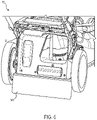
- FIG. 6 illustrates a rear skirt of the lawnmower of FIG. 1 , according to some embodiments.
- FIG. 7 illustrates another rear skirt of the lawnmower of FIG. 1 , according to some embodiment.
- FIG. 8 illustrates another rear skirt of the lawnmower of FIG. 1 , according to some embodiments.
- FIG. 9 is a block diagram of a method performed by the controller of FIG. 4 , according to some embodiments.
- FIG. 1 illustrates a lawnmower 10 (e.g., a walk-behind lawnmower), according to some embodiments.
- the lawnmower 10 includes a housing 12 and a handle 16 coupled to the housing 12 by support beams 14 .
- a motor housing 18 is coupled to an upper portion of the housing 12 and houses a motor configured to drives cutting blades 20 .
- the blades 20 are coupled to a lower portion of the housing 12 .
- the lawnmower 10 includes a plurality of wheels 22 driven by the motor. In some embodiments, the plurality of wheels 22 are driven by an auxiliary motor within the motor housing 18 .
- a portion of the housing 12 forms a metal chassis 30 , as described below in more detail.
- FIGS. 2 A- 2 B illustrate the handle 16 , according to some embodiments.
- the handle 16 includes a handle housing 24 .
- a first paddle 26 a and a second paddle 26 b extend from the handle housing 24 and act as a switch or trigger.
- the first paddle 26 a and second paddle 26 b are both embedded in the handle housing 24 .
- operation of the first paddle 26 a and the second paddle 26 b may drive the motor and/or the auxiliary motor.
- the lawnmower 10 is a battery-powered lawnmower.
- FIG. 3 illustrates a battery pack 100 that includes a battery pack housing 105 and an interface portion 110 for connecting the battery pack 100 to a device, such as the lawnmower 10 . While embodiments described herein primarily relate to a battery-powered lawnmower, in some embodiments, the lawnmower 10 is a gasoline-powered lawnmower, a corded lawnmower, or another type of walk-behind lawnmower.
- a controller 200 for the lawnmower 10 is illustrated in FIG. 4 .
- the controller 200 is electrically and/or communicatively connected to a variety of modules or components of the lawnmower 10 .
- the illustrated controller 200 is connected to indicators 245 , secondary sensor(s) 272 (e.g., a speed sensor, a voltage sensor, a temperature sensor, a current sensor, etc.), the paddles 26 (via a contactless switch 158 and a rotation sensor 159 ), a power switching network 255 , and a power input unit 260 .
- the secondary sensor(s) 272 include, among other sensor(s), a current sensor, a voltage sensor, a temperature sensor, an orientation sensor, a speed sensor, and other sensors that assist in monitoring operation of the lawnmower 10 .
- the controller 200 includes a plurality of electrical and electronic components that provide power, operational control, and protection to the components and modules within the controller 200 and/or lawnmower 10 .
- the controller 200 includes, among other things, a processing unit 205 (e.g., a microprocessor, an electronic processor, an electronic controller, a microcontroller, or another suitable programmable device), a memory 225 , input units 230 , and output units 235 .
- the processing unit 205 includes, among other things, a control unit 210 , an arithmetic logic unit (“ALU”) 215 , and a plurality of registers 220 (shown as a group of registers in FIG.
- ALU arithmetic logic unit
- control and/or data buses are shown generally in FIG. 4 for illustrative purposes. The use of one or more control and/or data buses for the interconnection between and communication among the various modules and components would be known to a person skilled in the art in view of the embodiments described herein.
- the memory 225 is a non-transitory computer readable medium and includes, for example, a program storage area and a data storage area.
- the program storage area and the data storage area can include combinations of different types of memory, such as a ROM, a RAM (e.g., DRAM, SDRAM, etc.), EEPROM, flash memory, a hard disk, an SD card, or other suitable magnetic, optical, physical, or electronic memory devices.
- the processing unit 205 is connected to the memory 225 and executes software instruction that are capable of being stored in a RAM of the memory 225 (e.g., during execution), a ROM of the memory 225 (e.g., on a generally permanent basis), or another non-transitory computer readable medium such as another memory or a disc.
- the software included in the implementation of the lawnmower 10 can be stored in the memory 225 of the controller 200 .
- the software includes, for example, firmware, one or more applications, program data, filters, rules, one or more program modules, and other executable instructions.
- the controller 200 is configured to retrieve from the memory 225 and execute, among other things, instructions related to the control processes and methods described herein. In other embodiments, the controller 200 includes additional, fewer, or different components.
- the controller 200 drives the motor 280 to rotate the blades 20 and/or the plurality of wheels 22 in response to a user's actuation of the paddles 26 .
- Depression of the paddles 26 actuates the contactless switch 158 .
- a magnet coupled to the contactless switch 158 rotates with actuation of the contactless switch 158 .
- Rotation of the magnet is sensed by the rotation sensor 159 , which outputs a signal to the controller 200 to drive the motor 280 , and therefore the blades 20 and/or the plurality of wheels 22 .
- the lawnmower 10 may include a trigger switch that is physically actuated in response to actuation of the paddles 26 .
- the controller 200 controls a power switching network 255 (e.g., a FET switching bridge) to drive the motor 280 .
- the power switching network 255 may include a plurality of high side switching elements (e.g., FETs) and a plurality of low side switching elements.
- the controller 200 may control each of the plurality of high side switching elements and the plurality of low side switching elements to drive each phase of the motor 280 .
- the controller 200 may apply a braking force to the motor 280 .
- the power switching network 255 may be controlled to more quickly deaccelerate the motor 280 .
- the controller 200 drives an auxiliary motor to drive the plurality of wheels 22 .
- the motor 280 is controlled to drive the blades 20
- the auxiliary motor is controlled to drive the plurality of wheels 22 .
- the auxiliary motor may be controlled via a second power switching network.
- the indicators 245 are also connected to the controller 200 and receive control signals from the controller 200 to turn on and off or otherwise convey information based on different states of the lawnmower 10 .
- the indicators 245 include, for example, one or more light-emitting diodes (LEDs), or a display screen.
- the indicators 245 can be configured to display conditions of, or information associated with, the lawnmower 10 .
- a battery pack interface 250 is connected to the controller 200 and is configured to couple with the battery pack 100 .
- the battery pack interface 250 includes a combination of mechanical (e.g., a battery pack receiving portion) and electrical components configured to and operable for interfacing (e.g., mechanically, electrically, and communicatively connecting) the lawnmower 10 with the battery pack 100 .
- the battery pack interface 250 is coupled to the power input unit 260 .
- the battery pack interface 250 transmits the power received from the battery pack 100 to the power input unit 260 .
- the power input unit 260 includes active and/or passive components (e.g., voltage step-down controllers, voltage converters, rectifiers, filters, etc.) to regulate or control the power received through the battery pack interface 250 and to the controller 200 .
- the battery pack interface 250 is also coupled to the power switching network 255 . The operation of the power switching network 255 , as controlled by the controller 200 , determines how power is supplied to the motor 280 .
- FIG. 5 illustrates a control system for the battery pack 100 .
- the control system includes a controller 300 .
- the controller 300 is electrically and/or communicatively connected to a variety of modules or components of the battery pack 100 .
- the illustrated controller 300 is connected to one or more battery cells 305 and an interface 310 (e.g., the interface portion 110 of the battery pack 100 illustrated in FIG. 3 ).
- the controller 300 is also connected to one or more voltage sensors or voltage sensing circuits 315 , one or more current sensors or current sensing circuit 320 , and one or more temperature sensors or temperature sensing circuits 325 .
- the controller 300 includes combinations of hardware and software that are operable to, among other things, control the operation of the battery pack 100 , monitor a condition of the battery pack 100 , enable or disable charging of the battery pack 100 , enable or disable discharging of the battery pack 100 , etc.
- the controller 300 includes a plurality of electrical and electronic components that provide power, operational control, and protection to the components and modules within the controller 300 and/or the battery pack 100 .
- the controller 300 includes, among other things, a processing unit 335 (e.g., a microprocessor, a microcontroller, or another suitable programmable device), a memory 340 , input units 345 , and output units 350 .
- the processing unit 335 includes, among other things, a control unit 355 , an arithmetic logic unit (“ALU”) 360 , and a plurality of registers 365 (shown as a group of registers in FIG.
- ALU arithmetic logic unit
- control and/or data buses are shown generally in FIG. 5 for illustrative purposes. The use of one or more control and/or data buses for the interconnection between and communication among the various modules, circuits, and components would be known to a person skilled in the art in view of the invention described herein.
- the memory 340 is a non-transitory computer readable medium and includes, for example, a program storage area and a data storage area.
- the program storage area and the data storage area can include combinations of different types of memory, such as a ROM, a RAM (e.g., DRAM, SDRAM, etc.), EEPROM, flash memory, a hard disk, an SD card, or other suitable magnetic, optical, physical, or electronic memory devices.
- the processing unit 335 is connected to the memory 340 and executes software instructions that are capable of being stored in a RAM of the memory 340 (e.g., during execution), a ROM of the memory 340 (e.g., on a generally permanent basis), or another non-transitory computer readable medium such as another memory or a disc.
- Software included in the implementation of the battery pack 100 can be stored in the memory 340 of the controller 300 .
- the software includes, for example, firmware, one or more applications, program data, filters, rules, one or more program modules, and other executable instructions.
- the controller 300 is configured to retrieve from the memory 340 and execute, among other things, instructions related to the control processes and methods described herein. In other constructions, the controller 300 includes additional, fewer, or different components.
- the interface 310 includes a combination of mechanical components (e.g., rails, grooves, latches, etc.) and electrical components (e.g., one or more terminals) configured to and operable for interfacing (e.g., mechanically, electrically, and communicatively connecting) the battery pack 100 with another device (e.g., a power tool, a battery pack charger, the lawnmower 10 , etc.).
- the interface 310 is configured to receive power via a power line between the one or more battery cells 305 and the interface 310 .
- the interface 310 is also configured to communicatively connect to the controller 300 .
- the metal chassis 30 of the lawnmower 10 can accumulate static charge. This accumulated static charge can be potentially dangerous to an operator of the lawnmower 10 . For example, should the user come into contact with the metal chassis 30 or another conductive portion of the lawnmower 10 connected to the metal chassis 30 , the accumulated static charge on the metal chassis 30 can be discharged through the user in the form of an electric shock.
- FIG. 6 illustrates a rear skirt 500 (also referred to as skirt 500 ) of the lawnmower 10 coupled below the metal chassis 30 .
- the rear skirt 500 is connected to the metal chassis 30 such that the rear skirt 500 provides a conductive path from the metal chassis 30 to ground. Accordingly, the rear skirt 500 creates a discharge path for any static charge accumulated on the metal chassis 30 , thereby achieving electrostatic discharge (“ESD”) of the metal chassis 30 .
- the rear skirt 500 is composed of a metalized plastic or rubber (e.g., metal is integrated with the plastic or rubber at manufacture to allow the rear skirt 500 to conduct electricity).
- the rear skirt 500 is made of or includes a conductive polymer (e.g., polyacetylene (PA), polyaniline (PAM), polypyrrole (PPy), polythiophene (PTH), poly(para-phenylene) (PPP), poly(phenylenevinylene) (PPV), polyfuran (PF), and the like).
- the rear skirt 500 is coated with a metallic coating to make the rear skirt 500 electrically conductive.
- the rear skirt 500 may include a metallic outer boarder (e.g., a metal frame is placed around a circumference of the rear skirt 500 ) to provide the conductive path to ground.
- the rear skirt 500 is made of metal and the entire rear skirt 500 can conduct electricity. In such embodiments, the entire surface area of the rear skirt 500 provides a conductive path.
- the rear skirt 500 includes an embedded conductive path.
- FIG. 7 and FIG. 8 illustrate other embodiments of the rear skirt 500 including one or more conductive paths 505 .
- the conductive path 505 is configured as a strip of metal or a wire (e.g., copper, aluminum, brass, gold, or the like) physically attached to (e.g., screwed, adhered, embedded within, molded within, or otherwise fastened) the rear skirt 500 .
- the conductive path 505 is a conductive metal that provides a conductive path from the metal chassis 30 to the ground, therefore discharging any build-up of static electricity.
- the conductive path 505 is molded into the rear skirt 500 (e.g., at manufacture).
- the rear skirt 500 may be constructed of a non-conductive material (e.g., plastic).
- the conductive path 505 is positioned at approximately a center of the rear skirt 500 .
- the conductive path 505 may be positioned elsewhere on or within the rear skirt 500 , such as at the edges of the rear skirt 500 .
- more than one conductive path 505 is included within the rear skirt 500 .
- a first conductive path 505 A is provided on a first end of the rear skirt 500 and a second conductive path 505 B is provided on a second end of the rear skirt 500 .
- the first conductive path 505 A and the second conductive path 505 B are separated by a non-conductive portion 510 . While only two conductive paths are illustrated, in some embodiments, the rear skirt 500 includes more than two conductive paths (e.g., three conductive paths, four conductive paths, etc.).
- FIG. 9 provides a method 900 for discharging the metal chassis 30 of the lawnmower 10 , according to some embodiments.
- the method 900 includes detecting, with the controller 200 , actuation of an input device.
- the controller 200 detects, using the rotation sensor 159 , actuation of the paddles 26 .
- the method 900 includes controlling, with the controller 200 , the motor 280 based on actuation of the input device.
- the controller 200 receives the output from the rotation sensor 159 and drives the motor 280 by controlling the power switching network 255 based on the output from the rotation sensor 159 .
- the controller 200 controls the output of the auxiliary motor based on the actuation of the paddles 26 .
- the method 900 includes discharging, with the rear skirt 500 , an electrostatic buildup accumulated on the metal chassis 30 of the lawnmower 10 to the ground.
- the electrostatic charge that has accumulated on the metal chassis 30 is discharged to the ground through the conductive path 505 of the rear skirt 500 in FIG. 7 .
- the accumulated electrostatic discharge occurs through the rear skirt 500 itself, such as the rear skirt 500 as described in FIG. 6 .
- the accumulated electrostatic charge is continuously discharged to the ground during operation of the motor 280 .
- an electrical connection is made (e.g., between the metal chassis 30 and the rear skirt 500 upon actuation of the input device (e.g., paddles 26 ).
- embodiments described herein provide, among other things, a rear skirt coupled to the lawnmower housing and configured to discharge static buildup of the lawnmower housing.
Landscapes
- Life Sciences & Earth Sciences (AREA)
- Environmental Sciences (AREA)
- Engineering & Computer Science (AREA)
- Mechanical Engineering (AREA)
- Harvester Elements (AREA)
- Charge And Discharge Circuits For Batteries Or The Like (AREA)
- Arrangement Or Mounting Of Propulsion Units For Vehicles (AREA)
Abstract
Description
- This application claims the benefit of U.S. Provisional Patent Application No. 63/231,401, filed Aug. 10, 2021, the entire content of which is hereby incorporated by reference.
- Embodiments described herein relate to discharging static buildup of electric lawnmowers. Specifically, embodiments described herein provide a rear skirt coupled to the lawnmower housing and configured to discharge static buildup of the lawnmower housing.
- Walk-behind lawnmowers described herein include a housing including a metal chassis, a handle coupled to the housing by support beams, a battery pack interface configured to receive a battery pack, a motor housed within the housing, one or more cutting blades configured to be driven by the motor, and a skirt coupled to the metal chassis of the housing. The skirt is configured to provide a conductive path to discharge an electrostatic charge accumulated on the metal chassis.
- Walk-behind lawnmowers described herein include a housing, a handle coupled to the housing by support beams, a battery pack interface configured to receive a battery pack, a motor housed within the housing, one or more cutting blades configured to be driven by the motor, and a skirt coupled to the housing. The skirt includes a conductive path molded into the skirt. The conductive path is configured to discharge an electrostatic charge accumulated on the housing.
- Methods described herein provide for discharging electrostatic buildup of a walk-behind lawnmower. The lawnmower includes a housing including a metal chassis, a motor housed within the housing, and a battery pack interface configured to receive a battery pack. The methods include detecting, via a controller, actuation of an input device, controlling, via the controller, the motor based on actuation of the input device, and discharging, via a rear skirt connected to the metal chassis, an electrostatic buildup accumulated on the metal chassis of the lawnmower.
- Before any embodiments are explained in detail, it is to be understood that the embodiments are not limited in their application to the details of the configuration and arrangement of components set forth in the following description or illustrated in the accompanying drawings. The embodiments are capable of being practiced or of being carried out in various ways. Also, it is to be understood that the phraseology and terminology used herein are for the purpose of description and should not be regarded as limiting. The use of “including,” “comprising,” or “having” and variations thereof are meant to encompass the items listed thereafter and equivalents thereof as well as additional items. Unless specified or limited otherwise, the terms “mounted,” “connected,” “supported,” and “coupled” and variations thereof are used broadly and encompass both direct and indirect mountings, connections, supports, and couplings.
- In addition, it should be understood that embodiments may include hardware, software, and electronic components or modules that, for purposes of discussion, may be illustrated and described as if the majority of the components were implemented solely in hardware. However, one of ordinary skill in the art, and based on a reading of this detailed description, would recognize that, in at least one embodiment, the electronic-based aspects may be implemented in software (e.g., stored on non-transitory computer-readable medium) executable by one or more processing units, such as a microprocessor and/or application specific integrated circuits (“ASICs”). As such, it should be noted that a plurality of hardware and software-based devices, as well as a plurality of different structural components, may be utilized to implement the embodiments. For example, “servers,” “computing devices,” “controllers,” “processors,” etc., described in the specification can include one or more processing units, one or more computer-readable medium modules, one or more input/output interfaces, and various connections (e.g., a system bus) connecting the components.
- Relative terminology, such as, for example, “about,” “approximately,” “substantially,” etc., used in connection with a quantity or condition would be understood by those of ordinary skill to be inclusive of the stated value and has the meaning dictated by the context (e.g., the term includes at least the degree of error associated with the measurement accuracy, tolerances [e.g., manufacturing, assembly, use, etc.] associated with the particular value, etc.). Such terminology should also be considered as disclosing the range defined by the absolute values of the two endpoints. For example, the expression “from about 2 to about 4” also discloses the range “from 2 to 4”. The relative terminology may refer to plus or minus a percentage (e.g., 1%, 5%, 10%, or more) of an indicated value.
- It should be understood that although certain drawings illustrate hardware and software located within particular devices, these depictions are for illustrative purposes only. Functionality described herein as being performed by one component may be performed by multiple components in a distributed manner. Likewise, functionality performed by multiple components may be consolidated and performed by a single component. In some embodiments, the illustrated components may be combined or divided into separate software, firmware and/or hardware. For example, instead of being located within and performed by a single electronic processor, logic and processing may be distributed among multiple electronic processors. Regardless of how they are combined or divided, hardware and software components may be located on the same computing device or may be distributed among different computing devices connected by one or more networks or other suitable communication links. Similarly, a component described as performing particular functionality may also perform additional functionality not described herein. For example, a device or structure that is “configured” in a certain way is configured in at least that way but may also be configured in ways that are not explicitly listed.
-
FIG. 1 is a lawnmower, according to some embodiments. -
FIGS. 2A-2B are perspective views of a handle of the lawnmower ofFIG. 1 , according to some embodiments. -
FIG. 3 is a perspective view of a battery pack, according to some embodiments. -
FIG. 4 is a block diagram of a control system for the lawnmower ofFIG. 1 , according to some embodiments. -
FIG. 5 is a block diagram of a control system for the battery pack ofFIG. 3 , according to some embodiments. -
FIG. 6 illustrates a rear skirt of the lawnmower ofFIG. 1 , according to some embodiments. -
FIG. 7 illustrates another rear skirt of the lawnmower ofFIG. 1 , according to some embodiment. -
FIG. 8 illustrates another rear skirt of the lawnmower ofFIG. 1 , according to some embodiments. -
FIG. 9 is a block diagram of a method performed by the controller ofFIG. 4 , according to some embodiments. -
FIG. 1 illustrates a lawnmower 10 (e.g., a walk-behind lawnmower), according to some embodiments. Thelawnmower 10 includes ahousing 12 and ahandle 16 coupled to thehousing 12 bysupport beams 14. Amotor housing 18 is coupled to an upper portion of thehousing 12 and houses a motor configured to drivescutting blades 20. Theblades 20 are coupled to a lower portion of thehousing 12. Thelawnmower 10 includes a plurality ofwheels 22 driven by the motor. In some embodiments, the plurality ofwheels 22 are driven by an auxiliary motor within themotor housing 18. A portion of thehousing 12 forms ametal chassis 30, as described below in more detail. -
FIGS. 2A-2B illustrate thehandle 16, according to some embodiments. Thehandle 16 includes ahandle housing 24. In the embodiment ofFIG. 2A , afirst paddle 26 a and asecond paddle 26 b (e.g., paddles 26) extend from thehandle housing 24 and act as a switch or trigger. In the embodiment ofFIG. 2B , thefirst paddle 26 a andsecond paddle 26 b are both embedded in thehandle housing 24. In both embodiments, operation of thefirst paddle 26 a and thesecond paddle 26 b may drive the motor and/or the auxiliary motor. - In some embodiments, the
lawnmower 10 is a battery-powered lawnmower.FIG. 3 illustrates abattery pack 100 that includes abattery pack housing 105 and aninterface portion 110 for connecting thebattery pack 100 to a device, such as thelawnmower 10. While embodiments described herein primarily relate to a battery-powered lawnmower, in some embodiments, thelawnmower 10 is a gasoline-powered lawnmower, a corded lawnmower, or another type of walk-behind lawnmower. - A
controller 200 for thelawnmower 10 is illustrated inFIG. 4 . Thecontroller 200 is electrically and/or communicatively connected to a variety of modules or components of thelawnmower 10. For example, the illustratedcontroller 200 is connected toindicators 245, secondary sensor(s) 272 (e.g., a speed sensor, a voltage sensor, a temperature sensor, a current sensor, etc.), the paddles 26 (via acontactless switch 158 and a rotation sensor 159), apower switching network 255, and apower input unit 260. In some embodiments, the secondary sensor(s) 272 include, among other sensor(s), a current sensor, a voltage sensor, a temperature sensor, an orientation sensor, a speed sensor, and other sensors that assist in monitoring operation of thelawnmower 10. - The
controller 200 includes a plurality of electrical and electronic components that provide power, operational control, and protection to the components and modules within thecontroller 200 and/orlawnmower 10. For example, thecontroller 200 includes, among other things, a processing unit 205 (e.g., a microprocessor, an electronic processor, an electronic controller, a microcontroller, or another suitable programmable device), amemory 225,input units 230, andoutput units 235. Theprocessing unit 205 includes, among other things, acontrol unit 210, an arithmetic logic unit (“ALU”) 215, and a plurality of registers 220 (shown as a group of registers inFIG. 4 ), and is implemented using a known computer architecture (e.g., a modified Harvard architecture, a von Neumann architecture, etc.). Theprocessing unit 205, thememory 225, theinput units 230, and theoutput units 235, as well as the various modules connected to thecontroller 200 are connected by one or more control and/or data buses (e.g., common bus 240). The control and/or data buses are shown generally inFIG. 4 for illustrative purposes. The use of one or more control and/or data buses for the interconnection between and communication among the various modules and components would be known to a person skilled in the art in view of the embodiments described herein. - The
memory 225 is a non-transitory computer readable medium and includes, for example, a program storage area and a data storage area. The program storage area and the data storage area can include combinations of different types of memory, such as a ROM, a RAM (e.g., DRAM, SDRAM, etc.), EEPROM, flash memory, a hard disk, an SD card, or other suitable magnetic, optical, physical, or electronic memory devices. Theprocessing unit 205 is connected to thememory 225 and executes software instruction that are capable of being stored in a RAM of the memory 225 (e.g., during execution), a ROM of the memory 225 (e.g., on a generally permanent basis), or another non-transitory computer readable medium such as another memory or a disc. Software included in the implementation of thelawnmower 10 can be stored in thememory 225 of thecontroller 200. The software includes, for example, firmware, one or more applications, program data, filters, rules, one or more program modules, and other executable instructions. Thecontroller 200 is configured to retrieve from thememory 225 and execute, among other things, instructions related to the control processes and methods described herein. In other embodiments, thecontroller 200 includes additional, fewer, or different components. - The
controller 200 drives themotor 280 to rotate theblades 20 and/or the plurality ofwheels 22 in response to a user's actuation of thepaddles 26. Depression of thepaddles 26 actuates thecontactless switch 158. A magnet coupled to thecontactless switch 158 rotates with actuation of thecontactless switch 158. Rotation of the magnet is sensed by therotation sensor 159, which outputs a signal to thecontroller 200 to drive themotor 280, and therefore theblades 20 and/or the plurality ofwheels 22. While embodiments described herein primarily relate to a contactless switch configuration, in other instances, thelawnmower 10 may include a trigger switch that is physically actuated in response to actuation of thepaddles 26. - In some embodiments, the
controller 200 controls a power switching network 255 (e.g., a FET switching bridge) to drive themotor 280. For example, thepower switching network 255 may include a plurality of high side switching elements (e.g., FETs) and a plurality of low side switching elements. Thecontroller 200 may control each of the plurality of high side switching elements and the plurality of low side switching elements to drive each phase of themotor 280. When thepaddles 26 are released, thecontroller 200 may apply a braking force to themotor 280. For example, thepower switching network 255 may be controlled to more quickly deaccelerate themotor 280. In some embodiments, thecontroller 200 drives an auxiliary motor to drive the plurality ofwheels 22. For example, themotor 280 is controlled to drive theblades 20, and the auxiliary motor is controlled to drive the plurality ofwheels 22. The auxiliary motor may be controlled via a second power switching network. - The
indicators 245 are also connected to thecontroller 200 and receive control signals from thecontroller 200 to turn on and off or otherwise convey information based on different states of thelawnmower 10. Theindicators 245 include, for example, one or more light-emitting diodes (LEDs), or a display screen. Theindicators 245 can be configured to display conditions of, or information associated with, thelawnmower 10. - A
battery pack interface 250 is connected to thecontroller 200 and is configured to couple with thebattery pack 100. Thebattery pack interface 250 includes a combination of mechanical (e.g., a battery pack receiving portion) and electrical components configured to and operable for interfacing (e.g., mechanically, electrically, and communicatively connecting) thelawnmower 10 with thebattery pack 100. Thebattery pack interface 250 is coupled to thepower input unit 260. Thebattery pack interface 250 transmits the power received from thebattery pack 100 to thepower input unit 260. Thepower input unit 260 includes active and/or passive components (e.g., voltage step-down controllers, voltage converters, rectifiers, filters, etc.) to regulate or control the power received through thebattery pack interface 250 and to thecontroller 200. In some embodiments, thebattery pack interface 250 is also coupled to thepower switching network 255. The operation of thepower switching network 255, as controlled by thecontroller 200, determines how power is supplied to themotor 280. -
FIG. 5 illustrates a control system for thebattery pack 100. The control system includes acontroller 300. Thecontroller 300 is electrically and/or communicatively connected to a variety of modules or components of thebattery pack 100. For example, the illustratedcontroller 300 is connected to one ormore battery cells 305 and an interface 310 (e.g., theinterface portion 110 of thebattery pack 100 illustrated inFIG. 3 ). Thecontroller 300 is also connected to one or more voltage sensors orvoltage sensing circuits 315, one or more current sensors orcurrent sensing circuit 320, and one or more temperature sensors ortemperature sensing circuits 325. Thecontroller 300 includes combinations of hardware and software that are operable to, among other things, control the operation of thebattery pack 100, monitor a condition of thebattery pack 100, enable or disable charging of thebattery pack 100, enable or disable discharging of thebattery pack 100, etc. - The
controller 300 includes a plurality of electrical and electronic components that provide power, operational control, and protection to the components and modules within thecontroller 300 and/or thebattery pack 100. For example, thecontroller 300 includes, among other things, a processing unit 335 (e.g., a microprocessor, a microcontroller, or another suitable programmable device), amemory 340,input units 345, andoutput units 350. Theprocessing unit 335 includes, among other things, acontrol unit 355, an arithmetic logic unit (“ALU”) 360, and a plurality of registers 365 (shown as a group of registers inFIG. 5 ), and is implemented using a known computer architecture (e.g., a modified Harvard architecture, a von Neumann architecture, etc.). Theprocessing unit 335, thememory 340, theinput units 345, and theoutput units 350, as well as the various modules or circuits connected to thecontroller 300, are connected by one or more control and/or data buses (e.g., common bus 370). The control and/or data buses are shown generally inFIG. 5 for illustrative purposes. The use of one or more control and/or data buses for the interconnection between and communication among the various modules, circuits, and components would be known to a person skilled in the art in view of the invention described herein. - The
memory 340 is a non-transitory computer readable medium and includes, for example, a program storage area and a data storage area. The program storage area and the data storage area can include combinations of different types of memory, such as a ROM, a RAM (e.g., DRAM, SDRAM, etc.), EEPROM, flash memory, a hard disk, an SD card, or other suitable magnetic, optical, physical, or electronic memory devices. Theprocessing unit 335 is connected to thememory 340 and executes software instructions that are capable of being stored in a RAM of the memory 340 (e.g., during execution), a ROM of the memory 340 (e.g., on a generally permanent basis), or another non-transitory computer readable medium such as another memory or a disc. Software included in the implementation of thebattery pack 100 can be stored in thememory 340 of thecontroller 300. The software includes, for example, firmware, one or more applications, program data, filters, rules, one or more program modules, and other executable instructions. Thecontroller 300 is configured to retrieve from thememory 340 and execute, among other things, instructions related to the control processes and methods described herein. In other constructions, thecontroller 300 includes additional, fewer, or different components. - The
interface 310 includes a combination of mechanical components (e.g., rails, grooves, latches, etc.) and electrical components (e.g., one or more terminals) configured to and operable for interfacing (e.g., mechanically, electrically, and communicatively connecting) thebattery pack 100 with another device (e.g., a power tool, a battery pack charger, thelawnmower 10, etc.). For example, theinterface 310 is configured to receive power via a power line between the one ormore battery cells 305 and theinterface 310. Theinterface 310 is also configured to communicatively connect to thecontroller 300. - During operation of the
lawnmower 10, themetal chassis 30 of thelawnmower 10 can accumulate static charge. This accumulated static charge can be potentially dangerous to an operator of thelawnmower 10. For example, should the user come into contact with themetal chassis 30 or another conductive portion of thelawnmower 10 connected to themetal chassis 30, the accumulated static charge on themetal chassis 30 can be discharged through the user in the form of an electric shock. -
FIG. 6 illustrates a rear skirt 500 (also referred to as skirt 500) of thelawnmower 10 coupled below themetal chassis 30. Therear skirt 500 is connected to themetal chassis 30 such that therear skirt 500 provides a conductive path from themetal chassis 30 to ground. Accordingly, therear skirt 500 creates a discharge path for any static charge accumulated on themetal chassis 30, thereby achieving electrostatic discharge (“ESD”) of themetal chassis 30. As one example, therear skirt 500 is composed of a metalized plastic or rubber (e.g., metal is integrated with the plastic or rubber at manufacture to allow therear skirt 500 to conduct electricity). In other examples, therear skirt 500 is made of or includes a conductive polymer (e.g., polyacetylene (PA), polyaniline (PAM), polypyrrole (PPy), polythiophene (PTH), poly(para-phenylene) (PPP), poly(phenylenevinylene) (PPV), polyfuran (PF), and the like). In some embodiments, therear skirt 500 is coated with a metallic coating to make therear skirt 500 electrically conductive. Therear skirt 500 may include a metallic outer boarder (e.g., a metal frame is placed around a circumference of the rear skirt 500) to provide the conductive path to ground. In other embodiments, therear skirt 500 is made of metal and the entirerear skirt 500 can conduct electricity. In such embodiments, the entire surface area of therear skirt 500 provides a conductive path. - In some instances, rather than the entire
rear skirt 500 providing a conductive path (as shown inFIG. 6 ), therear skirt 500 includes an embedded conductive path. For example,FIG. 7 andFIG. 8 illustrate other embodiments of therear skirt 500 including one or moreconductive paths 505. InFIG. 7 , theconductive path 505 is configured as a strip of metal or a wire (e.g., copper, aluminum, brass, gold, or the like) physically attached to (e.g., screwed, adhered, embedded within, molded within, or otherwise fastened) therear skirt 500. Theconductive path 505 is a conductive metal that provides a conductive path from themetal chassis 30 to the ground, therefore discharging any build-up of static electricity. In some embodiments, theconductive path 505 is molded into the rear skirt 500 (e.g., at manufacture). In the embodiments ofFIG. 7 andFIG. 8 , therear skirt 500 may be constructed of a non-conductive material (e.g., plastic). In the example ofFIG. 7 , theconductive path 505 is positioned at approximately a center of therear skirt 500. In other embodiments, theconductive path 505 may be positioned elsewhere on or within therear skirt 500, such as at the edges of therear skirt 500. - In
FIG. 8 , more than oneconductive path 505 is included within therear skirt 500. Particularly, in the example ofFIG. 8 , a firstconductive path 505A is provided on a first end of therear skirt 500 and a secondconductive path 505B is provided on a second end of therear skirt 500. The firstconductive path 505A and the secondconductive path 505B are separated by anon-conductive portion 510. While only two conductive paths are illustrated, in some embodiments, therear skirt 500 includes more than two conductive paths (e.g., three conductive paths, four conductive paths, etc.). -
FIG. 9 provides amethod 900 for discharging themetal chassis 30 of thelawnmower 10, according to some embodiments. Atblock 905, themethod 900 includes detecting, with thecontroller 200, actuation of an input device. For example, thecontroller 200 detects, using therotation sensor 159, actuation of thepaddles 26. Atblock 910, themethod 900 includes controlling, with thecontroller 200, themotor 280 based on actuation of the input device. For example, thecontroller 200 receives the output from therotation sensor 159 and drives themotor 280 by controlling thepower switching network 255 based on the output from therotation sensor 159. In some embodiments, thecontroller 200 controls the output of the auxiliary motor based on the actuation of thepaddles 26. - At
block 915, themethod 900 includes discharging, with therear skirt 500, an electrostatic buildup accumulated on themetal chassis 30 of thelawnmower 10 to the ground. As one example, the electrostatic charge that has accumulated on themetal chassis 30 is discharged to the ground through theconductive path 505 of therear skirt 500 inFIG. 7 . As another example, the accumulated electrostatic discharge occurs through therear skirt 500 itself, such as therear skirt 500 as described inFIG. 6 . In some embodiments, the accumulated electrostatic charge is continuously discharged to the ground during operation of themotor 280. In some embodiments, an electrical connection is made (e.g., between themetal chassis 30 and therear skirt 500 upon actuation of the input device (e.g., paddles 26). - Thus, embodiments described herein provide, among other things, a rear skirt coupled to the lawnmower housing and configured to discharge static buildup of the lawnmower housing.
Claims (20)
Priority Applications (1)
| Application Number | Priority Date | Filing Date | Title |
|---|---|---|---|
| US17/885,457 US12543640B2 (en) | 2021-08-10 | 2022-08-10 | Lawnmower including electrostatic discharge |
Applications Claiming Priority (2)
| Application Number | Priority Date | Filing Date | Title |
|---|---|---|---|
| US202163231401P | 2021-08-10 | 2021-08-10 | |
| US17/885,457 US12543640B2 (en) | 2021-08-10 | 2022-08-10 | Lawnmower including electrostatic discharge |
Publications (2)
| Publication Number | Publication Date |
|---|---|
| US20230051663A1 true US20230051663A1 (en) | 2023-02-16 |
| US12543640B2 US12543640B2 (en) | 2026-02-10 |
Family
ID=85176617
Family Applications (1)
| Application Number | Title | Priority Date | Filing Date |
|---|---|---|---|
| US17/885,457 Active 2044-08-26 US12543640B2 (en) | 2021-08-10 | 2022-08-10 | Lawnmower including electrostatic discharge |
Country Status (4)
| Country | Link |
|---|---|
| US (1) | US12543640B2 (en) |
| CN (1) | CN222532245U (en) |
| DE (1) | DE112022003236T5 (en) |
| WO (1) | WO2023018837A1 (en) |
Citations (10)
| Publication number | Priority date | Publication date | Assignee | Title |
|---|---|---|---|---|
| US3570225A (en) * | 1969-06-02 | 1971-03-16 | Leonard A Miskiewicz | Safety shield |
| USH1104H (en) * | 1990-03-02 | 1992-09-01 | The United States Of America As Represented By The Secretary Of The Navy | Air cushion vehicle conductive/semiconductive flexible skirt, and method |
| US5638667A (en) * | 1995-06-26 | 1997-06-17 | The Toro Company | Mulching mower |
| US5703450A (en) * | 1994-06-27 | 1997-12-30 | Josephs; Harold | Safety guard for pedestrian-operated machines having rotatable blades |
| US20020179311A1 (en) * | 2001-05-29 | 2002-12-05 | Philip Alper | Vehicle antistatic device |
| US20080112105A1 (en) * | 2006-10-26 | 2008-05-15 | Chen David Z | Static electricity dissipation device for vehicles |
| US20100037418A1 (en) * | 2005-12-02 | 2010-02-18 | Irobot Corporation | Autonomous Coverage Robots |
| US20100115901A1 (en) * | 2008-11-13 | 2010-05-13 | Hurst John O | Lawn mower having collecting and mulching modes |
| US20170202138A1 (en) * | 2014-09-15 | 2017-07-20 | Pellenc (Societe Anonyme) | Wheeled lawnmower for walking driver |
| US20180160622A1 (en) * | 2015-07-27 | 2018-06-14 | Pellenc (Societe Anonyme) | Electric mower with multiple blades |
Family Cites Families (63)
| Publication number | Priority date | Publication date | Assignee | Title |
|---|---|---|---|---|
| US3230696A (en) | 1964-04-02 | 1966-01-25 | M T & D Company | Bag-supporting means for mowers |
| US3579966A (en) | 1968-10-04 | 1971-05-25 | Perfection Mfg Co | Grass catcher assembly |
| US3750378A (en) | 1971-08-27 | 1973-08-07 | Toro Mfg Corp | Rotary mower with safety discharge |
| US3820313A (en) | 1972-10-24 | 1974-06-28 | Perfection Mfg Co | Grass catcher assembly |
| US4047367A (en) | 1974-08-02 | 1977-09-13 | The Toro Company | Rotary mower bagging apparatus |
| US4126986A (en) | 1976-11-19 | 1978-11-28 | Outboard Marine Corporation | Grass collection bag for rotary lawn mower |
| US4214424A (en) | 1979-01-22 | 1980-07-29 | Roper Corporation | Catcher securement for rear bagger |
| USD304728S (en) | 1987-11-30 | 1989-11-21 | Piorkowski Peter V | String trimmer attachment for a lawnmower |
| USD311009S (en) | 1988-12-02 | 1990-10-02 | Wilkins Robert W | Grass trimmer attachment for lawn mowers |
| US4897988A (en) | 1989-02-10 | 1990-02-06 | Deere & Company | Lawn mower discharge opening cover and deflector |
| JPH02127113U (en) | 1989-03-31 | 1990-10-19 | ||
| AU116308S (en) | 1992-02-12 | 1993-02-09 | Black & Decker Inc | A lawn mower |
| US5398491A (en) | 1992-10-13 | 1995-03-21 | Honda Giken Kogyo Kabushiki Kaisha | Lawn mower side discharge chute |
| AU5579294A (en) | 1992-11-18 | 1994-06-08 | James George Rolfe | Rotary lawnmower attachment |
| JPH06169624A (en) | 1992-12-04 | 1994-06-21 | Iseki & Co Ltd | Variable collector in lawn mower |
| USD359291S (en) | 1993-05-12 | 1995-06-13 | Tihonovich Albert J | Mower with line weeder/trimmer attachment |
| USD390576S (en) | 1996-06-11 | 1998-02-10 | Makita Corporation | Mower |
| JP3160759B2 (en) | 1996-09-17 | 2001-04-25 | 本田技研工業株式会社 | Electric lawn mower |
| USD421265S (en) | 1997-08-27 | 2000-02-29 | Honda Giken Kogyo Kabushiki Kaisha | Lawn mower |
| US5992135A (en) | 1997-12-08 | 1999-11-30 | Deere & Company | Discharge chute support member |
| US6044634A (en) | 1998-04-03 | 2000-04-04 | Wright Manufacturing, Inc. | Pivoting grass catcher attachment to self-propelled power mower |
| USD424070S (en) | 1998-07-23 | 2000-05-02 | Ariens Company | Lawnmower |
| USD450064S1 (en) | 2000-08-11 | 2001-11-06 | Black & Decker Inc. | Mower |
| JP4607382B2 (en) | 2000-12-28 | 2011-01-05 | 本田技研工業株式会社 | Walking type work machine |
| US6910322B2 (en) | 2003-05-28 | 2005-06-28 | Ariens Company | Grass catcher attachment method and apparatus |
| USD489734S1 (en) | 2003-06-10 | 2004-05-11 | Macauto Industrial Co., Ltd. | Lawn mower |
| US7275615B2 (en) | 2004-05-21 | 2007-10-02 | Textron Inc. | Speed control system for walk behind powered equipment |
| US7240756B2 (en) | 2004-05-21 | 2007-07-10 | Textron Inc. | Method of operator presence control on walk behind powered equipment |
| JP4497079B2 (en) | 2005-10-26 | 2010-07-07 | パナソニック電工株式会社 | Lawn mower |
| USD544501S1 (en) | 2006-04-26 | 2007-06-12 | Hsin-Chih Chung Lee | Petrol lawn mower |
| JP4925723B2 (en) | 2006-05-24 | 2012-05-09 | 本田技研工業株式会社 | Lawn mower drive operation mechanism |
| US7726110B2 (en) | 2006-08-24 | 2010-06-01 | Exmark Manufacturing Company, Inc. | Discharge chute for turf mower |
| FR2908264B1 (en) | 2006-11-06 | 2008-12-12 | Renault Sas | ACTUATOR FOR THE FLOW OF ELECTROSTATIC LOADS IN A MOTOR VEHICLE |
| US20090266042A1 (en) | 2008-04-25 | 2009-10-29 | Mooney P Wade | Mower |
| US20110108335A1 (en) | 2008-06-30 | 2011-05-12 | Andreas Levander | Drive hand-control system for a lawn mower |
| NZ570911A (en) | 2008-08-29 | 2010-01-29 | Masport Ltd | A lawn mower with a shredder blade feed by a tube that passes through the belt sending power to the rear wheels |
| USD605667S1 (en) | 2008-09-29 | 2009-12-08 | Neuton, Inc. | Lawn mower |
| USD600254S1 (en) | 2008-09-29 | 2009-09-15 | Neuton, Inc. | Lawn mower |
| US8275516B2 (en) | 2009-07-21 | 2012-09-25 | Trimble Navigation Limited | Agricultural vehicle autopilot rollover risk assessment system |
| USD620029S1 (en) | 2009-09-11 | 2010-07-20 | Black & Decker Inc. | Mower |
| US8046980B1 (en) | 2010-08-02 | 2011-11-01 | Elaine Schroeck | Weed whacker attachment |
| USD665823S1 (en) | 2010-10-11 | 2012-08-21 | Andreas Stihl Ag & Co. Kg | Battery powered lawnmower |
| USD653265S1 (en) | 2011-01-04 | 2012-01-31 | Black & Decker Inc. | Lawnmower |
| AU338056S (en) | 2011-01-04 | 2011-08-11 | Black & Decker Inc | Lawnmower |
| USD648354S1 (en) | 2011-03-16 | 2011-11-08 | Makita Corporation | Mower |
| US9651138B2 (en) | 2011-09-30 | 2017-05-16 | Mtd Products Inc. | Speed control assembly for a self-propelled walk-behind lawn mower |
| EP2908617B1 (en) | 2012-10-17 | 2020-01-01 | Husqvarna AB | Smart ignition system |
| JP6103907B2 (en) | 2012-12-07 | 2017-03-29 | 株式会社クボタ | Mohr and mower with the mower |
| USD685822S1 (en) | 2013-01-04 | 2013-07-09 | Mtd Products Inc | Blower attachment for a walk-behind lawn mower |
| CN105794388A (en) | 2014-12-30 | 2016-07-27 | 南京德朔实业有限公司 | Power tool |
| JP6382761B2 (en) | 2015-03-30 | 2018-08-29 | 株式会社クボタ | Self-propelled vehicle |
| CN106258180B (en) | 2015-05-20 | 2019-03-08 | 南京德朔实业有限公司 | walk mower |
| US9538699B1 (en) | 2015-07-06 | 2017-01-10 | Honda Motor Co., Ltd. | Adjustable ground speed and acceleration control devices, systems, and methods for walk-behind equipment |
| US9807929B2 (en) | 2016-01-20 | 2017-11-07 | Deere & Company | Mower deck side discharge chute mounting |
| JP2018082682A (en) | 2016-11-25 | 2018-05-31 | 本田技研工業株式会社 | Working machine |
| USD834071S1 (en) | 2017-03-14 | 2018-11-20 | Husqvarna Ab | Lawnmower |
| USD834072S1 (en) | 2017-03-14 | 2018-11-20 | Husqvarna Ab | Lawnmower |
| CN117256299A (en) | 2017-06-23 | 2023-12-22 | 创科(澳门离岸商业服务)有限公司 | Lawn mower |
| JP6825513B2 (en) | 2017-07-31 | 2021-02-03 | 井関農機株式会社 | Riding mower |
| EP3729937B1 (en) | 2017-12-19 | 2023-07-05 | Kubota Corporation | Autonomous travel work machine |
| CN211671395U (en) * | 2019-01-04 | 2020-10-16 | 南京德朔实业有限公司 | Lawn mower |
| CN210202483U (en) | 2019-05-07 | 2020-03-31 | 曹丹 | Novel mower |
| US11716932B2 (en) | 2020-02-19 | 2023-08-08 | Excel Industries, Inc. | Side-discharge to bagging conversion assembly for mower |
-
2022
- 2022-08-10 WO PCT/US2022/040003 patent/WO2023018837A1/en not_active Ceased
- 2022-08-10 US US17/885,457 patent/US12543640B2/en active Active
- 2022-08-10 CN CN202290000607.8U patent/CN222532245U/en active Active
- 2022-08-10 DE DE112022003236.7T patent/DE112022003236T5/en active Pending
Patent Citations (10)
| Publication number | Priority date | Publication date | Assignee | Title |
|---|---|---|---|---|
| US3570225A (en) * | 1969-06-02 | 1971-03-16 | Leonard A Miskiewicz | Safety shield |
| USH1104H (en) * | 1990-03-02 | 1992-09-01 | The United States Of America As Represented By The Secretary Of The Navy | Air cushion vehicle conductive/semiconductive flexible skirt, and method |
| US5703450A (en) * | 1994-06-27 | 1997-12-30 | Josephs; Harold | Safety guard for pedestrian-operated machines having rotatable blades |
| US5638667A (en) * | 1995-06-26 | 1997-06-17 | The Toro Company | Mulching mower |
| US20020179311A1 (en) * | 2001-05-29 | 2002-12-05 | Philip Alper | Vehicle antistatic device |
| US20100037418A1 (en) * | 2005-12-02 | 2010-02-18 | Irobot Corporation | Autonomous Coverage Robots |
| US20080112105A1 (en) * | 2006-10-26 | 2008-05-15 | Chen David Z | Static electricity dissipation device for vehicles |
| US20100115901A1 (en) * | 2008-11-13 | 2010-05-13 | Hurst John O | Lawn mower having collecting and mulching modes |
| US20170202138A1 (en) * | 2014-09-15 | 2017-07-20 | Pellenc (Societe Anonyme) | Wheeled lawnmower for walking driver |
| US20180160622A1 (en) * | 2015-07-27 | 2018-06-14 | Pellenc (Societe Anonyme) | Electric mower with multiple blades |
Non-Patent Citations (1)
| Title |
|---|
| JP_H02127113_U_I_-_English_translation (Year: 1990) * |
Also Published As
| Publication number | Publication date |
|---|---|
| US12543640B2 (en) | 2026-02-10 |
| CN222532245U (en) | 2025-02-28 |
| WO2023018837A1 (en) | 2023-02-16 |
| DE112022003236T5 (en) | 2024-04-25 |
Similar Documents
| Publication | Publication Date | Title |
|---|---|---|
| US12573919B2 (en) | Power tool printed circuit board including embedded busbars | |
| CN106329012B (en) | Battery pack and electric vehicle including the same | |
| EP3968493A1 (en) | Battery management system | |
| US12562328B2 (en) | Contactless switch for a lawnmower | |
| DE602004009542D1 (en) | SYSTEM AND METHOD FOR USING ELECTROSTATICALLY LOADED ROLLING TIRES AS AN ENERGY SOURCE | |
| US20170250549A1 (en) | Battery protection circuit and battery pack including same | |
| CN110832732A (en) | Battery protection circuit and power supply device provided with same | |
| CN110011281A (en) | The anti-locking apparatus of battery overcharge | |
| US20250337232A1 (en) | Resettable electronic fuse for high-power devices | |
| US20240204315A1 (en) | Commercial flexible battery pack with secondary output control | |
| CN106329011A (en) | Battery pack and electric vehicle including the same | |
| US12543640B2 (en) | Lawnmower including electrostatic discharge | |
| KR20170031062A (en) | Battery system with an overcharge protection and/or deep discharge protection | |
| CN110520327A (en) | Battery system for vehicle | |
| US11146077B2 (en) | Voltage equalizing device | |
| US20250364800A1 (en) | Switch shut-off device for power supply system | |
| CN110291679B (en) | Battery pack and data transmission method of battery pack | |
| US12379260B2 (en) | Temperature sensing circuit including multiple thermistors | |
| CN211916895U (en) | Power supply circuit for mechanical arm and mechanical arm | |
| GB2545921A (en) | Battery management system | |
| CN217063349U (en) | Charging device with charging protection function | |
| US20210046847A1 (en) | Charge connector detection | |
| KR20240078974A (en) | Method and device for determining state of charge, and battery system | |
| NL2023697A (en) | Electrically-powered agricultural machine |
Legal Events
| Date | Code | Title | Description |
|---|---|---|---|
| FEPP | Fee payment procedure |
Free format text: ENTITY STATUS SET TO UNDISCOUNTED (ORIGINAL EVENT CODE: BIG.); ENTITY STATUS OF PATENT OWNER: LARGE ENTITY |
|
| STPP | Information on status: patent application and granting procedure in general |
Free format text: DOCKETED NEW CASE - READY FOR EXAMINATION |
|
| AS | Assignment |
Owner name: MILWAUKEE ELECTRIC TOOL CORPORATION, WISCONSIN Free format text: ASSIGNMENT OF ASSIGNORS INTEREST;ASSIGNORS:CASPER, MAXWELL A.;MCCUE, SHANE;ERTL, DANIEL R.;AND OTHERS;SIGNING DATES FROM 20240126 TO 20240221;REEL/FRAME:066604/0727 |
|
| STPP | Information on status: patent application and granting procedure in general |
Free format text: NON FINAL ACTION MAILED |
|
| STPP | Information on status: patent application and granting procedure in general |
Free format text: RESPONSE TO NON-FINAL OFFICE ACTION ENTERED AND FORWARDED TO EXAMINER |
|
| STPP | Information on status: patent application and granting procedure in general |
Free format text: ALLOWED -- NOTICE OF ALLOWANCE NOT YET MAILED Free format text: NOTICE OF ALLOWANCE MAILED -- APPLICATION RECEIVED IN OFFICE OF PUBLICATIONS |
|
| STPP | Information on status: patent application and granting procedure in general |
Free format text: PUBLICATIONS -- ISSUE FEE PAYMENT RECEIVED Free format text: PUBLICATIONS -- ISSUE FEE PAYMENT VERIFIED |
|
| STPP | Information on status: patent application and granting procedure in general |
Free format text: PUBLICATIONS -- ISSUE FEE PAYMENT VERIFIED |
|
| STCF | Information on status: patent grant |
Free format text: PATENTED CASE |