US20230242524A1 - Inhibitors of (alpha-v)(beta-6) integrin - Google Patents
Inhibitors of (alpha-v)(beta-6) integrin Download PDFInfo
- Publication number
- US20230242524A1 US20230242524A1 US17/967,346 US202217967346A US2023242524A1 US 20230242524 A1 US20230242524 A1 US 20230242524A1 US 202217967346 A US202217967346 A US 202217967346A US 2023242524 A1 US2023242524 A1 US 2023242524A1
- Authority
- US
- United States
- Prior art keywords
- compound
- mmol
- tetrahydro
- alkylene
- pentyl
- Prior art date
- Legal status (The legal status is an assumption and is not a legal conclusion. Google has not performed a legal analysis and makes no representation as to the accuracy of the status listed.)
- Granted
Links
Images


Classifications
-
- A—HUMAN NECESSITIES
- A61—MEDICAL OR VETERINARY SCIENCE; HYGIENE
- A61P—SPECIFIC THERAPEUTIC ACTIVITY OF CHEMICAL COMPOUNDS OR MEDICINAL PREPARATIONS
- A61P11/00—Drugs for disorders of the respiratory system
-
- C—CHEMISTRY; METALLURGY
- C07—ORGANIC CHEMISTRY
- C07D—HETEROCYCLIC COMPOUNDS
- C07D471/00—Heterocyclic compounds containing nitrogen atoms as the only ring hetero atoms in the condensed system, at least one ring being a six-membered ring with one nitrogen atom, not provided for by groups C07D451/00 - C07D463/00
- C07D471/02—Heterocyclic compounds containing nitrogen atoms as the only ring hetero atoms in the condensed system, at least one ring being a six-membered ring with one nitrogen atom, not provided for by groups C07D451/00 - C07D463/00 in which the condensed system contains two hetero rings
- C07D471/04—Ortho-condensed systems
-
- A—HUMAN NECESSITIES
- A61—MEDICAL OR VETERINARY SCIENCE; HYGIENE
- A61K—PREPARATIONS FOR MEDICAL, DENTAL OR TOILETRY PURPOSES
- A61K9/00—Medicinal preparations characterised by special physical form
- A61K9/0012—Galenical forms characterised by the site of application
- A61K9/0053—Mouth and digestive tract, i.e. intraoral and peroral administration
-
- A—HUMAN NECESSITIES
- A61—MEDICAL OR VETERINARY SCIENCE; HYGIENE
- A61P—SPECIFIC THERAPEUTIC ACTIVITY OF CHEMICAL COMPOUNDS OR MEDICINAL PREPARATIONS
- A61P13/00—Drugs for disorders of the urinary system
- A61P13/12—Drugs for disorders of the urinary system of the kidneys
-
- A—HUMAN NECESSITIES
- A61—MEDICAL OR VETERINARY SCIENCE; HYGIENE
- A61P—SPECIFIC THERAPEUTIC ACTIVITY OF CHEMICAL COMPOUNDS OR MEDICINAL PREPARATIONS
- A61P35/00—Antineoplastic agents
-
- C—CHEMISTRY; METALLURGY
- C07—ORGANIC CHEMISTRY
- C07D—HETEROCYCLIC COMPOUNDS
- C07D519/00—Heterocyclic compounds containing more than one system of two or more relevant hetero rings condensed among themselves or condensed with a common carbocyclic ring system not provided for in groups C07D453/00 or C07D455/00
Definitions
- Applicants have discovered novel ⁇ v ⁇ 6 integrin inhibitor compounds and evaluated the posession, performance and utility of represeentative examples of such compounds, both for biochemical potency (e.g., using the assay of from Examples below to evaluate fluorescence polarization assays of compounds for ⁇ v ⁇ 6 binding) and in vitro permeability properties (e.g., using a MDCK permeability assay provided in the Examples herein).
- FIG. 1 depicts a table summarizing inhibition of ⁇ v ⁇ 6 integrin by exemplary compounds measured in a fluorescence polarization assay.
- FIG. 3 B depicts a table summarizing permeability properties of exemplary compounds from FIG. 2 measured in a MDCK in vitro assay of Example 20.
- a reference to “A and/or B”, when used in conjunction with open-ended language such as “comprising” can refer, in one embodiment, to A only (optionally including elements other than B); in another embodiment, to B only (optionally including elements other than A); in yet another embodiment, to both A and B (optionally including other elements); etc.
- a particular enantiomer of compound of the present invention may be prepared by asymmetric synthesis, or by derivation with a chiral auxiliary, where the resulting diastereomeric mixture is separated and the auxiliary group cleaved to provide the pure desired enantiomers.
- the molecule contains a basic functional group, such as amino, or an acidic functional group, such as carboxyl, diastereomeric salts are formed with an appropriate optically-active acid or base, followed by resolution of the diastereomers thus formed by fractional crystallization or chromatographic means well known in the art, and subsequent recovery of the pure enantiomers.
- Alkyl refers to a fully saturated cyclic or acyclic, branched or unbranched carbon chain moiety having the number of carbon atoms specified, or up to 30 carbon atoms if no specification is made.
- alkyl of 1 to 8 carbon atoms refers to moieties such as methyl, ethyl, propyl, butyl, pentyl, hexyl, heptyl, and octyl, and those moieties which are positional isomers of these moieties.
- Cycloalkyl means mono- or bicyclic or bridged or spirocyclic, or polycyclic saturated carbocyclic rings, each having from 3 to 12 carbon atoms. Likewise, preferred cycloalkyls have from 3-10 carbon atoms in their ring structure, and more preferably have 3-6 carbons in the ring structure. Cycloalkyl groups may be substituted or unsubstituted.
- lower alkyl means an alkyl group, as defined above, but having from one to ten carbons, more preferably from one to six carbon atoms in its backbone structure such as methyl, ethyl, n-propyl, isopropyl, n-butyl, isobutyl, sec-butyl, and tert-butyl.
- lower alkenyl and “lower alkynyl” have similar chain lengths.
- preferred alkyl groups are lower alkyls.
- a substituent designated herein as alkyl is a lower alkyl.
- Alkenyl refers to any cyclic or acyclic, branched or unbranched unsaturated carbon chain moiety having the number of carbon atoms specified, or up to 26 carbon atoms if no limitation on the number of carbon atoms is specified; and having one or more double bonds in the moiety.
- Alkynyl refers to hydrocarbyl moieties of the scope of alkenyl, but having one or more triple bonds in the moiety.
- alkoxyl groups include methoxy, ethoxy, propoxy, tert-butoxy, and the like.
- An “ether” is two hydrocarbons covalently linked by an oxygen. Accordingly, the substituent of an alkyl that renders that alkyl an ether is or resembles an alkoxyl, such as can be represented by one of -O-alkyl, -O-alkenyl, -O-alkynyl, —O—(CH 2 ) m —R 10 , where m and R 10 are described below.
- R 11 and R 12 each independently represent a hydrogen, an alkyl, an alkenyl, or —(CH 2 ) m — R 10 .
- alkylamine as used herein means an amine group, as defined above, having a substituted or unsubstituted alkyl attached thereto, i.e., at least one of R 11 and R 12 is an alkyl group.
- an amino group or an alkylamine is basic, meaning it has a conjugate acid with a pK a > 7.00, i.e., the protonated forms of these functional groups have pK a s relative to water above about 7.00.
- each R 14 independently represent a hydrogen or hydrocarbyl group, or two R 14 are taken together with the N atom to which they are attached complete a heterocycle having from 4 to 8 atoms in the ring structure.
- the aromatic ring may be substituted at one or more ring positions with one or more substituents, such as halogen, azide, alkyl, aralkyl, alkenyl, alkynyl, cycloalkyl, hydroxyl, alkoxyl, amino, nitro, sulfhydryl, imino, amido, phosphonate, phosphinate, carbonyl, carboxyl, silyl, ether, alkylthio, sulfonyl, sulfonamido, ketone, aldehyde, ester, heterocyclyl, aromatic or heteroaromatic moieties, fluoroalkyl (such as trifluromethyl), cyano, or the like.
- the aryl group can be an unsubstituted C 5 -C 12 aryl and in certain embodiments, the aryl group can be a substituted C 5 -C 10 aryl.
- heterocyclyl or “heterocyclic group” refer to 3- to 12-membered ring structures, more preferably 5- to 12-membered rings, more preferably 5- to 10-membered rings, whose ring structures include one to four heteroatoms.
- Heterocycles can be monocyclic, bicyclic, spirocyclic, or polycyclic.
- Heterocyclyl groups include, for example, thiophene, thianthrene, furan, pyran, isobenzofuran, chromene, xanthene, phenoxathiin, pyrrole, imidazole, pyrazole, isothiazole, isoxazole, pyridine, pyrazine, pyrimidine, pyridazine, indolizine, isoindole, indole, indazole, purine, quinolizine, isoquinoline, quinoline, phthalazine, naphthyridine, quinoxaline, quinazoline, cinnoline, pteridine, carbazole, carboline, phenanthridine, acridine, pyrimidine, phenanthroline, phenazine, phenarsazine, phenothiazine, furazan, phenoxazine, pyrrolidine, o
- X′ is a bond or represents an oxygen or a sulfur
- R 15 represents a hydrogen, an alkyl, an alkenyl, —(CH 2 ) m —R 10 or a pharmaceutically acceptable salt
- R 16 represents a hydrogen, an alkyl, an alkenyl or —(CH 2 ) m —R 10 , where m and R 10 are as defined above.
- X′ is an oxygen and R 15 or R 16 is not hydrogen
- the formula represents an “ester.”
- X′ is an oxygen
- R 15 is as defined above, the moiety is referred to herein as a carboxyl group, and particularly when R 15 is a hydrogen, the formula represents a “carboxylic acid”.
- the term “substituted” is contemplated to include all permissible substituents of organic compounds.
- the permissible substituents include acyclic and cyclic, branched and unbranched, carbocyclic and heterocyclic, aromatic and nonaromatic substituents of organic compounds.
- Illustrative substituents include, for example, those described herein above.
- the permissible substituents can be one or more and the same or different for appropriate organic compounds.
- the heteroatoms such as nitrogen may have hydrogen substituents and/or any permissible substituents of organic compounds described herein which satisfy the valences of the heteroatoms.
- sulfoxido or “sulfinyl”, as used herein, refers to a moiety that can be represented by the formula:
- R 17 is selected from the group consisting of hydrogen, alkyl, alkenyl, alkynyl, cycloalkyl, heterocyclyl, aralkyl, or aryl.
- substituted refers to moieties having substituents replacing a hydrogen on one or more carbons of the backbone. It will be understood that “substitution” or “substituted with” includes the implicit proviso that such substitution is in accordance with permitted valence of the substituted atom and the substituent, and that the substitution results in a stable compound, e.g., which does not spontaneously undergo transformation such as by rearrangement, cyclization, elimination, etc. As used herein, the term “substituted” is contemplated to include all permissible substituents of organic compounds.
- Substituents can include any substituents described herein, for example, a halogen, a hydroxyl, a carbonyl (such as a carboxyl, an alkoxycarbonyl, a formyl, or an acyl), a thiocarbonyl (such as a thioester, a thioacetate, or a thioformate), an alkoxy, a phosphoryl, a phosphate, a phosphonate, a phosphinate, an amino, an amido, an amidine, an imine, a cyano, a nitro, an azido, a sulfhydryl, an alkylthio, a sulfate, a sulfonate, a sulfamoyl, a sulfonamido, a sulfonyl, a heterocyclyl, an aralkyl, or an aromatic or heteroaromatic moiety
- the invention relates to a compound of Formula I:
- the invention relates to a compound of Formula I:
- the invention relates to a compound of Formula I:
- the invention relates to a compound of Formula I:
- the invention relates to any one of the aforementioned compounds, wherein A is
- the invention relates to any one of the aforementioned compounds, wherein B is -alkylene-C(F) 2 C*H 2 -. In certain embodiments, the invention relates to any one of the aforementioned compounds, wherein B is -alkylene-O-alkylene-C*H(F)-. In some embodiments, alkylene-O-alkylene-C*H(F)- is -methylene-O-ethylene-C*H(F)-, or -ethylene-O-methylene-C*H(F)-. In certain embodiments, the invention relates to any one of the aforementioned compounds, wherein B is -alkylene-O-alkylene-C*(F) 2 -. In some embodiments, -alkylene-O-alkylene-C*(F) 2 - is -methylene-O-ethylene-C*(F) 2 -, or -ethylene-O-methylene-C*(F) 2 -.
- the invention relates to any one of the aforementioned compounds, wherein R 1 is H. In certain embodiments, the invention relates to any one of the aforementioned compounds, wherein R 1 is alkyl. In certain embodiments, the invention relates to any one of the aforementioned compounds, wherein R 1 is halide. In certain embodiments, the invention relates to any one of the aforementioned compounds, wherein R 1 is alkoxy. In some embodiments, alkoxy is methoxy, ethoxy, iso-propyloxy, iso-butyloxy, or tert-butyloxy. In certain embodiments, the invention relates to any one of the aforementioned compounds, wherein R 1 is CF 3 .
- the invention relates to any one of the aforementioned compounds, wherein R 2 is H. In certain embodiments, the invention relates to any one of the aforementioned compounds, wherein R 2 is alkyl. In certain embodiments, the invention relates to any one of the aforementioned compounds, wherein R 2 is substituted aryl. In some embodiments, substituted aryl is substituted phenyl, isoindoline, or oxo-isoindoline. In certain embodiments, the invention relates to any one of the aforementioned compounds, wherein R 2 is unsubstituted aryl. In some embodiments, unsubsituted aryl is phenyl.
- the invention relates to any one of the aforementioned compounds, wherein R 3 is hydroxyl. In certain embodiments, the invention relates to any one of the aforementioned compounds, wherein R 3 is alkoxy. In some embodiments, alkoxy is methoxy. In certain embodiments, the invention relates to any one of the aforementioned compounds, wherein R 3 is H, halide, Me, OMe, or Ph.
- the invention relates to any one of the aforementioned compounds, R a is H. In certain embodiments, the invention relates to any one of the aforementioned compounds, R a is (C 1 -C 6 )alkyl. In some embodiments, (C 1 -C 6 )alkyl is methyl, ethyl, n-propyl, i-propyl, n-butyl, i-butyl, or t-butyl. In certain embodiments, the invention relates to any one of the aforementioned compounds, wherein R a is (C 1 -C 6 )alkylene-O-(C 1 -C 6 )alkyl. In certain embodiments, the invention relates to any one of the aforementioned compounds, wherein R a is (C 1 -C 6 )alkylene-O-C(O)O(C 1 -C 6 )alkyl.
- the invention relates to a compound of Formula I:
- the invention relates to a compound of Formula I:
- the invention relates to a compound selected from the group consisting of:
- the invention relates to a compound selected from the group consisting of:
- the invention relates to a compound selected from the group consisting of:
- the invention relates to a compound selected from the group consisting of:
- the invention relates to a compound selected from the group consisting of:
- the invention relates to a compound selected from the group consisting of:
- the invention relates to a compound selected from the group consisting of:
- the invention relates to a compound selected from the group consisting of:
- the invention relates to a compound selected from the group consisting of:
- the invention relates to a compound selected from the group consisting of:
- the invention relates to a compound selected from the group consisting of:
- the invention relates to a pharmaceutical composition
- a pharmaceutical composition comprising any one of the aforementioned compounds and a pharmaceutically acceptable carrier.
- the concentration of active compound in the drug composition will depend on absorption, inactivation and excretion rates of the drug as well as other factors known to those of skill in the art. It is to be noted that dosage values will also vary with the severity of the condition to be alleviated. It is to be further understood that for any particular subject, specific dosage regimens should be adjusted over time according to the individual need and the professional judgment of the person administering or supervising the administration of the compositions, and that the concentration ranges set forth herein are exemplary only and are not intended to limit the scope or practice of the claimed composition.
- the active ingredient can be administered at once, or can be divided into a number of smaller doses to be administered at varying intervals of time.
- the tablets, pills, capsules, troches and the like can contain any of the following ingredients, or compounds of a similar nature: a binder such as microcrystalline cellulose, gum tragacanth or gelatin; an excipient such as starch or lactose, a disintegrating agent such as alginic acid, Primogel or corn starch; a lubricant such as magnesium stearate or Sterotes; a glidant such as colloidal silicon dioxide; a sweetening agent such as sucrose or saccharin; or a flavoring agent such as peppermint, methyl salicylate, or orange flavoring.
- a binder such as microcrystalline cellulose, gum tragacanth or gelatin
- an excipient such as starch or lactose, a disintegrating agent such as alginic acid, Primogel or corn starch
- a lubricant such as magnesium stearate or Sterotes
- a glidant such as colloidal silicon dioxide
- a sweetening agent such
- the compound or a pharmaceutically acceptable prodrug or salts thereof can also be mixed with other active materials that do not impair the desired action, or with materials that supplement the desired action, such as antibiotics, antifungals, antiinflammatories or other antivirals, including but not limited to nucleoside compounds.
- carriers include physiological saline and phosphate buffered saline (PBS).
- PBS phosphate buffered saline
- the active compounds are prepared with carriers that will protect the compound against rapid elimination from the body, such as a controlled release formulation, including but not limited to implants and microencapsulated delivery systems.
- a controlled release formulation including but not limited to implants and microencapsulated delivery systems.
- Biodegradable, biocompatible polymers can be used, such as ethylene vinyl acetate, polyanhydrides, polyglycolic acid, collagen, polyorthoesters and polylactic acid.
- enterically coated compounds can be used to protect cleavage by stomach acid. Methods for preparation of such formulations will be apparent to those skilled in the art. Suitable materials can also be obtained commercially.
- Liposomal suspensions are also preferred as pharmaceutically acceptable carriers. These can be prepared according to methods known to those skilled in the art, for example, as described in U.S. Pat. No. 4,522,811 (incorporated by reference).
- liposome formulations can be prepared by dissolving appropriate lipid(s) (such as stearoyl phosphatidyl ethanolamine, stearoyl phosphatidyl choline, arachadoyl phosphatidyl choline, and cholesterol) in an inorganic solvent that is then evaporated, leaving behind a thin film of dried lipid on the surface of the container. An aqueous solution of the active compound is then introduced into the container. The container is then swirled by hand to free lipid material from the sides of the container and to disperse lipid aggregates, thereby forming the liposomal suspension.
- appropriate lipid(s) such as stearoyl phosphatidyl ethanolamine, stearoyl phosphatidyl choline
- the invention relates to a method of treating a disease or a condition selected from idiopathic pulmonary fibrosis, diabetic nephropathy, focal segmental glomerulosclerosis, chronic kidney disease, nonalcoholic steatohepatitis, primary biliary cholangitis, primary sclerosing cholangitis, solid tumors, hematological tumors, organ transplant, Alport syndrome, interstitial lung disease, radiation-induced fibrosis, bleomycin-induced fibrosis, asbestos-induced fibrosis, flu-induced fibrosis, coagulation-induced fibrosis, vascular injury-induced fibrosis, aortic stenosis, and cardiac fibrosis comprising the step of: administering to a subject in need thereof a therapeutically effective amount of any one of the aforementioned compounds.
- the invention relates to any one of the aforementioned methods, wherein the disease or condition is selected from the group consisting of idiopathic pulmonary fibrosis, systemic sclerosis associated interstitial lung disease, myositis associated interstitial lung disease, systemic lupus erythematosus associated interstitial lung disease, rheumatoid arthritis, and associated interstitial lung disease.
- the disease or condition is selected from the group consisting of idiopathic pulmonary fibrosis, systemic sclerosis associated interstitial lung disease, myositis associated interstitial lung disease, systemic lupus erythematosus associated interstitial lung disease, rheumatoid arthritis, and associated interstitial lung disease.
- the invention relates to any one of the aforementioned methods, wherein the disease or condition is selected from the group consisting of nonalcoholic steatohepatitis, primary biliary cholangitis, and primary sclerosing cholangitis.
- R 1 and R 2 represent appropriate substituents; L represents an appropriate linker, and X represents an appropriate halogen, such as Br, Cl or I, or another leaving group such as mesylate or tosylate.
- Alkene intermediates may be cross-coupled to 2-halo naphthyridines or tetrahydronaphthyridines by the following procedure.
- Naphthyridines may be reduced to tetrahydronaphthyridines by the following procedure.
- a mixture of an appropriate naphthyridine (1 equiv.) and Pd/C (5-20 weight percent Pd, 0.05 to 0.2 equiv.) in ethyl acetate or another appropriate solvent (2-10 mL/mmol) was stirred under H 2 balloon at room temperature to 50° C. for 2-20 hours. The reaction was filtered and concentrated in vacuo to give the desired tetrahydronaphthyridine product.
- Boc-protected amine (1 equiv.) was treated with HCl (4-100 equiv.) in 1,4-dioxane (1-50 mL/mmol amine) at room temperature to 50° C. for 1-4 hours.
- the reaction was concentrated in vacuo, and the amine product was used crude or after purification by silica gel column.
- the amine could be used crude as a dihydrochloride salt or converted to the free base by dissolving in an appropriate solvent and washing with aqueous NaHCO 3 .
- the ester may be saponified under basic conditions.
- the ester (1 equiv.) was treated with LiOH—H 2 O (3-5 equiv.) in MeOH (3-10 mL/mmol ester) and water (3-10 mL/mmol ester) at room temperature to 50° C. for 1-16 hours.
- the reaction was concentrated in vacuo, and the residue was purified by prep HPLC to give the desired carboxylic acid product.
- the ester may be saponified under acidic conditions.
- the ester (1 equiv.) was treated with 4 N HCl (4-100 equiv.) in 1,4-dioxane (1-25 mL/mmol ester) at room temperature to 50° C. for 1-16 hours.
- the reaction was concentrated in vacuo, and the residue was purified by prep HPLC to give the desired carboxylic acid product.
- a Petasis reaction can be used to prepare certain aryl analogs: A mixture of amine (1 equiv.) aryl boronic acid or aryl boronate ester (1-1.5 equiv.) and 2-oxoacetic acid (1.5-2 equiv.) in MeCN or DMF (2-10 mL/mmole amine) was stirred at 50-80° C. for 2-16 hours. The reaction was concentrated in vacuo, and the residue was purified by prep HPLC to give the desired amino acetic acid.
- Prep HPLC A column: XBridge C18, 21.2 * 250 mm, 10 ⁇ m; mobile phase: A water (10 mM ammonium hydrogen carbonate), B CH 3 CN; gradient elution as in text; flow rate: 20 mL/min.
- Prep HPLC C column: XBridge OBD C18, 19 * 100 mm, 5 ⁇ m; mobile phase: A water, B CH 3 CN; gradient elution as in text; flow rate: 20 mL/min.
- Racemic products were separated to individual enantiomers by chiral Prep SFC using an SFC-80 (Thar, Waters) instrument, detection wavelength 214 nm:
- Prep chiral SFC B column: AD 20*250 mm, 10 ⁇ m (Daicel), column temperature: 35° C.,
- Prep chiral SFC C column: AS 20*250 mm, 10 ⁇ m (Daicel), column temperature: 35° C.,
- Prep chiral SFC D column: OD 20*250 mm, 10 ⁇ m (Daicel), column temperature: 35° C.,
- Chiral SFC A column: (R,R)-Whelk-O1, 4.6* 100 mm, 5 ⁇ m (Decial), column temperature: 40° C., mobile phase: CO 2 /methanol (0.2% methanol ammonia), isocratic elution as in text, flow rate: 4 g/min, back pressure: 120 bar.
- Chiral SFC B column: AD 4.6* 100 mm, 5 ⁇ m (Daicel), column temperature: 40° C.,
- Chiral SFC F column: OZ 4.6*100 mm, 5 ⁇ m (Daicel), column temperature: 40° C.,
- Chiral SFC K column: OZ-H 4.6*250 mm, 5 ⁇ m (SHIMADZU), column temperature: 40° C., mobile phase: n-Hexane(0.1%DEA):EtOH(0.1%DEA), isocratic elution as in text, flow rate: 1 mL/min.
- Step 6 (R)-7-(5,5-difluoro-5-(pyrrolidin-3-yl)pentyl)-1,2,3,4-tetrahydro-1,8-naphthyridine
- Step 1 (R)-tert-butyl 3-(1,1-difluoropent-4-enyl)pyrrolidine-1-carboxylate
- Step 2 (R)-tert-butyl 3-(1,1-difluoro-5-(4-methoxy-1,8-naphthyridin-2-yl)pentyl)pyrrolidine-1-carboxylate
- Step 3 (R)-7-(5,5-difluoro-5-(pyrrolidin-3-yl)pentyl)-5-methoxy-1,2,3,4-tetrahydro-1,8-naphthyridine dihydrochloride
- Step 4 7-(5-fluoro-5-((R)-pyrrolidin-3-yl)pentyl)-1,2,3,4-tetrahydro-1,8-naphthyridine stereoisomer A dihydrochloride
- tert-butyl 7-(5-((R)-1-(tert-butoxycarbonyl)pyrrolidin-3-yl)-5-fluoropentyl)-3,4-dihydro-1,8-naphthyridine-1(2H)-carboxylate stereoisomer A (1.1 g, 2.24 mmol) was treated with HCl in 1,4-dioxane (4 M, 20 mL) at 25° C. for 2 hours.
- Step 1 Tert-butyl (3R)-3-(5-(4-chloro-1,8-naphthyridin-2-yl)-1-fluoropentyl)pyrrolidine-1-carboxylate stereoisomer A
- Step 2 Tert-butyl (3R)-3-(1-fluoro-5-(4-methoxy-1,8-naphthyridin-2-yl)pentyl)pyrrolidine-1-carboxylate stereoisomer A
- Step 1 Tert-butyl (S)-3-(2-(methoxy(methyl)amino)-2-oxoethyl)pyrrolidine-1-carboxylate
- Step 5 Tert-butyl (S)-7-(5-(1-(tert-butoxycarbonyl)pyrrolidin-3-yl)-4,4-difluoropentyl)-3,4-dihydro-1,8-naphthyridine-1(2H)-carboxylate
- Step 6 (S)-7-(4,4-difluoro-5-(pyrrolidin-3-yl)pentyl)-1,2,3,4-tetrahydro-1,8-naphthyridine dihydrochloride
- Example 1 Preparation of 2-(2-cyclopropylpyridin-3-yl)-2-((R)-3-(1,1-difluoro-5-(5,6,7,8-tetrahydro-1,8-naphthyridin-2-yl)pentyl)pyrrolidin-1-yl)acetic acid (Compounds 1-E1 and 1-E2)
- Step 4 Ethyl 2-(2-cyclopropylpyridin-3-yl)-2-((R)-3-(1,1-difluoro-5-(5,6,7,8-tetrahydro-1,8-naphthyridin-2-yl)pentyl)pyrrolidin-1-yl)acetate
- Step 1 2-(1-benzyl-1H-pyrazol-4-yl)-2-((R)-3-(1,1-difluoro-5-(5,6,7,8-tetrahydro-1,8-naphthyridin-2-yl)pentyl)pyrrolidin-1-yl)acetic acid (Compounds 2-E1 and 2-E2)
- Step 3 Tert-butyl 2-(4-cyclopropylpyrimidin-5-yl)-2-((R)-3-(1,1-difluoro-5-(5,6,7,8-tetrahydro-1,8-naphthyridin-2-yl)pentyl)pyrrolidin-1-yl)acetate
- Step 4 2-(4-cyclopropylpyrimidin-5-yl)-2-((R)-3-(1,1-difluoro-5-(5,6,7,8-tetrahydro-1,8-naphthyridin-2-yl)pentyl)pyrrolidin-1-yl)acetic acid (Compound 3)
- Step 3 Tert-butyl 2-bromo-2-(5-fluoro-2-((tetrahydro-2H-pyran-4-yloxy)methyl)phenyl)acetate
- Step 4 Tert-butyl 2-((R)-3-(1,1-difluoro-5-(5,6,7,8-tetrahydro-1,8-naphthyridin-2-yl)pentyl)pyrrolidin-1-yl)-2-(5-fluoro-2-((tetrahydro-2H-pyran-4-yloxy)methyl)phenyl)acetate
- Step 5 2-((R)-3-(1,1-difluoro-5-(5,6,7,8-tetrahydro-1,8-naphthyridin-2-yl)pentyl)pyrrolidin-1-yl)-2-(5-fluoro-2-((tetrahydro-2H-pyran-4-yloxy)methyl)phenyl)acetic acid (compounds 4-E1 and 4-E2)
- Step 1 Ethyl 2-(2-cyclopropylpyridin-3-yl)-2-((R)-3-(1,1-difluoro-5-(4-methoxy-5,6,7,8-tetrahydro-1,8-naphthyridin-2-yl)pentyl)pyrrolidin-1-yl)acetate
- Step 2 2-(2-cyclopropylpyridin-3-yl)-2-((3R)-3-(1-fluoro-5-(5,6,7,8-tetrahydro-1,8-naphthyridin-2-yl)pentyl)pyrrolidin-1-yl)acetic acid stereoisomer A (Compounds 6-A-E1 and 6-A-E2)
- Step 3 2-(2-cyclopropylpyridin-3-yl)-2-((3R)-3-(1-fluoro-5-(5,6,7,8-tetrahydro-1,8-naphthyridin-2-yl)pentyl)pyrrolidin-1-yl)acetic acid stereoisomer B (Compounds 6-B-E1 and 6-B-E2)
- Example 7 Preparation of 2-(5-fluoro-2-((((S)-tetrahydrofuran-3-yl)oxy)methyl)phenyl)-2-((3R)-3-(1-fluoro-5-(5,6,7,8-tetrahydro-1,8-naphthyridin-2-yl)pentyl)pyrrolidin-1-yl)acetic acid (compounds 7-A-E1, 7-A-E2, 7-B-E1 and 7-BE2)
- Step 2 (S)-tert-butyl 2-(5-fluoro-2-((tetrahydrofuran-3-yloxy)methyl)phenyl)acetate
- Step 3 Tert-butyl 2-bromo-2-(5-fluoro-2-(((S)-tetrahydrofuran-3-yloxy)methyl)phenyl)acetate
- Step 4 Tert-butyl 2-(5-fluoro-2-((((S)-tetrahydrofuran-3-yl)oxy)methyl)phenyl)-2-((3R)-3-(1-fluoro-5-(5,6,7,8-tetrahydro-1,8-naphthyridin-2-yl)pentyl)pyrrolidin-1-yl)acetate stereoisomer A
- Step 5 2-(5-fluoro-2-((((S)-tetrahydrofuran-3-yl)oxy)methyl)phenyl)-2-((3R)-3-(1-fluoro-5-(5,6,7,8-tetrahydro-1,8-naphthyridin-2-yl)pentyl)pyrrolidin-1-yl)acetic acid stereoisomer A (Compounds 7-A-E1 and 7-A-E2)
- Example 8 Preparation of 2-(5-fluoro-2-((tetrahydro-2H-pyran-4-yloxy)methyl)phenyl)-2-((3R)-3-(1-fluoro-5-(5,6,7,8-tetrahydro-1,8-naphthyridin-2-yl)pentyl)pyrrolidin-1-yl)acetic acid (Compound 8)
- Step 1 Tert-butyl 2-(5-fluoro-2-((tetrahydro-2H-pyran-4-yloxy)methyl)phenyl)-2-((3R)-3-(1-fluoro-5-(5,6,7,8-tetrahydro-1,8-naphthyridin-2-yl)pentyl)pyrrolidin-1-yl)acetate
- Step 2 2-(5-fluoro-2-((tetrahydro-2H-pyran-4-yloxy)methyl)phenyl)-2-((3R)-3-(1-fluoro-5-(5,6,7,8-tetrahydro-1,8-naphthyridin-2-yl)pentyl)pyrrolidin-1-yl)acetic acid (Compound 8)
- Step 2 Tert-butyl 1-(3-bromopyridin-2-yl)-3,3-difluorocyclobutane-1-carboxylate
- Step 5 Tert-butyl 2-(2-(3,3-difluorocyclobutyl)pyridin-3-yl)acetate
- Step 6 Tert-butyl 2-bromo-2-(2-(3,3-difluorocyclobutyl)pyridin-3-yl)acetate
- Step 7 Tert-butyl 2-(2-(3,3-difluorocyclobutyl)pyridin-3-yl)-2-((3R)-3-(1-fluoro-5-(5,6,7,8-tetrahydro-1,8-naphthyridin-2-yl)pentyl)pyrrolidin-1-yl)acetate
- Example 10 Preparation of 2-(2-cyclopropylpyridin-3-yl)-2-((3R)-3-(1-fluoro-5-(4-methoxy-5,6,7,8-tetrahydro-1,8-naphthyridin-2-yl)pentyl)pyrrolidin-1-yl)acetic acid (Compounds 10-A-E1, 10-A-E2, 10-B-E1 and 10-B-E2)
- Step 2 2-(2-cyclopropylpyridin-3-yl)-2-((3R)-3-(1-fluoro-5-(4-methoxy-5,6,7,8-tetrahydro-1,8-naphthyridin-2-yl)pentyl)pyrrolidin-1-yl)acetic acid stereoisomer A (Compounds 10-A-E1 and 10-A-E2)
- Step 3 2-(2-cyclopropylpyridin-3-yl)-2-((3R)-3-(1-fluoro-5-(4-methoxy-5,6,7,8-tetrahydro-1,8-naphthyridin-2-yl)pentyl)pyrrolidin-1-yl)acetic acid stereoisomer B (Compounds 10-B-E1 and 10-B-E2)
- Step 1 Tert-butyl 2-(5-fluoro-2-((tetrahydro-2H-pyran-4-yloxy)methyl)phenyl)-2-((3R)-3-(1-fluoro-5-(4-methoxy-5,6,7,8-tetrahydro-1,8-naphthyridin-2-yl)pentyl)pyrrolidin-1-yl)acetate
- Step 2 2-(5-fluoro-2-((tetrahydro-2H-pyran-4-yloxy)methyl)phenyl)-2-((3R)-3-(1-fluoro-5-(4-methoxy-5,6,7,8-tetrahydro-1,8-naphthyridin-2-yl)pentyl)pyrrolidin-1-yl)acetic acid (Compound 11)
- Step1 Ethyl 2-(2-cyclopropylpyridin-3-yl)-2-((S)-3-(2,2-difluoro-5-(5,6,7,8-tetrahydro-1,8-naphthyridin-2-yl)pentyl)pyrrolidin-1-yl)acetate
- Step 6 2-(2-cyclopropylpyridin-3-yl)-2-((S)-3-(2,2-difluoro-5-(5,6,7,8-tetrahydro-1,8-naphthyridin-2-yl)pentyl)pyrrolidin-1-yl)acetic acid (Compound 12)
- Step 4 Tert-butyl 2-(2-cyclobutyl-5-fluoropyridin-3-yl)-2-((R)-3-(1-fluoro-5-(5,6,7,8-tetrahydro-1,8-naphthyridin-2-yl)pentyl)pyrrolidin-1-yl)acetate F-stereoisomer B
- Step 5 2-(2-cyclobutyl-5-fluoropyridin-3-yl)-2-((R)-3-(1-fluoro-5-(5,6,7,8-tetrahydro-1,8-naphthyridin-2-yl)pentyl)pyrrolidin-1-yl)acetic acid
- F-stereoisomer B (Compounds 57-E1 and 57-E2)
- Step 3 (R)-tert-butyl 3-(1-fluoro-5-(4-isopropoxy-1,8-naphthyridin-2-yl)pentyl)pyrrolidine-1-carboxylate stereoisomer A
- Step 4 (R)-tert-butyl 3-(l-fluoro-5-(4-isopropoxy-5,6,7,8-tetrahydro-l,8-naphthyridin-2-yl)pentyl)pyrrolidine-1-carboxylate stereoisomer A
- Step 5 7-(5-fluoro-5-((R)-pyrrolidin-3-yl)pentyl)-5-isopropoxy-1,2,3,4-tetrahydro-1,8-naphthyridine stereoisomer A
- Step 6 Ethyl 2-(2-cyclopropylpyridin-3-yl)-2-((R)-3-(1-fluoro-5-(4-isopropoxy-5,6,7,8-tetrahydro-1,8-naphthyridin-2-yl)pentyl)pyrrolidin-1-yl)acetate F-stereoisomer A
- Step 7 2-(2-cyclopropylpyridin-3-yl)-2-((R)-3-(1-fluoro-5-(4-isopropoxy-5,6,7,8-tetrahydro-1,8-naphthyridin-2-yl)pentyl)pyrrolidin-1-yl)acetic acid
- F-stereoisomer A (Compounds 58-E1 and 58-E2)
- Step 3 7-chloro-2-methyl-1,2,3,4-tetrahydro-1,8-naphthyridine
- Step 4 Tert-butyl 7-chloro-2-methyl-3,4-dihydro-1,8-naphthyridine-1(2H)-carboxylate stereoisomer A
- Step 5 Tert-butyl 7-(5-((R)-1-(tert-butoxycarbonyl)pyrrolidin-3-yl)-5-fluoropentyl)-2-methyl-3,4-dihydro-1,8-naphthyridine-1(2H)-carboxylate Me-stereoisomer A, F-stereoisomer A
- Step 6 7-(5-fluoro-5-((R)-pyrrolidin-3-yl)pentyl)-2-methyl-1,2,3,4-tetrahydro-1,8-naphthyridine Me-stereoisomer A, F-stereoisomer A
- Step 7 Ethyl 2-(2-cyclopropylpyridin-3-yl)-2-((R)-3-(1-fluoro-5-(7-methyl-5,6,7,8-tetrahydro-1,8-naphthyridin-2-yl)pentyl)pyrrolidin-1-yl)acetate Me-stereoisomer A, F-stereoisomer A
- Step 8 2-(2-cyclopropylpyridin-3-yl)-2-((R)-3-(1-fluoro-5-(7-methyl-5,6,7,8-tetrahydro-1,8-naphthyridin-2-yl)pentyl)pyrrolidin-1-yl)acetic acid Me-stereoisomer A, F-stereoisomer A (Compounds 59-A-E1 and 59-A-E2)
- Step 9 2-(2-cyclopropylpyridin-3-yl)-2-((R)-3-(1-fluoro-5-(7-methyl-5,6,7,8-tetrahydro-1,8-naphthyridin-2-yl)pentyl)pyrrolidin-1-yl)acetic acid
- Me-stereoisomer B, F-stereoisomer A (Compounds 59-B-E1 and 59-B-E2)
- Step 4 Tert-butyl 2-bromo-2-(5-fluoro-2-(tetrahydro-2H-pyran-2-yl)pyridin-3-yl)acetate
- Step 5 2-(5-fluoro-2-(tetrahydro-2H-pyran-2-yl)pyridin-3-yl)-2-((R)-3-(1-fluoro-5-(5,6,7,8-tetrahydro-1,8-naphthyridin-2-yl)pentyl)pyrrolidin-1-yl)acetic acid
- F-stereoisomer A, THP-stereoisomer A Compounds 60-E1 and 60-E2
- Example 18 Preparation of Compound 2-((R)-3-(1,1-difluoro-5-(5,6,7,8-tetrahydro-1,8-naphthyridin-2-yl)pentyl)pyrrolidin-1-yl)-2-(5-fluoro-2-(tetrahydro-2H-pyran-2-yl)pyridin-3-yl)acetic acid
- THP-stereoisomer A Compounds 62-E1 and 62-E2
- Step 1 Tert-butyl 2-((R)-3-(1,1-difluoro-5-(5,6,7,8-tetrahydro-1,8-naphthyridin-2-yl)pentyl)pyrrolidin-1-yl)-2-(5-fluoro-2-(tetrahydro-2H-pyran-2-yl)pyridin-3-yl)acetate THP-stereoisomer A
- Step 2 2-((R)-3-(1,1-difluoro-5-(5,6,7,8-tetrahydro-1,8-naphthyridin-2-yl)pentyl)pyrrolidin-1-yl)-2-(5-fluoro-2-(tetrahydro-2H-pyran-2-yl)pyridin-3-yl)acetic acid
- THP-stereoisomer A Compounds 62-E1 and 62-E2
Landscapes
- Chemical & Material Sciences (AREA)
- Organic Chemistry (AREA)
- Health & Medical Sciences (AREA)
- Veterinary Medicine (AREA)
- General Health & Medical Sciences (AREA)
- Medicinal Chemistry (AREA)
- Pharmacology & Pharmacy (AREA)
- Public Health (AREA)
- Life Sciences & Earth Sciences (AREA)
- Animal Behavior & Ethology (AREA)
- General Chemical & Material Sciences (AREA)
- Nuclear Medicine, Radiotherapy & Molecular Imaging (AREA)
- Chemical Kinetics & Catalysis (AREA)
- Bioinformatics & Cheminformatics (AREA)
- Engineering & Computer Science (AREA)
- Physiology (AREA)
- Epidemiology (AREA)
- Nutrition Science (AREA)
- Urology & Nephrology (AREA)
- Pulmonology (AREA)
- Pharmaceuticals Containing Other Organic And Inorganic Compounds (AREA)
- Acyclic And Carbocyclic Compounds In Medicinal Compositions (AREA)
- Nitrogen Condensed Heterocyclic Rings (AREA)
- Medicines That Contain Protein Lipid Enzymes And Other Medicines (AREA)
- Heterocyclic Carbon Compounds Containing A Hetero Ring Having Nitrogen And Oxygen As The Only Ring Hetero Atoms (AREA)
Abstract
Description
- This application claims the benefit of priority to U.S. Provisional Pat. Application No. 62/724,397, filed Aug. 29, 2018.
- This disclosure relates to novel chemical compounds and methods useful for inhibiting αvβ6 integrin.
- The heterodimeric integrin family of receptors modulate cellular shape and cell adhesion to the extracellular matrix in response to extrinsic and intrinsic cues.
- Integrin signaling controls cell survival, cell cycle progression, cell differentiation, and cell migration.
- The integrin receptor exclusively can signal a cell bi-directionally, both “inside-out” and “outside-in.” Thus, they mediate cell migration by transmitting forces from the extracellular matrix to the cytoskeleton and regulate cytoskeletal organization to achieve shape changes needed during cell migration. RGD-binding integrins can bind to and activate TGF-β, and have recently been implicated in fibrotic disease.
- Integrins are expressed on the surface of most of human cells. Their pathology contributes to a diverse set of human diseases, including platelet disorders, atherosclerosis, cancer, osteoporosis, fibrosis, diabetic neuropathy of the kidney, macular degeneration and various autoimmune and chronic inflammation diseases.
- The role of integrins as drug targets has long been recognized, and a total of six injectable integrin inhibitors have been approved by the Food and Drug Administration for the treatment of various therapeutic indications: inflammatory bowel disease (Entyvio®, Tysabri®), multiple sclerosis (Tysabri®), psoriasis (Raptiva®), and acute coronary syndrome (Reopro®, Aggrastat®, Integrilin®). However, there has been a notable absence of therapeutic success with orally bioavailable integrin inhibitors.
- Of the 24 known integrin heterodimers, as least half have relevance in inflammation, fibrosis, oncology and vascular disease. There exists a need for new classes of integrin inhibitors.
- For example, there remains a need for a small molecule integrin inhibitor of αvβ6 suitable for oral administration. The oral administration route is preferred for small-molecule delivery as it allows a wide range of doses to be administered, allows convenient patient self-administration, is adaptable to varying dosage regimens and needs no special equipment. Therefore, it is important to identify of αvβ6 integrin inhibitor compounds that are not only potent at the intended biological target, but are also demonstrating other characteristics relating to the ability of the compound to be absorbed in the body (e.g, after oral delivery) in a therapeutically effective manner. For example, αvβ6 integrin inhibitor compounds can be selected based on both potency and based on performance in an in vitro permeability assay (e.g., evaluating the ability of compounds to cross a layer of Madin-Darby Canine Kidney (MDCK) cells from the apical to basolateral side (A->B)).
- Applicants have discovered novel αvβ6 integrin inhibitor compounds and evaluated the posession, performance and utility of represeentative examples of such compounds, both for biochemical potency (e.g., using the assay of from Examples below to evaluate fluorescence polarization assays of compounds for αvβ6 binding) and in vitro permeability properties (e.g., using a MDCK permeability assay provided in the Examples herein).
- In certain embodiments, the invention relates to a compound of Formula I:
-

- wherein:
- A is
-

-

- B is -alkylene-C*H(F)-, -alkylene-C*(F)2-, -alkylene-CH(F)C*H2-, -alkylene-C(F)2C*H2-, -alkylene-O-alkylene-C*H(F)-, or -alkylene-O-alkylene-C*(F)2-;
- C is
-

- R1 is independently H, alkyl, halide, alkoxy, CF3, OH, alkylene-OH, NO2, or -N(H)Ra;
- R2 is H, alkyl, substituted or unsubstituted aryl, substituted or unsubstituted heteroaryl, cylcoalkyl, -alkylene-alkoxy, alkylene-aryl, or heterocycloalkyl;
- R3 is independently selected from H, halide, CF3, alkyl, alkylene-alkoxy, aryl, hydroxyl, and alkoxy;
- Ra is H, (Ci-C6)alkyl, -(C1-C6)alkylene-O-(C1-C6)alkyl, or -(C1-C6)alkylene-O-C(O)O(C1-C6)alkyl;
- n is 0, 1, 2, 3, or 4;
- * denotes the point of attachment of B to C; and
- the absolute configuration at any stereocenter is R, S, or a mixture thereof;
- or a pharmaceutically acceptable salt thereof.
- In certain embodiments, the invention relates to a compound of Formula I:
-

- wherein:
- A is
-

- B is -alkylene-C*H(F)-, -alkylene-C*(F)2-, -alkylene-CH(F)C*H2-, or -alkylene-C(F)2C*H2-;
- C is
-

- R1 is independently H, or alkoxy;
- R2 is substituted or unsubstituted aryl, substituted or unsubstituted heteroaryl, cylcoalkyl, alkylene-aryl, or heterocycloalkyl;
- Ra is H, (C1)-C6)alkyl, -(C1-C6)alkylene-O-(C1-C6)alkyl, or -(C1-C6)alkylene-O-C(O)O(C1-C6)alkyl;
- n is 0;
- * denotes the point of attachment of B to C; and
- the absolute configuration at any stereocenter is R, S, or a mixture thereof;
- or a pharmaceutically acceptable salt thereof.
- Preferably, A in the compounds of formula (I) comprises substitution of each R1 independently as H or alkoxy (e.g., methoxy). B in the compounds of formula (I) (e.g., in combination with each R1 being H or alkoxy) preferably comprises a linear, unbranched alkylene having 2 to 12 carbon atoms (e.g., —(CH2)4—). In some compounds, B can combine with C to form an ether containing 4 carbon atoms (e.g., —(CH2)4—O—). In some compounds, B can be selected from the group consisting of: —(CH2)4—O—, —(CH2)4—C*(H)(F)—, and —(CH2)4—C*(F)2. C in the compounds of formula (I) (e.g., in combination with each R1 being H or alkoxy and/or B comprising a 4-carbon linear alkylene) preferably comprises Ra that is H. In some examples, C in the compounds of formula (I) (e.g., in combination with each R1 being H or alkoxy and/or B comprising a 4-carbon linear alkylene, and Ra that is H) further comprises R2 that is selected from: phenyl, or a 6-atom heteroaromatic ring comprising one or more nitrogen atoms. In certain embodiments, the invention relates to any one of the aforementioned compounds, wherein R2 is an optionally substituted 6- membered aryl or heteroaryl. In certain embodiments, the invention relates to any one of the aforementioned compounds, wherein R2 is an optionally substituted 6- membered aryl ring, or a 6-membered heteroaryl ring comprising one or more N-atoms. Optionally, R2 is substituted with one or more R3′, where R3′ is selected from alkyl including cycloalkyl (e.g., C1-C6 linear, branched or cyclic, including methyl, and cyclopropyl) or alkoxy or O-containing heterocycloalkyl (e.g., 1-6 atom linear, branched or cyclic alkoxy or heterocycloalkyl).
- In certain embodiments, the invention relates to a method of treating a disease or a condition selected from the group consisting of idiopathic pulmonary fibrosis, diabetic nephropathy, focal segmental glomerulosclerosis, chronic kidney disease, nonalcoholic steatohepatitis, primary biliary cholangitis, primary sclerosing cholangitis, solid tumors, hematological tumors, organ transplant, Alport syndrome, interstitial lung disease radiation-induced fibrosis, bleomycin-induced fibrosis, asbestos-induced fibrosis, flu-induced fibrosis, coagulation-induced fibrosis, vascular injury-induced fibrosis, aortic stenosis, and cardiac fibrosis comprising the step of: administering to a subject in need thereof a therapeutically effective amount of any one of the compounds described herein.
-
FIG. 1 depicts a table summarizing inhibition of αvβ6 integrin by exemplary compounds measured in a fluorescence polarization assay. -
FIG. 2 depicts a table summarizing inhibition of αvβ6 integrin by additional exemplary compounds measured in a fluorescence polarization assay. -
FIG. 3A depicts a table summarizing permeability properties of exemplary compounds fromFIG. 1 measured in a MDCK in vitro assay of Example 20. -
FIG. 3B depicts a table summarizing permeability properties of exemplary compounds fromFIG. 2 measured in a MDCK in vitro assay of Example 20. - In certain embodiments, the invention relates to compounds that inhibit αvβ6 integrin. In certain embodiments, the compounds are selective for αvβ6 integrin.
- The compounds will be useful for the treatment of idiopathic pulmonary fibrosis, diabetic nephropathy, focal segmental glomerulosclerosis, chronic kidney disease, nonalcoholic steatohepatitis, primary biliary cholangitis, primary sclerosing cholangitis, solid tumors, hematological tumors, organ transplant, Alport syndrome, interstitial lung disease, radiation-induced fibrosis, bleomycin-induced fibrosis, asbestos-induced fibrosis, flu-induced fibrosis, coagulation-induced fibrosis, vascular injury-induced fibrosis, aortic stenosis, or cardiac fibrosis.
- For convenience, before further description of the present invention, certain terms employed in the specification, examples and appended claims are collected here. These definitions should be read in light of the remainder of the disclosure and understood as by a person of skill in the art. Unless defined otherwise, all technical and scientific terms used herein have the same meaning as commonly understood by a person of ordinary skill in the art.
- In order for the present invention to be more readily understood, certain terms and phrases are defined below and throughout the specification.
- The articles “a” and “an” are used herein to refer to one or to more than one (i.e., to at least one) of the grammatical object of the article. By way of example, “an element” means one element or more than one element.
- The phrase “and/or,” as used herein in the specification and in the claims, should be understood to mean “either or both” of the elements so conjoined, i.e., elements that are conjunctively present in some cases and disjunctively present in other cases. Multiple elements listed with “and/or” should be construed in the same fashion, i.e., “one or more” of the elements so conjoined. Other elements may optionally be present other than the elements specifically identified by the “and/or” clause, whether related or unrelated to those elements specifically identified. Thus, as a non-limiting example, a reference to “A and/or B”, when used in conjunction with open-ended language such as “comprising” can refer, in one embodiment, to A only (optionally including elements other than B); in another embodiment, to B only (optionally including elements other than A); in yet another embodiment, to both A and B (optionally including other elements); etc.
- As used herein in the specification and in the claims, “or” should be understood to have the same meaning as “and/or” as defined above. For example, when separating items in a list, “or” or “and/or” shall be interpreted as being inclusive, i.e., the inclusion of at least one, but also including more than one, of a number or list of elements, and, optionally, additional unlisted items. Only terms clearly indicated to the contrary, such as “only one of” or “exactly one of,” or, when used in the claims, “consisting of,” will refer to the inclusion of exactly one element of a number or list of elements. In general, the term “or” as used herein shall only be interpreted as indicating exclusive alternatives (i.e., “one or the other but not both”) when preceded by terms of exclusivity, such as “either,” “one of,” “only one of,” or “exactly one of.” “Consisting essentially of,” when used in the claims, shall have its ordinary meaning as used in the field of patent law.
- As used herein in the specification and in the claims, the phrase “at least one,” in reference to a list of one or more elements, should be understood to mean at least one element selected from any one or more of the elements in the list of elements, but not necessarily including at least one of each and every element specifically listed within the list of elements and not excluding any combinations of elements in the list of elements. This definition also allows that elements may optionally be present other than the elements specifically identified within the list of elements to which the phrase “at least one” refers, whether related or unrelated to those elements specifically identified. Thus, as a non-limiting example, “at least one of A and B” (or, equivalently, “at least one of A or B,” or, equivalently “at least one of A and/or B”) can refer, in one embodiment, to at least one, optionally including more than one, A, with no B present (and optionally including elements other than B); in another embodiment, to at least one, optionally including more than one, B, with no A present (and optionally including elements other than A); in yet another embodiment, to at least one, optionally including more than one, A, and at least one, optionally including more than one, B (and optionally including other elements); etc.
- It should also be understood that, unless clearly indicated to the contrary, in any methods claimed herein that include more than one step or act, the order of the steps or acts of the method is not necessarily limited to the order in which the steps or acts of the method are recited.
- In the claims, as well as in the specification above, all transitional phrases such as “comprising,” “including,” “carrying,” “having,” “containing,” “involving,” “holding,” “composed of,” and the like are to be understood to be open-ended, i.e., to mean including but not limited to. Only the transitional phrases “consisting of” and “consisting essentially of” shall be closed or semi-closed transitional phrases, respectively, as set forth in the United States Patent Office Manual of Patent Examining Procedures, Section 2111.03.
- Certain compounds contained in compositions of the present invention may exist in particular geometric or stereoisomeric forms. In addition, polymers of the present invention may also be optically active. The present invention contemplates all such compounds, including cis- and trans-isomers, R- and S-enantiomers, diastereomers, (D)-isomers, (L)-isomers, the racemic mixtures thereof, and other mixtures thereof, as falling within the scope of the invention. Additional asymmetric carbon atoms may be present in a substituent such as an alkyl group. All such isomers, as well as mixtures thereof, are intended to be included in this invention.
- If, for instance, a particular enantiomer of compound of the present invention is desired, it may be prepared by asymmetric synthesis, or by derivation with a chiral auxiliary, where the resulting diastereomeric mixture is separated and the auxiliary group cleaved to provide the pure desired enantiomers. Alternatively, where the molecule contains a basic functional group, such as amino, or an acidic functional group, such as carboxyl, diastereomeric salts are formed with an appropriate optically-active acid or base, followed by resolution of the diastereomers thus formed by fractional crystallization or chromatographic means well known in the art, and subsequent recovery of the pure enantiomers.
- Structures depicted herein are also meant to include compounds that differ only in the presence of one or more isotopically enriched atoms. For example, compounds produced by the replacement of a hydrogen with deuterium or tritium, or of a carbon with a 13C- or 14C-enriched carbon are within the scope of this invention.
- The term “prodrug” as used herein encompasses compounds that, under physiological conditions, are converted into therapeutically active agents. A common method for making a prodrug is to include selected moieties that are hydrolyzed under physiological conditions to reveal the desired molecule. In other embodiments, the prodrug is converted by an enzymatic activity of the host animal.
- The phrase “pharmaceutically acceptable excipient” or “pharmaceutically acceptable carrier” as used herein means a pharmaceutically acceptable material, composition or vehicle, such as a liquid or solid filler, diluent, excipient, solvent or encapsulating material, involved in carrying or transporting the subject chemical from one organ or portion of the body, to another organ or portion of the body. Each carrier must be “acceptable” in the sense of being compatible with the other ingredients of the formulation, not injurious to the patient, and substantially non-pyrogenic. Some examples of materials which can serve as pharmaceutically acceptable carriers include: (1) sugars, such as lactose, glucose, and sucrose; (2) starches, such as corn starch and potato starch; (3) cellulose, and its derivatives, such as sodium carboxymethyl cellulose, ethyl cellulose, and cellulose acetate; (4) powdered tragacanth; (5) malt; (6) gelatin; (7) talc; (8) excipients, such as cocoa butter and suppository waxes; (9) oils, such as peanut oil, cottonseed oil, safflower oil, sesame oil, olive oil, corn oil, and soybean oil; (10) glycols, such as propylene glycol; (11) polyols, such as glycerin, sorbitol, mannitol, and polyethylene glycol; (12) esters, such as ethyl oleate and ethyl laurate; (13) agar; (14) buffering agents, such as magnesium hydroxide and aluminum hydroxide; (15) alginic acid; (16) pyrogen-free water; (17) isotonic saline; (18) Ringer’s solution; (19) ethyl alcohol; (20) phosphate buffer solutions; and (21) other non-toxic compatible substances employed in pharmaceutical formulations. In certain embodiments, pharmaceutical compositions of the present invention are non-pyrogenic, i.e., do not induce significant temperature elevations when administered to a patient.
- The term “pharmaceutically acceptable salts” refers to the relatively non-toxic, inorganic and organic acid addition salts of the compound(s). These salts can be prepared in situ during the final isolation and purification of the compound(s), or by separately reacting a purified compound(s) in its free base form with a suitable organic or inorganic acid, and isolating the salt thus formed. Representative salts include the hydrobromide, hydrochloride, sulfate, bisulfate, phosphate, nitrate, acetate, valerate, oleate, palmitate, stearate, laurate, benzoate, lactate, phosphate, tosylate, citrate, maleate, fumarate, succinate, tartrate, naphthylate, mesylate, glucoheptonate, lactobionate, and laurylsulphonate salts, and the like. (See, for example, Berge et al. (1977) “Pharmaceutical Salts”, J. Pharm. Sci. 66:1-19.)
- In other cases, the compounds useful in the methods of the present invention may contain one or more acidic functional groups and, thus, are capable of forming pharmaceutically acceptable salts with pharmaceutically acceptable bases. The term “pharmaceutically acceptable salts” in these instances refers to the relatively non-toxic inorganic and organic base addition salts of a compound(s). These salts can likewise be prepared in situ during the final isolation and purification of the compound(s), or by separately reacting the purified compound(s) in its free acid form with a suitable base, such as the hydroxide, carbonate, or bicarbonate of a pharmaceutically acceptable metal cation, with ammonia, or with a pharmaceutically acceptable organic primary, secondary, or tertiary amine. Representative alkali or alkaline earth salts include the lithium, sodium, potassium, calcium, magnesium, and aluminum salts, and the like. Representative organic amines useful for the formation of base addition salts include ethylamine, diethylamine, ethylenediamine, ethanolamine, diethanolamine, piperazine, and the like (see, for example, Berge et al., supra).
- A “therapeutically effective amount” (or “effective amount”) of a compound with respect to use in treatment, refers to an amount of the compound in a preparation which, when administered as part of a desired dosage regimen (to a mammal, preferably a human) alleviates a symptom, ameliorates a condition, or slows the onset of disease conditions according to clinically acceptable standards for the disorder or condition to be treated or the cosmetic purpose, e.g., at a reasonable benefit/risk ratio applicable to any medical treatment.
- The term “prophylactic or therapeutic” treatment is art-recognized and includes administration to the host of one or more of the subject compositions. If it is administered prior to clinical manifestation of the unwanted condition (e.g., disease or other unwanted state of the host animal) then the treatment is prophylactic, (i.e., it protects the host against developing the unwanted condition), whereas if it is administered after manifestation of the unwanted condition, the treatment is therapeutic, (i.e., it is intended to diminish, ameliorate, or stabilize the existing unwanted condition or side effects thereof).
- The term “patient” refers to a mammal in need of a particular treatment. In certain embodiments, a patient is a primate, canine, feline, or equine. In certain embodiments, a patient is a human.
- An aliphatic chain comprises the classes of alkyl, alkenyl and alkynyl defined below. A straight aliphatic chain is limited to unbranched carbon chain moieties. As used herein, the term “aliphatic group” refers to a straight chain, branched-chain, or cyclic aliphatic hydrocarbon group and includes saturated and unsaturated aliphatic groups, such as an alkyl group, an alkenyl group, or an alkynyl group.
- “Alkyl” refers to a fully saturated cyclic or acyclic, branched or unbranched carbon chain moiety having the number of carbon atoms specified, or up to 30 carbon atoms if no specification is made. For example, alkyl of 1 to 8 carbon atoms refers to moieties such as methyl, ethyl, propyl, butyl, pentyl, hexyl, heptyl, and octyl, and those moieties which are positional isomers of these moieties. Alkyl of 10 to 30 carbon atoms includes decyl, undecyl, dodecyl, tridecyl, tetradecyl, pentadecyl, hexadecyl, heptadecyl, octadecyl, nonadecyl, eicosyl, heneicosyl, docosyl, tricosyl and tetracosyl. In certain embodiments, a straight chain or branched chain alkyl has 30 or fewer carbon atoms in its backbone (e.g., C1-C30 for straight chains, C3-C30 for branched chains), and more preferably 20 or fewer. Alkyl goups may be substituted or unsubstituted.
- As used herein, the term “alkylene” refers to an alkyl group having the specified number of carbons, for example from 2 to 12 carbon atoms, that contains two points of attachment to the rest of the compound on its longest carbon chain. Non-limiting examples of alkylene groups include methylene —(CH2)—, ethylene —(CH2CH2)—, n-propylene —(CH2CH2CH2)—, isopropylene —(CH2CH(CH3))—, and the like. Alkylene groups can be cyclic or acyclic, branched or unbranched carbon chain moiety, and may be optionally substituted with one or more substituents.
- “Cycloalkyl” means mono- or bicyclic or bridged or spirocyclic, or polycyclic saturated carbocyclic rings, each having from 3 to 12 carbon atoms. Likewise, preferred cycloalkyls have from 3-10 carbon atoms in their ring structure, and more preferably have 3-6 carbons in the ring structure. Cycloalkyl groups may be substituted or unsubstituted.
- Unless the number of carbons is otherwise specified, “lower alkyl,” as used herein, means an alkyl group, as defined above, but having from one to ten carbons, more preferably from one to six carbon atoms in its backbone structure such as methyl, ethyl, n-propyl, isopropyl, n-butyl, isobutyl, sec-butyl, and tert-butyl. Likewise, “lower alkenyl” and “lower alkynyl” have similar chain lengths. Throughout the application, preferred alkyl groups are lower alkyls. In certain embodiments, a substituent designated herein as alkyl is a lower alkyl.
- “Alkenyl” refers to any cyclic or acyclic, branched or unbranched unsaturated carbon chain moiety having the number of carbon atoms specified, or up to 26 carbon atoms if no limitation on the number of carbon atoms is specified; and having one or more double bonds in the moiety. Alkenyl of 6 to 26 carbon atoms is exemplified by hexenyl, heptenyl, octenyl, nonenyl, decenyl, undecenyl, dodenyl, tridecenyl, tetradecenyl, pentadecenyl, hexadecenyl, heptadecenyl, octadecenyl, nonadecenyl, eicosenyl, heneicosoenyl, docosenyl, tricosenyl, and tetracosenyl, in their various isomeric forms, where the unsaturated bond(s) can be located anywhere in the moiety and can have either the (Z) or the (E) configuration about the double bond(s).
- “Alkynyl” refers to hydrocarbyl moieties of the scope of alkenyl, but having one or more triple bonds in the moiety.
- The term “alkylthio” refers to an alkyl group, as defined above, having a sulfur moiety attached thereto. In certain embodiments, the “alkylthio” moiety is represented by one of -(S)-alkyl, -(S)-alkenyl, -(S)-alkynyl, and —(S)—(CH2)m—R1, wherein m and R1 are defined below. Representative alkylthio groups include methylthio, ethylthio, and the like. The terms “alkoxyl” or “alkoxy” as used herein refers to an alkyl group, as defined below, having an oxygen moiety attached thereto. Representative alkoxyl groups include methoxy, ethoxy, propoxy, tert-butoxy, and the like. An “ether” is two hydrocarbons covalently linked by an oxygen. Accordingly, the substituent of an alkyl that renders that alkyl an ether is or resembles an alkoxyl, such as can be represented by one of -O-alkyl, -O-alkenyl, -O-alkynyl, —O—(CH2)m—R10, where m and R10 are described below.
- The terms “amine” and “amino” are art-recognized and refer to both unsubstituted and substituted amines, e.g., a moiety that can be represented by the formulae:
-

-

- wherein R11, R12 and R13 each independently represent a hydrogen, an alkyl, an alkenyl, —(CH2)m—R10, or R11and R12 taken together with the N atom to which they are attached complete a heterocycle having from 4 to 8 atoms in the ring structure; R10 represents an alkenyl, aryl, cycloalkyl, a cycloalkenyl, a heterocyclyl, or a polycyclyl; and m is zero or an integer in the range of 1 to 8. In certain embodiments, only one of R11 or R12 can be a carbonyl, e.g., R11, R12, and the nitrogen together do not form an imide. In even more certain embodiments, R11 and R12 (and optionally R13) each independently represent a hydrogen, an alkyl, an alkenyl, or —(CH2)m— R10. Thus, the term “alkylamine” as used herein means an amine group, as defined above, having a substituted or unsubstituted alkyl attached thereto, i.e., at least one of R11 and R12 is an alkyl group. In certain embodiments, an amino group or an alkylamine is basic, meaning it has a conjugate acid with a pKa > 7.00, i.e., the protonated forms of these functional groups have pKas relative to water above about 7.00.
- The term “amide”, as used herein, refers to a group
-

- wherein each R14 independently represent a hydrogen or hydrocarbyl group, or two R14 are taken together with the N atom to which they are attached complete a heterocycle having from 4 to 8 atoms in the ring structure.
- The term “aryl” as used herein includes 3- to 12-membered substituted or unsubstituted single-ring aromatic groups in which each atom of the ring is carbon (i.e., carbocyclic aryl) or where one or more atoms are heteroatoms (i.e., heteroaryl). Preferably, aryl groups include 5- to 12-membered rings, more preferably 6- to 10-membered rings The term “aryl” also includes polycyclic ring systems having two or more cyclic rings in which two or more carbons are common to two adjoining rings wherein at least one of the rings is aromatic, e.g., the other cyclic rings can be cycloalkyls, cycloalkenyls, cycloalkynyls, aryls, heteroaryls, and/or heterocyclyls. Carboycyclic aryl groups include benzene, naphthalene, phenanthrene, phenol, aniline, and the like. Heteroaryl groups include substituted or unsubstituted aromatic 3- to 12-membered ring structures, more preferably 5- to 12-membered rings, more preferably 5-to 10-membered rings, whose ring structures include one to four heteroatoms. Heteroaryl groups include, for example, pyrrole, furan, thiophene, imidazole, oxazole, thiazole, triazole, pyrazole, pyridine, pyrazine, pyridazine and pyrimidine, and the like. Aryl and heteroaryl can be monocyclic, bicyclic, or polycyclic. Each instance of an aryl group may be independently optionally substituted, i.e., unsubstituted (an “unsubstituted aryl”) or substituted (a “substituted aryl”) with one or more substituents; e.g., for instance from 1 to 5 substituents, 1 to 4 substituents, 1 to 3 substituents, 1 to 2 substituents or just 1 substituent. The aromatic ring may be substituted at one or more ring positions with one or more substituents, such as halogen, azide, alkyl, aralkyl, alkenyl, alkynyl, cycloalkyl, hydroxyl, alkoxyl, amino, nitro, sulfhydryl, imino, amido, phosphonate, phosphinate, carbonyl, carboxyl, silyl, ether, alkylthio, sulfonyl, sulfonamido, ketone, aldehyde, ester, heterocyclyl, aromatic or heteroaromatic moieties, fluoroalkyl (such as trifluromethyl), cyano, or the like. For example, in certain embodiments, the aryl group can be an unsubstituted C5-C12 aryl and in certain embodiments, the aryl group can be a substituted C5-C10 aryl.
- The term “halo”, “halide”, or “halogen” as used herein means halogen and includes, for example, and without being limited thereto, fluoro, chloro, bromo, iodo and the like, in both radioactive and non-radioactive forms. In a preferred embodiment, halo is selected from the group consisting of fluoro, chloro and bromo.
- The terms “heterocyclyl” or “heterocyclic group” refer to 3- to 12-membered ring structures, more preferably 5- to 12-membered rings, more preferably 5- to 10-membered rings, whose ring structures include one to four heteroatoms. Heterocycles can be monocyclic, bicyclic, spirocyclic, or polycyclic. Heterocyclyl groups include, for example, thiophene, thianthrene, furan, pyran, isobenzofuran, chromene, xanthene, phenoxathiin, pyrrole, imidazole, pyrazole, isothiazole, isoxazole, pyridine, pyrazine, pyrimidine, pyridazine, indolizine, isoindole, indole, indazole, purine, quinolizine, isoquinoline, quinoline, phthalazine, naphthyridine, quinoxaline, quinazoline, cinnoline, pteridine, carbazole, carboline, phenanthridine, acridine, pyrimidine, phenanthroline, phenazine, phenarsazine, phenothiazine, furazan, phenoxazine, pyrrolidine, oxolane, thiolane, oxazole, piperidine, piperazine, morpholine, lactones, lactams such as azetidinones and pyrrolidinones, sultams, sultones, and the like. The heterocyclic ring can be substituted at one or more positions with such substituents as described above, as for example, halogen, alkyl, aralkyl, alkenyl, alkynyl, cycloalkyl, hydroxyl, amino, nitro, sulfhydryl, imino, amido, phosphate, phosphonate, phosphinate, carbonyl, carboxyl, silyl, sulfamoyl, sulfinyl, ether, alkylthio, sulfonyl, ketone, aldehyde, ester, a heterocyclyl, an aromatic or heteroaromatic moiety, —CF3, —CN, and the like.
- The term “carbonyl” is art-recognized and includes such moieties as can be represented by the formula:
-

-
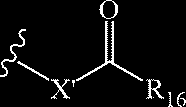
- wherein X′ is a bond or represents an oxygen or a sulfur, and R15 represents a hydrogen, an alkyl, an alkenyl, —(CH2)m—R10 or a pharmaceutically acceptable salt, R16 represents a hydrogen, an alkyl, an alkenyl or —(CH2)m—R10, where m and R10 are as defined above. Where X′ is an oxygen and R15 or R16 is not hydrogen, the formula represents an “ester.” Where X′ is an oxygen, and R15 is as defined above, the moiety is referred to herein as a carboxyl group, and particularly when R15 is a hydrogen, the formula represents a “carboxylic acid”. Where X′ is an oxygen, and R16 is a hydrogen, the formula represents a “formate.” In general, where the oxygen atom of the above formula is replaced by a sulfur, the formula represents a “thiocarbonyl” group. Where X′ is a sulfur and R15 or R16 is not hydrogen, the formula represents a “thioester” group. Where X′ is a sulfur and R15 is a hydrogen, the formula represents a “thiocarboxylic acid” group. Where X′ is a sulfur and R16 is a hydrogen, the formula represents a “thioformate” group. On the other hand, where X′ is a bond, and R15 is not hydrogen, the above formula represents a “ketone” group. Where X′ is a bond, and R15 is a hydrogen, the above formula represents an “aldehyde” group.
- As used herein, the term “substituted” is contemplated to include all permissible substituents of organic compounds. In a broad aspect, the permissible substituents include acyclic and cyclic, branched and unbranched, carbocyclic and heterocyclic, aromatic and nonaromatic substituents of organic compounds. Illustrative substituents include, for example, those described herein above. The permissible substituents can be one or more and the same or different for appropriate organic compounds. For purposes of this invention, the heteroatoms such as nitrogen may have hydrogen substituents and/or any permissible substituents of organic compounds described herein which satisfy the valences of the heteroatoms. This invention is not intended to be limited in any manner by the permissible substituents of organic compounds. It will be understood that “substitution” or “substituted with” includes the implicit proviso that such substitution is in accordance with permitted valence of the substituted atom and the substituent, and that the substitution results in a stable compound, e.g., which does not spontaneously undergo transformation such as by rearrangement, cyclization, elimination, etc.
- As used herein, the term “nitro” means —NO2; the term “halogen” designates —F, —Cl, —Br, or —I; the term “sulfhydryl” means —SH; the term “hydroxyl” means —OH; the term “sulfonyl” means —SO2—; the term “azido” means —N3; the term “cyano” means —CN; the term “isocyanato” means —NCO; the term “thiocyanato” means —SCN; the term “isothiocyanato” means —NCS; and the term “cyanato” means —OCN.
- The term “sulfamoyl” is art-recognized and includes a moiety that can be represented by the formula:
-

- in which R11and R12 are as defined above.
- The term “sulfate” is art recognized and includes a moiety that can be represented by the formula:
-

- in which R15 is as defined above.
- The term “sulfonamide” is art recognized and includes a moiety that can be represented by the formula:
-

- in which R11 and R16 are as defined above.
- The term “sulfonate” is art-recognized and includes a moiety that can be represented by the formula:
-

- in which R54 is an electron pair, hydrogen, alkyl, cycloalkyl, or aryl.
- The terms “sulfoxido” or “sulfinyl”, as used herein, refers to a moiety that can be represented by the formula:
-

- in which R17 is selected from the group consisting of hydrogen, alkyl, alkenyl, alkynyl, cycloalkyl, heterocyclyl, aralkyl, or aryl.
- The term “urea” is art-recognized and may be represented by the general formula
-

- wherein each R18 independently represents hydrogen or a hydrocarbyl, such as alkyl, or any occurrence of R18 taken together with another and the intervening atom(s) complete a heterocycle having from 4 to 8 atoms in the ring structure.
- As used herein, the definition of each expression, e.g., alkyl, m, n, etc., when it occurs more than once in any structure, is intended to be independent of its definition elsewhere in the same structure.
- The term “substituted” refers to moieties having substituents replacing a hydrogen on one or more carbons of the backbone. It will be understood that “substitution” or “substituted with” includes the implicit proviso that such substitution is in accordance with permitted valence of the substituted atom and the substituent, and that the substitution results in a stable compound, e.g., which does not spontaneously undergo transformation such as by rearrangement, cyclization, elimination, etc. As used herein, the term “substituted” is contemplated to include all permissible substituents of organic compounds. In a broad aspect, the permissible substituents include acyclic and cyclic, branched and unbranched, carbocyclic and heterocyclic, aromatic and non-aromatic substituents of organic compounds. The permissible substituents can be one or more and the same or different for appropriate organic compounds. For purposes of this invention, the heteroatoms such as nitrogen may have hydrogen substituents and/or any permissible substituents of organic compounds described herein which satisfy the valences of the heteroatoms. Substituents can include any substituents described herein, for example, a halogen, a hydroxyl, a carbonyl (such as a carboxyl, an alkoxycarbonyl, a formyl, or an acyl), a thiocarbonyl (such as a thioester, a thioacetate, or a thioformate), an alkoxy, a phosphoryl, a phosphate, a phosphonate, a phosphinate, an amino, an amido, an amidine, an imine, a cyano, a nitro, an azido, a sulfhydryl, an alkylthio, a sulfate, a sulfonate, a sulfamoyl, a sulfonamido, a sulfonyl, a heterocyclyl, an aralkyl, or an aromatic or heteroaromatic moiety. In preferred embodiments, the substituents on substituted alkyls are selected from C1-6 alkyl, C3-6 cycloalkyl, halogen, carbonyl, cyano, or hydroxyl. In more preferred embodiments, the substituents on substituted alkyls are selected from fluoro, carbonyl, cyano, or hydroxyl. It will be understood by those skilled in the art that substituents can themselves be substituted, if appropriate. Unless specifically stated as “unsubstituted,” references to chemical moieties herein are understood to include substituted variants. For example, reference to an “aryl” group or moiety implicitly includes both substituted and unsubstituted variants.
- For purposes of this invention, the chemical elements are identified in accordance with the Periodic Table of the Elements, CAS version, Handbook of Chemistry and Physics, 67th Ed., 1986-87, inside cover.
- In certain embodiments, the invention relates to a compound of Formula I:
-

- wherein:
- A is
-

-

- B is -alkylene-C*H(F)-, -alkylene-C*(F)2-, -alkylene-CH(F)C*H2-, -alkylene-C(F)2C*H2-, -alkylene-O-alkylene-C*H(F)-, or -alkylene-O-alkylene-C*(F)2-;
- C is
-

- R1 is independently H, alkyl, halide, alkoxy, CF3, OH, alkylene-OH, NO2, or —N(H)Ra;
- R2 is H, alkyl, substituted or unsubstituted aryl, substituted or unsubstituted heteroaryl, cylcoalkyl, -alkylene-alkoxy, alkylene-aryl, or heterocycloalkyl;
- R3 is independently selected from H, halide, CF3, alkyl, alkylene-alkoxy, aryl, hydroxyl, and alkoxy;
- Ra is H, (C1-C6)alkyl, -(C1-C6)alkylene-O-(C1-C6)alkyl, or -(C1-C6)alkylene-O-C(O)O(C1-C6)alkyl;
- n is 0, 1, 2, 3, or 4;
- * denotes the point of attachment of B to C; and
- the absolute configuration at any stereocenter is R, S, or a mixture thereof;
- or a pharmaceutically acceptable salt thereof.
- In certain embodiments, the invention relates to a compound of Formula I:
-

- wherein:
- A is
-

- B is -alkylene-C*H(F)-, -alkylene-C*(F)2-, -alkylene-CH(F)C*H2-, -alkylene-C(F)2C*H2-, -alkylene-O-alkylene-C*H(F)-, or -alkylene-O-alkylene-C*(F)2-;
- C is
-

- R1 is independently H, alkyl, halide, alkoxy, CF3, OH, alkylene-OH, NO2, or —N(H)Ra;
- R2 is H, alkyl, substituted or unsubstituted aryl, substituted or unsubstituted heteroaryl, cylcoalkyl, -alkylene-alkoxy, alkylene-aryl, or heterocycloalkyl;
- R3 is independently selected from H, halide, CF3, alkyl, alkylene-alkoxy, aryl, hydroxyl, and alkoxy;
- Ra is H, (C1-C6)alkyl, -(C1-C6)alkylene-O-(C1-C6)alkyl, or -(C1-C6)alkylene-O-C(O)O(C1-C6)alkyl;
- n is 0, 1, 2, 3, or 4;
- * denotes the point of attachment of B to C; and
- the absolute configuration at any stereocenter is R, S, or a mixture thereof;
- or a pharmaceutically acceptable salt thereof.
- In certain embodiments, the invention relates to a compound of Formula I:
-

- wherein:
- A is
-

-

- B is -alkylene-C*H(F)-, -alkylene-C*(F)2-, -alkylene-CH(F)C*H2-, or -alkylene-C(F)2C*H2-;
- C is
-

- R1 is independently H, alkyl, halide, alkoxy, CF3, OH, alkylene-OH, NO2, or —N(H)Ra;
- R2 is H, alkyl, substituted or unsubstituted aryl, substituted or unsubstituted heteroaryl, cylcoalkyl, -alkylene-alkoxy, alkylene-aryl, or heterocycloalkyl;
- R3 is independently selected from H, halide, CF3, alkyl, alkylene-alkoxy, aryl, hydroxyl, and alkoxy;
- Ra is H, (C1-C6)alkyl, -(C1-C6)alkylene-O-(C1-C6)alkyl, or -(C1-C6)alkylene-O-C(O)O(C1-C6)alkyl;
- n is 0, 1, 2, 3, or 4;
- * denotes the point of attachment of B to C; and
- the absolute configuration at any stereocenter is R, S, or a mixture thereof;
- or a pharmaceutically acceptable salt thereof.
- In certain embodiments, the invention relates to a compound of Formula I:
-

- wherein:
- A is
-

-

- B is -alkylene-C*H(F)-, -alkylene-C*(F)2-, -alkylene-CH(F)C*H2-, -alkylene-C(F)2C*H2-, -alkylene-O-alkylene-C*H(F)-, or -alkylene-O-alkylene-C*(F)2-;
- C is
-

- R1 is independently H, alkyl, halide, alkoxy, CF3, OH, alkylene-OH, NO2, or —N(H)Ra;
- R2 is H, alkyl, substituted or unsubstituted aryl, substituted or unsubstituted heteroaryl, cylcoalkyl, -alkylene-alkoxy, alkylene-aryl, or heterocycloalkyl;
- R3 is independently selected from H, halide, CF3, alkyl, alkylene-alkoxy, aryl, hydroxyl, and alkoxy;
- Ra is H;
- n is 0, 1, 2, 3, or 4;
- * denotes the point of attachment of B to C; and
- the absolute configuration at any stereocenter is R, S, or a mixture thereof;
- or a pharmaceutically acceptable salt thereof.
- In certain embodiments, the invention relates to a compound of Formula I:
-

- wherein:
- A is
-

-

- B is -alkylene-C*H(F)-, -alkylene-C*F)2-, -alkylene-CH(F)C*H2-, -alkylene-C(F)2C*H2-, -alkylene-O-alkylene-C*H(F)-, or -alkylene-O-alkylene-C*(F)2-;
- C is
-

- R1 is independently H, alkyl, halide, alkoxy, CF3, OH, alkylene-OH, NO2, or —N(H)Ra;
- R2 is H, alkyl, substituted or unsubstituted aryl, substituted or unsubstituted heteroaryl, cylcoalkyl, -alkylene-alkoxy, alkylene-aryl, or heterocycloalkyl;
- Ra is H, (C1-C6)alkyl, -(C1-C6)alkylene-O-(C1-C6)alkyl, or -(C1-C6)alkylene-O-C(O)O(C1-C6)alkyl;
- n is 0;
- * denotes the point of attachment of B to C; and
- the absolute configuration at any stereocenter is R, S, or a mixture thereof;
- or a pharmaceutically acceptable salt thereof.
- In certain embodiments, the invention relates to any one of the aforementioned compounds, wherein A is
-

- In certain embodiments, the invention relates to any one of the aforementioned compounds, wherein A is
-

- In certain embodiments, the invention relates to any one of the aforementioned compounds, wherein B is -alkylene-C*H(F)-. In some embodiments, -alkylene-C*H(F)-is —(CH2)4C*H(F)—. In certain embodiments, the invention relates to any one of the aforementioned compounds, wherein B is -alkylene-C*(F)2-. In some embodiments, -alkylene-C*(F)2 is —(CH2)4C*(F)2—. In certain embodiments, the invention relates to any one of the aforementioned compounds, wherein B is -alkylene-CH(F)C*H2-. In certain embodiments, the invention relates to any one of the aforementioned compounds, wherein B is -alkylene-C(F)2C*H2-. In certain embodiments, the invention relates to any one of the aforementioned compounds, wherein B is -alkylene-O-alkylene-C*H(F)-. In some embodiments, alkylene-O-alkylene-C*H(F)- is -methylene-O-ethylene-C*H(F)-, or -ethylene-O-methylene-C*H(F)-. In certain embodiments, the invention relates to any one of the aforementioned compounds, wherein B is -alkylene-O-alkylene-C*(F)2-. In some embodiments, -alkylene-O-alkylene-C*(F)2- is -methylene-O-ethylene-C*(F)2-, or -ethylene-O-methylene-C*(F)2-.
- In certain embodiments, the invention relates to any one of the aforementioned compounds, wherein R1 is H. In certain embodiments, the invention relates to any one of the aforementioned compounds, wherein R1 is alkyl. In certain embodiments, the invention relates to any one of the aforementioned compounds, wherein R1 is halide. In certain embodiments, the invention relates to any one of the aforementioned compounds, wherein R1 is alkoxy. In some embodiments, alkoxy is methoxy, ethoxy, iso-propyloxy, iso-butyloxy, or tert-butyloxy. In certain embodiments, the invention relates to any one of the aforementioned compounds, wherein R1 is CF3. In certain embodiments, the invention relates to any one of the aforementioned compounds, wherein R1 is OH. In certain embodiments, the invention relates to any one of the aforementioned compounds, wherein R1 is alkylene-OH. In certain embodiments, the invention relates to any one of the aforementioned compounds, wherein R1 is NO2. In certain embodiments, the invention relates to any one of the aforementioned compounds, wherein R1 is —N(H)Ra. In certain embodiments, the invention relates to any one of the aforementioned compounds, wherein R1 is NH2. In some embodimemts, at least one instance of R1 is alkyl, halide, OMe, OH, alkylene-OH, or NH2. In some embodimemts, at least one instance of R1 is OMe. In some embodimemts, all instances of R1 are H.
- In certain embodiments, the invention relates to any one of the aforementioned compounds, wherein R2 is H. In certain embodiments, the invention relates to any one of the aforementioned compounds, wherein R2 is alkyl. In certain embodiments, the invention relates to any one of the aforementioned compounds, wherein R2 is substituted aryl. In some embodiments, substituted aryl is substituted phenyl, isoindoline, or oxo-isoindoline. In certain embodiments, the invention relates to any one of the aforementioned compounds, wherein R2 is unsubstituted aryl. In some embodiments, unsubsituted aryl is phenyl. In certain embodiments, the invention relates to any one of the aforementioned compounds, wherein R2 is substituted heteroaryl. In certain embodiments, the invention relates to any one of the aforementioned compounds, wherein R2 is unsubstituted heteroaryl. In some embodiments, substituted heteroaryl is substituted pyridinyl, substituted pyrimidinyl, substituted pyrazolyl, azaindolyl, or isoindolyl. In certain embodiments, the invention relates to any one of the aforementioned compounds, wherein R2 is cylcoalkyl. In certain embodiments, the invention relates to any one of the aforementioned compounds, wherein R2 is -alkylene-alkoxy. In certain embodiments, the invention relates to any one of the aforementioned compounds, wherein R2 is alkylene-aryl. In certain embodiments, the invention relates to any one of the aforementioned compounds, wherein R2 is heterocycloalkyl. In certain embodiments, the invention relates to any one of the aforementioned compounds, wherein R2 is substituted with one or more substituents independently selected from alkyl, cycloalkyl, aryl, heteroaryl, heterocycloalkyl, alkoxy, OH, halide, -(O)alkyl, -alkylene-heteroaryl, -alkylene-O-alkyl; -alkylene-O-cycloalkyl, alkylene-O-heterocyclocycloalkyl,-O-alkylene-cycloalkyl, -O-alkylene-heterocycloalkyl, and each of which can be further substituted with alkyl, halogen, and alkoxyl.
- In certain embodiments, the invention relates to any one of the aforementioned compounds, wherein R3 is H. In certain embodiments, the invention relates to any one of the aforementioned compounds, wherein R3 is halide. In certain embodiments, the invention relates to any one of the aforementioned compounds, wherein R3 is CF3. In certain embodiments, the invention relates to any one of the aforementioned compounds, wherein R3 is alkyl. In certain embodiments, the invention relates to any one of the aforementioned compounds, wherein R3 is alkylene-alkoxy. In certain embodiments, the invention relates to any one of the aforementioned compounds, wherein R3 is aryl. In some embodiments, aryl is phenyl. In certain embodiments, the invention relates to any one of the aforementioned compounds, wherein R3 is hydroxyl. In certain embodiments, the invention relates to any one of the aforementioned compounds, wherein R3 is alkoxy. In some embodiments, alkoxy is methoxy. In certain embodiments, the invention relates to any one of the aforementioned compounds, wherein R3 is H, halide, Me, OMe, or Ph.
- In certain embodiments, the invention relates to any one of the aforementioned compounds, Ra is H. In certain embodiments, the invention relates to any one of the aforementioned compounds, Ra is (C1-C6)alkyl. In some embodiments, (C1-C6)alkyl is methyl, ethyl, n-propyl, i-propyl, n-butyl, i-butyl, or t-butyl. In certain embodiments, the invention relates to any one of the aforementioned compounds, wherein Ra is (C1-C6)alkylene-O-(C1-C6)alkyl. In certain embodiments, the invention relates to any one of the aforementioned compounds, wherein Ra is (C1-C6)alkylene-O-C(O)O(C1-C6)alkyl.
- In certain embodiments, the invention relates to a compound of Formula I:
-

- wherein:
- A is
-

- B is -alkylene-C*H(F)-, -alkylene-C*(F)2-, -alkylene-CH(F)C*H2-, or -alkylene-C(F)2C *H2-;
- C is
-

- R1 is independently H, alkyl, halide, alkoxy, CF3, OH, alkylene-OH, NO2, or —N(H)Ra;
- R2 is substituted or unsubstituted aryl, substituted or unsubstituted heteroaryl, cylcoalkyl, -alkylene-alkoxy, alkylene-aryl, or heterocycloalkyl;
- Ra is H;
- n is 0;
- * denotes the point of attachment of B to C; and
- the absolute configuration at any stereocenter is R, S, or a mixture thereof;
- or a pharmaceutically acceptable salt thereof.
- In certain embodiments, the invention relates to a compound of Formula I:
-

- wherein:
- A is
-

- B is -alkylene-C*H(F)-, -alkylene-C*(F)2-, -alkylene-CH(F)C*H2-, -alkylene-C(F)2C*H2-, -alkylene-O-alkylene-C*H(F)-, or -alkylene-O-alkylene-C*(F)2-;
- C is
-

- R1 is independently H or alkoxy;
- R2 is substituted or unsubstituted aryl, substituted or unsubstituted heteroaryl, cylcoalkyl, alkylene-aryl, or heterocycloalkyl;
- Ra is H;
- n is 0;
- * denotes the point of attachment of B to C; and
- the absolute configuration at any stereocenter is R, S, or a mixture thereof;
- or a pharmaceutically acceptable salt thereof.
- In certain embodiments, the invention relates to a compound of Formula I:
-

- wherein:
- A is
-

- B is -alkylene-C*H(F)-, -alkylene-C*(F)2-, -alkylene-CH(F)C*H2-, or -alkylene-C(F)2C *H2-;
- C is
-

- R1 is independently H or alkoxy;
- R2 is substituted or unsubstituted aryl, substituted or unsubstituted heteroaryl, cylcoalkyl, alkylene-aryl, or heterocycloalkyl;
- Ra is H;
- n is 0;
- * denotes the point of attachment of B to C; and
- the absolute configuration at any stereocenter is R, S, or a mixture thereof;
- or a pharmaceutically acceptable salt thereof.
- In certain embodiments, the invention relates to any one of the aforementioned compounds, wherein the absolute configuration at any stereocenter is R. In certain embodiments, the invention relates to any one of the aforementioned compounds, wherein the absolute configuration at any stereocenter is S. In certain embodiments, the invention relates to any one of the aforementioned compounds, wherein the absolute configuration at any stereocenter is a mixture of R and S.
- In certain embodiments, the invention relates to any one of the aforementioned compounds, wherein the compound is a pharmaceutically acceptable salt.
- In certain embodiments, the invention relates to a compound selected from the group consisting of:
-

-

-

-

-

-

-

-

-

-

-

-

-

-

-

-

-

-

-

-

-

-

-

-

-

-

-

-

-

-

-

-

-

-

-

-

-

- In certain embodiments, the invention relates to a compound selected from the group consisting of:
-

-

-

- In certain embodiments, the invention relates to a compound selected from the group consisting of:
-

-

-

-

-

-

-

-

-

-

-

-

-

-

-

-

-

-

-

-

-

-

- In certain embodiments, the invention relates to a compound selected fromthe group consisting of:
-

-

-

-

-

-

-

- In certain embodiments, the invention relates to a compound selected from the group consisting of:
-

-

- In certain embodiments, the invention relates to a compound selected from the group consisting of:
-

-

-

-

-

-

-

-

-

-

-

-

-

-

-

-

-

-

-

-

-

-

-

-

-

-

-

-

-

-

-

-

-

-

-

-

- In certain embodiments, the invention relates to a compound of formula:
-

- In certain embodiments, the invention relates to a compound selected from the group consisting of:
-

-

-

-

-

-

-

-

-

-

-

-

-

-

-

-

-

-

-

-

-

-

-

-

- In certain embodiments, the invention relates to a compound selected from the group consisting of:
-

-

-

-

-

-

-

-

-

-

-

-

-

-

-

-

-

-

-

-

- In some embodiments, the invention relates to a compound selected from the group consisting of:
-

-

-

-

- In certain embodiments, the invention relates to a compound selected from the group consisting of:
-

-

-

-

- In certain embodiments, the invention relates to a compound selected from the group consisting of:
-

-

-

-

- In certain embodiments, the invention relates to a compound selected from the group consisting of:
-

-

-

-

-

-

-

- In certain embodiments, the invention relates to a compound selected from the group consisting of:
-

-

-

-

-

-

-

-

-

-

-

-

-

-

-

-

-

-

-

- In certain embodiments, the invention relates to a compound of Formula I:
-

- wherein:
- A is
-

- B is -alkylene-C*H(F)-, -alkylene-C*(F)2-, -alkylene-CH(F)C*H2-, or -alkylene-C(F)2C*H2-, wherein the alkylene in B is -(CH2)4-;
- C is
-

- R1 is independently H or alkoxy;
- R2 is phenyl, or a substituted or unsubstituted 6-member heteroaryl, and R2 is optionally substituted with one or more R3′, where R3′ is selected from alkyl including cycloalkyl (e.g., C1-C6 linear, branched or cyclic, including methyl, and cyclopropyl) or alkoxy or O-containing heterocycloalkyl (e.g., 1-6 atom linear, branched or cyclic alkoxy or heterocycloalkyl).
- Ra is H;
- n is 0;
- * denotes the point of attachment of B to C; and
- the absolute configuration at any stereocenter is R, S, or a mixture thereof;
- or a pharmaceutically acceptable salt thereof.
- In certain embodiments, the invention relates to a pharmaceutical composition comprising any one of the aforementioned compounds and a pharmaceutically acceptable carrier.
- Patients, including but not limited to humans, can be treated by administering to the patient an effective amount of the active compound or a pharmaceutically acceptable prodrug or salt thereof in the presence of a pharmaceutically acceptable carrier or diluent. The active materials can be administered by any appropriate route, for example, orally, parenterally, intravenously, intradermally, subcutaneously, or topically, in liquid or solid form.
- The concentration of active compound in the drug composition will depend on absorption, inactivation and excretion rates of the drug as well as other factors known to those of skill in the art. It is to be noted that dosage values will also vary with the severity of the condition to be alleviated. It is to be further understood that for any particular subject, specific dosage regimens should be adjusted over time according to the individual need and the professional judgment of the person administering or supervising the administration of the compositions, and that the concentration ranges set forth herein are exemplary only and are not intended to limit the scope or practice of the claimed composition. The active ingredient can be administered at once, or can be divided into a number of smaller doses to be administered at varying intervals of time.
- In certain embodiments, the mode of administration of the active compound is oral. Oral compositions will generally include an inert diluent or an edible carrier. They can be enclosed in gelatin capsules or compressed into tablets. For the purpose of oral therapeutic administration, the active compound can be incorporated with excipients and used in the form of tablets, troches or capsules. Pharmaceutically compatible binding agents, and/or adjuvant materials can be included as part of the composition.
- The tablets, pills, capsules, troches and the like can contain any of the following ingredients, or compounds of a similar nature: a binder such as microcrystalline cellulose, gum tragacanth or gelatin; an excipient such as starch or lactose, a disintegrating agent such as alginic acid, Primogel or corn starch; a lubricant such as magnesium stearate or Sterotes; a glidant such as colloidal silicon dioxide; a sweetening agent such as sucrose or saccharin; or a flavoring agent such as peppermint, methyl salicylate, or orange flavoring. When the dosage unit form is a capsule, it can contain, in addition to material of the above type, a liquid carrier such as a fatty oil. In addition, unit dosage forms can contain various other materials that modify the physical form of the dosage unit, for example, coatings of sugar, shellac, or other enteric agents.
- The compound can be administered as a component of an elixir, suspension, syrup, wafer, chewing gum or the like. A syrup can contain, in addition to the active compound(s), sucrose or sweetener as a sweetening agent and certain preservatives, dyes and colorings and flavors.
- The compound or a pharmaceutically acceptable prodrug or salts thereof can also be mixed with other active materials that do not impair the desired action, or with materials that supplement the desired action, such as antibiotics, antifungals, antiinflammatories or other antivirals, including but not limited to nucleoside compounds. Solutions or suspensions used for parenteral, intradermal, subcutaneous, or topical application can include the following components: a sterile diluent such as water for injection, saline solution, fixed oils, polyethylene glycols, glycerine, propylene glycol or other synthetic solvents; antibacterial agents such as benzyl alcohol or methyl parabens; antioxidants such as ascorbic acid or sodium bisulfite; chelating agents, such as ethylenediaminetetraacetic acid; buffers, such as acetates, citrates or phosphates, and agents for the adjustment of tonicity, such as sodium chloride or dextrose. The parental preparation can be enclosed in ampoules, disposable syringes or multiple dose vials made of glass or plastic.
- If administered intravenously, carriers include physiological saline and phosphate buffered saline (PBS).
- In certain embodiments, the active compounds are prepared with carriers that will protect the compound against rapid elimination from the body, such as a controlled release formulation, including but not limited to implants and microencapsulated delivery systems. Biodegradable, biocompatible polymers can be used, such as ethylene vinyl acetate, polyanhydrides, polyglycolic acid, collagen, polyorthoesters and polylactic acid. For example, enterically coated compounds can be used to protect cleavage by stomach acid. Methods for preparation of such formulations will be apparent to those skilled in the art. Suitable materials can also be obtained commercially.
- Liposomal suspensions (including but not limited to liposomes targeted to infected cells with monoclonal antibodies to viral antigens) are also preferred as pharmaceutically acceptable carriers. These can be prepared according to methods known to those skilled in the art, for example, as described in U.S. Pat. No. 4,522,811 (incorporated by reference). For example, liposome formulations can be prepared by dissolving appropriate lipid(s) (such as stearoyl phosphatidyl ethanolamine, stearoyl phosphatidyl choline, arachadoyl phosphatidyl choline, and cholesterol) in an inorganic solvent that is then evaporated, leaving behind a thin film of dried lipid on the surface of the container. An aqueous solution of the active compound is then introduced into the container. The container is then swirled by hand to free lipid material from the sides of the container and to disperse lipid aggregates, thereby forming the liposomal suspension.
- In certain embodiments, the invention relates to a method of treating a disease or a condition selected from idiopathic pulmonary fibrosis, diabetic nephropathy, focal segmental glomerulosclerosis, chronic kidney disease, nonalcoholic steatohepatitis, primary biliary cholangitis, primary sclerosing cholangitis, solid tumors, hematological tumors, organ transplant, Alport syndrome, interstitial lung disease, radiation-induced fibrosis, bleomycin-induced fibrosis, asbestos-induced fibrosis, flu-induced fibrosis, coagulation-induced fibrosis, vascular injury-induced fibrosis, aortic stenosis, and cardiac fibrosis comprising the step of: administering to a subject in need thereof a therapeutically effective amount of any one of the aforementioned compounds.
- In certain embodiments, the invention relates to any one of the aforementioned methods, wherein the disease or condition is a solid tumor (sarcomas, carcinomas, and lymphomas). Exemplary tumors that may be treated in accordance with the invention include e.g., Ewing’s sarcoma, rhabdomyosarcoma, osteosarcoma, myelosarcoma, chondrosarcoma, liposarcoma, leiomyosarcoma, soft tissue sarcoma, non-small cell lung cancer, small cell lung cancer, bronchus cancer, prostate cancer, breast cancer, pancreatic cancer, gastrointestinal cancer, colon cancer, rectum cancer, colon carcinoma, colorectal adenoma, thyroid cancer, liver cancer, intrahepatic bile duct cancer, hepatocellular cancer, adrenal gland cancer, stomach cancer, gastric cancer, glioma (e.g., adult, childhood brain stem, childhood cerebral astrocytoma, childhood visual pathway and hypothalamic), glioblastoma, endometrial cancer, melanoma, kidney cancer, renal pelvis cancer, urinary bladder cancer, uterine corpus, uterine cervical cancer, vaginal cancer, ovarian cancer, multiple myeloma, esophageal cancer, brain cancer (e.g., brain stem glioma, cerebellar astrocytoma, cerebral astrocytoma/malignant glioma, ependymoma, meduloblastoma, supratentorial primitive neuroectodermal tumors, visual pathway and hypothalamic glioma), lip and oral cavity and pharynx, larynx, small intestine, melanoma, villous colon adenoma, a neoplasia, a neoplasia of epithelial character, lymphomas (e.g., AIDS-related, Burkitt’s, cutaneous T-cell, Hodgkin, non-Hodgkin, and primary central nervous system), a mammary carcinoma, basal cell carcinoma, squamous cell carcinoma, actinic keratosis, tumor diseases, including solid tumors, a tumor of the neck or head, polycythemia vera, essential thrombocythemia, myelofibrosis with myeloid metaplasia, Waldenstrom’s macroglobulinemia, adrenocortical carcinoma, AIDS-related cancers, childhood cerebellar astrocytoma, childhood cerebellar astrocytoma, basal cell carcinoma, extrahepatic bile duct cancer, malignant fibrous histiocytoma bone cancer, bronchial adenomas/carcinoids, carcinoid tumor, gastrointestinal carcinoid tumor, primary central nervous system, cerebellar astrocytoma, childhood cancers, ependymoma, extracranial germ cell tumor, extragonadal germ cell tumor, extrahepatic bile duct cancer, intraocular melanoma eye cancer, retinoblastoma eye cancer, gallbladder cancer, gastrointestinal carcinoid tumor, germ cell tumors (e.g., extracranial, extragonadal, and ovarian), gestational trophoblastic tumor, hepatocellular cancer, hypopharyngeal cancer, hypothalamic and visual pathway glioma, islet cell carcinoma (endocrine pancreas), laryngeal cancer, malignant fibroushistiocytoma of bone/osteosarcoma, meduloblastoma, mesothelioma, metastatic squamous neck cancer with occult primary, multiple endocrine neoplasia syndrome, multiple myeloma/plasma cell neoplasm, mycosis fungoides, nasal cavity and paranasal sinus cancer, nasopharyngeal cancer, neuroblastoma, oral cancer, oropharyngeal cancer, ovarian epithelial cancer, ovarian germ cell tumor, ovarian low malignant potential tumor, islet cell pancreatic cancer, parathyroid cancer, pheochromocytoma, pineoblastoma, pituitary tumor, pleuropulmonary blastoma, ureter transitional cell cancer, retinoblastoma, rhabdomyosarcoma, salivary gland cancer, Sezary syndrome, non-melanoma skin cancer, Merkel cell carcinoma, squamous cell carcinoma, testicular cancer, thymoma, gestational trophoblastic tumor, and Wilms’ tumor.
- In certain embodiments, the invention relates to any one of the aforementioned methods, wherein the disease is disease or condition is a hematological tumor. Exemplary homatological tumors that may be treated in accordance with the invention include e.g., acute lymphocytic leukemia, acute myelogenous leukemia, chronic lymphocytic leukemia, chronic myelogenous leukemia, Hodgkin lymphoma, non-Hodgkin lymphoma, and multiple myeloma.
- In certain embodiments, the invention relates to any one of the aforementioned methods, wherein the disease or condition is selected from the group consisting of idiopathic pulmonary fibrosis, systemic sclerosis associated interstitial lung disease, myositis associated interstitial lung disease, systemic lupus erythematosus associated interstitial lung disease, rheumatoid arthritis, and associated interstitial lung disease.
- In certain embodiments, the invention relates to any one of the aforementioned methods, wherein the disease or condition is selected from the group consisting of diabetic nephropathy, focal segmental glomerulosclerosis, and chronic kidney disease.
- In certain embodiments, the invention relates to any one of the aforementioned methods, wherein the disease or condition is selected from the group consisting of nonalcoholic steatohepatitis, primary biliary cholangitis, and primary sclerosing cholangitis.
- In certain embodiments, the invention relates to any one of the aforementioned methods, wherein the subject is a mammal. In certain embodiments, the invention relates to any one of the aforementioned methods, wherein the subject is human.
- The invention now being generally described, it will be more readily understood by reference to the following examples, which are included merely for purposes of illustration of certain aspects and embodiments of the present invention, and are not intended to limit the invention.
- The moieties R1 and R2 represent appropriate substituents; L represents an appropriate linker, and X represents an appropriate halogen, such as Br, Cl or I, or another leaving group such as mesylate or tosylate.
-

- represents an appropriate optionally substituted pyrrolidine.
-

- represents an appropriate optionally substituted tetrahydronaphthyridine.
-

- represents an appropriate optionally substituted naphthyridine.
-

-

-

-

- Alkene intermediates may be cross-coupled to 2-halo naphthyridines or tetrahydronaphthyridines by the following procedure. To a solution of alkene (1 equiv.) in dry THF (2-10 mL/mmol) under Ar was added 9-BBN (0.5 M solution in THF, 1-2 equiv.). The reaction was stirred at 40-80° C. for 1-4 hours, then cooled to room temperature. This solution was added to a mixture of 2-halonaphthyridine or Boc-protected 2-halotetrahydronaphthyridine (1-1.5 equiv.), cesium carbonate (2-5 equiv.) and Pd(PPh3)4 or another appropriate Pd/ligand combination (0.05 to 0.1 equiv.) in 1,4-Dioxane (2-10 mL/mmol). The reaction was stirred at 80-100° C. for 12-24 hours. Solvent was removed in vacuo, and the residue was purified by silica gel column to give the alkyl linked naphthyridine product.
-

- Naphthyridines may also be made from methyl ketones by the following procedure. A mixture of methyl ketone (1 equiv.), 2-aminonicotinaldehyde (1-2 equiv.) and secondary amine such as pyrrolidine or L-proline (1-2 equiv.) in DMF or EtOH (1-10 mL/mmol) was stirred at 70-100° C. for 2-10 hours. Solvent was removed in vacuo, and the residue was purified by silica gel column to give the desired naphthyridine product.
-

- Naphthyridines may be reduced to tetrahydronaphthyridines by the following procedure. A mixture of an appropriate naphthyridine (1 equiv.) and Pd/C (5-20 weight percent Pd, 0.05 to 0.2 equiv.) in ethyl acetate or another appropriate solvent (2-10 mL/mmol) was stirred under H2 balloon at room temperature to 50° C. for 2-20 hours. The reaction was filtered and concentrated in vacuo to give the desired tetrahydronaphthyridine product.
-

- Boc-protected amine (1 equiv.) was treated with HCl (4-100 equiv.) in 1,4-dioxane (1-50 mL/mmol amine) at room temperature to 50° C. for 1-4 hours. The reaction was concentrated in vacuo, and the amine product was used crude or after purification by silica gel column. The amine could be used crude as a dihydrochloride salt or converted to the free base by dissolving in an appropriate solvent and washing with aqueous NaHCO3.
-

- A mixture of amine (1 equiv.), alkylating agent (1-1.5 equiv.) and K2CO3 or N,N-diisopropylethylamine (2-10 equiv.) in MeCN or DMF (3-10 mL/mmole amine) was stirred at room temperature to 80° C. for 4-16 hours. The reaction was concentrated in vacuo, and the residue was purified by silica gel column to give the desired amino acetic acid ester. The amine used may be the free base or a salt such hydrochloride or dihydrochloride. If the reaction is done with a salt of the amine, additional equivalents of base may be needed.
-

- For certain esters such as R1 = Me or ethyl, the ester may be saponified under basic conditions. The ester (1 equiv.) was treated with LiOH—H2O (3-5 equiv.) in MeOH (3-10 mL/mmol ester) and water (3-10 mL/mmol ester) at room temperature to 50° C. for 1-16 hours. The reaction was concentrated in vacuo, and the residue was purified by prep HPLC to give the desired carboxylic acid product.
- or certain esters such as R1 = tert-butyl, the ester may be saponified under acidic conditions. The ester (1 equiv.) was treated with 4 N HCl (4-100 equiv.) in 1,4-dioxane (1-25 mL/mmol ester) at room temperature to 50° C. for 1-16 hours. The reaction was concentrated in vacuo, and the residue was purified by prep HPLC to give the desired carboxylic acid product.
-

- As an alternative to the amine alkylation/saponification sequence, a Petasis reaction can be used to prepare certain aryl analogs: A mixture of amine (1 equiv.) aryl boronic acid or aryl boronate ester (1-1.5 equiv.) and 2-oxoacetic acid (1.5-2 equiv.) in MeCN or DMF (2-10 mL/mmole amine) was stirred at 50-80° C. for 2-16 hours. The reaction was concentrated in vacuo, and the residue was purified by prep HPLC to give the desired amino acetic acid.
- Crude samples were dissolved in MeOH and purified by prep HPLC using a Gilson 215 instrument, detection wavelength 214 nm:
- Prep HPLC A: column: XBridge C18, 21.2 * 250 mm, 10 µm; mobile phase: A water (10 mM ammonium hydrogen carbonate), B CH3CN; gradient elution as in text; flow rate: 20 mL/min.
- Prep HPLC B: column: XBridge C18, 21.2 * 250 mm, 10 µm; mobile phase: A water (10 mM formic acid), B CH3CN; gradient elution as in text; flow rate: 20 mL/min.
- Prep HPLC C: column: XBridge OBD C18, 19 * 100 mm, 5 µm; mobile phase: A water, B CH3CN; gradient elution as in text; flow rate: 20 mL/min.
- Racemic products were separated to individual enantiomers by chiral Prep SFC using an SFC-80 (Thar, Waters) instrument, detection wavelength 214 nm:
- Prep chiral SFC A: column: (R,R)-Whelk-O1, 20*250 mm, 5 µm (Decial), column temperature: 35° C., mobile phase: CO2/methanol (0.2% methanol ammonia)= 60/40, flow rate: 80 g/min, back pressure: 100 bar.
- Prep chiral SFC B: column:
AD 20*250 mm, 10 µm (Daicel), column temperature: 35° C., - mobile phase: CO2/methanol (0.2% methanol ammonia)= 60/40, flow rate: 80 g/min, back pressure: 100 bar.
- Prep chiral SFC C: column: AS 20*250 mm, 10 µm (Daicel), column temperature: 35° C.,
- mobile phase: CO2/methanol (0.2% methanol ammonia)= 60/40, flow rate: 80 g/min, back pressure: 100 bar.
- Prep chiral SFC D: column:
OD 20*250 mm, 10 µm (Daicel), column temperature: 35° C., - mobile phase: CO2/methanol (0.2% methanol ammonia)= 60/40, flow rate: 80 g/min, back pressure: 100 bar.
- Prep chiral SFC E: column: Cellulose-
SC 20*250 mm, 10 µm (Daicel), column temperature: 35° C., mobile phase: CO2/methanol (0.2% methanol ammonia)= 60/40, flow rate: 80 g/min, back pressure: 100 bar. - Prep chiral SFC F: column:
OZ 20*250 mm, 10 µm (Daicel), column temperature: 35° C., mobile phase: CO2/methanol (0.2% methanol ammonia)= 60/40, flow rate: 80 g/min, back pressure: 100 bar. - Prep chiral SFC G: column:
IC 20*250 mm, 10 µm (Daicel), column temperature: 35° C., mobile phase: CO2/methanol (0.2% methanol ammonia)= 60/40, flow rate: 80 g/min, back pressure: 100 bar. - Prep chiral SFC H: column: (S,S)-Whelk-O1, 20*250 mm, 5 µm (Decial), column temperature: 35° C., mobile phase: CO2/methanol (0.2% methanol ammonia)= 60/40, flow rate: 80 g/min, back pressure: 100 bar.
- Chiral products were analyzed by chiral SFC using an SFC-80 (Thar, Waters) instrument, detection wavelength 214 nm:
- Chiral SFC A: column: (R,R)-Whelk-O1, 4.6* 100 mm, 5 µm (Decial), column temperature: 40° C., mobile phase: CO2/methanol (0.2% methanol ammonia), isocratic elution as in text, flow rate: 4 g/min, back pressure: 120 bar.
- Chiral SFC B: column: AD 4.6* 100 mm, 5 µm (Daicel), column temperature: 40° C.,
- mobile phase: CO2/methanol (0.2% methanol ammonia), isocratic elution as in text, flow rate: 4 g/min, back pressure: 120 bar.
- Chiral SFC C: column: AS 4.6*100 mm, 5 µm (Daicel), column temperature: 40° C.,
- mobile phase: CO2/methanol (0.2% methanol ammonia), isocratic elution as in text, flow rate: 4 g/min, back pressure: 120 bar.
- Chiral SFC D: column: OD 4.6*100 mm, 5 µm (Daicel), column temperature: 40° C., mobile phase: CO2/methanol (0.2% methanol ammonia), isocratic elution as in text, flow rate: 4 g/min, back pressure: 120 bar.
- Chiral SFC E: column: Cellulose-SC 4.6*100 mm, 5 µm (Daicel), column temperature: 40° C., mobile phase: CO2/methanol (0.2% methanol ammonia), isocratic elution as in text, flow rate: 4 g/min, back pressure: 120 bar.
- Chiral SFC F: column: OZ 4.6*100 mm, 5 µm (Daicel), column temperature: 40° C.,
- mobile phase: CO2/methanol (0.2% methanol ammonia), isocratic elution as in text, flow rate: 4 g/min, back pressure: 120 bar.
- Chiral SFC G: column: IC 4.6* 100 mm, 5 µm (Daicel), column temperature: 40° C.,
- mobile phase: CO2/methanol (0.2% methanol ammonia), isocratic elution as in text, flow rate: 4 g/min, back pressure: 120 bar.
- Chiral SFC H: column: (S,S)-Whelk-O1, 4.6*100 mm, 5 µm (Decial), column temperature: 40° C., mobile phase: CO2/methanol (0.2% methanol ammonia), isocratic elution as in text, flow rate: 4 g/min, back pressure: 120 bar.
- Chiral SFC I: column: IC 4.6*250 mm, 5 µm (SHIMADZU), column temperature: 40° C.,
- mobile phase: n-Hexane(0.1%DEA):EtOH(0.1%DEA), isocratic elution as in text, flow rate: 1 mL/min.
- Chiral SFC J: column: (S,S)-Whelk-O1 4.6*250 mm, 5 µm (SHIMADZU), column temperature: 40° C., mobile phase: n-Hexane(0.1%DEA):EtOH(0.1%DEA), isocratic elution as in text, flow rate: 1 mL/min.
- Chiral SFC K: column: OZ-H 4.6*250 mm, 5 µm (SHIMADZU), column temperature: 40° C., mobile phase: n-Hexane(0.1%DEA):EtOH(0.1%DEA), isocratic elution as in text, flow rate: 1 mL/min.
- Chiral SFC L: column: chiral PAK IG 4.6*250 mm, 5 µm (SHIMADZU), column temperature: 35° C., mobile phase: n-Hexane(0.1%DEA):EtOH(0.1%DEA), isocratic elution as in text, flow rate: 1 mL/min.
- Chiral SFC M: column: EnantioPak OJ 4.6*250 mm, 5 µm (Decial), column temperature: 40° C., mobile phase: n-Hexane(0.1%DEA):EtOH(0.1%DEA), isocratic elution as in text, flow rate: 1 mL/min.
- The following intermediates were prepared according to the procedures below for use in synthesizing compounds 1-55:
-

- A mixture of (R)-1-(tert-butoxycarbonyl)pyrrolidine-3-carboxylic acid (10.0 g, 46.5 mmol), N,O-dimethylhydroxylamine hydrochloride (6.8 g, 69.8 mmol), EDCI (17.8 g, 93.0 mmol), HOBt (12.6 g, 93.0 mmol) and diisopropylethylamine (18.1 g, 139.5 mmol) in dichloromethane (120 mL) was stirred at room temperature overnight. Solvent was removed in vacuo, and the residue was purified by silica gel column (pet ether: EtOAc 2: 1) to give the desired product (R)-tert-butyl 3-(methoxy(methyl)carbamoyl) pyrrolidine-1-carboxylate as a colorless oil (7.5 g).
Yield 63%. (ESI 259.0 (M+H) +). -

- To a solution of (R)-tert-butyl 3-(methoxy(methyl)carbamoyl) pyrrolidine-1-carboxylate (7 g, 27.1 mmol) in THF (40 mL) at 0° C., was added 3-butenylmagnesium bromide solution 0.5 M in THF (108 mL, 54 mmol) dropwise. The reaction was stirred at 0° C. for 1 hour, then stirred at room temperature overnight, quenched with sat. NH4Cl (10 mL) and extracted with EtOAc (3× 40 mL). The organic combined phases were washed with brine, dried over Na2SO4, filtered and concentrated in vacuo. The residue was purified by silica gel column (pet ether: EtOAc 5:1) to give the desired product (R)-tert-butyl 3-pent-4-enoylpyrrolidine-1-carboxylate as a yellow oil (4.4 g).
Yield 64%.(ESI 254.0 (M+H) +). -

- A mixture of (R)-tert-butyl 3-pent-4-enoylpyrrolidine-1-carboxylate (4.4 g, 17.4 mmol) and BAST (19.2 g, 87 mmol) was stirred at room temperature for 40 hours. The reaction was quenched with MeOH (2 mL), diluted with H2O (10 mL) and extracted with EtOAc (50 mL). The organic layer was washed with brine, dried over Na2SO4, filtered and concentrated in vacuo. The residue was purified by silica gel column (pet ether: EtOAc 10:1) to give the desired product (R)-tert-butyl 3-(1,1-difluoropent-4-enyl) pyrrolidine -1-carboxylate as a yellow oil (1.7 g).
Yield 36% (ESI 276 (M+H) +). -

- To a solution of (S)-tert-butyl 3-(1,1-difluoropent-4-enyl)pyrrolidine-1-carboxylate (1.4 g, 5.1 mmol) in THF (dry, 5 mL) under Ar, was added 9-BBN (0.5 M solution in THF, 20.4 mL, 10.2 mmol). The reaction was stirred at 50° C. for 2 hours, then cooled to room temperature. This solution was added to a mixture of 2-bromo-1,8-naphthyridine (1.07 g, 5.1 mmol), cesium carbonate (4.98 g, 15.3 mmol) and Pd(PPh3)4 (295 mg, 0.255 mmol) in 1,4-dioxane (10 mL). The reaction was stirred at 90° C. for 1.5 hours, then concentrated in vacuo, and the residue was purified by silica gel column (DCM:MeOH 30:1) to give the desired product (R)-tert-butyl 3-(1,1-difluoro-5-(1,8-naphthyridin-2-yl)pentyl)pyrrolidine-1-carboxylate as a yellow oil (1 g).
Yield 48% (ESI 406 (M+H) +). -

- A mixture of (R)-tert-butyl 3-(1,1-difluoro-5-(1,8-naphthyridin-2-yl)pentyl)pyrrolidine-1-carboxylate (1 g, 2.47 mmol), Pd/C (200 mg, 20 Wt%) in ethyl acetate (20 mL) was stirred under H2 balloon at 40° C. for 16 hours. The reaction was filtered and concentrated in vacuo to give the desired product (R)-tert-butyl 3-(1,1-difluoro-5-(5,6,7,8-tetrahydro-1,8-naphthyridin-2-yl)pentyl)pyrrolidine-1-carboxylate as a yellow oil (1 g). Yield 98% (ESI 410 (M+H) +).
-

- (R)-tert-butyl 3-(1,1-difluoro-5-(5,6,7,8-tetrahydro-1,8-naphthyridin-2-yl)pentyl)pyrrolidine-1-carboxylate (1 g, 2.44 mmol) was treated with HCl in 1,4-dioxane(4 M, 10 mL) at room temperature for 2 hours. Solvent was removed in vacuo to give the desired product (R)-7-(5,5-difluoro-5-(pyrrolidin-3-yl)pentyl)-1,2,3,4-tetrahydro-1,8-naphthyridine as a HCl salt (930 mg). Yield 99% (ESI 310 (M+H) +).
-

- To a solution of (S)-tert-butyl 3-(1,1-difluoropent-4-enyl)pyrrolidine-1-carboxylate (1.4 g, 5.1 mmol) in THF (dry, 5 mL) under Ar, was added 9-BBN (0.5 M solution in THF, 20.4 mL, 10.2 mmol). The reaction was stirred at 50° C. for 2 hours, then cooled to room temperature and added to a mixture of 2,4-dichloro-1,8-naphthyridine (1.01 g, 5.1 mmol), cesium carbonate (4.98 g, 15.3 mmol) and Pd(PPh3)4 (295 mg, 0.255 mmol) in 1,4-Dioxane (10 mL). The reaction was stirred at 90° C. for 2 hours. Solvent was removed in vacuo, and the residue was purified by silica gel column (DCM:MeOH 30:1) to give the desired product as a yellow oil (0.95 g).
Yield 42% (ESI 440 (M+H) +). -

- To a solution of (R)-tert-butyl 3-(5-(4-chloro-1,8-naphthyridin-2-yl)-1,1-difluoropentyl)pyrrolidine-1-carboxylate (0.95 g, 2.16 mmol) in MeOH (30 mL)was added sodium methoxide (233 mg, 4.32 mmol). The reaction was refluxed for 15 hours, then concentrated in vacuo. The residue was dissolved in ethyl acetate (20 mL), washed with water (2 × 20 mL), dried over MgSO4, filtered and concentrated in vacuo to give the desired product as a colorless oil (750 mg).
Yield 80% (ESI 436 (M+H) +). -

- A mixture of (R)-tert-butyl 3-(1,1-difluoro-5-(4-methoxy-1,8-naphthyridin-2-yl)pentyl)pyrrolidine-1-carboxylate (750 mg, 1.72 mmol) and Pd/C (10%, 75 mg) in EtOAc (50 mL) was stirred under balloon hydrogen at room temperature for 16 hours. The mixture was filtered and concentrated in vacuo. The residue was treated with HCl in 1,4-dioxane (4 M, 10 mL) at 25° C. for 2 hours. Solvent was removed in vacuo to give (R)-7-(5,5-difluoro-5-(pyrrolidin-3-yl)pentyl)-5-methoxy-1,2,3,4-tetrahydro-1,8-naphthyridine dihydrochloride as a colorless oil (620 mg). Yield 88% (ESI 340 (M+H) +).
-

- To a solution of (R)-tert-butyl 3-pent-4-enoylpyrrolidine-1-carboxylate (253 mg, 1 mmol) in MeOH (10 mL) at 0° C., was added NaBH4 (46 mg, 1.2 mmol). The reaction was stirred at 0° C. for 1 hour. Solvent was removed in vacuo, and the residue was purified by silica gel column (pet ether: EtOAc 2:1) to give the desired product (3R)-tert-butyl 3-(1-hydroxypent-4-enyl)pyrrolidine-1-carboxylate as a colorless oil (210 mg). Yield 82% (ESI 256 (M+H) +).
-

- A mixture of (3R)-tert-butyl 3-(1-hydroxypent-4-enyl)pyrrolidine-1-carboxylate (210 mg, 0.82 mmol), PyFluor (199 mg, 1.23 mmol) and DBU (187 mg, 1.23 mmol) in toluene (2 mL) in a sealed tube was stirred at 50° C. overnight. The reaction mixture was partitioned between 0.5 M aq. HCl (10 mL) and EtOAc (10 mL). The layers were separated and the aqueous layer was extracted with EtOAc (2× 10 mL). The combined organic layer was concentrated in vacuo, and the residue was purified by silica gel column (pet ether: EtOAc=2:1) to give the desired product (3R)-tert-butyl 3-(1-fluoropent-4-enyl)pyrrolidine-1-carboxylate as a colorless oil (85 mg).
Yield 40 % (ESI 258 (M+H) +). The racemic product was separated by Prep chiral SFC (IG column) to give (3R)-tert-butyl 3-(1-fluoropent-4-enyl)pyrrolidine-1-carboxylate stereoisomer A (Rt = 1.88 min, 30 mg) and (3R)-tert-butyl 3-(1-fluoropent-4-enyl)pyrrolidine-1-carboxylate stereoisomer B (Rt = 2.96 min, 25 mg) as colorless oil. -

- To a solution of (3R)-tert-butyl 3-(1-fluoropent-4-enyl)pyrrolidine-1-carboxylate stereoisomer A (1 g, 3.89 mmol) in THF (dry, 10 mL) under Ar, was added 9-BBN (0.5 M solution in THF, 15.6 mL, 7.78 mmol). The reaction was stirred at 50° C. for 2 hours, then cooled to room temperature. This solution was added to a mixture of tert-butyl 7-chloro-3,4-dihydro-1,8-naphthyridine-1(2H)-carboxylate (1.05 g, 3.89 mmol), cesium carbonate (3.81 g, 11.7 mmol) and Pd(PPh3)4 (225 mg, 0.19 mmol) in 1,4-Dioxane (15 mL). The reaction was stirred at 90° C. for 17 hours. Solvent was removed in vacuo, and the residue was purified by silica gel column (pet ether: EtOAc=1:1 to 1:10) to give the desired product tert-butyl 7-(5-((R)-1-(tert-butoxycarbonyl)pyrrolidin-3-yl)-5-fluoropentyl)-3,4-dihydro-1,8-naphthyridine-1(2H)-carboxylate stereoisomer A as a yellow oil (1.1 g).
Yield 57% (ESI 492 (M+H) +). -

- tert-butyl 7-(5-((R)-1-(tert-butoxycarbonyl)pyrrolidin-3-yl)-5-fluoropentyl)-3,4-dihydro-1,8-naphthyridine-1(2H)-carboxylate stereoisomer A (1.1 g, 2.24 mmol) was treated with HCl in 1,4-dioxane (4 M, 20 mL) at 25° C. for 2 hours. Solvent was removed in vacuo to give the desired product 7-(5-fluoro-5-((R)-pyrrolidin-3-yl)pentyl)-1,2,3,4-tetrahydro-1,8-naphthyridine stereoisomer A dihydrochloride as a colorless oil (783 mg). Yield 96% (ESI 292 (M+H) +).
- 7-fluoro-5-((R)-pyrrolidin-3-yl)pentyl)-1,2,3,4-tetrahydro-1,8-naphthyridine dihydrochloride stereoisomer B was prepared by the same method starting from (3R)-tert-butyl 3-(1-fluoropent-4-enyl)pyrrolidine-1-carboxylate stereoisomer B.
- 7-fluoro-5-((R)-pyrrolidin-3-yl)pentyl)-1,2,3,4-tetrahydro-1,8-naphthyridine dihydrochloride was also prepared as a mixture of stereoisomer A and stereoisomer B by the same method starting from (3R)-tert-butyl 3-(1-fluoropent-4-enyl)pyrrolidine-1-carboxylate mixture of stereoisomer A and stereoisomer B.
-

- To a solution of (3R)-tert-butyl 3-(1-fluoropent-4-enyl)pyrrolidine-1-carboxylate stereoisomer A (1.3 g, 5.0 mmol) in THF (dry, 5 mL) under Ar, was added 9-BBN (0.5 M solution in THF, 20 mL, 10.0 mmol). The reaction was stirred at 50° C. for 2 hours, then cooled to room temperature. This solution was added to a mixture of 2,4-dichloro-1,8-naphthyridine (1.01 g, 5.1 mmol), cesium carbonate (4.98 g, 15.3 mmol) and Pd(PPh3)4 (295 mg, 0.255 mmol) in 1,4-dioxane (10 mL). The reaction was stirred at 90° C. for 2 hours. Solvent was removed in vacuo, and the residue was purified by silica gel column (DCM:MeOH 30:1) to give the desired product tert-butyl (3R)-3-(5-(4-chloro-1,8-naphthyridin-2-yl)-1-fluoropentyl)pyrrolidine-1-carboxylate stereoisomer A as a yellow oil (0.95 g).
Yield 45% (ESI 422 (M+H) +). -

- To a solution of (3R)-3-(5-(4-chloro-1,8-naphthyridin-2-yl)-1-fluoropentyl)pyrrolidine-1-carboxylate stereoisomer A (0.95 g, 2.25 mmol) in MeOH (30 mL) was added NaOMe (243 mg, 4.50 mmol). The reaction was refluxed for 15 hours, then concentrated in vacuo. The residue was dissolved in ethyl acetate (20 mL), washed with water (2 × 20 mL), dried over MgSO4, filtered, and concentrated in vacuo to give the desired product tert-butyl (3R)-3-(1-fluoro-5-(4-methoxy-1,8-naphthyridin-2-yl)pentyl)pyrrolidine-1-carboxylate stereoisomer A as a colorless oil (780 mg). Yield 83% (ESI 418 (M+H) +).
-

- A mixture of tert-butyl (3R)-3-(1-fluoro-5-(4-methoxy-1,8-naphthyridin-2-yl)pentyl)pyrrolidine-1-carboxylate stereoisomer A (780 mg, 1.87 mmol) and Pd/C (10%, 78 mg) in EtOAc (50 mL) was stirred under balloon hydrogen at room temperature for 16 hours. The mixture was filtered and concentrated in vacuo. The residue was treated with HCl in 1,4-dioxane(4 M, 10 mL) at 25° C. for 2 hours. Solvent was removed in vacuo to give 7-(5-fluoro-5-((R)-pyrrolidin-3-yl)pentyl)-5-methoxy-1,2,3,4-tetrahydro-1,8-naphthyridine stereoisomer A dihydrochloride as a colorless oil (690 mg). Yield 94% (ESI 322 (M+H)+).
- 7-fluoro-5-((R)-pyrrolidin-3-yl)pentyl)-5-m ethoxy-1,2,3,4-tetrahydro-1,8-naphthyridine stereoisomer B dihydrochloride was prepared by the same method starting from (3R)-tert-butyl 3-(1-fluoropent-4-enyl)pyrrolidine-1-carboxylate stereoisomer B.
- 7-fluoro-5-((R)-pyrrolidin-3-yl)pentyl)-5-methoxy-1,2,3,4-tetrahydro-1,8-naphthyridine dihydrochloride was also prepared as a mixture of stereoisomer A and stereoisomer B by the same method starting from (3R)-tert-butyl 3-(1-fluoropent-4-enyl)pyrrolidine-1-carboxylate mixture of stereoisomer A and stereoisomer B.
-

- To a solution of (S)-2-(1-(tert-butoxycarbonyl)pyrrolidin-3-yl)acetic acid (3 g, 13.08 mmol) in dichloromethane (75 mL) was added CDI (2.122 g, 13.08 mmol), and the mixture was stirred for 1.5 hours at room temperature. Next, N,O-dimethylhydroxylamine hydrochloride (1.276 g, 13.08 mmol) was added, and after stirring for an additional 3 hours, the mixture was quenched with hydrochloric acid (1 M solution in water). The organic phase was separated, and the aqueous phase was extracted twice with dichloromethane. The combined organic layers were washed with saturated aqueous sodium hydrogencarbonate, dried over sodium sulfate and concentrated in vacuo. The residue was purified by flash column chromatography (80 g silica; heptane, 10%-80% ethyl actate) to give the desired product tert-butyl (S)-3-(2-(methoxy(methyl)amino)-2-oxoethyl)pyrrolidine-1-carboxylate (2.95 g). Yield 83% (ESI 217 (M-tBu+H) +).
-

- To an ice cooled solution of tert-butyl (S)-3-(2-(methoxy(methyl)amino)-2-oxoethyl)pyrrolidine-1-carboxylate (4.77 g, 17.51 mmol) in THF (90 mL) was added allylmagnesium chloride (12.36 mL, 21.02 mmol, 1.7 M solution in THF) dropwise over a period of 10 minutes. After 10 minutes cooling was stopped, and the mixture was stirred at room temperature for 90 minutes, then poured into saturated aqueous ammonium chloride, diluted with water and extracted three times with ethyl acetate. The combined organic layers were washed with brine, dried over sodium sulfate, and concentrated. The residue was purified by flash column chromatography (80 g silica; heptane, 10%-40% ethyl actate) to give the desired product tert-butyl (S)-3-(2-oxopent-4-en-1-yl)pyrrolidine-1-carboxylate (4.05 g). Yield 91% (ESI 198 (M-tBu+H) +).
-

- In a 24 mL vial, DAST (21.79 mL, 178 mmol) was added to tert-butyl (S)-3-(2-oxopent-4-en-1-yl)pyrrolidine-1-carboxylate (3.69 g, 14.57 mmol). The vial was sealed and stirred for 20 hours at room temperature. The mixture was diluted with dichloromethane (500 mL) and dropwise added to saturated aqueous sodium hydrogencarbonate. The layers were separated, and the water layer was extracted twice with dichloromethane. The combined organic layers were washed with brine, dried over sodium sulfate, concentrated and the residue was purified by flash column chromatography (220 g silica; heptane, 2%-20% ethyl actate) to give the desired product tert-butyl (S)-3-(2,2-difluoropent-4-en-1-yl)pyrrolidine-1-carboxylate (1.01 g).
Yield 25% (ESI 220 (M-tBu+H) +). -

- To a solution of TMEDA (4.36 mL, 28.9 mmol) in THF (30 mL) at -20° C. was added n-butyllithium (12.03 mL, 28.9 mmol, 2.4 M solution in hexanes) over ten minutes. The mixture was stirred at 10° C. for 30 minutes, then cooled to -78° C., and a solution of tert-butyl (6-chloropyridin-2-yl)carbamate (3 g, 13.12 mmol) in THF (15 mL) was added over a period of 5 minutes. After 40 minutes, copper(I) iodide (2.499 g, 13.12 mmol) was added, and the mixture was stirred at -10° C. for 1 hour. 1-Chloro-3-iodopropane (2.113 mL, 19.68 mmol) was added over a period of 1 minute, and the mixture was allowed to reach room temperature. After 2.5 hours the mixture was added to saturated aqueous sodium hydrogencarbonate and extracted three times with ethyl acetate. The combined organic layers were dried over sodium sulfate, filtered and concentrated. The residue was stirred in dichloromethane (30 mL), filtered through a glass-sintered funnel and concentrated to half volume and then applied onto a flash column (120 g silica), eluting with 2-20% ethyl acetate in heptane. The eluent coming off the column was passed through a column of potassium carbonate. This gave the desired product tert-butyl 7-chloro-3,4-dihydro-1,8-naphthyridine-1(2H)-carboxylate (2.637 g).
Yield 74% 1H NMR (400 MHz, Chloroform-d) δ 7.32 (d, J = 7.9 Hz, 1H), 6.94 (d, J = 7.8 Hz, 1H), 3.81 -3.69 (m, 2H), 2.73 (t, J = 6.6 Hz, 2H), 1.93 (p, J = 6.5 Hz, 2H), 1.54 (s, 9H). -

- A solution of tert-butyl (S)-3-(2,2-difluoropent-4-en-1-yl)pyrrolidine-1-carboxylate (205 mg, 0.745 mmol) in THF (2 mL) was purged with argon for 10 minutes. Then, 9-BBN (1.638 mL, 0.819 mmol, 0.5 M solution in THF) was added. After 1 hour, additional 9-BBN, 0.5 M solution in THF (0.893 mL, 0.447 mmol) was added. After 30 minutes, this solution was added to a mixture of tert-butyl 7-chloro-3,4-dihydro-1,8-naphthyridine-1(2H)-carboxylate (200 mg, 0.745 mmol), cesium carbonate (364 mg, 1.117 mmol) and tetrakis(triphenylphosphine)palladium(0) (43.0 mg, 0.037 mmol) in 1,4-dioxane (3 mL), which had been purged with argon for 10 minutes. The resulting mixture was heated to 70° C. for 16 hours, then cooled to room temperature, diluted with water and extracted with ethyl acetate. The organic layer was washed brine, dried over sodium sulfate and concentrated. The residue was purified by flash column chromatography (12 g; heptane, 10%-33% ethyl actate) to give the desired product tert-butyl (S)-7-(5-(1-(tert-butoxycarbonyl)pyrrolidin-3-yl)-4,4-difluoropentyl)-3,4-dihydro-1,8-naphthyridine-1(2H)-carboxylate (216 mg). Yield 51% (ESI 510 (M+H) +).
-

- To a solution of tert-butyl (S)-7-(5-(1-(tert-butoxycarbonyl)pyrrolidin-3-yl)-4,4-difluoropentyl)-3,4-dihydro-1,8-naphthyridine-1(2H)-carboxylate (827 mg, 1.623 mmol) in methanol (16 mL) was added hydrochloric acid (16.23 mL, 64.9 mmol, 4N solution in dioxane). After 22 hours, additional hydrochloric acid (8.11 mL, 32.5 mmol, 4N solution in dioxane) was added. The mixture was stirred for 23 hours, then concentrated, and the residue was co-evaporated twice with acetonitrile to give the desired product (S)-7-(4,4-difluoro-5-(pyrrolidin-3-yl)pentyl)-1,2,3,4-tetrahydro-1,8-naphthyridine dihydrochloride (674 mg). Yield 100% (ESI 310 (M-2HCl+H) +). 1H NMR (400 MHz, DMSO-d6) δ 14.40 (s, 1H), 9.40 (d, J = 26.3 Hz, 2H), 8.13 (s, 1H), 7.61 (d, J = 7.3 Hz, 1H), 6.63 (d, J = 7.3 Hz, 1H), 3.53 - 3.26 (m, 4H), 3.26 - 3.14 (m, 1H), 3.14 - 2.98 (m, 1H), 2.82 - 2.65 (m, 4H), 2.47 - 2.29 (m, 1H), 2.21 - 2.02 (m, 4H), 2.02 - 1.72 (m, 5H), 1.63 - 1.48 (m, 1H).
- The following methods were used to prepare compounds 1-12:
-

- To a solution of 2,3-dibromopyridine (3 g, 12.8 mmol) and cyclopropylzinc(II) bromide (76 mL, 0.5 M in THF) in THF (30 mL) was added Pd(PPh3)4 (740 mg, 0.64 mmol). The mixture was stirred at 70° C. under N2 for 4 hours, then diluted with water (50 ml) and extracted with EtOAc (3× 50 mL). The combined organic layers were dried over Na2SO4, filtered, and concentrated in vacuo. The residue was purified by silica gel column (pet ether: EtOAc 10:1) to give the desired product 3-bromo-2-cyclopropylpyridine as a yellow oil (1.2 g).
Yield 48% (ESI 198(M+H) +). -

- To a solution of EtMgBr (1 M, 3.65 m, 3.65 mmol) in THF (20 mL) at 0° C. under N2, was added n-BuLi (2.9 mL, 7.3 mmol). The solution was stirred at 0° C. for 30 min, then a solution of 3-bromo-2-cyclopropylpyridine (1.2 g, 6.1 mmol) in THF (5 mL) was added at -10° C. The mixture was stirred at that temperature for 30 min, and ethyl 2-oxoacetate (50% in toluene, 5 g, 24.4 mmol) was added. The reaction was stirred at 0° C. for 2 hours, then quenched with saturated K2CO3 solution (20 mL) and extracted with EtOAc (3× 50 mL). The combined organic layers were dried over Na2SO4, filtered and concentrated in vacuo. The residue was purified by flash chromatography on silica gel (pet ether: EtOAc 2:1) to give the desired product ethyl 2-(2-cyclopropylpyridin-3-yl)-2-hydroxyacetate as a yellow oil (700 mg).
Yield 52% (ESI 222 (M+H) +). -

- To a solution of ethyl 2-(2-cyclopropylpyridin-3-yl)-2-hydroxyacetate(300 mg, 1.36 mmol) and triethylamine (411 mg, 4.1 mmol) in DCM (5 mL) at 0° C. was added MsCl(232 mg, 2 mmol). The reaction was stirred at room temperature for 2 hours, then concentrated in vacuo and purified by silica gel column (pet ether: EtOAc 4:1) to get the desired product ethyl 2-(2-cyclopropylpyridin-3-yl)-2-(methylsulfonyloxy)acetate as a yellow oil (190 mg).
Yield 47% (ESI 300 (M+H) +). -

- A mixture of (R)-7-(5,5-difluoro-5-(pyrrolidin-3-yl)pentyl)-1,2,3,4-tetrahydro-1,8-naphthyridine hydrochloride (200 mg, 0.52 mmol), ethyl 2-(2-cyclopropylpyridin-3-yl)-2-(methylsulfonyloxy)acetate (172 mg, 0.58 mmol) and diisopropylethylamine (201 mg, 1.56 mmol) in acetonitrile (10 mL) was stirred at 50° C. overnight. Solvent was removed in vacuo, and the residue was purified by silica gel column (DCM: MeOH = 0%-20%) to give the desired product as a yellow oil (130 mg).
Yield 49% (ESI 513 (M+H) +). -

- Ethyl 2-(2-cyclopropylpyridin-3-yl)-2-((R)-3-(1,1-difluoro-5-(5,6,7,8-tetrahydro-1,8-naphthyridin-2-yl)pentyl)pyrrolidin-1-yl)acetate (130 mg, 0.25 mmol) was treated with LiOH—H2O (126 mg, 3.0 mmol) in MeOH (4 mL) and H2O (1 mL) at room temperature for 2 hours. Solvent was removed in vacuo, and the residue was purified by Prep-HPLC A (30-60% MeCN) to give the desired product as a white solid (60 mg, 50% yield). The racemic product was separated by Prep chiral SFC E to give diastereomeric products compound 1-E1 (18 mg) and compound 1-E2 (18 mg) as white solids.
- Compound 1-E1 LC/MS ESI 485 (M+H)+ 1H NMR (400 MHz, MeOD) δ 8.36 (m, 1H), 8.00 (d, J = 8.0 Hz, 1H), 7.26-7.17 (m, 2H), 6.42 (d, J = 7.6 Hz, 1H), 4.80 (s, 1H), 3.42-2.57 (m, 12H), 2.15-1.45 (m, 10H), 1.30-1.25 (m, 1H), 1.10-0.85 (m, 3H). Chiral SFC E (45% MeOH): ee 86%, Rt = 2.78 min
- Compound 1-E2 LC/MS ESI 485 (M+H)+ 1H NMR (400 MHz, MeOD) δ 8.36 (m, 1H), 8.00 (d, J = 7.6 Hz, 1H), 7.27-7.17 (m, 2H), 6.42 (d, J = 7.6 Hz, 1H), 4.80 (s, 1H), 3.50-2.55 (m, 12H), 2.15-1.50 (m, 10H), 1.30-1.25 (m, 1H), 1.10-0.85 (m, 3H). Chiral SFC E (45% MeOH):
ee 63%, Rt = 6.01 min -

- A mixture of ((R)-7-(5,5-difluoro-5-(pyrrolidin-3-yl)pentyl)-1,2,3,4-tetrahydro-1,8-naphthyridine (60 mg, 0.19 mmol), 1-benzyl-4-(4,4,5,5-tetramethyl-1,3,2-dioxaborolan-2-y1)-1H-pyrazole (108 mg, 0.38 mmol) and 2-oxoacetic acid (50% in water, 29 mg, 0.38 mmol) in MeCN (5 mL) was stirred at 70° C. for 16 hours. Solvent was removed in vacuo, and the residue was purified by Prep-HPLC B (30-65% MeCN) to give diastereomeric products compound 2-E1 (33 mg) and compound 2-E2 (21 mg) as HCOOH salts.
- Compound 2-E1 LC/MS ESI 524 (M+H) +. 1H NMR (400 MHz, MeOD) δ 8.48 (s, 1H), 7.92 (d, J=6.8 Hz, 1H), 7.70 (s, 1H), 7.48 (d, J=7.2 Hz, 1H), 7.36 - 7.24 (m, 5H), 6.52 (d, J = 7.6 Hz, 1H), 5.35 (s, 2H), 4.71-4.68 (m, 1H), 3.74 - 2.67 (m, 11H), 2.19-1.50 (m, 10H).
- Compound 2-E2 LC/MS ESI 524 (M+H) +. 1H NMR (400 MHz, MeOD) δ 8.40 (s, 1H), 7.92 (d, J=6.8 Hz, 1H), 7.70 (s, 1H), 7.50 (d, J=7.2 Hz, 1H), 7.36 - 7.24 (m, 5H), 6.54 (d, J = 7.6 Hz, 1H), 5.35 (s, 2H), 4.71-4.68 (m, 1H), 3.74 - 2.67 (m, 11H), 2.19-1.50 (m, 10H).
-

- A mixture of 5-bromo-4-cyclopropylpyrimidine (700 mg, 3.52 mmol), (2-tert-butoxy-2-oxoethyl)zinc(II) bromide solution 0.5 M in THF (28.2 mL, 14.1 mmol), Pd2(dba)3 (162 mg, 0.18 mmol) and Q-phos ( 128 mg, 0.18 mmol) in THF (12 mL) was stirred at 65° C. for 2 hours. Solvent was removed in vacuo, and the residue was purified by silica gel column (pet ether: EtOAc 5:1) to give the desired product tert-butyl 2-(4-cyclopropylpyrimidin-5-yl)acetate as a yellow oil (650 mg).
Yield 79% (ESI 235.0 (M+H) +). -

- To a solution of tert-butyl 2-(4-cyclopropylpyrimidin-5-yl)acetate (300 mg, 1.28 mmol) in THF (10 mL) at -78° C. was added lithium diisopropylamide solution 2.0 M in THF/hexanes (1.6 ml, 3.2 mmol) dropwise. The reaction was stirred at -78° C. for 30 min, and then a solution of chlorotrimethylsilane (346 mg, 3.20 mmol) in THF (5 mL) was added. The reaction was stirred at -78° C. for another 30 min., and a solution of NBS (378 mg, 3.20 mmol) in THF (5 mL) was added. The reaction was stirred at -78° C. for 1 hour, then quenched with MeOH (2 mL) and concentrated in vacuo. The residue was purified by silica gel column (pet ether: EtOAc 4:1) to give the desired product tert-butyl 2-bromo-2-(4-cyclopropylpyrimidin-5-yl)acetate as a yellow oil (160 mg).
Yield 40% (ESI 314 (M+H) +). -

- A mixture of tert-butyl 2-bromo-2-(4-cyclopropylpyrimidin-5-yl)acetate (160 mg, 0.51 mmol), (R)-7-(5,5-difluoro-5-(pyrrolidin-3-yl)pentyl)-1,2,3,4-tetrahydro-1,8-naphthyridine (158 mg, 0.51 mmol) and diisopropylethylamine (198 mg, 1.53 mmol) in acetonitrile (8 mL) was stirred 60° C. for 16 hours. Solvent was removed in vacuo, and the residue was purified by silica gel column (DCM: MeOH 20:1) to give the desired product tert-butyl 2-(4-cyclopropylpyrimidin-5-yl)-2-((R)-3-(1,1-difluoro-5-(5,6,7,8-tetrahydro-1,8-naphthyridin-2-yl)pentyl)pyrrolidin-1-yl)acetate as a yellow oil (120 mg).
Yield 43% (ESI 542 (M+H) +). -

- 2-cyclopropylpyrimidin-5-yl)-2-((R)-3-(1,1-difluoro-5-(5,6,7,8-tetrahydro-1,8-naphthyridin-2-yl)pentyl)pyrrolidin-1-yl)acetate (120 mg, 0.22 mmol) was treated with HCl in 1,4-dioxane (4 M, 4 mL) at 25° C. for 2 hours. Solvent was removed in vacuo, and the residue was purified by Prep-HPLC A (33-65% MeCN) to give the desired product 2-(4-cyclopropylpyrimidin-5-yl)-2-((R)-3-(1,1-difluoro-5-(5,6,7,8-tetrahydro-1,8-1 naphthyridin-2-yl)pentyl)pyrrolidin-1-yl)acetic acid (Compound 3) as a white solid (6 mg, 5% yield).
-
Compound 3 LC/MS ESI 486.6 (M+H) +. 1H NMR (400 MHz, MeOD) δ 8.9 (s, 1H), δ 8.38 (s, 1H), 7.18 - 7.09 (m, 1H), 6.35 - 6.22 (d, J = 7.3 Hz, 1H), 5.50 (s, 1H) 4.80 - 4.61 (m, 2H), 3.50 - 2.96 (m, 5H), 2.96 - 2.67 (m, 3H), 2.56-2.54 (m, 4H), 2.06 - 1.68 (m, 6H), 1.56 (d, J = 6.5 Hz, 2H), 1.49 - 1.21 (m, 4H). -

- To a solution of 2-bromo-1-(bromomethyl)-4-fluorobenzene (3.0 g, 11 mmol) in n-heptane (15 mL) was added
sodium hydroxide 50% solution in water (10.8 mL, 132 mmol), tetrabutylammonium bromide (182 mg, 0.055 mmol) and tetrahydro-2H-pyran-4-ol (1.3 g, 22 mmol). The mixture was stirred at 80° C. for 2 hours, then cooled to room temperautre and diluted with ethyl acetate (50 mL) and water (50 mL). The organic phase was separated, and the aqueous phase was extracted twice with ethyl acetate (30 mL). The combined organic layers were dried over Na2SO4, filtered and concentrated in vacuo. The residue was purified by silica gel column (pet ether: EtOAc =10:1) to give the desired product as a colorless oil (2.5 g).Yield 77%. (ESI 313 (M+Na) +). -

- A mixture of 4-(2-bromo-4-fluorobenzyloxy)tetrahydro-2H-pyran (1.0 g, 3.5 mmol), (2-tert-butoxy-2-oxoethyl)zinc(II) bromide solution 0.5 M in THF (35 mL, 17.5 mmol), Pd2(dba)3 (180 mg, 0.175 mmol) and Qphos ( 125 mg, 0.175 mmol) in THF (10 mL) was stirred at 80° C. for 2 hours. Ethyl acetate (50 mL) and aqueous NaHCO3 (50 mL) were added. The solid was removed by filtration, and the organic phase was separated and washed with brine. The organic layer was dried over Na2SO4, filtered and concentrated in vacuo. The residue was purified by silica gel column (pet ether: EtOAc =10:1) to give the desired product as a colorless oil (500 mg).
Yield 44%. (ESI 167). -

- To a solution of tert-butyl 2-(5-fluoro-2-((tetrahydro-2H-pyran-4-yloxy)methyl)phenyl)acetate (600 mg, 2 mmol) in THF (10 mL) at -78° C. under Ar, was added LDA (2 M in THF, 2.5 mL, 5 mmol) dropwise. The reaction was stirred at -78° C. for 30 min, and then a solution of TMSCl (540 mg, 5 mmol) in THF (1 mL) was added.
- The reaction was stirred at -78° C. for 30 min, and a solution of NBS (890 mg, 5 mmol) in THF (5 mL) was added. The mixture was stirred at -78° C. for 30 min., then quenched with MeOH (3 mL), diluted with H2O (10 mL) and extracted with EtOAc (20 mL). The organic layer was washed with saturated NaCl (aq.), dried over Na2SO4, filtered and concentrated in vacuo. The residue was purified by silica gel column (pet ether: EtOAc =10:1) to give the desired product as a colorless oil (470 mg).
Yield 58% (ESI 245). -

- A mixture of (R)-7-(5,5-difluoro-5-(pyrrolidin-3-yl)pentyl)-1,2,3,4-tetrahydro-1,8-naphthyridine (300 mg, 0.79 mmol), tert-butyl 2-bromo-2-(5-fluoro-2-((tetrahydro-2H-pyran-4-yloxy)methyl)phenyl)acetate (351 mg, 0.87 mmol) and diisopropylethylamine (306 mg, 2.37 mmol) in acetonitrile (10 mL) was stirred at room temperature overnight. Solvent was removed in vacuo, and the residue was purified by silica gel column (DCM: MeOH = 0%~20%) to give the desired product tert-butyl 2-((R)-3-(1,1-difluoro-5-(5,6,7,8-tetrahydro-1,8-naphthyridin-2-yl)pentyl)pyrrolidin-1-yl)-2-(5-fluoro-2-((tetrahydro-2H-pyran-4-yloxy)methyl)phenyl)acetate as a yellow oil (450 mg). Yield 90% (ESI 632.0 (M+H) +).
-

- Tert-butyl 2-((R)-3-(1,1-difluoro-5-(5,6,7,8-tetrahydro-1,8-naphthyridin-2-yl)pentyl)pyrrolidin-1-yl)-2-(5-fluoro-2-((tetrahydro-2H-pyran-4-yloxy)methyl)phenyl)acetate (450 mg, 0.71 mmol) was treated with HCl in 1,4-dioxane(4 M, 4 mL) at 25° C. for 2 hours. Solvent was removed in vacuo, and the residue was purified by Prep-HPLC A (30-65% MeCN) to give
compound 4 as a white solid (250 mg, 61% yield). The racemic product was separated by Prep chiral SFC H to give diastereomeric products compound 4-E1 (61 mg) and compound 4-E2 (75 mg) as white solids. - Compound 4-E1 LC/MS ESI 576 (M+H)+ 1H NMR (400 MHz, MeOD) δ 8.10 (s, 1H), 7.50-7.40 (m, 3H), 7.16-7.12 (m, 1H), 6.50 (d, J = 5.6 Hz, 1H), 4.99-4.97 (m, 1H), 4.90-4.84 (m, 1H), 4.57-4.55 (m, 1H), 3.96-2.64 (m, 16H), 2.23-1.95 (m, 14H). Chiral SFC H (40% MeOH): ee 100%, Rt = 2.82 min
- Compound 4-E2 LC/MS ESI 576 (M+H)+ 1H NMR (400 MHz, MeOD) δ 8.48 (s, 1H), 7.50-7.44 (m, 3H), 7.16-7.12 (m, 1H), 6.53-6.52 (m, 1H), 4.99-4.97 (m, 1H), 4.90-4.86 (m, 1H), 4.57-4.55 (m, 1H), 3.96-2.68 (m, 16H), 2.23-1.58 (m, 14H). Chiral SFC H (40% MeOH): ee 98%, Rt = 4.03 min
-

- A mixture of (R)-7-(5,5-difluoro-5-(pyrrolidin-3-yl)pentyl)-5-methoxy-1,2,3,4-tetrahydro-1,8-naphthyridine (150 mg, 0.39 mmol), ethyl 2-(2-cyclopropylpyridin-3-yl)-2-(methylsulfonyloxy)acetate (128 mg, 0.43 mmol) and diisopropylethylamine (151 mg, 1.17 mmol) in MeCN (5 mL) was stirred at room temperature overnight. Solvent was removed in vacuo, and the residue was purified by silica gel column (MeOH:DCM = 0%~20%) to give the desired product ethyl 2-(2-cyclopropylpyridin-3-yl)-2-((R)-3-(1,1-difluoro-5-(4-methoxy-5,6,7,8-tetrahydro-1,8-naphthyridin-2-yl)pentyl)pyrrolidin-1-yl)acetate as a yellow oil (40 mg).
Yield 19% (ESI 543.3 (M+H) +). -

- Ethyl 2-(2-cyclopropylpyridin-3-yl)-2-((R)-3-(1,1-difluoro-5-(4-methoxy-5,6,7,8-tetrahydro-1,8-naphthyridin-2-yl)pentyl)pyrrolidin-1-yl)acetate (40 mg, 0.074 mmol) was treated with LiOH—H2O (126 mg, 3.0 mmol) in MeOH (4 mL) and H2O (1 mL) at room temperature for 2 hours. Solvent was removed in vacuo, and the residue was purified by Prep-HPLC A (30-65% MeCN) to give compound MRT-5 as a white solid (24.0 mg, 63% yield).
-
Compound 5 LC/MS ESI 515 (M+H)+ 1H NMR (400 MHz, MeOD) δ 8.53-8.51 (m, 1H), 7.96-7.92 (m, 1H), 7.35-7.31(m, 1H), 6.60(s, 1H), 5.60(d, 1H), 4.0(s, 3H), 3.82-3.00 (m, 6H), 2.76-2.47 (m, 5H), 2.30-1.55 (m, 10H), 1.30-0.95 (m, 4H). -

- A mixture of 7-(5-fluoro-5-((R)-pyrrolidin-3-yl)pentyl)-1,2,3,4-tetrahydro-1,8-naphthyridine stereoisomer A (125 mg, 0.43 mmol), ethyl 2-(2-cyclopropylpyridin-3-yl)-2-(methylsulfonyloxy)acetate (128 mg, 0.43 mmol) and diisopropylethylamine (1030 mg, 7.50 mmol) in acetonitrile (8 mL) was stirred at 50° C. for 16 hours. Solvent was removed in vacuo, and the residue was purified by silica gel column (DCM: MeOH 20:1) to give the desired product ethyl 2-(2-cyclopropylpyridin-3-yl)-2-((3R)-3-(1-fluoro-5-(5,6,7,8-tetrahydro-1,8-naphthyridin-2-yl)pentyl)pyrrolidin-1-yl)acetate stereoisomer A as a colorless oil (150 mg).
Yield 71% (ESI 495 (M+H) +). -

- Ethyl 2-(2-cyclopropylpyridin-3-yl)-2-((3R)-3-(1-fluoro-5-(5,6,7,8-tetrahydro-1,8-naphthyridin-2-yl)pentyl)pyrrolidin-1-yl)acetate stereoisomer A (150 mg, 0.30 mmol) was treated with LiOH—H2O (52 mg, 1.24 mmol) in MeOH (4 mL) and H2O (1 mL) at 40° C. for 4 hours. Solvent was removed in vacuo, and the residue was purified by Prep-HPLC A (30-65% MeCN) to give compound 6-A as a white solid (100 mg, 70% yield). The racemic product was separated by Prep chiral SFC A to give compound 6-A-E1 (25 mg) and compound 6-A-E2 (40 mg) as white solids.
- Compound 6-A-E1 LC/MS ESI 467 (M+H) +. 1H NMR (400 MHz, MeOD) δ 8.40 (d, J = 4.4 Hz, 1H), 8.01 (d, J=8.0 Hz,1H), 7.21 (m, 2H), 6.39 (d, J=7.2 Hz,1H), 5.10(s,1H), 4.55(m, 1H), 3.70-3.35 (m, 3H), 3.28-2.95 (m, 3H), 2.75-2.48 (m, 6H), 2.18-1.70 (m,4H), 1.65-1.40 (m, 6H), 1.35-0.80 (m.4H). Chiral SFC A (45% MeOH) ee 100%, Rt = 1.86 min.
- Compound 6-A-E2 LC/MS ESI 467 (M+H) +. 1H NMR (400 MHz, MeOD) δ 8.35 (d, J = 4.4 Hz, 1H), 8.01 (d, J=8.4 Hz,1H), 7.20-7.13 (m, 2H), 6.36 (d, J=6.8 Hz,1H), 4.91 (s,1H), 4.48(m, 1H), 3.40-3.35 (m, 3H), 3.05-2.85 (m, 3H), 2.70-2.45 (m, 6H), 2.18-1.70 (m,4H), 1.65-1.40 (m, 6H), 1.35-0.80 (m.4H). Chiral SFC A (45% MeOH) ee 100%, Rt = 3.46 min.
-

- 2-cyclopropylpyridin-3-yl)-2-((3R)-3-(1-fluoro-5-(5,6,7,8-tetrahydro-1,8-naphthyridin-2-yl)pentyl)pyrrolidin-1-yl)acetic acid stereoisomer B (compound 6-B) was synthesized from 7-(5-fluoro-5-((R)-pyrrolidin-3-yl)pentyl)-1,2,3,4-tetrahydro-1,8-naphthyridine stereoisomer B by the same procedures as for stereoisomer A. The racemic product was separated by Prep chiral SFC A to give compound 6-B-E1 and compound 6-B-E2
- Compound 6-B-E1 LC/MS ESI 467 (M+H) +. 1H NMR (400 MHz, MeOD) δ 8.42 (d, J = 4.4 Hz, 1H), 8.01 (d, J=8.0 Hz,1H), 7.21 (m, 2H), 6.39 (d, J=7.2 Hz,1H), 5.10 (s,1H), 4.55(m, 1H), 3.70-3.35 (m, 3H), 3.28-2.95 (m, 3H), 2.75-2.48 (m, 6H), 2.18-1.70 (m,4H), 1.65-1.40 (m, 6H), 1.35-0.80 (m.4H). Chiral SFC A (45% MeOH) ee 100%, Rt = 1.90 min.
- Compound 6-B-E2 LC/MS ESI 467 (M+H) +. 1H NMR (400 MHz, MeOD) δ 8.40 (d, J = 4.4 Hz, 1H), 8.01 (d, J=8 Hz,1H), 7.24-7.17 (m, 2H), 6.38 (d, J=7.2 Hz,1H), 5.11 (s,1H), 4.50 (m, 1H), 3.70-3.35 (m, 3H), 3.28-3.05 (m, 3H), 2.75-2.50 (m, 6H), 2.18-1.70 (m,4H), 1.65-1.40 (m, 6H), 1.35-0.80 (m.4H). Chiral SFC A (45% MeOH) ee 100%, Rt = 3.44 min.
-

- To a solution of 2-bromo-1-(bromomethyl)-4-fluorobenzene (3.0 g, 11 mmol) in n-Heptane (15 mL) was added
sodium hydroxide 50% solution in water (10.8 mL, 132 mmol), tetrabutylammonium bromide (182 mg, 0.055 mmol) and (S)-tetrahydrofuran-3-ol (1.94 g, 22 mmol). The mixture was stirred at 80° C. for 2 hours, then cooled to room temperautre, diluted with water (50 mL) and extracted with EtOAc (3× 30 mL). The combined organic layers were dried over Na2SO4, filtered and concentrated in vacuo. The residue was purified by silica gel column (pet ether: EtOAc =10:1) to give the desired product as a colorless oil (2.6 g). Yield 86%. (ESI 297 (M+Na) +). -

- A mixture of (S)-3-(2-bromo-4-fluorobenzyloxy)tetrahydrofuran (0.96 g, 3.5 mmol), (2-tert-butoxy-2-oxoethyl)zinc(II) bromide solution 0.5 M in THF (35 mL, 17.5 mmol), Pd2(dba)3 (180 mg, 0.175 mmol) and Q-phos ( 125 mg, 0.175 mmol) in THF (10 mL) was stirred at 80° C. for 2 hours. EtOAc (50 mL) and aq.NaHCO3 (50 mL) were added. The solid was removed by filtration, and the organic phase was separated, washed with brine, dried over Na2SO4, filtered and concentrated in vacuo. The residue was purified by silica gel column (pet ether: EtOAc =10:1) to give the desired product as a colorless oil (550 mg). Yield 51%. (ESI 167).
-

- To a solution of (S)-tert-butyl 2-(5-fluoro-2-((tetrahydrofuran-3-yloxy)methyl)phenyl)acetate (620 mg, 2 mmol) in THF (10 mL) at -78° C. under Ar was added LDA (2 M in THF, 2.5 mL, 5 mmol) dropwise. The reaction was stirred at -78° C. for 30 min. Then a solution of TMSCl (540 mg, 5 mmol) in THF (1 mL) was added, and the reaction was stirred at -78° C. for 30 min. Then a solution of NBS (890 mg, 5 mmol) in THF (5 mL) was added, and the mixture was stirred at -78° C. for 30 min., then quenched with MeOH (3 mL), diluted with water (10 mL) and extracted with EtOAc (20 mL). The organic layer was washed with brine, dried over Na2SO4, filtered and concentrated in vacuo. The residue was purified by silica gel column (pet ether: EtOAc =10:1) to give the desired product as a colorless oil (450 mg).
Yield 58% (ESI 245). -

- A mixture of 7-(5-fluoro-5-((R)-pyrrolidin-3-yl)pentyl)-1,2,3,4-tetrahydro-1,8-naphthyridine stereoisomer A dihydrochloride (100 mg, 0.28 mmol), tert-butyl 2-bromo-2-(5-fluoro-2-(((S)-tetrahydrofuran-3-yloxy)methyl)phenyl)acetate (107 mg, 0.28 mmol) and diisopropylethylamine (213 mg, 1.65 mmol) in acetonitrile (10 mL) was stirred at room temperature overnight. Solvent was removed in vacuo, and the residue was purified by silica gel column (DCM: MeOH = 0%~20%) to give the desired product tert-butyl 2-(5-fluoro-2-((((S)-tetrahydrofuran-3-yl)oxy)methyl)phenyl)-2-((3R)-3-(1-fluoro-5-(5,6,7,8-tetrahydro-1,8-naphthyridin-2-yl)pentyl)pyrrolidin-1-yl)acetate stereoisomer A as a yellow oil (110 mg).
Yield 67% (ESI 600 (M+H) +). -

- Tert-butyl 2-(5-fluoro-2-((((S)-tetrahydrofuran-3-yl)oxy)methyl)phenyl)-2-((3R)-3-(1-fluoro-5-(5,6,7,8-tetrahydro-1,8-naphthyridin-2-yl)pentyl)pyrrolidin-1-yl)acetate stereoisomer A (110 mg, 0.18 mmol) was treated with HCl in 1,4-dioxane(4 M, 4 mL) at 25° C. for 4 hours. Solvent was removed in vacuo, and the residue was purified by Prep-HPLC A (30-65% MeCN) to give compound 7-A as a white solid (75 mg, 77% yield). The racemic product was separated by Prep chiral SFC A to give diastereomeric products compound 7-A-E1 (8 mg) and compound 7-A-E2 (9 mg) as white solids.
- Compound 7-A-E1 LC/MS ESI 544 (M+H)+ 1H NMR (500 MHz, MeOD) δ 7.50-7.47 (m, 2H), 7.26-7.12 (m, 2H), 6.35 (d, J = 5.6 Hz, 1H), 4.99-4.97 (m, 1H), 4.70 (s, 1H), 4.55-4.38 (m, 3H), 3.96-3.40 (m, 8H), 2.98-2.50 (m, 7H), 2.23-1.40 (m, 12H). Chiral SFC A (35% MeOH): ee 100%, Rt = 3.50 min
- Compound 7-A-E2 LC/MS ESI 544 (M+H)+ 1H NMR (500 MHz, MeOD) δ 7.50-7.43 (m, 2H), 7.20-7.15 (m, 2H), 6.38 (d, J = 5.6 Hz, 1H), 4.99-4.97 (m, 1H), 4.80 (s, 1H), 4.58-4.36 (m, 3H), 3.96-3.40 (m, 8H), 3.25-3.05 (m, 3H), 2.74-2.50 (m, 5H), 2.20-1.40 (m, 12H). Chiral SFC A (35% MeOH): ee 100%, Rt = 5.26 min
-

- 2-fluoro-2-((((S)-tetrahydrofuran-3-yl)oxy)methyl)phenyl)-2-((3R)-3-(1-fluoro-5-(5,6,7,8-tetrahydro-1,8-naphthyridin-2-yl)pentyl)pyrrolidin-1-yl)acetic acid stereoisomer B (compound 7-B) was synthesized from 7-fluoro-5-((R)-pyrrolidin-3-yl)pentyl)-1,2,3,4-tetrahydro-1,8-naphthyridine stereoisomer B by the same procedures as for stereoisomer A. The racemic product was separated by Prep chiral SFC A to give compound 7-B-E1 and compound 7-B-E2.
- Compound 7-B-E1 LC/MS ESI 544 (M+H)+ 1H NMR (500 MHz, MeOD) δ 7.55-7.45 (m, 2H), 7.21-7.15 (m, 2H), 6.40 (d, J = 5.6 Hz, 1H), 4.99-4.97 (m, 1H), 4.80 (s, 1H), 4.55-4.38 (m, 3H), 3.96-3.40 (m, 8H), 3.05-2.50 (m, 7H), 2.23-1.40 (m, 12H). Chiral SFC A (35% MeOH): ee 100%, Rt = 3.76 min
- Compound 7-B-E2 LC/MS ESI 544 (M+H)+ 1H NMR (500 MHz, MeOD) δ 7.50-7.43 (m, 2H), 7.20-7.15 (m, 2H), 6.38 (d, J = 5.6 Hz, 1H), 4.99-4.97 (m, 1H), 4.85 (s, 1H), 4.58-4.36 (m, 3H), 4.12-3.40 (m, 8H), 3.25-3.05 (m, 3H), 2.74-2.50 (m, 5H), 2.20-1.40 (m, 12H). Chiral SFC A (35% MeOH): ee 100%, Rt = 5.14 min
-

- A mixture of tert-butyl 2-bromo-2-(5-fluoro-2-((tetrahydro-2H-pyran-4-yloxy)methyl)phenyl)acetate (552 mg, 1.38 mmol), 7-(5-fluoro-5-((R)-pyrrolidin-3-yl)pentyl)-1,2,3,4-tetrahydro-1,8-naphthyridine (400 mg, 1.38 mmol) and diisopropylethylamine (532 mg, 4.12 mmol) in acetonitrile (10 mL) was stirred at room temperature for 2 hours. The mixture was diluted with water (8 mL) and extracted with EtOAc (25 mL). The organic phase was washed with brine, dried over Na2SO4, filtered and concentrated in vacuo. The residue was purified by silica gel column (DCM:MeOH 20:1) to give the desired product tert-butyl 2-(5-fluoro-2-((tetrahydro-2H-pyran-4-yloxy)methyl)phenyl)-2-((3R)-3-(1-fluoro-5-(5,6,7,8-tetrahydro-1,8-naphthyridin-2-yl)pentyl)pyrrolidin-1-yl)acetate as a colorless oil (510 mg).
Yield 60% (ESI 614 (M+H)+. -

- A solution of tert-butyl 2-(5-fluoro-2-((tetrahydro-2H-pyran-4-yloxy)methyl)phenyl)-2-((3R)-3-(1-fluoro-5-(5,6,7,8-tetrahydro-1,8-naphthyridin-2-yl)pentyl)pyrrolidin-1-yl)acetate (200 mg, 0.32 mmol) in 4 N HCl/dioxane (3 mL, 12 mmol) was stirred at room temperature for 17 hours. The mixture was concentrated, adjusted with NH3/MeOH to pH=7 and purified by prep-HPLC A (40-70% MeCN) to give the desired
product compound 8 as a white solid (90 mg, 49 % yield). -
Compound 8 LC/MS ESI 558(M+H) +. 1H NMR (400 MHz, MeOD) δ 7.47-7.45 (m, 2H), 7.16 - 7.13 (m, 2H), 6.38- 6.35 (m, 1H), 4.98 - 4.97 (m, 1H), 4.82 - 4.80 (m, 1H), 4.56-4.40 (m, 4H), 3.95-3.32 (m, 9H), 3.20 - 2.50 (m, 6H), 2.20-1.25 (m, 14H). -

- To a solution of 3,3-difluorocyclobutane-1-carboxylic acid (3.0 g, 22.2 mmol) in DCM (25 mL) at 0° C. was added DMAP (270 mg, 2.22 mmol) portionwise and 2-methylpropan-2-ol (3.3 g, 44.4 mmol) in one portion. A 1 M solution of N,N′-dicyclohexylcarbodiimide in DCM (25 mL, 25 mmol) was added dropwise keeping the temperature below 10° C. The resulting slurry was warmed to room temperature and stirred for 18 hours. The solid was removed by filtration, and the filtrate was washed with 2 N aqueous HCl solution(2× 15 mL), water (2× 15 mL), and saturated aqueous NaHCO3 solution (2× 15 mL), dried over MgSO4, filtered, and concentrated in vacuo to give tert-
butyl 3,3-difluorocyclobutane-1-carboxylate (2.4 g) as a colorless oil.Yield 63%. 1H NMR (500 MHz, CDCl3) δ:1.47 (s, 9H), 2.81 (m, 5H). -

- To a solution of tert-
butyl 3,3-difluorocyclobutane-1-carboxylate (2.4 g, 12.5 mmol) and 3-bromo-2-fluoropyridine (1.83 g, 10.4 mmol) in toluene (30 mL) was added NaHMDS (13.5 mL, 13.5 mmol) at 0° C. The mixture was stirred at room temperature for 4 hours, then quenched with NH4Cl solution and extracted with EtOAc (3x 20 mL). The combined organic phase was concentrated in vacuo, and the residue was purified by silica gel column (pet ether: EtOAc 5:1) to give the desired compound tert-butyl 1-(3-bromopyridin-2-yl)-3,3-difluorocyclobutane-1-carboxylate as a colorless oil ( 1.6 g) .Yield 46% (ESI 348.0 (M+H) +). -

- To a solution of tert-butyl 1-(3-bromopyridin-2-yl)-3,3-difluorocyclobutane-1-carboxylate (1.6 g, 4.6 mmol) in DCM (20 mL) at room temperature was added TFA (8 mL). The mixture was stirred at 40° C. for 4 hours, then concentrated in vacuo to give the desired product 1-(3-bromopyridin-2-yl)-3,3-difluorocyclobutane-1-carboxylic acid as a yellow oil (1.1 g). Yield 82% (ESI 292.0 (M+H) +).
-

- A solution of 1-(3-bromopyridin-2-yl)-3,3-difluorocyclobutane-1-carboxylic acid (1.1 g, 3.8 mmol) in toluene (20 mL) was stirred at 90° C. for 18 hours. The reaction was concentrated in vacuo, and the residue was purified by silica gel column (pet ether: EtOAc 5:1) to give the desired product 3-bromo-2-(3,3-difluorocyclobutyl)pyridine as a colorless oil (800 mg). Yield 85% (ESI 248.0 (M+H) +).
-

- To a mixture of 3-bromo-2-(3,3-difluorocyclobutyl)pyridine (800 mg, 3.2 mmol), Pd2(dba)3 (82 mg, 0.09 mmol) and Q-phos (64 mg, 0.09 mmol) in THF (15 mL) under Ar at room temperature was added (2-tert-butoxy-2-oxoethyl)zinc(II) bromide solution 1 M in THF (16 mL, 16 mmol). The reaction was stirred at room temperature for 2 hours, then quenched with NaHCO3 solution, filtered and concentrated in vacuo. The residue was purified by silica gel column (pet ether: EtOAc 5:1) to give the desired product tert-butyl 2-(2-(3,3-difluorocyclobutyl)pyridin-3-yl)acetate as a colorless oil (600 mg).
Yield 66% (ESI 284.0 (M+H) +). -

- To a solution of tert-butyl 2-(2-(3,3-difluorocyclobutyl)pyridin-3-yl)acetate (240 mg, 0.84 mmol) in THF (6 mL) at -78° C. was added lithium diisopropylamide solution 2.0 M in THF/hexanes (1.7 mL, 1.7 mmol) dropwise. The reaction was stirred at -78° C. for 30 min, then chlorotrimethylsilane (182 mg, 1.68 mmol) was added, and the reaction was stirred at -78° C. for another 30 min. Then a solution of NBS (300 mg, 1.68 mmol) in THF (3 mL) was added, and the reaction was stirred at -78° C. for 1 hour, then quenched with MeOH (2 mL) and concentrated in vacuo. The residue was purified by silica gel column (pet ether: EtOAc 5:1) to give the desired product tert-butyl 2-bromo-2-(2-(3,3-difluorocyclobutyl)pyridin-3-yl)acetate as a yellow oil (80 mg). Yield: 26% ( ESI 362.0 (M+H) +).
-

- A mixture of tert-butyl 2-bromo-2-(2-(3,3-difluorocyclobutyl)pyridin-3-yl)acetate (80 mg, 0.22 mmol), 7-(5-fluoro-5-((R)-pyrrolidin-3-yl)pentyl)-1,2,3,4-tetrahydro-1,8-naphthyridine (64 mg, 0.22 mmol) and diisopropylethylamine (57 mg, 0.44 mmol) in acetonitrile (8 mL) was stirred at room temperature for 3 hours. Solvent was removed in vacuo, and the residue was purified by silica gel column (DCM: MeOH 10:1) to give the desired product tert-butyl 2-(2-(3,3-difluorocyclobutyl)pyridin-3-yl)-2-((3R)-3-(1-fluoro-5-(5,6,7,8-tetrahydro-1,8-naphthyridin-2-yl)pentyl)pyrrolidin-1-yl)acetate as a yellow oil (35 mg).
Yield 28% (ESI 573.0 (M+H) +). -

- To a solution of tert-butyl 2-(2-(3,3-difluorocyclobutyl)pyridin-3-yl)-2-((3R)-3-(1-fluoro-5-(5,6,7,8-tetrahydro-1,8-naphthyridin-2-yl)pentyl)pyrrolidin-1-yl)acetate (35 mg, 0.06 mmol) in DCM (5 mL) was added TFA (0.4 mL). The mixture was stirred at room temperature for 18 hours, then concentrated in vacuo. The residue was purified by Prep-HPLC A (30-65% MeCN) to give
compound 9 as a white solid (10 mg, 33% yield). -
Compound 9 LC/MS ESI 517.3 (M+H) +. 1H NMR (500 MHz, MeOD) δ 8.56 - 8.45 (m, 2H), 8.08 - 7.95 (m, 1H), 7.40 - 7.35 (m, 2H), 6.45 - 6.40 (m, 1H), 4.55 - 4.40 (m, 1H), 4.10 - 4.00 (m, 1H), 3.48 - 2.55 (m, 15H), 2.18 - 1.35 (m, 11H). -

- A mixture of 7-(5-fluoro-5-((R)-pyrrolidin-3-yl)pentyl)-5-methoxy-1,2,3,4-tetrahydro-1,8-naphthyridine stereoisomer A dihydrochloride (200 mg, 0.51 mmol), ethyl 2-(2-cyclopropylpyridin-3-yl)-2-(methylsulfonyloxy)acetate(193 mg, 0.63 mmol) and diisopropylethylamine (513 mg, 3.72 mmol) in acetonitrile (8 mL) was stirred at 50° C. for 16 hours. Solvent was removed in vacuo, and the residue was purified by silica gel column (DCM: MeOH 20:1) to give the desired product ethyl 2-(2-cyclopropylpyridin-3-yl)-2-((3R)-3-(1-fluoro-5-(4-methoxy-5,6,7,8-tetrahydro-1,8-naphthyridin-2-yl)pentyl)pyrrolidin-1-yl)acetate stereoisomer A as a yellow oil (170 mg).
Yield 64% (ESI 525 (M+H) +). -

- Ethyl 2-(2-cyclopropylpyridin-3-yl)-2-((3R)-3-(1-fluoro-5-(4-methoxy-5,6,7,8-tetrahydro-1,8-naphthyridin-2-yl)pentyl)pyrrolidin-1-yl)acetate stereoisomer A (170 mg, 0.32 mmol) was treated with LiOH—H2O (200 mg, 4.76 mmol) in MeOH (4 mL) and H2O (1 mL) at 40° C. for 2 hours. Solvent was removed in vacuo, and the residue was purified by Prep-HPLC A (30-65% MeCN) to give compound 10-A as a white solid (60 mg, 38% yield). The racemic product was separated by Prep chiral SFC H to give compound 10-A-E1 (11 mg) and compound 10-A-E2 (12 mg) as white solids.
- Compound 10-A-E1 LC/MS ESI 497 (M+H) +. 1H NMR (400 MHz, MeOD) δ 8.31 (d, J=3.6 Hz, 1H), 8.02 (d, J=7.2 Hz,1H), 7.18-7.14 (m, 1H), 6.29 (s, 1H), 4.71 (s, 1H), 4.49-4.35 (m, 1H), 3.86 (s, 3H), 3.36-3.30 (m, 2H), 3.15-3.10 (m, 1H), 2.95-2.70 (m, 3H), 2.65-2.42 (m, 6H), 2.20-1.45 (m,10H), 1.35-0.80 (m, 4H), Chiral SFC H (45% MeOH), ee 100%, Rt = 2.36 min.
- Compound 10-A-E2 LC/MS ESI 497 (M+H) +. 1H NMR (400 MHz, MeOD) δ 8.29 (d, J=4.0 Hz, 1H), 8.01 (d, J=7.6 Hz, 1H), 7.16-7.13 (m, 1H), 6.31 (s, 1H), 4.67 (s, 1H), 4.51-4.38 (m, 1H), 3.87 (s, 3H), 3.36-3.20 (m, 3H), 2.85-2.70 (m, 2H), 2.65-2.45 (m, 7H), 2.02-1.45 (m,10H), 1.35-0.80 (m, 4H), Chiral SFC H (45% MeOH), ee 100%, Rt = 3.46 min.
-

- 2-cyclopropylpyridin-3-yl)-2-((3R)-3-(1-fluoro-5-(4-methoxy-5,6,7,8-tetrahydro-1,8-naphthyridin-2-yl)pentyl)pyrrolidin-1-yl)acetic acid stereoisomer B (compound 10-B) was synthesized from 7-(5-fluoro-5-((R)-pyrrolidin-3-yl)pentyl)-5-methoxy-1,2,3,4-tetrahydro-1,8-naphthyridine stereoisomer B by the same procedures as for stereoisomer A. The racemic product was separated by Prep chiral SFC A to give compound 10-B-E1 and compound 10-B-E2.
- Compound 10-B-E1 LC/MS ESI 497 (M+H) +. 1H NMR (400 MHz, MeOD) δ 8.31-8.29 (m, 1H), 8.04 (d, J=7.6 Hz, 1H), 7.19-7.15 (m, 1H), 6.27 (s, 1H), 4.67 (s, 1H), 4.49-4.35 (m, 1H), 3.86 (s, 3H), 3.30-3.18 (m, 3H), 2.95-2.85 (m, 1H), 2.80-2.44 (m, 8H), 2.65-2.42 (m, 6H), 2.02-1.45 (m,10H), 1.35-0.80 (m, 4H), Chiral SFC A (45% MeOH), ee 100%, Rt = 2.05 min.
- Compound 10-B-E2 LC/MS ESI 497 (M+H) +. 1H NMR (400 MHz, MeOD) δ 8.29-8.27 (m, 1H), 8.05 (d, J=6.4 Hz, 1H), 7.17-7.14 (m, 1H), 6.23 (s, 1H), 4.58 (s, 1H), 4.56-4.35 (m, 1H), 3.83 (s, 3H), 3.34-3.30 (m, 2H), 3.08-2.98 (m, 1H), 2.82-2.40 (m, 9H), 2.02-1.45 (m, 10H), 1.35-0.80 (m, 4H), Chiral SFC A (45% MeOH), ee 100%, Rt = 3.53 min.
-

- A mixture of 7-(5-fluoro-5-((R)-pyrrolidin-3-yl)pentyl)-5-methoxy-l,2,3,4-tetrahydro-1,8-naphthyridine (120 mg, 0.30 mmol), tert-butyl 2-bromo-2-(5-fluoro-2-((tetrahydro-2H-pyran-4-yloxy)methyl)phenyl)acetate (121 mg, 0.30 mmol) and diisopropylethylamine (116 mg, 0.90 mmol) in MeCN (10 mL) was stirred at room temperature overnight. Solvent was removed in vacuo, and the residue was purified by silica gel column (DCM: MeOH = 0%-20%) to give the desired product as a yellow oil (120 mg).
Yield 62% (ESI 644 (M+H) +). -

- Tert-butyl 2-(5 -fluoro-2-((tetrahydro-2H-pyran-4-yl oxy)methyl)phenyl)-2-((3 R)-3 -(1 -fluoro-5-(4-methoxy-5,6,7,8-tetrahydro-l,8-naphthyridin-2-yl)pentyl)pyrrolidin-l-yl)acetate (120 mg, 0.19 mmol) was treated with HCl in 1,4-dioxane (4 M, 4 mL) at 25° C. for 2 hours. Solvent was removed in vacuo, and the residue was purified by Prep-HPLC A (30-65% MeCN) to give
compound 11 as a white solid (29.0 mg, 26% yield). -
Compound 11 LC/MS ESI 588 (M+H)+ 1H NMR (400 MHz, MeOD) δ 7.50-7.49 (m, 2H), 7.47 (s, 1H),6.30 (d, 1H), 5.00 (d, 1H), 4.70-4.56 (m, 3H), 3.96- 2.85 (m, 12H), 2.70 - 2.55 (m, 5H), 2.10-1.50 (m, 15H). -

- A mixture of (S)-7-(4,4-difluoro-5-(pyrrolidin-3-yl)pentyl)-1,2,3,4-tetrahydro-1,8-naphthyridine (200 mg, 0.52 mmol), ethyl 2-(2-cyclopropylpyridin-3-yl)-2-(methylsulfonyloxy)acetate (172 mg, 0.57 mmol) and diisopropylethylamine (201 mg, 1.56 mmol) in acetonitrile (8 mL) was stirred at 50° C. for 16 hours. Solvent was removed in vacuo, and the residue was purified by silica gel column (DCM: MeOH 20:1) to give the desired product ethyl 2-(2-cyclopropylpyridin-3-yl)-2-((S)-3-(2,2-difluoro-5-(5,6,7,8-tetrahydro-1,8-naphthyridin-2-yl)pentyl)pyrrolidin-1-yl)acetate as a yellow oil (210 mg).
Yield 79% (ESI 513 (M+H) +). -

- Ethyl 2-(2-cyclopropylpyridin-3-yl)-2-((S)-3-(2,2-difluoro-5-(5,6,7,8-tetrahydro-1,8-naphthyridin-2-yl)pentyl)pyrrolidin-1-yl)acetate (210 mg, 0.41 mmol) was treated with LiOH—H2O (69 mg, 1.64 mmol) in MeOH (4 mL) and H2O (1 mL) at 60° C. for 2 hours. Solvent was removed in vacuo, and the residue was purified by Prep-HPLC A (30-65% MeCN) to give
compound 12 as a white solid (55 mg, 28% yield). -
Compound 12 LC/MS ESI 485.6 (M+H) +. 1H NMR (400 MHz, MeOD) δ 8.33 - 8.16 (m, 1H), 8.06 (s, 1H), 7.33 - 6.98 (m, 2H), 6.37-6.34 (m, 1H), 4.67-4.59 (m, 1H), 3.47 -3.34 (m, 2H),3.31- 3.15 (m, 1H), 2.99 - 2.57 (m, 5H), 2.48-2.35 (m, 4H), 2.30 - 1.60 (m, 9H), 1.58-1.56 (m, 1H), 1.29 - 0.75 (m, 4H). -

- To a solution of 2,3-dibromo-5-fluoropyridine (2.5 g, 9.8 mmol) and cyclobutylzinc(II) bromide (0.5 M in THF, 19.6 mL, 9.80 mmol) in THF (30 mL) was added Pd(PPh3)4 (566 mg, 0.49 mmol). The mixture was stirred at 70° C. under N2 for 4 hours. The reaction was diluted with water (30 mL) and extracted with EtOAc (3 × 50 mL). The combined organic layers were dried over Na2SO4, filtered, and concentrated in vacuo. The residue was purified by silica gel column (pet ether: EtOAc 10:1) to give the desired product 3-bromo-2-cyclobutyl-5-fluoropyridine as a yellow oil (1.1 g).
Yield 49% (ESI 230 (M+H) +). -

- A mixture of 3-bromo-2-cyclobutyl-5-fluoropyridine (500 mg, 2.17 mmol), (2-tert-butoxy-2-oxoethyl)zinc(II) bromide solution (0.5 M in THF, 13 mL, 6.5 mmol), Pd2(dba)3 (101 mg, 0.11 mmol) and Q-phos (78 mg, 0.11 mmol) in THF (15 mL) was stirred at 80° C. for 2 hours. Then the reaction mixture was poured into sat. NaHCO3 aq. solution (50 mL) and extracted with EtOAc (3 × 20 mL). The combined organic layers were dried over Na2SO4, filtered and concentrated under vacuum. The residue was purified by silica gel column (pet ether: EtOAc 5:1) to give the desired product tert-butyl 2-(2-cyclobutyl-5-fluoropyridin-3-yl)acetate as a red oil (260 mg).
Yield 45% (ESI 266 [M+H]+). -

- To a solution of tert-butyl 2-(2-cyclobutyl-5-fluoropyridin-3-yl)acetate (300 mg, 1.13 mmol) in THF (10 mL) at -78° C. was added a solution of lithium diisopropylamide (2.0 M in THF/Hexanes, 1.13 mL, 2.26 mmol) dropwise. The reaction was stirred at -78° C. for 30 min, and a solution of chlorotrimethylsilane (246 mg, 2.26 mmol) in THF (1 mL) was added. The reaction was stirred at -78° C. for another 30 min. Then a solution of N-bromosuccinimide (402 mg, 2.26 mmol) in THF (5 mL) was added, and the reaction was stirred at -78° C. for 1 hour. The reaction was quenched with MeOH (2 mL) and concentrated in vacuo. The residue was purified by silica gel column (pet ether: EtOAc 5:1) to give the desired product tert-butyl 2-bromo-2-(2-cyclobutyl-5-fluoropyridin-3-yl)acetate as colorless oil (180 mg).
Yield 46% (ESI 344 [M+H]+). -

- A mixture of tert-butyl 2-bromo-2-(2-cyclobutyl-5-fluoropyridin-3-yl)acetate (180 mg, 0.52 mmol), 7-(5-fluoro-5-((R)-pyrrolidin-3-yl)pentyl)-1,2,3,4-tetrahydro-1,8-naphthyridine hydrochloride stereoisomer B (189 mg, 0.52 mmol) and DIPEA (201 mg, 1.56 mmol) in acetonitrile (10 mL) was stirred at 40° C. for 4 hours. Solvent was removed in vacuo, and the residue was purified by silica gel column (DCM: MeOH 10:1) to give the desired product tert-butyl 2-(2-cyclobutyl-5-fluoropyridin-3-yl)-2-((R)-3-(1-fluoro-5-(5,6,7,8-tetrahydro-1,8-naphthyridin-2-yl)pentyl)pyrrolidin-1-yl)acetate F-stereoisomer B as a yellow oil (190 mg).
Yield 66% (ESI 555 (M+H) +). -

- Tert-butyl 2-(2-cyclobutyl-5-fluoropyridin-3-yl)-2-((R)-3-(1-fluoro-5-(5,6,7,8-tetrahydro-1,8-naphthyridin-2-yl)pentyl)pyrrolidin-1-yl)acetate F-stereoisomer B (190 mg, 0.34 mmol) was treated with HCl in 1,4-dioxane (4 M, 10 mL) at 25° C. for 2 hours. Solvent was removed in vacuo, and the residue was purified by Prep-HPLC A (33-65% MeCN) to give compound 57 F-stereoisomer B as a white solid (110 mg, 65% yield). The racemic product was separated by Prep chiral SFC E to give diastereomeric products compound 57-E1 (34 mg) and compound 57-E2 (41 mg) as white solids.
- Compound 57-E1 LC/MS ESI 499 (M+H) +. 1H NMR (500 MHz, MeOD) δ 8.42 (d, J = 2.5 Hz, 1H), 7.87 (dd, J = 9.5 Hz, 3.0 Hz, 1H), 7.23 (d, J = 7.5 Hz, 1H), 6.42 (d, J = 7.5 Hz, 1H), 4.55-4.40 (m, 2H), 4.30-4.25 (m, 1H), 3.42 - 3.36 (m, 2H), 3.18 - 2.25 (m, 13H), 2.13-1.82 (m, 5H), 1.78 - 1.42 (m, 8H). Chiral SFC E (45% MeOH): ee 90%, Rt = 3.11 min
- Compound 57-E2 LC/MS ESI 499 (M+H) +. 1H NMR (500 MHz, MeOD) δ 8.42 (d, J = 2.5 Hz, 1H), 7.87 (dd, J = 9.5 Hz, 3.0 Hz, 1H), 7.29 (d, J = 7.5 Hz, 1H), 6.45 (d, J = 7.5 Hz, 1H), 4.55-4.38 (m, 2H), 4.25-4.18 (m, 1H), 3.42 - 3.39 (m, 2H), 3.26-3.22 (m, 1H), 2.98 - 2.22 (m, 12H), 2.18-1.82 (m, 5H), 1.78 - 1.40 (m, 8H). Chiral SFC E (45% MeOH): ee 93%, Rt = 3.96 min
-

- To a solution of 2-chloro-4-methoxy-1,8-naphthyridine (500 mg, 2.57 mmol) in DCM (30 mL) at 0° C. was added tribromoborane (1 M in DCM, 10.3 mL, 10.28 mmol) dropwise. The mixture was stirred at room temperature under N2 overnight. The reaction was diluted with water (30 mL), washed with sat. NaHCO3 to pH=7 and extracted with DCM (3 × 50 mL). The combined organic layer was dried over Na2SO4, filtered, and concentrated in vacuo to give the desired product 2-chloro-1,8-naphthyridin-4-ol as a white solid (240 mg).
Yield 52% (ESI 181 (M+H) +). -

- To a mixture of 2-chloro-1,8-naphthyridin-4-ol (500 mg, 2.77 mmol) and K2CO3 (765 mg, 5.54 mmol) in DMF (30 mL) was added 2-iodopropane (706 mg, 4.16 mmol). The mixture was stirred at 60° C. overnight, filtered and concentrated in vacuo. The residue was purified by silica gel column (50:1 DCM: MeOH) to give the desired product 2-chloro-4-isopropoxy-1,8-naphthyridine as a white solid (290 mg).
Yield 47% (ESI 223 (M+H) +). -

- To a solution of (R)-tert-butyl 3-(1-fluoropent-4-enyl)pyrrolidine-1-carboxylate stereoisomer A (578 mg, 2.25 mmol) in THF (dry, 5 mL) under Ar was added 9-BBN (0.5 M solution in THF, 9 mL, 4.50 mmol). The reaction was stirred at 50° C. for 2 hours, then cooled to room temperature. This solution was added to a mixture of 2-chloro-4-isopropoxy-1,8-naphthyridine (500 mg, 2.25 mmol), cesium carbonate (2.20 g, 6.75 mmol) and Pd(PPh3)4 (130 mg, 0.113 mmol) in 1,4-Dioxane (10 mL). The reaction was stirred at 90° C. for 4 hours. Solvent was removed in vacuo, and the residue was purified by silica gel column (DCM:MeOH 30:1) to give the desired product (R)-tert-butyl 3-(1-fluoro-5-(4-isopropoxy-l,8-naphthyridin-2-yl)pentyl)pyrrolidine-l -carboxylate stereoisomer A as a yellow oil (610 mg).
Yield 61% (ESI 446 (M+H) +). -

- A mixture of (R)-tert-butyl 3-(1-fluoro-5-(4-isopropoxy-1,8-naphthyridin-2-yl)pentyl)pyrrolidine-1-carboxylate stereoisomer A (610 mg, 1.37 mmol) and Pd/C (120 mg, 20 Wt%) in ethyl acetate (20 mL) was stirred under H2 balloon at 40° C. for 16 hours. The solid was removed by filtration, the filtrate was concentrated in vacuo, and the residue was purified by silica gel column (30:1 DCM:MeOH) to give the desired product (R)-tert-butyl 3-(1-fluoro-5-(4-isopropoxy-5,6,7,8-tetrahydro-1,8-naphthyridin-2-yl)pentyl)pyrrolidine-1-carboxylate stereoisomer A as a yellow oil (430 mg).
Yield 70% (ESI 450 (M+H) +). -

- (R)-tert-butyl 3-(1-fluoro-5-(4-isopropoxy-5,6,7,8-tetrahydro-1,8-naphthyridin-2-yl)pentyl)pyrrolidine-1-carboxylate stereoisomer A (430 mg, 0.96 mmol) was treated with HCl in 1,4-dioxane (4 M, 10 mL) at room temperature for 2 hours. Solvent was removed in vacuo to give the desired product 7-(5-fluoro-5-((R)-pyrrolidin-3-yl)pentyl)-5-isopropoxy-1,2,3,4-tetrahydro-l,8-naphthyridine stereoisomer A as a HCl salt (360 mg). Yield 89% (ESI 350 (M+H) +).
-

- A mixture of 7-(5-fluoro-5-((R)-pyrrolidin-3-yl)pentyl)-5-isopropoxy-1,2,3,4-tetrahydro-1,8-naphthyridine hydrochloride stereoisomer A (180 mg, 0.43 mmol), ethyl 2-(2-cyclopropylpyridin-3-yl)-2-(methylsulfonyloxy)acetate (128 mg, 0.43 mmol) and DIEA (166 mg, 1.29 mmol) in acetonitrile (10 mL) was stirred at 50° C. overnight. Solvent was removed in vacuo, and the residue was purified by silica gel column (DCM: MeOH = 0% → 20%) to give the desired product as a yellow oil (190 mg).
Yield 80% (ESI 553 (M+H)+). -

- Ethyl 2-(2-cyclopropylpyridin-3-yl)-2-((R)-3-(1-fluoro-5-(4-isopropoxy-5,G,7, 8-tetrahydro-1,8-naphthyridin-2-yl)pentyl)pyrrolidin-1-yl)acetate F-stereoisomer A (190 mg, 0.34 mmol) was treated with LiOH—H2O (210 mg, 5.0 mmol) in MeOH (4 mL) and H2O (1 mL) at room temperature for 2 hours. Solvent was removed in vacuo, and the residue was purified by Prep-HPLC A (30-60% MeCN) to give the desired product as a white solid (110 mg, 62% yield). The racemic product was separated by Prep chiral SFC A to give diastereomeric products compound 58-E1 (12 mg) and compound 58-E2 (12 mg) as white solids.
- Compound 58-E1 LC/MS ESI 525 (M+H) +. 1H NMR (500 MHz, MeOD) δ 8.30- 8.28 (m, 1H), 8.03 (d, J = 6.5 Hz, 1H), 7.17-7.15 (m, 1H), 6.34 (s, 1H), 4.80-4.38 (m, 3H), 3.39-3.35 (m, 2H), 3.22 - 3.18 (m, 1H), 2.82 - 2.40 (m, 8H), 2.08-1.82 (m, 3H), 1.78 -1.25 (m, 14H), 1.20 - 0.85 (m, 4H). Chiral SFC A (45% MeOH): ee 100%, Rt = 1.79 min
- Compound 58-E2 LC/MS ESI 525 (M+H) +. 1H NMR (500 MHz, MeOD) δ 8.28- 8.26 (m, 1H), 8.07 (d, J = 7.0 Hz, 1H), 7.17-7.15 (m, 1H), 6.25 (s, 1H), 4.72-4.33 (m, 3H), 3.34-3.31 (m, 2H), 3.04 - 3.01 (m, 1H), 2.75 - 2.40 (m, 8H), 2.04-1.75 (m, 3H), 1.70 -1.25 (m, 14H), 1.20 - 0.85 (m, 4H). Chiral SFC A (45% MeOH): ee 100%, Rt = 3.08 min
-

- A mixture of 2,6-dichloronicotinaldehyde (10.0 g, 57.14 mmol) and 1-(triphenylphosphoranylidene)propan-2-one (22.7 g, 71.43 mmol) in toluene (100 mL) was stirred at 110° C. overnight. The mixture was diluted with H2O (100 mL), then extracted with EtOAc (3 × 100 mL). The combined organic layer was washed with brine, dried over anhydrous sodium sulfate, filtered and concentrated in vacuo. The residue was purified by silica gel column (pet ether/EtOAc = 0% → 20%) to give the desired product 4-(2,6-dichloropyridin-3-yl)but-3-en-2-one as a yellow solid (6.5 g).
Yield 53% (ESI 216 (M+H) +). -

- To a mixture of 4-(2,6-dichloropyridin-3-yl)but-3-en-2-one (4 g, 18.6 mmol) and ammonium acetate (7.2 g, 93 mmol) in MeOH (100 mL) was added NaCNBH3 (3.5 g, 55.8 mmol) in portions. The mixture was stirred at room temperature overnight. Solvent was removed in vacuo, and the residue was purified by silica gel column (pet ether/EtOAc = 0% → 100%) to give the desired product 4-(2,6-dichloropyridin-3-yl)butan-2-amine as a yellow oil (2.4 g).
Yield 59% (ESI 219 (M+H) +). -

- A mixture of 4-(2,6-dichloropyridin-3-yl)butan-2-amine (2.4 g, 11 mmol) and Cs2CO3 (18 g, 55 mmol) in DMF (100 mL) was stirred at 140° C. overnight. The mixture was cooled to room temperature, diluted with H2O (100 mL) and extracted with EtOAc (3 × 100 mL). The combined organic layer was washed with brine, dried over anhydrous sodium sulfate, filtered and concentrated in vacuo. The residue was purified by silica gel column (pet ether/EtOAc = 0% → 20%) to give the desired product 7-chloro-2-methyl-1,2,3,4-tetrahydro-1,8-naphthyridine as a white solid (500 mg).
Yield 25% (ESI 183 (M+H) +). - 7-Chloro-2-methyl-1,2,3,4-tetrahydro-1,8-naphthyridine (900 mg) was separated by Prep chiral SFC B to give stereoisomer A (410 mg) and stereoisomer B (400 mg) as white solids.
-

- A mixture of 7-chloro-2-methyl-1,2,3,4-tetrahydro-1,8-naphthyridine stereoisomer A (320 mg, 1.76 mmol), (Boc)2O (1.15 g, 5.28 mmol) and DMAP (644 mg, 5.28 mmol) in THF (40 mL) was stirred at 60° C. overnight. The mixture was concentraed in vacuo, and the residue was purified by silica gel column (pet ether/EtOAc = 0% → 20%) to give the desired product tert-butyl 7-chloro-2-methyl-3,4-dihydro-1,8-naphthyridine-1(2H)-carboxylate stereoisomer A as a white solid (400 mg).
Yield 80% (ESI 283.0 (M+H) +). -

- To a solution of (R)-tert-butyl 3-(1-fluoropent-4-enyl)-3-methylpyrrolidine-1-carboxylate stereoisomer A (437 mg,1.70 mmol) in THF (dry, 5 mL) under Ar, was added 9-BBN (0.5 M solution in THF, 5.7 mL, 2.84 mmol). The reaction was stirred at 50° C. for 2 hours, then cooled to room temperature. This solution was added to a mixture of tert-butyl 7-chloro-2-methyl-3,4-dihydro-1,8-naphthyridine-1(2H)-carboxylate stereoisomer A (400 mg, 1.42 mmol), Pd(PPh3)4 (82 mg, 0.071 mmol) and CS2CO3 (1.39 g, 4.26 mmol) in 1,4-Dioxane (10 mL). The reaction was stirred at 90° C. overnight. Solvent was removed in vacuo, and the residue was purified by silica gel column (pet ether/EtOAc = 0% → 30%) to give the desired product tert-butyl 7-(5-((R)-1-(tert-butoxycarbonyl)pyrrolidin-3-yl)-5-fluoropentyl)-2-methyl-3,4-dihydro-1, 8-naphthyridine-1 (2H)-carboxylate Me-stereoisomer A, F-stereoisomer A as a yellow oil (800 mg). Yield 90% (ESI 506.0 (M+H) +).
-

- tert-butyl 7-(5-((R)-1-(tert-butoxycarbonyl)pyrrolidin-3-yl)-5-fluoropentyl)-2-methyl-3,4-dihydro-1,8-naphthyridine-1(2H)-carboxylate Me-stereoisomer A, F-stereoisomer A (800 mg, 1.58 mmol) was was treated with HCl in 1,4-dioxane (4 M, 20 mL) at room temperature overnight. Solvent was removed in vacuo to give the desired product 7-(5-fluoro-5-((R)-pyrrolidin-3-yl)pentyl)-2-methyl-1,2,3,4-tetrahydro-1,8-naphthyridine Me-stereoisomer A, F-stereoisomer A as a HCl salt (600 mg). Yield 90% (ESI 306.0 (M+H)+).
-

- A mixture of 7-(5-fluoro-5-((R)-pyrrolidin-3-yl)pentyl)-2-methyl-1,2,3,4-tetrahydro-1,8-naphthyridine (200 mg, 0.66 mmol), ethyl 2-chloro-2-(2-cyclopropylpyridin-3-yl)acetate (206 mg, 0.66 mmol), DIPEA (255 mg, 1.98 mmol) and NaI (50 mg) in acetonitrile (20 mL) was stirred at 50° C. overnight. Solvent was removed in vacuo, and the residue was purified by silica gel column (DCM/MeOH = 0% → 10%) to give the product ethyl 2-(2-cyclopropylpyridin-3-yl)-2-((R)-3-(1-fluoro-5-(7-methyl-5, 6, 7, 8-tetrahydro- 1, 8-naphthyridin-2-yl)pentyl)pyrrolidin-1-yl)acetate Me-stereoisomer A, F-stereoisomer A as a yellow oil (200 mg).
Yield 60% (ESI 509.0 (M+H) +). -

- Ethyl 2-(2-cyclopropylpyridin-3-yl)-2-((R)-3-(1-fluoro-5-(7-methyl-5,6,7,8-tetrahydro-1,8-naphthyridin-2-yl)pentyl)pyrrolidin-1-yl)acetate Me-stereoisomer A, F-stereoisomer A (200 mg, 0.39 mmol) was treated with LiOH—H2O (252 mg, 6.0 mmol) in MeOH (5 mL) and H2O (1 mL) at 50° C. overnight. Solvent was removed in vacuo, and the residue was purified by Prep-HPLC A (40-75% MeCN) to give compound 59-A as a white solid (90 mg). The racemic product was separated by Prep chiral SFC H to give diastereomeric products compound 59-A-E1 (32 mg) and compound 59-A-E2 (26 mg) as white solids.
- Compound 59-A-E1 LC/MS ESI 481.2 (M+H) +. 1H NMR (400 MHz, MeOD) δ 8.45-8.35 (m, 1H), 8.05-7.96 (m, 1H), 7.25-7.10 (m, 2H), 6.42-6.38 (m, 1H), 5.05 (s, 1H), 4.55-4.38 (m, 1H), 3.60-3.36 (m, 2H), 3.20-2.95 (m, 3H), 2.80-2.70 (m, 2H), 2.65-2.44 (m, 4H), 2.20-1.85 (m, 3H), 1.78-1.35 (m, 7H), 1.25-1.18 (m, 4H), 1.05-0.88 (m, 3H). Chiral SFC H (40% MeOH): ee 96%, Rt = 2.34 min
- Compound 59-A-E2 LC/MS ESI 481.2 (M+H) +. 1H NMR (400 MHz, MeOD) δ 8.39-8.37 (m, 1H), 7.98-7.95 (m, 1H), 7.24-7.16 (m, 2H), 6.42-6.40 (m, 1H), 5.01 (s, 1H), 4.60-4.42 (m, 1H), 3.60-3.48 (m, 2H), 3.20-2.92 (m, 3H), 2.76-2.70 (m, 2H), 2.64-2.46 (m, 4H), 2.15-1.90 (m, 3H), 1.72-1.39 (m, 7H), 1.22-1.18 (m, 4H), 1.05-0.88 (m, 3H). Chiral SFC H (40% MeOH): ee 100%, Rt = 3.66 min
-

- 2-cyclopropylpyridin-3-yl)-2-((R)-3-((1-fluoro-5-(7-methyl-5,6,7,8-tetrahydro-1,8-naphthyridin-2-yl)pentyl)pyrrolidin-1-yl)acetic acid Me-stereoisomer B, F-stereoisomer A (diastereomeric compounds 59-B-E1 and 59B-E2) was synthesized from tert-butyl 7-chloro-2-methyl-3,4-dihydro-1,8-naphthyridine-1(2H)-carboxylate stereoisomer B by the same procedures as for stereoisomer A.
- Compound 59-B-E1 LC/MS ESI 481.2 (M+H) +. 1H NMR (400 MHz, MeOD) δ 8.25-8.20 (m, 1H), 7.85-7.80 (m, 1H), 7.12-7.00 (m, 2H), 6.25-6.21 (m, 1H), 4.89 (s, 1H), 4.41-4.24 (m, 1H), 3.44-3.22 (m, 2H), 3.02-2.85 (m, 3H), 2.60-2.38 (m, 6H), 2.00-1.78 (m, 3H), 1.58-1.20 (m, 7H), 1.15-1.08 (m, 4H), 0.95-0.78 (m, 3H). Chiral SFC H (40% MeOH): ee 100%, Rt = 2.53 min
- Compound 59-B-E2 LC/MS ESI 481.2 (M+H) +. 1H NMR (400 MHz, MeOD) δ 8.40-8.38 (m, 1H), 7.98-7.95 (m, 1H), 7.24-7.18 (m, 2H), 6.22-6.18 (m, 1H), 5.01 (s, 1H), 4.60-4.42 (m, 1H), 3.60-3.45 (m, 2H), 3.18-2.85 (m, 3H), 2.75-2.45 (m, 6H), 2.16-1.88 (m, 3H), 1.75-1.40 (m, 7H), 1.24-1.20 (m, 4H), 1.05-0.88 (m, 3H). Chiral SFC H (40% MeOH): ee 100%, Rt = 3.52 min
-

- Under N2, to a solution of 2,3-dibromo-5-fluoropyridine (3 g, 11.77 mmol) in MeOH (10 mL) was added 2-(3,4-dihydro-2H-pyran-6-yl)-4,4,5,5-tetramethyl-1,3,2-dioxaborolane (1.98 g, 9.42 mmol), palladium(II) acetate (915 mg, 1 mmol), PPh3 (476 mg, 1 mmol) and potassium carbonate (3.5 g, 25 mmol). The mixture was stirred at 50° C. for 5 hours under N2, then cooled to room temperature, and diluted with ethyl acetate (60 mL) and water (60 mL) were added. The organic layer was separated, and the aqueous layer was extracted with ethyl acetate (20 mL × 2). The combined organic layer was washed with brine and dried over anhydrous Na2SO4. After filtration and concentration, the residue was purified by silica gel column (pet ether/EtOAc = 0% → 20%) to give the desired product as a colorless oil (1.0 g, 33% yield). ESI 258.7 (M+H)+.
-

- A mixture of 3-bromo-2-(3,4-dihydro-2H-pyran-6-yl)-5-fluoropyridine (1 g, 3.87 mmol), (2-(tert-butoxy)-2-oxoethyl)zinc(II) bromide (0.5 M in THF, 15 mL, 11.1 mmol), Pd2(dba)3 (201 mg, 0.22 mmol) and Q-phos (156 mg, 0.22 mmol) in THF (dry, 10 mL) was stirred at 60° C. for 2 hours under N2. Then the reaction mixture was poured into sat. NaHCO3 aq. solution (50 mL) and extracted with EtOAc (3 × 40 mL). The combined organic layers were dried over anhydrous Na2SO4, filtered and concentrated under vacuum. The residue was purified by silica gel column (pet ether/EtOAc 4:1) to give the desired product tert-butyl 2-(2-(3,4-dihydro-2H-pyran-6-yl)-5-fluoropyridin-3-yl)acetate (710 mg, 63% yield). ESI 294.7 [M+H]+.
-

- To a solution of tert-butyl 2-(2-(3,4-dihydro-2H-pyran-6-yl)-5-fluoropyridin-3-yl)acetate (710 mg, 2.4 mmol) in MeOH (10 mL) was added Pd/C (20%, 80 mg). The mixture was stirred for 5 hours at 35° C. under H2 atmosphere (with a H2 balloon). Then, the catalyst was removed by filtration, and the filtrate was concentrated under reduced pressure. The residue was purified by silica gel column (pet ether/EtOAc = 5% → 20%) to give the desired product as a pale-yellow oil (630 mg, 88% yield). ESI 296.1 (M+H)+. The racemic compound was separated by Prep chiral SFC G to give stereoisomer A (195 mg) and stereoisomer B (180 mg) as pale-yellow oils.
-

- To a solution of tert-butyl 2-(5-fluoro-2-(tetrahydro-2H-pyran-2-yl)pyridin-3-yl)acetate stereoisomer A (180 mg, 0.61 mmol) in THF (5 mL dry) under N2 at -78° C. was added LDA (2 M in THF, 0.8 mL, 1.52 mmol) dropwise. After the reaction was stirred at -78° C. for 0.5 hour, and TMSCl (198 mg, 1.83 mmol) was added. The reaction was stirred continuously for 15 minutes, and a solution of N-bromosuccinimide (325 mg, 1.83 mmol) in THF (5 mL, dry) was added. The reaction was stirred for 0.5 hour at -78° C., then quenched with H2O (10 mL) and extracted with ethyl acetate (20 mL × 3). The combined organic layer was washed with brine and dried over anhydrous Na2SO4. After filtration and concentration, the residue was purified by silica gel column (pet ether/EtOAc = 5% → 20%) to give the desired product as a yellow oil (110 mg, 48.2 % yield). ESI 374.0 (M+H)+.
-

- A mixture of 7-(5-fluoro-5-((R)-pyrrolidin-3-yl)pentyl)-1,2,3,4-tetrahydro-1,8-naphthyridine stereoisomer A (132 mg, 0.40 mmol), tert-butyl 2-bromo-2-(5-fluoro-2-(tetrahydro-2H-pyran-2-yl)pyridin-3-yl)acetate stereoisomer A (150 mg, 0.40 mmol), NaI (50 mg, 0.33 mmol) and DIEA (156 mg, 1.21 mmol) in acetonitrile (20 mL) were stirred at 40° C. for 16 hours. Solvent was removed in vacuo to give the crude product tert-butyl 2-(5-fluoro-2-(tetrahydro-2H-pyran-2-yl)pyridin-3-yl)-2-((R)-3-(1-fluoro-5-(5,6,7,8-tetrahydro-1,8-naphthyridin-2-yl)pentyl)pyrrolidin-1-yl)acetate F-stereoisomer A, THP-stereoisomer A (300 mg). The crude product was treated with TFA (4 mL) in DCM (4 mL) at room temperature for 16 hours. Solvent was removed in vacuo, and the residue was purified by Prep-HPLC A (30-60% MeCN) to give
compound 60 as a white solid (80 mg, 38% yield in two steps). The racemic product was separated by Prep chiral SFC B to give compound 60-E1 (29 mg) and compound 60-E2 (20 mg) as white solids. - Compound 60-E1 LC/MS ESI 529.0 (M+H) +.1H NMR (400 MHz, MeOD) δ 8.42 (d, J = 2.8 Hz, 1H), 7.94 (d, J = 12.5 Hz, 1H), 7.21 (d, J = 7.3 Hz, 1H), 6.41 (d, J = 7.3 Hz, 1H), 4.95 - 4.87 (m, 1H), 4.66 (s, 1H), 4.54 - 4.42 (m, 1H), 4.08 - 4.04 (m, 1H), 3.78 -3.74 (m, 1H), 3.44 - 3.36 (m, 3H), 3.09 - 2.48 (m, 7H), 2.05 - 1.45 (m, 17H). Chiral SFC B (20% MeOH), ee 97%, Rt = 3.36 min.
-

- A mixture of 7-(5-fluoro-5-((R)-pyrrolidin-3-yl)pentyl)-5-methoxy-1,2,3,4-tetrahydro-1,8-naphthyridine stereoisomer A (143 mg, 0.40 mmol), tert-butyl 2-bromo-2-(5-fluoro-2-(tetrahydro-2H-pyran-2-yl)pyridin-3-yl)acetate stereoisomer A (150 mg, 0.40 mmol), NaI (50 mg, 0.33 mmol) and DIEA (156 mg, 1.21 mmol) in acetonitrile (20 mL) were stirred at 40° C. for 16 hours. Solvent was removed in vacuo to give the crude product tert-butyl 2-(5-fluoro-2-(tetrahydro-2H-pyran-2-yl)pyridin-3-yl)-2-((R)-3-(1-fluoro-5-(4-methoxy-5,6,7,8-tetrahydro-1,8-naphthyridin-2-yl)pentyl)pyrrolidin-1-yl)acetate F-stereoisomer A, THP-stereoisomer A (250 mg). The crude product was treated with TFA (4 mL) in DCM (4 mL) at room temperature for 16 hours. Solvent was removed in vacuo, and the residue was purified by Prep-HPLC A (30-60% MeCN) to give compound 61-E1 as a white solid (95 mg, 43% yield in two steps).
- Compound 61-E1 LC/MS ESI 559.0 (M+H) +.1H NMR (400 MHz, MeOD) δ 8.39 (d, J = 2.8 Hz, 1H), 7.95 (dd, J = 9.8, 2.8 Hz, 1H), 6.43 (s, 1H), 5.13 - 4.99 (m, 1H), 4.54-4.45 (m, 2H), 4.11 - 4.02 (m, 1H), 3.93 (s, 3H), 3.87 - 3.80 (m, 1H), 3.40 - 3.35 (m, 2H), 3.31 - 3.24 (m, 1H), 2.97 - 2.87 (m, 1H), 2.86 - 2.43 (m, 7H), 2.13 - 1.41 (m, 17H).
-

- To a solution of (R)-7-(5,5-difluoro-5-(pyrrolidin-3-yl)pentyl)-1,2,3,4-tetrahydro-1,8-naphthyridine (65 mg, 0.24 mmol) in MeCN (5 mL) was added tert-butyl 2-bromo-2-(5-fluoro-2-(tetrahydro-2H-pyran-2-yl)pyridin-3-yl)acetate stereoisomer A (30 mg, 0.08 mmol) and DIPEA (20 mg, 0.16 mmol). The reaction was stirred at room temperature for 4 hours, diluted with water (10 mL) and extracted with ethyl acetate (3 × 15 mL). The combined organic layer was washed with brine and dried over anhydrous Na2SO4. After filtration and concentration, the residue was purified by silica gel column (pet ether/
EtOAc 20% → 80%) to give the desired product as white solid (15 mg, 31% yield). ESI 603.3 (M+H)+. -

- To a solution of tert-butyl 2-((R)-3-(1,1-difluoro-5-(5,6,7,8-tetrahydro-1,8-naphthyridin-2-yl)pentyl)pyrrolidin-1-yl)-2-(5-fluoro-2-(tetrahydro-2H-pyran-2-yl)pyridin-3-yl)acetate THP-stereoisomer A (40 mg, 0.06 mmol) in DCM (5 mL) was added TFA (1 mL, 1.6 mmol). The reaction was stirred at room temperature for 8 hours, then concentrated, and the residue was purified with prep-HPLC to give diastereomeric compound 62-E1 (10 mg) and compound 62-E2 (15 mg) as white solids.
- Compound 62-E1 LC/MS ESI 547.2 (M+H)+, 1H NMR (500 MHz, MeOD) δ 8.44 (d, J = 2.8 Hz, 1H), 7.93 (dd, J = 9.6, 2.8 Hz, 1H), 7.45 (d, J = 7.3 Hz, 1H), 6.54 (d, J = 7.3 Hz, 1H), 5.02 (d, J = 10.9 Hz, 1H), 4.72 (s, 1H), 4.06 (d, J = 9.3 Hz, 1H), 3.88 - 3.76 (m, 1H), 3.56 (s, 1H), 3.50- 3.41 (m, 2H), 3.18- 2.86 (m, 4H), 2.79 (t, J = 6.2 Hz, 2H), 2.68 (t, J = 7.6 Hz, 2H), 2.14 - 1.53 (m, 16H).
- Compound 62-E2 LC/MS ESI 547.2 (M+H)+, 1H NMR (500 MHz, MeOD) δ 8.40 (d, J = 2.3 Hz, 1H), 8.03 - 7.85 (m, 1H), 7.34 (d, J = 7.2 Hz, 1H), 6.47 (d, J = 7.3 Hz, 1H), 5.01 (d, J = 11.1 Hz, 2H), 4.12 (d, J = 10.2 Hz, 1H), 3.69 (s, 1H), 3.46 - 3.38 (m, 2H), 3.23 (s, 1H), 3.10 (s, 1H), 2.95- 2.70 (m, 5H), 2.65 (t, J = 7.5 Hz, 2H), 2.15 - 1.55 (m, 16H).
- Compounds 13-55 and 63-81 were prepared using general procedures based on the methods used to prepare compounds 1-12 and 57-62.
- Compound 13-E1 LC/MS ESI 444.3 (M+H)+. 1H NMR (500 MHz, MeOD) δ 7.62 - 7.36 (m, 5H), 7.21 - 7.16 (m, 1H), 6.41 - 6.37 (m, 1H), 4.25 - 4.18 (m, 1H), 3.44 - 3.18 (m, 3H), 3.02 - 2.48 (m, 8H), 2.22 - 1.42 (m, 10H). Chiral SFC A (35% MeOH):
ee 22%, Rt = 2.44 min. - Compound 13-E2 1H NMR (500 MHz, MeOD) δ 7.62 - 7.36 (m, 5H), 7.21 - 7.16 (m, 1H), 6.41 - 6.37 (m, 1H), 4.25 - 4.18 (m, 1H), 3.44 - 3.18 (m, 3H), 3.02 - 2.48 (m, 8H), 2.22 - 1.42 (m, 10H). Chiral SFC A (35% MeOH): ee 95%, Rt = 4.52 min.
-

-
Compound 14 LC/MS ESI 516.4 (M+H)+ 1H NMR (400 MHz, MeOD) δ 8.49 (s, 1H), 7.75-7.67 (m, 1H), 7.42-7.34 (m, 4H), 6.47-6.43 (m, 1H), 4.98-4.91 (m, 2H), 4.51-4.45 (m, 1H), 3.95-3.65 (m, 2H), 3.52-3.25 (m, 3H), 3.20-2.56 (m, 7H), 2.23-1.42 (m, 10H), 1.35-0.18 (m, 6H). -

-
Compound 15 LC/MS ESI 538.4 (M+H)+ . 1H NMR (400 MHz, MeOD) δ 7.54-7.52(m, 2H), 7.45(m, 1H), 7.31(s, 1H), 7.24-7.16(m, 3H), 6.38-6.36(m, 1H), 5.28(s, 2H), 4.31-4.23(m, 1H), 3.55-3.36(m, 3H), 3.15-2.85(m, 4H), 2.72-2.69(m, 2H), 2.56-2.51(m, 2H), 2.07(s, 3H), 2.00-1.85(m, 6H), 1.69-1.64(m, 2H), 1.52-1.47(m, 2H). -

- Compound 16-E1 LC/MS ESI 544 (M+H)+. 1H NMR (500 MHz, MeOD) δ 7.69(d, J = 7.0 Hz, 1H), 7.45-7.39(m, 3H), 7.16(d, J = 7.0 Hz, 1H), 6.39(d, J = 7.0 Hz, 1H), 5.05-4.97(m, 1H), 4.79(s, 1H), 4.49-4.38(m, 2H), 3.94-3.91(m, 2H), 3.81-3.73(m,3H), 3.41-3.38(m, 3H), 3.01-2.97(m, 3H), 2.73-2.71(m, 2H), 2.57-2.54(m, 2H), 2.18-2.06(m, 4H), 1.92-1.87(m, 4H), 1.71-1.68(m, 2H), 1.54-1.51(m,2H). Chiral SFC A (40% MeOH): ee 98%, Rt = 2.53 min.
- Compound 16-E2 LC/MS ESI 544 (M+H)+. 1H NMR (500 MHz, MeOD) δ 7.69(d, J = 7.0 Hz, 1H), 7.45-7.39(m, 3H), 7.15(d, J = 7.0 Hz, 1H), 6.37(d, J = 7.0 Hz, 1H), 5.05-4.97(m, 1H), 4.78(s, 1H), 4.51-4.37(m, 2H), 4.11-3.91(m, 2H), 3.75-3.69(m, 2H), 3.57-3.38(m, 3H), 3.11-2.90(m, 4H), 2.73-2.70(m, 2H), 2.55-2.52(m, 2H), 2.15-2.06(m, 4H), 1.91-1.87(m, 4H), 1.69-1.66(m, 2H), 1.52-1.50(m, 2H). Chiral SFC A (40% MeOH): ee 98%, Rt = 3.69 min.
-

-
Compound 17 LC/MS ESI 544 (M+H)+. 1H NMR (500 MHz, MeOD) δ 7.70-7.68(m, 1H),7.44-7.39(m, 3H), 7.17-7.15(m, 1H), 6.39-6.36(m, 1H), 5.04-4.95(m, 1H), 4.80(s, 1H), 4.54-4.37(m, 2H), 4.07-3.91(m, 2H), 3.80-3.72(m, 3H), 3.40-3.38(m, 2H), 3.33-3.22(m, 3H), 2.72-2.70(m, 2H), 2.57-2.52(m, 2H), 2.19-2.12(m, 4H), 2.06-1.89(m, 4H), 1.69-1.66(m, 2H), 1.55-1.49(m, 2H). -

-
Compound 18 LC/MS ESI 530 (M+H)+. 1H NMR (500 MHz, MeOD) δ 7.75-7.74(m, 1H), 7.43-7.36(m, 3H), 7.16-7.1 (m, 1H), 6.39-6.35(m, 1H), 5.01-4.99(m, 1H), 4.86-4.79(m, 2H), 4.69-4.66(m, 3H), 4.48-4.46(m, 1H), 3.41-3.38(m, 3H), 3.33-3.29(m, 2H), 2.91-2.89(m, 3H), 2.73-2.71(m, 2H), 2.56-2.51(m, 2H), 1.93-1.88(m, 2H), 1.71-1.65(m, 4H), 1.54-1.52(m, 2H), 1.51-1.49(m, 2H). -

- Compound 19-E1 LC/MS ESI 450 (M+H)+ 1H NMR (400 MHz, MeOD) δ 8.37-8.36 (m, 1H), 8.27-8.25 (m, 1H), 7.38-7.34 (m, 1H), 7.14-7.12 (m, 1H), 6.38-6.36 (m, 1H), 5.19-5.17 (m, 1H), 4.53-4.51 (m, 1H), 4.28-4.26 (m, 1H), 3.82-3.80 (m, 1H), 3.35-3.32 (m, 2H), 2.63 - 2.50 (m, 8H), 2.00-1.48 (m, 10H), 1.30 - 1.20 (m, 6H). Chiral SFC F (45% MeOH): ee 100%, Rt = 2.11 min.
- Compound 19-E2 LC/MS ESI 450 (M+H)+ 1HNMR (400 MHz, MeOD) δ 8.42-8.41 (m, 1H), 8.24-8.22 (m, 1H), 7.40-7.39 (m, 1H), 7.18-7.16 (m, 1H), 6.38-6.36 (m, 1H), 5.18-5.15 (m, 1H), 4.54-4.52 (m, 1H), 4.46-4.44 (m, 1H), 3.84-3.82 (m, 1H), 3.35-3.32 (m, 2H), 2.63 - 2.50 (m, 8H), 2.00-1.48 (m, 10H), 1.30 - 1.20 (m, 6H). Chiral SFC F (45% MeOH): ee 100%, Rt = 5.67 min.
-

-
Compound 20 LC/MS ESI 526 (M+H)+ 1H NMR (400 MHz, MeOD) δ 8.59-8.58 (m, 1H), 8.35 (bs, 2H), 7.51 (d, J = 7.2 Hz, 1H), 6.55 (d, J = 7.2 Hz, 1H), 5.01-5.00 (m, 1H), 3.50-2.50 (m, 12H), 2.50-1.55 (m, 11H), 1.50-1.00 (m, 8H). -

-
Compound 21 LC/MS ESI 485 (M+H)+ 1H NMR (400 MHz, MeOD) δ 8.74 (s, 1H), 8.33 (d, J = 5.6 Hz, 1H), 7.30 (d, J = 6.0 Hz, 1H), 6.97 (d, J = 5.6 Hz,1H), 6.44 (d, J = 7.2 Hz,1H), 3.45-3.41 (m, 3H), 3.93-3.91 (m, 2H), 2.97-2.89 (m, 3H), 2.74 (t, J = 5.6 Hz, 2H), 2.58 (t, J = 8.0 Hz, 2H), 2.06 - 1.96 (m, 6H), 1.72 - 1.50 (m, 4H), 1.21-0.87 (m, 4H). -

-
Compound 22 LC/MS ESI 517.3 (M+H)+ 1H NMR (400 MHz, MeOD) δ 8.82 (s, 1H), 8.41-8.38 (m, 1H), 7.58-7.55 (m, 1H), 7.21-7.19 (m, 1H), 6.41-6.38 (m, 1H), 4.96-4.78 (m, 2H), 4.18-4.11 (m, 1H), 3.83-3.76 (m, 1H), 3.40-3.05 (m, 3H), 2.79-2.49 (m, 8H), 2.04-1.44 (m, 10H), 1.29-1.20 (m, 6H). -

-
Compound 23 LC/MS ESI 539.4 (M+H) +. 1H NMR (400 MHz, MeOD) δ 7.80 (t, J = 7.0 Hz, 1H), 7.64-7.62 (m, 1H), 7.45-7.42 (m, 1H), 7.12-7.10 (m, 1H), 6.35-6.33 (m, 1H), 4.71- 4.69 (m, 2H), 3.81 (d, J = 8.5 Hz, 1H), 3.57 - 3.33 (m, 2H), 3.14- 2.97 (m, 2H), 2.71- 2.67 (m, 4H), 2.59 - 2.25 (m, 4H), 1.94- 1.87 (m, 6H), 1.64- 1.51 (m, 2H), 1.48-1.46 (m, 2H), 0.92- 0.90 (m, 4H). -

-
Compound 24 LC/MS ESI 541.3 (M+H) +.1H NMR (400 MHz, MeOD) δ 7.87 - 7.70 (m, 2H), 7.54-7.50 (m, 1H), 7.33-7.30 (m, 1H), 6.46 (d, J = 7.4, 1H), 4.84 - 4.65 (m, 2H), 4.65 - 4.55 (m, 1H), 4.33 - 4.30 (m, 1H), 3.44 - 3.36 (m, 2H), 3.14 - 3.12 (m, 1H), 3.05 - 2.77 (m, 4H), 2.76 - 2.73 (m, 2H), 2.69 - 2.55 (m, 2H), 2.12 - 1.89 (m, 6H), 1.72 -1.70 (m, 4H), 1.37 - 1.32 (m, 6H). -

-
Compound 25 LC/MS ESI 524.3 (M+H)+ 1H NMR (500 MHz, MeOD) δ 7.73 - 7.72 (m, 1H), 7.34 - 7.24 (m, 5H), 7.18 (d, J = 7.0 Hz, 1H), 6.48 - 6.47 (m, 1H), 6.39 (d, J = 7.0 Hz, 1H), 5.36 (s, 1H), 4.93 - 4.60 (m, 3H), 3.63 - 3.41 (m, 1H), 3.40 - 3.39 (m, 2H), 3.30 - 3.17 (m, 2H), 2.94 - 2.79 (m, 1H), 2.73 (t, J = 6.0 Hz, 2H), 2.56 (t, J = 7.5 Hz, 2H), 2.18 - 1.92 (m, 2H), 1.91 - 1.79 (m, 3H), 1.72 - 1.60 (m, 2H), 1.50 - 1.40 (m, 2H). -

- Compound 26-E1 LC/MS ESI 529.4 (M+H)+ 1H NMR (400 MHz, MeOD) δ 8.45-8.41 (m, 1H), 8.22-8.19 (m, 1H), 7.43-7.40 (m, 1H), 7.23-7.21 (m, 1H), 6.41-6.39 (m, 1H), 5.09-5.08 (m, 1H), 4.60 (s, 1H), 4.48-4.45 (m, 1H), 4.17-4.10 (m, 1H), 3.41-3.31 (m, 3H), 3.05-2.49 (m, 8H), 2.34-1.81 (m, 10H), 1.79-1.40 (m, 6H).
- Compound 26-E2 LC/MS ESI 529.4 (M+H)+ 1H NMR (400 MHz, MeOD) δ 8.47-8.45 (m, 1H), 8.21-8.19 (m, 1H), 7.45-7.41 (m, 1H), 7.27-7.24 (m, 1H), 6.44-6.40 (m, 1H), 5.09-5.07 (m, 1H), 4.61 (s, 1H), 4.48-4.45 (m, 1H), 4.16-4.10 (m, 1H), 3.51-3.31 (m, 3H), 3.05-2.52 (m, 8H), 2.31-1.81 (m, 10H), 1.79-1.44 (m, 6H).
-

-
Compound 27 LC/MS ESI 529.3(M+H) +.1H NMR (400 MHz, MeOD) δ 8.81 (s, 1H), 8.49 - 8.48(m, 1H), 7.53 - 7.38(m, 2H), 6.50 (d, J = 7.3 Hz, 1H), 4.82 (s, 1H), 4.72 - 4.46 (m, 2H), 4.22 - 4.07 (m, 1H), 3.44 - 3.32 (m, 2H), 3.23 - 3.14 (m, 1H), 2.88 - 2.81 (m, 3H), 2.78 - 2.75 (m, 2H), 2.67 - 2.64 (m, 2H), 2.40 - 2.21 (m, 2H), 2.21 - 1.83 (m, 8H), 1.81 - 1.44 (m, 7H). -

-

- Compound 29-E1 LC/MS ESI 562.3 (M+H)+ 1H NMR (400 MHz, MeOD) δ 7.50 - 7.43 (m, 2H), 7.23 (d, J = 7.6 Hz, 1H), 7.11 - 7.09 (m, 1H), 6.42 (d, J = 7.6 Hz, 1H), 4.99-4.96 (m, 1H), 4.87 (s,1H), 4.44 (d, J = 7.6 Hz, 1H), 4.34 (s, 1H), 3.95 - 3.75 (m, 4H), 3.50 -3.22 (m, 4H), 3.17 - 2.80 (m, 3H), 2.74 (t, J = 6.4 Hz, 2H), 2.59 (t, J = 7.2 Hz, 2H), 2.21 -2.02 (m, 4H), 1.92 - 1.86 (m, 4H), 1.70 - 1.62 (m, 2H), 1.58 - 1.48 (m, 2H). Chiral SFC J (40% MeOH): ee 100 %, Rt = 1.74 min
- Compound 29-E2 LC/MS ESI 562.3 (M+H)+ 1H NMR (400 MHz, MeOD) δ 7.48 - 7.43 (m, 2H), 7.28 (d, J = 7.6 Hz, 1H),7.15 - 7.10 (m, 1H), 6.45 (d, J = 7.2 Hz, 1H), 4.99-4.96 (m, 1H), 4.77 (s, 1H), 4.52-4.49 (m, 1H), 4.38 (s, 1H), 4.04 (d, J = 10.0 Hz, 1H), 3.92 -3.90 (m, 1H), 3.79 - 3.74 (m, 3H), 3.41 - 3.39 (m, 2H), 3.07 - 2.97 (m, 3H), 2.73 (t, J = 6.4 Hz, 2H), 2.61 (t, J = 7.6 Hz, 2H), 2.15 - 2.02 (m, 4H), 2.01 - 1.86 (m, 4H), 1.72 - 1.62 (m, 2H), 1.58 - 1.48 (m, 2H). Chiral SFC J (40% MeOH): ee 100 %, Rt = 3.63 min
-

- Compound 30-E1 LC/MS ESI 562.3 (M+H)+ 1H NMR (400 MHz, MeOD) δ 7.54 - 7.45 (m, 2H), 7.36 (d, J = 7.6 Hz, 1H),7.19 (t, J = 9.6 Hz, 1H), 6.48 (d, J = 7.2 Hz, 1H), 4.87 (s,1H), 4.83 - 4.80 (m,2H), 4.44 (d, J = 10.0 Hz, 1H), 3.79 - 3.68 (m, 4H), 3.44 - 3.39 (m,3H), 3.17 - 3.00 (m,3H), 2.77 (t, J = 6.4 Hz, 2H), 2.64 (t, J = 7.6 Hz, 2H), 2.18 - 2.02 (m,4H), 2.08 - 1.86 (m, 4H), 1.76- 1.62 (m, 2H), 1.58 - 1.50 (m, 2H). Chiral SFC A (35% MeOH): ee 100%, Rt = 3.35 min.
- Compound 30-E2 LC/MS ESI 562.3 (M+H)+ 1H NMR (400 MHz, MeOD) δ 7.58 (d, J = 7.2 Hz, 1H), 7.43 - 7.39 (m, 1H), 7.19 - 7.13 (m, 2H), 6.36 (d, J = 7.2 Hz, 1H), 4.90 (s,1H), 4.74 (d, J = 11.2 Hz, 2H), 4.36 - 4.35 (m,1H), 3.88 - 3.73 (m, 4H), 3.44 - 3.36 (m,3H), 3.17 - 2.80 (m,4H), 2.71 (t, J = 6.4 Hz, 2H), 2.54 (t, J = 7.2 Hz, 2H), 2.17 - 1.94 (m,4H), 1.89 - 1.79 (m, 4H), 1.76 - 1.62 (m, 2H), 1.55 - 1.41 (m, 2H). Chiral SFC A (35% MeOH): ee 94.1%, Rt = 3.74 min.
-

-
Compound 31 LC/MS ESI 518.3 (M+H)+ 1H NMR (400 MHz, MeOD) δ 8.72 (s, 1H), 8.67-8.65 (m, 2H), 7.45 - 7.42 (m, 1H), 6.53 - 6.50 (m, 1H), 4.73 (d, J = 6.8 Hz, 1H), 4.39 - 4.31 (m, 1H), 4.24 - 4.19 (m, 1H), 3.51 - 3.41 (m, 3H), 3.22 - 2.80 (m, 4H), 2.73- 2.61 (m, 4H), 2.18 - 1.86 (m, 7H), 1.79 - 1.62 (m, 2H), 1.59 - 1.50 (m, 2H). -

-
Compound 32 LC/MS ESI 562.3(M+H) +.1H NMR (400 MHz, MeOD) δ 7.53 - 7.48 (m, 2H), 7.28 - 7.10 (m, 2H), 6.41 (t, J = 6.8 Hz, 1H), 4.94 - 4.91 (m, 1H), 4.78 - 4.68 (m, 3H), 4.50 - 4.44 (m, 3H), 3.44 - 3.32 (m, 2H), 3.60 - 3.35 (m, 3H), 3.28 - 2.78 (m, 4H), 2.74 - 2.55 (m, 4H), 2.20 - 1.83 (m, 6H), 1.81 - 1.44 (m, 7H). -

- Compound 33-E1 LC/MS ESI 500 (M+H) +. 1H NMR (500 MHz, MeOD) δ 8.40 (s, 1H), 7.56-7.32 (m, 5H), 6.56-6.52 (m, 1H), 5.18-5.12 (m, 1H), 4.96 (s, 1H), 4.26-3.98 (m, 2H), 3.88-3.27 (m, 9H), 2.79-2.65 (m, 4H), 2.48-2.25 (m, 2H), 2.05-1.88 (m, 4H), 1.78-1.52 (m, 4H).
- Compound 33-E2 LC/MS ESI 500 (M+H) +. 1H NMR (500 MHz, MeOD) δ 8.40 (s, 1H), 7.53-7.50 (m, 2H), 7.45-7.41 (m, 2H), 7.39-7.31 (m, 1H), 6.51 (d, J = 8.0 Hz, 1H), 5.16-5.11(m, 1H), 4.97 (s, 1H), 4.11-3.94 (m, 3H), 3.84-3.73 (m, 3H), 3.35-3.32 (m, 3H), 3.31-3.27(m, 2H), 2.79-2.77(m, 2H), 2.68-2.65(m, 2H), 2.55-2.37(m, 2H), 1.97-1.91(m, 4H), 1.73-1.54(m, 4H).
-

-
Compound 34 LC/MS ESI 562.3 (M+H)+ 1H NMR (400 MHz, MeOD) δ 7.50 - 7.43 (m, 2H), 7.21 - 7.18 (m, 1H), 7.15 - 7.11 (m, 1H), 6.41 - 6.38 (m, 1H), 5.01- 4.96 (m, 1H), 4.69-4.67 (m, 1H), 4.50 - 4.41 (m, 1H), 4.34 (s, 1H), 4.10 - 3.85 (m, 2H), 3.83 - 3.69 (m, 3H), 3.50 - 3.39 (m, 2H), 3.32 - 2.84 (m, 4H), 2.73 - 2.71 (m, 2H), 2.58 - 2.55 (m, 2H), 2.21 - 2.02 (m, 4H), 1.98 - 1.86 (m, 4H), 1.76 - 1.62 (m, 2H), 1.58 - 1.48 (m, 2H). -

-
Compound 35 LC/MS ESI 562.3(M+H) +.1H NMR (400 MHz, MeOD) δ 7.55 - 7.42 (m, 2H), 7.20 - 7.17 (m, 2H), 6.41 - 6.37 (m, 1H), 4.92 - 4.74 (m, 4H), 4.37 (s, 1H), 4.09 -3.56 (m, 5H), 3.40 - 3.31 (m, 2H), 3.12 - 2.85 (m, 3H), 2.74 - 2.53 (m, 4H), 2.20 - 1.81 (m, 8H), 1.75 - 1.44 (m, 4H). -

-
Compound 36 LC/MS ESI 473.3 (M+H)+ 1H NMR (400 MHz, MeOD) δ 8.81 (s, 1H), 8.35 (t, J = 6.4 Hz, 1H), 7.33 - 7.31 (m, 2H), 6.46 (d, J = 7.6 Hz, 1H), 4.47 (d, J = 6.4 Hz, 1H), 3.43 - 3.39 (m, 2H), 3.03 - 2.75 (m, 9H), 2.62 - 2.59 (m, 2H), 2.18 - 1.80 (m, 6H), 1.79 - 1.62 (m, 2H), 1.59 - 1.50 (m, 2H), 1.38 - 1.28 (m, 3H). -

-
Compound 37 LC/MS ESI 546.3 (M+H)+ 1H NMR (400 MHz, MeOD) δ 8.78 (s, 1H), 8.63 (d, J = 9.2 Hz, 1H), 7.46 (d, J = 6.4 Hz, 1H), 6.55 - 6.53 (m, 1H), 4.75 (d, J = 7.2 Hz, 1H), 4.59 - 4.50 (m, 1H), 4.39 - 4.35 (m, 1H), 4.18 - 3.61 (m, 5H), 3.45 - 3.42 (m, 2H), 3.30 - 2.86 (m, 3H), 2.83 2.78 (m, 3H), 2.67 (t, J = 7.6 Hz, 2H), 2.21 - 1.80 (m, 8H), 1.76 - 1.65 (m, 3H), 1.60 - 1.55 (m, 2H). -

-
Compound 38 LC/MS ESI 562 (M+H)+. 1H NMR (500 MHz, MeOD) δ 7.57-7.55 (m, 1H), 7.47-7.45 (m, 1H), 7.23-7.19 (m, 2H), 6.42-6.38 (m, 1H), 4.86-4.81 (m, 1H), 4.76-4.73 (m, 1H), 4.51-4.45(m, 2H), 3.81-3.66 (m, 1H), 3.42-3.38 (m, 2H), 3.07-2.97 (m, 3H), 2.74-2.71 (m, 2H), 2.60-2.54 (m, 2H), 2.22-2.09 (m, 2H), 1.92-1.87 (m, 4H), 1.68-1.65 (m, 5H), 1.54-1.52 (m, 2H). -

-
Compound 39 LC/MS ESI 516 (M+H)+. 1H NMR (400 MHz, MeOD) δ 8.68-8.66 (m, 2H), 7.14-7.12 (m, 1H), 6.39-6.37 (m, 1H), 4.23-4.21 (m, 2H), 3.71-3.69 (m, 1H), 3.42-2.98 (m, 4H), 2.72-2.38 (m, 7H), 1.92-1.83 (m, 5H), 1.80-1.55 (m, 6H), 0.55-0.42 (m, 4H). -

-
Compound 40 LC/MS ESI 544.2 (M+H)+ 1H NMR (400 MHz, MeOD) δ 7.59 - 7.48 (m, 2H), 7.19 - 7.14 (m, 2H), 6.39 - 6.36 (m, 1H), 4.93 - 4.90 (m, 1H), 4.83 - 4.80 (m, 1H), 4.79 - 4.77 (m, 1H), 4.73 - 4.70 (m, 2H), 4.51 - 4.47 (m, 4H), 3.80 - 3.60 (m, 1H), 3.59 - 3.38 (m, 3H), 3.18 - 3.02 (m, 2H), 2.73 - 2.70 (m, 2H), 2.56 - 2.51 (m, 2H), 2.18 -2.02 (m, 1H), 1.92 - 1.82 (m, 3H), 1.70 - 1.62 (m, 6H), 1.58 - 1.55 (m, 4H). -

-
Compound 41 LC/MS ESI 530(M+H)+ 1H NMR (400 MHz, MeOD) δ 7.49-7.47 (m, 2H), 7.16-7.14 (m, 2H), 6.38-6.36 (m, 1H), 4.90-4.40(m, 8H), 3.50-2.85 (m, 6H), 2.80-2.48 (m, 5H), 2.20-1.25 (m, 11H). -

-
Compound 42 LC/MS ESI 592.3 (M+H)+ . 1H NMR (400 MHz, MeOD) δ 7.52-7.48 (m, 1H), 7.42-7.40 (m, 1H), 7.10-6.90 (m, 1H), 6.36 (d, J = 6.4 Hz, 1H), 5.00-4.90 (m, 1H), 4.67(s, 1H), 4.50-4.48 (m, 2H), 4.40-4.33 (m, 1H), 4.11- 3.72 (m,7H), 3.35- 2.58 (m, 7H), 2.10-1.22(m, 12H). -

-
Compound 43 LC/MS ESI 544.3 (M+H)+. 1H NMR (400 MHz, MeOD) δ 7.70 - 7.52 (m, 2H), 7.50 - 7.45 (m, 1H), 7.30-7.23 (m, 1H), 6.70-6.60 (m, 1H), 5.30-5.20 (m, 1H), 4.70-4.30 (m, 3H), 4.10- 3.60 (m, 5H), 3.51-3.49 (m, 2H), 3.33 - 3.31 (m, 3H), 2.84 -2.70 (m, 5H), 2.25-1.30 (m, 13H). -

-
Compound 44 LC/MS ESI 574.3 (M+H)+. 1H NMR (400 MHz, MeOD) δ 7.37 - 7.33 (m, 2H), 7.10 - 6.85 (m, 1H), 6.16-6.10 (m, 1H), 4.78-4.60 (m, 1H), 4.59-4.24 (m, 3H), 3.90- 3.40 (m, 10H), 3.10-2.70 (m, 3H), 2.60 - 2.20 (m, 5H), 2.10-1.10 (m, 13H). -

-
Compound 45 LC/MS ESI 511.2 (M+H)+ 1H NMR (400 MHz, MeOD) δ 8.50 - 8.48 (m, 1H), 8.10 - 8.07 (m, 1H), 7.28 - 7.26 (m, 2H), 6.43 - 6.42 (m, 1H), 4.80 - 4.73 (m, 1H), 4.60 - 4.38 (m, 1H), 4.08 - 4.00 (m, 2H), 3.95 - 3.58 (m, 3H), 3.39 - 3.30 (m, 2H), 3.22 - 2.82 (m, 3H), 2.73 - 2.70 (m, 2H), 2.58- 2.55 (m, 3H), 2.20 - 1.92 (m, 4H), 1.89 - 1.80 (m, 3H), 1.72 - 1.60 (m, 4H), 1.58 - 1.24 (m, 4H). -

-
Compound 46 LC/MS ESI 503.3 (M+H)+. 1H NMR (400 MHz, MeOD) δ 8.72 - 8.11 (m, 2H), 7.27 - 6.94 (m, 2H), 6.37 - 6.23 (m, 1H), 4.81 - 4.64 (m, 2H), 3.53 - 3.05 (m, 4H), 3.01 - 2.68 (m, 3H), 2.71- 2.56 (m, 4H), 2.10 - 1.68 (m, 6H), 1.56 (d, J = 6.5 Hz, 2H), 1.50 - 1.19 (m, 8H). -

- Compound 47-E1 (mixture of 2 diastereomers) LC/MS ESI 544.3 (M+H)+. 1H NMR (400 MHz, MeOD) δ 7.46-7.44 (m, 2H), 7.14 - 7.11 (m, 2H), 6.37-6.34 (m, 1H), 4.93-4.75 (m, 1H), 4.42-4.35 (m, 3H), 3.90-3.70 (m, 5H), 3.37 - 2.70 (m, 5H), 2.60- 2.20 (m, 5H), 2.10-1.20 (m, 13H)
- Compound 47-E2 (mixture of 2 diastereomers) LC/MS ESI 544.3 (M+H)+. 1H NMR (400 MHz, MeOD) δ 7.47-7.42 (m, 2H), 7.15-7.09 (m, 2H), 6.35 (d, J = 5.6 Hz, 1H), 4.87-4.74 (m, 1H), 4.52-4.32 (m, 3H), 4.20-3.56 (m, 5H), 3.36 - 2.80 (m, 5H), 2.70 -2.50 (m, 5H), 2.20 - 1.30 (m, 13H)
-

- Compound 48-E1 (mixture of 2 diastereomers) LC/MS ESI 481 (M+H)+ 1H NMR (500 MHz, MeOD) δ 8.55-8.54 (m, 1H), 8.03-8.02 (m, 1H), 7.29-7.19 (m, 2H), 6.41-6.39 (m, 1H), 4.74-4.22 (m, 3H), 3.41-3.32 (m, 2H), 3.04-2.29 (m, 12H), 2.14-1.85 (m, 6H), 1.72-1.40 (m, 7H). Chiral SFC F (45% MeOH): ee 100%, Rt = 4.05 min.
- Compound 48-E2 (mixture of 2 diastereomers) LC/MS ESI 481 (M+H)+ 1H NMR (500 MHz, MeOD) δ 8.48-8.44 (m, 1H), 7.93-7.91 (m, 1H), 7.17-7.12 (m, 2H), 6.31-6.29 (m, 1H), 4.70-4.12 (m, 3H), 3.41-3.32 (m, 2H), 3.04-2.20 (m, 12H), 2.02-1.75 (m, 6H), 1.58-1.30 (m, 7H). Chiral SFC F (45% MeOH): ee 100%, Rt = 8.21 min.
-

- Compound 49-E1: LC/MS ESI 499.3 (M+H)+, 1H NMR (500 MHz, MeOD) δ 8.71 (s, 1H), 8.31 (d, J = 5.4 Hz, 1H), 7.36 (d, J = 7.3 Hz, 1H), 6.98 (d, J = 5.4 Hz, 1H), 6.48 (d, J = 7.3 Hz, 1H), 4.74 (s, 1H), 3.45 - 3.37 (m, 3H), 2.87 - 2.72 (m, 6H), 2.70 - 2.56 (m, 2H), 2.54 - 2.44 (m, 1H), 2.08 - 1.82 (m, 7H), 1.76 - 1.65 (m, 2H), 1.58 (m, 2H), 1.51 -1.40 (m, 2H), 1.22 - 1.13 (m, 2H), 1.03 - 0.95 (m, 1H), 0.74 (m, 1H). Chiral SFC : MeOH(0.2%Methanol Ammonia) (R,R)-Whelk-O1 4.6*100
mm 5 um,ee 80 %, Rt = 1.84 min. - Compound 49-E2: LC/MS ESI 499.3 (M+H)+, 1H NMR (500 MHz, MeOD) δ 8.68 (s, 1H), 8.25 (d, J = 5.4 Hz, 1H), 7.28 (d, J = 7.3 Hz, 1H), 6.89 (d, J = 5.4 Hz, 1H), 6.42 (d, J = 7.3 Hz, 1H), 4.33 (s, 1H), 3.42 - 3.35 (m, 2H), 2.99 (s, 1H), 2.80 - 2.59 (m, 6H), 2.59 -2.44 (m, 3H), 1.95-2.01 (m, 1H), 1.93 - 1.62 (m, 7H), 1.60 - 1.49 (m, 3H), 1.46 - 1.36 (m, 1H), 1.07-1.10 (m, 2H), 1.01 - 0.93 (m, 1H), 0.68 (m, 1H). Chiral SFC A (40% MeOH): ee 99%, Rt = 3.05 min.
-

- Compound 50: LC/MS ESI 500.3 (M+H)+, 1H NMR (500 MHz, MeOD) δ 8.69 (s, 1H), 8.64 (s, 1H), 7.30 (d, J = 7.3 Hz, 1H), 6.39 (d, J = 7.3 Hz, 1H), 4.34 (s, 1H), 3.34 - 3.26 (m, 2H), 3.21 (m, 2H), 2.96 (t, J= 8.4 Hz, 1H), 2.71 - 2.45 (m, 9H), 2.00 - 1.82 (m, 2H), 1.82 - 1.67 (m, 4H), 1.66 - 1.51 (m, 2H), 1.49 - 1.41 (m, 2H), 1.39 - 1.28 (m, 2H), 1.17 - 1.11 (m, 1H), 1.01 (m, 3H).
-

- Compound 51: LC/MS ESI 488.3 (M+H)+, 1H NMR (500 MHz, MeOD) δ 9.03 (d, J = 11.9 Hz, 1H), 8.65 (d, J = 2.9 Hz, 1H), 7.33 (t, J = 7.0 Hz, 1H), 6.44 (dd, J = 7.3, 2.5 Hz, 1H), 4.22 (dq, J= 86.3, 6.5 Hz, 1H), 3.77 (s, 1H), 3.70 (s, 1H), 3.47 - 3.36 (m, 2H), 3.27 - 3.03 (m, 1H), 2.98 - 2.64 (m, 6H), 2.61 - 2.54 (m, 2H), 2.10 - 1.99 (m, 1H), 1.98 -1.73 (m, 5H), 1.70 - 1.58 (m, 2H), 1.54 - 1.41 (m, 5H), 1.40 - 1.29 (m, 2H).
-

-
Compound 52 LC/MS ESI 548.3 (M+H)+. 1H NMR (500 MHz, MeOD) δ 7.58 (d, J = 4.1 Hz, 1H), 7.46 (s, 1H), 7.27 - 7.11 (m, 2H), 6.45 - 6.35 (m, 1H), 5.37 (s, 1H), 4.83 -4.75 (m, 2H), 4.73 - 4.60 (m, 2H), 4.55 (s, 1H), 3.40 (m, 2H), 3.00 (m, 2H), 2.73 (m, 2H), 2.56 (m, 2H), 2.25 - 2.17 (m, 1H), 2.06 (s, 2H), 1.90 (s, 3H), 1.69 (m, 2H), 1.53 (m, 2H), 1.34 (m, 6H), 0.92 (m, 1H). -

-
Compound 53 1H NMR (500 MHz, MeOD) δ 7.53 (d, J = 10.0 Hz, 1H), 7.45 (dd, J = 10.1, 4.1 Hz, 1H), 7.24 - 7.17 (m, 1H), 7.14 - 7.02 (m, 1H), 6.41 (t, J = 7.7 Hz, 1H), 4.95 (d, J = 11.9 Hz, 1H), 4.87 - 4.73 (m, 3H), 4.67 (m, 1H), 4.58 (m, 2H), 4.49 - 4.40 (m, 1H), 3.41 (m, 2H), 2.89 (m, 4H), 2.73 (m, 2H), 2.57 (m, 2H), 1.99 (m, 7H), 1.69 (m, 2H), 1.58 - 1.47 (m, 2H). -

-
Compound 54 LC/MS ESI 562.3 (M+H)+, 1H NMR (500 MHz, MeOD) δ 7.59 (d, J = 7.2 Hz, 1H), 7.28 (t, J = 7.1 Hz, 2H), 7.19 (m, 1H), 6.62 (m, 1H), 5.41 (d, J= 43.0 Hz, 1H), 4.28 - 4.17 (m, 1H), 4.10 (m, 1H), 4.06 - 3.87 (m, 2H), 3.84 (t, J = 5.1 Hz, 1H), 3.80 - 3.65 (m, 2H), 3.50 (m, 3H), 3.34 (s, 2H), 3.09 (s, 1H), 2.83 (t, J= 6.2 Hz, 3H), 2.74 (m, 2H), 2.20 (m, 3H), 1.97 (m, 4H), 1.90 - 1.71 (m, 3H), 1.61 (m, 2H). -

-
Compound 55 LC/MS A: 96% purity, UV=214 nm, Rt = 1.57 min, ESI 519.7(M+H) +. 1H NMR (500 MHz, MeOD) δ 8.07 (dd, J= 11.2, 2.9 Hz, 1H), 7.82 (dd, J= 8.1, 3.6 Hz, 1H), 7.28-7.18 (m, 1H), 6.44-6.39 (m, 1H), 4.51 (m, 2H), 4.32 (s, 1H), 3.45 - 3.37 (m, 3H), 3.11 (d, J = 79.5 Hz, 2H), 2.86 (s, 3H), 2.66 (m, 5H), 1.96-1.89 (m, 4H), 1.70 (m, 2H), 1.54 (m, 2H), 0.80 (m, 4H). -

- Compound 63-E1 LC/MS ESI 467.2 (M+H) +.1H NMR (500 MHz, MeOD) δ 8.43-8.42 (m, 1H), 8.00-7.98 (m, 1H), 7.24-7.19 (m, 2H), 6.40 (d, J = 7.5 Hz, 1H), 5.09 (s, 1H), 4.56 - 4.45 (m, 1H), 3.65 - 3.38 (m, 3H), 3.25 - 3.02 (m, 3H), 2.75 - 2.50 (m, 6H), 2.15 - 1.41 (m, 10H), 1.28 - 0.92 (m, 4H). Chiral SFC A (45% MeOH), ee 100%, Rt = 1.86 min.
- Compound 63-E2 LC/MS ESI 467.2 (M+H) +.1H NMR (500 MHz, MeOD) δ 8.43-8.42 (m, 1H), 8.00-7.98 (m, 1H), 7.24-7.17 (m, 2H), 6.38 (d, J = 7.5 Hz, 1H), 5.12 (s, 1H), 4.56 - 4.45 (m, 1H), 3.55 - 3.35 (m, 3H), 3.20 - 3.05 (m, 3H), 2.74 - 2.53 (m, 6H), 2.16 - 1.41 (m, 10H), 1.28 - 0.92 (m, 4H). Chiral SFC A (45% MeOH), ee 90%, Rt = 3.16 min.
-

- Compound 64-E1 LC/MS ESI 497 (M+H) +. 1H NMR (400 MHz, MeOD) δ 8.31-3.29 (d, J = 8.0 Hz, 1H), 8.05-8.03 (d, J = 8.0 Hz, 1H), 7.18-7.15 (m, 1H), 6.27 (s, 1H), 4.67 (s, 1H), 4.50-4.36 (m, 1H), 3.88 (s, 3H), 3.39-3.32 (m, 1H), 3.21-3.19 (m, 1H), 2.97-2.91 (m, 1H), 2.79-2.70 (m, 2H), 2.65-2.40 (m, 6H), 2.25 (s, 1H), 2.05-1.97 (m, 1H), 1.87-1.81 (m, 2H), 1.70-1.24 (m, 7H), 1.21-1.18 (m, 1H), 1.07-1.01 (m, 2H), 0.91-0.82 (m, 1H). Chiral SFC A (45% MeOH), ee 100%, Rt = 2.05 min.
- Compound 64-E2 LC/MS ESI 497 (M+H) +. 1H NMR (400 MHz, MeOD) δ 8.29-3.27 (d, J = 8.0 Hz, 1H), 8.07-8.05 (d, J = 8.0 Hz, 1H), 7.17-7.14 (m, 1H), 6.23 (s, 1H), 4.58 (s, 1H), 4.50-4.36 (m, 1H), 3.81 (s, 3H), 3.30-3.24 (m, 1H), 3.11-3.02 (m, 1H), 2.81-2.78 (m, 2H), 2.72-2.60 (m, 2H), 2.59-2.50 (m, 4H), 2.49-2.40 (m, 1H), 2.20 (s, 1H), 2.02-1.97 (m, 1H), 1.87-1.81 (m, 2H), 1.70-1.24 (m, 7H), 1.21-1.18 (m, 1H), 1.07-1.01 (m, 2H), 0.91-0.82 (m, 1H). Chiral SFC A (45% MeOH), ee 100%, Rt = 3.53 min.
-

- Compound 65-E1 LC/MS ESI 515 (M+H) +. 1H NMR (400 MHz, MeOD) δ 8.31-8.29 (m, 1H), 8.04-8.02 (m, 1H), 7.18-7.15 (m, 1H), 6.42 (s, 1H), 4.61 (s, 1H), 3.95 (s, 3H), 3.39-3.34 (m, 2H), 3.02-2.55 (m, 10H), 2.18-1.48 (m, 10H), 1.21-1.18 (m, 1H), 1.07-0.85 (m, 3H). Chiral SFC B (20% EtOH), ee 100%, Rt = 1.63 min.
- Compound 65-E2 LC/MS ESI 515 (M+H) +. 1H NMR (400 MHz, MeOD) δ 8.29-8.27 (m, 1H), 8.05-8.03 (m, 1H), 7.17-7.14 (m, 1H), 6.41 (s, 1H), 4.57 (s, 1H), 3.92 (s, 3H), 3.39-3.25 (m, 3H), 3.95-2.55 (m, 9H), 2.08-1.44 (m, 10H), 1.21-1.18 (m, 1H), 1.07-0.85 (m, 3H). Chiral SFC B (20% EtOH), ee 96%, Rt = 2.21 min.
-

- Compound 66-A-E1 LC/MS ESI 558.2 (M+H)+, 1H NMR (400 MHz, MeOD) δ 7.56 -7.24 (m, 2H), 7.10 (d, J = 7.3 Hz, 1H), 7.09 - 6.98 (m, 1H), 6.28 (d, J = 7.3 Hz, 1H), 4.98 - 4.95 (m, 1H), 4.65 (s, 1H),4.57 - 4.43 (m, 2H), 3.87 - 3.74 (m, 2H), 3.69 - 3.18 (m, 7H), 2.93 - 2.70 (m, 2H), 2.68 - 2.59 (m, 2H), 2.53 - 2.45 m, 2H), 2.06 - 1.80 (m, 4H), 1.79 - 1.75 (m, 2H), 1.61 - 1.41 (m, 6H), 1.42 - 1.06 (m, 3H). Chiral SFC A (40% MeOH): ee 100 %, Rt = 2.26 min.
- Compound 66-A-E2 LC/MS ESI 558.2 (M+H)+, 1H NMR (400 MHz, MeOD) δ 7.56 -7.24 (m, 2H), 7.10 (d, J = 7.3 Hz, 1H), 7.09 - 6.98 (m, 1H), 6.28 (d, J = 7.3 Hz, 1H), 4.98 - 4.95 (m, 1H), 4.76 (s, 1H),4.57 - 4.43 (m, 2H), 3.87 - 3.74 (m, 2H), 3.69 - 3.18 (m, 7H), 2.93 - 2.70 (m, 2H), 2.68 - 2.59 (m, 2H), 2.53 - 2.45 m, 2H), 2.06 - 1.80 (m, 4H), 1.79 - 1.75 (m, 2H), 1.61 - 1.41 (m, 6H), 1.42 - 1.06 (m, 3H). Chiral SFC A (40% MeOH): ee 93.8 %, Rt = 3.16 min.
- Compound 66-B-E1 LC/MS ESI 558.0 (M+H) +. 1H NMR (400 MHz, MeOD) δ 7.60-7.40 (m, 2H), 7.20-7.10 (m, 2H), 6.40-6.30 (m, 1H), 5.10-4.90 (m, 1H), 4.80 (s, 1H), 4.56 (d, J = 9.2 Hz, 2H), 4.00-3.90 (m, 2H), 3.80-3.70 (m, 2H), 3.60-3.30 (m, 5H), 3.10-2.90 (m, 2H), 2.75-2.50 (m, 5H), 2.20-1.80 (m, 6H), 1.75-1.30 (m, 8H).
- Compound 66-B-E2 LC/MS ESI 558.0 (M+H) +. 1H NMR (400 MHz, MeOD) δ 7.60-7.40 (m, 2H), 7.20-7.10 (m, 2H), 6.40-6.30 (m, 1H), 5.10-4.90 (m, 1H), 4.80 (s, 1H), 4.56 (d, J = 9.2 Hz, 2H), 4.00-3.90 (m, 2H), 3.80-3.70 (m, 1H), 3.68-3.62 (m, 1H), 3.60-3.30 (m, 5H), 3.10-3.00 (m, 2H), 2.75-2.50 (m, 5H), 2.20-1.80 (m, 6H), 1.75-1.30 (m, 8H).
-

- Compound 67-A-E1 LC/MS ESI 588.3 (M+H)+, 1H NMR (400 MHz, MeOD) δ 8.55 (s, 1H), 7.55-7.40 (m, 2H), 7.20-7.10 (m, 1H), 6.43 (s, 1H), 4.97 (d, J = 11.2 Hz, 1H), 4.81 (s, 1H), 4.70-4.40 (m, 2H), 3.95-3.85 (m, 5H), 3.80-3.72 (m, 2H), 3.60-3.45 (m, 2H), 3.40-3.35 (m, 3H), 3.10-2.90 (m, 2H), 2.70-2.50 (m, 5H), 2.20-1.95 (m, 4H), 1.90-1.80 (m, 2H), 1.70-1.40 (m, 8H). Chiral SFC A (45% EtOH): ee 93.8 %, Rt = 2.24 min.
- Compound 67-A-E2 LC/MS ESI 588.3 (M+H)+, 1H NMR (400 MHz, MeOD) δ 7.65-7.45 (m, 2H), 7.20-7.12 (m, 1H), 6.28 (s, 1H), 4.98 (d, J = 8.8 Hz, 1H), 4.70 (s, 1H), 4.58-4.40 (m, 2H), 3.98-3.85 (m, 2H), 3.80-3.70 (m, 4H), 3.60-3.45 (m, 2H), 3.40-3.30 (m, 3H), 3.20-2.90 (m, 2H), 2.60-2.40 (m, 5H), 2.20-1.95 (m, 5H), 1.90-1.80 (m, 2H), 1.75-1.40 (m, 7H). Chiral SFC A (45% EtOH): ee 96.5 %, Rt = 3.20 min.
- Compound 67-B-E1 LC/MS ESI 588.2 (M+H)+, 1H NMR (400 MHz, MeOD) δ 7.53 -7.37 (m, 2H), 7.8 - 6.95 (m, 1H), 6.18 (s, 1H), 4.97 - 4.88 (m, 1H), 4.54 - 4.23 (m, 3H), 3.92 - 3.73 (m, 5H), 3.69 - 3.54 (m, 1H), 3.43 - 3.20 (m, 5H), 3.07 - 2.68 (m, 3H), 2.54 - 2.33 (m, 5H), 2.07 - 1.82 (m, 3H), 1.81 - 1.61 (m, 3H), 1.71 - 1.46 (m, 8H). Chiral SFC H (40% EtOH): ee 100 %, Rt = 3.91 min.
- Compound 67-B-E2 LC/MS ESI 588.2 (M+H)+, 1H NMR (400 MHz, MeOD) δ 7.53 -7.37 (m, 2H), 7.8 - 6.95 (m, 1H), 6.18 (s, 1H), 4.99 - 4.97 (m, 1H), 4.54 - 4.23 (m, 3H), 3.92 - 3.73 (m, 5H), 3.69 - 3.54 (m, 1H), 3.43 - 3.20 (m, 5H), 3.07 - 2.68 (m, 3H), 2.54 - 2.33 (m, 5H), 2.07 - 1.82 (m, 3H), 1.81 - 1.61 (m, 2H), 1.71 - 1.46 (m, 9H). Chiral SFC H (40% EtOH): ee 92.6 %, Rt = 5.01 min.
-

- Compound 68-A-E1 LC/MS ESI 481 (M+H)+, 1H NMR (500 MHz, MeOD) δ 8.52 -8.51 (m, 1H), 8.07 - 8.05 (m, 1H), 7.27-7.22 (m, 2H), 6.39 (d, J = 7.0 Hz, 1H), 4.59 (s, 1H), 4.45 - 4.32 (m, 2H), 3.35 - 3.24 (m, 3H), 3.02 - 2.25 (m, 12H), 2.20 - 1.85 (m, 6H), 1.70 - 1.35 (m, 6H). Chiral SFC F (45% MeOH): ee 100 %, Rt = 3.77 min.
- Compound 68-A-E2 LC/MS ESI 481 (M+H)+, 1H NMR (500 MHz, MeOD) δ 8.52 -8.51 (m, 1H), 8.07 - 8.05 (m, 1H), 7.36-7.25 (m, 2H), 6.45 (d, J = 7.0 Hz, 1H), 4.70 (s, 1H), 4.55 -4.35 (m, 2H), 3.35 - 3.24 (m, 3H), 3.02 - 2.25 (m, 12H), 2.20 - 1.85 (m, 6H), 1.70 - 1.35 (m, 6H). Chiral SFC F (45% MeOH): ee 100%, Rt = 7.81 min.
- Compound 68-B-E1 LC/MS ESI 481 (M+H)+, 1H NMR (500 MHz, MeOD) δ 8.62 -8.61 (m, 1H), 8.03 - 8.01 (m, 1H), 7.48-7.46 (m, 1H), 7.34-7.31 (m, 1H), 6.53 (d, J = 7.0 Hz, 1H), 4.80 (s, 1H), 4.57 - 4.46 (m, 1H), 4.26 - 4.23 (m, 1H), 3.50 - 3.05 (m, 6H), 2.75 - 2.35 (m, 9H), 2.20 - 1.85 (m, 6H), 1.70 - 1.45 (m, 6H). Chiral SFC B (25% IPA): ee 92 %, Rt = 2.52 min.
- Compound 68-B-E2 LC/MS ESI 481 (M+H)+, 1H NMR (500 MHz, MeOD) δ 8.62 -8.61 (m, 1H), 8.03 - 8.01 (m, 1H), 7.48-7.46 (m, 1H), 7.34-7.31 (m, 1H), 6.54 (d, J = 7.0 Hz, 1H), 4.89 (s, 1H), 4.59 - 4.47 (m, 1H), 4.24 - 4.21 (m, 1H), 3.65 - 3.42 (m, 3H), 3.25 - 3.02 (m, 3H), 2.82 - 2.35 (m, 9H), 2.20 - 1.85 (m, 6H), 1.80 - 1.45 (m, 6H). Chiral SFC B (25% IPA): ee 100 %, Rt = 4.00 min.
-

- Compound 69-E1 LC/MS ESI 606 (M+H) +. 1H NMR (400 MHz, MeOD) δ 7.52-7.46 (m, 2H), 7.13-7.09 (m, 1H), 6.48 (s, 1H), 5.01-4.91 (m, 1H), 4.68-4.56 (m, 2H), 3.97-3.74 (m, 6H), 3.52-3.22 (m, 6H), 3.05-2.61 (m, 7H), 2.23-1.52 (m, 14H).
- Comopund 69-E2 LC/MS ESI 606 (M+H) +. 1H NMR (400 MHz, MeOD) δ 7.52-7.46 (m, 2H), 7.12-7.08 (m, 1H), 6.50 (s, 1H), 5.01-4.91 (m, 1H), 4.68-4.56 (m, 2H), 3.97-3.74 (m, 6H), 3.52-3.22 (m, 6H), 3.05-2.61 (m, 7H), 2.23-1.52 (m, 14H).
-

- Compound 70-A-E1 LC/MS ESI 511 (M+H) 1H NMR (500 MHz, MeOD) δ 8.52 (d, J = 3.4 Hz, 1H), 8.04 (d, J= 7.9 Hz, 1H), 7.28 (dd, J= 7.9, 4.8 Hz, 1H), 6.37 (s, 1H), 4.51 (d, J = 63.1 Hz, 2H), 4.34 - 4.27 (m, 1H), 3.91 (s, 3H), 3.37 - 3.34 (m, 2H), 3.06-2.99 (m, 4H), 2.66 - 2.57 (m, 5H), 2.54 - 2.32 (m, 4H), 2.14 - 1.84 (m, 6H), 1.75 - 1.56 (m, 6H).
- Compound 70-A-E2 LC/MS ESI 511 (M+H) +. 1H NMR (500 MHz, MeOD) δ 8.50 (d, J = 4.7 Hz, 1H), 8.01 (d, J= 7.8 Hz, 1H), 7.26 (dd, J = 7.9, 4.8 Hz, 1H), 6.39 (s, 1H), 4.58-4.49 (m, 2H), 4.30 - 4.23 (m, 1H), 3.36 - 3.33 (m, 2H), 3.24 - 3.19 (m, 1H), 2.88 - 2.81 (m, 3H), 2.69 - 2.58 (m, 5H), 2.51 - 2.33 (m, 4H), 2.15 - 1.86 (m, 6H), 1.76 - 1.54 (m, 6H).
- Compound 70-B-E1 LC/MS ESI 511 (M+H) 1H NMR (500 MHz, MeOD) δ 8.52-8.51 (m, 1H), 8.06 (d, J = 7.5 Hz, 1H), 7.28 (dd, J = 7.5, 4.5 Hz, 1H), 6.37 (s, 1H), 4.54-4.28 (m, 3H), 3.91 (s, 3H), 3.35 - 3.30 (m, 3H), 3.01-2.75 (m, 3H), 2.62 - 2.34 (m, 9H), 2.14 -1.46 (m, 12H). Chiral SFC B (30% IPA): ee 91 %, Rt = 2.52 min.
- Compound 70-B-E2 LC/MS ESI 511 (M+H) 1H NMR (500 MHz, MeOD) δ 8.52-8.51 (m, 1H), 8.06 (dd, J = 7.5, 1.5 Hz, 1H), 7.29-7.26 (m, 1H), 6.37 (s, 1H), 4.53-4.30 (m, 3H), 3.90 (s, 3H), 3.35 - 3.32 (m, 2H), 3.05-2.75 (m, 4H), 2.65 - 2.32 (m, 9H), 2.14 - 1.45 (m, 12H). Chiral SFC B (30% IPA): ee 90 %, Rt = 4.61 min.
-

- Compound 71-E1 LC/MS ESI 528 (M+H)+, 1H NMR (500 MHz, MeOD) δ 7.48 - 7.42 (m, 2H), 7.20 (d, J= 7.3 Hz, 1H), 7.13 (td, J= 8.5, 2.8 Hz, 1H), 6.41 (d, J= 7.3 Hz, 1H), 4.57 - 4.52 (m, 1H), 4.11 - 3.99 (m, 2H), 3.70 - 3.62 (m, 3H), 3.46 - 3.34 (m, 3H), 3.12 -3.07 (m, 3H), 2.77 - 2.54 (m, 5H), 2.13 - 1.88 (m, 6H), 1.78 - 1.40 (m, 9H). Chiral SFC H (40% EtOH): ee 96 %, Rt = 1.95 min.
- Compound 71-E2 LC/MS ESI 528 (M+H)+, 1H NMR (500 MHz, MeOD) δ 7.35 (dd, J= 10.3, 2.5 Hz, 1H), 7.33 - 7.29 (m, 1H), 7.06 (d, J = 7.3 Hz, 1H), 6.98 (t, J = 8.5, 2.6 Hz, 1H), 6.26 (d, J= 7.3 Hz, 1H), 4.65 (s, 1H), 4.34 -4.29 (m, 1H),3.93 - 3.89 (m, 2H), 3.59-3.50 (m, 2H), 3.29 - 3.25 (m, 3H), 3.01 - 2.76 (m, 3H), 2.59 (t, J= 6.2 Hz, 2H), 2.42 (t, J = 7.2 Hz, 3H), 1.97 - 1.7483 (m, 6H), 1.64 - 1.29 (m, 9H). Chiral SFC H (40% EtOH): ee 96 %, Rt = 2.75 min.
-

- Compound 72-E1 LC/MS ESI 544 (M+H)+, 1H NMR (500 MHz, MeOD) δ 7.22 (d, J = 8.7 Hz, 1H), 7.04 (dd, J = 10.4, 6.1 Hz, 3H), 6.26 (d, J = 7.3 Hz, 1H), 4.77 - 4.74 (m, 1H), 4.59 - 4.33 (m, 4H), 4.00 (s, 2H), 3.30 - 3.25 (m, 2H), 3.07 - 2.93 (m, 2H), 2.61 - 2.40 (m, 5H), 2.04 - 1.94 (m, 2H), 1.81 - 1.75 (m, 2H), 1.61 - 1.12 (m, 12H). Chiral SFC A (45% MeOH): ee 98 %, Rt = 2.00 min.
- Compound 72-E2 LC/MS ESI 544 (M+H)+, 1H NMR (500 MHz, MeOD) δ 7.35 (d, J = 6.5 Hz, 1H), 7.15 (dd, J = 14.7, 6.0 Hz, 3H), 6.37 (d, J = 7.3 Hz, 1H), 4.88 - 4.83 (m, 1H), 4.71 - 4.41 (m, 4H), 4.12 (s, 2H), 3.43 - 3.36 (m, 2H), 3.21 - 3.17 (m, 2H), 2.72 - 2.51 (m, 5H), 2.17 - 1.87 (m, 4H), 1.70 - 1.30 (m, 12H). Chiral SFC A (45% MeOH): ee 97 %, Rt = 3.00 min.
-

- Compound 73-E1 LC/MS ESI 485.2 (M+H)+, 1H NMR (400 MHz, MeOD) δ 8.39 -8.37 (m, 1H), 8.14 (d, J = 7.7 Hz, 1H), 7.28 - 7.25 (m, 1H), 6.37 (s, 1H), 4.61 - 4.29 (m, 2H), 4.05 - 3.77 (m, 3H), 3.37 - 3.29 (m, 2H), 3.15 - 2.96 (m, 3H), 2.94 - 2.34 (m, 8H), 2.02 - 2.01 (m, 1H), 1.95 - 1.78 (m, 3H), 1.76 - 1.39 (m, 6H), 1.32 (t, J = 7.6 Hz, 3H). Chiral SFC F (45% MeOH): ee 100 %, Rt = 2.99 min.
- Compound 73-E2 LC/MS ESI 485.2 (M+H)+, 1H NMR (400 MHz, MeOD) δ 8.39 -8.37 (m, 1H), 8.14 (d, J = 7.7 Hz, 1H), 7.28 - 7.25 (m, 1H), 6.37 (s, 1H), 4.61 - 4.29 (m, 2H), 4.05 - 3.77 (m, 3H), 3.37 - 3.29 (m, 2H), 3.15 - 2.96 (m, 3H), 2.94 - 2.34 (m, 8H), 2.02 - 1.78 (m, 4H), 1.76 - 1.39 (m, 6H), 1.32 (t, J = 7.6 Hz, 3H). Chiral SFC F (45% MeOH): ee 95.2 %, Rt = 7.99 min.
-

- Compound 74-A-E1 LC/MS ESI 514 (M+H) +. 1H NMR (500 MHz, MeOD) δ 7.59-7.56 (m, 1H), 7.49-7.45 (m, 1H), 7.18-7.14 (m, 2H), 6.38 (d, J = 7.0 Hz, 1H), 5.29-5.27 (m, 1H), 4.90 (s, 1H), 4.55-4.45 (m, 1H), 4.10-4.08 (m, 1H), 3.97-3.95 (m, 1H), 3.52-3.30 (m, 4H), 3.06-2.94 (m, 2H), 2.73-2.45 (m, 6H), 2.12-1.89 (m, 7H), 1.68-1.42 (m, 6H).
- Compound 74-A-E2 LC/MS ESI 514 (M+H) +. 1H NMR (500 MHz, MeOD) δ 7.49-7.44 (m, 2H), 7.18-7.12 (m, 2H), 6.38 (d, J = 7.5 Hz, 1H), 5.29-5.27 (m, 1H), 4.90 (s, 1H), 4.55-4.45 (m, 1H), 4.17-4.15 (m, 1H), 3.92-3.90 (m, 1H), 3.50-2.95 (m, 6H), 2.73-2.40 (m, 6H), 2.16-1.88 (m, 7H), 1.68-1.42 (m, 6H).
- Compound 74-B-E1 LC/MS ESI 514 (M+H) +. 1H NMR (400 MHz, MeOD) δ 7.59-7.56 (m, 1H), 7.45-7.44 (m, 1H), 7.17-7.14 (m, 2H), 6.36 (d, J = 8.0 Hz, 1H), 5.28 (t, J = 16.0 Hz, 1H), 4.91 (s, 1H), 4.52-4.38 (m, 1H), 4.10-4.04 (m, 1H), 3.96-3.86 (m, 1H), 3.49-3.34 (m, 3H), 3.21-3.07 (m, 3H), 2.72-2.69 (m, 2H), 2.54-2.47 (m, 4H), 2.15-1.88 (m, 7H), 1.78-1.32 (m, 6H).
- Compound 74-B-E2 LC/MS ESI 514 (M+H) +. 1H NMR (400 MHz, MeOD) δ 7.47-7.42 (m, 2H), 7.17-7.10 (m, 2H), 6.39-6.37 (d, J = 8.0 Hz, 1H), 5.12 (t, J = 12.0 Hz, 1H), 4.97-4.94 (m, 1H), 4.62-4.42 (m, 1H), 4.19-4.12 (m, 1H), 3.92-3.82 (m, 1H), 3.59-3.34 (m, 3H), 3.27-3.21 (m, 1H), 3.01-2.81 (m, 2H), 2.72-2.69 (m, 2H), 2.56-2.52 (m, 3H), 2.39-2.37 (m, 1H), 2.20-1.97 (m, 5H), 1.90-1.82 (m, 2H), 1.70-1.40 (m, 6H).
-

- Compound 75-E1 LC/MS ESI 515.2 (M+H)+, 1H NMR (400 MHz, MeOD) δ 8.15 (s, 1H), 7.80-7.65 (m, 1H), 6.30 (s, 1H), 4.58 (s, 1H), 4.50-4.20 (m, 1H), 3.80 (s, 3H), 3.00-2.60 (m, 3H), 2.55-2.30 (m, 6H), 2.00-1.70 (m, 3H), 1.65-1.25 (m, 7H), 1.20-1.00 (m, 1H), 0.95-0.70 (m, 3H). Chiral SFC H (40% EtOH): ee 100 %, Rt =1.92 min.
- Compound 75-E2 LC/MS ESI 515.2 (M+H)+, 1H NMR (400 MHz, MeOD) δ 8.15 (s, 1H), 7.80-7.65 (m, 1H), 6.30 (s, 1H), 4.50 (s, 1H), 4.42-4.20 (m, 1H), 3.80 (s, 3H), 3.15-3.00 (m, 1H), 2.80-2.30 (m, 8H), 2.00-1.70 (m, 3H), 1.65-1.25 (m, 7H), 0.95-0.65 (m, 4H). Chiral SFC H (40% EtOH): ee 100 %, Rt = 3.06 min.
-

- Compound 76-E1 LC/MS ESI 529.2 (M+H)+, 1H NMR (500 MHz, MeOD) δ 8.37-8.36 (m, 1H), 7.91-7.88 (m, 1H), 6.42 (s, 1H), 4.50-4.25 (m, 3H), 3.93 (s, 3H), 3.37-3.30 (m, 2H), 2.89-2.29 (m, 13H), 2.12-1.45 (m, 12H). Chiral SFC H (35% MeOH): ee 97%, Rt = 3.37 min.
- Compound 76-E2 LC/MS ESI 529.2 (M+H)+, 1H NMR (500 MHz, MeOD) δ 8.36-8.35 (m, 1H), 7.91-7.88 (m, 1H), 6.43 (s, 1H), 4.50-4.22 (m, 3H), 3.94 (s, 3H), 3.37-3.30 (m, 2H), 3.06-3.03 (m, 1H), 2.79-2.25 (m, 12H), 2.15-1.40 (m, 12H). Chiral SFC H (35% MeOH): ee 99%, Rt = 4.77 min.
-

-
Compound 77 LC/MS ESI 558 (M+H) +. 1H NMR (400 MHz, MeOD) δ 7.37-7.32 (m, 1H), 7.17-7.10 (m, 3H), 6.39-6.37 (m, 1H), 5.01-4.97 (m, 1H), 4.62-4.42 (m, 1H), 4.01-3.87 (m, 4H), 3.52-3.34 (m, 4H), 3.27-3.01 (m, 3H), 2.72-2.69 (m, 2H), 2.56-2.52 (m, 2H), 2.18-1.97 (m, 3H), 1.90-1.82 (m, 4H), 1.70-1.55 (m, 3H), 1.50-1.35 (m, 6H). -

- Compound 78-E1 LC/MS ESI 576 (M+H) +. 1H NMR (400 MHz, MeOD) δ 7.37-7.34 (m, 1H), 7.20-7.14 (m, 3H), 6.38 (d, J = 7.2 Hz, 1H), 5.05 (s, 1H), 4.60-4.48 (m, 1H), 4.19-4.13 (m, 2H), 3.88-3.85 (m, 2H), 3.79-3.72(m, 3H), 3.41-3.38 (m, 3H), 3.14-3.07 (m, 2H), 2.73-2.53 (m, 5H), 2.11-1.86(m, 8H), 1.71-1.43 (m, 6H). Chiral SFC B (25% IPA): ee 100 %, Rt = 2.90 min.
- Compound 78-E2 LC/MS ESI 576 (M+H) +. 1H NMR (400 MHz, MeOD) δ 7.38-7.35 (m, 1H), 7.19-7.14 (m, 3H), 6.37 (d, J = 7.2 Hz, 1H), 4.99 (s, 1H), 4.54-4.41 (m, 1H), 4.19-4.14 (m, 2H), 3.88-3.73 (m, 4H), 3.53 (m, 1H), 3.40-3.38 (m, 2H), 3.26-3.16 (m, 3H), 2.73-2.70 (m, 2H), 2.55-2.51 (m, 3H), 2.16-1.86(m, 8H), 1.71-1.48 (m, 6H). Chiral SFC B (25% IPA): ee 95%, Rt = 5.07 min.
-

-
Compound 79 LC/MS ESI 588 (M+H) +. 1H NMR (400 MHz, MeOD) δ 7.37-7.32 (m, 1H), 7.17-7.08 (m, 2H), 6.24-6.23 (d, J = 4.0 Hz, 1H), 4.96-4.93 (d, J = 12.0 Hz, 1H), 4.62-4.42 (m, 1H), 4.01-3.87 (m, 4H), 3.84-3.83 (d, J = 4.0 Hz, 3H) 3.65-3.42 (m, 3H), 3.27-3.01 (m, 4H), 2.64-2.50 (m, 5H), 2.18-1.97 (m, 3H), 1.90-1.78 (m, 4H), 1.77-1.62 (m, 3H), 1.59-1.38 (m, 6H). -

-
Compound 80 LC/MS ESI 563.2(M+H) +. 1H NMR (500 MHz, MeOD) δ 7.93 (dd, J = 5.3, 3.0 Hz, 1H), 7.67 (td, J = 8.9, 3.0 Hz, 1H), 7.19 - 7.07 (m, 1H), 6.32 (dd, J = 7.3, 5.1 Hz, 1H), 4.81 (d, J = 6.7 Hz, 1H), 4.63 (s, 1H), 3.59 (m, 1H), 3.34 - 3.26 (m, 2H), 3.15 (d, J = 6.7 Hz, 4H), 3.07 (s, 1H), 2.91 (s, 2H), 2.78 (dt, J = 12.7, 6.5 Hz, 3H), 2.62 (t, J = 5.9 Hz, 2H), 2.48 (t, J = 7.4 Hz, 2H), 2.12 - 1.84 (m, 6H), 1.83 - 1.73 (m, 3H), 1.59 (d, J = 7.0 Hz, 2H), 1.44 (m, 2H). -

-
Compound 81 LC/MS ESI 563.2(M+H) +. 1H NMR (500 MHz, MeOD) δ 8.04 (dd, J = 7.0, 3.0 Hz, 1H), 7.79 (td, J = 8.9, 2.9 Hz, 1H), 7.27 (t, J = 6.7 Hz, 1H), 6.49 - 6.40 (m, 1H), 5.41 - 5.30 (m, 1H), 4.73 (s, 1H), 4.25 - 4.09 (m, 1H), 3.58 - 3.36 (m, 3H), 3.28 (s, 3H), 2.98 (d, J = 49.0 Hz, 3H), 2.75 (t, J = 5.7 Hz, 2H), 2.61 (td, J = 7.8, 3.2 Hz, 2H), 2.54 - 2.34 (m, 4H), 2.23 - 1.78 (m, 7H), 1.78 - 1.65 (m, 2H), 1.56 (m, 2H). - Fluorescence Polarization (FP) assays were used to measure compound activity through binding competition with the fluorescein-labeled peptide GRGDLGRL. In the assay, 10 nM of integrin αvβ6 was incubated with the test compound in 2 mM manganese chloride, 0.1 mM calcium chloride, 20 mM HEPES buffer at pH 7.3, 150 mM sodium chloride, 0.01% Triton X-100, 2% DMSO, and 3 nM of the fluorescein-labeled peptide. The assays were run in 384-well plates. For both assay versions, the integrin protein was preincubated with the test compounds for 15 minutes at 22° C. before the fluorescein-labeled peptide was added. After the fluorescein-labeled peptide was added, the assay was incubated at 22° C. for 1 hour and fluorescence polarization was measured. IC50 values were determined by nonlinear regression, 4-parameter curve fitting (data in tables in
FIG. 1 andFIG. 2 ). - Compounds were tested for permeability in an MDCK permeability assay. This assay measures the ability of compounds to cross a layer of Madin-Darby Canine Kidney (MDCK) cells from the apical to basolateral side (A->B). This measurement is predictive of the ability of compounds to be absorbed in the gut following oral dosing, an essential characteristic of an orally administered small molecule integrin inhibitor drug.
- The assay is run in two formats. One uses wild type MDCK cells with no inhibitor. This method works well in determining the passive permeability of compounds with low efflux by P-glyocprotein (Pgp), and was used to assess permeability of a Reference Compound having the chemical formula shown below. The MDCK value of less than 1 (i.e., less than about 0.23) was obtained for the Reference Compound using this method; an IC50 value of about 96.5 nM was obtained for the Reference Compound using the fluorescence polarization assay of Example 19.
-

-
Reference Compound avb6. (IC50) [nM] MDCK (A->B) 96.5 <0.23 - However, for compounds with Pgp efflux, it is necessary to include a Pgp inhibitor order to determine passive permeability for A->B transmission. In this case, a MDCK-NB7R1 cell line overexpressing Pgp is used, and PGP inhibitor GF120918 is included at sufficient concentration (10 µM) to block activity of Pgp. This procedure (MDCK-MDR1 with PGP inh (A->B) [10 \^6 cm/s]) was used to obtain the data presented in Tables shown in
FIGS. 3A and 3B . MDCK permeability values of less than 5 10^6 cm/s predict low absorption in the gut, while permeability values greater than 5 10^6 cm/s predict sufficient absorption in the gut for oral dosing of a small molecule drug. - The detailed experimental procedure is as follows:
-
EQUIPMENT REAGENTS • 24-well Cell Culture Plate (PET membrane): Millipore # PSHT 010 R5 • GF120918 (Pgp inhibitor) • Lucifer Yellow • 24-well feeder tray: Millipore #PSMW 010 R5 • Reference compounds: Quinidine, Metoprolol, Atenolol • Millicell ERS System - Millipore # MERS 000 01 • Cell line: MDCK (ATCC) or MDCK MDR1 (NKI) • 96-well U-shape plates (BH Bio# BH-04ML-96U) • Cell culture growth medium (MEM + 10% FBS + 1% NEAA): • 96-well microplates (Greiner#655209) • 37□CO2 Incubator • Trypsin-EDTA (Invitrogen, Cat# 25200-072) • Infinite F2000pro (TECAN) • Assay and dosing solution buffer: Hanks Balanced Salt Solution (HBSS, Invitrogen, Cat# 14025-092) with 25 mM HEPES, pH 7.4 • Test article and reference compound stock solutions were prepared in DMSO, Lucifer Yellow (LY) stock solution was prepared in the assay buffer. -
- Cell stock cultures (MDCK or MDCK MDR1) are maintained in MEM + 10% FBS + 1% NEAA, grown in 75 cm2 tissue culture treated flasks and split (passed) 2 times weekly to maintain desired confluence.
- For maintenance passage: trypsinized cells are routinely distributed into new flasks at a standard passage ratio of 1:20.
- Seeding assay plates: MDCK assay plates are seeded with MDCK or MDCK MCR1 cells 3-4 days prior to running the assay. 24-well plates are seeded at a cell density of 0.88×10⁵/well in a 400 µL apical chamber volume (2.2×10⁵/mL) with a 25 mL volume of growth medium to the 24-well basal chamber. Assay plates are generally provided with a
growth medium change 24 hours prior to the assay. - Preparation of the assay plates and Trans-epithelial Electrical Resistance (TEER) measurement: MDCK assay plates are rinsed with HBSS+ prior to running the assay. After rinsing, fresh HBSS+ is added to the assay plate in a 400 µL apical chamber volume and a 0.8 mL HBSS+ basal chamber volume. Measure the electrical resistance across the monolayer using the Millicell ERS system ohm meter. (The cells will be used if TEER is higher than 100 ohm*cm2).
- Preparation of dosing solution. Donor solutions are prepared in HBSS+ with 0.4% DMSO and 5 µM test compound. The donor solution contains 5 µM lucifer yellow for apical dosing, but no lucifer yellow for basolateral dosing. The donor solution may also contain 10 µM GF 120918 for Pgp inhibition. Receiver solutions are prepared with HBSS+ with 0.4% DMSO. Donor and receiver solutions were centrifuged at 4000 rpm, 5 min, and supernatants were used for compound dosing.
-
- Remove the buffer from the apical side and basolateral side. Add 600 µL of donor solution (for A-to-B) or 500 µL of receiver solution (for B-to-A) to the apical wells based on plate map.
- A fresh basolateral plate is prepared by adding 800 µL of receiver solution (for A-to-B) or 900 µL of donor solution (B-to-A) to the well of a new 24-well plate.
- Put the apical plate and basolateral plate into a 37 CO□2 incubator.
-
- After 5 min, transfer 100 µL of samples from all donors (for both A-to-B and B-to-A) into appropriate wells of a sample plate for D0. And transfer 100 µL of samples from all apical chambers (the donor of A-to-B and receiver of B-to-A) into appropriate wells of a microplate for Lucifer Yellow D0 (D0 LY)
- Lay the apical plate to the basolateral plate to start transport process.
- At 90 min, separate the apical and basolateral plates and transfer 100 µL of samples from all donors (for both A-to-B and B-to-A) into appropriate wells of a new sample plate for D90, and transfer 200 µL of samples from all receivers into appropriate wells of a sample plate for R90. Transfer 100 µL of samples from all basolateral chambers (receiver of A-to-B and donor of B-to-A) into appropriate wells of a new microplate for Lucifer Yellow R90 (R90 LY).
- Determine LY permeability by reading D0 LY and R90 LY at an excitation wavelength of 485 nm and an emission wavelength of 535 nm using a fluorescent plate reader.
- LC/MS/MS Sample preparation:
- For receiver solution: 60 µL of sample + 60 µL ACN with IS (200 ng/mL Osalmid)
- For donor solution: 6 µL of sample + 54 µL 0.4% DMSO/HBSS + 60 µL ACN with IS (200 ng/mL Osalmid)
- The compound standard curve 20X solutions (0.1 - 60 µM range) are prepared in MeOH:H2O (1:1). 1X concentrated solutions (0.005 - 3 µM range) are prepared by mixing 3 µL of 20X solution with 57 µL 0.4% DMSO HBSS and 60 µL ACN with IS (200 ng/mL Osalmid).
-
- Lucifer Yellow permeability:
-
- Plate drug transport assays using the following equation:
-
- Drug permeability:
-
- Where VR is the volume in the receiver well (0.8 mL for A-to-B and 0.4 mL for B-to-A), area is the surface area of the membrane (0.7 cm2 for Millipore-24 Cell Culture Plates), and time is the total transport time in seconds.
-
- All of the U.S. patents and U.S. patent application publications cited herein are hereby incorporated by reference.
- Those skilled in the art will recognize, or be able to ascertain using no more than routine experimentation, many equivalents to the specific embodiments of the invention described herein. Such equivalents are encompassed by the following claims.
Claims (50)


Priority Applications (1)
| Application Number | Priority Date | Filing Date | Title |
|---|---|---|---|
| US17/967,346 US12528803B2 (en) | 2018-08-29 | 2022-10-17 | Inhibitors of αvβ6 integrin |
Applications Claiming Priority (6)
| Application Number | Priority Date | Filing Date | Title |
|---|---|---|---|
| US201862724397P | 2018-08-29 | 2018-08-29 | |
| PCT/US2019/048734 WO2020081154A1 (en) | 2018-08-29 | 2019-08-29 | INHIBITORS OF ανβ6 INTEGRIN |
| US202117271985A | 2021-02-26 | 2021-02-26 | |
| US202117513449A | 2021-10-28 | 2021-10-28 | |
| US202217717672A | 2022-04-11 | 2022-04-11 | |
| US17/967,346 US12528803B2 (en) | 2018-08-29 | 2022-10-17 | Inhibitors of αvβ6 integrin |
Related Parent Applications (1)
| Application Number | Title | Priority Date | Filing Date |
|---|---|---|---|
| US202217717672A Continuation | 2018-08-29 | 2022-04-11 |
Publications (2)
| Publication Number | Publication Date |
|---|---|
| US20230242524A1 true US20230242524A1 (en) | 2023-08-03 |
| US12528803B2 US12528803B2 (en) | 2026-01-20 |
Family
ID=70284760
Family Applications (1)
| Application Number | Title | Priority Date | Filing Date |
|---|---|---|---|
| US17/967,346 Active 2041-06-12 US12528803B2 (en) | 2018-08-29 | 2022-10-17 | Inhibitors of αvβ6 integrin |
Country Status (17)
| Country | Link |
|---|---|
| US (1) | US12528803B2 (en) |
| EP (1) | EP3844162B1 (en) |
| AR (1) | AR116036A1 (en) |
| DK (1) | DK3844162T3 (en) |
| ES (1) | ES3018512T3 (en) |
| FI (1) | FI3844162T3 (en) |
| HR (1) | HRP20250289T1 (en) |
| HU (1) | HUE071053T2 (en) |
| LT (1) | LT3844162T (en) |
| PL (1) | PL3844162T3 (en) |
| PT (1) | PT3844162T (en) |
| RS (1) | RS66733B1 (en) |
| SI (1) | SI3844162T1 (en) |
| SM (1) | SMT202500129T1 (en) |
| TW (3) | TWI835840B (en) |
| UY (1) | UY38352A (en) |
| WO (1) | WO2020081154A1 (en) |
Cited By (5)
| Publication number | Priority date | Publication date | Assignee | Title |
|---|---|---|---|---|
| US12145935B2 (en) | 2017-02-28 | 2024-11-19 | Morphic Therapeutic, Inc. | Inhibitors of (α-v)(β-6) integrin |
| US12415796B2 (en) | 2017-02-28 | 2025-09-16 | Morphic Therapeutic, Inc. | Inhibitors of (αv)(β6) integrin |
| US12459942B2 (en) | 2018-08-29 | 2025-11-04 | Morphic Therapeutic, Inc. | Inhibiting (α-v)(β-6) integrin |
| US12528803B2 (en) | 2018-08-29 | 2026-01-20 | Morphic Therapeutic, Inc. | Inhibitors of αvβ6 integrin |
| US12552786B2 (en) | 2018-08-29 | 2026-02-17 | Morphic Therapeutic, Inc. | Inhibitors of αvβ6 integrin |
Families Citing this family (2)
| Publication number | Priority date | Publication date | Assignee | Title |
|---|---|---|---|---|
| CN120957721A (en) * | 2023-02-14 | 2025-11-14 | 莫菲克医疗股份有限公司 | Inhibition of αvβ8 integrin |
| WO2026136824A1 (en) * | 2024-12-20 | 2026-06-25 | Rayzebio, Inc. | Radiopharmaceutical compositions targeting alpha v beta 6 integrin receptor and method of uses thereof |
Citations (1)
| Publication number | Priority date | Publication date | Assignee | Title |
|---|---|---|---|---|
| US20180244648A1 (en) * | 2017-02-28 | 2018-08-30 | Lazuli, Inc. | Inhibitors of (alpha-v)(beta-6) integrin |
Family Cites Families (97)
| Publication number | Priority date | Publication date | Assignee | Title |
|---|---|---|---|---|
| US4522811A (en) | 1982-07-08 | 1985-06-11 | Syntex (U.S.A.) Inc. | Serial injection of muramyldipeptides and liposomes enhances the anti-infective activity of muramyldipeptides |
| DE4134467A1 (en) | 1991-10-18 | 1993-04-22 | Thomae Gmbh Dr K | HETEROBIARYL DERIVATIVES, MEDICAMENTS CONTAINING THESE COMPOUNDS AND METHOD FOR THE PRODUCTION THEREOF |
| JPH07501063A (en) | 1991-11-14 | 1995-02-02 | グラクソ、グループ、リミテッド | Piperidine acetic acid derivatives as fibrinogen-dependent platelet aggregation inhibitors |
| WO1993014077A1 (en) | 1992-01-21 | 1993-07-22 | Glaxo Group Limited | Piperidineacetic acid derivatives as inhibitors of fibrinogen-dependent blood platelet aggregation |
| ATE181735T1 (en) | 1993-05-01 | 1999-07-15 | Merck Patent Gmbh | SUBSTITUTED 1-PHENYL-OXAZOLIDIN-2-ONE DERIVATIVES, THEIR PREPARATION AND THEIR USE AS ADHESION RECEPTOR ANTAGONISTS |
| US6069143A (en) | 1994-12-20 | 2000-05-30 | Smithkline Beecham Corporation | Fibrinogen receptor antagonists |
| US20010034445A1 (en) | 1995-12-29 | 2001-10-25 | Smithkline Beecham Corporation | Vitronectin receptor antagonists |
| WO1997024124A1 (en) | 1995-12-29 | 1997-07-10 | Smithkline Beecham Corporation | Vitronectin receptor antagonists |
| TR199801255T2 (en) | 1995-12-29 | 1998-10-21 | Smithkline Beecham Corporation | Vitronectin receptor antagonists. |
| EP0880511A4 (en) | 1996-01-16 | 1999-06-16 | Merck & Co Inc | INTEGRIN RECEPTOR ANTAGONISTS |
| ATE212990T1 (en) | 1996-03-20 | 2002-02-15 | Hoechst Ag | BONE RESORPTION INHIBITORS AND VITRONECTIN RECEPTOR ANTAGONISTS |
| NZ326874A (en) | 1996-03-29 | 2000-01-28 | Pfizer | 6-phenylpyridyl-2-amine derivatives |
| JP2002511052A (en) | 1996-08-29 | 2002-04-09 | メルク エンド カンパニー インコーポレーテッド | Integrin antagonist |
| CA2268940A1 (en) | 1996-10-30 | 1998-05-07 | Merck & Co., Inc. | Integrin antagonists |
| US5952341A (en) | 1996-10-30 | 1999-09-14 | Merck & Co., Inc. | Integrin antagonists |
| WO1998044797A1 (en) | 1997-04-07 | 1998-10-15 | Merck & Co., Inc. | A method of treating cancer |
| AU7105498A (en) | 1997-04-14 | 1998-11-11 | Merck & Co., Inc. | Combination therapy for the prevention and treatment of osteoporosis |
| JP2001524481A (en) | 1997-11-26 | 2001-12-04 | デュポン ファーマシューティカルズ カンパニー | 1,3,4-thiadiazoles and 1,3,4-oxadiazoles as αVβ3 antagonists |
| EP1047425A4 (en) | 1997-12-17 | 2009-04-22 | Merck & Co Inc | ANTAGONISTS OF THE INTEGRIN RECEPTOR |
| SK9192000A3 (en) * | 1997-12-17 | 2001-03-12 | Merck & Co Inc | Integrin receptor antagonists |
| US6017926A (en) * | 1997-12-17 | 2000-01-25 | Merck & Co., Inc. | Integrin receptor antagonists |
| US6048861A (en) | 1997-12-17 | 2000-04-11 | Merck & Co., Inc. | Integrin receptor antagonists |
| ES2243016T3 (en) | 1997-12-17 | 2005-11-16 | MERCK & CO., INC. | INTEGRINE RECEIVER ANTAGONISTS. |
| DE69830806T2 (en) | 1997-12-17 | 2006-04-27 | Merck & Co., Inc. | INTEGRIN RECEPTOR ANTAGONISTS |
| US6329372B1 (en) | 1998-01-27 | 2001-12-11 | Celltech Therapeutics Limited | Phenylalanine derivatives |
| WO2000006169A1 (en) | 1998-07-29 | 2000-02-10 | Merck & Co., Inc. | Integrin receptor antagonists |
| GB9825652D0 (en) | 1998-11-23 | 1999-01-13 | Celltech Therapeutics Ltd | Chemical compounds |
| JP2002533064A (en) | 1998-12-19 | 2002-10-08 | メルク パテント ゲゼルシャフト ミット ベシュレンクテル ハフトング | Integrin αvβ6 inhibitor |
| EP1150965A4 (en) | 1999-02-03 | 2002-05-15 | Merck & Co Inc | BENZAZEPINE DERIVATIVES FOR USE AS ANTAGONISTS OF THE INTEGRIN ALPHA-V RECEPTOR |
| US6723711B2 (en) | 1999-05-07 | 2004-04-20 | Texas Biotechnology Corporation | Propanoic acid derivatives that inhibit the binding of integrins to their receptors |
| US6518283B1 (en) | 1999-05-28 | 2003-02-11 | Celltech R&D Limited | Squaric acid derivatives |
| DE60035779T2 (en) | 1999-06-02 | 2008-04-30 | Merck & Co., Inc. | ALPHA V INTEGRIN RECEPTOR ANTAGONISTS |
| EP1194151A4 (en) * | 1999-06-23 | 2003-01-15 | Merck & Co Inc | INTEGRIN RECEPTOR ANTAGONISTS |
| DE19933173A1 (en) | 1999-07-15 | 2001-01-18 | Merck Patent Gmbh | Cyclic peptide derivatives as inhibitors of the integrin alpha¶v¶beta¶6¶ |
| US6514964B1 (en) | 1999-09-27 | 2003-02-04 | Amgen Inc. | Fused cycloheptane and fused azacycloheptane compounds and their methods of use |
| GB9929988D0 (en) | 1999-12-17 | 2000-02-09 | Celltech Therapeutics Ltd | Chemical compounds |
| WO2001053297A1 (en) | 2000-01-20 | 2001-07-26 | Merck & Co., Inc. | Alpha v integrin receptor antagonists |
| JP2003520271A (en) | 2000-01-24 | 2003-07-02 | メルク エンド カムパニー インコーポレーテッド | αv integrin receptor antagonist |
| JP2004511434A (en) | 2000-06-15 | 2004-04-15 | ファルマシア・コーポレーション | Heteroarylalkanoic acids as integrin receptor antagonists |
| DE10041423A1 (en) | 2000-08-23 | 2002-03-07 | Merck Patent Gmbh | biphenyl |
| AU2001290772A1 (en) | 2000-09-14 | 2002-03-26 | Merck And Co., Inc. | Alpha v integrin receptor antagonists |
| WO2002022615A1 (en) | 2000-09-14 | 2002-03-21 | Merck & Co., Inc. | Alpha v integrin receptor antagonists |
| EP1322311A1 (en) | 2000-09-18 | 2003-07-02 | Merck & Co., Inc. | Treatment of inflammation with a combination of a cyclooxygenase-2 inhibitor and an integrin alpha-v antagonist |
| WO2002060438A1 (en) | 2001-01-29 | 2002-08-08 | 3-Dimensional Pharmaceuticals, Inc. | Substituted indoles and their use as integrin antagonists |
| DE10112771A1 (en) | 2001-03-16 | 2002-09-26 | Merck Patent Gmbh | New 3-acylamino-3-phenyl-propionic acid derivatives, are integrin inhibitors useful e.g. for treating thrombosis, cardiac infarction, angina pectoris, tumor diseases, inflammation, osteoporosis or infections |
| EP1387688A2 (en) | 2001-05-03 | 2004-02-11 | Merck & Co., Inc. | Benzazepinone alpha v integrin receptor antagonists |
| US20040043988A1 (en) | 2001-06-15 | 2004-03-04 | Khanna Ish Kurmar | Cycloalkyl alkanoic acids as intergrin receptor antagonists |
| DE10204789A1 (en) | 2002-02-06 | 2003-08-14 | Merck Patent Gmbh | Inhibitors of the integrin alpha¶v¶beta6 |
| EP1539739B1 (en) | 2002-08-16 | 2010-11-24 | Janssen Pharmaceutica NV | Piperidinyl compounds that selectively bind integrins |
| FI20041129A0 (en) | 2004-08-30 | 2004-08-30 | Ctt Cancer Targeting Tech Oy | Thioxothiazolidinone compounds for use as drugs |
| AR059224A1 (en) | 2006-01-31 | 2008-03-19 | Jerini Ag | COMPOUNDS FOR THE INHIBITION OF INTEGRINS AND USE OF THESE |
| JP2009539815A (en) | 2006-06-09 | 2009-11-19 | アストラゼネカ アクチボラグ | N- (Benzoyl) -O- [2- (pyridin-2-ylamino) ethyl] -L-tyrosine derivatives and related compounds as a5bl antagonists for the treatment of solid tumors |
| KR20100037600A (en) | 2007-06-13 | 2010-04-09 | 브리스톨-마이어스 스큅 컴퍼니 | Dipeptide analogs as coagulation factor inhibitors |
| EP2221308B1 (en) | 2007-11-16 | 2013-07-10 | Ube Industries, Ltd. | Benzazepinone compound |
| US20120289481A1 (en) | 2011-05-13 | 2012-11-15 | O'neil Jennifer | Compositions and methods for treating cancer |
| US8716226B2 (en) | 2012-07-18 | 2014-05-06 | Saint Louis University | 3,5 phenyl-substituted beta amino acid derivatives as integrin antagonists |
| IN2015DN00099A (en) | 2012-07-18 | 2015-05-29 | Univ Saint Louis | |
| EP2784511A1 (en) | 2013-03-27 | 2014-10-01 | Universität Zürich | Integrin alpha-v-beta6 for diagnosis/prognosis of colorectal carcinoma |
| GB201305668D0 (en) | 2013-03-28 | 2013-05-15 | Glaxosmithkline Ip Dev Ltd | Avs6 Integrin Antagonists |
| WO2015103643A2 (en) | 2014-01-06 | 2015-07-09 | The General Hospital Corporation | Integrin antagonists |
| MA39823A (en) | 2014-04-03 | 2018-01-09 | Janssen Pharmaceutica Nv | MACROCYCLIC PYRIDINE DERIVATIVES |
| WO2015179823A2 (en) | 2014-05-23 | 2015-11-26 | The California Institute For Biomedical Research | Lung localized inhibitors of alpha(v)beta 6 |
| WO2016022851A1 (en) | 2014-08-06 | 2016-02-11 | Children's Medical Center Corporation | Modified integrin polypeptides, modified integrin polypeptide dimers, and uses thereof |
| GB201417018D0 (en) | 2014-09-26 | 2014-11-12 | Glaxosmithkline Ip Dev Ltd | Novel compounds |
| GB201417011D0 (en) * | 2014-09-26 | 2014-11-12 | Glaxosmithkline Ip Dev Ltd | Novel compounds |
| GB201417094D0 (en) * | 2014-09-26 | 2014-11-12 | Glaxosmithkline Ip Dev Ltd | Novel compounds |
| GB201417002D0 (en) * | 2014-09-26 | 2014-11-12 | Glaxosmithkline Ip Dev Ltd | Novel compound |
| EP3925959A1 (en) * | 2015-02-19 | 2021-12-22 | OcuTerra Therapeutics, Inc. | Fluorinated derivatives of 3-(2-oxo-3-(3-(5,6,7,8-tetrahydro-1,8-naphthyridin-2-yl)propyl)imidazolidin-1-yl)propanoic acid and uses thereof |
| LT3275883T (en) | 2015-03-25 | 2021-08-25 | Fujifilm Corporation | Method for producing novel nitrogen-containing compound or salt thereof, and production intermediate of same |
| JP2018514568A (en) | 2015-04-30 | 2018-06-07 | サイフルーア ライフ サイエンシズ インコーポレイテッド | Tetrahydronaphthyridinylpropionic acid derivatives and methods of use |
| HK1244806A1 (en) | 2015-12-30 | 2018-08-17 | Saint Louis University | Meta-azacyclic amino benzoic acid derivatives as pan integrin antagonists |
| GB201604589D0 (en) | 2016-03-18 | 2016-05-04 | Glaxosmithkline Ip Dev Ltd | Chemical compound |
| GB201604680D0 (en) | 2016-03-21 | 2016-05-04 | Glaxosmithkline Ip Dev Ltd | Chemical Compounds |
| GB201604681D0 (en) | 2016-03-21 | 2016-05-04 | Glaxosmithkline Ip Dev Ltd | Chemical Compounds |
| DE102016003731A1 (en) * | 2016-03-24 | 2017-09-28 | Friedrich-Alexander-Universität Erlangen-Nürnberg | Method for producing a composite material with hierarchical porosity |
| KR20190026001A (en) | 2016-07-05 | 2019-03-12 | 더 락커펠러 유니버시티 | Tetrahydronaphthyridine pentanamide integrin antagonist |
| CN109996541A (en) | 2016-09-07 | 2019-07-09 | 普利安特治疗公司 | N- acyl amino acid compounds and its application method |
| AU2017354041B2 (en) | 2016-11-01 | 2024-02-01 | Arrowhead Pharmaceuticals, Inc. | Alpha-V beta-6 integrin ligands and uses thereof |
| WO2018085552A1 (en) | 2016-11-02 | 2018-05-11 | Saint Louis University | Integrin antagonists |
| WO2018085578A1 (en) | 2016-11-02 | 2018-05-11 | Saint Louis University | Integrin inhibitors in combination with an agent which interacts with a chemokine receptor |
| CN110167934B (en) | 2016-11-08 | 2022-06-10 | 百时美施贵宝公司 | Cyclobutane-and azetidine-containing monocyclic and spiro compounds as alpha V integrin inhibitors |
| EP3538528B1 (en) | 2016-11-08 | 2020-12-23 | Bristol-Myers Squibb Company | Pyrrole amides as alpha v integrin inhibitors |
| AU2017359028A1 (en) | 2016-11-08 | 2019-06-20 | Bristol-Myers Squibb Company | Azole amides and amines as alpha V integrin inhibitors |
| PT3538525T (en) | 2016-11-08 | 2022-08-16 | Bristol Myers Squibb Co | 3-substituted propionic acids as alpha v integrin inhibitors |
| EA201991123A1 (en) | 2016-11-08 | 2019-11-29 | INDAZOLE DERIVATIVES AS ANTEGRIN ANTAGONISTS αV | |
| US10696672B2 (en) | 2016-12-23 | 2020-06-30 | Pliant Therapeutics, Inc. | Amino acid compounds and methods of use |
| CA3045491A1 (en) | 2016-12-29 | 2018-07-19 | Indalo Therapeutics, Inc. | Integrin antagonists |
| US11046685B2 (en) | 2017-02-28 | 2021-06-29 | Morphic Therapeutic, Inc. | Inhibitors of (α-v)(β-6) integrin |
| CU24684B1 (en) | 2018-03-07 | 2023-10-06 | Pliant Therapeutics Inc | AMINO ACIDS COMPOUNDS AS INTEGRIN INHIBITORS |
| TWI841573B (en) | 2018-06-27 | 2024-05-11 | 美商普萊恩醫療公司 | Amino acid compounds with unbranched linkers and methods of use |
| US20210284638A1 (en) | 2018-07-03 | 2021-09-16 | Saint Louis University | ALPHAvBETA1 INTEGRIN ANTAGONISTS |
| AU2019327475B2 (en) | 2018-08-29 | 2025-06-05 | Morphic Therapeutic, Inc. | INHIBITING αV β6 INTEGRIN |
| EP3843728B1 (en) | 2018-08-29 | 2025-04-30 | Morphic Therapeutic, Inc. | Inhibitors of (alpha-v)(beta-6) integrin |
| PT3844162T (en) | 2018-08-29 | 2025-03-28 | Morphic Therapeutic Inc | Inhibitors of av beta6 integrin |
| WO2020047208A1 (en) | 2018-08-29 | 2020-03-05 | Morphic Therapeutic, Inc. | Inhibitors of (alpha-v)(beta-6) integrin |
| TW202028179A (en) | 2018-10-08 | 2020-08-01 | 美商普萊恩醫療公司 | Amino acid compounds and methods of use |
| EP3952902A4 (en) | 2019-04-08 | 2022-12-21 | Pliant Therapeutics, Inc. | DOSAGE FORMS AND TREATMENT SCHEMES FOR AMINO ACID COMPOUNDS |
-
2019
- 2019-08-29 PT PT198734238T patent/PT3844162T/en unknown
- 2019-08-29 UY UY0001038352A patent/UY38352A/en active IP Right Grant
- 2019-08-29 PL PL19873423.8T patent/PL3844162T3/en unknown
- 2019-08-29 SM SM20250129T patent/SMT202500129T1/en unknown
- 2019-08-29 DK DK19873423.8T patent/DK3844162T3/en active
- 2019-08-29 SI SI201930917T patent/SI3844162T1/en unknown
- 2019-08-29 LT LTEPPCT/US2019/048734T patent/LT3844162T/en unknown
- 2019-08-29 HR HRP20250289TT patent/HRP20250289T1/en unknown
- 2019-08-29 HU HUE19873423A patent/HUE071053T2/en unknown
- 2019-08-29 TW TW108131116A patent/TWI835840B/en active
- 2019-08-29 WO PCT/US2019/048734 patent/WO2020081154A1/en not_active Ceased
- 2019-08-29 RS RS20250304A patent/RS66733B1/en unknown
- 2019-08-29 TW TW113106110A patent/TWI857918B/en active
- 2019-08-29 TW TW113134577A patent/TWI902445B/en active
- 2019-08-29 AR ARP190102463A patent/AR116036A1/en unknown
- 2019-08-29 FI FIEP19873423.8T patent/FI3844162T3/en active
- 2019-08-29 ES ES19873423T patent/ES3018512T3/en active Active
- 2019-08-29 EP EP19873423.8A patent/EP3844162B1/en active Active
-
2022
- 2022-10-17 US US17/967,346 patent/US12528803B2/en active Active
Patent Citations (1)
| Publication number | Priority date | Publication date | Assignee | Title |
|---|---|---|---|---|
| US20180244648A1 (en) * | 2017-02-28 | 2018-08-30 | Lazuli, Inc. | Inhibitors of (alpha-v)(beta-6) integrin |
Non-Patent Citations (1)
| Title |
|---|
| Meanwell, "Fluorine and FLuorinated Motifs in the Design and Application of Bioisosteres for Drug Design", J. Med. Chem., 61, 5822-5880 (Year: 2018) * |
Cited By (5)
| Publication number | Priority date | Publication date | Assignee | Title |
|---|---|---|---|---|
| US12145935B2 (en) | 2017-02-28 | 2024-11-19 | Morphic Therapeutic, Inc. | Inhibitors of (α-v)(β-6) integrin |
| US12415796B2 (en) | 2017-02-28 | 2025-09-16 | Morphic Therapeutic, Inc. | Inhibitors of (αv)(β6) integrin |
| US12459942B2 (en) | 2018-08-29 | 2025-11-04 | Morphic Therapeutic, Inc. | Inhibiting (α-v)(β-6) integrin |
| US12528803B2 (en) | 2018-08-29 | 2026-01-20 | Morphic Therapeutic, Inc. | Inhibitors of αvβ6 integrin |
| US12552786B2 (en) | 2018-08-29 | 2026-02-17 | Morphic Therapeutic, Inc. | Inhibitors of αvβ6 integrin |
Also Published As
| Publication number | Publication date |
|---|---|
| DK3844162T3 (en) | 2025-03-03 |
| EP3844162A4 (en) | 2022-05-25 |
| PL3844162T3 (en) | 2025-06-09 |
| PT3844162T (en) | 2025-03-28 |
| TWI857918B (en) | 2024-10-01 |
| UY38352A (en) | 2020-03-31 |
| TW202528309A (en) | 2025-07-16 |
| HRP20250289T1 (en) | 2025-05-09 |
| ES3018512T3 (en) | 2025-05-16 |
| AR116036A1 (en) | 2021-03-25 |
| SI3844162T1 (en) | 2025-06-30 |
| TWI902445B (en) | 2025-10-21 |
| TW202423925A (en) | 2024-06-16 |
| TWI835840B (en) | 2024-03-21 |
| EP3844162B1 (en) | 2025-01-01 |
| FI3844162T3 (en) | 2025-03-27 |
| EP3844162A1 (en) | 2021-07-07 |
| LT3844162T (en) | 2025-05-26 |
| TW202019928A (en) | 2020-06-01 |
| US12528803B2 (en) | 2026-01-20 |
| WO2020081154A1 (en) | 2020-04-23 |
| HUE071053T2 (en) | 2025-07-28 |
| SMT202500129T1 (en) | 2025-05-12 |
| RS66733B1 (en) | 2025-05-30 |
Similar Documents
| Publication | Publication Date | Title |
|---|---|---|
| US20230219949A1 (en) | Inhibitors of (alpha-v)(beta-6) integrin | |
| US12459942B2 (en) | Inhibiting (α-v)(β-6) integrin | |
| US12552786B2 (en) | Inhibitors of αvβ6 integrin | |
| US12528803B2 (en) | Inhibitors of αvβ6 integrin | |
| US12415796B2 (en) | Inhibitors of (αv)(β6) integrin | |
| US12145935B2 (en) | Inhibitors of (α-v)(β-6) integrin | |
| WO2026036054A1 (en) | Inhibiting alpha-v beta-8 integrin |
Legal Events
| Date | Code | Title | Description |
|---|---|---|---|
| FEPP | Fee payment procedure |
Free format text: ENTITY STATUS SET TO UNDISCOUNTED (ORIGINAL EVENT CODE: BIG.); ENTITY STATUS OF PATENT OWNER: LARGE ENTITY |
|
| FEPP | Fee payment procedure |
Free format text: ENTITY STATUS SET TO SMALL (ORIGINAL EVENT CODE: SMAL); ENTITY STATUS OF PATENT OWNER: LARGE ENTITY |
|
| AS | Assignment |
Owner name: MORPHIC THERAPEUTIC, INC., MASSACHUSETTS Free format text: ASSIGNMENT OF ASSIGNORS INTEREST;ASSIGNOR:SCHROEDINGER, LLC;REEL/FRAME:061875/0480 Effective date: 20200706 Owner name: SCHROEDINGER, LLC, NEW YORK Free format text: ASSIGNMENT OF ASSIGNORS INTEREST;ASSIGNOR:SCHROEDINGER, INC.;REEL/FRAME:061633/0583 Effective date: 20200706 Owner name: SCHROEDINGER, INC., NEW YORK Free format text: ASSIGNMENT OF ASSIGNORS INTEREST;ASSIGNORS:GERASYUTO, ALEKSEY I.;BORTOLATO, ANDREA;SVENSSON, MATS A.;AND OTHERS;SIGNING DATES FROM 20200702 TO 20200710;REEL/FRAME:061633/0562 Owner name: MORPHIC THERAPEUTIC, INC., MASSACHUSETTS Free format text: ASSIGNMENT OF ASSIGNORS INTEREST;ASSIGNORS:HARRISON, BRYCE A.;DOWLING, JAMES E.;BURSAVICH, MATTHEW G.;AND OTHERS;SIGNING DATES FROM 20200806 TO 20200901;REEL/FRAME:061633/0542 |
|
| STPP | Information on status: patent application and granting procedure in general |
Free format text: DOCKETED NEW CASE - READY FOR EXAMINATION |
|
| FEPP | Fee payment procedure |
Free format text: ENTITY STATUS SET TO UNDISCOUNTED (ORIGINAL EVENT CODE: BIG.); ENTITY STATUS OF PATENT OWNER: LARGE ENTITY |
|
| STPP | Information on status: patent application and granting procedure in general |
Free format text: NON FINAL ACTION MAILED |
|
| STPP | Information on status: patent application and granting procedure in general |
Free format text: RESPONSE TO NON-FINAL OFFICE ACTION ENTERED AND FORWARDED TO EXAMINER |
|
| STPP | Information on status: patent application and granting procedure in general |
Free format text: ALLOWED -- NOTICE OF ALLOWANCE NOT YET MAILED Free format text: NOTICE OF ALLOWANCE MAILED -- APPLICATION RECEIVED IN OFFICE OF PUBLICATIONS |
|
| STPP | Information on status: patent application and granting procedure in general |
Free format text: AWAITING TC RESP., ISSUE FEE NOT PAID |
|
| STPP | Information on status: patent application and granting procedure in general |
Free format text: NOTICE OF ALLOWANCE MAILED -- APPLICATION RECEIVED IN OFFICE OF PUBLICATIONS |
|
| STPP | Information on status: patent application and granting procedure in general |
Free format text: PUBLICATIONS -- ISSUE FEE PAYMENT RECEIVED |
|
| STPP | Information on status: patent application and granting procedure in general |
Free format text: PUBLICATIONS -- ISSUE FEE PAYMENT VERIFIED |
|
| STCF | Information on status: patent grant |
Free format text: PATENTED CASE |
|
| CC | Certificate of correction | ||
| CC | Certificate of correction |