US2981040A - Automatic carton caser - Google Patents
Automatic carton caser Download PDFInfo
- Publication number
- US2981040A US2981040A US794546A US79454659A US2981040A US 2981040 A US2981040 A US 2981040A US 794546 A US794546 A US 794546A US 79454659 A US79454659 A US 79454659A US 2981040 A US2981040 A US 2981040A
- Authority
- US
- United States
- Prior art keywords
- case
- elevator
- containers
- pressure
- pusher
- Prior art date
- Legal status (The legal status is an assumption and is not a legal conclusion. Google has not performed a legal analysis and makes no representation as to the accuracy of the status listed.)
- Expired - Lifetime
Links
- 230000008093 supporting effect Effects 0.000 description 61
- 230000033001 locomotion Effects 0.000 description 58
- 239000010410 layer Substances 0.000 description 44
- 239000012530 fluid Substances 0.000 description 38
- 230000000694 effects Effects 0.000 description 29
- 230000007246 mechanism Effects 0.000 description 21
- 230000003028 elevating effect Effects 0.000 description 13
- 230000009471 action Effects 0.000 description 6
- 239000002356 single layer Substances 0.000 description 6
- 230000006378 damage Effects 0.000 description 5
- 208000027418 Wounds and injury Diseases 0.000 description 3
- 230000000977 initiatory effect Effects 0.000 description 3
- 208000014674 injury Diseases 0.000 description 3
- 239000000945 filler Substances 0.000 description 2
- 235000013336 milk Nutrition 0.000 description 2
- 239000008267 milk Substances 0.000 description 2
- 210000004080 milk Anatomy 0.000 description 2
- 229940002865 4-way Drugs 0.000 description 1
- 238000009825 accumulation Methods 0.000 description 1
- 210000003484 anatomy Anatomy 0.000 description 1
- 230000008859 change Effects 0.000 description 1
- 239000004020 conductor Substances 0.000 description 1
- 230000002950 deficient Effects 0.000 description 1
- 238000010586 diagram Methods 0.000 description 1
- -1 e.g. Substances 0.000 description 1
- 239000011810 insulating material Substances 0.000 description 1
- 230000002452 interceptive effect Effects 0.000 description 1
- 239000000463 material Substances 0.000 description 1
- 235000015205 orange juice Nutrition 0.000 description 1
- 238000003825 pressing Methods 0.000 description 1
- 239000000126 substance Substances 0.000 description 1
Images




Classifications
-
- B—PERFORMING OPERATIONS; TRANSPORTING
- B65—CONVEYING; PACKING; STORING; HANDLING THIN OR FILAMENTARY MATERIAL
- B65B—MACHINES, APPARATUS OR DEVICES FOR, OR METHODS OF, PACKAGING ARTICLES OR MATERIALS; UNPACKING
- B65B5/00—Packaging individual articles in containers or receptacles, e.g. bags, sacks, boxes, cartons, cans, jars
- B65B5/06—Packaging groups of articles, the groups being treated as single articles
- B65B5/065—Gable-topped container
Definitions
- This invention relates to apparatus for placing in cases 'or other holders groups of containers such as paper and pasteboard cartons, particularly the now widely used cartons for storing and transporting milk, orange juice, etc.
- caser which, with only minor adjustments, can automatically case, say, quart cartons in a group of a desired number within a case containing a single layer of such cartons, or pints in two layers in a case, or half-pints in three layers, etc.
- the reference to quarts, pints and half-pints is for purposes of illustration only and the invention is adapted to handle containers of other sizes than those mentioned.
- the invention is shown incorporated in a milk carton casing machine for easing quarts, pints and half-pints and the .description which follows will largely be confined to the present illustrated embodiment of the invention. It will be understood, however, that the novel 7 features and improvements are susceptible of other applications, such, forexample, as handling cartons of other sizes. Hence, the scope of this invention is not confined to the embodiments herein described.
- the carton caser embodying the present invention comprises the following main units:
- a carton grouping mechanism for forming a first row of cartons of the desired number and transferring each row as formed to a collecting station where the desired number of rows accumulates.
- This mechanism includes pressure pads for clamping and holding the group of cartons while the bridge fingers move from aposition above the empty case to a position spaced laterally therefrom to permit the n ited States Patent empty case to rise and receive the group of cartons while the latter is held by the pressure pads.
- the case elevator designed to move the ease up to be filled and the filled case down to be discharged from the machine.
- This elevator mechanism is designed to handle large cartons, say, quarts, to elevate the case to receive the group of cartons in a single layer and then downwardly the full return stroke to position the filled case into discharge position.
- the case elevator When handling, say, pints, the case elevator first moves upwardly the full stroke to receive the first layer of pints, then descends partially, enough to permit the bridge fingers to be moved into position to receive the next layer of cartons but not to filled-case discharge position, and after this next layer of cartons is gripped by the pressure pads and held thereby, the bridge fingers are withdrawn and the case elevator is moved up less than the full distance but enough to receive the second layer of pints, the bases of which will rest on the tops of the first layer, and thereafter descends to the discharge position.
- the case elevator first moves up the full stroke to receive the first layer of cartons, then descends partially, then moves up somewhat less than the full stroke to receive the second layer, again descends partially, then moves up a shorter distance to receive the third layer and then descends to the discharge position.
- the action of the case elevator is to first raise the case the full stroke to receive the first layer, then lower the case partially, raise the case to receive the second layer, then lower it partially, raise the case to receive the third layer, and then lower it to the discharge position; After each upward stroke of the case elevator, the bridge fingers are moved to receive a succeeding group in position to be received by the case, the group is held by the pressure pads, the bridge fingers then move to a position spaced laterally from above the empty case, and the case is elevated to receive the held group.
- the above actions are repeated as long as cartons and case are supplied to the machine. Should the supply of cartons or cases be interrupted, the machine stops automatically.
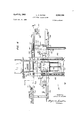
- Figure 1 is an exploded isometric view showing the relative arrangement of the more important parts of a machine embodying the present invention. It will be appreciated that, in order to show the arrangement of these parts in this isometric view, it is necessary to distort somewhat the relative position of some of the parts. Thus, for example, the case elevator and empty case are directly below the space defined on three sides by the pressure pads. However, in order to show these parts on the same view, it is necessary to show the empty case to one side of this space;
- Figure 2 is a top plan view of a caser apparatus embodying this invention with the cover for the top of the machine removed to show the interior structure;
- FIG. 3 is a front elevational view of the apparatus of Figure 2;
- Figure 4 is a side elevational view of this apparatus
- Fig. 5 is a rear elevational view of this apparatus
- FIG. 6 is a detail of the timing mechanism, selectively placed in operation for easing different sizes of cartons, as hereinafter described, actuated by the platform member of the pusher which eflects feed of; a group of cartons onto the bridge fingers;
- Figure 6A is a side elevation of oneof; the. timing ratchets shown in Figure 6; r a
- Figure 7 is a wiring diagram showing the circuit containing the timing switches of Figure 6 and the safety switches which control operation. of, the carton pusher so that the latter will not operate unless the bridge fingers are in position to receive the group, of cartons above an empty or partially filled case; and,
- Figures 8 and 8A are isometric views which, together with Figure 8 held on the left-hand side and Figure 8A held on the right-hand side, show the pressure fluid. cylinders, and the control valves therefor for effecting actuation of the moving parts of the machine except for the motor-driven chain-belt conveyor; as in the case of Figure 1, to show the parts in these figures, it was necessary to show some of them displaced from their actual positions.
- the racks and gears shown in Figure 8A mesh, but are not so shown to permit illustration of other important parts in these views.
- the carton conveyer 10 (Figs. 1, 2 and 8), which may be a chain or belt conveyer is driven by a motor 11.
- This motor drives a sprocket 12 (Figs. 2 and 5) which through a chain 13 (Figs. 1 and 2) drives a conveyer shaft 14 etfecting movement of the conveyer 10.
- This conveyer 10 is the only part of the machine driven by a motor. All other moving parts are actuated by pressure fluid supplied through pressure fluid cylinders, as hereinafter more fully described, under a pressure such that the forces exerted by the moving parts are relatively small, i.e., a pressure of from 30 to 40 pounds or less.
- the machine is, therefore, safe, i.e., the moving parts, other than the conveyer chain or belt, will not injure any member with which they may come into contact because the forces exerted thereby are low enough not to do so.
- the carton conveyer 10 brings the cartons 15 in a single line into the machine; the cartons 15 are supplied to the conveyer chain or belt 1! from one or more cartonfilling machines, or other suitable source of supply.
- the upper run of the conveyer chain 10 terminates contiguous to a dead plate 16.
- This plate 16 is in longitudinal alignment mm the direction of movement of the upper run of the carton conveyer 10.
- the carton conveyer moves the cartons thereon, the cartons are discharged onto the dead plate 16 and when, say, five or six cartons have accumulated on the dead plate and on the discharge end of the conveyer chain 1%, in abutment, the conveyer chain 10 exerts enough force to move the leading carton of the group across the dead plate 16 into engagement with a stop bar 17.
- Stop bar 17 carries a microswitch S (Figs. 1, 2, 7 and 8) which is in circuit with a normally closed solenoid valve 19 (Fig. 8). Movement of the cartons by the conveyer 10 as hereinabove described causes the leading carton on the dead plate when the desired group, in the present case four, has collected in side-by-side abutting engagement on the dead plate and conveyer 10 to engage the microswitch S and close this switch. Closing of the switch S energizes the solenoid valve 19 to supply pressure fluid, e.g., air (the expression air will be used hereinafter to refer to such pressure fluid, in the interests of brevity), to the pressure cylinder 21 through 4-way valve 22 controlled through the shuttle valves 23 and 24 (Fig. 8).
- pressure fluid e.g., air
- Return motion of the pusher plate 25 is effected when air is supplied, as hereinafter described, through 4-way valve 22 to the right-hand end of the pressure cylinder 21.
- the pressure fluid exhausts from the pressure cylinder 21 through the 4-way valve 22.
- Pressure fluid is supplied to the 4-way valve 22 through line 27 having a pressure-reducing valve 28 therein and communicating with the main pressure fluid line, e.g., supply line 29, equipped with a filter 31, a main pressure-reducing valve 32, and a lubricator 33.
- Main pressure line 29 communicates with an accumulator tank, or other tank, supplied with pressure fluid from an air pump or other suitable pressure fluid pump.
- Pusher bar 25 extends in a direction parallel to the direction of movement of the conveyer 10. It is carried by supporting bars 34 depending from platform 35 in turn carried by a slide bar 36 mounted for reciprocatory movement in suitable guides and actuated by the piston rod in pressure cylinder 21.
- a holdback bar 37 extends at right angles to the pusher bar 25 and is mounted for movement with this pusher bar on the supporting bars 34.
- the platform 35- carries a roller 38 which, when the platform is moved by the pressure cylinder 21, engages a control button 39 (Fig. 8) of a 3-way valve 41, which through line 42 and shuttle valve 24 actuates the 4-way valve 22 to etfect the return movement of the piston in cylinder 21.
- 3-way valve 41 communicates through line 43 containing a normally open solenoid valve 44, with line. 45 communicating with the main air line 29. Since solenoid valve 44. is normally open, air is supplied when control button 39 is actuated by the roller 38 through the shuttle valve 24 to etfect operation of 4-way valve 22 to return the pusher 25 to its original position.
- Roller 33 and button 39 are so positioned that the pusher 25 is reciprocated the desired distance, say about three inches, to move a row of cartons from the dead plate 16 to the collecting plate 26 laterally adjacent thereto.
- This short-stroke reciprocation of pusher 25 takes place a desired number of times controlled by timing mechanisrn hereinafter described.
- timing mechanisrn hereinafter described.
- Timing mechanism As best shown in Fig. 6, the platform 35 has at its rearward end one or more adjustable screws 46. These adjustable screws eifect actuation of the timing mechanism which determines the number of rows accumulated on the collecting plate 26 and when the resulting number of rows are moved onto the bridge fingers for deposit in the case.
- this timing mechanism comprises three timing ratchets 47, 48 and 49 mounted for rotation on a shaft fixed in a frame 50 suitably disposed in the machine just to the rear of the platform 35 (Figs. 1, 2 and 6).
- Ratchet 47 has on its sides four contact buttons 52 (shown in Fig. 6A) spaced 90 apart and which, as the ratchet 47 is.
- Fig. 6 shows the contact members 53 for the ratchets 48 and 49 respectively; one of these contact members 53 associated with ratchet 47 is shown in Fig. 6A. These ratchets are of suitable insulating material.
- Ratchet 47 has sixteen teeth and thus closes a switch 54 (Fig. 7) associated therewith every fourth stroke of the platform 35.
- Switch 54 is the switch associated with ratchet 47, which switch is closed each time one of the spaced contacts 52 is positioned between the contact members 53 associated with ratchet 47.
- the adjustable screw 46 on platform 35 Whenever the platform makes a rearward stroke, engages the depending member 55 secured to a rocker shaft 56 having fixed thereon the arms 57 having pivoted thereto the pawls 58.
- Ratchet 48 may have fourteen teeth with four contacts and thus, when this ratchet is rendered effective by closing toggle switch 64 (toggle switches 63 and 65 then being open), will close switch 61 once, upon the completion of the fourth stroke of the platform 35, and the second time upon the completion of the third stroke; the contacts being properly spaced to effect such closing of the switch 61.
- This ratchet is used when the machine is set to place sixteen containers in the first layer and twelve containers in the second layer; for example, it may be used to case pints.
- Ratchet 49 may have eleven teeth and be provided with three contact members 52 spaced about the opposite sides of the ratchet.
- this ratchet When this ratchet is rendered effective by closing toggle switch 65, the other two toggle switches 63, 64 being open, it energizes switch 62 every fourth stroke twice, and the third time on the third stroke.
- this ratchet may be used when casing half-pints to produce three layers containing sixteen, sixteen and twelve, or sixteen, twelve and sixteen half-pints in each layer. It will be appreciated that by the use of ratchets having the desired number of teeth and contact buttons, the grouping of the cartons may be varied, as desired, within limits.
- switch 54 On the end of the third stroke, switch 54 is closed thus energizing the solenoid valve 44 which closes the air supply to 3-way valve 41. Accordingly, pressure cylinder 21 effects the long-stroke movement of pusher bar 25 to move the group of cartons from conveyer 10 and dead plate 16 and the adjacent collecting plate 26 onto the bridge fingers 66.
- the bridge fingers 66 (Figs. 1, 2, 4 and 8) consist of spaced parallel bars arranged for reciprocatory motion from a position above an empty case supported on elevator 67 to a position such that the terminal ends of the bridge fingers are laterally spaced from the side of the empty case and back.
- the bridge fingers In the first mentioned position the bridge fingers are disposed contiguous to the collecting plate 26 to receive the groups of cartons moved thereonto by the pusher 25 as hereinabove described.
- the bridge fingers permit the case to rise to receive the held group of cartons.
- Such reciprocal movement of the bridge fingers is effected by pressure cylinder 68 having its piston rod 6? fixed to the cross bar 71 carrying the bridge fingers 66.
- the latter are guided and supported for reciprocatory motion in a stationary support 72 on the frame of the machine provided with suitable openings through which the bridge fingers move.
- Pressure cylinder 68 is supplied with air through line 45 provided with a presure-reducing valve 73 controlling the flow of air to a 4-Way valve 74 controlling the supply of air to and the exhaust of air from cylinder 68 to effect reciprocatory motion of the piston therein.
- the 4-way valve 74 is actuated by a 3-way valve 75 which also actuates a 3-way valve 76 and 4-way valve 22 through shuttle valve 24.
- Valve 75 is actuated by extension or member 77 on slide bar 36 when it completes its long stroke. The operation of these controlling valves 74, 75, 76 will be described more fully hereinafter.
- the pressure pad holders for the groups of cartons comprise a series of pads 78, desirably one for each row of cartons, an oppositely positioned plate '79 and a third holding plate 81 at right angles to the plate 79 and pads 78 so that the group of cartons is confined on three sides by the pressure pads 78, the opposite plate 79 and the end plate 81.
- Each pad has thereon a spring-return pressure cylinder 82. When pressure is no longer applied to the cylinders 82, the spring action returns the pads to their original positions where they exercise no pressure on the group of cartons.
- the pressure fluid circuit for effecting actuation of the pressure pads 78 comprises the 3-way valve '75 and the 3-way valve 76 in circuit with the spring-return cylinders 82 for applying pressure fluid to clamp the group of cartons against the action of the springs in the cylinders 82.
- the springs cause the pressure pads to return to their original positions. 4
- extension 77 engages and actuates the 3-way valve 75.
- This valve 75 in turn controls the operation of 3-way valve 76 to supply air to cylinders 82, actuating the pressure pads to firmly hold the group of cartons.
- Valve 75 also supplies air to the 4-way valve 74 and thence to the pressure cylinder 68 to effect movement of the bridge fingers 66 from right to left (viewing Fig. 8).
- an actuating member 83 carried by the cross bar 71 engages a 3-way valve 84.
- Valve 84 is in the pressure fluid circuit containing 4- way valve 85 which controls the flow of air to and the exhaust of air from cylinder 86, actuating the case elevator '67.
- 3-way valve 84 is actuated by the actuating member 83 on the bridge finger cross bar 71 (during 7 the movement of this cross bar from right to left, viewing Fig. 8), the pressure cylinder 86 is actuated to raise the case elevator with the case thereon.
- Movable cross bar 71 carries a contact member '71 arranged to engage and close a switch S desirably a microswitch on stationary support 72, when the bridge fingers 66 are properly positioned above the case on the case elevator 67. Unless the bridge fingers are properly positioned above the case elevator 67, switch 8; remains open.
- Switch S is a safety switch to insure proper positioning of the bridge fingers above the case on the case elevator before the group of cartons can be moved onto the bridge fingers.
- solenoid 93 is energized to close solenoid valve 44 thus preventing 3-way valve 41 from feeding air to 4-way valve 22 to reverse cylinder 21 on the short stroke. Hence, a long stroke takes place as described above.
- solenoid 93 is actuated, relay 91 is energized to move switch 92 to the B position. This causes the circuit containing the S switch and solenoid 89 to include the S switch through branch circuit containing the conductors C and D.
- Case elevator and mechanism for operating it The case elevator shown in Figs. 1, 3 and 8A comprises a frame 97 mounted for up and down movement in the frame of the machine.
- the case supporting floor 97a of this frame has fixed thereto spaced bars 97b on which the case rests supported above the fioor 97a.
- This frame has spaced racks 98 fixed thereto and in meshing engagement with gears 99 keyed to a shaft 101, which has also keyed thereon a latch member 102 (Fig. 8A) having a tooth 103 adapted to be engaged by a pivoted latch lever 104.
- Elevator 67 is suitably counterweighted by counterweight 100 (Figs. 3 and 5) for facile up and down movement.
- Latch member 102 makes slightly less than a complete revolution on each up or down stroke of the racks 98. It is free to turn freely in the direction indicated by the arrow thereon in Fig. 8A and in the opposite direction also, unless the latch lever 104 engages the tooth 103; when this happens, the case elevator is locked against movement. Such locking, as pointed out more fully hereinafter, takes place whenever the case elevator descends and latch lever 104 is in position to engage the tooth 103. When so locked or held, the case elevator is positioned at an intermediate point (shown in dot-and-dash lines in Fig. 3) of its possible full descent so as to position the top of the case about one inch below the bridge fingers 66.
- the latch lever 104 at its end 105 has pivoted thereto an operating rod 106 which is actuated by a spring-type pressure cylinder 107.
- the spring in the pressure cylinder 107 normally maintains the latch lever 104 in engagement with the latch member 102.
- this pressure fluid moves the latch lever 104 about its pivot to release the case elevator to enable it to move to the case discharge position, which is at the lowermost position of the case elevator descent.
- the latch lever 104 engages, so that the elevator does not complete its lowering movement to the discharge position, but stops at the intermediate point.
- the latch lever 104 engages tooth 103 during the downward movement of the case elevator to stop it at said intermediate point during each downward movement of the elevator except the last.
- air is supplied to cylinder 107 to disengage the latch 104 to cause the elevator to make a complete downstroke and position the filled case in discharge position.
- Piston rod 108 of pressure cylinder 86 is fixed to the frame 97 of the case elevator and effects the up and down movement of the elevator whenever the piston in cylinder 86 is actuated.
- the pressure fluid circ'uit for effecting actuation of the piston in cylinder 86 contains 4-way valve 85 and 3-way valve 84 actuated by the bridge lingers in their outward movement to initiate upward movement of the elevator. Holding pressure on the group of cartons is still maintained by valve through 3-way valve 76.
- the 3-way valve 109 is actuated to supply pressure fluid through the 4-way valve to the pressure cylinder 86, thus lowering the case elevator and the case carried thereby.
- actuating member 111 Mounted on the frame 97 of the case elevator is an actuating member 111 which, whenever the case elevator lowers, actuates a 3-way valve 112.
- the pressure fluid circuit containing valve 112 also contains 4-way valve 74 which controls the actuation of the pressure cylinder 68 actuating the bridge fingers to move them into position over the case.
- Three 3-way valves 113, 114 and 115 are actuated by a pivoted member 116 carried by the elevator frame 97.
- Member 116 is so pivoted that, in the upward movement of the elevator, it engages each of the 3- way valves 115, 114 and 113 and moves the valve stems therein.
- member 116 is spring biased so that it does not, in its downward stroke, engage the operating buttons for the 3-way valves 113, 114 and 115.
- 3-way valve 113 actuates 4-way valve 152 (which, as hereinafter described, controls operation of the cylinder 151 actuating the case pusher 136), 3-Way valve 117 (provided manually-operated valve a is open) and 3-way valve 76 which releases the pressure pads 78.
- valve 109 effects actuation of 4-way valve 85 to operate cylinder 86 to lower the case elevator.
- 3-way valve 114 controls the supply of air to effect actuation of (l) 3-way valve 117 (provided valve a is open), (2) valve 76 to release the pressure pads, and (3) if valve d is open, cylinder 107 to release latch to permit the case elevator to make a full stroke.
- 3-way valve controls the supply of air to effect actuation of 3-way valve 123 (provided valve b is open) and.
- 3-Way valve 129 (provided valve d or e is open) to actuate cylinder 107 to release latch 105 to permit the case elevator to make a full stroke.
- Flow of pressure fluid to the spring-actuated pressure cylinder 107 is controlled by a 3-way valve 129 actuated through shuttle valve 131'.
- the pressure fluid system in which the 3-way valve 129 is disposed contains, besides the shuttle valve 131', a manually operated flow control valve in the line connecting shuttle valve 131 with the main pressure supply.
- the air lines connecting the various valves are shown in Figs. 8 and 8A; these lines are conventional tube feed lines supplying pressure fluid to and exhausting pressure fluid from the cylinders, and hence it is believed further description is unnecessary.
- the shuttle valves may be integral with the 3- or 4-way valves with which they are associated to effect actuation of such valves from two or more positions.
- the 4-way valves control the application of air to one side or the other of a pressure cylinder to effect movement of the piston therein from right to left or left to right.
- the 3-way valves either control the feed of air to a component or exhaust the line leading from that component.
- the shuttle valves are air switches which permit actuation of the components to which the shuttle valves are attached from two or more sources.
- Case conveyer system The empty cases are supplied to the machine by a conveyer chain 199 or other mechanism which feeds the cases in a single line into throat 135 (Fig. 2) of the case chute 136' guiding the empty cases into the machine.
- An empty case is moved onto the spaced bars 97a of the case elevator by a pivoted case pusher 136 (Figs. 1, 4 and 8A) which is carried by a sliding support 137 actuated by the piston stem 138 of the pressure cylinder-151.
- This control mechanism is a case control mechanism 141 for controlling the feed of an empty case to the case elevator 67.
- This control mechanism as shown in Figs. 1, 2 and 8A, comprises a shaft 142' journaled for rotation in the frame of the. machine and having fixed thereto two spaced stop fingers 142 and 143.
- Shaft 142 has also fixed thereto a latch member 144 adapted to be engaged by a pivoted latch lever 145 which is actuated by a spring-type pressure cylinder 146.
- latch lever 145 When pressure is applied to cylinder 146, latch lever 145 is moved about its pivot to release member 144 and permit fingers 142 and 143 to be moved by the case so as to swing from a preceding case into the next case, permitting the preceding case to be moved onto the supporting bars 97b of the elevator.
- Conveyer chain 199 which may be motor driven, passes between bars 97b.
- the floor 97a of the case elevator is provided with an opening extending thereacross permitting the elevator to rise and descend without disturbing the chain 199. This chain slides under the held empty cases without moving them because they are held by the fingers 142 and 143. It effects the removal of the filled case when the latter is deposited thereon after being removed from the supporting bars 97b of the case elevator, as hereinafter more fully described.
- the pressure fluid circuit effecting actuation of the case pusher 136 and the fingers 142 and 143 involves the pressure fluid cylinder 151, the 4-way valve 152, and 3-way valve 153.
- 3-way valve 153 is arranged to be actuated by an actuating member 154 carried by the case pushor during the forward stroke of the case pusher to effect 16 156 carriedrby the case elevator, which member 156 effects actuation of the 3-way valve 155 when the case elevator is in position for discharge of the filled case.
- the conveyer chain 199 receives the filled case when pushed off the case elevator by a preceding empty case being moved onto the case elevator and effects its removal from the machine.
- the toggle switches 63, 64 and 65 (Fig. 7) and the manually operated valves a, b, c, d and e are disposed on a suitable panel or wall of the machine where they are readily accessible. Desirably, this panel or wall contains a notice of the directions which should be followed in operatingthe machine. Thus, the notice should indicate that switch 63 is closed when casing quarts or other large containers, and the other two'switches 64 and 65 are then open. Switch 64 is closed when casing pints, 63 and 65 being open. Switch 65 is closed when casing halfpints, switches 63 and 64 being then open.
- the parts of the machine hereinabove described are supported on a suitable frame 200 carried by adjustable legs 201 to permit adjustment, if necessary, for example, to accommodate variations in the pitch of the floor on which the machine may be supported and to etfect other adjustments in height which may be necessary for proper functioning of the machine.
- valve c When casing quarts or other relatively large size containers in a single layer, valve c is open; valves a, b, d and eare closed. Air, therefore, is not supplied to 3-way valves 117 and 128, but is supplied to valve 129.
- member 83 actuates 3-way valve 84 which through 4-w-ay valve 85 effects supply of air to cylinder 86, raising the case elevator 67 with the empty case thereon.
- the pressure pads 78 in the form of thin plates and plates 79 and 81 extend inside the case.
- Case elevator through spring biased actuating member 116 actuates the 3-way valves 113, 114 and 115.
- the latter two are ineffective because air is not supplied thereto due to closing of valves a and b.
- 3-Way valve 113 through the shuttle valve 131 and the 3-Way valve 76 interrupts the supply of pressure fluid to the cylinders 82, causing the pressure pads to release the pressure onthe group of cartons under the influence of the springs in the cylinders 82. The group of cartons is thus deposited in the case.
- 3-way valve 113 also efiects actuation of the 4-way valve 152, controlling the supply of air to the pressure cylinder 151 which actuates the pivoted case pusher 136.
- actuating member 156 etfects movement of the 3-way valve 155.
- This 3-way valve 155 controls the supply of pressure fluid to the spring-type pressure cylinder 146 which then moves the latch 145, permitting rotation of the shaft 141 carrying the stop fingers 142 and 143 from a preceding empty case to a succeeding empty case, and permitting the preceding empty case to be moved onto the case elevator under the pressure exerted by the case pusher 136. This movement effects the simultaneous discharge of a filled case.
- 3-way valve 155 positions the valves for the next machine cycle.
- member 154 actuates 3-way valve 153 to eifect actuation of pressure cylinder 151 through 4-way valve 152 to efiect the return stroke of the case pusher.
- the pivoted pusher bar 136 swings about its pivot and thus does not push the incoming cases out of the machine but swings into proper position to feed the next empty case toward the case elevator.
- valve 129 valve being open
- Double layer casing For operation of the machine to case pints or other containers in two layers, the valves a and d are opened and the valves b, c and e are closed. Also, the toggle switch 64 is closed and the switches 63 and 65 are open.
- the elevator latch 102 engages the latch lever 105 to control the elevator down stroke to stop the lowering motion with the top of the case containing the first layer about one inch below the bridge fingers ready for the next layer of containers.
- the case stop fingers 142 and 143 With the elevator held by latch 102 above the point where actuation of 3-way valve 155 takes place by member 156, the case stop fingers 142 and 143 will not release, and the elevator makes its second upward stroke before a new case is allowed to be placed on the case elevator.
- valves a, b and e are opened and valves 0 and d are closed.
- the toggle switches 63 and 64 are closed and switch 65 is open.
- actuating member 116 engages and actuates valve 115 which is then under the air pressure supplied thereto through the 3-way valve 123 in the line containing the open valve b.
- This causes the case elevator to stop at a level corresponding to the desired third height to receive the third layer,
- Such actuation is effected through valves 117, 128 (vaives a and b being open), shuttle valve 132, 4-way valve 76 releasing the pressure on pads 78, which on their return movement actuate valve 109, controlling 4-way valve which in turn controls the supply of air to cylinder $6 to lower the case elevator.
- 3-way valve also actuates (valve 0 being open) 3-way valve 129 which controls the supply of air to the cylinder 107, effecting release of the elevator latch.
- the elevator is free to move to the case discharge position.
- member 156 On its descent, member 156 actuates valve to clear all valves for the next machine cycle and etfect the replacement of the filled case on the case elevator with an empty case.
- the present apparatus is so designed that it will operate at low air pressures of the order of 30 to 40 pounds per square inch. Accordingly, the moving parts actuated under such air pressures cannot damage each other, nor will they injure the cartons or containers that might be misaligned or not uniform for some reason. What is equally important, if not more so, the machine is so designed that the moving parts can be stopped or kept from starting by holding with the human hand; accordingly, the possibility of injury to the operator is minimized, if not completelyeliminated.
- timing ratchets layers containing difterent numbers of containers can be formed. With one and the same ratchet having different numbers of teeth between adjacent con tacts, by starting the ratchet at a different tooth the layering can be altered, say 16-12-16, or 16-16-12, etc.
- a container handling apparatus comprising, in combination, a case elevator adapted to elevate a case from a lower position to a higher position to receive a group of said containers and to move said case contain ing said containers to said lower position where discharge of the filled case takes place, a horizontally reciprocable supporting member movable from a first position to one side of said case on said case elevator to a second position above said case on said case elevator, means for moving a group of containers onto said supporting member when in position above said case, means for engaging the side walls of containers in said group and exerting a holding pressure on said group of containers while on said supporting member, in said second position, means for moving said supporting member to said first position while said containers are so held, means for raising said case elevator with the case thereon into position to receive said group of containers, means for releasing the holding pressure on said group of containers, means for lowering the case with said containers therein, and means for effecting the discharge of the filled case,
- a container handling apparatus comprising, in combination, a conveyer for feeding a row of containers, a dead plate at the exit end of the conveyer for receiving said containers from said conveyer, a stop plate at the end of said dead plate, a switch on said stop plate arranged to be closed by the leading container on said dead plate, a reciprocable.
- the caontainer.handling apparatus comprising, in combination, a combined pusher and hold-back bar, a conveyor for feeding a row of containers, a dead plate for receiving said containers from said conveyor disposed in longitudinal alignment with said conveyor contiguous to the discharge end thereof, a collector plate positioned laterally adjacent said dead plate to receive containers from said dead plate, said pusher and hold-back bar being adapted to reciprocate across said dead plate to move containers thereon onto said collector plate and simultaneously provide a stop for containers fed by said cona higher position to receive a group of said containers and veyor, a case elevator for elevating and lowering a case and arranged to position said case laterally continguous to said collector plate, a reciprocable supporting member adapted to be moved from a position over said case elevator laterally contiguous to said collector plate to a second position adjacent said case elevator, pressure pad holding means disposed above said case elevator arranged to engage the side walls of containers forming a group of containers positioned on said supporting member and to hold said group of containers by exerting pressure on the
- case stop mechanism for controlling the movement of' said cases, said case pusher being constructed and arranged to move an empty case onto said case elevator and simultaneously eifect the discharge of a filled case therefrom.
- Container handling apparatus as defined in claim 5, in which the means for actuating the combined pusher and hold-back bar, the case elevator, the reciprocating supporting member, the pressure pad holder, the case pusher and the case stop are actuated by pressure fluid.
- a container caser comprising, in combination, a case elevator, means for supporting a group of containers above said case elevator, means for elevating said case elevator from an initial lowermost level to a higher level to receive a first layer of said containers collected on said supporting means, means for moving said case elevator in a downward direction terminating short of its original lowermost level, means for elevating said case elevator into a position to receive a second layer of containers, means for lowering said case elevator to said original lowermost level, and means for effecting the removal of said case from said case elevator.
- a container caser comprising, in combination, a case elevator, supporting means reciprocable from a position above said case elevator bridging the open top of a case on said case elevator to a position laterally adjacent said ca'se, pressure pad means for engaging the side walls of the end of a group of containers positioned on said supporting means to hold said group and permit said supporting means to be moved to said position laterally adjacent said case elevator, and means for elevating said case elevator in a series of up and down strokes, said last mentioned means including control means for effecting each downward stroke of said series except the last stroke so that it terminates short of the lowermost position of the elevator and for effecting the succeeding upward 15' stroke of said series after the first stroke of said series so that it terminates short of the uppermost position of the elevator, to receive aplurality of layers of groups of containers fed successively to said supporting means.
- a container caser as defined in claim 8 comprising means for feeding a row of empty cases and successively placing the leading empty case on the case elevator while effecting the discharge of the filled case.
- a container caser comprising, in combination, a case elevator, means for supporting a group of containers above said case elevator, means for feeding successive groups of containers to said supporting means, means for elevating said case elevator to receive in separate'layers the successive groups of containers, said elevating means including control means for effecting movement of said case elevator after receiving the first layer downwardly but terminating short of its initial lowermost position and then elevating the case but terminating short of its initial uppermost position, means for lowering said case elevator containing the filled case to its initial lowermost position, and means for effecting the discharge of said filled case from said case elevator.
- a container caser comprising, in combination, a case elevator, supporting means reciprocable from a position above said case elevator bridging the open top of a case on said case elevator to a position laterally adjacent said case, means for holding a group of containers positioned on said supporting means to permit said supporting means to be moved to said position laterally adjacent said case elevator, means for feeding successive groups of containers to said holding means, means for elevating said case elevator in a series of up and down strokes, said last mentioned means including control means for effecting each downward stroke of said series except the last stroke so that it terminates short of the lowermost position of the elevator and for effecting the succeeding upward stroke of said series after the first stroke of said series so that it terminates short of the uppermost position of the elevator, to receive said successive groups of containers and form a plurality of layers of said containers in said case, means for lowering the case elevator to its initial lowermost position after the case has received its top layer, and means for feeding an empty case on said case elevator while simultaneously effecting the discharge of the filled case.
- Container handling apparatus comprising, in combination, a' combined pusher and hold-back bar, a pressure cylinder for actuating said combined pusher and holdback bar, a conveyor for feeding a row of containers, a dead plate for receiving said containers from said conveyor disposed in longitudinal alignment with said conveyor contiguous to the discharge end thereof, a collector plate positioned laterally adjacent said dead plate to receive containers from said dead plate, said pusher and hold-back bar being adapted to reciprocate across said dead plate to move containers thereon onto said collector plate and simultaneously provide a stop for containers fed by said conveyor, a case elevator for elevating and lowering a case and arranged to position said case laterall y contiguous to said collector plate, a pressure cylinder ror actuating said case elevator, a reciprocably supporting member adapted to be moved from a position over said case elevator laterally contiguous to said collector plate to a second position adjacent said case elevator, a pressure cylinder for actuating said supporting member, pressure pad holding means disposed above said case elevator arranged to receive a group of
- a container handling apparatus comprising, in combination, a conveyor for feeding a row of containers, a
- dead plate at the exit of the conveyor for receiving said containers from said conveyor, a stop plate at the end of said dead plate, a switch on said stop plate arranged to be closed by the leading container on said dead plate, a reciprocable pusher and hold-back bar movable across said dead plate to remove a row of containers therefrom, a collecting plate positioned laterally contiguous to said dead plate, a reciprocable supporting means positioned laterally contiguous to said collecting plate, means for reciprocating said pusher hold-back bar initially through a series of short back-and-forth strokes to move successive rows of containers from said dead plate onto said collecting plate followed by a long stroke for moving said rows on said dead plate and said collecting plate onto said supporting means, initiation of said strokes being effected by the closing of said switch, a case elevator disposed below said supporting means, means for actuating said case elevator to elevate a case to receive said group of containers, said reciprocable supporting means being reciprocable in a direction substantially parallel to the direction of movement of said conveyor from a first position to one side of said
- a container handling apparatus comprising, in combination, a conveyor for feeding a row of containers, a dead plate at the exit end of the conveyor for receiving said containers from said conveyor, a stop plate at the end of said dead plate, a switch on said stop plate arranged to be closed by the leading container on said dead plate, a reciprocable pusher and hold-back bar movable across said dead plate to remove a row of containers therefrom, a collecting plate positioned laterally contiguous'to said dead plate, a supporting means positioned laterally contiguous to said collecting plate, pressure fluid means for reciprocating said pusher and hold-back bar initially through a series of short back-and-forth strokes to move successive rows of containers from said dead plate onto said collecting plate and interpose said holdback bar across the discharge end of said conveyor and return said pusher to its starting position followed by a long stroke for moving in one direction said rows on said dead plate and said collecting plate onto said supporting means and in the other direction returning said pusher to its starting position, initiation of said short strokes being effected by the closing
- Container handling apparatus comprising, in combination, a combined pusher and hold-back bar, a pressure cylinder for actuating said combined pusher and hold-back bar, a conveyor for feeding a row of containers, a dead plate for receiving said containers from said conveyor disposed in longitudinal alignment with said conveyor contiguous to the discharge end thereof, a collector plate positioned laterally adjacent said dead plate to receive containers from said dead plate, said pusher and hold-back bar being adapted to reciprocate across 17' said dead plate to move containers thereon onto said collector plate and simultaneously provide a, stop for containers fed by said conveyor, a case elevator for elevating and lowering a case and arranged to position said case laterally contiguous tosaid collector plate, a reciprocably supporting member adapted to be moved from a position over said case elevator laterally contiguous-to said collector plate to a second position adjacent said case elevator, at pressure cylinder for actuating said supporting member, pressure pad holding means disposed above said case elevator arranged to receive a group of containers positioned on said supporting member and to hold said group of
- pressure actuated means for elevating said elevator in a plurality of up-and-down strokes, the downward strokes, except the last of each series, terminating short of the lowermost position of the elevatorv and the upward strokes, after the first of each series, terminating short of the uppermost position of the elevator to introduce successive groups of containers and form a plurality of layers of said containers in said case, means for guiding empty cases, a case pusher'for moving a row. of empty cases and arranged to move the leading case of said row onto said case elevator, -apressure cylinder for actuating said case pusher, case stop.
- Container handling apparatus comprising, in combination, a conveyor for feeding a row of containers, a
- dead plate at the exit end of the conveyer for receiving said containers from said conveyer, a stop plate at the end of said dead plate, a collecting plate laterally adjacent said stop plate, reciprocable bridge fingers positioned laterally adjacent said collecting plate, a case elevator disposed to position a case directly beneath said reciprocable bridge fingers with said bridge fingers bridging the space above said empty case, said reciprocable bridge fingers being movable to a position laterally contiguous to said empty case, pressure pad holding means for holding a group of said containers collected on said supporting means, a case pusher for moving empty cases successively onto said case elevator, a case stop, a switch on said stop plate arranged to be closed by a leading container on said dead plate and effect the actuation of said pusher in short back and forth strokes to move successive rows of containers from said dead plate onto said collecting plate, means for effecting a long stroke of said pusher to move rows of containers from said dead plate and collecting plate onto said supporting means and means for effecting the operation of said parts so that at the end of said long stroke, said pressure pads act
- Container handling apparatus comprising, in combination, a combined pusher and hold-back bar, a pressure cylinder for actuating said combined pusher and hold-bar, a conveyor for feeding a row of containers, a dead plate for receiving said containers from said conveyer disposed in longitudinal alignment with said conveyer contiguous to the discharge end thereof, a collector plate positioned laterally adjacent said-dead plate to receive containers from said dead plate, said pusher and; hold-back bar being adapted to reciprocate across said dead plate to move containers thereon onto said collector plate and simultaneously provide a stop for-containers fed by said conveyer, a case elevator for elevating and lowering a case and arranged to position said case laterally contiguous to said collector plate, a reciprocably support ing member adapted to be moved from a position over said case elevator laterally contiguous to said collector; plate to a second position adjacentsaid case elevator, apressure cylinder for actuating said supporting member, pressure pad holding means disposed above said case elevator arranged to receive a group of containers posi
- a container handling apparatus comprising in combination, a conveyer for feeding a row of containers, reciprocable bridge fingers movable from a position above a case to a position to one side of said case, means for moving containers from said conveyer onto said bridge fingers, a switch actuated by the leading container of said row to control said means for moving said containers onto said bridge fingers and a second switch actuated by said bridge fingers when in proper position above said case, said second switch being in circuit with said first mentioned switch so that said means for moving containers onto said bridge fingers is operative only when said bridge fingers are in position above said case.
- a container caser comprising in combination, a conveyer for feeding a row of containers, reciprocable bridge fingers movable from a position above a case to a position to one side of said case, pressure pad holding means above said bridge fingers, pusher means for 19 moving a group 'of containers from said conveyor onto said bridge fingers, a case elevator, means for feeding cases ⁇ to said casev elevator, means for actuating said pusher means and for efiecting actuation of the pressure pad holders to hold a group of containers while supported on said bridge fingers, means to withdraw said bridge fingers while said containers are so held and effecting initiation of the upward movement of said case elevator,
- a casing apparatus comprising, in combination, means for moving a case into position to receive a group of articles to be cased, a movable supporting member movable into position above a case in said article re DCving position, means for forming a row of articles on said supporting member, means including pressure pads engaging the side walls of the end articles of said row to compress said row and thus exert a holding pressure thereon while on said supporting member, means for moving said supporting member to a position where the said row of articles is no longer supported thereby but said articles are held by said pressure pad holding means, and means for moving said row of articles into said case.
Landscapes
- Engineering & Computer Science (AREA)
- Mechanical Engineering (AREA)
- Supplying Of Containers To The Packaging Station (AREA)
Description
Aprll 25, 1961 L. A. MAPES AUTOMATIC CARTON CASER 9 Sheets-Sheet 1 Filed Feb. 20, 1959 INVENTOR. 4551/5 7 MAPES April 25, 1961 A. MAPES AUTOMATIC CARTON CASER 9 Sheets-Sheet 2 Filed Feb. 20, 1959 INVENTOR AESL/E 4. MAAFS ,QI'raA'A/EV April 25, 1961 L. A. MAPES 2,981,040
AUTOMATIC CARTON CASER Filed Feb. 20, 1959 9 Sheets-Sheet 5 FIG. 3
INVENTOR.
(ESL/E 7. M4P$ April 25, 1961 L. A. MAPES AUTOMATIC CARTON CASER Filed Feb. 20. 1959 9 Sheets-Sheet 4 m RA 1 Y E M m QN Wm q, 4
April 25, 1961 Filed Feb. 20, 1959 L. A. MAPES 2,981,040
AUTOMATIC CARTON CASER 9 Sheets-Sheet 5 FIG. 5
l in
H O m 4 :4 a: v
INVENTOR.
A ril 25, 1961 A. MAPES 2,981,040
AUTOMATIC CARTON CASER Filed Feb. 20, 1959 9 Sheets-Sheet 6 INVENTOR.
LE 5415 4- MAPES April 25, 1961 A. MAPES AUTOMATIC CARTON CASER 9 Sheets-Sheet '7 Filed Feb. 20, 1959 l I I .4 I
| I E l 1 I I 4 m INVENTOR LESL/E .4 M4755 April 25, 1961 L. A. MAPES AUTOMATIC CARTON CASER 9 Sheets-Sheet 8 Filed Feb. 20, 1959 FIG. 8
INVENTOR. 155A IE ,4. MAPES April 25, 1961 L. A. MAPES AUTOMATIC CARTON CASER Filed Feb. 20, 1959 I 9 Sheets-Sheet 9 .r aym m R. V W I a. ,1, u 2 a: & M/M W Lh fi kw i ZESZ/E l7. IMKFFES flrrmwsy AUTOMATIC 'CARTON CASER Leslie A. Mapes, 9 Drury Lane, Palisade, NJ. Filed Feb. 20, 1959, Ser. No. 794,546
21 Claims. (or. 53-62) This invention relates to apparatus for placing in cases 'or other holders groups of containers such as paper and pasteboard cartons, particularly the now widely used cartons for storing and transporting milk, orange juice, etc.
It is among the objects of this invention to provide apparatus for casing containers, particularly cartons, which apparatus can group and place in cases difierent size cartons, for example, quarts, pints, half-pints, etc.
It is another object of this invention to provide such caser which, with only minor adjustments, can automatically case, say, quart cartons in a group of a desired number within a case containing a single layer of such cartons, or pints in two layers in a case, or half-pints in three layers, etc. It will be appreciated that the reference to quarts, pints and half-pints is for purposes of illustration only and the invention is adapted to handle containers of other sizes than those mentioned.
It is still another object of the present invention to provide such caser which is substantially fool-proof in operation, i.e., the cartons are cased only when properly grouped and positioned for disposition within the case and the latter is in position to receive the group.
It is a further object of the present invention to provide such caser in which substantially all moving parts are actuated by pressure fluid under relatively low pressures of the order of 30 to 40 pounds per square inch, thus avoiding damage to the cartons as well as possible injury to the operator. Should an operator inadvertently place his hand or other part of his body in the path of movement of any of these moving parts, such obstruction would bring the moving parts to a halt without causing material injury to the part of the anatomy thus engaged.
Other objects and advantages of this invention will be apparent from the following detailed description thereof.
In the preferred embodiment illustrated in the drawings, the invention is shown incorporated in a milk carton casing machine for easing quarts, pints and half-pints and the .description which follows will largely be confined to the present illustrated embodiment of the invention. It will be understood, however, that the novel 7 features and improvements are susceptible of other applications, such, forexample, as handling cartons of other sizes. Hence, the scope of this invention is not confined to the embodiments herein described.
The carton caser embodying the present invention comprises the following main units:
(1) A carton grouping mechanism for forming a first row of cartons of the desired number and transferring each row as formed to a collecting station where the desired number of rows accumulates.
(2) Mechanism for moving the accumulation or group of cartons from the collecting station onto reciprocal bridge fingers which support the group of cartons above an empty case. This mechanism includes pressure pads for clamping and holding the group of cartons while the bridge fingers move from aposition above the empty case to a position spaced laterally therefrom to permit the n ited States Patent empty case to rise and receive the group of cartons while the latter is held by the pressure pads.
(3) A case feed to move an empty case into position on a case elevator and simultaneously efiect the discharge of a filled case from the machine. 7
(4) The case elevator designed to move the ease up to be filled and the filled case down to be discharged from the machine. This elevator mechanism is designed to handle large cartons, say, quarts, to elevate the case to receive the group of cartons in a single layer and then downwardly the full return stroke to position the filled case into discharge position. When handling, say, pints, the case elevator first moves upwardly the full stroke to receive the first layer of pints, then descends partially, enough to permit the bridge fingers to be moved into position to receive the next layer of cartons but not to filled-case discharge position, and after this next layer of cartons is gripped by the pressure pads and held thereby, the bridge fingers are withdrawn and the case elevator is moved up less than the full distance but enough to receive the second layer of pints, the bases of which will rest on the tops of the first layer, and thereafter descends to the discharge position.
In the case of half-pints, the case elevator first moves up the full stroke to receive the first layer of cartons, then descends partially, then moves up somewhat less than the full stroke to receive the second layer, again descends partially, then moves up a shorter distance to receive the third layer and then descends to the discharge position.
The above described movements take place automatically. Each group of cartons is moved onto the bridge fingers over the case on the case elevator, the group is held by the pressure-pad action, the case is elevated by the elevator after the bridge fingers have been withdrawn, the loaded case is lowered, and, where one layer only is received by the case, discharged from the machine while an empty case is brought into position. Where a case receives two layers, it, after receiving the first layer, is lowered partially, again elevated to receive the second layer, then lowered completely and discharged from the machine. In those instances where the case receives three layers, the action of the case elevator is to first raise the case the full stroke to receive the first layer, then lower the case partially, raise the case to receive the second layer, then lower it partially, raise the case to receive the third layer, and then lower it to the discharge position; After each upward stroke of the case elevator, the bridge fingers are moved to receive a succeeding group in position to be received by the case, the group is held by the pressure pads, the bridge fingers then move to a position spaced laterally from above the empty case, and the case is elevated to receive the held group. The above actions are repeated as long as cartons and case are supplied to the machine. Should the supply of cartons or cases be interrupted, the machine stops automatically.
In the accompanying drawings forming a part of this specification and showing for purposes of exemplification a preferred embodiment of this invention, without limiting the claimed invention to this embodiment:
Figure 1 is an exploded isometric view showing the relative arrangement of the more important parts of a machine embodying the present invention. It will be appreciated that, in order to show the arrangement of these parts in this isometric view, it is necessary to distort somewhat the relative position of some of the parts. Thus, for example, the case elevator and empty case are directly below the space defined on three sides by the pressure pads. However, in order to show these parts on the same view, it is necessary to show the empty case to one side of this space;
Figure 2 isa top plan view of a caser apparatus embodying this invention with the cover for the top of the machine removed to show the interior structure;
Figure 3 is a front elevational view of the apparatus of Figure 2; I
Figure 4 is a side elevational view of this apparatus;
Fig. 5 is a rear elevational view of this apparatus;
Figure 6 is a detail of the timing mechanism, selectively placed in operation for easing different sizes of cartons, as hereinafter described, actuated by the platform member of the pusher which eflects feed of; a group of cartons onto the bridge fingers;
Figure 6A is a side elevation of oneof; the. timing ratchets shown in Figure 6; r a
Figure 7 is a wiring diagram showing the circuit containing the timing switches of Figure 6 and the safety switches which control operation. of, the carton pusher so that the latter will not operate unless the bridge fingers are in position to receive the group, of cartons above an empty or partially filled case; and,
Figures 8 and 8A are isometric views which, together with Figure 8 held on the left-hand side and Figure 8A held on the right-hand side, show the pressure fluid. cylinders, and the control valves therefor for effecting actuation of the moving parts of the machine except for the motor-driven chain-belt conveyor; as in the case of Figure 1, to show the parts in these figures, it was necessary to show some of them displaced from their actual positions. For example, the racks and gears shown in Figure 8A mesh, but are not so shown to permit illustration of other important parts in these views.
CARTON GROUPING Referring to the drawings, the carton conveyer 10 (Figs. 1, 2 and 8), which may be a chain or belt conveyer is driven by a motor 11. This motor drives a sprocket 12 (Figs. 2 and 5) which through a chain 13 (Figs. 1 and 2) drives a conveyer shaft 14 etfecting movement of the conveyer 10. This conveyer 10 is the only part of the machine driven by a motor. All other moving parts are actuated by pressure fluid supplied through pressure fluid cylinders, as hereinafter more fully described, under a pressure such that the forces exerted by the moving parts are relatively small, i.e., a pressure of from 30 to 40 pounds or less. The machine is, therefore, safe, i.e., the moving parts, other than the conveyer chain or belt, will not injure any member with which they may come into contact because the forces exerted thereby are low enough not to do so.
The carton conveyer 10 brings the cartons 15 in a single line into the machine; the cartons 15 are supplied to the conveyer chain or belt 1! from one or more cartonfilling machines, or other suitable source of supply. The upper run of the conveyer chain 10 terminates contiguous to a dead plate 16. This plate 16 is in longitudinal alignment mm the direction of movement of the upper run of the carton conveyer 10. As the carton conveyer moves the cartons thereon, the cartons are discharged onto the dead plate 16 and when, say, five or six cartons have accumulated on the dead plate and on the discharge end of the conveyer chain 1%, in abutment, the conveyer chain 10 exerts enough force to move the leading carton of the group across the dead plate 16 into engagement with a stop bar 17.
Stop bar 17 carries a microswitch S (Figs. 1, 2, 7 and 8) which is in circuit with a normally closed solenoid valve 19 (Fig. 8). Movement of the cartons by the conveyer 10 as hereinabove described causes the leading carton on the dead plate when the desired group, in the present case four, has collected in side-by-side abutting engagement on the dead plate and conveyer 10 to engage the microswitch S and close this switch. Closing of the switch S energizes the solenoid valve 19 to supply pressure fluid, e.g., air (the expression air will be used hereinafter to refer to such pressure fluid, in the interests of brevity), to the pressure cylinder 21 through 4-way valve 22 controlled through the shuttle valves 23 and 24 (Fig. 8). Through shuttle valve 23 air is supplied to 4-way valve 22 which in turn supplies air to the left-hand side (viewing Fig. 8) of the pressure cylinder 21, thus moving the piston therein and the pusher bar carried thereby from left to right (Fig. 8) to push the row of four cartons on dead plate 16 and conveyer 10 onto collecting plate 26. Collecting plate 26, as best seen in Fig. l, is disposed in the same horizontal plane contiguous to the dead plate 16 to receive the cartons pushed off of the dead plate 16 onto the collecting plate 26.
Return motion of the pusher plate 25 is effected when air is supplied, as hereinafter described, through 4-way valve 22 to the right-hand end of the pressure cylinder 21. The pressure fluid exhausts from the pressure cylinder 21 through the 4-way valve 22. Pressure fluid is supplied to the 4-way valve 22 through line 27 having a pressure-reducing valve 28 therein and communicating with the main pressure fluid line, e.g., supply line 29, equipped with a filter 31, a main pressure-reducing valve 32, and a lubricator 33. Main pressure line 29 communicates with an accumulator tank, or other tank, supplied with pressure fluid from an air pump or other suitable pressure fluid pump.
The platform 35- carries a roller 38 which, when the platform is moved by the pressure cylinder 21, engages a control button 39 (Fig. 8) of a 3-way valve 41, which through line 42 and shuttle valve 24 actuates the 4-way valve 22 to etfect the return movement of the piston in cylinder 21. 3-way valve 41 communicates through line 43 containing a normally open solenoid valve 44, with line. 45 communicating with the main air line 29. Since solenoid valve 44. is normally open, air is supplied when control button 39 is actuated by the roller 38 through the shuttle valve 24 to etfect operation of 4-way valve 22 to return the pusher 25 to its original position. Roller 33 and button 39 are so positioned that the pusher 25 is reciprocated the desired distance, say about three inches, to move a row of cartons from the dead plate 16 to the collecting plate 26 laterally adjacent thereto. This short-stroke reciprocation of pusher 25 takes place a desired number of times controlled by timing mechanisrn hereinafter described. Thus, for example, when casing a single layer of quarts, it takes place three times, thus forming three rows of cartons on the collecting plate 26, each row containing four cartons, and thereafter a long stroke of the pusher 25 takes place moving a group consisting of four rows of cartons onto the bridge fingers hereinafter described.
Timing mechanism As best shown in Fig. 6, the platform 35 has at its rearward end one or more adjustable screws 46. These adjustable screws eifect actuation of the timing mechanism which determines the number of rows accumulated on the collecting plate 26 and when the resulting number of rows are moved onto the bridge fingers for deposit in the case. In the embodiment "of the invention shown in the drawings, with particular reference to Fig. 6, this timing mechanism comprises three timing ratchets 47, 48 and 49 mounted for rotation on a shaft fixed in a frame 50 suitably disposed in the machine just to the rear of the platform 35 (Figs. 1, 2 and 6). Ratchet 47 has on its sides four contact buttons 52 (shown in Fig. 6A) spaced 90 apart and which, as the ratchet 47 is. rotated, come progressively between flexible contact members 53, closing the switch 54 (Fig. 7). Fig. 6 shows the contact members 53 for the ratchets 48 and 49 respectively; one of these contact members 53 associated with ratchet 47 is shown in Fig. 6A. These ratchets are of suitable insulating material.
Ratchet 49 may have eleven teeth and be provided with three contact members 52 spaced about the opposite sides of the ratchet. When this ratchet is rendered effective by closing toggle switch 65, the other two toggle switches 63, 64 being open, it energizes switch 62 every fourth stroke twice, and the third time on the third stroke. Thus, this ratchet may be used when casing half-pints to produce three layers containing sixteen, sixteen and twelve, or sixteen, twelve and sixteen half-pints in each layer. It will be appreciated that by the use of ratchets having the desired number of teeth and contact buttons, the grouping of the cartons may be varied, as desired, within limits.
Assuming toggle switch 63 is closed and switches 64 and 65 are open, it will be evident from the above description that the pusher bar 25 makes three short strokes back and forth, while three teeth of the ratchet 47 are engaged and moved, thus grouping three rows of four cartons each on the collecting plate 26. Each stroke is, of course, initiated by the leading carton of the row, closing the microswitch 13 which energizes solenoid valve 19 to supply air through shuttle valve 23, 4-way valve 22 to cylinder 21 to move the pusher bar 25 from left to right (viewing Fig. 8). The short return stroke is effected when the roller 38 engages control button 35', by pressure fluid supplied through the shuttle valve 24, the 4-way valve 22 to cylinder 21 to effect this short return stroke.
On the end of the third stroke, switch 54 is closed thus energizing the solenoid valve 44 which closes the air supply to 3-way valve 41. Accordingly, pressure cylinder 21 effects the long-stroke movement of pusher bar 25 to move the group of cartons from conveyer 10 and dead plate 16 and the adjacent collecting plate 26 onto the bridge fingers 66.
Bridge fingers and associated pressure pad mechanism The bridge fingers 66 (Figs. 1, 2, 4 and 8) consist of spaced parallel bars arranged for reciprocatory motion from a position above an empty case supported on elevator 67 to a position such that the terminal ends of the bridge fingers are laterally spaced from the side of the empty case and back. In the first mentioned position the bridge fingers are disposed contiguous to the collecting plate 26 to receive the groups of cartons moved thereonto by the pusher 25 as hereinabove described. In the second mentioned position, the bridge fingers permit the case to rise to receive the held group of cartons.
Such reciprocal movement of the bridge fingers is effected by pressure cylinder 68 having its piston rod 6? fixed to the cross bar 71 carrying the bridge fingers 66. The latter are guided and supported for reciprocatory motion in a stationary support 72 on the frame of the machine provided with suitable openings through which the bridge fingers move.
The pressure fluid circuit for effecting actuation of the pressure pads 78 comprises the 3-way valve '75 and the 3-way valve 76 in circuit with the spring-return cylinders 82 for applying pressure fluid to clamp the group of cartons against the action of the springs in the cylinders 82. When pressure fluid isno longer applied to the cylinders 82, the springs cause the pressure pads to return to their original positions. 4
When the pusher 25 completes its long stroke hereinabove described, so that the group of cartons is moved onto the bridge fingers 66, then in position above an empty case on the case elevator 67, extension 77 engages and actuates the 3-way valve 75. This valve 75 in turn controls the operation of 3-way valve 76 to supply air to cylinders 82, actuating the pressure pads to firmly hold the group of cartons. Valve 75 also supplies air to the 4-way valve 74 and thence to the pressure cylinder 68 to effect movement of the bridge fingers 66 from right to left (viewing Fig. 8). As the bridge fingers move from right to left, an actuating member 83 carried by the cross bar 71 engages a 3-way valve 84.
Switch S is a safety switch to insure proper positioning of the bridge fingers above the case on the case elevator before the group of cartons can be moved onto the bridge fingers.
From Fig. 7, it will be noted that current is supplied from any suitable source such as a lltl-volt line through a transformer 87 to a secondary circuit 88 having therein switch 8,, the solenoid 89 of solenoid valve 19, and the single pole double-throw relay 91, comprising the double throw switch 92 involving the two closed switch positions A and B; switch B is closed only when relay 91 is energized; switch A is closed when relay 91 is deenergized. In circuit with relay 91 is the solenoid 93 of the solenoid valve 44, the switches 54-, 61 and 6-2, and toggle switches 63, 64 and 65, hereinabovc described and all as shown in Fig. 7.
Whenever the leading carton closes switch S the circuit 88 containing solenoid 89 is completed through the closed relay switch position A to initiate the for- .ward motion of the pusher 25, as hereinabove described.
Current is not supplied to solenoid 93 because the contacts on the selected ratchets 47, 48 and 49 have not closed the corresponding switches 54, 61 and 62, respectively. When switch 54, 61 or 62 is closed, solenoid 93 is energized to close solenoid valve 44 thus preventing 3-way valve 41 from feeding air to 4-way valve 22 to reverse cylinder 21 on the short stroke. Hence, a long stroke takes place as described above. When solenoid 93 is actuated, relay 91 is energized to move switch 92 to the B position. This causes the circuit containing the S switch and solenoid 89 to include the S switch through branch circuit containing the conductors C and D. When, and only when, switch S is closed and hence the bridge fingers are in proper position, will the pusher 25 etfect its long stroke to move the group of cartons onto the bridge fingers. Switch as above pointed out, is closed only when the bridge fingers are properly positioned above the case elevator.
Case elevator and mechanism for operating it The case elevator shown in Figs. 1, 3 and 8A comprises a frame 97 mounted for up and down movement in the frame of the machine. The case supporting floor 97a of this frame has fixed thereto spaced bars 97b on which the case rests supported above the fioor 97a. This frame has spaced racks 98 fixed thereto and in meshing engagement with gears 99 keyed to a shaft 101, which has also keyed thereon a latch member 102 (Fig. 8A) having a tooth 103 adapted to be engaged by a pivoted latch lever 104. Elevator 67 is suitably counterweighted by counterweight 100 (Figs. 3 and 5) for facile up and down movement.
Latch member 102 (Fig. 8A) makes slightly less than a complete revolution on each up or down stroke of the racks 98. It is free to turn freely in the direction indicated by the arrow thereon in Fig. 8A and in the opposite direction also, unless the latch lever 104 engages the tooth 103; when this happens, the case elevator is locked against movement. Such locking, as pointed out more fully hereinafter, takes place whenever the case elevator descends and latch lever 104 is in position to engage the tooth 103. When so locked or held, the case elevator is positioned at an intermediate point (shown in dot-and-dash lines in Fig. 3) of its possible full descent so as to position the top of the case about one inch below the bridge fingers 66.
The latch lever 104 at its end 105 has pivoted thereto an operating rod 106 which is actuated by a spring-type pressure cylinder 107. The spring in the pressure cylinder 107 normally maintains the latch lever 104 in engagement with the latch member 102. However, when pressure fluid is supplied to the cylinder 107, this pressure fluid moves the latch lever 104 about its pivot to release the case elevator to enable it to move to the case discharge position, which is at the lowermost position of the case elevator descent.
As soon as pressure fluid is no longer supplied to cylinder 107, the latch lever 104 engages, so that the elevator does not complete its lowering movement to the discharge position, but stops at the intermediate point.
When casing quarts, for example, pressure fluid is applied to cylinder 107 continuously, so that the case elevator makes complete up and down movements.
When casing in two or more layers, the latch lever 104 engages tooth 103 during the downward movement of the case elevator to stop it at said intermediate point during each downward movement of the elevator except the last. By the mechanism hereinafter described, upon completion of the last up stroke, air is supplied to cylinder 107 to disengage the latch 104 to cause the elevator to make a complete downstroke and position the filled case in discharge position.
When the pressure pads 78 move from right to left (viewing Fig. 8), the 3-way valve 109 is actuated to supply pressure fluid through the 4-way valve to the pressure cylinder 86, thus lowering the case elevator and the case carried thereby.
Mounted on the frame 97 of the case elevator is an actuating member 111 which, whenever the case elevator lowers, actuates a 3-way valve 112. The pressure fluid circuit containing valve 112 also contains 4-way valve 74 which controls the actuation of the pressure cylinder 68 actuating the bridge fingers to move them into position over the case.
Three 3- way valves 113, 114 and 115 are actuated by a pivoted member 116 carried by the elevator frame 97. Member 116 is so pivoted that, in the upward movement of the elevator, it engages each of the 3- way valves 115, 114 and 113 and moves the valve stems therein. As the elevator moves downwardly, member 116 is spring biased so that it does not, in its downward stroke, engage the operating buttons for the 3- way valves 113, 114 and 115.
3-way valve 113 actuates 4-way valve 152 (which, as hereinafter described, controls operation of the cylinder 151 actuating the case pusher 136), 3-Way valve 117 (provided manually-operated valve a is open) and 3-way valve 76 which releases the pressure pads 78. When the pressure pads are released, valve 109 effects actuation of 4-way valve 85 to operate cylinder 86 to lower the case elevator.
3-way valve 114 controls the supply of air to effect actuation of (l) 3-way valve 117 (provided valve a is open), (2) valve 76 to release the pressure pads, and (3) if valve d is open, cylinder 107 to release latch to permit the case elevator to make a full stroke.
3-way valve controls the supply of air to effect actuation of 3-way valve 123 (provided valve b is open) and. 3-Way valve 129 (provided valve d or e is open) to actuate cylinder 107 to release latch 105 to permit the case elevator to make a full stroke.
Flow of pressure fluid to the spring-actuated pressure cylinder 107 is controlled by a 3-way valve 129 actuated through shuttle valve 131'. The pressure fluid system in which the 3-way valve 129 is disposed contains, besides the shuttle valve 131', a manually operated flow control valve in the line connecting shuttle valve 131 with the main pressure supply.
The air lines connecting the various valves are shown in Figs. 8 and 8A; these lines are conventional tube feed lines supplying pressure fluid to and exhausting pressure fluid from the cylinders, and hence it is believed further description is unnecessary. The shuttle valves may be integral with the 3- or 4-way valves with which they are associated to effect actuation of such valves from two or more positions.
It will be appreciated the various 4-way valves, 3-way valves and shuttle valves are standard valves employed in pressure fluid systems.
The 4-way valves control the application of air to one side or the other of a pressure cylinder to effect movement of the piston therein from right to left or left to right.
The 3-way valves either control the feed of air to a component or exhaust the line leading from that component.
The shuttle valves are air switches which permit actuation of the components to which the shuttle valves are attached from two or more sources.
Case conveyer system The empty cases are supplied to the machine by a conveyer chain 199 or other mechanism which feeds the cases in a single line into throat 135 (Fig. 2) of the case chute 136' guiding the empty cases into the machine. An empty case is moved onto the spaced bars 97a of the case elevator by a pivoted case pusher 136 (Figs. 1, 4 and 8A) which is carried by a sliding support 137 actuated by the piston stem 138 of the pressure cylinder-151.
Disposed to the left of the case pusher 136 (viewing Fig.,
8A) is a case control mechanism 141 for controlling the feed of an empty case to the case elevator 67. This control mechanism, as shown in Figs. 1, 2 and 8A, comprises a shaft 142' journaled for rotation in the frame of the. machine and having fixed thereto two spaced stop fingers 142 and 143.
The pressure fluid circuit effecting actuation of the case pusher 136 and the fingers 142 and 143 involves the pressure fluid cylinder 151, the 4-way valve 152, and 3-way valve 153. 3-way valve 153 is arranged to be actuated by an actuating member 154 carried by the case pushor during the forward stroke of the case pusher to effect 16 156 carriedrby the case elevator, which member 156 effects actuation of the 3-way valve 155 when the case elevator is in position for discharge of the filled case.
The conveyer chain 199 receives the filled case when pushed off the case elevator by a preceding empty case being moved onto the case elevator and effects its removal from the machine.
The toggle switches 63, 64 and 65 (Fig. 7) and the manually operated valves a, b, c, d and e are disposed on a suitable panel or wall of the machine where they are readily accessible. Desirably, this panel or wall contains a notice of the directions which should be followed in operatingthe machine. Thus, the notice should indicate that switch 63 is closed when casing quarts or other large containers, and the other two'switches 64 and 65 are then open. Switch 64 is closed when casing pints, 63 and 65 being open. Switch 65 is closed when casing halfpints, switches 63 and 64 being then open.
The parts of the machine hereinabove described are supported on a suitable frame 200 carried by adjustable legs 201 to permit adjustment, if necessary, for example, to accommodate variations in the pitch of the floor on which the machine may be supported and to etfect other adjustments in height which may be necessary for proper functioning of the machine.
DESCRIPTION OF OPERATION Single layer casing When casing quarts or other relatively large size containers in a single layer, valve c is open; valves a, b, d and eare closed. Air, therefore, is not supplied to 3- way valves 117 and 128, but is supplied to valve 129.
The operation of forming the group of cartons on collecting plate 26 has been described fully above and need not be repeated. During the fourth stroke, the piston in cylinder 21 is not reversed after its short forward stroke, say about three inches in length, because the solenoid of valve 44 is energized to close valve 44, and hence makes its full stroke, say fourteen inches, thus placing the group of containers on bridge fingers 66 over the empty case on the case elevator and in proper position to be held by the pressure pad holders 78, 79 and 81. At the end of this stroke, member 77 operates 3-way valve 75. This actuates cylinders 82 to move the pressure pads 78 and clamp and hold the group of containers. It also actuates cylinder 68 to move the bridge fingers from above the empty case to a position laterally to one side of the empty case; this actuation takes place after the group is held by the pressure pad holders 78, 79 and 81.
As the bridge fingers move, member 83 actuates 3-way valve 84 which through 4-w-ay valve 85 effects supply of air to cylinder 86, raising the case elevator 67 with the empty case thereon. In the elevated position of the case, the pressure pads 78 in the form of thin plates and plates 79 and 81 extend inside the case.
Case elevator through spring biased actuating member 116 actuates the 3- way valves 113, 114 and 115. The latter two are ineffective because air is not supplied thereto due to closing of valves a and b. 3-Way valve 113, however, through the shuttle valve 131 and the 3-Way valve 76 interrupts the supply of pressure fluid to the cylinders 82, causing the pressure pads to release the pressure onthe group of cartons under the influence of the springs in the cylinders 82. The group of cartons is thus deposited in the case. 3-way valve 113 also efiects actuation of the 4-way valve 152, controlling the supply of air to the pressure cylinder 151 which actuates the pivoted case pusher 136. The row of empty cases in front of the pusher 136 is thus placed under a pushing force; the cases, however, cannot move because they are held by the stop fingers 142, 143 which are locked in the position shown in Fig. 8 by the latch lever engaging the latch 144 on the shaft 141 carrying the depending locking stop fingers 142, 143.
As the pressure pads 78 move to the release position,
1 1 they actuate 3-way valve 109 which through 4-way valve 85 efiects actuationof the cylinder 86 to move the case elevator now containing the group of containers therem in a downward direction. As the case elevator moves down, member 111 actuates valve 112 to return the bridge fingers 66 in position over the case.
When the case elevator reaches its lowermost position, actuating member 156 etfects movement of the 3-way valve 155. This 3-way valve 155 controls the supply of pressure fluid to the spring-type pressure cylinder 146 which then moves the latch 145, permitting rotation of the shaft 141 carrying the stop fingers 142 and 143 from a preceding empty case to a succeeding empty case, and permitting the preceding empty case to be moved onto the case elevator under the pressure exerted by the case pusher 136. This movement effects the simultaneous discharge of a filled case. Thus, 3-way valve 155 positions the valves for the next machine cycle.
As the case pusher 136 moves forward, member 154 actuates 3-way valve 153 to eifect actuation of pressure cylinder 151 through 4-way valve 152 to efiect the return stroke of the case pusher. During this return stroke, the pivoted pusher bar 136 swings about its pivot and thus does not push the incoming cases out of the machine but swings into proper position to feed the next empty case toward the case elevator.
When performing single layer casing, pressure is maintained on cylinder 107 through valve 129 (valve being open) throughout the operation. Hence, the case elevator is free to move during the down strgke to the case discharge position.
Double layer casing For operation of the machine to case pints or other containers in two layers, the valves a and d are opened and the valves b, c and e are closed. Also, the toggle switch 64 is closed and the switches 63 and 65 are open.
The operation is substantially as hereinabove described with this chief exception. When 3-way valve 113 is actuated by spring biased pivoted actuating member 116, this actuation places the 3-way valve 114 under air pressure supplied to this valve 114 by 3-way valve 117, which is supplied with air through the line containing valve a which, as noted, is now open. Accordingly, when valve 113 is actuated, the release of the pressure pads 78, and the forward motion of the case pusher 136 takes place as above described, and also air is placed on valve 114, ready for it to operate on the second elevator stroke. The case elevator during its down stroke effects actuation of valve 112 to eifect supply of pressure fiuid to cylinder 68 to move the bridge fingers into position over the case. The elevator latch 102 engages the latch lever 105 to control the elevator down stroke to stop the lowering motion with the top of the case containing the first layer about one inch below the bridge fingers ready for the next layer of containers. With the elevator held by latch 102 above the point where actuation of 3-way valve 155 takes place by member 156, the case stop fingers 142 and 143 will not release, and the elevator makes its second upward stroke before a new case is allowed to be placed on the case elevator.
As the pusher bar goes through its motions for producing the second group and placing this group on the bridge fingers, the operations are the same as hereinabove described up to the point where the case elevator rises and valve 114 is actuated. In this position, the case having received the first layer of containers as hereinabove described receives the second layer upon release of the pressure pads 78. In this position the partially filled case is at a lower position corresponding to the distance between valves 113 and 114, ie valve 114 below valve 113, in etfect, causes the case elevator to stop at a lower level when member 116 actuates valves 114, at which lower level it receives the second layer.
As the pressure pads move to relieve the pressure on the group of containers, which motion is initiated by valve 114 through valve 117, shuttle valve 131 and 4-way valve 76 actuated through shuttle valve 132, they actuate the 3-way valve 109 which, through the 4-way valve 85, effects actuation of the cylinder 86 to lower the case elevator to the discharge position of the filled case. In this position, actuating member 156 effects actuation of the 3-way valve 155; this causes air to be supplied to latch cylinder 107 to release the case elevator to enable it to move to the case discharge position. The pivoted case pusher is returned to its rearward position and all valves are cleared for the next machine cycle, as hereinabove described.
Triple layer casing For casing half-pints or other small containers in three layers, valves a, b and e are opened and valves 0 and d are closed.' The toggle switches 63 and 64 are closed and switch 65 is open.
The operation is substantially the same as hereinabove described with the chief exception that when the actuating member 116 on the case elevator on its first upward stroke effects actuation of the 3-way valve 113, air is then supplied to the 3-way valve 114 containing the open valve 0 as described in connection with the operation involving the application of two layers in the case. This actuation of valve 114 causes the case elevator to stop on its downward stroke at an intermediate level, about one inch below the bridge fingers within the case chute, so that the case pusher is ineffective to feed an additional case to the case elevator. When the case elevator is moved upwardly for the third time to receive the third layer, actuating member 116 engages and actuates valve 115 which is then under the air pressure supplied thereto through the 3-way valve 123 in the line containing the open valve b. This causes the case elevator to stop at a level corresponding to the desired third height to receive the third layer, Such actuation is effected through valves 117, 128 (vaives a and b being open), shuttle valve 132, 4-way valve 76 releasing the pressure on pads 78, which on their return movement actuate valve 109, controlling 4-way valve which in turn controls the supply of air to cylinder $6 to lower the case elevator.
3-way valve also actuates (valve 0 being open) 3-way valve 129 which controls the supply of air to the cylinder 107, effecting release of the elevator latch. Thus, the elevator is free to move to the case discharge position. On its descent, member 156 actuates valve to clear all valves for the next machine cycle and etfect the replacement of the filled case on the case elevator with an empty case.
It will be noted that unless the bridge fingers 66 are in position to receive containers and the S switch closed by the forward movement of the bridge fingers due to member 71' effecting closing of this switch, the full stroke of the pusher 25 will not take place until an operator removes whatever obstruction has occurred to prevent the proper positioning of the bridge fingers. For example, if a foreign substance is positioned on the bridge fingers, interfering with their movement directly above the empty case, the full stroke of the pusher 25 to effect the movement of the group of containers on the bridge fingers will not take place.
The present apparatus is so designed that it will operate at low air pressures of the order of 30 to 40 pounds per square inch. Accordingly, the moving parts actuated under such air pressures cannot damage each other, nor will they injure the cartons or containers that might be misaligned or not uniform for some reason. What is equally important, if not more so, the machine is so designed that the moving parts can be stopped or kept from starting by holding with the human hand; accordingly, the possibility of injury to the operator is minimized, if not completelyeliminated.
13 It will be further noted that by proper choice of the timing ratchets, layers containing difterent numbers of containers can be formed. With one and the same ratchet having different numbers of teeth between adjacent con tacts, by starting the ratchet at a different tooth the layering can be altered, say 16-12-16, or 16-16-12, etc.
Operation of the machine in desired cycles will take place as long as there is no interference created by containers or cases that have been mutilated by some defective operation. The machine operation is controlled by the weight and continued movement of oncoming containers and continues as long as containers and cases are fed in a continuous flow. When containers stop coming or slow down, the machine will either stand still or adjust itself to the speed of the container input. Thus, for example, when the caser is casing the output of two fillers, and one filler stops so that about half the containers are now supplied to belt 10, the caser will immediately adjust to the rate of supply, without requiring any manual change so to do.
Since diiferent embodiments of the invention could be made without departing from-the scope of this invention, it is intended that all matter contained in the above description or shown in the accompanying drawings shall be interpreted as illustrative and not in a limiting sense.
What is claimed is:
1. A container handling apparatus comprising, in combination, a case elevator adapted to elevate a case from a lower position to a higher position to receive a group of said containers and to move said case contain ing said containers to said lower position where discharge of the filled case takes place, a horizontally reciprocable supporting member movable from a first position to one side of said case on said case elevator to a second position above said case on said case elevator, means for moving a group of containers onto said supporting member when in position above said case, means for engaging the side walls of containers in said group and exerting a holding pressure on said group of containers while on said supporting member, in said second position, means for moving said supporting member to said first position while said containers are so held, means for raising said case elevator with the case thereon into position to receive said group of containers, means for releasing the holding pressure on said group of containers, means for lowering the case with said containers therein, and means for effecting the discharge of the filled case,
2. Apparatus as defined in claim 1 in which said holding pressure means are plates adapted to exert pressure on the side walls of containers of said group and adapted to be disposed within said case when said case is in said higher position.
3. A container handling apparatus as defined in claim 1, in which said supporting means for said group of containers are reciprocable bridge fingers and the means for moving said fingers, said case elevator, and said group of containers onto said bridge fingers are all actuated by pressure fluid means.
4. A container handling apparatus comprising, in combination, a conveyer for feeding a row of containers, a dead plate at the exit end of the conveyer for receiving said containers from said conveyer, a stop plate at the end of said dead plate, a switch on said stop plate arranged to be closed by the leading container on said dead plate, a reciprocable. pusher movable across said dead plate to remove a row of containers'thereon, pneumatic means for actuating said pusher, a solenoid valve for controlling the actuation of said pusherin circuit with said switch, a collecting plate for receiving a row of containers from said dead plate, a second solenoid valve for controlling the actuation of said pneumatic means, valve means, means on said pusher actuating said valve means to effect return motion of said pusher, a case elevator forelevating the case from ,a lower position to to move said case containing said containers to said lower position where discharge of the filled case takes place, reciprocable means reciprocable in a direction substantially parallel to the direction of movement of said conveyer from a first position to one side of said case on said case elevator to a second position above said case on said case elevator for supporting a group of containers in position above said case elevator, means for actuating said reciprocable means, and means for actuating said pusher to move a group of containers from said dead plate and collecting plate onto said supporting means when in position above said case elevator.
5.C'ontainer.handling apparatus comprising, in combination, a combined pusher and hold-back bar, a conveyor for feeding a row of containers, a dead plate for receiving said containers from said conveyor disposed in longitudinal alignment with said conveyor contiguous to the discharge end thereof, a collector plate positioned laterally adjacent said dead plate to receive containers from said dead plate, said pusher and hold-back bar being adapted to reciprocate across said dead plate to move containers thereon onto said collector plate and simultaneously provide a stop for containers fed by said cona higher position to receive a group of said containers and veyor, a case elevator for elevating and lowering a case and arranged to position said case laterally continguous to said collector plate, a reciprocable supporting member adapted to be moved from a position over said case elevator laterally contiguous to said collector plate to a second position adjacent said case elevator, pressure pad holding means disposed above said case elevator arranged to engage the side walls of containers forming a group of containers positioned on said supporting member and to hold said group of containers by exerting pressure on the said side walls engaged by said pressure pad holding means while said supporting member is moved from said position above said case elevator to said second position, means for guiding empty cases, a case pusher for moving a row of empty cases and arranged to move the leading case of said row onto said case elevator, and
case stop mechanism for controlling the movement of' said cases, said case pusher being constructed and arranged to move an empty case onto said case elevator and simultaneously eifect the discharge of a filled case therefrom.
6. Container handling apparatus as defined in claim 5, in which the means for actuating the combined pusher and hold-back bar, the case elevator, the reciprocating supporting member, the pressure pad holder, the case pusher and the case stop are actuated by pressure fluid.
7. A container caser comprising, in combination, a case elevator, means for supporting a group of containers above said case elevator, means for elevating said case elevator from an initial lowermost level to a higher level to receive a first layer of said containers collected on said supporting means, means for moving said case elevator in a downward direction terminating short of its original lowermost level, means for elevating said case elevator into a position to receive a second layer of containers, means for lowering said case elevator to said original lowermost level, and means for effecting the removal of said case from said case elevator.
8. A container caser comprising, in combination, a case elevator, supporting means reciprocable from a position above said case elevator bridging the open top of a case on said case elevator to a position laterally adjacent said ca'se, pressure pad means for engaging the side walls of the end of a group of containers positioned on said supporting means to hold said group and permit said supporting means to be moved to said position laterally adjacent said case elevator, and means for elevating said case elevator in a series of up and down strokes, said last mentioned means including control means for effecting each downward stroke of said series except the last stroke so that it terminates short of the lowermost position of the elevator and for effecting the succeeding upward 15' stroke of said series after the first stroke of said series so that it terminates short of the uppermost position of the elevator, to receive aplurality of layers of groups of containers fed successively to said supporting means.
9. A container caser as defined in claim 8, comprising means for feeding a row of empty cases and successively placing the leading empty case on the case elevator while effecting the discharge of the filled case.
10. A container caser comprising, in combination, a case elevator, means for supporting a group of containers above said case elevator, means for feeding successive groups of containers to said supporting means, means for elevating said case elevator to receive in separate'layers the successive groups of containers, said elevating means including control means for effecting movement of said case elevator after receiving the first layer downwardly but terminating short of its initial lowermost position and then elevating the case but terminating short of its initial uppermost position, means for lowering said case elevator containing the filled case to its initial lowermost position, and means for effecting the discharge of said filled case from said case elevator.
11. A container caser comprising, in combination, a case elevator, supporting means reciprocable from a position above said case elevator bridging the open top of a case on said case elevator to a position laterally adjacent said case, means for holding a group of containers positioned on said supporting means to permit said supporting means to be moved to said position laterally adjacent said case elevator, means for feeding successive groups of containers to said holding means, means for elevating said case elevator in a series of up and down strokes, said last mentioned means including control means for effecting each downward stroke of said series except the last stroke so that it terminates short of the lowermost position of the elevator and for effecting the succeeding upward stroke of said series after the first stroke of said series so that it terminates short of the uppermost position of the elevator, to receive said successive groups of containers and form a plurality of layers of said containers in said case, means for lowering the case elevator to its initial lowermost position after the case has received its top layer, and means for feeding an empty case on said case elevator while simultaneously effecting the discharge of the filled case.
12. Container handling apparatus comprising, in combination, a' combined pusher and hold-back bar, a pressure cylinder for actuating said combined pusher and holdback bar, a conveyor for feeding a row of containers, a dead plate for receiving said containers from said conveyor disposed in longitudinal alignment with said conveyor contiguous to the discharge end thereof, a collector plate positioned laterally adjacent said dead plate to receive containers from said dead plate, said pusher and hold-back bar being adapted to reciprocate across said dead plate to move containers thereon onto said collector plate and simultaneously provide a stop for containers fed by said conveyor, a case elevator for elevating and lowering a case and arranged to position said case laterall y contiguous to said collector plate, a pressure cylinder ror actuating said case elevator, a reciprocably supporting member adapted to be moved from a position over said case elevator laterally contiguous to said collector plate to a second position adjacent said case elevator, a pressure cylinder for actuating said supporting member, pressure pad holding means disposed above said case elevator arranged to receive a group of containers positioned on said supporting member and to exert pressure on the side walls of containers in said group to hold said group of containers while said supporting member is moved from said position above said case elevator to said second position, spring actuated pressure cylinders for actuating said pressure pad holding means, means for guiding empty cases, a case pusher for moving a row of empty cases and arranged to move the leading case of said row onto said case elevator, a pressure cylinder for actuating said case pusher, case stop mechanism for controlling the movement of said cases, and a spring actuated pressure cylinder for actuating said case stop mechanism, said case pusher being constructed and arranged to move an empty case onto said case elevator and simultaneously effect a discharge of a filled case therefrom.
13. A container handling apparatus comprising, in combination, a conveyor for feeding a row of containers, a
dead plate at the exit of the conveyor for receiving said containers from said conveyor, a stop plate at the end of said dead plate, a switch on said stop plate arranged to be closed by the leading container on said dead plate, a reciprocable pusher and hold-back bar movable across said dead plate to remove a row of containers therefrom, a collecting plate positioned laterally contiguous to said dead plate, a reciprocable supporting means positioned laterally contiguous to said collecting plate, means for reciprocating said pusher hold-back bar initially through a series of short back-and-forth strokes to move successive rows of containers from said dead plate onto said collecting plate followed by a long stroke for moving said rows on said dead plate and said collecting plate onto said supporting means, initiation of said strokes being effected by the closing of said switch, a case elevator disposed below said supporting means, means for actuating said case elevator to elevate a case to receive said group of containers, said reciprocable supporting means being reciprocable in a direction substantially parallel to the direction of movement of said conveyor from a first position to one side of said case on said case elevator to a second position above said case on said case elevator, and means for reciprocating said reciprocable supporting means.
14. A container handling apparatus comprising, in combination, a conveyor for feeding a row of containers, a dead plate at the exit end of the conveyor for receiving said containers from said conveyor, a stop plate at the end of said dead plate, a switch on said stop plate arranged to be closed by the leading container on said dead plate, a reciprocable pusher and hold-back bar movable across said dead plate to remove a row of containers therefrom, a collecting plate positioned laterally contiguous'to said dead plate, a supporting means positioned laterally contiguous to said collecting plate, pressure fluid means for reciprocating said pusher and hold-back bar initially through a series of short back-and-forth strokes to move successive rows of containers from said dead plate onto said collecting plate and interpose said holdback bar across the discharge end of said conveyor and return said pusher to its starting position followed by a long stroke for moving in one direction said rows on said dead plate and said collecting plate onto said supporting means and in the other direction returning said pusher to its starting position, initiation of said short strokes being effected by the closing of said switch, a valve for controlling supply of pressure fluid to said pressure fluid means to effect said return short stroke, said long stroke being effected by means controlling said valve to permit said pressure'fluid means to make said long stroke, a case elevator disposed below said supporting means and means for actuating said case elevator to elevate a case to receive said groups of containers and thereafter descend to position the filled case for discharge from the machine.
15. Container handling apparatus comprising, in combination, a combined pusher and hold-back bar, a pressure cylinder for actuating said combined pusher and hold-back bar, a conveyor for feeding a row of containers, a dead plate for receiving said containers from said conveyor disposed in longitudinal alignment with said conveyor contiguous to the discharge end thereof, a collector plate positioned laterally adjacent said dead plate to receive containers from said dead plate, said pusher and hold-back bar being adapted to reciprocate across 17' said dead plate to move containers thereon onto said collector plate and simultaneously provide a, stop for containers fed by said conveyor, a case elevator for elevating and lowering a case and arranged to position said case laterally contiguous tosaid collector plate, a reciprocably supporting member adapted to be moved from a position over said case elevator laterally contiguous-to said collector plate to a second position adjacent said case elevator, at pressure cylinder for actuating said supporting member, pressure pad holding means disposed above said case elevator arranged to receive a group of containers positioned on said supporting member and to hold said group of containers while said supporting member is moved from said position above said case elevator to said second position, spring actuated pressure cylinders for actuating said pressure pad holding means,
pressure actuated means for elevating said elevator in a plurality of up-and-down strokes, the downward strokes, except the last of each series, terminating short of the lowermost position of the elevatorv and the upward strokes, after the first of each series, terminating short of the uppermost position of the elevator to introduce successive groups of containers and form a plurality of layers of said containers in said case, means for guiding empty cases, a case pusher'for moving a row. of empty cases and arranged to move the leading case of said row onto said case elevator, -apressure cylinder for actuating said case pusher, case stop. mechanism for controlling the movement of said cases,.anda spring actuated pressure cylinder for actuating saidtcase stop mechanism, said case pusher being constructed and arranged to move an e p y ea QntQsaid case elevator and simultaneous- 1y effect discharge of a filled case therefrom.
l6. Container handling apparatus comprising, in combination, a conveyor for feeding a row of containers, a
dead plate at the exit end of the conveyer for receiving said containers from said conveyer, a stop plate at the end of said dead plate, a collecting plate laterally adjacent said stop plate, reciprocable bridge fingers positioned laterally adjacent said collecting plate, a case elevator disposed to position a case directly beneath said reciprocable bridge fingers with said bridge fingers bridging the space above said empty case, said reciprocable bridge fingers being movable to a position laterally contiguous to said empty case, pressure pad holding means for holding a group of said containers collected on said supporting means, a case pusher for moving empty cases successively onto said case elevator, a case stop, a switch on said stop plate arranged to be closed by a leading container on said dead plate and effect the actuation of said pusher in short back and forth strokes to move successive rows of containers from said dead plate onto said collecting plate, means for effecting a long stroke of said pusher to move rows of containers from said dead plate and collecting plate onto said supporting means and means for effecting the operation of said parts so that at the end of said long stroke, said pressure pads act to apply pressure to a group of said containers on said bridge fingers, said pressure pads when said pressure is released effecting actuation of the means for lowering the elevator, said bridge fingers in their movement effecting actuation of the case elevator to elevate a case, said case elevator in the elevated position effecting release of the pressure on said pressure pads and also actuating the means which initiates lowering of the case elevator and the movement of the case pusher and said case elevator in its lowermost position releasing the case stop and returning the case pusher to its initial position.
17. Container handling apparatus comprising, in combination, a combined pusher and hold-back bar, a pressure cylinder for actuating said combined pusher and hold-bar, a conveyor for feeding a row of containers, a dead plate for receiving said containers from said conveyer disposed in longitudinal alignment with said conveyer contiguous to the discharge end thereof, a collector plate positioned laterally adjacent said-dead plate to receive containers from said dead plate, said pusher and; hold-back bar being adapted to reciprocate across said dead plate to move containers thereon onto said collector plate and simultaneously provide a stop for-containers fed by said conveyer, a case elevator for elevating and lowering a case and arranged to position said case laterally contiguous to said collector plate, a reciprocably support ing member adapted to be moved from a position over said case elevator laterally contiguous to said collector; plate to a second position adjacentsaid case elevator, apressure cylinder for actuating said supporting member, pressure pad holding means disposed above said case elevator arranged to receive a group of containers posigtioned on said supporting member and to hold said group of containers while said supporting member is moved from said position above said case elevator to said second position, spring actuated pressure cylinders foractuating said pressure pad holding means, pressure actuatedmeans for elevating said elevator in a plurality of up anddown strokes, the downward strokes, except the last of each series, terminating short of the lowermost position of theelevator and the upward strokes, after-the first of each series, terminating short of the uppermost position of the elevator to introduce said successive groups of containers and form a plurality of layersof said containers in said case, means for guiding empty cases, a case pusher for moving a row of empty cases andar ranged to move the leading case of said row onto said case elevator, a pressure cylinder for actuating said case, pusher, case stop mechanism for controlling the, move,- ment of said-cases, a spring actuated press'urecylinder for actuating said case stop mechanism, said case pusher being constructed and arranged to move an empty case onto said case elevator and simultaneously effect a discharge of a filled case therefrom, a switch arranged to be closed by a leading container on said dead plate and effect the actuation of said pusher and hold-back bar in short back and forth strokes to move successive rows of containers from said dead plate onto said collecting plate, means for effecting a long stroke of said pusher and hold-back bar to move rows of containers from said dead plate and collecting plate onto said supporting means and means for effecting the operation of said parts so that at the end of said long stroke, said pressure pads act to apply pressure to the group of said containers on said supporting means, said pressure pads when said pressure is released effecting actuation of the means for withdrawing said supporting member, said supporting member in its movement effecting actuation of the case elevator to elevate a case, said case elevator in its elevated position effecting release of the pressure on said pressure pads and also actuating the means which initiates lowering of the case elevator and the movement of the case pusher, and said case elevator in its lowermost position releasing the case stop and returning the case pusher to its initial position.
18. A container handling apparatus comprising in combination, a conveyer for feeding a row of containers, reciprocable bridge fingers movable from a position above a case to a position to one side of said case, means for moving containers from said conveyer onto said bridge fingers, a switch actuated by the leading container of said row to control said means for moving said containers onto said bridge fingers and a second switch actuated by said bridge fingers when in proper position above said case, said second switch being in circuit with said first mentioned switch so that said means for moving containers onto said bridge fingers is operative only when said bridge fingers are in position above said case.
19. A container caser comprising in combination, a conveyer for feeding a row of containers, reciprocable bridge fingers movable from a position above a case to a position to one side of said case, pressure pad holding means above said bridge fingers, pusher means for 19 moving a group 'of containers from said conveyor onto said bridge fingers, a case elevator, means for feeding cases {to said casev elevator, means for actuating said pusher means and for efiecting actuation of the pressure pad holders to hold a group of containers while supported on said bridge fingers, means to withdraw said bridge fingers while said containers are so held and effecting initiation of the upward movement of said case elevator,
means for efiecting actuation of said case elevator effecting when the elevator is in an elevated position release movement of the pressure pad holders, means actuated by movement of the pressure pad holders during the said release movement for actuating the means for actuating the-case elevator to move it downwardly, means actuated bythe elevator on its downward movement to actuate the means for moving the bridge fingers to eifect movement to be cased and to move said case containing said articles to saidlower position where discharge of the filled case takes place, a reciprocable supporting member movable from a first position from one side of said case on said case elevator to a second position above said case on said ease elevator, means for forming a group of articles on said supporting member arranged in rows, means including pressure pads engaging the side walls of the end article of each of said rows to compress said rows and thus exert a holding pressure on said group of articles while on said supporting member,'in' said second position, means for moving said supporting'm'ember to said first position while said articles are so held, means for raising the case elevator with the case thereon into position to receive said group of articles, means for releasing the holding pressure on said group of articles and means for lowering the case with said articles therein.
21. A casing apparatus comprising, in combination, means for moving a case into position to receive a group of articles to be cased, a movable supporting member movable into position above a case in said article re ceiving position, means for forming a row of articles on said supporting member, means including pressure pads engaging the side walls of the end articles of said row to compress said row and thus exert a holding pressure thereon while on said supporting member, means for moving said supporting member to a position where the said row of articles is no longer supported thereby but said articles are held by said pressure pad holding means, and means for moving said row of articles into said case.
References Cited in the file of this patent UNITED STATES PATENTS 2,633,251 Brue Mar. 31, 1953 2,701,650 Stevenson Feb. 8, 1955 2,727,664 Ardell Dec. 20, 1955 2,815,623 Holstebroe et a1. Dec. 10, 1957 2,821,822 v Mapes Feb. 4, 1958
Priority Applications (1)
| Application Number | Priority Date | Filing Date | Title |
|---|---|---|---|
| US794546A US2981040A (en) | 1959-02-20 | 1959-02-20 | Automatic carton caser |
Applications Claiming Priority (1)
| Application Number | Priority Date | Filing Date | Title |
|---|---|---|---|
| US794546A US2981040A (en) | 1959-02-20 | 1959-02-20 | Automatic carton caser |
Publications (1)
| Publication Number | Publication Date |
|---|---|
| US2981040A true US2981040A (en) | 1961-04-25 |
Family
ID=25162952
Family Applications (1)
| Application Number | Title | Priority Date | Filing Date |
|---|---|---|---|
| US794546A Expired - Lifetime US2981040A (en) | 1959-02-20 | 1959-02-20 | Automatic carton caser |
Country Status (1)
| Country | Link |
|---|---|
| US (1) | US2981040A (en) |
Cited By (3)
| Publication number | Priority date | Publication date | Assignee | Title |
|---|---|---|---|---|
| US3159954A (en) * | 1962-03-05 | 1964-12-08 | Cherry Burrell Corp | Casing machine |
| US3273304A (en) * | 1963-04-17 | 1966-09-20 | Windor Inc | Casing machine |
| US20220279955A1 (en) * | 2021-03-03 | 2022-09-08 | Capbran Holdings, Llc | Juicer |
Citations (5)
| Publication number | Priority date | Publication date | Assignee | Title |
|---|---|---|---|---|
| US2633251A (en) * | 1948-02-02 | 1953-03-31 | Production Aids Inc | Palletizer |
| US2701650A (en) * | 1948-06-09 | 1955-02-08 | Iii Clarence H Stevenson | Pallet loading device |
| US2727664A (en) * | 1950-06-08 | 1955-12-20 | Emhart Mfg Co | Bottle packer |
| US2815623A (en) * | 1954-11-03 | 1957-12-10 | Emhart Mfg Co | Machines for packing articles in cases |
| US2821822A (en) * | 1955-03-02 | 1958-02-04 | Leslie A Mapes | Process and apparatus for casing groups of articles such as bottles |
-
1959
- 1959-02-20 US US794546A patent/US2981040A/en not_active Expired - Lifetime
Patent Citations (5)
| Publication number | Priority date | Publication date | Assignee | Title |
|---|---|---|---|---|
| US2633251A (en) * | 1948-02-02 | 1953-03-31 | Production Aids Inc | Palletizer |
| US2701650A (en) * | 1948-06-09 | 1955-02-08 | Iii Clarence H Stevenson | Pallet loading device |
| US2727664A (en) * | 1950-06-08 | 1955-12-20 | Emhart Mfg Co | Bottle packer |
| US2815623A (en) * | 1954-11-03 | 1957-12-10 | Emhart Mfg Co | Machines for packing articles in cases |
| US2821822A (en) * | 1955-03-02 | 1958-02-04 | Leslie A Mapes | Process and apparatus for casing groups of articles such as bottles |
Cited By (4)
| Publication number | Priority date | Publication date | Assignee | Title |
|---|---|---|---|---|
| US3159954A (en) * | 1962-03-05 | 1964-12-08 | Cherry Burrell Corp | Casing machine |
| US3273304A (en) * | 1963-04-17 | 1966-09-20 | Windor Inc | Casing machine |
| US20220279955A1 (en) * | 2021-03-03 | 2022-09-08 | Capbran Holdings, Llc | Juicer |
| US12471731B2 (en) * | 2021-03-03 | 2025-11-18 | Capbran Holdings, Llc | Juicer |
Similar Documents
| Publication | Publication Date | Title |
|---|---|---|
| US3327450A (en) | Case packer | |
| US3453802A (en) | Apparatus for automatically boxing layers of articles | |
| US3360844A (en) | Applicator closure inserting machine | |
| US2452376A (en) | Bottle packing machine | |
| US2556082A (en) | Casing machine | |
| US4587792A (en) | Apparatus for opening box flaps on an article loading machine | |
| US4259826A (en) | Case packing machine | |
| US2707572A (en) | Article transfer apparatus | |
| US3609939A (en) | Apparatus for the metering and loading of articles of substantially uniform size and shape | |
| US2727664A (en) | Bottle packer | |
| US3592002A (en) | Drop-through case packer | |
| US3672118A (en) | Card packaging apparatus | |
| US3386224A (en) | Case packer | |
| US2029299A (en) | Combined filling and capping machine | |
| US1318910A (en) | Automatic cottnter and stacker | |
| US2698692A (en) | Stacking and conveying mechanism for packaging apparatus | |
| US4009553A (en) | Machine for filling pockets | |
| US2634874A (en) | Shipping case unloading apparatus | |
| US3301376A (en) | Casing machine | |
| US2634852A (en) | Transferring device for butter bars and similar products | |
| US3452508A (en) | Casing machine | |
| US3526924A (en) | Separator sheet feeder and patty molder | |
| US3526075A (en) | Collator apparatus and method | |
| US3105598A (en) | Cut size paper handling machine | |
| US2957290A (en) | Olive packing machine |