US3074659A - Method and apparatus for the starting of coil winding operations - Google Patents
Method and apparatus for the starting of coil winding operations Download PDFInfo
- Publication number
- US3074659A US3074659A US87482A US8748261A US3074659A US 3074659 A US3074659 A US 3074659A US 87482 A US87482 A US 87482A US 8748261 A US8748261 A US 8748261A US 3074659 A US3074659 A US 3074659A
- Authority
- US
- United States
- Prior art keywords
- yarn
- coil
- clamping
- spindle
- core
- Prior art date
- Legal status (The legal status is an assumption and is not a legal conclusion. Google has not performed a legal analysis and makes no representation as to the accuracy of the status listed.)
- Expired - Lifetime
Links
- 238000004804 winding Methods 0.000 title claims description 113
- 238000000034 method Methods 0.000 title description 35
- 238000006073 displacement reaction Methods 0.000 claims description 8
- 230000000063 preceeding effect Effects 0.000 claims 1
- 230000009471 action Effects 0.000 description 15
- 238000005520 cutting process Methods 0.000 description 15
- 230000007246 mechanism Effects 0.000 description 10
- 230000000694 effects Effects 0.000 description 9
- 238000013461 design Methods 0.000 description 6
- 230000004048 modification Effects 0.000 description 6
- 238000012986 modification Methods 0.000 description 6
- 230000008901 benefit Effects 0.000 description 5
- 230000000717 retained effect Effects 0.000 description 5
- 230000015572 biosynthetic process Effects 0.000 description 4
- 230000008859 change Effects 0.000 description 3
- 238000012360 testing method Methods 0.000 description 2
- 101100497221 Bacillus thuringiensis subsp. alesti cry1Ae gene Proteins 0.000 description 1
- 101100365384 Mus musculus Eefsec gene Proteins 0.000 description 1
- 230000001133 acceleration Effects 0.000 description 1
- 238000009825 accumulation Methods 0.000 description 1
- 230000008878 coupling Effects 0.000 description 1
- 238000010168 coupling process Methods 0.000 description 1
- 238000005859 coupling reaction Methods 0.000 description 1
- 238000010586 diagram Methods 0.000 description 1
- 230000002349 favourable effect Effects 0.000 description 1
- 230000006872 improvement Effects 0.000 description 1
- 238000003780 insertion Methods 0.000 description 1
- 230000037431 insertion Effects 0.000 description 1
- 239000000463 material Substances 0.000 description 1
- 230000004044 response Effects 0.000 description 1
- 238000010008 shearing Methods 0.000 description 1
- 230000020347 spindle assembly Effects 0.000 description 1
- 239000004753 textile Substances 0.000 description 1
- 238000009941 weaving Methods 0.000 description 1
Images


Classifications
-
- B—PERFORMING OPERATIONS; TRANSPORTING
- B65—CONVEYING; PACKING; STORING; HANDLING THIN OR FILAMENTARY MATERIAL
- B65H—HANDLING THIN OR FILAMENTARY MATERIAL, e.g. SHEETS, WEBS, CABLES
- B65H65/00—Securing material to cores or formers
-
- B—PERFORMING OPERATIONS; TRANSPORTING
- B65—CONVEYING; PACKING; STORING; HANDLING THIN OR FILAMENTARY MATERIAL
- B65H—HANDLING THIN OR FILAMENTARY MATERIAL, e.g. SHEETS, WEBS, CABLES
- B65H2402/00—Constructional details of the handling apparatus
- B65H2402/20—Force systems, e.g. composition of forces
-
- B—PERFORMING OPERATIONS; TRANSPORTING
- B65—CONVEYING; PACKING; STORING; HANDLING THIN OR FILAMENTARY MATERIAL
- B65H—HANDLING THIN OR FILAMENTARY MATERIAL, e.g. SHEETS, WEBS, CABLES
- B65H2701/00—Handled material; Storage means
- B65H2701/30—Handled filamentary material
- B65H2701/31—Textiles threads or artificial strands of filaments
Definitions
- My invention relates to the winding of coils or bobbins of yarn for textile purposes and particularly to a method and means for vstarting .the Winding of a pirn, cop, quill or other bobbin after the completion of a previouslywound bobbin, preferably on automatically operating coil winding machines, for example as shown and described in my Patent No. 2,657,867, issued November 3, 1953 and assigned to the assignee of the present invention.
- an empty core is supplied to a winding station whenever a coil previously wound is completed. Particular care must be taken to have the end of the yarn on the completed coil, before being severed, remain iirmly connected with the empty core newly supplied, until at least the rst few turns of yarn have run onto the core so that the yarn can hold itself on the core.
- the yarn end is clamped between bo-b'bin core and spindle head and is thus held in clamped ⁇ condition until the Winding of the bobbin is completed. Thereafter, the relatively long end of yarn of the first layer of turns remains attached to the bobbin as a ⁇ taiL During the further use of the bobbin, for instance in the shuttle of a weaving loom, the tail may become extremely troublesome because it may considerably interfere with the proper running of the yarn from the coil. It has been proposed, therefore, to clamp the starting end of the yarn to the spindle head and to employ a revolver head with several spindles of which only one at a time is connected with the Winder drive.
- Each fully-wound bobbin is then kept on the revolver at least until the new bobbin core is placed into the winding operation.
- the removal of the full bobbin from the revolver is then eifected by a subsequent operation.
- Such a device is intricate and, aside from requiring a number of mechanical control means, is also too large as the turning of a revolver structure requires considerable space which in such machines is at a premium because it is needed for other mechanism parts that must be located at the winding station to cooperate with the Winder spindle.
- the thread guide cannot run closely adjacent to the coil being wound.
- the revolver structure also obstructs the space best needed for the ⁇ displacing device for actuating the thread guide to make the incoming thread travel Iback and forth along the body of yarn ybeing wound. Consequently, the advantage ot' a shortened yarn tail at the beginning of a coil, obtainable with coiling units having such a revolver structure, results in considerable disadvantages in other respect's.
- llt is an object of ⁇ the present invention to eliminate the above-mentioned disadvantages of long yarn ends at the beginning of a bobbin while also avoiding the disadvantages inherent in machines equipped with revolver structures of the kind described.
- I provide a novel method for starting the winding operation. That is, in coil winding machines that automatically, or partially automatically, change from -a full coil to an empty coil core, the starting of the coil winding operation ice is effected by clamping and simultaneously severing the yarn when changing from a full to an empty coil.
- the yarn can no longer tear at any location but is always severed at a predetermined point.
- This is particularly advantageous with coil winding machines in which .the coil changing operation is accompanied by an ejection of the full coil from the coil holding device.
- the combined clamping and severing operation can even be directly combined with the supplying of the new coil core or with the removal of ⁇ the full coil by having the core supplying operation occur directly ahead of the combined clamping and severing operation and by having these operations occur simultaneously with the ejection of the full coil.
- the clamping operation may be effected only temporarily and may be terminated as soon as a few turns of yarn are located one above the other upon the coil core next to be wound, thus making a further clamping of the yarn end unnecessary.
- the movement of the coil during the winding operation may be utilized. This can be done, for instance, by having the clamping operation released under the effect of centrifugal force acting upon a weight mounted upon the Winder spindle.
- a stored amount of yarn is formed between the yarn supply and the clamping location, perferably between the vbody of yarn that supplies the yarn to the winding machine, on the one hand, and the thread guide of the winding machine on the other hand.
- This stored amount of yarn is formed during the coil changing operation and is available at the moment when the next winding operation is started, so that one or more turns of yarn are rst placed about the coil core before the stored amount is consumed.
- Thi-s has the result of preventing that, when starting a new coil, the sudden pull imposed upon the yarn can produce an excessive tension that may cause breaking of the yarn or may force the yarn end out of the clamping connection with the spindle head.
- the provision of a small amount of stored yarn during coil changing has the effect of placing the ⁇ stored amount under such a slight pulling tension that the yarn cannot droop but, on the other hand, cannot be torn -by friction and hence is kept under tension only to the amount needed to hold it su'iciently taut.
- the stored amount of yarn is available to form the beginning of the first few Winding turns and is sufficient to make the yarn hold itself fas-t upon the coil core until the incoming yarn 'has been wound over the lirst few turns and has tightened them against the core under the slight pulling efeot of the yarn.
- the tension in the thread lbeing wound does .not increase abruptly but rather at a sutliciently low rate to eliminate the danger of breaking the thread due tov starting impact.
- the apparatus ⁇ for performing the starting method according to the invention is equipped with a device for the simultaneous severing and clamping of the yarn, this device being located in the vicinity of the spindle head and preferably on the spindle head itself.
- the spindle head may be provided with stationary or moveable thread guiding means which shift the thread toward the clamping place, for instance from the control members that effect the coil change.
- stationary thread guiding means are disposed in the vicinity of the spindle head to direct the supply of yarn to the proper clamping and severing location.
- a weight or mass subjected to centrifugal force is mounted on the clamping member and causes the clamping member to be released when the spindle head has reached a given speed of revolution.
- I provide the spindle head with a device which stops the spindle head always in a predetermined rotational position so that the severing and clamping member mounted on the spindle head will always occupy the correct position when the spindle is at standstill and when the coil is being exchanged.
- the severing and clamping device is moved out of the range of the incoming yarn after termination of the severing operation so tha-t then the coil core can be supplied with yarn over its entire length without being obstructed by the severing and clamping member.
- I preferably provide for a temporary accumulation of thread material just ahead of the winding location to reduce the tension at the commencement of a winding pass.
- a device for forming a loop of yarn which device comprises a yarn guiding means composed of two bridge portions and a hook-shaped member. The hook member passes between the two bridge portions and is subjected to force so as to pull the yarn -between the bridge portions. In this manner, the thread forms the desired loop before reaching the thread guide of the coil winding mechanism proper, and the winding is thus begun without tension in the yarn.
- the force normally acting upon the hook-shaped member may not alone suflice for forming the loop.
- a pusher is caused to act during the coil changing operation either directly upon the yarn or upon the hook-shaped member, thus forming the loop either directly or with the aid of the hook-shaped member.
- the hook-shaped member is securely moved into the position that corresponds to the tautened thread.
- the pusher is placed under the action of a force, for instance spring force, so that it remains in the pushed-out position until the pull subsequently imposed upon the thread when the winding is started, is active to force the pusher back into the position corresponding to the stretched course of the yarn being supplied.
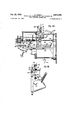
- FIG. l shows schematically a front view of a Winder unit.
- FIG. 2 is a side view, seen from the right of FIG. 1 and shown partly in section, of the thread guide, the spindle head, and an ejected full bobbin.
- FIG. 3 shows the same devices as FIG. 2 but at a moment shortly after the starting of a new bobin coil.
- FIG. 4 is a part-sectional view of an empty spindle head and of a fully wound bobin corresponding to the illustration in FIG. 2.
- FIG. 5 shows a view similar to lFIG. 4 but in the same operating condition as in FIG. 3, one turn of the coil being started on a new bobbin.
- FIG. 6 is a view similar -to that of FIG. 5 but shown shortly after a few turns have run onto the bobbin core.
- FIG. 7 is. a sectional view on a larger scale of the pinching and cutting device of the spindle head, the spindle head being in the position shown in FIGS. 4 and 6.
- FIGS. 8 and 9 show side views in respectively diierent operating positions
- FIG. 10 shows a front view of a device for arresting ,4 the spindle shaft in a given starting position, this device forming part of the machine illustrated in FIGS. 1 to 7.
- FIGS. l1, 12 and 13 show a modified design of a device for arresting the spindle shaft in a given starting position, these illustrations being otherwise comparable with FIGS. 8 to 10 respectively.
- FIG. 14 shows a third embodiment of a device for arresting the spindle shaft.
- FIG. 15 illustrates schematically a modified embodiment of the device for removing the pinched thread from the clamping device.
- FIGS. 16 and 17 show a side view and a front view, respectively, of a modified spindle head provided with a plurality of clamping-cutting devices, applicable in a machine otherwise designed in accordance with the preceding gures.
- FIG. 18 is a schematic top view of a coil winding machine with a plurality of coiling units, each designed and operative in accordance ⁇ with the unit according to FIG. l.
- FIG. 19 shows a partial front view of an embodiment according to the invention in which a completely wound bobbin is clamped in position in order to eiect severing of the thread by tearing.
- FIG. 2O is a similar front view of another embodiment in which the thread is clamped between the fully wound bobbin and ⁇ the spindle head in order to effect tearing of the thread.
- FIG. 20a is a fragmentary top view along line XXa-XXa of the device according to FIG. 20.
- FIG. 2l is an end view of the device of FIG. 20.
- FIG. 22 shows a spindle head as used in the embodiments according to FIGS. 19 and 20, the clamping device of the spindle head being illustrated in the open position.
- FIG. 23 shows the same spindle head with the clamping evice in closed position.
- FIG. 24 illustrates schematically a front view generally similar to FIG. l but operating tto form a loop of yarn ahead of the coiling location
- FIG. 25 shows a partial lateral view on a sectional plane denoted in FIG. 24 by (25)-(25).
- the spindle head 1 (FIGS. l, l0) is driven by a shaft 2 which can be coupled, under' selective control by a lever 3, either with a belt drive 4 ⁇ or with a belt 4drive 5.
- Belt drive 4 when in operation, revolves the spindle shaft 2 in the normal coiling direction at the desired operating speed, whereas belt drive 5, when. operative, Arevolves the spindle shaft 2 in the reverse direction at slow speed, as will be more fully explained. in a later place.
- a grooved thread guide 6 is displace-- ably mounted on a rod 7 yand takes care of shifting the: thread F back and forth during the coil winding operation.
- a coil or bobbin core 9 is shown Iinserted between the spindle head 1 and a counter bearing S (FIG. 1).V
- the core 9 is released by counter clockwise rotation of the control lever 3 which moves the spindle head i. toward the left and away from the counter bearing 8.
- the re-l leased full bobbin 9 then drops into a trough 10 (FIGS- l to 5.)
- a pusher 11 (FIGS. l, 4), located at the end of trough 10, is connected with a slide -rod 12 (FIG. l).
- thread F may be properly directed by means of a threadv guiding member 14 (FIGS. 2 and 4). This member is located above the spindle head, but a second thread guiding member I5 may ⁇ be provided below the spindle head..
- the thread guiding members 14 and 15 are attached to the pusher 11 and enter into engagement with the thread F when the pusher 11 is being shifted to the left (FIG. 1).
- the spindle head 1 consists essentially of a cup-shaped structure 16 (FIGS. 4, 5) in whose bottom an ejector pin 17 is displaceable parallel to 4the spindle shaft 2.
- the shaft 2 is pulled toward the left (FIG. 1) a sufficient distance to have the exterior side of the cup bottom nearly abut against the fixed bearing 18 of the shaft (FIG. 4).
- the ejector pin 17, abutting against the bearing 18, is pushed forward into the cup space (FIG. 4).
- the ejector pin 17 has a transverse groove 19 engaged by a lug 2li of a cutter blade 21 (FIGS. 4, 5). Located opposite the cutter blade 21 is a counter blade 22 (FIGS. 4 to 7).
- FIG. 17 The shapes of blades Z1 and 22 are shown in FIG. 17.
- a leaf spring 23 bears against the outside of the cutter blade 21 to provide the necessary cutting and clamping pressure.
- the spring 23 is somewhat under tension when the cutter blade 21 is in the inactive position.
- Mounted on the leaf spring 23 is a weight in form of a button 24 to provide for suicient mass and inertia.
- the three members 21, 22, 23 are held together by a screw 25 (FIGS. 4, 5, 6). They are so guided by means of slots that, when the lug 20 performs its return movement relative to the cup 16 from the position of FIG. 4 tothe position of FIG.
- the cutter blade 21 is first moved back from the cutting position, longitudinally of the spindle, and that, after cutting of the :thread between the shearing edges of the blades 21 and 22, not only the cutter blade 21 but also the counter blade 22 and the clamping spring 23 participate in the return movement.
- the end of the thread leading to the coiling spindle is pinched and clamped between the members 2-1 and 23.
- Member 23 is lifted during rotation of the coil after the coil has reached a given speed of rotation. The clamping effect Ithen ceases, and the yarn pulls itself out of the clamping place. The actuation of the knife 21 then takes place.
- a device for returning the spindle shaft to a given position comprises a cam disk 31 firm y connected with shaft 2 and provided with a single cam notch 32 (FIGS. 8 to 10).
- Located opposite the disk 3i. is an angular lever 33 mounted on a pvot pin 36 and biased by a spring 35 in the direction toward a fixed stop 34.
- the pivot shaft 36 of the angular lever 33 is shifted parallel to the axis of spindle shaft 2 so that the angular lever 33 can cooperate with the cam disk 31 only when the spindle shaft is in the illustrated position, that is when the spindle head 1 is displaced toward the left. This is the case when the coiling unit is in coil-changing position which is the normal stopping position.
- a member 37 of a friction clutch (FIGS. 1, 10) selectively engageable with respective clutch members 38 and 39.
- Member 39 forms a belt sheave and is driven by the belt drive 4 to operate the spindle 2 at normal speed in the proper coiling direction during winding operation.
- Clutch member 38 forms a belt sheave for the belt drive 5 and when in engagement with the clutch member 37 drives the shaft 2 slowly in the reverse direction.
- the friction clutch permits slipping between the two clutch members that are in clutching operation at a time. Consequently, when the angular lever 33 drops into the notch 32 of cam disk 31, the clutch member 37 and the shaft 2 are arrested while the driven clutch member 39 is permitted to slip relative to member 37'.
- the position of shaft 2 thus to be fixed by the arresting device is so chosen that the clamping-cutting members 20 to 25 with the thread guiding members 14 and 1S are in proper position relative to the thread so that the thread, guided by members 14 and 15, always encounters the clampingcutting devices in the correct position.
- the switching movement of the control lever 3 is utilized for lifting the guiding lever 42 from cam piece 41 as soon as the spindle shaft 2 is set in rotation, while forcing the guiding lever 42 against cam piece 41 is soon as the spindle shaft 2 is shifted into coil-changing position or is at rest.
- the force thus acting upon the lever 42 may be trans mitted through a pressure spring 43 one end of which bears against the lever 42 while the other end is connected by a suitrble connecting rod or mechanism with the control lever 3.
- a stationary stop 44 prevents excessive movement of the forcing lever 42.
- control lever 3 simultaneously acts as a forcing lever similarly to lever 42 in the modification described with reference to FIGS. l1 to ⁇ 13.
- the control lever 3 (FIG. 14) is mounted on its shaft Sland is'provided with a prismatic nose 46 which bears against a cam piece 47 on shaft 2 and thus returns shaft 2 into a posiJ tion determined by the angular position of the cam.
- the lever 3 is turned clockwise. The back'of the nose 46 then abuts against a collar 45 which shifts the shaft 2 into the forward-run position.
- the clamping spring 23 is not provided with a weight (24 in FIGS. 4, 6) so that, during rotation of spindle shaft 2, the spring 23 cannot automatically lift itself off the cutter blade.
- a hook-shaped part 50 under control by any suitable speed sensing device, is placed between the bobbin core and the clamping-cutting device and then at the desired rotational speed of shaft 2 pulls the clamped end of the thread out of the clamping engagement.
- the tail end of the yarn is liung outwardly due to centrifugal force and flutters as it is whipped about by the whip-lash action created by the rapidly rotating bobbin head.
- the thread being wound onto the core now passes repeatedly along that tail end so that the tail is slowly coiled into the winding being built up on the core.
- the further coil-winding operation is the same as in the known machines.
- the present invention concerns itself primarily with having the yarn F, which leads from the supply coil to the filled bobbin 13, fastened at the next empty core 9 to be wound.
- This purpose is served by the yarn-catching device which seizes the yarn end, severs it by tearing from the completed bobbin 13 and holds it fast until a sufficient number of turns are wound onto the new core or pirn y9 so that when this yarn end F is released, the yarn can no longer be pulled off lthe filled bobbin 13.
- control devices for actuating the control lever 3 and the control bar 12 (FIG. l) at the proper time, for instance whenever a bobbin is completed, may be identical with the control devices of known coil-winding machines, particularly with those used in the automatic pirn winders and quillers manufactured and sold by applicants assignee in this country and abroad under the trade name Autocopserf
- control devices are not novel and do not form part of the invention proper, a brief description thereof will be given in the following with reference to FIG. 1.
- the control lever 3 and the spindle shaft 2 according to FIG. l are normally held in the illustrated positions by means of a helical .pressure spring 71 which bears against a stationary abutment 72 and acts through a ball bearing 73 against a shoulder member 74 mounted on shaft 2.
- the spring “l1 thus operates to normal-ly couple the shaft 2 by clutch members 37, 39 with the forward drive 4 for coil winding operation.
- the control lever 3 is forced counter clockwise about the pivot 51 by means of an angular lever 75 pivoted at 76.
- the actuation of lever 75 is elfected through cam means (not shown) mounted on the control bar 12, and this actuation occurs near the beginning of the shifting movement of bar 12 from the illustrated position toward the left.
- a single cam 81 mounted on the frame structure of the multi-unit machine (see FIG. 18) is driven at a uniform rate of rotation independently of the speed of the coil-winding operation.
- Cam 81 mounted on a carn shaft S2 acts through an arm 83 to apply a continual rocking movement to a rocking shaft 84 which extends along all winding units of the machine.
- Each of the individual units is equipped with a long sword member 8S seated upon the rocking shaft 84.
- the control bar 12 in this particular winding unit is locked to the sword member 85 and then travels with it for one back and forth movement.
- the locking action is effected by means of a latch pawl 86 which is pivoted at 87 to the control bar 12, but is normally disengaged from the sword member 8S.
- a feeler mechanism (not illustrated), responsive to the completion of the bobbin, causes the latch pawl 86 to be temporarily turned ⁇ downward so that the notch 88 of pawl 86 enters into engagement with a pin and sword member 85.
- the control bar then follows the reciprocating .movement of the sword member 85 for one complete reciprocation. Thereafter the pawl member 86 is released from sword member 8S.
- the objective of clamping and severing the thread can also be met by fixing the thread temporarily at two points and producing a relative movement between these two points, thus severing the thread by tearing it apart.
- a sharp edge may be provided between the two points of fixation. Then, the stress imposed upon the thread at the locationo-n of the edge during the relative movement is particularly great so that the thread will be severed at that edge and hence at the most desired location.
- the fixation of the thread may be effected by having the clamping means act directly on the thread.
- the completed bobbin itself may be held fixed so that, as a consequence, the thread is likewise kept fixed.
- the fixation of the bobbin or of the thread may be released directly after tearing of the thread because this is the only purpose of the fixation. That is, the bobbin, after the thread is torn, can be released from its clamped position or, if the tail end of the thread is clamped directly, this tail end may be released immediately upon tearing of the thread; and the completed bobbin may then -be discharged.
- the clamping of the yarn ends is temporarily limited.
- FIGS. 19 to 23 incorporate the pronouncedioned features and are applicable in a coil winding machine otherwise in accordance with the one described with reference to FIGS. 1 to 20.
- the control rod 12 is provided with a step or shoulder 12a in the active range of the cam segment 112.
- the cam 112 is rotatably mounted about the axis 111 and is pulled by the spring 115 against a stop 113 on the control rod 12.
- the illustrated position of rod 12 corresponds to the starting position as illustrated, for example, on the left-hand side of the diagram illustrated in FIG. 7 of US. Patent 2,657,867 of S. Frst, issued November 3, 1953.
- an empty bobbin core 9 is placed between the spindle head 1 and the counter socket 8. It will be remembered that the spindle head 1 for releasing the previously completed bobbin was moved toward the left. As soon as the empty core 9 is in the proper position, the spindle head 1 is moved toward the right so that the core head is seized by the spindle head. 'The previously completed, full bobbin, which has previously Adropped into the trough 10, has now reached the position shown in FIG. 19 either by sliding downward along the trough 1d or by actuation of the above-described pusher 11 (see FiG. l).
- the control rod 12 first moves toward the left. This lifts the lever arm 54h and lowers lever arm 54. The lowering of the lever arm 54 is sufficient so that the coil 13 is not only liberated from the clamping action of edge 5S and tunnel roof S2 but the holder portion 53 of the lever arm 54 simultaneously is removed from the end to let the coil 13 glide downwardly down chute 10. Thereafter, the cam follower 54h glides on the upper edge ⁇ of cam 112 a distance straight ahead to move arm 54 counter clockwise and retain it in position for a time long enough for the coil 13 to he removed out of the clamping range.
- lever arm 54h leaves the cam 112, and drops slightly under the action of spring 54a until it glides along the upper face of the control rod 12.
- the holder portion 53 of Athe lever arm 54 has already turned into the gliding trough suiiciently to form a stop for Ithe subsequent just completely wound coil 13, to keep it from gliding down out of the trough, but the coil is not yet clamped fast by edge S5.
- the coil dropping into the gliding trough 10 thus passes without hindrance between the clamping cheeks 52, 55, but is retained -by end 53 of lever arm 54.
- the completed bobbin is not subjected to clamping. Instead, the thread F is held fixed with the aid of a second clamping member 61 which engages a pair of clamping cheeks 63 and 64, whereas the completed bobbin remains free within the trough 16 until, after tearing of the thread between the clamping locations, the completed bobbin can be shifted out of the trough.
- the mechanism for accomplishing the above according to FIG. 7.0 operates as follows.
- FIG. 20 shows the motion of the clamping member 61 under the action of the control rod 12.
- the clamping lever 61 may be xedly mounted ou a rigid shaft 61d which is pivotally journalled and on which the lever arm 61a is also fas-tened.
- the lever arm 61 andthe lever arm 61a consist of a single unitary piece.
- the f-ree end or cam follower portion 61e of the lever arm 61a glides on the surface of the control rod 12 which is provided with a recess 116.
- the spring 61h pulls the clamping lever 61 toward the left in a counter clockwise direction about pivot axis 61d and thus presses the end 61C of lever arm 61a onto the upper surface of control rod 12.
- the position shown in FIG. 20 is the starting position at the beginning of a coil-exchanging operation.
- the control rod 12 is then moved toward the left so that the clamping effect on the yarn F between the clamping lever 61 and the parts 63, 64 is released, as shown in plan view in FIG. 20a. This clamping remains released until the control rod 12 again travels toward the righ-t and has nearly reached its end limit position.
- FIG. 20a shows in plan view a section or portion corresponding to the line XXa-XXa of FIG. 20.
- the part 63 is illustrated in section Iand the part 64 is located and l2 spaced beneath it at the proper distance as shown in FIG. 20.
- Located to the right of these parts 63, 64 and clampingly cooperating therewith is the tip of the clamping lever 61 which has a contour as illustrated in FIG. 20a.
- the yarn F is passed along the path F illustrated as a dot-and-dash line in FIG. 20a and glides, due to its tension, between the parts 63, 61 on the one hand, and the clamping lever 61 on the other hand.
- the tip 61e of the lever arm 61a is moved into the recess 116 of the control rod l2, as shown in FIG. 20a. Consequently, the clamping lever 61 performs a pivotal motion counter clockwise toward the left and clamps the yarn F between the parts 63, 61 and 64.
- FIGS. 22 and 23 Another embodiment of the clamping device is illustrated in FIGS. 22 and 23.
- the spindle head 1 mounted on the spindle shaft 2 moves from the left toward the right when an empty bobbin core is inserted, and an ejector pin 17 then moves toward the left out of the bottom of the spindle head.
- a clamping member 51 Connected with the ejector pin 17 is a clamping member 51.
- the clamping member 51 cooperates with a nose 561on the spindle head facing the coil being wound.
- the clamping member 51 is then effective to pinch the thread ⁇ end against the nose of the spindle head. rI ⁇ his is apparent from FIG. 23.
- the clamping member 51 turns upwardly while the ejector pin 17 is moving toward the right. Consequently, the previously clamped thread end F' is now released.
- the spindle head 1 is equipped with impeller blades 151 and has one or more bores 152 which extend from the outs-ide into the interior space of the spindle head.
- the air caught by the blades 151 passes through the bores 152 along the core head 27 onto the starting end of the winding. It is particularly important to provide a blade and a bore directly behind the clamping member 23.
- an air current supplied from the outside may be passed indirectly upon the thread by guiding it in such a manner that only the refiected air current causes the yarn end to be blown against the winding being wound.
- FIGS. 24 and 25 is to a large extent similar to the one descirbed with reference to FIG. 1 but incorporates a further improvement by vir-ture of which a loop of yarn is formed directly ahead of the Winding location in order -to reduce the stresses that may be imposed upon the yarn.
- a spindle head 101 is mounted on a spindle shaft 102 normally coupled with the Winder drive 104 by a clutch member 139 and engageable with the reversing drive 1415 through a clutch member 138 under control by a control lever 103, all substantially fas described with reference to the embodiment of FIG. l.
- the spindle head -1 cooperates with a counter socket 1118 in order to accommodate the bobbin core 1119; Located below the spindle assembly is a trough 1141 into which the completed bobbin 113 ⁇ will drop as soon as the winding operation is completed and the coil changing operation has commenced.
- the full bobbin 113 is placed in the illustrated position by means ⁇ of a pusher 111 mounted on a slidable control bar 112. During shifting movement of bar 112, the thread F places itself in front of clamping members 121, 123 and is seized by these members 'at the start of the next winding operation. Simultaneously with the full bobbin 1 13,1the revolvable thread guide 106, slidable on the rod 111,7, is displaced intro the lefthand position shown in FIG. 24.
- the thread guide 166 is mounted on a displaceable holder 114- vrhich also possesses a carrier structure 115 on which a thread-guide ing eye is mounted. The thread F passes through the eye.
- Located between the eye 116 and the -thread guide 106 is a double bridge whose two bridge portions 115 and 119 are spaced from each other a distance of at least one ⁇ centimeter.
- the two bridge portions 118 and 119 ⁇ straddle a hook 120 mounted on a swing arm 131.
- the swing arm 131 is pivoted at 122 and is biased by a spiral spring 133 which tends to rotate the arrn 131 clockwise (FIG. 24) with only slight force.
- the incoming thread after having passed through the eye 116, is so guided that the lio-ok 120 in FIG. remains at the right-hand side of the bridge portions 118 and 119.
- a pusher member 124 secured to the upper end -of the pusher 111 cooperates with the swing arm 131 so that during coil changing operation the swing arm 1311 is pushed tow-ard the left.
- the size of the loop is preferably so dimensioned that at least three to four turns about the core body are possible. During formation of these turns, the effect of the spring 133 prevents the yarn tension from increasing as abruptly as would be the case with a suddenly commencing starting of the operation so that the danger of damaging the yarn is correspondingly reduced.
- the formation of a stored amount of yarn can also be secured by means of two bridge portions mounted on the eey carrier 115, between which bridge portions the pusher ⁇ member 124 will directly enter to form the loop of yarn.
- the tautening of the yarn can be assigned to a thread guard of the known design which for this purpose is preferably given a larger range of swinging movement than usual.
- a current of air directed against the yarn may be used to operate by air pressure or suction in order to keep the yarn in tau condition.
- the method of starting a coil winding on a core carried by a rotating wind-up spindle, in yarn winding machinos which comprises 'fixing a yarn portion coming from a completed coil at a location near the spool head by clamping action on the completed coil, during the spool-charging procedure, resiliently radially clamping, in relation to the spindle axis, the starting yarn portion, intended for the replacement empty core, at a location turning with the spindle, tearing said yarn portion along its length leading from the completed coil while the spindle is turning in the winding-up operation, and terminating the ⁇ clamping action so that it is released as soon as a few turns of yarn are located upon the replacement core and so that the released yarn end is wound beneath subsequently wound turns on said core.
- the method of starting a coil winding on a core carried by a rotating wind-up spindle, in yarn winding machines which comprises fixing a yarn portion coming from a completed coil at a location near the spool head, during the spool-changing procedure, resiliently radially clamping, in relation to the spindle axis, the staiting yarn portion, intended for the replacement empty core, at a location turning with the spindle, tearing said yarn portion along its length leading from the completed coil while the spindle is turning in the winding-up operation, terminating the clamping action so that it is released as soon as a few turns of yarn are located upon the replacement core and so that the released yarn end is retained beneath subsequently Wound turns on said core, and preventing the yarn from becoming overloaded and torn at the commencing of the winding operation by storing an amount of yarn in the form of a loop 'under tension before it has reached the core being wound up, the amount being sufficient for a-t least one turn about the core'.
- the method of starting a coil winding on a core carried by a rotating wind-up spindle, in yarn winding machines which comprises resiliently radially clamping, in relation to the spindle axis, the starting yarn portion, intended for the replacemen-t empty core, at a location turning with the spindle, during the spool-changing procedure wherein a completed coil is eliminated and said replacement core is inserted in said spindle for the next coil to be wound, parting said starting yarn portion from the yarn -attached to the completed coil while the spindle is in winding-up operation, and terminating the clamping action by centrifugal force of the rotating spindle acting at said location so that said starting yarn portion is released to ilutter by whiplash action caused by rotation of said replacement core as soon as a few turns of yarn are located upon the replacement core and so that the released yarn end is retained beneath subsequent turns of yarn on said replacement core.
- Method according to claim 5 characterized in that the clamping operation is terminated after the formation of a few windings so that the yarn end is released.
- Method according to claim 5 characterized in that during coil changing operation but prior to the starting of the next coil there is formed a loop defining a stored amount of yarn betwen the yarn supply and said replacement core forming the coil next to be wound, the length of the stored amount of yarn corresponding to at least one to three turns about the core.
- the method of starting a coil winding on a core carried by a rotating wind-up spindle, in yarn winding machines which comprises seizing and resiliently radially clamping, in relation to the spindle axis, the starting end of the yarn at a location xed on the spindle, prior to bringing the spindle up to rated speed, thereafter accelerating the spindle rotation up to the normal winding speed, the seizing and clamping location rotating at the same angular velocity as the spindle and core, no pull being exerted by the said clamping on the yarn in the direction of the winding operation on the core, and automatically unclamping to release the yarn end when the rated operating speed of the spindle is reached so that the yarn end is held into and beneath subsequent turns wound onto said core.
- the method of starting a coil winding on a rotating wind-up spindle in yarn winding machines which comprises holding the starting portion of the yarn xedly clamped on the rotating spindle prior to commencing the winding of the yarn on said spindle, then commencing and accelerating the spindle rotation up to the normal winding speed, and automatically resiliently radially unclamping the starting portion of the yarn, in relation to the spindle axis, to release it after a first few turns are wound, at a moment not later than the end of the accelerating interval, the starting portion being parted from a preceding coil winding after said release so that the parted yarn end is wound into and beneath subsequent yarn turns wound onto said core.
- the method of starting a yarn-coil winding operation on a rotating wind-up spindle after completion of the next preceding winding operation thereon which comprises holding the yarn end, parted from the coil precedingly completed, stationarily clamped at a iixed location, clamping the yarn at another location which rotates at the same angular velocity and about the same axis as the spindle, then accelerating the Winding operation up to the normal winding speed, the yarn end being Withdrawn from said fixed location at the start of the accelerating interval, and thereafter releasing the yarn end from the second location after a number of initial turns are wound so that the yarn end is placed into and beneath subsequent yarn turns wound.
- the step of releasing the yarn end being performed upon reaching a predetermined acceleration of the commencing winding operation.
- the method of starting a coil winding on a core carried by a rotating wind-up spindle, in yarn winding machines which comprises automatically seizing and resiliently radially clamping, in relation to the spindle axis, the starting end of the yarn at a location iixed on the spindle, prior to bringing the spindle up to rated speed, thereafter accelerating the spindle rotation up to the normal winding speed, the seizing and clamping location rotating at the same angular velocity as the spindle and core, and automatically unclamping to release the yarn end when the rated operating speed of the spindle is reached, the automatic unclamping being energized by the application of centrifugal force of the rotating spindle at said location so that the released yarn end is wound into and beneath subsequent yarn turns wound on the core.
- the method of starting a coil winding on a core carried by a rotating wind-up spindle, in yarn winding machines which comprises automatically seizing and resiliently radially clamping, in relation to the spindle axis, the starting end of the yarn yat a location fixed on the spindle, prior to bringing the spindle up to rated speed, thereafter accelerating the spindle rotation up to the normal winding speed, the seizing and clamping location rotating at the same angular velocity as the spindle and core, and automatically unclamping to release the yarn end at a moment not later than when the rated operating speed of the spindle is reached, the starting portion being 17 parted from a preceding' coil winding not later than said release, the automatic unclamping being energized by the application of centrifugal force of the rotating spindle at said location so that the yarn end is wound into and beneath subsequent yarn turns wound on said core.
- a device for starting a coil winding operation after completion of the preceding coil and for parting the yarn from the completed coil comprising a revolvable spindle having a spindle head and means for entraining a coil core, a thread guide defining a path for the yarn to be wound onto the core, a yarn clamping device mounted on and rotating at the same angular velocity as said spindle head and having a radially displaceable portion engageable with the yarn coming from said guide and mounted for displacement thereof relative to said spindle head between yarn clamping and yarn releasing positions, and automatic control means connected with said clamping device for radially displacing said portion to clamp the yarn end during the starting interval of said spindle head and to subsequently release the yarn end.
- a device for starting a coil winding operation after completion of the preceding coil and for parting the yarn from the co-mpleted coil comprising a revolvable spindle head having means for entraining a coil core, a yarn clamping device mounted on and rotating at the same angular velocity as said spindle head and having a radially displaceable clamping portion engageable with the yarn coming from said guide, said portion being radially displaceable between yarn clamping and yarn releasing positions, said portion of the clamping device clamping the yarn end during the starting interval of said spindle head and being subsequently released from the yarn end, the yarn end when released, and after parting, being wound into and bene-ath subsequent yarn turns wound onto the core, said release being actuated by :application of centrifugal force of the rotating spindle at said location.
- a yarn-coil winding machine Ia device for starting a coil winding operation :after completion of the preceding coil, comprising a revolvable spindle head having means for entraining a coil core, a yarn spring clamping device mounted on and rotating at the same angular velocity as said spindle head and having a radially displaceable clamping portion engageable with the yarn coming from said guide, said portion being radially displaceable between yarn clamping and yarn releasing positions, said portion of the spring clamping device clamping the yarn end during the starting interval of said spindle head land being subsequently released from the yarn end, the yarn end when released being wound into and beneath subsequent yarn turns wound onto the core, and weight means attached to said portion f the spring clamping device to pull said portion outwardly by centrifugal force to effect said yarn end release.
- the spindle head being axially displace-able, to carry out the winding operation and to remove power from the latter
- the yarn clamping device comprising -a weighted resilient member having said clamping portion normally pressing in the direction toward the spindle head, said member being mounted for axial movement
- yarn severing means comprising a cutter blade and a cutter counter blade mounted for axial movement between the resilient member andthe spindle head, means for controlling the cutting operation in dependence upon the axial displacement of the spindle head so that, immediately subsequent to the cutting of the yarn, the end of the yarn leading to the core being'woundv is clamped.
- a device for starting a coil winding operation after completion of the precedingly wound coil comprising a revolvable spindle head having means for entraining a coil core, a thread guide ⁇ delining a path for the yarn to be wound onto the core, a yarn clamping device having a yarn clamping member mounted on said spindle head and having a clamping portion engageable with said head for clamping the starting end of the yarn during coil starting operation, said member being resiliently pressed inwardly toward the spindle head and being movable by centrifugal force radially away from the clamping position when said spindle head accelerates to a given speed during said starting operation so that the yarn end when released is wound into and beneath yarn turns subsequently wound onto the core.
- a yarn-coil winding machine a device for starting a coil winding operation after completion of the preceding coil and for parting the yarn from the completed coil, comprising a revolvable spindle having a spindle head and means for entraining a coil core, a thread guide dening a path for the yarn to be wound onto the core, a yarn clamping device mounted on and rotating at the same angular velocity as said spindle head and having a radially displaceable portion engageable with the yarn coming from said guide, said portion being radially displaceable between yarn clamping and y-arn releasing positions, and automatic control means connected with said clamping device for causing said portion to clamp the yarn end during the starting interval of said spindle head and to subsequently release the yarn end so that the yarn end when released, and after parting, is wound into and beneath subsequent yarn turns wound onto the core, means for releasing the completed coil from the spindle, means for receiving the completed coil from the spindle, means for temporarily arresting the
- a coil starting device comprising yarn clamping means and yarn severing means, said device being located near said winder head and being engageable by the yarn, means operable in accordance with the posit-ion of the winder head lfor clamping the starting end of the coil to be woun'd and simultaneously parting the yarn end of the completed coil, and means for arresting the yarn attached to the completed coil after said ⁇ completed coil has been released from said win-der head so as to part the yarn in coopenation with said clamping means.
- Device according to claim 2l characterized by the yfact that yarn severing means is provided, rotatable together with the spindle head, and tha-t arresting means are provided which become eilective when the spindle drive is switched off and which hold the clamping-severing means in' a predetermined position until lthe yarn is guided into the device.
- clamping and severing means are mounted on the Winder head and that they are adjustable to a given position during coil changing operation, relative to the rotation of the Winder spindle.
- Device according to claim 2l characterized in that a loop-forming ⁇ device acting during coil changing operation and a tensioning ⁇ device for applying slight tension to this loop are provided at the coiling location.
- the loop-forming device comprises two bridge members and a pusher member cooperating with said bridge mem- 10 bers and entering between them to form the loop.
Landscapes
- Winding Filamentary Materials (AREA)
Applications Claiming Priority (2)
| Application Number | Priority Date | Filing Date | Title |
|---|---|---|---|
| DE348904X | 1954-10-04 | ||
| DE121154X | 1954-11-12 |
Publications (1)
| Publication Number | Publication Date |
|---|---|
| US3074659A true US3074659A (en) | 1963-01-22 |
Family
ID=25750815
Family Applications (1)
| Application Number | Title | Priority Date | Filing Date |
|---|---|---|---|
| US87482A Expired - Lifetime US3074659A (en) | 1954-10-04 | 1961-01-31 | Method and apparatus for the starting of coil winding operations |
Country Status (2)
| Country | Link |
|---|---|
| US (1) | US3074659A (de) |
| CH (1) | CH348904A (de) |
Cited By (2)
| Publication number | Priority date | Publication date | Assignee | Title |
|---|---|---|---|---|
| US20040094653A1 (en) * | 2002-11-14 | 2004-05-20 | Fair Roderick D. | Method and apparatus for winding a coil |
| CN111577850A (zh) * | 2020-04-29 | 2020-08-25 | 浙江捷昌线性驱动科技股份有限公司 | 一种操作方便的线性致动器 |
Citations (1)
| Publication number | Priority date | Publication date | Assignee | Title |
|---|---|---|---|---|
| US2718360A (en) * | 1953-01-30 | 1955-09-20 | Whitin Machine Works | Weft handling mechanism for automatic filling winder |
-
1955
- 1955-09-29 CH CH348904D patent/CH348904A/de unknown
-
1961
- 1961-01-31 US US87482A patent/US3074659A/en not_active Expired - Lifetime
Patent Citations (1)
| Publication number | Priority date | Publication date | Assignee | Title |
|---|---|---|---|---|
| US2718360A (en) * | 1953-01-30 | 1955-09-20 | Whitin Machine Works | Weft handling mechanism for automatic filling winder |
Cited By (5)
| Publication number | Priority date | Publication date | Assignee | Title |
|---|---|---|---|---|
| US20040094653A1 (en) * | 2002-11-14 | 2004-05-20 | Fair Roderick D. | Method and apparatus for winding a coil |
| US6860446B2 (en) * | 2002-11-14 | 2005-03-01 | Delphi Technologies, Inc. | Method and apparatus for winding a coil |
| CN111577850A (zh) * | 2020-04-29 | 2020-08-25 | 浙江捷昌线性驱动科技股份有限公司 | 一种操作方便的线性致动器 |
| US12049945B2 (en) | 2020-04-29 | 2024-07-30 | Zhejiang Jiecang Linear Motion Technology Co., Ltd. | Linear actuator convenient to operate |
| US12281693B2 (en) | 2020-04-29 | 2025-04-22 | Zhejiang Jiecang Linear Motion Technology Co., Ltd. | Linear actuator convenient to operate |
Also Published As
| Publication number | Publication date |
|---|---|
| CH348904A (de) | 1960-09-15 |
Similar Documents
| Publication | Publication Date | Title |
|---|---|---|
| US4083171A (en) | Method and apparatus for eliminating an abnormality in a thread to be wound onto the bobbin of an open-end spinning device | |
| US3377676A (en) | Creel assembly for textile machines | |
| US2998202A (en) | Initial thread end snagger | |
| US2481031A (en) | Winding method and apparatus | |
| US4644742A (en) | Process and device for joining a thread in an open-end spinning device | |
| US4356692A (en) | Method and apparatus for removing an irregularity in a thread | |
| US4943009A (en) | Plying or doubling machine | |
| US2306871A (en) | Cross winding frame with continuous yarn feeding | |
| US4210293A (en) | Strand transfer | |
| GB1200455A (en) | Improvements in and relating to textile machines having yarn winding means | |
| US3136494A (en) | Method and means for preparing spinning cops for rewinding | |
| US3184174A (en) | Yarn-spool winding machine with automatic spool-exchanging device | |
| US3314621A (en) | Method of and device for winding yarn without interrupting the winding process during removal of yarn breakage | |
| US4223517A (en) | Method and mechanism for elimination of an irregularity in a yarn | |
| US2638936A (en) | Method and means for automatically winding filling bobbins in a loom and supplying them to the shuttle thereof | |
| US2449328A (en) | Automatic winder | |
| US2670150A (en) | Bobbin handling mechanism | |
| US2870971A (en) | Winding machine and method of doffing and thread-in | |
| US3841074A (en) | Ring spinning machine and method of operation | |
| DE2227903A1 (de) | Verfahren und vorrichtung zum verbinden zweier oder mehrerer arbeitsgaenge bei der herstellung, garnvorbereitung oder der veredlung von garnen | |
| US3224693A (en) | Control device for a winding machine | |
| US2936130A (en) | Device for seizing, positioning, and tying of starting end of yarn to be wound | |
| US3043529A (en) | Apparatus for preparing coils of yarn for further fabrication | |
| US2681666A (en) | Loom having automatic bobbinchanging mechanism | |
| US2785704A (en) | Textile machine |