US3087516A - Loom beam let-off - Google Patents
Loom beam let-off Download PDFInfo
- Publication number
- US3087516A US3087516A US116737A US11673761A US3087516A US 3087516 A US3087516 A US 3087516A US 116737 A US116737 A US 116737A US 11673761 A US11673761 A US 11673761A US 3087516 A US3087516 A US 3087516A
- Authority
- US
- United States
- Prior art keywords
- sheave
- shaft
- tension
- loom
- assembly
- Prior art date
- Legal status (The legal status is an assumption and is not a legal conclusion. Google has not performed a legal analysis and makes no representation as to the accuracy of the status listed.)
- Expired - Lifetime
Links
- 239000000543 intermediate Substances 0.000 description 17
- 230000010355 oscillation Effects 0.000 description 10
- 230000009977 dual effect Effects 0.000 description 6
- 230000007246 mechanism Effects 0.000 description 6
- 230000007423 decrease Effects 0.000 description 5
- 238000009941 weaving Methods 0.000 description 5
- 238000005266 casting Methods 0.000 description 3
- 230000002093 peripheral effect Effects 0.000 description 3
- RTZKZFJDLAIYFH-UHFFFAOYSA-N Diethyl ether Chemical compound CCOCC RTZKZFJDLAIYFH-UHFFFAOYSA-N 0.000 description 2
- 230000009471 action Effects 0.000 description 2
- 230000008859 change Effects 0.000 description 2
- 238000010276 construction Methods 0.000 description 2
- 230000003247 decreasing effect Effects 0.000 description 2
- 230000006872 improvement Effects 0.000 description 2
- 238000012423 maintenance Methods 0.000 description 2
- 230000000712 assembly Effects 0.000 description 1
- 238000000429 assembly Methods 0.000 description 1
- 230000006835 compression Effects 0.000 description 1
- 238000007906 compression Methods 0.000 description 1
- 239000004744 fabric Substances 0.000 description 1
- 230000002452 interceptive effect Effects 0.000 description 1
- 238000004519 manufacturing process Methods 0.000 description 1
- 235000020030 perry Nutrition 0.000 description 1
- 239000002994 raw material Substances 0.000 description 1
- 230000001105 regulatory effect Effects 0.000 description 1
Images

Classifications
-
- D—TEXTILES; PAPER
- D03—WEAVING
- D03D—WOVEN FABRICS; METHODS OF WEAVING; LOOMS
- D03D49/00—Details or constructional features not specially adapted for looms of a particular type
- D03D49/04—Control of the tension in warp or cloth
- D03D49/06—Warp let-off mechanisms
Definitions
- Loom let-offs have been in use in which the tension on the whip roll has been transmitted through various systems including pivoted linkage, weights and the like to adjust disc assemblies to vary their output to the loom beam drive responsive to changes in tension on the whip roll.
- Diiiculty has been experienced in the operation of such devices because the arcuate movements of such pivoted links do not transmit a straight line adjustment to the expansible pulleys.
- the present invention overcomes this difficulty by providing a dual sheave or pulley means for driving the loom beam which is mounted on a pivoted frame which is moved responsive to variations in tensions of the warp yarn to automatically vary the speed of the loom beam to maintain the tension of the warp yarn as nearly uniform as possible.
- An important object of the invention is to provide a loom beam let-off including a pair of variable speed pulleys moved through a particular arcuate path responsive to variations in warp tension so that input and output belt tension is maintained more nearly constant throughout the range of the drive.
- Another important object of the invention is the provision of a positive type loom beam let-olf; requiring no pivoted linkage, spring loaded pulleys having slidable mountings, and the like; which will produce more nearly responsive action to variations in the tension of the warp yarns upon the whip roll because the distorted variations in pitch diameter produced by the action of the pivoted linkage upon slidable disc mountings have been eliminated.
- Another object of the invention is -to provide a let-olf which quickly adjusts Ithe peripheral speed of the loom beam to compensate for variations and tension of they warp yarn in which there is a positive arrangement with no belt slippage.
- Another object of the invention is to provide a loom beam let-off arrangement, which automatically controls the peripheral speed of the warp beam to maintain the tension on the warp beam as nearly uniform as possible responsive to variations in tension of the warp yarn, having fewer pants and which will be inexpensive and reduce maintenance.
- Another object of the invention is to provide a loom beam let-off which, through more responsive, closer control upon the warp tension permits a loom to be operated with a tighter warp without danger of a breakout which might be caused if the warp Was running on the verge of breaking and the let-off failed to respond suiiiciently quickly to tension variations thus producing more yards per pound of raw material. Tight Warps also avoid slack ends which get in the way of the shuttle and are broken.
- a further object of the invention is to provide a loom beam let-olf which may be easily set to provide proper tension especially when beginning weaving with a full warp beam.
- Another object of the invention is to provide a let-off which may be easily disengaged from its driving mechanism permitting manual release of the warp tension when such is desirable as in case of ends down.
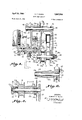
- FIGURE l is a perspective view illustrating a loom let-off constructed in accordance with the present invention mounted in operative position upon a loom,
- FIGURE 2 is an enlarged side elevation looking from the left-hand side of FIGURE 1,
- FIGURE 3 is an enlarged side elevation looking from the rightJhand side of FIGURE 1,
- FIGURE 4 is an enlarged transverse sectional elevation taken on the line 4-4 in FIGURE 1,
- FIGURE 5 is an enlarged transverse sectional view taken on lthe line 5 5 in 4FIGURE 1, and
- FIGURE 6 is an enlarged transverse sectional View taken on the line 6-e6 in FIGURE 1.
- FIGURE 1 a loom let-olf constructed in accordance with the present invention is illustrated in FIGURE 1 as being driven by suitable means such as the cam shaft of a loom through suitable driving means A.
- a pulley or sheave B is driven by the driving means A and drives a driving belt which, in turn, drives a dual variable pulley assembly E.
- the pulley assembly E is mounted upon a pivoted frame C mounted upon a suitable support fixed to the loom. 'l'he frame C is swung in an arcuate path responsive to tension upon the whip roll W through the linkage D which includes a weighted arm.
- the sheave assembly E includes a pair of spaced elements each having a like inwardly facing cone surface as well as an intermediate element having like outwardly facing cone surfaces.
- the second pulley formed by the sheave assembly drives a sheave F, which through suitable driving means G, drives the loom beam L.
- the driving and the driven pulley belt means are so mounted on opposite sides of the assembly E that swinging movement responsive to variations of tension in the warp yarns move the slidable element to speed up or slow down the driven pulley belt and the means driven by the driven pulley belt driving the loom beam drive.
- the arc traversed by the dual variable pulley assembly E is such that it will vary its pitch diameters to accommodate fixed belt lengths.
- FIGURE l A preferred embodiment of the loom beam let-olf is illustrated in FIGURE l as being mounted in opera/tive positionupon a loom having side frames 10, the usual arch 11 and front girt 12.
- the warp yarn Y is illustrated as coming olf the loom beam L and passing over the whip roll W, through the drop wires 13 and the harnesses 14 which form the shed for weaving.
- itis important that uniform tension be exerted upon the Warp yarn so as to avoid ends coming down, bad work and otherwise interfering with the operation of the loom parts.
- the loom -beam L is driven by a suitable drive mechanism H which is driven from a loom cam shaft 1S through the let-off mechanism which forms the subject matter of this invention.
- the mechanism of the let-olf is automatically adjusted responsive to variations in the tension upon the whip roll W exerted thereon by the vvarp yarn.
- the whip roll is illustrated as being mounted 1n the usual rocker arm 16 carried by the bearing stand 17.
- the rocker arm 16 has a ⁇ stub shaft 118 -which has fixed connection to the linkage mechanism D for adjustmg the let-off mechanism as will be described below.
- the cam shaft 15 carries a sprocket 19 for driving the chain 20 which, in turn, drives a larger sprocket 21.
- the sprocket 21 has a fixed mounting as by set screw 21a and key 2lb upon a shaft 22 journaled within a support 23.
- the support 23 has adjustable mounting upon the side frame of the loom.
- a base in the form of a suitable casting 24 is fixed to the loom frame 10 as by bolts 25 carried within vertical slots 24a adjacent each side of the casting 24.
- a pair of threaded members 26 are threaded into an inward projection 24b and bear against the base 23a of the support 23. By adjusting the threaded members 26, the support 23 may be turned about the hub 24e which forms a part of the casting 24.
- the shaft 22 also has support from the arm 2312 into which it is also journaled.
- the shaft 22 carries a sheave or pulley B which is mounted for free rotation thereon.
- the sheave B has anges 27 and carries a toothed segment 2-8 which, together with a corresponding toothed segment k29, forms a dog clutch.
- An internally threaded operating member 30' is carried adjacent the threaded end 22a of the shaft 22.
- the segment-s 28 and 29 have corresponding bores 28a and 29a, respectively, for housing a ⁇ spring 31.
- the segment 29 is keyed to the shaft as at 29h so that by turning the internally threaded member 30 the clutch segments 28 and 29 may be engaged or disengaged to correspondingly fix or disengage the sheave B'from the shaft 22.
- the sheave B drives a belt 32 which, in turn, drives an assembly E which is oscillatably mounted adjacent one end of a depending frame C.
- the frame C has a shaft '33 mounted thereon to slide and turn Within the bushings 34.
- a pair of spaced elements 35 and 36 are carried upon the shaft 33 ⁇ and have inwardly facing cone surfaces 35a and 36a, respectively.
- the spacing of the elements 35 and 36 are determined outwardly by a retaining ring 37 on one end land an internally threaded housing 38 on the other which forms part of an adjustable assembly for determining the spacing.
- the internally threaded housing 38 is carried upon a threaded portion 33a of the shaft 33 and a threaded socket 39 ⁇ is threaded in the threaded bore 38a into tight engagement with the adjacent end of the shaft 33 to form a locking arrangemen.
- An intermediate element 40 is carried upon the shaft 33 for sliding movement thereon.
- the intermediate element 40 has outwardly projecting cone surfaces 35b and 36b carried thereby so that the surfaces 35a and 35b form a sheave while the cone surfaces 36a and 36b form another sheave.
- the assembly E. is mounted between a pair of arms 41 and 42 which are included in the pivoted depending frame C.
- the arms at their lower ends have hubs 41a and 42a, respectively, each carrying a bushing 34 for accommodating the assembly E.
- the arms 41 and 42 are joined at the top by a housing 43 which is xed upon the shaft 44 by set screws 45.
- the shaft 44 is journaled in the upper bearing support 23d of the support 23 -within a suitable bearing 46.
- a sleeve 47 confines the shaft 44 within the bearing 46 and is fixed to the shaft 44 by the set screw 47a.
- variable sheave assembly E traverse an arc formed by the intersections of radii which are the center to center distances from the fixed sheaves to respective variable sheaves wherein said radii correspond to each other in that as one of the pulleys of the assembly increases its pitch diameter the opposite pulley decreases its pitch diameter in a straight line proportion so that, due to the fact that a single member is common to both variable pulleys and the pinch diameters of the fixed pulleys are equal, belts of equal length may be accommodated by the assembly.
- the pivoted dcpending frame C has a pivot located medially between the fixed pulleys and is of such length that the variable sheave assembly carried by the lower portion thereof substantially traverses the arc described above.
- the arc for its operative range in the embodiment of the invention illustrated is a true circle and corresponds within mechanical tolerances applicable here to the dcsired arc.
- variable speed drive such as ratio range, physical dimensions of total unit, type and length of belt which will satisfy these conditions
- the following computations may be fused to develop the required design dimensions. It has been found that a ratio range of the input pulley B to the output pulley F of from 1:"31/2 to 31/2:l is suitable although other ranges may be used to satisfy required conditions.
- the center to center distance between the fixed pulleys to suit the overall dimensions of the unit is determined. Then using the pinch diameters of the fixed pulleys and various pitch diameters of the variable assembly, noting that as the pitch diameters of the variable assembly depart from the mean or center pitch line (occurring when the two belts are equidistant from the center of the variable assembly) one pich diameter increases proportionately to the decrease of the other pitch diameter, a number of corresponding center to center distances between the fixed and variable assembly are calculated using the following equations.
- the determination of position of pivot and length of control arm can now be determined graphically by scribing arcs of lengths determined above using the center of the fixed pulleys as locii.
- a line passing through the points of intersection of arcs of lengths corresponding to the center distances between fixed and variable pulley assembly may be constructed. Perpendicular bisectors to this line will converge at one point (within the range of the unit). This point will be the position of the pivot of the control arm and the distance from this point to the curved line will be the length of the control arm. It will be apparent that the curved line (passing through the intersections of the corresponding arcs) will be the only path of the variable assembly that will maintain proper tension on the belts as the control arm moves to change the ratio of the drive unit.
- a number of triangles may be formed.
- the linkage D includes a link 48 which is fixed upon the Y shaft 44 by a set screw ⁇ 48a on one end thereof while the other end is joined to a weighted arm 49 by a hub 50.
- the hub 50 has a rod 51 slidable therein adjacent one end thereof and a compression spring S2 is confined upon the rod 51 by a bolt 53 on its free end and bears against an abutment 54 adjacent the hub 50.
- the abutment 54 has an arcuate surface to conform to the inner surface of the hub 50.
- the link 51 is pivotally connected at its other end to a link 55 by a pin 55a.
- the other end of the link 55 has fixed connection with the stub shaft 18 as by the bolt 56.
- the sheave formed by the cone surfaces 36a and 36h drives a belt 58 to, in turn, drive the sheave F.
- the sheave F is fixed to a shaft ⁇ 59 as by the key 60 and the set screw 61 and has flanges 62 with a handle 63 secured as by screws 63a to manually turn the shaft 59 when the dog clutch is disengaged.
- the shaft 59 is journaled within an arm 23C -of the support 23 and carries a Worm gear 64 adjacent its end remote from the sheave F.
- the worm gear -64 is fixed to the shaft as by the set screw 64a and key 64b.
- the worm gear 64 drives a pinion 65 which is included in the driving means G.
- the pinion 65 is fixed to the shaft 66 by a set screw 65a.
- the shaft 66 carries a worm 67 fixed adjacent its other end as by the nut 67a.
- the worm 67 drives a pinion 68 which, in turn, drives a shaft 69 'and is fixed thereto by a set screw 68a.
- the shaft 69 is journaled within the hub 24C and is confined therein by the sleeve 70 fixed to the shaft y69 by the set screw 70a.
- the shaft 69 is fixed to a pinion 7,1 as by set screw 71a and a key 71b.
- the pinion 7-1 forms a part of a gear drive serving as the drive H for the loom beam L.
- the pinion 71 drives a ring gear 72 which, in turn, drives the loom beam L.
- the :shaft 73 of the loom beam is mounted in suitable trunnions (not shown) for supporting same upon the loom.
- the speed of rotation of the shaft 33l is now increased. Also, since the belt 58 is now at a larger diameter on the pulley formed by the surfaces 36a and 36b, driving the fixed pulley F, the rotational speed of the shaft 59 is now increased by the combination of the increased speed of the adjustable assembly F and the change in pitch diameter of pulley formed by the surfaces 36a and 36h. This increase in speed is transmitted through gears 64 and 65, shaft G, and gears 67 and 68, through the shaft 69, to the pinion 71 and beam gear 72. The gear 72 is attached -to the loom beam L which, due to its increase in rotational speed supplies more yarn to relieve the excess tension on warp yarn Y.
- the correct decrease in speed of warp beam L is achieved by reversal of the sequence of ⁇ operation described above.
- the assembly E is moved toward the front 'of the loom and the belt 5S forces the slidable element 40 to move inward- Vly toward the loom allowing ⁇ the belt 58 to seek a smaller pitch diameter and causing the belt 32 to seek a larger pitch diameter.
- the rotational speed of the shaft 59 is now decreased as is the rotational speed of the loom beam L so that less yarn is delivered at greater tension.
- the frame C traverses an arc so that depending upon a given Warp diameter and picks per inch of cloth construction, the arm C will traverse a given arc. It is, therefore, desirable to have a calibrated dial 73a carried by the upper bearing support 23d while an indicator 74 i-s carried by the housing to 43 to facilitate resetting to the proper position.
- the dual pulley assembly E may be moved to reset the let-off for the proper tension to begin a weaving operation with a full loom beam. The let-off should be reset prior to placing the new full beam upon the loom but, if desired, an additional dog clutch arrangement may be provided to disengage the pulley F from the beam drive.
- a let-off for a loom having a loom beam and a whip Toll moved responsive to tension on the warp yarn including, a first sheave driven by the loom, a second sheave ⁇ driving said loom beam mounted in a plane parallel to the plane of the first sheave, a shaft disposed between said .first sheave and said second sheave in a plane parallel to the axis of rotation of said sheaves, Ia pair of spaced inwardly facing cone elements carried by the shaft, an element carried by the shaft carrying outwardly facing fcone elements intermediate said inwardly facing cone elements, a first belt driven by said first sheave positioned between one of the pair of adjacent inwardly and outwardly facing cone elements, a second belt driving said second sheave positioned on the other of the pair of adjacent inwardly and outwardly facing cone elements, and means moving said shaft in an arcuate path responsive to movement of the whip roll to vary the spacing between each of the pair of adjacent inwardly and outwardly facing cone elements
- a let-off for a loom having a loom beam and a whip roll moved responsive to tension on the warp yarn including, a first shaft disposed horizontally longitudinally of the loom and driven thereby, a first sheave carried by said first shaft and driven thereby, a second shaft disposed horizontally longitudinally of the loom, :a second sheave driving said loom beam carried by said second shaft, a depending pivoted frame carried between said first and second sheaves, a third shaft carried by the lower end of said frame disposed between said first sheave and said second sheave in a plane parallel to the first and second shafts, a pair of spaced inwardly facing cone elements carried by the third shaft, an element carried by the third shaft carrying outwardly facing cone elements intermediate said inwardly facing cone elements, a first belt driven by said first sheave positioned between one of the pair of adjacent inwardly and outwardly facing cone elements, a second belt driving said second sheave positioned on the other of the pair of adjacent inwardly and outwardly facing cone
- a let-off for a loom beam drive and the like operated 'responsive to the tension of the warp yarn including, a gpivotally mounted frame, means transmitting variations in tension orf the warp yarn to oscillate said frame, an assembly carried by said frame including, a pair of aligned :spaced elements each having an inwardly facing cone surf-ace, an element having corresponding outwardly facing cone surface intermediate said spaced elements so that a pair of pulleys are formed by adjacent facing cone surfaces, pulley belt means driving said assembly carried by one of said pair of pulleys, and pulley belt means driven by said assembly carried by the ether of said pulleys, said driving and said driven pulley belt means being so mounted on opposite sides of said assembly that oscillations of the frame responsive to variations of tension in the warp yarn vary the distance between the inwardly facing cone lsurfaces with respect to the outwardly yfacing cone surfaces to vary the effective diameters of the pulleys formed by adjacent facing cone surfaces to speed up or slow down said driven
- a let-off control for a loom beam drive operated responsive to the force exerted upon the whip roll by the tension of the warp yarn including, a support, a pivoted depending frame mounted upon said support for oscillation thereon, means connecting the frame with the whip roll transmitting variations ⁇ in tension on the warp yarn to oscillate said frame, an assembly carried by said frame including, a pair of aligned spaced elements each having an inwardly facing cone sunface, an element having corresponding outwardly facing cone surfaces intermediate said spaced elements so that a pair of pulleys are formed by adjacent facing cone surfaces, driving pulley belt means driving said assembly carried by one of said pair of pulleys, driven pulley belt means driven by said assembly carried by the other of said pulleys, said driving and said driven pulley belt means being so mounted on opposite sides of said assembly that oscillations of the frame responsive to variations of tension in the warp yarn vary the distance between the inwardly facing cone surfaces with respect to the outwardly facing cone sunfaces to vary the effective diameters of the pulle
- variable pulley assembly intermediate 4the input and output pulleys, said variable pulley assembly including a pair of spaced opposed cone surfaces and an element intermediate said cone surfaces having cone surfaces opposed to said first mentioned cone surfaces, and means mounting said variable pulley assembly substantially to traverse an arc formed by the intersections of radii which are the center to center distances from the input pulley and the output pulley to said variable pulley assembly wherein said radii correspond to each other in that as one of the pulleys of the assembly increases its pitch diameter the opposite pulley decreases its pitch diameter in a straight line proportion.
- variable pulley assembly intermediate the input and output pulleys
- said variable pulley assembly including a pair of spaced opposed cone surfaces cone surfaces opposed to said first mentioned cone surand an element intermediate said cone surfaces having cone surfaces opposed to said first mentioned cone surfaces forming a pair of variable pulleys
- a first pulley belt connecting said input pulley with said variable pulley assembly
- a second pulley belt connecting said variable pulley assembly with the output pulley
- a let-off control for a loom beam drive operated responsive to the pressure exerted upon the Whip roll by the tension of the warp yarn including, a support, a frame mounted upon said support for oscillation thereon, means through which said support has connection with the whip roll through which variations in tension on the warp yarn are transmitted to oscillate said frame, an assembly shaft carried by said frame, a pair of spaced elements each having an inwardly facing cone surface fixed upon said assembly shaft, an element having corresponding outwardly facing cone surfaces carried by the assembly shaft intermedi-ate said spaced elements, said inwardly facing cone surfaces and outwardly facing cone surfaces being axially movable with respect to each other, lpulley belt means driving said assembly, pulley belt means driven by said assembly, said driving and said driven pulley belt means being so mounted on opposite sides of said assembly that oscillations responsive to variations of tension in the warp yarn move the inwardly facing cone surfaces and the outwardly lfacing cone surfaces .to vary the effective diameters -of the pulleys formed by adjacent cone
- a let-olf control for a loom beam drive operated responsive to the pressure exerted upon the whip roll by the tension of the warp yarn including, a support, a pivoted depending frame mounted upon said support for oscillation thereon, linkage means through which said support has connection with the whip -roll through which variations in tension on the warp yarn are transmitted .to oscillate said frame, means exerting a bias upon said frame exerting tension upon said warp yarn, an assembly shaft carried by said frame, a pair of spaced elements each having lan inwardly facing cone surface fixed upon said assembly shaft, an element having corresponding outwardly facing cone .surfaces carried by the assembly shaft intermediate said spaced elements, said inwardly facing cone surfaces 'and outwardly facing cone surfaces being axially movable with respect to each other, pulley belt means driving said assembly, pulley belt means driven by said assembly, said driving and said driven pulley belt means being so mounted on opposite sides of said assembly that oscillations responsive to variations of .tension in the warp yarn move the inwardly facing
- a let-olf for a loom having a loom beam and a whip roll moved responsive to tension on the warp yarn including, a irst sheave driven by the loom, a second sheave driving said loom beam mounted in a plane parallel to the plane of the first sheave, a shaft disposed between s-aid first sheave and said second sheave in a plane parallel to the axis of rotation of said sheaves, :a pair of spaced inwardly facing cone elements carried by the shaft, an element carried by the shaft carrying outwardly facing cone elements intermediate said inwardly facing cone elements, a rst belt driven by said rst sheave positioned between one of the pair of adjacent inwardly and outwardly facing cone elements, a second belt driving said second sheave positioned on the other of the pair of adjacent inwardly and outwardly facing cone elements, -and means moving said shaft responsive to movement of the whip roll to vary the spacing between each of the pair of adjacent inwardly and outwardly facing
- a let-off for a loom having a loom beam carrying warp yarn including, a iirst driven sheave, a second sheave driving said beam mounted in a plane parallel to the plane of the first sheave, a shaft disposed between said iirst sheave and said second sheave in a plane parallel to the axis of rotation of said sheaves, a pair of spaced inwardly facing cone elements carried by the shaft, an element carried by the shaft carrying outwardly facing cone elements intermediate said inwardly facing cone elements, a first belt driven by said first sheave positioned between one of the pair of -adjacent inwardly and outwardly facing cone elements, a second belt driving said second sheave positioned on the other of the pair of adjacent inwardly and outwardly lfacing cone elements, and means moving said shaft responsive to vari-ations in tension on the warp yarn to vary the spacing between each of the pair of adjacent inwardly and outwardly lfacing cone elements, whereby the speed of the second
- a let-olf control for a loom beam operated responsive to the tension upon the warp yarn including, a support, a frame mounted upon said support for oscillation thereon, means oscillating said frame responsive to variations in tension upon the warp yarn, an assembly shaft carried by said frame, a pair of spaced elements each having an inwardly facing cone surface fixed upon said assembly shaft, an element having corresponding outwardly facing cone surfaces carried by the assembly shaft intermediate said spaced elements, said inwardly facing cone surfaces and outwardly facing cone surfaces being axially movable with respect to each other, pulley belt means driving said assembly, pulley belt means driven by said assembly, said driving and said driven pulley belt means being so mounted on opposite sides of said assembly that oscillation responsive to variations of tension in the warp yarn move the inwardly facing cone surfaces and the outwardly facing cone -surfaces to vary the effective diameters of the pulleys formed by adjacent cone surfaces to speed up or slow down said driven pulley belt, and means driven by said driven pulley belt driving the loom beam drive
Landscapes
- Engineering & Computer Science (AREA)
- Textile Engineering (AREA)
- Looms (AREA)
Priority Applications (6)
| Application Number | Priority Date | Filing Date | Title |
|---|---|---|---|
| US116737A US3087516A (en) | 1961-06-13 | 1961-06-13 | Loom beam let-off |
| DE19621535675 DE1535675B1 (de) | 1961-06-13 | 1962-06-04 | Antrieb fuer den Kettbaum einer Webmaschine |
| CH669662A CH403671A (de) | 1961-06-13 | 1962-06-04 | Kettbaumantrieb für Webstuhl |
| GB21648/62A GB1016436A (en) | 1961-06-13 | 1962-06-05 | Warp beam let-off mechanism |
| ES278228A ES278228A1 (es) | 1961-06-13 | 1962-06-12 | Una disposición de accionamiento del plegado de urdimbre para telares |
| BE618866A BE618866A (fr) | 1961-06-13 | 1962-06-13 | Dispositif de commande d'ensouple pour métier à tisser |
Applications Claiming Priority (1)
| Application Number | Priority Date | Filing Date | Title |
|---|---|---|---|
| US116737A US3087516A (en) | 1961-06-13 | 1961-06-13 | Loom beam let-off |
Publications (1)
| Publication Number | Publication Date |
|---|---|
| US3087516A true US3087516A (en) | 1963-04-30 |
Family
ID=22368914
Family Applications (1)
| Application Number | Title | Priority Date | Filing Date |
|---|---|---|---|
| US116737A Expired - Lifetime US3087516A (en) | 1961-06-13 | 1961-06-13 | Loom beam let-off |
Country Status (6)
| Country | Link |
|---|---|
| US (1) | US3087516A (de) |
| BE (1) | BE618866A (de) |
| CH (1) | CH403671A (de) |
| DE (1) | DE1535675B1 (de) |
| ES (1) | ES278228A1 (de) |
| GB (1) | GB1016436A (de) |
Cited By (3)
| Publication number | Priority date | Publication date | Assignee | Title |
|---|---|---|---|---|
| US3630239A (en) * | 1970-01-26 | 1971-12-28 | Southern Machinery Co | Letoff for looms |
| CN103510251A (zh) * | 2012-06-20 | 2014-01-15 | 吴江市金真缝纫机有限公司 | 一种改进的织机的送经机构 |
| CN108265378A (zh) * | 2018-04-03 | 2018-07-10 | 青岛天集团红旗纺织机械有限公司 | 一种喷水织机双侧积极式松经装置及喷水织机 |
Citations (15)
| Publication number | Priority date | Publication date | Assignee | Title |
|---|---|---|---|---|
| US2175551A (en) * | 1937-07-22 | 1939-10-10 | Reeves Pulley Co | Reversible incrementally variable-speed power transmission mechanism |
| DE722529C (de) * | 1939-04-27 | 1942-07-11 | Gustav Von Alt | Keilriemenregelgetriebe |
| US2350954A (en) * | 1942-11-30 | 1944-06-06 | Draper Corp | Constant tension letoff mechanism |
| US2581328A (en) * | 1950-07-07 | 1952-01-01 | Reeves Pulley Co | Constant tension control |
| US2608741A (en) * | 1950-06-16 | 1952-09-02 | Reeves Pulley Co | Constant tension control |
| US2649811A (en) * | 1951-02-02 | 1953-08-25 | Kidde Mfg Co Inc | Variable-speed drive for fabric take-up roll of warp knitting machines |
| US2753128A (en) * | 1952-12-31 | 1956-07-03 | Reliance Electric & Eng Co | Differential control for beam let-off drive or the like |
| US2755822A (en) * | 1953-10-08 | 1956-07-24 | John O Hunt | Resistance let-offs |
| US2755824A (en) * | 1953-10-08 | 1956-07-24 | John O Hunt | Let-offs for use on looms |
| US2755823A (en) * | 1953-05-22 | 1956-07-24 | John O Hunt | Warp let-off for looms |
| US2775415A (en) * | 1953-07-09 | 1956-12-25 | Reliance Electric & Eng Co | Tension-dominated control |
| US2775414A (en) * | 1953-07-09 | 1956-12-25 | Reliance Electric & Eng Co | Constant tension control mechanism |
| US2775263A (en) * | 1953-07-09 | 1956-12-25 | Reliance Electric & Eng Co | Tension-responsive control |
| US2786491A (en) * | 1956-03-02 | 1957-03-26 | John O Hunt | Let-offs |
| US2819512A (en) * | 1955-05-11 | 1958-01-14 | Reliance Electric & Eng Co | Automatic constant tension control with high-speed pick-up |
Family Cites Families (1)
| Publication number | Priority date | Publication date | Assignee | Title |
|---|---|---|---|---|
| CH377748A (de) * | 1959-12-14 | 1964-05-15 | Denco Ag | Kettbaumantrieb |
-
1961
- 1961-06-13 US US116737A patent/US3087516A/en not_active Expired - Lifetime
-
1962
- 1962-06-04 DE DE19621535675 patent/DE1535675B1/de active Pending
- 1962-06-04 CH CH669662A patent/CH403671A/de unknown
- 1962-06-05 GB GB21648/62A patent/GB1016436A/en not_active Expired
- 1962-06-12 ES ES278228A patent/ES278228A1/es not_active Expired
- 1962-06-13 BE BE618866A patent/BE618866A/fr unknown
Patent Citations (15)
| Publication number | Priority date | Publication date | Assignee | Title |
|---|---|---|---|---|
| US2175551A (en) * | 1937-07-22 | 1939-10-10 | Reeves Pulley Co | Reversible incrementally variable-speed power transmission mechanism |
| DE722529C (de) * | 1939-04-27 | 1942-07-11 | Gustav Von Alt | Keilriemenregelgetriebe |
| US2350954A (en) * | 1942-11-30 | 1944-06-06 | Draper Corp | Constant tension letoff mechanism |
| US2608741A (en) * | 1950-06-16 | 1952-09-02 | Reeves Pulley Co | Constant tension control |
| US2581328A (en) * | 1950-07-07 | 1952-01-01 | Reeves Pulley Co | Constant tension control |
| US2649811A (en) * | 1951-02-02 | 1953-08-25 | Kidde Mfg Co Inc | Variable-speed drive for fabric take-up roll of warp knitting machines |
| US2753128A (en) * | 1952-12-31 | 1956-07-03 | Reliance Electric & Eng Co | Differential control for beam let-off drive or the like |
| US2755823A (en) * | 1953-05-22 | 1956-07-24 | John O Hunt | Warp let-off for looms |
| US2775415A (en) * | 1953-07-09 | 1956-12-25 | Reliance Electric & Eng Co | Tension-dominated control |
| US2775414A (en) * | 1953-07-09 | 1956-12-25 | Reliance Electric & Eng Co | Constant tension control mechanism |
| US2775263A (en) * | 1953-07-09 | 1956-12-25 | Reliance Electric & Eng Co | Tension-responsive control |
| US2755822A (en) * | 1953-10-08 | 1956-07-24 | John O Hunt | Resistance let-offs |
| US2755824A (en) * | 1953-10-08 | 1956-07-24 | John O Hunt | Let-offs for use on looms |
| US2819512A (en) * | 1955-05-11 | 1958-01-14 | Reliance Electric & Eng Co | Automatic constant tension control with high-speed pick-up |
| US2786491A (en) * | 1956-03-02 | 1957-03-26 | John O Hunt | Let-offs |
Cited By (4)
| Publication number | Priority date | Publication date | Assignee | Title |
|---|---|---|---|---|
| US3630239A (en) * | 1970-01-26 | 1971-12-28 | Southern Machinery Co | Letoff for looms |
| CN103510251A (zh) * | 2012-06-20 | 2014-01-15 | 吴江市金真缝纫机有限公司 | 一种改进的织机的送经机构 |
| CN108265378A (zh) * | 2018-04-03 | 2018-07-10 | 青岛天集团红旗纺织机械有限公司 | 一种喷水织机双侧积极式松经装置及喷水织机 |
| CN108265378B (zh) * | 2018-04-03 | 2023-08-15 | 青岛天一红旗纺机集团有限公司 | 一种喷水织机双侧积极式松经装置及喷水织机 |
Also Published As
| Publication number | Publication date |
|---|---|
| BE618866A (fr) | 1962-10-01 |
| ES278228A1 (es) | 1962-12-01 |
| DE1535675B1 (de) | 1970-04-30 |
| GB1016436A (en) | 1966-01-12 |
| CH403671A (de) | 1965-11-30 |
Similar Documents
| Publication | Publication Date | Title |
|---|---|---|
| US4572244A (en) | Warp let-off motion for loom having two warp beams | |
| US5037059A (en) | X-ray diagnostic device with safe and durable X-ray tube suspension mechanism | |
| US2753128A (en) | Differential control for beam let-off drive or the like | |
| US2130433A (en) | Equalizing drive for conveyer systems | |
| US3234806A (en) | V-belt pulley variable transmission | |
| US2734253A (en) | Variable speed drive apparatus | |
| US2923046A (en) | Automatic device for adjusting the tension of the fabric in finishing machines | |
| US3156267A (en) | hooper | |
| US3804348A (en) | Regulated windup apparatus | |
| US2371620A (en) | Device for controlling the tension in the yarns being wound upon a beam in a warping or beaming plant | |
| US2775414A (en) | Constant tension control mechanism | |
| EP0038025B1 (de) | Vorrichtung zum Regeln der Spannung der Kettfäden im Webstuhl | |
| US2707883A (en) | Variable sheave | |
| US4387743A (en) | Apparatus for regulating tension in warps of a weaving machine | |
| US4058143A (en) | Constant tension regulator of positively unwound flexible material, particularly warp threads in weaving machines | |
| US2206246A (en) | Means for winding flexible materials onto spools, bobbins, or the like | |
| US2585167A (en) | Letoff mechanism for looms | |
| US2775263A (en) | Tension-responsive control | |
| US3255784A (en) | Loom let-offs | |
| KR840000816B1 (ko) | 직기에 있어서의 경사장력조정장치 | |
| US2914092A (en) | Let-off means for textile machines and the like | |
| US4402348A (en) | Apparatus for regulating tension in warps of a weaving machine | |
| US3799210A (en) | Brake unit for the warp beam of weaving looms | |
| US3478983A (en) | Thread tensioning apparatus | |
| US2654543A (en) | Regulator for take-up reels |