US314840A - Leggin - Google Patents
Leggin Download PDFInfo
- Publication number
- US314840A US314840A US314840DA US314840A US 314840 A US314840 A US 314840A US 314840D A US314840D A US 314840DA US 314840 A US314840 A US 314840A
- Authority
- US
- United States
- Prior art keywords
- leggin
- flap
- lacing
- cord
- holes
- Prior art date
- Legal status (The legal status is an assumption and is not a legal conclusion. Google has not performed a legal analysis and makes no representation as to the accuracy of the status listed.)
- Expired - Lifetime
Links
- 239000004744 fabric Substances 0.000 description 16
- 239000000463 material Substances 0.000 description 7
- 238000004519 manufacturing process Methods 0.000 description 4
- 210000000887 face Anatomy 0.000 description 3
- 239000004568 cement Substances 0.000 description 2
- 208000027418 Wounds and injury Diseases 0.000 description 1
- 230000015572 biosynthetic process Effects 0.000 description 1
- 208000018747 cerebellar ataxia with neuropathy and bilateral vestibular areflexia syndrome Diseases 0.000 description 1
- 238000010276 construction Methods 0.000 description 1
- 230000006378 damage Effects 0.000 description 1
- 238000007599 discharging Methods 0.000 description 1
- 208000014674 injury Diseases 0.000 description 1
- 239000010985 leather Substances 0.000 description 1
- 210000003739 neck Anatomy 0.000 description 1
- 210000001331 nose Anatomy 0.000 description 1
- 238000009877 rendering Methods 0.000 description 1
- 239000000126 substance Substances 0.000 description 1
Images
Classifications
-
- A—HUMAN NECESSITIES
- A41—WEARING APPAREL
- A41D—OUTERWEAR; PROTECTIVE GARMENTS; ACCESSORIES
- A41D17/00—Gaiters; Spats
-
- Y—GENERAL TAGGING OF NEW TECHNOLOGICAL DEVELOPMENTS; GENERAL TAGGING OF CROSS-SECTIONAL TECHNOLOGIES SPANNING OVER SEVERAL SECTIONS OF THE IPC; TECHNICAL SUBJECTS COVERED BY FORMER USPC CROSS-REFERENCE ART COLLECTIONS [XRACs] AND DIGESTS
- Y10—TECHNICAL SUBJECTS COVERED BY FORMER USPC
- Y10T—TECHNICAL SUBJECTS COVERED BY FORMER US CLASSIFICATION
- Y10T24/00—Buckles, buttons, clasps, etc.
- Y10T24/37—Drawstring, laced-fastener, or separate essential cooperating device therefor
- Y10T24/3737—Drawstring, laced-fastener, or separate essential cooperating device therefor having lacing directing means in particular pattern
Definitions
- leggins have been made with eyelets in both flaps or edges, with buttons and button-holes, and with lacinghooks on both flaps or edges.
- the primary object of my invention is to produce a leggin suitable for the use of sportsmen, which object I attain without in any way lessening the desirability of the same for general purposes, but, on the contrary, rendering it more desirable for all uses than those previously made.
- the leggin be so constructed that it may be fitted and made to conform closely to the leg of the wearer. that a close joint be formed between the edges of the flaps, and that the application and removal of the leggin may be quickly performed.
- the leggin When the leggin is intended for the use of sportsmen, it is especially important that no hooks or projections be used in such position that they may catch in brush or vines, because when that occurs the sportsman is impeded and is liable to be thrown down, at the risk of accidentally discharging his gun and to the injury of his person and clothing; or the fastenings are apt to be destroyed and the leggin rendered useless.
- A indicates the leggin as a whole, having an opening, preferably at the side, and flaps ab at the sides of said opening, as is common in this class of leg
- the body of the leggin may be of can vas, leather, rubber cloth, or any other suit-v able material, and cut to any approved pattern.
- the flap a which is at the forward side of the opening, is provided at suitable intervals with lacingholes c, advisably furnished with eyelets d, to prevent the edges of the holes from tearing or fraying out, andto afford a smooth surface for a lacing-cord, B, which is employed to draw the flaps a and b together.
- the lacing-holes c are near the edge of the flap a, but far enough therefrom to avoid tearing out.
- the rear flap, b is furnished with lacinghooks c, and is designed to pass under flap a far enough to close the space between the edge of the front flap and the lacing-hooks and to allow a reasonable variation in the width of said space without leaving an uncovered opening between them. This permits the wearer to adjust the leggin as desired to compensate for variations in the clothing worn beneath the leggin, and yet to secure asnug fit in all cases.
- the hooks e have their ends or noses turned backward, and their rounded necks turned forward, so that there is no liability of their catching in vines or of twigs being caught therein.
- the lacing cord B which will be of any suitable material, may be passed through the holes or eyelets of flap a and drawnout in loops in any one of several ways, each producing substantially the same result-that is, the
- Figs. 1, 2, and 3 the cord is represented as passing through one hole, thence around the edge of the flap a, thence through the next hole, and so on throughout the series, giving the appearance of a whipped edge.
- This arrangement is convenient, and permits the loops to be readily caught hold of by the fingers to throw them over the hooks, allows the cord to run freely through the holes or eyelets, and is deemed the best mode of lacing.
- Fig. 4 the cord is shown passing from one hole to the next on the inner face of the flap, thence through the second hole and to the third on the outer face of the flap, and so on throughout, the cord being drawn out between each two holes to form the loop f.
- leggins constructed in the manner above described are found in actual use to give great satisfaction.
- Buttons may be used in the place and as equivalents of the hooks e,- but the hooks are preferred.
- a leggin composed of an outer wearing fabric and an inner lining or stiffening fabric intimately and firmly joined throughout their adjacent faces by rubber or equivalent cementing material, as and for the purpose explained.
- leggin consisting of body A, provided with front flap, a, having lacing-holes a, and rear flap, I), provided with lacing-hookse, and thelacing-eord B. threaded through the holes cfrom the inner to the outer faces of the flap, substantially as described and shown.
Landscapes
- Engineering & Computer Science (AREA)
- Textile Engineering (AREA)
- Orthopedics, Nursing, And Contraception (AREA)
Description
(No Model.)
* G. O. I-IENNING.
LEGGIN.
No. 314,840. Patented Mar. 31, 1885.
IN PETERS. Pljolo-Lilhngraphcr. Wuhingwn. 04 c.
UNITED STATES PATENT OFFICE.
GEORGE G. HENNING, OF WASHINGTON, DISTRICT OF COLUMBIA.
LEGGIN.
SPECIFICATION forming part of Letters Patent No. 314,840, dated March 31, 1885.
Application filed January 30, 1855. (X0 model.)
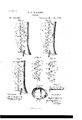
a side View of my improved leggin, showing the lacing-cord slackened; Fig. 2, a similar view showing theloops of the cord cast off the hooks; Fig. 3, a view showing the cord drawn taut; Figs. 4 and 5, illustrations of different plans of lacing; and Fig. 6, a top end view of the leggin, showing how the flaps or edges overlap; Fig. 7, a view illustrating the nature of the fabric used.
Prior to my invention leggins have been made with eyelets in both flaps or edges, with buttons and button-holes, and with lacinghooks on both flaps or edges.-
In a leggin patented since my invention, and designed to be water-proof,a folding section of suitable material was employed to connect the two edges,which were drawn together by means of a lacing-cord running loosely in the hem of one edge, and drawn out through openings made in said hem at suitable intervals, to form loops to pass around lacinghooks applied to the other edge or flap, and each of these modes of lacing or fastenings have long been common in shoes, as is well known to those familiar with the art.
The primary object of my invention is to produce a leggin suitable for the use of sportsmen, which object I attain without in any way lessening the desirability of the same for general purposes, but, on the contrary, rendering it more desirable for all uses than those previously made.
It is important in all cases that the leggin be so constructed that it may be fitted and made to conform closely to the leg of the wearer. that a close joint be formed between the edges of the flaps, and that the application and removal of the leggin may be quickly performed.
gins.
When the leggin is intended for the use of sportsmen, it is especially important that no hooks or projections be used in such position that they may catch in brush or vines, because when that occurs the sportsman is impeded and is liable to be thrown down, at the risk of accidentally discharging his gun and to the injury of his person and clothing; or the fastenings are apt to be destroyed and the leggin rendered useless.
By the construction which I shall now describe I insure a neat fit, while providing for different thicknesses of material under the leggin, secure a close joint, permit a ready application and removal, and avoid all liability of the fastenings becoming entangled in vines or brush or obstructions of any kind.
Referring again to the drawings, A indicates the leggin as a whole, having an opening, preferably at the side, and flaps ab at the sides of said opening, as is common in this class of leg The body of the leggin may be of can vas, leather, rubber cloth, or any other suit-v able material, and cut to any approved pattern. The flap a, which is at the forward side of the opening, is provided at suitable intervals with lacingholes c, advisably furnished with eyelets d, to prevent the edges of the holes from tearing or fraying out, andto afford a smooth surface for a lacing-cord, B, which is employed to draw the flaps a and b together. The lacing-holes c are near the edge of the flap a, but far enough therefrom to avoid tearing out. The rear flap, b, is furnished with lacinghooks c, and is designed to pass under flap a far enough to close the space between the edge of the front flap and the lacing-hooks and to allow a reasonable variation in the width of said space without leaving an uncovered opening between them. This permits the wearer to adjust the leggin as desired to compensate for variations in the clothing worn beneath the leggin, and yet to secure asnug fit in all cases. The hooks e have their ends or noses turned backward, and their rounded necks turned forward, so that there is no liability of their catching in vines or of twigs being caught therein. The lacing cord B, which will be of any suitable material, may be passed through the holes or eyelets of flap a and drawnout in loops in any one of several ways, each producing substantially the same result-that is, the
formation of a series of loops to pass over and around the hooks of flap b.
In Figs. 1, 2, and 3 the cord is represented as passing through one hole, thence around the edge of the flap a, thence through the next hole, and so on throughout the series, giving the appearance of a whipped edge. This arrangement is convenient, and permits the loops to be readily caught hold of by the fingers to throw them over the hooks, allows the cord to run freely through the holes or eyelets, and is deemed the best mode of lacing.
In Fig. 4 the cord is shown passing from one hole to the next on the inner face of the flap, thence through the second hole and to the third on the outer face of the flap, and so on throughout, the cord being drawn out between each two holes to form the loop f.
In Fig. 5 the cord is passed through the holes in the same manner, but only drawn into loops between each alternate pair of holes, so as to bring all the loops on the same side of the flap. These variations in the lacing are not important, but are described simply to explain more fully the manner of constructing and using the leggin.
In the manufacture of leggins much difficulty has been encountered in securing permanence of shape, a difficulty which lacing is found to increase somewhat.
Ordinary fabrics suitable for the manufacture of leggins do not possess the requisite I stiffness to retain their shape when used alone;
hence it has been customary to employ some kind of lining capable of giving the additional stiffness required but in using leggins so made the outer and inner fabrics draw and give unequally, and asa consequence the leggins in a short time present a wrinkled and somewhat disfigured appearance. To avoid this difficulty I employ an outer fabric, 9, and an inner lining or stiffening fabric, h, which may be the same or different in texture and quality, though preferably alike, and I eombine and firmly unite the adjacent faces th ereof by means of rubber or other suitable cement ing substance before the parts of the leggins are cut out. In this way I produce a complete fabric, showing only the Woven material on its faces, yet rendered water-proof by the rubber which unites the two fabrics, and in which the inner and outer fabrics are so perfectly joined that neither'ean yield or draw without the other. In practice I usually employ strong canvas for both the inner and outer faces, and the fabric produced by their union in the manner explained is found to answer admirably for the manufacture of leggins, giving the required stiffness and strength with lightness.
Iam aware that it is not new to unite two light fabrics by means of rubber or rubber cement, thereby producing a light material suitable for water-proof coats and wraps; hence I make no claim, broadly, thereto; but I am not aware that any one has heretofore made a fabric suitable for the manufacture ofleggins by firmly and intimately joining an outer wearing fabric and an inner stiffening fabric, and thereby giving the leggins at once strength, stiffness,and ability to withstand the drawing or straining effects of a lacing-cord applied as herein set forth. a
The leggins constructed in the manner above described are found in actual use to give great satisfaction.
Buttons may be used in the place and as equivalents of the hooks e,- but the hooks are preferred.
Having thus described'my invention, what I claim isi 1. A leggin composed of an outer wearing fabric and an inner lining or stiffening fabric intimately and firmly joined throughout their adjacent faces by rubber or equivalent cementing material, as and for the purpose explained.
2. The herein-described leggin, consisting of body A, provided with front flap, a, having lacing-holes a, and rear flap, I), provided with lacing-hookse, and thelacing-eord B. threaded through the holes cfrom the inner to the outer faces of the flap, substantially as described and shown.
GEO. O. HENNING,
Witnesses:
J NO. W. BLAKELOOK, S. KATZENSTEIN.
Publications (1)
| Publication Number | Publication Date |
|---|---|
| US314840A true US314840A (en) | 1885-03-31 |
Family
ID=2383989
Family Applications (1)
| Application Number | Title | Priority Date | Filing Date |
|---|---|---|---|
| US314840D Expired - Lifetime US314840A (en) | Leggin |
Country Status (1)
| Country | Link |
|---|---|
| US (1) | US314840A (en) |
Cited By (2)
| Publication number | Priority date | Publication date | Assignee | Title |
|---|---|---|---|---|
| US6595969B1 (en) * | 1999-05-21 | 2003-07-22 | Michel Emerit | Cutaneous applicator with a liquid storage cartridge |
| US20220248787A1 (en) * | 2021-02-11 | 2022-08-11 | NightHawk Designs and Solutions, LLC | Lighted gaiters |
-
0
- US US314840D patent/US314840A/en not_active Expired - Lifetime
Cited By (3)
| Publication number | Priority date | Publication date | Assignee | Title |
|---|---|---|---|---|
| US6595969B1 (en) * | 1999-05-21 | 2003-07-22 | Michel Emerit | Cutaneous applicator with a liquid storage cartridge |
| US20220248787A1 (en) * | 2021-02-11 | 2022-08-11 | NightHawk Designs and Solutions, LLC | Lighted gaiters |
| US12290118B2 (en) * | 2021-02-11 | 2025-05-06 | NightHawk Designs and Solutions, LLC | Lighted gaiters |
Similar Documents
| Publication | Publication Date | Title |
|---|---|---|
| US801899A (en) | Shoe-dress. | |
| US314840A (en) | Leggin | |
| US1146829A (en) | Bonnet. | |
| US229290A (en) | weaver | |
| US998774A (en) | Garment. | |
| US211500A (en) | Improvement in pantaloons-protectors | |
| US1523333A (en) | Garment | |
| US1384440A (en) | Suppobting-garhelirt | |
| US595833A (en) | Boot or shoe | |
| US218507A (en) | Improvement in shoe-fastenings | |
| US431737A (en) | Shoe-fastening | |
| US1251966A (en) | Shoe. | |
| US724301A (en) | Shirt-waist. | |
| US362507A (en) | Elizabeth helen kobson hall | |
| US1330615A (en) | Lacing device | |
| US355955A (en) | valiant | |
| US224528A (en) | Shoes | |
| US373062A (en) | James h | |
| US304935A (en) | James jerkin | |
| US770822A (en) | Shoe. | |
| US189333A (en) | Improvement in boots and shoes | |
| US296882A (en) | seibel | |
| US278805A (en) | Moses loewenthal | |
| US289812A (en) | John c | |
| US275710A (en) | rheubottom |