US3336132A - Stainless steel manufacturing process and equipment - Google Patents
Stainless steel manufacturing process and equipment Download PDFInfo
- Publication number
- US3336132A US3336132A US350297A US35029764A US3336132A US 3336132 A US3336132 A US 3336132A US 350297 A US350297 A US 350297A US 35029764 A US35029764 A US 35029764A US 3336132 A US3336132 A US 3336132A
- Authority
- US
- United States
- Prior art keywords
- chromium
- carbon
- oxygen
- silicon
- metal
- Prior art date
- Legal status (The legal status is an assumption and is not a legal conclusion. Google has not performed a legal analysis and makes no representation as to the accuracy of the status listed.)
- Expired - Lifetime
Links
Images
Classifications
-
- C—CHEMISTRY; METALLURGY
- C21—METALLURGY OF IRON
- C21C—PROCESSING OF PIG-IRON, e.g. REFINING, MANUFACTURE OF WROUGHT-IRON OR STEEL; TREATMENT IN MOLTEN STATE OF FERROUS ALLOYS
- C21C7/00—Treating molten ferrous alloys, e.g. steel, not covered by groups C21C1/00 - C21C5/00
- C21C7/10—Handling in a vacuum
-
- C—CHEMISTRY; METALLURGY
- C21—METALLURGY OF IRON
- C21C—PROCESSING OF PIG-IRON, e.g. REFINING, MANUFACTURE OF WROUGHT-IRON OR STEEL; TREATMENT IN MOLTEN STATE OF FERROUS ALLOYS
- C21C5/00—Manufacture of carbon-steel, e.g. plain mild steel, medium carbon steel or cast steel or stainless steel
- C21C5/005—Manufacture of stainless steel
-
- C—CHEMISTRY; METALLURGY
- C21—METALLURGY OF IRON
- C21C—PROCESSING OF PIG-IRON, e.g. REFINING, MANUFACTURE OF WROUGHT-IRON OR STEEL; TREATMENT IN MOLTEN STATE OF FERROUS ALLOYS
- C21C5/00—Manufacture of carbon-steel, e.g. plain mild steel, medium carbon steel or cast steel or stainless steel
- C21C5/28—Manufacture of steel in the converter
- C21C5/30—Regulating or controlling the blowing
- C21C5/32—Blowing from above
-
- C—CHEMISTRY; METALLURGY
- C22—METALLURGY; FERROUS OR NON-FERROUS ALLOYS; TREATMENT OF ALLOYS OR NON-FERROUS METALS
- C22C—ALLOYS
- C22C33/00—Making ferrous alloys
- C22C33/04—Making ferrous alloys by melting
Definitions
- This invention pertains to new and improved processes for making stainless steels and, more particularly, to processes for the economical production of straight chromium and chromium-nickel stainless steels upon a large scale, continuous or semi-continuous basis.
- the stainless steels owe their generic name to their ability to effectively resist the attack of corrosive and oxidizing environments.
- This resistance to corrosive and oxidative attack is a direct result of the presence in these ir-on base alloys of relatively large quantities of the element chromium, and the degree of resistance to such attack is largely a function of the quantity of chromium present. About 11 or 12 weight percent chromium is required in order for these alloys to exhibit elTective stainless properties.
- the stainless steels are generally characterized as either (1) martensitic, (2) ferritic or (3) austenitic. Whereas the straight chromium steels are martensitic or ferritic in structure, others, by virtue of one or more alloying additions, possess an austenitic structure. Commonly produced and used austenitic stainless steel are those containing, in addition to about 14 to 24 weight percent chromium, relatively large amounts, e.g., 3 to 15 weight percent, of the element nickel.
- stainless steels may be, and often are, modified by the incorporation therein of other alloying elements, as manganese, silicon, nitrogen, sulfur, carbon, molybdenum, zirconium, titanium, columbium, tantalum, copper, vanadium or aluminum whereby one or more property characteristics of the basic steel composition is altered.
- the stainless steels contain relatively large amounts of the element chromium which has a great chemical affinity for both carbon and oxygen.
- Certain others of the useful alloying additions to stainless steels, as silicon, titanium, aluminum, vanadium and columbium also are very readily oxidizable, and are more reactive in this regard than the base alloy element, iron.
- the earliest, conventional electric furnaceprocess for stainless steel manufacture the so-called dilution process comprised the melting, in an electric furnace, of carbon steel scrap followed by the addition of an oxidizing agent such as mill roll scale or iron ore or, in some cases chromium ore, to remove carbon by oxidation thereof to carbon monoxide.
- an oxidizing agent such as mill roll scale or iron ore or, in some cases chromium ore
- the carbon was first reduced to a required low level, whereupon the slag was then changed to a reducing slag such as lime and fiuorspar to which a reducing material such as ferrosilicon was added to reduce the iron oxide content in the slag.
- the chromium-containing bath was oxidized to remove carbon, and, simultaneously, large portions of the chromium were oxidized and were incorporated in the slag. Thereafter, the chromium was reduced from the slag, e.g., by use of addition of reducing agents such as ferrosilicon.
- reducing agents such as ferrosilicon.
- Such processes generally were carried out at relatively high temperatures, e.g., about 3250 F. in order to take advantage of the inverted oxidation susceptibility of carbon and chromium at such temperatures.
- Such processes still require lengthy periods of holding the hot metal, with consequent uneconomical production rates and decreased refractory life.
- the slag products encountered are voluminous, also tending to reduce production rate and creating disposal problems.
- Still another object of the invention constitutes the provision of an improved method for making chromiumnickel stainless steels by oxygen vessel conversion of chromium-nickel blast furnace pig iron.
- Still another object of the invention is the provision of economical methods for the production, at a rapid rate, and in large quantities, of hot metal containing stainless steelmaking quantities of chromium, with or without nickel, which metal is useful for direct conversion to low carbon, low silicon stainless steels, without the use of an electric arc furnace.
- a more specific object is the provision of methods and apparatus for partially decarburizing high carbon iron base materials containing chromium, and with or without nickel, by limited oxygen blowing, followed by vacuum decarburization of the partially blown steel, to a final low carbon stainless steel composition.
- a preferred embodiment of the present inventive process comprises production, in a blast furnace, of an efiiuent metal containing stainless steelmaking quantities of chromium, with or without substantial quantities of nickel, together with substantial. quantities of carbon and silicon, blowing the effluent metal with oxygen at a time and temperature determined to oxidize all or most of the silicon and only a portion of the carbon content of the metal and to substantially saturate the metal with oxygen, and then treating the metal under vacuum whereby the carbon content is reduced to a very low level, all without substantial loss of chromium by oxidation.
- a preferred embodiment of the inventive means comprises, in combination, means, as a blast furnace, to produce liquid, high chromium pig iron, with or without nickel, and containing substantial quantities of .carbon and silicon, means, as an oxygen converter, to burn a part of the carbon and/or the silicon from the pig iron, and vacuum means to complete the carbon removal to stainless steelmaking levels, while retaining in the iron all or substantially all of the original chromium content of the pig iron.
- the average Cr/ Fe ratio in cast numbers 43544359 (215 tons total weight) is 0.188.
- the Cr/Fe ratio in the cast metal was, as above shown, reasonably close to that in the furnace burden, such discrepancy as was observed is due principally to loss of chromium fines in the blast furnace flue dust.
- the invention contemplates the production, in a blast furnace, of an eifiuent hot metal containing from about 9 to about 21 weight percent chromium, together with at least about 3.5% carbon and at least about 2% silicon, for reasons set out hereinbelow. Accordingly, for the purpose of the invention, the furnace burden is closely controlled, in respect of the Cr/ Fe ratio, to produce effiuent metal containing chromium within the above range.
- a furnace burden comprising chromium ore containing not less than about 20% by weight Cr O preferably not less than about 40% Cr O
- the desired Cr/Fe ratio of the furnace burden may be established by use of stainless steel scrap and/ or high carbon ferrochromium as a portion of the chromium-containing charge material.
- the use of high chromium ore proves to be more economical.
- the furnace was operated in accordance with the following dependent casts during the period of use of a higher chromium ore burden averaging about 16% chromium.
- the furnace burden may comprise a nickel-bearing material to produce chromium-nickel effiuent metals.
- metal turnings in amounts up to 500 pounds per ton of hot metal as a furnace burden constituent in production of basic iron. From those tests, it is evident that stainless steel turnings, such as 18 percent Cr-8 percent Ni can be employed to raise the nickel content of the Cr/Fe hot metal as contemplated herein. Larger amounts of nickel, e.g. up to 800 pounds/ton, or even more, are feasible in such instances.
- high chromium, or chromium-nickel pig irons such as those exemplified in Table 1, containing, preferably, as aforesaid, about 9 to about 21 weight percent chromium, up to about 8 percent nickel, about 3.5 to 6 percent carbon and about 2 to 5 percent silicon, are delivered to an oxygen converter wherein the metal is subjected to an oxygen blowing step, with the two-fold objective of (1) eliminating all or most of the silicon content (the oxidation of which element is highly exothermic and hence serves as a convenient thermal energy source in the oxygen blow), and preferably, a large part of the carbon (also a fuel source), and (2) substantially saturating the molten metal with oxygen-the significance of the latter requirement being made apparent hereinbelow.
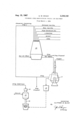
- the oxygen blow is conveniently and preferably accomplished by means of available top-blowing processes and apparatus such as the socalled L-D equipment (as schematically shown in the appended drawing wherein the converter is denoted generally by the numeral 11), or the K-aldo process, the Rotor process, the Ajax process or any equivalent of any of these.
- the oxygen blow may be done by bottom or side blowing means and methods, as a Bessemer converter.
- a top-blowing oxygen-treating process is highly preferred, not only for the usual technical reasons advanced in favor of such processes over other, older processes, but for the additional or supplementary variables. reason that the temperatures requ1red 1n the oxygen 'blow TABLE III Operating Variables Campaign Period, Furnace Burden 1 Days Avg. Wind Avg. Coke Avg. Blast Rate, Rate, Avg. Blast Pressure, s.c.f.m. Lbs/Ton Temp., F. p.s.i.
- Equation 2 Percent C T +8'76
- Equation 1 shows that a converter temperature upwardly of 3400" F. is required. Such temperatures are extremely deleterious as regards useful life of the converter refractories. In order to operate a converter, even a top blown converter, at a temperature of, say 3400-3600 F., operation must be limited to extremely short time periods. Even then, refractory life is so affected as to make commercial operation under such conditions subject to a definite economic disadvantage.
- blast furnace manufacture of high chromium pig iron affords an extremely economical and productive source of chromium metal-in contrast to the usual, more expensive procedures by means of which chromium is generally placed in form and condition for production of stainless steels, for example, by common prior art electric arc melting practices which utilize either ferrochromium, ferrochcromium silicon or stainless steel scrap of variable chromium cntent-the use of such materials in a direct conversion, duplex process, although useful under certain conditions, e.g., where best compositional control is not required, or where process economics are not controlling, has definite and significant limitations.
- Equation 1 shows that, at the lower temperature of 3200 F., 0.10% carbon is productive of an equilibrium chromium content of 9.3%, while, at a temperature of 3300 F., in a nickel-free bath, a chromium content of about 14.1% can be obtained with an equilibrium carbon content of 0.100% in the final steel composition, and 9.2% chromium can be obtained with 0.065% carbon, and, at a converter temperature of 3400 F., a carbon level of 0.10% in the final stainless steel composition is productive of an equilibrium chromium content of 20.9%. Steels of still greater chromium content and/ or steels with commensurate chromium content, but of lower carbon content, require, of course, still higher temperatures for oxygen blowing to final, equilibrium composition.
- the final stainless steel products contemplated by the present invention include those containing chromium in a range of from about 9 to about 21%, or even greater, as up to about 25%, but preferably about 12 to about 18%, together with carbon contents below about 0.15% to 0.20%, preferably below 0.10%, although, in certain instances, the carbon content of the final steels may be much higher, e.g., about 0.60 to 1.20%, as in the case of the modified AISI 440 type cutlery steels, as types 440A, 440-B, 440-BM, 440-F and 440-F-Se.
- a 16,000-pound charge of a high carbon, high silicon, chromium-iron blast furnace product was melted in an electric arc furnace (in commercial practice of the invention, molten blast furnace metal would preferably be used directly), then the molten metal transferred to an approximately -ton capacity basic oxygen converter of the top-blown type.
- the metal was blown at a constant rate of 80,000 s.c.f.h. after an initial addition of 1100 pounds of lime.
- a further addition of 700 pounds of lime was made after the first sampling of the metal after commencement of oxygen blowing.
- Table IV The process factors and chemistries involved are given in the following Table IV.
- the total weight of the product after completion of the limited blowing was 13,750 pounds, representing a product yield of 86%.
- the chromium recovery was 93.1%.
- the steel was poured into a ladle with deslagging, and alloyed by ladle additions of 40 pounds of aluminum, 90 pounds of titanium, 120 pounds of 0% ferrosilicon and 60 pounds of electrolytic manganese.
- the metal was then poured into a 24-inch by 27-inch ingot having a composition: 0.35% carbon, 13.04% chromium, 0.56% silicon, 0.51% manganese, 0.24% titanium, balance substantially iron.
- the initial composition was 4.28% carbon, 1.19% silicon, 11.68% chromium, balance substantially iron with usual steelmaking impurities.
- the metal was oxygen-blown, at a constant, uninterrupted rate of 80,000 s.c.f.h., for about 13 minutes, for a total oxygen input of 17,000 s.c.f.
- the blown metal was thus tapped into a ladle, to which 40 pounds of aluminum, pounds of titanium, pounds of 50% ferrosilicon, and 60 pounds of electrolytic manganese, were made, and the product then teemed into a. 24 inch by 27 inch ingot which was analyzed and found to have a composition as follows: 0.16% carbon, 054% silicon, 11.50% chromium, 0.25% titanium, 0.40% manganese, balance substantially iron.
- a still further 1600 pound charge was melted, having a composition: 4.41% carbon, 0.98% silicon, 13.29% chromium, balance substantially iron. Eleven hundred pounds of lime were added to the molten metal which was then oxygen blown, again at a constant, uninterrupted rate of 80,000 s.c.f.h., for about 12 minutes (oxygen input of 16,500 s.c.f.). The blowing rate was then reduced to 50,000 s.c.f.h. for three minutes, giving an additional oxygen input of 2000 s.c.f., for a total of 18,500 s.c.f.
- the blast furnace effluent metal for use in the process of this invention, is required to contain at least about 1%, preferably about 2 or 3% to about 5% or more, by weight, of silicon, in addition to the aforesaid quantities of carbon.
- blast furnace temperatures are required which are appreciably higher than those required in the same or similar installations for the production of plain carbon pig iron.
- these higher operating temperatures result in generally higher percentages of silicon so that silicon contents greater than 2% are readily obtainable.
- the combination of higher temperature, together with high chromium content is productive of higher percentages of carbon in the resultant hot metal.
- the temperature of the molten bath in the converter can conveniently becontrolled, within the aforementioned desired range, by the addition of controlled quantities of scrap metal to the molten bath.
- scrap additions may be of the same or substantially the same composition as that of the bath itself or of the final desired product.
- alterations to the bath chemistry may be made at this point in the process by addition of scrap having a composition other than that of the molten bath.
- the temperature of the. molten bath in the oxygen converter can, of course, be controlled in other ways, such as the addition of ferroalloys or ores or changes in oxygen blowing rate.
- the converter charge metal may usefully have a composition other than that which, after oxygen blowing, would be directly productive of the desired final stainless steel composition.
- converter charge metal relatively deficient in alloying elements, such as chromium may be produced and the desired enrichment achieved by scrap or other alloying additions as described hereinabove.
- the partially refined metal resulting from a limited, low temperature oxygen blow, as above described, still contains substantial quantities of carbon-far above the carbon levels required in most stainless steels.
- such partially refined materials do have the highly reactive silicon content substantially removed. This is of considerable importance in view of the preferential oxidation of silicon over carbon and the consequent inability to effectively further lower the carbon content of melts containing appreciable quantities of silicon, as will be shown hereinafter.
- oxidation of silicon is productive of voluminous slag formation. Absence of both such possibilities is of importance inthe further stages of the inventive process as will become apparent.
- the molten bath contains substantial quantities of elements which are relatively more readily oxidizable than carbon under the particular process conditions, these elements will combine with oxygen and lower its content in the bath such that not as much is available for the Equation 3 reaction.
- elements are commonly present in stainless steel melts, either as intentional alloying additions, or as impurities. Silicon is exemplary of such elements.
- the invention provides, as hereinabove described, a bath for final refinement (and amenable to further alloying with such highly reactive elements) wherein such reactive elements are absent or substantially so.
- Such inhibiting reactions in chromium-containing steel melts are believed to involve the formation of chromium-oxygen or ironchromium-oxygen compounds, with or without other elements, as manganese, for example, chromium oxides (Cr O .Cr O chromite (FeO.Cr O or, if manganese is present, the corresponding manganese compounds or manganese-chromium compounds, e.g., MnO.Cr O
- the presence in the bath of appreciable quantities of silicon possibly lead to the formation of complex compounds, as rhodonite (MnO.SiO or fayalite (FeO.SiO as well as silicon dioxide (SiO all of which possibly act, and in a manner more profoundly than that which would be stoichiometrically indicated, to alter availability of oxygen added in chemically combined, solid, particulate form.
- the molten bath after being subjected to the limited oxygen blow pursuant to the present invention, is substantially saturated with dissolved oxygen which, in the absence of more reactive elements removed by the blow,.is readily available for combination with the remaining carbon when the bath is subjected to the contemplated vacuum treatment.
- Illustrative of the latter step of the invention there were prepared several heats of a chromium-containing steel saturated with oxygen, at a temperature of 3000 F., representing the product of a typical, limited oxygen blowing step as herein contemplated.
- Containers of these steels each holding thirty pounds of molten steel, at the stated 3000 F. temperature, were placed in a vacuum chamber and the chamber evacuated.
- the metal commenced boiling at a pressure of about 300 mm. Hg.
- the vacuum pumps were throttled to hold the pressure substantially constant until boiling subsided, whereupon pressure was again reduced until boiling again occurred. This procedure was repeated until a final pressure of 0.1 mm. Hg was reached.
- Percent Percent Si 0 Cr 17 silicon content of the blast furnace effluent metal be substantially completely removed in the oxygen blowing step of the inventive process.
- the oxygen content of the blown steels was much higher than would be expected from known oxygen-solubility data.
- the reason for this discrepancy is not known, but it is believed that it may be due to the presence in the blown steel compositions of metal oxides, possibly including those of chromium, as would be indicated by the reduction in chromium content of the steels after blowing. Possibly a fraction of oxides so produced remain dispersed, in extremely finely divided form in the molten metal.
- Nickel-containing austenitic stainless steels as well as the straight chromium steels, are similarly amenable to the contemplated vacuum treatment step of the invention.
- the invention contemplates the production, in accordance with the above-described three-step or triplex steelmaking process, of austenitic, nickel-bearing steels, such as the several steels of the A.I.S.I. Type 200 and 300 series, as well as the martensitic or ferritic chromium steels of the A.I.S.I. Type 400 series.
- Other stainless steels, such as the straight 12 percent chromium grades are also contemplated, as well as other chromium-bearing steels for special applications.
- the converter 11 after partial deslagging, as shown in the drawing, is emptied of its metallic contents, the latter being poured into a vessel suitable for subsequent vacuum treatment of its contents, e.g., a ladle 12, as also illustrated in the drawing. The latter is then removed to the vacuum treating zone, into operative association with the vacuum equipment.
- a vessel suitable for subsequent vacuum treatment of its contents e.g., a ladle 12, as also illustrated in the drawing.
- the latter is then removed to the vacuum treating zone, into operative association with the vacuum equipment.
- Any suitable means may be utilized for performing the vacuum treatment of the invention.
- Various types of equipment and processes 'which are currently available may be used, or the same may be modified in any desirable or necessary fashion.
- Other expedieuts obvious to those skilled in the art are, of course, within the purview of the invention.
- Those processes and means which are best adapted to create a large surface area for the' carbon-oxygen reaction and for degasification of the molten steel, are preferred.
- Illustrative of a preferred method and means for carrying out the vacuum treatment is the so-called D-H device and process wherein the liquid metal to be treated is contained in a ladle into which depends a refractory ceramic tube through which the metal is forced upwardly into an overlying vacuum chamber.
- Such equipment is schematically illustrated in the drawing, the numeral 13 denoting generally the vac uum treating equipment, the depending tube being identified by the numeral 14.
- equipment and process is well adapted to maximize surface area exposure for the above-stated purposes. This effect, in the above-described or other vacuum apparatus and processes, can be still further increased, if required or desired, by injecting into the molten metal undergoing vacuum treatment an inert, low atomic weight gas, such as hydrogen.
- vacuum treatment devices and processes may be used in the performance of the invention, for example, a vacuum stream degassing step, or merely exposure of a container of the partially refined steel to subatmospheric pressure in an evacuated chamber.
- alloying additions of relatively reactive elements as titanium, aluminum, calcium, magnesium, manganese, zirconium, vanadium, rare earth metals or silicon may be made to the refined metal bath. Loss of such elements, as by unwanted oxidation, by adding them to the contemplated products at this stageof their manufacture, is substantially eliminated. It is also contemplated that substantial further additions of chromium or nickel can be made to the melt at this point in the process, as well as additions of relatively less reactive alloying elements, as copper, molybdenum, columbium, tantalum, etc.
- the latter elements may, of course, also be added to the molten metal at an earlier stage of the process, as after the limited oxygen blow.
- Non-metals as sulfur, boron, nitrogen, etc., may also be added, preferably after the vacuum treatment has been completed. Addition of the more highly reactive alloying additions when necessitated in the final steels for any particular property requirement, is definitely preferred after vacuum treatment for the added reason that addition thereof prior to completion of the required carbon-oxygen reaction would inhibit that reaction by preferential oxidation of such more oxidation-susceptible elements, thereby preventing achievement of the desired low carbon levels.
- resiliconizing is preferably accomplished in this manner, as well as the incorporation of alloying or deoxidizing elements as titanium, columbium, or aluminum, all of which elements are commonly or occasionally required in one or another of the contemplated stainless steels.
- the so-called DH equipment is particularly preferred for the additional reason of the relative ease of making such alloying additions, as by means of an evacuable hopper 15 atop the vacuum chamber.
- the addition of relatively large percentages of difiicultly soluble alloying elements to the molten metal bath at one or another stage of the inventive process, as above described, may require a supplemental heat input to the metal bath to attain complete solution.
- This may be conveniently accomplished by removing the molten metal to an electric arc furnace, as a separate step of the process, or, alternatively, additional heat may be supplied in conjunction with one of the aforesaid process steps, e.g., by providing holding means for the metal in the vacuum chamber and heating the metal, while so held, for example, by radiation, induction, etc.
- the converter input metal although preferably constituting a blast furnace product, as described, may be produced by an electric furnace or even an open hearth or cupola process, for example, by melting, in such furnaces, an iron base material containing the required quantities of chromium, with or without nickel, and by adding the necessary quantities of carbon and silicon for performance of the subsequent oxygen blowing step.
- the invention also contemplates, in its broader aspect, production of a converter input metal by a submerged arc electric furnace smelting procedure, or by a combination thereof with melting furnace". as aforesaid.
- Such procedures are, generally, more difiicult, time consuming and costly than the use of blast furnace metal, although definite advantages are realizable with the use of a converter input metal produced by cupola-melted metal or by the product of a submerged are electric furnace process.
- blast furnace metal is directly productive of a converter input metal having the required quantities of carbon, from about 3.5 to about 6 weight percent, and silicon, about 2 to 5 weight percent, which are useful as fuels to supply the necessary thermal energy for the oxygen blowing.
- Such blast furnace products depending upon the nature of the ores used in their production, contain more or less manganese.
- This element also is oxidized during the oxygen blowing step and, if desired in appreciable amounts in the final steel compositions, can conveniently be re-added after completion of refinement as above-described.
- a forceful oxygen blow in a suitable converter is preferred in the performance of the invention, but alternatives are possible within the broadest contemplation of the invention principles.
- a partially refined heat of a desired stainless steel composition may be made by an electric furnace, open hearth, cupola, or other practice as mentioned above.
- the molten metal may be substantially saturated with oxygen, as by a comparatively slow bubbling or diffusion of oxygen into the the bathin contradistinction to the use of a forceful jet of oxygen to itself remove substantial quantities of carbon and/or silicon.
- Such an oxygen-saturated product can then be vacuum treated as above described.
- the input metal to the vacuum treatment operation be substantially free of silicon, since the presence of substantial quantities of that element will cause reaction with the oxygen present and thereby prevent occurrence or completion of the desired carbon-oxygen reaction.
- oxidation of quantities of silicon is productive of voluminous slag formation which not only impedes effective vacuum treatment, but is also quite deleterious to the refractory linings used in vacuum treatment equipment.
- the invention also is inclusive, in its broader aspects, of processes wherein the second and third steps, as above described, i.e., oxygen saturation and vacuum treatment of the molten metal, are performed simultaneously.
- a partially-refined melt that is, one wherein silicon is substantially absent and carbon is at an intermediate level as above-described, is placed within an evacuated chamber and therein subjected to a relatively slow injection, as by bubbling or diffusion, of oxygen whereby the carbon combines with the injected oxygen and the resulting gaseous carbon oxides removed under vacuum.
- the oxygen may be mixed with an inert stirring gas, as argon, nitrogen, etc., to promote the carbon-oxygen reaction kinetics.
- superheated steam may be utilized which, upon dissociation, provides oxygen for carbon removal and hydrogen for bath agitation.
- a method of producing chromium-bearing stainless steel having a carbon content less than about 0.10 percent comprising:
- Percent chromium 12 to 25 nickel Up to 8 carbon 3.5 to 6 silicon 2 to 5 iron, balance, except for impurities.
Landscapes
- Chemical & Material Sciences (AREA)
- Engineering & Computer Science (AREA)
- Materials Engineering (AREA)
- Metallurgy (AREA)
- Organic Chemistry (AREA)
- Manufacturing & Machinery (AREA)
- Mechanical Engineering (AREA)
- Treatment Of Steel In Its Molten State (AREA)
Priority Applications (4)
| Application Number | Priority Date | Filing Date | Title |
|---|---|---|---|
| US350297A US3336132A (en) | 1964-03-09 | 1964-03-09 | Stainless steel manufacturing process and equipment |
| GB9349/65A GB1079226A (en) | 1964-03-09 | 1965-03-04 | Stainless steel manufacturing process and equipment |
| FR8340A FR1430516A (fr) | 1964-03-09 | 1965-03-08 | Procédé et installation pour l'élaboration d'acier inoxydable |
| DE1965C0035254 DE1458829B1 (de) | 1964-03-09 | 1965-03-09 | Verfahren zur Herstellung von legiertem korrosionsbestaendigem Stahl |
Applications Claiming Priority (1)
| Application Number | Priority Date | Filing Date | Title |
|---|---|---|---|
| US350297A US3336132A (en) | 1964-03-09 | 1964-03-09 | Stainless steel manufacturing process and equipment |
Publications (1)
| Publication Number | Publication Date |
|---|---|
| US3336132A true US3336132A (en) | 1967-08-15 |
Family
ID=23376093
Family Applications (1)
| Application Number | Title | Priority Date | Filing Date |
|---|---|---|---|
| US350297A Expired - Lifetime US3336132A (en) | 1964-03-09 | 1964-03-09 | Stainless steel manufacturing process and equipment |
Country Status (4)
| Country | Link |
|---|---|
| US (1) | US3336132A (fr) |
| DE (1) | DE1458829B1 (fr) |
| FR (1) | FR1430516A (fr) |
| GB (1) | GB1079226A (fr) |
Cited By (18)
| Publication number | Priority date | Publication date | Assignee | Title |
|---|---|---|---|---|
| US3607247A (en) * | 1968-11-12 | 1971-09-21 | Crucible Inc | Processes for the oxygen converter production of stainless steels |
| US3649246A (en) * | 1969-08-29 | 1972-03-14 | Allegheny Ludlum Steel | Decarburizing molten steel |
| US3723102A (en) * | 1970-06-15 | 1973-03-27 | Airco Inc | High strength iron-chromium-nickel alloy |
| US3751242A (en) * | 1969-04-02 | 1973-08-07 | Eisenwerk Gmbh Sulzbach Rosenb | Process for making chrimium alloys |
| US3770415A (en) * | 1969-09-10 | 1973-11-06 | Italsider Spa | Method for recovering iron from blast furnace and basic oxygen furnace wastes |
| US3773496A (en) * | 1970-02-18 | 1973-11-20 | Maximilianshuette Eisenwerk | Process for producing chrome steels and a converter for carrying out the process |
| US3791819A (en) * | 1968-11-12 | 1974-02-12 | Jones & Laughlin Steel Corp | Production of stainless steels |
| US3816100A (en) * | 1970-09-29 | 1974-06-11 | Allegheny Ludlum Ind Inc | Method for producing alloy steel |
| US3839018A (en) * | 1968-06-03 | 1974-10-01 | British Iron Steel Research | Production of low carbon ferroalloys |
| US3841867A (en) * | 1969-10-15 | 1974-10-15 | British Steel Corp | Alloying steels |
| US3907547A (en) * | 1973-03-24 | 1975-09-23 | Krupp Ag Huettenwerke | Method of preparing vacuum-treated steel for making ingots for forging |
| US4001009A (en) * | 1969-04-03 | 1977-01-04 | Hannsgeorg Bauer | Process for the manufacture of steels with a high chromium content |
| DE2754988A1 (de) * | 1976-12-10 | 1978-06-15 | Showa Denko Kk | Verfahren zur herstellung von ferrochrom in einem hochofen |
| US4294611A (en) * | 1978-10-04 | 1981-10-13 | Vasipari Kutato Intezet | Process and apparatus for reducing the inclusion content of steels and for refining their structure |
| US4358313A (en) * | 1980-03-17 | 1982-11-09 | Nippon Steel Corporation | Process for refining molten pig iron and steel |
| USRE31676E (en) * | 1982-09-29 | 1984-09-18 | Thyssen Aktiengesellschaft vorm August Thyssen-Hutte AG | Method and apparatus for dispensing a fluidizable solid from a pressure vessel |
| US4515630A (en) * | 1983-08-15 | 1985-05-07 | Olin Corporation | Process of continuously treating an alloy melt |
| US4729787A (en) * | 1985-04-26 | 1988-03-08 | Mitsui Engineering And Ship Building Co., Ltd. | Method of producing an iron; cobalt and nickel base alloy having low contents of sulphur, oxygen and nitrogen |
Families Citing this family (2)
| Publication number | Priority date | Publication date | Assignee | Title |
|---|---|---|---|---|
| FR2216362B1 (fr) * | 1973-02-07 | 1975-10-31 | Creusot Loire | |
| GB8711192D0 (en) * | 1987-05-12 | 1987-06-17 | Consarc Eng Ltd | Metal refining process |
Citations (11)
| Publication number | Priority date | Publication date | Assignee | Title |
|---|---|---|---|---|
| US2040566A (en) * | 1933-11-20 | 1936-05-12 | Heraeus Vacuumschmelze Ag | Vacuum method of manufacturing steel |
| US2093666A (en) * | 1934-11-23 | 1937-09-21 | Wacker Chemie Gmbh | Process for treating iron and iron alloys |
| US2238078A (en) * | 1939-01-23 | 1941-04-15 | Percy H Royster | Production of ferrochromium |
| US2959478A (en) * | 1956-12-22 | 1960-11-08 | Hoerder Huettenunion Ag | Method and apparatus for handling metallic melts |
| US3003865A (en) * | 1959-09-10 | 1961-10-10 | Cameron Iron Works Inc | Decarburizing process for alloy steels containing chromium |
| US3042510A (en) * | 1958-11-25 | 1962-07-03 | Heraeus Gmbh W C | Degasification of molten steel |
| US3052576A (en) * | 1958-02-06 | 1962-09-04 | Soc Metallurgique Imphy | Metal composition having improved oxidation- and corrosion-resistance and magnetic characteristics, and method of preparing same |
| US3060015A (en) * | 1960-03-22 | 1962-10-23 | Ruhrstahl Ag | Steel purification |
| US3172758A (en) * | 1965-03-09 | Oxygen process for producing high | ||
| US3240588A (en) * | 1961-01-09 | 1966-03-15 | Finkl & Sons Co | Method and apparatus for treating molten metal |
| US3252790A (en) * | 1956-06-27 | 1966-05-24 | Union Carbide Corp | Preparation of metals and alloys |
-
1964
- 1964-03-09 US US350297A patent/US3336132A/en not_active Expired - Lifetime
-
1965
- 1965-03-04 GB GB9349/65A patent/GB1079226A/en not_active Expired
- 1965-03-08 FR FR8340A patent/FR1430516A/fr not_active Expired
- 1965-03-09 DE DE1965C0035254 patent/DE1458829B1/de not_active Withdrawn
Patent Citations (11)
| Publication number | Priority date | Publication date | Assignee | Title |
|---|---|---|---|---|
| US3172758A (en) * | 1965-03-09 | Oxygen process for producing high | ||
| US2040566A (en) * | 1933-11-20 | 1936-05-12 | Heraeus Vacuumschmelze Ag | Vacuum method of manufacturing steel |
| US2093666A (en) * | 1934-11-23 | 1937-09-21 | Wacker Chemie Gmbh | Process for treating iron and iron alloys |
| US2238078A (en) * | 1939-01-23 | 1941-04-15 | Percy H Royster | Production of ferrochromium |
| US3252790A (en) * | 1956-06-27 | 1966-05-24 | Union Carbide Corp | Preparation of metals and alloys |
| US2959478A (en) * | 1956-12-22 | 1960-11-08 | Hoerder Huettenunion Ag | Method and apparatus for handling metallic melts |
| US3052576A (en) * | 1958-02-06 | 1962-09-04 | Soc Metallurgique Imphy | Metal composition having improved oxidation- and corrosion-resistance and magnetic characteristics, and method of preparing same |
| US3042510A (en) * | 1958-11-25 | 1962-07-03 | Heraeus Gmbh W C | Degasification of molten steel |
| US3003865A (en) * | 1959-09-10 | 1961-10-10 | Cameron Iron Works Inc | Decarburizing process for alloy steels containing chromium |
| US3060015A (en) * | 1960-03-22 | 1962-10-23 | Ruhrstahl Ag | Steel purification |
| US3240588A (en) * | 1961-01-09 | 1966-03-15 | Finkl & Sons Co | Method and apparatus for treating molten metal |
Cited By (19)
| Publication number | Priority date | Publication date | Assignee | Title |
|---|---|---|---|---|
| US3839018A (en) * | 1968-06-03 | 1974-10-01 | British Iron Steel Research | Production of low carbon ferroalloys |
| US3791819A (en) * | 1968-11-12 | 1974-02-12 | Jones & Laughlin Steel Corp | Production of stainless steels |
| US3607247A (en) * | 1968-11-12 | 1971-09-21 | Crucible Inc | Processes for the oxygen converter production of stainless steels |
| US3751242A (en) * | 1969-04-02 | 1973-08-07 | Eisenwerk Gmbh Sulzbach Rosenb | Process for making chrimium alloys |
| US4001009A (en) * | 1969-04-03 | 1977-01-04 | Hannsgeorg Bauer | Process for the manufacture of steels with a high chromium content |
| US3649246A (en) * | 1969-08-29 | 1972-03-14 | Allegheny Ludlum Steel | Decarburizing molten steel |
| US3770415A (en) * | 1969-09-10 | 1973-11-06 | Italsider Spa | Method for recovering iron from blast furnace and basic oxygen furnace wastes |
| US3841867A (en) * | 1969-10-15 | 1974-10-15 | British Steel Corp | Alloying steels |
| US3773496A (en) * | 1970-02-18 | 1973-11-20 | Maximilianshuette Eisenwerk | Process for producing chrome steels and a converter for carrying out the process |
| US3723102A (en) * | 1970-06-15 | 1973-03-27 | Airco Inc | High strength iron-chromium-nickel alloy |
| US3816100A (en) * | 1970-09-29 | 1974-06-11 | Allegheny Ludlum Ind Inc | Method for producing alloy steel |
| US3907547A (en) * | 1973-03-24 | 1975-09-23 | Krupp Ag Huettenwerke | Method of preparing vacuum-treated steel for making ingots for forging |
| DE2754988A1 (de) * | 1976-12-10 | 1978-06-15 | Showa Denko Kk | Verfahren zur herstellung von ferrochrom in einem hochofen |
| US4106929A (en) * | 1976-12-10 | 1978-08-15 | Showa Denko Kabushiki Kaisha | Process for preparing a ferrochromium by using a blast furnace |
| US4294611A (en) * | 1978-10-04 | 1981-10-13 | Vasipari Kutato Intezet | Process and apparatus for reducing the inclusion content of steels and for refining their structure |
| US4358313A (en) * | 1980-03-17 | 1982-11-09 | Nippon Steel Corporation | Process for refining molten pig iron and steel |
| USRE31676E (en) * | 1982-09-29 | 1984-09-18 | Thyssen Aktiengesellschaft vorm August Thyssen-Hutte AG | Method and apparatus for dispensing a fluidizable solid from a pressure vessel |
| US4515630A (en) * | 1983-08-15 | 1985-05-07 | Olin Corporation | Process of continuously treating an alloy melt |
| US4729787A (en) * | 1985-04-26 | 1988-03-08 | Mitsui Engineering And Ship Building Co., Ltd. | Method of producing an iron; cobalt and nickel base alloy having low contents of sulphur, oxygen and nitrogen |
Also Published As
| Publication number | Publication date |
|---|---|
| DE1458829B1 (de) | 1970-11-12 |
| FR1430516A (fr) | 1966-03-04 |
| GB1079226A (en) | 1967-08-16 |
Similar Documents
| Publication | Publication Date | Title |
|---|---|---|
| US3198624A (en) | Process for the manufacture of stainless steel | |
| CN103255356A (zh) | 一种制造低碳不锈钢的方法 | |
| US3169058A (en) | Decarburization, deoxidation, and alloy addition | |
| US3158464A (en) | Ferrochromium production | |
| US3728101A (en) | Process for making stainless steel | |
| US3323907A (en) | Production of chromium steels | |
| US3615348A (en) | Stainless steel melting practice | |
| US3043681A (en) | Metallurgical processes | |
| US3607247A (en) | Processes for the oxygen converter production of stainless steels | |
| US4029497A (en) | Manufacture of alloy steels and ferrous alloys | |
| US3885958A (en) | Method of producing chromium containing alloys | |
| WO2001086006A2 (fr) | Procede ameliore de production d'aciers inoxydables et d'aciers a forte teneur en chrome et acier inoxydable ainsi produit | |
| US4200453A (en) | Process for the production of nickel alloys | |
| JPS6250545B2 (fr) | ||
| US3012875A (en) | Metallurgical process | |
| RU2186856C1 (ru) | Композиционная шихта для выплавки легированных сталей | |
| US3816100A (en) | Method for producing alloy steel | |
| JP3063537B2 (ja) | ステンレス鋼の製造方法 | |
| JP4114346B2 (ja) | 高Cr溶鋼の製造方法 | |
| US3754900A (en) | Production of low nitrogen high chromium ferrous alloys | |
| CA3163853A1 (fr) | Charge liquide pour un convertisseur basique a oxygene | |
| US3556770A (en) | Process for making alloys and metals | |
| US2542177A (en) | Manufacture of chromium steels | |
| US1770433A (en) | Alloy | |
| US1812941A (en) | Manufacture of stainless iron |
Legal Events
| Date | Code | Title | Description |
|---|---|---|---|
| AS | Assignment |
Owner name: COLT INDUSTRIES OPERATING CORP. Free format text: MERGER AND CHANGE OF NAME;ASSIGNOR:CRUCIBLE CENTER COMPANY (INTO) CRUCIBLE INC. (CHANGED TO);REEL/FRAME:004120/0308 Effective date: 19821214 |
|
| AS | Assignment |
Owner name: CRUCIBLE MATERIALS CORPORATION, A DE CORP. Free format text: ASSIGNMENT OF ASSIGNORS INTEREST.;ASSIGNOR:COLT INDUSTRIES OPERATING CORP.;REEL/FRAME:004194/0621 Effective date: 19831025 Owner name: CRUCIBLE MATERIALS CORPORATION, PENNSYLVANIA Free format text: ASSIGNMENT OF ASSIGNORS INTEREST;ASSIGNOR:COLT INDUSTRIES OPERATING CORP.;REEL/FRAME:004194/0621 Effective date: 19831025 |