US3336359A - Dicyanoacetylene synthesis - Google Patents
Dicyanoacetylene synthesis Download PDFInfo
- Publication number
- US3336359A US3336359A US419427A US41942764A US3336359A US 3336359 A US3336359 A US 3336359A US 419427 A US419427 A US 419427A US 41942764 A US41942764 A US 41942764A US 3336359 A US3336359 A US 3336359A
- Authority
- US
- United States
- Prior art keywords
- dicyanoacetylene
- nitrogen
- carbon
- stream
- temperature
- Prior art date
- Legal status (The legal status is an assumption and is not a legal conclusion. Google has not performed a legal analysis and makes no representation as to the accuracy of the status listed.)
- Expired - Lifetime
Links
- ZEHZNAXXOOYTJM-UHFFFAOYSA-N dicyanoacetylene Chemical group N#CC#CC#N ZEHZNAXXOOYTJM-UHFFFAOYSA-N 0.000 title claims description 22
- 230000015572 biosynthetic process Effects 0.000 title description 5
- 238000003786 synthesis reaction Methods 0.000 title description 5
- IJGRMHOSHXDMSA-UHFFFAOYSA-N Atomic nitrogen Chemical compound N#N IJGRMHOSHXDMSA-UHFFFAOYSA-N 0.000 claims description 45
- 229910052757 nitrogen Inorganic materials 0.000 claims description 22
- OKTJSMMVPCPJKN-UHFFFAOYSA-N Carbon Chemical compound [C] OKTJSMMVPCPJKN-UHFFFAOYSA-N 0.000 claims description 19
- 229910052799 carbon Inorganic materials 0.000 claims description 18
- 239000007795 chemical reaction product Substances 0.000 claims description 8
- 238000004519 manufacturing process Methods 0.000 claims description 8
- UFHFLCQGNIYNRP-UHFFFAOYSA-N Hydrogen Chemical class [H][H] UFHFLCQGNIYNRP-UHFFFAOYSA-N 0.000 claims description 5
- 239000001257 hydrogen Substances 0.000 claims description 5
- 229910052739 hydrogen Inorganic materials 0.000 claims description 5
- 239000000047 product Substances 0.000 description 8
- 239000007789 gas Substances 0.000 description 7
- 238000000034 method Methods 0.000 description 5
- JMANVNJQNLATNU-UHFFFAOYSA-N oxalonitrile Chemical compound N#CC#N JMANVNJQNLATNU-UHFFFAOYSA-N 0.000 description 5
- CSCPPACGZOOCGX-UHFFFAOYSA-N Acetone Chemical compound CC(C)=O CSCPPACGZOOCGX-UHFFFAOYSA-N 0.000 description 4
- CURLTUGMZLYLDI-UHFFFAOYSA-N Carbon dioxide Chemical compound O=C=O CURLTUGMZLYLDI-UHFFFAOYSA-N 0.000 description 4
- QVGXLLKOCUKJST-UHFFFAOYSA-N atomic oxygen Chemical group [O] QVGXLLKOCUKJST-UHFFFAOYSA-N 0.000 description 4
- 239000001301 oxygen Substances 0.000 description 4
- 229910052760 oxygen Inorganic materials 0.000 description 4
- OKKJLVBELUTLKV-UHFFFAOYSA-N Methanol Chemical compound OC OKKJLVBELUTLKV-UHFFFAOYSA-N 0.000 description 3
- 125000003178 carboxy group Chemical group [H]OC(*)=O 0.000 description 3
- 125000003277 amino group Chemical group 0.000 description 2
- 239000001569 carbon dioxide Substances 0.000 description 2
- 229910002092 carbon dioxide Inorganic materials 0.000 description 2
- 238000006243 chemical reaction Methods 0.000 description 2
- 150000001875 compounds Chemical class 0.000 description 2
- 238000001816 cooling Methods 0.000 description 2
- 239000007788 liquid Substances 0.000 description 2
- 239000000463 material Substances 0.000 description 2
- 125000002496 methyl group Chemical group [H]C([H])([H])* 0.000 description 2
- 230000003287 optical effect Effects 0.000 description 2
- 239000007787 solid Substances 0.000 description 2
- VHUUQVKOLVNVRT-UHFFFAOYSA-N Ammonium hydroxide Chemical compound [NH4+].[OH-] VHUUQVKOLVNVRT-UHFFFAOYSA-N 0.000 description 1
- 239000004215 Carbon black (E152) Substances 0.000 description 1
- RYGMFSIKBFXOCR-UHFFFAOYSA-N Copper Chemical compound [Cu] RYGMFSIKBFXOCR-UHFFFAOYSA-N 0.000 description 1
- 229920000742 Cotton Polymers 0.000 description 1
- VYPSYNLAJGMNEJ-UHFFFAOYSA-N Silicium dioxide Chemical compound O=[Si]=O VYPSYNLAJGMNEJ-UHFFFAOYSA-N 0.000 description 1
- 239000000908 ammonium hydroxide Substances 0.000 description 1
- 244000309464 bull Species 0.000 description 1
- YTIVTFGABIZHHX-UHFFFAOYSA-N butynedioic acid Chemical compound OC(=O)C#CC(O)=O YTIVTFGABIZHHX-UHFFFAOYSA-N 0.000 description 1
- 239000006227 byproduct Substances 0.000 description 1
- 239000003795 chemical substances by application Substances 0.000 description 1
- 238000009833 condensation Methods 0.000 description 1
- 230000005494 condensation Effects 0.000 description 1
- 239000000470 constituent Substances 0.000 description 1
- 229910052802 copper Inorganic materials 0.000 description 1
- 239000010949 copper Substances 0.000 description 1
- 230000002939 deleterious effect Effects 0.000 description 1
- 229910001873 dinitrogen Inorganic materials 0.000 description 1
- YWEUIGNSBFLMFL-UHFFFAOYSA-N diphosphonate Chemical compound O=P(=O)OP(=O)=O YWEUIGNSBFLMFL-UHFFFAOYSA-N 0.000 description 1
- 238000001704 evaporation Methods 0.000 description 1
- 230000008020 evaporation Effects 0.000 description 1
- 239000005350 fused silica glass Substances 0.000 description 1
- 239000011491 glass wool Substances 0.000 description 1
- 229910002804 graphite Inorganic materials 0.000 description 1
- 239000010439 graphite Substances 0.000 description 1
- 239000005337 ground glass Substances 0.000 description 1
- 229930195733 hydrocarbon Natural products 0.000 description 1
- 150000002430 hydrocarbons Chemical class 0.000 description 1
- 230000006698 induction Effects 0.000 description 1
- 238000009413 insulation Methods 0.000 description 1
- 238000010943 off-gassing Methods 0.000 description 1
- DLYUQMMRRRQYAE-UHFFFAOYSA-N phosphorus pentoxide Inorganic materials O1P(O2)(=O)OP3(=O)OP1(=O)OP2(=O)O3 DLYUQMMRRRQYAE-UHFFFAOYSA-N 0.000 description 1
- 229920000642 polymer Polymers 0.000 description 1
- 239000007858 starting material Substances 0.000 description 1
- 230000003068 static effect Effects 0.000 description 1
- XLYOFNOQVPJJNP-UHFFFAOYSA-N water Substances O XLYOFNOQVPJJNP-UHFFFAOYSA-N 0.000 description 1
Images
Classifications
-
- C—CHEMISTRY; METALLURGY
- C07—ORGANIC CHEMISTRY
- C07C—ACYCLIC OR CARBOCYCLIC COMPOUNDS
- C07C255/00—Carboxylic acid nitriles
Definitions
- Dicyanoacetylene is formed by direct combination of gaseous nitrogen with carbon heated to 2376 to about 3,000 degrees K., uncombined nitrogen and reaction products flowing away to a cooler region where products may be separated by condensation.
- This invention pertains to the art of organic chemistry and specifically to a way of preparing dicyanoacetylene, C N
- Dicyanoacetylene was first prepared by C. Maureau in 1909, as reported in Bull. Soc. Chim. (V), p. 846. His process involved several steps. First, he replaced the hydrogen in each carboxyl group of acetylene dicarboxylic acid with a methyl group derived from methyl alcohol. By treatment with ammonium hydroxide each methyl group and an adjacent oxygen were replaced by an amino group. The hydrogens-of the amino group and the surviving oxygen of the original carboxyl were then condensed out over phosphorus pentoxide, leaving a triple bonded nitrogen and carbon in place of the original carboxyl group.
- an important object of my invention is the production of dicyanoacetylene by direct combination of its constituent elements.
- Other objects of my invention are to produce dicyanoacetylene rapidly, by a process involving only a few steps, and from very inexpensive and readily available starting materials.
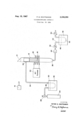
- the figure represents a train of apparatus suitable for producing dicyanoacetylene in accordance with my invention.
- the reaction chamber actually employed in the first demonstration of my invention was a fused silica tube two inches in diameter, here represented by designation 12. At its top it is surmounted by a totally reflecting prism 14 at which there is aimed an optical pyrometer 16, the total arrangement permitting the optical pyrometer to view the brightness of sample 18.
- Sample 18 (to be discussed 3,336,359 Patented Aug. 15,- 1967 Ice in more detail hereinafter) lies in the field of inductor 20 (here represented as edgewise wound copper strip, sectioned at a plane through its central axis) which is the output coil of a radio frequency furnace or induction heater 22 of the kind used for many years in outgassing radio tubes during manufacture.
- a source of nitrogen 24 (represented as a conventional compressed gas cylinder) is represented connected through a conventional diaphragm reducing valve 26 to a U-tube 28, whose lower part is immersed in a beaker 30 which is partly filled with a solution 32 of carbon dioxide in acetone.
- beaker 30 will be surounded by some thermal insulation such as glass wool or simple cotton batting; or a Dewar flask may replace the beaker 30.
- the function of the first U-tube 28 is simply to refrigerate incoming nitrogen to insure the removal of most of the water or hydrocarbon vapor present in the commercial gas. It is particularly desirable to minimize the hydrogen concentration in the apparatus because hydrogen will readily enter into combination with the reactive materials present, producing undesired side products.
- the nitrogen thus purified passes through a tube 34 to a port 36 at the top of tube 12, flowing downward past sample 18 to an exit 38 at the bottom of tube 12.
- Exit 38 is connected to a ground glass joint 40 which leads to a stopcock 42 of a U-tube 44 whose lower part is immersed in a solution 46 of carbon dioxide in acetone, contained in a beaker (or Dewar flask) 48.
- the exit from the U-tube runs through a stopcock 50.
- the product of the synthesis appears as condensate 52 at the bottom of the U- tube 44.
- regulator 26 is so adjusted as to produce a flow of purified nitrogen at a linear velocity of about 15 centimeters per second past sample 18, which may conveniently be a cylinder of graphite about inch in diameter and /2 inch high.
- sample 18 which may conveniently be a cylinder of graphite about inch in diameter and /2 inch high.
- the radio frequency furnace 22 is adjusted to heat the sample 18 to a temperature of about 3,000 degrees Kelvin.
- the condensate 52 appears at the bottom of U-tube 44.
- I analyzed this product in the mass spectrometer (which -was connected to the U-tube 44 through stopcock 50). Typical results obtained were as follows:
- the method of making dicyanoacetylene which comprises the steps of (1) Providing a surface of carbon heated to a temperature from at least 2673 to about 3000 degrees Kelvin;
- the method of making dicyanoacetylene which comprises the steps of (1) Bringing gaseous nitrogen in contact with heated carbon at a temperature from at least 2673 to about 3000 degrees Kelvin to form reaction products;
- the method of making dicyanoacetylene which comprises the steps of (1) Bringing gaseous nitrogen in contact with heated carbon to a temperature from at least 2673 to about 3000 degrees Kelvin to form reaction prodnets;
Landscapes
- Chemical & Material Sciences (AREA)
- Organic Chemistry (AREA)
- Organic Low-Molecular-Weight Compounds And Preparation Thereof (AREA)
- Production Of Liquid Hydrocarbon Mixture For Refining Petroleum (AREA)
Priority Applications (5)
| Application Number | Priority Date | Filing Date | Title |
|---|---|---|---|
| US419427A US3336359A (en) | 1964-12-18 | 1964-12-18 | Dicyanoacetylene synthesis |
| FR42620A FR1460282A (fr) | 1964-12-18 | 1965-12-16 | Procédé pour la synthèse du dicyanoacétylène |
| DE19651518962 DE1518962A1 (de) | 1964-12-18 | 1965-12-16 | Verfahren zur Herstellung von Dicyanacetylen |
| CH1737465A CH458325A (de) | 1964-12-18 | 1965-12-16 | Verfahren zur Herstellung von Dicyanacetylen |
| GB53652/65A GB1092750A (en) | 1964-12-18 | 1965-12-17 | Improvements in dicyanoacetylene synthesis |
Applications Claiming Priority (1)
| Application Number | Priority Date | Filing Date | Title |
|---|---|---|---|
| US419427A US3336359A (en) | 1964-12-18 | 1964-12-18 | Dicyanoacetylene synthesis |
Publications (1)
| Publication Number | Publication Date |
|---|---|
| US3336359A true US3336359A (en) | 1967-08-15 |
Family
ID=23662220
Family Applications (1)
| Application Number | Title | Priority Date | Filing Date |
|---|---|---|---|
| US419427A Expired - Lifetime US3336359A (en) | 1964-12-18 | 1964-12-18 | Dicyanoacetylene synthesis |
Country Status (5)
| Country | Link |
|---|---|
| US (1) | US3336359A (de) |
| CH (1) | CH458325A (de) |
| DE (1) | DE1518962A1 (de) |
| FR (1) | FR1460282A (de) |
| GB (1) | GB1092750A (de) |
Families Citing this family (1)
| Publication number | Priority date | Publication date | Assignee | Title |
|---|---|---|---|---|
| FR3027554B1 (fr) | 2014-10-27 | 2020-02-07 | Centre National De La Recherche Scientifique | Procede d'impression en trois dimensions |
-
1964
- 1964-12-18 US US419427A patent/US3336359A/en not_active Expired - Lifetime
-
1965
- 1965-12-16 CH CH1737465A patent/CH458325A/de unknown
- 1965-12-16 DE DE19651518962 patent/DE1518962A1/de active Pending
- 1965-12-16 FR FR42620A patent/FR1460282A/fr not_active Expired
- 1965-12-17 GB GB53652/65A patent/GB1092750A/en not_active Expired
Non-Patent Citations (1)
| Title |
|---|
| None * |
Also Published As
| Publication number | Publication date |
|---|---|
| FR1460282A (fr) | 1966-11-25 |
| DE1518962A1 (de) | 1969-08-21 |
| CH458325A (de) | 1968-06-30 |
| GB1092750A (en) | 1967-11-29 |
Similar Documents
| Publication | Publication Date | Title |
|---|---|---|
| McGee Jr et al. | Cryochemical preparation of monomeric aminoborane | |
| Hastie et al. | Infra-red spectra and geometry of SO2 and SeO2 in rare gas matrices | |
| Strickland-Constable | The interaction of oxygen and carbon filaments at high temperatures | |
| Spanier et al. | The conversion of silane to higher silanes in a silent electric discharge | |
| Smart et al. | Carbon monoxide adsorption on magnesium oxide | |
| Fawcett et al. | Cyanogen fluoride: synthesis and properties | |
| US3336359A (en) | Dicyanoacetylene synthesis | |
| Dows et al. | Infrared spectra of intermediate species in the formation of ammonium azide from hydrazoic acid | |
| Hanst et al. | Infrared spectrum and molecular structure of B2O3 | |
| US3206331A (en) | Method for coating articles with pyrolitic graphite | |
| US2994723A (en) | Manufacture of tetrafluoroethylene | |
| Rice et al. | The Dimethylamino Radical1 | |
| Gordon et al. | Condensation of an atomic beam on a cold (⪷ 2 K) surface | |
| Marshall et al. | The Solubility of Iron in Mercury at 25-700° | |
| US1677363A (en) | Process of treating methane gas | |
| GB934673A (en) | Improvements in or relating to the production of semi-conductor materials | |
| US2218066A (en) | Method for the preparation of ketene | |
| US1065182A (en) | Producing isoprene. | |
| US2929678A (en) | Method of producing zinc selenide | |
| US3134643A (en) | Process for the concentration of isotopes of nitrogen and oxygen in nitric oxide | |
| US3428540A (en) | Process for making trifluoroamine oxide | |
| US1315544A (en) | Ration | |
| US2752383A (en) | Production of formaldehyde cyanohydrin | |
| US3008798A (en) | Preparation of cyanogen fluoride | |
| US3748242A (en) | Preparation of cyclobutanones from glutaric anhydrides |