US3380406A - Composite design for transparent armour - Google Patents
Composite design for transparent armour Download PDFInfo
- Publication number
- US3380406A US3380406A US451441A US45144165A US3380406A US 3380406 A US3380406 A US 3380406A US 451441 A US451441 A US 451441A US 45144165 A US45144165 A US 45144165A US 3380406 A US3380406 A US 3380406A
- Authority
- US
- United States
- Prior art keywords
- glass
- impact
- armor
- layers
- polymer
- Prior art date
- Legal status (The legal status is an assumption and is not a legal conclusion. Google has not performed a legal analysis and makes no representation as to the accuracy of the status listed.)
- Expired - Lifetime
Links
- 239000002131 composite material Substances 0.000 title description 33
- 239000011521 glass Substances 0.000 description 59
- 239000000463 material Substances 0.000 description 47
- 229920000642 polymer Polymers 0.000 description 36
- 239000011159 matrix material Substances 0.000 description 20
- 230000003014 reinforcing effect Effects 0.000 description 18
- 229920005989 resin Polymers 0.000 description 15
- 239000011347 resin Substances 0.000 description 15
- 239000002952 polymeric resin Substances 0.000 description 10
- 229920003002 synthetic resin Polymers 0.000 description 10
- QXJJQWWVWRCVQT-UHFFFAOYSA-K calcium;sodium;phosphate Chemical compound [Na+].[Ca+2].[O-]P([O-])([O-])=O QXJJQWWVWRCVQT-UHFFFAOYSA-K 0.000 description 7
- PPBRXRYQALVLMV-UHFFFAOYSA-N Styrene Chemical compound C=CC1=CC=CC=C1 PPBRXRYQALVLMV-UHFFFAOYSA-N 0.000 description 6
- 230000001154 acute effect Effects 0.000 description 4
- 239000003822 epoxy resin Substances 0.000 description 4
- 229920006158 high molecular weight polymer Polymers 0.000 description 4
- 238000010030 laminating Methods 0.000 description 4
- 229920000647 polyepoxide Polymers 0.000 description 4
- -1 allyl ester Chemical class 0.000 description 3
- 239000003795 chemical substances by application Substances 0.000 description 3
- 239000000203 mixture Substances 0.000 description 3
- 229920000728 polyester Polymers 0.000 description 3
- 230000035939 shock Effects 0.000 description 3
- 229920001187 thermosetting polymer Polymers 0.000 description 3
- 239000004634 thermosetting polymer Substances 0.000 description 3
- 239000000853 adhesive Substances 0.000 description 2
- 230000001070 adhesive effect Effects 0.000 description 2
- 150000001412 amines Chemical class 0.000 description 2
- 238000000576 coating method Methods 0.000 description 2
- GYZLOYUZLJXAJU-UHFFFAOYSA-N diglycidyl ether Chemical compound C1OC1COCC1CO1 GYZLOYUZLJXAJU-UHFFFAOYSA-N 0.000 description 2
- 238000010304 firing Methods 0.000 description 2
- 239000012634 fragment Substances 0.000 description 2
- 239000002245 particle Substances 0.000 description 2
- WYTZZXDRDKSJID-UHFFFAOYSA-N (3-aminopropyl)triethoxysilane Chemical compound CCO[Si](OCC)(OCC)CCCN WYTZZXDRDKSJID-UHFFFAOYSA-N 0.000 description 1
- QNRATNLHPGXHMA-XZHTYLCXSA-N (r)-(6-ethoxyquinolin-4-yl)-[(2s,4s,5r)-5-ethyl-1-azabicyclo[2.2.2]octan-2-yl]methanol;hydrochloride Chemical compound Cl.C([C@H]([C@H](C1)CC)C2)CN1[C@@H]2[C@H](O)C1=CC=NC2=CC=C(OCC)C=C21 QNRATNLHPGXHMA-XZHTYLCXSA-N 0.000 description 1
- MKEPGIQTWYTRIW-ODZAUARKSA-N (z)-but-2-enedioic acid;ethane-1,2-diol Chemical compound OCCO.OC(=O)\C=C/C(O)=O MKEPGIQTWYTRIW-ODZAUARKSA-N 0.000 description 1
- VILCJCGEZXAXTO-UHFFFAOYSA-N 2,2,2-tetramine Chemical compound NCCNCCNCCN VILCJCGEZXAXTO-UHFFFAOYSA-N 0.000 description 1
- KUBDPQJOLOUJRM-UHFFFAOYSA-N 2-(chloromethyl)oxirane;4-[2-(4-hydroxyphenyl)propan-2-yl]phenol Chemical compound ClCC1CO1.C=1C=C(O)C=CC=1C(C)(C)C1=CC=C(O)C=C1 KUBDPQJOLOUJRM-UHFFFAOYSA-N 0.000 description 1
- KOGSPLLRMRSADR-UHFFFAOYSA-N 4-(2-aminopropan-2-yl)-1-methylcyclohexan-1-amine Chemical compound CC(C)(N)C1CCC(C)(N)CC1 KOGSPLLRMRSADR-UHFFFAOYSA-N 0.000 description 1
- 239000004342 Benzoyl peroxide Substances 0.000 description 1
- OMPJBNCRMGITSC-UHFFFAOYSA-N Benzoylperoxide Chemical compound C=1C=CC=CC=1C(=O)OOC(=O)C1=CC=CC=C1 OMPJBNCRMGITSC-UHFFFAOYSA-N 0.000 description 1
- XZMCDFZZKTWFGF-UHFFFAOYSA-N Cyanamide Chemical compound NC#N XZMCDFZZKTWFGF-UHFFFAOYSA-N 0.000 description 1
- 239000004593 Epoxy Substances 0.000 description 1
- 229920002319 Poly(methyl acrylate) Polymers 0.000 description 1
- KWYUFKZDYYNOTN-UHFFFAOYSA-M Potassium hydroxide Chemical compound [OH-].[K+] KWYUFKZDYYNOTN-UHFFFAOYSA-M 0.000 description 1
- OFOBLEOULBTSOW-UHFFFAOYSA-N Propanedioic acid Natural products OC(=O)CC(O)=O OFOBLEOULBTSOW-UHFFFAOYSA-N 0.000 description 1
- 229910000831 Steel Inorganic materials 0.000 description 1
- 230000001476 alcoholic effect Effects 0.000 description 1
- XAGFODPZIPBFFR-UHFFFAOYSA-N aluminium Chemical compound [Al] XAGFODPZIPBFFR-UHFFFAOYSA-N 0.000 description 1
- 229910052782 aluminium Inorganic materials 0.000 description 1
- PNEYBMLMFCGWSK-UHFFFAOYSA-N aluminium oxide Inorganic materials [O-2].[O-2].[O-2].[Al+3].[Al+3] PNEYBMLMFCGWSK-UHFFFAOYSA-N 0.000 description 1
- 238000000149 argon plasma sintering Methods 0.000 description 1
- 235000019400 benzoyl peroxide Nutrition 0.000 description 1
- 239000011230 binding agent Substances 0.000 description 1
- 239000000919 ceramic Substances 0.000 description 1
- 239000011248 coating agent Substances 0.000 description 1
- 229920001577 copolymer Polymers 0.000 description 1
- 238000004132 cross linking Methods 0.000 description 1
- 229910003460 diamond Inorganic materials 0.000 description 1
- 239000010432 diamond Substances 0.000 description 1
- ZBCBWPMODOFKDW-UHFFFAOYSA-N diethanolamine Chemical compound OCCNCCO ZBCBWPMODOFKDW-UHFFFAOYSA-N 0.000 description 1
- 230000000694 effects Effects 0.000 description 1
- 229920001971 elastomer Polymers 0.000 description 1
- LYCAIKOWRPUZTN-UHFFFAOYSA-N ethylene glycol Natural products OCCO LYCAIKOWRPUZTN-UHFFFAOYSA-N 0.000 description 1
- 238000009472 formulation Methods 0.000 description 1
- 238000010438 heat treatment Methods 0.000 description 1
- WGCNASOHLSPBMP-UHFFFAOYSA-N hydroxyacetaldehyde Natural products OCC=O WGCNASOHLSPBMP-UHFFFAOYSA-N 0.000 description 1
- VZCYOOQTPOCHFL-UPHRSURJSA-N maleic acid Chemical compound OC(=O)\C=C/C(O)=O VZCYOOQTPOCHFL-UPHRSURJSA-N 0.000 description 1
- 239000011976 maleic acid Substances 0.000 description 1
- 238000004519 manufacturing process Methods 0.000 description 1
- RTWNYYOXLSILQN-UHFFFAOYSA-N methanediamine Chemical compound NCN RTWNYYOXLSILQN-UHFFFAOYSA-N 0.000 description 1
- 238000012986 modification Methods 0.000 description 1
- 230000004048 modification Effects 0.000 description 1
- CFJYNSNXFXLKNS-UHFFFAOYSA-N p-menthane Chemical compound CC(C)C1CCC(C)CC1 CFJYNSNXFXLKNS-UHFFFAOYSA-N 0.000 description 1
- 230000035515 penetration Effects 0.000 description 1
- 150000002978 peroxides Chemical class 0.000 description 1
- 230000000704 physical effect Effects 0.000 description 1
- 229920003229 poly(methyl methacrylate) Polymers 0.000 description 1
- 229920003217 poly(methylsilsesquioxane) Polymers 0.000 description 1
- 229920002037 poly(vinyl butyral) polymer Polymers 0.000 description 1
- 229920000570 polyether Polymers 0.000 description 1
- 229920000120 polyethyl acrylate Polymers 0.000 description 1
- 229920005596 polymer binder Polymers 0.000 description 1
- 239000002491 polymer binding agent Substances 0.000 description 1
- 239000002861 polymer material Substances 0.000 description 1
- 239000004926 polymethyl methacrylate Substances 0.000 description 1
- 230000001902 propagating effect Effects 0.000 description 1
- 239000011819 refractory material Substances 0.000 description 1
- 239000005368 silicate glass Substances 0.000 description 1
- 239000010959 steel Substances 0.000 description 1
- 239000000126 substance Substances 0.000 description 1
- 229920001169 thermoplastic Polymers 0.000 description 1
- VZCYOOQTPOCHFL-UHFFFAOYSA-N trans-butenedioic acid Natural products OC(=O)C=CC(O)=O VZCYOOQTPOCHFL-UHFFFAOYSA-N 0.000 description 1
- 239000012780 transparent material Substances 0.000 description 1
Images

Classifications
-
- F—MECHANICAL ENGINEERING; LIGHTING; HEATING; WEAPONS; BLASTING
- F41—WEAPONS
- F41H—ARMOUR; ARMOURED TURRETS; ARMOURED OR ARMED VEHICLES; MEANS OF ATTACK OR DEFENCE, e.g. CAMOUFLAGE, IN GENERAL
- F41H5/00—Armour; Armour plates
- F41H5/02—Plate construction
- F41H5/04—Plate construction composed of more than one layer
- F41H5/0407—Transparent bullet-proof laminatesinformative reference: layered products essentially comprising glass in general B32B17/06, e.g. B32B17/10009; manufacture or composition of glass, e.g. joining glass to glass C03; permanent multiple-glazing windows, e.g. with spacing therebetween, E06B3/66
Definitions
- a transparent composite armor material has now been fabricated by laminating glass or other high modulus transparent materials with a polymer binder, using the high modulus material in the form of, for example, thin plates or prisms constituted of thin plates and disposing them within the composite in such a way that at least one major plane surface of the high modulus material is at an acute angle to the outer surface of the composite.
- This system has been found to possess many advantages in reflection of shock stress and non-propagating failure.
- an object of this invention to provide an armor material containing a high modulus material having a surface positioned at an acute angle with respect to that surface of the armor adapted to receive impact.
- Still another object of this invention is the provision of a transparent armor material which will resist penetration by high speed projectiles and without the production of other high speed particles.
- the composite armor of this invention comprises at least one layer of high molecular weight organic polymeric material having contained therein a plurality of high modulus members, generally in the form of thin sheets, at least one major surface of which is at an acute angle with respect to the surface of the composite.
- the high modulus members placed at an angle to the surface of the composite function to turn the projectile as it strikes the multiple interfaces. While not bound by any theory, it is believed that the turning or tipping motion of the projectile is also partially derived from the refiection of the shock pressure by the slanted layers of high modulus material.
- the high modulus members are ice thus the origin of several dilferent forces all of which combine to stop the projectile.
- the high modulus members also serve to reinforce the armor material, increasing its structural integrity.
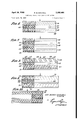
- FIGURE 1 is a cross-sectional view of an embodiment of the invention wherein the high modulus material is in the form of thin glass sheets 10 disposed at a 45 angle with respect to the surface upon which the bullet impacts.
- the glass sheets are held together by very thin polymer coating (not shown).
- three individual layers 12 of the glass sheets are bonded together to form a single composite transparent armor material.
- FIGURE 2 shows a perspective View of another embodiment wherein the high modulus material is in the form of elongated glass prisms 14 of triangular cross section each consisting of thin plates 16 held together by very thin adhesive coatings of polymer. As shown, several sections of the armor material may be placed endto-end to increase the area protected from bullet impact.
- FIGURE 3 shows a perspective view with a portion broken away for clarity of illustration, of still another embodiment wherein two layers, 18 and 20, composed of several sheets of glass 22 and a layer of glass spheres 24 are bound by polymer, and are separated from each other by a polymer layer 26 containing glass columns 28 and 30.
- the composition of these glass columns is chosen so that they are possessed of differing fracture stress. Thus, as the shock produced by the bullet impact proceeds into these columns one will break first. This is a planned device to assist in the deflection of the projectile.
- This embodiment is of particular value in stopping an armor piercing shell.
- the second layer of the compo-site material aids in stopping the inner core of such a shell.
- Layers 32 and 34 are uniform polymer layers to aid in containing spall caused by bullet impact.
- FIGURE 4 is a section taken along the plane of one of the sphere layers 24 in FIGURE 3.
- FIGURE 5 shows a plurality of sections of the armor material assembled in the form of staggered rows to increase the available impact area.
- FIGURE 6 is an end view in a partial cross-section of an embodiment where two layers 36 and 38, composed of thin glass sheets adhered to each other by polymer, are separated by a polymer layer containing glass columns having unlike fracture stress. One of the columns is shown at 40.
- the glass sheets in each layer are bonded with a polymer, and the lower layer 38 is both overcoated 42 and undercoated 44 with the polymer to contain any spall caused by bullet impact.
- FIGURE 7 is an end View in partial cross-section of an embodiment in the form of three layers 46, 48 and 50, composed of thin glass sheets adhered to each other by polymer.
- Layers 46 and 48 are separated by a polymer layer 52 containing glass columns of unlike fracture stress. One of the columns is shown at 54.
- Layers 48 and 50 contain glass sheets at angles and bonded with a polymer.
- the layers 48 and 50 are separated by a polymer layer 55 as well as undercoated with polymer layer 56 to aid in containing spall.
- FIGURE 8 is an end view in partial cross-section of an embodiment wherein in layers 58 and 60, the high modulus glass sheets 62 are separated by alternating layers of small spheres 64.
- the glass sheets and spheres are bonded together by a polymer and two individual layers thereof are again separated by a resin layer 66 containing glass columns of unlike fracture stress, one column being shown at 68.
- the lower polymer layer 70 is adapted to contain spall.
- FIGURE 9 is an end view in partial cross-section of an embodiment generally similar to that of FIGURE 5 except that the glass sheets 72 are cut at right angles to the upper edge of the sheets to provide a sawtooth glass surface within the polymer bonded layer.
- FIGURE shows an end view in partial cross-section of an embodiment similar to that of FIGURE 8 except that the glass is in two parts 74 and 76 to provide a double sawtooth effect, and small spheres 78 are contained within each glass sheet.
- any glass, including alumina silicate glass, or other transparent high modulus material such as the ceramics or refractory materials may be effectively used in this invention.
- the modulus referred to herein refers to elasticity, or more particularly, the stress-strain ratio which is commonly called Youngs modulus.
- the transparent plates used in this invention are said to possess a high modulus since relatively great stress is required to produce a small deflection (strain).
- the armor material of this invention is generally assembled as follows. A plurality of the thin glass sheets, usually from about 0.05 to 0.2 inch thick, are placed in a post-type jig, the glass being alternated with very thin plies of resin on the order of from about 0.004 to about 0.01 inch in thickness. Layers of small glass spheres may be interposed. Alternatively, the spheres may be glued into the glass prior to positioning in the jig. The top of the jig is set in place and the assembly is transfered to a press where it is heated under pressure to the laminating temperature of the polymer (or the curing temperature in the case of a thermosetting polymer). The laminate is then cut up in a diamond saw to provide the desired angle between its surface and the imbedded glass sheets. Thereafter, polymer layers containing glass columns of equal fracture stress or resin layers containing spall may be joined to the basic laminate by heating or adhesives.
- the individual glass sheets may be washed and primed prior to being placed in the jig.
- a 10% alcoholic potassium hydroxide solution may be used as a cleaner, and a 0.5% solution of aminopropyltriethoxysilane as the primer.
- a transparent composite armor material was prepared by laminating 0.04" x 1.0" x 3.0" glass plates at an angle of 45 with respect to the surface of the armor, using an epoxy resin as a matrix, (a diglycidyl ether of 2, Z-bis (4-hydroxyphenyl) propane and cured with methane diamine) containing 2.2 parts of the amine curing agent menthane 100 parts resin.
- the particular specimen was prepared with three layers of diagonal glass (each 0.75" thick) as shown in FIGURE 1.
- the laminate was cured at 10 psi. for 2 hours at 200 F., and then cut in the manner described above.
- the specimen was then tested by firing a Springfield model O3-A3 rifle (30-06) into the specimen from a distance of 50 feet.
- the armor specimen was shattered by the impact. However, an aluminum witness plate positioned at the rear of the specimen was not penetrated by the bullet or by any of the fragments.
- the bullet was recovered in the immediate area and was curled and flattened by the tipping action resulting from impact with, the composite.
- the resin used to bind the glass and for the spall layers has the formulation Parts Maleic acid-ethylene glycol polyester dissolved in styrene 90.0 Styrene 10.0 Benzoyl peroxide 0.5
- the laminates are cured for 4 hours at F. and then for 1 hour at 200 F. Upon the firing of a bullet into the specimens, the results were similar to those obtained in Example 1.
- the polymer material which may be employed as the matrix in the transparent composite armor material of this invention may be a thermosetting polymer such as an epoxy or styrenated polyester, or a thermoplastic polymer such as polymethyl acrylate, polymethyl methacrylate and polyethyl acrylate, a co-polymer of styrene and an allyl ester, polychlorotrifluoroethylene, tetrafluoroethylene-hexafluoropropylene copolymers and polyethers. These polymers completely fill all of the spaces between the high modulus material within the armor material.
- Various suitable curing agents may be employed along with the thermosetting polymers in order to assure complete cross-linking of the polymer.
- Typical of such curing agents are the amines, such as menthane diamine, triethylenetetramine and diethanolamine and the peroxides.
- the epoxy resin polymers are preferred because the armor obtainable therefrom is completely transparent and free of light scattering at normal temperatures.
- the diglycidyl ether of 2, -bis-(4-hydroxyphenyl) propane (sold by Shell Chemical under the name Epon 828) is particularly suitable.
- the polyester polymers used are of the common unsaturated type based on maleic acid and an alkylene glycol, such as those sold under the name Laminac 4101 by American Cyanamid, and Vibrin 156 by Naugatuck Division of US. Rubber.
- the resin in the spall layers and in the layer containing the glass columns may be the same as that used to join the individual glass sheets.
- Other common resins used in the glass laminating art may also be used, including polyvinyl butyral.
- composition of the glass used in the columns of unequal fracture stress may be readily ascertained by those skilled in the art from the available physical property data of glass provided in the literature.
- the high modulus material may be in the form of thin sheets or glass prisms (constructed of alternate layers of glass and binder as shown in the drawings).
- a major surface of the high modulus materials is disposed at an angle of less than and generally of from about 30 to about 75, to the surface of the armor adapted to receive the bullet impact can be utilized.
- glass of triangular, square, rhombic, rectangular, pentagonal and other cross-sectional configuration may be utilized.
- a transparent composite armor material having a surface adapted to receive impact comprising a layer of an organic high molecular weight polymeric matrix having contained therein a plurality of separate transparent high modulus reinforcing sheet members having at least one major plane surface disposed at an acute angle with respect to the surface of said armor adapted to receive impact.
- a transparent composite armor material having a surface adapted to receive impact comprising a layer of an organic high molecular weight polymeric matrix having contained therein a plurality of separate transparent glass reinforcing sheet members having at least one major place surface disposed at an angle of less than 90 with respect to the surface of said armor adapted to receive impact.
- a transparent composite armor material having a surface adapted to receive impact comprising a layer of epoxy resin polymer matrix having contained therein a plurality of separate transparent high modulus reinforcing sheet members having at least one major plane surface disposed at an angle of less than 90 with respect to the surface of said armor adapted to receive impact.
- a transparent composite armor material having a surface adapted to receive impact comprising a layer of an organic high molecular weight polymeric resin matrix having contained therein a plurality of separate transparent high modulus reinforcing sheet members having at least one major plane surface disposed at an angle of less than 90 with respect to the surface of said armor adapted to receive bullet impact, and having firmly adhered to the back of said layer a uniform polymer layer to contain spall produced by the impact.
- a transparent composite armor material having a surface adapted to receive impact comprising a layer of an organic high molecular weight polymeric resin matrix having contained therein a plurality of separate transparent high modulus reinforcing sheet members comprising elongated thin sheets lying in parallel planes and adhered to each other by said resin, each of said sheets having at least one major plane surface disposed at an angle of less than 90 with respect to the surface of said armor adapted to receive impact.
- a transparent composite armor material having a surface adapted to receive impact comprising a layer of an organic high molecular weight polymeric resin matrix having contained therein a plurality of high modulus reinforcing members comprising elongated prisms of triangular cross section and being constructed of a plurality of thin glass plates adhered to each other by said resin, each prism and each glass plate therein having at least one major plane surface disposed at an angle of less than 90 with respect to the surface of said armor adapted to receive impact.
- a transparent composite armor material having a surface adapted to receive impact comprising a layer of an organic high molecular weight polymeric resin matrix having contained therein a plurality of separate transparent reinforcing members comprising alternating layers of thin glass sheets and glass spheres lying in parallel planes and adhered to each other by said resin, each of said layers having at least one major plane surface disposed at an angle .of less than 90 with respect to the surface of said armor adapted to receive impact.
- a transparent composite armor material having a surface adapted to receive impact comprising a layer of an organic high molecular weight polymeric resin matrix having contained therein a plurality of separate transparent reinforcing members comprising alternating layers of thin glass sheets and glass spheres lying in parallel planes and adhered to each other by said resin, each .of said layers having at least one major plane surface disposed at an angle of less than 90 with respect to the surface of said armor adapted to receive impact, and having firmly adhered to at least one side of said layer a uniform polymer layer to contain spall produced by the impact.
- a transparent composite armor material having a surface adapted to receive impact comprising a layer of an organic high molecular weight polymeric resin matrix having contained therein a plurality reinforcing members comprising uniform rectangular thin glass sheets lying in parallel planes and adhered to each other by said resin, each sheet having at least one major surface disposed at an angle of less than 90 with respect to the surface of said armor adapted to receive impact and the edges of said sheets forming a saw-tooth configuration at and underlying the surface of said armor.
- a transparent composite armor material having a surface adapted to receive impact comprising a layer of an organic high molecular weight polymeric resin matrix having contained therein a plurality reinforcing members comprising uniform rectangular thin glass sheets lying in parallel planes and adhered to each other by said resin, each sheet having at least one major surface disposed at an angle of less than with respect to the surface of said armor adapted to receive impact and the edges of said sheets forming a saw-tooth configuration at and underlying the surface of said armor, and having firmly adhered to at least one side of said layer a uniform polymer layer to contain spall produced by the impact.
- a transparent composite armor material having a surface adapted to receive impact comprising a layer of an organic high molecular weight polymeric resin matrix having contained therein a plurality reinforcing members comprising uniform rectangular thin glass sheets having a plurality of glass spheres imbedded therein, said sheets each having at least one major surface disposed at an angle of less than 90 with respect to the surface of said armor adapted to receive impact and the edges of said sheets forming a saw-tooth configuration at and underlying the surface of said armor.
- a transparent composite armor material having a surface adapted to receive impact comprising a layer of an organic high molecular weight polymeric resin matrix having contained therein a plurality reinforcing members comprising uniform rectangular thin glass sheets having a plurality of glass spheres imbedded therein, said sheets each having at least one major surface disposed at an angle of less than 90 with respect to the surface of said armor adapted to receive impact and the edges of said sheets forming a saw-tooth configuration at and underlying the surface of said armor, and having firmly adhered to at least one side of said layer a uniform polymer layer to contain spall produced by the impact.
- a transparent composite armor material having -a surface adapted to receive impact comprising two layers of an organic high molecular weight polymeric resin matrix each having contained therein a plurality of high modulus reinforcing members each having at least one major plane surface disposed at an angle of less than 90 with respect to the surface of said armor adapted to receive impact, the two layers being adhered together in spaced apart relation by means of an organic high molecular weight resin layer containing glass columns of equal length but of unequal fracture stress so that upon impact some of the columns will fracture while others remain intact.
- a transparent composite armor material having a surface adapted to receive impact comprising two layers of an organic high molecular weight epoxy resin matrix each having contained therein a plurality of glass reinforcing members each having at least one major plane surface disposed at an angle of about 45 with respect to the surface of said armor adapted to receive impact, the two layers being adhered together in spaced apart relation by means of an organic high molecular weight resin layer containing glass columns of equal length but of unequal fracture stress so that upon impact some of the columns will fracture while others remain intact.
- a transparent composite armor material having a surface adapted to receive impact comprising two layers of an organic high molecular weight polymeric matrix each having contained therein a plurality of high modulus reinforcing members each having at least one major plane surface disposed at an angle of less than 90 with respect to the surface of said armor adapted to receive impact, one of said layers having adhered to at least one side thereof a uniform polymer layer to contain spall produced by impact, the two layers being adhered together in spaced apart relation by means of an organic high molecular weight polymer layer containing glass columns of equal length but of unequal fracture stress so that upon impact some of the columns will fracture while others remain intact.
- a transparent composite armor material having a surface adapted to receive impact comprising two layers of an organic high molecular weight polymeric matrix each having contained therein a plurality of high modulus reinforcing members comprising uniform rectangular thin glass sheets lying in parallel planes and adhered to each other by said polymer, each having at least one major lane surface disposed at an angle of less than 90 w th respect to the surface of said armor adapted to receive impact, one of said layers having adhered to at least one side thereof a uniform polymer layer to contain spall produced by impact, the two layers being adhered together in spaced apart relation by means of an organic high molecular weight polymer layer containing glass columns of equal length but of unequal fracture stress so that upon impact some of the columns will fracture while others remain intact.
- a transparent composite armor material having a surface adapted to receive impact comprising two layers of an organic high molecular weight polymeric matrix each having contained therein a plurality of reinforcing members comprising alternating layers of thin glass sheets and glass spheres lying in parallel planes and adhered to each other by said polymer, each of said sheets having at least one major plane surface disposed at an angle of less thn 90 with respect to the surface of said armor adapted to receive the impact, one of said layers having adhered to at least one side thereof a uniform polymer layer to contain spall produced by impact, the two layers being adhered together in spaced apart relation by means of an organic high molecular weight polymer layer containing glass columns of equal length but of unequal fracture stress so that upon impact, some of the columns will fracture while others remain intact.
- a transparent composite armor material comprising three layers of an organic high molecular weight polymeric matrix each having contained therein a plurality of high modulus reinforcing members comprising uniform rectangular thin glass sheets lying in parallel planes and adhered to each other by said polymer, each of said sheets having at least one major plane surface disposed at an angle of less than 90 with respect to the surface of said armor adapted to receive the impact, the first and the second layers of said armor material being adhered together in spaced apart relation by means of an organic high molecular weight polymer layer containing glass columns of equal length but of unequal fracture stress so that upon impact, some of the columns will fracture while others remain intact, and the second and third layers of said armor material being separated by a uniform polymer layer to contain spall produced by impact.
Landscapes
- Engineering & Computer Science (AREA)
- General Engineering & Computer Science (AREA)
- Laminated Bodies (AREA)
- Aiming, Guidance, Guns With A Light Source, Armor, Camouflage, And Targets (AREA)
Description
April 30, 1968 R. B. GOSNELL 3,330,406
COMPOSITE DESIGN FOR TRANSPARENT ARMOUR Filed April 28, 1965 2 Sheets-Sheet l [$136469 GdS/Vd INVENTOR ATTZ/VfVS United States Patent 3,380,406 COMPOSITE DESIGN FOR TRANSPARENT ARMOUR Rex Beach Gosnell, San Diego, Calif., assignor to Whittaker Corporation, Los Angeles, Calif., a corporation of California Filed Apr. 28, 1965, Ser. No. 451,441 18 Claims. (Cl. 10980) ABSTRACT OF THE DISCLOSURE This invention relates to novel lightweight armor adapted to provide protection against high speed projectiles.
Various bullet resistant glasses and high tempered glass-resin laminates have been proposed for protection against high speed projectiles. All of these materials, as well as steel boiler plate, have been found to be penetrated quite readily by a high velocity bullet, and in many cases with little apparent reduction in projectile velocity. In addition, these materials tend to disintegrate upon bullet impact, thereby producing additional high speed particles in the form of fragments from the armor material itself.
According to the present invention, a transparent composite armor material has now been fabricated by laminating glass or other high modulus transparent materials with a polymer binder, using the high modulus material in the form of, for example, thin plates or prisms constituted of thin plates and disposing them within the composite in such a way that at least one major plane surface of the high modulus material is at an acute angle to the outer surface of the composite. This system has been found to possess many advantages in reflection of shock stress and non-propagating failure.
Accordingly, it is an object of this invention to provide a novel composite transparent armor material.
More particular, it is an object of this invention to provide an armor material containing a high modulus material having a surface positioned at an acute angle with respect to that surface of the armor adapted to receive impact.
Still another object of this invention is the provision of a transparent armor material which will resist penetration by high speed projectiles and without the production of other high speed particles.
These and other objects of this invention will become apparent from the detailed description which follows.
The composite armor of this invention comprises at least one layer of high molecular weight organic polymeric material having contained therein a plurality of high modulus members, generally in the form of thin sheets, at least one major surface of which is at an acute angle with respect to the surface of the composite. The high modulus members placed at an angle to the surface of the composite function to turn the projectile as it strikes the multiple interfaces. While not bound by any theory, it is believed that the turning or tipping motion of the projectile is also partially derived from the refiection of the shock pressure by the slanted layers of high modulus material. The high modulus members are ice thus the origin of several dilferent forces all of which combine to stop the projectile. The high modulus members also serve to reinforce the armor material, increasing its structural integrity.
The invention will be better understood by reference to the accompanying drawings depicting several preferred embodiments of the armor material of my invention, the side intended to receive bullet impact being indicated by an arrow and in which:
FIGURE 1 is a cross-sectional view of an embodiment of the invention wherein the high modulus material is in the form of thin glass sheets 10 disposed at a 45 angle with respect to the surface upon which the bullet impacts. The glass sheets are held together by very thin polymer coating (not shown). In the embodiment shown in FIGURE 1, three individual layers 12 of the glass sheets are bonded together to form a single composite transparent armor material.
FIGURE 2 shows a perspective View of another embodiment wherein the high modulus material is in the form of elongated glass prisms 14 of triangular cross section each consisting of thin plates 16 held together by very thin adhesive coatings of polymer. As shown, several sections of the armor material may be placed endto-end to increase the area protected from bullet impact.
FIGURE 3 shows a perspective view with a portion broken away for clarity of illustration, of still another embodiment wherein two layers, 18 and 20, composed of several sheets of glass 22 and a layer of glass spheres 24 are bound by polymer, and are separated from each other by a polymer layer 26 containing glass columns 28 and 30. The composition of these glass columns is chosen so that they are possessed of differing fracture stress. Thus, as the shock produced by the bullet impact proceeds into these columns one will break first. This is a planned device to assist in the deflection of the projectile. This embodiment is of particular value in stopping an armor piercing shell. The second layer of the compo-site material aids in stopping the inner core of such a shell. Layers 32 and 34 are uniform polymer layers to aid in containing spall caused by bullet impact.
FIGURE 4 is a section taken along the plane of one of the sphere layers 24 in FIGURE 3.
FIGURE 5 shows a plurality of sections of the armor material assembled in the form of staggered rows to increase the available impact area.
FIGURE 6 is an end view in a partial cross-section of an embodiment where two layers 36 and 38, composed of thin glass sheets adhered to each other by polymer, are separated by a polymer layer containing glass columns having unlike fracture stress. One of the columns is shown at 40. The glass sheets in each layer are bonded with a polymer, and the lower layer 38 is both overcoated 42 and undercoated 44 with the polymer to contain any spall caused by bullet impact.
FIGURE 7 is an end View in partial cross-section of an embodiment in the form of three layers 46, 48 and 50, composed of thin glass sheets adhered to each other by polymer. Layers 46 and 48 are separated by a polymer layer 52 containing glass columns of unlike fracture stress. One of the columns is shown at 54. Layers 48 and 50 contain glass sheets at angles and bonded with a polymer. The layers 48 and 50 are separated by a polymer layer 55 as well as undercoated with polymer layer 56 to aid in containing spall.
FIGURE 8 is an end view in partial cross-section of an embodiment wherein in layers 58 and 60, the high modulus glass sheets 62 are separated by alternating layers of small spheres 64. The glass sheets and spheres are bonded together by a polymer and two individual layers thereof are again separated by a resin layer 66 containing glass columns of unlike fracture stress, one column being shown at 68. The lower polymer layer 70 is adapted to contain spall.
FIGURE 9 is an end view in partial cross-section of an embodiment generally similar to that of FIGURE 5 except that the glass sheets 72 are cut at right angles to the upper edge of the sheets to provide a sawtooth glass surface within the polymer bonded layer.
FIGURE shows an end view in partial cross-section of an embodiment similar to that of FIGURE 8 except that the glass is in two parts 74 and 76 to provide a double sawtooth effect, and small spheres 78 are contained within each glass sheet.
Any glass, including alumina silicate glass, or other transparent high modulus material such as the ceramics or refractory materials may be effectively used in this invention. The modulus referred to herein refers to elasticity, or more particularly, the stress-strain ratio which is commonly called Youngs modulus. The transparent plates used in this invention are said to possess a high modulus since relatively great stress is required to produce a small deflection (strain).
The armor material of this invention is generally assembled as follows. A plurality of the thin glass sheets, usually from about 0.05 to 0.2 inch thick, are placed in a post-type jig, the glass being alternated with very thin plies of resin on the order of from about 0.004 to about 0.01 inch in thickness. Layers of small glass spheres may be interposed. Alternatively, the spheres may be glued into the glass prior to positioning in the jig. The top of the jig is set in place and the assembly is transfered to a press where it is heated under pressure to the laminating temperature of the polymer (or the curing temperature in the case of a thermosetting polymer). The laminate is then cut up in a diamond saw to provide the desired angle between its surface and the imbedded glass sheets. Thereafter, polymer layers containing glass columns of equal fracture stress or resin layers containing spall may be joined to the basic laminate by heating or adhesives.
If desired, the individual glass sheets may be washed and primed prior to being placed in the jig. For example, a 10% alcoholic potassium hydroxide solution may be used as a cleaner, and a 0.5% solution of aminopropyltriethoxysilane as the primer.
To more clearly illustrate the invention, the following example is presented. The present invention may take many forms and numerous modifications in the arrangement of the high modulus members, spheres and polymer layers will be apparent to those skilled in the art from the herein contained description of my invention. Accordingly, the example should not be regarded as limiting in any way.
EXAMPLE 1 A transparent composite armor material was prepared by laminating 0.04" x 1.0" x 3.0" glass plates at an angle of 45 with respect to the surface of the armor, using an epoxy resin as a matrix, (a diglycidyl ether of 2, Z-bis (4-hydroxyphenyl) propane and cured with methane diamine) containing 2.2 parts of the amine curing agent menthane 100 parts resin. The particular specimen was prepared with three layers of diagonal glass (each 0.75" thick) as shown in FIGURE 1. The laminate was cured at 10 psi. for 2 hours at 200 F., and then cut in the manner described above. The specimen was then tested by firing a Springfield model O3-A3 rifle (30-06) into the specimen from a distance of 50 feet. The armor specimen was shattered by the impact. However, an aluminum witness plate positioned at the rear of the specimen was not penetrated by the bullet or by any of the fragments. The bullet was recovered in the immediate area and was curled and flattened by the tipping action resulting from impact with, the composite.
4 Specimens are prepared, one having the figuration shown in FIGURE 5 and the other that of FIGURE 7. The resin used to bind the glass and for the spall layers has the formulation Parts Maleic acid-ethylene glycol polyester dissolved in styrene 90.0 Styrene 10.0 Benzoyl peroxide 0.5
The laminates are cured for 4 hours at F. and then for 1 hour at 200 F. Upon the firing of a bullet into the specimens, the results were similar to those obtained in Example 1.
The polymer material which may be employed as the matrix in the transparent composite armor material of this invention may be a thermosetting polymer such as an epoxy or styrenated polyester, or a thermoplastic polymer such as polymethyl acrylate, polymethyl methacrylate and polyethyl acrylate, a co-polymer of styrene and an allyl ester, polychlorotrifluoroethylene, tetrafluoroethylene-hexafluoropropylene copolymers and polyethers. These polymers completely fill all of the spaces between the high modulus material within the armor material. Various suitable curing agents may be employed along with the thermosetting polymers in order to assure complete cross-linking of the polymer. Typical of such curing agents are the amines, such as menthane diamine, triethylenetetramine and diethanolamine and the peroxides. The epoxy resin polymers are preferred because the armor obtainable therefrom is completely transparent and free of light scattering at normal temperatures. The diglycidyl ether of 2, -bis-(4-hydroxyphenyl) propane (sold by Shell Chemical under the name Epon 828) is particularly suitable. The polyester polymers used are of the common unsaturated type based on maleic acid and an alkylene glycol, such as those sold under the name Laminac 4101 by American Cyanamid, and Vibrin 156 by Naugatuck Division of US. Rubber.
The resin in the spall layers and in the layer containing the glass columns may be the same as that used to join the individual glass sheets. Other common resins used in the glass laminating art may also be used, including polyvinyl butyral.
The composition of the glass used in the columns of unequal fracture stress may be readily ascertained by those skilled in the art from the available physical property data of glass provided in the literature.
The high modulus material may be in the form of thin sheets or glass prisms (constructed of alternate layers of glass and binder as shown in the drawings). In addition, it will be apparent that many other configurations wherein a major surface of the high modulus materials is disposed at an angle of less than and generally of from about 30 to about 75, to the surface of the armor adapted to receive the bullet impact can be utilized. Thus, glass of triangular, square, rhombic, rectangular, pentagonal and other cross-sectional configuration may be utilized.
Having fully described the invention, it is intended that it be limited only by the lawful scope of the appended claims.
I claim:
1. A transparent composite armor material having a surface adapted to receive impact comprising a layer of an organic high molecular weight polymeric matrix having contained therein a plurality of separate transparent high modulus reinforcing sheet members having at least one major plane surface disposed at an acute angle with respect to the surface of said armor adapted to receive impact.
2. A transparent composite armor material having a surface adapted to receive impact comprising a layer of an organic high molecular weight polymeric matrix having contained therein a plurality of separate transparent glass reinforcing sheet members having at least one major place surface disposed at an angle of less than 90 with respect to the surface of said armor adapted to receive impact.
3. A transparent composite armor material having a surface adapted to receive impact comprising a layer of epoxy resin polymer matrix having contained therein a plurality of separate transparent high modulus reinforcing sheet members having at least one major plane surface disposed at an angle of less than 90 with respect to the surface of said armor adapted to receive impact.
4. A transparent composite armor material having a surface adapted to receive impact comprising a layer of an organic high molecular weight polymeric resin matrix having contained therein a plurality of separate transparent high modulus reinforcing sheet members having at least one major plane surface disposed at an angle of less than 90 with respect to the surface of said armor adapted to receive bullet impact, and having firmly adhered to the back of said layer a uniform polymer layer to contain spall produced by the impact.
5. A transparent composite armor material having a surface adapted to receive impact comprising a layer of an organic high molecular weight polymeric resin matrix having contained therein a plurality of separate transparent high modulus reinforcing sheet members comprising elongated thin sheets lying in parallel planes and adhered to each other by said resin, each of said sheets having at least one major plane surface disposed at an angle of less than 90 with respect to the surface of said armor adapted to receive impact.
6. A transparent composite armor material having a surface adapted to receive impact comprising a layer of an organic high molecular weight polymeric resin matrix having contained therein a plurality of high modulus reinforcing members comprising elongated prisms of triangular cross section and being constructed of a plurality of thin glass plates adhered to each other by said resin, each prism and each glass plate therein having at least one major plane surface disposed at an angle of less than 90 with respect to the surface of said armor adapted to receive impact.
7. A transparent composite armor material having a surface adapted to receive impact comprising a layer of an organic high molecular weight polymeric resin matrix having contained therein a plurality of separate transparent reinforcing members comprising alternating layers of thin glass sheets and glass spheres lying in parallel planes and adhered to each other by said resin, each of said layers having at least one major plane surface disposed at an angle .of less than 90 with respect to the surface of said armor adapted to receive impact.
8. A transparent composite armor material having a surface adapted to receive impact comprising a layer of an organic high molecular weight polymeric resin matrix having contained therein a plurality of separate transparent reinforcing members comprising alternating layers of thin glass sheets and glass spheres lying in parallel planes and adhered to each other by said resin, each .of said layers having at least one major plane surface disposed at an angle of less than 90 with respect to the surface of said armor adapted to receive impact, and having firmly adhered to at least one side of said layer a uniform polymer layer to contain spall produced by the impact.
9. A transparent composite armor material having a surface adapted to receive impact comprising a layer of an organic high molecular weight polymeric resin matrix having contained therein a plurality reinforcing members comprising uniform rectangular thin glass sheets lying in parallel planes and adhered to each other by said resin, each sheet having at least one major surface disposed at an angle of less than 90 with respect to the surface of said armor adapted to receive impact and the edges of said sheets forming a saw-tooth configuration at and underlying the surface of said armor.
10. A transparent composite armor material having a surface adapted to receive impact comprising a layer of an organic high molecular weight polymeric resin matrix having contained therein a plurality reinforcing members comprising uniform rectangular thin glass sheets lying in parallel planes and adhered to each other by said resin, each sheet having at least one major surface disposed at an angle of less than with respect to the surface of said armor adapted to receive impact and the edges of said sheets forming a saw-tooth configuration at and underlying the surface of said armor, and having firmly adhered to at least one side of said layer a uniform polymer layer to contain spall produced by the impact.
11. A transparent composite armor material having a surface adapted to receive impact comprising a layer of an organic high molecular weight polymeric resin matrix having contained therein a plurality reinforcing members comprising uniform rectangular thin glass sheets having a plurality of glass spheres imbedded therein, said sheets each having at least one major surface disposed at an angle of less than 90 with respect to the surface of said armor adapted to receive impact and the edges of said sheets forming a saw-tooth configuration at and underlying the surface of said armor.
12. A transparent composite armor material having a surface adapted to receive impact comprising a layer of an organic high molecular weight polymeric resin matrix having contained therein a plurality reinforcing members comprising uniform rectangular thin glass sheets having a plurality of glass spheres imbedded therein, said sheets each having at least one major surface disposed at an angle of less than 90 with respect to the surface of said armor adapted to receive impact and the edges of said sheets forming a saw-tooth configuration at and underlying the surface of said armor, and having firmly adhered to at least one side of said layer a uniform polymer layer to contain spall produced by the impact.
13. A transparent composite armor material having -a surface adapted to receive impact comprising two layers of an organic high molecular weight polymeric resin matrix each having contained therein a plurality of high modulus reinforcing members each having at least one major plane surface disposed at an angle of less than 90 with respect to the surface of said armor adapted to receive impact, the two layers being adhered together in spaced apart relation by means of an organic high molecular weight resin layer containing glass columns of equal length but of unequal fracture stress so that upon impact some of the columns will fracture while others remain intact.
14. A transparent composite armor material having a surface adapted to receive impact comprising two layers of an organic high molecular weight epoxy resin matrix each having contained therein a plurality of glass reinforcing members each having at least one major plane surface disposed at an angle of about 45 with respect to the surface of said armor adapted to receive impact, the two layers being adhered together in spaced apart relation by means of an organic high molecular weight resin layer containing glass columns of equal length but of unequal fracture stress so that upon impact some of the columns will fracture while others remain intact.
15. A transparent composite armor material having a surface adapted to receive impact comprising two layers of an organic high molecular weight polymeric matrix each having contained therein a plurality of high modulus reinforcing members each having at least one major plane surface disposed at an angle of less than 90 with respect to the surface of said armor adapted to receive impact, one of said layers having adhered to at least one side thereof a uniform polymer layer to contain spall produced by impact, the two layers being adhered together in spaced apart relation by means of an organic high molecular weight polymer layer containing glass columns of equal length but of unequal fracture stress so that upon impact some of the columns will fracture while others remain intact.
16. A transparent composite armor material having a surface adapted to receive impact comprising two layers of an organic high molecular weight polymeric matrix each having contained therein a plurality of high modulus reinforcing members comprising uniform rectangular thin glass sheets lying in parallel planes and adhered to each other by said polymer, each having at least one major lane surface disposed at an angle of less than 90 w th respect to the surface of said armor adapted to receive impact, one of said layers having adhered to at least one side thereof a uniform polymer layer to contain spall produced by impact, the two layers being adhered together in spaced apart relation by means of an organic high molecular weight polymer layer containing glass columns of equal length but of unequal fracture stress so that upon impact some of the columns will fracture while others remain intact.
17. A transparent composite armor material having a surface adapted to receive impact comprising two layers of an organic high molecular weight polymeric matrix each having contained therein a plurality of reinforcing members comprising alternating layers of thin glass sheets and glass spheres lying in parallel planes and adhered to each other by said polymer, each of said sheets having at least one major plane surface disposed at an angle of less thn 90 with respect to the surface of said armor adapted to receive the impact, one of said layers having adhered to at least one side thereof a uniform polymer layer to contain spall produced by impact, the two layers being adhered together in spaced apart relation by means of an organic high molecular weight polymer layer containing glass columns of equal length but of unequal fracture stress so that upon impact, some of the columns will fracture while others remain intact.
18. A transparent composite armor material compris ing three layers of an organic high molecular weight polymeric matrix each having contained therein a plurality of high modulus reinforcing members comprising uniform rectangular thin glass sheets lying in parallel planes and adhered to each other by said polymer, each of said sheets having at least one major plane surface disposed at an angle of less than 90 with respect to the surface of said armor adapted to receive the impact, the first and the second layers of said armor material being adhered together in spaced apart relation by means of an organic high molecular weight polymer layer containing glass columns of equal length but of unequal fracture stress so that upon impact, some of the columns will fracture while others remain intact, and the second and third layers of said armor material being separated by a uniform polymer layer to contain spall produced by impact.
References Cited UNITED STATES PATENTS 1,888,042 11/1932 Lynn et al 10985 2,758,951 8/1956 Case 161--6O 787,065 4/1905 \Vhite 109-84 952,877 3/1910 Coles lO9-82 2,019,118 10/1935 Carothers 161203 3,009,845 11/1961 Wiser a- 161404 3,135,645 6/1964 Burkley l6l404 FOREIGN PATENTS 235,828 10/1961 Australia.
227,168 8/ 1943 Switzerland.
817,596 3/1937 France.
REINALDO P. MACHADO, Primary Examiner.
Priority Applications (1)
| Application Number | Priority Date | Filing Date | Title |
|---|---|---|---|
| US451441A US3380406A (en) | 1965-04-28 | 1965-04-28 | Composite design for transparent armour |
Applications Claiming Priority (1)
| Application Number | Priority Date | Filing Date | Title |
|---|---|---|---|
| US451441A US3380406A (en) | 1965-04-28 | 1965-04-28 | Composite design for transparent armour |
Publications (1)
| Publication Number | Publication Date |
|---|---|
| US3380406A true US3380406A (en) | 1968-04-30 |
Family
ID=23792228
Family Applications (1)
| Application Number | Title | Priority Date | Filing Date |
|---|---|---|---|
| US451441A Expired - Lifetime US3380406A (en) | 1965-04-28 | 1965-04-28 | Composite design for transparent armour |
Country Status (1)
| Country | Link |
|---|---|
| US (1) | US3380406A (en) |
Cited By (22)
| Publication number | Priority date | Publication date | Assignee | Title |
|---|---|---|---|---|
| US3559528A (en) * | 1969-10-27 | 1971-02-02 | Zed Cunningham | Weapons system for motor vehicles |
| US3638589A (en) * | 1970-02-02 | 1972-02-01 | Diebold Inc | Protective door structure |
| US3930452A (en) * | 1972-09-29 | 1976-01-06 | Glaverbel-Mecaniver S.A. | Impact resistant panels |
| US4355562A (en) * | 1980-03-12 | 1982-10-26 | The United States Of America As Represented By The Secretary Of The Navy | Armor |
| WO1991012483A1 (en) * | 1990-02-19 | 1991-08-22 | Kabushiki Kaisha Komatsu Seisakusho | Armor plate |
| EP0943886A3 (en) * | 1998-03-20 | 1999-10-13 | The State Of Israel, Ministry Of Defense, Rafael Armament Development Authority | Lightweight armour against firearm projectiles |
| US7163731B2 (en) | 1998-03-20 | 2007-01-16 | Rafael Armament Development Authority, Ltd. | Lightweight armor against firearm projectiles |
| EP1916495A1 (en) * | 2006-10-27 | 2008-04-30 | Nederlandse Organisatie voor Toegepast-Natuuurwetenschappelijk Onderzoek TNO | Transparent armour |
| US20080264243A1 (en) * | 2001-07-25 | 2008-10-30 | Petru Grigorie Lucuta | Ceramic components, ceramic component systems, and ceramic armour systems |
| WO2008140480A1 (en) * | 2006-11-30 | 2008-11-20 | Corning Incorporated | Crack-arresting transparent armor |
| US20090320675A1 (en) * | 2007-04-23 | 2009-12-31 | Landingham Richard L | Mosaic Transparent Armor |
| US20100132540A1 (en) * | 2005-06-24 | 2010-06-03 | Saint-Gobain Glass France | Ballistic resistant laminated structure |
| US20100330341A1 (en) * | 2006-06-15 | 2010-12-30 | Defbar Systems Llc | Transparent blast and ballistic projectile resistant barrier |
| US20120125187A1 (en) * | 2009-07-09 | 2012-05-24 | Lockheed Martin Corporation | Armor Having Prismatic, Tesselated Core |
| US20120132064A1 (en) * | 2008-07-22 | 2012-05-31 | Lockheed Martin Corporation | Armor Having Prismatic, Tesselated Core |
| US20120186424A1 (en) * | 2007-10-19 | 2012-07-26 | Tunis George C | Armor panel system to deflect incoming projectiles |
| AU2010203090B2 (en) * | 2005-06-10 | 2012-08-02 | Saint-Gobain Ceramics & Plastics, Inc. | Transparent ceramic composite |
| WO2012135407A1 (en) | 2011-04-01 | 2012-10-04 | Am General Llc | Transparent armor structure |
| US8685161B2 (en) | 2004-04-08 | 2014-04-01 | Saint-Gobain Ceramics & Plastics, Inc. | Method of forming a sapphire crystal using a melt fixture including thermal shields having a stepped configuration |
| US20150377595A1 (en) * | 2014-06-27 | 2015-12-31 | Ppg Industries Ohio, Inc. | Reduced weight armor systems and methods of manufacturing the same |
| US10415936B2 (en) | 2013-12-31 | 2019-09-17 | Ppg Industries Ohio, Inc. | Armor mounting system and armor incorporating the same |
| US11047650B2 (en) | 2017-09-29 | 2021-06-29 | Saint-Gobain Ceramics & Plastics, Inc. | Transparent composite having a laminated structure |
Citations (9)
| Publication number | Priority date | Publication date | Assignee | Title |
|---|---|---|---|---|
| US787065A (en) * | 1902-04-25 | 1905-04-11 | Frank G White | Armor-plate. |
| US952877A (en) * | 1909-05-28 | 1910-03-22 | Sherard Osborn Cowper-Coles | Armor-plate. |
| US1888042A (en) * | 1930-12-20 | 1932-11-15 | Guardian Metals Company | Compound alloy plate |
| US2019118A (en) * | 1931-11-11 | 1935-10-29 | Du Pont | Laminated article |
| FR817596A (en) * | 1936-05-11 | 1937-09-06 | Advanced shielding | |
| CH227168A (en) * | 1942-09-21 | 1943-05-31 | Thonon Maurice | Shielding. |
| US2758951A (en) * | 1953-07-23 | 1956-08-14 | James W Case | Glass-reinforced plastic article |
| US3009845A (en) * | 1956-08-08 | 1961-11-21 | Lockheed Aircraft Corp | High impact strength transparent enclosure |
| US3135645A (en) * | 1958-12-05 | 1964-06-02 | Goodyear Aerospace Corp | Laminates |
-
1965
- 1965-04-28 US US451441A patent/US3380406A/en not_active Expired - Lifetime
Patent Citations (9)
| Publication number | Priority date | Publication date | Assignee | Title |
|---|---|---|---|---|
| US787065A (en) * | 1902-04-25 | 1905-04-11 | Frank G White | Armor-plate. |
| US952877A (en) * | 1909-05-28 | 1910-03-22 | Sherard Osborn Cowper-Coles | Armor-plate. |
| US1888042A (en) * | 1930-12-20 | 1932-11-15 | Guardian Metals Company | Compound alloy plate |
| US2019118A (en) * | 1931-11-11 | 1935-10-29 | Du Pont | Laminated article |
| FR817596A (en) * | 1936-05-11 | 1937-09-06 | Advanced shielding | |
| CH227168A (en) * | 1942-09-21 | 1943-05-31 | Thonon Maurice | Shielding. |
| US2758951A (en) * | 1953-07-23 | 1956-08-14 | James W Case | Glass-reinforced plastic article |
| US3009845A (en) * | 1956-08-08 | 1961-11-21 | Lockheed Aircraft Corp | High impact strength transparent enclosure |
| US3135645A (en) * | 1958-12-05 | 1964-06-02 | Goodyear Aerospace Corp | Laminates |
Cited By (37)
| Publication number | Priority date | Publication date | Assignee | Title |
|---|---|---|---|---|
| US3559528A (en) * | 1969-10-27 | 1971-02-02 | Zed Cunningham | Weapons system for motor vehicles |
| US3638589A (en) * | 1970-02-02 | 1972-02-01 | Diebold Inc | Protective door structure |
| US3930452A (en) * | 1972-09-29 | 1976-01-06 | Glaverbel-Mecaniver S.A. | Impact resistant panels |
| US4355562A (en) * | 1980-03-12 | 1982-10-26 | The United States Of America As Represented By The Secretary Of The Navy | Armor |
| WO1991012483A1 (en) * | 1990-02-19 | 1991-08-22 | Kabushiki Kaisha Komatsu Seisakusho | Armor plate |
| EP0943886A3 (en) * | 1998-03-20 | 1999-10-13 | The State Of Israel, Ministry Of Defense, Rafael Armament Development Authority | Lightweight armour against firearm projectiles |
| US7163731B2 (en) | 1998-03-20 | 2007-01-16 | Rafael Armament Development Authority, Ltd. | Lightweight armor against firearm projectiles |
| US20080264243A1 (en) * | 2001-07-25 | 2008-10-30 | Petru Grigorie Lucuta | Ceramic components, ceramic component systems, and ceramic armour systems |
| US9963800B2 (en) | 2004-04-08 | 2018-05-08 | Saint-Gobain Ceramics & Plastics, Inc. | Method of making a sapphire component including machining a sapphire single crystal |
| US9926645B2 (en) | 2004-04-08 | 2018-03-27 | Saint-Gobain Ceramics & Plastics, Inc. | Method of forming a single crystal sheet using a die having a thermal gradient along its length |
| US8685161B2 (en) | 2004-04-08 | 2014-04-01 | Saint-Gobain Ceramics & Plastics, Inc. | Method of forming a sapphire crystal using a melt fixture including thermal shields having a stepped configuration |
| AU2010203090B2 (en) * | 2005-06-10 | 2012-08-02 | Saint-Gobain Ceramics & Plastics, Inc. | Transparent ceramic composite |
| US20100132540A1 (en) * | 2005-06-24 | 2010-06-03 | Saint-Gobain Glass France | Ballistic resistant laminated structure |
| US7908958B2 (en) * | 2005-06-24 | 2011-03-22 | Saint-Gobain Glass France | Ballistic resistant laminated structure |
| US20100330341A1 (en) * | 2006-06-15 | 2010-12-30 | Defbar Systems Llc | Transparent blast and ballistic projectile resistant barrier |
| US7861638B1 (en) * | 2006-06-15 | 2011-01-04 | Defbar Systems Llc | Transparent blast and ballistic projectile resistant barrier |
| EP1916495A1 (en) * | 2006-10-27 | 2008-04-30 | Nederlandse Organisatie voor Toegepast-Natuuurwetenschappelijk Onderzoek TNO | Transparent armour |
| WO2008140480A1 (en) * | 2006-11-30 | 2008-11-20 | Corning Incorporated | Crack-arresting transparent armor |
| US20090320675A1 (en) * | 2007-04-23 | 2009-12-31 | Landingham Richard L | Mosaic Transparent Armor |
| US8739675B2 (en) * | 2007-10-19 | 2014-06-03 | Hardwire, Llc | Armor panel system to deflect incoming projectiles |
| US20120186424A1 (en) * | 2007-10-19 | 2012-07-26 | Tunis George C | Armor panel system to deflect incoming projectiles |
| US9182200B2 (en) * | 2008-07-22 | 2015-11-10 | Lockheed Martin Corporation | Armor having prismatic, tesselated core |
| US20120132064A1 (en) * | 2008-07-22 | 2012-05-31 | Lockheed Martin Corporation | Armor Having Prismatic, Tesselated Core |
| US8985001B2 (en) * | 2008-07-22 | 2015-03-24 | Lockheed Martin Corporation | Armor having prismatic, tesselated core |
| US20150285597A1 (en) * | 2008-07-22 | 2015-10-08 | Lockheed Martin Corporation | Armor having prismatic, tesselated core |
| US9188410B2 (en) * | 2008-07-22 | 2015-11-17 | Lockheed Martin Corporation | Armor having prismatic, tesselated core |
| US8850946B2 (en) * | 2009-07-09 | 2014-10-07 | Lockheed Martin Corporation | Armor having prismatic, tesselated core |
| US20120125187A1 (en) * | 2009-07-09 | 2012-05-24 | Lockheed Martin Corporation | Armor Having Prismatic, Tesselated Core |
| US9157703B2 (en) | 2011-04-01 | 2015-10-13 | Am General Llc | Transparent Armor Structure |
| WO2012135407A1 (en) | 2011-04-01 | 2012-10-04 | Am General Llc | Transparent armor structure |
| US10415936B2 (en) | 2013-12-31 | 2019-09-17 | Ppg Industries Ohio, Inc. | Armor mounting system and armor incorporating the same |
| US10895439B2 (en) | 2013-12-31 | 2021-01-19 | Ppg Industries Ohio, Inc. | Armor mounting system and armor incorporating the same |
| US11353296B2 (en) | 2013-12-31 | 2022-06-07 | Ppg Industries Ohio, Inc. | Armor mounting system and armor incorporating the same |
| US11788821B2 (en) | 2013-12-31 | 2023-10-17 | Ppg Industries Ohio, Inc. | Armor mounting system and armor incorporating the same |
| US20150377595A1 (en) * | 2014-06-27 | 2015-12-31 | Ppg Industries Ohio, Inc. | Reduced weight armor systems and methods of manufacturing the same |
| US9803959B2 (en) * | 2014-06-27 | 2017-10-31 | Ppg Industries Ohio, Inc. | Reduced weight armor systems and methods of manufacturing the same |
| US11047650B2 (en) | 2017-09-29 | 2021-06-29 | Saint-Gobain Ceramics & Plastics, Inc. | Transparent composite having a laminated structure |
Similar Documents
| Publication | Publication Date | Title |
|---|---|---|
| US3563836A (en) | Projectile armor fabrication | |
| US4868040A (en) | Antiballistic composite armor | |
| US4048365A (en) | Armor structure formed from plastic laminates | |
| US5045371A (en) | Glass matrix armor | |
| US3573150A (en) | Transparent armor | |
| US10030941B2 (en) | Multilayer armor | |
| US7938053B1 (en) | Armor | |
| US8646371B2 (en) | Protection armor | |
| Grogan et al. | Ballistic resistance of 2D and 3D woven sandwich composites | |
| CN101702934B (en) | Transparent armor system and method of manufacture | |
| US20090169855A1 (en) | Armor Panel System | |
| ES2030881T3 (en) | LIGHTWEIGHT AGGLOMERATED PANEL INTENDED FOR THE CONSTRUCTION OF MULTILAYER STRUCTURES RESISTANT TO HITS AND THERMAL AGGRESSIONS. | |
| AU2008357703A1 (en) | Armor panel system to deflect incoming projectiles | |
| US3671374A (en) | Composite armor | |
| CN107000345A (en) | Armor, shields and helmets with highly performance mismatched interface materials to reduce impact and damage | |
| Heisserer et al. | Ballistic depth of penetration studies in Dyneema® composites | |
| EP0027128A1 (en) | Impact resistant composite structure | |
| US2991209A (en) | Transparent bullet resisting structure | |
| US20220196369A1 (en) | Ballistic glass and associated methods and assemblies | |
| CN104329991A (en) | Light composite sandwich bullet-resisting structure containing rectangular pyramid dot matrix structure | |
| JPH06503159A (en) | Bulletproof composite materials for armor | |
| RU2130159C1 (en) | Bullet-proof panel used in armor protection | |
| RU2359832C1 (en) | Transparent ceramic composition | |
| US10627193B1 (en) | Armor for lightweight ballistic protection | |
| Sanborn et al. | Ballistic performance of enhanced cross-laminated timber (Eclt) |