US3472078A - Pressure measuring instrument - Google Patents
Pressure measuring instrument Download PDFInfo
- Publication number
- US3472078A US3472078A US718713A US3472078DA US3472078A US 3472078 A US3472078 A US 3472078A US 718713 A US718713 A US 718713A US 3472078D A US3472078D A US 3472078DA US 3472078 A US3472078 A US 3472078A
- Authority
- US
- United States
- Prior art keywords
- molecules
- screen
- plates
- hot
- moment
- Prior art date
- Legal status (The legal status is an assumption and is not a legal conclusion. Google has not performed a legal analysis and makes no representation as to the accuracy of the status listed.)
- Expired - Lifetime
Links
- 239000007789 gas Substances 0.000 description 13
- 230000005855 radiation Effects 0.000 description 11
- 239000000463 material Substances 0.000 description 5
- 230000000694 effects Effects 0.000 description 4
- 238000005339 levitation Methods 0.000 description 3
- 230000003071 parasitic effect Effects 0.000 description 3
- IJGRMHOSHXDMSA-UHFFFAOYSA-N Atomic nitrogen Chemical compound N#N IJGRMHOSHXDMSA-UHFFFAOYSA-N 0.000 description 2
- OKTJSMMVPCPJKN-UHFFFAOYSA-N Carbon Chemical compound [C] OKTJSMMVPCPJKN-UHFFFAOYSA-N 0.000 description 2
- RYGMFSIKBFXOCR-UHFFFAOYSA-N Copper Chemical compound [Cu] RYGMFSIKBFXOCR-UHFFFAOYSA-N 0.000 description 2
- 238000010521 absorption reaction Methods 0.000 description 2
- 229910052802 copper Inorganic materials 0.000 description 2
- 239000010949 copper Substances 0.000 description 2
- 229910002804 graphite Inorganic materials 0.000 description 2
- 239000010439 graphite Substances 0.000 description 2
- 229910052751 metal Inorganic materials 0.000 description 2
- 239000002184 metal Substances 0.000 description 2
- ZOKXTWBITQBERF-UHFFFAOYSA-N Molybdenum Chemical compound [Mo] ZOKXTWBITQBERF-UHFFFAOYSA-N 0.000 description 1
- 241000845082 Panama Species 0.000 description 1
- 238000001816 cooling Methods 0.000 description 1
- 230000003247 decreasing effect Effects 0.000 description 1
- 230000001419 dependent effect Effects 0.000 description 1
- 239000011521 glass Substances 0.000 description 1
- 239000007788 liquid Substances 0.000 description 1
- 238000000034 method Methods 0.000 description 1
- 239000000203 mixture Substances 0.000 description 1
- 229910052750 molybdenum Inorganic materials 0.000 description 1
- 239000011733 molybdenum Substances 0.000 description 1
- 229910052757 nitrogen Inorganic materials 0.000 description 1
- 239000007787 solid Substances 0.000 description 1
- 239000002470 thermal conductor Substances 0.000 description 1
Images
Classifications
-
- G—PHYSICS
- G01—MEASURING; TESTING
- G01L—MEASURING FORCE, STRESS, TORQUE, WORK, MECHANICAL POWER, MECHANICAL EFFICIENCY, OR FLUID PRESSURE
- G01L21/00—Vacuum gauges
Definitions
- thermomolecular member for measuring gas pressures which are sufficiently low to permit of considering the paths of the molecules inside the measuring instrument to be rectilinear.
- the measuring instrument comprises a movable element adapted to rotate about one of its axes of symmetry, for example, a disc. This element is subjected to a mechanical moment due to the gas molecules striking selectively the two half surfaces symmetrical to said axis, the velocity of which molecules is increased by the contact with a comparatively hot surface.
- the whole surface of the movable element is struck by gas molecules, which, in general, have a comparatively low velocity which corresponds to the thermal equilibrium of the gas relative to the whole instrument. This does not apply to the molecules striking said hot surface and repelled by the hot surface after a period of capture with a velocity corresponding to the thermal equilibrium relative to the hot surface and not relative to the whole instrument.
- the whole device may be considered to form a thermal machine in which the hot surface constitutes the heat source, whereas the further part of the device having a lower temperature constitutes the cold source, which has to be cooled.
- a suitable member In order to exert an effective moment on the movable element, a suitable member has to direct, as stated above, the molecules of higher velocity selectively to the two half faces of the element lying symmetrical to the rotary axis.
- the term half face only applies to an element of flat shape, in this case a disc. This shape may be very effective, but it is not necessary to choose this shape.
- An element in the form of a wheel may be appropriate. It is only of importance that all or most of the molecules incident to the element should tend to rotate the element in the same direction. According to the application Ser. No.
- the selective control of the hot molecules is obtained by means of a cylindrical thick screen having apertures directed so that a whirl of the rectilinear paths of the molecules is obtained, which are heated by their contact with a surface surrounding the screen.
- the screen constitutes the cold source.
- the apertures in this screen select, however, not only the hot molecules but also in the same manner the infrared rays inevitably emerging from the hot surface, whereas the irradiation of the cold screen is practically negligible.
- the radiation exerts a pressure (and hence a moment) on the movable element similar to the pressure or the moment exerted by the hot molecules.
- This moment has the same sense as the moment referred above.
- said moment has to be considered to be a para- 3,472,078 Patented Oct. 14, 1969 sitic one, since it is not dependent upon the gas pressure to be measured. If said pressure drops to about 10' torr, the moment produced by the incident hot molecules is small with respect to the moment exerted by the radiation and if the pressure continues decreasing, the moment becomes practically negligible so that it can no longer be measured.
- the adjustment of this compensation is critical.
- the surface of the screen capable of accommodating said compensation windows is necessarily larger than the surface of the apertures intended for the hot molecules, so that the number of molecules likely to strike the movable element to produce the effective moment is reduced.
- the present application has for its object to improve said pressure measuring instrument by obviating said disadvantages.
- the improvement resides in the use of a different cold screen.
- This cold screen for a thermomolecular measuring instrument comprising a hot surface beyond said screen and a rotatable element surrounded by said screen, said cold screen having apertures orientated so that a moment can be exerted on the movable element by thermomolecular action in a given direction, is characterized in that the active portion of the screen is formed by thin plates forming surface portions extending parallel or substantially parallel to the rotary axis of the element and made of a material reflecting infrared radiation and not reflecting gas molecules.
- This screen has the advantage that the thin-plate structure leaves much space between the plates for passing the hot gas molecules which produce the effective torque. This torque is therefore higher than with the thick screen employed before.
- the orientation of these plates which corresponds with that of the guide blades of a turbine, provides an appropriate selection of the hot gas molecules travelling between the plates. However, this selection is effective only when the hot molecules passing through the screen and remaining hot are only those molecules which have been in contact with said plates.
- the cold screen does not serve for capturing or absorbing the molecules; it serves to reduce the velocity of hot molecules striking the plates, since these molecules are not travelling in the correct sense.
- the second, more frequent phenomenon is that of the absorption: the molecule is temporarly absorbed in the 7 surface and re-emitted in a substantially arbitrary direction with a velocity corresponding to the thermal equilibrium relative to the surface. In practice these two phenomena mix up to a greater or lesser extent.
- the second phenomenon is conductive to the directional effect of the plates: for being certainly effective a molecule has to pass between two substantially parallel plates across the screen and has to remain hot," its direction of travel being substantially parallel to that of the plates. Otherwise the molecule strikes one of the plates and is cooled.
- FIGS. 1 and 2 show by way of example one embodiment of the pressure measuring instrument improved in accordance with the present application.
- the scope of the invention includes as a matter of course the method of operating and the device required thereto and equivalent embodiments thereof.
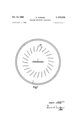
- FIG. 1 is a cross sectional view of the cold screen according to the invention.
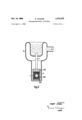
- FIG, 2 is a diametrical sectional view of the same screen.
- FIG. 1 shows the heat source formed by the wall 7 of the space whose pressure has to be measured and the movable graphite disc 1, which is kept floating by magnetic levitation, as is explained in the main application.
- This disc is rotatable about the vertical axis at right angles to the plane of the drawing.
- the figure furthermore shows the plates 400 having a thickness of 0.1 mm., a width of 1.5 mm. and a length (FIG. 2) of 8 mm.
- These plates are made of molybdenum, which material is chosen for the following reasons: it is not magnetic and will 4 therefore not deform the field of levitation; it is a good thermal conductor which allows cooling of the plates forming the screen by one end or by both ends. Also mechanically this metal is quite appropriate.
- FIG. 2 shows the upper supporting member 402 of copper, in which the plates 400 are fastened.
- This supporting member is thick and is integral with a copper rod 8, through which it is in connection with liquid nitrogen in the Dewar vessel 9, T husnot only the supporting member 402 which interconnects the plates 400 on the lower side.
- a pressure measuring instrument including a cold screen for use in a. thermomolecular measuring member, comprising a hot surface beyond said screen and a rota able element inside said screen, said cold screen having apertures orientated so that a thermomolecular effect due to gas molecules from the hot surface passing through the screen exerts a moment in a given direction on said rotatable element, said screen being formed by thin plates having surface portions extending parallel to the rotary axis of said element, said plates being made of a material which reflects the infrared radiation and does not reflect the gas molecules.
Landscapes
- Physics & Mathematics (AREA)
- General Physics & Mathematics (AREA)
- Photometry And Measurement Of Optical Pulse Characteristics (AREA)
- Radiation Pyrometers (AREA)
- Investigating Or Analyzing Materials Using Thermal Means (AREA)
- Measuring Fluid Pressure (AREA)
Applications Claiming Priority (1)
| Application Number | Priority Date | Filing Date | Title |
|---|---|---|---|
| FR102289A FR92131E (fr) | 1967-04-11 | 1967-04-11 | Perfectionnements aux dispositifs de mesure de pression |
Publications (1)
| Publication Number | Publication Date |
|---|---|
| US3472078A true US3472078A (en) | 1969-10-14 |
Family
ID=8628605
Family Applications (1)
| Application Number | Title | Priority Date | Filing Date |
|---|---|---|---|
| US718713A Expired - Lifetime US3472078A (en) | 1967-04-11 | 1968-04-04 | Pressure measuring instrument |
Country Status (3)
| Country | Link |
|---|---|
| US (1) | US3472078A (fr) |
| FR (1) | FR92131E (fr) |
| GB (1) | GB1230793A (fr) |
Citations (1)
| Publication number | Priority date | Publication date | Assignee | Title |
|---|---|---|---|---|
| US3357254A (en) * | 1964-04-09 | 1967-12-12 | Lab D Electronique Et De Physi | Pressure measuring device |
-
1967
- 1967-04-11 FR FR102289A patent/FR92131E/fr not_active Expired
-
1968
- 1968-04-04 US US718713A patent/US3472078A/en not_active Expired - Lifetime
- 1968-04-08 GB GB1230793D patent/GB1230793A/en not_active Expired
Patent Citations (1)
| Publication number | Priority date | Publication date | Assignee | Title |
|---|---|---|---|---|
| US3357254A (en) * | 1964-04-09 | 1967-12-12 | Lab D Electronique Et De Physi | Pressure measuring device |
Also Published As
| Publication number | Publication date |
|---|---|
| FR92131E (fr) | 1968-09-27 |
| GB1230793A (fr) | 1971-05-05 |
Similar Documents
| Publication | Publication Date | Title |
|---|---|---|
| CN109900420B (zh) | 一种小型化冷原子真空压力传感系统 | |
| Estermann | Molecular beam technique | |
| US3963327A (en) | Device for operating frusto-conical optical concentrators | |
| US3472078A (en) | Pressure measuring instrument | |
| Penning | High vacuum gauges | |
| CN113272621A (zh) | 用于确定物体的厚度的装置 | |
| US3582190A (en) | High power mirror | |
| US2883555A (en) | Thickness measuring apparatus with compensation for atmospheric conditions | |
| US3307448A (en) | Output energy indicating optical maser | |
| US2393196A (en) | Thermoelectric device | |
| US3521056A (en) | Adjustable specimen stage for electron beam apparatus employing adjusting levers arranged to minimize beam defocussing resulting from thermal expansion of stage components | |
| Gulyaev | Schlieren photography of thermal pulses in liquid He 4 | |
| US3537796A (en) | Temperature compensated spectrometer | |
| US2690463A (en) | Thermoelectric power cell | |
| Black et al. | The performance of a double-guarded cold-plate thermal conductivity apparatus | |
| US1980213A (en) | Radiation differential thermometer | |
| US664764A (en) | Pyrometer. | |
| US1969558A (en) | Electrooptical device | |
| Walker et al. | The Northwestern University 50 cm liquid helium bubble chamber | |
| JP3236891B2 (ja) | 太陽熱収集装置及びその制御システム | |
| Anderson | SLAC high power hydrogen target | |
| JPH04347096A (ja) | 石英チューブの気密シール構造及び気密シール方法 | |
| SU476460A1 (ru) | Высокотемпературный дилатометрический датчик | |
| US3357254A (en) | Pressure measuring device | |
| US2017084A (en) | Vacuum thermocouple |