US3645934A - Ozone resistant blends of natural rubber/polychloroprene/epdm copolymer and a process for the preparation thereof - Google Patents
Ozone resistant blends of natural rubber/polychloroprene/epdm copolymer and a process for the preparation thereof Download PDFInfo
- Publication number
- US3645934A US3645934A US62595A US3645934DA US3645934A US 3645934 A US3645934 A US 3645934A US 62595 A US62595 A US 62595A US 3645934D A US3645934D A US 3645934DA US 3645934 A US3645934 A US 3645934A
- Authority
- US
- United States
- Prior art keywords
- rubbers
- parts based
- epdm
- natural rubber
- total weight
- Prior art date
- Legal status (The legal status is an assumption and is not a legal conclusion. Google has not performed a legal analysis and makes no representation as to the accuracy of the status listed.)
- Expired - Lifetime
Links
Images
Classifications
-
- C—CHEMISTRY; METALLURGY
- C08—ORGANIC MACROMOLECULAR COMPOUNDS; THEIR PREPARATION OR CHEMICAL WORKING-UP; COMPOSITIONS BASED THEREON
- C08L—COMPOSITIONS OF MACROMOLECULAR COMPOUNDS
- C08L7/00—Compositions of natural rubber
-
- C—CHEMISTRY; METALLURGY
- C08—ORGANIC MACROMOLECULAR COMPOUNDS; THEIR PREPARATION OR CHEMICAL WORKING-UP; COMPOSITIONS BASED THEREON
- C08L—COMPOSITIONS OF MACROMOLECULAR COMPOUNDS
- C08L11/00—Compositions of homopolymers or copolymers of chloroprene
-
- C—CHEMISTRY; METALLURGY
- C08—ORGANIC MACROMOLECULAR COMPOUNDS; THEIR PREPARATION OR CHEMICAL WORKING-UP; COMPOSITIONS BASED THEREON
- C08L—COMPOSITIONS OF MACROMOLECULAR COMPOUNDS
- C08L23/00—Compositions of homopolymers or copolymers of unsaturated aliphatic hydrocarbons having only one carbon-to-carbon double bond; Compositions of derivatives of such polymers
- C08L23/02—Compositions of homopolymers or copolymers of unsaturated aliphatic hydrocarbons having only one carbon-to-carbon double bond; Compositions of derivatives of such polymers not modified by chemical after-treatment
- C08L23/16—Ethylene-propylene or ethylene-propylene-diene copolymers
-
- C—CHEMISTRY; METALLURGY
- C08—ORGANIC MACROMOLECULAR COMPOUNDS; THEIR PREPARATION OR CHEMICAL WORKING-UP; COMPOSITIONS BASED THEREON
- C08L—COMPOSITIONS OF MACROMOLECULAR COMPOUNDS
- C08L2312/00—Crosslinking
Definitions
- the process consists essentially of preparing a premix by mixing about 15-30 parts based on the total weight of rubbers of a random, linear elastomeric ethylene/propylene/open-chain non-conjugated diene copolymer having a Mooney viscosity (ML-1+4/ 121 C.) of about 35-75 with about -35 parts based on the total weight of rubbers mercaptan-modified sol of a polymer of chloroprene having a Mooney viscosity (ML-1'+2.5/ 100 C.) of about 50, and about 60 parts based on the total weight of rubbers of a reinforcing carbon black having an EM surface area of at least about square meters per gram, and mixing the premix with about -60 parts based on the weight of total rubbers of natural rubber.
- This invention relates to vulcanizable chain-saturated elastomeric a-olefin copolymers. More particularly this invention relates to improving the ozone resistance of mixtures of natural rubber with certain vulcanizable, chain-saturated, elastomeric tl-olefill copolymers and a polychloroprene by controlling the order of mixing of the components.
- the amorphous copolymers of ethylene with higher alpha-monoolefins constitute an important class because of their desirable elastomeric character and their generally good resistance to ozone and other chemicals.
- the chemical inertness of these polymers is attributed to the fact that the linear chain or backbone is a completely saturated structure without the reactive double bonds of the common elastomeric materials such as natural rubber or the synthetic elastomers made from conjugated diolefins.
- non-conjugated aliphatic diolefins such as 1,4-hexadiene and 6-rnethyl-1,5-heptadione as the third monomer in hydrocarbon elastomers of this sort is taught, for instance, in U.S. Pat. 2,933,480, and the use of bridged ring diolefins having double bonds of unequal reactivity is similarly taught in U.S. Pat. 3,211,709.
- These tripolymers are generally referred to as EPDM copolymers.
- Tire sidewalls are subject to relatively rapid deterioration and failure when formulated using blends of natural ice rubber and the substantially straight-chain EPDM copolymers.
- Ternary blends of natural rubber, polychloroprene and substantially linear EPDM copolymers are known in the art. However neither has the ozone resistance of these blends wherein the EPDM is made from open-chain dienes proved entirely satisfactory for use of these blends in tire sidewall formulations.
- a process for preparing a vulcanizable ozone resistant composition consisting essentially of natural rubber, carbon black, chloroprene, and an EPDM copolymer which consists essentially of preparing a premix by mixing about 15-30 parts based on the total weight of rubbers of a random, linear, elastomeric ethylene/propylene/open-chain nonconjugated diene copolymer having a Mooney viscosity (ML1+4/12l C.) of about 35-75 with about 20-35 parts based on the total weight of rubbers of a mercaptanmodified sol polymer of chloroprene having a Mooney viscosity (ML-1+2.5/ C.) of about 50, and about 2560 parts based on the total weight of rubbers of a reinforcing carbon black having an EM surface area of at least about 40 square meters per gram, and mixing the premix with about 50-60 parts based on the weight
- the term consisting essentially of has its generally accepted meaning as requiring that specified components be present but not excluding unspecified ingredients which do not materially detract from the basic and novel characteristics of the composition as disclosed.
- EPDM copolymers used in practicing this invention are well known in the art. They are conveniently prepared by reacting ethylene, propylene, and an openchain non-conjugated diene in the presence of a coordination catalyst system.
- catalyst systems for making elastomeric copolyolefins are those based on hydrocarbon soluble compounds of vanadium such as vanadium oxytrichloride, vanadium tetrachloride, vanadium tris-(acetylacetonate), etc., used in conjunction with organoaluminum compounds such as aluminum alkyls (e.g., triisobutyl aluminum), and alkyl aluminum chlorides or bromides (e.g., diisobutyl aluminum chloride), and so on.
- organoaluminum compounds such as aluminum alkyls (e.g., triisobutyl aluminum), and alkyl aluminum chlorides or bromides (e.g., diisobutyl aluminum chloride), and so on.
- Halogen should be present on at least one of the catalyst components. Many variations and refinements of these catalyst systems are now well known in the art.
- solvents can be employed with the catalyst. Among the most useful are tetrachloroethylene, and aliphatic hydrocarbons such as hexane. Other solvents will be apparent to those skilled in the art.
- Double bonds that are found not to be readily polymerizable are generally the internal, i.e., nonterminal double bonds of aliphatic olefins, sterically hindered double bonds of aliphatic olefins such as those carrying a methyl group or other substitutent on one of the doubly bonded carbon atoms, and double bonds in relatively unstrained cycloaliphatic rings.
- Typical non-conjugated diolefins containing only one polymerizable double bond that are suitable in EPDM copolymers useful in this invention are 1,4-hexadiene, 2-methyl-1,5-hexadiene, 1,9- octadecadiene, 6-methyl-1,5 heptadiene, 7-methyl-l,6- octadiene, 11-ethyl-1,1l-tridecadiene, and the like.
- the use of such compounds to provide pendant sulfur-reactive unsaturated structures on an amorphous polyolefin is well known in the art.
- the EPDM copolymers useful in this invention are the random, linear, elastomeric ethylene/propylene/ open-chain non-conjugated diene copolymers. No particular advantage in controlling the order of mixing has been found using EPDM copolymers containing a cycloaliphatic compound.
- Useful EPDM copolymers have a Mooney viscosity (ML-1+4/ 121 C.) of about 35-75. The preferred viscosity is about 50-70. Mooney viscosity is measured at 121 C. in accordance with ASTM Method D-1646-67 using the large rotor. After the sample has been warmed in the machine for one minute, the shearing disc viscometer motor is started.
- a particularly preferred EPDM copolymer is ethylene/ propylene/ 1,4-hexadiene.
- parts based on the total weight of rubbers means parts by weight divided by the sum of the parts by weight of the natural rubber, the open-chain non-conjugated diene, and the mercaptanmodified sol of a polymer of chloroprene in the vulcanizable ozone resistant composition.
- the premix also contains about 20-35 parts based on the total weight of rubbers mercaptan-modified sol of a polymer of chloroprene.
- Chloroprene, 2-chloro-1,3butadiene is well known in the art.
- the mercaptan-modified sol polymer of chloroprene and the method of preparation are also known in the art. See, for example, US. Pat. 2,914,497 (Example 1) and U.S. Pat. 2,494,087 (Example 6).
- the mercaptan modified polychloroprene useful in this invention has a Mooney viscosity (ML- 1+2.5/ 100 C.) of about 50. Mooney viscosity is measured in accordance with ASTM Method D-1646- 67.
- the preferred amount of the mercaptan-modified sol polymer of chloroprene is about 28-32 parts based on the total weight of rubbers.
- the premix also contains about -60 parts based on the total weight of rubbers of a reinforcing carbon black having an EM surface area of at least about square meters per gram.
- EM surface area refers to the surface area as measured using an electron microscope.
- the preferred amount of reinforcing carbon black is about 25- parts by weight.
- Particularly preferred blacks are FEF and HAF carbon black (types N-550 and N-330, respectively, according to ASTM Standard D-1765-68).
- SAF type N-llO
- SCF type N-195
- ISAF- LS type N-219
- ISAF-HM type N-220
- lSAF-LM type N-231
- ISAF-HS type N-242
- CF types N- 293 and N-296
- SCF type N-294
- EPC type S- 300
- MPC type 8-301
- HAP-LS types N'326 and N-327
- HAP-HS type N-347
- SPF type N-358
- FF type N-440
- FEF-LS type N-539
- FEF-HS type N-568
- HMF type N-601
- GPF ype N-660 GPF ype N-660
- APF type ,N-683
- Carbon blacks are, further de: scribed in U.S. Pat. 3,364,156; Reinforcement of Elas tomers, ed. by G. Kraus, Interscience Publishers, N.Y., 1965, Chapters 6', l0, and 12; and Introduction to Rubber Technology, ed. by M. Morton, Reinhold Publishing Corporation, N.Y., 1959, Chapter 8.- Y
- the EPDM copolymer, polychloroprene, and reinforcing carbon black are blended to form a premix. Blending can be accomplished using rubber processing equipment familiar in the art. For example, roll mills and internal mixers (such as Banbury mixers) are typical devices which can be conveniently used to prepare the premix. Mixer, loading, operating time and speeds, etc. will be obvious to those skilled in the art.
- elastomeric composition prepared by the process of this invention possesses ozone resistance superior to that of similar compositions not prepared in accordance with the mixing order herein prescribed.
- composition of this invention can be cured by a variety of curing systems.
- the most important of these curing systems are the sulfur curing system and peroxide curing system.
- EXAMPLE Ozone resistant elastomeric composition of natural rubber/ polychloroprene/ carbon black/EPDM hydrocarbon rubber
- the ingredients of the recipe given below are mixed according to the procedures described below. Ingredients are mixed in a Midget Banbury Mixer," Farrel Corp, having a 250-m1. void. The mixer is operated at 142 rpm. All mixes are started at F. (32 C.) and dumped between 175 and 200 F. (79 C. and 93 C.). Total mixing time is 12 minutes in each case.
- the polychloroprene has a Mooney viscosity (ML-1+2.5/100 C.)
- the EPDM copolymer is a rubber-like hydrocarbon copolymer having a Mooney viscosity (ML-1 +4/ 121 C.) of about 70, an inherent viscosity of about 3.7 measured at 30 C. on a solution of 0.1 gram of copolymer in ml. of tetrachloroethylene), and the following monomer unit concentration (by weight): ethylene, 52.4%; propylene, 44% total 1,4-hexadiene, 3.6%; the ethylenic group content amounts to about 0.33 gram-mol/ kg.
- the ethylenic group content is determined by corrected bromine absorption as described under 1,4-hexadiene content in US. Pat. 3,467,633.
- Mooney viscosity is measured in accordance with ASTM Method D-l646- 63.
- the naphthenic processing oil ASTM D-2226 Type 103, has a specific gravity at 60 F. (15.6 C.) of 0.92, a SUS viscosity by ASTM Test D-88 (100 F./210 F.) (37.8 C./98.9 C.) of 156/41, and 42.9% total aromatics. It is available from Sun Oil Company under the trademark Circo light rubber processing oil. The use of zinc oxide and processing oil is optional.
- the furnace black has an EM surface area of about 80 square meters per gram and a DBF absorption (dibutyl phthalate absorption number by ASTM Test D-24l4- 6ST) of about 127 cc./100 grams.
- the elastomeric compositions are prepared as follows. In each case, a premix is prepared followed by the addition of the balance of the recipe and further mixing.
- Sample No. 9 is an elastomeric composition prepared in accordance with the process of this invention. The remainder of the samples are for comparison.
- each sample is formed into slabs 1" x 5" by 75 mils (2.54 x 12.7 x 0.14 cm.) thick and press-cured between polyester (Mylar) sheets for minutes at 320 F. (160 C.). The samples are taken out of the press and the polyester sheets removed. Standard dumbbells (die C, ASTM-D-412) are cut from the 1" x 5" (2.54 x 12.7 cm.) slabs and allowed to stand at room temperature for at least 24 hours before testing.
- the dumbbells prepared as described above are exposed to ozone at a concentration of 50 p.p.h.m. and a temperature of 40 C. in a Mast test chamber (Model 700-1 manufactured by Mast Development Co., Davenport, Iowa).
- the dumbbells are tested dynamically in the Dynamat attachment. This is a device in which the dumbbells are clamped at either end, then alternately stretched to an elongation of about and returned to an unstressed condition at about cycles per minute.
- Results The appearance of the samples at the end of 24 hours is recorded below.
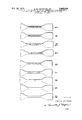
- the number ratings refer to the ozone resistance standards appearing in the figure.
- a process for preparing a vulcanizable ozone resistant composition consisting essentially of natural rubber, carbon black, polychloroprene, and an EPDM copolymer which consists essentially of preparing a premix by mixing about 15-30 parts based on the total weight of rubbers of a random, linear, elastomeric ethylene/propylene/openchain non-conjugated diene copolymer having a Mooney viscosity (ML-1+4/121" C.) of about -75 with about 20-35 parts based on the total weight of rubbers of a mercaptan-modified sol polymer of chloroprene having a Mooney viscosity (ML-1+2.5/100 C.) of about 50, and about 25-60 parts based on the total weight of rubbers of a reinforcing carbon black having an EM surface area of at least about square meters per gram, and mixing the premix with about -60 parts based on the weight of total rubbers of natural rubber.
- EPDM copolymer is about 18-22 parts based on the weight of total rubbers of ethylene/propylene/1,4-hexadiene having a Mooney viscosity (ML-1+4/ 121 C.) of about 40-70.
Landscapes
- Chemical & Material Sciences (AREA)
- Health & Medical Sciences (AREA)
- Chemical Kinetics & Catalysis (AREA)
- Medicinal Chemistry (AREA)
- Polymers & Plastics (AREA)
- Organic Chemistry (AREA)
- Compositions Of Macromolecular Compounds (AREA)
Applications Claiming Priority (1)
| Application Number | Priority Date | Filing Date | Title |
|---|---|---|---|
| US6259570A | 1970-08-10 | 1970-08-10 |
Publications (1)
| Publication Number | Publication Date |
|---|---|
| US3645934A true US3645934A (en) | 1972-02-29 |
Family
ID=22043517
Family Applications (1)
| Application Number | Title | Priority Date | Filing Date |
|---|---|---|---|
| US62595A Expired - Lifetime US3645934A (en) | 1970-08-10 | 1970-08-10 | Ozone resistant blends of natural rubber/polychloroprene/epdm copolymer and a process for the preparation thereof |
Country Status (6)
| Country | Link |
|---|---|
| US (1) | US3645934A (de) |
| CA (1) | CA959187A (de) |
| DE (1) | DE2139888C3 (de) |
| FR (1) | FR2102146B1 (de) |
| GB (1) | GB1346202A (de) |
| ZA (1) | ZA714665B (de) |
Cited By (5)
| Publication number | Priority date | Publication date | Assignee | Title |
|---|---|---|---|---|
| US4267079A (en) * | 1979-11-13 | 1981-05-12 | The Firestone Tire & Rubber Company | Cured rubber skim compositions exhibiting better humidity aged metal adhesion and metal adhesion retention |
| US4388484A (en) * | 1981-10-02 | 1983-06-14 | York Gerald O | Oil field mats |
| US4480066A (en) * | 1983-08-18 | 1984-10-30 | The Firestone Tire & Rubber Company | Rubber compositions and articles thereof having improved metal adhesion and metal adhesion retention |
| US5281651A (en) * | 1992-01-29 | 1994-01-25 | Exxon Chemical Patents Inc. | Compatibilization of dissimilar elastomer blends using ethylene/acrylate/acrylic acid terpolymers |
| US5409987A (en) * | 1994-02-03 | 1995-04-25 | Bridgestone/Firestone, Inc. | Polychloroprene and polymonoolefin rubber adhesive composition |
Families Citing this family (2)
| Publication number | Priority date | Publication date | Assignee | Title |
|---|---|---|---|---|
| GB8904475D0 (en) * | 1989-02-28 | 1989-04-12 | Pipe & Sewer Renovations Limit | Rubber compositions |
| US9096741B1 (en) * | 2011-04-12 | 2015-08-04 | Firestone Industrial Products Company, Llc | Air springs with improved high temperature performance |
-
1970
- 1970-08-10 US US62595A patent/US3645934A/en not_active Expired - Lifetime
-
1971
- 1971-07-06 CA CA117,557A patent/CA959187A/en not_active Expired
- 1971-07-15 ZA ZA714665A patent/ZA714665B/xx unknown
- 1971-08-05 FR FR717128756A patent/FR2102146B1/fr not_active Expired
- 1971-08-09 DE DE2139888A patent/DE2139888C3/de not_active Expired
- 1971-08-10 GB GB3754271A patent/GB1346202A/en not_active Expired
Cited By (5)
| Publication number | Priority date | Publication date | Assignee | Title |
|---|---|---|---|---|
| US4267079A (en) * | 1979-11-13 | 1981-05-12 | The Firestone Tire & Rubber Company | Cured rubber skim compositions exhibiting better humidity aged metal adhesion and metal adhesion retention |
| US4388484A (en) * | 1981-10-02 | 1983-06-14 | York Gerald O | Oil field mats |
| US4480066A (en) * | 1983-08-18 | 1984-10-30 | The Firestone Tire & Rubber Company | Rubber compositions and articles thereof having improved metal adhesion and metal adhesion retention |
| US5281651A (en) * | 1992-01-29 | 1994-01-25 | Exxon Chemical Patents Inc. | Compatibilization of dissimilar elastomer blends using ethylene/acrylate/acrylic acid terpolymers |
| US5409987A (en) * | 1994-02-03 | 1995-04-25 | Bridgestone/Firestone, Inc. | Polychloroprene and polymonoolefin rubber adhesive composition |
Also Published As
| Publication number | Publication date |
|---|---|
| FR2102146B1 (de) | 1973-06-29 |
| CA959187A (en) | 1974-12-10 |
| DE2139888C3 (de) | 1979-01-11 |
| ZA714665B (en) | 1972-04-26 |
| DE2139888B2 (de) | 1978-05-18 |
| FR2102146A1 (de) | 1972-04-07 |
| GB1346202A (en) | 1974-02-06 |
| DE2139888A1 (de) | 1972-02-17 |
Similar Documents
| Publication | Publication Date | Title |
|---|---|---|
| US2933480A (en) | Sulfur vulcanizable unsaturated elastomeric interpolymers of monoolefins and diolefins | |
| US3646169A (en) | Sulfur vulcanizable elastomeric blends comprising diolefin rubber and epdm terpolymers | |
| EP0628065B1 (de) | KOMPATIBILISIERUNG VON MISCHUNGEN AUS UNTERSCHIEDLICHEN ELASTOMEREN UNTER VERWENDUNG VON ETHENACRYLAT-ACRYLSäURE TERPOLYMEREN | |
| US4468496A (en) | Polybutadiene rubber compositions | |
| EP0381611A1 (de) | Steife Kautschukmischungen und Artikel, die Komponenten davon enthalten | |
| US3816358A (en) | Vulcanizable rubber mixtures | |
| JPH0699596B2 (ja) | 向上した引裂強さを有する天然ゴム含有組成物 | |
| US2332194A (en) | Rubberlike composition and process for making the same | |
| US2619481A (en) | Curing rubbery olefinic copolymers | |
| US3645934A (en) | Ozone resistant blends of natural rubber/polychloroprene/epdm copolymer and a process for the preparation thereof | |
| US2822342A (en) | Heat processing of butyl rubber with carbon black and a promoter and product obtained | |
| US3712360A (en) | Production of composite vehicle tires by covulcanization of layers of olefin terpolymers and natural rubber | |
| CA1123996A (en) | Curable vinyl chloride resin composition | |
| US2557642A (en) | Synthetic rubber compound | |
| US3331793A (en) | Abrasion resistant vulcanizates comprising epd rubber, carbon black, and minor amounts of natural rubber or sbr | |
| US2975159A (en) | Rubber-like interpolymers of ethylene and two other monoolefins | |
| US3919130A (en) | Tire tread compositions of improved wet skid resistance | |
| EP3613776A1 (de) | Verfahren zur herstellung von multicopolymer, multicopolymer, kautschukzusammensetzung und reifen | |
| US3891725A (en) | Vulcanizable chlorinated elastomer composition | |
| US3627856A (en) | Rubber compositions containing a polyhydroxy diene polymer | |
| US3821152A (en) | Heat resistant vulcanizable blend of butadiene/styrene rubbers and ethylene propylene-diene terpolymers | |
| US3567653A (en) | Copoymer catalyst system and product | |
| US3320204A (en) | Method of preparing a vulcanized synthetic rubber | |
| US3607829A (en) | Sulfur-curable elastomer having improved building tack | |
| US3652729A (en) | Branched-chain hydrocarbon elastomers |