US3665293A - Phase-controlled static switch for a power circuit having a variable power factor - Google Patents
Phase-controlled static switch for a power circuit having a variable power factor Download PDFInfo
- Publication number
- US3665293A US3665293A US120509A US3665293DA US3665293A US 3665293 A US3665293 A US 3665293A US 120509 A US120509 A US 120509A US 3665293D A US3665293D A US 3665293DA US 3665293 A US3665293 A US 3665293A
- Authority
- US
- United States
- Prior art keywords
- gating
- signal
- thyristors
- control signal
- thyristor
- Prior art date
- Legal status (The legal status is an assumption and is not a legal conclusion. Google has not performed a legal analysis and makes no representation as to the accuracy of the status listed.)
- Expired - Lifetime
Links
- 230000003068 static effect Effects 0.000 title claims abstract description 28
- 230000008859 change Effects 0.000 claims abstract description 22
- 230000001419 dependent effect Effects 0.000 claims description 17
- 238000010304 firing Methods 0.000 claims description 12
- 241000269627 Amphiuma means Species 0.000 claims description 10
- 230000004044 response Effects 0.000 claims description 6
- 230000009471 action Effects 0.000 abstract description 3
- 230000001939 inductive effect Effects 0.000 description 17
- 230000001965 increasing effect Effects 0.000 description 13
- 238000004904 shortening Methods 0.000 description 5
- 230000000694 effects Effects 0.000 description 4
- 230000001960 triggered effect Effects 0.000 description 3
- XUIMIQQOPSSXEZ-UHFFFAOYSA-N Silicon Chemical compound [Si] XUIMIQQOPSSXEZ-UHFFFAOYSA-N 0.000 description 2
- 230000000903 blocking effect Effects 0.000 description 2
- 238000013461 design Methods 0.000 description 2
- 238000012986 modification Methods 0.000 description 2
- 230000004048 modification Effects 0.000 description 2
- 238000013021 overheating Methods 0.000 description 2
- 230000000979 retarding effect Effects 0.000 description 2
- 229910052710 silicon Inorganic materials 0.000 description 2
- 239000010703 silicon Substances 0.000 description 2
- 238000013459 approach Methods 0.000 description 1
- 239000000470 constituent Substances 0.000 description 1
- 238000011161 development Methods 0.000 description 1
- 238000010586 diagram Methods 0.000 description 1
- 230000006698 induction Effects 0.000 description 1
- 238000000034 method Methods 0.000 description 1
- 230000008569 process Effects 0.000 description 1
- 108090000623 proteins and genes Proteins 0.000 description 1
Images


Classifications
-
- G—PHYSICS
- G05—CONTROLLING; REGULATING
- G05F—SYSTEMS FOR REGULATING ELECTRIC OR MAGNETIC VARIABLES
- G05F1/00—Automatic systems in which deviations of an electric quantity from one or more predetermined values are detected at the output of the system and fed back to a device within the system to restore the detected quantity to its predetermined value or values, i.e. retroactive systems
- G05F1/10—Regulating voltage or current
- G05F1/12—Regulating voltage or current wherein the variable actually regulated by the final control device is AC
- G05F1/40—Regulating voltage or current wherein the variable actually regulated by the final control device is AC using discharge tubes or semiconductor devices as final control devices
- G05F1/44—Regulating voltage or current wherein the variable actually regulated by the final control device is AC using discharge tubes or semiconductor devices as final control devices semiconductor devices only
- G05F1/45—Regulating voltage or current wherein the variable actually regulated by the final control device is AC using discharge tubes or semiconductor devices as final control devices semiconductor devices only being controlled rectifiers in series with the load
- G05F1/455—Regulating voltage or current wherein the variable actually regulated by the final control device is AC using discharge tubes or semiconductor devices as final control devices semiconductor devices only being controlled rectifiers in series with the load with phase control
-
- G—PHYSICS
- G05—CONTROLLING; REGULATING
- G05F—SYSTEMS FOR REGULATING ELECTRIC OR MAGNETIC VARIABLES
- G05F1/00—Automatic systems in which deviations of an electric quantity from one or more predetermined values are detected at the output of the system and fed back to a device within the system to restore the detected quantity to its predetermined value or values, i.e. retroactive systems
- G05F1/10—Regulating voltage or current
- G05F1/12—Regulating voltage or current wherein the variable actually regulated by the final control device is AC
- G05F1/40—Regulating voltage or current wherein the variable actually regulated by the final control device is AC using discharge tubes or semiconductor devices as final control devices
- G05F1/44—Regulating voltage or current wherein the variable actually regulated by the final control device is AC using discharge tubes or semiconductor devices as final control devices semiconductor devices only
- G05F1/445—Regulating voltage or current wherein the variable actually regulated by the final control device is AC using discharge tubes or semiconductor devices as final control devices semiconductor devices only being transistors in series with the load
-
- H—ELECTRICITY
- H02—GENERATION; CONVERSION OR DISTRIBUTION OF ELECTRIC POWER
- H02M—APPARATUS FOR CONVERSION BETWEEN AC AND AC, BETWEEN AC AND DC, OR BETWEEN DC AND DC, AND FOR USE WITH MAINS OR SIMILAR POWER SUPPLY SYSTEMS; CONVERSION OF DC OR AC INPUT POWER INTO SURGE OUTPUT POWER; CONTROL OR REGULATION THEREOF
- H02M1/00—Details of apparatus for conversion
- H02M1/08—Circuits specially adapted for the generation of control voltages for semiconductor devices incorporated in static converters
- H02M1/081—Circuits specially adapted for the generation of control voltages for semiconductor devices incorporated in static converters wherein the phase of the control voltage is adjustable with reference to the AC source
Definitions
- ABSTRACT A gating control for an ac phase-controlled, single-phase static switch comprising a pair of thyristors connected in inverse parallel relationship in a power circuit that has a variable power factor.
- the gating control controls the length of the non-conducting period between successive conduction periods of the switch in such a manner that the length of the non-conducting period is made approximately inversely proportional to an input control signal for the gating control, when the input control signal is between and l per unit.
- a conduction-angle balancing circuit modifies the action of the gating control in such a manner that the conduction angles are forced toward a condition of equality despite a change therein produced by a change in the effective input control signal and despite the power circuits having a low power factor.
- This invention relates to an a-c static switch comprising a pair of thyristors connected in inverse parallel relationship in a power circuit and, more particularly, relates to gating control means for controlling the phase angle of the a-c wave at which each thyristor is triggered into conduction.
- This phase angle as measured from the start of forward voltage of the source of the power circuit, is referred to hereinafter as the gating angle.
- a static switch is open when all of its constituent thyristors are turned off, and it is closed when the thyristors are turned on and conducting.
- the inversely poled thyristors conduct alternately, and they are cyclically triggered into conduction in synchronism with the source voltage.
- the moment of triggering is conveniently expressed as an electricalangle referenced to zero crossings of the source voltage, which angle is referred to hereinafter as the gating angle.
- the time during which the thyristor conducts following triggering is referred to hereinafter as the conduction angle.
- Source voltage is applied to the load in the power circuit only during the conducting intervals of the switch, and therefore the average or mean value of load voltage will depend on when the thyristors are triggered and how long they conduct each cycle.
- the load voltage is varied between maximum and zero by appropriately varying (retarding or advancing) the gating angle.
- an input signal is supplied to the gating control of the switch, and the gating control responds to this input signal by adjusting the conduction angle of the switch to a value dependent upon the magnitude of theinput signal.
- a conduction angle of substantially 180 i.e., a fully-on condition
- a substantially 0 conduction angle i.e., a fully-off condition
- a conduction angle approximately proportional to the input signal is desired.
- the conduction angle has a substantially fixed relationship with respect to the gating angle, and the gating angle can be made inversely proportional to the magnitude of the input signal to achieve the desired control of the conduction angle.
- the power factor can be widely different from unity and in some such circuits, the power factor can be widely variable. In these latter type circuits, it is not sufficient merely to make the gating angle inversely proportional to the input signal.
- An object of our invention is to provide a gating control which, despite wide variations in the power factor of the power circuit, is capable of maintaining an approximately proportional relationship between the conduction angle and the input signal for values of input signal varying between 0 and l per unit.
- Another object is to provide a gating control which, though capable of producing the approximately proportional relationship of the preceding paragraph, is effectively prevented from producing conduction angles exceeding l80 despite input signals greater than 1 per unit. This is an undesirable condition for a number of reasons, one of which is that the current flowing through the power circuit under such conditions will have an undesirable d-c component that can produce saturation and overheating effects.
- a difficulty is encountered. More specifically, a change in input signal tends to force the switch characteristics into an undesirable asymmetrical conducting condition in which the conduction periods for one thyristor are unequal to those of the oppositely conducting thyristor. Unless this tendency is counteracted, the more the input signal is changed, the more pronounced becomes the asymmetrical conducting condition.
- Another object of our invention is to provide a gating control, which though operating on the principle of making the nonconducting period approximately inversely proportional to the input signal, can function without causing the aforesaid asymmetrical conducting conditionto develop even in an inductive power circuit application.
- a gating control that measures the nonconducting period between successive conduction periods and develops an off-time indicating signal that is representative of the length of said nonconducting period.
- This indicating signal is compared with an effective input controlsignal, and from this comparison a gating control signal is derived which controls the length of the nonconducting period in such a manner as to make this nonconducting period approximately inversely proportional in length to the input control signal, when the input control signal is between 0 and l per unit.
- the gating control further includes a conduction-angle balancing circuit which develops a balance-indicating signal that has a magnitude proportional to the difference between the conduction angles of the two oppositely-conducting thyristors.
- Means sensitive to this balance-indicating signal modifies the gating control signal in such a manner that said conduction angles are forced toward a condition of equality despite a change therein produced by a change in the effective input control signal and despite the power circuits having a low power factor.
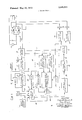
- FIG. 1 is a schematic diagram of a static switch with a gating control embodying one form of our invention.
- FIG. 2 is a graphic representation of certain electrical relationships that are present in the gating control of FIG. 1.
- FIG. 3 is a graphic representation of the gating angles that will produce stable operation of a static switch for different circuit power factors.
- FIG. 4 is another graphic representation of certain electrical relationships that are present in the gating control of FIG. 1, with particular emphasis on the conduction-angle balancing feature of the switch.
- an a-c power circuit 10 that comprises a source 12 of alternating voltage, a load 14, and a static switch 16.
- the load 14 and the static switch 16 are connected in series with each other across the terminals of source 12.
- the load is one which has a power factor that is subject to wide variations or changes while the power circuit is in operation.
- An example of such a load is an induction furnace, where the impedance and power factor vary widely as the charge within the furnace is melted. Under certain conditions, the efiective load may be almost entirely inductive.
- the illustrated static switch 16 comprises a pair of thyristors, in the fonn of conventional silicon controlled rectifiers (SCRs) 17a and 17b, connected in inverse parallel relationship in the power circuit.
- SCRs silicon controlled rectifiers
- Each thyristor has a nonconducting or blocking state in which it presents very high impedance to flow of current and a conducting or tumed-on state in which it freely conducts forward current with only a relatively slight voltage drop. It can be switched abruptly from the blocking state to the turned-on state by the concurrence of a forward bias on its main electrodes (anode 18 at a positive potential with respect to cathode 19) and a trigger signal on its gate 21.
- the time at which the thyristor is turned on measured in electrical degrees from the cyclically recurring instant at which the source voltage becomes positive is referred to as the gating angle.”
- a thyristor 17a or 17b will continue conducting until its "forward current is subsequently reduced below a given holding level by the action of the external circuit in which the thyristor is connected.
- This turn-off process is generally referred to as commutation.”
- the time during which the thyristor is turned on measured in electrical degrees from the instant of turn-on to the instant of commutation is referred to as the conduction angle.
- Control 20 For controlling the gating angle and hence the conduction angle of each thyristor 17a, 17b, we provide a gating control 20 which responds to a unidirectional input signal received via an input control channel 22 to produce gating of the thyristors at gating angles dependent upon the magnitude of the input signal.
- Control 20 comprises, firstof all, a voltage sensor 24 which senses the instantaneous voltage present across static switch 16 and produces an output at 25 whenever this voltage exceeds a predetermined threshold value. This threshold value is selected to be slightly higher than the maximum voltage drop across the thyristor when in its forward current conducting state.
- each thyristor'lla and 17b might be a commercially available silicon controlled rectifier having a maximum forward drop of 1.5 volts when conducting 100 amperes and less than 4 volts at 5,500 amperes peak surge current.
- 5 volts is selected as a practical threshold value at which the detecting means 24 operates to develop its output at 25. It is noted that this threshold value is about 1 percent of the r.m.s. source voltage and is attained by the source voltage v in less than 1 electrical degree as it rises from a natural voltage 0. If additional series-connected thyristors are present, this threshold value would be increased accordingly.
- the voltage sensor 24 may be of any suitable conventional design but is preferably of the design shown in more detail and claimed in application Ser. No. 836,765-Kelley et al., filed June 26, 1969, and assigned to the assignee of the present invention.
- the voltage sensor 24 is shown in FIG. 1 with input leads 23 connected across the switch 16.
- the voltage sensor includes a suitable isolating transformer (not shown in the present application) which electrically insulates the output components of the voltage sensor from its input components.
- the output from the voltage sensor 24 is supplied via channel 25 to a conventional function generator 27 which instantaneously responds to this output from the voltage sensor to develop a constant magnitude indicating signal on its output signal is received via channel 31.
- This second indicating signal referred to hereinafter as the off-time indicating signal," is shown at 38 in FIG. 2d, where it can be seen that it rises substantially linearly so long as the input signal 35 is received.
- the off-time indicating signal 38 is supplied via channel 36 to a summing circuit 40 that has four primary input channels 22, 36, 42 and 82 and an output channel 44.
- Input channel 22 is the channel through which the input control signal is supplied.
- Input channel 42 is a channel through which a bias signal, soon to be described, is supplied.
- Input channel 36 is the channel through which the off-time indicating signal 38 is supplied to the summing circuit.
- Input channel 82 is a channel through which a balance-indicating signal is supplied indicative of the difference in conduction angles of the two thyristors 17a and 17b.
- the summing circuit 40 is able to add together the signals supplied thereto via input channels 22, 42, 36 and 82, provided it is turned on and maintained turned on by an enabling signal (soon to be described) supplied via a permissive channel 46. Assuming such turn-on, the summing circuit 40 develops on channel 44 an output signal equal to the sum of these input signals at 22, 42, 36 and 82.
- the off-time indicating signal 38 and the input control signal at 22 are of positive polarity; and the bias signal at 42 is of a negative polarity.
- the sum of these signals is an output signal such as illustrated at 50 in FIG. 2e.
- This output signal 50 rises towards 0 from a negative base level 52 determined by the sum of the negative bias signal and the positive input control signal.
- FIG. 22 depicts this base level in dotted-line form. If there is no input control signal at 22, the output signal 50 will not cross 0 during a 1 rise of the indicating signal 38. But if there is a positive input control signal at 22, the base level 52 will be nearer to 0, and the output signal 50 will accordingly. cross the 0 line before the expiration of electricaldegrees.
- a 0+ crossing detector 54 For sensing the instant that the output signal 50 crosses the 0 line, a 0+ crossing detector 54 of conventional form is provided. This crossing detector responds to the 0 crossing by immediately developing an output on channel 56 upon such a O crossing. It is understood that a 0 crossing occurs when the input signal rises from a negative value or from O to a value slightly exceeding 0.
- the sum of the positive input control signal at 22 and the negative bias signal at 42 can be thought of as the effective input control signal for the gating control 20.
- This efi'ective input control signal has a magnitude represented by the dotted horizontal line 52 of FIG. 2e.
- Summing circuit 40 in effect, compares this effective input control signal with the offtime indicating signal received via channel 36. When this comparison shows the off-time indicating signal exceeding the effective input control signal, the 0-icrossing detector 54 responds by developing its output at 56.
- a pulse generator 58 receives the output at 56 from zero plus crossing detector 54 and immediately develops a pulse on channel 60 in response to receipt of this output.
- This pulse on channel 60 is supplied to an appropriate one of two pulse amlifiers 62 and 64, which immediately responds by supplying a gating pulse to the gate 21 of the appropriate thyristor 17a or 17b to initiate conduction of switch l6,via the gated thyristor.
- a pulse steerer 66 For determining which of the two pulse amplifiers will receive the pulse from pulse generator 58, a pulse steerer 66 is provided.
- This pulse steerer 66 is a conventional bistable switching circuit that in one condition supplies the pulse to amplifier 62 and in its other condition supplies the pulse to amplifier 64.
- the condition of the switching circuit 66 is determined by the polarity of a control signal received from voltage sensor 24 via a control channel 67. When this control signal is positive, indicating that the voltage across the thyristor 17a is in a forward direction with respect to this particular thyristor, the pulse steerer steers the pulse to the amplifier 62.
- the pulse steerer steers the pulse to the other amplifier 64.
- the first amplifier 62 upon receipt of a pulse, supplies an amplified-pulse triggering signal to thyristor 17a, thus turning on this thyristor.
- the other amplifier 64 upon receipt of a pulse, supplies an amplified-pulse triggering signal to thyristor 17b, thus turning on this thyristor.
- a reset circuit 70 For resetting the frequency attenuator 34 to a zero output condition, a reset circuit 70 is provided. So long as the frequency attenuator has an output, the reset circuit 70 tends to reset the frequency attenuator but is prevented from doing so by an inhibit signal received from the function generator 27 via channel 30. Reset circuit 70 is prevented from functioning so long as it receives this inhibit signal. When the output of function generator 27 terminates, as a result of no voltage being present across the switch 16, the inhibit channel ceases supplying the inhibit signal to reset circuit 70. The reset circuit responds to this condition by resetting the frequency attenuator to a output condition.
- Such resetting occurs at the end of each forward voltage period across a thyristor irrespective of whether or not gating of the forwardly biased thyristor has occurred during the period forward voltage has appeared thereacross.
- Such resetting is important in that it permits a fresh comparison to be made at the beginning of each forward voltage period of the effective input control signal and the offtime indicating signal, thus assuring a consistent response to a given input control signal.
- Permissive Device 47 for Controlling Summing Circuit 40 The summing circuit 40 is normally turned off, or disabled, and will turn on and continue turned on to perform its intended summing function only while it receives an enabling signal via a permissive channel 46 from a permissive device 47.
- Permissive device 47 is simply a switch that effectively closes when supplied with the output of function generator 27 via channel 32. So long as this permissive switch 47 is closed, an enabling signal is supplied therethrough via channel 46 to the summing circuit 40. Since the permissive device produces its enabling signal in response to an output from the function generator 27, the enabling signal is supplied only during and in coincidence with the nonconducting period of the static power switch 16.
- the permissive device 47 acts to assure that the summing circuit will have an output of 0. Thus, unless the permissive device is turned on, the zero plus crossing detector 54 is receiving zero input.
- the 0+ crossing detector 54 receive no positive input during conduction periods of static switch 16 because otherwise the detector 54 might be unprepared to initiate a new pulse-generating operation at the precise proper instant.
- the permissive device 47 was absent and that the summing circuit 40was receiving via channel 22 a continuous input signal greater than one per unit and that this input signal minus the bias at 42 was being supplied as a positive effective input signal to the 0+ crossing detector during the conduction period of the static switch 16.
- the static switch reached the end of its conduction period and the summing circuit 40 began receiving a new offtime indicating signal via channel 36, there would be no new 0 crossing under the assumed conditions (because the 0+ crossing detector would already be receiving an input signal greater than 0).
- the 0+ crossing detector 54 would remain ineffective so long as the input control signal at 22 was greater than one.
- the permissive device 47 positively prevents the 0+ crossing detector 54 from entering such an ineffective conduction because it assures that the input to crossing detector 54 will be returned to 0 during each conducting interval of static switch 16.
- the permissive device 47 is preventing the summing circuit 20 from developing its output at 44 while the static switch 16 is conducting, it will be apparent that equivalent performance could be obtained if the summing circuit 20 was always allowed to develop its output at 44, and the permissive device 47 was arranged to normally block the 0+ crossing detector 54 from effectively receiving this output until the end of a conducting period of the static switch 16.
- the non-conducting time is inversely proportional to the magnitude of the input control signal at 22. Accordingly, the conduction angle a is directly proportional to the magnitude of the input control signal at 22 (assuming that the input control signal is between 0 and l per unit).
- the output 50 from the summing circuit will jump from its normal 0 value to a positive value. This immediately turns on the 0+ crossing detector 54 to produce immediate gating of the appropriate thyristor 17a or 17b. Irrespective of how much the input control signal at 22 exceeds 1 per unit, the summing circuit 40 cannot develop an output on channel 44 for receipt by the 0+ crossing detector until turned on by the permissive device 47 at the start of the nonconduction period of switch 16.
- the 0+ crossing detector 54 will not initiate a gating operation for either thyristor 17a or 17b until the then-conducting thyristor has ceased conducting. If symmetrical current conditions are present, then this relationship of the immediately preceding sentence will prevent the input control signal from producing a conduction angle of greater than irrespective of how high the input control signal is.
- the relationship between gating angle and conduction angle varies widely as the power factor of the circuit varies.
- the curve A of FIG. 3 illustrates the gating angles a that will produce a fully-on condition of the switch for a given circuit power factor.
- a gating angle a of 180 will produce a fully-off condition, as indicated by the horizontal line B.
- the gating angle must fall between the two curves A and B in order to produce stable operation of the switch for a given circuit power factor. From this graph of FIG. 3, it can be observed that for purely resistive circuits (with a power factor of 1), stable operation can be obtained for gating angle variations of between and 180.
- a gating angle of 0 produces a fully-on condition
- a gating angle of 180 produces a fully-off condition.
- the gating angle limits are 90 for fully-on and 180 for fully-off.
- the gating angle limits are 90 for fully-on and 180 for fully-off.
- an object of our invention is to produce substantially the same conduction angle of the switch for a given input signal despite wide variations in the power factor of the power circuit.
- FIG 2 illustrates how an input signal of a given magnitude (e.g., 0.67 per unit of input) produces the same conduction angle for both a purely resistive circuit and a purely inductive circuit.
- the partially dotted-line sine wave of FIG. 2a shows the source voltage for a purely inductive circuit, where gating takes place at a gating angle a measured from passage through 0 of the source voltage. Up to the instanto'l2 the reverse thyristor is conducting, and no substantial voltage appears across the switch 16.
- the reverse thyristor ceases conducting, and forward voltage immediately appears across the switch.
- This causes the function generator 27 to develop an output 35 shown in FIG. 20 and the attenuator 34 to develop the output 38 shown in FIG. 2d.
- the summing circuit develops an output shown at 50 in FIG. 2e, producing a 0 crossing at a, which causes the pulse generator 58 to immediately trigger the forwardly biased thyristor into conduction.
- Conduction continues for a conduction angle of o- In a purely inductive circuit, the conduction period following voltage 0 will equal the conduction period prior to voltage 0, since energy is released from the circuit inductance at the same rate as stored therein in the absence of resistance.
- the switch 16 again becomes nonconducting, and the function generator 27 again turns on, causing another gating pulse to be developed after a non-conducting time interval equal in length to that required for the first gating operation.
- the sine wave of FIG. 211 represents the source voltage in a purely resistive power circuit. Gating is shown taking place at a gating angle a that results in a conduction angle 0' equal to the conduction angle 0' in FIG. 2a.
- the curves of FIGS. 2a and 2b are horizontally offset so that these equal conduction angles are vertically aligned.
- voltage across the switch does likewise, causing the function generator 27 to begin its output immediately following the 0 crossing of the source voltage. This results in the frequency attenuator 34 developing an output 38 of the same shape as it did with the purely inductive circuit.
- the same input signal as fed to the summing circuit 40 in the case of the inductive power circuit will result in the output 50 from the summing circuit crossing zero at the same time after the function generator starts its output as with the inductive circuit. Accordingly, for a given input signal at 22, the non-conducting period for the switch 16 will be the same for both the inductive and the resistive power circuits. It can be shown that if the time interval that the switch remains in its nonconducting state between conducting periods is held constant, then the conduction angle will also be held constant irrespective of the circuit power factor, assuming symmetrical current conditions where the thyristors 17a and 17b have equal conduction angles. Accordingly, by holding this nonconducting time interval constant for a given input signal, we obtain the same conduction angle for a given input signal, irrespective of the circuit power factor, again assuming symmetrical current conditions.
- This asymmetrical current condition is an undesirable one because it results in a d-c current component flowing through the power circuit, and such current component can produce objectionable saturation and overheating effects.
- One factor responsible for the development of this asymmetrical condition is that we have, in the above-described example, changed all our nonconducting periods by a fixed amount for a given change in input signal, and, in the purely inductive circuit, this has increased one conduction angle without changing the other.
- This conduction angle balancing circuit 80 develops a unidirectional balance-indicating signal that has a magnitude proportional to the difference between the conduction angles of the two thyristors.
- the balance-indicating signal is negative if forward thyristor 17a has the longer conduction angle and positive if the reverse thyristor 17b has the longer conduction angle.
- This balance-indicating signal is fed to summing circuit 40 via a channel 82 and is added to the input signals received via the other channels 22, 42, and 36 during the timing period preceding the firing of forward thyristor 17a. If the balance-indicating signal is positive, indicating that forward thyristor 17a has a shorter conduction angle than 17b, the balance indicating signal acts to advance the triggering of thyristor 17a thereby lengthening its conduction angle and causing a resultant shortening of the conduction angle of the other thyristor 17b, thus forcing theseconduction angles toward equality, all in a manner soon to be described in detail.
- the balance indicating signal acts to retard triggering of thyristor 17a, thereby shortening its con duction angle and lengthening the conduction angle of the other thyristor 17b to force these conduction angles toward equality.
- this circuit comprises two pulse generators 84 and 85.
- pulse generator 84 produces a constant amplitude pulse of negative polarity (shown at 86 in FIG. 4e) having a duration equal to the duration of the conducting interval of thyristor 17a.
- the other pulse generator 85 produces a constant amplitude pulse of positive polarity (shown at 87 in FIG. 4e) having a duration equal to the duration of the conduction interval of 17b.
- Suitable sensing means including voltage sensor 24 is provided for turning on the proper pulse generator 84 or 85 depending upon which thyristor 17a or 17b is conducting.
- each pulse generator is fed to a frequency attenuator 89', in the form of an integrator, that integrates the pulse input to provide a voltage that linearly increases in the direction of the pulse input polarity.
- the negatively increasing voltage resulting from negative pulse 86 is shown at 90 in FIG. 4f
- the positively increasing voltage resulting froma positive pulse 87 is shown at 91 in FIG. 4f.
- the peak voltage to which the negative signal 90 increases is held until the positively increasing signal 91 is received, following which the positively increasing signal is added to this peak value to provide (at the instant 93 that forward voltage begins on thyristor 17a) a balance-indicating signal 92 equal to the difference between the peak value of the two voltages 90 and 91.
- This balance-indicating signal 92 has a magnitude that is proportional to the difference in time duration between the two pulses 86 and 87, which in turn equals the difference in the conduction angles of the two thyristors 17a and 17b.
- the balance-indicating signal 92 is applied to summing circuit 40, but only from the instant 93 when the summing circuit is operating during the period that forward voltage is on forward thyristor 17a preceding its firing.
- a gate 95 normally blocks this balance-indicating signal from reaching summing circuit 40, but this gate is rendered nonblocking when forward voltage begins building up across forward thyristor 17a, thus allowing the balance-indicating signal then to be supplied to the summing circuit for the entire period when forward voltage is present on nonconducting forward thyristor 17a prior to its firing.
- a suitable permissive circuit 96 renders gate 95 nonblocking during this interval. In the disclosed embodiment, the balance-indicating signal is not permitted to reach the summing circuit 40 during the summing period before the firing of the other thyristor 17b.
- the balance-indicating signal 92 advances the firing point of thyristor 170, thus lengthening the conduction angle of this thyristor 17a.
- This phase-angle advancement takes place because when the balance-indicating signal 92 is received at instant 93 in FIG. 4g, the base line 52 shifts to a less negative position, thus reducing the time required by the increasing signal 50 received via channel 36 to cross the line.
- the reverse thyristor 17b is fired X later than on the previous cycle of voltage; and this reduces the conduction time of thyristor 17b after voltage 0 by X, thus shortening its total conduction time by 2X".
- the conduction times of the two thyristors 17a and 17b are changed in opposite directions, thereby driving them toward equality. If the changes in the two conduction angles are insufficient to equalize the two conduction angles, then a balanceindicating signal is again developed on the next cycle at instant 103, and the conduction angles are again changed in directions to produce equality.
- the balance-indicating signal 92 is negative instead of positive as above described, it will retard the firing point of thyristor 17a, thus shortening the conduction angle of thyristor 17a and lengthening the conduction angle of thyristor 17b, to drive these conduction angles toward equality in generally the same manner as above described.
- the increment at 102 will be less than that at 100. This will result in less shortening of the conduction angle of thyristor 17b and a larger balance-indicating signal will accordingly be present at instant 103 than with the purely inductive circuit. This simply results in one or more additional balancing operations on the next few cycles.
- the conduction-angle balancing frequency attenuator 89 is reset to a 0 output condition each time the thyristor 17a is fired. This resetting is effected by reset means 104, which is tumed-on each time the pulse amplifier 62 receives a pulse from pulse generator 58.
- control power for the various components of the gating control is derived from a control power supply that is independent of the power circuit 10 and independent of voltage across switch.16. Leads from this control power supply to the function generator 27 are shown at 105. Similar leads extend to all the other components of the gate control requiring control power but, for simplicity, are not shown. Having an independent control 'power supply is advantageous in isolating the gating control from the effects of variations in power circuit voltage and current and in making the control power independent of voltage across the switch 16.
- a gating control for an a-c phase-controlled static switch comprising a pair of thyristors connected in inverse parallel relationship in a power circuit that is operable with a power factor substantially different from unity, said gating control comprising:
- c. means for comparing the conduction angles of said inverse parallel thyristors on successive conducting periods and for deriving a balance-indicating signal having a magnitude indicative of the difference between said conduction angles, summing means effective while said thyristors are in their nonconducting state preceding the firing of said one thyristor for adding said effective input control signal, said off-time indicating signal, and said balance-indicating signal together to provide a gating control signal that has a magnitude dependent upon the sum of said signals, and
- e. means for developing a gating pulse for delivery to said one thyristor when said gating control signal reaches a predetermined level, whereby said one thyristor is gated into conduction at an instant dependent on the magnitudes of said efiective input control signal and said balance-indicating signal.
- said effective input control signal for desired conduction angles less than 180 has a polarity opposite to that of said off-time indicating signal
- said balance-indicating signal has a polarity the same as said off-time indicating signal when the conduction angle of said one thyristor is longer than the conduction angle of the other of said thyristors.
- a gating control as defined in claim 1 in which: on the next nonconducting period following firing of said one thyristor, a gating pulse is developed for delivery to said other thyristor at a time following the start of said next nonconducting period that:
- a. isdependent upon the sum of said effective input control signal and an off-time indicating signal representative of the duration of said next nonconducting period and b. is independent of any balance-indicating signal.
- a gating control for an a-c phase-controlled, single-phase static switch comprising a pair of thyristors connected in inverse parallel relationship in a power circuit that has a variable power factor, said gating control comprising:
- off-time indicating means for developing an off-time indicating signal that varies in magnitude as a direct function of the time interval that said thyristors both remain in their nonconducting state preceding the gating of either of said thyristors
- summing means effective while said thyristors are in their nonconducting state preceding the gating of a thyristor for adding said effective input control signal and said offtime indicating signal together to provide a gating control signal that has a magnitude dependent upon the sum of said signals
- resetting means for returning said off-time indicating signal to zero when the forward voltage across said one thyristor disappears, irrespective of whether or not gating of said one thyristor has occurred during the period that forward voltage has appeared across said one thyristor
- control-power supply means is provided for supplying control power to said olT-time indicating means independently of said power circuit
- said means for developing said gating pulses comprises a level detector that receives said gating control signal and is operable in response to said gating control signal reaching said predetermined level,
- said level detector is prepared to properly respond on the next nonconducting period of said switch to a change in the gating control signal effectively received by said level detector.
- said means for developing said gating pulses comprises a crossing detector that receives said gating control signal and detects when said gating control signal passes through a threshold level slightly on one side of 0,
- said effective input control signal has amagnitude on the 0 side of said threshold level when said efiective input control signal is calling for conduction angles less than 180,
- a gating control for an a-c phase-controlled single phase static switch comprising a pair of thyristors connected in inverse parallel relationship in a power circuit that has a variable power factor, said gating control comprising:
- summing means to which are supplied said off-time indicating signal, a constant magnitude biasing signal of a polarity opposite to that of said off-time indicating signal, and an input control signal of the same polarity as said off-time indicating signal; said summing means having an output which is representative of the sum of said biasing signal, said off-time indicating signal, and said input control signal, I
- d. means responsive to the output of said summing means for supplying a gating pulse to the gate of one of said thyristors when said summing means output reaches a predetermined threshold level
- said summing means output reaching said predetermined threshold level in a time commencing with entry of said thyristors into their nonconducting state that remains substantially constant for a given magnitude input control signal despite changes in the power factor of said power circuit.
- said means responsive to the output of said summing means comprises a level detector that is adapted to receive said output, and
- permissive means is provided for preventing said level detector from effectively receiving said output so long as said switch is in a conducting state, whereby said level detector is prepared to properly respond on the next nonconducting period of said switch to a change in said outll
- a gating control for an ac phase-controlled static switch comprising a pair of thyristors connected in inverse 75 parallel relationship in a power circuit that is operable with a power factor substantially different from unity, said gating control comprising:
- c. means for sensing any d-c component of current in said power circuit resulting from current asymmetry and for deriving a balance-indicating signal having a magnitude indicative of the magnitude of said d-c component
- summing means effective while said thyristors are in their non-conducting state preceding the firing of said one thyristor for adding said effective input control signal, and said balance-indicating signal together to provide a gating control signal that has a magnitude dependent upon the sum of said signals, and
- e. means for developing a gating pulse for delivery to said one thyristor when said gating control signal reaches a predetermined level, whereby said one thyristor is gated into conduction at an instant dependent on the magnitudes of said effective input control signal and said balance-indicating signal.
- a gating control for an a-c static switch comprising a pair of thyristors connected in inverse parallel relationship in a power circuit that is operable with a power factor substantially different from unity, said gating control comprising: 7
- balancing means for measuring and comparing the conduction angles of said alternate thyristors on successive conducting periods and for deriving a balance-indicating signal having a magnitude indicative of the difference between said conduction angles
- said balancing means comprising: (c') means for developing first and second signals of opposite polarities each having a magnitude substantially proportional to the conduction-angle of the conducting one of said thyristors on successive conduction periods, and (c") means for adding together said opposite polarity signals to derive a signal equal to the difference between said opposite polarity signals which serves as said balance-indicating signal,
Landscapes
- Engineering & Computer Science (AREA)
- Power Engineering (AREA)
- Physics & Mathematics (AREA)
- Electromagnetism (AREA)
- General Physics & Mathematics (AREA)
- Radar, Positioning & Navigation (AREA)
- Automation & Control Theory (AREA)
- Control Of Electrical Variables (AREA)
- Power Conversion In General (AREA)
Applications Claiming Priority (1)
| Application Number | Priority Date | Filing Date | Title |
|---|---|---|---|
| US12050971A | 1971-03-03 | 1971-03-03 |
Publications (1)
| Publication Number | Publication Date |
|---|---|
| US3665293A true US3665293A (en) | 1972-05-23 |
Family
ID=22390747
Family Applications (1)
| Application Number | Title | Priority Date | Filing Date |
|---|---|---|---|
| US120509A Expired - Lifetime US3665293A (en) | 1971-03-03 | 1971-03-03 | Phase-controlled static switch for a power circuit having a variable power factor |
Country Status (6)
| Country | Link |
|---|---|
| US (1) | US3665293A (de) |
| JP (1) | JPS4729829A (de) |
| CH (1) | CH558568A (de) |
| FR (1) | FR2127962A5 (de) |
| GB (1) | GB1371705A (de) |
| SE (1) | SE375892B (de) |
Cited By (8)
| Publication number | Priority date | Publication date | Assignee | Title |
|---|---|---|---|---|
| US3754184A (en) * | 1972-06-21 | 1973-08-21 | Harnischfeger Corp | Reactive power compensation control system |
| US3780252A (en) * | 1972-07-20 | 1973-12-18 | Litton Systems Inc | Microwave oven power supply circuit |
| US3936726A (en) * | 1974-09-03 | 1976-02-03 | General Electric Company | Gating control for a static switching arrangement with improved dynamic response |
| US4260948A (en) * | 1978-02-28 | 1981-04-07 | Tokyo Shibaura Denki Kabushiki Kaisha | Method and apparatus for controlling electric valves in AC power supply |
| US4338503A (en) * | 1979-08-03 | 1982-07-06 | Tokyo Shibaura Denki Kabushiki Kaisha | Inductive heating apparatus |
| US5338994A (en) * | 1989-07-20 | 1994-08-16 | General Electric Company | Method and apparatus for achieving current balance in parallel connected switching devices |
| US6208126B1 (en) * | 1998-11-27 | 2001-03-27 | Stmicroelectronics S.A. | Circuit having a bidirectional switch for supplying a load from an AC voltage supply |
| EP1300935A3 (de) * | 1993-11-22 | 2006-05-31 | Lti International, Inc. | Energiesparendes Stromsteuerungssystem |
Families Citing this family (1)
| Publication number | Priority date | Publication date | Assignee | Title |
|---|---|---|---|---|
| JPS6086086U (ja) * | 1983-11-16 | 1985-06-13 | 富士電機株式会社 | サイリスタスイツチの点弧回路 |
-
1971
- 1971-03-03 US US120509A patent/US3665293A/en not_active Expired - Lifetime
-
1972
- 1972-03-01 GB GB954772A patent/GB1371705A/en not_active Expired
- 1972-03-02 SE SE7202666A patent/SE375892B/xx unknown
- 1972-03-03 FR FR7207400A patent/FR2127962A5/fr not_active Expired
- 1972-03-03 CH CH317572A patent/CH558568A/de not_active IP Right Cessation
- 1972-11-07 JP JP2162772A patent/JPS4729829A/ja active Pending
Cited By (8)
| Publication number | Priority date | Publication date | Assignee | Title |
|---|---|---|---|---|
| US3754184A (en) * | 1972-06-21 | 1973-08-21 | Harnischfeger Corp | Reactive power compensation control system |
| US3780252A (en) * | 1972-07-20 | 1973-12-18 | Litton Systems Inc | Microwave oven power supply circuit |
| US3936726A (en) * | 1974-09-03 | 1976-02-03 | General Electric Company | Gating control for a static switching arrangement with improved dynamic response |
| US4260948A (en) * | 1978-02-28 | 1981-04-07 | Tokyo Shibaura Denki Kabushiki Kaisha | Method and apparatus for controlling electric valves in AC power supply |
| US4338503A (en) * | 1979-08-03 | 1982-07-06 | Tokyo Shibaura Denki Kabushiki Kaisha | Inductive heating apparatus |
| US5338994A (en) * | 1989-07-20 | 1994-08-16 | General Electric Company | Method and apparatus for achieving current balance in parallel connected switching devices |
| EP1300935A3 (de) * | 1993-11-22 | 2006-05-31 | Lti International, Inc. | Energiesparendes Stromsteuerungssystem |
| US6208126B1 (en) * | 1998-11-27 | 2001-03-27 | Stmicroelectronics S.A. | Circuit having a bidirectional switch for supplying a load from an AC voltage supply |
Also Published As
| Publication number | Publication date |
|---|---|
| GB1371705A (en) | 1974-10-23 |
| CH558568A (de) | 1975-01-31 |
| FR2127962A5 (de) | 1972-10-13 |
| JPS4729829A (de) | 1972-11-07 |
| SE375892B (de) | 1975-04-28 |
Similar Documents
| Publication | Publication Date | Title |
|---|---|---|
| US3849670A (en) | Scr commutation circuit for current pulse generators | |
| US3761792A (en) | Switching circuit for motor start winding | |
| US4164772A (en) | AC fault current limiting circuit | |
| US3873282A (en) | Automatic voltage control for an electronic precipitator | |
| US4139723A (en) | Power control unit for a single phase load with slightly changing impedances | |
| GB1277649A (en) | Circuit arrangement | |
| GB1272178A (en) | Improvements in or relating to circuit arrangements for stabilising and igniting welding arcs | |
| US3176212A (en) | Direct current power supplies | |
| US3693069A (en) | Gating control for a static switching arrangement with improved conduction angle balancing means | |
| US4369403A (en) | Power factor controller for induction motor | |
| US3535615A (en) | Power control circuits including a bidirectional current conducting semiconductor | |
| US3746951A (en) | Switching circuit for motor start winding | |
| US3406328A (en) | Static inverter carrier system | |
| US4037044A (en) | Power control system for single phase induction melting or heating furnace | |
| US3936726A (en) | Gating control for a static switching arrangement with improved dynamic response | |
| US3071717A (en) | Motor starating circuit | |
| US3508134A (en) | Electronic motor control circuits responsive to back emf | |
| US3818310A (en) | Switching circuits for energising a load | |
| US4238810A (en) | Forced commutation precipitator circuit | |
| US3919620A (en) | Inverter adaptive lock-out technique | |
| US4209683A (en) | Load responsive trigger interval control for induction heating apparatus having inversely parallel connected thyristors | |
| US3604996A (en) | Controlled power supply system | |
| US3771041A (en) | Margin angle control for hvdc converter having improved valve current monitor | |
| US4271386A (en) | Power factor controller for induction motor | |
| US3967138A (en) | Device for firing thyristor |
Legal Events
| Date | Code | Title | Description |
|---|---|---|---|
| AS | Assignment |
Owner name: CGEE ALSTHOM NORTH AMERICA, INCORPORATED, A CORPOR Free format text: ASSIGNMENT OF ASSIGNORS INTEREST. SUBJECT TO LICENSE RECITED;ASSIGNOR:GENERAL ELECTRIC COMPANY;REEL/FRAME:004875/0798 Effective date: 19870707 Owner name: CGEE ALSTHOM NORTH AMERICA, INCORPORATED,PENNSYLVA Free format text: ASSIGNMENT OF ASSIGNORS INTEREST;ASSIGNOR:GENERAL ELECTRIC COMPANY;REEL/FRAME:004875/0798 Effective date: 19870707 |