US4186534A - Partition wall capable of being dismantled - Google Patents
Partition wall capable of being dismantled Download PDFInfo
- Publication number
- US4186534A US4186534A US05/893,689 US89368978A US4186534A US 4186534 A US4186534 A US 4186534A US 89368978 A US89368978 A US 89368978A US 4186534 A US4186534 A US 4186534A
- Authority
- US
- United States
- Prior art keywords
- panels
- upper rail
- adjoining
- upright
- rail
- Prior art date
- Legal status (The legal status is an assumption and is not a legal conclusion. Google has not performed a legal analysis and makes no representation as to the accuracy of the status listed.)
- Expired - Lifetime
Links
- 238000005192 partition Methods 0.000 title claims abstract description 42
- 210000002105 tongue Anatomy 0.000 claims abstract description 37
- 239000000463 material Substances 0.000 claims description 5
- 230000001427 coherent effect Effects 0.000 claims 2
- 238000000034 method Methods 0.000 claims 2
- 239000007787 solid Substances 0.000 claims 1
- 230000004048 modification Effects 0.000 description 2
- 238000012986 modification Methods 0.000 description 2
- 239000002023 wood Substances 0.000 description 2
- 239000011230 binding agent Substances 0.000 description 1
- 239000011449 brick Substances 0.000 description 1
- 239000002131 composite material Substances 0.000 description 1
- 230000006835 compression Effects 0.000 description 1
- 238000007906 compression Methods 0.000 description 1
Images

Classifications
-
- E—FIXED CONSTRUCTIONS
- E04—BUILDING
- E04B—GENERAL BUILDING CONSTRUCTIONS; WALLS, e.g. PARTITIONS; ROOFS; FLOORS; CEILINGS; INSULATION OR OTHER PROTECTION OF BUILDINGS
- E04B2/00—Walls, e.g. partitions, for buildings; Wall construction with regard to insulation; Connections specially adapted to walls
- E04B2/74—Removable non-load-bearing partitions; Partitions with a free upper edge
- E04B2/82—Removable non-load-bearing partitions; Partitions with a free upper edge characterised by the manner in which edges are connected to the building; Means therefor; Special details of easily-removable partitions as far as related to the connection with other parts of the building
- E04B2/821—Connections between two opposed surfaces (i.e. floor and ceiling) by means of a device offering a restraining force acting in the plane of the partition
-
- E—FIXED CONSTRUCTIONS
- E04—BUILDING
- E04B—GENERAL BUILDING CONSTRUCTIONS; WALLS, e.g. PARTITIONS; ROOFS; FLOORS; CEILINGS; INSULATION OR OTHER PROTECTION OF BUILDINGS
- E04B2/00—Walls, e.g. partitions, for buildings; Wall construction with regard to insulation; Connections specially adapted to walls
- E04B2/74—Removable non-load-bearing partitions; Partitions with a free upper edge
- E04B2002/749—Partitions with screw-type jacks
- E04B2002/7492—Partitions with screw-type jacks used in partitions extending from floor to ceiling
- E04B2002/7494—Partitions with screw-type jacks used in partitions extending from floor to ceiling the jacks being located at the top or the side of the partition
Definitions
- partition walls capable of being dismantled are well known. They are indeed extremely frequently employed in business premises, offices, exhibition halls and the like. They may be adapted to be dismantled rapidly or on the contrary conserved as such for several years. Consequently, these partition walls not only must be easy to place in position or dismantle but must have sufficient strength. They are therefore usually composed of elements assembled by means of tongues inserted in grooves of two neighbouring elements, these elements having a considerable height and preferably the height of the partition wall to be installed, which creates handling and positioning problems when erecting or dismantling the partition wall.
- An object of the present invention is to overcome these drawbacks by providing a partition wall capable of being dismantled and comprising panels of relatively small sizes which may be easily placed in position without the use of special tools and which are clamped together so as to ensure a sufficient strength of the partition wall.
- a partition wall which is capable of being dismantled and comprises a horizontal upper rail, a horizontal lower rail, one of which rails is provided with a tongue and the other with a groove, panels each having on two adjacent sides tongues and on two opposite sides grooves the depth of which grooves corresponds to the outer height of the tongues, said panels being mounted between the rails in superimposed rows which are in laterally staggered relation, and means for clamping the panels against each other and against the lower rail, said clamping means being carried by the outer face of the upper rail and being operative between the upper rail and a ceiling.
- the partition wall comprises panels of a plurality of sizes so that the edges of the end panels of the different rows may be put in alignment with each other.
- the partition wall preferably comprises vertical uprights at each of its ends and each of said uprights is provided with a groove whose width corresponds to the width of a panel.
- the vertical uprights may be door support posts or uprights for fixing to a support wall.
- Such a partition wall is easily placed in position after fixing a vertical upright to the wall and placing the horizontal lower rail on the floor by manually fitting the different panels together, and then placing the upper rail in position. An adjustment of the clamping means between the upper rail and the ceiling is then sufficient to ensure the fixing of the assembly. All these operations can be easily carried out by hand with no special handling or adjustment. Skirting boards or other coverings can be easily secured to the partition wall constructed in this way.
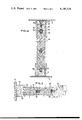
- FIG. 1 is a side elevational view with a part cut away of an erected partition wall
- FIG. 2 is a side elevational view of a panel for constructing the partition wall
- FIG. 3 is a sectional view taken on line 3--3 of FIG. 2;
- FIG. 4 is a sectional view taken on line 4--4 of FIG. 1;
- FIG. 5 is a sectional view taken on line 5--5 of FIG. 1;
- FIG. 6 is a view similar to FIG. 2 of a modification of the panel.
- FIG. 7 is a sectional view taken on line 7--7 of FIG. 6.
- the partition wall according to the invention and capable of being dismantled is mounted between a floor 1 and a ceiling 2 and extends from a support wall 4.
- This partition wall comprises a horizontal lower rail 6 placed on the floor 1 and provided with a longitudinal tongue 8 in the upper part of the rail.
- this rail 6 is fitted in a groove 12 of a vertical upright or post 10 which is secured by any suitable means, for example by screws and wall-plugs (not shown), to the wall 4.
- the groove 12 of the upright 10 extends throughout the height of the latter on the side of the upright opposed to the wall 4 and receives alternately superimposed panels 14 and 15 the width of which panels is similar to the width of the rail 6.
- Each of the panels 14 or 15 which are preferably made of wood or agglomerated lignous materials of the same type, comprises four sides. Two of the adjacent sides which form in the partition wall shown in FIG. 1 the upper edge and the right lateral edge carry a tongue respectively 16 and 18. The two other sides are provided with a groove respectively 20 and 22 the depth of which corresponds to the outer height of the tongue of the opposite sides (FIG. 3).
- the tongue 16, 18 are made from a material which is more compact and stronger than that from which the whole of the panel is made and are maintained in a groove of the panel carrying them by adhesion or any other means.
- the panels are made in a composite manner and comprise two outer plates or slabs 24 and 26 between which there is interposed a more compact plate or slab 28 which is offset relative to the other two plates and thus projects therefrom on two sides of the panel while it is set back therefrom on the other two sides.
- the plate 28 forms two tongues 17 and 19 and defines two grooves 21 and 23.
- the partition wall comprises not only panels 14, such as those shown in FIGS. 2 and 6 which have a rectangular shape, but also substantially square panels 15 the side of which has a length one half of the length of the panel 14. It is in this way possible to dispose panels in superimposed horizontal rows which are laterally staggered or offset relative to each other as shown in FIG. 1, at least one row having one or two panels 15.
- the panels 14 or 15 are thus superimposed in the manner of bricks, each of the grooves 20 fitting on the tongue 16 or 17 of two lower panels while each of the tongues 18 fit in the groove 22 of the neighbouring panel.
- the tongues 15 of the panels of the last row are fitted in a groove 30 formed in the lower side of a horizontal rail 32.
- This upper rail 32 is provided with apertures 34 which are evenly spaced apart and communicate with the upper side of the rail 32 (FIG. 4).
- a nut 36 is blocked in the end of each of the apertures 34 and a screwthreaded rod 38 is screwthreadedly engaged in this nut.
- the rod 38 is provided with a flared enlarged head 40 which forms a support surface for bearing against the ceiling 2.
- the screwthreaded rod 38 and nut 36 constitute expansible means and that an unscrewing of the rod 38 first applies the head 40 against the ceiling 2 and then tends to move the head 40 and the nut 36 away from each other, that is to say tends to urge the rail 38 against the panels 14 and 15 of the partition wall.
- the rods 38 or screw jacks are arranged in equally-spaced relation along the rail 32, their action results in an even compression of the rail 32 against the panels 14 and consequently clamps these panels against each other and against the lower rail 6.
- the depth of the grooves of each of the panels corresponds to the outer height of the tongues and the panels bear evenly against each other and are rendered closely rigid with each other with no intervention of any binder or like means.
- a second vertical upright or post similar to the upright 10 is placed at the end of the partition wall opposed to the upright 10.
- the second upright 42 may be exactly identical to the upright 10 and have a height equal to that of the partition wall. It then forms the end of the partition wall.
- the second vertical upright is a support post 44 of a door (FIG. 5).
- the upright 42, 44 comprises a groove 12 whose shape corresponds to that of the end of a panel 14 or 15. This groove 12 is however extended by a smaller groove 46 whose shape corresponds to that of the tongue 18 of the panel assembled therewith.
- a skirting board 48 and a plinth 50 may be, if desired, mounted on the lower and upper sides of the partition wall so as to embellish the latter and hide the screw jacks 38, 40. Further, whenever desirable, coverings may be placed on the partition wall.
- a partition wall of this type is extremely easy to erect.
- the vertical upright 10 is first secured to the wall 4 in the desired position and then the rail 6 is placed on the floor and fitted in the groove 12 of this upright. Then a first panel 14 or 15 is slid in the groove 12 of the upright 10 and fitted on the tongue 8 of the rail 6. Other panels 14 or 15 are fitted in succession on this tongue 8 and on the tongue 18 of the panel already placed in position.
- a second row is placed in position in the same way. However, this second row starts with a panel 15 if the first row started with a panel 14, as clearly shown in FIG. 1.
- the last panel of this row is so chosen that the end edges carrying the tongues 18 or 19 are in vertical alignment with each other.
- the rail 32 is fitted on the upper tongues of these panels and then the screw jacks are so adjusted as to ensure an appropriate clamping of the panels against each other.
- a vertical upright 42 or 44 can then be fitted on the end tongues 18 or 19 of the panels of the partition wall.
- the vertical upright is a door support post 44, another partition portion must be constructed. This portion may be constructed in the same way as the first portion in starting at a vertical upright 42 secured to a wall opposed to the wall 4 in the lower part of which there is fitted a lower rail 56.
- Panels 14 and 15 are then fitted on and superimposed on the rail 56 and fitted in the vertical upright 42.
- a new upright similar to the upright 44 is fitted on the end edge of the panels so as to enable a door to be mounted.
- a short horizontal rail forms the upper part of the door opening and may support panels which close the space between this door and the ceiling 2.
- the screw jacks 38 and 40 are adjusted only when all of the panels 14 and 15 have been placed in position.
- the partition wall is also extremely easy to dismantle since the release of the jacks 38, 40 frees the rail 32 and enables the panels 14 or 15 of the upper row to be separated sufficiently to disengage the tongue of these panels. The latter are then easily withdrawn as are all the other panels. As the lower rail is not fixed it can also be easily shifted, the sole fixing means to be withdrawn being those which maintain the vertical uprights 44 and the uprights 10 and 42.
- the panels may be easily transported and re-erected in another place just as rapidly with no need for skilled labour or special tools. Further, the panels may be easily made from agglomerated wood or fibreboard or from any other material light enough to be easily handled but nonetheless imparting sufficient strength to the partition wall. It will be understood that some of the elements of these panels may be sound insulating and/or fireproof so that the partition wall also has qualities providing comfort, attractiveness and safety.
Landscapes
- Engineering & Computer Science (AREA)
- Architecture (AREA)
- Physics & Mathematics (AREA)
- Electromagnetism (AREA)
- Civil Engineering (AREA)
- Structural Engineering (AREA)
- Building Environments (AREA)
- Finishing Walls (AREA)
- Body Structure For Vehicles (AREA)
- Panels For Use In Building Construction (AREA)
Applications Claiming Priority (2)
| Application Number | Priority Date | Filing Date | Title |
|---|---|---|---|
| FR7710274A FR2386655A1 (fr) | 1977-04-05 | 1977-04-05 | Cloison demontable |
| FR7710274 | 1977-04-05 |
Publications (1)
| Publication Number | Publication Date |
|---|---|
| US4186534A true US4186534A (en) | 1980-02-05 |
Family
ID=9189057
Family Applications (1)
| Application Number | Title | Priority Date | Filing Date |
|---|---|---|---|
| US05/893,689 Expired - Lifetime US4186534A (en) | 1977-04-05 | 1978-04-05 | Partition wall capable of being dismantled |
Country Status (8)
| Country | Link |
|---|---|
| US (1) | US4186534A (fr) |
| BE (1) | BE865683A (fr) |
| CA (1) | CA1078576A (fr) |
| DE (1) | DE2814713A1 (fr) |
| ES (1) | ES469375A1 (fr) |
| FR (1) | FR2386655A1 (fr) |
| GB (1) | GB1601071A (fr) |
| IT (1) | IT7848752A0 (fr) |
Cited By (9)
| Publication number | Priority date | Publication date | Assignee | Title |
|---|---|---|---|---|
| US4972634A (en) * | 1989-01-19 | 1990-11-27 | Dresden Gregory M | Portable walling |
| DE9213493U1 (de) * | 1992-10-07 | 1993-01-07 | hülsta-werke Hüls GmbH & Co KG, 4424 Stadtlohn | Wand- und Deckenflächenelement mit Wabenkern |
| US5265390A (en) * | 1990-01-25 | 1993-11-30 | John K. Tanner | Wall panels and methods of construction thereof |
| US5992109A (en) * | 1997-04-14 | 1999-11-30 | Steelcase Development, Inc. | Floor-to-ceiling demountable wall |
| US20060283104A1 (en) * | 2005-06-02 | 2006-12-21 | Sunflex Aluminiumsysteme Gmbh | Swivel fitting for a folding sliding wall |
| US20070029057A1 (en) * | 2005-06-02 | 2007-02-08 | Sunflex Aluminiumsysteme Gmbh | Fitting for a folding sliding wall |
| US20070270882A1 (en) * | 2006-05-19 | 2007-11-22 | Acorn Cardiovascular, Inc. | Pericardium management method for intra-pericardial surgical procedures |
| US20090049766A1 (en) * | 2007-08-24 | 2009-02-26 | Kopish Andrew J | Wall-Ceiling Slip Joint Permitting Seismic Induced Movement |
| US20150240553A1 (en) * | 2014-02-21 | 2015-08-27 | Advanced Equipment Corporation | Collapsible wall |
Families Citing this family (2)
| Publication number | Priority date | Publication date | Assignee | Title |
|---|---|---|---|---|
| NL189418C (nl) * | 1980-02-16 | 1993-04-01 | Hunter Douglas Ind Bv | Sandwichpaneelelement. |
| NL9500184A (nl) * | 1995-02-01 | 1996-09-02 | Pella Bv | Klemwandsysteem. |
Citations (5)
| Publication number | Priority date | Publication date | Assignee | Title |
|---|---|---|---|---|
| US2238355A (en) * | 1939-11-08 | 1941-04-15 | James B Whitenack | Wall building unit and structure incorporating same |
| US3386216A (en) * | 1964-01-17 | 1968-06-04 | Zwickert Charles | Partitioning elements, in particular for the erection of dismantlable and removable partitioning |
| US3508364A (en) * | 1968-06-17 | 1970-04-28 | Walter W Thompson | Partition system |
| US3511000A (en) * | 1968-08-08 | 1970-05-12 | Henry P C Keuls | Interlocking hollow building blocks |
| US4103463A (en) * | 1976-09-28 | 1978-08-01 | Panelfold Doors, Inc. | Portable wall system |
-
1977
- 1977-04-05 FR FR7710274A patent/FR2386655A1/fr active Granted
-
1978
- 1978-04-04 BE BE186562A patent/BE865683A/fr not_active IP Right Cessation
- 1978-04-04 CA CA300,452A patent/CA1078576A/fr not_active Expired
- 1978-04-05 DE DE19782814713 patent/DE2814713A1/de not_active Withdrawn
- 1978-04-05 ES ES469375A patent/ES469375A1/es not_active Expired
- 1978-04-05 GB GB13407/78A patent/GB1601071A/en not_active Expired
- 1978-04-05 IT IT7848752A patent/IT7848752A0/it unknown
- 1978-04-05 US US05/893,689 patent/US4186534A/en not_active Expired - Lifetime
Patent Citations (5)
| Publication number | Priority date | Publication date | Assignee | Title |
|---|---|---|---|---|
| US2238355A (en) * | 1939-11-08 | 1941-04-15 | James B Whitenack | Wall building unit and structure incorporating same |
| US3386216A (en) * | 1964-01-17 | 1968-06-04 | Zwickert Charles | Partitioning elements, in particular for the erection of dismantlable and removable partitioning |
| US3508364A (en) * | 1968-06-17 | 1970-04-28 | Walter W Thompson | Partition system |
| US3511000A (en) * | 1968-08-08 | 1970-05-12 | Henry P C Keuls | Interlocking hollow building blocks |
| US4103463A (en) * | 1976-09-28 | 1978-08-01 | Panelfold Doors, Inc. | Portable wall system |
Cited By (11)
| Publication number | Priority date | Publication date | Assignee | Title |
|---|---|---|---|---|
| US4972634A (en) * | 1989-01-19 | 1990-11-27 | Dresden Gregory M | Portable walling |
| US5265390A (en) * | 1990-01-25 | 1993-11-30 | John K. Tanner | Wall panels and methods of construction thereof |
| DE9213493U1 (de) * | 1992-10-07 | 1993-01-07 | hülsta-werke Hüls GmbH & Co KG, 4424 Stadtlohn | Wand- und Deckenflächenelement mit Wabenkern |
| US5992109A (en) * | 1997-04-14 | 1999-11-30 | Steelcase Development, Inc. | Floor-to-ceiling demountable wall |
| US20060283104A1 (en) * | 2005-06-02 | 2006-12-21 | Sunflex Aluminiumsysteme Gmbh | Swivel fitting for a folding sliding wall |
| US20070029057A1 (en) * | 2005-06-02 | 2007-02-08 | Sunflex Aluminiumsysteme Gmbh | Fitting for a folding sliding wall |
| US20070270882A1 (en) * | 2006-05-19 | 2007-11-22 | Acorn Cardiovascular, Inc. | Pericardium management method for intra-pericardial surgical procedures |
| US20090049766A1 (en) * | 2007-08-24 | 2009-02-26 | Kopish Andrew J | Wall-Ceiling Slip Joint Permitting Seismic Induced Movement |
| US7624549B2 (en) * | 2007-08-24 | 2009-12-01 | Krueger International, Inc. | Wall-ceiling slip joint permitting seismic induced movement |
| US20150240553A1 (en) * | 2014-02-21 | 2015-08-27 | Advanced Equipment Corporation | Collapsible wall |
| US9982480B2 (en) * | 2014-02-21 | 2018-05-29 | Advanced Equipment Corporation | Collapsible wall |
Also Published As
| Publication number | Publication date |
|---|---|
| FR2386655A1 (fr) | 1978-11-03 |
| DE2814713A1 (de) | 1978-10-12 |
| FR2386655B1 (fr) | 1982-07-09 |
| IT7848752A0 (it) | 1978-04-05 |
| CA1078576A (fr) | 1980-06-03 |
| ES469375A1 (es) | 1979-08-16 |
| BE865683A (fr) | 1978-10-04 |
| GB1601071A (en) | 1981-10-21 |
Similar Documents
| Publication | Publication Date | Title |
|---|---|---|
| EP1382765B1 (fr) | Panneau de construction | |
| US3017672A (en) | Non-load bearing dry wall partition construction | |
| CA1078576A (fr) | Cloison demontable | |
| US4033548A (en) | Concrete shuttering connecting means | |
| US1798392A (en) | Partition structure-movable | |
| US6032434A (en) | Half-timber frame and half-timber compartment element | |
| DE2700076A1 (de) | Gebaeudekonstruktionselement | |
| US4548008A (en) | Tile panel having convex and concave portions around substrate board, and method for production thereof | |
| EP2169132A2 (fr) | Élément de construction en forme de panneau | |
| EP4257768B1 (fr) | Ensemble d'éléments de construction pour un bâtiment en bois | |
| EP0593984B1 (fr) | Elément de construction de paroi et paroi réalisée à partir de cet élément de construction | |
| US3712011A (en) | Partition wall construction | |
| US3999341A (en) | Composite concrete structure and method of making same | |
| US5144785A (en) | Girder | |
| DE19640633A1 (de) | Verfahren zur Befestigung von Strukturelementen, entsprechendes Strukturelement und Halteelement hierfür | |
| DE2428038A1 (de) | Konstruktionssystem | |
| US20190177975A1 (en) | Structural element | |
| US2252568A (en) | Prefabricated building structure | |
| AT520334B1 (de) | Mauerstein | |
| DE19521990C2 (de) | Raumzellen-Modul | |
| GB2574172A (en) | Prefabricated block wall | |
| JP7022930B2 (ja) | 壁下地装置及びこれを用いた壁下地施工方法 | |
| DE2648935A1 (de) | Aus wenigstens einer bauplatte bestehende montagewand | |
| DE29805952U1 (de) | Schalldämmende Innen- oder Außenwandbekleidung | |
| GB2117425A (en) | A cladding system for a ceiling or a wall |