US4248603A - Method and tank for producing hot briquettes - Google Patents
Method and tank for producing hot briquettes Download PDFInfo
- Publication number
- US4248603A US4248603A US06/076,379 US7637979A US4248603A US 4248603 A US4248603 A US 4248603A US 7637979 A US7637979 A US 7637979A US 4248603 A US4248603 A US 4248603A
- Authority
- US
- United States
- Prior art keywords
- chambers
- briquettes
- tank
- blanks
- hot
- Prior art date
- Legal status (The legal status is an assumption and is not a legal conclusion. Google has not performed a legal analysis and makes no representation as to the accuracy of the status listed.)
- Expired - Lifetime
Links
Images


Classifications
-
- C—CHEMISTRY; METALLURGY
- C10—PETROLEUM, GAS OR COKE INDUSTRIES; TECHNICAL GASES CONTAINING CARBON MONOXIDE; FUELS; LUBRICANTS; PEAT
- C10L—FUELS NOT OTHERWISE PROVIDED FOR; NATURAL GAS; SYNTHETIC NATURAL GAS OBTAINED BY PROCESSES NOT COVERED BY SUBCLASSES C10G OR C10K; LIQUIFIED PETROLEUM GAS; USE OF ADDITIVES TO FUELS OR FIRES; FIRE-LIGHTERS
- C10L5/00—Solid fuels
- C10L5/02—Solid fuels such as briquettes consisting mainly of carbonaceous materials of mineral or non-mineral origin
- C10L5/26—After-treatment of the shaped fuels, e.g. briquettes
Definitions
- This invention relates to blast furnace fuel in general and, in particular, to a new and useful method for the production of hot briquettes, using a briquetting material of non-caking components such as low temperature coke from bituminous coal and/or lignite, coke dust and/or oil coke and caking fat coal, at temperatures between 430° C. and 540° C. with subsequent rehardening and cooling of the blank, and to equipment for the execution of the method.
- non-caking components such as low temperature coke from bituminous coal and/or lignite, coke dust and/or oil coke and caking fat coal
- tempering the blanks is carried out immediately after their compaction in an atmosphere containing less than 3% oxygen.
- difficulties are encountered again and again in controlling the oxygen content in the hardening tanks. Up to the present time, they were sealed against the outside air by spraying in water below the layer of blanks during the tempering, and having the water vapor penetrate to the outside and, in part, also through the filled-in blanks, thus more or less preventing the penetration of air.
- the solidified hot briquettes are cooled by immersion and/or water sprinkling.
- the water in which the rehardened blanks are dipped, in the other cooling method becomes severely contaminated and must be cleaned again by costly purification processes.
- the present invention provides a method in which the environment is protected and a most extensive recovery of heating gases which otherwise would escape into the open is obtained and, in addition, the hitherto unused thermal energy is satisfactorily employed.
- the blanks after leaving the briquetting press, are tempered and redegassed in a closed system of several chambers having gas communication with each other.
- the partly changing gas quantities generated in the various chambers are discharged together with one and the same overpressure.
- the hot briquettes are maintained in air- and gastight chambers during their entire transport to and from rehardening and during tempering so that no emissions can reach the open. It is particularly favorable if, after briquetting, the blanks are tempered at temperatures of up to a maximum of 100° C. below the compacting temperature without additional input of heat and a rich gas consisting predominantly of hydrogen, methane and ethane is generated and discharged from all of the filled chambers with one and the same pressure.
- the blanks When tempered in this way, the blanks, at the conclusion of tempering, have a residual content of volatiles of about 7.5%, and it has been demonstrated that this produce is excellent for use as blast furnace fuel.
- the temperature of the blanks during tempering can also be raised by introducing controlled amounts of oxygen or O 2 -containing gases into the chambers, so that the blanks are degassed more intensively and a partly combusted gas of increased CO 2 and CO content is generated and discharged. It is thus possible to favorably influence the quality of the coke blanks with respect to their content of volatile ingredients in view of their further use. For example, a produce containing 1.5% residual volatiles can be generated which can be used as an electrode coke.
- the gas pressure in the chambers should be adjusted from 0 mm to 50 mm water column, preferably 5 mm to 10 MM of water column.
- the method of the present invention has proven to be particularly economical energywise and environmentally safe if the blanks, after tempering, are placed into a closed cooling tank under exclusion of air and sprayed therein with water while withdrawing the forming water vapor from the bottom with overpressure.
- the water vapor generated can be used in the plant as a secondary heating steam for cleaning the dust-laden gas produced when mixing the various coal components ahead of the briquetting press.
- All tar-carrying pipes can be heated with the recovered steam so that deposits and clogging inside the pipes are prevented.
- the hardening system consist of a single, cube-shaped tank, one corner of which is inclined downwardly and which is divided into several narrow chambers by walls disposed parallel to the inclined outside surface, and which has a channel for charging the hot briquettes and for discharging the gases generated in tempering above an upper lateral edge and has an emptying channel for the rehardened blanks diagonally opposite the charging channel, underneath a lower lateral edge.
- Another advantage, according to the invention, is the absence of costly helical structures inside of the individual tank chambers.
- the present vertical hardening tanks require the installation of expensive helical chutes to prevent the hot briquettes from breaking apart due to the great drop height and the fact that the solidification of the blanks is not yet concluded when being loaded.
- the hot briquettes keep sliding down very easily and the originating abrasion is insignificant.
- each gastight device at the briquette entry point into the hot stuff conveyor, after the briquetting press and, at the discharge point from the emptying channel, the shutoff elements for the briquette transport control above and below each individual chamber are not of a gastight design. Therefore, only two gastight devices are required in total for all of the chambers, which devices, due to their complicated design, particularly at the high temperatures of about 500° C., require considerable financial outlay and can readily lead to breakdowns in operation. Much less expensive and simpler grates, flaps or slides can be chosen for the shutoff elements at each individual chamber.
- the charging channel is also a gas collecting pipe and that, after the gas discharge point, only a single pressure regulator is present for the control of the different gas quantities produced in the various hardening chambers as a function of the respective tempering time.
- a single pressure regulator is present for the control of the different gas quantities produced in the various hardening chambers as a function of the respective tempering time.
- the charging channel and gas collecting pipe unit is also advantageous for the reason that possible encrustations and cakings at the upper openings of the chambers, brought about by the discharging crude gas are again removed every time blanks are filled in through the same openings. All deposits are rubbed off again in every filling operation by the dry and hot bulk material.
- the high temperature of about 500° C. of the arriving blanks substantially prevents the formation of condensation and corrosion.
- the proposed combination method of rehardening and cooling of the hot briquettes offers considerable advantages over the hitherto known process phases, in particular, in the area of environmental protection.
- the coal gas forming in the tempering of the briquettes is recovered in a simple manner.
- the heat which is freed during cooling of the hot briquettes is ingeniously utilized by generating steam.
- hot briquettes are produced using a briquetting material of non-caking components which comprises delivering the components in the temperature range of about 430° C. to 540° C. into a briquetting press to form briquette blanks, and tempering and degassing the blanks by delivering them into individual chambers of a closed system of several chambers having gas communication therebetween so that there is partly changing amounts of gas generated in the individual chambers to form the tempered briquettes, and applying an overpressure to the chambers to conduct the generated gas away from the chambers with the same overpressures.
- an object of the present invention is to provide a device for producing hot briquettes which comprises a substantially cube-shaped tank having one corner which is inclined downwardly which is divided into several relatively narrow substantially parallel chambers and which includes a channel disposed along the upper edge of the cube-shaped tank for charging the hot briquettes into the tank and for conducting away gases formed during tempering and which further includes an emptying channel disposed along the lower edge of the tank for receiving the rehardened blanks after they are tempered in the chambers.
- a furtherr object of the present invention is to provide an apparatus for producing hot briquettes which is simple in design, rugged in construction and economical to manufacture.
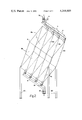
- FIG. 1 is a schematic representation of the apparatus for the production of hot briquettes in accordance with the invention
- FIG. 2 is an enlarged perspective view of the tank employed for tempering the briquettes.
- FIG. 3 is a view similar to FIG. 2 of another embodiment of the invention showing a closed discharging tank arrangement.
- the invention embodied therein, comprises a method for the production of hot briquettes using a briquetting material of non-caking components such as low temperature coke from bituminous coal and/or lignite, coke dust and/or oil coke and caking fat coal at temperatures in the range of about 430° C. to 540° C.
- non-caking components such as low temperature coke from bituminous coal and/or lignite, coke dust and/or oil coke and caking fat coal at temperatures in the range of about 430° C. to 540° C.
- hot briquettes are produced at a temperature of from about 430° C. to 540° C., by compacting a briquetting material of non-softening solids and caking coal in a roller press 1.
- the hot briquettes are fed to the hardening system by a honeycomb conveyor belt 2, to a gastight bucket wheel 4 and then to a hot stuff conveyor 3, all of which are under the exclusion of air and slight overpressure.
- the hardening system consists of a single, cube-shaped tank 6, divided by parallel, spaced apart walls 6a into several substantially identical chambers 6b.
- the cube-shaped tank 6 is mounted on a three-legged supporting frame 20 (FIGS. 2 and 3), so that one corner of the cube points downwardly, causing a bottom 6c and side surfaces 6a of the individual chambers 6b to be severely inclined. This assures that the blanks automatically keep sliding.
- the hot briquettes are transported via a chute 5a into a charging channel 5 disposed at the upper lateral edge of the cube-shaped tank 6.
- the briquettes are delivered from the channel into one of the respectively provided chambers 6b after selective actuation of the shutoff elements 7.
- the hardening system is normally run in the sequence "filling, tempering without motiion of the solids (briquettes), emptying”. This requires at least three chambers 6b. Tempering with motion of solids can also be done with fewer chambers 6b. Emptying of the individual chambers 6b is accomplished through an emptying channel 9 and a gastight bucket wheel 10 by opening valves or shutoff elements 8 provided at the bottom of the individual chambers.
- the control of the coal gas quantity generated and of the uniform, slight gas overpressure in the hardening system is accomplished by a single pressure regulator 30 in the line 12a.
- Cooling of the hot briquettes after they leave the bucket wheel 10 is shown schematically in FIG. 1.
- the tempered hot briquettes drop into a water immersion tank 15, from which they are conveyed by a conveyor belt 13, with a possibly required resprinkling being attended to by a sprinkling system 14.
- the cooling of the hot briquettes in a closed cooling tank directly coupled to the hardening system is shown in FIG. 3.
- the tempered hot briquettes were discharged continuously through the gastight bucket wheel 10 in the example of FIG. 1, emptying of the individual chambers 6b into a closed quenching or cooling tank 16 (FIG. 3) is advantageously carried out discontinuously in a very short period of time after tempering.
- the shutoff fitting 21 which closes gastight, the hot content (400°-500° C.) runs out of the selected tank chamber 6b into the quenching tank 16 disposed beneath the hardening tank 6 in about one minute.
- a nozzle system 22 is operated to spray water into the quenching tank 16, cooling the hot briquettes in a short time to 150° C. to 200° C.
- the shutoff fitting 17 below the tank 16 is tightly closed during the quenching operation.
- the water vapor forming during the cooling is removed under pressure regulation (about 0.5 to 3 bar) through a line 18 and is used elsewhere.
- the fitting 17 is opened after a short time and the hot briquettes, which are already greatly cooled down, are transported away by a conveyor belt 19 and, if needed, are subsequently cooled to the required shipping temperature by water sprinkling (similar to FIG. 1).
- Second chamber Temper without motion of solids, 1.5 h
- the tempering time is about three hours, with the tanks being filled with about 75 m 3 of briquettes each time.
- a typical hot briquette analysis before entry into the hardening tank is as follows:
- the briquette After tempering, prior to entry into the cooling tank 16, the briquette has the following analysis:
- the briquettes are cooled from 450° C. to 180° C., with about 7 t of steam being produced per tank chamber from 45 t hot briquettes at about 2 bar pressure (saturated steam).
Landscapes
- Chemical & Material Sciences (AREA)
- Life Sciences & Earth Sciences (AREA)
- Environmental & Geological Engineering (AREA)
- General Life Sciences & Earth Sciences (AREA)
- Geochemistry & Mineralogy (AREA)
- Geology (AREA)
- Oil, Petroleum & Natural Gas (AREA)
- Organic Chemistry (AREA)
- Manufacture And Refinement Of Metals (AREA)
- Solid Fuels And Fuel-Associated Substances (AREA)
- Coke Industry (AREA)
Applications Claiming Priority (2)
| Application Number | Priority Date | Filing Date | Title |
|---|---|---|---|
| DE2842425A DE2842425C2 (de) | 1978-09-29 | 1978-09-29 | Vorrichtung zum Nachhärten von Heißbriketts |
| DE2842425 | 1978-09-29 |
Publications (1)
| Publication Number | Publication Date |
|---|---|
| US4248603A true US4248603A (en) | 1981-02-03 |
Family
ID=6050819
Family Applications (1)
| Application Number | Title | Priority Date | Filing Date |
|---|---|---|---|
| US06/076,379 Expired - Lifetime US4248603A (en) | 1978-09-29 | 1979-09-17 | Method and tank for producing hot briquettes |
Country Status (4)
| Country | Link |
|---|---|
| US (1) | US4248603A (de) |
| JP (1) | JPS5548292A (de) |
| DE (1) | DE2842425C2 (de) |
| GB (1) | GB2035370B (de) |
Cited By (4)
| Publication number | Priority date | Publication date | Assignee | Title |
|---|---|---|---|---|
| US4564369A (en) * | 1981-05-28 | 1986-01-14 | The Standard Oil Company | Apparatus for the enhanced separation of impurities from coal |
| US4601728A (en) * | 1983-09-06 | 1986-07-22 | Firma Carl Still Gmbh & Co. Kg | Method and apparatus for preparing a material for hot briquetting |
| US5840651A (en) * | 1993-11-19 | 1998-11-24 | Mitsui Mining Co., Ltd. | Process for the production of activated coke for simultaneous desulfurization and denitrification |
| US20060112617A1 (en) * | 2003-02-11 | 2006-06-01 | Clark Keith N | Briquetting process |
Citations (6)
| Publication number | Priority date | Publication date | Assignee | Title |
|---|---|---|---|---|
| US1632052A (en) * | 1923-02-09 | 1927-06-14 | Gen Fuel Briquette Corp | Method of carbonizing fuel briquettes |
| US1920327A (en) * | 1925-05-06 | 1933-08-01 | Charles W Sewell | Briquette and method of manufacturing briquettes |
| US2610115A (en) * | 1948-09-30 | 1952-09-09 | Henry G Lykken | Method for dehydrating lignite |
| US3181488A (en) * | 1961-02-23 | 1965-05-04 | Burns & Roe Inc | Apparatus for drying coal in bunkers |
| FR1562473A (de) * | 1967-04-21 | 1969-04-04 | ||
| US4187079A (en) * | 1977-09-13 | 1980-02-05 | Firma Carl Still | Method for producing form coke |
Family Cites Families (3)
| Publication number | Priority date | Publication date | Assignee | Title |
|---|---|---|---|---|
| DE1915905C3 (de) * | 1969-03-28 | 1974-07-11 | Eschweiler Bergwerks-Verein, 5122 Kohlscheid | Verfahren zum Herstellen von Heißbriketts |
| US3926576A (en) * | 1972-05-12 | 1975-12-16 | Bergwerksverband Gmbh | Process for producing hot briquettes |
| DE2247101A1 (de) * | 1972-09-26 | 1974-04-04 | Bergwerksverband Gmbh | Verfahren zum nachbehandeln von heissbriketts oder dgl |
-
1978
- 1978-09-29 DE DE2842425A patent/DE2842425C2/de not_active Expired
-
1979
- 1979-09-17 US US06/076,379 patent/US4248603A/en not_active Expired - Lifetime
- 1979-09-27 GB GB7933592A patent/GB2035370B/en not_active Expired
- 1979-09-28 JP JP12428079A patent/JPS5548292A/ja active Granted
Patent Citations (6)
| Publication number | Priority date | Publication date | Assignee | Title |
|---|---|---|---|---|
| US1632052A (en) * | 1923-02-09 | 1927-06-14 | Gen Fuel Briquette Corp | Method of carbonizing fuel briquettes |
| US1920327A (en) * | 1925-05-06 | 1933-08-01 | Charles W Sewell | Briquette and method of manufacturing briquettes |
| US2610115A (en) * | 1948-09-30 | 1952-09-09 | Henry G Lykken | Method for dehydrating lignite |
| US3181488A (en) * | 1961-02-23 | 1965-05-04 | Burns & Roe Inc | Apparatus for drying coal in bunkers |
| FR1562473A (de) * | 1967-04-21 | 1969-04-04 | ||
| US4187079A (en) * | 1977-09-13 | 1980-02-05 | Firma Carl Still | Method for producing form coke |
Cited By (7)
| Publication number | Priority date | Publication date | Assignee | Title |
|---|---|---|---|---|
| US4564369A (en) * | 1981-05-28 | 1986-01-14 | The Standard Oil Company | Apparatus for the enhanced separation of impurities from coal |
| US4601728A (en) * | 1983-09-06 | 1986-07-22 | Firma Carl Still Gmbh & Co. Kg | Method and apparatus for preparing a material for hot briquetting |
| US5840651A (en) * | 1993-11-19 | 1998-11-24 | Mitsui Mining Co., Ltd. | Process for the production of activated coke for simultaneous desulfurization and denitrification |
| US20060112617A1 (en) * | 2003-02-11 | 2006-06-01 | Clark Keith N | Briquetting process |
| US7892302B2 (en) | 2003-02-11 | 2011-02-22 | Commonwealth Scientific And Industrial Research Organisation | Briquetting process |
| US8070839B2 (en) | 2003-02-11 | 2011-12-06 | Commonwealth Scientific And Industrial Research Organisation | Briquetting process |
| USRE46052E1 (en) | 2003-02-11 | 2016-07-05 | Commonwealth Scientific And Industrial Research Organisation | Briquetting process |
Also Published As
| Publication number | Publication date |
|---|---|
| JPS5739680B2 (de) | 1982-08-23 |
| JPS5548292A (en) | 1980-04-05 |
| GB2035370A (en) | 1980-06-18 |
| DE2842425A1 (de) | 1980-04-17 |
| GB2035370B (en) | 1983-01-19 |
| DE2842425C2 (de) | 1984-09-27 |
Similar Documents
| Publication | Publication Date | Title |
|---|---|---|
| US3655518A (en) | Retort system for oil shales and the like | |
| US3959084A (en) | Process for cooling of coke | |
| US4052173A (en) | Simultaneous gasification of coal and pyrolysis of organic solid waste materials | |
| US3047473A (en) | Drying, preheating, transferring and carbonizing coal | |
| US3996044A (en) | Electro-pyrolytic upright shaft type solid refuse disposal and conversion process | |
| CA1117097A (en) | Method and apparatus for producing active coke | |
| WO2010086008A2 (de) | Verfahren zur versorgung eines flugstromvergasungs- reaktors mit brennstoff aus einem vorratsbehälter | |
| DE3026949C2 (de) | ||
| US4050990A (en) | Method and apparatus for producing form coke | |
| DE3614048A1 (de) | Verfahren und vorrichtung zur vergasung minderwertiger brennstoffe in einem feuerfluessigen metallschmelzbad | |
| US4366026A (en) | Process for the production of coke or semicoke | |
| US7413647B2 (en) | Method and apparatus for upgrading bituminous material | |
| US4248603A (en) | Method and tank for producing hot briquettes | |
| CN101568619A (zh) | 从含橡胶废品生产炭黑、烃燃料的组分和用于化学工业的原料 | |
| US4060479A (en) | Process for obtaining oil, gas, sulfur and other products from oil shale | |
| US4305788A (en) | Process for the production of molded metallurgical coke from coal briquettes | |
| US2732332A (en) | Geller | |
| US3141834A (en) | Process for continuous destructive distillation and carbonization of coal | |
| US1278180A (en) | Apparatus for making gas. | |
| DE2909657C2 (de) | Verfahren und Vorrichtung zur Vergasung von körnigem Brennstoff | |
| Wenning | The VEBA OEL technologie pyrolysis process | |
| US4106996A (en) | Method of improving the mechanical resistance of coke | |
| CA1083059A (en) | Oven for thermal processing of lump solid fuel | |
| US4604165A (en) | Apparatus for processing bulk materials by induction | |
| US3918929A (en) | Process for post-treating hot briquettes and the like |