US4273051A - Electric device - Google Patents
Electric device Download PDFInfo
- Publication number
- US4273051A US4273051A US06/004,265 US426579A US4273051A US 4273051 A US4273051 A US 4273051A US 426579 A US426579 A US 426579A US 4273051 A US4273051 A US 4273051A
- Authority
- US
- United States
- Prior art keywords
- control circuit
- winding
- circuit
- load
- inductor
- Prior art date
- Legal status (The legal status is an assumption and is not a legal conclusion. Google has not performed a legal analysis and makes no representation as to the accuracy of the status listed.)
- Expired - Lifetime
Links
Images


Classifications
-
- B—PERFORMING OPERATIONS; TRANSPORTING
- B60—VEHICLES IN GENERAL
- B60R—VEHICLES, VEHICLE FITTINGS, OR VEHICLE PARTS, NOT OTHERWISE PROVIDED FOR
- B60R21/00—Arrangements or fittings on vehicles for protecting or preventing injuries to occupants or pedestrians in case of accidents or other traffic risks
- B60R21/01—Electrical circuits for triggering passive safety arrangements, e.g. airbags, safety belt tighteners, in case of vehicle accidents or impending vehicle accidents
- B60R21/017—Electrical circuits for triggering passive safety arrangements, e.g. airbags, safety belt tighteners, in case of vehicle accidents or impending vehicle accidents including arrangements for providing electric power to safety arrangements or their actuating means, e.g. to pyrotechnic fuses or electro-mechanic valves
-
- F—MECHANICAL ENGINEERING; LIGHTING; HEATING; WEAPONS; BLASTING
- F41—WEAPONS
- F41A—FUNCTIONAL FEATURES OR DETAILS COMMON TO BOTH SMALLARMS AND ORDNANCE, e.g. CANNONS; MOUNTINGS FOR SMALLARMS OR ORDNANCE
- F41A19/00—Firing or trigger mechanisms; Cocking mechanisms
- F41A19/58—Electric firing mechanisms
- F41A19/63—Electric firing mechanisms having means for contactless transmission of electric energy, e.g. by induction, by sparking gap
-
- F—MECHANICAL ENGINEERING; LIGHTING; HEATING; WEAPONS; BLASTING
- F42—AMMUNITION; BLASTING
- F42B—EXPLOSIVE CHARGES, e.g. FOR BLASTING, FIREWORKS, AMMUNITION
- F42B3/00—Blasting cartridges, i.e. case and explosive
- F42B3/10—Initiators therefor
- F42B3/18—Safety initiators resistant to premature firing by static electricity or stray currents
-
- F—MECHANICAL ENGINEERING; LIGHTING; HEATING; WEAPONS; BLASTING
- F42—AMMUNITION; BLASTING
- F42B—EXPLOSIVE CHARGES, e.g. FOR BLASTING, FIREWORKS, AMMUNITION
- F42B3/00—Blasting cartridges, i.e. case and explosive
- F42B3/10—Initiators therefor
- F42B3/18—Safety initiators resistant to premature firing by static electricity or stray currents
- F42B3/188—Safety initiators resistant to premature firing by static electricity or stray currents having radio-frequency filters, e.g. containing ferrite cores or inductances
-
- F—MECHANICAL ENGINEERING; LIGHTING; HEATING; WEAPONS; BLASTING
- F42—AMMUNITION; BLASTING
- F42C—AMMUNITION FUZES; ARMING OR SAFETY MEANS THEREFOR
- F42C15/00—Arming-means in fuzes; Safety means for preventing premature detonation of fuzes or charges
- F42C15/40—Arming-means in fuzes; Safety means for preventing premature detonation of fuzes or charges wherein the safety or arming action is effected electrically
-
- H—ELECTRICITY
- H01—ELECTRIC ELEMENTS
- H01F—MAGNETS; INDUCTANCES; TRANSFORMERS; SELECTION OF MATERIALS FOR THEIR MAGNETIC PROPERTIES
- H01F38/00—Adaptations of transformers or inductances for specific applications or functions
- H01F38/08—High-leakage transformers or inductances
-
- H—ELECTRICITY
- H02—GENERATION; CONVERSION OR DISTRIBUTION OF ELECTRIC POWER
- H02H—EMERGENCY PROTECTIVE CIRCUIT ARRANGEMENTS
- H02H9/00—Emergency protective circuit arrangements for limiting excess current or voltage without disconnection
Definitions
- This invention generally deals with electrical control circuits for energizing an electrically ignited load such as a fusehead in an explosive detonator.
- the circuit harmlessly dissipates electrical energy which is either accidentally or purposefully connected to the circuit input unless such energy is of predetermined magnitude and frequency.
- the control circuit of this invention is especially useful and advantageous for firing an electrical ignition device, for example, an electric fusehead disposed in ignition relationship with one or more explosive charges.
- an electrical ignition device for example, an electric fusehead disposed in ignition relationship with one or more explosive charges.
- fusehead assemblies are used, for example, in blasting operations, seismic exploration and for the actuation of passive restraint systems in automobiles. In all such applications, it is important for the electrical load to be promptly actuated when desired but, at the same time, it is necessary to take safety precautions against inadvertent or improper load ignition.
- explosive charges are usually detonated from a remote firing point to insure operator safety.
- the required electrical firing signal is transmitted to a detonator which explodes, and in turn, ignites the main explosive charge either instantaneously or after some predetermined time delay.
- the firing signal may also be transmitted, at least in part, in a non-electrical form by the burning of a pyrotechnic train and/or the propagation of a detonation wave through an explosive train.
- the usual electric fusehead is ignited by electrical current passing through a fuse wire or metallic film. When sufficient electrical current passes through this essentially resistive load, its temperature is raised sufficiently to ignite a chemical composition disposed in contact with the wire. The ignition of the fusehead, per se, may then be used to initiate a sequence of pyrotechnic and/or explosive charges which eventually ignites or detonates the main explosive charge.
- the electrical energy for igniting the fusehead is commonly obtained from a battery, pulse generator, a.c. power supply or the discharge of a capacitor.
- the degree of safety associated with a given electric fusehead installation depends on both the sensitivity of the fusehead to ignition by spurious sources of electrical energy and the chance that such spurious sources will be encountered. Accordingly, in the past, one approach to safety has been to decrease the sensitivity of an electric fusehead by requiring high firing currents to ignite the pyrotechnic chemical disposed adjacent the wire or film which is heated by the flow of electrical currents. However, such an approach requires relatively heavy and expensive wiring and high firing energy levels which still fail to provide adequate safety for some operations. For example, the use of an electrical fusehead is normally prohibited in many mining operations where dry granular explosives are loaded by compressed air. Of course, such prior techniques of reduced fusehead sensitivity still permit the fusehead to be easily ignited either illegally or accidentally.
- U.S. Pat. No. 3,762,331 discloses a voltage step-down transformer in combination with capacitors and an inductor for selectively operating an electric fusehead at a frequency on the order of 10 kilohertz.
- the voltage ratio of the step-down transformer is fairly large (on the order of 100:1) so as to increase the voltage level required for firing and thus decrease sensitivity to spurious input voltages even if of the appropriate frequency.
- a series input capacitor is also used to block spurious d.c. voltages and to attenuate lower a.c. frequency signals (e.g., power frequencies).
- a shunt capacitor is also connected across the primary of the transformer to bypass the higher radio frequency signals which may appear across that winding said capacitor being selected to resonate with the primary inductance of the transformer at the operating frequency.
- a series input inductor is used to match input line impedances and to attenuate higher frequencies.
- Coupling transformers for use in such systems have also been designed so that magnetic saturation of the transformer core provides increased protection against improper fusehead ignition at the normal lower a.c. frequencies (e.g., a.c. power frequencies).
- British Pat. No. 1,235,844--(published 1971) also shows a transformer coupled (pot-shaped core) a.c. input to an electric fusehead which ignites at a low 330 Hz. frequency generated integrally to the device from a direct voltage supply. Higher frequencies are attenuated by core losses.
- transformers with such large stepdown ratios limits the usefulness of such coupling devices where fusehead firing voltages on the order of 50 volts or more may be required. That is, in complex blasting operations, a series connection may not be usable due to the extremely large firing signal voltages that would have to be generated if the primaries of these transformers are connected in series.
- Such control circuits typically incorporating components other than a transformer, are also often bulky and expensive and cannot be conveniently and economically incorporated within a detonator casing. For example, a typical design according to U.S. Pat. No.
- 3,762,331 requires a transformer primary inductance of 40 millihenries, a shunt capacitor of 6000 picofarads, a series capacitor of 4000 picofarads and a series input inductor of 200 millihenries.
- a design according to British Pat. No. 1,235,844 embodies inductors of 40-380 turns that will typically have inductances in the 5-500 millihenry range, together with semiconductors, resistors and a capacitor.
- Control circuits according to British Specification 1,235,844 contain circuit elements specifically designed to generate a firing signal of the appropriate frequency, and such circuits would be directly energized by a condenser discharge of the appropriate polarity.
- an electrically ignited load e.g., an electric fusehead
- an electric fusehead can be more safely manufactured, transported, stored and connected into a blasting system.
- the circuit of this invention is similar to the prior art use of a coupling transformer where a.c. electrical energy is input to the primary winding to fire an electric fusehead connected to the secondary winding.
- the transformer structure of this invention is specially constructed so as to provide a substantial leakage inductance (usually associated with the secondary winding) effectively connected in series with the electric fusehead.
- a substantial leakage inductance may come about by special transformer core construction techniques and/or by the provision of a completely separate magnetic circuit (usually linked to the secondary winding).
- the dissipation that can be achieved in a transformer without substantial series inductance in the secondary gives insufficient protection against the level of capacitor discharge previously cited.
- the dissipation is increased by a large factor through the series inductance, particularly if the said inductance also has substantial core loss at the capacitor discharge frequency.
- an electrical energy dissipating circuit (either linear or non-linear with respect to applied voltages) may be connected directly in the circuit, e.g., across the primary or secondary winding or across the leakage inductance.
- a fusable link may also be connected in series with the primary or in series with another or even tertiary winding of the transformer to provide added protection against input current of excessive magnitude.
- the control circuit of this invention selectively couples electrical energy to an electrically ignited load by highly attenuating sources of electrical energy other than one of a predetermined magnitude and frequency. This invention is believed to achieve such desired safety requirements in a more reliable and economic manner than has heretofore been possible.
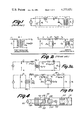
- FIG. 1 is a schematic diagram of a prior art control circuit for selectively energizing an electrical fusehead
- FIG. 2 is a schematic diagram showing an equivalent circuit for a two winding transformer
- FIG. 3 is a schematic diagram of an electrical control circuit according to this invention.
- FIG. 4 is a diagrammatic longitudinal medial section of a detonator having a transformer a.c. coupled fusehead in accordance with this invention
- FIGS. 5-12 inclusive diagrammatically depict various transformer structures which may be used in the detonator of FIG. 4, the transformers of FIGS. 8, 9 and 11 being modifications of the transformer shown in FIG. 7;
- FIG. 13 is a graph showing the current and voltage firing characteristic curves for the fusehead of FIG. 1 without a resistive energy dissipation circuit connected across the primary or secondary winding of the transformer;
- FIG. 14 is a graph showing the current and power firing characteristic curves for the fusehead of FIG. 1 with a resistive energy dissipation circuit connected across either the primary or secondary winding of the transformer.
- Capacitor C1 effectively blocks d.c. input signals and capacitor C2 acts to shunt radio frequency signals being resonant with the primary inductance of the transformer at the operating frequency.
- Inductor L tends to block higher frequency a.c. inputs and match the impedance of the input signal line and resistance R bleeds static charges to ground.
- the fusehead is denoted as the resistive load R L .
- FIG. 1 It is, of course, also well-known that a practical two winding transformer of the type shown in FIG. 1 may be represented by an equivalent circuit as shown in FIG. 2.
- the resistances r 1 , r 2 and R m are due to core losses and resistive winding losses.
- D.c. isolation and a.c. coupling is provided by an ideal unit ratio transformer.
- L 1 is the primary inductance
- L 2 the secondary inductance
- the shunt inductance M is related to the mutual coupling between the primary and secondary windings of the transformer.
- one or other of the inductances (L 1 -M), (L 2 -M) may be negative, in which case the transfer characteristics can only be physically realized through the mutual magnetic coupling of a transformer. If, however, N ⁇ 1 and K 2 N ⁇ 1 the transfer characteristics of the transformer may be physically realized by a T network of inductors (L 1 -M), (L 2 --M) and M, and the transformer discarded if d.c. isolation between primary and secondary circuits is not required.
- a transformer with leakage inductance may be represented by a unit coupled transformer with a primary leakage inductance (1-K 1 )L 1 in series with the generator and a secondary leakage inductance (1-K 2 )L 2 in series with the load.
- the equivalent resistive loss in the primary is shown as r 1
- the equivalent resistive loss in the secondary is shown as r 2 .
- the primary leakage inductance will include the inductance of conducting leads that are an integral part of the detonator fusehead assembly, the natural leakage of the transformer and an additional series inductance if desired.
- the secondary leakage inductance will include the natural leakage of the transformer and an additional series inductance.
- FIG. 3(b) shows the secondary circuit that is equivalent to FIG. 3(a) wherein this invention provides a protective series connected inductance 100, with an equivalent series loss resistance r 4 with the fusehead load denoted as resistance R L .
- the fusehead may be a very low resistance on the order of one ohm or so.
- the circuit of this invention as depicted in FIG. 3(b) includes a shunt inductance 102 with an equivalent shunt resistance R m .
- the inductor 102 may be physically realized through the secondary of the transformer, or an inductor connected as shown. In the latter arrangement the transformer may be omitted if d.c. isolation of primary and secondary circuits is not required.
- Virtually complete protection against actuation of load RL from a.c. sources having frequencies less than, for example, 500 hertz may be achieved by providing a fusable link in series with the input.
- the link may be designed to fuse or break whenever the input current and/or current in inductor 102 rises above the normal operation by a significant amount.
- Characteristics of the fusable link e.g., the fusing current
- its positioning within the circuit and the sensitivity load RL then determine the minimum predetermined operating frequency. For example, the 500 hertz low frequency protection limit could be increased if a corresponding increase is made in the predetermined design operating frequency.
- the equivalent shunt resistance R m may be an element connected in parallel with either the primary or secondary winding.
- the resistive element may also dissipate a proportion of the applied energy even at the predetermined operating frequency.
- the ratio of energy dissipated in the resistive element to the energy dissipated in the electrical load RL increases.
- the relative degree of protection will be increased if the resistive element has a non-linear characterstic with resistance decreasing as applied voltage increases (e.g., a zener diode, spark gap, etc.).
- the energy dissipation, other than in the load will be increased further if a resistive element with the aforesaid characteristics is connected in shunt with inductor 100.
- the magnetic circuits associated with one or both of inductors 100 and 102 may comprise a magnetic material (e.g., manganese--zinc or nickel--zinc ferrite) which has a loss component of magnetic permeability at frequencies above the designed operating frequency. In this manner, further energy is dissipated at higher frequencies. It is a characteristic of the design that inductors typically of 1-50 microhenries can be used, thereby increasing the frequency of capacitor discharge compared with the prior art. Increased energy may also be dissipated at lower than the predetermined operating frequency if the magnetic circuit(s) are designed to saturate at the higher current levels which flow at lower frequencies.
- a magnetic material e.g., manganese--zinc or nickel--zinc ferrite
- the degree of protection against higher level spurious inputs is also enhanced if at least the magnetic circuit associated with inductor 102 is formed from a magnetic material which saturates at approximately the flux density required to produce a firing current through inductor 100 to ignite the load RL.
- the saturation flux density in the magnetic circuit(s) should be significantly above but close to the peak a.c. flux density required for providing minimum firing current through inductor 100 within the time delay from initial signal input (lag time) which is permitted for firing the particular detonator at hand.
- lag time initial signal input
- the circuit of this invention may be formed from a transformer having primary and secondary windings and also including a third magnetic circuit which is magnetically linked with at least part of the primary winding but not with the secondary winding. Such third magnetic circuit would then provide a further protective series inductance associated with the primary winding. Such a third magnetic circuit would also preferably link a tertiary winding which includes a fusable link as shown in FIG. 11. The fusable link is then designed to fuse at a predetermined current in the primary winding which exceeds the required firing current for the fusehead. This link in a tertiary winding may be an addition to or in place of the fusable link in the primary winding earlier discussed.
- the secondary winding may also be connected indirectly to the electrically ignited load or fusehead.
- the secondary winding may be coupled to an energy storage means (e.g., a rectifier connected to a capacitor), with the energy storage means being connected, in turn, through a switch to the electrically ignited load or fusehead.
- the switch may be operated by an electronic timing means.
- the primary and secondary windings or other inductive elements are selected to provide a desired degree of protection in accordance with the firing characteristics of a particular fusehead (firing element, firing energy, lag time, etc.) and with due consideration to the type of input signals against which protection is required.
- a detonator should be protected against electric batteries, alternating power supplies, radio frequencies in excess of 100 kilohertz and capacitor discharges. In practice, the optimum range of operating frequencies may be between 5 and 15 kilohertz.
- the protective inductances formed either separately or as an effective part of other inductive elements are therefore designed to control the rate at which current in the secondary winding can increase whenever current in the primary winding rises rapidly so as to limit energy transfer to a safe value at frequencies higher and lower than the designed predetermined operating frequency.
- Either a resistive element (e.g., connected in parallel with the primary winding) and/or the loss component of a magnetic circuit are represented by the equivalent shunt resistance R m and equivalent series resistance r 4 in FIG. 3(b), in FIG. 3 and are selected to give increasing energy dissipation for higher relative rates of increase of input current.
- the inductance of a secondary winding (including the protective or leakage inductance) is chosen so as to increase the required current in the primary winding whenever it rises at a slower rate thus enabling a fusable link to be selected which will fuse at lower frequencies before the electrical load is ignited while, at the designed predetermined operating frequency, the load will be ignited before the fusable link fuses.
- the saturation characteristics are chosen so, that at the predetermined operating frequency, the difference in magnitizing current flowing in the primary winding and the transformed current flowing in the secondary winding brings the flux in the magnetic circuit of inductor 102 near the saturation level. Then, for example, if a spurious input from an a.c. power supply rapidly increases the current in the primary winding, its associated core material will saturate thus causing the rate at which magnetic flux increases to fall rapidly below the rate at which the magnitizing field is being increased and thus causing the induced voltage resulting from mutual linkage with the saturated magnetic circuit to quickly fall towards zero and prevent ignition of the load.
- the detonator of FIG. 4 has a tubular metal casing 101 containing a delay element 20, explosive charge train 30, fushead 40 and transformer 50.
- the transformer secondary winding 52 is connected through lead wires 170 to the fuse head ignition element 40 and the primary winding 54 is connected by lead wires 130 to a source of alternating (a.c.) current 60.
- a current limiting fusible link 70 is included in series with wires 130 to provide further protection against accidental direct coupling of the input to a power circuit.
- An energy dissipation means such as resistor 80 is connected across leads 130 to increase energy dissipation at high frequencies.
- a primary winding 140 is connected to an a.c. source of firing energy through wires 130 and a secondary winding is in two serially connected parts 150 and 160 that are connected by wires 170 to the ignition circuit of the fusehead 40 (FIG. 4.)
- the first magnetic circuit 110 links the primary winding 140 and part 150 of the secondary winding.
- the second magnetic circuit 120 provides self-linkage to part 160 of the secondary winding and thus provides increased leakage inductance in the secondary winding.
- wire portions 190 and 200 constitute part of the secondary winding and pass through holes in a cylinder 180 of magnetic material, the primary wnding 140 and part 150 of the secondary winding being arranged as in FIG. 5. Flux generated in material 180 by current in wire portions 190 and 200 is self-linked and the cylinder 180 thus constitutes a second magnetic circuit providing increased leakage inductance in the secondary winding.
- a primary winding 140 is linked to a secondary winding 230 through a first magnetic circuit 210.
- a magnetic shunt 220 which may be of material different from that of magnetic circuit 210, completes a second and third magnetic circuit for self-linkage of flux through the secondary winding 230, as well as that of the primary winding 140, thereby providing increased leakage inductance in both windings.
- the first magnetic circuit may be constructed from a material which reaches saturation at a predetermined design level of primary current.
- part 240 of the magnetic circuit is constructed from such magnetic material, (e.g., saturated at a design level of current)
- the remainder of the magnetic circuit is made of less readily saturable material.
- the magnetic shunt 250 is external to the first magnetic circuit linking primary winding 140 and secondary winding 230.
- the ratio of leakage flux in the second magnetic circuit to mutual flux is increased and the ratio of primary leakage flux in the first magnetic circuit to mutual flux is decreased.
- the first magnetic circuit is provided by a pot core that can be separated into two parts 260 and 270 containing a primary winding 280 and a secondary winding 290 respectively (shown in cross-section in FIG. 10).
- a ring of magnetic material 300 constitutes a magnetic shunt and therby provides a second and a third magnetic circuit similar to that of FIGS. 7 and 8.
- a further magnetic shunt 330 has been introduced into the arrangement of FIG. 9 and constitutes a magnetic circuit providing increased leakage inductance in the primary winding 140 additional to that provided by shunt 360.
- a single turn of wire 340 links the flux in shunt 330, the circuit being completed by fusible link 350.
- the link When the link is complete, the current induced in wire 340 by flux (induced by primary current) in shunt 330 generates an opposing flux and reduces the total flux in shunt 330 to a small fraction of the primary flux.
- the link 350 fuses before a firing current is reached thereby interrupting the current in wire 340 and increasing the flux in shunt 330, decreasing the primary current and protecting the primary winding against excessive current.
- a transformer similar to that shown in FIG. 6 is mounted in a detonator casing 370.
- the first magnetic circuit is divided at 400, the part 380 with secondary winding 150 being sealed with sealing compound 440 into the detonator casing.
- the second portion 390 of the first magnetic circuit with the primary winding 140 is sealed with sealing compound 430 into a cap 410.
- the two parts 380 and 390 are held together locking the cap 410 to the detonator case 370 with pins 420 in a bayonet connection.
- the first magnetic circuit may be designed so that the part 380 is the first to reach a saturation flux, thereby giving protection against lower frequency energy sources before the firing input is attained.
- the characteristic curves shown in FIGS. 13 and 14 indicate relationships between operating voltage for normal firing, the required fusible link fusion current, and the effect of the energy dissipating resistor.
- FD denotes the designed operating frequency
- F denotes the frequency of the applied a.c. signal
- I denotes the root mean square a.c. current flowing continuously through wires 13
- I o denotes the maximum safe (no-fire) root mean square a.c. current flowing continuously through the fusehead
- V denotes the root mean square voltage applied continuously to the input wires 13
- V o denotes the maximum safe (no-fire) root means square voltage that can be applied continuously to the fusehead. All scales are logarithmic.
- Line A denotes the value I o and V o , all values of I and V below this line being safe.
- Line B denotes the maximum safe (no-fire) value of V relative to V o and line C denotes the maximum safe (no-fire) value of I relative to I o when the fusehead is connected to a source of a.c. firing voltage and current in accordance with the invention. All combinations of I and V that lie below lines B and C are safe and it will be observed that the protection against spurious current increases as F/FD decreases and protection against spurious voltage increases as F/FD increases.
- Point D represents a typical combination of firing current and voltage for the fusehead
- point E represents the fusing current R for a fusible link 70 at a value of F/FD represented by G.
- F/FD the current required to fire the fusehead
- the current required to fuse the fusehead is less than the current corresponding to point E required to fuse the fusible link 70 by sufficient margin to ensure that the fusible link 70 remains intact.
- FIG. 14 F FD, I and I o have the same designations as in FIG. 13.
- P denotes continuous flow of power to the input wires 13 and P o denotes the maximum safe (no-fire) continuous flow of power that can be applied to the fusehead.
- Line H denotes the value I o and P o , all values of I and P below Line H being safe
- Line J denotes the maximum safe (no-fire) value of I relative to I o
- Line K denotes the maximum safe (no-fire) value of P relative to P o when the fusehead is connected to a source of a.c. power in accordance with the invention. All combinations of I and P that lie below lines J and K are safe and it will be observed that the protection against spurious current increases both as F/FD increases and decreases and that for frequencies above FD the firing power rises rapidly with frequency.
- Points D, E, and G have the same designations as in FIG. 13.
- Point S represents the fusing current R for a fusible link 70 at a value of F/FD represented by T. For frequencies less than G or greater than T the fusible link 70 will fuse but the fusehead will not fire.
Landscapes
- Engineering & Computer Science (AREA)
- General Engineering & Computer Science (AREA)
- Power Engineering (AREA)
- Mechanical Engineering (AREA)
- Fuses (AREA)
- Ignition Installations For Internal Combustion Engines (AREA)
- Relay Circuits (AREA)
- Selective Calling Equipment (AREA)
- Cookers (AREA)
Applications Claiming Priority (1)
| Application Number | Priority Date | Filing Date | Title |
|---|---|---|---|
| GB405878 | 1978-02-01 |
Publications (1)
| Publication Number | Publication Date |
|---|---|
| US4273051A true US4273051A (en) | 1981-06-16 |
Family
ID=9769938
Family Applications (1)
| Application Number | Title | Priority Date | Filing Date |
|---|---|---|---|
| US06/004,265 Expired - Lifetime US4273051A (en) | 1978-02-01 | 1979-01-17 | Electric device |
Country Status (15)
| Country | Link |
|---|---|
| US (1) | US4273051A (de) |
| EP (1) | EP0003396A1 (de) |
| JP (1) | JPS54119800A (de) |
| AT (1) | AT383889B (de) |
| AU (1) | AU518694B2 (de) |
| BR (1) | BR7900634A (de) |
| CA (1) | CA1126370A (de) |
| ES (1) | ES477322A1 (de) |
| FI (1) | FI790328A7 (de) |
| GB (1) | GB2014380B (de) |
| IN (1) | IN151012B (de) |
| NO (1) | NO790178L (de) |
| NZ (1) | NZ189450A (de) |
| PH (1) | PH17857A (de) |
| ZA (1) | ZA79206B (de) |
Cited By (22)
| Publication number | Priority date | Publication date | Assignee | Title |
|---|---|---|---|---|
| US4422378A (en) * | 1980-12-11 | 1983-12-27 | Imperial Chemical Industries Plc | Means for and a method of initiating explosions |
| US4422379A (en) * | 1981-06-22 | 1983-12-27 | Imperial Chemical Industries Plc | Means for and a method of initiating explosions |
| US4544035A (en) * | 1984-02-14 | 1985-10-01 | Voss Charles V | Apparatus and method for use in detonating a pipe-conveyed perforating gun |
| US4674047A (en) * | 1984-01-31 | 1987-06-16 | The Curators Of The University Of Missouri | Integrated detonator delay circuits and firing console |
| US4754703A (en) * | 1986-02-27 | 1988-07-05 | Nippon Oil And Fats Co. Ltd. | Method of electrically blasting detonator and cordless detonator for use in said method |
| US5773749A (en) * | 1995-06-07 | 1998-06-30 | Tracor, Inc. | Frequency and voltage dependent multiple payload dispenser |
| US6211682B1 (en) | 1998-08-24 | 2001-04-03 | Prime Perforating Systems Limited | Method and circuitry for measuring loop resistance |
| US6302023B1 (en) * | 1997-05-28 | 2001-10-16 | Trw Occupant Restraint Systems Gmbh & Co. Kg | Detonator for a pyrotechnical gas generator and gas generator |
| US6470803B1 (en) | 1997-12-17 | 2002-10-29 | Prime Perforating Systems Limited | Blasting machine and detonator apparatus |
| US6584907B2 (en) | 2000-03-17 | 2003-07-01 | Ensign-Bickford Aerospace & Defense Company | Ordnance firing system |
| US6659011B1 (en) * | 1999-09-08 | 2003-12-09 | Daimlerchrysler Ag | Device for triggering an airbag |
| WO2004030997A1 (de) * | 2002-10-01 | 2004-04-15 | Robert Bosch Gmbh | Vorrichtung zur ansteuerung von wenigstens einem rückhaltemittel |
| US20050040800A1 (en) * | 2003-08-21 | 2005-02-24 | Sehat Sutardja | Digital low dropout regulator |
| US20050040796A1 (en) * | 2003-08-21 | 2005-02-24 | Marvell World Trade Ltd. | Voltage regulator |
| US20050061191A1 (en) * | 2003-09-24 | 2005-03-24 | Dietrich Mark Charles | Projectile inductive interface for the concurrent transfer of data and power |
| US20050212496A1 (en) * | 2004-03-26 | 2005-09-29 | Marvell World Trade Ltd. | Voltage regulator |
| US20070176585A1 (en) * | 2004-07-13 | 2007-08-02 | Marvell World Trade Ltd. | Closed-loop digital control system for a DC/DC converter |
| US20080105113A1 (en) * | 2006-10-04 | 2008-05-08 | Arthur Schneider | Supercapacitor power supply |
| US20100001822A1 (en) * | 2008-07-02 | 2010-01-07 | Chun Li | Methods and configurations of lc combined transformers and effective utilizations of cores therein |
| US8558344B2 (en) | 2011-09-06 | 2013-10-15 | Analog Devices, Inc. | Small size and fully integrated power converter with magnetics on chip |
| US8786393B1 (en) * | 2013-02-05 | 2014-07-22 | Analog Devices, Inc. | Step up or step down micro-transformer with tight magnetic coupling |
| US9293997B2 (en) | 2013-03-14 | 2016-03-22 | Analog Devices Global | Isolated error amplifier for isolated power supplies |
Families Citing this family (12)
| Publication number | Priority date | Publication date | Assignee | Title |
|---|---|---|---|---|
| FR2438820A1 (fr) * | 1978-10-13 | 1980-05-09 | France Etat | Dispositif electrique d'allumage d'une substance pyrotechnique |
| GB2040612B (en) | 1979-01-15 | 1983-01-26 | Ici Ltd | Control circuit for detonator |
| SE431486B (sv) * | 1979-09-03 | 1984-02-06 | Bofors Ab | Elektrisk tendare |
| ATE19151T1 (de) * | 1981-09-28 | 1986-04-15 | Ici Plc | Anordnung zum elektrischen zuenden. |
| NL8303994A (nl) * | 1983-11-10 | 1985-06-03 | Nedap Nv | Strooiveldarme lektransformator. |
| GB8410518D0 (en) * | 1984-04-25 | 1984-05-31 | Ici Plc | Controlled inductive coupling device |
| WO1987000264A1 (en) * | 1985-06-28 | 1987-01-15 | Moorhouse, D., J. | Detonator |
| FR2586800B1 (fr) * | 1985-09-03 | 1989-04-21 | Commissariat Energie Atomique | Initiateur pyrotechnique |
| US4852493A (en) * | 1988-02-12 | 1989-08-01 | The United States Of America As Represented By The United States Department Of Energy | Ferrite core coupled slapper detonator apparatus and method |
| CA1326068C (en) * | 1988-02-25 | 1994-01-11 | James Robert Simon | Detonator firing system |
| DE3911881C1 (en) * | 1989-04-11 | 1990-08-09 | Radex-Heraklith Industriebeteiligungs Ag, Wien, At | Fired gas flushing brick - for decarburisation of molten steel in vacuum vessel, comprises ceramic parallel tube lets |
| US7561387B2 (en) | 2005-10-19 | 2009-07-14 | Eaton Corporation | Current transformer including a low permeability shunt and a trip device employing the same |
Citations (6)
| Publication number | Priority date | Publication date | Assignee | Title |
|---|---|---|---|---|
| US2976485A (en) * | 1959-03-30 | 1961-03-21 | Bendix Corp | Continuity testing device for explosive igniting circuits |
| US3171063A (en) * | 1962-07-20 | 1965-02-23 | Jersey Prod Res Co | Remote trigger arrangement for blaster |
| GB1235844A (en) * | 1967-10-17 | 1971-06-16 | Ml Aviation Co Ltd | Electrical ignition of explosive devices |
| US3640224A (en) * | 1969-09-12 | 1972-02-08 | Us Navy | Rf immune firing circuit employing high-impedance leads |
| US3762331A (en) * | 1972-03-29 | 1973-10-02 | Motion Picture And Television | Firing circuit for blasting caps |
| US4141297A (en) * | 1976-05-04 | 1979-02-27 | M.L. Aviation Company Limited | Ignition circuits |
Family Cites Families (7)
| Publication number | Priority date | Publication date | Assignee | Title |
|---|---|---|---|---|
| US1952072A (en) * | 1932-02-12 | 1934-03-27 | Gen Electric | Electrical instrument |
| US2145703A (en) * | 1937-07-05 | 1939-01-31 | Wirz Emil | Shell type transformer |
| US3185093A (en) * | 1962-02-08 | 1965-05-25 | Bjorksten Res Lab For Industry | High frequency immune squib |
| US3425004A (en) * | 1963-11-29 | 1969-01-28 | Mc Donnell Douglas Corp | Radio frequency energy attenuator |
| US3229582A (en) * | 1964-01-31 | 1966-01-18 | Roland W Schlie | Mechanical pulse transformer |
| FR1588871A (de) * | 1968-08-26 | 1970-03-16 | ||
| US3892182A (en) * | 1973-12-10 | 1975-07-01 | Cbf Systems Inc | Squib control circuit |
-
1979
- 1979-01-11 EP EP79300048A patent/EP0003396A1/de not_active Ceased
- 1979-01-11 GB GB7901018A patent/GB2014380B/en not_active Expired
- 1979-01-17 US US06/004,265 patent/US4273051A/en not_active Expired - Lifetime
- 1979-01-18 NO NO790178A patent/NO790178L/no unknown
- 1979-01-18 ZA ZA79206A patent/ZA79206B/xx unknown
- 1979-01-19 IN IN37/DEL/79A patent/IN151012B/en unknown
- 1979-01-23 NZ NZ189450A patent/NZ189450A/xx unknown
- 1979-01-24 AU AU43602/79A patent/AU518694B2/en not_active Expired
- 1979-01-26 PH PH22118A patent/PH17857A/en unknown
- 1979-01-31 ES ES477322A patent/ES477322A1/es not_active Expired
- 1979-02-01 CA CA320,663A patent/CA1126370A/en not_active Expired
- 1979-02-01 FI FI790328A patent/FI790328A7/fi unknown
- 1979-02-01 BR BR7900634A patent/BR7900634A/pt unknown
- 1979-02-01 AT AT0076779A patent/AT383889B/de not_active IP Right Cessation
- 1979-02-01 JP JP973979A patent/JPS54119800A/ja active Pending
Patent Citations (6)
| Publication number | Priority date | Publication date | Assignee | Title |
|---|---|---|---|---|
| US2976485A (en) * | 1959-03-30 | 1961-03-21 | Bendix Corp | Continuity testing device for explosive igniting circuits |
| US3171063A (en) * | 1962-07-20 | 1965-02-23 | Jersey Prod Res Co | Remote trigger arrangement for blaster |
| GB1235844A (en) * | 1967-10-17 | 1971-06-16 | Ml Aviation Co Ltd | Electrical ignition of explosive devices |
| US3640224A (en) * | 1969-09-12 | 1972-02-08 | Us Navy | Rf immune firing circuit employing high-impedance leads |
| US3762331A (en) * | 1972-03-29 | 1973-10-02 | Motion Picture And Television | Firing circuit for blasting caps |
| US4141297A (en) * | 1976-05-04 | 1979-02-27 | M.L. Aviation Company Limited | Ignition circuits |
Cited By (39)
| Publication number | Priority date | Publication date | Assignee | Title |
|---|---|---|---|---|
| US4422378A (en) * | 1980-12-11 | 1983-12-27 | Imperial Chemical Industries Plc | Means for and a method of initiating explosions |
| US4422379A (en) * | 1981-06-22 | 1983-12-27 | Imperial Chemical Industries Plc | Means for and a method of initiating explosions |
| US4674047A (en) * | 1984-01-31 | 1987-06-16 | The Curators Of The University Of Missouri | Integrated detonator delay circuits and firing console |
| US4544035A (en) * | 1984-02-14 | 1985-10-01 | Voss Charles V | Apparatus and method for use in detonating a pipe-conveyed perforating gun |
| US4754703A (en) * | 1986-02-27 | 1988-07-05 | Nippon Oil And Fats Co. Ltd. | Method of electrically blasting detonator and cordless detonator for use in said method |
| US5773749A (en) * | 1995-06-07 | 1998-06-30 | Tracor, Inc. | Frequency and voltage dependent multiple payload dispenser |
| US6302023B1 (en) * | 1997-05-28 | 2001-10-16 | Trw Occupant Restraint Systems Gmbh & Co. Kg | Detonator for a pyrotechnical gas generator and gas generator |
| US6470803B1 (en) | 1997-12-17 | 2002-10-29 | Prime Perforating Systems Limited | Blasting machine and detonator apparatus |
| US6211682B1 (en) | 1998-08-24 | 2001-04-03 | Prime Perforating Systems Limited | Method and circuitry for measuring loop resistance |
| US6659011B1 (en) * | 1999-09-08 | 2003-12-09 | Daimlerchrysler Ag | Device for triggering an airbag |
| US20060060102A1 (en) * | 2000-03-17 | 2006-03-23 | Boucher Craig J | Ordinance firing system for land vehicle |
| US7278658B2 (en) | 2000-03-17 | 2007-10-09 | Ensign-Bickford Aerospace And Defense Co. | Ordinance firing system for land vehicle |
| US6889610B2 (en) | 2000-03-17 | 2005-05-10 | Ensign-Bickford Aerospace And Defense Co. | Ordnance firing system |
| US6584907B2 (en) | 2000-03-17 | 2003-07-01 | Ensign-Bickford Aerospace & Defense Company | Ordnance firing system |
| WO2004030997A1 (de) * | 2002-10-01 | 2004-04-15 | Robert Bosch Gmbh | Vorrichtung zur ansteuerung von wenigstens einem rückhaltemittel |
| US20050040800A1 (en) * | 2003-08-21 | 2005-02-24 | Sehat Sutardja | Digital low dropout regulator |
| US20050040796A1 (en) * | 2003-08-21 | 2005-02-24 | Marvell World Trade Ltd. | Voltage regulator |
| US7760525B2 (en) | 2003-08-21 | 2010-07-20 | Marvell World Trade Ltd. | Voltage regulator |
| US20100277141A1 (en) * | 2003-08-21 | 2010-11-04 | Sehat Sutardja | Digital low dropout regulator |
| US7872454B2 (en) | 2003-08-21 | 2011-01-18 | Marvell World Trade Ltd. | Digital low dropout regulator |
| US8299763B2 (en) | 2003-08-21 | 2012-10-30 | Marvell World Trade Ltd. | Digital low dropout regulator |
| US20050061191A1 (en) * | 2003-09-24 | 2005-03-24 | Dietrich Mark Charles | Projectile inductive interface for the concurrent transfer of data and power |
| US7077045B2 (en) | 2003-09-24 | 2006-07-18 | Raytheon Company | Projectile inductive interface for the concurrent transfer of data and power |
| WO2005088235A3 (en) * | 2003-09-24 | 2005-12-29 | Raytheon Co | Projectile inductive interface for the concurrent transfer of data and power |
| US8324872B2 (en) * | 2004-03-26 | 2012-12-04 | Marvell World Trade, Ltd. | Voltage regulator with coupled inductors having high coefficient of coupling |
| US20050212496A1 (en) * | 2004-03-26 | 2005-09-29 | Marvell World Trade Ltd. | Voltage regulator |
| US8183846B2 (en) | 2004-07-13 | 2012-05-22 | Marvell World Trade Ltd. | Method and apparatus for controlling a DC/DC converter |
| US7679347B2 (en) | 2004-07-13 | 2010-03-16 | Marvell World Trade Ltd. | Closed-loop digital control system for a DC/DC converter |
| US20100171478A1 (en) * | 2004-07-13 | 2010-07-08 | Runsheng He | Closed-loop digital control system for a dc/dc converter |
| US20070176585A1 (en) * | 2004-07-13 | 2007-08-02 | Marvell World Trade Ltd. | Closed-loop digital control system for a DC/DC converter |
| US20080105113A1 (en) * | 2006-10-04 | 2008-05-08 | Arthur Schneider | Supercapacitor power supply |
| US7946209B2 (en) * | 2006-10-04 | 2011-05-24 | Raytheon Company | Launcher for a projectile having a supercapacitor power supply |
| US20100001822A1 (en) * | 2008-07-02 | 2010-01-07 | Chun Li | Methods and configurations of lc combined transformers and effective utilizations of cores therein |
| US9257225B2 (en) * | 2008-07-02 | 2016-02-09 | Chun Li | Methods and configurations of LC combined transformers and effective utilizations of cores therein |
| US8558344B2 (en) | 2011-09-06 | 2013-10-15 | Analog Devices, Inc. | Small size and fully integrated power converter with magnetics on chip |
| US8907448B2 (en) | 2011-09-06 | 2014-12-09 | Analog Devices, Inc. | Small size and fully integrated power converter with magnetics on chip |
| US9640604B2 (en) | 2011-09-06 | 2017-05-02 | Analog Devices, Inc. | Small size and fully integrated power converter with magnetics on chip |
| US8786393B1 (en) * | 2013-02-05 | 2014-07-22 | Analog Devices, Inc. | Step up or step down micro-transformer with tight magnetic coupling |
| US9293997B2 (en) | 2013-03-14 | 2016-03-22 | Analog Devices Global | Isolated error amplifier for isolated power supplies |
Also Published As
| Publication number | Publication date |
|---|---|
| JPS54119800A (en) | 1979-09-17 |
| EP0003396A1 (de) | 1979-08-08 |
| AU518694B2 (en) | 1981-10-15 |
| ZA79206B (en) | 1980-03-26 |
| CA1126370A (en) | 1982-06-22 |
| PH17857A (en) | 1985-01-09 |
| FI790328A7 (fi) | 1979-08-02 |
| GB2014380A (en) | 1979-08-22 |
| NZ189450A (en) | 1982-12-07 |
| GB2014380B (en) | 1982-09-08 |
| ES477322A1 (es) | 1979-10-16 |
| AU4360279A (en) | 1979-08-09 |
| ATA76779A (de) | 1987-01-15 |
| BR7900634A (pt) | 1979-08-28 |
| NO790178L (no) | 1979-08-02 |
| AT383889B (de) | 1987-09-10 |
| IN151012B (de) | 1983-02-12 |
Similar Documents
| Publication | Publication Date | Title |
|---|---|---|
| EP0003396A1 (de) | Steuerkreis zum Erregen einer elektrisch gezündeten Last | |
| CA1146806A (en) | Selectively actuable electrical circuit for electrically ignitable load | |
| US5279225A (en) | Attenuator for protecting an electroexplosive device from inadvertent RF energy or electrostatic energy induced firing | |
| CA2183488C (en) | Radio frequency and electrostatic discharge insensitive electro-explosive devices having non-linear resistances | |
| US5099762A (en) | Electrostatic discharge immune electric initiator | |
| US6470803B1 (en) | Blasting machine and detonator apparatus | |
| US3185093A (en) | High frequency immune squib | |
| US4297947A (en) | Electric igniter | |
| US4141297A (en) | Ignition circuits | |
| US3255366A (en) | Pulse forming apparatus | |
| US3804018A (en) | Initiator and blasting cap | |
| US3762331A (en) | Firing circuit for blasting caps | |
| US4649821A (en) | Electrical circuit continuity test apparatus for firing unit | |
| US4145968A (en) | Device for the contactless transmission of electrical energy, in particular for pyrotechnic ignitors or firing devices | |
| GB1075321A (en) | Improvements in and relating to ignition devices for use with gas or oil burners | |
| JPH0321838B2 (de) | ||
| US4848233A (en) | Means for protecting electroexplosive devices which are subject to a wide variety of radio frequency | |
| US3018733A (en) | Multipurpose safety for igniter circuits | |
| US3148619A (en) | High frequency immune squib | |
| CA2224870C (en) | Blasting machine and method | |
| US4422379A (en) | Means for and a method of initiating explosions | |
| GB2057645A (en) | Electric igniter | |
| FI70323B (fi) | Foerfarande och anordning foer taendning av explosioner | |
| FI76214C (fi) | Foerfarande foer laddning av ett borrhaol med en spraengaemnespelare. | |
| EP0163364B1 (de) | Gesteuerte induktive Kopplungseinrichtung |
Legal Events
| Date | Code | Title | Description |
|---|---|---|---|
| STCF | Information on status: patent grant |
Free format text: PATENTED CASE |