US4288288A - Apparatus for mixing chemicals into pulp at a refiner inlet - Google Patents
Apparatus for mixing chemicals into pulp at a refiner inlet Download PDFInfo
- Publication number
- US4288288A US4288288A US06/048,933 US4893379A US4288288A US 4288288 A US4288288 A US 4288288A US 4893379 A US4893379 A US 4893379A US 4288288 A US4288288 A US 4288288A
- Authority
- US
- United States
- Prior art keywords
- tubes
- sleeve
- pulp
- flange
- refiner
- Prior art date
- Legal status (The legal status is an assumption and is not a legal conclusion. Google has not performed a legal analysis and makes no representation as to the accuracy of the status listed.)
- Expired - Lifetime
Links
Images

Classifications
-
- D—TEXTILES; PAPER
- D21—PAPER-MAKING; PRODUCTION OF CELLULOSE
- D21D—TREATMENT OF THE MATERIALS BEFORE PASSING TO THE PAPER-MAKING MACHINE
- D21D1/00—Methods of beating or refining; Beaters of the Hollander type
- D21D1/20—Methods of refining
- D21D1/30—Disc mills
-
- D—TEXTILES; PAPER
- D21—PAPER-MAKING; PRODUCTION OF CELLULOSE
- D21B—FIBROUS RAW MATERIALS OR THEIR MECHANICAL TREATMENT
- D21B1/00—Fibrous raw materials or their mechanical treatment
- D21B1/04—Fibrous raw materials or their mechanical treatment by dividing raw materials into small particles, e.g. fibres
- D21B1/12—Fibrous raw materials or their mechanical treatment by dividing raw materials into small particles, e.g. fibres by wet methods, by the use of steam
- D21B1/14—Disintegrating in mills
- D21B1/16—Disintegrating in mills in the presence of chemical agents
-
- D—TEXTILES; PAPER
- D21—PAPER-MAKING; PRODUCTION OF CELLULOSE
- D21D—TREATMENT OF THE MATERIALS BEFORE PASSING TO THE PAPER-MAKING MACHINE
- D21D1/00—Methods of beating or refining; Beaters of the Hollander type
- D21D1/20—Methods of refining
Definitions
- Pulping is the changing of wood chips or other wood particulate matter to fibrous form. Chemical pulping requires cooking of the chips in solution with a chemical, and includes partial removal of the coloring matter such as lignin associated with the wood.
- Bleaching is the treatment of cellulosic fibers to remove or alter the coloring matter associated with the fibers to allow the fiber to reflect white light more truly.
- the Kamyr blow line oxygen system is described in Richter, U.S. Pat. No. 3,963,561, issued June 15, 1976, and in Kleppe et al "Oxygen Alkali Delignification at Kamyr Digester Blow Line Consistency--status report," 1976 International Pulp Bleaching Conference, May 2-6, 1976, TAPPI November 1976, Vol. 59, No. 11, pp. 77-80.
- oxygen is added to the pulp in the blow line between the digester and the oxygen reactor.
- the oxygen is added just prior to a refiner located at the bottom of the reactor.
- the pulp is at a consistency of 5-20% and preferably 8-12%.
- the reactor is of an upflow-downflow type in which the pulp and oxygen are carried upward in a conical inner section of the reactor and flow downward in the outer section of the reactor.
- the pulp must remain in the inner upflow section of the reactor for from 20-30 minutes, allowing the pulp to become 90% oxidized.
- the retention time in the inner upflow section of the reactor was 40 minutes.
- the patent and article disclose a number of mechanical features within the reactor to keep the pulp from floating to the top and to ensure that the pulp remains within the conical inner section of the reactor the appropriate length of time.
- the patent is directed to the reuse of the excess oxygen within the system.
- the article describes this system in use at the Moss Norway plant.
- the Kunststoffa-Repola system is described in the Federal Republic of Germany patent disclosure No. 24 41 579, Mar. 13, 1975 and in Yrjala, et al., New Aspects in Oxygen Bleaching, dated Apr. 18, 1974.
- the system uses the Vortex mixer shown in FIGS. 2 and 3. Using either a number of passes through a single mixer or several mixers in series, it is possible to bleach the pulp in from 5 to 15 minutes. The consistency is 3%.
- the Kamyr reactor is also described in an article, "Pilot and Commercial Results of Medium Consistency Chlorination" given at the Bleaching Seminar on Chlorination and Caustic Extraction, Nov. 10, 1977 in Washington, D.C.
- the inventors decided that better treatment of pulp with oxygen could be obtained if the oxygen were added to the pulp more uniformly and closer to the mixing action. They devised the present system which adds oxygen at the inlet of the mixing section, uniformly around the entrance.
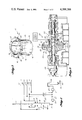
- FIG. 1 is a diagram of a blow line oxygen system using a refiner.
- FIG. 2 is an isometric view of a diffuser used with a refiner to add the oxygen to the refiner.
- FIGS. 3 and 4 are cross sections of refiners, each with the diffuser of FIG. 2.
- FIG. 1 is a diagram of part of a pulp mill.
- Chips 10, process water 11, steam 12 and pulping chemicals 13 are fed to the pulping section 14 of digester 15.
- the digester 15 is continuous in operation.
- the wood chips 10 may be treated prior to entering the digester 15. This is optional. Exemplary of such treatment are presteaming of the chips in a steaming vessel or impregnation of the chips with the digestion chemicals in an impregnation vessel prior to entering the digester.
- the chemicals 13 entering the digester will depend on the process being used, be it sulfate, sulfite, or soda.
- the chips will be cooked in the pulping section 14 under conditions appropriate to the chemicals, wood species and type, and size of chip. These conditions are well known.
- the products of the digestion process are the delignified or partially delignified wood chips, the spent pulping chemicals, and the lignin and carbohydrate products which have been removed from the wood chips in the digestion process.
- a major portion of the spent pulping chemicals and lignin products is removed from the chips prior to further processing.
- the chips are washed in the washing section of the digester. This is indicated by process water 16 entering and the effluent stream 17 leaving the washing stage 18 of digester 15.
- the effluent stream 17 will consist of the lignin and carbohydrates which have been removed from the chips during the digestion process and the spent digestion chemicals. This effluent will be carried to a treating facility. In the case of kraft or sulfate pulp this would be a recovery system in which the liquor is burned to recover the digestion chemicals for reuse.
- the chips will pass from the digester 15 through the blow line to storage or blow tank 24. It is customary in pulp mills to have storage tanks between processing steps so that the entire mill will not shut down if one section of the mill is shut down.
- Storage tank 24 is one such tank. It would be between the digester stage and the subsequent washing or bleaching stages.
- the storage tank 24 is open to the atmosphere and at atmospheric pressure. Line 25 and pump 26 carry the pulp from the tank 24.
- the material passing through the blow line is a slurry which contains the remaining lignin and carbohydrates, the spent digestion chemicals, and the fibers formed from the chips as they are blown from the digester.
- the chips will be formed into fibers when the pressure on the chips is released, usually at the exit of digester 15.
- additional fiberizing may be done by a refiner, or refiners, in the blow line.
- the refiners will fiberize the large particles that have not been reduced to fibers earlier in the process.
- the blow line is shown in three sections-section 19 between the digester 15 and refiner 20; section 22 between the refiners 20 and 21; and section 23 between the refiner 21 and the storage tank 24.
- Sodium hydroxide and steam are added to the pulp slurry in line 22 between refiners 20 and 21 or just in front of refiner 21.
- Sodium hydroxide which both adjusts the pH of the pulp and buffers the oxygen reaction, is added through line 28.
- Steam is added through line 29. The steam raises the temperature of the pulp to a temperature appropriate for the oxygenation.
- Oxygen is added to the pulp at the refiner through line 30.
- Line 31 carries process water to lines 11 and 16.
- Line 32 carries chemicals to line 13. It may represent a number of chemical lines.
- Line 33 carries alkali to line 28. If the same chemical is used as the alkali and as the digestion chemical, then this line and line 32 would be the same line.
- Line 34 carries steam to lines 12 and 29.
- Line 35 carries oxygen to line 30.
- FIGS. 2, 3 and 4 show our unit for providing better distribution of the oxygen.
- FIG. 2 shows the distribution unit by itself and
- FIGS. 3 and 4 show cross sections of refiners using the unit.
- the unit 40 consists of an inlet sleeve 41 which fits into the refiner casing inlet and is fixed in place by bolts which extend through holes 42 in flange 43.
- Each diffuser has an inlet section 45 and an outlet section 46.
- the inlet section 45 extends radially along the flange 43 and the outlet section 46 extends longitudinally of the sleeve 41.
- the tube may have any cross section. There are several ways of attaching the diffusers 44 to the sleeve and flange.
- the inlet section 45 may be along the interior or exterior face of flange 43, be fitted in recesses in the interior or exterior face of flange 43, or be within and formed by the walls of the flange. In the latter design, an outlet tube would extend radially from the flange 43 as shown in FIG. 2.
- the outlet section 46 could be affixed to the inner or outer wall of the sleeve 41, fitted into recesses in the inner or outer walls of the sleeve or be within and formed by the walls of the sleeve. They would be formed within and by the walls by casting when the sleeve and the flange are formed or by drilling through the wall.
- the preferred form is shown in FIG. 2.
- the inlet section 45 is formed in the flange and the outlet section 46 affixed to the inner wall of the sleeve.
- Each diffuser will have one or more outlets for oxygen. Six diffusers should adequately disperse the oxygen in the pulp.
- FIG. 3 the unit is shown with a refiner. A single disc refiner is shown. Only the major portions of the refiner are identified.
- the refiner 50 has an inlet 51, a screw conveyor section 52, a refiner section 53 and an outlet 54.
- the refiner shaft 55 is within the casing. Attached to the shaft are screw conveyor 56 and the revolving refiner member 57.
- the revolving refiner plate 58 is attached to member 57. Attached to the refiner casing 59 are the fixed refiner member 60 and the fixed refiner plate 61 which is aligned with revolving plate 58.
- the shaft 55, conveyor 56, revolving refiner member 57 and plate 58 are rotated by a suitable motor 62.
- the unit 40 would be part of the wear plate for the conveyer.
- the diffuser 44 would be recessed in the sleeve 41. This would allow the oxygen to be admitted after the conveyor section and as close as possible to the refiner plates so that there would be immediate mixing of the oxygen and pulp.
- Oxygen is fed to the diffusers through the oxygen manifold 64.
- the oxygen enters the diffusers 44 through the manifold 64 and is added to the pulp after the conveyer 56.
- the diffusers also dispense the oxygen finely and completely throughout the pulp.
- the oxygenated pulp leaves the refiner through the outlet 54.
- the blow line 22 is attached to inlet 51.
- FIG. 4 shows the use of unit 40 in a refiner that does not have a conveyer section.
- the reference numerals are the same as in FIG. 3.
- any type of refiner there is relative rotative movement between two opposed surfaces which are spaced to allow passage of material between them.
- Disc refiners are normally used because of the ability to change the clearance and pressure on the plates, depending on the furnish to the refiner and the end product desired.
- refiners There are other types of refiners that may be used.
- the rotating disc In the usual double disc refiners, the rotating disc has refiner plates on both faces which act against opposing fixed plates.
- Another type of double disc refiner has both refiner plates mounted on discs which rotate in opposite directions to provide both a rolling and an abrading action. The discs are mounted on separate shafts which may be concentric. A conical refiner may also be used.
- the diffuser unit may also be placed in the inlet of a mixing device.
- the refiner when stopped, may be used as a mixing device.
- the clearance between discs has been tested at around 13 mm and can be up to 75 mm. The clearance can be smaller. This clearance creates a mixing action between the pulp and oxygen.
Landscapes
- Engineering & Computer Science (AREA)
- Chemical & Material Sciences (AREA)
- Chemical Kinetics & Catalysis (AREA)
- General Chemical & Material Sciences (AREA)
- Life Sciences & Earth Sciences (AREA)
- Wood Science & Technology (AREA)
- Mechanical Engineering (AREA)
- Paper (AREA)
Priority Applications (3)
| Application Number | Priority Date | Filing Date | Title |
|---|---|---|---|
| US06/048,933 US4288288A (en) | 1979-06-15 | 1979-06-15 | Apparatus for mixing chemicals into pulp at a refiner inlet |
| CA000353685A CA1140537A (fr) | 1979-06-15 | 1980-06-10 | Melangeur a diffuseur d'admission a coudes multiples |
| NZ194039A NZ194039A (en) | 1979-06-15 | 1980-06-12 | Apparatus for adding chemicals to refiner pulp |
Applications Claiming Priority (1)
| Application Number | Priority Date | Filing Date | Title |
|---|---|---|---|
| US06/048,933 US4288288A (en) | 1979-06-15 | 1979-06-15 | Apparatus for mixing chemicals into pulp at a refiner inlet |
Publications (1)
| Publication Number | Publication Date |
|---|---|
| US4288288A true US4288288A (en) | 1981-09-08 |
Family
ID=21957224
Family Applications (1)
| Application Number | Title | Priority Date | Filing Date |
|---|---|---|---|
| US06/048,933 Expired - Lifetime US4288288A (en) | 1979-06-15 | 1979-06-15 | Apparatus for mixing chemicals into pulp at a refiner inlet |
Country Status (3)
| Country | Link |
|---|---|
| US (1) | US4288288A (fr) |
| CA (1) | CA1140537A (fr) |
| NZ (1) | NZ194039A (fr) |
Cited By (12)
| Publication number | Priority date | Publication date | Assignee | Title |
|---|---|---|---|---|
| US4339206A (en) * | 1979-11-27 | 1982-07-13 | Kamyr Ab | Mixing apparatus for mixing a fluid fiber suspension with a treatment fluid suspension |
| US4534397A (en) * | 1979-07-10 | 1985-08-13 | Aga Aktiebolag | Method for producing chemimechanical high yield pulp using an oxygen alkali treatment followed by an oxygen mechanical defibration |
| US4820381A (en) * | 1987-02-25 | 1989-04-11 | Internationa Paper Company | Pulp refiner with fluidizing inlet |
| US5200038A (en) * | 1985-08-28 | 1993-04-06 | International Paper Company | Pulp refiner with fluidizing inlet |
| US5260221A (en) * | 1989-03-16 | 1993-11-09 | Ramel Urs A | Sample pad assay initiation device |
| US5314583A (en) * | 1989-08-16 | 1994-05-24 | Maschinenfabrik Andritz Actiengesellschaft | Process for the comminution of materials and plant for carrying out the process |
| FR2701274A1 (fr) * | 1993-02-09 | 1994-08-12 | Air Liquide | Procédé de fabrication de pâtes à papier chimicothermomécaniques blanchies (CTMP). |
| US5746583A (en) * | 1995-01-20 | 1998-05-05 | Spear; Scott | Vacuum boost device |
| US5791778A (en) * | 1994-01-25 | 1998-08-11 | A. Ahlstrom Corporation | Method and apparatus for mixing gaseous chemical to fiber suspension |
| US6503466B1 (en) * | 1998-08-06 | 2003-01-07 | Voith Sulzer Paper Technology North America, Inc. | Apparatus and method for chemically loading fibers in a fiber suspension |
| US20050173082A1 (en) * | 1998-08-24 | 2005-08-11 | Arbozon Oy Ltd. | Bleaching of medium consistency pulp with ozone without high shear mixing |
| WO2010106220A1 (fr) * | 2009-03-17 | 2010-09-23 | Metso Paper, Inc. | Procédé, système et raffineur pour le raffinage de copeaux de bois ou de fibres de pâte à papier |
Citations (12)
| Publication number | Priority date | Publication date | Assignee | Title |
|---|---|---|---|---|
| US1960613A (en) * | 1931-01-13 | 1934-05-29 | Internat Bleaching Corp | Method for bleaching paper pulp |
| US1971241A (en) * | 1933-04-01 | 1934-08-21 | Pennsylvania Salt Mfg Co | Method of chlorination |
| US2641164A (en) * | 1946-07-08 | 1953-06-09 | Hill Harold Sanford | Method for processing fibrous pulp |
| US2717195A (en) * | 1954-08-02 | 1955-09-06 | Jackson And Church Company | Method for treating a fibrous material |
| US2964382A (en) * | 1958-04-04 | 1960-12-13 | Wyandotte Chemicals Corp | Production of precipitated calcium carbonate |
| US3384533A (en) * | 1963-09-19 | 1968-05-21 | Air Liquide | Delignification and bleaching of chemical and semichemical cellulose pulps with oxygen and catalyst |
| US3521864A (en) * | 1967-09-20 | 1970-07-28 | Welles Products Corp | Method and apparatus for controlling oxygen transfer and power requirements in a water aeration system |
| US3652386A (en) * | 1968-10-29 | 1972-03-28 | Mo Och Domsjoe Ab | Process for treating cellulosic materials with alkali and oxygen in the presence of complex magnesium salts |
| DE2441579A1 (de) * | 1973-09-03 | 1975-03-13 | Rauma Repola Oy | Verfahren und vorrichtung zur behandlung von zellulosemasse mit sauerstoff unter alkalischen bedingungen bei erhoehtem druck und erhoehter temperatur |
| US3881986A (en) * | 1965-02-25 | 1975-05-06 | Svenska Cellulosa Ab | Method of producing homogeneously delignified pulp from fibrous material, containing lignocellulose, in a digester partially filled with liquor |
| US4082233A (en) * | 1975-06-04 | 1978-04-04 | Rolf Bertil Reinhall | Disc refiner having means for removing gaseous media from pulp stock |
| US4093506A (en) * | 1975-03-14 | 1978-06-06 | Kamyr Aktiebolag | Method and apparatus for effecting even distribution and mixing of high consistency pulp and treatment fluid |
-
1979
- 1979-06-15 US US06/048,933 patent/US4288288A/en not_active Expired - Lifetime
-
1980
- 1980-06-10 CA CA000353685A patent/CA1140537A/fr not_active Expired
- 1980-06-12 NZ NZ194039A patent/NZ194039A/xx unknown
Patent Citations (12)
| Publication number | Priority date | Publication date | Assignee | Title |
|---|---|---|---|---|
| US1960613A (en) * | 1931-01-13 | 1934-05-29 | Internat Bleaching Corp | Method for bleaching paper pulp |
| US1971241A (en) * | 1933-04-01 | 1934-08-21 | Pennsylvania Salt Mfg Co | Method of chlorination |
| US2641164A (en) * | 1946-07-08 | 1953-06-09 | Hill Harold Sanford | Method for processing fibrous pulp |
| US2717195A (en) * | 1954-08-02 | 1955-09-06 | Jackson And Church Company | Method for treating a fibrous material |
| US2964382A (en) * | 1958-04-04 | 1960-12-13 | Wyandotte Chemicals Corp | Production of precipitated calcium carbonate |
| US3384533A (en) * | 1963-09-19 | 1968-05-21 | Air Liquide | Delignification and bleaching of chemical and semichemical cellulose pulps with oxygen and catalyst |
| US3881986A (en) * | 1965-02-25 | 1975-05-06 | Svenska Cellulosa Ab | Method of producing homogeneously delignified pulp from fibrous material, containing lignocellulose, in a digester partially filled with liquor |
| US3521864A (en) * | 1967-09-20 | 1970-07-28 | Welles Products Corp | Method and apparatus for controlling oxygen transfer and power requirements in a water aeration system |
| US3652386A (en) * | 1968-10-29 | 1972-03-28 | Mo Och Domsjoe Ab | Process for treating cellulosic materials with alkali and oxygen in the presence of complex magnesium salts |
| DE2441579A1 (de) * | 1973-09-03 | 1975-03-13 | Rauma Repola Oy | Verfahren und vorrichtung zur behandlung von zellulosemasse mit sauerstoff unter alkalischen bedingungen bei erhoehtem druck und erhoehter temperatur |
| US4093506A (en) * | 1975-03-14 | 1978-06-06 | Kamyr Aktiebolag | Method and apparatus for effecting even distribution and mixing of high consistency pulp and treatment fluid |
| US4082233A (en) * | 1975-06-04 | 1978-04-04 | Rolf Bertil Reinhall | Disc refiner having means for removing gaseous media from pulp stock |
Non-Patent Citations (3)
| Title |
|---|
| Jenkin, "Pilot and Commercial Results of Medium Consistency Chlorination", Bleaching Seminar on Chlorination and Caustic Extraction, Wash., D.C., 11-10-1977. * |
| Kleppe et al., "Oxygen/Alkali Delignification at Kamyr Digester Blowline Consistency-A Status Report", TAPPI, vol. 59, No. 11, pp. 77-80, Nov. 1976. * |
| Yrjala et al., "New Aspects in Oxygen Bleaching", Rauma-Repola Oy, Rauma, Finland, Apr. 18, 1974. * |
Cited By (15)
| Publication number | Priority date | Publication date | Assignee | Title |
|---|---|---|---|---|
| US4534397A (en) * | 1979-07-10 | 1985-08-13 | Aga Aktiebolag | Method for producing chemimechanical high yield pulp using an oxygen alkali treatment followed by an oxygen mechanical defibration |
| US4339206A (en) * | 1979-11-27 | 1982-07-13 | Kamyr Ab | Mixing apparatus for mixing a fluid fiber suspension with a treatment fluid suspension |
| US5200038A (en) * | 1985-08-28 | 1993-04-06 | International Paper Company | Pulp refiner with fluidizing inlet |
| US4820381A (en) * | 1987-02-25 | 1989-04-11 | Internationa Paper Company | Pulp refiner with fluidizing inlet |
| US5260221A (en) * | 1989-03-16 | 1993-11-09 | Ramel Urs A | Sample pad assay initiation device |
| USRE36033E (en) * | 1989-08-16 | 1999-01-12 | Maschinenfabrik Andritz Actiengesellschaft | Process for the comminution of materials and plants for carrying out the process |
| US5314583A (en) * | 1989-08-16 | 1994-05-24 | Maschinenfabrik Andritz Actiengesellschaft | Process for the comminution of materials and plant for carrying out the process |
| FR2701274A1 (fr) * | 1993-02-09 | 1994-08-12 | Air Liquide | Procédé de fabrication de pâtes à papier chimicothermomécaniques blanchies (CTMP). |
| WO1994018382A1 (fr) * | 1993-02-09 | 1994-08-18 | L'air Liquide, Societe Anonyme Pour L'etude Et L'exploitation Des Procedes Georges Claude | Procede de fabrication de pates a papier chimicothermomecaniques (ctmp) |
| US5791778A (en) * | 1994-01-25 | 1998-08-11 | A. Ahlstrom Corporation | Method and apparatus for mixing gaseous chemical to fiber suspension |
| US5746583A (en) * | 1995-01-20 | 1998-05-05 | Spear; Scott | Vacuum boost device |
| US6503466B1 (en) * | 1998-08-06 | 2003-01-07 | Voith Sulzer Paper Technology North America, Inc. | Apparatus and method for chemically loading fibers in a fiber suspension |
| US20050173082A1 (en) * | 1998-08-24 | 2005-08-11 | Arbozon Oy Ltd. | Bleaching of medium consistency pulp with ozone without high shear mixing |
| WO2010106220A1 (fr) * | 2009-03-17 | 2010-09-23 | Metso Paper, Inc. | Procédé, système et raffineur pour le raffinage de copeaux de bois ou de fibres de pâte à papier |
| CN102356194A (zh) * | 2009-03-17 | 2012-02-15 | 美卓造纸机械公司 | 用于对木片或浆纤维进行磨浆的方法、系统以及磨浆机 |
Also Published As
| Publication number | Publication date |
|---|---|
| CA1140537A (fr) | 1983-02-01 |
| NZ194039A (en) | 1982-12-21 |
Similar Documents
| Publication | Publication Date | Title |
|---|---|---|
| US4298426A (en) | Method and apparatus for treating pulp with oxygen in a multi-stage bleaching sequence | |
| US4295925A (en) | Treating pulp with oxygen | |
| US4295926A (en) | Method and apparatus for treating pulp with oxygen | |
| US4298427A (en) | Method and apparatus for intimately mixing oxygen and pulp while using an alkali to extract bleaching by-products | |
| US4294653A (en) | Process for manufacturing chemimechanical cellulose pulp in a high yield within the range from 65 to 95% | |
| US4248662A (en) | Oxygen pulping with recycled liquor | |
| US4303470A (en) | Method and apparatus for mixing gases with a wood pulp slurry | |
| US3773610A (en) | Pressurized system for pulp refining including pressurized double disk treatment | |
| EP1541753B1 (fr) | Blanchiment en raffineur avec hydroxyde ou oxyde de magnesium et ions de perhydroxyles | |
| US4288288A (en) | Apparatus for mixing chemicals into pulp at a refiner inlet | |
| US6245196B1 (en) | Method and apparatus for pulp yield enhancement | |
| CA2174875C (fr) | Methode et appareil pour faire de la pate a papier a partir de bran de scie | |
| US4295927A (en) | Method and apparatus for treating pulp with oxygen and storing the treated pulp | |
| US4619736A (en) | Apparatus for defiberizing, screening and pumping cellulose pulp or recycled paper | |
| EP0056263B1 (fr) | Procédé pour améliorer le lavage de pâtes cellulosiques préparées en partant d'une matière lignocellulosique | |
| CA2224685C (fr) | Procede et dispositif de traitement de la pate a papier dans un echangeur thermique indirect apres la reduction en pate | |
| US4002528A (en) | Apparatus for processing pulp | |
| CA1327474C (fr) | Processus de delignification approfondie dans des diffuseurs sous pression | |
| US5227021A (en) | Method for producing pulp using medium consistency mixer for defiberizing pulp | |
| FI74497C (fi) | Foerfarande foer blandning av kemikalier med massa av ved och vid foerfarandet anvaend blandare. | |
| US6113742A (en) | Digester having screening arrangement for isothermal cooking of fibrous material | |
| Andrews et al. | Extended delignification kraft pulping of softwoods-effect of treatments on chips and pulp with sulfide-containing liquors | |
| US5021127A (en) | Extended delignification in pressure diffusers | |
| US6315863B1 (en) | Chlorine dioxide pulp bleaching process having reduced barium scaling by recycling post-chlorination waste filtrate | |
| JPH0114357B2 (fr) |
Legal Events
| Date | Code | Title | Description |
|---|---|---|---|
| STCF | Information on status: patent grant |
Free format text: PATENTED CASE |