US4300633A - Method of cementing wells with foam-containing cement - Google Patents
Method of cementing wells with foam-containing cement Download PDFInfo
- Publication number
- US4300633A US4300633A US06/156,848 US15684880A US4300633A US 4300633 A US4300633 A US 4300633A US 15684880 A US15684880 A US 15684880A US 4300633 A US4300633 A US 4300633A
- Authority
- US
- United States
- Prior art keywords
- cement
- slurry
- gas
- cement slurry
- column
- Prior art date
- Legal status (The legal status is an assumption and is not a legal conclusion. Google has not performed a legal analysis and makes no representation as to the accuracy of the status listed.)
- Expired - Lifetime
Links
- 239000004568 cement Substances 0.000 title claims abstract description 168
- 239000006260 foam Substances 0.000 title claims abstract description 34
- 238000000034 method Methods 0.000 title claims description 17
- 239000002002 slurry Substances 0.000 claims abstract description 110
- 230000015572 biosynthetic process Effects 0.000 claims abstract description 39
- 230000002706 hydrostatic effect Effects 0.000 claims description 20
- 239000012530 fluid Substances 0.000 claims description 10
- 230000003068 static effect Effects 0.000 claims description 2
- 238000012544 monitoring process Methods 0.000 claims 1
- 230000000149 penetrating effect Effects 0.000 abstract description 3
- 239000007789 gas Substances 0.000 description 46
- 238000005755 formation reaction Methods 0.000 description 36
- IJGRMHOSHXDMSA-UHFFFAOYSA-N Atomic nitrogen Chemical compound N#N IJGRMHOSHXDMSA-UHFFFAOYSA-N 0.000 description 23
- 229910052757 nitrogen Inorganic materials 0.000 description 10
- 239000000126 substance Substances 0.000 description 9
- 239000003795 chemical substances by application Substances 0.000 description 8
- 239000008186 active pharmaceutical agent Substances 0.000 description 7
- 230000035699 permeability Effects 0.000 description 7
- XLYOFNOQVPJJNP-UHFFFAOYSA-N water Substances O XLYOFNOQVPJJNP-UHFFFAOYSA-N 0.000 description 7
- 238000005553 drilling Methods 0.000 description 5
- 239000013535 sea water Substances 0.000 description 5
- 238000010586 diagram Methods 0.000 description 4
- 229910001873 dinitrogen Inorganic materials 0.000 description 4
- 230000005484 gravity Effects 0.000 description 4
- 238000006243 chemical reaction Methods 0.000 description 3
- 239000004088 foaming agent Substances 0.000 description 3
- 239000000463 material Substances 0.000 description 3
- 239000003129 oil well Substances 0.000 description 3
- 238000007789 sealing Methods 0.000 description 3
- XAGFODPZIPBFFR-UHFFFAOYSA-N aluminium Chemical group [Al] XAGFODPZIPBFFR-UHFFFAOYSA-N 0.000 description 2
- 239000010426 asphalt Substances 0.000 description 2
- 238000004891 communication Methods 0.000 description 2
- 230000003247 decreasing effect Effects 0.000 description 2
- 239000006185 dispersion Substances 0.000 description 2
- 229930195733 hydrocarbon Natural products 0.000 description 2
- 150000002430 hydrocarbons Chemical class 0.000 description 2
- 238000002347 injection Methods 0.000 description 2
- 239000007924 injection Substances 0.000 description 2
- 150000002500 ions Chemical class 0.000 description 2
- 239000004094 surface-active agent Substances 0.000 description 2
- 239000000725 suspension Substances 0.000 description 2
- 238000011282 treatment Methods 0.000 description 2
- 239000004215 Carbon black (E152) Substances 0.000 description 1
- FAPWRFPIFSIZLT-UHFFFAOYSA-M Sodium chloride Chemical compound [Na+].[Cl-] FAPWRFPIFSIZLT-UHFFFAOYSA-M 0.000 description 1
- 241000364021 Tulsa Species 0.000 description 1
- YKTSYUJCYHOUJP-UHFFFAOYSA-N [O--].[Al+3].[Al+3].[O-][Si]([O-])([O-])[O-] Chemical compound [O--].[Al+3].[Al+3].[O-][Si]([O-])([O-])[O-] YKTSYUJCYHOUJP-UHFFFAOYSA-N 0.000 description 1
- 239000003513 alkali Substances 0.000 description 1
- 229910052782 aluminium Inorganic materials 0.000 description 1
- 239000003945 anionic surfactant Substances 0.000 description 1
- 229960000892 attapulgite Drugs 0.000 description 1
- 239000000440 bentonite Substances 0.000 description 1
- 229910000278 bentonite Inorganic materials 0.000 description 1
- SVPXDRXYRYOSEX-UHFFFAOYSA-N bentoquatam Chemical compound O.O=[Si]=O.O=[Al]O[Al]=O SVPXDRXYRYOSEX-UHFFFAOYSA-N 0.000 description 1
- 230000015556 catabolic process Effects 0.000 description 1
- 230000001413 cellular effect Effects 0.000 description 1
- 239000000919 ceramic Substances 0.000 description 1
- 239000004927 clay Substances 0.000 description 1
- 239000003245 coal Substances 0.000 description 1
- 150000001875 compounds Chemical class 0.000 description 1
- 239000004020 conductor Substances 0.000 description 1
- 238000005260 corrosion Methods 0.000 description 1
- 230000007797 corrosion Effects 0.000 description 1
- 239000000945 filler Substances 0.000 description 1
- 238000005187 foaming Methods 0.000 description 1
- 239000008187 granular material Substances 0.000 description 1
- 239000003112 inhibitor Substances 0.000 description 1
- 239000007788 liquid Substances 0.000 description 1
- 238000011089 mechanical engineering Methods 0.000 description 1
- 239000000203 mixture Substances 0.000 description 1
- 150000002892 organic cations Chemical class 0.000 description 1
- 229910052625 palygorskite Inorganic materials 0.000 description 1
- 239000002245 particle Substances 0.000 description 1
- 239000003208 petroleum Substances 0.000 description 1
- 238000005086 pumping Methods 0.000 description 1
- DAJSVUQLFFJUSX-UHFFFAOYSA-M sodium;dodecane-1-sulfonate Chemical group [Na+].CCCCCCCCCCCCS([O-])(=O)=O DAJSVUQLFFJUSX-UHFFFAOYSA-M 0.000 description 1
- 230000008023 solidification Effects 0.000 description 1
- 238000007711 solidification Methods 0.000 description 1
- 238000009834 vaporization Methods 0.000 description 1
- 230000008016 vaporization Effects 0.000 description 1
- 239000011800 void material Substances 0.000 description 1
- 239000003643 water by type Substances 0.000 description 1
Images


Classifications
-
- C—CHEMISTRY; METALLURGY
- C04—CEMENTS; CONCRETE; ARTIFICIAL STONE; CERAMICS; REFRACTORIES
- C04B—LIME, MAGNESIA; SLAG; CEMENTS; COMPOSITIONS THEREOF, e.g. MORTARS, CONCRETE OR LIKE BUILDING MATERIALS; ARTIFICIAL STONE; CERAMICS; REFRACTORIES; TREATMENT OF NATURAL STONE
- C04B38/00—Porous mortars, concrete, artificial stone or ceramic ware; Preparation thereof
- C04B38/007—Porous mortars, concrete, artificial stone or ceramic ware; Preparation thereof characterised by the pore distribution, e.g. inhomogeneous distribution of pores
-
- C—CHEMISTRY; METALLURGY
- C09—DYES; PAINTS; POLISHES; NATURAL RESINS; ADHESIVES; COMPOSITIONS NOT OTHERWISE PROVIDED FOR; APPLICATIONS OF MATERIALS NOT OTHERWISE PROVIDED FOR
- C09K—MATERIALS FOR MISCELLANEOUS APPLICATIONS, NOT PROVIDED FOR ELSEWHERE
- C09K8/00—Compositions for drilling of boreholes or wells; Compositions for treating boreholes or wells, e.g. for completion or for remedial operations
- C09K8/42—Compositions for cementing, e.g. for cementing casings into boreholes; Compositions for plugging, e.g. for killing wells
- C09K8/46—Compositions for cementing, e.g. for cementing casings into boreholes; Compositions for plugging, e.g. for killing wells containing inorganic binders, e.g. Portland cement
-
- C—CHEMISTRY; METALLURGY
- C09—DYES; PAINTS; POLISHES; NATURAL RESINS; ADHESIVES; COMPOSITIONS NOT OTHERWISE PROVIDED FOR; APPLICATIONS OF MATERIALS NOT OTHERWISE PROVIDED FOR
- C09K—MATERIALS FOR MISCELLANEOUS APPLICATIONS, NOT PROVIDED FOR ELSEWHERE
- C09K8/00—Compositions for drilling of boreholes or wells; Compositions for treating boreholes or wells, e.g. for completion or for remedial operations
- C09K8/42—Compositions for cementing, e.g. for cementing casings into boreholes; Compositions for plugging, e.g. for killing wells
- C09K8/46—Compositions for cementing, e.g. for cementing casings into boreholes; Compositions for plugging, e.g. for killing wells containing inorganic binders, e.g. Portland cement
- C09K8/467—Compositions for cementing, e.g. for cementing casings into boreholes; Compositions for plugging, e.g. for killing wells containing inorganic binders, e.g. Portland cement containing additives for specific purposes
- C09K8/473—Density reducing additives, e.g. for obtaining foamed cement compositions
-
- E—FIXED CONSTRUCTIONS
- E21—EARTH OR ROCK DRILLING; MINING
- E21B—EARTH OR ROCK DRILLING; OBTAINING OIL, GAS, WATER, SOLUBLE OR MELTABLE MATERIALS OR A SLURRY OF MINERALS FROM WELLS
- E21B33/00—Sealing or packing boreholes or wells
- E21B33/10—Sealing or packing boreholes or wells in the borehole
- E21B33/13—Methods or devices for cementing, for plugging holes, crevices or the like
- E21B33/14—Methods or devices for cementing, for plugging holes, crevices or the like for cementing casings into boreholes
Definitions
- the present invention relates to a method of cementing wells, such as oil wells, gas wells or water wells penetrating underground formations.
- a cement slurry is placed in the annular space and the cement, after setting thereof, will seal the passage through the annulus and bond the casing string to the wall of the well.
- the cement slurry may be pumped directly into the annulus, or may first be passed downwards through the casing string (or through a special cementing tube suspended in the string) and subsequently upwards through the annular space around the casing string.
- the cement slurries of the lightweight type have a density that is considerably lower than the density of the normal cement slurries, such as in the range of 900-1900 kg/m 3 , whereas the density of a normal cement slurry is about 1920 kg/m 3 .
- the density decrease of cements is often obtained by adding granular material of low density to a pumpable cement slurry.
- granular material of low density may be bentonite, coal, asphalt, fired clay and void-containing particles that cannot be wetted by water (such as hollow sealed ceramic spheres). Care should then be taken that the compressive strength of the cement after setting is not decreased to an undesirable extent.
- Another attractive manner of reducing the density of a cement slurry is by adding gas (such as air and nitrogen) to the cement slurry in a manner such that the gas forms a fine dispersion in the slurry, which dispersion may be stabilized by means of suitable foaming agents.
- gas such as air and nitrogen
- 3,926,257 suggests sealing along such gas sands with a cement slurry which contains a surfactant for converting any gas which diffuses into the slurry into an immobile foam.
- Numerous U.S. Pat. Nos. such as 2,191,555; 2,163,207; 2,371,928; 2,228,556; 3,591,394 and British No. 1,541,129, describe various ways of generating gas within a cement slurry in order to form a foam cement suitable as a lightweight porous cement, a permeable cement, a pre-stressed cement, a non-shrinking cement and the like. Paper No. 75-PET-10 by B. H. Aldrich and B. J.
- the object of the invention is to provide a method of cementing a well in a formation that is prone to fracturing, by means of a lightweight foam cement slurry, whereby an optimal strength of the set cement column will be obtained.
- the method according to the invention of cementing the annulus around a pipe or casing string in a well penetrating an underground formation includes the steps of placing a column of foam-containing cement slurry in the annulus and allowing the cement slurry to set.
- the hydrostatic pressure at each depth within the column of cement slurry is less than the fracturing pressure but more than the fluid pressure in the formation at the same depth.
- the volume of gas contained in the foamed cement slurry and the column of set cement is such that the density of the cement column is greater in the lower region than in the upper region.
- the density of the cement column may increase gradually or incrementally from the top of the cement column to the lower region thereof.
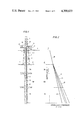
- FIG. 1 is a schematic illustration of a well and the subterranean formations encountered by a marine well.
- FIG. 2 shows a plot of the variations of hydrostatic pressures of various fluids with depth below sea level at the location illustrated by FIG. 1.
- FIG. 3 shows the variation with depth of the porosity of various foam cements in a typical subterranean environment.
- FIG. 4 shows the variations in specific gravity with depths of various foam cements in a similar environment.
- FIG. 5 shows the gradients of fracturing pressures, foamed and unfoamed cements and sea waters in typical offshore subterranean formations.
- FIG. 6 shows the variation with depth in the porosity of various cements in relatively small portions of typical offshore subterranean earth formations.
- the present invention is at least in part premised on the discovery that the interrelationship of the fluid pressure gradients and fracturing pressure gradients within subterranean earth formations and the physical and chemical properties of foamed and conventional cement slurries makes it feasible and advantageous to use the following process for flowing a cement slurry into a well so that the slurry forms a column within an annulus around a pipe which is to be bonded to the adjacent earth formations.
- the amount of gas or gas-forming chemicals contained in the cement slurry being flowed into the well is adjusted so that, within the annulus, (a) at least near the top of the column, the cement slurry comprises a foam, (b) the largest proportion of gas or gas-forming chemicals included within any portion of the inflowing cement slurry is insufficient to form a cement having a porosity of more than about 52%, (c) prior to the setting of the cement, the hydrostatic pressure within the cement slurry is, at each depth, greater than the formation fluid pressure but less than the fracturing pressure of the adjacent earth formations and (d) after setting, the cement is, at each depth, strong enough to sustain the stresses to which it is subjected.
- the so-inflowed cement slurry and the pipe it surrounds are kept substantially static during the setting of the cement.
- the proportion of the gas being added is adjusted to the extent necessary to ensure that the column of cement slurry which is formed in the annulus: contains foam near the top of the column; is free of any portion having a porosity exceeding about 52%; provides a hydrostatic pressure which exceeds the formation fluid pressure at each depth, without exceeding the formation fracturing pressure at any depth; and is capable of setting to a cement which, at each depth, is strong enough to sustain the stresses to which it is subjected.
- the foaming agents used in a foam cement slurry must be active in the highly alkaline environment of the cement and show resistance to bivalent organic cations if seawater is used as make up water for the cement slurry.
- Anionic surfactants with the general formula [C n H m --SO 3 ] - and [C n H m --O--SO 3 ] - with alkali ions as counter ions, n and m being in the range of 12-40, have been found to be particularly suitable.
- An example of a surfactant with very good performance is sodium lauryl sulphonate sold under the trade name Elfan OS 46 by AKZO.
- gas generating chemicals may be added to the slurry. Such chemicals may start the generation of gas during the introduction of the slurry into the well.
- the proportion and reaction rates of such chemicals should be such that the amounts of gas present in the slurry when the slurry is in the annulus are sufficient to reduce the density of the slurry to an extent required to obviate fracturing of the formations surrounding the well.
- the variation is such that the density and porosity gradients of the set cement tend to remain substantially constant over the height of the cement column.
- a foam cement slurry of extremely low density should be applied to obviate fracturing. It has been experienced, however, that the foam cement with extremely low density may have--after setting thereof--insufficient strength for meeting the requirements that are to be fulfilled at the lower end of the cemented tubing or casing. Low strength foam cement at this level may be cracked when the drilling proceeds through the cemented tubing or casing to deeper levels. Further, the properties of such a low-strength foam cements may be insufficient to meet the requirements in a fluid productive interval in which fluids are to be recovered from an underground formation.
- the present invention includes the steps of flowing a volume of a settable cement slurry into the annulus while continuously adding gas to the slurry so as to form a foam cement slurry, the gas being added at a pressure sufficient to enter the slurry flow at a rate such that the density of the column of cement in the annulus increases in a downward direction, and allowing the foam cement slurry to solidify in the annulus.
- a method of cementing the annulus around a casing string in a well includes the steps of flowing a volume of settable cement slurry into the well, the slurry containing chemicals generating gas in the slurry thereby forming a foam cement slurry which when present in the annulus forms a cement column with a density increasing from the top of the column to the bottom thereof, and having a hydrostatic pressure at the bottom that is less than the fracturing pressure at the level of the said bottom, and allowing the cement in the column to set.
- the cement column obtained by application of the present invention have sufficient strength in the lower region thereof so as to meet the conditions existing at the lower end of the casing, and at the same time give an adequate support to the casing string at a fracture gradient that is sufficiently low to obviate formation fracturing.
- the overburden pressures and fracturing pressures tend to be relatively high and it may be desirable to inflow a portion of cement slurry containing little or no gas or gas-forming material to be placed at or near the bottom of the interval being cemented.
- FIG. 1 shows a structure 1 supported on the seabottom 2.
- the structure 1 supports a platform 3 at some distance above the sea level 4.
- a drilling rig 5 is carried by the platform 3, and a hole 6 has been drilled in the formations 7A, 7B and 7C below the sea bottom 2.
- This hole has been drilled by drilling equipment (not shown) such as a drill string with a drill bit attached thereto which is lowered into the formations 7 via the conductor string 8 that is supported from the platform 3.
- the drilling equipment is lifted from the hole 6 and a casing string 9 is lowered into the hole and suspended from the platform 3. Details of the suspension of the casing string 9 are not shown since such suspensions are known per se.
- the inlet to the casing string 9 is subsequently brought into communication with a cement pump 11 via a conduit 10.
- the pump can draw cement slurry from a (not shown) suitable source of cement slurry.
- High pressure vessels 12 containing nitrogen under pressure are in communication with the conduit 10 by means of a pipe 13 provided with a valve 14. If the vessels contain liquid nitrogen, suitable vaporization units are installed between the vessels and the entry of the pipe 13 to the conduit 10.
- a cement slurry of a suitable composition is then forced by the pump 11 into the casing string 9 via the conduit 10. Simultaneously therewith, nitrogen gas is supplied to the flow of cement slurry in the conduit 10 at a pressure sufficient to enter the cement slurry flow in the conduit 10.
- suitable mixing means may be installed and suitable foaming agents may be added to promote the formation of a homogeneous gas-containing foam cement slurry, that passes down the casing 9.
- the nitrogen gas supply to the conduit 10 is controlled by the valve 14 in the pipe 13 in a manner such that the ratio between the flow rate of the cement slurry leaving the pump 11 and the flow rate of the nitrogen gas passing through the pipe 13 is kept substantially constant.
- the gas present in the foam cement slurry will be compressed during the travel of the slurry to the lower end of the casing 9 since the hydrostatic pressure increases in the direction of travel.
- the gas expands again.
- the pressure on the gas bubbles in the foam cement column increases gradually from the top of the cement column to the bottom thereof. Since the gas/cement ratio of the slurry at injection thereof in to the casing 9 was kept substantially constant, the density of the cement column in the annulus 15 will gradually increase from the top of the column down to the bottom thereof.
- the compressive strength of the foam cement after setting will increase from the top of the column down to the bottom thereof.
- the compressive strength of the set cement in the region of the lower end of the column can be sufficiently high for the purpose intended (such as for drilling through in a tophole or intermediate string cementing job, or for completion procedures when the lower end of the column is at the level of a hydrocarbon fluid producing formation), whereas the compressive strength of the cement in the upper parts of the column, which is not subjected to high loads, is relatively low. It will be appreciated that although a dense cement is so placed in the lower end of the column, the hydrostatic pressure in the column prior to setting of the cement has not exceeded the fracturing pressure of the formation.
- curve A indicates the hydrostatic pressure prevailing at the various levels in the foam cement column present in the annulus 15 prior to setting.
- the hydrostatic pressure P is indicated along the horizontal axis
- the depth level L below the sea level 4 is indicated along the vertical axis of the diagram.
- the density of the foam cement in the column is in the lower region thereof higher than at the levels near the top thereof. The density increases gradually from the top to the bottom of the column.
- the straight line B in the diagram of FIG. 2 indicates the hydrostatic pressure in the well 6 when it contains sea water over the full height thereof.
- the straight line C indicates the pressure at which the formations 7 will fracture
- the straight line D indicates the hydrostatic pressure that would prevail in the cement column in the annulus if no gas would have been added to the cement.
- the cement slurry that has been treated to form a gas-containing foam slurry having a substantially constant amount of gas (measured at standard conditions) per unit volume of cement will, when present in the annulus, form a cement column wherein the hydrostatic pressure varies in accordance with the curve A. At any level in the well, this pressure should be lower than the pressure at which fracturing will occur. Moreover, the column has its maximum density, and consequently its greatest compressive strength, at the bottom part thereof. As has already been explained above, this large compressive strength at the lower levels of the well is advantageous in view of the treatments that are to be carried out at these levels after the cement column has set.
- the method according to the invention may also be carried out by varying the amount of gas supplied per unit volume of cement that is supplied to the well.
- the variations in the amount of gas are chosen such that the density of the foam cement column in the annulus increases in the downward direction, and the hydrostatic pressure at the bottom of the column is less than the fracturing pressure of the formation at that level.
- Any gas other than nitrogen gas as described with reference to FIG. 1 may be used for carrying out the present cementing method, such as pressurized air that is supplied to the cement conduit 10 (or to a foam generating unit that is inserted in this conduit) from a compressor unit.
- the gas may be generated by chemicals that are mixed with cement slurry prior to injecting the slurry into the well.
- Gas-generating agents for use in forming foam cement are known per se and are therefore not described in detail.
- a suitable agent for this purpose is aluminum powder that may be mixed with dry cement prior to forming the cement slurry by the addition of water. It will be appreciated, however, that application of the method according to the present invention is not restricted to the use of aluminum as a gas-generating agent, nor to any other type of gas-generating agent or means.
- the reaction rate of the gas-generating agents should be controlled (if necessary by adding a reaction rate controller) so that essentially all of the gas has been generated prior to the moment that the total cement column is present in the annulus.
- the amounts of the gas-generating agents present per unit volume of cement slurry should be controlled so that the density of the cement column at the top thereof is smaller than the density at the lower region thereof, and that the hydrostatic pressure at the lower region is lower than the fracturing pressure of the formation at the level of that region. Attractive results will be obtained by controlling the supply of chemicals to the cement in a manner such that the column of foam cement slurry in the annulus has a density that gradually increases from the top of the column to the bottom thereof.
- the amount of gas-generating agents per unit volume of cement slurry, that are present in or supplied to the cement slurry that is passed into the well may either be kept substantially constant (as a result whereof the density will gradually increase in a downward direction) or be varied (gradually or stepwise), provided that the variation is such that the density of the cement column increases in a downward direction and that the hydrostatic pressure at the lower region is lower than the fracturing pressure of the formation at the level of that region, i.e., where the inclusion of gas or gas-generating agents with the inflowing cement slurry is terminated, such a termination should be made in the portion which will be placed at the bottom of the column of cement slurry.
- the cement slurry when in place in the annulus is kept stationary until solidification of the cement has taken place.
- the solidified cement column in the annulus has a density that is relatively high near the bottom of the column and relatively low near the top thereof.
- the compressive strength of the column is largest in the region of the lower parts thereof.
- the density of the cement slurry at the sea-bed should substantially equal that of sea-water; this should prevent formation breakdown.
- the porosity of any foamed cement should not exceed about 52%; since it is known that there is a jump from a negligible permeability to a high permeability when the porosity is increased above 52%.
- the gas used to foam the cement is a substantially weightless ideal gas and is insoluble in the cement slurry.
- the fracture gradient of the formation is 13.6 kPa/m(0.6 psi/ft).
- Libit-G e.g., as described in U.S. Pat. No. 3,887,385
- Pozmix e.g., as described in U.S. Pat. No. 3,887,385
- API cement slurry e.g., as described in U.S. Pat. No. 3,887,385
- the specific gravities of their neat (unfoamed) slurries are 1.31, 1.60 and 1.91, respectively.
- this cementation would require 700 ⁇ 10 3 l (28 ⁇ 10 3 SCF) nitrogen delivered at 343 l/s (823 SCF/min).
- This rate is well within the capability of existing liquid-nitrogen units which are currently used in oil and gasfield operations.
- Such a supply unit has a nitrogen capacity of 4.65 ⁇ 10 6 l (186,000 SCF), which it can discharge at rates up to 2.5 ⁇ 10 3 -13.75 ⁇ 10 3 l/s (6,000 to 33,000 SCF/min), at pressures up to 69,000 kPa (10,000 psi) and at temperatures between -1° C. and 93° C. (30° F. and 200° F.).
- FIG. 3 shows that the porosity of a foamed Libit cement increases from 10% at the shoe to 21% at the sea bed.
- FIG. 4 shows that the specific gravity of the slurry correspondingly decreased from 1.18 to 1.04.
- FIG. 5 shows how the foamed Libit hydrostatic gradient falls further below the fracture gradient than that of the neat Libit slurry. Both neat Pozmix and API cement slurries would fracture this formation, whereas their foamed slurries would not.
- Pozmix and API slurries foamed to the specific gravity of sea water have porosities of 35% and 46%, respectively (FIG. 3). These are well below the 52% limit for reliable strength. From a compressive strength point of view, the API cement would probably be preferable to the other two possibilities, although the gas requirements would be greater.
- Example 4 is similar to Example 3, except that the sea depth is reduced from 610 m to 91 m (2,000 to 300 ft) and the shoe depth from 1,220 m to 305 m (4,000 to 1,000 ft). This could correspond to a 20" casing cementation.
- Example 3 The results are generally similar to those of Example 3 and are illustrated by FIG. 6. There are, however, differences of note.
- the variation in the densities of the foamed cements with depth is greater than in Example 3 and the foamed API cement would exceed the fracture gradient.
- such a problem can be overcome by increasing the gas-injection rate/gas content of the slurry below 244 m (800 ft).
- the porosity is instantaneously increased at 244 m (800 ft) from 15 to 30% (FIG. 6), with a corresponding decrease in the hydrostatic pressure.
Landscapes
- Chemical & Material Sciences (AREA)
- Life Sciences & Earth Sciences (AREA)
- Engineering & Computer Science (AREA)
- General Life Sciences & Earth Sciences (AREA)
- Organic Chemistry (AREA)
- Materials Engineering (AREA)
- Inorganic Chemistry (AREA)
- Ceramic Engineering (AREA)
- Geology (AREA)
- Mining & Mineral Resources (AREA)
- Fluid Mechanics (AREA)
- Geochemistry & Mineralogy (AREA)
- Physics & Mathematics (AREA)
- Environmental & Geological Engineering (AREA)
- Structural Engineering (AREA)
- Consolidation Of Soil By Introduction Of Solidifying Substances Into Soil (AREA)
- Curing Cements, Concrete, And Artificial Stone (AREA)
- Processing Of Solid Wastes (AREA)
Applications Claiming Priority (2)
| Application Number | Priority Date | Filing Date | Title |
|---|---|---|---|
| GB7941635A GB2063962B (en) | 1979-12-03 | 1979-12-03 | Method of cementing wells |
| GB41635/79 | 1979-12-03 |
Publications (1)
| Publication Number | Publication Date |
|---|---|
| US4300633A true US4300633A (en) | 1981-11-17 |
Family
ID=10509574
Family Applications (1)
| Application Number | Title | Priority Date | Filing Date |
|---|---|---|---|
| US06/156,848 Expired - Lifetime US4300633A (en) | 1979-12-03 | 1980-06-05 | Method of cementing wells with foam-containing cement |
Country Status (7)
| Country | Link |
|---|---|
| US (1) | US4300633A (fr) |
| AU (1) | AU538586B2 (fr) |
| CA (1) | CA1149732A (fr) |
| DK (1) | DK510280A (fr) |
| GB (1) | GB2063962B (fr) |
| MY (1) | MY8500918A (fr) |
| NO (1) | NO803618L (fr) |
Cited By (42)
| Publication number | Priority date | Publication date | Assignee | Title |
|---|---|---|---|---|
| US4466833A (en) * | 1982-04-30 | 1984-08-21 | The Dow Chemical Company | Lightweight cement slurry and method of use |
| US4797003A (en) * | 1987-04-22 | 1989-01-10 | Dowell Schlumberger Incorporated | Foamed slurry generator |
| US5020594A (en) * | 1990-06-28 | 1991-06-04 | Sans. Gas. Inc. | Method to prevent gas intrusion into wellbores during setting of cements |
| US5133409A (en) * | 1990-12-12 | 1992-07-28 | Halliburton Company | Foamed well cementing compositions and methods |
| US5213161A (en) * | 1992-02-19 | 1993-05-25 | Halliburton Company | Well cementing method using acid removable low density well cement compositions |
| US5220960A (en) * | 1992-02-19 | 1993-06-22 | Halliburton Company | Retarded acid soluble well cement compositions and methods |
| US5281270A (en) * | 1992-02-19 | 1994-01-25 | Halliburton Company | Retarded acid soluble well cement compositions and methods |
| US5696174A (en) * | 1995-02-14 | 1997-12-09 | Allied Foam Tech Corporation | Stable and water-resistant aqueous foam composition |
| US6145591A (en) * | 1997-12-12 | 2000-11-14 | Bj Services Company | Method and compositions for use in cementing |
| US6230804B1 (en) | 1997-12-19 | 2001-05-15 | Bj Services Company | Stress resistant cement compositions and methods for using same |
| US6508305B1 (en) | 1999-09-16 | 2003-01-21 | Bj Services Company | Compositions and methods for cementing using elastic particles |
| US6626243B1 (en) | 1999-08-24 | 2003-09-30 | Bj Services Company | Methods and compositions for use in cementing in cold environments |
| US6729405B2 (en) | 2001-02-15 | 2004-05-04 | Bj Services Company | High temperature flexible cementing compositions and methods for using same |
| US20040177962A1 (en) * | 2003-03-12 | 2004-09-16 | Bour Daniel L. | Reverse circulation cementing system and method |
| US20050077045A1 (en) * | 2003-10-10 | 2005-04-14 | Jiten Chatterj | Methods of cementing subterranean zones with cement compositions having enhanced compressive strengths |
| US20050166902A1 (en) * | 2004-01-30 | 2005-08-04 | Siemens Vdo Automotive Corporation | Coupling valve structure for fuel supply module |
| US20060016600A1 (en) * | 2004-07-22 | 2006-01-26 | Badalamenti Anthony M | Methods and systems for cementing wells that lack surface casing |
| WO2006008475A1 (fr) * | 2004-07-22 | 2006-01-26 | Halliburton Energy Services, Inc. | Procedes et systemes de cimentation permettant d'amorcer un ecoulement de fluide avec une pression de pompage reduite |
| US20060042798A1 (en) * | 2004-08-30 | 2006-03-02 | Badalamenti Anthony M | Casing shoes and methods of reverse-circulation cementing of casing |
| US20060086503A1 (en) * | 2004-10-26 | 2006-04-27 | Halliburton Energy Services | Casing strings and methods of using such strings in subterranean cementing operations |
| US20060086502A1 (en) * | 2004-10-26 | 2006-04-27 | Halliburton Energy Services | Casing strings and methods of using such strings in subterranean cementing operations |
| US20060131018A1 (en) * | 2004-12-16 | 2006-06-22 | Halliburton Energy Services, Inc. | Apparatus and method for reverse circulation cementing a casing in an open-hole wellbore |
| US20060169176A1 (en) * | 2003-11-12 | 2006-08-03 | Reddy B Raghava | Processes for incorporating inert gas in a cement composition containing spherical beads |
| US20070089678A1 (en) * | 2005-10-21 | 2007-04-26 | Petstages, Inc. | Pet feeding apparatus having adjustable elevation |
| US20070137870A1 (en) * | 2005-12-20 | 2007-06-21 | Griffith James E | Method and means to seal the casing-by-casing annulus at the surface for reverse circulation cement jobs |
| US20070164364A1 (en) * | 2006-01-06 | 2007-07-19 | Hirohisa Kawasaki | Semiconductor device using sige for substrate and method for fabricating the same |
| US7270183B2 (en) | 2004-11-16 | 2007-09-18 | Halliburton Energy Services, Inc. | Cementing methods using compressible cement compositions |
| US7303008B2 (en) | 2004-10-26 | 2007-12-04 | Halliburton Energy Services, Inc. | Methods and systems for reverse-circulation cementing in subterranean formations |
| US20080083535A1 (en) * | 2006-10-06 | 2008-04-10 | Donald Winslow | Methods and Apparatus for Completion of Well Bores |
| US7357181B2 (en) | 2005-09-20 | 2008-04-15 | Halliburton Energy Services, Inc. | Apparatus for autofill deactivation of float equipment and method of reverse cementing |
| US7533728B2 (en) | 2007-01-04 | 2009-05-19 | Halliburton Energy Services, Inc. | Ball operated back pressure valve |
| US7533729B2 (en) | 2005-11-01 | 2009-05-19 | Halliburton Energy Services, Inc. | Reverse cementing float equipment |
| US7614451B2 (en) | 2007-02-16 | 2009-11-10 | Halliburton Energy Services, Inc. | Method for constructing and treating subterranean formations |
| US7647969B1 (en) * | 2003-07-07 | 2010-01-19 | Hill Gilman A | Method for growth of a hydraulic fracture along a well bore annulus and creating a permeable well bore annulus |
| US7654324B2 (en) | 2007-07-16 | 2010-02-02 | Halliburton Energy Services, Inc. | Reverse-circulation cementing of surface casing |
| CN103541679A (zh) * | 2013-10-16 | 2014-01-29 | 中国矿业大学 | 煤矿井下水力压裂钻孔组合式封孔方法 |
| CN110776902A (zh) * | 2019-10-31 | 2020-02-11 | 西安石油大学 | 一种开孔泡沫水泥压裂液及其制备方法和利用其构筑压裂储层的方法 |
| CN110862809A (zh) * | 2019-12-03 | 2020-03-06 | 中国石油化工股份有限公司 | 一种固体泡沫调剖组合物、固体泡沫调剖浆料及其制备方法、调剖方法 |
| CN111963150A (zh) * | 2020-08-27 | 2020-11-20 | 安徽理工大学 | 一种煤层瓦斯压力测定装置及使用方法 |
| WO2023224793A1 (fr) * | 2022-05-19 | 2023-11-23 | Baker Hughes Oilfield Operations Llc | Système de cimentation expansée comprenant une alimentation en gaz automatisée |
| CN117266161A (zh) * | 2023-09-25 | 2023-12-22 | 浙江大学 | 一种自钻进式加气轻质水泥土mjs装置及其施工方法 |
| CN117350084A (zh) * | 2023-12-05 | 2024-01-05 | 中国石油大学(华东) | 适于深水浅层的强度梯度固井安全性能评价方法 |
Families Citing this family (1)
| Publication number | Priority date | Publication date | Assignee | Title |
|---|---|---|---|---|
| US4437520A (en) | 1981-06-15 | 1984-03-20 | In Situ Technology, Inc. | Method for minimizing subsidence effects during production of coal in situ |
Citations (7)
| Publication number | Priority date | Publication date | Assignee | Title |
|---|---|---|---|---|
| US2236987A (en) * | 1939-01-04 | 1941-04-01 | California Portland Cement Co | Method of cementing wells |
| US2288556A (en) * | 1939-06-28 | 1942-06-30 | Gulf Research Development Co | Method of and composition for producing permeable packs in wells |
| US3098754A (en) * | 1959-01-23 | 1963-07-23 | Phillips Petroleum Co | Method for preparing cellular cement |
| US3573941A (en) * | 1967-03-30 | 1971-04-06 | Bp Chem Int Ltd | Expanded magnesia cement |
| US3798186A (en) * | 1968-03-21 | 1974-03-19 | Takenaka Komuten Co | Composition for plugging formations having pores in constructive works |
| US3926257A (en) * | 1973-05-18 | 1975-12-16 | Gaz De France | Well cementing processes |
| US4234344A (en) * | 1979-05-18 | 1980-11-18 | Halliburton Company | Lightweight cement and method of cementing therewith |
-
1979
- 1979-12-03 GB GB7941635A patent/GB2063962B/en not_active Expired
-
1980
- 1980-06-05 US US06/156,848 patent/US4300633A/en not_active Expired - Lifetime
- 1980-10-16 CA CA000362573A patent/CA1149732A/fr not_active Expired
- 1980-12-01 DK DK510280A patent/DK510280A/da not_active Application Discontinuation
- 1980-12-01 AU AU64945/80A patent/AU538586B2/en not_active Ceased
- 1980-12-01 NO NO803618A patent/NO803618L/no unknown
-
1985
- 1985-12-30 MY MY918/85A patent/MY8500918A/xx unknown
Patent Citations (7)
| Publication number | Priority date | Publication date | Assignee | Title |
|---|---|---|---|---|
| US2236987A (en) * | 1939-01-04 | 1941-04-01 | California Portland Cement Co | Method of cementing wells |
| US2288556A (en) * | 1939-06-28 | 1942-06-30 | Gulf Research Development Co | Method of and composition for producing permeable packs in wells |
| US3098754A (en) * | 1959-01-23 | 1963-07-23 | Phillips Petroleum Co | Method for preparing cellular cement |
| US3573941A (en) * | 1967-03-30 | 1971-04-06 | Bp Chem Int Ltd | Expanded magnesia cement |
| US3798186A (en) * | 1968-03-21 | 1974-03-19 | Takenaka Komuten Co | Composition for plugging formations having pores in constructive works |
| US3926257A (en) * | 1973-05-18 | 1975-12-16 | Gaz De France | Well cementing processes |
| US4234344A (en) * | 1979-05-18 | 1980-11-18 | Halliburton Company | Lightweight cement and method of cementing therewith |
Non-Patent Citations (1)
| Title |
|---|
| Aldrich et al., "Strength Permeabilities and Porosity of Oilwell Foam Cement", Journal of Engineering for Industry, Aug. 1976, pp. 1103-1106. |
Cited By (74)
| Publication number | Priority date | Publication date | Assignee | Title |
|---|---|---|---|---|
| US4466833A (en) * | 1982-04-30 | 1984-08-21 | The Dow Chemical Company | Lightweight cement slurry and method of use |
| US4797003A (en) * | 1987-04-22 | 1989-01-10 | Dowell Schlumberger Incorporated | Foamed slurry generator |
| US5020594A (en) * | 1990-06-28 | 1991-06-04 | Sans. Gas. Inc. | Method to prevent gas intrusion into wellbores during setting of cements |
| US5133409A (en) * | 1990-12-12 | 1992-07-28 | Halliburton Company | Foamed well cementing compositions and methods |
| US5281270A (en) * | 1992-02-19 | 1994-01-25 | Halliburton Company | Retarded acid soluble well cement compositions and methods |
| US5220960A (en) * | 1992-02-19 | 1993-06-22 | Halliburton Company | Retarded acid soluble well cement compositions and methods |
| US5213161A (en) * | 1992-02-19 | 1993-05-25 | Halliburton Company | Well cementing method using acid removable low density well cement compositions |
| US5298069A (en) * | 1992-02-19 | 1994-03-29 | Halliburton Company | Acid removable low density well cement compositions and methods |
| US5696174A (en) * | 1995-02-14 | 1997-12-09 | Allied Foam Tech Corporation | Stable and water-resistant aqueous foam composition |
| US6145591A (en) * | 1997-12-12 | 2000-11-14 | Bj Services Company | Method and compositions for use in cementing |
| US6230804B1 (en) | 1997-12-19 | 2001-05-15 | Bj Services Company | Stress resistant cement compositions and methods for using same |
| US6626243B1 (en) | 1999-08-24 | 2003-09-30 | Bj Services Company | Methods and compositions for use in cementing in cold environments |
| US6508305B1 (en) | 1999-09-16 | 2003-01-21 | Bj Services Company | Compositions and methods for cementing using elastic particles |
| US20040194960A1 (en) * | 2001-02-15 | 2004-10-07 | Bj Services Company | High temperature flexible cementing compositions and methods for using the same |
| US6729405B2 (en) | 2001-02-15 | 2004-05-04 | Bj Services Company | High temperature flexible cementing compositions and methods for using same |
| US20040177962A1 (en) * | 2003-03-12 | 2004-09-16 | Bour Daniel L. | Reverse circulation cementing system and method |
| WO2004081338A1 (fr) * | 2003-03-12 | 2004-09-23 | Halliburton Energy Services, Inc. | Systeme et procede de cimentation a circulation inverse |
| US6920929B2 (en) | 2003-03-12 | 2005-07-26 | Halliburton Energy Services, Inc. | Reverse circulation cementing system and method |
| US7647969B1 (en) * | 2003-07-07 | 2010-01-19 | Hill Gilman A | Method for growth of a hydraulic fracture along a well bore annulus and creating a permeable well bore annulus |
| US20050077045A1 (en) * | 2003-10-10 | 2005-04-14 | Jiten Chatterj | Methods of cementing subterranean zones with cement compositions having enhanced compressive strengths |
| US6899177B2 (en) * | 2003-10-10 | 2005-05-31 | Halliburton Energy Services, Inc. | Methods of cementing subterranean zones with cement compositions having enhanced compressive strengths |
| US20060169176A1 (en) * | 2003-11-12 | 2006-08-03 | Reddy B Raghava | Processes for incorporating inert gas in a cement composition containing spherical beads |
| US20050166902A1 (en) * | 2004-01-30 | 2005-08-04 | Siemens Vdo Automotive Corporation | Coupling valve structure for fuel supply module |
| US20060016599A1 (en) * | 2004-07-22 | 2006-01-26 | Badalamenti Anthony M | Cementing methods and systems for initiating fluid flow with reduced pumping pressure |
| WO2006008475A1 (fr) * | 2004-07-22 | 2006-01-26 | Halliburton Energy Services, Inc. | Procedes et systemes de cimentation permettant d'amorcer un ecoulement de fluide avec une pression de pompage reduite |
| US7290611B2 (en) | 2004-07-22 | 2007-11-06 | Halliburton Energy Services, Inc. | Methods and systems for cementing wells that lack surface casing |
| US20060016600A1 (en) * | 2004-07-22 | 2006-01-26 | Badalamenti Anthony M | Methods and systems for cementing wells that lack surface casing |
| US7252147B2 (en) * | 2004-07-22 | 2007-08-07 | Halliburton Energy Services, Inc. | Cementing methods and systems for initiating fluid flow with reduced pumping pressure |
| US20070158068A1 (en) * | 2004-07-22 | 2007-07-12 | Badalamenti Anthony M | Methods of Cementing in Subterranean Formations Involving Reduced Pumping Pressure |
| US20060042798A1 (en) * | 2004-08-30 | 2006-03-02 | Badalamenti Anthony M | Casing shoes and methods of reverse-circulation cementing of casing |
| US7503399B2 (en) | 2004-08-30 | 2009-03-17 | Halliburton Energy Services, Inc. | Casing shoes and methods of reverse-circulation cementing of casing |
| US7621336B2 (en) | 2004-08-30 | 2009-11-24 | Halliburton Energy Services, Inc. | Casing shoes and methods of reverse-circulation cementing of casing |
| US7322412B2 (en) | 2004-08-30 | 2008-01-29 | Halliburton Energy Services, Inc. | Casing shoes and methods of reverse-circulation cementing of casing |
| US7621337B2 (en) | 2004-08-30 | 2009-11-24 | Halliburton Energy Services, Inc. | Casing shoes and methods of reverse-circulation cementing of casing |
| US7938186B1 (en) | 2004-08-30 | 2011-05-10 | Halliburton Energy Services Inc. | Casing shoes and methods of reverse-circulation cementing of casing |
| US7284608B2 (en) | 2004-10-26 | 2007-10-23 | Halliburton Energy Services, Inc. | Casing strings and methods of using such strings in subterranean cementing operations |
| US7401646B2 (en) | 2004-10-26 | 2008-07-22 | Halliburton Energy Services Inc. | Methods for reverse-circulation cementing in subterranean formations |
| US20060086502A1 (en) * | 2004-10-26 | 2006-04-27 | Halliburton Energy Services | Casing strings and methods of using such strings in subterranean cementing operations |
| US7303008B2 (en) | 2004-10-26 | 2007-12-04 | Halliburton Energy Services, Inc. | Methods and systems for reverse-circulation cementing in subterranean formations |
| US7303014B2 (en) | 2004-10-26 | 2007-12-04 | Halliburton Energy Services, Inc. | Casing strings and methods of using such strings in subterranean cementing operations |
| US7451817B2 (en) | 2004-10-26 | 2008-11-18 | Halliburton Energy Services, Inc. | Methods of using casing strings in subterranean cementing operations |
| US20080041585A1 (en) * | 2004-10-26 | 2008-02-21 | Halliburton Energy Services | Methods of Using Casing Strings in Subterranean Cementing Operations |
| US7409991B2 (en) | 2004-10-26 | 2008-08-12 | Halliburton Energy Services, Inc. | Methods of using casing strings in subterranean cementing operations |
| US7404440B2 (en) | 2004-10-26 | 2008-07-29 | Halliburton Energy Services, Inc. | Methods of using casing strings in subterranean cementing operations |
| US7389815B2 (en) | 2004-10-26 | 2008-06-24 | Halliburton Energy Services, Inc. | Methods for reverse-circulation cementing in subterranean formations |
| US20060086503A1 (en) * | 2004-10-26 | 2006-04-27 | Halliburton Energy Services | Casing strings and methods of using such strings in subterranean cementing operations |
| US7270183B2 (en) | 2004-11-16 | 2007-09-18 | Halliburton Energy Services, Inc. | Cementing methods using compressible cement compositions |
| US7290612B2 (en) | 2004-12-16 | 2007-11-06 | Halliburton Energy Services, Inc. | Apparatus and method for reverse circulation cementing a casing in an open-hole wellbore |
| US20060131018A1 (en) * | 2004-12-16 | 2006-06-22 | Halliburton Energy Services, Inc. | Apparatus and method for reverse circulation cementing a casing in an open-hole wellbore |
| US7357181B2 (en) | 2005-09-20 | 2008-04-15 | Halliburton Energy Services, Inc. | Apparatus for autofill deactivation of float equipment and method of reverse cementing |
| US20070089678A1 (en) * | 2005-10-21 | 2007-04-26 | Petstages, Inc. | Pet feeding apparatus having adjustable elevation |
| US7533729B2 (en) | 2005-11-01 | 2009-05-19 | Halliburton Energy Services, Inc. | Reverse cementing float equipment |
| US7392840B2 (en) | 2005-12-20 | 2008-07-01 | Halliburton Energy Services, Inc. | Method and means to seal the casing-by-casing annulus at the surface for reverse circulation cement jobs |
| US20070137870A1 (en) * | 2005-12-20 | 2007-06-21 | Griffith James E | Method and means to seal the casing-by-casing annulus at the surface for reverse circulation cement jobs |
| US20070164364A1 (en) * | 2006-01-06 | 2007-07-19 | Hirohisa Kawasaki | Semiconductor device using sige for substrate and method for fabricating the same |
| US20080083535A1 (en) * | 2006-10-06 | 2008-04-10 | Donald Winslow | Methods and Apparatus for Completion of Well Bores |
| US7597146B2 (en) | 2006-10-06 | 2009-10-06 | Halliburton Energy Services, Inc. | Methods and apparatus for completion of well bores |
| US7533728B2 (en) | 2007-01-04 | 2009-05-19 | Halliburton Energy Services, Inc. | Ball operated back pressure valve |
| US7614451B2 (en) | 2007-02-16 | 2009-11-10 | Halliburton Energy Services, Inc. | Method for constructing and treating subterranean formations |
| US8162047B2 (en) | 2007-07-16 | 2012-04-24 | Halliburton Energy Services Inc. | Reverse-circulation cementing of surface casing |
| US7654324B2 (en) | 2007-07-16 | 2010-02-02 | Halliburton Energy Services, Inc. | Reverse-circulation cementing of surface casing |
| CN103541679A (zh) * | 2013-10-16 | 2014-01-29 | 中国矿业大学 | 煤矿井下水力压裂钻孔组合式封孔方法 |
| CN103541679B (zh) * | 2013-10-16 | 2016-11-23 | 中国矿业大学 | 煤矿井下水力压裂钻孔组合式封孔方法 |
| CN110776902B (zh) * | 2019-10-31 | 2022-04-12 | 西安石油大学 | 一种开孔泡沫水泥压裂液及其制备方法和利用其构筑压裂储层的方法 |
| CN110776902A (zh) * | 2019-10-31 | 2020-02-11 | 西安石油大学 | 一种开孔泡沫水泥压裂液及其制备方法和利用其构筑压裂储层的方法 |
| CN110862809A (zh) * | 2019-12-03 | 2020-03-06 | 中国石油化工股份有限公司 | 一种固体泡沫调剖组合物、固体泡沫调剖浆料及其制备方法、调剖方法 |
| CN110862809B (zh) * | 2019-12-03 | 2022-01-21 | 中国石油化工股份有限公司 | 一种固体泡沫调剖组合物、固体泡沫调剖浆料及其制备方法、调剖方法 |
| CN111963150A (zh) * | 2020-08-27 | 2020-11-20 | 安徽理工大学 | 一种煤层瓦斯压力测定装置及使用方法 |
| CN111963150B (zh) * | 2020-08-27 | 2023-08-22 | 安徽理工大学 | 一种煤层瓦斯压力测定装置及使用方法 |
| WO2023224793A1 (fr) * | 2022-05-19 | 2023-11-23 | Baker Hughes Oilfield Operations Llc | Système de cimentation expansée comprenant une alimentation en gaz automatisée |
| US11828133B1 (en) | 2022-05-19 | 2023-11-28 | Baker Hughes Oilfield Operations Llc | Foamed cementing system including automated gas supply |
| CN117266161A (zh) * | 2023-09-25 | 2023-12-22 | 浙江大学 | 一种自钻进式加气轻质水泥土mjs装置及其施工方法 |
| CN117350084A (zh) * | 2023-12-05 | 2024-01-05 | 中国石油大学(华东) | 适于深水浅层的强度梯度固井安全性能评价方法 |
| CN117350084B (zh) * | 2023-12-05 | 2024-04-05 | 青岛理工大学 | 适于深水浅层的强度梯度固井安全性能评价方法 |
Also Published As
| Publication number | Publication date |
|---|---|
| AU6494580A (en) | 1981-06-18 |
| CA1149732A (fr) | 1983-07-12 |
| DK510280A (da) | 1981-06-04 |
| GB2063962A (en) | 1981-06-10 |
| NO803618L (no) | 1981-06-04 |
| GB2063962B (en) | 1983-06-02 |
| AU538586B2 (en) | 1984-08-23 |
| MY8500918A (en) | 1985-12-31 |
Similar Documents
| Publication | Publication Date | Title |
|---|---|---|
| US4300633A (en) | Method of cementing wells with foam-containing cement | |
| US5339902A (en) | Well cementing using permeable cement | |
| US4410041A (en) | Process for gas-lifting liquid from a well by injecting liquid into the well | |
| CA1175447A (fr) | Ciment stabilise a l'azote gazeux, methode de fabrication et mode d'essai connexes | |
| US7040419B2 (en) | Foamed compositions and methods of use in subterranean zones | |
| US3136361A (en) | Fracturing formations in wells | |
| US4232741A (en) | Temporarily plugging a subterranean reservoir with a self-foaming aqueous solution | |
| EP0712817B1 (fr) | Méthode de cimentation d'un tube conducteur dans un puits sous-marin | |
| US6732797B1 (en) | Method of forming a cementitious plug in a well | |
| CN108180001A (zh) | 泡沫注浆法改造海洋泥质粉砂型天然气水合物储层的方法 | |
| MX2015004731A (es) | Material de consolidacion mejorado con burbujas para la fracturacion de pozos. | |
| CA2385474C (fr) | Procede et materiau de colmatage destines a reduire la migration de fluides de formation dans des puits | |
| US20230272696A1 (en) | Method for deep-sea extraction of natural gas hydrates with reservoir top control and sand prevention | |
| CN106545325B (zh) | 一种支撑海洋天然气水合物增产裂缝的装置及方法 | |
| NO842774L (no) | Fremgangsmaate for aa frakturere en underjordisk formasjon | |
| MX2011005048A (es) | Metodos para reducir al minimo perdida de fluido a y determinar las ubicaciones de zonas de circulacion con perdida. | |
| RU2184206C1 (ru) | Способ проводки скважин в высокопроницаемых трещиноватых газонасыщенных коллекторах | |
| US3326289A (en) | Process for treating formations with sulfur dioxide solutions | |
| Ward | N2 and CO2 in the oil field: stimulation and completion applications | |
| US10570709B2 (en) | Remedial treatment of wells with voids behind casing | |
| RU2320848C1 (ru) | Способ цементирования скважины с аномально низким пластовым давлением | |
| EP1663908B1 (fr) | Compositions expansees et procedes d'utilisation dans des zones souterraines | |
| Moehrl | Well grouting and well protection | |
| Karol | Use of chemical grouts to sample sands | |
| JP7404549B2 (ja) | 坑井の坑底に侵入する層状水を防ぐ方法 |
Legal Events
| Date | Code | Title | Description |
|---|---|---|---|
| AS | Assignment |
Owner name: SHELL OIL COMPANY, A CORP. OF DE. Free format text: ASSIGNMENT OF ASSIGNORS INTEREST.;ASSIGNOR:STEWART ROBERT B.;REEL/FRAME:003887/0140 Effective date: 19800519 Owner name: SHELL OIL COMPANY Free format text: ASSIGNMENT OF ASSIGNORS INTEREST;ASSIGNOR:STEWART ROBERT B.;REEL/FRAME:003887/0140 Effective date: 19800519 |
|
| STCF | Information on status: patent grant |
Free format text: PATENTED CASE |