US4440501A - Method of automatic adjustment of self-contained radio-clock by means of time mark - Google Patents
Method of automatic adjustment of self-contained radio-clock by means of time mark Download PDFInfo
- Publication number
- US4440501A US4440501A US06/272,559 US27255981A US4440501A US 4440501 A US4440501 A US 4440501A US 27255981 A US27255981 A US 27255981A US 4440501 A US4440501 A US 4440501A
- Authority
- US
- United States
- Prior art keywords
- clock
- time
- time mark
- transmitter
- receiver
- Prior art date
- Legal status (The legal status is an assumption and is not a legal conclusion. Google has not performed a legal analysis and makes no representation as to the accuracy of the status listed.)
- Expired - Fee Related
Links
- 238000000034 method Methods 0.000 title claims abstract description 41
- 238000012937 correction Methods 0.000 claims abstract description 26
- 230000000737 periodic effect Effects 0.000 claims description 5
- 238000009434 installation Methods 0.000 description 9
- 238000010586 diagram Methods 0.000 description 6
- 230000000694 effects Effects 0.000 description 6
- 230000011664 signaling Effects 0.000 description 5
- 230000001276 controlling effect Effects 0.000 description 3
- 238000005259 measurement Methods 0.000 description 3
- 238000004590 computer program Methods 0.000 description 2
- 238000010276 construction Methods 0.000 description 2
- 238000006073 displacement reaction Methods 0.000 description 2
- 238000011156 evaluation Methods 0.000 description 2
- 230000006870 function Effects 0.000 description 2
- 230000002452 interceptive effect Effects 0.000 description 2
- 206010054197 Gait deviation Diseases 0.000 description 1
- 101100410811 Mus musculus Pxt1 gene Proteins 0.000 description 1
- 230000006978 adaptation Effects 0.000 description 1
- 238000004891 communication Methods 0.000 description 1
- 125000004122 cyclic group Chemical group 0.000 description 1
- 230000002950 deficient Effects 0.000 description 1
- 230000001419 dependent effect Effects 0.000 description 1
- 238000013461 design Methods 0.000 description 1
- 238000005516 engineering process Methods 0.000 description 1
- 230000007613 environmental effect Effects 0.000 description 1
- 238000004880 explosion Methods 0.000 description 1
- 238000004519 manufacturing process Methods 0.000 description 1
- 238000011022 operating instruction Methods 0.000 description 1
- 230000001105 regulatory effect Effects 0.000 description 1
- 230000002123 temporal effect Effects 0.000 description 1
Images



Classifications
-
- G—PHYSICS
- G04—HOROLOGY
- G04R—RADIO-CONTROLLED TIME-PIECES
- G04R20/00—Setting the time according to the time information carried or implied by the radio signal
- G04R20/20—Setting the time according to the time information carried or implied by the radio signal the radio signal being an AM/FM standard signal, e.g. RDS
- G04R20/22—Tuning or receiving; Circuits therefor
-
- G—PHYSICS
- G04—HOROLOGY
- G04R—RADIO-CONTROLLED TIME-PIECES
- G04R40/00—Correcting the clock frequency
- G04R40/06—Correcting the clock frequency by computing the time value implied by the radio signal
Definitions
- This invention relates to a method of and a device for adjusting a clock by a time mark.
- the clock can be a digital clock or a clock indicating in quasi-analog manner with the help of a stepping motor, and that--apart from the first installation or a service--it never needs an adjustment, even after a long operational period during which a time mark is missing, and does not have a distinguishable speed- or rate deviation.
- the clock according to this invention works accurately under extreme interference and is power-saving.
- the term "self-contained" radio-clock in this disclosure means an automatically working radio-clock which is independent of a manual adjusting process.
- time mark denotes a part of a modulation envelope that is transmitted by wire or wirelessly to indicate the time reference signal given by a transmitter (FIG. 9).
- radial-clock denotes a clock receiving the time mark.
- clock radial denotes a clock with a radio set.
- the known methods of adjusting radio-clocks can be divided into three categories: 1. synchronization, 2. triggering, 3. demodulation and direct indication of a coded time information. For all these methods there are numerous variations and circuits including the necessary backup time, and a great number of publications are available.
- the first category includes analog or digital clocks whose internal time base is constantly or partly corrected in relation to a received reference frequency by means of automatic frequency control or phase comparison, as e.g. described by Tetzner, Karl: "Funksynchronjone Uhren” in: Funkschau 1976, vol. 15, p.
- the second category includes digital clocks that work independently with a varying amount of accuracy and that are set at nominal value at a fixed time (mostly 0 o'clock) by means of a time mark, as e.g. described by Beck, J.: “Korrekturautomatik fur Digitaluhren” in Elektor 1974, vol. 7, p. 79 (Elektor Verlag GmbH Gangelt, Federal Republic of Germany).
- the third category divides into two methods: 3.1 the time code transmitter is constantly received, as e.g. described by Weiss, Reinhard: "Uhrzeit- und Normalfrequenzempfanger fur DCF 77 mit Gangreserve” in: Funkschau 1976, vol. 22, p.
- the third category also includes receivers, e.g. television sets, that are not radio-clocks primarily but indicate the correct time after pressure on a push-button, as e.g. developed by AEG-Telefunken and described in the magazine “Elektrotechnik” vol. 6, 1972, p. 29 (Vogel-Verlag KG, Wurzburg, Federal Republic of Germany) and under the title: "Kunftig nur ought Atomzeit".
- the methods mentioned have different advantages and disadvantages of which only the disadvantages to be emphasized are enumerated here: as to the 1st category: relatively long turn-on time of the receiver, which raises the susceptibility and the required energy; relatively short backup time; no self-contained operation in the original sense. As to the 2nd category: relatively inexact time indication after a longer missing time mark, because the rates of the subsequent, not corrected time intervals add up continuously; triggering is at 0 o'clock (counter reset) which makes it impossible to tune out interferences occurring regularly at that time.
- a time code transmitter with a sufficient field intensity must be receivable which presupposes relatively elaborate and expensive receiving devices; the decoder circuits are relatively elaborate; the mounting of quasi-analog indicating clocks is not possible.
- the aforedescribed time measuring method has the disadvantage that the rate of the clock reaches a relatively high value before correction begins.
- a general object of the present invention is to overcome the aforementioned disadvantages. More particularly, an object of this invention is to provide a fourth category of radio-clocks which presents a combination of a time measuring method for the rate of the clock with an automatic adjusting process typical for radio-clocks, the result of which is a self-contained operation.
- the rate deviation of the clock is measured both as to its magnitude and its direction by means of a time mark with defined equal time intervals, the deviation is stored and then used for the correction of the rate and the oscillator frequency of the clock.
- the turning-on of the time signal receiver, the fixing of the lock-in range for the time mark, as well as the decoding of the time mark is also performed by this oscillator frequency.
- the lock-in range must be chosen wide enough to ensure that the time mark is within the limit value, even under the worst operational conditions. After a missing time mark, a false measurement and false correction is inhibited.
- the master clock can, among other things, be regarded as amplifier stage for the time mark, providing all slave clocks with an amplified time mark.
- the time-signal receiver can automatically adjust to the transmitter with the highest field intensity, and can select another transmitter after repeated missing time mark.
- a displacement of the time-signal receiver into commercial radio and TV sets is possible, so that the already existing receiving device can be used by the radio-clock as well (FIGS. 6a, 6b).
- the invention presents the following advantages: 1. the maximum rate can be kept smaller than the display resolution; 2. the backup time is very high; 3. the method can be applied to digital clocks as well as to quasi-analog indicating clocks; 4. the time-signal receiver is turned on periodically for very short moments, the result of which is a very high freedom from interference and 5. energy economy; 6. the correction of the indicated value need not necessarily be at 0 o'clock; 7. the method can be applied to clock installations; 8. at the clock manufacturing the oscillator alignment can be avoided.
- a uniform time-signal (e.g. as in FIG. 9) which can be established and transmitted by far less problematically than a coded time information, further advantages can be provided: 9. the decoder circuits are laid out comparatively simple and can be produced in large numbers of pieces; 10. it is possible to displace the time-signal receiver into commercial radio and TV sets, so the already existing receiving device for this equipment can be useful for the radio-clock as well (FIGS. 6a, 6b); moreover the radio-clock can be produced more cheaply; 11.
- the time-signal receiver can be produced less expensively than a receiver for coded time information because 11.1 a larger field intensity can be counted on (receiver locks in place to transmitter with highest field intensity); 11.2 the decoder circuit is more simple; 11.3 higher demodulation distortion is admissible; 11.4 the power supply can be smaller.
- FIG. 1 shows in a flow chart the method of this invention
- FIG. 2 shows in a block diagram the functional sequence of FIG. 1;
- FIG. 3 shows the time diagram of the indication correction
- FIG. 4 shows a block diagram of the time-signal receiver
- FIG. 5 shows schematically a complete concept of the radio-clock according to this invention
- FIGS. 6A and 6B shows the displacement of the time-signal receiver in commercial radio and television sets
- FIG. 7 shows the principle of function of a clock installation according to the invention
- FIG. 8 shows schematically another embodiment of the clock installation according to the method invented.
- FIG. 9 shows an example of an appropriate time-signal for the method of this invention.
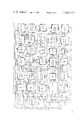
- the flow chart in FIG. 1 shows the time sequence of the most important signal conducting lines of the block diagram in FIG. 2. These signal conduits are denoted by encircled reference numerals corresponding to those in FIG. 2.
- This block diagram is intended merely for illustrating the function of this invention and in practice is substituted by a computer program.
- the rate of the clock 49 is determined by the frequency stability of the oscillator 30. In order to measure this rate, a comparison with a supposedly "correct" time interval must be possible. As there is no absolutely correct time scale, the basis for clock applications has to be the legal time transmitted by non-uniform time-signals by radio and television stations and time code transmitters. The following disclosure supposes, however, that a uniform automatically evaluable time-signal is transmitted by all radio and television stations, so that the method described here can fully take effect.
- the clock is put into operation by means of the switch f that turns on the start-automatic 48 and the time-signal receiver 45. In case the clock is in operation it can be stopped by means of the stop-pushbutton e.
- the hand setter is set to the time reference or held at that position.
- the next time mark 3 or 5 gets into the clock via the start-automatic 48 and adjusts all registers--according to the time reference given--to the desired value, and starts the time counter.
- the clock 49 works automatically without any influence of the transmitter with the accuracy of its quartz-oscillator until the arrival of the subsequent time mark 3 or 5.
- the quiescent state is produced via the reset path of the start-automatic: the flip-flop 47 is reset via the OR-gate 41, which interlocks the time mark output of the AND-gate 46; the clock counter 40 is brought to O and the flip-flop 38 is brought to a rest position via an OR-gate 36, so that clock signal 1 cannot get into a clock counter 40 via an AND-gate 39; a switching-on stage 43, 44 of the time-signal receiver 45 is brought to the "off"-position via an OR-gate 35; further, the registers in the adjusting logic 31 are set to the desired value, and the contents of the memory for sign 23 and of the memory for difference time 26 are brought to 0.
- a temporal preselection signal 1 of the clock 49 turns on the time-signal receiver 45 via the switching-on stage 43, 44, (e.g. after 23 h. / 59 min. / 50 s.) and opens the AND-gate 39 by means of the flip-flop 38, so that clock signal 1 can get into the clock counter 40.
- the next in time signal 2 is given by the clock counter 40, and releases the time mark output of the time-signal receiver 45 via the flip-flop 47 and the AND-gate 46, resets the registers in the difference time measuring stage 24 and in the priority logic 21, and releases via the AND-gates 22, 25 the carry of information from priority logic 21 and difference time measuring stage 24 to the memory for sign 23 and the memory for difference time 26.
- the priority logic 21 now accepts the time mark 3, 5, or the periodic pulse 4 from the clock counter 40. In case the periodic pulse 4 arrives before the time mark 5, there is a positive sign in the priority logic 21 (the signal for the memory for sign e.g. has the potential H); in the opposite case, there is a negative sign by definition (the signal for the memory for sign e.g. has the potential L).
- the difference time measuring stage 24 is started by the priority logic 21 whereby counting pulses of clock signal line 2, leading from the clock counter 40 to the difference time measuring stage 24 and to the correcting stage 27, are counted and determine the resolution of the time measuring stage for the rate of the clock 49.
- the difference time measuring is then ended by the last arriving signal 4 or 5 via the path of priority logic 21.
- the signal 7 of the clock counter 40 then interlocks the time mark 3, 5 via OR-gate 41, flip-flop 47, and OR-gate 46.
- the next output 8 of the clock counter 40 turns off the time-signal receiver 45 via OR-gate 35, flip-flop 43, and OR-gate 44, and with the same signal 8 transmits the measuring values from priority logic 21 and difference time measuring stage 24, via the OR-gates 22, 25 into the memory for sign 23 and the memory for difference time 26.
- the correction can be initiated from the clock counter 40 via the signalling line 9.
- the indication correction is performed by means of the pulse stage (1) 29, pulse stage (2) 33, and the OR-gate 37 in a way that the rate values stored in the memory for sign 23 and the memory for difference time 26 are cancelled.
- the pulse stage (1) 29 converts clock signal 1 (FIG.
- the counter in the difference time measuring stage 24 reaches its maximum value and sets the flip-flop 34 with its output or overflow 6.
- the carry pulse 8 has no effect, so that the following indication correction is performed on the basis of the values lastly stored in the memory for sign 23 and the memory for difference time 26.
- the oscillator correction is inhibited by the flip-flop 34, so the automatic control system is interrupted in order to preserve the high backup time.
- the signalling line DST (daylight saving time) from the clock 49 to the adjusting logic 31 presupposes a computer-regulated date clock.
- H-potential corresponds e.g. to summer time, L-potential to winter time.
- this signalling line produces the aimed adjusting process of one hour respectively by means of the aforedescribed method for indication correction.
- the display resolution should be one second in any case in order to make visually noticeable the following information: the clock is too fast, or the clock is not in operation. This signalling is sufficient for outsiders, even without operating instructions, to disregard the display.
- Interference pulses outside the lock-in range have no effect whatsoever. Interference pulses within the lock-in range only have an effect if they arise before the arrival of the time mark 3 or 5. In this case, there is a high probability of a continuous interference, i.e. a high probability of an interference impulse sequence ranging over the whole lock-in range.
- first interference pulse being nearest to the bottom limit (FIG. 1) has an effect. Hence it is simulated that the clock is slow.
- the lock-in range--in spite of misinterpreted time marks-- will not shift too far even after repeated interferences.
- the time mark 3 is expected within the first half of the lock-in range; whereby the interference pulse has only little action time. It must be regarded that the lock-in range with the periodic pulse 4 from the clock counter 40 changes in relation to the time mark 3, 5, whereas the time mark itself 3, 5 can be regarded as stationary.
- FIG. 4 shows a detailed block diagram of the time-signal receiver 45.
- the radio tuner 61--as described before-- has a simple design.
- the transmitter tuning is controlled by voltage.
- the receiver-microcomputer 68 automatically sets the radio tuner 61 to the transmitter of the highest field intensity after the switching-on by the OR-gate 44 and the switching-on stage 64. This is e.g. done by evaluating the AGC voltage supplied to the receiver-microcomputer 68 via the amplifier 62 and via the A/D-converter 66.
- First the computer program checks the whole received frequency range by means of the tuning voltage transformed by the D/A-converter 65 and stores the respective AGC voltage values.
- the receiver-microcomputer 68 can simply register a repeated missing time mark, as it also has to perform the time mark decoding. In this case, it searches the transmitter of the second highest field intensity.
- the radio tuner 61 is to be used as a clock radio at the same time, a changeover to manual tuning by means of the switch g is advisable.
- the then tuned-in transmitter is now used as a time mark transmitter as well.
- the start-automatic 48 must be interlocked via the OR-gate 69, and the receiver-microcomputer 68 must be changed over to a different software loop.
- Pushbutton i can cancel this operating mode: if the program registers a 0 when sensing the memory location for the given transmitter, it then selects the transmitter of the highest field intensity.
- the time-signal LF to be decoded (FIG. 9) is amplified by the amplifier 63 and becomes high enough to be used as square-wave with defined logic levels.
- the flip-flop 67 improves the decodability, as it halves the mark frequency, and provides an exact impulse ratio of 2.
- the most simple and least expensive embodiment of a clock installation according to this method includes a master clock according to FIG. 5, and quasi-analog indicating slave clocks with stepp motors 82.
- the controlling of the slave clocks is done by a single signalling line that leads the second step with correction to each slave clock. So the installation of the slave clocks is restricted to one twin wire--without power supply--, which recommends this method for applications where explosion hazards exist.
- FIG. 7 Similarly simple is the embodiment of a clock installation according to FIG. 7.
- the master clock is worked out as in FIG. 5, and so are the slave clocks; the latter, however, have no time-signal receiver 45.
- the controlling of the slave clocks in this embodiment is done by means of the time mark.
- the slave clocks work trouble-free, need no adjustment after a master clock failure (exploitation of high backup time) and can be equipped with a digital display 81.
- slave clocks are installed in places hard to get at and exposed to extreme environmental influences; so the service should be easy for this type of clock in particular.
- FIG. 8 shows an example, where the controlling of the slave clocks is done again by means of the time mark, resulting in trouble-free operation with a high backup time; moreover, there is the additional possibility of indicating, in a central control station, the defective operation of a slave clock by the cyclic checking of all slave clocks. After a performed service, a precision adjusting process derived from the master clock is also possible.
- the requisite condition for this process is the possibility of addressing each slave clock from the master clock, and the simple setting and recognition of the specific addresses in the slave clock.
- this problem can be solved comparatively easily by means of thumbwheel switches 91 (FIG. 8). Then there is the possibility of performing adjusting process for DST coming from the master clock.
- UTC-month Coordinatd Universal Time
- the general principle of the leap second internationally agreed upon is kept up. If more than one time-signal is transmitted per day (there should be 2 at least, displaced by 12 hours), then a time scale jump in each time-signal of a time interval (e.g. of one day) must be taken into consideration in the same way. Practical experience shows that one correction of the clock per day is sufficient.
- the LF-modulation frequency of 1000 Hz was chosen because in communication engineering it serves as reference frequency for many parameters, and moreover can be made audible.
- the chosen duration of 3 seconds in all is an advantageous compromise between unnecessarily long (which means interference-prone) and too short (which means insufficient selection from an optional LF-signal).
- all decisive time intervals can be derived by binary dividers from a usual "clock frequency", e.g. 2 15 Hz or 2 22 Hz, for which sufficient resonators are available. This advantage is valid for both the time mark coder and decoder circuits.
- the equally selected time intervals cooperate to a computer evaluation, because then software loops or subroutines can be applied.
Landscapes
- Physics & Mathematics (AREA)
- General Physics & Mathematics (AREA)
- Engineering & Computer Science (AREA)
- Mathematical Physics (AREA)
- Theoretical Computer Science (AREA)
- Electric Clocks (AREA)
- Electromechanical Clocks (AREA)
Applications Claiming Priority (3)
| Application Number | Priority Date | Filing Date | Title |
|---|---|---|---|
| DE3022949 | 1980-06-19 | ||
| DE3022949A DE3022949C2 (de) | 1980-06-19 | 1980-06-19 | Verfahren zur automatischen Korrektur der Gangabweichung einer Uhr |
| EP81102235 | 1981-03-25 |
Publications (1)
| Publication Number | Publication Date |
|---|---|
| US4440501A true US4440501A (en) | 1984-04-03 |
Family
ID=6104961
Family Applications (1)
| Application Number | Title | Priority Date | Filing Date |
|---|---|---|---|
| US06/272,559 Expired - Fee Related US4440501A (en) | 1980-06-19 | 1981-06-11 | Method of automatic adjustment of self-contained radio-clock by means of time mark |
Country Status (4)
| Country | Link |
|---|---|
| US (1) | US4440501A (ja) |
| EP (1) | EP0042913B1 (ja) |
| JP (1) | JPS5735780A (ja) |
| DE (2) | DE3022949C2 (ja) |
Cited By (28)
| Publication number | Priority date | Publication date | Assignee | Title |
|---|---|---|---|---|
| US4582434A (en) * | 1984-04-23 | 1986-04-15 | Heath Company | Time corrected, continuously updated clock |
| US4768178A (en) * | 1987-02-24 | 1988-08-30 | Precision Standard Time, Inc. | High precision radio signal controlled continuously updated digital clock |
| US4823328A (en) * | 1987-08-27 | 1989-04-18 | Conklin Charles C | Radio signal controlled digital clock |
| US4993003A (en) * | 1988-08-17 | 1991-02-12 | Electronic-Werke Deutschland Gmbh | Apparatus for updating time-of-day information in a signal |
| WO1991011763A1 (en) * | 1990-01-29 | 1991-08-08 | The United States Of America, Represented By The Secretary, United States Department Of Commerce | Device and method for providing accurate time and/or frequency |
| DE4104767A1 (de) * | 1990-05-22 | 1992-01-09 | Samsung Electronics Co Ltd | Schaltung zur automatischen zeiteinstellung |
| US5128909A (en) * | 1990-08-17 | 1992-07-07 | Ball Corporation | Advanced clock measurement system |
| US5150954A (en) * | 1984-12-05 | 1992-09-29 | Seiko Corporation | Pager watch system utilizing time slot communication |
| US5265070A (en) * | 1989-11-08 | 1993-11-23 | Seiko Epson Corporation | Receiving device with timekeeping function |
| US5297120A (en) * | 1992-03-04 | 1994-03-22 | Seiko Instruments Inc. | Radio wave-standardized electronic timepiece |
| US5422863A (en) * | 1989-11-08 | 1995-06-06 | Seiko Epson Corporation | Automatically correcting electronic timepiece for selected signal receiving wireless receiver |
| US5444672A (en) * | 1993-03-29 | 1995-08-22 | Nec Corporation | Time-keeping radio display pager precisely calibrated to local standard time |
| EP0691598A3 (de) * | 1994-07-04 | 1998-05-20 | GRUNDIG Aktiengesellschaft | Verfahren und Anordnung zum Betreiben einer Software-Uhr in einem Gerät der Unterhaltungselektronik |
| US20050002279A1 (en) * | 2003-05-15 | 2005-01-06 | Oki Electric Industry Co., Ltd. | Time-of-day apparatus receiving standard time code broadcast |
| US20050036514A1 (en) * | 2003-07-31 | 2005-02-17 | Roland Polonio | Radio controlled clock and method for retrieving time information from time signals |
| US20050099993A1 (en) * | 2003-09-10 | 2005-05-12 | Seiko Precision Inc. | Radio wave correction clock |
| US20050116856A1 (en) * | 2003-11-28 | 2005-06-02 | Atmel Germany Gmbh | Radio-controlled clock and method for acquiring time information from a time signal with reduced evaluation overhead |
| US20050122951A1 (en) * | 2003-12-08 | 2005-06-09 | Joachim Kuehnle | Receiver circuit and method using selectively variable amplification for receiving time signals from different transmitters |
| US20050122952A1 (en) * | 2003-12-08 | 2005-06-09 | Atmel Germany Gmbh | Radio-controlled clock and method for automatically receiving and evaluating any one of plural available time signals |
| US20050147080A1 (en) * | 2003-12-30 | 2005-07-07 | Horst Haefner | Radio-controlled clock and method for determining the beginning of a second from a transmitted time signal |
| US20050169230A1 (en) * | 2004-02-04 | 2005-08-04 | Atmel Germany Gmbh | Radio-controlled clock, receiver circuit and method for acquiring time information with economized receiver and microcontroller |
| US20050175039A1 (en) * | 2004-01-29 | 2005-08-11 | Horst Haefner | Radio-controlled clock and method for determining the signal quality of a transmitted time signal |
| US20050202796A1 (en) * | 2004-01-29 | 2005-09-15 | Atmel Germany Gmbh | Radio-controlled clock and method for gaining time information |
| US20050260958A1 (en) * | 2004-01-29 | 2005-11-24 | Horst Haefner | Method for gaining time information and receiver for implementing the method |
| US20080107210A1 (en) * | 2005-11-26 | 2008-05-08 | Atmel Germany Gmbh | Radio clock and method for extracting time information |
| US20090129208A1 (en) * | 2009-01-28 | 2009-05-21 | Weiss Kenneth P | Apparatus, system and method for keeping time |
| US20100039901A1 (en) * | 2008-08-15 | 2010-02-18 | Hon Hai Precision Industry Co., Ltd. | Electronic device capable of self-clock adjustment and method thereof |
| US20130141272A1 (en) * | 2010-08-31 | 2013-06-06 | Huawei Technologies Co., Ltd. | Microwave transmission apparatus |
Families Citing this family (5)
| Publication number | Priority date | Publication date | Assignee | Title |
|---|---|---|---|---|
| DE3439638C1 (de) * | 1984-10-30 | 1986-05-15 | Gebrüder Junghans GmbH, 7230 Schramberg | Autonome Funkuhr |
| JPH01152776U (ja) * | 1988-04-15 | 1989-10-20 | ||
| DE3822412A1 (de) * | 1988-07-01 | 1990-01-04 | Schulz Werner Dipl Ing Fh | Verfahren zum automatischen stellen autonomer funkuhren |
| EP0427515A3 (en) * | 1989-11-08 | 1991-10-09 | Seiko Epson Corporation | Automatically corrected electronic timepiece |
| DE4403124C2 (de) * | 1994-02-02 | 1997-02-13 | Telefunken Microelectron | Verfahren zum Betrieb einer Funkuhr |
Citations (8)
| Publication number | Priority date | Publication date | Assignee | Title |
|---|---|---|---|---|
| CH540521A (de) * | 1972-01-06 | 1973-04-13 | Landis & Gyr Ag | Elektronische Uhr, insbesondere Synchronuhr mit Gangreserve |
| US3772258A (en) * | 1971-10-13 | 1973-11-13 | Texaco Inc | Process for the polymerization of acrylic acid esters |
| US3852953A (en) * | 1972-04-12 | 1974-12-10 | S Mischiatti | Control and synchronisation of clocks |
| US4014166A (en) * | 1976-02-13 | 1977-03-29 | The United States Of America As Represented By The Secretary Of Commerce | Satellite controlled digital clock system |
| US4114363A (en) * | 1975-06-18 | 1978-09-19 | Kabushiki Kaisha Suwa Seikosha | Electronic timepiece |
| US4117661A (en) * | 1975-03-10 | 1978-10-03 | Bryant Jr Ellis H | Precision automatic local time decoding apparatus |
| US4128991A (en) * | 1976-01-12 | 1978-12-12 | Ebauches Sa | Electronic digital watch |
| US4204167A (en) * | 1978-05-24 | 1980-05-20 | Liu Yung Ho | Electronic time piece automatic calibrating device |
Family Cites Families (9)
| Publication number | Priority date | Publication date | Assignee | Title |
|---|---|---|---|---|
| DE1673793C3 (de) * | 1967-03-23 | 1981-03-19 | Telefonbau Und Normalzeit Gmbh, 6000 Frankfurt | Verfahren zur laufenden Übermittlung der Uhrzeit |
| CH1229067A4 (ja) * | 1967-09-01 | 1970-05-29 | ||
| US3945194A (en) * | 1973-12-15 | 1976-03-23 | Itt Industries, Inc. | Electronic quartz clock with integrated circuits |
| JPS5127968A (en) * | 1974-09-03 | 1976-03-09 | Suwa Seikosha Kk | Denshidokei no jidoshuseihoho |
| JPS5162074A (en) * | 1974-11-28 | 1976-05-29 | Seiko Instr & Electronics | Denshidokeino byoshuseisochi |
| CH624539B (fr) * | 1977-12-02 | Ebauches Electroniques Sa | Piece d'horlogerie electronique avec correction automatique de l'ecart de marche. | |
| CH618315GA3 (ja) * | 1977-02-21 | 1980-07-31 | ||
| DE2715096C2 (de) * | 1977-04-04 | 1982-12-16 | Wolfgang Dr.-Ing. 6101 Groß-Bieberau Hilberg | Anordnung zur Gewinnung und Anzeige einer Zeitinformation, bestehend aus einer Funkuhr und einer mit dieser räumlich zusammengefaßten Quarzuhr |
| JPS552927A (en) * | 1978-06-21 | 1980-01-10 | Nec Corp | Automatic time correction device |
-
1980
- 1980-06-19 DE DE3022949A patent/DE3022949C2/de not_active Expired
-
1981
- 1981-03-25 EP EP81102235A patent/EP0042913B1/de not_active Expired
- 1981-03-25 DE DE8181102235T patent/DE3175319D1/de not_active Expired
- 1981-06-11 US US06/272,559 patent/US4440501A/en not_active Expired - Fee Related
- 1981-06-19 JP JP9407681A patent/JPS5735780A/ja active Pending
Patent Citations (8)
| Publication number | Priority date | Publication date | Assignee | Title |
|---|---|---|---|---|
| US3772258A (en) * | 1971-10-13 | 1973-11-13 | Texaco Inc | Process for the polymerization of acrylic acid esters |
| CH540521A (de) * | 1972-01-06 | 1973-04-13 | Landis & Gyr Ag | Elektronische Uhr, insbesondere Synchronuhr mit Gangreserve |
| US3852953A (en) * | 1972-04-12 | 1974-12-10 | S Mischiatti | Control and synchronisation of clocks |
| US4117661A (en) * | 1975-03-10 | 1978-10-03 | Bryant Jr Ellis H | Precision automatic local time decoding apparatus |
| US4114363A (en) * | 1975-06-18 | 1978-09-19 | Kabushiki Kaisha Suwa Seikosha | Electronic timepiece |
| US4128991A (en) * | 1976-01-12 | 1978-12-12 | Ebauches Sa | Electronic digital watch |
| US4014166A (en) * | 1976-02-13 | 1977-03-29 | The United States Of America As Represented By The Secretary Of Commerce | Satellite controlled digital clock system |
| US4204167A (en) * | 1978-05-24 | 1980-05-20 | Liu Yung Ho | Electronic time piece automatic calibrating device |
Non-Patent Citations (2)
| Title |
|---|
| Funkschau, 1979, Copy 26 pp. 99 103 Funkyhr Mit Mitternachsvetekektor. * |
| Funkschau, 1979, Copy 26 pp. 99-103 "Funkyhr Mit Mitternachsvetekektor." |
Cited By (37)
| Publication number | Priority date | Publication date | Assignee | Title |
|---|---|---|---|---|
| US4582434A (en) * | 1984-04-23 | 1986-04-15 | Heath Company | Time corrected, continuously updated clock |
| US5150954A (en) * | 1984-12-05 | 1992-09-29 | Seiko Corporation | Pager watch system utilizing time slot communication |
| US4768178A (en) * | 1987-02-24 | 1988-08-30 | Precision Standard Time, Inc. | High precision radio signal controlled continuously updated digital clock |
| US4823328A (en) * | 1987-08-27 | 1989-04-18 | Conklin Charles C | Radio signal controlled digital clock |
| US4993003A (en) * | 1988-08-17 | 1991-02-12 | Electronic-Werke Deutschland Gmbh | Apparatus for updating time-of-day information in a signal |
| US5422863A (en) * | 1989-11-08 | 1995-06-06 | Seiko Epson Corporation | Automatically correcting electronic timepiece for selected signal receiving wireless receiver |
| US5265070A (en) * | 1989-11-08 | 1993-11-23 | Seiko Epson Corporation | Receiving device with timekeeping function |
| WO1991011763A1 (en) * | 1990-01-29 | 1991-08-08 | The United States Of America, Represented By The Secretary, United States Department Of Commerce | Device and method for providing accurate time and/or frequency |
| US5274545A (en) * | 1990-01-29 | 1993-12-28 | The United States Of America As Represented By The Secretary Of Commerce | Device and method for providing accurate time and/or frequency |
| DE4104767A1 (de) * | 1990-05-22 | 1992-01-09 | Samsung Electronics Co Ltd | Schaltung zur automatischen zeiteinstellung |
| US5128909A (en) * | 1990-08-17 | 1992-07-07 | Ball Corporation | Advanced clock measurement system |
| US5297120A (en) * | 1992-03-04 | 1994-03-22 | Seiko Instruments Inc. | Radio wave-standardized electronic timepiece |
| US5444672A (en) * | 1993-03-29 | 1995-08-22 | Nec Corporation | Time-keeping radio display pager precisely calibrated to local standard time |
| EP0691598A3 (de) * | 1994-07-04 | 1998-05-20 | GRUNDIG Aktiengesellschaft | Verfahren und Anordnung zum Betreiben einer Software-Uhr in einem Gerät der Unterhaltungselektronik |
| US20050002279A1 (en) * | 2003-05-15 | 2005-01-06 | Oki Electric Industry Co., Ltd. | Time-of-day apparatus receiving standard time code broadcast |
| US20050036514A1 (en) * | 2003-07-31 | 2005-02-17 | Roland Polonio | Radio controlled clock and method for retrieving time information from time signals |
| US7486657B2 (en) | 2003-07-31 | 2009-02-03 | Atmel Germany Gmbh | Radio controlled clock and method for retrieving time information from time signals |
| US20050099993A1 (en) * | 2003-09-10 | 2005-05-12 | Seiko Precision Inc. | Radio wave correction clock |
| US7474651B2 (en) * | 2003-09-10 | 2009-01-06 | Seiko Precision Inc. | Radio wave correction clock |
| US20050116856A1 (en) * | 2003-11-28 | 2005-06-02 | Atmel Germany Gmbh | Radio-controlled clock and method for acquiring time information from a time signal with reduced evaluation overhead |
| US20050122951A1 (en) * | 2003-12-08 | 2005-06-09 | Joachim Kuehnle | Receiver circuit and method using selectively variable amplification for receiving time signals from different transmitters |
| US7333467B2 (en) | 2003-12-08 | 2008-02-19 | Atmel Germany Gmbh | Receiver circuit and method using selectively variable amplification for receiving time signals from different transmitters |
| US20050122952A1 (en) * | 2003-12-08 | 2005-06-09 | Atmel Germany Gmbh | Radio-controlled clock and method for automatically receiving and evaluating any one of plural available time signals |
| US20050147080A1 (en) * | 2003-12-30 | 2005-07-07 | Horst Haefner | Radio-controlled clock and method for determining the beginning of a second from a transmitted time signal |
| US7317905B2 (en) | 2004-01-29 | 2008-01-08 | Atmel Germany Gmbh | Radio-controlled clock and method for gaining time information |
| US20050260958A1 (en) * | 2004-01-29 | 2005-11-24 | Horst Haefner | Method for gaining time information and receiver for implementing the method |
| US7369628B2 (en) | 2004-01-29 | 2008-05-06 | Atmel Germany Gmbh | Method for gaining time information and receiver for implementing the method |
| US20050202796A1 (en) * | 2004-01-29 | 2005-09-15 | Atmel Germany Gmbh | Radio-controlled clock and method for gaining time information |
| US20050175039A1 (en) * | 2004-01-29 | 2005-08-11 | Horst Haefner | Radio-controlled clock and method for determining the signal quality of a transmitted time signal |
| CN1648800B (zh) * | 2004-01-29 | 2010-05-26 | Atmel德国有限公司 | 获取时间信息的方法和无线电钟表 |
| US20050169230A1 (en) * | 2004-02-04 | 2005-08-04 | Atmel Germany Gmbh | Radio-controlled clock, receiver circuit and method for acquiring time information with economized receiver and microcontroller |
| US20080107210A1 (en) * | 2005-11-26 | 2008-05-08 | Atmel Germany Gmbh | Radio clock and method for extracting time information |
| US8160184B2 (en) | 2005-11-26 | 2012-04-17 | Atmel Corporation | Radio clock and method for extracting time information |
| US20100039901A1 (en) * | 2008-08-15 | 2010-02-18 | Hon Hai Precision Industry Co., Ltd. | Electronic device capable of self-clock adjustment and method thereof |
| US20090129208A1 (en) * | 2009-01-28 | 2009-05-21 | Weiss Kenneth P | Apparatus, system and method for keeping time |
| US20130141272A1 (en) * | 2010-08-31 | 2013-06-06 | Huawei Technologies Co., Ltd. | Microwave transmission apparatus |
| US9069054B2 (en) * | 2010-08-31 | 2015-06-30 | Huawei Technologies Co., Ltd. | Microwave transmission apparatus |
Also Published As
| Publication number | Publication date |
|---|---|
| DE3022949C2 (de) | 1983-11-17 |
| EP0042913A3 (en) | 1982-01-20 |
| JPS5735780A (en) | 1982-02-26 |
| EP0042913A2 (de) | 1982-01-06 |
| DE3175319D1 (en) | 1986-10-23 |
| EP0042913B1 (de) | 1986-09-17 |
| DE3022949A1 (de) | 1981-12-24 |
Similar Documents
| Publication | Publication Date | Title |
|---|---|---|
| US4440501A (en) | Method of automatic adjustment of self-contained radio-clock by means of time mark | |
| US4315332A (en) | Electronic timepiece radio | |
| US5422863A (en) | Automatically correcting electronic timepiece for selected signal receiving wireless receiver | |
| US5105396A (en) | Autonomous radio timepiece | |
| US4023344A (en) | Automatically corrected electronic timepiece | |
| EP2120108B1 (en) | Radio-controlled timepiece and control method for a radio-controlled timepiece | |
| GB2261752A (en) | Timepiece with synchronising means | |
| US7075859B2 (en) | Radio-controlled timepiece and control method for the same | |
| US7027363B2 (en) | Time measurement system and method of controlling the same | |
| US7372779B2 (en) | Radio controlled timepiece and method of controlling the same | |
| EP0461849B1 (en) | Paging receiver with a time piece function | |
| US5177714A (en) | Autonomous radio timepiece | |
| US7486657B2 (en) | Radio controlled clock and method for retrieving time information from time signals | |
| US4020628A (en) | Automatic regulation of an electronic watch | |
| KR100293072B1 (ko) | 자동시각수정기능을가진무선선택호출수신기 | |
| US7317905B2 (en) | Radio-controlled clock and method for gaining time information | |
| CA1167649A (en) | Method of automatic adjustment of self-contained radio-clock by means of time mark | |
| US20050116856A1 (en) | Radio-controlled clock and method for acquiring time information from a time signal with reduced evaluation overhead | |
| JP2005195597A (ja) | 時刻情報を含んだ送信された時報信号から秒開始を求める方法 | |
| US3876840A (en) | Automatic time-temperature-message announcing system | |
| JPS61155789A (ja) | 無線制御式時計 | |
| US20050002279A1 (en) | Time-of-day apparatus receiving standard time code broadcast | |
| GB1575580A (en) | Electronic watch or clock | |
| JP5083384B2 (ja) | 時刻データ受信装置、及び、電波時計 | |
| EP0427515A2 (en) | Automatically corrected electronic timepiece |
Legal Events
| Date | Code | Title | Description |
|---|---|---|---|
| MAFP | Maintenance fee payment |
Free format text: PAYMENT OF MAINTENANCE FEE, 4TH YEAR, PL 96-517 (ORIGINAL EVENT CODE: M170); ENTITY STATUS OF PATENT OWNER: SMALL ENTITY Year of fee payment: 4 |
|
| FEPP | Fee payment procedure |
Free format text: PAYOR NUMBER ASSIGNED (ORIGINAL EVENT CODE: ASPN); ENTITY STATUS OF PATENT OWNER: SMALL ENTITY |
|
| FEPP | Fee payment procedure |
Free format text: MAINTENANCE FEE REMINDER MAILED (ORIGINAL EVENT CODE: REM.); ENTITY STATUS OF PATENT OWNER: SMALL ENTITY |
|
| LAPS | Lapse for failure to pay maintenance fees | ||
| FP | Lapsed due to failure to pay maintenance fee |
Effective date: 19920405 |
|
| STCH | Information on status: patent discontinuation |
Free format text: PATENT EXPIRED DUE TO NONPAYMENT OF MAINTENANCE FEES UNDER 37 CFR 1.362 |