US4507335A - Method and apparatus for pelletizing sulphur - Google Patents
Method and apparatus for pelletizing sulphur Download PDFInfo
- Publication number
- US4507335A US4507335A US06/579,686 US57968684A US4507335A US 4507335 A US4507335 A US 4507335A US 57968684 A US57968684 A US 57968684A US 4507335 A US4507335 A US 4507335A
- Authority
- US
- United States
- Prior art keywords
- particles
- sulphur
- drum
- bed
- solid
- Prior art date
- Legal status (The legal status is an assumption and is not a legal conclusion. Google has not performed a legal analysis and makes no representation as to the accuracy of the status listed.)
- Expired - Lifetime
Links
- NINIDFKCEFEMDL-UHFFFAOYSA-N Sulfur Chemical compound [S] NINIDFKCEFEMDL-UHFFFAOYSA-N 0.000 title claims abstract description 176
- 239000005864 Sulphur Substances 0.000 title claims abstract description 176
- 238000000034 method Methods 0.000 title claims abstract description 38
- 238000005453 pelletization Methods 0.000 title abstract description 7
- 239000002245 particle Substances 0.000 claims abstract description 176
- 239000007787 solid Substances 0.000 claims abstract description 79
- 239000007921 spray Substances 0.000 claims abstract description 65
- 239000007788 liquid Substances 0.000 claims abstract description 60
- 230000003028 elevating effect Effects 0.000 claims abstract description 3
- 239000003570 air Substances 0.000 claims description 23
- 230000010006 flight Effects 0.000 claims description 16
- 238000005507 spraying Methods 0.000 claims description 14
- 239000008188 pellet Substances 0.000 claims description 12
- 230000001965 increasing effect Effects 0.000 claims description 11
- 239000012080 ambient air Substances 0.000 claims description 7
- 230000033001 locomotion Effects 0.000 claims description 5
- 239000000110 cooling liquid Substances 0.000 claims description 3
- 230000003247 decreasing effect Effects 0.000 claims 5
- 230000001419 dependent effect Effects 0.000 claims 1
- XLYOFNOQVPJJNP-UHFFFAOYSA-N water Substances O XLYOFNOQVPJJNP-UHFFFAOYSA-N 0.000 description 24
- 239000000047 product Substances 0.000 description 9
- 238000004519 manufacturing process Methods 0.000 description 8
- 230000008569 process Effects 0.000 description 8
- 238000005469 granulation Methods 0.000 description 6
- 230000003179 granulation Effects 0.000 description 6
- 230000007423 decrease Effects 0.000 description 5
- 239000003595 mist Substances 0.000 description 5
- 239000011248 coating agent Substances 0.000 description 3
- 238000000576 coating method Methods 0.000 description 3
- 230000009471 action Effects 0.000 description 2
- 230000001174 ascending effect Effects 0.000 description 2
- 238000009835 boiling Methods 0.000 description 2
- 239000008187 granular material Substances 0.000 description 2
- 239000000203 mixture Substances 0.000 description 2
- 229940095674 pellet product Drugs 0.000 description 2
- 238000007711 solidification Methods 0.000 description 2
- 230000008023 solidification Effects 0.000 description 2
- XSQUKJJJFZCRTK-UHFFFAOYSA-N Urea Chemical compound NC(N)=O XSQUKJJJFZCRTK-UHFFFAOYSA-N 0.000 description 1
- 230000002411 adverse Effects 0.000 description 1
- 238000000889 atomisation Methods 0.000 description 1
- 239000004202 carbamide Substances 0.000 description 1
- 230000008859 change Effects 0.000 description 1
- 239000007795 chemical reaction product Substances 0.000 description 1
- 238000010276 construction Methods 0.000 description 1
- 238000010924 continuous production Methods 0.000 description 1
- 238000001816 cooling Methods 0.000 description 1
- 239000000428 dust Substances 0.000 description 1
- 230000000694 effects Effects 0.000 description 1
- 230000008030 elimination Effects 0.000 description 1
- 238000003379 elimination reaction Methods 0.000 description 1
- 239000003337 fertilizer Substances 0.000 description 1
- 238000009472 formulation Methods 0.000 description 1
- 238000007710 freezing Methods 0.000 description 1
- 230000008014 freezing Effects 0.000 description 1
- 230000004927 fusion Effects 0.000 description 1
- 230000003116 impacting effect Effects 0.000 description 1
- 230000005012 migration Effects 0.000 description 1
- 238000013508 migration Methods 0.000 description 1
- 239000006223 plastic coating Substances 0.000 description 1
- 230000009467 reduction Effects 0.000 description 1
- 238000004513 sizing Methods 0.000 description 1
- 238000003860 storage Methods 0.000 description 1
- 238000009834 vaporization Methods 0.000 description 1
- 230000008016 vaporization Effects 0.000 description 1
Images

Classifications
-
- C—CHEMISTRY; METALLURGY
- C01—INORGANIC CHEMISTRY
- C01B—NON-METALLIC ELEMENTS; COMPOUNDS THEREOF; METALLOIDS OR COMPOUNDS THEREOF NOT COVERED BY SUBCLASS C01C
- C01B17/00—Sulfur; Compounds thereof
- C01B17/02—Preparation of sulfur; Purification
- C01B17/0237—Converting into particles, e.g. by granulation, milling
-
- B—PERFORMING OPERATIONS; TRANSPORTING
- B01—PHYSICAL OR CHEMICAL PROCESSES OR APPARATUS IN GENERAL
- B01J—CHEMICAL OR PHYSICAL PROCESSES, e.g. CATALYSIS OR COLLOID CHEMISTRY; THEIR RELEVANT APPARATUS
- B01J2/00—Processes or devices for granulating materials, e.g. fertilisers in general; Rendering particulate materials free flowing in general, e.g. making them hydrophobic
- B01J2/12—Processes or devices for granulating materials, e.g. fertilisers in general; Rendering particulate materials free flowing in general, e.g. making them hydrophobic in rotating drums
Definitions
- This invention relates to an improved method and apparatus for producing relatively small sulphur pellets in a continuous process. More specifically the invention relates to a method and apparatus for continuously generating sulphur seed particles within the sulphur pelletizing drum.
- the heretofore known system includes a rotating drum which rotates a bed of solid sulphur particles.
- the bed of solid sulphur particles is caused to be elevated by flights associated with the inner surface of the drum so as to cause the solid sulphur particles to descend in a curtain onto the bed.
- the drum has a pair of deflector plates extending lengthwise of the drum for deflecting the descending solid sulphur particles into two separated, distinct, generally continuous curtains which fall onto the bed at spaced locations.
- a series of sulphur spray nozzles are spaced longitudinally of the drum beneath one of the deflector plates to spray atomized liquid sulphur particles onto one of the curtains at a pressure in the range of about 200-500 p.s.i. and a temperature above 260° F.
- the liquid sulphur coats the solid sulphur particles in the curtain of particles to increase the particles in size as they migrate from the feed end of the drum towards the discharge end of the drum.
- the temperature of the solid sulphur particles inside the drum was maintained between 120° to 180° F. as a general rule. These temperatures were not high enough to evaporate the water sprayed in the drum.
- the moist or wet granules being at a temperature lower than the boiling point of water (212° F.) did not evaporate the moisture on the sulphur particles fast enough.
- the moist sulphur particles in contact with the small seed nuclei particles had an adverse effect, in that the seed particles stuck to the granules and thereby created an even higher and unpredictable demand for seed particles.
- the seed particles are produced within the drum by intermittently raising the temperature of the bed of solid sulphur particles by at least 40° F. for brief periods.
- the temperature of the bed is raised to the range of about 160°-220° F.
- the liquid sulphur sprayed on the falling curtain of solid sulphur particles does not completely solidify immediately and the sprayed sulphur coating remains slightly soft or plastic on the surface of the particles.
- the abrading action of the other particles rub or break off small pieces of this soft coating having a diameter in the size range of about 0.1 to 1.0 m.m.
- a supply of sulphur seed nuclei particles is generated inside the granulating drum on a continuous controlled basis. It has been discovered that the sulphur seed nuclei particles can be generated in portions of the drum by elevating the temperature of the solid sulphur particles bed and/or falling curtain of solid sulphur particles within a specified range of about 180° to 230° F. It has been discovered that under certain controlled operating conditions a portion of the sprayed liquid sulphur particles solidifies into seed nuclei particles prior to contacting the falling curtain of solid sulphur particles in the area of the spray pattern having a minimum density of the liquid sulphur particles. In so doing, the generation of seed nuclei particles is confined to a localized confined area of the drum, leaving the remaining area of the drum available for the growth of product size sulphur pellets.
- the quantity of seed generation within the drum may be controlled to match changing product rates of the system. Accordingly, by changing one or a combination of operational variables at a given rate and/or time the generation of seed nuclei on a continuous basis can be matched to the required production rate. An identification and discussion of these variables will hereinbelow be discussed in further detail.
- the apparatus in accordance with a preferred embodiment of the invention includes an elongated, rotatable, generally cylindrical drum having an axis of rotation inclined slightly with respect to the horizontal from a feed end to a discharge end, whereby rotation of the drum causes solid sulphur particles forming a bed therein to move from the feed end toward the discharge end.
- the inside surface of the drum has a plurality of inwardly extending lifting flights, whereby rotation of the drum causes the flights to lift solid sulphur particles from the bed to an upper zone in the drum and to then drop the particles so that a curtain of solid sulphur particles fall toward the bed.
- a longitudinally extending inclined, upper collecting pan is supported in an upper center area of the drum to receive and direct solid sulphur particles dropping from the flights in the form of a falling curtain onto an upper area of a longitudinally extending, inclined, lower collecting pan supported below the upper collecting pan.
- the lower collecting pan may also receive solid sulphur particles dropping directly from the flights.
- the solid sulphur particles from the lower pan are directed in the form of a falling curtain onto the bed.
- the respective ends of the drum are open to direct air through the drum.
- the general direction of air movement through the drum is preferably co-current with the direction of movement of the bed through the drum.
- a plurality of longitudinally spaced fans are supported within the drum in facing relation to the curtain of falling solid sulphur particles from the upper pan toward the lower pan to internally direct humidified air onto such curtain to remove heat therefrom.
- a series of longitudinally spaced liquid sulphur spray nozzles are supported within the drum spaced from and in facing relation to the curtain of solid sulphur particles cascading off the lower pan for spraying liquid sulphur particles onto such curtain.
- the positioning and design of these nozzles are relevant to the generation of sulphur seed nuclei within the drum.
- a plurality of liquid spray nozzles are supported within an area of the drum behind the upper and lower pans to spray an atomized cooling liquid into the drum.
- the cooling liquid mixes with the air circulating through to form humid air which serves to reduce the temperature of the solid sulphur particles.
- the internal fans direct this humid air directly onto the curtain of solid sulphur particles cascading from the upper pan.
- the humid air is also utilized to control the temperature of certain portions of the bed in a manner, as will further be discussed hereinbelow, to generate sulphur seed nuclei within the drum.
- the humid air in the vicinity of the liquid sulphur cools a fine mist portion of the sulphur spray pattern generated from the sulphur spray nozzles to solidify same into solid particles, which drop out as the sulphur seed nuclei.
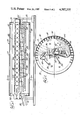
- FIG. 1 is a schematic, partially cross-sectional side view of a sulphur pelletizing system in accordance with the invention.
- FIG. 2 is an enlarged cross-sectional view taken along line 2--2 in FIG. 1.
- FIG. 3 is an enlarged schematic, partially cross-sectional, side view of the feed end of the system illustrated in FIG. 1.
- FIG. 4 is a schematic representation of the side and end views of a sulphur spray pattern from one of the liquid sulphur spray nozzles.
- System 10 includes an open-ended, elongated hollow, cylindrical rotatable drum 12 having a central axis 14 inclined slightly (i.e. less than 2°) with respect to a horizontal plane from its entrance or feed end 16 to its exit or discharge end 18. Feed end 16 is partially closed by an annular ring 20 and discharge end 18 is partially closed by a similar ring 22.
- a bed 24 of solid sulphur particles tumbles in the bottom of drum 12 as the drum is rotated around its axis of rotation 14 by conventional means (not illustrated). As drum 12 rotates, one elongated edge 26 of bed 24 is elevated above the other elongated edge 28.
- the solid sulphur particles in bed 24 range in size from microscopic dust particles to the full sized, generally spherical pellets having a predetermined diameter in the range of about 2 to 20 m.m., that are the end product of the system.
- the solid sulphur particles in bed 24 gradually move from the feed end 16 to the discharge end 18 as drum 12 rotates, and then fall over the small discharge end ring 22 and out of drum 12 onto a sizing screen having openings of a predetermined size (not illustrated).
- Pellets having a diameter larger than the holes in the screen are suitably directed into a product hopper or storage silo (not illustrated). Particles that fall through the holes in the screen are suitably directed to a conventional conveyor means 30 and back into the feed end 16 of drum 12.
- Drum 12 rotates in a counterclockwise direction as viewed in FIG. 2.
- a series of essentially identical particle lifting flights 32 are equally spaced around the inside surface of drum 12, and project generally inwardly toward the center of the drum. Flights 32 extend longtitudinally substantially the entire length of the drum. As flights 32 move through bed 24, they scoop solid sulphur particles from the bed and raise the particles to the upper portion of drum 12. The flights are generally flat so that each flight will have dropped essentially all of the particles it is carrying by the time the flight has moved a short distance past the highest point in drum 12. This produces a concentrated shower of falling particles in the right hand quadrants I and II of drum 12, as seen in FIG. 3, with a much smaller number of particles falling into the left hand quadrant III near the vertical center line of the drum.
- Drum 12 has means located within it for deflecting the shower of falling solid sulphur particles into two separated distinct, relatively thin, continuous curtains 36 and 38 of solid sulphur particles.
- An upper elongated deflector pan 40 extending lengthwise of drum 12 is located in the upper portions of quadrants II and III adjacent the vertical center line of the drum, as viewed in a plane perpendicular to the axis of the drum, which contains the highest ascending flights 32.
- a lower elongated deflector pan 42 extending lengthwise of drum 12 is located near the center of the drum, with a major portion of the pan 42 being located in a lower portion of quadrant II of the drum, when viewed in a plane perpendicular to the axis of the drum, which contain the highest ascending flights 32 in planes.
- Pans 40 and 42 are parallel to each other and are preferably inclined at an angle of approximately 45° to collect and direct falling particles into curtains 36 and 38.
- the solid sulphur particles from the flights 32 descend directly onto either pan 40 or pan 42 in their down flights back towards bed 24.
- the particles which are collected on upper pan 40 descend from the lower edge thereof to form the upper curtain 36, which in turn is received on lower pan 42.
- the particles from curtain 36 mix with the particles descending directly onto pan 42 and descend together from the lower edge thereof, to form the lower curtain 38, which in turn is directed towards bed 24.
- substantially all of the particles from bed 24 which are lifted by flights 32 are ultimately deflected by pan 42 and descend back into bed 24 in curtain 38.
- the headers 44 and 46 are suitably received in steam jackets 49 of well known construction.
- Nozzles 48 are generally aligned horizontally in the direction of movement of the particles in bed 24, and spray atomized liquid sulphur at a pressure preferably in the range of about 200 to 260 p.s.i. and at a temperature preferably in the range of about 275° to 305° F. onto the curtain 38 of falling solid sulphur particles.
- the angle of the sulphur spray pattern and the distance of the spray nozzles from the curtain 38 will be hereinbelow discussed in further detail. Since the solid sulphur particles in bed 24 increase in average size as they migrate from the feed end 16 to discharge end 18, the amount of liquid sulphur particles sprayed into curtain 38 may be increased in the direction of particle migration. This can be accomplished by increasing the pressure at the nozzles 48 from the feed end 16 to the discharge end 18, or by increasing the effective flow area of the nozzles 48 from the feed end 16 to discharge end 18.
- the stationary portions of system 10 are supported in a suitable manner.
- atomized water in the form of a fine mist spray is injected into drum 12.
- the heat of vaporization removes the heat of fusion of the liquid sulphur which is solidifying in the drum.
- U.S. Pat. No. 4,213,924 for a discussion of the use of atomized water as a means to control the temperature of the solid particles within a granulation drum.
- a series of longitudinally spaced spray nozzles 50 and 52 extend substantially the entire length of the drum within quadrants III and IV.
- the spray patterns from nozzles 50 and 52 should preferably be a wide angle round spray pattern.
- spray nozzles contemplated for use in conjunction with the present are Spraying System Co. atomizing nozzles fine spray nozzles #LN12, LN18 and LN26.
- the water is atomized in a section of the drum 12 which is substantially free from falling solid sulphur particles such that the water is allowed to quickly evaporate into the drum's atmosphere without directly contacting the solid sulphur particles.
- the temperature of the solid sulphur particles in various portions of the drum 12 may be suitably controlled by controlling the volume of atomized water sprayed in these portions through the nozzles 50 and 52 located in such portions of the drum.
- a plurality of propeller type fans 54 are suitably supported within the drum along the length thereof in facing relationship and behind the curtain 36.
- Fans 54 spray humidified air directly onto the solid sulphur particles in the curtain 36 to reduce and control the temperature of the particles.
- the fans 54 are mounted in secions of the drum 12 not subject to falling sulphur particles and, to prevent excessive moisture contact with the blades, they are mounted out of the section of the drum where water is atomized. It is preferred that the fans be able to recycle approximately five times the volume of air which is pulled through the drum 12.
- the temperature of the bed 24 may be maintained in the manner as discussed above in the range of 110° to 170° F. It has been found that at these temperature ranges a quality pellet product results from solidification of the liquid sulphur sprayed onto the solid sulphur particles.
- the liquid sulphur sprayed on the falling solid sulphur particles does not completely solidify immediately, thereby as the particles are tumbled in the bed an abrading action of the particles rubs or breaks off small pieces of the soft coating which form the seed nuclei.
- the present invention is specifically directed to the generation of seed nuclei in the drum 12 on a continuous basis. Briefly stated, it has been discovered that by increasing the temperature of the solid sulphur particles within the drum, the water sprayed on the hot solid sulphur particles evaporates (water boiling at 212° F.) removing heat from the particles. The steam generated in this manner humidifies the air flowing through the drum. The humid air in the vicinity of the liquid sulphur spray cools the fine mist portion of the spray pattern generated by the liquid sulphur spray nozzles and sulphur seed nuclei drop out. By controlling the location of the water spraying and the water quantity, and the solid sulphur bed temperature, the location and magnitude of seed nuclei generation may be controlled.
- the flat jet spray nozzle 48 has a spray pattern as illustrated generally in FIG. 4.
- Area A which contains a maximum population or high density of liquid sulphur spray particles
- Area B which contains a minimum population or low density of liquid sulphur spray particles.
- the liquid sulphur particles in Area B form the seed nuclei and the liquid sulphur particles in Area A coat the solid sulphur particles in curtain 38.
- the relative size of Areas A and B may be controlled by changing one or a combination of various parameters.
- the size of the Areas A and B in the spray pattern may also be controlled by changing the angle of spray (C) of the spray pattern.
- An increase in the angle of spray C increases the Area B and decreases the Area A.
- an increase in the liquid sulphur particle quantity and the spraying pressure will increase the Area A and decrease the Area B.
- the angle of spray (c) be in the range of 80° to 110°, and more preferrably in the range of 90° to 100°.
- a system 10 constructed as hereinabove discussed is able to generate seed nuclei within the drum 12 on a continuous basis upon operation in accordance with the following operational criteria and parameters.
- the system 10 is designed to produce at between 20 to 25 MTPH production rates.
- the sulphur spray nozzles 48 are unijet nozzles with flat spray tips #6508 and #6510 as manufactured by the Spraying System Co.
- the temperature of the solid sulphur particles in the portion of the drum in which seed nuclei is generated is maintained in the range of about 180° to 230° F., and preferably in the range of 190° to 210° F.
- the temperature of the liquid sulphur particles leaving the spray nozzles 48 is preferably in the range of 275° to 305° F. and the pressure is preferably in the range of 200 to 260 PSI.
- the distance from the spray nozzles 48 to the curtain 38 (Z) is preferably in the range of 6 to 8 inches.
- Air flow through the drum 12 varies between 2000 to 12000 CFM depending upon the ambient air temperatures.
- the atomized water spray nozzles 50 and 52 used for humidification are preferably atomizing fine spray nozzles #LN12, or LN14, or LN18, or LN26, as manufactured by the Spraying Systems Co.
- the humifidification water flow rates through the nozzles 50 and 52 are preferably at flow rates between 1 and 5 GPM depending upon the production rates, liquid sulphur temperature and ambient air temperature and process air volumes.
- the process exit air temperature is maintained in the range of 120° to 140° F. and the temperature of the discharge solid sulphur particles is maintained at approximately 160° F.
- the specific operating criteria and parameters are selected by experimentation to meet various changing operational parameters. For example, in order to meet a change in production rates of the system, it may be necessary to increase or decrease the continuous seed nuclei generation requirements of the system. This can be achieved by changing one or a combination of the following variables at a given rate and/or time:
- the seed nuclei be generated in an area of the drum 12 close to the feed end 16.
- the generated seed nuclei has sufficient drum length to be coated with liquid sulphur particles as it moves towards the discharge end 18. It is possible that, by controlling the generation of the required quantity of seed nuclei close to the inlet end 16 of the drum 12, the system can generate the seed nuclei in the drum and the growth to product size particles may be accomplished in a single pass through the system. To this end, the operational criteria discussed above to increase seed nuclei generation would be maximized at the inlet end of the drum and the criteria necessary to increase particle growth rate would be maximized over the remaining length of the drum.
- the temperature of the solid sulphur particles in bed 24 close to the inlet end of the drum would be maintained in the range of 180° to 230° F. and the spray pattern of liquid sulphur from nozzles 48 would be designed to increase the Area B. Further, over the remaining portion of the drum, the temperature of the solid sulphur particles in bed 24 would be maintained in the range of 110° to 170° F. and the spray pattern of liquid sulphur from nozzles 48 would be designed to increase the Area A, and thereby maximize particle growth.
- the nuclei seed nuclei can be continuously generated in an area of the drum by increasing the temperature of the bed of solid sulphur particles in such area in the range of about 180° to 230° F., and preferably 190° to 210° F.
- the temperature is controlled and maintained in this range by the spray of atomized liquid (water) into such area of the drum.
- the water spray nozzles may be individually controlled, allowing the control of the temperature profile within the drum.
- the water when sprayed on the hot solid sulphur particles, evaporates and removes heat from the particles.
- the steam generated in this way humidifies the air flowing through the drum.
- This humid air in the vicinity of the liquid sulphur spray patterns cools the fine mist generated by the liquid sulphur nozzles (Area B) and solid seed nuclei drop out.
- the temperature of the solid sulphur particle bed can be controlled.
- This unique method of seed nuclei generation continuously within the drum has enabled the control of one of the major variables in the sulphur pelletizing process and has enabled the reduction and/or elimination of the crusher as the primary souce of seed nuclei supply to the process. Further, the seed nuclei so produced is of improved shape and results in spherical product size sulphur pellets.
Landscapes
- Chemical & Material Sciences (AREA)
- Organic Chemistry (AREA)
- Inorganic Chemistry (AREA)
- Chemical Kinetics & Catalysis (AREA)
- Fertilizers (AREA)
- Glanulating (AREA)
Priority Applications (2)
| Application Number | Priority Date | Filing Date | Title |
|---|---|---|---|
| US06/579,686 US4507335A (en) | 1984-02-13 | 1984-02-13 | Method and apparatus for pelletizing sulphur |
| CA000451468A CA1205978A (fr) | 1984-02-13 | 1984-04-06 | Methode et dispositif de bouletage du soufre |
Applications Claiming Priority (1)
| Application Number | Priority Date | Filing Date | Title |
|---|---|---|---|
| US06/579,686 US4507335A (en) | 1984-02-13 | 1984-02-13 | Method and apparatus for pelletizing sulphur |
Publications (1)
| Publication Number | Publication Date |
|---|---|
| US4507335A true US4507335A (en) | 1985-03-26 |
Family
ID=24317923
Family Applications (1)
| Application Number | Title | Priority Date | Filing Date |
|---|---|---|---|
| US06/579,686 Expired - Lifetime US4507335A (en) | 1984-02-13 | 1984-02-13 | Method and apparatus for pelletizing sulphur |
Country Status (2)
| Country | Link |
|---|---|
| US (1) | US4507335A (fr) |
| CA (1) | CA1205978A (fr) |
Cited By (23)
| Publication number | Priority date | Publication date | Assignee | Title |
|---|---|---|---|---|
| US4686115A (en) * | 1985-01-18 | 1987-08-11 | Fertimont S.P.A. | Process for granulating chemical products and apparatus therefor |
| WO1988005345A1 (fr) * | 1987-01-20 | 1988-07-28 | The Dow Chemical Company | Production de biphenols granules |
| US4777056A (en) * | 1985-10-30 | 1988-10-11 | Nestec S.A. | Process for agglomerating food products |
| US4813982A (en) * | 1987-01-20 | 1989-03-21 | The Dow Chemical Company | Process for obtaining a bisphenol melt |
| US4935173A (en) * | 1987-01-20 | 1990-06-19 | The Dow Chemical Company | Process for producing prills |
| US5108034A (en) * | 1987-01-20 | 1992-04-28 | The Dow Chemical Company | Spray header and nozzle assembly |
| US5435945A (en) * | 1992-05-29 | 1995-07-25 | Procor Sulphur Services, Inc. | Method and apparatus for generating sulphur seed particles for sulphur granule production |
| US5505885A (en) * | 1993-06-29 | 1996-04-09 | Bacardi; Jean M. | Granulation of phosphorus pentasulfide with a predetermined reactivity |
| US5695701A (en) * | 1993-11-15 | 1997-12-09 | Niro Holding A/S | Apparatus and a process for the preparation of an agglomerated material |
| US6142095A (en) * | 1998-06-03 | 2000-11-07 | Coating Machinery Systems, Inc. | Machine for coating particulate material |
| US6451115B1 (en) * | 1999-05-21 | 2002-09-17 | Louisiana-Pacific Corp. | Wood particle/resin etc. tumbler-blender |
| US6511541B2 (en) | 2001-02-27 | 2003-01-28 | Spray Dynamics, Ltd. | Powder applicator for particulate material coating |
| US20090108481A1 (en) * | 2007-10-26 | 2009-04-30 | Martin Resource Management Corp. | Method and system for pelletizing sulfur |
| WO2009155682A1 (fr) | 2008-06-27 | 2009-12-30 | Enersul Inc. | Appareil et procédé de granulation de soufre |
| US8329072B2 (en) | 2010-11-24 | 2012-12-11 | Brimrock International Inc. | Method and system for generating sulfur seeds and granules |
| US9731304B2 (en) | 2014-12-11 | 2017-08-15 | James L. Paris | Apparatus for coating particulate material flowing through a chute |
| US9782705B2 (en) | 2015-03-05 | 2017-10-10 | Gala Industries, Inc. | Tumbler systems and methods |
| CN108396475A (zh) * | 2018-04-03 | 2018-08-14 | 海宁市丁桥镇永畅知识产权服务部 | 一种用于纱线表面的处理装置 |
| CN108642865A (zh) * | 2018-04-03 | 2018-10-12 | 海宁市丁桥镇永畅知识产权服务部 | 一种防污尼龙纱线的加工工艺 |
| CN108660634A (zh) * | 2018-04-03 | 2018-10-16 | 海宁市丁桥镇永畅知识产权服务部 | 一种用于纱线表面的处理装置中的喷涂机构 |
| US20230157199A1 (en) * | 2020-04-10 | 2023-05-25 | Timothy Todd Brace | Batch seed coating devices, scale fillers, mixers, discharge chutes and gates, and related systems and methods |
| WO2024133729A1 (fr) | 2022-12-22 | 2024-06-27 | Tessenderlo Group Nv | Granulé de soufre ayant une résistance à l'écrasement améliorée |
| US12350642B2 (en) | 2021-03-24 | 2025-07-08 | Enersul, Inc. | Single pass header for generating sulfur seed particles and enlarging sulfur granules, and method of using the same |
Citations (4)
| Publication number | Priority date | Publication date | Assignee | Title |
|---|---|---|---|---|
| US4213924A (en) * | 1978-06-19 | 1980-07-22 | Tennessee Valley Authority | Granulation and coating by improved method of heat removal |
| US4234318A (en) * | 1977-02-04 | 1980-11-18 | Cominco Ltd. | Process for granulation of sulfur |
| US4272234A (en) * | 1978-11-06 | 1981-06-09 | Procor Limited | Pelletizing apparatus |
| US4424176A (en) * | 1982-09-29 | 1984-01-03 | Tennessee Valley Authority | Process for granulation of molten materials |
-
1984
- 1984-02-13 US US06/579,686 patent/US4507335A/en not_active Expired - Lifetime
- 1984-04-06 CA CA000451468A patent/CA1205978A/fr not_active Expired
Patent Citations (4)
| Publication number | Priority date | Publication date | Assignee | Title |
|---|---|---|---|---|
| US4234318A (en) * | 1977-02-04 | 1980-11-18 | Cominco Ltd. | Process for granulation of sulfur |
| US4213924A (en) * | 1978-06-19 | 1980-07-22 | Tennessee Valley Authority | Granulation and coating by improved method of heat removal |
| US4272234A (en) * | 1978-11-06 | 1981-06-09 | Procor Limited | Pelletizing apparatus |
| US4424176A (en) * | 1982-09-29 | 1984-01-03 | Tennessee Valley Authority | Process for granulation of molten materials |
Cited By (31)
| Publication number | Priority date | Publication date | Assignee | Title |
|---|---|---|---|---|
| US4686115A (en) * | 1985-01-18 | 1987-08-11 | Fertimont S.P.A. | Process for granulating chemical products and apparatus therefor |
| US4815958A (en) * | 1985-10-30 | 1989-03-28 | Nestec S.A. | Apparatus for agglomeration |
| US4777056A (en) * | 1985-10-30 | 1988-10-11 | Nestec S.A. | Process for agglomerating food products |
| US5108034A (en) * | 1987-01-20 | 1992-04-28 | The Dow Chemical Company | Spray header and nozzle assembly |
| US4813982A (en) * | 1987-01-20 | 1989-03-21 | The Dow Chemical Company | Process for obtaining a bisphenol melt |
| US4935173A (en) * | 1987-01-20 | 1990-06-19 | The Dow Chemical Company | Process for producing prills |
| WO1988005345A1 (fr) * | 1987-01-20 | 1988-07-28 | The Dow Chemical Company | Production de biphenols granules |
| US5435945A (en) * | 1992-05-29 | 1995-07-25 | Procor Sulphur Services, Inc. | Method and apparatus for generating sulphur seed particles for sulphur granule production |
| US5505885A (en) * | 1993-06-29 | 1996-04-09 | Bacardi; Jean M. | Granulation of phosphorus pentasulfide with a predetermined reactivity |
| US5534349A (en) * | 1993-06-29 | 1996-07-09 | Bacardi; Jean M. | Granulation of phosphorus pentasulfide with a predetermined reactivity |
| US5695701A (en) * | 1993-11-15 | 1997-12-09 | Niro Holding A/S | Apparatus and a process for the preparation of an agglomerated material |
| US6142095A (en) * | 1998-06-03 | 2000-11-07 | Coating Machinery Systems, Inc. | Machine for coating particulate material |
| US6451115B1 (en) * | 1999-05-21 | 2002-09-17 | Louisiana-Pacific Corp. | Wood particle/resin etc. tumbler-blender |
| US6511541B2 (en) | 2001-02-27 | 2003-01-28 | Spray Dynamics, Ltd. | Powder applicator for particulate material coating |
| US20090108481A1 (en) * | 2007-10-26 | 2009-04-30 | Martin Resource Management Corp. | Method and system for pelletizing sulfur |
| US7638076B2 (en) | 2007-10-26 | 2009-12-29 | Martin Resource Management Corporation | Method and system for pelletizing sulfur |
| WO2009155682A1 (fr) | 2008-06-27 | 2009-12-30 | Enersul Inc. | Appareil et procédé de granulation de soufre |
| US20110140294A1 (en) * | 2008-06-27 | 2011-06-16 | Brian Pyke | Sulphur Granulation Apparatus and Process |
| EP2300140A4 (fr) * | 2008-06-27 | 2011-11-23 | Enersul Inc | Appareil et procédé de granulation de soufre |
| US8329072B2 (en) | 2010-11-24 | 2012-12-11 | Brimrock International Inc. | Method and system for generating sulfur seeds and granules |
| US8691121B2 (en) | 2010-11-24 | 2014-04-08 | Brimrock International Inc. | Sulfur granulator system and method |
| US9731304B2 (en) | 2014-12-11 | 2017-08-15 | James L. Paris | Apparatus for coating particulate material flowing through a chute |
| US10987616B2 (en) | 2015-03-05 | 2021-04-27 | Gala Industies, Inc. | Tumbler systems and methods |
| US10363499B2 (en) | 2015-03-05 | 2019-07-30 | Gala Industries, Inc. | Tumbler systems and methods |
| US9782705B2 (en) | 2015-03-05 | 2017-10-10 | Gala Industries, Inc. | Tumbler systems and methods |
| CN108396475A (zh) * | 2018-04-03 | 2018-08-14 | 海宁市丁桥镇永畅知识产权服务部 | 一种用于纱线表面的处理装置 |
| CN108642865A (zh) * | 2018-04-03 | 2018-10-12 | 海宁市丁桥镇永畅知识产权服务部 | 一种防污尼龙纱线的加工工艺 |
| CN108660634A (zh) * | 2018-04-03 | 2018-10-16 | 海宁市丁桥镇永畅知识产权服务部 | 一种用于纱线表面的处理装置中的喷涂机构 |
| US20230157199A1 (en) * | 2020-04-10 | 2023-05-25 | Timothy Todd Brace | Batch seed coating devices, scale fillers, mixers, discharge chutes and gates, and related systems and methods |
| US12350642B2 (en) | 2021-03-24 | 2025-07-08 | Enersul, Inc. | Single pass header for generating sulfur seed particles and enlarging sulfur granules, and method of using the same |
| WO2024133729A1 (fr) | 2022-12-22 | 2024-06-27 | Tessenderlo Group Nv | Granulé de soufre ayant une résistance à l'écrasement améliorée |
Also Published As
| Publication number | Publication date |
|---|---|
| CA1205978A (fr) | 1986-06-17 |
Similar Documents
| Publication | Publication Date | Title |
|---|---|---|
| CA1205978A (fr) | Methode et dispositif de bouletage du soufre | |
| US5435945A (en) | Method and apparatus for generating sulphur seed particles for sulphur granule production | |
| CA1129182A (fr) | Procede et appareil de boulettage | |
| US4213924A (en) | Granulation and coating by improved method of heat removal | |
| JP6283093B2 (ja) | 粒子調整装置 | |
| US4190622A (en) | Process for prilling urea | |
| JPS6034517B2 (ja) | 流動層で尿素を造粒する方法 | |
| US4563315A (en) | Production of particulate solids in rotary fluidizer | |
| RU2283171C2 (ru) | Способ гранулирования в псевдоожиженном слое и гранулятор (варианты) | |
| US4024210A (en) | Sulfur pelletizing | |
| JP7501576B2 (ja) | 造粒焼結原料の製造装置および製造方法 | |
| RU2631347C2 (ru) | Способ и устройство для гранулирования жидкости, в частности для гранулирования мочевины | |
| JPS6271529A (ja) | 造粒装置 | |
| US3607993A (en) | Method of prilling | |
| US3819310A (en) | Apparatus for prilling urea | |
| DE69218784T2 (de) | Granulieren von schlacke | |
| US3117020A (en) | Process for the spherical granulation of water-soluble nitrogenous material | |
| CN206897343U (zh) | 一种低塔喷雾冷却造粒装置 | |
| IE862024L (en) | Granulating devide and plant. | |
| DE2428522A1 (de) | Verfahren zum gefrieren von fluessigem schwefel | |
| JPS6041535A (ja) | スプレ−グレ−ナ | |
| US4995894A (en) | Enclosures for slag pelletization apparatus and method of operation | |
| PL117977B1 (en) | Method of sulfur granulation and apparatus thereforry | |
| Shirley Jr et al. | Melt granulation of urea by the falling-curtain process | |
| US12350642B2 (en) | Single pass header for generating sulfur seed particles and enlarging sulfur granules, and method of using the same |
Legal Events
| Date | Code | Title | Description |
|---|---|---|---|
| AS | Assignment |
Owner name: PROCOR LIMITED, A CANADIAN CORP. Free format text: ASSIGNMENT OF ASSIGNORS INTEREST.;ASSIGNOR:MATHUR, KRISHNA S.;REEL/FRAME:004230/0609 Effective date: 19840123 |
|
| STCF | Information on status: patent grant |
Free format text: PATENTED CASE |
|
| FEPP | Fee payment procedure |
Free format text: PAYOR NUMBER ASSIGNED (ORIGINAL EVENT CODE: ASPN); ENTITY STATUS OF PATENT OWNER: LARGE ENTITY |
|
| FPAY | Fee payment |
Year of fee payment: 4 |
|
| AS | Assignment |
Owner name: PROCOR SULPHUR SERVICES INC., ALBERTA Free format text: ASSIGNMENT OF ASSIGNORS INTEREST.;ASSIGNOR:PROCOR LIMITED;REEL/FRAME:005360/0542 Effective date: 19900101 |
|
| FPAY | Fee payment |
Year of fee payment: 8 |
|
| FPAY | Fee payment |
Year of fee payment: 12 |