US4699618A - Fluff free tampon and method for making - Google Patents
Fluff free tampon and method for making Download PDFInfo
- Publication number
- US4699618A US4699618A US06/606,079 US60607984A US4699618A US 4699618 A US4699618 A US 4699618A US 60607984 A US60607984 A US 60607984A US 4699618 A US4699618 A US 4699618A
- Authority
- US
- United States
- Prior art keywords
- tampon
- cotton wool
- fiber
- fluff
- wool web
- Prior art date
- Legal status (The legal status is an assumption and is not a legal conclusion. Google has not performed a legal analysis and makes no representation as to the accuracy of the status listed.)
- Expired - Fee Related
Links
- 238000000034 method Methods 0.000 title description 18
- 229920000742 Cotton Polymers 0.000 claims abstract description 63
- 238000004049 embossing Methods 0.000 claims abstract description 19
- 229920001169 thermoplastic Polymers 0.000 claims abstract description 19
- 239000004416 thermosoftening plastic Substances 0.000 claims abstract description 19
- 239000000835 fiber Substances 0.000 claims description 40
- 239000004743 Polypropylene Substances 0.000 claims description 13
- 229920001155 polypropylene Polymers 0.000 claims description 13
- 229920000297 Rayon Polymers 0.000 claims description 12
- -1 polypropylene Polymers 0.000 claims description 12
- 239000002964 rayon Substances 0.000 claims description 12
- 238000011084 recovery Methods 0.000 claims description 4
- QNRATNLHPGXHMA-XZHTYLCXSA-N (r)-(6-ethoxyquinolin-4-yl)-[(2s,4s,5r)-5-ethyl-1-azabicyclo[2.2.2]octan-2-yl]methanol;hydrochloride Chemical compound Cl.C([C@H]([C@H](C1)CC)C2)CN1[C@@H]2[C@H](O)C1=CC=NC2=CC=C(OCC)C=C21 QNRATNLHPGXHMA-XZHTYLCXSA-N 0.000 claims description 2
- 229920000728 polyester Polymers 0.000 claims description 2
- 230000002745 absorbent Effects 0.000 claims 6
- 239000002250 absorbent Substances 0.000 claims 6
- 238000005096 rolling process Methods 0.000 claims 1
- 239000000463 material Substances 0.000 abstract description 17
- 238000007596 consolidation process Methods 0.000 abstract description 10
- 239000007858 starting material Substances 0.000 abstract description 2
- 229920002994 synthetic fiber Polymers 0.000 abstract description 2
- 239000012209 synthetic fiber Substances 0.000 abstract description 2
- 238000010438 heat treatment Methods 0.000 abstract 1
- 238000004519 manufacturing process Methods 0.000 description 14
- 239000002344 surface layer Substances 0.000 description 9
- 239000007788 liquid Substances 0.000 description 8
- 239000000203 mixture Substances 0.000 description 6
- 238000012360 testing method Methods 0.000 description 6
- 238000010521 absorption reaction Methods 0.000 description 5
- 238000005303 weighing Methods 0.000 description 5
- 210000001215 vagina Anatomy 0.000 description 4
- 239000004698 Polyethylene Substances 0.000 description 3
- 229910000831 Steel Inorganic materials 0.000 description 3
- 230000015572 biosynthetic process Effects 0.000 description 3
- 238000003490 calendering Methods 0.000 description 3
- 238000009960 carding Methods 0.000 description 3
- 230000006835 compression Effects 0.000 description 3
- 238000007906 compression Methods 0.000 description 3
- 229920000573 polyethylene Polymers 0.000 description 3
- 238000004080 punching Methods 0.000 description 3
- 238000007789 sealing Methods 0.000 description 3
- 239000010959 steel Substances 0.000 description 3
- 238000003780 insertion Methods 0.000 description 2
- 230000037431 insertion Effects 0.000 description 2
- 239000010410 layer Substances 0.000 description 2
- 238000007711 solidification Methods 0.000 description 2
- 230000008023 solidification Effects 0.000 description 2
- 206010061218 Inflammation Diseases 0.000 description 1
- 239000000853 adhesive Substances 0.000 description 1
- 230000001070 adhesive effect Effects 0.000 description 1
- 210000001124 body fluid Anatomy 0.000 description 1
- 239000010839 body fluid Substances 0.000 description 1
- 238000005520 cutting process Methods 0.000 description 1
- 230000003247 decreasing effect Effects 0.000 description 1
- 230000002349 favourable effect Effects 0.000 description 1
- 238000011065 in-situ storage Methods 0.000 description 1
- 230000004054 inflammatory process Effects 0.000 description 1
- 230000008018 melting Effects 0.000 description 1
- 238000002844 melting Methods 0.000 description 1
- 230000002175 menstrual effect Effects 0.000 description 1
- 239000004745 nonwoven fabric Substances 0.000 description 1
- 238000000059 patterning Methods 0.000 description 1
- 230000000149 penetrating effect Effects 0.000 description 1
- 239000004033 plastic Substances 0.000 description 1
- 229920003023 plastic Polymers 0.000 description 1
- 238000012545 processing Methods 0.000 description 1
- 230000028327 secretion Effects 0.000 description 1
- 238000000926 separation method Methods 0.000 description 1
- 238000010561 standard procedure Methods 0.000 description 1
- 230000008961 swelling Effects 0.000 description 1
- XLYOFNOQVPJJNP-UHFFFAOYSA-N water Substances O XLYOFNOQVPJJNP-UHFFFAOYSA-N 0.000 description 1
- 210000002268 wool Anatomy 0.000 description 1
Images

Classifications
-
- A—HUMAN NECESSITIES
- A61—MEDICAL OR VETERINARY SCIENCE; HYGIENE
- A61F—FILTERS IMPLANTABLE INTO BLOOD VESSELS; PROSTHESES; DEVICES PROVIDING PATENCY TO, OR PREVENTING COLLAPSING OF, TUBULAR STRUCTURES OF THE BODY, e.g. STENTS; ORTHOPAEDIC, NURSING OR CONTRACEPTIVE DEVICES; FOMENTATION; TREATMENT OR PROTECTION OF EYES OR EARS; BANDAGES, DRESSINGS OR ABSORBENT PADS; FIRST-AID KITS
- A61F13/00—Bandages or dressings; Absorbent pads
- A61F13/15—Absorbent pads, e.g. sanitary towels, swabs or tampons for external or internal application to the body; Supporting or fastening means therefor; Tampon applicators
- A61F13/15577—Apparatus or processes for manufacturing
- A61F13/15617—Making absorbent pads from fibres or pulverulent material with or without treatment of the fibres
- A61F13/15658—Forming continuous, e.g. composite, fibrous webs, e.g. involving the application of pulverulent material on parts thereof
-
- Y—GENERAL TAGGING OF NEW TECHNOLOGICAL DEVELOPMENTS; GENERAL TAGGING OF CROSS-SECTIONAL TECHNOLOGIES SPANNING OVER SEVERAL SECTIONS OF THE IPC; TECHNICAL SUBJECTS COVERED BY FORMER USPC CROSS-REFERENCE ART COLLECTIONS [XRACs] AND DIGESTS
- Y10—TECHNICAL SUBJECTS COVERED BY FORMER USPC
- Y10S—TECHNICAL SUBJECTS COVERED BY FORMER USPC CROSS-REFERENCE ART COLLECTIONS [XRACs] AND DIGESTS
- Y10S604/00—Surgery
- Y10S604/904—Tampons
Definitions
- This invention relates to a hygienic fleece consisting of a web of cotton wool covered by a fluff-proof nonwoven surface layer. It also relates to a method of making this fleece.
- Web-form cotton wool fleeces are widely used for absorbing body fluid, for example, in surgical dressings, panty liners and in plugs of the type used for absorbing menstrual secretion (so-called tampons).
- the cotton wool web is consolidated either by calendering or by needle punching and subsequently compressed into cylindrical form. Since the starting material consists of individual fibers having an average length of from 20 to 40 mm, fibers or pieces of cotton wool can remain behind in the wound, vagina, etc. after removal of the surgical dressing or tampon and can cause inflammation.
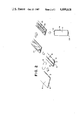
- FIG. 1 shows the production of a cotton wool web having a fluff-proof surface layer.
- FIG. 2 shows the procedure involved in the production of panty liners.
- the object of the present invention is to provide a hygienic fleece which is inexpensive to produce, does not form any fluff and which, despite its excellent absorbency, does not require a separate non-woven wrapping. According to the invention, this object is achieved in a hygienic fleece by a hot-embossed surface consolidation of a thermoplastic or meltable fiber component of the cotton wool web to form an embossed, nonwoven, fluff-proof surface layer.
- the present invention also relates to a method for making a hygienic fleece comprising a cotton wool web covered by a fluff-proof nonwoven surface layer, wherein a cotton wool web is prepared with a synthetic fiber component amenable to thermoplastic consolidation (herein, sometimes referred to as a "thermoplastic fiber") of the surface and in that at least one surface of the prepared cotton wool web is continuously or intermittent consolidated in the form of a nonwoven layer in a calender comprising at least one working roller with a heated embossing surface.
- thermoplastic consolidation herein, sometimes referred to as a "thermoplastic fiber”
- the prepared cotton wool web passes through a heated calender resulting in the "in situ" formation of a nonwoven surface layer on the cotton wool web thus treated, during which the surface layer remains part of the cotton wool web and is joined firmly thereto.
- all the edges, including the cut edges, also called divided edges or parting lines, and side edges (also called longitudinal edges) of the web can also be sealed in fluff-proof form by the heat sealing process of the invention.
- the calender used to form a fluff-proof surface on the upper surface and/or underneath of the cotton wool web should preferably comprise one or two pairs of rollers.
- a heated embossing roller, for example having a rhombic or hexagonal pattern, and a counter roller belong to each pair of rollers.
- the temperature of the heated embossing rollers or working rollers is adjusted to suit the thermoplastic fibers used and of course, takes into account the melting temperature of a particular thermoplastic fiber used. Where polypropylene fibers are used in a proportion of 20%, embossing temperatures in the range of from about 150° to about 160° are suitable.
- the pressure applied by the calender is best increased when the cotton wool web passes through at relatively high speeds and decreased when the web passes through at lower speeds.
- the calender pressure and the throughput rate are selected to be substantially inversely proportional.
- the calender pressure can be in the range of from about 0.5 to about 2 bars.
- the patterning of the embossing or working rollers is also selected in accordance with the material to be treated.
- the reliefs can have a diameter of, for example, from about 0.5 to about 3 mm.
- a cotton wool web for tampons can be produced, for example, from a mixture of standard tampon material, for example, 100% rayon staple fiber, preferably with a denier of 2.8 to 3.6 dtex and a fiber length of 30 to 40 mm, and approximately 20% of a thermoplastic fiber.
- standard tampon materials include rayon, cotton or mixtures hereof.
- thermoplastic fibers include polypropylene, polypropylene/polyethylene (for example Chisso ES bicomponent fiber), polyester, Heterofilfibers (ICI).
- the fibers can be mixed in a weighing box feeder.
- the thermoplastic fiber is used in an amount of from 5 to 20% of the total fiber content of the cotton wool web, more preferably from 10 to 20% and most preferably about 20%, if no fiber seperation is made.
- the thermoplastic fiber may be favourably present in amounts as low as about 5%.
- Further processing is then carried out by carding, followed by calendering to form a cotton wool web having the required width, for example from about 50 to about 90 mm.
- the cotton wool web can also be produced by needle punching. It is pointed out at this juncture that, in the manufacture of tampons, it is important in carrying out the present invention for the cotton wool web to pass through the heated calender containing at least one embossing roller before entering the tampon machine which divides the cotton wool web into suitable lengths and compresses those lengths to form finished tampons. In producing rolled tampons only one surface of the cotton wool band is consolidated in the form of a nonwoven layer, preferably in an intermittent way, so that fluff-proof segments result which form the surface of the tampon.
- roller embossing according to the invention with embossed lines, points, or lines and points also has an important bearing on the softness of the surface.
- whole-surface solidification would result in relatively stiff lengths of the cotton wool web which would not be easy to compress.
- Absorbency is also improved by "spot" solidification.
- edges, including end edges and side edges, of the individual lengths of cotton wool web can also be solidified, particularly by heat sealing.
- cut edges which have not been sealed in this way may, of course, also be displaced into the interior of the tampon or the like by special folding techniques of the type described in the German Patent Applications referred to earlier.
- panty liners, wound dressings and the like can also be produced by the process of the invention.
- webs of the nonwoven material of the invention weighing from about 110 to about 200 g/m 2 are prepared, folded into a U, and covered on one side with liquid-impermeable underwear protection, for example, a polymeric material impermeable to liquids, such as a polypropylene (PP) or polyethylene (PE) film.
- PP polypropylene
- PE polyethylene
- Liners can also be produced from a web-form or sheet form material by a sealing-embossing/stamping process. In cases where several predetermined embossing patterns are applied to a single rotating embossing roller, it is also possible economically to produce a corresponding number of liners at the same time.
- FIG. 1 shows the production of a cotton wool web having a fluff-proof surface layer.
- FIG. 2 shows the various stages involved in the production of panty liners.
- a fiber mixture of 80% rayon staple fiber (denier 3.6 dtex, fiber length 30 mm) and 20% polypropylene fibers (denier 3.0 dtex, 17/8", matt) was produced by a standard loosening technique, more particularly by carding, and made up into a cotton wool web weighing 728 g/m 2 which was then consolidated by needle punching.
- a rayon staple/polypropylene mixture 1 was transported by a conveyor belt 2 from a weighing box feeder 3 onto a card 4 comprising workers and strippers.
- the resulting fibrous web 5 was transported by conveyor belt 6 through a preparing unit 7, in which it was converted into a random-fiber web, and finally onto a sieve belt 8 where it was treated by a needle puncher 9.
- the needle-punched (or, alternatively, calendered) cotton wool web 10 was then transported by another conveyor belt 11 into a heatable calender consisting of a heated steel engraving roller 12 and a cotton or plastic roller 13.
- the cotton wool web can be surface-consolidated to give a fluff-proof finish on both sides if another calender comprising another counter roller 13' acting on the already consolidated surface of the cotton wool web 10 and a steel engraving roller 12' acting on the unconsolidated surface of the cotton wool web is arranged after the first calender, optionally with guide rollers 14 in between.
- the surface-consolidated part of the cotton wool web weighed approximately 15 to 20 g/m 2 . It did not give off any fluff.
- the surface consolidated cotton wool web prepared as described above was then cut up into lengths measuring 40 ⁇ 70 mm. At the same time, the cut edges, also called divided edges, were also consolidated, partly by means of a cutting and sealing machine. A recovery cord was then sewn onto each of the lengths of cotton wool web longitudinally thereof. The individual lengths were then axially and radially compressed by standard techniques to form cylindrical bodies and inserted into insertion tubes. The temperature applied during compression was in the range of from 100° to 120° C.
- the tampons produced from the surface-consolidated cotton wool web were compared with tampons produced from the same fiber mixture, but without surface consolidation and with conventional tampons consisting entirely of rayon staple (3.6 dtex, 30 mm).
- the first line (1.) relates to a tampon produced from a surface-consolidated cotton wool web prepared as above in accordance with the invention.
- the second line (2.) relates to a tampon prepared as above, but without surface consolidation.
- the third line (3.) relates to a tampon consisting entirely of rayon staple, 3.6 dtex, 30 mm prepared as above but without surface consolidation.
- Absorption capacity was determined by means of an artificial test vagina known as a Syngina.
- the test liquid used was water under an initial pressure of 30 mbar.
- the test was not conducted under isobaric pressure conditions; instead the pressure increased with increasing swelling through the absorption of liquid.
- V represents the volume and G the density of the tampon.
- a tampon produced in accordance with the invention has a slightly smaller volume than a tampon produced without any surface consolidation, so that its density is slightly greater.
- absorbency with pressure increase is better in the tampon produced in accordance with the invention than in the other two tampons.
- the tampons containing 20% polypropylene expand on withdrawal from the tube and occupy a greater volume V than tampons of pure rayon staple.
- This may be regarded as an advantage because the tampons which are flexible and relatively soft after expansion conform closely to the walls of the vagina and effectively prevent liquid from penetrating past.
- the tampons consisting entirely of rayon staple initially retain their rigid, rodlet shape and only begin to swell after contact with liquid.
- the nonwoven surface layer does not affect absorption capacity.
- the absorption capacity of the tampons containing polypropylene is increased by approximately 18%. This is attributable, inter alia, to the greater recovery power of that fiber mixture so that liquid can be taken up more quickly.
- absorbency is also increased in this region in inverse proportion to density. The increase in pressure on contact with liquid is distinctly lower in the case of tampons containing polypropylene.
- the tampons of 20% polypropylene and 80% rayon staple having the nonwoven surface layer formed in accordance with the invention are better than tampons consisting entirely of rayon staple for the following reasons:
- Panty liners are produced using a standard panty liner machine of the type commonly used for producing the cotton wool-based liners.
- a cotton wool web weighing approximately 130 g/m 2 consolidated in the same way as in EXAMPLE I was cut into 100 mm wide strips 15 as shown in FIG. 2.
- the cotton strip 15 had a surface 16 provided with a fluff-proof finish in accordance with the process of the invention decribed in EXAMPLE I using one pair of rollers.
- Cotton strip 15 also has an open surface 17.
- the cotton wool strip 15 was then folded on both sides in a manner shown by curved arrows 18, so that the consolidated surface 16 of the cotton wool strip forms the outside surface 19 of folded cotton wool strip 20, and forms a fold line 21.
- a moisture-impermeable film 22 was then bonded to the fold over fold line 21 as shown.
- the film 22 serves as underwear protection.
- An adhesive strip 23 was next applied, more particularly using a siliconized paper, to the film 22 in the usual way for fastening to underwear.
- the longitudinal ends 24 were finished, more particularly rounded off, and consolidated by means of a heated embossing roller (not shown), so that fluff-proof ends 25 are obtained. Embossing and consolidation are possible in that region because the cotton wool web contains thermoplastic fibers.
- the process of the invention is particularly economical because there is no need for separate wrapping in a nonwoven material, eliminating all the problems which this normally involves.
Landscapes
- Health & Medical Sciences (AREA)
- Engineering & Computer Science (AREA)
- Vascular Medicine (AREA)
- Epidemiology (AREA)
- Biomedical Technology (AREA)
- Heart & Thoracic Surgery (AREA)
- Manufacturing & Machinery (AREA)
- Life Sciences & Earth Sciences (AREA)
- Animal Behavior & Ethology (AREA)
- General Health & Medical Sciences (AREA)
- Public Health (AREA)
- Veterinary Medicine (AREA)
- Absorbent Articles And Supports Therefor (AREA)
Applications Claiming Priority (2)
| Application Number | Priority Date | Filing Date | Title |
|---|---|---|---|
| DE19833316431 DE3316431A1 (de) | 1983-05-05 | 1983-05-05 | Hygienevlies und verfahren zum herstellen des vlieses |
| DE3316431 | 1983-05-05 |
Publications (1)
| Publication Number | Publication Date |
|---|---|
| US4699618A true US4699618A (en) | 1987-10-13 |
Family
ID=6198231
Family Applications (1)
| Application Number | Title | Priority Date | Filing Date |
|---|---|---|---|
| US06/606,079 Expired - Fee Related US4699618A (en) | 1983-05-05 | 1984-05-01 | Fluff free tampon and method for making |
Country Status (3)
| Country | Link |
|---|---|
| US (1) | US4699618A (fr) |
| EP (1) | EP0124834A3 (fr) |
| DE (1) | DE3316431A1 (fr) |
Cited By (10)
| Publication number | Priority date | Publication date | Assignee | Title |
|---|---|---|---|---|
| US5171235A (en) * | 1990-04-03 | 1992-12-15 | Hoechst Aktiengesellschaft | Tampon and manufacture thereof |
| US5185010A (en) * | 1992-01-31 | 1993-02-09 | Tambrands Inc. | Spirally wound tampon with overwrap |
| US20030225389A1 (en) * | 2002-05-31 | 2003-12-04 | The Procter & Gamble Company | Sewn digital tampon |
| US6758839B2 (en) | 1997-12-03 | 2004-07-06 | Johnson & Johnson Gmbh | Tampon for feminine hygiene or medical purposes, and process for producing the same |
| US20050039846A1 (en) * | 1999-05-05 | 2005-02-24 | Schmidt Bradley G. | Method for embossing air-laid webs using laser engraved heated hard rubber embossing rolls |
| KR100477859B1 (ko) * | 1998-09-15 | 2005-07-11 | 도레이새한 주식회사 | 폴리에스테르 부직포의 분리막 지지체 |
| US7011033B2 (en) | 2003-06-30 | 2006-03-14 | The Procter & Gamble Company | Method and apparatus for cord attachment |
| US20070126141A1 (en) * | 1999-04-27 | 2007-06-07 | Georgia-Pacific Consumer Products Lp | Air-Laid Absorbent Sheet With Sinuate Emboss |
| US20070160654A1 (en) * | 2001-10-12 | 2007-07-12 | Convatec Limited | Gel-forming fabric composite |
| US20130068388A1 (en) * | 2009-02-24 | 2013-03-21 | Uni-Charm Corporation | Method and apparatus for manufacturing a roll of sheet |
Families Citing this family (6)
| Publication number | Priority date | Publication date | Assignee | Title |
|---|---|---|---|---|
| DE8704942U1 (de) * | 1987-04-02 | 1987-05-27 | Gerke, Peter, Dr.med., 2125 Adendorf | Tupfer für medizinische Zwecke |
| DE3736276C1 (de) * | 1987-10-27 | 1989-05-18 | Pelz & Co Kg W | Verfahren zur Herstellung von Wattetupfern und Anlage zur Herstellung eines solchen Wattetupfers nach diesem Verfahren |
| US4943286A (en) * | 1988-12-30 | 1990-07-24 | Armstead Kenneth W | Patient underpad |
| DE4036208A1 (de) * | 1990-11-14 | 1992-05-21 | Vostra Medicalprodukte Vertrie | Medizinisches saugtuch |
| GR1002202B (en) * | 1991-04-12 | 1996-03-22 | Mcneil Ppc Inc | Absorbent pads and process thereof. |
| US6066775A (en) * | 1997-10-09 | 2000-05-23 | Amir Paper Products | Absorbent core and method for construction thereof |
Citations (9)
| Publication number | Priority date | Publication date | Assignee | Title |
|---|---|---|---|---|
| US3545442A (en) * | 1964-09-23 | 1970-12-08 | Huyck Corp | Bandaging and dressing material |
| US3855046A (en) * | 1970-02-27 | 1974-12-17 | Kimberly Clark Co | Pattern bonded continuous filament web |
| US3976075A (en) * | 1975-02-24 | 1976-08-24 | Personal Products Company | Tampon blank with reduced sloughing properties |
| US4054141A (en) * | 1976-04-06 | 1977-10-18 | Julius Schwaiger | Absorptive material for hygienic purposes |
| US4275105A (en) * | 1978-06-16 | 1981-06-23 | The Buckeye Cellulose Corporation | Stabilized rayon web and structures made therefrom |
| US4333979A (en) * | 1980-08-18 | 1982-06-08 | Kimberly-Clark Corporation | Soft, bulky, lightweight nonwoven web and method of producing; the web has both fused spot bonds and patterned embossments |
| DE3236540A1 (de) * | 1982-10-02 | 1984-04-05 | Henkel KGaA, 4000 Düsseldorf | Tampon fuer die frauenhygiene und verfahren zu dessen herstellung |
| DE3236541A1 (de) * | 1982-10-02 | 1984-04-05 | Henkel KGaA, 4000 Düsseldorf | Tampon fuer die frauenhygiene und verfahren zu dessen herstellung |
| US4543098A (en) * | 1982-12-23 | 1985-09-24 | Kimberly-Clark Corporation | Tampon with resilient component and microfiber insert |
Family Cites Families (7)
| Publication number | Priority date | Publication date | Assignee | Title |
|---|---|---|---|---|
| US3507943A (en) * | 1965-10-04 | 1970-04-21 | Kendall & Co | Method for rolling nonwoven fabrics |
| US3937223A (en) * | 1974-04-19 | 1976-02-10 | American Cyanamid Company | Compacted surgical hemostatic felt |
| US4082886A (en) * | 1977-08-15 | 1978-04-04 | Johnson & Johnson | Liquid absorbent fibrous material and method of making the same |
| SE7802305L (sv) * | 1978-03-01 | 1979-09-02 | Landstingens Inkopscentral | P y * larsson # okerum |
| DE2838618A1 (de) * | 1978-09-05 | 1980-03-06 | Bayer Ag | Verfahren zur verfestigung von wattebaendern aus synthesefasern fuer die tampon-herstellung |
| DE3039728A1 (de) * | 1979-10-22 | 1981-04-30 | Kimberly-Clark Corp., 54956 Neenah, Wis. | Saugfaehige einrichtung |
| NZ201073A (en) * | 1981-07-10 | 1985-12-13 | Chicopee | An absorbent thermal bonded nonwoven fabric and its use in a catamenial device |
-
1983
- 1983-05-05 DE DE19833316431 patent/DE3316431A1/de not_active Withdrawn
-
1984
- 1984-04-27 EP EP84104748A patent/EP0124834A3/fr not_active Withdrawn
- 1984-05-01 US US06/606,079 patent/US4699618A/en not_active Expired - Fee Related
Patent Citations (9)
| Publication number | Priority date | Publication date | Assignee | Title |
|---|---|---|---|---|
| US3545442A (en) * | 1964-09-23 | 1970-12-08 | Huyck Corp | Bandaging and dressing material |
| US3855046A (en) * | 1970-02-27 | 1974-12-17 | Kimberly Clark Co | Pattern bonded continuous filament web |
| US3976075A (en) * | 1975-02-24 | 1976-08-24 | Personal Products Company | Tampon blank with reduced sloughing properties |
| US4054141A (en) * | 1976-04-06 | 1977-10-18 | Julius Schwaiger | Absorptive material for hygienic purposes |
| US4275105A (en) * | 1978-06-16 | 1981-06-23 | The Buckeye Cellulose Corporation | Stabilized rayon web and structures made therefrom |
| US4333979A (en) * | 1980-08-18 | 1982-06-08 | Kimberly-Clark Corporation | Soft, bulky, lightweight nonwoven web and method of producing; the web has both fused spot bonds and patterned embossments |
| DE3236540A1 (de) * | 1982-10-02 | 1984-04-05 | Henkel KGaA, 4000 Düsseldorf | Tampon fuer die frauenhygiene und verfahren zu dessen herstellung |
| DE3236541A1 (de) * | 1982-10-02 | 1984-04-05 | Henkel KGaA, 4000 Düsseldorf | Tampon fuer die frauenhygiene und verfahren zu dessen herstellung |
| US4543098A (en) * | 1982-12-23 | 1985-09-24 | Kimberly-Clark Corporation | Tampon with resilient component and microfiber insert |
Cited By (16)
| Publication number | Priority date | Publication date | Assignee | Title |
|---|---|---|---|---|
| US5171235A (en) * | 1990-04-03 | 1992-12-15 | Hoechst Aktiengesellschaft | Tampon and manufacture thereof |
| US5185010A (en) * | 1992-01-31 | 1993-02-09 | Tambrands Inc. | Spirally wound tampon with overwrap |
| US6758839B2 (en) | 1997-12-03 | 2004-07-06 | Johnson & Johnson Gmbh | Tampon for feminine hygiene or medical purposes, and process for producing the same |
| KR100477859B1 (ko) * | 1998-09-15 | 2005-07-11 | 도레이새한 주식회사 | 폴리에스테르 부직포의 분리막 지지체 |
| US7699955B2 (en) | 1999-04-27 | 2010-04-20 | Georgia-Pacific Consumer Products Lp | Air-laid absorbent sheet with sinuate emboss |
| US20070126141A1 (en) * | 1999-04-27 | 2007-06-07 | Georgia-Pacific Consumer Products Lp | Air-Laid Absorbent Sheet With Sinuate Emboss |
| US20070181243A1 (en) * | 1999-05-05 | 2007-08-09 | Georgia-Pacific Consumer Products Lp | Method for Embossing Air-Laid Webs Using Laser Engraved Heated Embossing Rolls |
| US6893525B1 (en) * | 1999-05-05 | 2005-05-17 | Fort James Corporation | Method for embossing air-laid webs using laser engraved heated embossing rolls |
| US7208064B2 (en) | 1999-05-05 | 2007-04-24 | Georgia-Pacific Consumer Products Lp | Method for embossing air-laid webs using laser engraved heated hard rubber embossing rolls |
| US20050039846A1 (en) * | 1999-05-05 | 2005-02-24 | Schmidt Bradley G. | Method for embossing air-laid webs using laser engraved heated hard rubber embossing rolls |
| US7655105B2 (en) | 1999-05-05 | 2010-02-02 | Georgia-Pacific Consumer Products Lp | Method for embossing air-laid webs using laser engraved heated embossing rolls |
| US20070160654A1 (en) * | 2001-10-12 | 2007-07-12 | Convatec Limited | Gel-forming fabric composite |
| US6887226B2 (en) | 2002-05-31 | 2005-05-03 | The Procter & Gamble Company | Sewn digital tampon |
| US20030225389A1 (en) * | 2002-05-31 | 2003-12-04 | The Procter & Gamble Company | Sewn digital tampon |
| US7011033B2 (en) | 2003-06-30 | 2006-03-14 | The Procter & Gamble Company | Method and apparatus for cord attachment |
| US20130068388A1 (en) * | 2009-02-24 | 2013-03-21 | Uni-Charm Corporation | Method and apparatus for manufacturing a roll of sheet |
Also Published As
| Publication number | Publication date |
|---|---|
| EP0124834A3 (fr) | 1985-04-17 |
| EP0124834A2 (fr) | 1984-11-14 |
| DE3316431A1 (de) | 1984-11-08 |
Similar Documents
| Publication | Publication Date | Title |
|---|---|---|
| US4699618A (en) | Fluff free tampon and method for making | |
| EP1100424B1 (fr) | Tampon a panneaux flexibles | |
| US3854481A (en) | Tampon having an insertion end of lesser density than the body portion | |
| US5576090A (en) | Sheet elastic complex used in sanitary products its manufacturing process, and its usages | |
| EP0109280B1 (fr) | Pansement adhésif d'une seule pièce | |
| DE60309485T2 (de) | Tampon mit sauberem erscheinungsbild nach dem gebrauch | |
| KR0134905B1 (ko) | 분말 접착된 단층 랩을 갖는 탐폰 | |
| JP2001522957A (ja) | 衛生用品で使用するための、セルロース繊維からなる繊維素材ウェブを製造する方法と装置 | |
| MXPA01010160A (es) | Tampon con proteccion incrementada a las fugas | |
| ZA200007362B (en) | Tampon with flexible panels. | |
| CZ284462B6 (cs) | Složený netkaný materiál a způsob jeho výroby | |
| AU2025203354A1 (en) | Tampon for feminine hygiene | |
| KR101862434B1 (ko) | 탄력성 탐폰 및 제조 방법 | |
| MXPA03005746A (es) | Tampon tipo bolsa que contiene un material fibroso comprimido. | |
| WO2003073971A2 (fr) | Procede de production d'une structure composite absorbante destinee a fabriquer des couches, des serviettes hygieniques et analogues, et structures produits par ce procede | |
| EP0676943B1 (fr) | Tampon catamenial et son procede de production | |
| CA1307103C (fr) | Batonnet absorbant pour la cavite buccale | |
| EP0174152B1 (fr) | Produits absorbants | |
| JPS58180651A (ja) | 不織布の製造方法 | |
| GB2145970A (en) | Sanitary napkins | |
| DE2550730B2 (de) | Tampon für die Frauenhygiene | |
| DE8313318U1 (de) | Hygienebinde | |
| DE8337858U1 (de) | Tampon |
Legal Events
| Date | Code | Title | Description |
|---|---|---|---|
| AS | Assignment |
Owner name: HENKEL KOMMANDITGESELLSCHAFT AUF AKTIEN (HENKEL KG Free format text: ASSIGNMENT OF ASSIGNORS INTEREST.;ASSIGNOR:SUSTMANN, SCARLET;REEL/FRAME:004256/0383 Effective date: 19840424 |
|
| AS | Assignment |
Owner name: VEREINIGTE PAPIERWERKE, SCHICKEDANZ & CO., SCHOPPE Free format text: ASSIGNMENT OF ASSIGNORS INTEREST.;ASSIGNOR:HENKEL KOMMANDITGESELLSCHAFT AUF AKTIEN;REEL/FRAME:004611/0913 Effective date: 19860523 |
|
| REMI | Maintenance fee reminder mailed | ||
| LAPS | Lapse for failure to pay maintenance fees | ||
| FP | Lapsed due to failure to pay maintenance fee |
Effective date: 19911013 |
|
| STCH | Information on status: patent discontinuation |
Free format text: PATENT EXPIRED DUE TO NONPAYMENT OF MAINTENANCE FEES UNDER 37 CFR 1.362 |