US4770027A - Method of measuring concentrations of odors and a device therefor - Google Patents
Method of measuring concentrations of odors and a device therefor Download PDFInfo
- Publication number
- US4770027A US4770027A US06/935,491 US93549186A US4770027A US 4770027 A US4770027 A US 4770027A US 93549186 A US93549186 A US 93549186A US 4770027 A US4770027 A US 4770027A
- Authority
- US
- United States
- Prior art keywords
- odors
- odorimetric
- odor detector
- total concentration
- chamber
- Prior art date
- Legal status (The legal status is an assumption and is not a legal conclusion. Google has not performed a legal analysis and makes no representation as to the accuracy of the status listed.)
- Expired - Lifetime
Links
- 235000019645 odor Nutrition 0.000 title claims abstract description 169
- 238000000034 method Methods 0.000 title claims description 25
- 238000005259 measurement Methods 0.000 claims abstract description 24
- 239000004065 semiconductor Substances 0.000 claims abstract description 13
- 238000010438 heat treatment Methods 0.000 claims abstract description 7
- 229910044991 metal oxide Inorganic materials 0.000 claims abstract description 7
- 150000004706 metal oxides Chemical class 0.000 claims abstract description 6
- 239000000758 substrate Substances 0.000 claims abstract description 4
- 239000000523 sample Substances 0.000 claims description 17
- 239000003570 air Substances 0.000 claims description 14
- 239000013074 reference sample Substances 0.000 claims description 9
- 238000003795 desorption Methods 0.000 claims description 8
- 238000001179 sorption measurement Methods 0.000 claims description 8
- XLOMVQKBTHCTTD-UHFFFAOYSA-N Zinc monoxide Chemical compound [Zn]=O XLOMVQKBTHCTTD-UHFFFAOYSA-N 0.000 claims description 7
- XOLBLPGZBRYERU-UHFFFAOYSA-N tin dioxide Chemical compound O=[Sn]=O XOLBLPGZBRYERU-UHFFFAOYSA-N 0.000 claims description 7
- 238000012544 monitoring process Methods 0.000 claims description 6
- 229910001887 tin oxide Inorganic materials 0.000 claims description 6
- 230000008859 change Effects 0.000 claims description 5
- 230000007246 mechanism Effects 0.000 claims description 5
- 230000004044 response Effects 0.000 claims description 5
- 239000012080 ambient air Substances 0.000 claims description 4
- 239000000126 substance Substances 0.000 claims description 4
- 239000012212 insulator Substances 0.000 claims description 3
- 239000002594 sorbent Substances 0.000 claims description 3
- 239000011787 zinc oxide Substances 0.000 claims description 3
- 239000011230 binding agent Substances 0.000 claims description 2
- 239000000919 ceramic Substances 0.000 claims description 2
- TWNQGVIAIRXVLR-UHFFFAOYSA-N oxo(oxoalumanyloxy)alumane Chemical compound O=[Al]O[Al]=O TWNQGVIAIRXVLR-UHFFFAOYSA-N 0.000 claims description 2
- 238000007789 sealing Methods 0.000 claims description 2
- 239000003610 charcoal Substances 0.000 claims 1
- 239000002131 composite material Substances 0.000 abstract description 4
- 235000013399 edible fruits Nutrition 0.000 abstract description 3
- 235000013361 beverage Nutrition 0.000 abstract description 2
- 238000007740 vapor deposition Methods 0.000 abstract 1
- 239000007789 gas Substances 0.000 description 20
- 238000007689 inspection Methods 0.000 description 11
- 241000209094 Oryza Species 0.000 description 9
- 235000007164 Oryza sativa Nutrition 0.000 description 9
- 235000009566 rice Nutrition 0.000 description 9
- 235000016213 coffee Nutrition 0.000 description 7
- 235000013353 coffee beverage Nutrition 0.000 description 7
- 235000013305 food Nutrition 0.000 description 7
- OKTJSMMVPCPJKN-UHFFFAOYSA-N Carbon Chemical compound [C] OKTJSMMVPCPJKN-UHFFFAOYSA-N 0.000 description 6
- 235000019219 chocolate Nutrition 0.000 description 6
- 235000020083 shōchū Nutrition 0.000 description 6
- 235000013555 soy sauce Nutrition 0.000 description 5
- 239000011550 stock solution Substances 0.000 description 5
- 238000004519 manufacturing process Methods 0.000 description 4
- 238000011156 evaluation Methods 0.000 description 3
- 238000004817 gas chromatography Methods 0.000 description 3
- 230000001105 regulatory effect Effects 0.000 description 3
- 244000144725 Amygdalus communis Species 0.000 description 2
- 235000011437 Amygdalus communis Nutrition 0.000 description 2
- 235000013334 alcoholic beverage Nutrition 0.000 description 2
- 235000020224 almond Nutrition 0.000 description 2
- 235000019568 aromas Nutrition 0.000 description 2
- 238000007865 diluting Methods 0.000 description 2
- 230000006870 function Effects 0.000 description 2
- 230000008569 process Effects 0.000 description 2
- 230000035945 sensitivity Effects 0.000 description 2
- 230000008786 sensory perception of smell Effects 0.000 description 2
- 238000005245 sintering Methods 0.000 description 2
- 239000000243 solution Substances 0.000 description 2
- 235000015096 spirit Nutrition 0.000 description 2
- 238000012360 testing method Methods 0.000 description 2
- 238000001771 vacuum deposition Methods 0.000 description 2
- XLYOFNOQVPJJNP-UHFFFAOYSA-N water Substances O XLYOFNOQVPJJNP-UHFFFAOYSA-N 0.000 description 2
- 229910018404 Al2 O3 Inorganic materials 0.000 description 1
- 241001474374 Blennius Species 0.000 description 1
- CWEKGCILYDRKNV-KPOOZVEVSA-L Orange B Chemical compound [Na+].[Na+].CCOC(=O)c1[nH]n(-c2ccc(cc2)S([O-])(=O)=O)c(=O)c1\N=N\c1ccc(c2ccccc12)S([O-])(=O)=O CWEKGCILYDRKNV-KPOOZVEVSA-L 0.000 description 1
- 229920002472 Starch Polymers 0.000 description 1
- 230000032683 aging Effects 0.000 description 1
- 238000004458 analytical method Methods 0.000 description 1
- 125000003118 aryl group Chemical group 0.000 description 1
- 239000003054 catalyst Substances 0.000 description 1
- 239000011248 coating agent Substances 0.000 description 1
- 238000000576 coating method Methods 0.000 description 1
- 238000010276 construction Methods 0.000 description 1
- 238000007796 conventional method Methods 0.000 description 1
- 239000002537 cosmetic Substances 0.000 description 1
- 230000003247 decreasing effect Effects 0.000 description 1
- 230000002950 deficient Effects 0.000 description 1
- 230000001877 deodorizing effect Effects 0.000 description 1
- 238000010790 dilution Methods 0.000 description 1
- 239000012895 dilution Substances 0.000 description 1
- 238000000855 fermentation Methods 0.000 description 1
- 230000004151 fermentation Effects 0.000 description 1
- 238000012625 in-situ measurement Methods 0.000 description 1
- 239000000463 material Substances 0.000 description 1
- 230000009965 odorless effect Effects 0.000 description 1
- 235000013987 orange B Nutrition 0.000 description 1
- 238000001259 photo etching Methods 0.000 description 1
- 230000002035 prolonged effect Effects 0.000 description 1
- 102000004169 proteins and genes Human genes 0.000 description 1
- 108090000623 proteins and genes Proteins 0.000 description 1
- 238000005070 sampling Methods 0.000 description 1
- 229920006395 saturated elastomer Polymers 0.000 description 1
- 230000014860 sensory perception of taste Effects 0.000 description 1
- 238000004544 sputter deposition Methods 0.000 description 1
- 229910001220 stainless steel Inorganic materials 0.000 description 1
- 239000010935 stainless steel Substances 0.000 description 1
- 235000019698 starch Nutrition 0.000 description 1
- 239000008107 starch Substances 0.000 description 1
- 238000012549 training Methods 0.000 description 1
Images


Classifications
-
- G—PHYSICS
- G01—MEASURING; TESTING
- G01N—INVESTIGATING OR ANALYSING MATERIALS BY DETERMINING THEIR CHEMICAL OR PHYSICAL PROPERTIES
- G01N27/00—Investigating or analysing materials by the use of electric, electrochemical, or magnetic means
-
- G—PHYSICS
- G01—MEASURING; TESTING
- G01N—INVESTIGATING OR ANALYSING MATERIALS BY DETERMINING THEIR CHEMICAL OR PHYSICAL PROPERTIES
- G01N33/00—Investigating or analysing materials by specific methods not covered by groups G01N1/00 - G01N31/00
- G01N33/02—Food
Definitions
- the present invention relates to the field of odorimetry and, more particularly, to a method of measuring the total concentration of odors of an object, a method of discriminating objects by comparatively analyzing the concentrations of various odors of the objects, and an apparatus for use in carrying out such methods.
- Odorimetry plays an important role in the field of quality inspection, for example, when the freshness of perishable foods being shipped is to be evaluated.
- Other examples include control of fermentation and classification by grade of seaweed, coffee, alcoholic beverages or the like in accordance with odor concentrations. For such quality inspections, it is required not so much to measure individual odors separately but to monitor the total concentration of the odors instantaneously.
- Another object of the present invention is to provide a method of discriminating objects without resort to the human sense by measuring and analyzing objectively various odors of the objects.
- a further object of the present invention is to provide an apparatus useful for carrying out the above-mentioned methods that includes one or more non-selective odor detectors.
- a method of measuring the total concentration of odors of an object using an odorimetric device including a non-selective odor detector disposed within an odorimetric chamber comprising the steps of: (a) heating a non-selective odor detector to a predetermined temperature at which the rate of adsorption and desorption of odors of an object to be measured is sufficiently high to enable a real time measurement of the total concentration of the odors; (b) introducing fresh air into an odorimetric chamber defined in the odorimetric device to scavenge the odorimetric chamber; (c) placing the object in the odorimetric chamber; (d) sealing off the odorimetric chamber from the surrounding environment; and (e) monitoring the total concentration of the odors of the object through the output reading of the odor detector.
- an odoriometric device for measuring the total concentration of odors of an object, comprising: (a) a housing defining therein an odorimetric chamber for accommodating an object to be measured; (b) a door for sealingly closing the odorimetric chamber from the surrounding environment; (c) an non-selective odor detector mounted within the odorimetric chamber for monitoring the total concentration of odors emitting from the object; (d) heater means for heating the non-selective odor detector to a predetermined temperature at which the rate of adsorption and desorption of odors of the object to be measured is sufficiently high to enable a real time measurement of the total concentration of the odors; (e) means for introducing fresh air into the odorimetric chamber to scavenge it; (f) display means for providing an instantaneous indication of the monitored total concentration of the odors.
- FIG. 1A is a front elevation showing an odorimetric device embodying the present invention
- FIG. 1B is a section taken along line 1B--1B of FIG. 1A;
- FIG. 2 is a schematic front elevation showing a typical non-selective odor detector incorporated in the odorimetric device of FIGS. 1A and 1B;
- FIG. 3 is a view similar to FIG. 1B but showing an odorimetric device according to a second embodiment of the present invention
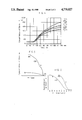
- FIG. 4 is a plot against time of the outputs of a plurality of odor detectors, each representative of the total concentration of odors of a single piece of almond chocolate, the plurality of odor detectors having different characteristics together comprising a single composite odor detector used in the odorimetric device of FIG. 1;
- FIG. 5 is a plot against time of the total concentrations of odors of a relatively fresh orange and of an orange left for one week;
- FIG. 6 is a plot against time of the total concentrations of odors of "Kilimanjaro" coffee just ground and of the same coffee left at a room temperature for one hour;
- FIG. 7 is a plot against time of the total concentrations of odors of Japanese traditional spirits called the "Srochu” just distilled and the same “Srochu” matured for twenty years;
- FIG. 8 is a plot against time of the total concentrations of odors of fresh rice and of stale rice.
- FIG. 9 is a plot against time of the total concentrations of odors of a stock solution for commercially available soy sauce and of the same soy sauce prepared by diluting the stock solution with five times as much city water as the solution.
- a non-selective odor detector is used for measuring the total concentration of odors to provide a representative electric signal.
- the odor detector may be comprised of a plurality of known gas sensors having selective characteristics or of a single non-selective odor detector to be described later in detail.
- the odor detector used should be capable of detecting the total concentration of odors of a sample, but is not necessarily required to provide a separate indication of the concentration of each order.
- a plurality of existing selective gas sensors or alternatively, a plurality of non-selective sensors having their characteristics adjusted in the manner to be described below can be used. Since the selective detectors are well known in the art, the following description is desired exclusively to embodiments incorporating non-selective gas sensors.
- the three major requirements for gas detectors utilizing a semiconductor which exhibits an electric resistance varying (or decreasing) in response to exposure to gases when it is held at a high temperature are as follows: (1) The detector must have selectivity, i.e., a high sensitivity to gases of interest; (2) It is insensitive to other gases; and (3) The characteristics of the detector must be stable throughout its useful life.
- an odor detector for measuring the total concentration of various odors from an object to provide an instantaneous indication thereof, based on the observation that an n-type semiconductor becomes sensitive to a variety of gases containing odors if the purity is raised above a certain level without adding catalysts.
- One example of such non-selective odor detector comprises a sensor portion formed of a simple substance of an n-type semiconductor, such as tin oxide (SnO 2 ) or zinc oxide (ZnO), having its electric resistance varying in response to adsorption and desorption of gas molecules; and a heater for heating the sensor portion to a predetermined operating temperature.
- the n-type semiconductor to be used in the sensor portion is of a sintered body or film of the metal oxide.
- a p-type semiconductor generally is not satisfactorily sensitive to odors.
- the tin oxide and zinc oxide as described above show excellent sensitivity.
- the sensor portion can be fabricated by conventional techniques such as vacuum deposition, sputtering, chemical treatment (i.e., sintering to provide porosity) or photoetching. In the sintering method, for example, the heat treatment is performed at 600° to 850° C.
- a voltage of 2 to 6 V is applied to a heater having a resistance of about 10 K ⁇ .
- This range of the voltage is selected so as to facilitate the measurement of odors of an object.
- the present invention should not be limited to that particular voltage range and the resistance value.
- the odor detector in order to increase the adsorption and desorption rates, the odor detector has to be heated preparatory to measurement until it reaches a predetermined temperature (e.g., about 200° C.).
- the measurement can be started when the electric current flowing through the odor detector has become stable, usually several tens of minutes after the power is switched on.
- the odor detector provides an electric signal representative of the total concentration of odors present in a monitored environment.
- the electric signal is fed to a display which may be a digital or analog display.
- the electric signal may be supplied to a recorder which can plot odor concentration changing with time.
- the total concentration of odors from an object relative to a reference value.
- the reference value can be set in a common display and/or recorder useful for measuring the total concentration of the odors.
- a separate odor detector may be provided just for setting the reference value representative of the concentration of a sample In the latter case, it is convenient to place the measuring detector and the reference detector side by side so that the readings of an object under measurement and of a reference sample may be visually compared with each other.
- the outputs of the respective detectors are transformed into either corresponding patterns of numerical values or graphical representations which are then compared with stored data to match a particular pattern representative of a known object. If a matching pattern is established, this means that the object being evaluated for its odors is identical to the known object.
- the odor detector according to the present invention can not only make a measurement of odor concentration under saturated conditions of a monitored environment but also determines the rate at which odors diffuse in the environment.
- the odor detector can be designed so that the sample holder incorporates therein a band heater, the output of the odor detector being fed to the Y-axis input of an X-Y recorder and the temperature representative signal derived from the band heater being applied to the X-axis input. With this arrangement, the rate of volatilation of various odors can be recorded as a function of sensor temperature.
- the semiconductor sensor is heated to 350° to 450° C. where it is desired to meausre combustible gases with the present odor detector. Since, however, gases containing odors generally have lower concentrations than such combustible gases, the sensor should be held at a lower temperature (e.g., 200° C.) to enable an efficient and accurate determination of odor concentration.
- an odorimetric device is constructed of: a housing defining therein an odorimetric chamber 11 for accommodating an object to be measured (not shown); a door 12 for sealingly closing the chamber 11 from the surrounding environment; a non-selective odor detector 13 mounted within the odorimetric chamber 11 for monitoring the total concentration of odors emitting from the object; and a control panel 14, as will be described in the following. All of the inner walls of the odorimetric chamber 11 are lined with stainless steel plates. The houding is formed in its rear wall with air inlet ports 15 and also in its side wall with a gas outlet 16.
- the rear wall of the housing is formed with an externally opening recess 17 which communicate with the odorimetric chamber 11 through the air inlet ports 15 and in which there are removably charged a filter 18 comprised of surface active sorbent such as activated charcoal.
- a ventilating fan 19 is provided in the gas outlet 16 for removing the residual odors in the odorimetric chamber.
- the air inlet ports 15 and the gas outlet 16 may preferably be fitted with doors for shutting off the ambient air from the odorimetric chamber.
- the control panel 14 includes: a digital display 21 for providing a digital indication of the total concentration of odors being monitored by the odor detector 13; a main switch 22; a fan switch 23; a voltage regulating knob 24 for regulating the voltage to be applied to the odor detector 13; a fine adjustment knob 25 for finely adjusting the voltage regulated by the knob 24; a voltmeter 26 for indicating the voltage applied to the odor detector 13; and a peak-hold knob 27 for holding the peak of the total concentration of the measured odors.
- Reference numeral 28 denotes a sample holder for holding thereon a sample or an object to be measured.
- the non-selective odor detector 13 comprises: a sensor portion 131 formed of a film which is fabricated by coating a substrate or ceramic plate 132 having a thickness of 0.6 mm with a metal oxide (which contains tin oxide having a purity of 99.999% and a binder of aluminum oxide Al 2 O 3 ) by vacuum deposition.
- the sensor portion 131 has its opposite ends sandwiched by a pair of electrodes 133 and 133' therebetween. the electrodes 133 and 133' are placed on a pair of insulators 134.
- a pair of screws 135 are used to fixedly mount the sensor portion 131 with the electrodes 133 and 133' to the insulators 134.
- the odor detector 13 is held at a constant temperature throughout measurement cycles so that it may not be influenced by the ambient temperature and humidity.
- the odor detector 13 per se has no odor discriminating function but can detect differential concentrations of odors among individual samples of like object which have been treated under different conditions.
- the odor detector 13 In operation, the odor detector 13 is heated to a predetermined operating temperature, which usually takes several tens of minutes after the main switch 22 is turned on. the measurement will commence after the electric current flowing through the odor detector 13 has become stable.
- the fan switch 23 is turned on to actuate the ventilating fan 19. As a result, the ambient air is filtered through the activated charcoal filter 18 and passes into the odorimetric chamber 11 to deodorize it.
- a sample to be used as a reference is placed on the sample holder 28 within the odorimetric chamber 11. Then, the door 12 is closed to shut off the reference sample from the environment outside of the odorimetric chamber 11. With gases containing odors of the sample coming into contact with the odor detector 13, the detector exhibits a change in its electric resistance, causing a corresponding change in the electric current flowing therethrough. This change in the current is derived as a voltage signal, which signal is amplified for display on the digital display 21. This voltage signal may be recorded by a printer (not shown).
- the door 12 is opened to remove the reference sample from the odorimetric chamber 11 and then closed.
- the fan switch 23 is turned on to run the ventilating fan 19. This will introduce fresh air into the odorimetric chamber 11 to ensure that the chamber 11 returns to an odorless state.
- an object to be measured is placed in the odorimetric chamber 11 to measure the total concentration of odors associated with the object.
- the total concentration of the odors of the object can be compared with that of the reference sample.
- the odorimetric chamber 11 has a recess 29 formed in its rear wall to receive therein the odor detector 13.
- the recess 29 includes a shutter mechanism 31 operative to isolate the odor detector 13 from the odorimetric chamber 11.
- This shutter mechanism 31 is of a manually operated type, but may be of an electrically operated type.
- a sample is placed into the odorimetric chamber 11 after the chamber 11 is cleaned or qurified with air introduced from the surrounding environment.
- the shutter mechanism 31 is actuated to open the recess to the chamber 11 to thereby enable a measurement of the total concentration of the odors without being affected by any other odors.
- the use of the shutter mechanism 31 also serves to protect the odor detector 13 for its prolonged service life.
- Like parts or components as used in the embodiment of FIG. 1B are denoted by the same reference numerals in FIG. 3.
- Non-selective odor detectors of the same type as used in the embodiment of FIG. 2 were assembled into a single composite odor detector.
- Each of these five odor detectors includes a heater having a resistance of 10 K ⁇ .
- the heater associated with the first detector was supplied with a voltage of 2.0 V; the heter for the second detector a voltage of 2.5 V; the third a voltage of 3.0 V; the fourth a voltage of 3.5 V; and the fifth a voltage of 4.0 V, thus resulting in the five detectors having different sensing characteristics.
- FIG. 4 is a graph plotting against time the output voltages of the five odor detectors, each being reprentative of the total concentration of odors of almond chocolate manufactured by "L" Corporation.
- an odorimetric device which is identical to that shown in FIGS. 1A and 1B except using the composite odor detector was used.
- the ventilating fan 19 was turned on to introduce fresh ambient air into the odorimetric chamber 11 through the activated charcoal filter 18 to thereby deodorize the chamber.
- a sample of chocolate was placed on the sample holder 28 and odorimetric chamber 11 was then sealed off. With the door 12 closed, the odor molecules emitted from the sample chocolate began to diffuse into the plenum of the chamber 11.
- the five odor detector showed changes in their electric resistances in response to exposure to the odor molecules, resulting in corresponding changes in the electric current flowing through the detectors. These current changes were transformed into corresponding changes in voltage, which were then amplified for subsequent recordal by a five-channel printer.
- the present invention permits a quality inspection of food products such as chocolate by analytically comparing the total concentration of odors therefrom.
- the total concentrations of odors from a relatively fresh orange and an orange left for one week were compared by the present odorimetric device.
- a curve a represents the total concentration of the odors of the relatively fresh orange
- a curve B shows the total concentration of the odors from the orange left for one week.
- the present odorimetric device was used to compare the total concentrations of odors from "Kilimanjaro" coffee just ground and the one left at a room temperature for one hour.
- curve A indicates the value of the former coffee
- curve B shows the latter.
- the results of such comparison indicate that coffee is very quick to lose its unique aroma. This will lead to the conclusion that aromatic foods and beverages and coffee as well will be subject to a quick dilution of unique aromas and therefore an early consumption thereof after exposure to the outside air is recommended.
- the present odorimetric device was used to compare Japanese traditional spirits called “SACHu” just distrilled and the one which were matured for twenty years.
- curves A and A' correspond to the younger "SACHu”
- curves B and B' correspond to the matured "SACHu”.
- the gain of the DC amplifier was switched to change the scale from curves A and B to curves A' and B' to thereby enable tracking of the changing total concentration of odors. Comparison of the curves indicates that the total concentration of aromas or odors of "SACHu" is the highest when just distilled.
- the progress of the maturing process can be monitored by measuring the total concentration of odors of the spirits, which will permit and easy evaluation of the aging thereof.
- a stock solution for commercially available soy sauce was compared with soy sauce which was prepared by diluting the stock solution with five times as much city water as the solution.
- a curve A plots the total concentration of odors of the stock
- a curve B shows that of the diluted soy sauce.
- the graph reveals that the odors of the stock solution are considerably lost if it is diluted five times.
- This example may well be utilized as a convenient technique for evaluating the deodorizing effect in a food manufacturing process.
- the present invention enables a real time measurement of the concentration of odors of an object without making a direct contact therewith. This makes it possible to quantitatively evaluate the freshness of certain foods such as fruits and rice and also the degree of maturity of certain alcoholic beverages in a more efficient and reliable way than conventional organoleptic tests.
- the present invention also permits an instantaneous evaluation of whether an object to be measured has an acceptable quality by measuring the total concentration of odors of the object, followed by comparing the measured concentration value with a reference value previously derived from typical objects of the same kind. Accordingly, it is possible to perform quality inspections in a quick and efficient manner with the prevent odorimetric device.
- the present odorimetric device is relatively simple in construction and inexpensive to manufacture, which lends itself to a real time evaluation of the freshness of perishable goods.
- the present invention can find widespread use in the food production industry, especially where there is the need for a quick and reliable quality inspection at the time of food production and shipment.
Landscapes
- Chemical & Material Sciences (AREA)
- Health & Medical Sciences (AREA)
- Life Sciences & Earth Sciences (AREA)
- Engineering & Computer Science (AREA)
- Food Science & Technology (AREA)
- Biochemistry (AREA)
- Physics & Mathematics (AREA)
- Analytical Chemistry (AREA)
- General Health & Medical Sciences (AREA)
- General Physics & Mathematics (AREA)
- Immunology (AREA)
- Pathology (AREA)
- Medicinal Chemistry (AREA)
- Chemical Kinetics & Catalysis (AREA)
- Electrochemistry (AREA)
- Investigating Or Analyzing Materials By The Use Of Fluid Adsorption Or Reactions (AREA)
Applications Claiming Priority (8)
| Application Number | Priority Date | Filing Date | Title |
|---|---|---|---|
| JP61066468A JPS62222154A (ja) | 1986-03-24 | 1986-03-24 | におい濃度を測定する方法 |
| JP61-66468 | 1986-03-24 | ||
| JP61-45347 | 1986-03-26 | ||
| JP1986045347U JPS62156871U (fr) | 1986-03-26 | 1986-03-26 | |
| JP61131214A JPS62287141A (ja) | 1986-06-05 | 1986-06-05 | 香気濃度検出器 |
| JP61-131214 | 1986-06-05 | ||
| JP61144317A JPH0731143B2 (ja) | 1986-06-19 | 1986-06-19 | におい成分を構成する物質のにおい濃度を測定する方法及びにおい構成成分の対比によるにおいを有する物質の識別方法 |
| JP61-144317 | 1986-06-19 |
Publications (1)
| Publication Number | Publication Date |
|---|---|
| US4770027A true US4770027A (en) | 1988-09-13 |
Family
ID=27461685
Family Applications (1)
| Application Number | Title | Priority Date | Filing Date |
|---|---|---|---|
| US06/935,491 Expired - Lifetime US4770027A (en) | 1986-03-24 | 1986-11-26 | Method of measuring concentrations of odors and a device therefor |
Country Status (4)
| Country | Link |
|---|---|
| US (1) | US4770027A (fr) |
| EP (1) | EP0239233B1 (fr) |
| KR (1) | KR970007069B1 (fr) |
| DE (1) | DE3769344D1 (fr) |
Cited By (32)
| Publication number | Priority date | Publication date | Assignee | Title |
|---|---|---|---|---|
| US4884435A (en) * | 1987-11-17 | 1989-12-05 | Katsuo Ehara | Odor identifying apparatus and method |
| US5047214A (en) * | 1989-03-08 | 1991-09-10 | New Cosmos Electric Co., Ltd. | Smell sensing element and smell sensing device |
| US5051240A (en) * | 1989-06-22 | 1991-09-24 | Kirin Beer Kabushiki Kaisha | Volatile component detector with socket for sample receptacle |
| US5090232A (en) * | 1989-05-19 | 1992-02-25 | Wakabayashi & Co. | Method and apparatus for detecting odors |
| US5177994A (en) * | 1991-05-22 | 1993-01-12 | Suntory Limited And Tokyo Institute Of Technology | Odor sensing system |
| US5263359A (en) * | 1992-12-09 | 1993-11-23 | International Flavors & Fragrances Inc. | Method and apparatus for simultaneously analyzing aroma emitted from the interior and exterior of living tree and optionally from living fruit |
| US5269169A (en) * | 1992-12-09 | 1993-12-14 | International Flavors & Fragrances Inc. | Method and apparatus for simultaneously analyzing aroma emitted from the interior and exterior of living fruit |
| US5276434A (en) * | 1992-04-03 | 1994-01-04 | Brooks Elgin C | Carbon monoxide concentration indicator and alarm |
| US5621162A (en) * | 1995-01-24 | 1997-04-15 | Lg Semicon Co., Ltd. | Gas sensor for detecting gases generated from food products |
| US5623212A (en) * | 1994-03-23 | 1997-04-22 | Nohmi Bosai Ltd. | Odor concentration measurement method and apparatus for use in fire detection |
| US5627305A (en) * | 1995-02-24 | 1997-05-06 | Lg Electronics Inc. | Gas sensing apparatus and method |
| US5675070A (en) * | 1996-02-09 | 1997-10-07 | Ncr Corporation | Olfatory sensor identification system and method |
| US5801297A (en) * | 1993-09-17 | 1998-09-01 | Alpha M.O.S. | Methods and devices for the detection of odorous substances and applications |
| US5959191A (en) * | 1995-03-27 | 1999-09-28 | California Institute Of Technology | Sensor arrays for detecting analytes in fluids |
| US6050129A (en) * | 1997-10-30 | 2000-04-18 | International Flavors & Fragrances Inc. | Process for testing diffusivity, odor character and odor intensity of a fragrance material and fragrance diffusion evaluation apparatus for carrying out such process |
| US6196057B1 (en) * | 1998-04-02 | 2001-03-06 | Reliance Electric Technologies, Llc | Integrated multi-element lubrication sensor and lubricant health assessment |
| US6286363B1 (en) * | 1998-04-02 | 2001-09-11 | Reliance Electric Technologies, Llc | Integrated multi-element lubrication sensor and health lubricant assessment system |
| US6467332B1 (en) * | 1999-11-04 | 2002-10-22 | Givaudan Sa | Device for olfactory judgment of an odorous substance, use thereof and a method of operating the device |
| US6571650B2 (en) | 2001-10-22 | 2003-06-03 | Perkinelmer Instruments Llc | Variable headspace sampling system |
| WO2004034085A3 (fr) * | 2002-10-08 | 2004-05-27 | Giuliano Sciocchetti | Dispositif de detection de produits gazeux |
| US20050081657A1 (en) * | 2001-12-19 | 2005-04-21 | Rule Niederstadt | Process for determining the odor-inhibiting properties of textile auxiliaries |
| US20050140943A1 (en) * | 2003-12-26 | 2005-06-30 | Canon Kabushiki Kaisha | Concentration measuring mechanism, exposure apparatus, and device production method |
| US20050255607A1 (en) * | 2004-05-11 | 2005-11-17 | Nicolas Vezard | Scent identification apparatus and method |
| US20060042353A1 (en) * | 2004-08-25 | 2006-03-02 | Brent Marquis | Analyte quantitation using semiconducting metal oxide gas sensors |
| US20060191319A1 (en) * | 2004-12-17 | 2006-08-31 | Kurup Pradeep U | Electronic nose for chemical sensing |
| US7581434B1 (en) | 2003-09-25 | 2009-09-01 | Rockwell Automation Technologies, Inc. | Intelligent fluid sensor for machinery diagnostics, prognostics, and control |
| DE102011007665A1 (de) * | 2011-04-19 | 2012-10-25 | Siemens Aktiengesellschaft | Detektion und Analyse von ölbasierten Kontaminanten in organischem Material |
| US20150000373A1 (en) * | 2013-07-01 | 2015-01-01 | Universiti Putra Malaysia | Artificial Olfactory System and an Application Thereof |
| JPWO2017150214A1 (ja) * | 2016-02-29 | 2018-03-15 | 京セラ株式会社 | 検査装置及び検査システム |
| WO2021176329A1 (fr) * | 2020-03-02 | 2021-09-10 | Udyogyantra Technologies Llp | Système et procédé de contrôle de qualité d'aliments cuits et emballés |
| US20230304985A1 (en) * | 2022-03-22 | 2023-09-28 | Toshiba Global Commerce Solutions Holdings Corporation | Odor-Based Produce Identification System |
| US12203913B2 (en) | 2020-04-02 | 2025-01-21 | I-Pex Inc. | Odor detection system, odor detection method, and program |
Families Citing this family (9)
| Publication number | Priority date | Publication date | Assignee | Title |
|---|---|---|---|---|
| GB2237880A (en) * | 1989-10-24 | 1991-05-15 | British Gas Plc | Determining concentration of pollutant gas in an atmosphere |
| DE4223263A1 (de) * | 1992-07-16 | 1994-01-20 | Drescher Ruediger | Parfüm- Testverfahren |
| DE4239277A1 (de) * | 1992-11-24 | 1994-06-16 | Drescher Ruediger | Parfüm-Testverfahren |
| KR100518039B1 (ko) * | 2001-12-03 | 2005-09-28 | 주식회사 맥사이언스 | 다중 배열 센서를 사용한 맛과 향의 판별 장치 |
| KR100601052B1 (ko) * | 2004-11-30 | 2006-07-19 | 한국전자통신연구원 | 후각 정보 부호화 장치 및 그 방법과 향기 코드 생성 장치및 그 방법 |
| DE102005015652A1 (de) * | 2005-04-05 | 2006-10-12 | Fraunhofer-Gesellschaft zur Förderung der angewandten Forschung e.V. | Kleinprüfkammer zur humanolfaktorischen Charakterisierung von Materialien |
| CN100399015C (zh) * | 2005-07-07 | 2008-07-02 | 中国科学院化学研究所 | 一种用单传感器检测气体的方法和装置 |
| KR100831589B1 (ko) * | 2007-02-02 | 2008-05-23 | 주식회사 과학기술분석센타 | 가스센서의 출력 특성 추출방법과 이를 이용한 가스농도측정장치 및 그 방법 |
| CN114924038B (zh) * | 2022-05-17 | 2023-07-11 | 福建赛福食品检测研究所有限公司 | 一种基于食品检测的电子鼻设备 |
Citations (8)
| Publication number | Priority date | Publication date | Assignee | Title |
|---|---|---|---|---|
| US3028490A (en) * | 1957-10-24 | 1962-04-03 | Sarl La Detection Electronique | Apparatus responsive to the composition of a gaseous medium |
| US3635282A (en) * | 1969-06-05 | 1972-01-18 | New Cosmos Electric Co | Air-conditioning device of automatic ventilation type |
| US4145913A (en) * | 1976-03-01 | 1979-03-27 | National Research Development Corporation | Gas detectors |
| US4397888A (en) * | 1981-01-14 | 1983-08-09 | Westinghouse Electric Corp. | Thick film sensor for hydrogen and carbon monoxide |
| US4399687A (en) * | 1980-12-23 | 1983-08-23 | Carter Collins | Apparatus for analyzing and identifying odorants |
| US4505146A (en) * | 1983-06-16 | 1985-03-19 | Allied Corporation | Portable SF6 decomposition sensor |
| US4563893A (en) * | 1983-04-22 | 1986-01-14 | Necmi Tanyolac | Methods and apparatus for detection and identification of volatile materials and odors |
| US4644333A (en) * | 1983-10-14 | 1987-02-17 | Statt der Nederlanden (Stattsbedrijf der Rosterijen, Telegrafie en Telefonie) | Gas sensor and detection system comprising such a sensor |
Family Cites Families (2)
| Publication number | Priority date | Publication date | Assignee | Title |
|---|---|---|---|---|
| US4414839A (en) * | 1979-04-12 | 1983-11-15 | Board Of Trustees, A Constitutional Corporation Operating Michigan State University | Gas sensing apparatus and method |
| CH665908A5 (de) * | 1983-08-30 | 1988-06-15 | Cerberus Ag | Vorrichtung zum selektiven detektieren der gasfoermigen bestandteile von gasgemischen in luft mittels eines gassensors. |
-
1986
- 1986-11-26 US US06/935,491 patent/US4770027A/en not_active Expired - Lifetime
-
1987
- 1987-01-06 KR KR1019870000012A patent/KR970007069B1/ko not_active Expired - Fee Related
- 1987-02-20 EP EP87301502A patent/EP0239233B1/fr not_active Expired - Lifetime
- 1987-02-20 DE DE8787301502T patent/DE3769344D1/de not_active Expired - Fee Related
Patent Citations (8)
| Publication number | Priority date | Publication date | Assignee | Title |
|---|---|---|---|---|
| US3028490A (en) * | 1957-10-24 | 1962-04-03 | Sarl La Detection Electronique | Apparatus responsive to the composition of a gaseous medium |
| US3635282A (en) * | 1969-06-05 | 1972-01-18 | New Cosmos Electric Co | Air-conditioning device of automatic ventilation type |
| US4145913A (en) * | 1976-03-01 | 1979-03-27 | National Research Development Corporation | Gas detectors |
| US4399687A (en) * | 1980-12-23 | 1983-08-23 | Carter Collins | Apparatus for analyzing and identifying odorants |
| US4397888A (en) * | 1981-01-14 | 1983-08-09 | Westinghouse Electric Corp. | Thick film sensor for hydrogen and carbon monoxide |
| US4563893A (en) * | 1983-04-22 | 1986-01-14 | Necmi Tanyolac | Methods and apparatus for detection and identification of volatile materials and odors |
| US4505146A (en) * | 1983-06-16 | 1985-03-19 | Allied Corporation | Portable SF6 decomposition sensor |
| US4644333A (en) * | 1983-10-14 | 1987-02-17 | Statt der Nederlanden (Stattsbedrijf der Rosterijen, Telegrafie en Telefonie) | Gas sensor and detection system comprising such a sensor |
Cited By (42)
| Publication number | Priority date | Publication date | Assignee | Title |
|---|---|---|---|---|
| US4884435A (en) * | 1987-11-17 | 1989-12-05 | Katsuo Ehara | Odor identifying apparatus and method |
| US5047214A (en) * | 1989-03-08 | 1991-09-10 | New Cosmos Electric Co., Ltd. | Smell sensing element and smell sensing device |
| US5090232A (en) * | 1989-05-19 | 1992-02-25 | Wakabayashi & Co. | Method and apparatus for detecting odors |
| AU629934B2 (en) * | 1989-05-19 | 1992-10-15 | Wakabayashi & Co., | Method and apparatus for detecting odors |
| US5051240A (en) * | 1989-06-22 | 1991-09-24 | Kirin Beer Kabushiki Kaisha | Volatile component detector with socket for sample receptacle |
| US5177994A (en) * | 1991-05-22 | 1993-01-12 | Suntory Limited And Tokyo Institute Of Technology | Odor sensing system |
| US5276434A (en) * | 1992-04-03 | 1994-01-04 | Brooks Elgin C | Carbon monoxide concentration indicator and alarm |
| US5263359A (en) * | 1992-12-09 | 1993-11-23 | International Flavors & Fragrances Inc. | Method and apparatus for simultaneously analyzing aroma emitted from the interior and exterior of living tree and optionally from living fruit |
| US5269169A (en) * | 1992-12-09 | 1993-12-14 | International Flavors & Fragrances Inc. | Method and apparatus for simultaneously analyzing aroma emitted from the interior and exterior of living fruit |
| US5801297A (en) * | 1993-09-17 | 1998-09-01 | Alpha M.O.S. | Methods and devices for the detection of odorous substances and applications |
| US5918257A (en) * | 1993-09-17 | 1999-06-29 | Alpha M.O.S. | Methods and devices for the detection of odorous substances and applications |
| US5623212A (en) * | 1994-03-23 | 1997-04-22 | Nohmi Bosai Ltd. | Odor concentration measurement method and apparatus for use in fire detection |
| US5621162A (en) * | 1995-01-24 | 1997-04-15 | Lg Semicon Co., Ltd. | Gas sensor for detecting gases generated from food products |
| US5627305A (en) * | 1995-02-24 | 1997-05-06 | Lg Electronics Inc. | Gas sensing apparatus and method |
| US5959191A (en) * | 1995-03-27 | 1999-09-28 | California Institute Of Technology | Sensor arrays for detecting analytes in fluids |
| US5675070A (en) * | 1996-02-09 | 1997-10-07 | Ncr Corporation | Olfatory sensor identification system and method |
| US6050129A (en) * | 1997-10-30 | 2000-04-18 | International Flavors & Fragrances Inc. | Process for testing diffusivity, odor character and odor intensity of a fragrance material and fragrance diffusion evaluation apparatus for carrying out such process |
| US6196057B1 (en) * | 1998-04-02 | 2001-03-06 | Reliance Electric Technologies, Llc | Integrated multi-element lubrication sensor and lubricant health assessment |
| US6286363B1 (en) * | 1998-04-02 | 2001-09-11 | Reliance Electric Technologies, Llc | Integrated multi-element lubrication sensor and health lubricant assessment system |
| US6467332B1 (en) * | 1999-11-04 | 2002-10-22 | Givaudan Sa | Device for olfactory judgment of an odorous substance, use thereof and a method of operating the device |
| US6571650B2 (en) | 2001-10-22 | 2003-06-03 | Perkinelmer Instruments Llc | Variable headspace sampling system |
| US7051572B2 (en) * | 2001-12-19 | 2006-05-30 | Ciba Specialty Chemicals Corporation | Process for determining the odor-inhibiting properties of textile auxiliaries |
| US20050081657A1 (en) * | 2001-12-19 | 2005-04-21 | Rule Niederstadt | Process for determining the odor-inhibiting properties of textile auxiliaries |
| US7665345B2 (en) * | 2002-10-08 | 2010-02-23 | Giuliano Sciocchetti | Gaseous product detecting device |
| US20060123886A1 (en) * | 2002-10-08 | 2006-06-15 | Giuliano Sciocchetti | Gaseous product detecting device |
| WO2004034085A3 (fr) * | 2002-10-08 | 2004-05-27 | Giuliano Sciocchetti | Dispositif de detection de produits gazeux |
| US7581434B1 (en) | 2003-09-25 | 2009-09-01 | Rockwell Automation Technologies, Inc. | Intelligent fluid sensor for machinery diagnostics, prognostics, and control |
| US20050140943A1 (en) * | 2003-12-26 | 2005-06-30 | Canon Kabushiki Kaisha | Concentration measuring mechanism, exposure apparatus, and device production method |
| US7244346B2 (en) * | 2003-12-26 | 2007-07-17 | Canon Kabushiki Kaisha | Concentration measuring mechanism, exposure apparatus, and device production method |
| US20050255607A1 (en) * | 2004-05-11 | 2005-11-17 | Nicolas Vezard | Scent identification apparatus and method |
| US20060042353A1 (en) * | 2004-08-25 | 2006-03-02 | Brent Marquis | Analyte quantitation using semiconducting metal oxide gas sensors |
| US20060191319A1 (en) * | 2004-12-17 | 2006-08-31 | Kurup Pradeep U | Electronic nose for chemical sensing |
| DE102011007665A1 (de) * | 2011-04-19 | 2012-10-25 | Siemens Aktiengesellschaft | Detektion und Analyse von ölbasierten Kontaminanten in organischem Material |
| US20150000373A1 (en) * | 2013-07-01 | 2015-01-01 | Universiti Putra Malaysia | Artificial Olfactory System and an Application Thereof |
| US9651529B2 (en) * | 2013-07-01 | 2017-05-16 | Universiti Putra Malaysia | Artificial olfactory system and an application thereof |
| JPWO2017150214A1 (ja) * | 2016-02-29 | 2018-03-15 | 京セラ株式会社 | 検査装置及び検査システム |
| US20190063994A1 (en) * | 2016-02-29 | 2019-02-28 | Kyocera Corporation | Inspection apparatus and inspection system |
| WO2021176329A1 (fr) * | 2020-03-02 | 2021-09-10 | Udyogyantra Technologies Llp | Système et procédé de contrôle de qualité d'aliments cuits et emballés |
| US12203913B2 (en) | 2020-04-02 | 2025-01-21 | I-Pex Inc. | Odor detection system, odor detection method, and program |
| TWI911203B (zh) * | 2020-04-02 | 2026-01-11 | 日商愛伯股份有限公司 | 氣味檢測系統、氣味檢測方法及記錄媒體 |
| US20230304985A1 (en) * | 2022-03-22 | 2023-09-28 | Toshiba Global Commerce Solutions Holdings Corporation | Odor-Based Produce Identification System |
| US12553876B2 (en) * | 2022-03-22 | 2026-02-17 | Toshiba Global Commerce Solutions Holdings Corporation | Odor-based produce identification system |
Also Published As
| Publication number | Publication date |
|---|---|
| KR870009228A (ko) | 1987-10-24 |
| EP0239233A3 (en) | 1988-08-03 |
| DE3769344D1 (de) | 1991-05-23 |
| EP0239233A2 (fr) | 1987-09-30 |
| KR970007069B1 (ko) | 1997-05-02 |
| EP0239233B1 (fr) | 1991-04-17 |
Similar Documents
| Publication | Publication Date | Title |
|---|---|---|
| US4770027A (en) | Method of measuring concentrations of odors and a device therefor | |
| US4884435A (en) | Odor identifying apparatus and method | |
| US4399687A (en) | Apparatus for analyzing and identifying odorants | |
| Zhang et al. | Electronic nose with an air sensor matrix for detecting beef freshness | |
| US4414839A (en) | Gas sensing apparatus and method | |
| US4363635A (en) | Method and apparatus for measuring breath alcohol | |
| US4410632A (en) | Gas sensing apparatus and method | |
| CN101493431A (zh) | 利用电子鼻检测鸡肉新鲜度的方法 | |
| US5090232A (en) | Method and apparatus for detecting odors | |
| Hofmann et al. | High resolution gas chromatography/selective odorant measurement by multisensor array (HRGC/SOMSA): a useful approach to standardise multisensor arrays for use in the detection of key food odorants | |
| Patel et al. | Role of sensor in the food processing industries | |
| US20060043300A1 (en) | Water activity determination using near-infrared spectroscopy | |
| DELWICHE et al. | Sensitivity of Near-Infrared Absorption to Moisture Content Versus Water Activity | |
| JPH0575265B2 (fr) | ||
| Balbin et al. | Measurement of VOCs in Ripening Stage of Persea Americana Fruit Using Sensor Array via Raspberry Pi | |
| JPH0219717Y2 (fr) | ||
| JPS62299752A (ja) | におい成分を構成する物質のにおい濃度を測定する方法及びにおい構成成分の対比によるにおいを有する物質の識別方法 | |
| JPH07120424A (ja) | におい濃度検出装置及びそれを使用したにおい濃度測定装置 | |
| US4495418A (en) | Method of standardizing IR breath alcohol device | |
| Charumporn et al. | Classifying smokes using an electronic nose and neural networks | |
| JPH06213850A (ja) | におい濃度を測定する方法 | |
| Koronczi et al. | Medical diagnosis with the gradient microarray of the KAMINA | |
| JP3873491B2 (ja) | におい測定方法 | |
| JPH10267873A (ja) | 精製魚油の品質管理方法、その装置および品質の管理された精製魚油 | |
| Lawson et al. | Toward a selective detection of ethanol by perspiration |
Legal Events
| Date | Code | Title | Description |
|---|---|---|---|
| STCF | Information on status: patent grant |
Free format text: PATENTED CASE |
|
| FEPP | Fee payment procedure |
Free format text: PAYOR NUMBER ASSIGNED (ORIGINAL EVENT CODE: ASPN); ENTITY STATUS OF PATENT OWNER: SMALL ENTITY |
|
| FPAY | Fee payment |
Year of fee payment: 4 |
|
| FPAY | Fee payment |
Year of fee payment: 8 |
|
| FPAY | Fee payment |
Year of fee payment: 12 |