US4773007A - Complier code optimization method for a source program having a first and second array definition and use statements in a loop - Google Patents
Complier code optimization method for a source program having a first and second array definition and use statements in a loop Download PDFInfo
- Publication number
- US4773007A US4773007A US07/015,018 US1501887A US4773007A US 4773007 A US4773007 A US 4773007A US 1501887 A US1501887 A US 1501887A US 4773007 A US4773007 A US 4773007A
- Authority
- US
- United States
- Prior art keywords
- array
- program
- definition
- statement
- processing
- Prior art date
- Legal status (The legal status is an assumption and is not a legal conclusion. Google has not performed a legal analysis and makes no representation as to the accuracy of the status listed.)
- Expired - Lifetime
Links
Images



Classifications
-
- G—PHYSICS
- G06—COMPUTING OR CALCULATING; COUNTING
- G06F—ELECTRIC DIGITAL DATA PROCESSING
- G06F8/00—Arrangements for software engineering
- G06F8/40—Transformation of program code
- G06F8/41—Compilation
- G06F8/43—Checking; Contextual analysis
- G06F8/433—Dependency analysis; Data or control flow analysis
Definitions
- the present invention relates to a program translation method for compiling a source program of a computer language into an object program.
- a procedure for translating a program in a FORTRAN compiler is represented as shown in FIG. 2. Namely, a lexical/syntax analysis is conducted on a source program 201 to transform the source program into a first program 203 of an intermediate language suitable for the processing of the compiler (step 202), and then an optimization is accomplished on the first program 203 of the intermediate language so as to increase the execution performance of the object program thereof, thereby generating a second program 205A of the intermediate language (step 204A). Thereafter, the second program 205A of the intermediate language is translated into an object program 207A executable in a computer (step 206).
- the optimization processing 204A is achieved as briefly illustrated in FIG. 3. That is, a control flow analysis processing (step 301) is first executed to obtain control flow data 305 representing the sequence of execution of the components included in the intermediate language program 203 (step 301). Next, a dataflow analysis processing is executed to obtain, by use of the control flow data 305, dataflow data 306A representing the relationships between definitions and uses of variables (step 302A). Thereafter, a program transformation processing is executed to transform the intermediate language program 203 by use of the control flow data 305 and the dataflow data 306A and to output an intermediate language program 205A corresponding to the object program 207A having an improved execution efficiency.
- the method of the reference (1) above for analyzing the definition/use relationships is a method associated with variables; however, this method cannot be applied to the definition/use relationships of array references because of the following reason. Namely, although a reference to a variable at a point of a program always indicates a fixed address, a reference to an array element at a point of a program indicates an address which changes depending on a subscript thereof.
- the method of the reference (2) for analyzing the definition/use relationship is a method associated with array references; however, this method is attended with a disadvantage that when a loop includes a conditional statement, an appropriate dataflow data essential for the optimization cannot be attained in some cases.
- FIG. 4 The diagram illustrates a program 401 written in FORTRAN.
- This source program can be transformed or vectorized into an object program executable in a supercomputer such as Cray-1, S-810 of Hitachi, or the like, which enables to execute the program at a speed considerably higher than that developed in a general purpose computer.
- the program 401 does not include a definition/use relationship unsuitable for the vectorization, namely, which cannot be vectorized without changing the result of the program execution.
- the definition/use relationship not suitable for the vectorization will be here described with reference to FIG. 10. Assume that there exist a first statement including a first definition d1 of an array or a variable and a first use u1 thereof and a second statement 902 including a second definition d2 of an array or a variable and a second use d2 thereof and that there exist a definition/use relationship from the first definition d1 to the second use u2 and a definition/use relationship from the second definition d2 to the first use u1. With such cyclic definition/use relationships, even when the statements in a loop are arbitrarily reordered, the result of the execution of the vectorized program cannot be matched with that of the original program, which has been well known and has been discussed in the reference (3).
- the problem to be solved to determine whether or not the vectorization is applicable is the relationship between the array definition statement d3 and the array use statement u. Namely, if the value of data defined by the array definition statement d3 is used by the array use statement u, there appears a cyclic definition/use relationship and the program is hence unsuitable for a vectorization, namely, the program cannot be transformed into a program executable in a supercomputer. However, since the value of data defined by the array definition statement d3 is changed by use of the array definition statements d1 and d2, it is not possible that the value is used by the array use statement u. Consequently, the program 401 does not contain a definition/use relationship unsuitable for the vectorization.
- the relationship between the array definition statement d3 and the array use statement u is assumed to be unsuitable for the vectorization, and hence the program 401 cannot be subjected to a vectorization.
- the relationship is regarded as unsuitable for the vectorization because of the following reason.
- the analysis method of the definition/use relationships described in the reference (2) when the relationship between the array definition statement d3 and the array use statement u is checked, the presence or absence of the definition/use relationship is judged only by comparing the subscripts of the array definition and the array use. Namely, the array definition statement d1 and the array definition statement d2 are not taken into consideration. As a result, the value of data defined by the array definition statement d3 is assumed to be possibly used by the array use statement u. However, this relationship is not suitable for the vectorization.
- the appropriate definition/use relationships can be attained through a relatively easy procedure for examining the subscripts of the array definition statements other than the array definition statement for which the relationship is to be determined.
- this procedure cannot be used to determine the relationship. This is because the following two cases cannot be discriminated.
- the first case is a case like the program 401. That is, in all paths from the first step of the DO loop to the array use statement to be subjected to the judgment of the definition/use relationship, namely, in the case of the program 401, there exists an array definition statement having a subscript I in the path passing THEN side of the conditional control structure from the IF statement 411 to the END IF statement 412, which passes the array definition statement d1 and in the path passing ELSE side of the conditional control structure, which passes the array definition statement d2; consequently, the value of data defined by the array definition statement d3 does not reach the array use statement u.
- the second case includes a path not having an array definition statement, and hence the value of the data defined by the array definition statement actually reaches the array use statement.
- the value defined by the array definition statement d3 reaches the array use statement u.
- the program 401 is analyzed as follows.
- the array definition/use relationship analysis processing 102 there are detected two paths from the array definition statement d3 to the array use statement u, namely, a path passing the THEN side of the conditional control structure including the statements from the statement 411 to the statement 412 and a path passing the ELSE side thereof.
- the subscripts of the array definition statements d3, d1, and d2 are compared with each other, it can be found that the subscripts become equal to each other when the loop is executed.
- the program transformation processing 303 judges that the execution result of the program 401 does not change even when the program 401 is vectorized, and then the program 401 is subjected to a vectorization.
- FIGS. 1a, 1b, and 1c are flowcharts illustrating a program translation method according to the present invention in which FIG. 1a shows the overall configuration, FIG. 1b depicts the details of the loop independent dependence analysis, and FIG. 1c illustrates the details of the loop carried dependence analysis;
- FIG. 2 is a flow diagram illustrating an outline of the processing of a FORTRAN compiler
- FIG. 3 is a flow diagram illustrating an outline of the optimization processing of FIG. 2;
- FIG. 4 is a flow diagram showing a FORTRAN program for explaining problems and an embodiment of the prior art method
- FIG. 5 is a schematic diagram illustrating a structure of a control flow data generated and used by the compiler optimization processing
- FIG. 6 is an explanatory diagram showing a control flow data immediately before the array definition/use relationship analysis processing and the data of intermediate results thereof;
- FIG. 7 is an explanatory diagram illustrating a control flow data after the completion of the array definition/use relationship analysis processing and the intermediate results thereof;
- FIG. 8 is a schematic diagram illustrating the array definition/use relationship data, namely, the analysis results immediately after the completion of the array definition/use relationship analysis processing;
- FIG. 9 is a schematic diagram showing a cyclic definition/use relationship of a variable or an array for which the vectorization associated therewith cannot be accomplished;
- FIG. 10 is a diagram illustrating a soruce program corresponding to an object program obtained by effecting a transformation and a translation on the source program 401 according to the program translation method of the present invention, namely, a soruce program which can be vectorized by use of the conventional method.
- FIGS. 1a-1c and 4-10 an embodiment will be described.
- a source program 201 is subjected to lexical/syntax analysis so as to be translated into a first program 203 of an intermediate language suitable for the compiler processing (step 202) also in this embodiment.
- an optimization is achieved on the first program 203 of the intermediate language so as to obtain a second program 205 of the intermediate language (step 204), which is different from the processqng of the prior art (to be described later).
- the second program of the intermediate language 205 is translated into an object program 207 executable in a computer (step 206).
- the optimization processing 204 is accomplished as follows. First, a control flow analysis processing 301 is executed to obtain a control flow data 305 representing a sequence of an execution of each component of the intermediate language program 203. Next, a dataflow analysis processing 302 is achieved to obtain, by use of the control flow data 305, a dataflow data 306 representing definition/use relationships of variables and the like. Thereafter, a program transformation processing 303 is executed to transform, by use of the control flow data 305 and the dataflow data 306, the intermediate-language program 203 and outputs the intermediate language program 205 having an improved execution performance. These processing will be described in detail in the following paragraphs.
- control flow analysis processing 301 will be described. This processing is executed to generate the control flow data 305 and is assumed to be achieved according to the method described in the reference (1).
- control flow data 305 When the control flow analysis processing 301 is accomplished for the program 401 of FIG. 4, the control flow data 305 is obtained as indicated by 601a-601e in FIG. 6.
- the control flow data 305 will be described here with reference to FIG. 5 representing the data in an abstract fashion as a graph.
- Reference numeral 501a-501e indicate parts of the intermediate-language program 203 corresponding to the program 401 of FIG. 4.
- each statement is executed in a sequence described in the program.
- the program sections are referred to as basic blocks in general.
- the appropriate definition of the basic block is described in the reference (1).
- the sequence of execution between basic blocks is indicated by an arrow mark in FIG. 5.
- the basic block 501b comprises a portion which obtains a condition C to effect a judgment.
- the basic block 501c includes a portion associated with the THEN side of the conditional statement, namely, the array definition statement d1.
- the basic block 501d comprises a portion related to the ELSE side of the conditional statement, namely, the array definition statement d2.
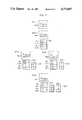
- FIG. 6 is a schematic diagram illustrating the control flow data 305 immediately before the array definition/use relationship analysis processing 102 and the work areas 621-624 and 631-634 allocated corresponding thereto in the analysis processing 102.
- the tables 601a-601e represent the basic blocks 501a-501e, respectively.
- These tables 601a-601e include list data of tables representing basic blocks which can be executed immediately before the respective basic blocks.
- the table 601a comprises an empty list data [ ]. Namely, this indicates that there does not exist a block executable immediately before the basic block 501b as shown in FIG. 5.
- the table 601b includes the list data [a, d] having as elements thereof address a of a table associated with the basic block 501a and address d of the table 601d associated with the basic block 501d. That is, as shown in FIG. 5, there exist two blocks, namely, the basic blocks 501a and 501d executable immediately before the basic block 501b. This is also the case with the tables 601c-601e.
- the work areas 621-624 and 631-634 will be described in the description of the array definition/use relationship analysis processing 102.
- the dataflow analysis processing 302 mainly comprises two components as follows.
- the first component is the variable definition/use relationship analysis processing 101 to obtain the variable definition/use relationship data 108 representing the definition/use relationship of variables.
- the second component is the array definition/use relationship analysis processing 102 to obtain the array definition/use relationship data 109 representing the definition/use relationships of arrays.
- the dataflow data 306 is constituted from the variable definition/use relationship analysis processing 101 and the array definition/use relationship data 109.
- variable definition/use relationship analysis processing 101 is executed according to the methods described in the references (1)-(2).
- the variable definition/use relationship data 108 resulted from the execution of the analysis processing 101 is of the same structure as that of the array definition/use relationship data 109.
- the variable definition/use relationship data 108 becomes as indicated by reference numeral 811 in FIG. 8. Namely, it is represented that there exists a definition/use relationships from a statement u using the value of a variable X to a statement d3 using the value of a variable X.
- the processing 100 and the processing 103 are executed as a preparation for the array definition/use relationship analysis processing 102. Description of these processings 100 and 103 follows.
- step 100 of FIG. 1a the array definition statements appearing in the intermediate-language program 203 are counted and numbered.
- the numbering may be conducted in an arbitrary sequence.
- the number of array definition statements is 3 and hence the array definition statements are numbered as 1, 2, and 3.
- the processing generates array definition statement lists 631-633 associated with the array definition statements in the basic blocks and an array use statement list 634 associated with the array use statements in the basic blocks.
- a list 634 includes three elements, namely, an identifier indicating the statement, an array name, and a subscript.
- the tables 631-634 are generated as shown in FIG. 6.
- the table 631 is generated corresponding to the table 601c and represents the array definition d1 in the basic block 501c. Consequently, the table 631 includes an identifier d1, an array name A, and a subscript I.
- the table 632 is generated corresponding to the table 601d and represents the array definition d2 in the basic block 501. The table 632 therefore comprises an identifier d2, an array name A, and a subscript I.
- the table 633 is generated corresponding to the table 601e and represents the array definition d3 in the basic block 501e. Consequently, the table 633 includes an identifier d3, an array name A, and a subscript I+1.
- the table 634 is generated corresponding to the table 601e and represents the array use u in the basic block 501e. The table 634 therefore comprises an identifier u, an array name A, and a subscript I.
- work areas including four elements INi, OUTi, INc, and OUTc having at least the number of bits equal to the number of the array definition statements are allocated corresponding to the control flow data 305, and then the initial values are set thereto.
- the work areas 621-624 are allocated corresponding to the respective tables 601b-601e associated with the basic blocks in the DO loop in process, and then 0 is set to each bit to be used in the elements INi, OUTi, INc, and OUTc.
- at least three bits are allocated to each of these areas, and 0 is set to the three bits.
- the work areas 621-624 respectively represent sets of array definition statements.
- the first bit of the three bits indicates whether or not the array definition statement d1 numbered as 1 is an element of the set. Namely, if the bit is 1, the array definition statement d1 is an element of the set; otherwise, the statement d1 is not an element of the set.
- the second bit indicates whether or not the array definition statement d2 numbered as 2 is an element of the set, and the last bit indicates whether or not the array definition statement d3 numbered as 3 is an element of the set.
- the array definition/use relationship analysis processing 102 receives as an input the control flow data 305 and outputs the array definition/use relationship data 109, which is a portion of the dataflow data 306.
- the array definition/use relationship data 109 is outputted as shown in FIG. 8.
- the array definition/use relationship data 109 is configured in a list structure and includes as elements thereof a table 802 indicating that the value of data defined by the array definition statement d1 is possibly used by the array use statement u and a table 803 indicating that the value of data defined by the array definition statement d2 is possibly used by the array use statement u.
- the array definition/use relationship analysis processing 102 is effected as follows. First, the processing 104-106 is repetitiously executed for each DO loop of the intermediate-language program 203. The program 401 has only one DO loop, which need be subjected to the processing 104-106.
- the loop independent dependence analysis processing 104 is accomplished as shown in FIG. 1b. That is, for all basic blocks of the DO loop in process, the processing 110-116 is repetitiously executed according to the priority of depth, namely, in the depth-first order.
- the definition of the term, depth-first order and the method for sorting the basic blocks in the depth-first order have been described in the reference (1).
- the basic blocks are sorted in an order of 501a, 501b, 501c, 501d, and 501e.
- the processing 110 is executed to calculate the set data INi.
- the set data INi corresponding to the basic block in process is assumed to comprise a sum of sets including the set data OUTi of each basic block immediately before the basic block in process, namely, the list data. More concretely, an OR operation is conducted for the respective bits. For example, in the case of the basic block 501c, only the block 501b is the basic block immediately before the basic block 501c; consequently, the set data INi of the table 601c is set to be equal to the set data OUTi of the table 601b.
- the processing 111 is used to judge whether or not an array definition statement is included in the basic block in process. Namely, it is checked whether or not the basic block in process includes a list of array definition statements corresponding thereto. For each basic block in the DO loop of the program 401, the basic block 501b does not include an array definition statement. This can be recognized from a fact that the table 601b does not include a list of array definition statements corresponding thereto.
- the basic block 501c-501e each include an array definition statement, which can be determined from a fact that there exist the array definition statement lists 631-633 corresponding to the tables 601c-601e, respectively.
- the processing is effected as follows. First of all, the processing 112 is achieved. Namely, the subscripts are compared between each array use before the array definition statement in the basic block in process and each element of the set data INi. If matching results, the array definition/use relationship data 109 is generated.
- an array use statement u exists before the array definition statement d3. This can be recognized from a fact that there exists an array use statement list 633 corresponding to the table 601e.
- an array use statement list 633 corresponding to the table 601e.
- the first two bits are 1's namely, the array definition statments d1-d2 are the elements thereof; consequently a comparison is effected for a subscript I appearing in the array use statement u, a subscript I (included as the third element of the table 634) appearing in the array definition statement d1, and a subscript I (included as the third element of the table 632) appearing in the array definition statement d2 so as to determine whether or not these values are equal to each other.
- a portion of the array definition/use relationship data 109 is generated. That is, a table 802 is generated as a result of the first comparison.
- the table 802 indicates that there exists a definition/use relationship from the array definition statement d1 to the array use statement u.
- the second comparison causes to generate a table 803, which indicates an existence of a definition/use relationship from the array definition statement d2 to the array use statement u.
- the processing 113 is accomplished. Namely, a subscript comparison processing is executed between each array definition in the basic block in process and each element of the set data INi. If mismatching results, the array definition statement is set to be an element of the set data OUTi. In the case of the basic blocks 501c-501d, the elements INi of the table 601c-601d constitute an empty set, the comparison is not actually achieved and hence the elements OUTi of the tables 601c-601d still constitute an empty set.
- each array definition statement of the basic block in process is set to be an element of the set data OUTi.
- the array definition statement d1 is set to be an element of the set data OUTi constituting the table 601c. That is, the first bit of OUTi is set to 1.
- the array definition statements d2-d3 are respectively set to be elements of the set data OUTi constituting the tables 601d and 601e.
- the final processing 115 is accomplished as follows. The subscripts are compared between each array use after the array definition statements of the basic block in process and each element of the set data OUTi. If matching results, the array definition/use relationship data 109 is generated. In the cases of the basic blocks 501c-501e, there does not exist an array use after the array definition statements d1, d2, and d3, respectively; consequently, the comparison is not actually effected and hence the array definition/use relationship data 109 is not generated.
- the processing is achieved as follows. First, the processing 116 is executed, namely, the subscript of each array use in the basic block in process is compared with the subscript of each element of the set data INi. If matching results, the array definition/use relationship data 109 is generated. In the case of the basic block 501b, an array use is not included, and hence the comparison is not achieved and the array definition/use relationship data 109 is not generated.
- the processing 117 is executed, namely, the value of the set data INi of the table corresponding to the basic in process is set to be the value of the set data OUTi of the table.
- the loop carried dependence analysis preprocessing 105 is achieved as shown in FIG. 1a.
- the value of the set data INc of the basic blocks at the top of the loop is set to be equal to the value of the set data OUTi of the basic block at the end of the loop.
- the loop carried dependence analysis processing 106 is accomplished.
- the processing 106 is executed as shown in FIG. 1c. That is, the processing 120-126 is repetitiously achieved for all basic blocks of the DO loop in process in the depth-first sequence.
- the processing 120 is used to calculate the set data INc.
- the set data INi corresponding to the basic block in process is assumed to comprise the sum of sets of the set data OUTc of each basic block immediately before basic block in process. More concretely, an OR operation is effected for each bit of the set data OUTc of the table corresponding to the basic block in process. However, if the basic block in process is the basic block at the top of the loop, the setting of INc has already been completed, and hence this processing is not executed. Namely, in the case of the program 401, this processing is not accomplished for the basic block 501b.
- the processing 121 is achieved to judge whether or not an array definition statement is included in the basic block in process. For each block of the program 401, the result of the judgment is identical to the judgment result obtained by the processing 111. If an array definition statement is included, the processing 122-124 is executed; otherwise, the processing 125 is accomplished.
- the processing is achieved as follows. First, the processing 122 is executed, namely, the subscript overlapping detection processing is accomplished on each array use before the array definition statement of the basic block in process and each element of the set data INc. If the subscript overlapping is detected, the array definition/use relationship data 109 is generated.
- the subscript overlapping detection processing is achieved to judge whether or not two subscripts can take the same value in the iteration of the loop. If this is the case, the judgment results in the presence of the overlapping; otherwise, the judgment results in the absence thereof. The method of the judgment is effected as described in detail in the reference (2).
- the set data INc includes the array definition statements d1-d2, and hence the subscript overlapping detection processing is accomplished on the subscripts I's appearing in the array definition statements d1-d2 and the subscript of the array definition statement d3 of the basic block 501e.
- the subscript of the array definition statement d1 is obtained from the third element of the table 631, whereas the subscript of the array definition statement d2 is attained from the third element of the table 632. Since the subscript I+1 does not take the value of the subscript I in the subsequent iteration of the DO loop, the overlapping is judged absent.
- the processing 123 is achieved, namely, the value of the subscript of the array definition in the basic block in process is subjected to a loop processing and then the resultant value is compared with the subscript of each element of the set data INi. If mismatching results, the array definition statement is set to be an element of the set data OUTc.
- the value of the set data INc in the table 622 is a bit sequence of 111, which indicates that the array definition statements are included as elements of the set.
- the result of the subscript I of the array definition statement d1 in the basic block 501c undergone a loop processing, namely, the subscript I+1 is compared with the subscripts I, I, and I+1 of the array definition statements d1, d2, and d3, respectively. In these three comparisons, only the result of the last comparison is true. As a consequence, the value of the set data OUTc becomes to be a bit sequence of 110 in the table 622. Namely, the array definition statement d3 is not included in the set data OUTc.
- the set data OUTc in the table 601d includes the array definition statements d1-d2.
- the processing 124 is accomplished, namely, the subscript overlapping detection processing is effected for the subscript of each array use after the definition statement in the basic block in process and each element of the set data INc. If the subscript overlapping is detected, the array definition/use relationship data 109 is generated. In the program 401, there does not exist an array use statement after the array definition statement in any basic block, and consequently this processing is not actually executed.
- the processing is accomplished as follows. First, the processing 125 is executed, namely, the subscript overlapping detection processing is achieved for the subscript of each array use in the basic block in process and the subscript of each element of the set data INc. If the subscript overlapping is detected, the array definition/use relationship data 109 is generated. In the case of the basic block 501b, an array use is not included, and consequently this processing is not accomplished and the array definition/use relationship data 109 is not generated.
- the processing 126 is achieved, namely, the value of the set data INc of the table corresponding to the basic block in process is set to be the value of the set data OUTc of the table.
- FIG. 6 shows the control flow data 305 including tables 601a-601e before the starting of the array definition/use relationship analysis processing 102 and the work areas 621-624 and 631-634 allocated to the processing 102. These work areas have been subjected to the initialization processing 103.
- the loop independent dependence analysis processing 104 is executed.
- the basic block 501b is then processed to set the set data INi and OUTi in the table 621.
- the basic block 501b does not include an array definition statement, and thus the bits are kept to be 0 as shown in FIG. 7.
- the basic block 501c is processed to set the set data INi and OUTi in the table 622.
- the value of the set data INi in the table 622 is equal to the value of the set data OUTi in the table 621 and the bit sequence is 000, an array definition statement d1 exists in the basic block 501c; consequently, the value of the first bit of the set data OUTi is set to 1 in the table 622.
- the basic block 501d is processed to set the set data INi and OUTi in the table 623.
- the value of the set data INi in the table 623 is identical to the value of the set data OUTi in the table 621 and the bit sequence is 000; however, an array definition statement d2 exists in the basic block 501d, and therefore the value of the second bit of the set data OUTi is set to 1 in the table 623.
- the basic block 501e is processed to set the set data Ini and OUTi in the table 624.
- the value of the set data INi in the table 624 is the sum of sets, namely, the value of the set data OUTi in the table 622 and the value of the set data OUTi in the table 623, and hence the bit sequence is set to 110. Since the basic block 501e includes an array definition statement d3, the value of the set data OUTi is set to 111 in the table 624.
- tables 802-803 are generated as a portion of the array definiation/use relationship data 109.
- the loop carried dependence analysis proprocessing 105 is effected to set the value of the set data INc in the table 601b corresponding to the basic block 501b at the top of the loop. Since the value of the set data OUTi in the table 624 corresponding to the basic block 601e at the end of the loop is 111, l the value of the set data INc is also set to a bit series 111 in the table 621.
- the basic block 501b is first processed to set the set data OUTc in the table 621. Since the basic block 501b does not include an array definition statement, the set data OUTc becomes to be equal to the set data INc and the bit sequence is set to 111.
- the basic block 501c is processed to set the data INc and OUTc in the table 622.
- the value of the set data INc in the table 622 is equal to the value of the set data OUTc in the table 601b and the bit sequence is 111, there exists an array definition statement d1 and the third bit is held to be 0 in the processing 123, consequently, the value of the set data OUTc is set to a bit sequence 110 in the table 622.
- the basic block 501d is processed to set the set data INc and OUTc in the table 623.
- the value of the set data INc in the table 623 is identical to the value of the set data OUTc in the table 601b and the bit sequence is 111.
- the basic block 501e is processed to set the set data INc and OUTc in the table 624. Since the value of the set data INc in the table 624 in the sum of sets, namely, the value of the set data OUTc in the table 622 and the value of the set data OUTc in the table 623, the bit sequence becomes to be 110.
- the processing 123 sets the value of the set data INc to be equal to the value of the set data OUTc, and hence the value of the set data OUTi is set to a bit sequence 110 in the table 624.
- a vectorization is accomplished as the program transformation processing.
- the method of the vectorization has been described in the references (2)-(3) noted already. Since the vectorization can be executed only when there does not exist a definition/use relationship of a variable or an array not suitable for the vectorization, the condition is judged prior to the vectorization.
- the relationship between the array definition statement d3 and the array use statement u may possibly cause a problem in the judgment to determine whether or not the vectorization is to be accomplished. Namely, if the value of the data defined by the array definition statement d3 is used in the array use statement u, the relationship therebetween is not suitable for the vectorization. However, the value of the data defined by the array definition statement is rewritten or changed by the array definition statements d1-d2, and hence the value is not possibly used by the array use statement u. In the program 401, therefore, the cyclic definition/use relationship like that shown in FIG. 9 does not exist in this program, and hence there does not exist a definition/use relationship unsuitable for the vetorization. Consequently, the intermediate-language program associated with the program 401 can be transformed into a program executable in a supercomputer according to the method of the references (2) and (3).
- An object program outputted as a result of the transformation processing corresponds to the source program 1001 shown in FIG. 10.
- the obtained program corresponds to an object program resulting from a translation conducted on the source program 1001 according to the conventional program translation method.
- the program 1001 will be described in the following paragraphs.
- the portion of the program 100 preceding the statement d3 is identical to the program 401. Since the definition/use relationship from the array definition statement d3 to the array use statement u is not included in the array definition/use relationship data 109, there does not exist an array definition/use relationship having a direction opposite to the direction of description of the program.
- each statement of the program 401 is arranged in the description order.
- the elements other than A(11) is rewritten by the array definition statement d1 or d2, and hence only the definition of A(11) is kept remained.
- the appropriate array definition/use relationships can be attained also for a DO loop including a condition statement or a similar control structure like in the case of the program 401, the optimization such as a vectorization becomes possible, which enables to obtain an object program having a higher performance.
Landscapes
- Engineering & Computer Science (AREA)
- General Engineering & Computer Science (AREA)
- Theoretical Computer Science (AREA)
- Software Systems (AREA)
- Physics & Mathematics (AREA)
- General Physics & Mathematics (AREA)
- Devices For Executing Special Programs (AREA)
Applications Claiming Priority (2)
| Application Number | Priority Date | Filing Date | Title |
|---|---|---|---|
| JP61048309A JPH0685148B2 (ja) | 1986-03-07 | 1986-03-07 | 配列デ−タフロ−解析装置 |
| JP61-48309 | 1986-03-07 |
Publications (1)
| Publication Number | Publication Date |
|---|---|
| US4773007A true US4773007A (en) | 1988-09-20 |
Family
ID=12799815
Family Applications (1)
| Application Number | Title | Priority Date | Filing Date |
|---|---|---|---|
| US07/015,018 Expired - Lifetime US4773007A (en) | 1986-03-07 | 1987-02-17 | Complier code optimization method for a source program having a first and second array definition and use statements in a loop |
Country Status (3)
| Country | Link |
|---|---|
| US (1) | US4773007A (ja) |
| JP (1) | JPH0685148B2 (ja) |
| GB (1) | GB2191315A (ja) |
Cited By (30)
| Publication number | Priority date | Publication date | Assignee | Title |
|---|---|---|---|---|
| US4823257A (en) * | 1986-08-08 | 1989-04-18 | Hitachi, Ltd. | Information processing system having smart memories |
| US5109331A (en) * | 1986-09-19 | 1992-04-28 | Hitachi, Ltd. | Compiling a source program by analyzing a subscript of an array included in a loop processing of a computer |
| US5142681A (en) * | 1986-07-07 | 1992-08-25 | International Business Machines Corporation | APL-to-Fortran translators |
| US5146594A (en) * | 1987-11-06 | 1992-09-08 | Hitachi, Ltd. | Method of producing object program based on interprocedural dataflow analysis of a source program |
| US5193190A (en) * | 1989-06-26 | 1993-03-09 | International Business Machines Corporation | Partitioning optimizations in an optimizing compiler |
| US5202995A (en) * | 1989-10-12 | 1993-04-13 | International Business Machines Corporation | Method for removing invariant branches from instruction loops of a computer program |
| US5241678A (en) * | 1988-04-15 | 1993-08-31 | Hitachi, Ltd. | Program translation based on generalized partial computation |
| US5274812A (en) * | 1989-09-27 | 1993-12-28 | Kabushiki Kaisha Toshiba | Method of compiling source code into vectorized object code by performing a one-dimensional analysis on each dimension of a multi-dimensional array within a loop |
| US5349665A (en) * | 1992-01-16 | 1994-09-20 | Nec Corporation | Compiler vectorizing system |
| US5396627A (en) * | 1987-11-06 | 1995-03-07 | Hitachi, Ltd. | Method of producing object program based on interprocedural dataflow analysis of a source program |
| US5448737A (en) * | 1992-03-17 | 1995-09-05 | International Business Machines Corporation | System and method for optimizing computer code using a compact data flow representation |
| US5485619A (en) * | 1993-12-29 | 1996-01-16 | International Business Machines Corporation | Array variable transformation system employing subscript table mapping to scalar loop indices |
| US5522074A (en) * | 1992-12-14 | 1996-05-28 | Nec Corporation | Vectorization system for vectorizing loop containing condition induction variables |
| US5586020A (en) * | 1994-02-23 | 1996-12-17 | Nec Corporation | Program transformation processing system and method |
| US5606697A (en) * | 1993-09-30 | 1997-02-25 | Nec Corporation | Compiler system for language processing program |
| US5748965A (en) * | 1993-07-01 | 1998-05-05 | Nec Corporation | Language processing method for calculating optimum address of array |
| US5790859A (en) * | 1995-12-21 | 1998-08-04 | International Business Machines Corporation | Method of, system for, and computer program product for efficient identification of private variables in program loops by an optimizing compiler |
| US5812856A (en) * | 1997-06-23 | 1998-09-22 | Motorola, Inc. | Efficient ROM and PLA recoding to save chip area |
| USRE36204E (en) * | 1992-12-22 | 1999-04-27 | Sun Microsystems, Inc. | Method and apparatus for resolving data references in generated code |
| US5911076A (en) * | 1993-06-14 | 1999-06-08 | International Business Machines Corporation | Object oriented framework for creating new emitters for a compiler |
| US5991540A (en) * | 1997-04-01 | 1999-11-23 | Intel Corporation | Method for identifying partial redundancies in existing processor architectures |
| US6014516A (en) * | 1996-12-27 | 2000-01-11 | Nec Corporation | Language processing system which generates debugging source file corresponding to optimization image and method therefor |
| US6029005A (en) * | 1997-04-01 | 2000-02-22 | Intel Corporation | Method for identifying partial redundancies in a new processor architecture |
| US6031994A (en) * | 1997-04-01 | 2000-02-29 | Intel Corporation | Method for determining the set of variables that may be ambiguously defined at a point in a computer program |
| US6049864A (en) * | 1996-08-20 | 2000-04-11 | Intel Corporation | Method for scheduling a flag generating instruction and a subsequent instruction by executing the flag generating instruction in a microprocessor |
| US6055627A (en) * | 1992-06-22 | 2000-04-25 | Hitachi, Ltd. | Compiling method of accessing a multi-dimensional array and system therefor |
| US6074433A (en) * | 1995-08-25 | 2000-06-13 | Fujitsu Limited | Optimization control apparatus and optimization control method for array descriptions |
| US6151704A (en) * | 1997-04-01 | 2000-11-21 | Intel Corporation | Method for optimizing a loop in a computer program by speculatively removing loads from within the loop |
| US6173443B1 (en) * | 1989-11-08 | 2001-01-09 | Matsushita Electric Industrial Co., Ltd. | Method of compiling a loop |
| US20040205738A1 (en) * | 2003-04-10 | 2004-10-14 | Takehiro Yoshida | Compiler, program prduct, compilation device, communication terminal device, and compilation method |
Citations (4)
| Publication number | Priority date | Publication date | Assignee | Title |
|---|---|---|---|---|
| US4374408A (en) * | 1971-06-16 | 1983-02-15 | Burroughs Corporation | Multi-pass system and method for source to source code translation |
| US4567574A (en) * | 1983-03-14 | 1986-01-28 | International Business Machines Corporation | Optimizing cobol object code instruction path length with respect to perform statements |
| US4642765A (en) * | 1985-04-15 | 1987-02-10 | International Business Machines Corporation | Optimization of range checking |
| US4667290A (en) * | 1984-09-10 | 1987-05-19 | 501 Philon, Inc. | Compilers using a universal intermediate language |
-
1986
- 1986-03-07 JP JP61048309A patent/JPH0685148B2/ja not_active Expired - Fee Related
-
1987
- 1987-02-17 GB GB08703650A patent/GB2191315A/en not_active Withdrawn
- 1987-02-17 US US07/015,018 patent/US4773007A/en not_active Expired - Lifetime
Patent Citations (4)
| Publication number | Priority date | Publication date | Assignee | Title |
|---|---|---|---|---|
| US4374408A (en) * | 1971-06-16 | 1983-02-15 | Burroughs Corporation | Multi-pass system and method for source to source code translation |
| US4567574A (en) * | 1983-03-14 | 1986-01-28 | International Business Machines Corporation | Optimizing cobol object code instruction path length with respect to perform statements |
| US4667290A (en) * | 1984-09-10 | 1987-05-19 | 501 Philon, Inc. | Compilers using a universal intermediate language |
| US4642765A (en) * | 1985-04-15 | 1987-02-10 | International Business Machines Corporation | Optimization of range checking |
Non-Patent Citations (10)
| Title |
|---|
| Aho et al., "Code Optimization, " in: Aho et al., Compilers Principles, Techniques, and Tools (Massachusetts, Reading, 1986), pp. 585-605, QA76.76.C65A37. |
| Aho et al., "More About Data-Flow Analysis, " in: Aho et al., Principles of Compiler Design (Addison-Wesly, 1977), pp. 478-480. |
| Aho et al., Code Optimization, in: Aho et al., Compilers Principles, Techniques, and Tools (Massachusetts, Reading, 1986), pp. 585 605, QA76.76.C65A37. * |
| Aho et al., More About Data Flow Analysis, in: Aho et al., Principles of Compiler Design (Addison Wesly, 1977), pp. 478 480. * |
| Kuck et al., "Dependence Graphs and Compiler Optimizations, " 8th Conference on Principles of Programing Languages, ACM (1981), pp. 207-218. |
| Kuck et al., Dependence Graphs and Compiler Optimizations, 8th Conference on Principles of Programing Languages, ACM (1981), pp. 207 218. * |
| Takanuki et al., "Some Compiling Algorithms for an Array Processory, " 3rd USA-Japan Computer Conference, (1978), pp. 273-279. |
| Takanuki et al., Some Compiling Algorithms for an Array Processory, 3rd USA Japan Computer Conference, (1978), pp. 273 279. * |
| Tremblay et al., "Code Optimization, " in: Tremblay et al., The Theory and Practice of Computer Writing (New York, 1985), pp. 610-631, QA76.6.T734. |
| Tremblay et al., Code Optimization, in: Tremblay et al., The Theory and Practice of Computer Writing (New York, 1985), pp. 610 631, QA76.6.T734. * |
Cited By (32)
| Publication number | Priority date | Publication date | Assignee | Title |
|---|---|---|---|---|
| US5142681A (en) * | 1986-07-07 | 1992-08-25 | International Business Machines Corporation | APL-to-Fortran translators |
| US4823257A (en) * | 1986-08-08 | 1989-04-18 | Hitachi, Ltd. | Information processing system having smart memories |
| US5109331A (en) * | 1986-09-19 | 1992-04-28 | Hitachi, Ltd. | Compiling a source program by analyzing a subscript of an array included in a loop processing of a computer |
| US5146594A (en) * | 1987-11-06 | 1992-09-08 | Hitachi, Ltd. | Method of producing object program based on interprocedural dataflow analysis of a source program |
| US5396627A (en) * | 1987-11-06 | 1995-03-07 | Hitachi, Ltd. | Method of producing object program based on interprocedural dataflow analysis of a source program |
| US5241678A (en) * | 1988-04-15 | 1993-08-31 | Hitachi, Ltd. | Program translation based on generalized partial computation |
| US5193190A (en) * | 1989-06-26 | 1993-03-09 | International Business Machines Corporation | Partitioning optimizations in an optimizing compiler |
| US5274812A (en) * | 1989-09-27 | 1993-12-28 | Kabushiki Kaisha Toshiba | Method of compiling source code into vectorized object code by performing a one-dimensional analysis on each dimension of a multi-dimensional array within a loop |
| US5202995A (en) * | 1989-10-12 | 1993-04-13 | International Business Machines Corporation | Method for removing invariant branches from instruction loops of a computer program |
| US6173443B1 (en) * | 1989-11-08 | 2001-01-09 | Matsushita Electric Industrial Co., Ltd. | Method of compiling a loop |
| US5349665A (en) * | 1992-01-16 | 1994-09-20 | Nec Corporation | Compiler vectorizing system |
| US5448737A (en) * | 1992-03-17 | 1995-09-05 | International Business Machines Corporation | System and method for optimizing computer code using a compact data flow representation |
| US6055627A (en) * | 1992-06-22 | 2000-04-25 | Hitachi, Ltd. | Compiling method of accessing a multi-dimensional array and system therefor |
| US5522074A (en) * | 1992-12-14 | 1996-05-28 | Nec Corporation | Vectorization system for vectorizing loop containing condition induction variables |
| USRE38104E1 (en) * | 1992-12-22 | 2003-04-29 | Sun Microsystems, Inc. | Method and apparatus for resolving data references in generated code |
| USRE36204E (en) * | 1992-12-22 | 1999-04-27 | Sun Microsystems, Inc. | Method and apparatus for resolving data references in generated code |
| US5911076A (en) * | 1993-06-14 | 1999-06-08 | International Business Machines Corporation | Object oriented framework for creating new emitters for a compiler |
| US5748965A (en) * | 1993-07-01 | 1998-05-05 | Nec Corporation | Language processing method for calculating optimum address of array |
| US5606697A (en) * | 1993-09-30 | 1997-02-25 | Nec Corporation | Compiler system for language processing program |
| US5485619A (en) * | 1993-12-29 | 1996-01-16 | International Business Machines Corporation | Array variable transformation system employing subscript table mapping to scalar loop indices |
| US5586020A (en) * | 1994-02-23 | 1996-12-17 | Nec Corporation | Program transformation processing system and method |
| US6074433A (en) * | 1995-08-25 | 2000-06-13 | Fujitsu Limited | Optimization control apparatus and optimization control method for array descriptions |
| US5790859A (en) * | 1995-12-21 | 1998-08-04 | International Business Machines Corporation | Method of, system for, and computer program product for efficient identification of private variables in program loops by an optimizing compiler |
| US6049864A (en) * | 1996-08-20 | 2000-04-11 | Intel Corporation | Method for scheduling a flag generating instruction and a subsequent instruction by executing the flag generating instruction in a microprocessor |
| US6014516A (en) * | 1996-12-27 | 2000-01-11 | Nec Corporation | Language processing system which generates debugging source file corresponding to optimization image and method therefor |
| US6031994A (en) * | 1997-04-01 | 2000-02-29 | Intel Corporation | Method for determining the set of variables that may be ambiguously defined at a point in a computer program |
| US6029005A (en) * | 1997-04-01 | 2000-02-22 | Intel Corporation | Method for identifying partial redundancies in a new processor architecture |
| US6151704A (en) * | 1997-04-01 | 2000-11-21 | Intel Corporation | Method for optimizing a loop in a computer program by speculatively removing loads from within the loop |
| US5991540A (en) * | 1997-04-01 | 1999-11-23 | Intel Corporation | Method for identifying partial redundancies in existing processor architectures |
| US5812856A (en) * | 1997-06-23 | 1998-09-22 | Motorola, Inc. | Efficient ROM and PLA recoding to save chip area |
| US20040205738A1 (en) * | 2003-04-10 | 2004-10-14 | Takehiro Yoshida | Compiler, program prduct, compilation device, communication terminal device, and compilation method |
| US7624387B2 (en) * | 2003-04-10 | 2009-11-24 | Panasonic Corporation | Compiler, program product, compilation device, communication terminal device, and compilation method |
Also Published As
| Publication number | Publication date |
|---|---|
| GB2191315A (en) | 1987-12-09 |
| GB8703650D0 (en) | 1987-03-25 |
| JPS62206637A (ja) | 1987-09-11 |
| JPH0685148B2 (ja) | 1994-10-26 |
Similar Documents
| Publication | Publication Date | Title |
|---|---|---|
| US5586020A (en) | Program transformation processing system and method | |
| CN110543421B (zh) | 基于测试用例自动生成算法的单元测试自动执行方法 | |
| Allen et al. | Automatic translation of Fortran programs to vector form | |
| EP0533813B1 (en) | Method for representing scalar data dependencies for an optimizing compiler | |
| GB2191315A (en) | A program translation method | |
| US6662354B1 (en) | Determining destinations of a dynamic branch | |
| US6636880B1 (en) | Automatic conversion of units in a computer program | |
| Babich et al. | The method of attributes for data flow analysis: Part I. Exhaustive analysis | |
| US6654952B1 (en) | Region based optimizations using data dependence graphs | |
| Peralta et al. | Analysis of imperative programs through analysis of constraint logic programs | |
| CA2172772A1 (en) | Method and apparatus for an improved optimizing compiler | |
| US20080178149A1 (en) | Inferencing types of variables in a dynamically typed language | |
| JPH0667868A (ja) | アルゴリズムを記号評価する方法およびアルゴリズムをトランスレートする装置 | |
| JPH05257709A (ja) | 並列化判別方法およびそれを用いた並列化支援方法 | |
| US5109331A (en) | Compiling a source program by analyzing a subscript of an array included in a loop processing of a computer | |
| US4807126A (en) | Method for converting a source program having a loop including a control statement into an object program | |
| JP2002073333A (ja) | 手続き呼び出し先のデータ依存の解析表示方法 | |
| US5522074A (en) | Vectorization system for vectorizing loop containing condition induction variables | |
| RU2115158C1 (ru) | Способ и устройство для достоверной оценки семантических признаков в синтаксическом анализе при проходе вперед слева направо | |
| EP0692115B1 (en) | System for conversion of loop functions to continuation-passing style | |
| JP2002527816A (ja) | プログラム最適化装置および方法 | |
| Edupuganty et al. | Two-level grammar as a functional programming language | |
| Hill | Combinators for parsing expressions | |
| Harianto et al. | Enhancing incremental dataflow analysis in an ide | |
| Rózsa et al. | Don't DIY: Automatically transform legacy Python code to support structural pattern matching |
Legal Events
| Date | Code | Title | Description |
|---|---|---|---|
| AS | Assignment |
Owner name: HITACHI, LTD., 6, KANDA SURUGADAI 4-CHOME, CHIYODA Free format text: ASSIGNMENT OF ASSIGNORS INTEREST.;ASSIGNORS:KANADA, YASUSI;ISHIDA, KAZUHISA;REEL/FRAME:004671/0224 Effective date: 19870203 Owner name: HITACHI, LTD., A CORP. OF JAPAN,JAPAN Free format text: ASSIGNMENT OF ASSIGNORS INTEREST;ASSIGNORS:KANADA, YASUSI;ISHIDA, KAZUHISA;REEL/FRAME:004671/0224 Effective date: 19870203 |
|
| STCF | Information on status: patent grant |
Free format text: PATENTED CASE |
|
| FPAY | Fee payment |
Year of fee payment: 4 |
|
| FEPP | Fee payment procedure |
Free format text: PAYOR NUMBER ASSIGNED (ORIGINAL EVENT CODE: ASPN); ENTITY STATUS OF PATENT OWNER: LARGE ENTITY |
|
| FPAY | Fee payment |
Year of fee payment: 8 |
|
| FPAY | Fee payment |
Year of fee payment: 12 |