US4821325A - Endpoint detector - Google Patents
Endpoint detector Download PDFInfo
- Publication number
- US4821325A US4821325A US06/669,654 US66965484A US4821325A US 4821325 A US4821325 A US 4821325A US 66965484 A US66965484 A US 66965484A US 4821325 A US4821325 A US 4821325A
- Authority
- US
- United States
- Prior art keywords
- energy
- energy pulse
- frame
- pulse
- frames
- Prior art date
- Legal status (The legal status is an assumption and is not a legal conclusion. Google has not performed a legal analysis and makes no representation as to the accuracy of the status listed.)
- Expired - Lifetime
Links
Images


Classifications
-
- G—PHYSICS
- G10—MUSICAL INSTRUMENTS; ACOUSTICS
- G10L—SPEECH ANALYSIS TECHNIQUES OR SPEECH SYNTHESIS; SPEECH RECOGNITION; SPEECH OR VOICE PROCESSING TECHNIQUES; SPEECH OR AUDIO CODING OR DECODING
- G10L25/00—Speech or voice analysis techniques not restricted to a single one of groups G10L15/00 - G10L21/00
- G10L25/78—Detection of presence or absence of voice signals
- G10L25/87—Detection of discrete points within a voice signal
Definitions
- Our invention relates to automatic speech recognition, and more particularly, to arrangements for detecting the endpoints or boundaries of the speech portion of an input signal.
- An automatic speech recognizer identifies an unknown spoken utterance by matching an input signal which corresponds to the unknown utterance, to reference template signals which correspond to known utterances.
- the reference template which matches best is selected as the identity of the unknown utterance.
- the reference templates typically include only information-bearing or speech portions.
- the input signal often includes both speech and nonspeech sounds.
- An input signal from the switched telephone network for example, may have clicks, pops, tones and other background noise.
- an input signal interval which contains speech is divided into a sequence of time frames.
- the energy level of the signal in each time frame is computed.
- one or more energy pulses are identified over the signal interval.
- Each energy pulse consists of a group of contiguous time frames which correspond to a potential speech portion of the input signal.
- an input signal interval containing the spoken words "one eight” ideally yields three distinct energy pulses: the first corresponding to the voiced portion "one”; the second corresponding to the voiced portion “eigh”; and the third corresponding to the unvoiced portion "t".
- certain of the raw energy pulses are "combined", that is, the constituent frames of two or more adjacent energy pulses are grouped together to form a longer energy pulse.
- the second and third energy pulses may be combined to form a single energy pulse corresponding to "eight".
- the endpoints of the energy pulses remaining after the combining steps are passed to a speech recognizer.
- the identification of the raw energy pulses according to Johnston proceeds as follows.
- the energy levels are considered frame by frame in temporal sequence. If the energy level rises above a first threshold, and then above a second threshold before falling below the first threshold, the frame in which the energy level first rose above the first threshold is designated as the beginning frame of an energy pulse. Subsequently, the first frame in which the energy level falls below a third threshold is designated as the ending frame of the energy pulse. This process is repeated over the remainder of the input signal interval whereby a plurality of energy pulses may be detected.
- the Johnston arrangement attempts to find endpoints based on the energy of speech rising above the energy of the background noise. This may be conveniently characterized as a "bottom-up" approach.
- the bottom-up endpoint detector works well where the background noise is stationary. Where the level and spectral content of the background noise fluctuates, however, the bottom-up detector may be less effective.
- An interval of speech is divided into time frames.
- the frame having the maximum energy level over the interval is selected.
- the first frame preceding the maximum energy level frame which has an energy level below a threshold is defined as the beginning frame of an energy pulse.
- the first frame following the maximum energy level frame which has an energy level below a threshold is defined as the ending frame of the energy pulse.
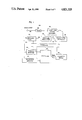
- FIG. 1 shows a general block diagram of an endpoint detector in accordance with the invention.
- FIGS. 2-10 show flow charts of endpoint detection in accordance with the invention.
- FIG. 1 shows a general block diagram of a top-down endpoint detector in accordance with the invention.
- the system of FIG. 1 may be used to provide the beginning and ending points of the information-bearing components of an input signal to a utilization device, such as a speech recognizer.
- the endpoint detector may comprise a programmed general purpose digital computer such as the MV8000 made by Data General Incorporated. Alternatively, the endpoint detector may be implemented with special purpose digital hardware, as is well known in the art.
- an interval of an input signal s(t) which includes speech is applied to the input of coder 104.
- the input signal is first bandpass filtered and sampled. If the input signal is a telephone bandwidth signal, for example, the input signal is bandpass filtered from 100 Hz to 3200 Hz and sampled at 6.67 kHz. The sampled speech is then quantized and converted to digital form.
- the digitized speech from coder 104 is applied to frame and window processor 106. There, the digitized speech is preemphasized using a simple first-order digital filter with a z-transform:
- N may be, for example, 300 samples and L may be 100 samples. This translates to a frame duration of 45 milliseconds with a 15 millisecond shift between frames.
- Each frame may then be weighted by a Hamming window of the form:
- the output of frame and window processor 106 is a preemphasized, windowed signal s(l,n) wherein the index l denotes the frame, the frames ranging from 0 to L-1.
- the index n denotes the particular sample within a frame, wherein n ranges from 0 to N-1.
- the windowed signals s(l,n) are applied to energy level generator 108.
- Generator 108 forms signals e(1) representative of the energy in each frame of the windowed signal:
- the output signal e(1) from energy level generator 108 is applied to equalizer-normalizer 110.
- Unit 110 performs adaptive level equalization to compensate for the mean background noise level.
- a second normalization is performed in unit 110 to obtain the energy level signal E(1):
- NP may be, for example, 15.
- coder 104 frame and window processor 106
- energy level generator 108 equalizer-normalizer 110
- Controller 120 next checks the first IT1 frames and last IT2 frames of the pulse for consistently low energy content which indicates breath noise.
- IT1 and IT2 may be, for example, 5 frames. Any low energy frames are eliminated by adjusting the endpoints in store 118. Then the adjusted energy pulse is tested to guarantee that its duration is greater than a minimum length threshold and that its maximum energy level frame is above a minimum level. The pulse is considered invalid if either test is failed.
- Controller 120 repeats the preceding steps starting with the next highest energy level frame over the input interval. All frames in previously detected pulses are eliminated from consideration in the current iteration. The process is complete when all frames over the input interval have been considered.
- Controller 120 next applies a pulse combiner algorithm to the energy pulses in store 118.
- the algorithm attempts to combine two or more adjacent pulses to form longer pulses.
- the first current pulse is the pulse having the highest peak energy frame of all the pulses in store 118.
- the first pulse preceding the current pulse is combined with the current pulse if the downward slope DS over the last IGAP frames of the preceding pulse is greater than a threshold and if the last frame of the preceding pulse is within NFW frames of the first frame of the current pulse.
- IGAP may be, for example, 3 frames.
- NFW may be set adaptively according to the value of DS.
- the first pulse following the current pulse is combined with the current pulse if the downward slope of the current pulse is greater than a threshold and if the following pulse is within NFW frames of the current pulse.
- Other pulse combining restrictions may be applied as would now be apparent to those skilled in the art. For example, the duration of any combined pulse may be constrained to be less than a predetermined maximum. Also, an upward slope minimum value could be imposed.
- the above process is repeated with the current pulse being the pulse which has the next highest peak energy frame of the pulses in store 118.
- the process terminates when all possible pulses have been considered.
- the final output to utilization device 122 is the beginning and ending frames IPB(J) and IPE(J) for each energy pulse.
- a program for implementing the instant endpoint detector invention may be structured, for example, in accordance with flow charts 200-1000 in FIGS. 2-10.
- flow charts 200-600 show a detailed example of finding the beginning and ending frames which define an energy pulse.
- Flow charts 700-900 show a detailed example of combining the raw energy pulses to form longer energy pulses.
- E(I) is less than K2 (224)
- mark counter MK is set to I (228). If I is less than NF (232), and E(I) is less than threshold K3 (230), and E(I) is greater than or equal to K2 (220), the process returns to test I (218). If E(I) is less than K2 (220), I is incremented (222) and the process returns to test I (232). If I is greater than or equal to NF (232) or if E(I) is less than K3 (230), and if I minus MK is greater than slope parameter IT slope center frame IPE(NPULSE+1) is set to MARK(238).
- IPE(NPULSE+1) is set to I (236).
- the outputs of blocks 236 and 238 are connected to control downward slope generation in block 242.
- the values of E, IGAP, ISLOPE and IPE (244) are provided to generate the downward slope (242).
- the slope generation is shown in block Z, FIG. 5.
- I is set to END minus 1 (520). If E(I) is greater than or equal to E(END) plus ISLOPE (522), NSEP is set to NSEP2 (516) and the subroutine returns the value of NSEP (514). If E(I) is less than E(END) plus ISLOPE (522), I is decremented (524). If I is greater than or equal to END minus IGAP (526), the process returns to test E(I) (522). If I is less than END minus IGAP (526), NSEP is set to NSEP1 (512) and the subroutine returns NSEP (514).
- I is set equal to J (304). If I is greater than 1 (306), I is decremented (308) and the subroutine block X is performed (310).
- NPULSE NPULSE 0 (610)
- block X returns a "NO" value (640). If NPULSE is not 0 (610), K is set to 1 (615). If I is less than IPE(K) (620), block X returns a "YES” value (635). If I is greater than or equal to IPE(K) (620), K is incremented (625). If K is greater than NPULSE (630), the subroutine returns "NO" (640). If K is less than or equal to NPULSE, the test on I is repeated (620).
- I is incremented (312) only if the block X subroutine returns a "YES” (310). If E(I) is greater than or equal to K2(314), the test on I is repeated (306). If I is less than or equal to 1, or if E(I) is less than K2 (314), MK is set to I (322). If the block X subroutine returns "NO” (320), and if I is greater than to 1 (318), and if E(I) is greater than or equal to K2 (316), the process returns to test I (306). If block X returns "YES" (320), I is incremented (336).
- IPB(NPULSE+1) is set to MK (332); otherwise IPB(NPULSE+1) is set to I (328). If block X returns "NO" (320) and I is less than or equal to 1 (318), or if I is greater than 1 (318), and E(I) is less than K2 (316) and K1 (324), the test on MK minus minud I plus 1 is run (326). If E(I) is greater than or equal to K1 (324), I is decremented (330) and MK is set to I (322). The outputs of both blocks 328 and 332 flow into point B, which is the same as point B of FIG. 4.
- J is set to IPE(NPULSE+1) (402).
- the maximum peak energy of the pulse is computed and output as XL (403).
- XLS(NPULSE+1) is set to XL (404). If IPE(NPULSE+1) minus IPB(NPULSE+1) plus 1 is greater than IT3 (405), then NPULSE is incremented (406); otherwise NPULSE remains the same. If NPULSE is equal to the maximum pulse number NPMAX (407), the process terminate (408); otherwise the process repeats as shown by connector F (409) which joins to connector F (214) in FIG. 2.
- the pulse combiner process begins (702) by testing the number of pulses NPULSE is equal to 0 (704). If NPULSE is 0, the process terminates (712). If NPULSE is greater than 0, the maximum energy XLS for each of the NPULSE pulses are sorted in order of decreasing peak energy (706). The output IXL is the index of the pulse with the highest peak energy. Next, I and IS are set to 1 (708). All pulses are initially marked as unused (710). J is set to IXL(I) (716). If pulse J is not currently marked (718), pulse J is marked used (720). If I is not equal to NPULSE(722), the process continues in FIG. 8, as shown by connector P (726) in FIG. 7 and connector P (856) in FIG. 8.
- NS is set to NSEP(J) (828). If J is equal to NPULSE (824), or if pulse J+1 is marked (826), or if IPB(J+1) minus IPE(J) plus 1 is greater than NS (830), IS is incremented (832) and I is incremented (834). If I is greater than NPULSE (836), IS is decremented (838) and the process terminates (840).
- IPB(J+1) minus IPE(J) (940) plus 1 is less than or equal to NS (830), and if IPE(J+1) minus IPB(J) plus 1 is greater than NFMAX (842), IS is incremented (832). If IPE(J+1) minus IPB(J) plus 1 is less than or equal to NFMAX (842), the process continues in FIG. 9, as shown by connector A' (846) in FIG. 8 and connector A' (905) in FIG. 9.
- NS equals NSEP2 (910)
- the pulses are not combined (915), and the process continues in FIG. 8, as shown by connector N (920) in FIG. 9 and connector N (852) in FIG. 8.
- NS does not equal NSEP2 (910)
- the upward slope NT of pulse J+1 is computed around frame IPB (J+1) (925) by subroutine block Y, as shown in FIG. 5.
- I is set to BEG plus 1 (504). If E(I) is greater than or equal to E(BEG) plus ISLOPE (506), NSEP is set to NSEP2 (516) and returned (514). If E(I) is less than E(BEG) plus ISLOPE (506), I is incremented (508). If I is less than or equal to BEG plus IGAP (510), the test on E(I) is performed (506). If I is greater than BEG plus IGAP (510), NSEP is set to NSEP1 (512) and returned (514).
- FIG. 10 is a flow chart showing the top-down approach to energy pulse detection in accordance with the invention.
- the maximum energy frame over the interval is found (1002).
- Surrounding frames are examined to determine the beginning and ending frames of a pulse (1004).
- the pulse is checked for validity (1006).
- Frames comprising the pulse are eliminated from further consideration (1008). If any frames remain in the interval (1010), the above process is repeated, otherwise the process terminates (1012).
- any of the aforementioned thresholds may be dynamically determined, instead of being fixed values.
- energy threshold K3 may be set responsive to the average signal energy over a prior time period.
Landscapes
- Engineering & Computer Science (AREA)
- Computational Linguistics (AREA)
- Signal Processing (AREA)
- Health & Medical Sciences (AREA)
- Audiology, Speech & Language Pathology (AREA)
- Human Computer Interaction (AREA)
- Physics & Mathematics (AREA)
- Acoustics & Sound (AREA)
- Multimedia (AREA)
- Compression, Expansion, Code Conversion, And Decoders (AREA)
- Telephonic Communication Services (AREA)
Priority Applications (3)
| Application Number | Priority Date | Filing Date | Title |
|---|---|---|---|
| US06/669,654 US4821325A (en) | 1984-11-08 | 1984-11-08 | Endpoint detector |
| PCT/US1985/002138 WO1986003047A1 (fr) | 1984-11-08 | 1985-10-28 | Detecteur de point final |
| CA000494814A CA1246228A (fr) | 1984-11-08 | 1985-11-07 | Detecteur de points terminaux |
Applications Claiming Priority (1)
| Application Number | Priority Date | Filing Date | Title |
|---|---|---|---|
| US06/669,654 US4821325A (en) | 1984-11-08 | 1984-11-08 | Endpoint detector |
Publications (1)
| Publication Number | Publication Date |
|---|---|
| US4821325A true US4821325A (en) | 1989-04-11 |
Family
ID=24687183
Family Applications (1)
| Application Number | Title | Priority Date | Filing Date |
|---|---|---|---|
| US06/669,654 Expired - Lifetime US4821325A (en) | 1984-11-08 | 1984-11-08 | Endpoint detector |
Country Status (3)
| Country | Link |
|---|---|
| US (1) | US4821325A (fr) |
| CA (1) | CA1246228A (fr) |
| WO (1) | WO1986003047A1 (fr) |
Cited By (39)
| Publication number | Priority date | Publication date | Assignee | Title |
|---|---|---|---|---|
| US4945566A (en) * | 1987-11-24 | 1990-07-31 | U.S. Philips Corporation | Method of and apparatus for determining start-point and end-point of isolated utterances in a speech signal |
| US5222190A (en) * | 1991-06-11 | 1993-06-22 | Texas Instruments Incorporated | Apparatus and method for identifying a speech pattern |
| WO1993017415A1 (fr) * | 1992-02-28 | 1993-09-02 | Junqua Jean Claude | Procede de determination des limites de mots isoles |
| US5307441A (en) * | 1989-11-29 | 1994-04-26 | Comsat Corporation | Wear-toll quality 4.8 kbps speech codec |
| US5369728A (en) * | 1991-06-11 | 1994-11-29 | Canon Kabushiki Kaisha | Method and apparatus for detecting words in input speech data |
| US5459814A (en) * | 1993-03-26 | 1995-10-17 | Hughes Aircraft Company | Voice activity detector for speech signals in variable background noise |
| US5596680A (en) * | 1992-12-31 | 1997-01-21 | Apple Computer, Inc. | Method and apparatus for detecting speech activity using cepstrum vectors |
| US5621849A (en) * | 1991-06-11 | 1997-04-15 | Canon Kabushiki Kaisha | Voice recognizing method and apparatus |
| US5638487A (en) * | 1994-12-30 | 1997-06-10 | Purespeech, Inc. | Automatic speech recognition |
| US5692104A (en) * | 1992-12-31 | 1997-11-25 | Apple Computer, Inc. | Method and apparatus for detecting end points of speech activity |
| US5740318A (en) * | 1994-10-18 | 1998-04-14 | Kokusai Denshin Denwa Co., Ltd. | Speech endpoint detection method and apparatus and continuous speech recognition method and apparatus |
| US5774851A (en) * | 1985-08-15 | 1998-06-30 | Canon Kabushiki Kaisha | Speech recognition apparatus utilizing utterance length information |
| US5845092A (en) * | 1992-09-03 | 1998-12-01 | Industrial Technology Research Institute | Endpoint detection in a stand-alone real-time voice recognition system |
| US5864793A (en) * | 1996-08-06 | 1999-01-26 | Cirrus Logic, Inc. | Persistence and dynamic threshold based intermittent signal detector |
| US5884260A (en) * | 1993-04-22 | 1999-03-16 | Leonhard; Frank Uldall | Method and system for detecting and generating transient conditions in auditory signals |
| US5927988A (en) * | 1997-12-17 | 1999-07-27 | Jenkins; William M. | Method and apparatus for training of sensory and perceptual systems in LLI subjects |
| US6019607A (en) * | 1997-12-17 | 2000-02-01 | Jenkins; William M. | Method and apparatus for training of sensory and perceptual systems in LLI systems |
| US6071123A (en) * | 1994-12-08 | 2000-06-06 | The Regents Of The University Of California | Method and device for enhancing the recognition of speech among speech-impaired individuals |
| US6097776A (en) * | 1998-02-12 | 2000-08-01 | Cirrus Logic, Inc. | Maximum likelihood estimation of symbol offset |
| US6109107A (en) * | 1997-05-07 | 2000-08-29 | Scientific Learning Corporation | Method and apparatus for diagnosing and remediating language-based learning impairments |
| US6134524A (en) * | 1997-10-24 | 2000-10-17 | Nortel Networks Corporation | Method and apparatus to detect and delimit foreground speech |
| US6157670A (en) * | 1999-08-10 | 2000-12-05 | Telogy Networks, Inc. | Background energy estimation |
| US6159014A (en) * | 1997-12-17 | 2000-12-12 | Scientific Learning Corp. | Method and apparatus for training of cognitive and memory systems in humans |
| US6216103B1 (en) * | 1997-10-20 | 2001-04-10 | Sony Corporation | Method for implementing a speech recognition system to determine speech endpoints during conditions with background noise |
| WO2001029821A1 (fr) * | 1999-10-21 | 2001-04-26 | Sony Electronics Inc. | Technique d'utilisation de contraintes de validite dans un detecteur de fin de signaux vocaux |
| US6321197B1 (en) * | 1999-01-22 | 2001-11-20 | Motorola, Inc. | Communication device and method for endpointing speech utterances |
| US6324509B1 (en) * | 1999-02-08 | 2001-11-27 | Qualcomm Incorporated | Method and apparatus for accurate endpointing of speech in the presence of noise |
| US6826528B1 (en) * | 1998-09-09 | 2004-11-30 | Sony Corporation | Weighted frequency-channel background noise suppressor |
| US20050153267A1 (en) * | 2004-01-13 | 2005-07-14 | Neuroscience Solutions Corporation | Rewards method and apparatus for improved neurological training |
| US20050175972A1 (en) * | 2004-01-13 | 2005-08-11 | Neuroscience Solutions Corporation | Method for enhancing memory and cognition in aging adults |
| US6937977B2 (en) * | 1999-10-05 | 2005-08-30 | Fastmobile, Inc. | Method and apparatus for processing an input speech signal during presentation of an output audio signal |
| US20050256711A1 (en) * | 2004-05-12 | 2005-11-17 | Tommi Lahti | Detection of end of utterance in speech recognition system |
| US20060241937A1 (en) * | 2005-04-21 | 2006-10-26 | Ma Changxue C | Method and apparatus for automatically discriminating information bearing audio segments and background noise audio segments |
| US20070033031A1 (en) * | 1999-08-30 | 2007-02-08 | Pierre Zakarauskas | Acoustic signal classification system |
| US7277853B1 (en) * | 2001-03-02 | 2007-10-02 | Mindspeed Technologies, Inc. | System and method for a endpoint detection of speech for improved speech recognition in noisy environments |
| US20080077403A1 (en) * | 2006-09-22 | 2008-03-27 | Fujitsu Limited | Speech recognition method, speech recognition apparatus and computer program |
| US20120209601A1 (en) * | 2011-01-10 | 2012-08-16 | Aliphcom | Dynamic enhancement of audio (DAE) in headset systems |
| US20150199979A1 (en) * | 2013-05-21 | 2015-07-16 | Google, Inc. | Detection of chopped speech |
| US20190036439A1 (en) * | 2017-07-26 | 2019-01-31 | Nxp B.V. | Current pulse transformer for isolating electrical signals |
Families Citing this family (4)
| Publication number | Priority date | Publication date | Assignee | Title |
|---|---|---|---|---|
| GB8613327D0 (en) * | 1986-06-02 | 1986-07-09 | British Telecomm | Speech processor |
| DE3733659A1 (de) * | 1986-10-03 | 1988-04-21 | Ricoh Kk | Verfahren zum vergleichen von mustern |
| GB9323991D0 (en) * | 1993-11-22 | 1994-01-12 | Holmes John N | Method and apparatus for spectral analysis |
| DE4422545A1 (de) * | 1994-06-28 | 1996-01-04 | Sel Alcatel Ag | Start-/Endpunkt-Detektion zur Worterkennung |
Citations (6)
| Publication number | Priority date | Publication date | Assignee | Title |
|---|---|---|---|---|
| US3619509A (en) * | 1969-07-30 | 1971-11-09 | Rca Corp | Broad slope determining network |
| US3679830A (en) * | 1970-05-11 | 1972-07-25 | Malcolm R Uffelman | Cohesive zone boundary detector |
| US3909532A (en) * | 1974-03-29 | 1975-09-30 | Bell Telephone Labor Inc | Apparatus and method for determining the beginning and the end of a speech utterance |
| US4032710A (en) * | 1975-03-10 | 1977-06-28 | Threshold Technology, Inc. | Word boundary detector for speech recognition equipment |
| US4357491A (en) * | 1980-09-16 | 1982-11-02 | Northern Telecom Limited | Method of and apparatus for detecting speech in a voice channel signal |
| US4370521A (en) * | 1980-12-19 | 1983-01-25 | Bell Telephone Laboratories, Incorporated | Endpoint detector |
-
1984
- 1984-11-08 US US06/669,654 patent/US4821325A/en not_active Expired - Lifetime
-
1985
- 1985-10-28 WO PCT/US1985/002138 patent/WO1986003047A1/fr not_active Ceased
- 1985-11-07 CA CA000494814A patent/CA1246228A/fr not_active Expired
Patent Citations (6)
| Publication number | Priority date | Publication date | Assignee | Title |
|---|---|---|---|---|
| US3619509A (en) * | 1969-07-30 | 1971-11-09 | Rca Corp | Broad slope determining network |
| US3679830A (en) * | 1970-05-11 | 1972-07-25 | Malcolm R Uffelman | Cohesive zone boundary detector |
| US3909532A (en) * | 1974-03-29 | 1975-09-30 | Bell Telephone Labor Inc | Apparatus and method for determining the beginning and the end of a speech utterance |
| US4032710A (en) * | 1975-03-10 | 1977-06-28 | Threshold Technology, Inc. | Word boundary detector for speech recognition equipment |
| US4357491A (en) * | 1980-09-16 | 1982-11-02 | Northern Telecom Limited | Method of and apparatus for detecting speech in a voice channel signal |
| US4370521A (en) * | 1980-12-19 | 1983-01-25 | Bell Telephone Laboratories, Incorporated | Endpoint detector |
Non-Patent Citations (2)
| Title |
|---|
| "An Algorithm for Determining the Endpoints of Isolated Utterances", The Bell System Technical Journal, vol. 54, No. 2, Feb. 1975, pp. 297-315. |
| An Algorithm for Determining the Endpoints of Isolated Utterances , The Bell System Technical Journal , vol. 54, No. 2, Feb. 1975, pp. 297 315. * |
Cited By (58)
| Publication number | Priority date | Publication date | Assignee | Title |
|---|---|---|---|---|
| US5774851A (en) * | 1985-08-15 | 1998-06-30 | Canon Kabushiki Kaisha | Speech recognition apparatus utilizing utterance length information |
| US4945566A (en) * | 1987-11-24 | 1990-07-31 | U.S. Philips Corporation | Method of and apparatus for determining start-point and end-point of isolated utterances in a speech signal |
| US5307441A (en) * | 1989-11-29 | 1994-04-26 | Comsat Corporation | Wear-toll quality 4.8 kbps speech codec |
| US5222190A (en) * | 1991-06-11 | 1993-06-22 | Texas Instruments Incorporated | Apparatus and method for identifying a speech pattern |
| US5369728A (en) * | 1991-06-11 | 1994-11-29 | Canon Kabushiki Kaisha | Method and apparatus for detecting words in input speech data |
| US5621849A (en) * | 1991-06-11 | 1997-04-15 | Canon Kabushiki Kaisha | Voice recognizing method and apparatus |
| WO1993017415A1 (fr) * | 1992-02-28 | 1993-09-02 | Junqua Jean Claude | Procede de determination des limites de mots isoles |
| US5305422A (en) * | 1992-02-28 | 1994-04-19 | Panasonic Technologies, Inc. | Method for determining boundaries of isolated words within a speech signal |
| US5845092A (en) * | 1992-09-03 | 1998-12-01 | Industrial Technology Research Institute | Endpoint detection in a stand-alone real-time voice recognition system |
| US5596680A (en) * | 1992-12-31 | 1997-01-21 | Apple Computer, Inc. | Method and apparatus for detecting speech activity using cepstrum vectors |
| US5692104A (en) * | 1992-12-31 | 1997-11-25 | Apple Computer, Inc. | Method and apparatus for detecting end points of speech activity |
| US5649055A (en) * | 1993-03-26 | 1997-07-15 | Hughes Electronics | Voice activity detector for speech signals in variable background noise |
| US5459814A (en) * | 1993-03-26 | 1995-10-17 | Hughes Aircraft Company | Voice activity detector for speech signals in variable background noise |
| US5884260A (en) * | 1993-04-22 | 1999-03-16 | Leonhard; Frank Uldall | Method and system for detecting and generating transient conditions in auditory signals |
| US5740318A (en) * | 1994-10-18 | 1998-04-14 | Kokusai Denshin Denwa Co., Ltd. | Speech endpoint detection method and apparatus and continuous speech recognition method and apparatus |
| US6123548A (en) * | 1994-12-08 | 2000-09-26 | The Regents Of The University Of California | Method and device for enhancing the recognition of speech among speech-impaired individuals |
| US6071123A (en) * | 1994-12-08 | 2000-06-06 | The Regents Of The University Of California | Method and device for enhancing the recognition of speech among speech-impaired individuals |
| US6302697B1 (en) | 1994-12-08 | 2001-10-16 | Paula Anne Tallal | Method and device for enhancing the recognition of speech among speech-impaired individuals |
| US5638487A (en) * | 1994-12-30 | 1997-06-10 | Purespeech, Inc. | Automatic speech recognition |
| US5864793A (en) * | 1996-08-06 | 1999-01-26 | Cirrus Logic, Inc. | Persistence and dynamic threshold based intermittent signal detector |
| US6457362B1 (en) | 1997-05-07 | 2002-10-01 | Scientific Learning Corporation | Method and apparatus for diagnosing and remediating language-based learning impairments |
| US6349598B1 (en) | 1997-05-07 | 2002-02-26 | Scientific Learning Corporation | Method and apparatus for diagnosing and remediating language-based learning impairments |
| US6109107A (en) * | 1997-05-07 | 2000-08-29 | Scientific Learning Corporation | Method and apparatus for diagnosing and remediating language-based learning impairments |
| US6216103B1 (en) * | 1997-10-20 | 2001-04-10 | Sony Corporation | Method for implementing a speech recognition system to determine speech endpoints during conditions with background noise |
| US6718302B1 (en) | 1997-10-20 | 2004-04-06 | Sony Corporation | Method for utilizing validity constraints in a speech endpoint detector |
| US6134524A (en) * | 1997-10-24 | 2000-10-17 | Nortel Networks Corporation | Method and apparatus to detect and delimit foreground speech |
| US6159014A (en) * | 1997-12-17 | 2000-12-12 | Scientific Learning Corp. | Method and apparatus for training of cognitive and memory systems in humans |
| US6019607A (en) * | 1997-12-17 | 2000-02-01 | Jenkins; William M. | Method and apparatus for training of sensory and perceptual systems in LLI systems |
| US5927988A (en) * | 1997-12-17 | 1999-07-27 | Jenkins; William M. | Method and apparatus for training of sensory and perceptual systems in LLI subjects |
| US6097776A (en) * | 1998-02-12 | 2000-08-01 | Cirrus Logic, Inc. | Maximum likelihood estimation of symbol offset |
| US6826528B1 (en) * | 1998-09-09 | 2004-11-30 | Sony Corporation | Weighted frequency-channel background noise suppressor |
| US6321197B1 (en) * | 1999-01-22 | 2001-11-20 | Motorola, Inc. | Communication device and method for endpointing speech utterances |
| US6324509B1 (en) * | 1999-02-08 | 2001-11-27 | Qualcomm Incorporated | Method and apparatus for accurate endpointing of speech in the presence of noise |
| US6157670A (en) * | 1999-08-10 | 2000-12-05 | Telogy Networks, Inc. | Background energy estimation |
| US20070033031A1 (en) * | 1999-08-30 | 2007-02-08 | Pierre Zakarauskas | Acoustic signal classification system |
| US8428945B2 (en) | 1999-08-30 | 2013-04-23 | Qnx Software Systems Limited | Acoustic signal classification system |
| US20110213612A1 (en) * | 1999-08-30 | 2011-09-01 | Qnx Software Systems Co. | Acoustic Signal Classification System |
| US7957967B2 (en) * | 1999-08-30 | 2011-06-07 | Qnx Software Systems Co. | Acoustic signal classification system |
| US6937977B2 (en) * | 1999-10-05 | 2005-08-30 | Fastmobile, Inc. | Method and apparatus for processing an input speech signal during presentation of an output audio signal |
| WO2001029821A1 (fr) * | 1999-10-21 | 2001-04-26 | Sony Electronics Inc. | Technique d'utilisation de contraintes de validite dans un detecteur de fin de signaux vocaux |
| US20100030559A1 (en) * | 2001-03-02 | 2010-02-04 | Mindspeed Technologies, Inc. | System and method for an endpoint detection of speech for improved speech recognition in noisy environments |
| US8175876B2 (en) | 2001-03-02 | 2012-05-08 | Wiav Solutions Llc | System and method for an endpoint detection of speech for improved speech recognition in noisy environments |
| US20080021707A1 (en) * | 2001-03-02 | 2008-01-24 | Conexant Systems, Inc. | System and method for an endpoint detection of speech for improved speech recognition in noisy environment |
| US7277853B1 (en) * | 2001-03-02 | 2007-10-02 | Mindspeed Technologies, Inc. | System and method for a endpoint detection of speech for improved speech recognition in noisy environments |
| US20120191455A1 (en) * | 2001-03-02 | 2012-07-26 | Wiav Solutions Llc | System and Method for an Endpoint Detection of Speech for Improved Speech Recognition in Noisy Environments |
| US20050153267A1 (en) * | 2004-01-13 | 2005-07-14 | Neuroscience Solutions Corporation | Rewards method and apparatus for improved neurological training |
| US20050175972A1 (en) * | 2004-01-13 | 2005-08-11 | Neuroscience Solutions Corporation | Method for enhancing memory and cognition in aging adults |
| US9117460B2 (en) * | 2004-05-12 | 2015-08-25 | Core Wireless Licensing S.A.R.L. | Detection of end of utterance in speech recognition system |
| US20050256711A1 (en) * | 2004-05-12 | 2005-11-17 | Tommi Lahti | Detection of end of utterance in speech recognition system |
| US20060241937A1 (en) * | 2005-04-21 | 2006-10-26 | Ma Changxue C | Method and apparatus for automatically discriminating information bearing audio segments and background noise audio segments |
| US8768692B2 (en) | 2006-09-22 | 2014-07-01 | Fujitsu Limited | Speech recognition method, speech recognition apparatus and computer program |
| US20080077403A1 (en) * | 2006-09-22 | 2008-03-27 | Fujitsu Limited | Speech recognition method, speech recognition apparatus and computer program |
| US20120209601A1 (en) * | 2011-01-10 | 2012-08-16 | Aliphcom | Dynamic enhancement of audio (DAE) in headset systems |
| US10218327B2 (en) * | 2011-01-10 | 2019-02-26 | Zhinian Jing | Dynamic enhancement of audio (DAE) in headset systems |
| US20150199979A1 (en) * | 2013-05-21 | 2015-07-16 | Google, Inc. | Detection of chopped speech |
| US9263061B2 (en) * | 2013-05-21 | 2016-02-16 | Google Inc. | Detection of chopped speech |
| US20190036439A1 (en) * | 2017-07-26 | 2019-01-31 | Nxp B.V. | Current pulse transformer for isolating electrical signals |
| US10826373B2 (en) * | 2017-07-26 | 2020-11-03 | Nxp B.V. | Current pulse transformer for isolating electrical signals |
Also Published As
| Publication number | Publication date |
|---|---|
| WO1986003047A1 (fr) | 1986-05-22 |
| CA1246228A (fr) | 1988-12-06 |
Similar Documents
| Publication | Publication Date | Title |
|---|---|---|
| US4821325A (en) | Endpoint detector | |
| KR100312919B1 (ko) | 화자인식을위한방법및장치 | |
| EP0548054B1 (fr) | Dispositif de détection de la présence d'un signal de parole | |
| KR950013551B1 (ko) | 잡음신호예측장치 | |
| EP1058925B1 (fr) | Systeme et procede de reconnaissance vocale a compensation de bruit | |
| US4881266A (en) | Speech recognition system | |
| GB2107100A (en) | Continuous speech recognition | |
| GB2107102A (en) | Speech recognition apparatus and method | |
| GB2188764A (en) | Noise compensation in speech recognition | |
| US4589131A (en) | Voiced/unvoiced decision using sequential decisions | |
| JP3105465B2 (ja) | 音声区間検出方法 | |
| US6718302B1 (en) | Method for utilizing validity constraints in a speech endpoint detector | |
| CA1061906A (fr) | Dispositif d'extraction de la periode fondamentale d'un signal de parole | |
| Acero et al. | Robust HMM-based endpoint detector. | |
| SE470577B (sv) | Förfarande och anordning för kodning och/eller avkodning av bakgrundsljud | |
| GB2188763A (en) | Noise compensation in speech recognition | |
| RU2174714C2 (ru) | Способ выделения основного тона | |
| Varga et al. | Control experiments on noise compensation in hidden Markov model based continuous word recognition | |
| AU612737B2 (en) | A phoneme recognition system | |
| KR20210154807A (ko) | 다이얼로그 검출기 | |
| EP0245252A1 (fr) | Systeme et procede de reconnaissance des sons avec selection de caracteres synchronisee a l'intonation de la voix | |
| JP2968976B2 (ja) | 音声認識装置 | |
| KR100345402B1 (ko) | 피치 정보를 이용한 실시간 음성 검출 장치 및 그 방법 | |
| RU2807170C2 (ru) | Детектор диалогов | |
| JPH04230798A (ja) | 雑音予測装置 |
Legal Events
| Date | Code | Title | Description |
|---|---|---|---|
| AS | Assignment |
Owner name: BELL TELEPHONE LABORATORIES, INCORPORATED, 600 MOU Free format text: ASSIGNMENT OF ASSIGNORS INTEREST.;ASSIGNORS:MARTIN, THOMAS B.;RABINER, LAWRENCE R.;WILPON, JAY G.;REEL/FRAME:004373/0280;SIGNING DATES FROM 19841220 TO 19841221 |
|
| STCF | Information on status: patent grant |
Free format text: PATENTED CASE |
|
| FEPP | Fee payment procedure |
Free format text: PAYOR NUMBER ASSIGNED (ORIGINAL EVENT CODE: ASPN); ENTITY STATUS OF PATENT OWNER: LARGE ENTITY |
|
| FPAY | Fee payment |
Year of fee payment: 4 |
|
| FEPP | Fee payment procedure |
Free format text: PAYOR NUMBER ASSIGNED (ORIGINAL EVENT CODE: ASPN); ENTITY STATUS OF PATENT OWNER: LARGE ENTITY Free format text: PAYER NUMBER DE-ASSIGNED (ORIGINAL EVENT CODE: RMPN); ENTITY STATUS OF PATENT OWNER: LARGE ENTITY |
|
| FPAY | Fee payment |
Year of fee payment: 8 |
|
| FEPP | Fee payment procedure |
Free format text: PAYOR NUMBER ASSIGNED (ORIGINAL EVENT CODE: ASPN); ENTITY STATUS OF PATENT OWNER: LARGE ENTITY Free format text: PAYER NUMBER DE-ASSIGNED (ORIGINAL EVENT CODE: RMPN); ENTITY STATUS OF PATENT OWNER: LARGE ENTITY |
|
| FPAY | Fee payment |
Year of fee payment: 12 |