US5151376A - Method of making polycrystalline silicon resistors for integrated circuits - Google Patents
Method of making polycrystalline silicon resistors for integrated circuits Download PDFInfo
- Publication number
- US5151376A US5151376A US07/531,012 US53101290A US5151376A US 5151376 A US5151376 A US 5151376A US 53101290 A US53101290 A US 53101290A US 5151376 A US5151376 A US 5151376A
- Authority
- US
- United States
- Prior art keywords
- polycrystalline silicon
- layer
- insulating layer
- region
- etching
- Prior art date
- Legal status (The legal status is an assumption and is not a legal conclusion. Google has not performed a legal analysis and makes no representation as to the accuracy of the status listed.)
- Expired - Lifetime
Links
Images


Classifications
-
- H—ELECTRICITY
- H10—SEMICONDUCTOR DEVICES; ELECTRIC SOLID-STATE DEVICES NOT OTHERWISE PROVIDED FOR
- H10D—INORGANIC ELECTRIC SEMICONDUCTOR DEVICES
- H10D84/00—Integrated devices formed in or on semiconductor substrates that comprise only semiconducting layers, e.g. on Si wafers or on GaAs-on-Si wafers
-
- H—ELECTRICITY
- H10—SEMICONDUCTOR DEVICES; ELECTRIC SOLID-STATE DEVICES NOT OTHERWISE PROVIDED FOR
- H10D—INORGANIC ELECTRIC SEMICONDUCTOR DEVICES
- H10D1/00—Resistors, capacitors or inductors
- H10D1/40—Resistors
- H10D1/47—Resistors having no potential barriers
-
- H—ELECTRICITY
- H10—SEMICONDUCTOR DEVICES; ELECTRIC SOLID-STATE DEVICES NOT OTHERWISE PROVIDED FOR
- H10B—ELECTRONIC MEMORY DEVICES
- H10B10/00—Static random access memory [SRAM] devices
-
- H—ELECTRICITY
- H10—SEMICONDUCTOR DEVICES; ELECTRIC SOLID-STATE DEVICES NOT OTHERWISE PROVIDED FOR
- H10B—ELECTRONIC MEMORY DEVICES
- H10B10/00—Static random access memory [SRAM] devices
- H10B10/15—Static random access memory [SRAM] devices comprising a resistor load element
Definitions
- the present invention relates generally to integrated circuits, and more specifically to a method for fabricating polycrystalline silicon resistor structures therein.
- CMOS SRAMs often use a four transistor cell design having resistive load devices. This design is used in order to save chip layout area over the traditional six transistor cell design. Two N-channel transistors are used to form a cross-coupled latch, while two additional N-channel transistors are used to provide access to the cell for reading and writing data. Two load devices are connected between the N-channel transistors in the latch and the power supply.
- the resistive load devices are formed after formation of the transistors. After the transistors have been formed, a dielectric layer is deposited and contact openings are formed to the substrate. A second polycrystalline silicon layer is deposited and lightly doped N-type to achieve a resistivity in the range of 10 6 to 10 13 ohms/square. This blanket implant determines the load resistor value.
- the resistivity of the load resistors must be low enough to supply ample current to compensate for transistor leakages, but high enough to allow for sufficient standby currents for proper device operation under adverse conditions.
- Resistance of the polycrystalline silicon load structures is a function of four variables. These are: the grain structure of the polycrystalline silicon used to form the resistor structure, the impurity levels used to dope the polycrystalline silicon; the cross-sectional area of the resistive device; and the length of the device. Impurity levels and polycrystalline silicon grain structure can be controlled only to limits determined by the process technology being used. If cross-sectional area of the structure could be reduced, length of the load resistor could also be reduced to preserve a given resistance for a small overall structure.
- a method for fabricating polycrystalline silicon resistor structures includes steps directed to the provision of a polycrystalline silicon structure having a decreased width.
- sidewall spacers are used to narrow a region in which the polycrystalline silicon resistors are formed.
- polycrystalline silicon resistors are formed as sidewall structures in a resistor region. Use of either technique provides a reduced cross-section for the resistor structures, allowing shorter resistors to be used, or providing increased resistance for longer resistors.
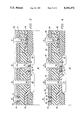
- FIGS. 1-4 illustrate the formation of polycrystalline silicon resistor structures according to a first preferred embodiment of the present invention
- FIG. 5 illustrates the formation of polycrystalline silicon resistor structures according to a second preferred embodiment
- FIG. 6 is a planned view of a resistor formed according to the technique described in connection with FIGS. 1-4;
- FIG. 7 illustrates resistive structures formed according to the technique described in connection with FIG. 5.
- integrated circuit devices are formed in a substrate 10.
- Field oxide regions 12, 14 separate and define active areas within the substrate 10.
- Polycrystalline silicon signal line 16 is used to conduct signals on the device.
- Signal line 16 is separated from the substrate 10 by gate oxide layer 18.
- Sidewall oxide spacers 20 are formed on either side of the signal line 16 as known in the art.
- signal line 16 can be a non-gate signal line which is utilized in a shared contact region.
- Signal line 16 will be so used as will be described further below.
- Active regions 22, 24 function as the source/drain regions of the field effect device if polycrystalline silicon signal line 16 actually functions as a field effect gate. In a shared contact layout, the active areas 22, 24 may actually be connected out of the plane of the drawing, so that the signal line 16 does not function as a gate.
- Polycrystalline silicon signal line 26 rests on field oxide region 14.
- Oxide sidewall spacers 28 are formed thereon at the same time as sidewall spacers 20.
- dielectric layer 30 is deposited over the surface of the integrated circuit device.
- This layer 30 is preferably LPCVD/APCVD/LTO silicon dioxide followed by a deposited layer of LPCVD silicon nitride as known in the art.
- Other insulating layers may be used if desired.
- insulating layer 32 is deposited over the surface of the device.
- Layer 32 is preferably a dielectric which can be easily planarized.
- Layer 32 may be, for example, BPSG which is deposited and heated to reflow as known in the art. If BPSG is used, the reflow is preferably performed in an ambient atmosphere including steam. The reflow cycle, or other planarization step, results in a nearly planar surface as shown in FIG. 1.
- an insulating layer 34 is deposited over the surface of the device.
- Insulating layer 34 is preferably an LPCVD silicon nitride layer deposited to a depth of approximately 2000-4000 Angstroms.
- Nitride layer 34 is then patterned and etched to define a region 36 in which polycrystalline silicon resistors are to be formed.
- Another insulating layer (not shown) is deposited over the surface of the chip, and anisotropically etched without masking to form sidewall spacers 38 within the resistor region 36.
- the insulating layer used to form the spacers 38 is preferably an LPCVD/LTO silicon oxide layer.
- the oxide layer is deposited to a thickness which results in the width of the oxide regions 38 resulting as desired.
- the width of the spacers 38 is approximately equal to the thickness of the oxide layer from which they are formed.
- the oxide layer used to produce spacers 38 is deposited to a depth of approximately 4000 angstroms.
- a layer of polycrystalline silicon 46 is deposited over the device.
- Layer 46 is preferably deposited to a depth of approximately 500 to 1500 angstroms.
- a blanket impurity implant is then made to control the resistivity of the polycrystalline silicon resistors to be fabricated in region 36. If N-type resistors are to be formed, an N - implant is made.
- the polycrystalline silicon layer 46 is patterned and etched to remove it except in the desired contact regions 40, 42, 44 and interconnect regions as desired. This results in various polycrystalline silicon contact structures 48 as shown.
- the layer 46 is etched to completely clear it, which can be accomplished by etching until the end point is reached as known in the art, and continuing the etch for a period of time approximately ten percent beyond reaching the end point. Such an over etch insures that undesired polycrystalline silicon regions do not remain behind.
- resistor region 36 is left unmasked. This causes the polycrystalline silicon overlying such region 36 to be etched away. However, due to the depth of the region 36, some material remains in the region between the sidewall spacers 38.
- This polycrystalline silicon region 50 provides the resistor desired for use in the device. As will be apparent to those skilled in the art, the cross-sectional area of resistor 50 is much smaller than a resistor which would have filled the resistor region 36.
- a masked N + implant can then be made to reduce the resistivity of the polycrystalline silicon contacts and interconnect 48.
- Remaining fabrication steps for the device, such as formation of further polycrystalline silicon and metal interconnect layers, is completed in a conventional manner. To a great extent, the device is already planarized due to the planarization of insulating layer 32, so that further planarization steps may be minimized or not required.
- FIG. 5 an alternative technique for fabricating small cross-section polycrystalline silicon resistor structures is shown.
- the technique used is very similar to that described in connection with FIGS. 1-4. The difference is that the deposition of the oxide layer, and anisotropic etching thereof to form sidewall spacers 38, is not performed. Instead, when polycrystalline silicon layer 46 is deposited over the device, it extends across the entire width of resistor region 36. When the polycrystalline silicon is anisotropically etched to form contact and interconnect regions 48, sidewall polycrystalline silicon regions 52 are formed within the resistor region 36. These regions 52 are separated by region 54 in much the same manner that sidewall oxide regions 38 were separated as described in connection with FIG. 2.
- FIG. 6 illustrates a plan view of a polycrystalline silicon resistor formed according to the techniques described in connection with FIGS. 1-4.
- Polycrystalline silicon contacts 60 connect to signal lines 62. Lines 64 indicate the boundaries of the resistor region 36.
- Polycrystalline silicon resistor 66 connects the contacts 60.
- the cross-sectional area of the polycrystalline silicon resistor 66 is greatly reduced from that which would normally be formed connecting contact regions 60. This allows a much higher valued resistor to be formed, or a shorter resistor to be used. Use of shorter resistor 66 allows the contacts 60 to be placed closer together, if desired, thereby reducing the overall layout area required for circuit structures such as 4-transistor SRAM cells.
- FIG. 7 is a plan view of a device constructed according to the method described in connection with FIG. 5.
- Contact regions 70 are connected to signal lines 72.
- Polycrystalline silicon resistors 74 connect the contact regions 70. Since the resistors are formed on both sidewalls of the resistor region 36, two parallel resistors 74 are formed.
- the twin resistor structures 74 shown in FIG. 7 have the same advantages as the single structure 66 shown in FIG. 6, and can be fabricated with a lesser number of process steps.
- the resistor structures described above provide polycrystalline silicon resistor structures which have a reduced width, and thus a reduced cross-sectional area. Use of such resistor structures in circuits such as CMOS SRAM cells allows the use of shorter resistors for a given required resistance. This can lead to smaller cell layout areas, and increased device density on an integrated circuit chip.
Landscapes
- Semiconductor Integrated Circuits (AREA)
- Internal Circuitry In Semiconductor Integrated Circuit Devices (AREA)
Priority Applications (6)
| Application Number | Priority Date | Filing Date | Title |
|---|---|---|---|
| US07/531,012 US5151376A (en) | 1990-05-31 | 1990-05-31 | Method of making polycrystalline silicon resistors for integrated circuits |
| EP91303596A EP0459618B1 (fr) | 1990-05-31 | 1991-04-22 | Résistance en silicium polycristallin pour circuits intégrés |
| DE69130547T DE69130547T2 (de) | 1990-05-31 | 1991-04-22 | Widerstände aus polykristallinem Silizium für integrierte Schaltungen |
| JP12640891A JP3418410B2 (ja) | 1990-05-31 | 1991-05-30 | Icデバイス内に抵抗器構造を組み立てる方法 |
| KR1019910009132A KR100231020B1 (ko) | 1990-05-31 | 1991-05-31 | 집적 회로 장치들의 다결정 실리콘 저항기들 |
| US07/869,517 US5825060A (en) | 1990-05-31 | 1992-04-16 | Polycrystalline silicon resistors for intergrated circuits |
Applications Claiming Priority (1)
| Application Number | Priority Date | Filing Date | Title |
|---|---|---|---|
| US07/531,012 US5151376A (en) | 1990-05-31 | 1990-05-31 | Method of making polycrystalline silicon resistors for integrated circuits |
Related Child Applications (1)
| Application Number | Title | Priority Date | Filing Date |
|---|---|---|---|
| US07/869,517 Division US5825060A (en) | 1990-05-31 | 1992-04-16 | Polycrystalline silicon resistors for intergrated circuits |
Publications (1)
| Publication Number | Publication Date |
|---|---|
| US5151376A true US5151376A (en) | 1992-09-29 |
Family
ID=24115894
Family Applications (2)
| Application Number | Title | Priority Date | Filing Date |
|---|---|---|---|
| US07/531,012 Expired - Lifetime US5151376A (en) | 1990-05-31 | 1990-05-31 | Method of making polycrystalline silicon resistors for integrated circuits |
| US07/869,517 Expired - Lifetime US5825060A (en) | 1990-05-31 | 1992-04-16 | Polycrystalline silicon resistors for intergrated circuits |
Family Applications After (1)
| Application Number | Title | Priority Date | Filing Date |
|---|---|---|---|
| US07/869,517 Expired - Lifetime US5825060A (en) | 1990-05-31 | 1992-04-16 | Polycrystalline silicon resistors for intergrated circuits |
Country Status (5)
| Country | Link |
|---|---|
| US (2) | US5151376A (fr) |
| EP (1) | EP0459618B1 (fr) |
| JP (1) | JP3418410B2 (fr) |
| KR (1) | KR100231020B1 (fr) |
| DE (1) | DE69130547T2 (fr) |
Cited By (12)
| Publication number | Priority date | Publication date | Assignee | Title |
|---|---|---|---|---|
| US5330933A (en) * | 1989-01-18 | 1994-07-19 | Sgs-Thomson Microelectronics, Inc. | Method for fabricating semiconductor circuits |
| US5395785A (en) * | 1993-12-17 | 1995-03-07 | Sgs-Thomson Microelectronics, Inc. | SRAM cell fabrication with interlevel dielectric planarization |
| US5403768A (en) * | 1992-04-08 | 1995-04-04 | Samsung Electronics Co., Ltd. | Manufacturing method of a thin film resistor |
| US5424570A (en) * | 1992-01-31 | 1995-06-13 | Sgs-Thomson Microelectronics, Inc. | Contact structure for improving photoresist adhesion on a dielectric layer |
| US5538915A (en) * | 1992-06-05 | 1996-07-23 | The Regents Of The University Of California | Process for forming synapses in neural networks and resistor therefor |
| US5545581A (en) * | 1994-12-06 | 1996-08-13 | International Business Machines Corporation | Plug strap process utilizing selective nitride and oxide etches |
| US5654239A (en) * | 1991-03-15 | 1997-08-05 | Mitsubishi Denki Kabushiki Kaisha | Method of manufacturing a contact structure of an interconnection layer for a semiconductor device and a multilayer interconnection SRAM |
| US5723352A (en) * | 1995-08-03 | 1998-03-03 | Taiwan Semiconductor Manufacturing Company | Process to optimize performance and reliability of MOSFET devices |
| US6140684A (en) * | 1997-06-24 | 2000-10-31 | Stmicroelectronic, Inc. | SRAM cell structure with dielectric sidewall spacers and drain and channel regions defined along sidewall spacers |
| US6190953B1 (en) * | 1997-03-25 | 2001-02-20 | Kabushiki Kaisha Toshibia | Semiconductor device and method for producing same |
| US6340829B1 (en) * | 1998-05-06 | 2002-01-22 | Mitsubishi Denki Kabushiki Kaisha | Semiconductor device and method for manufacturing the same |
| USRE37769E1 (en) | 1990-04-30 | 2002-06-25 | Stmicroelectronics, Inc. | Methods for fabricating memory cells and load elements |
Families Citing this family (3)
| Publication number | Priority date | Publication date | Assignee | Title |
|---|---|---|---|---|
| US6037623A (en) * | 1992-04-16 | 2000-03-14 | Stmicroelectronics, Inc. | Polycrystalline silicon resistors for integrated circuits |
| US5635418A (en) * | 1995-03-23 | 1997-06-03 | Micron Technology, Inc. | Method of making a resistor |
| KR100464941B1 (ko) * | 1998-12-24 | 2005-04-06 | 주식회사 하이닉스반도체 | 풀 씨모스 에스램 셀 제조 방법 |
Citations (10)
| Publication number | Priority date | Publication date | Assignee | Title |
|---|---|---|---|---|
| US4146902A (en) * | 1975-12-03 | 1979-03-27 | Nippon Telegraph And Telephone Public Corp. | Irreversible semiconductor switching element and semiconductor memory device utilizing the same |
| US4315239A (en) * | 1978-04-28 | 1982-02-09 | Sgs Ates, Componenti Elettronici S.P.A. | Process for producing a calibrated resistance element and integrated circuitry incorporating same |
| US4464212A (en) * | 1982-12-13 | 1984-08-07 | International Business Machines Corporation | Method for making high sheet resistivity resistors |
| JPS59155128A (ja) * | 1983-02-23 | 1984-09-04 | Mitsubishi Electric Corp | 半導体装置の製造方法 |
| JPS60236257A (ja) * | 1984-05-09 | 1985-11-25 | Matsushita Electric Ind Co Ltd | 半導体装置 |
| JPS61164241A (ja) * | 1985-01-16 | 1986-07-24 | Nec Corp | 半導体装置 |
| JPS62285462A (ja) * | 1986-06-03 | 1987-12-11 | Sony Corp | 半導体装置 |
| JPS6469031A (en) * | 1987-09-10 | 1989-03-15 | Matsushita Electronics Corp | Manufacture of semiconductor device |
| US4892839A (en) * | 1986-11-28 | 1990-01-09 | Fuji Electric Co., Ltd. | Method of manufacturing a semiconductor device with polysilicon resistors and field plate |
| JPH028831A (ja) * | 1988-06-28 | 1990-01-12 | Konica Corp | 放射線画像情報読取装置 |
Family Cites Families (5)
| Publication number | Priority date | Publication date | Assignee | Title |
|---|---|---|---|---|
| US4110776A (en) * | 1976-09-27 | 1978-08-29 | Texas Instruments Incorporated | Semiconductor integrated circuit with implanted resistor element in polycrystalline silicon layer |
| JPS61168955A (ja) * | 1985-01-22 | 1986-07-30 | Nec Corp | 半導体装置 |
| US4774203A (en) * | 1985-10-25 | 1988-09-27 | Hitachi, Ltd. | Method for making static random-access memory device |
| US4835589A (en) * | 1987-09-28 | 1989-05-30 | Motorola, Inc. | Ram cell having trench sidewall load |
| JPH01152662A (ja) * | 1987-12-09 | 1989-06-15 | Fujitsu Ltd | 半導体記憶装置 |
-
1990
- 1990-05-31 US US07/531,012 patent/US5151376A/en not_active Expired - Lifetime
-
1991
- 1991-04-22 DE DE69130547T patent/DE69130547T2/de not_active Expired - Fee Related
- 1991-04-22 EP EP91303596A patent/EP0459618B1/fr not_active Expired - Lifetime
- 1991-05-30 JP JP12640891A patent/JP3418410B2/ja not_active Expired - Fee Related
- 1991-05-31 KR KR1019910009132A patent/KR100231020B1/ko not_active Expired - Fee Related
-
1992
- 1992-04-16 US US07/869,517 patent/US5825060A/en not_active Expired - Lifetime
Patent Citations (10)
| Publication number | Priority date | Publication date | Assignee | Title |
|---|---|---|---|---|
| US4146902A (en) * | 1975-12-03 | 1979-03-27 | Nippon Telegraph And Telephone Public Corp. | Irreversible semiconductor switching element and semiconductor memory device utilizing the same |
| US4315239A (en) * | 1978-04-28 | 1982-02-09 | Sgs Ates, Componenti Elettronici S.P.A. | Process for producing a calibrated resistance element and integrated circuitry incorporating same |
| US4464212A (en) * | 1982-12-13 | 1984-08-07 | International Business Machines Corporation | Method for making high sheet resistivity resistors |
| JPS59155128A (ja) * | 1983-02-23 | 1984-09-04 | Mitsubishi Electric Corp | 半導体装置の製造方法 |
| JPS60236257A (ja) * | 1984-05-09 | 1985-11-25 | Matsushita Electric Ind Co Ltd | 半導体装置 |
| JPS61164241A (ja) * | 1985-01-16 | 1986-07-24 | Nec Corp | 半導体装置 |
| JPS62285462A (ja) * | 1986-06-03 | 1987-12-11 | Sony Corp | 半導体装置 |
| US4892839A (en) * | 1986-11-28 | 1990-01-09 | Fuji Electric Co., Ltd. | Method of manufacturing a semiconductor device with polysilicon resistors and field plate |
| JPS6469031A (en) * | 1987-09-10 | 1989-03-15 | Matsushita Electronics Corp | Manufacture of semiconductor device |
| JPH028831A (ja) * | 1988-06-28 | 1990-01-12 | Konica Corp | 放射線画像情報読取装置 |
Cited By (18)
| Publication number | Priority date | Publication date | Assignee | Title |
|---|---|---|---|---|
| US5831326A (en) * | 1989-01-18 | 1998-11-03 | Stmicroelectronics, Inc. | Semiconductor device with resistive load element |
| US5330933A (en) * | 1989-01-18 | 1994-07-19 | Sgs-Thomson Microelectronics, Inc. | Method for fabricating semiconductor circuits |
| USRE37769E1 (en) | 1990-04-30 | 2002-06-25 | Stmicroelectronics, Inc. | Methods for fabricating memory cells and load elements |
| US5654239A (en) * | 1991-03-15 | 1997-08-05 | Mitsubishi Denki Kabushiki Kaisha | Method of manufacturing a contact structure of an interconnection layer for a semiconductor device and a multilayer interconnection SRAM |
| US5424570A (en) * | 1992-01-31 | 1995-06-13 | Sgs-Thomson Microelectronics, Inc. | Contact structure for improving photoresist adhesion on a dielectric layer |
| US5877541A (en) * | 1992-01-31 | 1999-03-02 | Stmicroelectronics, Inc. | Contact structure for improving photoresist adhesion on a dielectric layer |
| US6010959A (en) * | 1992-01-31 | 2000-01-04 | Stmicroelectronics, Inc. | Method of improving photoresist adhesion on a dielectric layer |
| US5403768A (en) * | 1992-04-08 | 1995-04-04 | Samsung Electronics Co., Ltd. | Manufacturing method of a thin film resistor |
| US5538915A (en) * | 1992-06-05 | 1996-07-23 | The Regents Of The University Of California | Process for forming synapses in neural networks and resistor therefor |
| US5710461A (en) * | 1993-12-17 | 1998-01-20 | Sgs-Thomson Microelectronics, Inc. | SRAM cell fabrication with interlevel dielectric planarization |
| US5395785A (en) * | 1993-12-17 | 1995-03-07 | Sgs-Thomson Microelectronics, Inc. | SRAM cell fabrication with interlevel dielectric planarization |
| USRE41670E1 (en) | 1993-12-17 | 2010-09-14 | Stmicroelectronics, Inc. | Sram cell fabrication with interlevel Dielectric planarization |
| US5545581A (en) * | 1994-12-06 | 1996-08-13 | International Business Machines Corporation | Plug strap process utilizing selective nitride and oxide etches |
| US5723352A (en) * | 1995-08-03 | 1998-03-03 | Taiwan Semiconductor Manufacturing Company | Process to optimize performance and reliability of MOSFET devices |
| US6190953B1 (en) * | 1997-03-25 | 2001-02-20 | Kabushiki Kaisha Toshibia | Semiconductor device and method for producing same |
| US6140684A (en) * | 1997-06-24 | 2000-10-31 | Stmicroelectronic, Inc. | SRAM cell structure with dielectric sidewall spacers and drain and channel regions defined along sidewall spacers |
| US6340829B1 (en) * | 1998-05-06 | 2002-01-22 | Mitsubishi Denki Kabushiki Kaisha | Semiconductor device and method for manufacturing the same |
| US6699758B2 (en) | 1998-05-06 | 2004-03-02 | Mitsubishi Denki Kabushiki Kaisha | Semiconductor device and method for manufacturing the same |
Also Published As
| Publication number | Publication date |
|---|---|
| EP0459618A3 (fr) | 1994-01-19 |
| DE69130547D1 (de) | 1999-01-14 |
| EP0459618A2 (fr) | 1991-12-04 |
| KR910020892A (ko) | 1991-12-20 |
| JPH04230069A (ja) | 1992-08-19 |
| KR100231020B1 (ko) | 1999-11-15 |
| US5825060A (en) | 1998-10-20 |
| JP3418410B2 (ja) | 2003-06-23 |
| EP0459618B1 (fr) | 1998-12-02 |
| DE69130547T2 (de) | 1999-04-29 |
Similar Documents
| Publication | Publication Date | Title |
|---|---|---|
| US5151376A (en) | Method of making polycrystalline silicon resistors for integrated circuits | |
| US5739564A (en) | Semiconductor device having a static-random-access memory cell | |
| EP0460833B1 (fr) | Procédé de fabrication d'un dispositif à effet de champ avec un canal en silicium polycristallin | |
| US5485420A (en) | Static-random-access memory cell and an integrated circuit having a static-random-access memory cell | |
| US5616934A (en) | Fully planarized thin film transistor (TFT) and process to fabricate same | |
| US6277720B1 (en) | Silicon nitride dopant diffusion barrier in integrated circuits | |
| US4978637A (en) | Local interconnect process for integrated circuits | |
| US5348901A (en) | Interconnect and resistor for integrated circuits | |
| US4673969A (en) | Semiconductor device having multiple conductive layers and the method of manufacturing the semiconductor device | |
| US6188112B1 (en) | High impedance load for integrated circuit devices | |
| US5462894A (en) | Method for fabricating a polycrystalline silicon resistive load element in an integrated circuit | |
| JPS60213053A (ja) | 半導体メモリ素子 | |
| US5461000A (en) | Method of manufacturing dielectric as load resistor in 4T SRAM | |
| US4785342A (en) | Static random access memory having structure of first-, second- and third-level conductive films | |
| US5068201A (en) | Method for forming a high valued resistive load element and low resistance interconnect for integrated circuits | |
| US5770892A (en) | Field effect device with polycrystalline silicon channel | |
| US5291053A (en) | Semiconductor device having an overlapping memory cell | |
| US5323045A (en) | Semiconductor SRAM with low resistance power line | |
| US6037623A (en) | Polycrystalline silicon resistors for integrated circuits | |
| US5268325A (en) | Method for fabricating a polycrystalline silicon resistive load element in an integrated circuit | |
| US5840618A (en) | Method of manufacturing semiconductor device using an amorphous material | |
| US5196909A (en) | Capacitor for DRAM cell | |
| US5027186A (en) | Semiconductor device | |
| US5075761A (en) | Local interconnect for integrated circuits | |
| KR100204422B1 (ko) | 에스램 제조방법 |
Legal Events
| Date | Code | Title | Description |
|---|---|---|---|
| AS | Assignment |
Owner name: SGS-THOMSON MICROELECTRONICS, INC., TEXAS Free format text: ASSIGNMENT OF ASSIGNORS INTEREST.;ASSIGNOR:SPINNER, CHARLES R. III;REEL/FRAME:005343/0119 Effective date: 19900531 |
|
| STCF | Information on status: patent grant |
Free format text: PATENTED CASE |
|
| FPAY | Fee payment |
Year of fee payment: 4 |
|
| FEPP | Fee payment procedure |
Free format text: PAYOR NUMBER ASSIGNED (ORIGINAL EVENT CODE: ASPN); ENTITY STATUS OF PATENT OWNER: LARGE ENTITY |
|
| FPAY | Fee payment |
Year of fee payment: 8 |
|
| FPAY | Fee payment |
Year of fee payment: 12 |