US5159567A - Programmable serial multiplier - Google Patents
Programmable serial multiplier Download PDFInfo
- Publication number
- US5159567A US5159567A US07/627,153 US62715390A US5159567A US 5159567 A US5159567 A US 5159567A US 62715390 A US62715390 A US 62715390A US 5159567 A US5159567 A US 5159567A
- Authority
- US
- United States
- Prior art keywords
- flip
- multiplication
- constant
- multiplier
- shift register
- Prior art date
- Legal status (The legal status is an assumption and is not a legal conclusion. Google has not performed a legal analysis and makes no representation as to the accuracy of the status listed.)
- Expired - Fee Related
Links
Images


Classifications
-
- G—PHYSICS
- G06—COMPUTING OR CALCULATING; COUNTING
- G06F—ELECTRIC DIGITAL DATA PROCESSING
- G06F7/00—Methods or arrangements for processing data by operating upon the order or content of the data handled
- G06F7/38—Methods or arrangements for performing computations using exclusively denominational number representation, e.g. using binary, ternary, decimal representation
- G06F7/48—Methods or arrangements for performing computations using exclusively denominational number representation, e.g. using binary, ternary, decimal representation using non-contact-making devices, e.g. tube, solid state device; using unspecified devices
- G06F7/52—Multiplying; Dividing
- G06F7/523—Multiplying only
- G06F7/527—Multiplying only in serial-parallel fashion, i.e. one operand being entered serially and the other in parallel
-
- G—PHYSICS
- G06—COMPUTING OR CALCULATING; COUNTING
- G06F—ELECTRIC DIGITAL DATA PROCESSING
- G06F7/00—Methods or arrangements for processing data by operating upon the order or content of the data handled
- G06F7/38—Methods or arrangements for performing computations using exclusively denominational number representation, e.g. using binary, ternary, decimal representation
- G06F7/48—Methods or arrangements for performing computations using exclusively denominational number representation, e.g. using binary, ternary, decimal representation using non-contact-making devices, e.g. tube, solid state device; using unspecified devices
- G06F7/52—Multiplying; Dividing
- G06F7/523—Multiplying only
Definitions
- the invention relates to a programmable serial multiplier performing the multiplication of a multiplicand by a fixed constant which includes:
- It also relates to a computational processor performing a linear transform of data employing such a multiplier.
- serial multipliers Numerous embodiments of serial multipliers exist which are well suited to the processing of signals the regularity of the data streams of which makes it possible to exploit the pipelining possibilities of these serial multipliers.
- One particular class of these multipliers produces the product of a variable and a constant, then referred to as the coefficient. Applications thereof are found in filters, Fourier transforms, cosine transforms, etc. Advantage can be drawn from the fact that the constant is known when designing the circuit. It is then no longer necessary to provide data paths to route the coefficients.
- Such a multiplier is programmed by branching the corresponding inputs of the multiplier to 1 or to 0. It is easy to design but does not push to the limit the optimizations which are possible depending on the value of the coefficients. The optimization can be pushed much further: one example thereof is described in the patent "Method and digital circuit for fixed coefficient serial multiplication" GB 2,179,770 A.
- This document proposes a serial multiplier which carries out multiplications of a multiplicand by a constant which is a fractional number.
- This constant is programmed by retarding the result obtained as output from the adder of the multiplier before inserting this result as input to this same adder in order to add it to the subsequent term.
- the result of a multiplication is therefore obtained after a computation time which depends on the fixed constant employed.
- This multiplier is not however designed to treat the cases of arbitrary constants. The structure of such a multiplier is therefore very dependent on the coefficients employed and this may pose difficulties whilst designing a circuit operating with multiple constants which it may be led to rapidly change at least cost.
- a basic cell for example a multiplier
- a basic cell is available in a library and, during design, it must be adapted to the operations which are to be carried out. It is therefore desirable that this basic cell is the most universal possible and may be adapted without difficulty to a vast field of possibilities.
- the type of constant does not call into question the fundamental structure of the multiplier. This should be solved by minimal attachments, readily and rapidly produced by the designer.
- the structure of the multiplier and hence the plan of the masks is an aspect which takes on great importance.
- a basic plan must be designed which is very close to the final structure and which is the least dependent possible on the coefficients to be inserted.
- serial multipliers of this type it is necessary to try to minimize to the extent possible the specific operations for assemblage of cells.
- Stacks of serial multipliers, designed to order are sometimes difficult to produce. This difficulty in readily designing stacks of several multipliers is coupled with another disadvantage relating to the speed of the processing carried out.
- serial multipliers designed to order each one has its own speed related to the coefficient processed, which does not make it possible to define common specifications and militates against the perfecting of the stack. CAD techniques find themselves affected thereby.
- the form and the dimensions of the multiplier should not depend on the coefficient, which would be problematic in certain applications when it is desired to make stacks from these circuits. In fact, this would prevent them being assembled by simple abutment. A loss of space on the circuit would result therefrom.
- the number of totalling stages must not depend on the coefficient since the delay in obtaining the product would also depend on the coefficient, which would also be a complication in the uses in which several of these multipliers are employed in parallel and in which their results have to be combined whilst conforming with a synchronization.
- the solution consists in a programmable serial multiplier such as defined in the first paragraph and which comprises:
- the shift register being formed from (r/2)+1 initializable flip-flops
- connection means which make it possible to program the serial multiplier in order to perform the multiplication by the fixed constant C, either with the aid of the value +C when the constant C contains, in binary notation, a number of 1s less than or equal to the number of 0s, or with the aid of the value -C in the reverse case, the programming being carried out by bringing together at the outputs of the shift register at least part of the inputs of the first addition cell and of the second inputs of the other addition cells, and by rendering the other part inoperative.
- such a multiplier is readily parametrizable as a function of the coefficient employed. Its form and its dimensions do not depend on the coefficient. It is easy to assemble several multipliers by simple abutment. This is reflected by a space saving on the plan of the integrated circuit. When several multipliers are employed together there is no synchronization and computation time problem. Thus, multiplier assemblages with homogeneous characteristics (topography, speed) are available.
- the multiplier is partitioned into specified functional blocks connected by a parametrizable interconnection channel.
- An interconnection diagram corresponds to the programming of the particular coefficient. The form of the blocks and of the channel does not change and may be planned out in advance. An important point for large scale integrated circuit production is to obtain a multiplier the plan of which does not vary too much as a function of the value of the coefficient.
- the proposed circuit employs a specific number of adders, even if a smaller number is sufficient for a particular value of the constant. The only portion of the multiplier variable as a function of the value of the coefficient is therefore localized in the interconnection channel, thus not affecting the form of the circuit.
- the multiplier may operate with multiplicands and/or signed or unsigned coefficients.
- the first input of the first addition cell may be connected up to the said last flip-flop through an inverter, it being possible to initialize either to 1 or to 0 the flip-flop retarding the carry from the said first addition cell.
- the stacks which it is possible to produce with such a type of multiplier may for example constitute a computational processor for carrying out a linear transform, for example, Fourier transforms, cosine transforms etc.
- processors for computing such transforms are well known and it is possible to refer for example to the document FR-2,596,892.
- Such an implementation of a discreet cosine transformation DCT calls upon a battery of multipliers, adders and subtracters. After each multiplication summation operations are performed.
- the fixed coefficients are combinations of particular cosine values. This summation may consist of an addition or a subtraction.
- the number r of bits at the logic 1 state may be greater than/equal to or less than r/2.
- the multipliers then operate either with a constant +C or with a constant -C (with inverted bits) so that the number of 1s- of the binary notation is equal to or less than r/2.
- the invention relates to a computational processor which determines transformed data from input data according to a linear transform which carries out operations for multiplication of at least one multiplicand by at least one constant, then operations for summation of the partial results, characterized in that the said multiplications are carried out in series as described previously, and when a summation operation is to be carried out on two partial results one of which was obtained from a processing by the constant's oppositely signed number, the said summation operation is performed by inverting the type of operator initially provided, and when a summation operation is to be carried out on two partial results which were both obtained from a processing by a constant with inverted bits, the said summation operation is performed by retaining the type of operator initially provided, the operator type inversion being carried over to the first subsequent summation operation operating on a single inverted partial result.
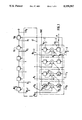
- FIG. 1 is a diagram of a multiplier according to the invention operating with an unsigned fixed coefficient
- FIG. 2A is a diagram of a multiplier with its interconnections for a particular example with an unsigned coefficient
- FIG. 3 is a diagram of the portion of FIG. 1 which is modified in order to operate with a signed fixed coefficient
- FIG. 4 is a diagram of an example linear transform.
- FIG. 1 shows a diagram of a serial multiplier operating with an unsigned fixed constant.
- the device functions in cycles of several clock beats operating on each of the registers.
- the multiplicand D is a signed 2's complement variable coded on d bits.
- the field of application of this multiplier is restricted to coefficients not having more 1 than 0 bits.
- the multiplicand D is presented serially, bit by bit, with the lowest order first.
- the product is also generated serially, lowest order bit first.
- the multiplier is composed of three elements:
- the register is reset to 0 on initialization.
- the input of this register and the outputs of all of the flip-flops are connected by the terminals D 0 , D 1 , . . . D(r/2)+1 to an interconnection channel 17 described below.
- Each addition cell except the first has its input A j connected to the sum output of the preceding one, whilst the inputs B j and the input A 0 of the input cell are connected to the interconnection channel 17.
- the product P is available at the sum output S(r/2)-2 of the final flip-flop 15(r/2)-2.
- the interconnection channel 17 enables the inputs B j of the adders and the input A 0 of the first adder to be connected to any one of the outputs D 0 -D(r/2)+1 of the shift register or else to 0.
- a particular wiring corresponds in fact to the programming of the value of a given coefficient.
- the sum is produced by the addition cells, each one adding a partial product to the preceding partial total.
- the multiplication by C i is obtained by ignoring the partial products where C i is zero.
- the multiplication by 2 i is obtained by selecting a flip-flop of the shift register containing the multiplicand retarded by i positions, and is filled in at the low order end by i zeros.
- the left-hand (order 0) adder adds up the partial products corresponding to the most significant b 1 bits of the coefficient, whilst the right-hand (order r/2-2) one inserts the partial product corresponding to the least significant 1 bit.
- FIG. 2A shows a diagram of a multiplier according to the invention with its interconnections for a particular example with an unsigned coefficient.
- the inputs A 0 and B 0 of the adder 13 0 must be connected up respectively to the outputs D 4 and D 0 of the register.
- the multiplication by 2 0 is carried out by connecting up the input B 1 of the adder 13 1 to the output D 0 , its input A 1 being connected to the flip-flop 15 0 .
- FIG. 2B shows a chronogram of the multiplication for the example of FIG. 2A.
- an RAZ signal performs the resetting to zero of all of the flip-flops (registers, carries, sums) so as to initialize the operations in each addition cell.
- the flip-flop for the sum of the final cell does not require this initialization.
- the least significant bit LSB shows up one clock period after the start of the appearance of the datum D 0 . The most significant bit MSB appears last.
- FIG. 3 shows a diagram of the portion of FIG. 1 which is modified in order to operate with a signed fixed coefficient.
- the other elements remain the same as those of FIG. 1.
- the final flip-flop 10(r/2) of the shift register is followed by an inverter 30 the output of which constitutes the output D(r/2)+1 to be connected up to the interconnection channel.
- the first adder 13 0 may have its carry 14 0 initialized to 1 (connection 31) instead of 0 (connection 32). The choice of the 1 or 0 initialization is likewise made by the interconnection channel.
- connection 31 connection 31
- connection 32 connection 32
- FIG. 4 shows a diagram of an example linear transform.
- An effecting of a linear transform calls upon a battery of multipliers which are surrounded by adders and subtracters.
- This implementation may be applied, among other things, to Fourier transforms and to cosine transforms.
- the use of "serial bit" operators like the multiplier which has just been described makes it possible to profit to the maximum from the pipelining of the various operations.
- the coefficients are combinations of cosine values of particular angles For these numbers, the restriction of not having more than r/2 one bits is not acceptable. This difficulty is solved in the following way. When a coefficient C has more than r/2 one bits, it is replaced by its oppositely signed number -C and it may easily be verified that C does not then have more than r/2 one bits.
- the result -P is obtained instead of the result P, and in order to take account of the change of sign the adder (respectively subtracter) situated downstream of the multiplier is replaced by a subtracted (respectively an adder).
- the adder situated downstream of the multiplier
- a subtracted respectively an adder
- the adder 40 1 adds X 3 and X 2 and delivers a result which is multiplied by C 2 .
- the adder 40 2 adds X 0 and X 1 and delivers a result which is multiplied by C 5 .
- the subtracter 411 subtracts X 0 from X 1 and delivers a result which is multiplied by C 4 .
- the data X 2 and X 3 are multiplied by C 3 and C 1 respectively.
Landscapes
- Physics & Mathematics (AREA)
- General Physics & Mathematics (AREA)
- Engineering & Computer Science (AREA)
- Computational Mathematics (AREA)
- Mathematical Analysis (AREA)
- Mathematical Optimization (AREA)
- Pure & Applied Mathematics (AREA)
- Theoretical Computer Science (AREA)
- Computing Systems (AREA)
- General Engineering & Computer Science (AREA)
- Complex Calculations (AREA)
Applications Claiming Priority (2)
| Application Number | Priority Date | Filing Date | Title |
|---|---|---|---|
| FR8916634 | 1989-12-15 | ||
| FR8916634A FR2656124A1 (fr) | 1989-12-15 | 1989-12-15 | Multiplieur serie programmable. |
Publications (1)
| Publication Number | Publication Date |
|---|---|
| US5159567A true US5159567A (en) | 1992-10-27 |
Family
ID=9388568
Family Applications (1)
| Application Number | Title | Priority Date | Filing Date |
|---|---|---|---|
| US07/627,153 Expired - Fee Related US5159567A (en) | 1989-12-15 | 1990-12-13 | Programmable serial multiplier |
Country Status (5)
| Country | Link |
|---|---|
| US (1) | US5159567A (fr) |
| EP (1) | EP0437876B1 (fr) |
| JP (1) | JPH04135233A (fr) |
| DE (1) | DE69025901D1 (fr) |
| FR (1) | FR2656124A1 (fr) |
Cited By (13)
| Publication number | Priority date | Publication date | Assignee | Title |
|---|---|---|---|---|
| US5459683A (en) * | 1993-08-02 | 1995-10-17 | Matsushita Electric Industrial Co., Ltd. | Apparatus for calculating the square root of the sum of two squares |
| US5481748A (en) * | 1991-12-13 | 1996-01-02 | International Business Machines Corporation | Method and apparatus for reducing the processing time required to solve numerical problems |
| US5815422A (en) * | 1997-01-24 | 1998-09-29 | Vlsi Technology, Inc. | Computer-implemented multiplication with shifting of pattern-product partials |
| US5828588A (en) * | 1995-11-27 | 1998-10-27 | U.S. Philips Corporation | Parametrizable control module comprising first and second loadable counter, an electronic circuit comprising a plurality of such parametrized control modules, and a method for synthesizing such circuit |
| US6311203B1 (en) * | 1998-07-27 | 2001-10-30 | Mitsubishi Denki Kabushiki Kaisha | Multiplier, and fixed coefficient FIR digital filter having plural multipliers |
| US6535646B2 (en) * | 1998-03-06 | 2003-03-18 | Vincenzo Arturo Luca Liguori | Discrete cosine transform method and apparatus |
| US20030061252A1 (en) * | 2001-09-27 | 2003-03-27 | Murphy Charles D. | Non-constant reduced-complexity multiplication in signal processing transforms |
| US20030074383A1 (en) * | 2001-10-15 | 2003-04-17 | Murphy Charles Douglas | Shared multiplication in signal processing transforms |
| US20030182342A1 (en) * | 2002-03-25 | 2003-09-25 | Murphy Charles Douglas | Low-cost multiplication in small DFT butterflies |
| US20030195913A1 (en) * | 2002-04-10 | 2003-10-16 | Murphy Charles Douglas | Shared multiplication for constant and adaptive digital filters |
| EP1752870A3 (fr) * | 1993-09-02 | 2007-05-16 | Matsushita Electric Industrial Co., Ltd. | Multiplieur |
| CN115756385A (zh) * | 2022-11-23 | 2023-03-07 | 杭州嘉楠耘智信息科技有限公司 | 数据处理方法、装置、电子设备及存储介质 |
| CN116126284A (zh) * | 2022-09-20 | 2023-05-16 | 电子科技大学 | 基于位串行结构的booth4乘法器的设计 |
Families Citing this family (2)
| Publication number | Priority date | Publication date | Assignee | Title |
|---|---|---|---|---|
| JP2840169B2 (ja) * | 1992-12-28 | 1998-12-24 | 松下電器産業株式会社 | 論理回路の自動設計方法およびその装置 |
| FR2867335A1 (fr) * | 2004-03-02 | 2005-09-09 | France Telecom | Procede cryptographique notamment a cle publique |
Citations (6)
| Publication number | Priority date | Publication date | Assignee | Title |
|---|---|---|---|---|
| US3456098A (en) * | 1966-04-04 | 1969-07-15 | Bell Telephone Labor Inc | Serial binary multiplier arrangement |
| GB1256221A (en) * | 1967-12-07 | 1971-12-08 | British Aircraft Corp Ltd | Improvements relating to binary multiplication circuits |
| GB2179770A (en) * | 1985-08-28 | 1987-03-11 | Plessey Co Plc | Method and digital circuit for fixed coefficient serial multiplication |
| US4839847A (en) * | 1987-04-14 | 1989-06-13 | Harris Corp. | N-clock, n-bit-serial multiplier |
| US4853887A (en) * | 1986-09-22 | 1989-08-01 | Francis Jutand | Binary adder having a fixed operand and parallel-serial binary multiplier incorporating such an adder |
| US5031137A (en) * | 1989-12-07 | 1991-07-09 | The Boeing Company | Two input bit-serial multiplier |
-
1989
- 1989-12-15 FR FR8916634A patent/FR2656124A1/fr active Pending
-
1990
- 1990-12-10 DE DE69025901T patent/DE69025901D1/de not_active Expired - Lifetime
- 1990-12-10 EP EP90203242A patent/EP0437876B1/fr not_active Expired - Lifetime
- 1990-12-13 US US07/627,153 patent/US5159567A/en not_active Expired - Fee Related
- 1990-12-14 JP JP2417991A patent/JPH04135233A/ja active Pending
Patent Citations (6)
| Publication number | Priority date | Publication date | Assignee | Title |
|---|---|---|---|---|
| US3456098A (en) * | 1966-04-04 | 1969-07-15 | Bell Telephone Labor Inc | Serial binary multiplier arrangement |
| GB1256221A (en) * | 1967-12-07 | 1971-12-08 | British Aircraft Corp Ltd | Improvements relating to binary multiplication circuits |
| GB2179770A (en) * | 1985-08-28 | 1987-03-11 | Plessey Co Plc | Method and digital circuit for fixed coefficient serial multiplication |
| US4853887A (en) * | 1986-09-22 | 1989-08-01 | Francis Jutand | Binary adder having a fixed operand and parallel-serial binary multiplier incorporating such an adder |
| US4839847A (en) * | 1987-04-14 | 1989-06-13 | Harris Corp. | N-clock, n-bit-serial multiplier |
| US5031137A (en) * | 1989-12-07 | 1991-07-09 | The Boeing Company | Two input bit-serial multiplier |
Cited By (13)
| Publication number | Priority date | Publication date | Assignee | Title |
|---|---|---|---|---|
| US5481748A (en) * | 1991-12-13 | 1996-01-02 | International Business Machines Corporation | Method and apparatus for reducing the processing time required to solve numerical problems |
| US5459683A (en) * | 1993-08-02 | 1995-10-17 | Matsushita Electric Industrial Co., Ltd. | Apparatus for calculating the square root of the sum of two squares |
| EP1752870A3 (fr) * | 1993-09-02 | 2007-05-16 | Matsushita Electric Industrial Co., Ltd. | Multiplieur |
| US5828588A (en) * | 1995-11-27 | 1998-10-27 | U.S. Philips Corporation | Parametrizable control module comprising first and second loadable counter, an electronic circuit comprising a plurality of such parametrized control modules, and a method for synthesizing such circuit |
| US5815422A (en) * | 1997-01-24 | 1998-09-29 | Vlsi Technology, Inc. | Computer-implemented multiplication with shifting of pattern-product partials |
| US6535646B2 (en) * | 1998-03-06 | 2003-03-18 | Vincenzo Arturo Luca Liguori | Discrete cosine transform method and apparatus |
| US6311203B1 (en) * | 1998-07-27 | 2001-10-30 | Mitsubishi Denki Kabushiki Kaisha | Multiplier, and fixed coefficient FIR digital filter having plural multipliers |
| US20030061252A1 (en) * | 2001-09-27 | 2003-03-27 | Murphy Charles D. | Non-constant reduced-complexity multiplication in signal processing transforms |
| US20030074383A1 (en) * | 2001-10-15 | 2003-04-17 | Murphy Charles Douglas | Shared multiplication in signal processing transforms |
| US20030182342A1 (en) * | 2002-03-25 | 2003-09-25 | Murphy Charles Douglas | Low-cost multiplication in small DFT butterflies |
| US20030195913A1 (en) * | 2002-04-10 | 2003-10-16 | Murphy Charles Douglas | Shared multiplication for constant and adaptive digital filters |
| CN116126284A (zh) * | 2022-09-20 | 2023-05-16 | 电子科技大学 | 基于位串行结构的booth4乘法器的设计 |
| CN115756385A (zh) * | 2022-11-23 | 2023-03-07 | 杭州嘉楠耘智信息科技有限公司 | 数据处理方法、装置、电子设备及存储介质 |
Also Published As
| Publication number | Publication date |
|---|---|
| JPH04135233A (ja) | 1992-05-08 |
| EP0437876B1 (fr) | 1996-03-13 |
| EP0437876A1 (fr) | 1991-07-24 |
| DE69025901D1 (de) | 1996-04-18 |
| FR2656124A1 (fr) | 1991-06-21 |
Similar Documents
| Publication | Publication Date | Title |
|---|---|---|
| Vijay et al. | A Review On N-Bit Ripple-Carry Adder, Carry-Select Adder And Carry-Skip Adder | |
| US5159567A (en) | Programmable serial multiplier | |
| Ma et al. | Multiplier policies for digital signal processing | |
| US4864529A (en) | Fast multiplier architecture | |
| Taylor | A single modulus complex ALU for signal processing | |
| US3670956A (en) | Digital binary multiplier employing sum of cross products technique | |
| Becker et al. | How many decomposition types do we need?[decision diagrams] | |
| O'Leary et al. | Non-restoring integer square root: A case study in design by principled optimization | |
| EP0241181A1 (fr) | Unité arithmétique à structure pipeline | |
| Guild | Some cellular logic arrays for non-restoring binary division | |
| US5530664A (en) | Method and apparatus for automatically designing logic circuit, and multiplier | |
| US5912904A (en) | Method for the production of an error correction parameter associated with the implementation of modular operations according to the Montgomery method | |
| Mencer | Rational arithmetic units in computer systems | |
| Hertz et al. | A methodology for parabolic synthesis of unary functions for hardware implementation | |
| Irwin et al. | A case for digit serial VLSI signal processors | |
| Bi et al. | High-performance bit-serial adders and multipliers | |
| Hsiao et al. | The CORDIC Householder algorithm. | |
| SU1756887A1 (ru) | Устройство дл делени чисел в модул рной системе счислени | |
| Parker et al. | Optimal value for the Newton-Raphson division algorithm | |
| KR950010451B1 (ko) | 그룹 트리구조 알고리즘(GTSM ; Group Tree Structure Method)을 적용한 고속 승산기 | |
| MacLeod | Arithmetic operations using TTL | |
| Chang et al. | High-performance digit-serial complex multiplier | |
| Ciminiera et al. | Partitioned array for stable matrix triangularisation | |
| Hartley et al. | Online Arithmetic | |
| Manuprasad et al. | Inexact Addition and Subtraction for the Reconfigurable FIR Filter Implementation using CSD based Common Subexpression Elimination |
Legal Events
| Date | Code | Title | Description |
|---|---|---|---|
| AS | Assignment |
Owner name: U.S. PHILIPS CORPORATION, 100 EAST 42ND ST., NEW Y Free format text: ASSIGNMENT OF ASSIGNORS INTEREST.;ASSIGNOR:GOBERT, JEAN;REEL/FRAME:005639/0321 Effective date: 19910307 |
|
| REMI | Maintenance fee reminder mailed | ||
| LAPS | Lapse for failure to pay maintenance fees | ||
| STCH | Information on status: patent discontinuation |
Free format text: PATENT EXPIRED DUE TO NONPAYMENT OF MAINTENANCE FEES UNDER 37 CFR 1.362 |