US5194237A - TiC based materials and process for producing same - Google Patents
TiC based materials and process for producing same Download PDFInfo
- Publication number
- US5194237A US5194237A US07/686,936 US68693691A US5194237A US 5194237 A US5194237 A US 5194237A US 68693691 A US68693691 A US 68693691A US 5194237 A US5194237 A US 5194237A
- Authority
- US
- United States
- Prior art keywords
- tic
- process according
- heating
- mixture
- titanium
- Prior art date
- Legal status (The legal status is an assumption and is not a legal conclusion. Google has not performed a legal analysis and makes no representation as to the accuracy of the status listed.)
- Expired - Fee Related
Links
Images
Classifications
-
- C—CHEMISTRY; METALLURGY
- C23—COATING METALLIC MATERIAL; COATING MATERIAL WITH METALLIC MATERIAL; CHEMICAL SURFACE TREATMENT; DIFFUSION TREATMENT OF METALLIC MATERIAL; COATING BY VACUUM EVAPORATION, BY SPUTTERING, BY ION IMPLANTATION OR BY CHEMICAL VAPOUR DEPOSITION, IN GENERAL; INHIBITING CORROSION OF METALLIC MATERIAL OR INCRUSTATION IN GENERAL
- C23C—COATING METALLIC MATERIAL; COATING MATERIAL WITH METALLIC MATERIAL; SURFACE TREATMENT OF METALLIC MATERIAL BY DIFFUSION INTO THE SURFACE, BY CHEMICAL CONVERSION OR SUBSTITUTION; COATING BY VACUUM EVAPORATION, BY SPUTTERING, BY ION IMPLANTATION OR BY CHEMICAL VAPOUR DEPOSITION, IN GENERAL
- C23C4/00—Coating by spraying the coating material in the molten state, e.g. by flame, plasma or electric discharge
- C23C4/18—After-treatment
- C23C4/185—Separation of the coating from the substrate
-
- C—CHEMISTRY; METALLURGY
- C01—INORGANIC CHEMISTRY
- C01B—NON-METALLIC ELEMENTS; COMPOUNDS THEREOF; METALLOIDS OR COMPOUNDS THEREOF NOT COVERED BY SUBCLASS C01C
- C01B32/00—Carbon; Compounds thereof
- C01B32/90—Carbides
- C01B32/914—Carbides of single elements
- C01B32/921—Titanium carbide
-
- C—CHEMISTRY; METALLURGY
- C22—METALLURGY; FERROUS OR NON-FERROUS ALLOYS; TREATMENT OF ALLOYS OR NON-FERROUS METALS
- C22C—ALLOYS
- C22C29/00—Alloys based on carbides, oxides, nitrides, borides, or silicides, e.g. cermets, or other metal compounds, e.g. oxynitrides, sulfides
- C22C29/02—Alloys based on carbides, oxides, nitrides, borides, or silicides, e.g. cermets, or other metal compounds, e.g. oxynitrides, sulfides based on carbides or carbonitrides
- C22C29/06—Alloys based on carbides, oxides, nitrides, borides, or silicides, e.g. cermets, or other metal compounds, e.g. oxynitrides, sulfides based on carbides or carbonitrides based on carbides, but not containing other metal compounds
-
- C—CHEMISTRY; METALLURGY
- C23—COATING METALLIC MATERIAL; COATING MATERIAL WITH METALLIC MATERIAL; CHEMICAL SURFACE TREATMENT; DIFFUSION TREATMENT OF METALLIC MATERIAL; COATING BY VACUUM EVAPORATION, BY SPUTTERING, BY ION IMPLANTATION OR BY CHEMICAL VAPOUR DEPOSITION, IN GENERAL; INHIBITING CORROSION OF METALLIC MATERIAL OR INCRUSTATION IN GENERAL
- C23C—COATING METALLIC MATERIAL; COATING MATERIAL WITH METALLIC MATERIAL; SURFACE TREATMENT OF METALLIC MATERIAL BY DIFFUSION INTO THE SURFACE, BY CHEMICAL CONVERSION OR SUBSTITUTION; COATING BY VACUUM EVAPORATION, BY SPUTTERING, BY ION IMPLANTATION OR BY CHEMICAL VAPOUR DEPOSITION, IN GENERAL
- C23C4/00—Coating by spraying the coating material in the molten state, e.g. by flame, plasma or electric discharge
- C23C4/12—Coating by spraying the coating material in the molten state, e.g. by flame, plasma or electric discharge characterised by the method of spraying
- C23C4/123—Spraying molten metal
-
- C—CHEMISTRY; METALLURGY
- C01—INORGANIC CHEMISTRY
- C01P—INDEXING SCHEME RELATING TO STRUCTURAL AND PHYSICAL ASPECTS OF SOLID INORGANIC COMPOUNDS
- C01P2004/00—Particle morphology
- C01P2004/01—Particle morphology depicted by an image
- C01P2004/02—Particle morphology depicted by an image obtained by optical microscopy
-
- C—CHEMISTRY; METALLURGY
- C01—INORGANIC CHEMISTRY
- C01P—INDEXING SCHEME RELATING TO STRUCTURAL AND PHYSICAL ASPECTS OF SOLID INORGANIC COMPOUNDS
- C01P2004/00—Particle morphology
- C01P2004/60—Particles characterised by their size
- C01P2004/61—Micrometer sized, i.e. from 1-100 micrometer
-
- C—CHEMISTRY; METALLURGY
- C01—INORGANIC CHEMISTRY
- C01P—INDEXING SCHEME RELATING TO STRUCTURAL AND PHYSICAL ASPECTS OF SOLID INORGANIC COMPOUNDS
- C01P2004/00—Particle morphology
- C01P2004/80—Particles consisting of a mixture of two or more inorganic phases
-
- C—CHEMISTRY; METALLURGY
- C01—INORGANIC CHEMISTRY
- C01P—INDEXING SCHEME RELATING TO STRUCTURAL AND PHYSICAL ASPECTS OF SOLID INORGANIC COMPOUNDS
- C01P2006/00—Physical properties of inorganic compounds
- C01P2006/80—Compositional purity
-
- C—CHEMISTRY; METALLURGY
- C22—METALLURGY; FERROUS OR NON-FERROUS ALLOYS; TREATMENT OF ALLOYS OR NON-FERROUS METALS
- C22B—PRODUCTION AND REFINING OF METALS; PRETREATMENT OF RAW MATERIALS
- C22B34/00—Obtaining refractory metals
- C22B34/10—Obtaining titanium, zirconium or hafnium
- C22B34/12—Obtaining titanium or titanium compounds from ores or scrap by metallurgical processing; preparation of titanium compounds from other titanium compounds see C01G23/00 - C01G23/08
- C22B34/129—Obtaining titanium or titanium compounds from ores or scrap by metallurgical processing; preparation of titanium compounds from other titanium compounds see C01G23/00 - C01G23/08 obtaining metallic titanium from titanium compounds by dissociation, e.g. thermic dissociation of titanium tetraiodide, or by electrolysis or with the use of an electric arc
-
- C—CHEMISTRY; METALLURGY
- C22—METALLURGY; FERROUS OR NON-FERROUS ALLOYS; TREATMENT OF ALLOYS OR NON-FERROUS METALS
- C22B—PRODUCTION AND REFINING OF METALS; PRETREATMENT OF RAW MATERIALS
- C22B4/00—Electrothermal treatment of ores or metallurgical products for obtaining metals or alloys
- C22B4/005—Electrothermal treatment of ores or metallurgical products for obtaining metals or alloys using plasma jets
Definitions
- This invention relates to the production of titanium carbide based materials and more particularly to the production of titanium carbide based composite materials for coatings and parts.
- the composite materials can also be obtained in a powder form.
- the invention also relates to the production of titanium carbide composite powder and titanium carbide crystals.
- Titanium carbide exhibits high hardness (7-10 RH, or 3200 Kg f /mm 2 with 50 g load), a low coefficient of friction, a high melting point (3170° C.) and a good resistance to corrosion. These properties as well as high thermal conductivity makes TiC particularly suitable for many applications such as parts in mining equipment (coal chutes, slurry conveyors, mill rolls), and in earth moving equipment (cutter blades), self sharpening edges, metal machining tools, etc.
- TiC powders and coatings can be obtained in pure form or in a composite form.
- the composite is a dispersion of TiC particles in a metal matrix, the metals being preferably one or more selected from the group of Al, Co, Cr, Cu, Fe, Mo, and Ni.
- TiC has thus far been mainly produced by directly reacting titanium or titanium dioxide with carbon in a resistance furnace or an induction furnace, usually under a protective atmosphere.
- Another TiC production method is a so-called auxiliary metal bath AMB) process, wherein iron or steel scrap is mixed with titanium, ferrotitanium or titanium oxide and melted in a graphite crucible, with an optional additional carbon charge, under vacuum or in hydrogen atmosphere. The TiC is then recovered by leaching the solidified melt.
- AMB auxiliary metal bath AMB
- Powdered TiC is obtained by grinding the product of a known TiC production method.
- Composite TiC powders are usually produced for thermally sprayed composite coatings. They are obtained by combining previously produced pure TiC powders and a powdered metallic substance. Liquid phase processes giving metal-coated TiC powders include electrolytical and hydrometallurgical processes such as the Sherritt Gordon autoclave method. Composite powders can also be obtained by gas phase deposition and by various agglomeration techniques using organic binders and by micropelletizing methods such as dispersion spray drying. Thermal post-treatments such as sintering are often used to improve and stabilize the quality of the micropellets and other composite powders.
- TiC composite parts are generally obtained by various powder metallurgy techniques such as hot pressing, hot isostatic pressing, infiltrating, sintering, etc., using TiC powders in combination with metallic powders or using composite TiC powders, or both.
- TiC coatings can be obtained by chemical vapour deposition (CVD) processes such as plasma activated CVD, ion plating, sputtering, etc.
- Hard-facing processes such as carbide particle injection process by laser-melting, electric contact sinter bonding and plasma-transferred arc (PTA) processes are also used.
- Plasma spraying is the most commonly applied hard-facing technique for TiC or TiC-based composites. Plasma spraying of TiC and of TiC-based composites uses previously produced TiC powders, alone or mixed with metallic powders respectively.
- None of the currently known processes can produce TiC-based composite materials containing a fine uniform dispersion of TiC in the preferred elements--Al, Co, Cr, Cu, Fe, Mo, Ni and alloys thereof. What can be produced thus far is a random mixture of TiC particles with a metallic substance. It is desirable that the size of TiC crystals, uniformly distributed throughout the metallic matrix, be fine (less than ca 20 ⁇ m) to very fine (less than 1 ⁇ m).
- the existing processes can produce relatively coarse TiC particles, much larger than 20 micrometers in size, which then require grinding for any particle size refinement.
- Exemplary methods of preparing titanium carbide are also described in Canadian Patents No. 1,072049 (Perugini) and 894,138 (Swaney) and in U.S. Pat. No. 4,161,512 (Merzhanov et al.).
- the Merzhanov et al patent uses a so-called self-propagating synthesis (SHS) wherein the starting materials are carbon and titanium, both finely divided. The exothermic reaction therebetween produces relatively coarse titanium carbide with the particle size predominantly in the 10-60 micron range.
- SHS self-propagating synthesis
- the Canadian patents propose to react, in a plasma furnace, titanium or titanium halide with compounds of a halogen and carbon, or methane.
- the resulting titanium carbide indeed very fine sized, is not in composite form.
- Dallaire et al. (U.S. Pat. No. 4,673,550) proposed a somewhat different process for obtaining titanium boride-based composite materials.
- the patent does not refer to titanium carbide.
- the process comprises reacting mixtures of titanium alloys with boron or ferroboron by effecting an exothermic reaction therebetween or by heating or melting.
- Hard-facing techniques may be employed to form TiB 2 composite overlays according to that process.
- composite TiC powders are until now produced, e.g., for thermally sprayed composite coating, by combining previously produced TiC powder and a powdered metallic substance selected from the above-defined group of metals.
- Such coatings using these TiC-based mixtures and produced by various hard-facing techniques still give coarse coating structures with the carbide unevenly dispersed throughout the coating matrix.
- TiC does not always appear in stoichiometric form with the atomic ratio 1:1. Due to crystalline defects, the carbon content in the compound may vary. Therefore, this compound may be represented more precisely as Ti x C y but for the purpose of this description, the formula TiC will be used throughout.
- a process for producing TiC-based composite materials consisting of fine TiC crystals less than about 20 ⁇ m in diameter evenly dispersed in a metallic phase.
- the process comprises the following basic steps:
- a titanium bearing alloy with carbon comprising of at least one auxiliary metal selected from the group consisting of Al, Co, Cr, Cu, Fe, Mo and Ni, and
- the titanium bearing alloy is substituted by a non-alloyed mixture of titanium and at least one auxiliary metal selected from the above-defined group, the non-alloyed mixture being mixed with carbon and subjected to the rapid heating.
- the components of the mixtures in both aspects of the invention are provided in comminuted form and mixed substantially uniformly prior to further treatment.
- the mixtures are preferably agglomerated, compacted or consolidated prior to the heating step.
- the rapid heating causes the mixture to melt within a relatively short time, in the range from a fraction of a second to a few minutes.
- Such rapid heating can be achieved by way of, for example, arc, electron beam and laser melting; thermal spraying (flame spraying, plasma spraying, induction coupled or radio-frequency plasma deposition); plasma transferred arc deposition.
- the rapid heating is followed by rapid solidification.
- the latter is defined as having a solidification, or cooling, rate higher than 100° C./second.
- TiC-based composite material consisting of fine TiC crystals dispersed substantially uniformly in a metallic matrix, or phase, the matrix (phase) being derived from the metallic elements previously alloyed with titanium or mixed with titanium and carbon.
- the synthesis of TiC which takes place during the rapid heating step, is promoted through the formation of an auxiliary metal bath which is a solution of molten titanium and the auxiliary metal or metals selected.
- the reaction can be expressed generally as;
- x,y,j, z, r, s, u, v, k, and w are atomic ratios
- Values of (x,y . . . j and z) may vary between 0.01 and 0.99 and preferably correspond to the composition at which the lowest melting temperature of the alloy or compound is attainable. Generally this corresponds to the eutectic composition and eutectic temperature.
- Me refers to metals, preferably Al, Co, Cr, Cu, Fe, Mo and Ni.
- the reaction can be expressed by the formula where:
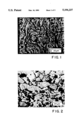
- FIG. 1 is a microphotograph showing a TiC composite coating obtained by plasma spraying according to the invention.
- FIG. 2 is a microphotograph showing prior art TiC composite coating obtained by plasma spraying.
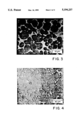
- FIG. 3 is a microphotograph illustrating a TiC-Fe composite obtained by arc melting according to the invention.
- FIG. 4 is a microphotograph illustrating a TiC-Ni composite obtained by arc melting according to the invention.
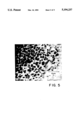
- FIG. 5 is a microphotograph showing a composite TiC powder obtained according to the invention.
- step 2 optionally milling mixtures obtained in step 1);
- agglomerating the mixtures using agglomeration techniques e.g. spray drying, mechanical agglomeration, crushing, granulating, pelletizing, cladding or coating; optionally sintering agglomerated particles;
- step 4 thermal spraying agglomerated particles from step 3) into water or another liquid.
- the composite powders and TiC powders obtained by the above steps contain smooth and well-rounded TiC crystals substantially below 10 ⁇ m in size. This constitutes a clear advantage over corresponding furnace-synthesized products (TiC and composites) which, beside the coarseness of TiC particles, are usually highly contaminated by unreacted products such as carbon and phases such as undesirable intermetallics. These drawbacks make it mandatory to first separate TiC of the prior art composite products and then mix the thus obtained TiC with metallic powders.
- TiC composite parts and TiC parts can be produced from the respective powders, using known powder metallurgy techniques e.g., pressing, forming, rolling, slip casting, injection moulding, sintering, infiltrating, hot isostatic pressing, forging, extruding, etc.
- TiC composite coatings can be obtained using hardfacing techniques such as plasma spraying, thermal spraying and plasma-transferred arc deposition.
- thermal spraying depositing agglomerated particles obtained through 1), 2) and 3) as in A onto a substrate. This operation is performed at a temperature sufficient to synthesize TiC. These agglomerated particles may also be deposited by various hardfacing techniques to obtain TiC composite coatings.
- the coatings obtained according to the invention contain a uniform distribution of very fine TiC crystals throughout metallic matrix.
- a ferrotitanium alloy is used as the titanium source.
- the ferrotitanium is a hypoeutectic Ti-Fe alloy in a powder form, known as Chemalloy Ti-Loy 70 "HP" (trademark) having a following composition (wt %):
- X-ray diffraction (XRD) analysis shows that a titanium solid solution phase and a FeTi intermetallic phase are the main constituents of this alloy.
- Lonza KS 2.5 (trademark) graphite powder is used as the carbon source.
- This crystalline substance comprises 99.9 wt % carbon.
- Iron powder, Quebec Metal Powder Atomet 95 (trademark), with particles less than 32 ⁇ m in size and containing 0.12 wt % carbon and 0.60 wt % oxygen was used.
- XRD analysis shows ⁇ -Fe peaks only.
- Ti-Loy was ball-milled in methanol to prevent oxidation, for several hours to a 15 ⁇ m powder and allowed to dry in room temperature air before dry mixing with iron and graphite.
- the samples were melted in an electric arc furnace under a flowing argon atmosphere at a pressure of 65 kPa.
- the current applied was in the range 110 to 130 A.
- Voltage varied with the arc length between the mobile tungsten--2% thorium cathode and the samples staying on the water-cooled copper base anode. (The approximate temperature of the arc was 3000° C.).
- the time of arc melting was in the order of from a few seconds (for 1 g samples) to 30 sec (for 2.5 g samples) which is equivalent to a heating rate of about 100° C./s.
- the product consists mostly of primary TiC near-round crystals 1 to 10 ⁇ m in size embedded in a matrix constituted of iron and of an iron-TiC pseudoeutectic phase.
- the powder was sieved to eliminate fines and sorted into two size fractions, -63+38 ⁇ m and -125+63 ⁇ m.
- the powder contained nominally 32.7 wt % ferrotitanium, 60.5 wt % Fe and 6.8 wt % Lonza graphite (atomic C/Ti ratio of 1.15); it was plasma sprayed onto low-carbon steel using the following process parameters:
- This plasma spray process can produce very thick TiC composite coatings.
- XRD analysis of coatings after they were removed from the substrates and ground showed that TiC was synthesized during the plasma spraying and that iron was the main constituent of the matrix.
- the coating is composed of alternate laminated layers whose average hardness are 1400 kg f /mm 2 (50 g) and 575 kg f /mm 2 (50 g) respectively.
- Hard layers are believed to contain unresolved titanium carbides in an iron-rich phase matrix, soft layers are thought to be mostly constituted of iron and of an iron-TiC pseudoeutectic phase.
- the coating is fairly dense and possesses a homogeneous microstructure throughout the thickness.
- FIG. 1 shows a typical microstructure of this sort of coating. It is not possible to distinguish the TiC crystals within the coating, so fine they are. Due to the rapid solidification involved in this process, the TiC crystals are submicronic.
- This plasma spray synthesized composite coating is thought to be particularly wear resistant due to its homogeneity and fine structure when compared to coatings obtained by means of spraying agglomerated mixtures of TiC powder and iron powder.
- the latter is less dense and less homogeneous, and the resulting TiC hard phases are coarser and their morphology is angular, as shown in FIG. 2.
- Example 2 To obtain a 60 vol. % TiC composite coating, 856 grams of ferrotitanium, 568 grams of iron and 177 grams of Lonza graphite were mixed as in Example 2. The materials were identical as in Example 1. Dow binder (41.0 g) and Carbowax plasticizer (8.2 g) were prepared, mixed and added to the mixture. The slurry was homogenized and spray-dried. The agglomerates containing nominally 53.5 wt % ferrotitanium, 35.6 wt % iron and 11.1 wt % Lonza graphite were sieved and sorted into two size fractions (-63+38 ⁇ m, -125+63 ⁇ m). These powders were then plasma sprayed using the same process parameters as described in Example 2.
- the resulting coatings contain also alternate laminated layers whose hardnesses are 1520 kgf/mm 2 (50 g) and 600 kg f /mm 2 (50 g) respectively.
- the synthesized composite contains rounded TiC crystals with size mostly in the range from 2 to 10 ⁇ m in an iron-rich matrix.
- a composite containing hard TiC phases was prepared by arc melting a mixture of 91.8 g of ball-milled ferrotitanium (as in Example 1) and 8.2 g of Fisher graphite. The atomic C/Ti ratio of the mixture was 0.50. The mixture was prepared according to the procedure as in Example 5.
- Arc melting of the mixture resulted in a composite comprising 60 vol. % rounded hard TiC phases whose sizes are mostly in the range from 5 to 10 ⁇ m, as shown in FIG. 3.
- The are bound by a matrix composed of an iron-rich solution and an intermetallic FeTi phase.
- a composite containing 50 vol. % TiC was prepared by a) cold-pressing to 18.2 kg f /mm 2 a mixture composed of 4.30 g of ferrotitanium, 4.92 g of iron powder and 0.77 g of Lonza graphite, and b) arc melting the green compact following the procedure described in Example 1.
- a composite containing 50 vol. % TiC was prepared by using titanium and iron as starting materials instead of ferrotitanium and iron.
- Example 7 and 8 comprised rounded hard TiC phases with sizes in the range from 2 to 20 ⁇ m, uniformly dispersed in an iron matrix.
- composite comprising 80 vol. % rounded hard TiC phases whose sizes range from 6 to 20 ⁇ m bound by a matrix composed of a nickel-rich solid solution and a pseudoeutectic Ni-TiC phase, as shown in FIG. 4.
- Sintered micropellets were injected into a plasma and the reacted product was collected in water.
- the plasma spraying equipment was operated with the following process parameters:
- the composite powders collected in water contain rounded hard TiC phases whose sizes range from 0.5 to 2 ⁇ m, bound by an iron-rich matrix. These very fine crystals compared to arc melted samples, result from the rapid solidification involved in this particular process.
Landscapes
- Chemical & Material Sciences (AREA)
- Engineering & Computer Science (AREA)
- Organic Chemistry (AREA)
- Materials Engineering (AREA)
- Mechanical Engineering (AREA)
- Metallurgy (AREA)
- Physics & Mathematics (AREA)
- Plasma & Fusion (AREA)
- Chemical Kinetics & Catalysis (AREA)
- Inorganic Chemistry (AREA)
- Coating By Spraying Or Casting (AREA)
- Carbon And Carbon Compounds (AREA)
Applications Claiming Priority (2)
| Application Number | Priority Date | Filing Date | Title |
|---|---|---|---|
| CA2015213 | 1990-04-23 | ||
| CA002015213A CA2015213C (fr) | 1990-04-23 | 1990-04-23 | Materiaux a base de titane et carbone et procede de fabrication connexe |
Publications (1)
| Publication Number | Publication Date |
|---|---|
| US5194237A true US5194237A (en) | 1993-03-16 |
Family
ID=4144810
Family Applications (1)
| Application Number | Title | Priority Date | Filing Date |
|---|---|---|---|
| US07/686,936 Expired - Fee Related US5194237A (en) | 1990-04-23 | 1991-05-20 | TiC based materials and process for producing same |
Country Status (2)
| Country | Link |
|---|---|
| US (1) | US5194237A (fr) |
| CA (1) | CA2015213C (fr) |
Cited By (24)
| Publication number | Priority date | Publication date | Assignee | Title |
|---|---|---|---|---|
| US5722306A (en) * | 1995-06-07 | 1998-03-03 | Alloy Technology International Inc. | Method for making a pelletizer knife and blank |
| WO1998042460A3 (fr) * | 1997-03-25 | 1998-10-29 | Komtek Inc | Systeme de mise en forme de metal |
| WO1999015705A1 (fr) * | 1997-09-19 | 1999-04-01 | Treibacher Schleifmittel Ag | Alliage dur a base de carbure de titane, son procede de production ainsi que son utilisation |
| EP1086927A3 (fr) * | 1999-09-22 | 2002-01-02 | Hartmetall Beteiligungs GmbH | Procédé de préparation de poudre sphéroidale de matériau dur |
| US20020034593A1 (en) * | 2000-07-26 | 2002-03-21 | Tilman Haug | Process for producing a surface layer |
| US20030012678A1 (en) * | 2001-07-16 | 2003-01-16 | Sherman Andrew J. | Powder friction forming |
| US20030145685A1 (en) * | 2000-02-22 | 2003-08-07 | Owers William Ronald | Process for producing titanium carbide, titanium nitride, or tungsten carbide hardened materials |
| CN1133584C (zh) * | 1999-11-05 | 2004-01-07 | 刘庆昌 | 超细碳化钛微粉气相合成工艺 |
| US20040038053A1 (en) * | 2000-12-20 | 2004-02-26 | Pertti Lintunen | Method for the manufacture of a metal matrix composite, and a metal matrix composite |
| US20050025655A1 (en) * | 2003-07-28 | 2005-02-03 | Kusanagi Ryota | Method for making a blade and blade manufactured thereby |
| US20050072545A1 (en) * | 2001-12-04 | 2005-04-07 | Claude Poncin | Cast parts with enhanced wear resistance |
| US20050089710A1 (en) * | 2003-10-27 | 2005-04-28 | Akira Hirai | Powder-sintered multi-layer tool part and manufacturing method thereof |
| US20070267390A1 (en) * | 2005-01-26 | 2007-11-22 | Caterpillar Inc. | Composite overlay compound |
| US20080283174A1 (en) * | 2007-03-30 | 2008-11-20 | Honeywell International Inc. | Bonding of carbon fibers to metal inserts for use in composites |
| US20090044409A1 (en) * | 2005-06-21 | 2009-02-19 | Gynz-Rekowski Gunther Hh Von | Bearing tools and process |
| US20090181188A1 (en) * | 2008-01-11 | 2009-07-16 | Tesa Ag | Process for preparing titanium carbide |
| DE102009029903A1 (de) * | 2009-06-19 | 2010-12-23 | Tesa Se | Verfahren zum Aufbringen einer dauerhaften Prozessmarke auf einem Produkt, insbesondere Glas |
| US20110131810A1 (en) * | 2005-06-21 | 2011-06-09 | Von Gynz-Rekowski Gunther Hh | Process for manufacturing a bearing |
| DE102009026655B3 (de) * | 2009-06-03 | 2011-06-30 | Linde Aktiengesellschaft, 80331 | Verfahren zur Herstellung eines Metallmatrix-Verbundwerkstoffs, Metallmatrix-Verbundwerkstoff und seine Verwendung |
| CN102373358A (zh) * | 2010-08-12 | 2012-03-14 | 李玉花 | 一种TiC弥散强化钼合金的制备方法 |
| US20210024357A1 (en) * | 2018-02-13 | 2021-01-28 | Mitsui Mining & Smelting Co., Ltd. | Sintered metal carbide and heat-resistant member for silicon carbide semiconductor manufacturing device comprising same |
| CN112743073A (zh) * | 2020-12-23 | 2021-05-04 | 长沙新材料产业研究院有限公司 | 一种增材制造用改性NiAl粉末材料及其制备方法 |
| RU2750784C1 (ru) * | 2020-12-05 | 2021-07-02 | Федеральное государственное бюджетное учреждение науки Институт физики прочности и материаловедения Сибирского отделения Российской академии наук (ИФПМ СО РАН) | Способ получения порошкового композиционного материала |
| CN117004941A (zh) * | 2022-04-28 | 2023-11-07 | 中南大学 | 一种应用于泥岩采掘刀具防护的钢结硬质合金球粒强化硬面涂层 |
Families Citing this family (2)
| Publication number | Priority date | Publication date | Assignee | Title |
|---|---|---|---|---|
| CN112575281A (zh) * | 2020-11-24 | 2021-03-30 | 中北大学 | 一种表面自润滑硬质合金的原位制备方法 |
| CN114657554A (zh) * | 2022-03-21 | 2022-06-24 | 山东建筑大学 | 一种模具修复用激光熔覆高熵合金涂层及其制备方法 |
Citations (3)
| Publication number | Priority date | Publication date | Assignee | Title |
|---|---|---|---|---|
| US3019084A (en) * | 1954-03-05 | 1962-01-30 | British Aluminum Company Ltd | Production of refractory carbides, borides and the like |
| US3106456A (en) * | 1960-04-07 | 1963-10-08 | Union Carbide Corp | Process for the production of reactive refractory metal carbides |
| US3161472A (en) * | 1958-02-25 | 1964-12-15 | Norton Co | Arc furnace process for the production of titanium carbide |
-
1990
- 1990-04-23 CA CA002015213A patent/CA2015213C/fr not_active Expired - Fee Related
-
1991
- 1991-05-20 US US07/686,936 patent/US5194237A/en not_active Expired - Fee Related
Patent Citations (3)
| Publication number | Priority date | Publication date | Assignee | Title |
|---|---|---|---|---|
| US3019084A (en) * | 1954-03-05 | 1962-01-30 | British Aluminum Company Ltd | Production of refractory carbides, borides and the like |
| US3161472A (en) * | 1958-02-25 | 1964-12-15 | Norton Co | Arc furnace process for the production of titanium carbide |
| US3106456A (en) * | 1960-04-07 | 1963-10-08 | Union Carbide Corp | Process for the production of reactive refractory metal carbides |
Cited By (39)
| Publication number | Priority date | Publication date | Assignee | Title |
|---|---|---|---|---|
| US5722306A (en) * | 1995-06-07 | 1998-03-03 | Alloy Technology International Inc. | Method for making a pelletizer knife and blank |
| WO1998042460A3 (fr) * | 1997-03-25 | 1998-10-29 | Komtek Inc | Systeme de mise en forme de metal |
| RU2196837C2 (ru) * | 1997-09-19 | 2003-01-20 | Трайбахер Шляйфмиттель Аг | Способ изготовления абразивного порошка |
| WO1999015705A1 (fr) * | 1997-09-19 | 1999-04-01 | Treibacher Schleifmittel Ag | Alliage dur a base de carbure de titane, son procede de production ainsi que son utilisation |
| EP1086927A3 (fr) * | 1999-09-22 | 2002-01-02 | Hartmetall Beteiligungs GmbH | Procédé de préparation de poudre sphéroidale de matériau dur |
| CN1133584C (zh) * | 1999-11-05 | 2004-01-07 | 刘庆昌 | 超细碳化钛微粉气相合成工艺 |
| US20030145685A1 (en) * | 2000-02-22 | 2003-08-07 | Owers William Ronald | Process for producing titanium carbide, titanium nitride, or tungsten carbide hardened materials |
| US20020034593A1 (en) * | 2000-07-26 | 2002-03-21 | Tilman Haug | Process for producing a surface layer |
| US6803078B2 (en) * | 2000-07-26 | 2004-10-12 | Daimlerchrysler Ag | Process for producing a surface layer |
| US20040038053A1 (en) * | 2000-12-20 | 2004-02-26 | Pertti Lintunen | Method for the manufacture of a metal matrix composite, and a metal matrix composite |
| US6818315B2 (en) * | 2000-12-20 | 2004-11-16 | Valtion Teknillinen Tutkimuskeskus | Method for the manufacture of a metal matrix composite, and a metal matrix composite |
| US20030012678A1 (en) * | 2001-07-16 | 2003-01-16 | Sherman Andrew J. | Powder friction forming |
| US7560067B2 (en) * | 2001-07-16 | 2009-07-14 | Sherman Andrew J | Powder friction forming |
| US7513295B2 (en) | 2001-12-04 | 2009-04-07 | Magotteaux International Sa | Cast parts with enhanced wear resistance |
| US7935431B2 (en) * | 2001-12-04 | 2011-05-03 | Magotteaux International Sa | Cast parts with enhanced wear resistance |
| US20050072545A1 (en) * | 2001-12-04 | 2005-04-07 | Claude Poncin | Cast parts with enhanced wear resistance |
| US20050025655A1 (en) * | 2003-07-28 | 2005-02-03 | Kusanagi Ryota | Method for making a blade and blade manufactured thereby |
| US20050089710A1 (en) * | 2003-10-27 | 2005-04-28 | Akira Hirai | Powder-sintered multi-layer tool part and manufacturing method thereof |
| US20070267390A1 (en) * | 2005-01-26 | 2007-11-22 | Caterpillar Inc. | Composite overlay compound |
| US7776451B2 (en) * | 2005-01-26 | 2010-08-17 | Caterpillar Inc | Composite overlay compound |
| US20090044409A1 (en) * | 2005-06-21 | 2009-02-19 | Gynz-Rekowski Gunther Hh Von | Bearing tools and process |
| US9803689B2 (en) * | 2005-06-21 | 2017-10-31 | United Machine Works, Inc. | Bearing tools and process |
| US20110131810A1 (en) * | 2005-06-21 | 2011-06-09 | Von Gynz-Rekowski Gunther Hh | Process for manufacturing a bearing |
| US20080283174A1 (en) * | 2007-03-30 | 2008-11-20 | Honeywell International Inc. | Bonding of carbon fibers to metal inserts for use in composites |
| US7588179B2 (en) * | 2007-03-30 | 2009-09-15 | Honeywell International Inc. | Bonding of carbon fibers to metal inserts for use in composites |
| US20090181188A1 (en) * | 2008-01-11 | 2009-07-16 | Tesa Ag | Process for preparing titanium carbide |
| US8821991B2 (en) * | 2008-01-11 | 2014-09-02 | Tesa Se | Process for preparing titanium carbide |
| EP2093185A1 (fr) * | 2008-01-11 | 2009-08-26 | tesa SE | Procédé de fabrication de carbure de titane |
| DE102009026655B3 (de) * | 2009-06-03 | 2011-06-30 | Linde Aktiengesellschaft, 80331 | Verfahren zur Herstellung eines Metallmatrix-Verbundwerkstoffs, Metallmatrix-Verbundwerkstoff und seine Verwendung |
| DE102009029903A1 (de) * | 2009-06-19 | 2010-12-23 | Tesa Se | Verfahren zum Aufbringen einer dauerhaften Prozessmarke auf einem Produkt, insbesondere Glas |
| US20110081551A1 (en) * | 2009-06-19 | 2011-04-07 | Tesa Se | Method of applying a durable process mark to a product, more particularly glass |
| US8308890B2 (en) | 2009-06-19 | 2012-11-13 | Tesa Se | Method of applying a durable process mark to a product, more particularly glass |
| CN102373358A (zh) * | 2010-08-12 | 2012-03-14 | 李玉花 | 一种TiC弥散强化钼合金的制备方法 |
| CN102373358B (zh) * | 2010-08-12 | 2013-09-04 | 苏州艾默特材料技术有限公司 | 一种TiC弥散强化钼合金的制备方法 |
| US20210024357A1 (en) * | 2018-02-13 | 2021-01-28 | Mitsui Mining & Smelting Co., Ltd. | Sintered metal carbide and heat-resistant member for silicon carbide semiconductor manufacturing device comprising same |
| US12024435B2 (en) * | 2018-02-13 | 2024-07-02 | Mitsui Mining & Smelting Co., Ltd. | Sintered metal carbide and heat-resistant member for silicon carbide semiconductor manufacturing device comprising same |
| RU2750784C1 (ru) * | 2020-12-05 | 2021-07-02 | Федеральное государственное бюджетное учреждение науки Институт физики прочности и материаловедения Сибирского отделения Российской академии наук (ИФПМ СО РАН) | Способ получения порошкового композиционного материала |
| CN112743073A (zh) * | 2020-12-23 | 2021-05-04 | 长沙新材料产业研究院有限公司 | 一种增材制造用改性NiAl粉末材料及其制备方法 |
| CN117004941A (zh) * | 2022-04-28 | 2023-11-07 | 中南大学 | 一种应用于泥岩采掘刀具防护的钢结硬质合金球粒强化硬面涂层 |
Also Published As
| Publication number | Publication date |
|---|---|
| CA2015213C (fr) | 1998-04-14 |
| CA2015213A1 (fr) | 1991-10-23 |
Similar Documents
| Publication | Publication Date | Title |
|---|---|---|
| CA2015213C (fr) | Materiaux a base de titane et carbone et procede de fabrication connexe | |
| US4673550A (en) | TiB2 -based materials and process of producing the same | |
| JP4969008B2 (ja) | 粉末混合物と複合粉末、その製造方法、及び複合材料におけるその使用 | |
| IL173056A (en) | Method for the production of fine metal powder, alloy powder and composite powder | |
| JP5703272B2 (ja) | 耐摩耗性材料 | |
| US4013460A (en) | Process for preparing cemented tungsten carbide | |
| US4508788A (en) | Plasma spray powder | |
| CN103834824B (zh) | 一种无粘结相碳化钨硬质合金及其制备方法 | |
| Reddy | Processing of nanoscale materials | |
| CA1309882C (fr) | Materiau en poudre pour alliages durs a grains fins et procede de preparation correspondant | |
| MXPA03005137A (es) | Agente refinador de granos para productos de magnesio o aluminio fundido. | |
| US4055742A (en) | Hard facing rod | |
| US4650722A (en) | Hard faced article | |
| EP0480636A2 (fr) | Matériaux résistants à l'usure et à dureté élevée | |
| GB2074609A (en) | Metal binder in compaction of metal powders | |
| Dallaire et al. | The influence of composition and process parameters on the microstructure of TiC-Fe multiphase and multilayer coatings | |
| CA2400632A1 (fr) | Procede de production de materiaux durcis de carbure de titane, de nitrure de titane, ou de carbure de tungstene | |
| Kennedy et al. | Microstructure and dispersion of Cu-TiC X master alloys into molten Cu and the relation to contact angle data | |
| Horlock et al. | High-velocity oxyfuel reactive spraying of mechanically alloyed Ni-Ti-C powders | |
| US4443255A (en) | Hard facing of metal substrates | |
| CA1253717A (fr) | Materiaux composites a tib.sub.2, et leur production | |
| JPH08109403A (ja) | サーメットの製造方法 | |
| JP2877999B2 (ja) | TiAl基複合金属間化合物の製造方法 | |
| Chrysanthou | New technologies for the reactive processing of metal-matrix composites | |
| Chrysanthou et al. | Carbothermic reduction of a columbite concentrate to produce cemented carbides and metal-matrix composites |
Legal Events
| Date | Code | Title | Description |
|---|---|---|---|
| AS | Assignment |
Owner name: NATIONAL RESEARCH COUNCIL OF CANADA, CANADA Free format text: ASSIGNMENT OF ASSIGNORS INTEREST.;ASSIGNORS:CLICHE, GILLES;DALLAIRE, SERGE;REEL/FRAME:005959/0776 Effective date: 19910807 |
|
| FPAY | Fee payment |
Year of fee payment: 4 |
|
| REMI | Maintenance fee reminder mailed | ||
| LAPS | Lapse for failure to pay maintenance fees | ||
| FP | Lapsed due to failure to pay maintenance fee |
Effective date: 20010316 |
|
| STCH | Information on status: patent discontinuation |
Free format text: PATENT EXPIRED DUE TO NONPAYMENT OF MAINTENANCE FEES UNDER 37 CFR 1.362 |