US5205751A - Electrically-conductive elastomeric connector - Google Patents
Electrically-conductive elastomeric connector Download PDFInfo
- Publication number
- US5205751A US5205751A US07/839,160 US83916092A US5205751A US 5205751 A US5205751 A US 5205751A US 83916092 A US83916092 A US 83916092A US 5205751 A US5205751 A US 5205751A
- Authority
- US
- United States
- Prior art keywords
- tubular
- shaped body
- electrically
- substrate
- claw arms
- Prior art date
- Legal status (The legal status is an assumption and is not a legal conclusion. Google has not performed a legal analysis and makes no representation as to the accuracy of the status listed.)
- Expired - Fee Related
Links
- 210000000078 claw Anatomy 0.000 claims abstract description 85
- 239000000758 substrate Substances 0.000 claims abstract description 78
- 230000005489 elastic deformation Effects 0.000 claims description 15
- 239000004020 conductor Substances 0.000 claims description 11
- 230000007423 decrease Effects 0.000 claims 1
- 238000004891 communication Methods 0.000 description 15
- 239000000463 material Substances 0.000 description 8
- 238000013519 translation Methods 0.000 description 8
- 239000013536 elastomeric material Substances 0.000 description 5
- 238000000926 separation method Methods 0.000 description 5
- 238000013461 design Methods 0.000 description 4
- 230000001413 cellular effect Effects 0.000 description 3
- 229910052751 metal Inorganic materials 0.000 description 3
- 239000002184 metal Substances 0.000 description 3
- 230000009467 reduction Effects 0.000 description 3
- 239000012815 thermoplastic material Substances 0.000 description 3
- 239000006227 byproduct Substances 0.000 description 2
- 239000011248 coating agent Substances 0.000 description 2
- 238000000576 coating method Methods 0.000 description 2
- 238000001125 extrusion Methods 0.000 description 2
- 238000000034 method Methods 0.000 description 2
- 238000005549 size reduction Methods 0.000 description 2
- BQCADISMDOOEFD-UHFFFAOYSA-N Silver Chemical compound [Ag] BQCADISMDOOEFD-UHFFFAOYSA-N 0.000 description 1
- 238000007792 addition Methods 0.000 description 1
- 238000013459 approach Methods 0.000 description 1
- 230000015572 biosynthetic process Effects 0.000 description 1
- 230000001419 dependent effect Effects 0.000 description 1
- 230000000694 effects Effects 0.000 description 1
- 238000002955 isolation Methods 0.000 description 1
- 238000012986 modification Methods 0.000 description 1
- 230000004048 modification Effects 0.000 description 1
- 230000002093 peripheral effect Effects 0.000 description 1
- 229920001296 polysiloxane Polymers 0.000 description 1
- 229910052709 silver Inorganic materials 0.000 description 1
- 239000004332 silver Substances 0.000 description 1
Images


Classifications
-
- H—ELECTRICITY
- H01—ELECTRIC ELEMENTS
- H01R—ELECTRICALLY-CONDUCTIVE CONNECTIONS; STRUCTURAL ASSOCIATIONS OF A PLURALITY OF MUTUALLY-INSULATED ELECTRICAL CONNECTING ELEMENTS; COUPLING DEVICES; CURRENT COLLECTORS
- H01R13/00—Details of coupling devices of the kinds covered by groups H01R12/70 or H01R24/00 - H01R33/00
- H01R13/02—Contact members
- H01R13/22—Contacts for co-operating by abutting
- H01R13/24—Contacts for co-operating by abutting resilient; resiliently-mounted
- H01R13/2407—Contacts for co-operating by abutting resilient; resiliently-mounted characterized by the resilient means
- H01R13/2414—Contacts for co-operating by abutting resilient; resiliently-mounted characterized by the resilient means conductive elastomers
-
- H—ELECTRICITY
- H01—ELECTRIC ELEMENTS
- H01Q—ANTENNAS, i.e. RADIO AERIALS
- H01Q1/00—Details of, or arrangements associated with, antennas
- H01Q1/12—Supports; Mounting means
- H01Q1/22—Supports; Mounting means by structural association with other equipment or articles
- H01Q1/24—Supports; Mounting means by structural association with other equipment or articles with receiving set
- H01Q1/241—Supports; Mounting means by structural association with other equipment or articles with receiving set used in mobile communications, e.g. GSM
- H01Q1/242—Supports; Mounting means by structural association with other equipment or articles with receiving set used in mobile communications, e.g. GSM specially adapted for hand-held use
-
- H—ELECTRICITY
- H01—ELECTRIC ELEMENTS
- H01Q—ANTENNAS, i.e. RADIO AERIALS
- H01Q1/00—Details of, or arrangements associated with, antennas
- H01Q1/52—Means for reducing coupling between antennas; Means for reducing coupling between an antenna and another structure
- H01Q1/526—Electromagnetic shields
-
- H—ELECTRICITY
- H01—ELECTRIC ELEMENTS
- H01R—ELECTRICALLY-CONDUCTIVE CONNECTIONS; STRUCTURAL ASSOCIATIONS OF A PLURALITY OF MUTUALLY-INSULATED ELECTRICAL CONNECTING ELEMENTS; COUPLING DEVICES; CURRENT COLLECTORS
- H01R12/00—Structural associations of a plurality of mutually-insulated electrical connecting elements, specially adapted for printed circuits, e.g. printed circuit boards [PCB], flat or ribbon cables, or like generally planar structures, e.g. terminal strips, terminal blocks; Coupling devices specially adapted for printed circuits, flat or ribbon cables, or like generally planar structures; Terminals specially adapted for contact with, or insertion into, printed circuits, flat or ribbon cables, or like generally planar structures
- H01R12/70—Coupling devices
- H01R12/71—Coupling devices for rigid printing circuits or like structures
- H01R12/72—Coupling devices for rigid printing circuits or like structures coupling with the edge of the rigid printed circuits or like structures
- H01R12/721—Coupling devices for rigid printing circuits or like structures coupling with the edge of the rigid printed circuits or like structures cooperating directly with the edge of the rigid printed circuits
-
- H—ELECTRICITY
- H01—ELECTRIC ELEMENTS
- H01R—ELECTRICALLY-CONDUCTIVE CONNECTIONS; STRUCTURAL ASSOCIATIONS OF A PLURALITY OF MUTUALLY-INSULATED ELECTRICAL CONNECTING ELEMENTS; COUPLING DEVICES; CURRENT COLLECTORS
- H01R13/00—Details of coupling devices of the kinds covered by groups H01R12/70 or H01R24/00 - H01R33/00
- H01R13/02—Contact members
- H01R13/03—Contact members characterised by the material, e.g. plating, or coating materials
- H01R13/035—Plated dielectric material
-
- H—ELECTRICITY
- H04—ELECTRIC COMMUNICATION TECHNIQUE
- H04B—TRANSMISSION
- H04B15/00—Suppression or limitation of noise or interference
- H04B15/02—Reducing interference from electric apparatus by means located at or near the interfering apparatus
-
- H—ELECTRICITY
- H05—ELECTRIC TECHNIQUES NOT OTHERWISE PROVIDED FOR
- H05K—PRINTED CIRCUITS; CASINGS OR CONSTRUCTIONAL DETAILS OF ELECTRIC APPARATUS; MANUFACTURE OF ASSEMBLAGES OF ELECTRICAL COMPONENTS
- H05K9/00—Screening of apparatus or components against electric or magnetic fields
- H05K9/0007—Casings
- H05K9/0015—Gaskets or seals
-
- H—ELECTRICITY
- H01—ELECTRIC ELEMENTS
- H01R—ELECTRICALLY-CONDUCTIVE CONNECTIONS; STRUCTURAL ASSOCIATIONS OF A PLURALITY OF MUTUALLY-INSULATED ELECTRICAL CONNECTING ELEMENTS; COUPLING DEVICES; CURRENT COLLECTORS
- H01R2201/00—Connectors or connections adapted for particular applications
- H01R2201/16—Connectors or connections adapted for particular applications for telephony
Definitions
- the present invention relates generally to electrical connectors for connecting two surfaces, and, more particularly, to a flexible, electrically-conductive, elastomeric connector suitable for electrically connecting two substrates theretogether.
- a large number of electronic devices contain circuitry which generate high-frequency signals.
- the circuitry of the vast majority of radio communication apparatus generate high frequency signals during operation thereof. (Such high frequency signals are typically generated by one or more high-frequency oscillators which form portions of the electronic circuitry of such apparatus.)
- a radio transceiver such as a radiotelephone utilized in a cellular, communication system, is one example of radio communication apparatus.
- spurious, high-frequency, electromagnetic signals are also generated.
- spurious signals While a byproduct of normal operation of the radio communication apparatus, are undesirable as such spurious signals can interfere with signals transmitted by other radio communication apparatus.
- electromagnetic shielding material is oftentimes positioned to cover the electronic circuitry of such apparatus whereat the spurious electromagnetic signals may be generated.
- housing structures of most radio communication apparatus are typically comprised of a thermoplastic material, by coating inner surfaces of such housing structures with an electrically-conductive, electromagnetic shielding material, the housing structures may be conveniently adapted to form electromagnetic shields which prevent emanation of the spurious electromagnetic signals generated by electronic circuitry housed within such housing structures.
- the electrically-conductive material coated on the inner surfaces of such housings must be electrically connected to the electrical circuits which generate the spurious, electromagnetic signals to block the emanation of the spurious, electromagnetic signals.
- an electrical connection is made with a ground plane of the electronic circuitry.
- such structure has typically been comprised of a braid of metallic, or a conductive-rubber, material (such as an elastomeric material impregnated with a metal).
- a braid or conductive-rubber material such as an elastomeric material impregnated with a metal.
- rib members or flanges must typically be formed on the inner surfaces of the housing, and channels must be formed in the rib members or flanges to seat the braid therein.
- the thickness of such ribbed member or flange must be at least as great as both the width of such channel and also opposing sidewalls which define the channel.
- a radio transceiver such as the radiotelephone utilized in a cellular, communication system, is one example of radio communication apparatus having electronic circuitry of designs which have been miniaturized.
- the housings of such electronic devices are typically comprised of a thermoplastic material.
- the walls of such housings comprised of such thermoplastic material must be greater than minimal thicknesses to ensure the structural integrity of such housings.
- Other associated mechanical structure suffer from similar limitations. In some instances, such mechanical structure cannot be produced in commercial quantities when smaller than minimum dimensions.
- braids conventionally used to connect electrically the housing and electrical circuits disposed upon circuit boards housed therewithin are seated within channels formed in rib members or flanges of the housing. Due to the increased miniaturization of the physical dimensions of the housings of radio communication apparatus, the minimum thickness of a ribbed member or flange required to permit formation of a channel permitting seating of the braid increasingly becomes a design constraint limiting reduction in the physical dimensions of the housings of the radio communication apparatus.
- the present invention accordingly, advantageously provides an electrically-conductive, elastomeric connector of improved design.
- the present invention further advantageously provides an electrically-conductive, elastomeric connector for electrically connecting two surfaces.
- an electrically-conductive, elastomeric connector electrically connects an electrically-conductive portion of a first substrate with an electrically-conductive portion of a second substrate.
- the elastomeric connector comprises a tubular-shaped body elongated along a longitudinal axis thereof.
- the tubular-shaped body is capable of elastic deformation responsive to compressive forces exerted thereagainst by the first substrate when the electrically-conductive portion of the first substrate is positioned against a first side of the tubular-shaped body, thereby to connect electrically the electrically-conductive portion of the first substrate and the tubular-shaped body along the first side surface thereof.
- the tubular-shaped body is affixed in releasable engagement beyond a second side surface of the tubular-shaped body at an edge surface of the second substrate, such that, when positioned in the releasable engagement at the edge surface of the substrate, a surface of the elastomeric connector abuts against the electrically-conductive portion of the second substrate to connect electrically the electrically-conductive portion of the second substrate thereto.
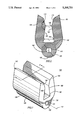
- FIG. 1 is an isometric view, in isolation, of the electrically-conductive, elastomeric connector of the preferred embodiment of the present invention
- FIG. 2 is a cross-sectional view taken along line 2--2 of the elastomeric connector of FIG. 1;
- FIG. 3 is an exploded, sectional view of the elastomeric connector of the preceding Figures positioned between two surfaces which are positioned in a first arrangement;
- FIG. 4 is a sectional view, similar with that of FIG. 3, but illustrating the elastomeric connector positioned to connect electrically the two surfaces shown in the exploded view of FIG. 3;
- FIG. 5 is an exploded, sectional view of the elastomeric connector of the preferred embodiment, similar with that of the sectional view of FIG. 3, but positioned between two surfaces which are positioned in a second arrangement;
- FIG. 6 is a sectional view, similar with that of FIG. 5, but illustrating the elastomeric connector positioned to connect electrically the two surfaces shown in the exploded view of FIG. 5;
- FIG. 7 is an exploded, isometric view of the elastomeric connector of the preferred embodiment of the present invention positioned between an electrical circuit board and a housing having an electrically-conductive material coated upon an inner surface thereof;
- FIG. 8 is another exploded, is isometric illustration of the elastomeric connector of the preferred embodiment of the present invention positioned between an electrical circuit board and a housing having an electrically-conductive material coated upon an inner surface thereof;
- FIG. 9 is an isometric view, similar with that of FIG. 8, but illustrating the elastomeric connector of the preferred embodiment of the present invention positioned to connect electrically the housing assembly and the electrical circuit board;
- FIG. 10 is a plan view of several elastomeric connectors of the preferred embodiment of the present invention affixed to flanges formed upon an electrically-conductive substrate;
- FIG. 11 is an isometric view of a radio transceiver which may employ the elastomeric connector of the preferred embodiment of the present invention.
- FIG. 12 is a sectional view taken along line 12--12 of FIG. 11 illustrating a circuit board housed within the housing of the radio transceiver and which is electrically connected to an inner surface of the housing by way of elastomeric connectors of the preferred embodiment of the present invention.
- Elastomeric connector 100 is comprised of an elastomeric material impregnated with a metal to be electrically conductive thereby.
- connector 100 is comprised of a silicone material impregnated with a silver-containing metal. Such a material is commercially available, and is of a relatively high conductivity. (although the conductivity of the elastomeric connector is dependent upon the cross-sectional area thereof, in the preferred embodiment, elastomeric connector 100 is of a resistance of approximately 1,400 milliohms per inch).
- connector 100 is enlarged in scale.
- connector 100 is of a height of approximately 2.5 mil, and is of a width of approximately 1.5 mil.
- the length may be selected to be of any desired length.
- Elastomeric connector 100 is comprised of a tubular-shaped body portion 106 which is elongated along a longitudinal axis, here indicated by line 112 extending longitudinally through tubular-shaped body portion 106.
- a longitudinally-extending aperture is formed to extend through body portion 106 of the connector.
- Such aperture is defined by inner sidewalls 118 which extend along body portion 106.
- the aperture defined thereby forms opening 124 formed upon front face surface 130 of connector 100.
- the aperture defined by inner sidewalls 118 extends through the entire length of body portion 106.
- Inner sidewalls 118 defining the aperture which extends through body portion 106 preferably defines an aperture of a circular, cross-section.
- First side surface 136 of body portion 106 forms a seating surface permitting seating of connector 100 upon a substrate (the substrate is not shown in the isolational view of FIG. 1).
- first and second claw arms 148 and 154 are formed integral with body portion 106 and extending beyond second side surface 142 of the body portion in directions generally transverse to the longitudinal axis of body portion 106.
- Claw arms 148 and 154 are coupled at proximal ends thereof with body portion 106 and are permitted limited flexional movement thereabout due to the flexible nature of the elastomeric material of which the claw arms are comprised.
- Inwardly-inclined inner surface 160 is defined upon an inner surface of first claw arm 148.
- inwardly-inclined inner surface 166 is defined upon an inner surface of second second claw arm 154. Distal, end portions 172 and 178 of surfaces 160 and 166 form “lead ins" which are beveled.
- FIG. 2 a cross-sectional view of elastomeric connector 100, taken along line 2--2 of FIG. 1, is shown.
- Connector 100 is again shown to be formed of body portion 106 having a central aperture defined by inner sidewalls 118, and first side surface 136 formed at a first outer side surface of the body portion. Protruding beyond second side surface 142 of body portion 106 are first and second claw arms 148 and 154, respectively. Inwardly-inclined inner surfaces 160 and 166 are defined upon inner surfaces of the first and second claw arms 148 and 154, and end portions 172 and 178 of surfaces 160 and 166, respectively, form beveled lead-ins.
- the diameter of the aperture defined by sidewalls 118 is of a length indicated by line segment 180.
- Arrow 184 extending between surfaces 160 and 166 of claw arms 148 and 154 at proximal portions of the respective claw arms close to their respective connections to second side surface 142 of body portion 106 is of a first length, here designated by length L 1 .
- Arrow 190 extending between surfaces 160 and 166 of claw arms 148 and 154, respectively, near distal ends of the respective claw arms is of a second length, here designated by length L 2 . Because of the inwardly-inclined nature of surfaces 160 and 166, the separation distance separating surfaces 160 and 166 at proximal portions thereof (designated in the figure by length L 1 ) is greater than the separation distance separating surfaces 160 and 166 near distal ends thereof (designated in the figure by length L 2 ).
- connector 300 Similar to elastomeric connector 100 of FIGS. 1-2, connector 300 comprises a longitudinally-extending body portion 306 having a central aperture defined by inner sidewalls 318. First side surface 336 of body portion 306 forms a seating surface, and first and second claw arms 348 and 354, respectively, extend beyond second side surface 342 of body portion 306. Again, inner surfaces of claw arms 348 and 354, here designated by reference numerals 360 and 366, respectively, form inwardly-inclined surfaces.
- First substrate 392 here a rib member formed to protrude beyond surface 394 of housing 396 is positioned beneath first side surface 336 of body portion 306.
- Second substrate 398 here an electrical circuit board, having an electrically-conductive edge surface 399, is positioned above connector 306.
- the thickness of second substrate 398 i.e., the distance separating top and bottom surfaces of the substrate
- the thickness of second substrate 398 is slightly less than the distance separating inner surfaces 360 and 366 of claw members 348 and 354 at proximal ends of the claw arms.
- separation distance L 1 separating inner surfaces of the claw arms near proximal portions thereof is greater than the thickness of substrate 398.
- the separation distance separating inner surfaces 360 and 366 near distal ends thereof is less than the thickness of substrate 398. (Such separation distance is indicated in the sectional view of connector 100 of FIG. 2 by length L 2 .)
- edge surfaces of the opposing side surfaces of substrate 398 which abut against a corresponding one of the inner surfaces 360 and 366 of connector 300 is electrically-conductive (such as when a circuit path of an electrical circuit is formed at one of the edge surfaces of the substrate), an electrical connection is also formed between such electrically-conductive side surface or surfaces of the substrate and the connector.
- FIG. 4 illustrates the relationship between connector 300 and substrates 392 and 398 when connector 300 is positioned to connect electrically substrates 392 and 398 theretogether.
- connector 500 the elastomeric connector, here designated by reference numeral 500, of the preferred embodiment of the present invention, is positioned in an alternate arrangement. Similar to connectors 100 and 300 of the preceding figures, connector 500 is comprised of a tubular-shaped body portion, here designated by reference numeral 506, and inner sidewalls 518 defining a central aperture extending therethrough.
- First side surface 536 forms a seating surface, and, extending from second side surface 542 are first and second claw arms 548 and 554 which have inwardly-inclined inner surfaces 560 and 566.
- FIG. 5 differs with that of FIGS. 3-4 in that substrate 592 (which corresponds to substrate 392 of FIGS. 3-4), here again a rib member formed upon an inner surface of a housing, is positioned above claw arms 548 and 554. Again, the inner surface of the housing is coated with an electrically-conductive material. And, substrate 598 (which corresponds with substrate 398 of FIGS. 3-4) is positioned beneath first side surface 536 of body portion 506.
- connector 500 in the direction indicated by arrow 606 causes flexional movement of claw arms 548 and 554 in the directions indicated by arrows 612 and 618, respectively, to position the inner surfaces of the claw arms about an edge portion of substrate 592.
- Electrical connection is formed between connector 500 and substrate 592 as a result of abutting engagement between second side surface 542 and substrate 592 as well as physical engagement of surfaces 560 and 566 with substrate 592.
- Such flexional movement causes compressive forces to be exerted against the edge portion of substrate 592 by claw arms 548 and 554 to affix in position connector 500 thereagainst.
- FIG. 6 is a sectional view, similar with that of FIG. 5, but illustrating the relationship between connector 500 and substrates 592 and 598 to connect electrically the substrates theretogether.
- the compressive forces exerted against connector 500 causes elastic deformation of tubular body 506 of the connector to cause opposing inner sidewalls positioned transverse to the direction of the compressive forces to approach one another. Exertion of compressive forces of increased levels causes the opposing sidewalls 518 of tubular body 506 to abut against one another.
- FIG. 7 is an exploded, isometric view of the elastomeric connector, here designated by reference numeral 700, of the preferred embodiment of the present invention in an arrangement analogous to the arrangement shown in the sectional view of FIG. 3.
- connector 700 is comprised of tubular-shaped body portion 706, having inner sidewalls 718 defining a central aperture extending through body portion 706, first side portion 736, second side surface 742, and first and second claw arms 748 and 754.
- Inner surfaces of claw arms 748 and 754 define inwardly-inclined inner surfaces 760 and 766, respectively.
- Rib member 792 (upon which an electrically-conductive material is coated) formed to protrude beyond an inner surface of housing 796 is positioned beneath first side surface 736 of body portion 706 of connector 700.
- An electrically-conductive, edge portion 797 of circuit board 798 is positioned above claw arms 748 and 754. Edge portion 797 forms a portion of an electrical circuit disposed upon circuit board 798.
- Claw arms 748 and 754 may be positioned about the edge portion of circuit board 798 to affix connector 700 thereto, such that second side surface 742 abuts against edge surface 797 of circuit board 798 to connect electrically connector 700 with circuit board 798.
- Ribbed member 792 may be positioned in abutting engagement with first side surface 736 of body portion 706 of connector 700 to exert compressive forces thereagainst, and to connect electrically rib member 792 and electrical connector 700. Hence, ribbed member 792 may be electrically connected to circuit path 802 of an electrical circuit disposed upon circuit board 798 by way of connector 700.
- FIG. 8 is another exploded, isometric view of elastomeric connector 700 of FIG. 7 positioned such that first side portion 736 thereof positioned between rib member 792 of housing 796 and circuit board 798.
- Translation of connector 700 positions the connector in abutting engagement with the rib member such that compressive forces are exerted by rib member 792 against side surface 736 to maintain connector 700 in electrical connection with rib member 792.
- Electrical circuit 798 is again illustrated above claw arms 748 and 754. (It is noted that housing 796 of FIGS. 7 and 8 differ only that a top-half of a housing is shown in the isometric view of FIG. 7, and a bottom-half of a housing is shown in the isometric view of FIG. 8.)
- circuit paths disposed upon circuit boards 798 may be electrically connected to the electrically-conductive material coating the inner surfaces of housing 796.
- FIG. 10 several elastomeric connectors, here designated by reference numerals 1000, 1012, 1018, and 1024 are shown in affixed engagement to flange portions 1030 formed about a peripheral portion of, and between opposing sides of, electrical shields 1040.
- Electrical shields may, for instance, be of dimensions suitable for positioning thereof upon an electrical circuit board having one or more electrical circuits disposed thereupon.
- the elastomeric connector of the preferred embodiment of the present invention is formed by an extrusion process
- the elastomeric connector may be of any desired length.
- connector 1000 is of a length several times greater that the lengths of connectors 1018 and 1024.
- the elastomeric connector of the preferred embodiment of the present invention is formed of such a flexible, elastomeric material, such an elastomeric connector may be positioned to be affixed upon a non-linear flange.
- Connector 1012 illustrates an elastomeric connector positioned to be affixed upon such a non-linear flange.
- shield 1040 having the elastomeric connectors 1000, 1012, 1018, and 1024 affixed to flange portions 1030 thereof is lowered into abutting engagement upon an electrical circuit board, abutting engagement of side surfaces of the respective connectors 1000-1024 permits an electrical connection to be created between shield 1040 and the circuit path of the electrical circuit board.
- a portable radio transceiver here a cellular telephone, referred to generally by reference numeral 1100.
- the connector of the preferred embodiment of the present invention, and illustrated in any of the preceding figures, may be advantageously utilized as a component portion of radio transceiver 1100.
- FIG. 12 illustrates a sectional view taken along lines 12--12 of FIG. 11. This sectional view illustrates the positioning of the elastomeric connectors of the preferred embodiment of the present invention, and here designated by reference numerals 1110 and 1120 positioned to electrically connect circuit paths of electrical circuit 1130 disposed upon electrical circuit board 1140 housed within housing 1150 of the radio transceiver. Rib members 1160 and 1170 formed to protrude beyond inner surfaces of housing 1150 abut against side surfaces of connectors 1110 and 1120 to permit electrical connection between the circuit paths of the electrical circuit 1130 and an electrically-conductive material coated upon the inner surfaces of housing 1150.
- the elastomeric connector of the preferred embodiment of the present invention does not require a channel to be formed within the rib members or flange portions formed to protrude beyond the inner surfaces of housing 1150, the dimensions of such ribbed members may be further reduced, further facilitating miniaturization of the housing of such radio transceiver.
Landscapes
- Engineering & Computer Science (AREA)
- Computer Networks & Wireless Communication (AREA)
- Physics & Mathematics (AREA)
- Electromagnetism (AREA)
- Microelectronics & Electronic Packaging (AREA)
- Signal Processing (AREA)
- Coupling Device And Connection With Printed Circuit (AREA)
- Multi-Conductor Connections (AREA)
- Prostheses (AREA)
Priority Applications (7)
| Application Number | Priority Date | Filing Date | Title |
|---|---|---|---|
| US07/839,160 US5205751A (en) | 1992-02-21 | 1992-02-21 | Electrically-conductive elastomeric connector |
| JP5514849A JP2549983B2 (ja) | 1992-02-21 | 1993-01-25 | 導電エラストマー製コネクタ |
| CA002107772A CA2107772C (en) | 1992-02-21 | 1993-01-25 | Electrically conductive elastomeric connector |
| KR1019930703100A KR970005577B1 (ko) | 1992-02-21 | 1993-01-25 | 도전성 탄성커넥터 |
| GB9320106A GB2270213B (en) | 1992-02-21 | 1993-01-25 | Electrically-conductive elastomeric connector |
| SK1152-93A SK115293A3 (en) | 1992-02-21 | 1993-01-25 | Electrically conductive elastomeric connector |
| PCT/US1993/000637 WO1993017537A1 (en) | 1992-02-21 | 1993-01-25 | Electrically-conductive elastomeric connector |
Applications Claiming Priority (1)
| Application Number | Priority Date | Filing Date | Title |
|---|---|---|---|
| US07/839,160 US5205751A (en) | 1992-02-21 | 1992-02-21 | Electrically-conductive elastomeric connector |
Publications (1)
| Publication Number | Publication Date |
|---|---|
| US5205751A true US5205751A (en) | 1993-04-27 |
Family
ID=25279005
Family Applications (1)
| Application Number | Title | Priority Date | Filing Date |
|---|---|---|---|
| US07/839,160 Expired - Fee Related US5205751A (en) | 1992-02-21 | 1992-02-21 | Electrically-conductive elastomeric connector |
Country Status (7)
| Country | Link |
|---|---|
| US (1) | US5205751A (ja) |
| JP (1) | JP2549983B2 (ja) |
| KR (1) | KR970005577B1 (ja) |
| CA (1) | CA2107772C (ja) |
| GB (1) | GB2270213B (ja) |
| SK (1) | SK115293A3 (ja) |
| WO (1) | WO1993017537A1 (ja) |
Cited By (22)
| Publication number | Priority date | Publication date | Assignee | Title |
|---|---|---|---|---|
| AT400654B (de) * | 1993-09-28 | 1996-02-26 | Urleb Alfred | Einrichtung für normgehäuse mit elektrisch leitenden frontplatten |
| US5502620A (en) * | 1994-03-11 | 1996-03-26 | Molex Incorporated | Grounded IC card |
| WO1997012505A1 (en) * | 1995-09-25 | 1997-04-03 | Ericsson Inc. | Gasket system for emi isolation |
| GB2306790A (en) * | 1995-10-28 | 1997-05-07 | Motorola Ltd | Gasket for electric field isolation |
| WO1998000886A1 (en) * | 1996-07-03 | 1998-01-08 | Ericsson Inc. | Method and device for connecting electrical components having wire leads |
| WO1998015162A1 (en) * | 1996-10-04 | 1998-04-09 | Ericsson Inc. | Gasket for emi shielding and environmental sealing |
| EP0809328A3 (en) * | 1996-04-26 | 1998-05-13 | Johnstech International Corporation | Electrical interconnect contact system |
| WO1998023139A1 (en) * | 1996-11-21 | 1998-05-28 | Ericsson Inc. | Over molded gasket |
| US5759049A (en) * | 1996-05-15 | 1998-06-02 | Dallas Semiconductor Corp. | Electrical contact clip |
| US5804762A (en) * | 1996-03-22 | 1998-09-08 | Parker-Hannifin Corporation | EMI shielding gasket having shear surface attachments |
| US5834693A (en) * | 1995-03-20 | 1998-11-10 | Woven Electronics Corporation | Computer I/O support bracket and cable assembly |
| US5885091A (en) * | 1997-05-05 | 1999-03-23 | Ford Motor Company | Method and apparatus for providing planar and non-planar compliant electrical connections between adjacent circuits |
| US6355304B1 (en) | 1998-06-02 | 2002-03-12 | Summit Coating Technologies, Llc. | Adhesion promotion |
| US6355878B1 (en) * | 1999-12-24 | 2002-03-12 | Expan Electronics Co., Ltd. | Clip type conductive gasket |
| US6403226B1 (en) | 1996-05-17 | 2002-06-11 | 3M Innovative Properties Company | Electronic assemblies with elastomeric members made from cured, room temperature curable silicone compositions having improved stress relaxation resistance |
| WO2002093683A1 (en) * | 2001-05-16 | 2002-11-21 | Ericsson Inc. | Three-dimensional elastomeric connector |
| US6525267B1 (en) * | 2002-06-14 | 2003-02-25 | Dell Products L.P. | Wrapped multiple density gasket |
| EP1455564A1 (en) * | 2003-03-05 | 2004-09-08 | Sony Ericsson Mobile Communications AB | Electronic device provided with an EMI shield |
| EP1507317A1 (de) * | 2003-08-11 | 2005-02-16 | Hirschmann Electronics GmbH & Co. KG | Elastische Kontaktelemente |
| US20150282298A1 (en) * | 2014-03-25 | 2015-10-01 | Microsoft Corporation | Edge plated printed circuit board |
| CN106848582A (zh) * | 2017-04-01 | 2017-06-13 | 深圳天珑无线科技有限公司 | 天线系统及移动终端 |
| CN110970750A (zh) * | 2019-10-10 | 2020-04-07 | 北京中科纳通电子技术有限公司 | 一种应用于5g移动终端的导电弹性垫片、电路主板及移动终端 |
Families Citing this family (1)
| Publication number | Priority date | Publication date | Assignee | Title |
|---|---|---|---|---|
| JP4679343B2 (ja) * | 2005-11-15 | 2011-04-27 | ポリマテック株式会社 | 弾性コネクタ |
Citations (5)
| Publication number | Priority date | Publication date | Assignee | Title |
|---|---|---|---|---|
| US2766494A (en) * | 1954-03-02 | 1956-10-16 | William G Stremmel | Window seal |
| FR2352942A1 (fr) * | 1976-05-26 | 1977-12-23 | Draftex Dev Ag | Armatures renforcantes pour bandes d'etancheite |
| US4823235A (en) * | 1986-02-06 | 1989-04-18 | Fujitsu Limited | Earth connection device in metal core printed circuit board |
| US5068493A (en) * | 1988-11-10 | 1991-11-26 | Vanguard Products Corporation | Dual elastomer gasket shield for electronic equipment |
| US5124889A (en) * | 1990-04-24 | 1992-06-23 | Motorola, Inc. | Electromagnetic shielding apparatus for cellular telephones |
-
1992
- 1992-02-21 US US07/839,160 patent/US5205751A/en not_active Expired - Fee Related
-
1993
- 1993-01-25 CA CA002107772A patent/CA2107772C/en not_active Expired - Fee Related
- 1993-01-25 SK SK1152-93A patent/SK115293A3/sk unknown
- 1993-01-25 WO PCT/US1993/000637 patent/WO1993017537A1/en not_active Ceased
- 1993-01-25 KR KR1019930703100A patent/KR970005577B1/ko not_active Expired - Fee Related
- 1993-01-25 JP JP5514849A patent/JP2549983B2/ja not_active Expired - Fee Related
- 1993-01-25 GB GB9320106A patent/GB2270213B/en not_active Expired - Fee Related
Patent Citations (5)
| Publication number | Priority date | Publication date | Assignee | Title |
|---|---|---|---|---|
| US2766494A (en) * | 1954-03-02 | 1956-10-16 | William G Stremmel | Window seal |
| FR2352942A1 (fr) * | 1976-05-26 | 1977-12-23 | Draftex Dev Ag | Armatures renforcantes pour bandes d'etancheite |
| US4823235A (en) * | 1986-02-06 | 1989-04-18 | Fujitsu Limited | Earth connection device in metal core printed circuit board |
| US5068493A (en) * | 1988-11-10 | 1991-11-26 | Vanguard Products Corporation | Dual elastomer gasket shield for electronic equipment |
| US5124889A (en) * | 1990-04-24 | 1992-06-23 | Motorola, Inc. | Electromagnetic shielding apparatus for cellular telephones |
Non-Patent Citations (2)
| Title |
|---|
| IBM Technical Bulletin, Crosby, vol. 20, No. 1, p. 282, Jun. 1977. * |
| IBM Technical Bulletin, Lockart, vol. 20, No. 10, p. 4026, Mar. 1978. * |
Cited By (31)
| Publication number | Priority date | Publication date | Assignee | Title |
|---|---|---|---|---|
| AT400654B (de) * | 1993-09-28 | 1996-02-26 | Urleb Alfred | Einrichtung für normgehäuse mit elektrisch leitenden frontplatten |
| US5502620A (en) * | 1994-03-11 | 1996-03-26 | Molex Incorporated | Grounded IC card |
| US5834693A (en) * | 1995-03-20 | 1998-11-10 | Woven Electronics Corporation | Computer I/O support bracket and cable assembly |
| WO1997012505A1 (en) * | 1995-09-25 | 1997-04-03 | Ericsson Inc. | Gasket system for emi isolation |
| US6242690B1 (en) | 1995-09-25 | 2001-06-05 | Ericsson Inc. | Gasket system for EMI isolation |
| GB2306790A (en) * | 1995-10-28 | 1997-05-07 | Motorola Ltd | Gasket for electric field isolation |
| GB2306790B (en) * | 1995-10-28 | 2000-01-12 | Motorola Ltd | Gasket and mounting therefor |
| US5804762A (en) * | 1996-03-22 | 1998-09-08 | Parker-Hannifin Corporation | EMI shielding gasket having shear surface attachments |
| EP0809328A3 (en) * | 1996-04-26 | 1998-05-13 | Johnstech International Corporation | Electrical interconnect contact system |
| KR100427219B1 (ko) * | 1996-04-26 | 2004-07-23 | 죤스테크 인터내셔날 코오포레이션 | 전기적으로상호접속하기위한접촉시스템 |
| US5759049A (en) * | 1996-05-15 | 1998-06-02 | Dallas Semiconductor Corp. | Electrical contact clip |
| US6403226B1 (en) | 1996-05-17 | 2002-06-11 | 3M Innovative Properties Company | Electronic assemblies with elastomeric members made from cured, room temperature curable silicone compositions having improved stress relaxation resistance |
| WO1998000886A1 (en) * | 1996-07-03 | 1998-01-08 | Ericsson Inc. | Method and device for connecting electrical components having wire leads |
| WO1998015162A1 (en) * | 1996-10-04 | 1998-04-09 | Ericsson Inc. | Gasket for emi shielding and environmental sealing |
| WO1998023139A1 (en) * | 1996-11-21 | 1998-05-28 | Ericsson Inc. | Over molded gasket |
| MY119462A (en) * | 1996-11-21 | 2005-05-31 | Ericsson Inc | Over molded gasket |
| US6051779A (en) * | 1996-11-21 | 2000-04-18 | Ericsson Inc. | Shield can with integrally molded gasket |
| AU729190B2 (en) * | 1996-11-21 | 2001-01-25 | Ericsson Inc. | Over molded gasket |
| US5885091A (en) * | 1997-05-05 | 1999-03-23 | Ford Motor Company | Method and apparatus for providing planar and non-planar compliant electrical connections between adjacent circuits |
| US6355304B1 (en) | 1998-06-02 | 2002-03-12 | Summit Coating Technologies, Llc. | Adhesion promotion |
| US6355878B1 (en) * | 1999-12-24 | 2002-03-12 | Expan Electronics Co., Ltd. | Clip type conductive gasket |
| WO2002093683A1 (en) * | 2001-05-16 | 2002-11-21 | Ericsson Inc. | Three-dimensional elastomeric connector |
| US6525267B1 (en) * | 2002-06-14 | 2003-02-25 | Dell Products L.P. | Wrapped multiple density gasket |
| EP1455564A1 (en) * | 2003-03-05 | 2004-09-08 | Sony Ericsson Mobile Communications AB | Electronic device provided with an EMI shield |
| EP1507317A1 (de) * | 2003-08-11 | 2005-02-16 | Hirschmann Electronics GmbH & Co. KG | Elastische Kontaktelemente |
| US20050070140A1 (en) * | 2003-08-11 | 2005-03-31 | Hirschmann Electronics Gmbh & Co. Kg | Elastic contact element |
| US20150282298A1 (en) * | 2014-03-25 | 2015-10-01 | Microsoft Corporation | Edge plated printed circuit board |
| US9433090B2 (en) * | 2014-03-25 | 2016-08-30 | Microsoft Technology Licensing, Llc | Edge plated printed circuit board |
| CN106848582A (zh) * | 2017-04-01 | 2017-06-13 | 深圳天珑无线科技有限公司 | 天线系统及移动终端 |
| CN106848582B (zh) * | 2017-04-01 | 2023-06-23 | 深圳天珑无线科技有限公司 | 天线系统及移动终端 |
| CN110970750A (zh) * | 2019-10-10 | 2020-04-07 | 北京中科纳通电子技术有限公司 | 一种应用于5g移动终端的导电弹性垫片、电路主板及移动终端 |
Also Published As
| Publication number | Publication date |
|---|---|
| CA2107772A1 (en) | 1993-08-22 |
| WO1993017537A1 (en) | 1993-09-02 |
| JP2549983B2 (ja) | 1996-10-30 |
| JPH06507520A (ja) | 1994-08-25 |
| GB2270213A (en) | 1994-03-02 |
| GB9320106D0 (en) | 1993-12-22 |
| KR970005577B1 (ko) | 1997-04-17 |
| GB2270213B (en) | 1995-08-16 |
| SK115293A3 (en) | 1994-05-11 |
| CA2107772C (en) | 1996-09-24 |
Similar Documents
| Publication | Publication Date | Title |
|---|---|---|
| US5205751A (en) | Electrically-conductive elastomeric connector | |
| US6992544B2 (en) | Shielded surface mount coaxial connector | |
| US5124889A (en) | Electromagnetic shielding apparatus for cellular telephones | |
| US5509827A (en) | High density, high bandwidth, coaxial cable, flexible circuit and circuit board connection assembly | |
| US3689865A (en) | Connector | |
| US5808529A (en) | Printed circuit board layering configuration for very high bandwidth interconnect | |
| US4619487A (en) | Flat cable connector with grounding clip | |
| US5083929A (en) | Grounding bulkhead connector for a shielded cable | |
| US20030218873A1 (en) | Structure for fastening a component | |
| US5899755A (en) | Integrated circuit test socket with enhanced noise imminity | |
| US6636725B1 (en) | Antenna equipment and communication terminal equipment | |
| US6324074B1 (en) | Electronic device having a shield member and a shield gasket | |
| GB2227131A (en) | Shielded electrical connectors | |
| US5668509A (en) | Modified coaxial to GCPW vertical solderless interconnects for stack MIC assemblies | |
| EP1003248A3 (en) | Angled coaxial connector module | |
| US4768004A (en) | Electrical circuit interconnect system | |
| KR20040081120A (ko) | 무선 데이터 전달을 채택한 디바이스용 전자파 적합성 장치 | |
| CN1099738C (zh) | 具有加强接地特性的电连接器 | |
| JPH09274969A (ja) | コネクタ | |
| GB2345208A (en) | An antenna for edge mounting on a PCB | |
| US5564083A (en) | Antenna element mounting in a radio | |
| JP3079467B2 (ja) | グランド強化型電気コネクタ | |
| US4906957A (en) | Electrical circuit interconnect system | |
| US8005429B2 (en) | Wireless communication noise suppression system | |
| US5428191A (en) | Consistent grounding technique between components of high frequency systems |
Legal Events
| Date | Code | Title | Description |
|---|---|---|---|
| AS | Assignment |
Owner name: MOTOROLA, INC., ILLINOIS Free format text: ASSIGNMENT OF ASSIGNORS INTEREST.;ASSIGNORS:SCHWARTZ, MARK W.;SEMENIK, SCOTT R.;REEL/FRAME:006037/0269 Effective date: 19920214 |
|
| FPAY | Fee payment |
Year of fee payment: 4 |
|
| FPAY | Fee payment |
Year of fee payment: 8 |
|
| REMI | Maintenance fee reminder mailed | ||
| LAPS | Lapse for failure to pay maintenance fees | ||
| STCH | Information on status: patent discontinuation |
Free format text: PATENT EXPIRED DUE TO NONPAYMENT OF MAINTENANCE FEES UNDER 37 CFR 1.362 |
|
| FP | Lapsed due to failure to pay maintenance fee |
Effective date: 20050427 |