US5315641A - Public switched telephone network access to public data network - Google Patents
Public switched telephone network access to public data network Download PDFInfo
- Publication number
- US5315641A US5315641A US07/959,920 US95992092A US5315641A US 5315641 A US5315641 A US 5315641A US 95992092 A US95992092 A US 95992092A US 5315641 A US5315641 A US 5315641A
- Authority
- US
- United States
- Prior art keywords
- feature group
- spc
- switch
- station
- central office
- Prior art date
- Legal status (The legal status is an assumption and is not a legal conclusion. Google has not performed a legal analysis and makes no representation as to the accuracy of the status listed.)
- Expired - Lifetime
Links
- 238000013475 authorization Methods 0.000 claims abstract description 38
- 230000011664 signaling Effects 0.000 claims abstract description 35
- 238000000034 method Methods 0.000 claims abstract description 24
- 238000004891 communication Methods 0.000 claims description 22
- 238000006243 chemical reaction Methods 0.000 claims description 5
- 230000000694 effects Effects 0.000 claims description 5
- 230000000977 initiatory effect Effects 0.000 claims description 3
- 108091006146 Channels Proteins 0.000 abstract description 16
- 230000007246 mechanism Effects 0.000 abstract description 3
- 238000004578 scanning tunneling potentiometry Methods 0.000 description 8
- 235000019832 sodium triphosphate Nutrition 0.000 description 8
- 230000005540 biological transmission Effects 0.000 description 6
- 239000000969 carrier Substances 0.000 description 6
- 230000008569 process Effects 0.000 description 6
- LLQPHQFNMLZJMP-UHFFFAOYSA-N Fentrazamide Chemical compound N1=NN(C=2C(=CC=CC=2)Cl)C(=O)N1C(=O)N(CC)C1CCCCC1 LLQPHQFNMLZJMP-UHFFFAOYSA-N 0.000 description 2
- 230000008901 benefit Effects 0.000 description 2
- 238000005516 engineering process Methods 0.000 description 2
- 230000006870 function Effects 0.000 description 2
- 238000012545 processing Methods 0.000 description 2
- 238000006467 substitution reaction Methods 0.000 description 2
- 238000012546 transfer Methods 0.000 description 2
- 238000007792 addition Methods 0.000 description 1
- 238000013459 approach Methods 0.000 description 1
- 238000010586 diagram Methods 0.000 description 1
- 238000005315 distribution function Methods 0.000 description 1
- 239000003999 initiator Substances 0.000 description 1
- 238000009434 installation Methods 0.000 description 1
- 230000006386 memory function Effects 0.000 description 1
- 230000009467 reduction Effects 0.000 description 1
- 238000011160 research Methods 0.000 description 1
- 230000000153 supplemental effect Effects 0.000 description 1
- 238000012360 testing method Methods 0.000 description 1
- 230000014616 translation Effects 0.000 description 1
Images


Classifications
-
- H—ELECTRICITY
- H04—ELECTRIC COMMUNICATION TECHNIQUE
- H04L—TRANSMISSION OF DIGITAL INFORMATION, e.g. TELEGRAPHIC COMMUNICATION
- H04L12/00—Data switching networks
- H04L12/66—Arrangements for connecting between networks having differing types of switching systems, e.g. gateways
-
- H—ELECTRICITY
- H04—ELECTRIC COMMUNICATION TECHNIQUE
- H04M—TELEPHONIC COMMUNICATION
- H04M11/00—Telephonic communication systems specially adapted for combination with other electrical systems
Definitions
- This invention relates generally to the use of the public switched telephone network for the transmission of data and more particularly to using the public switched telephone network to access the public data network.
- FIG. 1 The public switched telephone network (PSTN) as it existed before the Bell System break-up, is shown in grossly simplified form in FIG. 1.
- Each central office 10 provided service over telephone lines 14 to telephone stations 12.
- Central offices were connected to each other by trunks 16. Trunks are distinguished from telephone lines by the use of heavy lines.
- Each central office included a switch 8 for effecting connections between lines and lines, and lines and trunks. (Other switching facilities including tandem switches were provided for effecting trunk-trunk interconnections.)
- a trunk is a 5 communication path in a network which connects two switching systems and tandem switches switch trunk to trunk.
- a trunk circuit associated with the connection of a trunk to a switching system, serves to convert between the signal formats used internally in the switching system and those used in the transmission circuit, and it performs logic and sometimes memory functions associated with supervision.
- a line is a pair of wires carrying direct current and analog communication signals between a central office and a customer's terminal; a line-side connection is a connection of central of f ice equipment to a line.
- a protocol consists of procedures for communication between a sender and a receiver, of supervisory and address information, in order to establish and maintain a communications path. It is an agreed-to set of procedures so that communications between two ends will be intelligible in both directions (transmit and receive).
- the quality of communications was generally not as good when going through the facilities of an OCC. This was the case even though the trunks actually used by the OCCs were leased from AT&T. The reason was related to the fact that poor performance is attributable most often to the inferior transmission performance on line-side connections.
- a typical AT&T Bell System call involved two lines 14, one at each end of the overall communication path; all other interfaces along the way involved trunk connections.
- An OCC on the other hand, had an additional two line interface, as shown by numerals 20 and 22 in FIG. 2. Because each central office was connected over lines, not trunks, to an OCC switch, there were four line segments in each call, not just two.
- Interexchange Customer or Carrier is used to denote any subscriber of Switched Access Services, including an Interexchange Carrier.
- LATA Local Access and Transport Areas
- a typical LATA is shown in FIG. 3.
- a LATA is an area within which a Bell Operating Company--an Exchange Carrier (EC) or Local Exchange Carrier (LEC)--may offer telecommunication services.
- Interchange carriers (ICs) provide services between LATAS.
- the Interexchange Carriers are, AT&T, MCI, Sprint and others.
- the specific switched access arrangements offered by the Bell Operating Companies are known as the Feature Groups.
- An End Office is a Bell Operating Company switching system within a LATA where customer station loops (lines) are terminated for purposes of interconnection to each other and to trunks; a call may go directly from an End Office or be tandemed through a second office known as an Access Tandem (AT) to reach the IC.
- a tandem is a switching system in the message network that establishes trunk-to-trunk connections. As shown in FIG. 3, telecommunications within a LATA are handled by an EC, whereas telecommunications from one LATA to another are handled by an IC.
- An IC under the present scheme designates a location within a LATA for the connection of its facilities with those of the Bell Operating Company which serves that LATA. There are about two hundred LATAs in the United States, and each of the Bell Operating Companies serves all or portions of multiple LATAs.
- the location of interconnection designated by the IC is called a Point Of Presence (POP), and typically it is at a building that houses an IC's switching system or facility node.
- An IC may have more than one POP within a LATA.
- a POP is shown by the numeral 30.
- An aggregate of one or more IC trunks is shown by the numeral 32.
- An Access Tandem is a Bell Operating Company switching system that provides a traffic concentration and distribution function for inter-LATA traffic originating/terminating within a LATA.
- the AT thus provides the IC with access to more than one End office within the LATA. (A central office is an End Office).
- the LEC offers the IC a choice of four switched access arrangements called Feature Groups.
- Feature Groups Each IC, based on its own technical needs and business considerations, selects the access arrangement that it desires.
- the access arrangement involves a multiplicity of interfaces represented in FIG. 3 by the single trunk 28, it being understood that the drawing is only symbolic and there are in fact as many connections as there are maximum number of simultaneous calls that the IC expects to handle.
- Feature Group A is a two-wire line-side connection between the IC and the EC.
- Feature Group A is not of particular interest because it is a line-side connection and is the only one of the four access arrangements for which the calling party is billed any local tariffed charges, i.e., message units.
- the other three Feature Groups involve trunk-side connections.
- Feature Group B has an associated universal 7-digit (950-0/1XXX) access code and is used for the purpose of originating or terminating calls to or from subscribers.
- the XXX code is unique to each IC and, most importantly, it is the same throughout the country in all LATAs in which the IC has a presence.
- Feature Group B access arrangements include trunk signaling, trunk protocols, trunk transmission and trunk testing, and they provide answer and disconnect supervision.
- Feature Group C exists now but is transitional. AT&T, whose trunk-side connections are presently Feature Group C, will convert to Feature Group D as it becomes available.
- Feature Group B involves 2-stage dialing, the kind of arrangement which existed before subscribers could select an IC other than AT&T. With an arrangement such as that shown in FIG. 2, a first number is dialed in order to gain access to a line which is connected to the OCC facility, after a connection is established, a second series of numbers are dialed to tell the OCC the personal identification number of the caller (PIN) and the destination of the call. As an option, when the connection is established, Automatic Number Identification (ANI) information may be forwarded to the OCC.
- PIN personal identification number of the caller
- ANI Automatic Number Identification
- Feature Group D provides true "Equal Access" in that a customer can presubscribe to the long-distance carrier of his choice. By dialing the digit 1, his call will be connected to a Feature Group D trunk at the selected ICs Point Of Presence. There is only one number dialed, that of the destination. While the invention is applicable to Feature Group D service, the illustrative embodiment of the invention is described in terms of Feature Group B service.
- any subsequent dialing procedures are as specified by the IC for Feature Group A and Feature Group B service.
- In-band tone dialing is usually employed, but in any event the EC is transparent to address signaling and data communications between the subscriber and the IC.
- the IC can specify the type of supervisory signaling and interface to be used between the Bell Operating Company access facilities and the IC facilities at the ICs point of presence.
- the signaling options and interfaces that are available vary with the particular feature Group and tariff.
- a prior art credit card authorization scheme is shown in FIG. 4.
- a credit card authorization terminal 30 is connected via an ordinary telephone line 34 to a central office 10.
- the authorization terminal includes a standard modem 32.
- the terminal dials a number which is associated with a line connected to a particular Value Added Network (VAN).
- VAN Value Added Network
- line 36 is connected to modem 38.
- modem 38 is connected via a digital interface to a Packet Assembler/Disassembler (PAD) 42 or some other multiplexer or concentrator within the VAN.
- the PAD establishes communication with a host over leased line 44 or some other communication channel.
- the service establishment pays for a local call to the VAN.
- the VAN charges the credit card company for handling the call. There is no way to reduce the charges paid by the service establishment because a local call through the central office is being placed. It is also apparent that depending upon the location of the VAN in a particular city, the authorization terminals must have different numbers preprogrammed in their automatic dialers.
- FIG. 5 What is shown in FIG. 5 is a way that a service establishment can be relieved of paying for a local call. Also, the scheme of FIG. 5 must be employed when there is no VAN presence near the credit card authorization terminal.
- the terminal establishes a call through the dial network 46, and over line 34 and trunk 48 to an AT&T facility 50.
- the AT&T lines are extended as an 800 call to modems in VAN 40.
- the service establishment does not pay for the call; AT&T pays the Bell Operating Company.
- the credit card company picks up all charges of AT&T and the VAN.
- the arrangement of FIG. 5 is not preferred because of the cost of an 800 call.
- Lines 14 are connected to authorization terminals and are within the LATA of the Exchange Carrier. Some of the EC trunks, Feature Group B or D, are extended to the Point of Presence of an IC.
- a switch 54 is provided for extending trunks 28 to their destinations, in this case lines connected to modems and a PAD. Communications originate in the terminal, and a terminating modem in the POP is required to communicate with the modem in the terminal. Modems interface with lines, not trunks.
- a switch is the standard mechanism for interconnecting lines and trunks. Since only trunks come into the POP, a switch is necessary to connect an incoming trunk to a modem line (just as the switch of a central office connects a trunk and a subscriber line).
- This approach allows a terminal to be connected to the host.
- the service establishment need not be billed for the call because with Feature Group B or D service, the IC pays the EC for each call which is placed.
- the IC is the only source of billing to the calling party, and with switching equipment having sufficient intelligence, it would be possible for the IC to bill the credit card company for calls placed to its host installation.
- This FIG. 6 arrangement is stated to be not feasible, however, because of the cost of switch 54.
- a typical modem is stated to cost in the order of $500.
- a switch for 100 lines is stated to cost in the order of $200,000. That would make the cost per modem not $500, but $2,500. That is stated to be impractical. And it is further stated there is no apparent way to avoid the use of the switch.
- each authorization terminal There is a modem in each authorization terminal. There must be a modem at the other end of the connection. Modems have line connections.
- the EC/IC interface is over a Feature group B or D trunk. There is no way that a trunk can be interfaced with a conventional modem. Not only may the number of wires in the trunk be different from the number of wires at the modem input, but the signaling requirements are totally different.
- a costly switch is stated to be the device which allows a modem line to be connected to a trunk in the hypothecated solution of FIG. 6.
- the Local Exchange Carrier provides Feature Group B service on T1 access facilities using conventional E & M trunk protocol.
- the T1 link is connected to a conventional 24channel channel bank that includes a T1 trunk hardware interface.
- the modem is designed to execute a trunk protocol so that at the two ends of the transmission path, namely the LEC and the modem, a trunk protocol is executed.
- the E & M channel bank cards must be modified to provide a ground start interface for the modem.
- FIG. 7 which comprises a combination of FIGS. 3 and 7B from U.S. Pat. No. No. 4,796,292.
- the channel bank is connected to the Access Tandem where the LEC establishes a trunk connection.
- the Access Tandem exercises a trunk protocol.
- an existing LEC End Office is selected as the designated EO where the Feature Group B or Feature Group D trunk terminates.
- the point of sale device dials a Customer Identification Code (CIC) such as 950-1/0XXX or 7/10 digit dialing address that provides access to the designated end office.
- CIC Customer Identification Code
- the software at that end of f ice then effects address digit manipulation and/or special digit interpretation to convert the incoming address to a unique local address on the line side.
- the EO switch has the ability to delete digits or prefix new digits that conform to the line number(s) where one or more conventional modems are connected. This feature is typically called code conversion and is an available feature in existing end office switches.
- the end office switch also can perform special digit interpretation and routing for dedicated trunk groups. A pool of modems may be located at the designated end office and connected to the line side of the switch by a line hunting group.
- the code converting process substitutes the telephone number of the line hunting group (NXX-XXX) for the 950-1/0XXX CIC number that it received.
- the special digit interpretation process directs the call via a dedicated routing table that selects the unique end office line hunting group.
- the end office thus connects the incoming trunk to an available line circuit within the line hunt group wherein each line is equipped with a conventional modem.
- Each modem is directly connected to the Packet Data Network (PDN) and the modem and PDN respond to the signals and information generated by the point of sale terminal by passing the call information to or from the host computer.
- PDN Packet Data Network
- the end office is preferably established in a Common Channel Signaling (CCS) environment ordinarily using Signaling System 7 (SS7). This permits faster connection to the designated end office.
- CCS Common Channel Signaling
- SS7 Signaling System 7
- PDN Packet Data Network
- SPC Stored Program Control
- FIG. 1 constitutes a simplified illustration of the public switched telephone network as it existed prior to the Bell System divestiture
- FIG. 2 constitutes a simplified illustration of the public switched telephone network as it existed prior to the Bell System divestiture and after the entry of common carriers in addition to AT&T;
- FIG. 3 constitutes a simplified illustration of a typical present day Local Access and Transport Area (LATA);
- LATA Local Access and Transport Area
- FIG. 4 constitutes a simplified illustration of a previously proposed credit card authorization arrangement
- FIG. 5 constitutes a simplified illustration of another previously proposed credit card authorization arrangement
- FIG. 6 constitutes a simplified illustration of a previously suggested credit card authorization arrangement
- FIG. 7 constitutes a simplified illustration of another previously proposed credit card authorization arrangement
- FIG. 8 constitutes a simplified illustration of the current public switched telephone network including Common Channel Signaling
- FIG. 9 constitutes a diagrammatic illustration of a business point of sale terminal device responsive system constructed according to a preferred embodiment of the invention.
- CCS provides a method for exchanging information between Stored Program Control Systems (SPCS) that are inter-connected through a network of signaling links.
- CCS network nodes may include but are not limited to switching systems, network databases and operator service systems.
- the current common protocol for CCS is Specification of Signaling System 7 (SS7) which is described in the following Bellcore (Bell Communications Research) documents. (Section 6.5, LSSGR Issue 2, Jul. 1987, TR-TSY-000506, a module of TR-TSY-000064).
- FIG. 8 there is shown a simplified diagram of an SPC telephone network linking individual subscribers through Central offices (Cos) which are connected by trunks and linked by a typical CCS network.
- the COs typically consist of a programmable digital switch with CCS communications capabilities such as an AT&T 5ESS or Northern Telecom DS-100 or the like and may or may not be equipped and programmed to serve as Service Switching Points (SSPs).
- SSPs Service Switching Points
- FIG. 8 a series of central office switches 10,, 12 and 14 are shown connected to groups of local subscribers 16, 18 and 20 by conventional local loops or subscriber lines.
- the COs 10, 12 and 14 are connected by trunk circuits 22 and 24, by way of example, and are also connected by one or more access tandems (not shown).
- Common Channel Signaling is provided by SS7 data links 26-36 extending between each CO and Signaling Transfer Points (STPS) 38 and 40. These local STPs may be connected to state or regional STPS, not shown.
- STPS Signaling Transfer Points
- a pair of STPs is conventionally provided per LATA to provide redundancy so that in the event of failure of one the other immediately assumes its load. Similarly, if one STP becomes overloaded the other shares the load to create a load balance.
- the paired STPs are connected by Clinks so that each STP understands what the other is doing at all times.
- the STPs may be configured to continually share the load or may be configured in a hot and stand-by capacity. Generally speaking, one will basically monitor the other while they share the load. If one goes down the other is immediately aware of the situation via the C-link and picks up the load to avoid an outage.
- each of the COs 10, 12 and 14 are connected to each of the STPs 38 and 40.
- the STPs provide call processing data transfer between the various COs in the normal manner of SS7 common channel signaling.
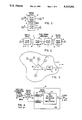
- FIG. 9 there is shown an arrangement of the public switched telephone network and public data network for carrying out the invention according to a preferred embodiment.
- a public switched telephone network as illustrated and described in connection with FIG. 7.
- an initiating or originating end office which is here illustrated by the central office 10
- the credit card authorization terminal 42 is connected by a station line 48 to the central office 10 and receives dial tone from that office.
- a conventional line side modem or modem pool arrangement 50 Connected to a designated end office, which is here illustrated as central office 12, is a conventional line side modem or modem pool arrangement 50.
- the modem 50 exercises a line protocol and is connected to the central office 12 via a line hardware interface and line 52.
- the modem 50 may be conveniently located at or adjacent to the end office 12.
- Modem 50 is connected by an outgoing tie line 54 to a packet switch in the public data network, indicated generally at 56. Conventional X.25 packet protocol or other protocols may be used.
- the public data network 56 connects to a host computer 58 for effecting the credit card authorization in the conventional manner.
- the originating central office 10 is connected to the terminating central office or end office 12 via Feature Group B or Feature Group D trunks which are indicated diagrammatically at 60, although it will be understood that the Feature Group trunk(.s) may be included within the trunk connection 22 between the central offices 10 and 12. It will be appreciated that while the invention is illustrated in terms of originating central office 10 and terminating central office 12 there may be one or more central office(s) and/or tandem switch(es) between the originating central office and the terminating central office connected by Feature Group B or Feature Group D trunks executing conventional E & M trunk protocol. The originating and terminating central offices need not be in the same LATA.
- the Feature Group trunk 60 interfaces with the station line 52 at the central office switch 12 through a code conversion or special digit interpretation process.
- Code conversion is an option in most SPC switching systems used by LECS.
- the software translations in the switches have the capabilities to do address digital manipulation.
- the switch software converts the incoming address to a different address on the line side.
- the end office switch has the ability to delete digits and prefix new digits that conform to the line number(s) where the modems are connected.
- Special digit interpretation is also an option in most SPC switching systems used by LECS. In this case, the incoming digits are "translated" via a dedicated routing table which selects a unique end office line or line hunting group. The unique end office lines are where the modems are connected.
- the end office switch When a bank of modems is used with a line hunt group the end office switch connects the incoming trunk to an available line circuit within the line hunt group assigned for the credit card authorization device. Each line is equipped with a modem. When ringing or quick start on the line begins, the modem is activated and aligns itself in the proper mode to receive signals from the credit card authorization device and convert them to the required digital format for forwarding to the public data network.
- Each modem is directly connected to the Packet Data Network, Public Data Network (PDN) or other data communications or data processing equipment, and the modem and PDN will respond to the signals and information generated by the credit card authorization device by passing the call information to/from the host computer.
- PDN Public Data Network
- both ends disconnect and all connections are restored to the idle state.
- a call is initiated from the credit card authorization terminal by the auto-dialing device dialing a CIC number or Feature Group access number such as 950-1/0XXX.
- the call is routed over the public switched network to the designated end office 12 using SS7 network signaling over CCS lines 26 and 28. While conventional signaling may be used CCS signaling permits a faster connection to the designated end office.
- the 950-1/0XXX call comes in on the incoming Feature Group B or Feature Group D trunk 60 to the designated end office 12 to terminate on the trunk side of the designated end office switch.
- the Feature Group B or Feature Group D trunk is connected by the stored program control (SPC) switch at the end office 12 to the station line 52 by code converting to a directory number or using special digit interpretation and routing for the line 52. If more than one line is required to handle the demand subsequent lines may be provided in a multiple line hunt group. This directs the call from the credit authorization device 42 to a line location, namely the modem or modem bank 50, which comprises a conventional line side modem or modem bank.
- SPC stored program control
- Instantaneous signaling to alert the modem is applied at the line by quick start, ground start or immediate ringing. This signal is speeded by the use of CCS or SS7 signaling.
- the modem is connected via the line 54 and public data network 56 to the host computer 58 for effecting the authentication. Once the connection is made to the host computer the exchange of information between the end user's or initiator's terminal device or credit card authorization device can begin.
- the method may be summarized as comprising the steps of:
- end office switch functioning in the manner of the invention is a conventional end office switch which simultaneously functions to perform central office switching operations. No additional equipment is necessary and no special purpose switches or modems are required.
- a car rental agency having reservation booths in hotels may provide cards which actuate point of sale terminals to signal the rental car site so that the car is ready and waiting by the time that the customer reaches the site.
- Cards may also be provided for ordering products which may be encoded in the cards or designated by key pad actuation.
- the system of the invention provides an improved point of sale credit card authorization service which utilizes currently available equipment so as to provide fast, efficient and effective service in an economical manner.
- the service is provided within the context of the existing public switched telephone network and packet data network without requiring specially designed equipment for interfacing between such networks.
- Common channel signaling and immediate ringing features are preferably provided to optimize the speed of operation.
- Available Feature Group B or Feature Group D technology is utilized without any requirement for modem equipment having a trunk side interface.
Landscapes
- Engineering & Computer Science (AREA)
- Signal Processing (AREA)
- Computer Networks & Wireless Communication (AREA)
- Data Exchanges In Wide-Area Networks (AREA)
- Meter Arrangements (AREA)
- Sub-Exchange Stations And Push- Button Telephones (AREA)
Priority Applications (5)
| Application Number | Priority Date | Filing Date | Title |
|---|---|---|---|
| US07/959,920 US5315641A (en) | 1992-10-14 | 1992-10-14 | Public switched telephone network access to public data network |
| AU50060/93A AU5006093A (en) | 1992-10-14 | 1993-08-12 | Public switched telephone network access to public data network |
| PCT/US1993/007568 WO1994009587A1 (fr) | 1992-10-14 | 1993-08-12 | Acces au reseau public de donnees par le reseau telephonique public commute |
| CA002104083A CA2104083C (fr) | 1992-10-14 | 1993-08-13 | Acces a un reseau de donnees public via un reseau telephonique public commute |
| CA002233430A CA2233430C (fr) | 1992-10-14 | 1993-08-13 | Acces du reseau telephonique public commute au reseau public de donnees |
Applications Claiming Priority (1)
| Application Number | Priority Date | Filing Date | Title |
|---|---|---|---|
| US07/959,920 US5315641A (en) | 1992-10-14 | 1992-10-14 | Public switched telephone network access to public data network |
Publications (1)
| Publication Number | Publication Date |
|---|---|
| US5315641A true US5315641A (en) | 1994-05-24 |
Family
ID=25502584
Family Applications (1)
| Application Number | Title | Priority Date | Filing Date |
|---|---|---|---|
| US07/959,920 Expired - Lifetime US5315641A (en) | 1992-10-14 | 1992-10-14 | Public switched telephone network access to public data network |
Country Status (4)
| Country | Link |
|---|---|
| US (1) | US5315641A (fr) |
| AU (1) | AU5006093A (fr) |
| CA (1) | CA2104083C (fr) |
| WO (1) | WO1994009587A1 (fr) |
Cited By (40)
| Publication number | Priority date | Publication date | Assignee | Title |
|---|---|---|---|---|
| US5487109A (en) * | 1994-05-17 | 1996-01-23 | Bellsouth Corporation | End office of a telephone system with a zero loss plan |
| US5513250A (en) * | 1994-10-13 | 1996-04-30 | Bell Atlantic Network Services, Inc. | Telephone based credit card protection |
| US5528595A (en) * | 1974-06-09 | 1996-06-18 | U.S. Robotics, Inc. | Modem input/output signal processing techniques |
| US5577105A (en) * | 1994-03-11 | 1996-11-19 | U.S. Robotics, Inc. | Telephone call routing and switching techniques for data communications |
| US5592541A (en) * | 1995-05-31 | 1997-01-07 | Southwestern Bell Technology Resources, Inc. | Apparatus and method for forwarding incoming calls |
| US5619559A (en) * | 1992-06-25 | 1997-04-08 | Compuserve Incorporated | Financial card authorization system |
| US5655007A (en) * | 1994-10-13 | 1997-08-05 | Bell Atlantic Network Services, Inc. | Telephone based credit card protection |
| US5680446A (en) * | 1995-08-24 | 1997-10-21 | Southwestern Bell Technology Resources, Inc. | Advanced intelligent network screening |
| US5799073A (en) * | 1995-06-07 | 1998-08-25 | Southwestern Bell Technology Resources, Inc. | Apparatus and method for recording call related data |
| WO1998048563A1 (fr) * | 1997-04-20 | 1998-10-29 | Ilan Ben David | Systeme et procede de vente au detail via un reseau |
| US5869821A (en) * | 1993-10-13 | 1999-02-09 | Samsung Electronics Co., Ltd. | Credit inquiry service system and method |
| US5912888A (en) * | 1994-06-09 | 1999-06-15 | U.S. Robotics Access Corp. | Digital network access server |
| US6061364A (en) * | 1997-12-16 | 2000-05-09 | Alcatel Usa Sourcing, L.P. | System and method for transporting SS7 signaling over broadband asynchronous transfer mode links |
| US6320856B1 (en) * | 1996-05-23 | 2001-11-20 | Alcatel Usa, Inc. | System and method for a multi-host subscriber loop |
| US6324183B1 (en) | 1998-12-04 | 2001-11-27 | Tekelec | Systems and methods for communicating messages among signaling system 7 (SS7) signaling points (SPs) and internet protocol (IP) nodes using signal transfer points (STPS) |
| US20010049730A1 (en) * | 2000-06-01 | 2001-12-06 | Brendes Dan Alan | Methods and systems for providing converged network management functionality in a gateway routing node |
| US20020105969A1 (en) * | 2000-12-12 | 2002-08-08 | Benedyk Robby Darren | Methods and systems for routing messages in a radio access network |
| WO2002037931A3 (fr) * | 2000-11-08 | 2002-09-06 | Tsunami Communications Inc | Systeme et procede de routage dynamique |
| US20020131400A1 (en) * | 2001-01-24 | 2002-09-19 | Tinsley Robert John | Distributed signaling system 7 (SS7) message routing gateway |
| US20030002650A1 (en) * | 2001-06-22 | 2003-01-02 | Sbc Technology Resources, Inc. | Identification of calling devices dialing a universal number to access a telecommunications relay service center |
| US20030228011A1 (en) * | 2002-06-07 | 2003-12-11 | Gibson Elizabeth Goldwyn | System and method for implementing and accessing call forwarding services |
| US20030231653A1 (en) * | 1998-12-04 | 2003-12-18 | Tekelec | Method for reliably recovering signaling system seven (SS7) user part message packets in response to a socket failure |
| US20040005045A1 (en) * | 1999-04-09 | 2004-01-08 | Sbc Technology Resources, Inc., Austin, Texas | System and method for implementing and accessing call forwarding services |
| US20040161083A1 (en) * | 2002-02-19 | 2004-08-19 | Sbc Properties, L.P. | Method and system for presenting customized call alerts in a service for internet caller identification |
| US6816481B1 (en) | 1999-04-09 | 2004-11-09 | Sbc Technology Resources, Inc. | Internet caller identification system and method |
| US20050144600A1 (en) * | 2001-09-24 | 2005-06-30 | Siemens Energy & Automation, Inc. | Method for providing engineering tool services and determining expense |
| US6940866B1 (en) | 1998-12-04 | 2005-09-06 | Tekelec | Edge device and method for interconnecting SS7 signaling points(SPs) using edge device |
| US6954526B1 (en) | 1999-04-05 | 2005-10-11 | Tekelec | Methods and systems for routing calling name service query messages in a communication network |
| US20050249344A1 (en) * | 2004-05-07 | 2005-11-10 | Sbc Knowledge Ventures, L.P. | Network delivery of personalized caller identification |
| US6967956B1 (en) | 2000-07-18 | 2005-11-22 | Tekelec | Methods and systems for providing message translation, accounting and routing service in a multi-protocol communications network environment |
| US6987781B1 (en) | 1998-12-04 | 2006-01-17 | Tekelec | Methods and systems for routing signaling messages in a communications network using circuit identification code (CIC) information |
| US20060013264A1 (en) * | 2004-07-14 | 2006-01-19 | Tekelec | Methods and systems for auto-correlating message transfer part (MTP) priority and internet protocol (IP) type of service in converged networks |
| US20060013204A1 (en) * | 1998-12-04 | 2006-01-19 | Tekelec | Methods and systems for communicating SS7 messages over packet-based network using transport adapter layer interface |
| US7113581B2 (en) | 2000-04-21 | 2006-09-26 | Tekelec | Methods and systems for providing dynamic routing key registration |
| US7206398B2 (en) | 1998-07-09 | 2007-04-17 | Sbc Technology Resources, Inc. | System and method for forwarding call from disconnected telephone number to new telephone number |
| US20070286740A1 (en) * | 2004-11-19 | 2007-12-13 | Richard Bergner Verbindungstechnik Gmbh & Co. Kg | Hydraulic unit and method for providing a pressurized hydraulic fluid |
| US20090034512A1 (en) * | 2007-07-31 | 2009-02-05 | Apirux Bantukul | Methods, systems, and computer readable media for managing the flow of signaling traffic entering a signaling system 7 (ss7) based network |
| US7804789B2 (en) | 2004-03-18 | 2010-09-28 | Tekelec | Methods, systems, and computer program products for organizing, managing, and selectively distributing routing information in a signaling message routing node |
| US20100290612A1 (en) * | 2009-05-18 | 2010-11-18 | At&T Intellectual Property I, L.P. | Next generation auto-dialer |
| US9219677B2 (en) | 2009-01-16 | 2015-12-22 | Tekelec Global, Inc. | Methods, systems, and computer readable media for centralized routing and call instance code management for bearer independent call control (BICC) signaling messages |
Families Citing this family (3)
| Publication number | Priority date | Publication date | Assignee | Title |
|---|---|---|---|---|
| PT2315398E (pt) * | 1995-10-11 | 2014-05-06 | Aip Acquisition Llc | Rede de comunicação eficiente |
| US7555458B1 (en) | 1996-06-05 | 2009-06-30 | Fraud Control System.Com Corporation | Method of billing a purchase made over a computer network |
| US7013001B1 (en) | 1996-06-05 | 2006-03-14 | David Felger | Method of billing a communication session conducted over a computer network |
Citations (5)
| Publication number | Priority date | Publication date | Assignee | Title |
|---|---|---|---|---|
| US4219200A (en) * | 1978-03-28 | 1980-08-26 | Izumi Takahashi | Device for automatically assembling tiles for the Mah-Jongg game |
| US4796292A (en) * | 1987-12-08 | 1989-01-03 | American Express Company | Data transmission over the public switched network |
| US5113430A (en) * | 1990-10-01 | 1992-05-12 | United States Advanced Network, Inc. | Enhanced wide area audio response network |
| US5163086A (en) * | 1990-12-31 | 1992-11-10 | At&T Bell Laboratories | Telephone network credit card calling apparatus and method of operation to determine validation and fraudulent use of credit cards in placing telephone calls |
| US5163087A (en) * | 1990-12-31 | 1992-11-10 | At&T Bell Laboratories | Delivery of customer data base key using automatic number identification |
Family Cites Families (3)
| Publication number | Priority date | Publication date | Assignee | Title |
|---|---|---|---|---|
| US3969701A (en) * | 1973-04-09 | 1976-07-13 | Telefonaktiebolaget L M Ericsson | Function block oriented SPC system |
| US4685127A (en) * | 1985-10-01 | 1987-08-04 | Southwestern Bell Telephone | System for converting a No. 5 crossbar telephone switching central office to a conforming equal access central office |
| US5184345A (en) * | 1991-01-02 | 1993-02-02 | At&T Bell Laboratories | Enhanced isdn 800 service |
-
1992
- 1992-10-14 US US07/959,920 patent/US5315641A/en not_active Expired - Lifetime
-
1993
- 1993-08-12 WO PCT/US1993/007568 patent/WO1994009587A1/fr not_active Ceased
- 1993-08-12 AU AU50060/93A patent/AU5006093A/en not_active Abandoned
- 1993-08-13 CA CA002104083A patent/CA2104083C/fr not_active Expired - Lifetime
Patent Citations (5)
| Publication number | Priority date | Publication date | Assignee | Title |
|---|---|---|---|---|
| US4219200A (en) * | 1978-03-28 | 1980-08-26 | Izumi Takahashi | Device for automatically assembling tiles for the Mah-Jongg game |
| US4796292A (en) * | 1987-12-08 | 1989-01-03 | American Express Company | Data transmission over the public switched network |
| US5113430A (en) * | 1990-10-01 | 1992-05-12 | United States Advanced Network, Inc. | Enhanced wide area audio response network |
| US5163086A (en) * | 1990-12-31 | 1992-11-10 | At&T Bell Laboratories | Telephone network credit card calling apparatus and method of operation to determine validation and fraudulent use of credit cards in placing telephone calls |
| US5163087A (en) * | 1990-12-31 | 1992-11-10 | At&T Bell Laboratories | Delivery of customer data base key using automatic number identification |
Cited By (94)
| Publication number | Priority date | Publication date | Assignee | Title |
|---|---|---|---|---|
| US5528595A (en) * | 1974-06-09 | 1996-06-18 | U.S. Robotics, Inc. | Modem input/output signal processing techniques |
| US5619559A (en) * | 1992-06-25 | 1997-04-08 | Compuserve Incorporated | Financial card authorization system |
| US5869821A (en) * | 1993-10-13 | 1999-02-09 | Samsung Electronics Co., Ltd. | Credit inquiry service system and method |
| US5577105A (en) * | 1994-03-11 | 1996-11-19 | U.S. Robotics, Inc. | Telephone call routing and switching techniques for data communications |
| US5841842A (en) * | 1994-03-11 | 1998-11-24 | U.S. Robotics Access Corp. | Telephone call routing and switching techniques for data communications |
| US5761281A (en) * | 1994-03-11 | 1998-06-02 | 3Com Corporation | Telephone call routing and switching techniques for data communications |
| US5487109A (en) * | 1994-05-17 | 1996-01-23 | Bellsouth Corporation | End office of a telephone system with a zero loss plan |
| US5912888A (en) * | 1994-06-09 | 1999-06-15 | U.S. Robotics Access Corp. | Digital network access server |
| US6636519B1 (en) | 1994-06-09 | 2003-10-21 | Ut Starcom, Inc. | Network access method and network access server therefor |
| US5655007A (en) * | 1994-10-13 | 1997-08-05 | Bell Atlantic Network Services, Inc. | Telephone based credit card protection |
| US5513250A (en) * | 1994-10-13 | 1996-04-30 | Bell Atlantic Network Services, Inc. | Telephone based credit card protection |
| US5592541A (en) * | 1995-05-31 | 1997-01-07 | Southwestern Bell Technology Resources, Inc. | Apparatus and method for forwarding incoming calls |
| US5799073A (en) * | 1995-06-07 | 1998-08-25 | Southwestern Bell Technology Resources, Inc. | Apparatus and method for recording call related data |
| US5680446A (en) * | 1995-08-24 | 1997-10-21 | Southwestern Bell Technology Resources, Inc. | Advanced intelligent network screening |
| US6320856B1 (en) * | 1996-05-23 | 2001-11-20 | Alcatel Usa, Inc. | System and method for a multi-host subscriber loop |
| WO1998048563A1 (fr) * | 1997-04-20 | 1998-10-29 | Ilan Ben David | Systeme et procede de vente au detail via un reseau |
| US7564870B2 (en) | 1997-07-02 | 2009-07-21 | Tekelec | Methods and systems for providing database node access control functionality in a communications network routing node |
| US20060034329A1 (en) * | 1997-07-02 | 2006-02-16 | Tekelec | Methods and systems for providing database node access control functionality in a communications network routing node |
| US6061364A (en) * | 1997-12-16 | 2000-05-09 | Alcatel Usa Sourcing, L.P. | System and method for transporting SS7 signaling over broadband asynchronous transfer mode links |
| US7206398B2 (en) | 1998-07-09 | 2007-04-17 | Sbc Technology Resources, Inc. | System and method for forwarding call from disconnected telephone number to new telephone number |
| US20060077978A1 (en) * | 1998-12-04 | 2006-04-13 | Tekelec | Methods and systems for communicating signaling system 7 (SS7) user part messages among SS7 signaling points (SPs) and internet protocol (IP) nodes using signal transfer points (STPs) |
| US6987781B1 (en) | 1998-12-04 | 2006-01-17 | Tekelec | Methods and systems for routing signaling messages in a communications network using circuit identification code (CIC) information |
| US8750328B2 (en) | 1998-12-04 | 2014-06-10 | Tekelec Global, Inc. | Methods and systems for communicating signaling system 7 (SS7) user part messages among SS7 signaling points (SPs) and internet protocol (IP) nodes using signal transfer points (STPs) |
| US8213410B2 (en) | 1998-12-04 | 2012-07-03 | Tekelec, Inc. | Methods and systems for communicating SS7 messages over packet-based network using transport adapter layer interface |
| US20030231653A1 (en) * | 1998-12-04 | 2003-12-18 | Tekelec | Method for reliably recovering signaling system seven (SS7) user part message packets in response to a socket failure |
| US20030231652A1 (en) * | 1998-12-04 | 2003-12-18 | Tekelec | Method for encapsulating a signaling system seven (SS7) user part message in an internet protocol (IP) packet for transmission over an IP network |
| US7839889B2 (en) | 1998-12-04 | 2010-11-23 | Tekelec | Methods and systems for communicating signaling system 7 (SS7) user part messages among SS7 signaling points (SPs) and internet protocol (IP) nodes using signal transfer points (STPs) |
| US20040100961A1 (en) * | 1998-12-04 | 2004-05-27 | Tekelec | Data structure embodied in a computer readable medium for communicating signaling system seven (SS7) user part messages between SS7 nodes |
| US7616659B2 (en) | 1998-12-04 | 2009-11-10 | Tekelec | Methods and systems for communicating SS7 messages over packet-based network using transport adapter layer interface |
| US7573905B2 (en) | 1998-12-04 | 2009-08-11 | Tekelec | Methods and systems for communicating SS7 messages over packet-based network using transport adapter layer interface (TALI) |
| US6324183B1 (en) | 1998-12-04 | 2001-11-27 | Tekelec | Systems and methods for communicating messages among signaling system 7 (SS7) signaling points (SPs) and internet protocol (IP) nodes using signal transfer points (STPS) |
| US7525997B2 (en) | 1998-12-04 | 2009-04-28 | Tekelec | Methods and systems for communicating SS7 messages over packet-based network using transport adapter layer interface |
| US6940866B1 (en) | 1998-12-04 | 2005-09-06 | Tekelec | Edge device and method for interconnecting SS7 signaling points(SPs) using edge device |
| US7031340B2 (en) | 1998-12-04 | 2006-04-18 | Tekelec | Method for processing an internet protocol (IP) encapsulated signaling system seven (SS7) user part message utilizing a signal transfer point (STP) |
| US7522580B2 (en) | 1998-12-04 | 2009-04-21 | Tekelec | Edge device and method for interconnecting SS7 signaling points (SPs) using edge device |
| US20050238036A1 (en) * | 1998-12-04 | 2005-10-27 | Tekelec | Edge device and method for interconnecting SS7 signaling points (SPs) using edge device |
| US7327670B2 (en) | 1998-12-04 | 2008-02-05 | Tekelec | Method for reliably recovering signaling system seven (SS7) user part message packets in response to a socket failure |
| US7242695B2 (en) | 1998-12-04 | 2007-07-10 | Tekelec | System for communicating signaling system 7 messages over an internet protocol network |
| US7190702B2 (en) | 1998-12-04 | 2007-03-13 | Tekelec | Method for encapsulating a signaling system seven (SS7) user part message in an internet protocol (IP) packet for transmission over an IP network |
| US7002988B1 (en) | 1998-12-04 | 2006-02-21 | Tekelec | Methods and systems for communicating SS7 messages over packet-based network using transport adapter layer interface |
| US7050456B1 (en) | 1998-12-04 | 2006-05-23 | Tekelec | Methods and systems for communicating signaling system 7 (SS7) user part messages among SS7 signaling points (SPs) and internet protocol (IP) nodes using signal transfer points (STPs) |
| US20060013204A1 (en) * | 1998-12-04 | 2006-01-19 | Tekelec | Methods and systems for communicating SS7 messages over packet-based network using transport adapter layer interface |
| US20060013203A1 (en) * | 1998-12-04 | 2006-01-19 | Tekelec | Methods and systems for communicating SS7 messages over packet-based network using transport adapter layer interface |
| US7046667B2 (en) | 1998-12-04 | 2006-05-16 | Tekelec | Data structure embodied in a computer readable medium for communicating signaling system seven (SS7) user part messages between SS7 nodes |
| US6954526B1 (en) | 1999-04-05 | 2005-10-11 | Tekelec | Methods and systems for routing calling name service query messages in a communication network |
| US7242754B2 (en) | 1999-04-09 | 2007-07-10 | At&T Labs, Inc. | System and method for implementing and accessing call forwarding services |
| US7995563B2 (en) | 1999-04-09 | 2011-08-09 | At&T Labs, Inc. | Internet caller identification system and method |
| US20040005045A1 (en) * | 1999-04-09 | 2004-01-08 | Sbc Technology Resources, Inc., Austin, Texas | System and method for implementing and accessing call forwarding services |
| US6816481B1 (en) | 1999-04-09 | 2004-11-09 | Sbc Technology Resources, Inc. | Internet caller identification system and method |
| US20040240651A1 (en) * | 1999-04-09 | 2004-12-02 | Sbc Technology Resources, Inc. | Internet caller identification system and method |
| US7336653B2 (en) | 1999-04-09 | 2008-02-26 | At&T Labs, Inc. | Internet caller identification system and method |
| US20070268892A1 (en) * | 1999-04-09 | 2007-11-22 | At&T Labs, Inc. | Internet caller identification system and method |
| US20070217584A1 (en) * | 1999-04-09 | 2007-09-20 | At&T Labs, Inc. | System and method for implementing and accessing call forwarding services |
| US7113581B2 (en) | 2000-04-21 | 2006-09-26 | Tekelec | Methods and systems for providing dynamic routing key registration |
| US7743131B2 (en) | 2000-06-01 | 2010-06-22 | Tekelec | Methods and systems for managing status audit messages in a gateway routing node |
| US20010049730A1 (en) * | 2000-06-01 | 2001-12-06 | Brendes Dan Alan | Methods and systems for providing converged network management functionality in a gateway routing node |
| US8224928B2 (en) | 2000-06-01 | 2012-07-17 | Tekelec, Inc. | Methods and systems for distributing operating status information within a converged network |
| US20080075115A1 (en) * | 2000-06-01 | 2008-03-27 | Tekelec | Methods and systems for providing converged network management functionality in a gateway routing node |
| US7318091B2 (en) | 2000-06-01 | 2008-01-08 | Tekelec | Methods and systems for providing converged network management functionality in a gateway routing node to communicate operating status information associated with a signaling system 7 (SS7) node to a data network node |
| US6967956B1 (en) | 2000-07-18 | 2005-11-22 | Tekelec | Methods and systems for providing message translation, accounting and routing service in a multi-protocol communications network environment |
| WO2002037931A3 (fr) * | 2000-11-08 | 2002-09-06 | Tsunami Communications Inc | Systeme et procede de routage dynamique |
| US6990089B2 (en) | 2000-12-12 | 2006-01-24 | Telelec | Methods and systems for routing messages in a radio access network |
| US20020105969A1 (en) * | 2000-12-12 | 2002-08-08 | Benedyk Robby Darren | Methods and systems for routing messages in a radio access network |
| US6965592B2 (en) | 2001-01-24 | 2005-11-15 | Tekelec | Distributed signaling system 7 (SS7) message routing gateway |
| US20020131400A1 (en) * | 2001-01-24 | 2002-09-19 | Tinsley Robert John | Distributed signaling system 7 (SS7) message routing gateway |
| US7809121B2 (en) | 2001-06-22 | 2010-10-05 | At&T Intellectual Property I, L.P. | Identification of calling devices dialing a universal number to access a telecommunications relay service center |
| US20030002650A1 (en) * | 2001-06-22 | 2003-01-02 | Sbc Technology Resources, Inc. | Identification of calling devices dialing a universal number to access a telecommunications relay service center |
| US20050144600A1 (en) * | 2001-09-24 | 2005-06-30 | Siemens Energy & Automation, Inc. | Method for providing engineering tool services and determining expense |
| US20040161083A1 (en) * | 2002-02-19 | 2004-08-19 | Sbc Properties, L.P. | Method and system for presenting customized call alerts in a service for internet caller identification |
| US7450701B2 (en) | 2002-02-19 | 2008-11-11 | At&T Intellectual Property I, L.P. | Method and system for presenting customized call alerts in a service for internet caller identification |
| US20070286391A1 (en) * | 2002-06-07 | 2007-12-13 | At&T Knowledge Ventures, L.P. | System and method for implementing and accessing call forwarding services |
| US7778403B2 (en) | 2002-06-07 | 2010-08-17 | At&T Intellectual Property I, L.P. | System and method for implementing and accessing call forwarding services |
| US8059808B2 (en) | 2002-06-07 | 2011-11-15 | At&T Intellectual Property I, L.P. | System and method for implementing and accessing call forwarding services |
| US20080170680A1 (en) * | 2002-06-07 | 2008-07-17 | At & T Knowledge Ventures, L.P. | System and method for implementing and accessing call forwarding services |
| US7346155B2 (en) | 2002-06-07 | 2008-03-18 | At&T Knowledge Ventures, L.P. | System and method for implementing and accessing call forwarding services |
| US7076045B2 (en) | 2002-06-07 | 2006-07-11 | Sbc Properties, L.P. | System and method for implementing and accessing call forward services |
| US7227940B2 (en) | 2002-06-07 | 2007-06-05 | At&T Knowledge Ventures, B.P. | System and method for implementing and accessing call forwarding services |
| US6954524B2 (en) | 2002-06-07 | 2005-10-11 | Sbc Properties, L.P. | System and method for implementing and accessing call forwarding services |
| US20060203986A1 (en) * | 2002-06-07 | 2006-09-14 | Sbc Properties L.P. | System and method for implementing and accessing call forwarding services |
| US20030228011A1 (en) * | 2002-06-07 | 2003-12-11 | Gibson Elizabeth Goldwyn | System and method for implementing and accessing call forwarding services |
| US8179885B2 (en) | 2004-03-18 | 2012-05-15 | Tekelec | Methods, systems, and computer program products for organizing, managing, and selectively distributing routing information in a signaling message routing node |
| US7804789B2 (en) | 2004-03-18 | 2010-09-28 | Tekelec | Methods, systems, and computer program products for organizing, managing, and selectively distributing routing information in a signaling message routing node |
| US9379965B2 (en) | 2004-03-18 | 2016-06-28 | Tekelec Global, Inc. | Organizing, managing, and selectively distributing routing information in a signaling message routing node |
| US8792334B2 (en) | 2004-03-18 | 2014-07-29 | Tekelec Global, Inc. | Methods, systems, and computer program products for organizing, managing, and selectively distributing routing information in a signaling message routing node |
| US20050249344A1 (en) * | 2004-05-07 | 2005-11-10 | Sbc Knowledge Ventures, L.P. | Network delivery of personalized caller identification |
| US20060013264A1 (en) * | 2004-07-14 | 2006-01-19 | Tekelec | Methods and systems for auto-correlating message transfer part (MTP) priority and internet protocol (IP) type of service in converged networks |
| US7532647B2 (en) | 2004-07-14 | 2009-05-12 | Tekelec | Methods and systems for auto-correlating message transfer part (MTP) priority and internet protocol (IP) type of service in converged networks |
| US20070286740A1 (en) * | 2004-11-19 | 2007-12-13 | Richard Bergner Verbindungstechnik Gmbh & Co. Kg | Hydraulic unit and method for providing a pressurized hydraulic fluid |
| US20090034512A1 (en) * | 2007-07-31 | 2009-02-05 | Apirux Bantukul | Methods, systems, and computer readable media for managing the flow of signaling traffic entering a signaling system 7 (ss7) based network |
| US9043451B2 (en) | 2007-07-31 | 2015-05-26 | Tekelec, Inc. | Methods, systems, and computer readable media for managing the flow of signaling traffic entering a signaling system 7 (SS7) based network |
| US9219677B2 (en) | 2009-01-16 | 2015-12-22 | Tekelec Global, Inc. | Methods, systems, and computer readable media for centralized routing and call instance code management for bearer independent call control (BICC) signaling messages |
| US20100290612A1 (en) * | 2009-05-18 | 2010-11-18 | At&T Intellectual Property I, L.P. | Next generation auto-dialer |
| US8355493B2 (en) * | 2009-05-18 | 2013-01-15 | At&T Intellectual Property I, L.P. | Next generation auto-dialer |
| US8873731B2 (en) | 2009-05-18 | 2014-10-28 | At&T Intellectual Property I, L.P. | Next generation auto-dialer |
Also Published As
| Publication number | Publication date |
|---|---|
| CA2104083C (fr) | 1999-05-11 |
| AU5006093A (en) | 1994-05-09 |
| CA2104083A1 (fr) | 1994-04-15 |
| WO1994009587A1 (fr) | 1994-04-28 |
Similar Documents
| Publication | Publication Date | Title |
|---|---|---|
| US5315641A (en) | Public switched telephone network access to public data network | |
| US5550905A (en) | Method and apparatus for delivering calls and caller identification information to multi-line users | |
| US5917899A (en) | Method of connecting a plurality of virtual networks | |
| US4796292A (en) | Data transmission over the public switched network | |
| JP3300363B2 (ja) | 音声およびデータの伝送能力に基づいて電話呼をルーティングする方法およびシステム | |
| US4897867A (en) | Method of and an arrangement for forwarding a customer order | |
| EP0644705B1 (fr) | Commutation pour télécommunications | |
| CA1159131A (fr) | Systeme cbx reparti utilisant un reseau a paquets | |
| US5970130A (en) | Independent central office which provides local and long distance calling services to new residential and commercial developments | |
| US7555109B2 (en) | System and method for caller control of a distinctive ring | |
| US5313463A (en) | ISDN credit checking | |
| JPH11136356A (ja) | 呼方向変更システム | |
| CA1262273A (fr) | Methode et amenagement pour la transmission des commandes clientele | |
| US4903263A (en) | Apparatus and method for providing existing telephone switching equipment with integrated services digital network capability | |
| US20080014950A1 (en) | Methods of routing interlata network traffic | |
| US6526138B1 (en) | System and method for edge switch query using advanced intelligent network protocol | |
| US5995613A (en) | Method for establishing virtual private line for long distance carrier | |
| US7254228B2 (en) | Method and system for effective utilizing the switching capacity of local exchanges | |
| US5905791A (en) | Method and apparatus for providing combined communication services including local service and toll service | |
| CA2233125C (fr) | Methode et appareil de prestation de services virtuels multi-reseaux | |
| CA2233430C (fr) | Acces du reseau telephonique public commute au reseau public de donnees | |
| US6633637B1 (en) | Suppressed ringing connectivity | |
| US6483904B1 (en) | Method and system for high-speed interface access to a computer network using a subscriber telephone line | |
| US7099446B1 (en) | Method for providing telephone services for commercial classes of service | |
| US6240173B1 (en) | Virtual end office in a switched telephone network |
Legal Events
| Date | Code | Title | Description |
|---|---|---|---|
| AS | Assignment |
Owner name: BELL ATLANTIC NETWORK SERVICES, INC., VIRGINIA Free format text: ASSIGNMENT OF ASSIGNORS INTEREST.;ASSIGNORS:MONTGOMERY, ROBERT H.;DELSS, LAWRENCE A.;REEL/FRAME:006336/0274;SIGNING DATES FROM 19921119 TO 19921123 |
|
| STCF | Information on status: patent grant |
Free format text: PATENTED CASE |
|
| FEPP | Fee payment procedure |
Free format text: PAYOR NUMBER ASSIGNED (ORIGINAL EVENT CODE: ASPN); ENTITY STATUS OF PATENT OWNER: LARGE ENTITY |
|
| FPAY | Fee payment |
Year of fee payment: 4 |
|
| FPAY | Fee payment |
Year of fee payment: 8 |
|
| FPAY | Fee payment |
Year of fee payment: 12 |
|
| AS | Assignment |
Owner name: VERIZON SERVICES CORP., VIRGINIA Free format text: CHANGE OF NAME;ASSIGNOR:BELL ATLANTIC NETWORK SERVICES, INC.;REEL/FRAME:032761/0226 Effective date: 20000801 |
|
| AS | Assignment |
Owner name: VERIZON PATENT AND LICENSING INC., NEW JERSEY Free format text: ASSIGNMENT OF ASSIGNORS INTEREST;ASSIGNOR:VERIZON SERVICES CORP.;REEL/FRAME:032851/0319 Effective date: 20140409 |