US5327367A - Computer system with vector functional unit for fast fourier transform - Google Patents
Computer system with vector functional unit for fast fourier transform Download PDFInfo
- Publication number
- US5327367A US5327367A US07/986,535 US98653592A US5327367A US 5327367 A US5327367 A US 5327367A US 98653592 A US98653592 A US 98653592A US 5327367 A US5327367 A US 5327367A
- Authority
- US
- United States
- Prior art keywords
- vector
- rotation
- fourier transform
- fast fourier
- elements
- Prior art date
- Legal status (The legal status is an assumption and is not a legal conclusion. Google has not performed a legal analysis and makes no representation as to the accuracy of the status listed.)
- Expired - Fee Related
Links
Images


Classifications
-
- G—PHYSICS
- G06—COMPUTING OR CALCULATING; COUNTING
- G06F—ELECTRIC DIGITAL DATA PROCESSING
- G06F17/00—Digital computing or data processing equipment or methods, specially adapted for specific functions
- G06F17/10—Complex mathematical operations
- G06F17/14—Fourier, Walsh or analogous domain transformations, e.g. Laplace, Hilbert, Karhunen-Loeve, transforms
- G06F17/141—Discrete Fourier transforms
- G06F17/142—Fast Fourier transforms, e.g. using a Cooley-Tukey type algorithm
Definitions
- the present invention relates to Fast Fourier Transform on a computer system provided with a vector functional unit, and in particular relates to a Fast Fourier Transform system with reduced storing area for rotation factors used in Fast Fourier Transform.
- Fast Fourier Transform processing on a computer system provided with a vector functional unit requires that a procedure consisting of input element rearrangement, vector addition, vector subtraction and rotation factor multiplication to be performed for three stages.
- rotation factors to be vector loaded and used in each of the three stages are stored as they are in a rotation factor storing array as shown in FIG. 5.
- rotation factors are read from the rotation factor storing array W as in FIG. 5 for every stage through vector loading.
- S is the size of the rotation factor storing area
- N is the number of elements for Fast Fourier Transform
- log is a logarithm to the base two.
- the size S of the storing area is generally larger than the size of input elements; when the number of elements for Fast Fourier Transform increases, the area to store the rotation factors becomes quite large. Besides, vector loading/storing must be performed the number of times represented by powers of 2 for rotation factor generation, which requires much time.
- a computer system for Fast Fourier Transform with a vector functional unit is provided with a process to store rotation factors by which the input elements are multiplied in Fast Fourier Transform into an array wherein, when the number of the rotation factors with the same value is not less than the maximum number of vector elements for the vector functional unit, the rotation factor with the same value is stored only once each time the vector elements amounts to the maximum number.
- the size of the rotation factor array area is log VL ⁇ N/2+N/2 ⁇ 1/VL ⁇ (log N-log VL) where N is the number of input elements of Fast Fourier Transform, VL is the maximum number of vector elements and log is a logarithm to the base two.
- a computer system for Fast Fourier Transform with a vector functional unit with a process to store rotation factors by which the input elements are multiplied in Fast Fourier Transform into an array wherein, when the number of the rotation factors with the same value is not less than the maximum number of vector elements for the vector functional unit, the rotation factor with the same value is stored only once each time the vector elements amounts to the maximum number, and also with a process to load rotation factors from the rotation factor array wherein, when the rotation factors to be loaded for a single vector instruction have the same value, the values of the rotation factors are scalar loaded, and when the rotation factors to be loaded for a single vector instruction have different value, the rotation factors are vector loaded.
- FIG. 1 is a block diagram to show the configuration outline of a computer system for Fast Fourier Transform to which the present invention is applied;
- FIG. 2 is a diagram to show an example of data flow in the ISOGEOMETRIC type Fast Fourier Transform
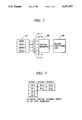
- FIG. 3 is a diagram to show an example of rotation factor storing array according to the present invention.
- FIG. 4 is a flowchart to show a process of rotation factor loading from the rotation factor storing array according to the present invention
- FIG. 5 is a diagram to show an example of a conventional rotation factor storing array
- FIG. 6 is a flowchart to illustrate a process of rotation factor loading from the rotation factor storing array as shown in FIG. 5.
- FIG. 1 is a block diagram to show the configuration outline of a computer system for Fast Fourier Transform provided with a vector functional unit.
- the reference numeral 10 indicates a main memory
- the numerals 2-1 to 2-4 are memory access controllers
- 30 is a vector register
- 40 is a vector functional unit.
- the main memory 10 actually has, for example, 512 banks, but it is provided with only four banks in the figure for easier understanding.
- a memory access controller 2-i (i may be 1, 2, 3 or 4) reads element data for Fast Fourier Transform from the bank i and writes data to the bank i in the main memory 10.
- the vector register 30 has a plurality of element storing areas.
- This Fast Fourier Transform system is provided with a function to decrease the size of rotation factor storing array required in Fast Fourier Transform by considering the maximum number of vector elements (maximum vector length) for the vector functional unit.
- FIG. 2 shows the data flow in the ISOGEOMETRIC type Fast Fourier Transform when the number of elements is 8.
- Input elements are indicated by f0 to f7 and output elements by F0 to F7.
- the input elements f0 to f7 are rearranged, subjected to vector addition/subtraction and then multiplied by rotation factors W0 to W3, so as to generate the output elements F0 to F7.
- This flow can be processed by vector processing.
- Rotation factors W0 to W3 are used in the stage 1, W0 and W2 in the stage 2 and W0 in the stage 3.
- the factor W0 is required in all stages.
- the number of rotation factors with the same value is doubled for every stage as in the array of FIG. 5.
- the rotation factor storing area is reduced by utilizing this fact and the maximum number of vector elements (maximum vector length) for the vector functional unit.
- the rotation factor W0 amounts to one at Stage 1, two at Stage 2 and four at Stage 3; it is doubled every stage.
- the rotation factor W2 amounts to one at Stage 1 and two at stage 2; W2 is also doubled every stage.
- the number of rotation factors loaded for a single vector instruction is limited to the maximum number of vector elements (maximum vector length) for the vector functional unit.
- the maximum number of vector elements is two, and two rotation factors corresponding to the maximum number of vector elements are loaded from the array for each vector instruction for rotation factor multiplication.
- the rotation factors W0 and W1 first, and then W2 and W3 are loaded at Stage 1.
- Stage 2 two W0's are loaded as the rotation factors having the same value, and two W2's are loaded also as the rotation factors having the same value.
- four W0's are loaded in two processes as the rotation factors having the same value.
- the number of rotation factors loaded for a single vector instruction is the same as the maximum number of vector elements (maximum vector length) for the vector functional unit. Therefore, if certain rotation factors having the same value are equal to or more than the maximum number of vector elements (maximum vector length), that rotation factor can be stored only once in the array for the maximum number of vector elements (maximum vector length).
- the number of rotation factor W0's at Stage 2 is two, which is equal to the maximum number of vector elements (maximum vector length). Accordingly, the rotation factor W0 is stored only once for the maximum number of vector elements (maximum vector length) as shown in the array of FIG. 3. Similarly, since there are two rotation factors W2 at Stage 2, which is the same as the maximum number of vector elements (maximum vector length), the rotation factor W2 is also stored only once for the maximum number of vector elements (maximum vector length). The rotation factors W0 and W2 thus stored are scalar loaded for each vector instruction.
- the rotation factor storing array in FIG. 3 can be of a size smaller than the conventional one (in FIG. 5).
- the size S of the storing array can be determined by the formula below.
- S is the size of the rotation factor storing area
- N is the number Of elements for Fast Fourier Transform
- VL is the maximum number of vector elements for the vector functional unit
- log is a logarithm to the base two.
- the above formula is applied to a decision of the size of the storing array.
- the rotation factor storing area has a size of 8 (FIG. 3), which is smaller than the conventional one.
- FIG. 4 is a flowchart to illustrate the rotation factor loading using the rotation factor storing array as shown in FIG. 3.
- Step 401 before loading of rotation factors by the maximum number of vector elements for each vector instruction, it is judged whether the rotation factors to be loaded have the same value or not (Step 401).
- the rotation factors In the processing at Stage 1 of the Fast Fourier Transform as shown in FIG. 2, the rotation factors have different values, and the answer for Step 401 is No.
- the values are vector loaded from the rotation factor storing area for rotation factor multiplication (Step 402). Specifically, the rotation factors W0 and W1 first, and then the rotation factors W2 and W3 are vector loaded.
- the W0 rotation factors have the same value and the W2 rotation factors have the same value, and the answer for Step 401 is Yes.
- rotation factors are scalar loaded from the rotation factor storing area for multiplication (Step 402). Specifically, the value of the stored rotation factor W0 is firstly scalar loaded for the number corresponding to the maximum number of vector elements, and then the value of the rotation factor W2 is scalar loaded for the number corresponding to the maximum number of vector elements.
- all rotation factors (W0) have the same value.
- the answer is Yes for Step 401, and the value of the rotation factor is scalar loaded from the rotation factor storing area for multiplication (Step 402). Specifically, the value of the stored rotation factor W0 is firstly scalar loaded for the number corresponding to the maximum number of vector elements, and then the value of the rotation factor W0 again is scalar loaded for the number corresponding to the maximum number of vector elements.
- the conventional method where all rotation factors are vector loaded as shown in FIG. 6 requires that all of the rotation factors used in different stages be kept in the rotation factor storing array, which results in the size S of the storing area needing to be N/2 ⁇ logN.
- the reduced size of the rotation factor storing area helps speed up the processing of rotation factor generation.
Landscapes
- Physics & Mathematics (AREA)
- Mathematical Physics (AREA)
- Engineering & Computer Science (AREA)
- General Physics & Mathematics (AREA)
- Computational Mathematics (AREA)
- Mathematical Analysis (AREA)
- Mathematical Optimization (AREA)
- Pure & Applied Mathematics (AREA)
- Data Mining & Analysis (AREA)
- Theoretical Computer Science (AREA)
- Discrete Mathematics (AREA)
- Algebra (AREA)
- Databases & Information Systems (AREA)
- Software Systems (AREA)
- General Engineering & Computer Science (AREA)
- Complex Calculations (AREA)
Applications Claiming Priority (2)
| Application Number | Priority Date | Filing Date | Title |
|---|---|---|---|
| JP3-348345 | 1991-12-05 | ||
| JP3348345A JPH05158967A (ja) | 1991-12-05 | 1991-12-05 | 計算機システム |
Publications (1)
| Publication Number | Publication Date |
|---|---|
| US5327367A true US5327367A (en) | 1994-07-05 |
Family
ID=18396406
Family Applications (1)
| Application Number | Title | Priority Date | Filing Date |
|---|---|---|---|
| US07/986,535 Expired - Fee Related US5327367A (en) | 1991-12-05 | 1992-12-07 | Computer system with vector functional unit for fast fourier transform |
Country Status (2)
| Country | Link |
|---|---|
| US (1) | US5327367A (ja) |
| JP (1) | JPH05158967A (ja) |
Cited By (3)
| Publication number | Priority date | Publication date | Assignee | Title |
|---|---|---|---|---|
| US7685220B2 (en) | 2005-12-14 | 2010-03-23 | Telefonaktiebolaget L M Ericsson (Publ) | Circular fast fourier transform |
| US20110185001A1 (en) * | 2009-06-24 | 2011-07-28 | Huawei Technologies Co., Ltd. | Signal Processing Method and Data Processing Method and Apparatus |
| US10375131B2 (en) * | 2017-05-19 | 2019-08-06 | Cisco Technology, Inc. | Selectively transforming audio streams based on audio energy estimate |
Citations (3)
| Publication number | Priority date | Publication date | Assignee | Title |
|---|---|---|---|---|
| US4223185A (en) * | 1977-11-18 | 1980-09-16 | Le Materiel Telephonique | Multifrequency digital signal receiver |
| US4231102A (en) * | 1978-12-21 | 1980-10-28 | Raytheon Company | Cordic FFT processor |
| US4899301A (en) * | 1986-01-30 | 1990-02-06 | Nec Corporation | Signal processor for rapidly calculating a predetermined calculation a plurality of times to typically carrying out FFT or inverse FFT |
-
1991
- 1991-12-05 JP JP3348345A patent/JPH05158967A/ja active Pending
-
1992
- 1992-12-07 US US07/986,535 patent/US5327367A/en not_active Expired - Fee Related
Patent Citations (3)
| Publication number | Priority date | Publication date | Assignee | Title |
|---|---|---|---|---|
| US4223185A (en) * | 1977-11-18 | 1980-09-16 | Le Materiel Telephonique | Multifrequency digital signal receiver |
| US4231102A (en) * | 1978-12-21 | 1980-10-28 | Raytheon Company | Cordic FFT processor |
| US4899301A (en) * | 1986-01-30 | 1990-02-06 | Nec Corporation | Signal processor for rapidly calculating a predetermined calculation a plurality of times to typically carrying out FFT or inverse FFT |
Cited By (6)
| Publication number | Priority date | Publication date | Assignee | Title |
|---|---|---|---|---|
| US7685220B2 (en) | 2005-12-14 | 2010-03-23 | Telefonaktiebolaget L M Ericsson (Publ) | Circular fast fourier transform |
| US20110185001A1 (en) * | 2009-06-24 | 2011-07-28 | Huawei Technologies Co., Ltd. | Signal Processing Method and Data Processing Method and Apparatus |
| US8145695B2 (en) * | 2009-06-24 | 2012-03-27 | Huawei Technologies Co., Ltd. | Signal processing method and data processing method and apparatus |
| KR101202729B1 (ko) | 2009-06-24 | 2012-11-21 | 후아웨이 테크놀러지 컴퍼니 리미티드 | 신호 처리 방법과 데이터 처리 방법 및 장치 |
| US8554818B2 (en) | 2009-06-24 | 2013-10-08 | Huawei Technologies Co., Ltd. | Signal processing method and data processing method and apparatus |
| US10375131B2 (en) * | 2017-05-19 | 2019-08-06 | Cisco Technology, Inc. | Selectively transforming audio streams based on audio energy estimate |
Also Published As
| Publication number | Publication date |
|---|---|
| JPH05158967A (ja) | 1993-06-25 |
Similar Documents
| Publication | Publication Date | Title |
|---|---|---|
| US5134695A (en) | Method and apparatus for constant stride accessing to memories in vector processor | |
| US4771380A (en) | Virtual vector registers for vector processing system | |
| US5923612A (en) | Synchronous semiconductor memory device having macro command storage and execution method therefor | |
| US5327367A (en) | Computer system with vector functional unit for fast fourier transform | |
| US6704834B1 (en) | Memory with vectorial access | |
| US8321869B1 (en) | Synchronization using agent-based semaphores | |
| US4301514A (en) | Data processor for processing at one time data including X bytes and Y bits | |
| US5548752A (en) | Method and system for storing data in a memory device | |
| US6023719A (en) | Signal processor and method for fast Fourier transformation | |
| US5602727A (en) | Image processor | |
| US20250068329A1 (en) | Memory device and operating method thereof | |
| US20230169144A1 (en) | Operation method, processor, and related product | |
| US6421825B2 (en) | Register control apparatus and method thereof for allocating memory based on a count value | |
| US5802522A (en) | Method and system of storing data blocks that have common data elements | |
| US5140542A (en) | Method and device for the arithmetical calculation of two-dimensional transforms | |
| US20250390551A1 (en) | Calculation device and calculation method | |
| US5640336A (en) | Computational array and method for calculating multiple terms of a polynomial in a single computing element | |
| CN112306402B (zh) | 程序执行方法、电子设备及计算机可读存储介质 | |
| US6668285B1 (en) | Object oriented processing with dedicated pointer memories | |
| US4987557A (en) | System for calculation of sum of products by repetitive input of data | |
| JPH0324695B2 (ja) | ||
| US5134694A (en) | Method and device for the processing of address words | |
| WO1996005598A1 (en) | Method and system for storing data blocks in a memory device | |
| KR0168973B1 (ko) | 어드레스를 자동 증가시켜 롬을 억세스하는 방법 및 그장치 | |
| JP2845746B2 (ja) | マイクロプログラム制御装置 |
Legal Events
| Date | Code | Title | Description |
|---|---|---|---|
| AS | Assignment |
Owner name: NEC CORPORATION, JAPAN Free format text: ASSIGNMENT OF ASSIGNORS INTEREST.;ASSIGNOR:YAMADA, SHOUICHIROU;REEL/FRAME:006453/0050 Effective date: 19930122 |
|
| FEPP | Fee payment procedure |
Free format text: PAYOR NUMBER ASSIGNED (ORIGINAL EVENT CODE: ASPN); ENTITY STATUS OF PATENT OWNER: LARGE ENTITY |
|
| FPAY | Fee payment |
Year of fee payment: 4 |
|
| REMI | Maintenance fee reminder mailed | ||
| LAPS | Lapse for failure to pay maintenance fees | ||
| STCH | Information on status: patent discontinuation |
Free format text: PATENT EXPIRED DUE TO NONPAYMENT OF MAINTENANCE FEES UNDER 37 CFR 1.362 |
|
| FP | Lapsed due to failure to pay maintenance fee |
Effective date: 20020705 |