US5342858A - Elastomeric adhesive foam - Google Patents
Elastomeric adhesive foam Download PDFInfo
- Publication number
- US5342858A US5342858A US08/085,537 US8553793A US5342858A US 5342858 A US5342858 A US 5342858A US 8553793 A US8553793 A US 8553793A US 5342858 A US5342858 A US 5342858A
- Authority
- US
- United States
- Prior art keywords
- foam
- elastomeric
- adhesive material
- adhesive
- copolymer
- Prior art date
- Legal status (The legal status is an assumption and is not a legal conclusion. Google has not performed a legal analysis and makes no representation as to the accuracy of the status listed.)
- Expired - Lifetime
Links
Images


Classifications
-
- C—CHEMISTRY; METALLURGY
- C08—ORGANIC MACROMOLECULAR COMPOUNDS; THEIR PREPARATION OR CHEMICAL WORKING-UP; COMPOSITIONS BASED THEREON
- C08J—WORKING-UP; GENERAL PROCESSES OF COMPOUNDING; AFTER-TREATMENT NOT COVERED BY SUBCLASSES C08B, C08C, C08F, C08G or C08H
- C08J9/00—Working-up of macromolecular substances to porous or cellular articles or materials; After-treatment thereof
- C08J9/30—Working-up of macromolecular substances to porous or cellular articles or materials; After-treatment thereof by mixing gases into liquid compositions or plastisols, e.g. frothing with air
-
- C—CHEMISTRY; METALLURGY
- C09—DYES; PAINTS; POLISHES; NATURAL RESINS; ADHESIVES; COMPOSITIONS NOT OTHERWISE PROVIDED FOR; APPLICATIONS OF MATERIALS NOT OTHERWISE PROVIDED FOR
- C09J—ADHESIVES; NON-MECHANICAL ASPECTS OF ADHESIVE PROCESSES IN GENERAL; ADHESIVE PROCESSES NOT PROVIDED FOR ELSEWHERE; USE OF MATERIALS AS ADHESIVES
- C09J153/00—Adhesives based on block copolymers containing at least one sequence of a polymer obtained by reactions only involving carbon-to-carbon unsaturated bonds; Adhesives based on derivatives of such polymers
- C09J153/02—Vinyl aromatic monomers and conjugated dienes
-
- C—CHEMISTRY; METALLURGY
- C09—DYES; PAINTS; POLISHES; NATURAL RESINS; ADHESIVES; COMPOSITIONS NOT OTHERWISE PROVIDED FOR; APPLICATIONS OF MATERIALS NOT OTHERWISE PROVIDED FOR
- C09J—ADHESIVES; NON-MECHANICAL ASPECTS OF ADHESIVE PROCESSES IN GENERAL; ADHESIVE PROCESSES NOT PROVIDED FOR ELSEWHERE; USE OF MATERIALS AS ADHESIVES
- C09J5/00—Adhesive processes in general; Adhesive processes not provided for elsewhere, e.g. relating to primers
- C09J5/08—Adhesive processes in general; Adhesive processes not provided for elsewhere, e.g. relating to primers using foamed adhesives
-
- C—CHEMISTRY; METALLURGY
- C08—ORGANIC MACROMOLECULAR COMPOUNDS; THEIR PREPARATION OR CHEMICAL WORKING-UP; COMPOSITIONS BASED THEREON
- C08J—WORKING-UP; GENERAL PROCESSES OF COMPOUNDING; AFTER-TREATMENT NOT COVERED BY SUBCLASSES C08B, C08C, C08F, C08G or C08H
- C08J2353/00—Characterised by the use of block copolymers containing at least one sequence of a polymer obtained by reactions only involving carbon-to-carbon unsaturated bonds; Derivatives of such polymers
- C08J2353/02—Characterised by the use of block copolymers containing at least one sequence of a polymer obtained by reactions only involving carbon-to-carbon unsaturated bonds; Derivatives of such polymers of vinyl aromatic monomers and conjugated dienes
-
- C—CHEMISTRY; METALLURGY
- C08—ORGANIC MACROMOLECULAR COMPOUNDS; THEIR PREPARATION OR CHEMICAL WORKING-UP; COMPOSITIONS BASED THEREON
- C08L—COMPOSITIONS OF MACROMOLECULAR COMPOUNDS
- C08L2666/00—Composition of polymers characterized by a further compound in the blend, being organic macromolecular compounds, natural resins, waxes or and bituminous materials, non-macromolecular organic substances, inorganic substances or characterized by their function in the composition
- C08L2666/02—Organic macromolecular compounds, natural resins, waxes or and bituminous materials
- C08L2666/04—Macromolecular compounds according to groups C08L7/00 - C08L49/00, or C08L55/00 - C08L57/00; Derivatives thereof
-
- C—CHEMISTRY; METALLURGY
- C08—ORGANIC MACROMOLECULAR COMPOUNDS; THEIR PREPARATION OR CHEMICAL WORKING-UP; COMPOSITIONS BASED THEREON
- C08L—COMPOSITIONS OF MACROMOLECULAR COMPOUNDS
- C08L2666/00—Composition of polymers characterized by a further compound in the blend, being organic macromolecular compounds, natural resins, waxes or and bituminous materials, non-macromolecular organic substances, inorganic substances or characterized by their function in the composition
- C08L2666/28—Non-macromolecular organic substances
-
- Y—GENERAL TAGGING OF NEW TECHNOLOGICAL DEVELOPMENTS; GENERAL TAGGING OF CROSS-SECTIONAL TECHNOLOGIES SPANNING OVER SEVERAL SECTIONS OF THE IPC; TECHNICAL SUBJECTS COVERED BY FORMER USPC CROSS-REFERENCE ART COLLECTIONS [XRACs] AND DIGESTS
- Y10—TECHNICAL SUBJECTS COVERED BY FORMER USPC
- Y10S—TECHNICAL SUBJECTS COVERED BY FORMER USPC CROSS-REFERENCE ART COLLECTIONS [XRACs] AND DIGESTS
- Y10S428/00—Stock material or miscellaneous articles
- Y10S428/913—Material designed to be responsive to temperature, light, moisture
-
- Y—GENERAL TAGGING OF NEW TECHNOLOGICAL DEVELOPMENTS; GENERAL TAGGING OF CROSS-SECTIONAL TECHNOLOGIES SPANNING OVER SEVERAL SECTIONS OF THE IPC; TECHNICAL SUBJECTS COVERED BY FORMER USPC CROSS-REFERENCE ART COLLECTIONS [XRACs] AND DIGESTS
- Y10—TECHNICAL SUBJECTS COVERED BY FORMER USPC
- Y10T—TECHNICAL SUBJECTS COVERED BY FORMER US CLASSIFICATION
- Y10T428/00—Stock material or miscellaneous articles
- Y10T428/24—Structurally defined web or sheet [e.g., overall dimension, etc.]
- Y10T428/24025—Superposed movable attached layers or components
-
- Y—GENERAL TAGGING OF NEW TECHNOLOGICAL DEVELOPMENTS; GENERAL TAGGING OF CROSS-SECTIONAL TECHNOLOGIES SPANNING OVER SEVERAL SECTIONS OF THE IPC; TECHNICAL SUBJECTS COVERED BY FORMER USPC CROSS-REFERENCE ART COLLECTIONS [XRACs] AND DIGESTS
- Y10—TECHNICAL SUBJECTS COVERED BY FORMER USPC
- Y10T—TECHNICAL SUBJECTS COVERED BY FORMER US CLASSIFICATION
- Y10T442/00—Fabric [woven, knitted, or nonwoven textile or cloth, etc.]
- Y10T442/60—Nonwoven fabric [i.e., nonwoven strand or fiber material]
- Y10T442/647—Including a foamed layer or component
- Y10T442/651—Plural fabric layers
Definitions
- the present invention is directed to an elastomeric composition, more particularly an elastomeric adhesive foam composition.
- the foams are particularly useful as an elastic component in disposable absorbent articles such as diapers, incontinent devices, training pants, and the like.
- these adhesive compositions can only be applied by utilizing very expensive manufacturing machinery such as extruders and the like. Further, this high viscosity slows the speed of production lines using conventional manufacturing machinery, thereby increasing the manufacturing costs of disposable garments employing these compositions.
- the adhesive compositions of Bunnelle, et al. do not appear to possess the level of adhesion which is necessary for the construction of disposable absorbent garments. Moreover, these compositions do not appear to provide for a convenient and expeditious means by which adhesion can be adjusted without affecting their elastomeric properties.
- the film formers can be extruded as a foam as well as a continuous film, and include pressure-sensitive adhesive materials.
- the pressure-sensitive adhesives disclosed by Korpman would be expected to possess a very high viscosity even at elevated temperatures. Consequently, these compositions, like the compositions of the foregoing Bunnelle patents, would be expected to require very expensive manufacturing equipment (e.g., extruders) and to suffer from low production speeds using conventional equipment.
- the structures of Korpman are limited by the extensibility of the backing and/or facing fabric.
- Another object of the present invention is to provide a foam which can be formed on-line in a pattern or shape.
- Another object of the present invention is to provide elastic foams which may be formed into a sheet or other shapes utilizing relatively inexpensive manufacturing techniques or devices, and further which may be formed in a relatively short production time.
- Yet another object of the present invention is to provide foams having properties desirable for use in absorbent articles, e.g., a relatively high elastomeric retention, a relatively short recovery time, and good adhesion to components typically used therein.
- a specified caliper i.e., loft or thickness
- the present invention relates to an elastomeric, hot-melt adhesive foam (also referred to herein as “elastomeric adhesive foam,” or “adhesive foam”) comprising an elastomeric, hot-melt adhesive material.
- the adhesive material preferably comprises:
- A-B-A block copolymer in which the A block (i.e., end block) is derived from styrene and the B block (i.e., mid block) is derived from butadiene or isoprene;
- the proportions of the block copolymer, aromatic modified hydrocarbon resin, and processing oil are preferably selected to provide an elastomeric, hot-melt adhesive material having a viscosity of less than about 200,000 centipoise at 325° F. and an elastomeric retention value of at least about 75%.
- the total concentration of styrene in the block copolymer may vary in a wide range of from about 15% to about 50%, more preferably about 25% to about 50%, of the total weight of the copolymer.
- a styrene concentration in the latter range provides an adhesive material which displays a particularly desirable viscosity.
- the foams of the present invention are preferably pressure-sensitive.
- the pressure-sensitive foam has a cell structure such that the foam remains compressible upon repeated application of compressive forces (i.e., the foam is resilient).
- foams are preferably characterized by closed cells.
- the present invention further relates to elastic structures and absorbent articles incorporating the elastomeric adhesive foam, and methods of making same.
- the foams of the present invention tend to provide improved structural rigidity, thereby decreasing the tendency of an absorbent article incorporating the foam to fold and/or crease.
- the foams tend to provide increased resiliency and compressibility so as to provide an improved fit of an absorbent garment incorporating the adhesive foam.
- the adhesive foams tend to distribute forces over a greater area (i.e., lower modulus), thereby reducing the tendency for red marking and increasing the comfort of the wearer of such absorbent articles.
- the foams of the present invention are made on-line and integral with an absorbent article to elasticize entire panels, or alternatively, discrete areas (e.g., side panels) of the article.
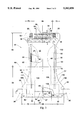
- FIG. 3 is a plan view of a disposable diaper embodiment of the present invention having portions cut away to reveal underlying structure, the outer surface of the diaper facing the viewer;
- FIG. 4 is a fragmentary sectional view of the disposable diaper shown in FIG. 3 taken along section line 4--4 of FIG. 3;
- the elastomeric adhesive foams of the present invention are formed from an elastomeric, hot-melt adhesive material (also referred to herein as "elastomeric adhesive material” or “adhesive material”).
- the adhesive material is preferably pressure-sensitive.
- Adhesive as used herein means a substance capable of holding materials together by surface attachment (adhesion). Adhesion typically results from (a) mechanical bonding and/or (b) chemical forces, including either primary covalent bonds or polar secondary forces between the adhesive and the surface (adherend). The particular mechanisms of bonding generally depend on the surface characteristics, including the porosity, of the adherend.
- melt includes but is not limited to the thermodynamic melt state in which crystals of a substance are in equilibrium with the liquid phase at a given temperature and pressure. These terms are also meant to include an apparently homogeneous, liquid condition.
- solidified refers to both solid, semi-solid, and tacky states.
- foam it is meant a dispersion of a gas in the molten elastomeric adhesive material or the solidified adhesive material (the latter is also referred to herein as a “permanent foam”).
- the dispersion results in a structure which can be described as membranes or struts of adhesive material which are interconnected so as to form cells.
- closed cell it is meant that a cell is completely enclosed by a membrane of the elastomeric adhesive material. Closed cell foams are generally impermeable by way of transport through the cells.
- an "open cell” is interconnected to at least one other cell. Typically, open cell foams are permeable via the cellular structure.
- the elastomeric, hot-melt adhesive material contains a relatively high molecular weight hot-melt elastomer.
- the hot-melt elastomer is preferably an elastomeric block copolymer having relatively non-elastomeric end blocks and an elastomeric mid block which is designated as an A-B-A block copolymer.
- A-B-A block copolymers are generally known in the art. For example, such copolymers are described in Handbook of Adhesives, 2d. Ed., Irving Skeist, Van Nostrand Reinhold Co. (1977), pp. 304-330, incorporated herein by reference.
- the A block is typically an alkenylarene polymer derived from a monomer such as styrene.
- the B block is typically a polymer of a conjugated aliphatic diene monomer of from 4 to 6 carbon atoms or a linear alkene monomer of from 2 to 6 carbon atoms.
- Suitable dienes include butadiene, isoprene, and the like.
- Suitable alkenes include ethylene, butylene, propylene, and the like.
- the block copolymers are referred to as S-B-S copolymers and S-I-S copolymers, respectively.
- Radial block copolymers may be designated (A-B) n X, wherein X is a polyfunctional atom or molecule and in which each (A-B) radiates from X in a way that A is an end block ("n" refers to the number of such radiating (A-B) portions).
- the total concentration of styrene in the block copolymer may vary in a wide range of from about 15% to about 50% of the total weight of the copolymer. More preferably, the block copolymer has a styrene concentration in the range of about 25% to about 50% of the total weight of the copolymer. Such concentrations surprisingly provide adhesive materials having particularly desirable viscosities when compared with compounds manufactured from related A-B-A copolymers which have less than 25% styrene by weight of the copolymer.
- block copolymers which are substantially fully coupled i.e., the copolymer is or is substantially 100% tri-block (i.e., contains low levels of or no diblock).
- the copolymer contains greater than 90% triblock, more preferably at least about 95% triblock, even more preferably at least about 99% triblock, most preferably about 100% triblock. It is believed that a relationship exists between the force which is expressed as the elastomeric retention of the adhesive material used in the present invention and the coupling efficiency of the A-B-A block copolymer of the adhesive material. In general, decreasing the amount of diblock tends to increase the elastomeric retention (at a given time interval) and the tensile strength of the adhesive material and thus of the adhesive foam.
- the S-I-S and S-B-S copolymers may be a linear copolymer in which "S" is a non-elastomeric polymeric block derived from styrene, and "I” or “B” is an elastomeric polymeric block derived from isoprene or butadiene, respectively.
- the total concentration of the styrene monomer in such copolymers ranges from about 15% to about 50%, more preferably from about 25% to about 50%, of the total weight of the copolymer.
- the copolymer is substantially fully coupled.
- Suitable S-I-S block copolymers of this type are commercially available from the Dexco Chemical Company under the product or trade designations Vector 4211, Vector 4411, and Vector 4111, respectively.
- Another suitable S-I-S block copolymer is available from the Shell Chemical Company under the trade designation RP6407.
- Vector 4211 and 4411 have respective styrene contents of about 29% and 44% of the total weight of the copolymer;
- Vector 4111 and RP6407 each have a styrene content of about 17% of the total weight of the copolymer.
- the S-I-S and S-B-S copolymer may alternatively be a teleblock copolymer.
- a teleblock copolymer includes radial copolymers characterized by molecules having at least three branches which radially branch out from a central hub, each of the branches having polystyrene terminal blocks and a polyisoprene or polybutadiene segment in the center.
- Teleblock copolymers also include branched copolymers having a branched polymerized isoprene or butadiene midblock with a polystyrene terminal block at the end of each branch.
- the total concentration of the styrene monomer in such teleblock copolymers ranges from about 15% to about 50%, more preferably from about 25% to about 50%, of the total weight of the copolymer.
- the teleblock copolymer is substantially fully coupled.
- the elastomeric adhesive material used for preparing the foam also comprises an aromatic modified hydrocarbon resin, preferably in an amount of about 30% to about 70% by weight of the adhesive material.
- the aromatic modified hydrocarbon resin associates with both the mid block and the end blocks of the tri-block copolymer.
- the resin is chemically compatible with both the end and mid blocks such that physical phase separation of the polymer and the resin does not occur to a significant extent.
- the aromatic modified hydrocarbon resin tends to increase the pressure-sensitivity (and tack) of the adhesive material and thus of the adhesive foam, at least up to a certain level of addition relative to the block copolymer. Up to a level of about 50%-60% resin, the adhesive material tends to increase in pressure-sensitivity with an increase in resin. Above about 60% resin, the adhesive tends to decrease in pressure-sensitivity and may become relatively hard and glassy. In addition, as the pressure-sensitivity increases, the elastomeric retention of the adhesive material tends to decrease until the glassy phase is reached. Similarly, the tensile strength of the adhesive material and foam may decrease with increasing levels of resin relative to the copolymer, at least until the adhesive material becomes glassy. The aromatic modified hydrocarbon resin also tends to decrease the viscosity of the adhesive material.
- the elastomeric adhesive material also preferably comprises a processing oil.
- the oil is present in amounts of up to about 30% by weight of the adhesive material.
- the oil provides some level of viscosity control and further operates as a diluent.
- the viscosity of the adhesive material tends to decrease as the amount of processing oil is increased.
- the processing oil tends to contribute to the pressure-sensitivity (and tack) of the adhesive material and foam.
- increasing levels of oil also tend to decrease the elastomeric retention and tensile strength of the adhesive material and foam.
- the oil is preferably compatible with the other components of the adhesive material such that a homogeneous mixture is formed, i.e., the mixture does not phase separate to a significant extent.
- a paraffinic or napthenic white processing oil such as are known in the art is used.
- a commercially available white processing oil suitable for use herein is available from the Witco Chemical Company as "Witco Plastics Oil 380.”
- Another suitable oil is "Kaydol,” which is also available from the Witco Chemical Company.
- the proportions of the block copolymer, aromatic modified hydrocarbon resin, and processing oil are also preferably selected in accordance with the foregoing description such that the adhesive material is pressure-sensitive (thus, the adhesive material has tack).
- Pressure-sensitivity may advantageously allow for the elasticization of absorbent articles without the need for external bonding agents, depending on the level of adhesion to a given substrate.
- the higher the tack the greater the tendency of the foam to lose compressibility, resulting in reduced caliper and a change in other physical properties. It is believed that the tack may be sufficient to cause open cell walls to cohere upon compression of the foam, resulting in a change in cell structure and a consequent loss of compressibility and other physical properties. It is further believed that this tendency can be offset by varying the open/closed cell ratio (the percent of open cells: the percent of closed cells; hereinafter referred to as the "cell ratio") of the elastomeric adhesive foam.
- the smaller the cell ratio i.e., the greater the number of closed cells relative to open cells
- the greater the tack the more desirable it will usually be to have a substantially closed cell structure. Modification of the cell ratio is further described herein.
- the elastomeric adhesive material of which the adhesive foam is comprised also preferably comprises a compound which functions as an antioxidant and/or thermal stabilizer (hereinafter referred to as stabilizer).
- stabilizer tends to protect the block copolymer, and thereby the adhesive material and adhesive foam incorporating same, from the deleterious thermal and/or oxidative effects which are frequently experienced by other similar copolymers during the manufacture and application of adhesive compositions utilizing same, as well as in the ordinary use of the final manufactured product. As should be understood, such degradation usually manifests itself by the deterioration of the adhesive material in appearance, physical properties and performance.
- a nucleating agent is incorporated into the elastomeric adhesive material.
- the nucleating agent tends to increase the foam growth rate and also influences the size distribution of the resultant bubbles. It is generally desirable to minimize the foam growth time (i.e., to increase the foam growth rate) in order to enable processing on conventional convening equipment such as used in the manufacture of disposable absorbent articles.
- the foam growth rate refers to the rate of change of volume of the foam (e.g., due to gas evolution and/or expansion out of or in the gas/adhesive material solution described herein); the foam growth time refers to the time required to achieve about 99% of final caliper once the solution is dispensed.
- the gas/adhesive material solution will typically need to be supersaturated in order to drive the gas evolution to a degree sufficient to form a foam.
- Nucleation of gas bubbles may then occur according to known principles, e.g., due to surface imperfections in the apparatus used to form the foam. Such nucleation is expected to result, however, in random bubble formation. Any bubbles which so form tend to be larger in size and fewer in number than when a nucleating agent is used.
- the foam growth time tends to be somewhat slower than when a nucleating agent is used.
- the nucleating agent tends to indirectly increase the foam growth rate.
- the bubbles will immediately form and begin to grow when the pressure of the system has been reduced to at least the critical solubility pressure, defined herein. It is believed that the growth involves both diffusion of dissolved gas molecules toward a gas phase in the bubbles and expansion of the gas bubbles. It is also believed that the nucleating agent in sufficient quantity decreases the mean diffusion path between gas bubbles since the agent induces a greater concentration of bubbles in the solution, thereby increasing the rate of gas diffusion out of solution (evolution) upon a sufficient decrease in pressure. As a result, the foam growth rate is increased.
- the rate of diffusion and thus of foam growth may also be increased by a decrease in viscosity of the gas/adhesive solution.
- a decrease in viscosity also tends to increase the foam growth rate by decreasing the flow resistance of adhesive melt surrounding the gas bubbles, thereby enhancing expansion of the gas bubbles. Expansion of the bubbles is believed to occur until the internal pressure of tile bubbles is balanced by the surface tension of the bubble in the solution.
- a decrease in viscosity and resultant increase in foam growth rate may be achieved by increasing the temperature of tile gas/adhesive solution and through compositional variations as previously described.
- Nucleating agents such as are known in the art, e.g., CaCO 3 and TiO 2 , may be used.
- the Nucleating agent is typically used in an amount of about 0.5% to about 1% by weight of the adhesive material.
- the specific nucleating agent level will generally be balanced with the effect of the agent on the viscosity of the adhesive material. The viscosity of the adhesive material tends to increase with increasing levels of the nucleating agent.
- the elastomeric adhesive material from which the foam of the present invention is made may be prepared using any of the techniques known in the art for conventional elastomeric adhesives.
- the oil and stabilizer components when used, may be placed in a jacketed mixing kettle, preferably a jacketed heavy duty mixer of the Baker-Perkins or Day type which is equipped with rotors. Thereafter, the temperature of the mixture is raised to a temperature sufficient to melt the various adhesive components, typically about 250° F. to about 350° F.
- the precise temperature to be used in this step will depend on the melt point of the particular ingredients.
- the foams of the present invention are generally formed by first melting the elastomeric adhesive material.
- the adhesive is typically melted by heating to a temperature of about 250° F. to about 400° F., preferably about 325° F. to about 375° F. Generally the temperature will be maximized in order to increase the flow rate of the material, however, the temperature and the time held at the temperature should be selected so as to avoid polymer degradation.
- the molten elastomeric adhesive material is then mixed under sufficient pressure with a suitable gas to form a solution of the gas in the elastomeric adhesive material (a foamable composition is formed).
- the gas evolves from and/or expands in the solution in the form of bubbles in the molten adhesive material to form a structure comprising the elastic adhesive material and cells (a foam is formed).
- the structure is stabilized, e.g., by cooling the adhesive material, to form a foam structure which is relatively permanent at room temperature.
- the amount of the gas which is incorporated into the molten elastomeric adhesive material may be selected so as to provide a foam having a desired density or caliper.
- the foam modulus tends to decrease with decreasing foam density (and thus with increasing gas loading) the desired density should be balanced with the desired modulus.
- at least about 25 volume %, more preferably at least about 50 volume % of gas is incorporated into the elastic adhesive material.
- About 65 volume % to about 75 volume % gas tends to provide a suitable balance of foam density, caliper, and modulus.
- the resultant foams typically have, respectively, a void volume of at least about 20-about 25%; at least about 40-about 50%; about 50-about 65%; and about 60-about 75%.
- solution is used herein to describe the molten elastomeric adhesive containing the gas supplied under a pressure above atmospheric pressure and sufficient to cause the gas to rapidly evolve and/or expand when the pressure is reduced to atmospheric pressure such that a foam is formed.
- the solution is a relatively homogeneous mixture of the gas and molten adhesive material, the gas molecules being dissolved and/or dispersed in the adhesive material.
- P cs is determined for at least two gas volume percentages by injecting a known volume percent of gas at standard temperature and pressure into a known quantity of adhesive material under a pressure such that, after sufficient mixing and time, no gas bubbles are visible. The pressure is then reduced until bubbles appear and further until the point at which the bubbles begin to grow in size. The pressure at which initial enlargement is apparent to the naked eye is taken as the critical solubility pressure P cs .
- the critical solubility pressure for a desired gas loading is then determined by multiplying the coefficient (A) by [x/(1-x)] where "x" is the desired volume fraction of the gas.
- the gas evolves from and/or expands in the solution in the form of bubbles in the molten adhesive material to form a structure comprising the elastic adhesive material and cells (a foam is formed).
- the solution is typically caused to foam by decreasing the pressure to a point below the critical solubility pressure. It is typically desired to avoid the reduction of pressure until the desired point of discharge. If the critical solubility pressure is reached before this point, there may be a loss of gas resulting in a decreased caliper. It is believed that, if the critical solubility pressure is reached before discharge, the wall shear exerted by a typical fluid transport system causes the bubbles flowing near the walls of the dispensing device to elongate and weaken. As a result, bubbles can burst upon exiting the device such that gas is lost and there is a decrease in caliper and an increase in density (and basis weight). An increased number of open cells relative to closed cells may also result.
- a particularly suitable method of incorporating the gas into the adhesive material utilizes the FoamMix® system available from the Nordson Corporation of West Lake, OH. This system is described in detail in U.S. Pat. Nos. 4,778,631, issued to Cobbs, Jr. et al., on Oct. 18, 1988; and 5,056,034, issued to Rucki, et al. on Oct. 8, 1991.
- the adhesive material may be mixed with the gas to provide an adhesive/gas solution under pressure such that when the adhesive/gas solution is subsequently discharged at atmospheric pressure, the gas is released from the solution and becomes entrapped in the adhesive material to form a relatively homogeneous foam.
- the disc mixer includes a tubular housing, one or more drive shafts extending along the length of the housing, and a series of discs spaced along the shafts.
- the gas enters into solution with the copolymer mixture in the compartments between the rotating discs.
- the overall pressure drop of the system is kept sufficiently low relative to the temperature increase of the material to maintain the gas in solution throughout the system and up to the dispensing device, e.g., a valved nozzle, to avoid foaming of the material prior to discharge.
- the foam is stabilized by cooling the molten adhesive material. Under laboratory conditions, ambient temperatures will generally suffice. Alternatively, the cellular structure may be cooled by external means, e.g., chill rolls. It is generally desired to immediately form a skin on the foam surfaces by cooling just the outside surfaces in order to prevent or minimize gas loss. Generally, every chilled surface will form a skin thereon. However, sufficient time should be allowed for the gas bubbles to grow to substantially their maximum size at standard temperature and pressure (i.e., the gas is at or near its equilibrium pressure at standard temperature and pressure). If the adhesive material sets prior to such growth, there may later be an apparent gas loss resulting from the pressure exerted by the gas entrapped in closed cells.
- lamination preferably occurs after the foam structure has solidified (e.g., using the pressure-sensitive properties of the adhesive material of the foam and/or external bonding agents as described herein). Lamination may alternatively occur before cooling (i.e., via the hot-melt properties of the adhesive material) if the process is carefully engineered to avoid compression during solidification.
- the clearance of the combining rolls may be set to the loft of the unsolidified foam existing at the time the laminae pass through the combining rolls.
- the foam is typically shaped during and/or after its formation. Shaping may be achieved by any conventional shaping technique as are known in the art to form a foam having a defined shape and size.
- Preferred methods for shaping the foam include casting, molding, or forming operations. Casting and molding techniques generally involve introducing the solution into a prepared mold cavity or onto a substrate and reducing the pressure such that the foam expands into the shape of the mold cavity or substrate. Examples of specific molding techniques for use herein include injection molding, rotary molding, and vacuum molding. Forming techniques involve performing various operations on the gas/adhesive material solution or foam to modify its shape and/or size. Examples of specific forming techniques for use herein include coating, extruding, and laminating operations.
- the resultant elastomeric adhesive material foam in an uncompressed state can be described as a relatively homogeneous dispersion of a gas in the elastomeric adhesive material.
- the gas can be dispersed to form closed and/or open cells, as previously defined.
- the foam may thus be characterized by a cell ratio, i.e., the percent open cells/percent closed cells.
- the cell ratio and other features can impact on various properties of the foam, including caliper, elongation force, compressibility, and resilience.
- the cell ratio may be varied by changing the percent of gas incorporated into the elastomeric adhesive material.
- the cell ratio may also vary with the viscosity, and thus the temperature, of the gas/adhesive material solution. For a given viscosity and temperature, the cell ratio tends to increase with an increase in gas loading (volume % or fraction). For a given gas loading, the greater the viscosity or the lower the temperature, the greater the tendency for closed cells to form such that the cell ratio decreases.
- a gas loading of about 50 volume % provides at least about 90% closed cells (cell ratio of 1:9) at the process temperatures typically used, e.g., 325° F.
- Gas loadings of 75-80 volume % may provide up to about 75% closed cells (cell ratio 4:3), depending on the process temperature used.
- the cell ratio may also be influenced by the length of the time period between the point at which the critical solubility pressure is reached and the point of discharge of the solution from, e.g., a dispensing nozzle (i.e., the "transit time"). It is believed that the longer the transit time, the more likely the formation of open cells and consequent gas loss and reduced caliper (it is believed that open cells tend to form as a result of wall shear during transport). For example, one system displayed about 50% gas loss for a transit time of about 10 milliseconds. Thus, the shorter the transit time, the lower the cell ratio tends to be.
- the transit time tends to decrease with an increase in the flow rate of the solution in a transport system.
- any factor tending to increase the flow rate tends to decrease the transit time and the cell ratio.
- the transit time may be reduced by decreasing the viscosity, e.g., by increasing the temperature, of the solution.
- the transit time may also be reduced by decreasing the length of the transport system, e.g., the dispensing device (e.g., nozzle).
- the foam For use in absorbent articles, it is generally preferred that the foam have a caliper of from about 25 to about 60 mils, preferably from about 35 to about 45 mils. Foams having such calipers are believed to aid in providing sufficient stiffness to prevent or minimize rolling and/or creasing of structures incorporating the foam. In addition, these calipers provide a desirable aesthetic effect in articles incorporating same.
- caliper tends to increase with increasing gas loadings and to decrease with increasing line speed.
- the foam caliper may tend to decrease after compression of the foam. This effect is more likely as the cell ratio increases.
- suitable foams may require using lower process temperatures and/or reduced transit times in order to ensure a percentage of closed cells sufficient to retain an initial caliper (and compressibility) after the foam is subjected to compressive forces, e.g., during processing or in use. Caliper is also affected by the ability of the foam to grow.
- the foams of the present invention may also be characterized by a force of elongation at 50% extension as defined herein in reference to elasticized side panels of absorbent articles.
- the force of elongation is primarily determined by the elastomeric adhesive material making up the foam.
- the force of elongation is also influenced by the foam density. For a given cell ratio and cell size, the force of elongation tends to increase with an increase in foam density (i.e., with a decrease in gas fraction).
- the force of elongation of the foam may also be influenced by the cell ratio.
- the elongation force tends to increase as the cell ratio decreases.
- the elongation force may be increased by any of the methods of decreasing the cell ratio, e.g., decreasing temperature or gas loading.
- the foams of the present invention are also compressible.
- compressible it is meant that the foam can be pressed down by a fairly low force, e.g., 1 psi.
- the foams are also resilient, i.e., they relax back substantially to their pre-compressed state upon removal of the compressive force.
- Compressibility and resilience are primarily a result of the foam cellular structure and the elastomeric properties of the elastomeric adhesive material. Thus, any factor which influences the cell structure and elastomeric properties may impact on compressibility and resilience. In general, compressibility tends to increase as the cell ratio increases (increasing open cells) while resilience tends to increase as the cell ratio decreases (increasing closed cells).
- the foams of the present invention are useful when joined to a carrier, and are particularly useful for imparting elastomeric properties to the carrier.
- the carrier may be any carrier as are known in the art such as non-woven webs, apertured polymeric webs, and polymer films. Suitable carriers include any of the top sheet, back sheet, or absorbent core materials described herein for use in absorbent articles.
- the carrier may be of any desired shape and may be shaped before, during or after joinder with the foam.
- the foam is preferably joined to the carrier via the adhesive properties of the elastomeric adhesive material making up the foam.
- external bonding agents such as those adhesives described herein in reference to joinder of the backsheet may be desired.
- the foam may be joined to the carrier in a continuous process, i.e. on-line, or alter forming the foam in an intermediate step, i.e., off-line.
- the foam may be joined to one or more carriers, e.g., to form a bilaminate or a trilaminate in which the foam is the central lamina and two carriers are the outboard laminae.
- the foam may be joined to at least one carrier via the hot-melt and/or pressure-sensitive properties of the adhesive foam.
- External bonding agents may also be used to effect or enhance joinder.
- joinder occurs via the hot-melt and/or pressure-sensitive properties of the elastomeric adhesive material of which the foam is comprised.
- Joinder via the hot-melt property of the adhesive material to at least one carrier occurs where the foam is formed directly on a permanent substrate, e.g., a backsheet material for use in absorbent articles.
- a permanent substrate e.g., a backsheet material for use in absorbent articles.
- the temperature of the hot-melt may need to be regulated in order to avoid or minimize deformation or melting of the carrier(s).
- a trilaminate can also be formed by solidifying the foam on a first carrier (the resultant bilaminate is via the hot-melt property) followed by joinder of a second carrier via the pressure-sensitive properties of the adhesive material and/or an external bonding agent where the adhesive foam has relatively low adhesion to the second carrier.
- the foam has sufficient tack so as to allow joinder to the second carrier via the pressure-sensitive property of the foam.
- the foam is formed and solidified on a temporary substrate such as a forming roll or forming belt (e.g., a transfer belt) and then affixed to one or more carriers via the pressure-sensitive property of the foam and/or an external bonding agent.
- a foam having sufficient pressure-sensitivity to allow joinder without additional bonding agents is used.
- the forming roll may be smooth to provide a continuous sheet of the foam, or patterned (e.g., a rotary mold such as a "pocket” or "pattern” roll, and preferably using at least one intermittent dispensing device) to provide foam shapes as may be desired.
- the foam is directly formed on a temporary substrate such as release paper.
- a temporary substrate such as release paper.
- the foam can be joined to one or more carriers via the pressure-sensitive adhesive properties of the foam and/or an external bonding agent.
- the foam may be applied to a first carrier in a pre-stretched (i.e., contractible) condition or in a non-stretched condition. If applied in a stretched condition, the stretch of the resultant bilaminate will generally be maintained through the step of joinder to a second carrier where a trilaminate is desired.
- the elastomeric adhesive foam can be joined to two carriers to form a unitary, elastically extensible laminate 30 having at least three laminae.
- the central lamina 30b comprises the adhesive foam of the present invention, and is joined in face-to-face relation with at least two outboard laminae 30a and 30c.
- the outboard laminae may be any of the materials described herein in reference to the carrier, and typically comprise a relatively inextensible material.
- the laminate 30 of the present invention may be produced on the illustrated apparatus 310.
- the apparatus 310 comprises three separate lines: line 312b for the central lamina 30b and complimentary lines 312a and 312c for the outboard laminae 30a and 30c.
- the first line 312b utilized for the central lamina 30b, comprises a source of the foamable gas/adhesive material solution (not shown), a dispensing device 316 and a chill roll 318 to form the web of the central lamina 30b.
- the outboard laminae 30a and 30c are formed on lines 312a and 312c.
- the materials used for the outboard laminae 30a and 30c are taken from unwind rolls 326a and 326c through S-wrap tensioning rolls 328a and 328c and, if desired, through tracking systems 314a and 314c.
- the combining rolls 324 join the confluent laminae 30a, 30b, and 30c into a unitary laminate 30.
- the apparatus 310 comprises the means for joining at least three laminae in face-to-face relation.
- the central lamina 30b is formed from a supply of foamable gas/adhesive material solution (not shown).
- the source of the foamable solution is suitably the mixer of the FoamMix® system shown in the above referenced patents to Cobbs, Jr., et al. and Rucki, et al.
- the foamable gas/adhesive material solution is generally held at a temperature of about 325° F.-375° F. and a pressure of about 500-2,000 psig.
- the mixer supplies the foamable solution, under pressure, to the dispensing device 316.
- the dispensing device 316 may be, for example, the nozzle shown in FIG. 1 of the above referenced U.S. Pat. No. 4,778,631 issued to Cobbs, Jr., or the gun 26 as shown in FIG. 1 of the above referenced U.S. Pat. No. 5,056,034 issued to Rucki, et al.
- the dispensing device 316 has a slot through which the foamable solution for forming the central lamina 30b is dispensed to form a thin film of foam (typically about 5-15 mils in thickness unfoamed, 20-60 mils in thickness foamed) and of any desired width, onto the chill roll 318.
- the central lamina 30b is then drawn through a nip formed between tensioning rolls 322.
- the tensioning rolls 322 provide for proper takeoff speed of the central lamina 30b from the chill roll 318 and further provide for proper entry of the central lamina 30b into the combining rolls 324.
- tensioning rolls having release properties such as are known in the art in order to prevent or minimize sticking of the foam to the rolls.
- the outboard laminae 30a and 30c are taken from the unwind rolls 326a and 326c and preferably pass through S-wrap tensioning rolls 328a and 328c to provide for proper tensioning to prevent puckering or bunching of the outboard laminae 30a and 30c.
- tracking systems 314a and 314c may be employed to optimally track and adjust the web of outboard laminae 30a and 30c into the combining rolls 324.
- a tracking system manufactured by the Fife Corporation of Oklahoma City, Okla., and sold as a Fife Guide Model No. OP6 LRA is suitable.
- the laminae 30a and 30c enter the combining rolls 324 generally parallel to the travel of the laminate 30 as it passes through the nip of the combining rolls 324.
- the nip of the combining rolls 324 compresses the laminae 30a and 30c into contacting relationship with the opposed faces of the central lamina 30b causing the central lamina 30b to bond to the outboard laminae 30a and 30c--joining the three laminae 30a, 30b, and 30c.
- the laminate 30 need not incorporate two outboard laminae 30a and 30c. If desired, either or both outboard laminae 30a and 30c may be omitted from the laminate 30. Such a structure may be manufactured by selectively not operating the line 312a or 312c of the outboard lamina 30a or 30c desired to be omitted.
- the resulting laminate 30 has one lamina 30b or, for example, two laminae 30a and 30b with the lamina 30b being of elastomeric adhesive foam and the lamina 30a being of relatively inextensible substrate material.
- the exposed face of the lamina 30b may be deactivated, by an anti-blocking agent as is commonly known in the art, so that the adhesive of the lamina 30b does not bond to other materials through the pressure-sensitive properties of the adhesive making up the foam of the lamina 30b.
- Anti-blocking is accomplished by the adhesive deactivation system 330 applying a powder of resin to the exposed face of the lamina 30b.
- Suitable resin powders include talcum powder, polyolefinic powders, and preferably a resin similar to that used for the second lamina 30a.
- the adhesive deactivation system 330 may be applied to the exposed face of the lamina 30b prior to the lamina 30a entering the nip of the combining rolls 324. (It will be apparent to one skilled in the art that an adhesive deactivation system 330 should not be employed prior to the combining rolls 324 if a laminate 30 having two outboard laminate 30a and 30c is to be constructed using to the apparatus 310 of FIG. 1.)
- the resultant laminate 30 can be described as a "zero strain” laminate, i.e., the elastomeric adhesive foam is joined to the carrier in a substantially untensioned condition (i.e., "zero strain”).
- At least a portion of the "zero strain" laminate 30 containing the elastomeric foam is then subjected to mechanical stretching sufficient to permanently elongate the relatively inextensible components of the laminate 30.
- the composite or elastomeric laminate is then returned to its substantially untensioned condition so as to form a "zero strain" stretch laminate.
- the lamina 30b may be operatively associated with the laminae 30a and/or 30c in a tensioned condition (prestretched). After prestretching the lamina 30b, the lamina 30b is joined with the second lamina 30a and/or 30c. Upon release of the force causing prestretching of the lamina 30b, the resulting laminate 30 gathers or contracts in the direction of prestretching. Where a relatively inextensible outboard lamina 30a and/or 30c is used, the resulting laminate 30 will be elastically extensible to the extensibility limit of the laminae 30a or 30c.
- the lamina 30b should be prestretched to at least the desired amount of elongation to obviate high stresses and strains on the outboard laminae and rupture of the laminate. After rupture, the elastic properties of the outboard laminae 30a and/or 30c would control further elongation.
- the central lamina 30b may be prestretched by any means known in the art, For example, the surface speed of the combining rolls 324 may be greater than the surface speed of the tensioning rolls 322. This causes prestretching of the central lamina 30b in the machine direction, which prestretching is proportional to the differential surface velocity between the combining rolls 324 and the tensioning rolls 322, and the distance therebetween. Prestretching in the cross direction can occur by methods such as are known in the art, e.g., by tentering the lamina using, e.g., a Mt. Hope roll, grooved roll, or an expanding conveyor and a cam.
- the elastomeric adhesive foam may alternatively be operatively associated with the outboard lamina 30a and 30c in a tensioned condition (prestretched), followed by mechanical stretching of the laminate 30 to form a mechanically stretched, pretensioned, stretch laminate.
- At least a portion of the relatively inextensible laminae 30a and/or 30c is subjected to mechanical stretching prior to lamination with the central lamina 30b in order to provide both a "zero strain" stretch laminate and to prestrain the portion of the inextensible lamina.
- the outboard laminae may be prestretched in the same manner described in reference to the central lamina 30b.
- the lamina 30b may be in the form of a continuous sheet.
- the lamina 30b is formed as a continuous sheet on a backsheet material as described herein.
- Lamina 30a then preferably comprises a topsheet material as described herein.
- the lamina 30b may be shaped as previously described, for example, by molding such as in a rotary mold. The shaped lamina 30b is then affixed to a backsheet material (lamina 30b) so as to elasticize particular portions of a disposable absorbent article after joinder with other components of the article.
- the elastomeric adhesive foam is formed by an intermediate process as described herein for subsequent association with a permanent carrier.
- the foam can be formed on release paper, e.g., using apparatus as shown and described for apparatus 310, wherein at least one of the material unwind rolls is release paper.
- the foam may also be formed on a transfer web such as known in the art).
- the foam may then be wound upon itself for later joinder to a carrier.
- the foam can be joined to the permanent carrier in a non-tensioned condition to form a "zero strain" laminate as previously described.
- the elastomeric adhesive foam may be associated with the carrier in an elastically contractible (prestretched) condition so that the elastomeric adhesive foam gathers or contracts the carrier upon release of the force used to prestretch the foam.
- the elastomeric adhesive foam can be contractibly affixed to the carrier by laterally extending the elastomeric adhesive foam member, affixing the elastomeric adhesive foam to the carrier, and allowing the adhesive foam to assume its relaxed or uncontracted orientation.
- the previously described shaped lamina 30b may also be contractibly affixed to a carrier in such manner in a continuous process).
- the resultant "zero strain" laminate or pre-stretched laminate may be mechanically stretched as previously described to form a "zero strain” stretch laminate or a pre-tensioned stretch laminate, respectively.
- the elastomeric adhesive foams and laminates are particularly useful to impart compressibility, resilience, and/or elasticity to absorbent articles. Entire panels of such articles or portions thereof may thus be made compressible, resilient, and/or elastic.
- absorbent article refers to devices which absorb and contain body exudates, and, more specifically, refers to devices which are placed against or in proximity to the body of the wearer to absorb and contain the various exudates discharged from the body.
- the term "diaper” refers to an absorbent article generally worn by infants and incontinent persons that is worn about the lower torso of the wearer. It should be understood, however, that the present invention is also applicable to other absorbent articles such as incontinent briefs, incontinent undergarments, diaper holders and liners, training pants, feminine hygiene garments, and the like.
- the diaper 20 comprises a containment assembly 22 preferably comprising a liquid pervious topsheet 24, a liquid impervious backsheet 26 joined with the topsheet 24, and an absorbent core 28 positioned between the topsheet 24 and the backsheet 26; elasticized side panels 30; elasticized leg cuffs 32; an elastic waist feature 34; and a closure system comprising a dual tension fastening system generally multiply designated as 36.
- the diaper 20 is shown in FIG. 3 to have an outer surface 52 (facing the viewer in FIG. 3), an inner surface 54 opposed to the outer surface 52, a first waist region 56, a second waist region 58 opposed to the first waist region 56, and a periphery 60 which is defined by the outer edges of the diaper 20 in which the longitudinal edges are designated 62 and the end edges are designated 64.
- a diaper is usually described in terms of having a pair of waist regions and a crotch region between the waist regions; in this application, for simplicity of terminology, the diaper 20 is described as having only waist regions, each of the waist regions including a portion of the diaper which would typically be designated as part of the crotch region).
- the inner surface 54 of the diaper 20 comprises that portion of the diaper 20 which is positioned adjacent to the wearer's body during use (i.e., the inner surface 54 generally is formed by at least a portion of the topsheet 24 and other components joined to the topsheet 24).
- the outer surface 52 comprises that portion of the diaper 20 which is positioned away from the wearer's body (i.e., the outer surface 52 generally is formed by at least a portion of the backsheet 26 and other components joined to the backsheet 26).
- body surface refers to the surface facing the wearer's body
- garment surface refers to the surface facing away from the wearer's body).
- FIG. 4 is a cross-sectional view of the diaper 20 taken along section line 4--4 of FIG. 3 in the first waist region 56.
- FIG. 4 shows a construction of the elasticized waistband 35 of the elastic waist feature 34.
- the elasticized waistband 35 is shown in FIG. 4 in its contracted or relaxed condition.
- the elasticized waistband 35 preferably comprises a portion of the topsheet 24, a portion of the backsheet 26 that has preferably been mechanically stretched, and an elastomeric member 76 positioned between the topsheet 24 and the backsheet 26.
- the elastomeric member 76 preferably comprises the elastomeric adhesive foam of the present invention.
- the elasticized waistband can also comprise a resilient member 77, preferably positioned between the backsheet 26 and the elastomeric member 76 as shown in FIG. 4.
- the resilient member is suitably as described in U.S. Pat. No. 5,151,092 issued to Buell et al. on Sep. 29, 1992, incorporated herein by reference.
- the adhesive foam of the present invention is itself resilient, the elasticized waistband can contain additional resilient members such as described in U.S. Pat. No. 5,151,092.
- the elastic waist feature 34 comprises an interconnecting panel zone 130, a first flexural hinge zone 132 joining the interconnecting panel zone 130 with the containment assembly 22 adjacent the waist edge 83 of the absorbent core 28, an elasticized waistband 35, and a second flexural hinge zone 134 joining the elasticized waistband 35 with the interconnecting panel zone 130.
- the elasticized waistband 35 comprises a shaping panel zone 136; a waistline panel zone 138; and a predisposed, resilient, waistband flexural hinge zone 140 joining the shaping panel zone 136 and the waistline panel zone 138.
- the interconnecting panel zone 130 comprises a portion of the topsheet 24 and the backsheet 26 while the elasticized waistband 35 comprises a portion of the topsheet 24 and the backsheet 26 and the elastomeric member 76.
- the elasticized waistband can comprise a resilient member 77 as previously described herein.
- the containment assembly 22 of the diaper 20 is shown in FIG. 3 as comprising the main body (chassis) of the diaper 20.
- the containment assembly 22 comprises at least an absorbent core 28 and preferably an outer covering layer comprising the topsheet 24 and the backsheet 26.
- the containment assembly 22 generally comprises the holder and the liner (i.e., the containment assembly 22 comprises one or more layers of material to define the holder while the liner comprises an absorbent composite such as a topsheet, a backsheet, and an absorbent core.)
- the containment assembly 22 comprises the main structure of the diaper with other features added to form the composite diaper structure.
- the containment assembly 22 for the diaper 20 generally comprises the topsheet 24, the backsheet 26, and the absorbent core 28.
- the absorbent core 28 may be any absorbent means which is generally compressible, conformable, non-irritating to the wearer's skin, and capable of absorbing and retaining liquids such as urine and other certain body exudates. As shown in FIG. 3, the absorbent core 28 has a garment surface 100, a body surface 102, side edges 82, and waist edges 83.
- the absorbent core 28 may be manufactured in a wide variety of sizes and shapes (e.g., rectangular, hourglass, "T"-shaped, asymmetric, etc.) and from a wide variety of liquid-absorbent materials commonly used in disposable diapers and other absorbent articles such as comminuted wood pulp which is generally referred to as airfelt.
- absorbent materials include creped cellulose wadding; meltblown polymers including conform; chemically stiffened, modified or cross-linked cellulosic fibers; tissue including tissue wraps and tissue laminates; absorbent foams; absorbent sponges; superabsorbent polymers; absorbent gelling materials; or any equivalent material or combinations of materials.
- the configuration and construction of the absorbent core may also be varied (e.g., the absorbent core may have varying caliper zones, a hydrophilic gradient, a superabsorbent gradient, or lower average density and lower average basis weight acquisition zones; or may comprise one or more layers or structures).
- the total absorbent capacity of the absorbent core 28 should, however, be compatible with the design loading and the intended use of the diaper 20.
- the size and absorbent capacity of the absorbent core 28 may be varied to accommodate wearers ranging from infants through adults.
- Exemplary absorbent structures for use as the absorbent core 28 are described in U.S. Pat. No. 4,610,678 entitled “High-Density Absorbent Structures” issued to Weisman et al. on Sep. 9, 1986; U.S. Pat. No. 4,673,402 entitled “Absorbent Articles With Dual-Layered Cores” issued to Weisman et al. on Jun. 16, 1987; U.S. Pat. No. 4,888,231 entitled “Absorbent Core Having A Dusting Layer” issued to Angstadt on Dec. 19, 1989; and U.S. Pat. No. 4,834,735, entitled "High Density Absorbent Members Having Lower Density and Lower Basis Weight Acquisition Zones", issued to Alemany et al. on May 30, 1989. Each of these patents are incorporated herein by reference.
- the backsheet 26 is positioned adjacent the garment surface 100 of the absorbent core 28.
- the backsheet 26 is joined to the absorbent core by the elastomeric adhesive foam.
- the term "joined” encompasses configurations whereby an element is directly secured to the other element by affixing the element directly to the other element, and configurations whereby the element is indirectly secured to the other element by affixing the element to intermediate member(s) which in turn are affixed to the other element.
- a trilaminate may be formed as previously described in which one material unwind roll supplies a backsheet material and the other material unwind roll supplies a topsheet material.
- the absorbent core material is provided by means such as are known in the art, e.g., by using a vacuum forming pocket roll and a transfer web, and is affixed to the foam lamina so as to leave some portion of the foam lamina exposed, preferably the portion around the periphery of the core.
- the topsheet material is then affixed to the exposed foam lamina to effect joinder with the backsheet.
- the absorbent core material may alternatively be joined to the topsheet 24 prior to lamination with the backsheet 26.
- the elastomeric adhesive foam covers substantially all of the backsheet lamina.
- the resultant bilaminate can then be combined with the absorbent core 28 in a manner such that a portion of the adhesive foam remains exposed, preferably a portion around the entire periphery of the absorbent core.
- the topsheet 24 may then be affixed to the backsheet via the adhesive properties of the foam so as to form the diaper 20.
- the adhesive foam is patterned on the backsheet lamina by means described herein.
- the foam is patterned onto those areas of the backsheet in which it is desirable to impart resilience, compressibility, elasticity, and/or adhesive properties without the use of external bonding agents.
- the foam can be patterned onto the backsheet in those areas corresponding to the elasticized side panels 30, elastic waist feature 34, and/or elasticized leg cuffs 32.
- the foam may also be patterned onto areas to effect joinder of the absorbent core 28 and/or topsheet 24 via the adhesive properties of the foam.
- the foam pattern corresponding to the area between the absorbent core and the backsheet need not cover the entire area.
- the pattern can be such to impart compressibility to areas particularly subjected to pressure while the diaper 20 is in use.
- the backsheet 26, absorbent core material 28, and the elastomeric adhesive foam can be laminated by any of the methods previously described, including a pre-tensioned laminate, a "zero strain” laminate, a "zero strain” stretch laminate, and a mechanically stretched, pre-tensioned stretch laminate.
- a "zero strain” laminate of the backsheet 26, the absorbent core 28, and the topsheet 24 is formed. Portions of the resultant "zero strain” laminate are then mechanically stretched to form a "zero strain” stretch laminate. Mechanical stretching is preferably performed on those regions corresponding to the elasticized side panels 30, the elastic waist feature 34, and/or the elasticized leg cuffs 32.
- attachment means may comprise heat bonds, pressure bonds, ultrasonic bonds, dynamic mechanical bonds, or any other suitable attachment means or combinations of these attachment means as are known in the art.
- the backsheet 26 is impervious to liquids (e.g., urine) and is preferably manufactured from a thin plastic film, although other flexible liquid impervious materials may also be used.
- the term "flexible” refers to materials which are compliant and will readily conform to the general shape and contours of the human body.
- the backsheet 26 prevents the exudates absorbed and contained in the absorbent core 28 from wetting articles which contact the diaper 20 such as bedsheets and undergarments.
- the backsheet 26 may thus comprise a woven or nonwoven material, polymeric films such as thermoplastic films of polyethylene or polypropylene, or composite materials such as a film-coated nonwoven material.
- the backsheet 26 have an ultimate elongation to break of at least about 400% to about 700% in the cross-machine direction as measured using a method consistent with ASTM D-638.
- the above noted RR8220 and RR5475 blends are suitable backsheet materials.
- the backsheet may be a laminate comprising at least one lamina of any of the foregoing backsheet materials and at least one lamina of the elastomeric adhesive foam of the present invention.
- the backsheet laminate can comprise the elastomeric adhesive foam as a central lamina between two lamina of any of the foregoing backsheet materials, e.g., a nonwoven.
- the laminate may be formed by any of the methods described herein. Typically, a "zero strain" laminate will be formed.
- the "zero strain” laminate is subjected to mechanical stretching in order to provide both a "zero strain” stretch laminate that forms the elasticized side panels 30 and to prestrain the portion of the backsheet 26 laminate coinciding with the elastic waist feature, as previously described.
- the backsheet lamina(e) of the laminate is prestretched as described herein. The laminate can then be constructed and incorporated into the diaper 20 as previously described.
- the topsheet 24 is positioned adjacent the body surface of the absorbent core 28 and is preferably joined thereto and to the backsheet 26 by the elastomeric adhesive foam in the manner described in reference to joinder of the backsheet 26 and absorbent core 28.
- the topsheet can be joined to those components by attachment means (not shown) such as those well known in the art. Suitable attachment means are described with respect to joining the backsheet 26 to the absorbent core 28.
- the topsheet 24 and the backsheet 26 are joined directly to each other in the diaper periphery 60 by the adhesive foam and are indirectly joined together by directly joining them to the absorbent core 28 by the elastomeric adhesive foam and/or other attachment means (not shown).
- the topsheet 24 may be a laminate comprising at least one lamina of any of the foregoing topsheet materials and at least one lamina of the elastomeric adhesive foam of the present invention.
- the topsheet 24 laminate may be formed in the manner described for the backsheet 26 laminate.
- at least a portion of the topsheet 24 laminate is subjected to mechanical stretching in order to form a zero-strain stretch laminate that forms the elasticized side panels 30.
- the topsheet 24 laminate has a configuration as described in U.S. Pat. No. 5,037,416 issued to Allen, et al. on Aug. 6, 1991.
- the topsheet laminate preferably has a liquid pervious zone as described therein.
- the diaper 20 preferably further comprises elasticized leg cuffs 32 for providing improved containment of liquids and other body exudates.
- Each elasticized leg cuff 32 may comprise several different embodiments for reducing the leakage of body exudates in the leg regions.
- the leg cuff can be and is sometimes also referred to as leg bands, side flaps, barrier cuffs, or elastic cuffs.
- U.S. Pat. No. 3,860,003, issued to Buell on Jan. 14, 1975 (Reexamination Certificate B1 3,860,003 issued Apr. 18, 1989), describes a disposable diaper which provides a contractible leg opening having a side flap and one or more elastic members to provide an elasticized leg cuff (gasketing cuff).
- each elasticized leg cuff 32 may be configured so as to be similar to any of the leg bands, side flaps, barrier cuffs, or elastic cuffs described above, it is preferred that each elasticized leg cuff 32 comprise at least an inner barrier cuff comprising a barrier flap and a spacing elastic member such as described in the above referenced U.S. Pat. No. 4,909,803.
- the elasticized leg cuff additionally comprises an elastic gasketing cuff with one or more elastic strands positioned outboard of the barrier cuff such as described in the above referenced U.S. Pat. No. 4,695,278.
- the elastomeric adhesive foam may be incorporated into the cuff by forming the foam in a rotary mold having a shape suitable for the elastic member.
- the shaped elastomeric adhesive foam may then be pre-stretched and affixed in a contractible condition.
- the shaped foam may alternatively be laminated in an untensioned condition in the leg cuff, followed by mechanically stretching the laminated portions so as to form a "zero strain" stretch laminate in the cuff region.
- the form is applied prestretched followed by mechanical stretching to form a mechanically stretched, pretensioned, stretch laminate.
- the diaper 20 preferably further comprises an elastic waist feature 34 that provides improved fit and containment.
- the elastic waist feature 34 is that portion or zone of the diaper 20 which is intended to elastically expand and contract to dynamically fit the wearer's waist.
- the elastic waist feature 34 at least extends longitudinally outwardly from at least one of the waist edges of the absorbent core 28 and generally forms at least a portion of the end edge 64 of the diaper 20.
- Disposable diapers are generally constructed so as to have two elastic waist features, one positioned in the first waist region and one positioned in the second waist region, although diapers can be constructed with a single elastic waist feature.
- the elastic waist feature 34 need only comprise an elasticized waistband and a flexural hinge zone joining the elasticized waistband with the containment assembly 22; as shown in FIG. 5 the elastic waist feature 34 more preferably comprises several additional zones such as described in the above referenced U.S. Pat. No. 5,151,092 issued to Buell, et al., incorporated herein by reference.
- the elastic waist feature 34 comprises an interconnecting panel zone 130, a first flexural hinge zone 132 joining the interconnecting panel zone 130 with the containment assembly 22 adjacent the waist edge 83 of the absorbent core 28, an elasticized waistband 35, and a second flexural hinge zone 134 joining the elasticized waistband 35 with the interconnecting panel zone 130.
- the interconnecting panel zone 130 preferably provides a flexible link between the elasticized waistband 35 and the containment assembly 22.
- the elasticized waistband 35 provides a member that maintains a defined area coverage, contacts the wearer's waist, and is elastically extensible in at least the lateral direction so as to dynamically fit against the waist of the wearer and to dynamically conform to the waist of the wearer so as to provide improved fit.
- the elasticized waistband 35 comprises a shaping panel zone 136; a waistline panel zone 138; and a predisposed, resilient, waistband flexural hinge zone 140 joining the shaping panel zone 136 and the waistline panel zone 138.
- the term "zone" is used to denote an area or element of the elastic waist feature 34. While a zone of the elastic waist feature 34 may be a distinct area or element; typically, a zone of the elastic waist feature will overlap somewhat with an adjacent zone(s). (For illustration purposes, the zones are delineated with brackets in FIG. 5.)
- the elastomeric member 76 can be operatively associated in the elasticized waistband 35 in a number of different ways.
- the elastomeric member 76 is associated in the elasticized waistband 35 in the form of a "zero strain” laminate.
- at least the regions of the "zero strain” laminate corresponding to the elasticized waist band 35 are mechanically stretched to form a "zero strain” stretch laminate.
- the elastomeric member may be operatively associated in an elastically contractible condition as described herein so that the elastomeric member gathers or contracts the elasticized waistband.
- the elastomeric member may be a shaped foam (e.g., as prepared in a rotary mold).
- the shaped elastomeric members 76 can be contractibly affixed in the elasticized waistband 35 by laterally extending the elastomeric member 76, affixing the elastomeric member 76 to either or both the topsheet 24 and the backsheet 26, and allowing the elastomeric member 76 to assume its relaxed or contracted orientation.
- the elastomeric member may also include known materials, e.g. elastomeric foam such as the polyurethane foam available from Bridgestone of Yokahama, Japan and designated Bridgestone SG Polyurethane Foam.
- elastomeric foam such as the polyurethane foam available from Bridgestone of Yokahama, Japan and designated Bridgestone SG Polyurethane Foam.
- Other suitable elastomeric materials for use in the elastomeric member 76 include "live" synthetic or natural rubber, elastomeric films (including heat-shrinkable elastomeric films), formed elastomeric scrim, or the like. Where such conventional elastomers are used, it may be necessary or desired to use external bonding agents as are known in the art to operatively associate the elastomeric member 76 with another diaper component.
- a laminate comprising a center lamina of the elastomeric adhesive foam of the present invention positioned between a lamina of the prestrained backsheet and a lamina of the topsheet is formed as previously described to form the elasticized waistband 35.
- the elasticized waistband in the second waist region 58 (or the first waist region 56 if elasticized side panels are disposed therein) and the elasticized side panels 30 can comprise a continuous elastomeric member, e.g., a continuous piece of the elastomeric adhesive foam, in both the side panels 72 and the central region 68 of the second waist region 58.
- the elasticized waistband 35 and the elasticized side panels 30 can be formed from the same piece of elastomeric adhesive foam to form a unitary, structure.
- An example of such an elasticized waistband/side panel configuration is disclosed in the hereinbefore referenced U.S. Pat. No. 4,887,067, issued to Wood, et al. on Aug. 15, 1989, and which patent is incorporated herein by reference.
- the elasticized waistband 35 may have differential extensibility along tile longitudinal axis when stretched in the lateral direction.
- the differential extensibility of tile elasticized waistband 35 allows portions to laterally expand to a greater degree than other portions along the longitudinal axis.
- This differential extensibility of the elasticized waistband provides an abdominally compliant elasticized waistband, i.e., an "expansive tummy panel", that allows the elasticized waistband to differentially shape, expand, and move with the stomach of the wearer as the wearer moves, sits, and stands.
- Differential extensibility along the longitudinal axis when stretched in the lateral direction of the elasticized waistband can be achieved in a number of ways such as is discussed with respect to the elasticized side panels 30.
- a preferred differential extensibility elasticized waistband has a pentagonal shape.
- the diaper also comprises elasticized side panels 30 disposed in the second waist region 58.
- the term "disposed” is used to mean that an element(s) of the diaper is formed (joined and positioned) in a particular place or position as a unitary structure with other elements of the diaper or as a separate element joined to another element of the diaper.
- the elasticized side panels 30 provide an elastically extensible feature that provides a more comfortable and contouring fit by initially conformably fitting the diaper to the wearer and sustaining this fit throughout the time of wear well past when the diaper has been loaded with exudates since the elasticized side panels allow the sides of the diaper to expand and contract.
- the elasticized side panels 30 further provide more effective application of the diaper 20 since even if the diaperer pulls one elasticized side panel 30 farther than the other during application (asymmetrically), the diaper 20 will "self-adjust" during wear. While the diaper 20 of the present invention preferably has the elasticized side panels 30 disposed in the second waist region 58; alternatively, the diaper 20 may be provided with elasticized side panels 30 disposed in the first waist region 56 or in both the first waist region 56 and the second waist region 58.
- the elastic side panel members 90 preferably comprise the elastomeric adhesive foam of the present invention.
- the elasticized side panels 30 may be constructed in a number of configurations
- examples of diapers with elasticized side panels positioned in the ears (ear flaps) of the diaper are disclosed in U.S. Pat. No. 4,857,067, entitled "Disposable Diaper Having Shirred Ears” issued to Wood, et al. on Aug. 15, 1989; U.S. Pat. No. 4,381,781, issued to Sciaraffa, et al. on May 3, 1983; U.S. Pat. No. 4,938,753, issued to Van Gompel, et al. on Jul. 3, 1990; and the hereinbefore referenced U.S. Pat. No. 5,151,092, issued to Buell et al. on Sep.
- each elasticized side panel 30 of the present invention may comprise a separate elastically extensible material or laminate joined to the diaper.
- each elasticized side panel 30 preferably comprises an ear flap 88 and an elastic side panel member 90 operatively associated therewith, such as described in the above referenced U.S. Pat. No. 5,151,092 issued to Buell, et al., on Sep. 29, 1992.
- each ear flap 88 comprises that portion of the side panel 72 that extends laterally outwardly from and along the side edge 82 of the absorbent core 28 to the longitudinal edge 62 of the diaper 20.
- the ear flap 88 generally extends longitudinally from the end edge 64 of the diaper 20 to the portion of the longitudinal edge 62 of the diaper 20 that forms the leg opening (this segment of the longitudinal edge 62 being designated as leg edge 106).
- each ear flap 88 in the second waist region 58 is formed by the portions of the topsheet 24 and the backsheet 26 that extend beyond the side edge 82 of the absorbent core 28.
- the elastic side panel members 90 are operatively associated with the diaper 20 in the ear flaps 88, preferably between the topsheet 24 and the backsheet 26, so that the elastic side panel members 90 allow the elasticized side panels 30 to be elastically extensible in the lateral direction (laterally elastically extensible).
- the term "elastically extensible” means a segment or portion of the diaper that will elongate in at least one direction (preferably the lateral direction for the side panels and the waistbands) when tensional forces (typically lateral tensional forces for the side panels and the waistbands) are applied, and will return to about its previous size and configuration when the tensional forces are removed.
- elastomeric materials useful in the present invention will contractively return to at least about 75% of their original configuration within about 15 seconds or less, preferably within about 5 seconds or less, upon stretch and immediate release thereof (i.e., a "snappy" elastic).
- the elastic side panel members 90 can be operatively associated in the ear flaps 88 in a number of different ways, preferably in any of the ways described in the above referenced U.S. Pat. No. 5,151,092 issued to Buell, et al. on Sep. 29, 1992.
- the elastic side panel member 90 is operatively associated in the ear flap 88 in the form of a "zero strain" stretch laminate, such as previously described.
- the elastic side panel member 90 is joined to the topsheet 24, the backsheet 26, or both while the elastic side panel member 90 is in a substantially untensioned condition.
- the elastic side panel member 90 comprising the elastomeric adhesive foam is preferably operatively associated in the ear flap 88 by forming a "zero strain" laminate of the adhesive foam, backsheet, and topsheet as previously described. At least a portion of the resultant laminate containing the elastic side panel member 90 is then subjected to mechanical stretching sufficient to permanently elongate the topsheet and the backsheet components (typically nonelastic components) of the laminate. The composite elastomeric laminate is then allowed to return to its substantially untensioned condition to form the "zero strain" stretch laminate. (Alternatively, the elastic side panel member 90 could be operatively associated in a tensioned condition and then subjected to mechanical stretching; although this is not as preferred as a "zero strain” stretch laminate.)
- the elastic side panel member 90 may be operatively associated in an elastically contractible condition as described herein so that the elastic side panel member 90 gathers or contracts the ear flap 88.
- the elastic side panel members 90 can be contractibly affixed in the ear flap 88 by laterally extending the elastic side panel member 90, joining the elastic side panel member 90 to either or both the topsheet 24 and the backsheet 26, and allowing the elastic side panel member 90 to assume its relaxed or contracted orientation.
- the elastic side panel member 90 will preferably be a shaped elastomeric adhesive foam of the present invention, e.g., as formed by a rotary mold.
- the elastic side panel members 90 may take on a number of different sizes, shapes, configurations and materials.
- the elasticized side panels 30 may be formed from one or a plurality of elastic side panel members 90 operatively associated in each ear flap 88; the elastic side panel members 90 may have varying widths and lengths; or the elastic side panel members 90 may comprise relatively narrow strands of elastomeric material or a larger area elastomeric patch.
- Elastomeric materials which are especially suitable for use as the elastic side panel member 90 (especially for "zero strain” stretch laminates) have an elongation to break of at least about 400% and an extension force of about 300 grams per inch of sample width at 50% extension of its unstrained length.
- elastomeric materials for rise as the elastic side panel members 90 include crosslinked natural rubber foams, polyurethane foams, "live” synthetic or natural rubber, other synthetic or natural rubber foams, elastomeric films (including heat shrinkable elastomeric films), elastomeric scrim, elastomeric woven or nonwoven webs, elastomeric composites such as elastomeric nonwoven laminates, or the like.
- elastomeric adhesive foam of the present invention e.g., in laminate form, as the side panel members 90.
- An external bonding agent such as those described herein may be desired in order to operatively associate such materials in the side panels.
- the elastic side panel member 90 comprises a patch of elastomeric material (elastomeric patch, preferably the elastomeric adhesive foam of the present invention) that preferably extends through a majority of the length of the ear flap 88 in the second waist region 58.
- the elastomeric patch is preferably positioned so that it forms not only the elastic side panel member 90 of one diaper but also the positioning patch 50 in the first waist region 56 of the adjacent diaper.
- the elastic side panel member 90 preferably extends from the end edge 64 of the diaper 20 inward toward the leg edge 106 of the ear flap 88.
- the length and width of the elastic side panel members 90 are dictated by the diaper's functional design.
- the elastic side panel member 90 may longitudinally extend through the entire length of the ear flap 88, it is preferred that the elastic side panel member 90 extend through only a portion of tile length of the ear flap 88 so as to form an extension panel 110.
- the extension panel 110 the portion of the elasticized side panel longitudinally extending from the base edge 108 of the elastic side panel member 90 to the leg edge 106 of the ear flap 88, has also been mechanically stretched at least to a degree to be extensible (i.e., the materials that make up the extension panel 110 have been prestrained or permanently elongated).
- extension panel 110 of tile elasticized side panels 30 While there are a number of ways to prestrain the extension panel 110 of tile elasticized side panels 30, the extension panel 110 is preferably prestrained in the same manner as the mechanical stretching performed on the "zero strain" stretch laminate portion. While the extension panel 110 of the elasticized side panels 30 may be formed from a number of different materials, in the preferred embodiment shown in FIG. 3, the extension panel 110 is formed from the portions of the topsheet 24 and the backsheet 26 forming the ear flap 88.
- the extension characteristics including the extension forces (i.e., force of elongation), extension modulus, and available stretch (extension); the contractive forces; elastic creep; elastic hysteresis; and rate of contraction of the elasticized side panels 30 are important considerations in the performance of both the elasticized side panels 30 and the diaper 20.
- the extension characteristics give the diaperer and wearer the overall perceived "stretchiness" during use. They also effect the ability of the diaper to achieve a suitable degree of application stretch (i.e., for a "normally" perceived tensioning of the diaper during application, the total amount of resultant stretch is that desired to achieve/maintain good conformity of fit).
- An elasticized side panel with a relatively high extension modulus can cause red marking on the wearer's skin while a relatively low extension modulus can cause sagging/slipping on the wearer.
- Elasticized side panels having too little available stretch may not achieve a suitable level of body conformity and may contribute in making the diaper uncomfortable to wear and hard to don.
- a diaper having elasticized side panels with very low contractive forces, or pool elastic creep or elastic hysteresis may not stay in place on the wearer and may tend to sag/slip on the wearer resulting in poor fit and containment.
- Available stretch measures the maximum amount of material available in the elasticized side panels to reversibly stretch to conform to the wearer's body during wear.
- the amount of available stretch relates to the maximum amount of extension that the diaperer has available to fit the diaper to the wearer.
- it relates to the maximum amount of recoverable extension available for the diaper to conform to the wearer's body.
- the available stretch is calculated from the equation: ((stretched length-original length)-original length) ⁇ 100.
- the minimum amount of available stretch required for a diaper application using elasticized side panels is preferably an available stretch of at least about 35% for medium sized diapers and at least about 50% for large sized diapers.
- the amount of sustainable contractive force (tension) exerted by the elasticized side panel 30 on the wearer is an important property of the elasticized side panel.
- An elasticized side panel with insufficient contractive forces may result in the diaper slipping down after being worn and loaded. Excessive contractive forces may reduce the comfort for the wearer and produce pressure markings on the wearer's skin. Contractive force is measured as the force per unit width produced while relaxing an elastomeric composite at a particular extension.
- the contractive force of the elasticized side panels is preferably at least about 90 grams/inch at 50% extension (a 50% extension would require the sample to be stretched to 1.5 times its original length).
- Typical elastomeric materials show a hysteresis loop of force in their stress-strain property. That is, for a given extension, the force (extension force) required to uniaxially extend the elastomeric material is greater than the force (contractive force) the elastomeric material exerts when it is allowed to contract from its pre-extended condition.
- the former curve can be referred to as the "load curve” and the latter curve can be referred to as the "unload curve”.
- the "load” extension force (extension force) is felt by the diaperer when the elasticized side panel is stretched to apply the diaper to the wearer. The wearer more nearly “feels” the "unload” contractive forces (contractive forces) once the diaper is on. Therefore, the hysteresis loss should not be so great that the contractive force is low enough to allow sagging/slipping of the diaper on the wearer.
- the final length of the elastomeric material is not greater than about 1.2 times the original length under tension for 30 minutes.
- the extension forces and available stretch of the elasticized waistband 35 can be important considerations in the performance of both the elasticized waistband 35 and the elasticized side panels 30.
- extension forces of the elasticized waistband 35 may be greater than the extension forces of the elasticized side panels 30, in a preferred embodiment of the present invention, the extension forces of the elasticized waistband 35 at its designed extensions is less than or equal to the extension forces of each elasticized side panel 30 at its designed extensions.
- An elasticized waistband 35 having lower extension forces than that of the elasticized side panels 30 provides for easy stomach movement without displacing the diaper on the child.
- the higher extension force elasticized side panels allow for small dimensional changes over the hip and under the stomach to keep the product comfortably in tension on the wearer. This design provides better fit, less leakage and improved comfort for the wearer through the reduction of sagging, gapping, rollover and roll-in at the front of the diaper and overall sliding/slipping of the diaper or diaper absorbent core on the wearer during use.
- the elasticized side panels 30 may also be provided with differential extensibility along the longitudinal axis when stretched in the lateral direction.
- differential extensibility is used to mean a material having a nonuniform degree of elastic extensional properties, as measured in the direction of stretching at various points along an axis oriented substantially perpendicular to the direction of stretching. This may, for example, include varying the elastic modulus or available stretch or both of the elastomeric material(s).
- the differential extensibility is preferably designed into the elasticized side panels 30 so that the lateral extensibility varies longitudinally through at least a portion of the elasticized side panel as measured from the end edge 64 of the diaper 20 to the leg edge 106 of the ear flap 88.
- a degree of reduced lateral extensibility in the portion of the elasticized side panel adjacent to the end edge 64 of the diaper 20 requires more of the total extension to be assumed by the elasticized waistband 35 thereby resulting in more localized stretching of the elasticized waistband 35 and a more compliant abdominal fit.
- a particularly preferred method and apparatus for imparting a varying degree of extensibility to a "zero strain” stretch laminate is to pass the "zero strain” stretch laminate through at least one set of meshing corrugated rolls, at least one of the corrugated rolls having corrugations of nonuniform profile along its point or points of contact with the "zero strain” stretch laminate web.
- the portions of the laminate web passing between the set of rolls are nonuniformly stretched.
- This produces a "zero strain” stretch laminate which is nonuniformly elasticized in a direction substantially perpendicular to the nonuniformly profiled corrugations.
- the oil and stabilizer are placed in a Baker-Perkins type jacketed heavy duty mixer equipped with rotors and the temperature of the mixture is raised to about 250° to 350° F. in order to melt the ingredients.
- the mixture is then blanketed with CO 2 at a slow flow rate.
- the aromatic modified hydrocarbon resins are then slowly added and melted at a temperature of from about 250° F. to about 350° F.
- the block copolymer is then added to the mixture.
- the mixture is then agitated until the copolymer is completely melted.
- a vacuum is then applied to remove any entrapped air.
- the viscosity of the composition is measured at a temperature of 325° F. using a Brookfield Thermosel, in accordance with ASTM Method D3236-73.
- Samples of the composition are coated on double-sided release paper using an Acumeter LH1 coater.
- the coating of the composition is approximately 5 mils thick and approximately 1.5 inches (38.1 mm) wide.
- the samples to be tested are rewound onto themselves. Following a period of storage for 24 hours, the samples to be tested are cut, in the machine direction, to a width of approximately 1 inch (25.4 mm), thereby eliminating any flaws in the samples which could exist along the edges of same. Samples are then cut to the appropriate length and placed in an Instron Series IX Tensile Tester.
- Each sample is then elongated or pulled to a distance which represents an elongation equal to 40%, and in a second series of tests, 80% of its unstressed length, at a rate of 20 inches per minute (50.8 cm/min.).
- the samples are held at these distances for a period of thirty (30) seconds.
- the sample is subjected to 2 holding periods at each elongation. Following the first holding period, the force of elongation is removed, thereby permitting the sample to return or retract toward its original length.
- the sample is then rested for 1 minute. Following the period of rest, the force of elongation is again applied for a second holding period to extend the sample to the same distance at the same rate of speed, (50.8 cm/min).
- Measurements of the elastomeric recovery force exhibited by the sample are taken at the beginning of the test, at the beginning of the first holding period; at the end of the second holding period; and at the end of the second cycle.
- the percent elastomeric retention is calculated by the following formula:
- the rate of recovery is measured using a RDA 700 (Rheometrics, Inc.) rheometer in a stress relaxation test mode.
- the sample to be tested is positioned between opposing plates of the rheometer and one of the plates is rotated 180° relative to the other, stationary plate. This rotation represents a 50% rotation deformation of the sample.
- the force of rotation is then released and the residual energy of the recovering sample is measured, each second, for a 60 second period.
- a fully recovered sample is arbitrarily given a 0.01 ⁇ 10 3 dynes/cm 2 per second or less recovery, rate. The time required to realize a fully relaxed sample following deformation is observed.
- an initial force is placed on each of the samples, thereby rotatingly deforming the samples by 50%.
- compositions would have the properties given in Table I.
- Table I The properties of Comparative Examples 1 (Findley 198-338) and 2 (based on the teaching of above referenced patents issued to Bunnelle) are also shown in Table I.
- Table I the viscosity of the composition decreases with an increase in styrene content of the copolymer.
- Table I also shows that, the higher the styrene content, the faster the elastomeric recovery rate and the lower the residual energy.
- the temperature of the gas/adhesive material solution exiting the mixer is 325° F. (all temperature controls are set to 325° F.).
- the overall flow rate of the solution from the mixer is approximately the same as the adhesive material flow rate because of the low mass of the gas.
- the resulting product will be a homogeneous adhesive/barn.
- the foam has a caliper of 18 mils and a width of 1.5 inches.
- the nitrogen gas content of the foam will be about 46%.
- An elastomeric adhesive foam may be prepared from the above compositions in the following manner:
- a FoamMix® disk mixer such as shown and described in the above referenced U.S. Pat. No. 4,778,631 issued to Cobbs, Jr., et al., FIG. 5, is used to prepare the foam.
- the system includes a Model 6000 glue melter, a Nordson 9400 Series FoamMix® unit, a H-20LBS gun fitted with a 1.5" slot nozzle having a 0.006" shim and a 0.015" land, and a laminating system such as previously described.
- the material unwind roll holds release paper.
- the temperature of the gas/adhesive material solution exiting the mixer is 375° F. (all temperature controls are set to 375° F.).
- the overall flow rate of the solution from the mixer is approximately the same as the adhesive material flow rate because of the low mass of the gas.
- the resulting product will be a homogeneous adhesive foam.
- the foam has a caliper of 19 mils and a width of 1.5 inches.
- Tile nitrogen gas content of the foam will be about 71%.
Landscapes
- Chemical & Material Sciences (AREA)
- Organic Chemistry (AREA)
- Chemical Kinetics & Catalysis (AREA)
- Engineering & Computer Science (AREA)
- Materials Engineering (AREA)
- Health & Medical Sciences (AREA)
- Medicinal Chemistry (AREA)
- Polymers & Plastics (AREA)
- Adhesives Or Adhesive Processes (AREA)
- Laminated Bodies (AREA)
- Absorbent Articles And Supports Therefor (AREA)
- Preparation Of Compounds By Using Micro-Organisms (AREA)
- Saccharide Compounds (AREA)
- Peptides Or Proteins (AREA)
- Measuring Or Testing Involving Enzymes Or Micro-Organisms (AREA)
Priority Applications (11)
| Application Number | Priority Date | Filing Date | Title |
|---|---|---|---|
| US08/085,537 US5342858A (en) | 1993-06-30 | 1993-06-30 | Elastomeric adhesive foam |
| US08/249,763 US5503919A (en) | 1993-06-30 | 1994-05-26 | Garments comprising an elastomeric adhesive foam |
| EP94923186A EP0706547B1 (de) | 1993-06-30 | 1994-06-08 | Elastomerischer klebeschaum |
| AU73131/94A AU7313194A (en) | 1993-06-30 | 1994-06-08 | Elastomeric adhesive foam |
| KR1019950706005A KR100318655B1 (ko) | 1993-06-30 | 1994-06-08 | 엘라스토머계접착발포체 |
| JP7503503A JPH08512076A (ja) | 1993-06-30 | 1994-06-08 | ゴム弾性のある接着性発泡体 |
| CA002164812A CA2164812C (en) | 1993-06-30 | 1994-06-08 | Elastomeric adhesive foam |
| ES94923186T ES2119217T3 (es) | 1993-06-30 | 1994-06-08 | Espuma de adhesivo elastomero. |
| DE69412621T DE69412621T2 (de) | 1993-06-30 | 1994-06-08 | Elastomerischer klebeschaum |
| AT94923186T ATE169952T1 (de) | 1993-06-30 | 1994-06-08 | Elastomerischer klebeschaum |
| PCT/US1994/006477 WO1995001408A2 (en) | 1993-06-30 | 1994-06-08 | Elastomeric adhesive foam |
Applications Claiming Priority (1)
| Application Number | Priority Date | Filing Date | Title |
|---|---|---|---|
| US08/085,537 US5342858A (en) | 1993-06-30 | 1993-06-30 | Elastomeric adhesive foam |
Related Child Applications (1)
| Application Number | Title | Priority Date | Filing Date |
|---|---|---|---|
| US08/249,763 Division US5503919A (en) | 1993-06-30 | 1994-05-26 | Garments comprising an elastomeric adhesive foam |
Publications (1)
| Publication Number | Publication Date |
|---|---|
| US5342858A true US5342858A (en) | 1994-08-30 |
Family
ID=22192270
Family Applications (2)
| Application Number | Title | Priority Date | Filing Date |
|---|---|---|---|
| US08/085,537 Expired - Lifetime US5342858A (en) | 1993-06-30 | 1993-06-30 | Elastomeric adhesive foam |
| US08/249,763 Expired - Lifetime US5503919A (en) | 1993-06-30 | 1994-05-26 | Garments comprising an elastomeric adhesive foam |
Family Applications After (1)
| Application Number | Title | Priority Date | Filing Date |
|---|---|---|---|
| US08/249,763 Expired - Lifetime US5503919A (en) | 1993-06-30 | 1994-05-26 | Garments comprising an elastomeric adhesive foam |
Country Status (10)
| Country | Link |
|---|---|
| US (2) | US5342858A (de) |
| EP (1) | EP0706547B1 (de) |
| JP (1) | JPH08512076A (de) |
| KR (1) | KR100318655B1 (de) |
| AT (1) | ATE169952T1 (de) |
| AU (1) | AU7313194A (de) |
| CA (1) | CA2164812C (de) |
| DE (1) | DE69412621T2 (de) |
| ES (1) | ES2119217T3 (de) |
| WO (1) | WO1995001408A2 (de) |
Cited By (43)
| Publication number | Priority date | Publication date | Assignee | Title |
|---|---|---|---|---|
| WO1996001094A1 (en) * | 1994-07-01 | 1996-01-18 | The Procter & Gamble Company | Fluid impervious zero strain stretch laminate web |
| US5540983A (en) * | 1994-03-25 | 1996-07-30 | Shell Oil Company | Conveyor belts derived from compositions comprising vinyl aromatic-conjugated diene block copolymers |
| US5605717A (en) * | 1995-06-01 | 1997-02-25 | Morgan Adhesives Company | Process for foaming an adhesive using moisture in a backing |
| WO1997043992A1 (de) * | 1996-05-18 | 1997-11-27 | Beiersdorf Ag | Selbstklebend beschichtetes, luftdurchlässiges trägermaterial, verfahren zu dessen herstellung und verwendung |
| US5696174A (en) * | 1995-02-14 | 1997-12-09 | Allied Foam Tech Corporation | Stable and water-resistant aqueous foam composition |
| EP0802949A4 (de) * | 1994-10-07 | 1998-03-04 | Procter & Gamble | Klebstoffzusammensetzung, verfahren und gerät zu dessen herstellung und absorbierende gegenstände die diese klebstoffzusammensetzung enthalten |
| US5773506A (en) * | 1995-03-03 | 1998-06-30 | Minnesota Mining And Manufacturing | Pressure sensitive adhesive comprising a block copolymer having low molecular weight endblocks and endblock-compatible tackifier or oil |
| US5780523A (en) * | 1994-12-15 | 1998-07-14 | Norton Performance Plastics Corporation | Foamed pressure sensitive tapes |
| US5853874A (en) * | 1994-11-28 | 1998-12-29 | Exxon Chemical Patents, Inc. | Low viscosity hot melt pressure sensitive ashesive compositions |
| US5905097A (en) * | 1993-01-08 | 1999-05-18 | The Dow Chemical Company | High-strength breathable films of block copolymer lattices |
| US6008262A (en) * | 1996-03-14 | 1999-12-28 | H.B. Fuller Licensing & Financing, Inc. | Foamable compositions comprising low viscosity thermoplastic material comprising an ethylene α-olefin |
| US6012452A (en) * | 1997-10-16 | 2000-01-11 | Smiths Industries Public Limited Company | Laryngeal mask assemblies |
| EP1013733A1 (de) * | 1998-12-23 | 2000-06-28 | National Starch and Chemical Investment Holding Corporation | Multifunktionalschmelzhaftkleber |
| US6103152A (en) * | 1998-07-31 | 2000-08-15 | 3M Innovative Properties Co. | Articles that include a polymer foam and method for preparing same |
| EP1048276A1 (de) | 1999-04-28 | 2000-11-02 | The Procter & Gamble Company | Verfahren zum Aufbringen einer schäumbaren Dichtmasse auf ein absorbierendes Element |
| US6169138B1 (en) | 1994-12-15 | 2001-01-02 | Saint-Gobain Performance Plastics Corporation | Foamed pressure sensitive tapes |
| US6255367B1 (en) | 1995-03-07 | 2001-07-03 | Landec Corporation | Polymeric modifying agents |
| US20010007881A1 (en) * | 1995-03-07 | 2001-07-12 | Bitler Steven P. | Polymeric modifying agents |
| US6383630B1 (en) * | 1996-05-18 | 2002-05-07 | Beiersdorf Ag | Air-permeable substrate material partially coated with a self-adhesive substance, process for its production and its use |
| US6384138B1 (en) | 1998-09-04 | 2002-05-07 | Exxonmobil Chemical Patents, Inc. | Hot melt pressure sensitive adhesive composition |
| US6410129B2 (en) | 1999-09-17 | 2002-06-25 | The Procter & Gamble Company | Low stress relaxation elastomeric materials |
| US6630531B1 (en) | 2000-02-02 | 2003-10-07 | 3M Innovative Properties Company | Adhesive for bonding to low surface energy surfaces |
| US6642430B1 (en) | 1999-04-28 | 2003-11-04 | The Procter & Gamble Company | Method for applying a foamable movement obstruction agent to an absorbent member |
| US20030211308A1 (en) * | 2001-02-02 | 2003-11-13 | Khandpur Ashish K | Adhesive for bonding to low surface energy surfaces |
| USH2100H1 (en) | 1996-03-26 | 2004-04-06 | Kraton Polymers Llc | Low stress relaxation adhesive having high molecular weight endblock copolymer |
| US20040138610A1 (en) * | 2002-12-26 | 2004-07-15 | Michel Cormier | Active agent delivery device having composite members |
| US20040202814A1 (en) * | 2003-04-10 | 2004-10-14 | Moeller Scott Allen | Pressure-sensitive adhesive compositions and constructions |
| US20050233139A1 (en) * | 2002-05-11 | 2005-10-20 | Tesa Ag | Foamed contact adhesives |
| US20070239128A1 (en) * | 2006-04-06 | 2007-10-11 | Uni-Charm Corporation | Disposable diaper |
| US20080220194A1 (en) * | 2007-03-08 | 2008-09-11 | Ross Alan Spalding Burnham | Kit for adhesive products |
| US20100113628A1 (en) * | 2006-08-10 | 2010-05-06 | Eli Kendra | Curable sealing method and foamed composition |
| US20110263734A1 (en) * | 2010-04-21 | 2011-10-27 | Lapierre Renee M | Blowing agents formed from nanoparticles of carbonates |
| WO2013048862A1 (en) * | 2011-09-28 | 2013-04-04 | Johnson & Johnson Consumer Companies, Inc. | Methods for making a foamed adhesive containing closed cells |
| US8536241B2 (en) | 2010-06-30 | 2013-09-17 | 3M Innovative Properties Company | (Meth)acryloyl pressure-sensitive foam adhesives |
| US8618348B2 (en) | 2011-09-28 | 2013-12-31 | Johnson & Johnson Consumer Companies, Inc. | Dressings with a foamed adhesive layer |
| WO2014116395A1 (en) | 2013-01-24 | 2014-07-31 | Henkel Ltd. | Foamable hot melt adhesive compositions and use thereof |
| WO2014152713A1 (en) * | 2013-03-15 | 2014-09-25 | Associated Hygienic Products, Llc | Elastic securement using foamed hot melt adhesive in absorbent products |
| US8987372B2 (en) | 2011-02-18 | 2015-03-24 | Henkel US IP & Holding GmbH | Low temperature hot melt adhesives for disposable articles with high creep resistance |
| US9056975B2 (en) | 2011-02-14 | 2015-06-16 | Kuraray America, Inc. | Elastomeric formulations useful in films and sheets |
| US20160068721A1 (en) * | 2014-09-09 | 2016-03-10 | H.B. Fuller Company | Elastic hot melt adhesive composition and an elastic composite made with the same |
| US20160143247A1 (en) * | 2004-12-22 | 2016-05-26 | Principle Business Enterprises, Inc. | Animal incontinence device |
| US20160271291A1 (en) * | 2015-03-16 | 2016-09-22 | H.B. Fuller Company | Elastic adhesive composition and an elastic composite made with the same |
| US20220194048A1 (en) * | 2019-04-17 | 2022-06-23 | Nitto Denko Corporation | Elastic laminate |
Families Citing this family (48)
| Publication number | Priority date | Publication date | Assignee | Title |
|---|---|---|---|---|
| KR100430732B1 (ko) | 1995-11-09 | 2004-06-16 | 킴벌리-클라크 월드와이드, 인크. | 탄성부를 포함하는 일회용 흡수물품 |
| US5843056A (en) * | 1996-06-21 | 1998-12-01 | Kimberly-Clark Worldwide, Inc. | Absorbent article having a composite breathable backsheet |
| US5968853A (en) * | 1997-03-10 | 1999-10-19 | The Procter & Gamble Company | Tissue with a moisture barrier |
| JPH10328237A (ja) * | 1997-05-30 | 1998-12-15 | Uni Charm Corp | 使い捨て着用物品 |
| US8393932B1 (en) | 1997-07-24 | 2013-03-12 | Genie Toys Plc | Doll'S clothing and play set |
| US6103154A (en) * | 1998-02-27 | 2000-08-15 | Reebok International Ltd. | Method of molding cross-linked foamed compositions |
| AU768305B2 (en) * | 1998-12-21 | 2003-12-04 | Mcneil-Ppc, Inc. | Absorbent hot melt adhesive |
| JP3510145B2 (ja) * | 1999-04-13 | 2004-03-22 | ユニ・チャーム株式会社 | 使い捨ておむつ |
| US6632213B1 (en) | 1999-04-13 | 2003-10-14 | Kimberly-Clark Worldwide, Inc. | Absorbent article with a rolled leg cuff |
| WO2001019916A1 (en) * | 1999-09-17 | 2001-03-22 | The Procter & Gamble Company | Radiation crosslinked elastomeric materials |
| US20020009940A1 (en) * | 2000-05-15 | 2002-01-24 | May Raymond Jeffrey | Targeted elastic laminate having zones of different polymer materials |
| US8182457B2 (en) * | 2000-05-15 | 2012-05-22 | Kimberly-Clark Worldwide, Inc. | Garment having an apparent elastic band |
| US20020007148A1 (en) * | 2000-05-15 | 2002-01-17 | May Raymond Jeffrey | Garment having integrated zone of elastic tension aligned with an opening |
| US6635041B1 (en) | 2000-08-15 | 2003-10-21 | Kimberly-Clark Worldwide, Inc. | Absorbent garment with asymmetrical leg elastic tension |
| US6440246B1 (en) | 2000-08-15 | 2002-08-27 | Kimberly-Clark Worldwide, Inc. | Method of applying curved leg elastics using rotating disks |
| US6689115B1 (en) | 2000-08-15 | 2004-02-10 | Kimberly-Clark Worldwide, Inc. | Absorbent garment with asymmetrical leg elastic spacing |
| US6585841B1 (en) | 2000-08-15 | 2003-07-01 | Kimberly-Clark Worldwide, Inc. | Method of optimizing spacing between elastic members in applying leg elastics |
| US6613033B1 (en) | 2000-08-15 | 2003-09-02 | Kimberly-Clark Worldwide, Inc. | Pant-like absorbent garments having curved leg cuffs |
| US6540857B1 (en) | 2000-08-15 | 2003-04-01 | Kimberly-Clark Worldwide, Inc. | Method of applying curved leg elastics using curved pucks |
| US6375769B1 (en) | 2000-08-15 | 2002-04-23 | Kimberly-Clark Worldwide, Inc. | Method of applying curved leg elastics using pucks with curved surfaces |
| US6569275B1 (en) | 2000-08-15 | 2003-05-27 | Kimberly-Clark Worldwide, Inc. | Method of optimizing tension in applying leg elastics |
| US6652504B1 (en) | 2000-08-15 | 2003-11-25 | Kimberly-Clark Worldwide, Inc. | Pant-like absorbent garments having curved leak guard flaps |
| US6545195B2 (en) * | 2001-04-11 | 2003-04-08 | Paragon Trade Brands, Inc. | Low-density, substantially non-wicking layers for absorbent articles |
| US20030109842A1 (en) * | 2001-12-12 | 2003-06-12 | Louis Raymond Gerard St. | Separated targeted elastic zone for improved process and product function |
| US20030114825A1 (en) * | 2001-12-19 | 2003-06-19 | Morman Michael Tod | Method for making an absorbent article with elastic cuff areas and necked substrates |
| US6902796B2 (en) | 2001-12-28 | 2005-06-07 | Kimberly-Clark Worldwide, Inc. | Elastic strand bonded laminate |
| US7335273B2 (en) * | 2002-12-26 | 2008-02-26 | Kimberly-Clark Worldwide, Inc. | Method of making strand-reinforced elastomeric composites |
| US7524984B2 (en) * | 2002-07-31 | 2009-04-28 | The Procter & Gamble Company | Phase change solvents |
| US7459494B2 (en) * | 2002-07-31 | 2008-12-02 | The Procter & Gamble Company | Phase change solvents for thermoplastic elastomers |
| US20040024110A1 (en) * | 2002-07-31 | 2004-02-05 | The Procter & Gamble Company | Phase change solvents for thermoplastic polymers |
| US7563838B2 (en) * | 2002-07-31 | 2009-07-21 | The Procter & Gamble Company | Phase change solvents for thermoplastic polymers |
| US7468411B2 (en) * | 2002-07-31 | 2008-12-23 | The Procter & Gamble Company | Thermoplastic elastomer compositions containing a phase change solvent and selected processing oils |
| US20050148975A1 (en) * | 2003-12-31 | 2005-07-07 | Kimberly-Clark Worldwide, Inc. | Disposable garment having an elastic inner layer with a narrow width in the crotch region |
| US20050148987A1 (en) * | 2003-12-31 | 2005-07-07 | Kimberly-Clark Worldwide, Inc. | Disposable garment having a light framework and flexible waist closure |
| US7344523B2 (en) * | 2003-12-31 | 2008-03-18 | Kimberly-Clark Worldwide, Inc. | Dual-layered disposable garment having tailored stretch characteristics |
| US7658732B2 (en) * | 2003-12-31 | 2010-02-09 | Kimberly-Clark Worldwide, Inc. | Dual-layered disposable garment |
| US7329794B2 (en) * | 2003-12-31 | 2008-02-12 | Kimberly-Clark Worldwide, Inc. | Disposable absorbent garment with elastic inner layer having multiple fasteners |
| US7799169B2 (en) * | 2004-09-01 | 2010-09-21 | Georgia-Pacific Consumer Products Lp | Multi-ply paper product with moisture strike through resistance and method of making the same |
| US7850670B2 (en) * | 2006-09-27 | 2010-12-14 | First Quality Retail Services, Llc | Better fit to the bottom area of a disposable product |
| US20080077102A1 (en) * | 2006-09-27 | 2008-03-27 | Loida Guzman Reyes | Double stretch for top and bottom of a disposable absorbent article |
| FR2928383B1 (fr) | 2008-03-06 | 2010-12-31 | Georgia Pacific France | Feuille gaufree comportant un pli en materiau hydrosoluble et procede de realisation d'une telle feuille. |
| US9168413B2 (en) | 2011-08-31 | 2015-10-27 | Athlotek Llc | Fitness and training garment |
| US9174138B2 (en) | 2013-03-05 | 2015-11-03 | Genie Toys Plc | Playsets with molded shells |
| ES2554490T3 (es) * | 2013-05-03 | 2015-12-21 | Mondi Gronau Gmbh | Método de fabricar un estratificado elástico |
| JP6721335B2 (ja) * | 2015-12-28 | 2020-07-15 | マクセルホールディングス株式会社 | 両面粘着テープ |
| CA3087749A1 (en) | 2017-01-06 | 2018-07-12 | Lawrence T. Petrakis | Breathable heavyweight garments for physical conditioning |
| US10829634B2 (en) | 2017-12-05 | 2020-11-10 | Ticona Llc | Aromatic polymer composition for use in a camera module |
| JP7322415B2 (ja) * | 2019-01-28 | 2023-08-08 | 日本ゼオン株式会社 | ブロック共重合体を含有する組成物および粘接着剤組成物 |
Citations (18)
| Publication number | Priority date | Publication date | Assignee | Title |
|---|---|---|---|---|
| US3912665A (en) * | 1969-02-06 | 1975-10-14 | Spitzer Joseph G | Emulsified propellant compositions for foamed structures such as applicator pads, and process |
| US4036673A (en) * | 1973-12-28 | 1977-07-19 | Congoleum Corporation | Method for installing surface covering or the like |
| US4229548A (en) * | 1978-08-03 | 1980-10-21 | Bayer Aktiengesellschaft | Process for the preparation of organopolysiloxane moulding compositions which give fine-pored elastomeric foam mouldings |
| US4259220A (en) * | 1978-12-06 | 1981-03-31 | H. B. Fuller Company | Hot melt adhesive for elastic banding |
| US4418123A (en) * | 1978-12-06 | 1983-11-29 | H. B. Fuller Company | Extrudable self-adhering elastic and method of employing same |
| US4423161A (en) * | 1979-02-28 | 1983-12-27 | Nordson Corporation | Apparatus and method for dispensing foamable compositions |
| US4543099A (en) * | 1978-12-06 | 1985-09-24 | H. B. Fuller Company | Method for imparting elastic properties to a flexible substrate |
| US4731066A (en) * | 1984-03-30 | 1988-03-15 | Personal Products Company | Elastic disposable diaper |
| US4778631A (en) * | 1985-10-02 | 1988-10-18 | Nordson Corporation | Method and apparatus for foaming high viscosity polymer materials |
| US4970242A (en) * | 1989-08-18 | 1990-11-13 | Nationwide Industries, Inc. | Anhydrous, nonflammable tire sealer and inflator |
| US4978570A (en) * | 1988-06-06 | 1990-12-18 | Exxon Chemical Patents Inc. | Garment with foam cushion elastic closure |
| EP0424295A1 (de) * | 1989-09-28 | 1991-04-24 | H.B. Fuller France Sarl | Schmelzklebstoff, insbesondere geeignet für elastische Taillenbänder für Einmalwindeln |
| US5037416A (en) * | 1989-03-09 | 1991-08-06 | The Procter & Gamble Company | Disposable absorbent article having elastically extensible topsheet |
| US5056034A (en) * | 1989-11-20 | 1991-10-08 | Nordson Corporation | Method and apparatus for controlling the gas content of foam materials |
| US5171239A (en) * | 1989-08-10 | 1992-12-15 | Uni-Charm Corporation | Disposable garments |
| EP0526868A2 (de) * | 1991-08-07 | 1993-02-10 | Kimberly-Clark Corporation | Absorbierendes Wegwerfhöschen |
| US5196000A (en) * | 1991-06-13 | 1993-03-23 | The Proctor & Gamble Company | Absorbent article with dynamic elastic waist feature comprising an expansive tummy panel |
| JPH05123360A (ja) * | 1991-11-07 | 1993-05-21 | Kao Corp | 吸収性物品 |
Family Cites Families (4)
| Publication number | Priority date | Publication date | Assignee | Title |
|---|---|---|---|---|
| US4417935A (en) * | 1981-10-13 | 1983-11-29 | Paper Converting Machine Company | Method of diaper manufacture |
| US5024667A (en) * | 1988-11-07 | 1991-06-18 | H. B. Fuller Licensing & Financing, Inc. | Disposable article construction |
| US5089190A (en) * | 1989-11-13 | 1992-02-18 | Nordson Corporation | Method and apparatus for hollow core extrusion of high viscosity materials |
| WO1993010734A1 (en) * | 1991-12-02 | 1993-06-10 | H.B. Fuller Licensing & Financing Inc. | A thermoplastic adhesive composition and corresponding article |
-
1993
- 1993-06-30 US US08/085,537 patent/US5342858A/en not_active Expired - Lifetime
-
1994
- 1994-05-26 US US08/249,763 patent/US5503919A/en not_active Expired - Lifetime
- 1994-06-08 WO PCT/US1994/006477 patent/WO1995001408A2/en not_active Ceased
- 1994-06-08 JP JP7503503A patent/JPH08512076A/ja active Pending
- 1994-06-08 AU AU73131/94A patent/AU7313194A/en not_active Abandoned
- 1994-06-08 DE DE69412621T patent/DE69412621T2/de not_active Expired - Lifetime
- 1994-06-08 ES ES94923186T patent/ES2119217T3/es not_active Expired - Lifetime
- 1994-06-08 KR KR1019950706005A patent/KR100318655B1/ko not_active Expired - Fee Related
- 1994-06-08 EP EP94923186A patent/EP0706547B1/de not_active Expired - Lifetime
- 1994-06-08 CA CA002164812A patent/CA2164812C/en not_active Expired - Fee Related
- 1994-06-08 AT AT94923186T patent/ATE169952T1/de not_active IP Right Cessation
Patent Citations (19)
| Publication number | Priority date | Publication date | Assignee | Title |
|---|---|---|---|---|
| US3912665A (en) * | 1969-02-06 | 1975-10-14 | Spitzer Joseph G | Emulsified propellant compositions for foamed structures such as applicator pads, and process |
| US3912666A (en) * | 1969-02-06 | 1975-10-14 | Spitzer Joseph G | Emulsified propellant compositions for foamed structures such as applicator pads, and process |
| US4036673A (en) * | 1973-12-28 | 1977-07-19 | Congoleum Corporation | Method for installing surface covering or the like |
| US4229548A (en) * | 1978-08-03 | 1980-10-21 | Bayer Aktiengesellschaft | Process for the preparation of organopolysiloxane moulding compositions which give fine-pored elastomeric foam mouldings |
| US4259220A (en) * | 1978-12-06 | 1981-03-31 | H. B. Fuller Company | Hot melt adhesive for elastic banding |
| US4418123A (en) * | 1978-12-06 | 1983-11-29 | H. B. Fuller Company | Extrudable self-adhering elastic and method of employing same |
| US4543099A (en) * | 1978-12-06 | 1985-09-24 | H. B. Fuller Company | Method for imparting elastic properties to a flexible substrate |
| US4423161A (en) * | 1979-02-28 | 1983-12-27 | Nordson Corporation | Apparatus and method for dispensing foamable compositions |
| US4731066A (en) * | 1984-03-30 | 1988-03-15 | Personal Products Company | Elastic disposable diaper |
| US4778631A (en) * | 1985-10-02 | 1988-10-18 | Nordson Corporation | Method and apparatus for foaming high viscosity polymer materials |
| US4978570A (en) * | 1988-06-06 | 1990-12-18 | Exxon Chemical Patents Inc. | Garment with foam cushion elastic closure |
| US5037416A (en) * | 1989-03-09 | 1991-08-06 | The Procter & Gamble Company | Disposable absorbent article having elastically extensible topsheet |
| US5171239A (en) * | 1989-08-10 | 1992-12-15 | Uni-Charm Corporation | Disposable garments |
| US4970242A (en) * | 1989-08-18 | 1990-11-13 | Nationwide Industries, Inc. | Anhydrous, nonflammable tire sealer and inflator |
| EP0424295A1 (de) * | 1989-09-28 | 1991-04-24 | H.B. Fuller France Sarl | Schmelzklebstoff, insbesondere geeignet für elastische Taillenbänder für Einmalwindeln |
| US5056034A (en) * | 1989-11-20 | 1991-10-08 | Nordson Corporation | Method and apparatus for controlling the gas content of foam materials |
| US5196000A (en) * | 1991-06-13 | 1993-03-23 | The Proctor & Gamble Company | Absorbent article with dynamic elastic waist feature comprising an expansive tummy panel |
| EP0526868A2 (de) * | 1991-08-07 | 1993-02-10 | Kimberly-Clark Corporation | Absorbierendes Wegwerfhöschen |
| JPH05123360A (ja) * | 1991-11-07 | 1993-05-21 | Kao Corp | 吸収性物品 |
Non-Patent Citations (3)
| Title |
|---|
| "Handbook of Adhesives," 2d, I. Skeist (Van Nostrand Reinhold Co. 1977), pp. 304-330. |
| Handbook of Adhesives, 2d, I. Skeist (Van Nostrand Reinhold Co. 1977), pp. 304 330. * |
| The Chemistry of Hot Melt Adhesives for the Nonwovens Industry; Mark Alper (Findley Adhesives Inc.). * |
Cited By (71)
| Publication number | Priority date | Publication date | Assignee | Title |
|---|---|---|---|---|
| US5905097A (en) * | 1993-01-08 | 1999-05-18 | The Dow Chemical Company | High-strength breathable films of block copolymer lattices |
| US5540983A (en) * | 1994-03-25 | 1996-07-30 | Shell Oil Company | Conveyor belts derived from compositions comprising vinyl aromatic-conjugated diene block copolymers |
| WO1996001094A1 (en) * | 1994-07-01 | 1996-01-18 | The Procter & Gamble Company | Fluid impervious zero strain stretch laminate web |
| EP0802949A4 (de) * | 1994-10-07 | 1998-03-04 | Procter & Gamble | Klebstoffzusammensetzung, verfahren und gerät zu dessen herstellung und absorbierende gegenstände die diese klebstoffzusammensetzung enthalten |
| US5853874A (en) * | 1994-11-28 | 1998-12-29 | Exxon Chemical Patents, Inc. | Low viscosity hot melt pressure sensitive ashesive compositions |
| US6169138B1 (en) | 1994-12-15 | 2001-01-02 | Saint-Gobain Performance Plastics Corporation | Foamed pressure sensitive tapes |
| US5780523A (en) * | 1994-12-15 | 1998-07-14 | Norton Performance Plastics Corporation | Foamed pressure sensitive tapes |
| WO1997047681A3 (en) * | 1994-12-15 | 1998-08-06 | Norton Performance Plastics Co | Pressure sensitive foam adhesives |
| US5696174A (en) * | 1995-02-14 | 1997-12-09 | Allied Foam Tech Corporation | Stable and water-resistant aqueous foam composition |
| US5773506A (en) * | 1995-03-03 | 1998-06-30 | Minnesota Mining And Manufacturing | Pressure sensitive adhesive comprising a block copolymer having low molecular weight endblocks and endblock-compatible tackifier or oil |
| US20010007881A1 (en) * | 1995-03-07 | 2001-07-12 | Bitler Steven P. | Polymeric modifying agents |
| US6831116B2 (en) | 1995-03-07 | 2004-12-14 | Landec Corporation | Polymeric modifying agents |
| US6255367B1 (en) | 1995-03-07 | 2001-07-03 | Landec Corporation | Polymeric modifying agents |
| US5605717A (en) * | 1995-06-01 | 1997-02-25 | Morgan Adhesives Company | Process for foaming an adhesive using moisture in a backing |
| US6008262A (en) * | 1996-03-14 | 1999-12-28 | H.B. Fuller Licensing & Financing, Inc. | Foamable compositions comprising low viscosity thermoplastic material comprising an ethylene α-olefin |
| USH2100H1 (en) | 1996-03-26 | 2004-04-06 | Kraton Polymers Llc | Low stress relaxation adhesive having high molecular weight endblock copolymer |
| US6383630B1 (en) * | 1996-05-18 | 2002-05-07 | Beiersdorf Ag | Air-permeable substrate material partially coated with a self-adhesive substance, process for its production and its use |
| AU719280B2 (en) * | 1996-05-18 | 2000-05-04 | Beiersdorf Aktiengesellschaft | Air-permeable carrier material with self-adhesive coating, process for its preparation and use |
| WO1997043992A1 (de) * | 1996-05-18 | 1997-11-27 | Beiersdorf Ag | Selbstklebend beschichtetes, luftdurchlässiges trägermaterial, verfahren zu dessen herstellung und verwendung |
| US6180544B1 (en) | 1996-05-18 | 2001-01-30 | Beiersdorf Ag | Air-permeable substrate material with a self-adhesive coating, process for its production and its use |
| US6012452A (en) * | 1997-10-16 | 2000-01-11 | Smiths Industries Public Limited Company | Laryngeal mask assemblies |
| US6103152A (en) * | 1998-07-31 | 2000-08-15 | 3M Innovative Properties Co. | Articles that include a polymer foam and method for preparing same |
| US7879441B2 (en) | 1998-07-31 | 2011-02-01 | 3M Innovative Properties Company | Articles that include a polymer foam and method for preparing same |
| US6797371B1 (en) | 1998-07-31 | 2004-09-28 | 3M Innovative Properties Company | Articles that include a polymer foam and method for preparing same |
| US20040197545A1 (en) * | 1998-07-31 | 2004-10-07 | 3M Innovative Properties Company | Articles that include a polymer foam and method for preparing same |
| USRE45747E1 (en) | 1998-07-31 | 2015-10-13 | 3M Innovative Properties Company | Articles that include a polymer foam and method for preparing same |
| US6384138B1 (en) | 1998-09-04 | 2002-05-07 | Exxonmobil Chemical Patents, Inc. | Hot melt pressure sensitive adhesive composition |
| EP1013733A1 (de) * | 1998-12-23 | 2000-06-28 | National Starch and Chemical Investment Holding Corporation | Multifunktionalschmelzhaftkleber |
| EP1048276A1 (de) | 1999-04-28 | 2000-11-02 | The Procter & Gamble Company | Verfahren zum Aufbringen einer schäumbaren Dichtmasse auf ein absorbierendes Element |
| US6642430B1 (en) | 1999-04-28 | 2003-11-04 | The Procter & Gamble Company | Method for applying a foamable movement obstruction agent to an absorbent member |
| WO2000064396A1 (en) * | 1999-04-28 | 2000-11-02 | The Procter & Gamble Company | Method for applying a foamable movement obstruction agent to an absorbent member |
| US6617016B2 (en) | 1999-09-17 | 2003-09-09 | The Procter & Gamble Company | Low stress relaxation elastomeric materials |
| US6410129B2 (en) | 1999-09-17 | 2002-06-25 | The Procter & Gamble Company | Low stress relaxation elastomeric materials |
| US20040229000A1 (en) * | 2000-02-02 | 2004-11-18 | 3M Innovative Properties Company | Adhesive for bonding to low surface energy surfaces |
| US7163741B2 (en) | 2000-02-02 | 2007-01-16 | 3M Innovative Properties Company | Adhesive for bonding to low surface energy surfaces |
| US6630531B1 (en) | 2000-02-02 | 2003-10-07 | 3M Innovative Properties Company | Adhesive for bonding to low surface energy surfaces |
| US20040082700A1 (en) * | 2000-02-02 | 2004-04-29 | 3M Innovative Properties Company | Adhesive for bonding to low surface energy surfaces |
| US7491434B2 (en) | 2000-02-02 | 2009-02-17 | 3M Innovative Properties Company | Adhesive for bonding to low surface energy surfaces |
| US20030211308A1 (en) * | 2001-02-02 | 2003-11-13 | Khandpur Ashish K | Adhesive for bonding to low surface energy surfaces |
| US20050233139A1 (en) * | 2002-05-11 | 2005-10-20 | Tesa Ag | Foamed contact adhesives |
| US20040138610A1 (en) * | 2002-12-26 | 2004-07-15 | Michel Cormier | Active agent delivery device having composite members |
| US7081498B2 (en) | 2003-04-10 | 2006-07-25 | Morgan Adhesives Company | Pressure-sensitive adhesive compositions and constructions |
| US20040202814A1 (en) * | 2003-04-10 | 2004-10-14 | Moeller Scott Allen | Pressure-sensitive adhesive compositions and constructions |
| US20160143247A1 (en) * | 2004-12-22 | 2016-05-26 | Principle Business Enterprises, Inc. | Animal incontinence device |
| US10104865B2 (en) * | 2004-12-22 | 2018-10-23 | Principle Business Enterprises, Inc. | Absorbent device |
| US20070239128A1 (en) * | 2006-04-06 | 2007-10-11 | Uni-Charm Corporation | Disposable diaper |
| US8133212B2 (en) * | 2006-04-06 | 2012-03-13 | Uni-Charm Corporation | Disposable diaper |
| US8211952B2 (en) * | 2006-08-10 | 2012-07-03 | Adco Products, Inc. | Curable sealing method and foamed composition |
| US20100113628A1 (en) * | 2006-08-10 | 2010-05-06 | Eli Kendra | Curable sealing method and foamed composition |
| US20080220194A1 (en) * | 2007-03-08 | 2008-09-11 | Ross Alan Spalding Burnham | Kit for adhesive products |
| US20110263734A1 (en) * | 2010-04-21 | 2011-10-27 | Lapierre Renee M | Blowing agents formed from nanoparticles of carbonates |
| US8563621B2 (en) * | 2010-04-21 | 2013-10-22 | Polyfil Corporation | Blowing agents formed from nanoparticles of carbonates |
| US8536241B2 (en) | 2010-06-30 | 2013-09-17 | 3M Innovative Properties Company | (Meth)acryloyl pressure-sensitive foam adhesives |
| US9631084B2 (en) | 2011-02-14 | 2017-04-25 | Kuraray America, Inc. | Elastomeric formulations useful in films and sheets |
| US9056975B2 (en) | 2011-02-14 | 2015-06-16 | Kuraray America, Inc. | Elastomeric formulations useful in films and sheets |
| US9296930B2 (en) | 2011-02-18 | 2016-03-29 | Henkel IP & Holding GmbH | Low temperature hot melt adhesives for disposable articles with high creep resistance |
| US8987372B2 (en) | 2011-02-18 | 2015-03-24 | Henkel US IP & Holding GmbH | Low temperature hot melt adhesives for disposable articles with high creep resistance |
| CN103842460A (zh) * | 2011-09-28 | 2014-06-04 | 强生消费者公司 | 用于制备包含闭孔的泡沫粘合剂的方法 |
| AU2018208747B2 (en) * | 2011-09-28 | 2020-06-11 | Johnson & Johnson Consumer Companies, Inc. | Methods for making a foamed adhesive containing closed cells |
| US8618348B2 (en) | 2011-09-28 | 2013-12-31 | Johnson & Johnson Consumer Companies, Inc. | Dressings with a foamed adhesive layer |
| RU2636078C2 (ru) * | 2011-09-28 | 2017-11-20 | Джонсон Энд Джонсон Конзьюмер Компаниз, Инк. | Способы изготовления вспененного клея, содержащего закрытые поры |
| WO2013048862A1 (en) * | 2011-09-28 | 2013-04-04 | Johnson & Johnson Consumer Companies, Inc. | Methods for making a foamed adhesive containing closed cells |
| WO2014116395A1 (en) | 2013-01-24 | 2014-07-31 | Henkel Ltd. | Foamable hot melt adhesive compositions and use thereof |
| EP2948512A4 (de) * | 2013-01-24 | 2016-11-16 | Henkel Ltd | Schäumbare heissschmelzende haftmittelzusammensetzungen sowie verwendung davon |
| US10336920B2 (en) | 2013-01-24 | 2019-07-02 | Henkel Ag & Co. Kgaa | Foamable hot melt adhesive compositions and use thereof |
| WO2014152713A1 (en) * | 2013-03-15 | 2014-09-25 | Associated Hygienic Products, Llc | Elastic securement using foamed hot melt adhesive in absorbent products |
| US20160068721A1 (en) * | 2014-09-09 | 2016-03-10 | H.B. Fuller Company | Elastic hot melt adhesive composition and an elastic composite made with the same |
| US20160271291A1 (en) * | 2015-03-16 | 2016-09-22 | H.B. Fuller Company | Elastic adhesive composition and an elastic composite made with the same |
| US10603402B2 (en) * | 2015-03-16 | 2020-03-31 | H.B. Fuller Company | Elastic adhesive composition and an elastic composite made with the same |
| US20220194048A1 (en) * | 2019-04-17 | 2022-06-23 | Nitto Denko Corporation | Elastic laminate |
| US12515439B2 (en) * | 2019-04-17 | 2026-01-06 | Nitto Denko Corporation | Elastic laminate |
Also Published As
| Publication number | Publication date |
|---|---|
| CA2164812C (en) | 1999-10-05 |
| US5503919A (en) | 1996-04-02 |
| EP0706547A1 (de) | 1996-04-17 |
| KR100318655B1 (ko) | 2002-07-03 |
| ATE169952T1 (de) | 1998-09-15 |
| WO1995001408A2 (en) | 1995-01-12 |
| JPH08512076A (ja) | 1996-12-17 |
| ES2119217T3 (es) | 1998-10-01 |
| CA2164812A1 (en) | 1995-01-12 |
| DE69412621T2 (de) | 1999-02-25 |
| AU7313194A (en) | 1995-01-24 |
| DE69412621D1 (de) | 1998-09-24 |
| EP0706547B1 (de) | 1998-08-19 |
| WO1995001408A3 (en) | 1995-03-09 |
Similar Documents
| Publication | Publication Date | Title |
|---|---|---|
| US5503919A (en) | Garments comprising an elastomeric adhesive foam | |
| US5389168A (en) | Method of making an elastomeric adhesive foam and of elasticizing garments | |
| EP1807035B1 (de) | Verfahren zur herstellung eines geriffelten verstreckten laminats und verwendung dieses laminats in einem absorbierenden artikel | |
| EP0802949B1 (de) | Klebstoffzusammensetzung, verfahren und gerät zu dessen herstellung und absorbierende gegenstände die diese klebstoffzusammensetzung enthalten | |
| DE69517699T2 (de) | Verfahren und vorrichtung zur herstellung eines dehnbaren absorbierenden artikels | |
| US20110172629A1 (en) | Disposable Absorbent Article Having Side Panels with Structurally, Functionally and Visually Different Regions | |
| CA2174926A1 (en) | Method of making an absorbent article using an activatable composite elastic member | |
| EP1807262B1 (de) | Verfahren zur herstellung eines gewellten streckbaren laminats mit einem freigeformten bedruckten elastischen glied | |
| US9637603B2 (en) | Polymeric film exhibiting improved anti-blocking characteristics and process of making | |
| EP1874247B1 (de) | Polymerfilm mit verbesserten antiblockeigenschaften und herstellungsverfahren | |
| EP1674063A1 (de) | Elastische Seitenwand | |
| MXPA00009472A (en) | Elastic tab laminate | |
| MXPA00009459A (en) | Recombinant virus |
Legal Events
| Date | Code | Title | Description |
|---|---|---|---|
| STPP | Information on status: patent application and granting procedure in general |
Free format text: APPLICATION UNDERGOING PREEXAM PROCESSING |
|
| AS | Assignment |
Owner name: PROCTER & GAMBLE COMPANY, THE, OHIO Free format text: ASSIGNMENT OF ASSIGNORS INTEREST;ASSIGNORS:LITCHHOLT, JOHN J.;LODGE, RICHARD W.;REEL/FRAME:006874/0543 Effective date: 19930826 |
|
| FEPP | Fee payment procedure |
Free format text: PAYOR NUMBER ASSIGNED (ORIGINAL EVENT CODE: ASPN); ENTITY STATUS OF PATENT OWNER: LARGE ENTITY |
|
| FPAY | Fee payment |
Year of fee payment: 4 |
|
| CC | Certificate of correction | ||
| FPAY | Fee payment |
Year of fee payment: 8 |
|
| FPAY | Fee payment |
Year of fee payment: 12 |