US5398012A - Distributed processing of route selection across networks and subnetworks - Google Patents
Distributed processing of route selection across networks and subnetworks Download PDFInfo
- Publication number
- US5398012A US5398012A US07/980,854 US98085492A US5398012A US 5398012 A US5398012 A US 5398012A US 98085492 A US98085492 A US 98085492A US 5398012 A US5398012 A US 5398012A
- Authority
- US
- United States
- Prior art keywords
- route
- access agent
- destination
- end station
- source
- Prior art date
- Legal status (The legal status is an assumption and is not a legal conclusion. Google has not performed a legal analysis and makes no representation as to the accuracy of the status listed.)
- Expired - Lifetime
Links
Images



Classifications
-
- H—ELECTRICITY
- H04—ELECTRIC COMMUNICATION TECHNIQUE
- H04L—TRANSMISSION OF DIGITAL INFORMATION, e.g. TELEGRAPHIC COMMUNICATION
- H04L45/00—Routing or path finding of packets in data switching networks
- H04L45/02—Topology update or discovery
- H04L45/04—Interdomain routing, e.g. hierarchical routing
-
- H—ELECTRICITY
- H04—ELECTRIC COMMUNICATION TECHNIQUE
- H04L—TRANSMISSION OF DIGITAL INFORMATION, e.g. TELEGRAPHIC COMMUNICATION
- H04L45/00—Routing or path finding of packets in data switching networks
- H04L45/44—Distributed routing
Definitions
- the present invention relates to communications networks and, more particularly, to a method of selecting a least weight route between two end stations, or end nodes, in the network.
- a communications network can be generally defined as a collection of network nodes and end nodes, or end stations, interconnected through communications links.
- a network node can be characterized as a data processing system that provides certain functions within the network, such as routing of messages between itself and its adjacent, or neighboring, nodes, selection of routes for messages to be transmitted between two nodes, and the furnishing of directory services to connected end nodes.
- the link between nodes may be permanent communications links, such as conventional cable connections or links, that are enabled only when needed, such as dial-up telephone connections.
- End nodes are exemplified by devices, such as display terminals, intelligent workstations, printers, and the like, which do not provide routing or route selection or directory services to other nodes in the network.
- Collectively, the network nodes, the end nodes and the links between the nodes are referred to as network resources.
- the physical configuration and characteristics of the various nodes and links in a network are said to be the topology of the network.
- a path, or route For a user at one end node to exchange data with another user at another end node, a path, or route, must be set up through the network.
- the route will include the end node at which the first user is located (the source end node), the end node at which the second user is located (the destination end node), possibly one or more network nodes and the links, or transmission groups, which connect the nodes on the route.
- a transmission group is normally defined as a set of parallel links with similar characteristics that form a single logical link that has a higher capacity than each of the individual links in the group.
- transmission group can also contemplate a single physical link. The terms are used interchangeably in the following description.
- weights generally reflects how closely a given node, or transmission group, meets a predetermined standard of performance. For example, if weights were to be assigned on the basis of delay characteristics alone, a high-delay transmission group would have a greater assigned weight than a low-delay transmission group.
- a first user requests that a path be established through the network to a second user
- information as to the characteristics of the transmission groups connecting both user's end nodes to network nodes is furnished by the user's end nodes to the network node responsible for the route computation.
- This network node calculates an optimal route through the network in a staged process.
- the information received from the end nodes is used to calculate optimal routes from the end nodes to all network nodes to which those end nodes are connected.
- the network node uses information stored in its own network topology database to calculate optimal routes from a first set of network nodes to a second set of network nodes.
- the first set of network nodes is all network nodes connected to the first user's end node.
- the second set of network nodes is all network nodes connected to the second user's end node.
- the results of the end node to network node calculations and network node to network node calculations are concatenated, or combined, to determine the optimal end node to end node route through the network.
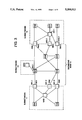
- FIG. 1 is an example of a communication network from the Baratz et al patent.
- the illustrated network includes a plurality of network nodes NNA, NNB, NNC, NND, NNE and NNF.
- the various network nodes are interconnected by transmission groups illustrated only as single lines.
- a number of end nodes, EN1 through EN10, are connected to various ones of the network nodes.
- Certain end nodes may be connected to more than one network node, and/or may have parallel transmission groups to the same network node.
- end node EN2 is connected to both network node NNA and NNB with two parallel transmission groups to network node NNB.
- end node EN6 is connected to both network nodes NND and NNF with three parallel transmission groups to node NNF.
- weights are assigned to each transmission group and network node in the network. These weights represent the "cost" of using the node, or transmission group, to transmit data.
- the weights are represented by numerals either appearing within the symbol for the network node, or adjacent the line representing the transmission group connecting the network nodes.
- the weight values themselves appearing in the figure are arbitrarily selected for purposes of illustration, and should not be interpreted as actual numerical values that would be assigned in a typical date communications network.
- the figure also shows weights assigned to transmission groups connecting end nodes to their adjacent network nodes.
- the weights assigned to the end node transmission groups are known to the end nodes, they may not be known to the network nodes if the network nodes maintain a topology database containing only information about the network nodes themselves and the transmission groups which interconnect the network nodes. While the information stored in the network nodes is adequate to allow the network nodes to compute optimal routes between any two network nodes, it is not adequate to permit a network node to compute an optimal route between two end nodes.
- FIG. 2 is a time-based chart of messages which flow through the network when a user located at an end node EN2 desires to communicate with a user located at end node EN6.
- the source end node EN2 sends a Message Unit (MU) to the network node NNB having responsibility for providing routing services to EN2.
- MU Message Unit
- the message includes information, or vectors, about the transmission groups which connect EN2 to both NNA and NNB.
- the transmission group vectors are saved at NNB, and the message is forwarded through the network via nodes NNC and NNF to end node EN6.
- End node EN6 responds with a Message Unit Reply (MUR) including information about the transmission groups which connect end node EN6 to its two adjacent network nodes, NND and NNF.
- MUR Message Unit Reply
- the reply is forwarded through the network to the serving network node NNB, which saves the destination transmission group vectors.
- Network node B then has the information it needs to compute an optimal route through the network between the origin end node EN2 and the destination end node EN6. As mentioned earlier, the computations are staged with the optimal end node to network node routes being computed separately from the routes between network nodes. All of the computations for determining best route take place in network node B.
- the above objects are accomplished by distributing the best route determination process over both source and destination network nodes.
- the network nodes at the interface between a Wide Area Network (WAN) and a subnetwork contain access agents to control the communication flow between the wide area network and an end station in the subnetwork.
- WAN Wide Area Network
- the task of selecting the best route between the two end stations is distributed between the access agents at the WAN interface in the first subnetwork, and the access agents at the WAN interface in the second subnetwork.
- Each access agent in the subnetwork group of access agents associated with the source end station obtains the best local route from itself to the source end station.
- Each access agent in the subnetwork group of access agents associated with the destination end station obtains the best local route from itself to the destination end station.
- the access agents in one of these subnetwork groups finds the best route across the WAN from each access agent in the source subnetwork to each access agent in the destination subnetwork, and then combines its best local route information with the best route information across the WAN.
- One designated access agent in the source subnetwork group now serves to collect and combine all the best route information found by the access agents at the source and destination subnetworks. This best route information is concatenated, and the route with the least weight is selected as the best route between end stations.
- FIG. 1, described above under description of prior art, shows an example of a communication network in which best route selection is performed.
- FIG. 2 shows the prior art process for gathering route information used in making the best route selection in the network of FIG. 1.
- FIG. 3 is an example of a communication network which is used in describing the operation of the present invention.
- FIG. 4 is a time-based communication message flowchart illustrating the operation of one embodiment of the invention in selecting the best route for communication between end stations ES-A and ES-B in FIG. 3.
- FIG. 5 is a time-based communication message flowchart illustrating the operation of another embodiment of the invention in selecting the best route for communication between end stations ES-A and ES-B in FIG. 3.
- FIG. 6 shows the process and operation of the preferred embodiment of the invention as implemented in the source-end access agents of FIG. 3.
- FIG. 7 shows the process and operation of the preferred embodiment of the invention as implemented in the destination-end access agents of FIG. 3.
- FIG. 8A shows the process and operation of the preferred embodiment of the invention as implemented in the source-end access agent selected for the best route.
- FIG. 8B shows the process and operation of the preferred embodiment of the invention as implemented in the destination-end access agent selected for the best route.
- the present invention will be described relative to the communication network in FIG. 3.
- the nomenclature used in FIG. 1 is substantially repeated in FIG. 3.
- the network in FIG. 3 is-made up of a backbone WAN 10 to which three subnetworks 11, 12 and 13 have been attached.
- Each network node NNx at the interface between WAN 10 and a subnetwork, contains an access agent.
- the access agents control the communication flow between the WAN and the subnetwork.
- network nodes NN1, NN2 and NN3 are at the interface with subnetwork 11.
- Each of these network nodes contains an access agent; access agents AA1.1, AA1.2 and AA1.3 reside, respectively, in network nodes NN1, NN2 and NN3.
- MAG Multiple Access Group
- Access agents in a Multiple Access Group (MAG) have been given the same root number (1.0, 2.0 or 3.0) to facilitate this description.
- MAG1 in subnetwork 11 has three access agents AA1.1, AA1.2 and AA1.3
- MAG2 also has three access agents AA2.1, AA2.2 and AA2.3.
- MAG 3 in subnetwork 13 is shown with only one access agent AA3.1.
- the subnetworks normally contain multiple end stations: ES-A and ES-X in subnetwork 11, ES-B, ES-Y and ES-Z in subnetwork 12.
- An end station might be a host computer, a personal computer, a file server, a printer, etc.
- communication is from source end station ES-A to destination end station ES-B.
- FIG. 4 is a time-based communication message flowchart of the same type as FIG. 2, and illustrates the function/process of the present invention when used in network/subnetworks in FIG. 3 when the subnetworks are analogous to the point-to-point subnetworks illustrated in FIG. 1.
- the communication process between ES-A and ES-B begins by ES-A sending a packet message 14 to its designated access agent which is AA1.3.
- the matching of an end station with a designated access agent may be accomplished by any number of techniques. One technique would be to check the address of the source end station from the communication message, and designate an access agent based on the source address. Alternatively, an end node may be pre-assigned to a network node, as described in FIG. 2.
- the designated access agent AA1.3 After the designated access agent AA1.3 receives the packet 14, it queries 16 other access agents AA1.1 and AA1.2 in its group MAG1 for the best route from each of them to ES-A.
- the best route is determined by accumulating route weights on each link in the route, just as discussed in the Baratz et al U.S. Pat. No. 4,873,517. Weights would typically reflect the communication costs of a route, and include such items as time charges, transmission speed, delays, line integrity, etc.
- Access agent AA1.3 also sends a FIND message 18 to each of the access agents AA2.1, AA2.2 and AA2.3 that make up multiple access group two (MAG2).
- MAG2 multiple access group two
- AA1.3 knows to send the FIND message to MAG2 from the destination address information in the packet message 14.
- the destination address indicates ES-B is the destination end station, and that ES-B is in MAG2.
- AA1.3 knows the members of MAG2 from the group formation, and maintenance processes for multiple access groups described in U.S. Ser. No. 07/976,826 cited above.
- AA1.3 could send the FIND message 18 to all MAG's. This is not the preferred embodiment, as it would consume additional WAN resources. The extent to which this may be undesirable depends on the size of the WAN, and on its capabilities to support fast message broadcasts.
- AA1.1, AA1.2 and AA1.3 determine the best route to ES-A. This is done by accumulating weights of transmission links over all possible paths from each of them to ES-A.
- AA1.1 and AA1.2 in response to the query from AA1.3, send their best route information as the local information route messages 20 and 22 back to AA1.3.
- AA1.3 has the route information of the best route it found from itself to ES-A.
- AA1.3 has weights and routes for the best route from ES-A to each of AA1.3, AA1.2 and AA1.1.
- AA2.1, AA2.2 and AA2.3 have been determining the best route from each of them to ES-B. This is done in the same manner as it was in MAG1 for routes to ES-A.
- AA2.1, AA2.2 and AA2.3 are determining the best route from each of them to each of the access agents in MAG1. This is preferably done from a topology database in each access agent in the same manner as described in Baratz et al U.S. Pat. No. 4,873,517.
- each of the access agents AA2.1, AA2.2 and AA2.3 determine the best route from ES-B through itself back to each of the access agents AA1.1, AA1.2 and AA1.3 in MAG1.
- AA2.1, AA2.2 and AA2.3 send FOUND messages 24, 26 and 28, respectively, to AA1.3.
- Each FOUND message contains three routes; the best route from each of the access agents in MAG1 through the access agent in MAG2, who sent the FOUND message, to ES-B.
- the effect of the process/operation described for MAG1 and MAG2 is to distribute the tasks of determining best routes over all the access agents at the source and destination subnetworks.
- the source agent AA1.3 the designated access agent, now knows the best routes and weights therefor from AA1.1, AA1.2 and AA1.3 to ES-A (three routes), and from AA1.1, AA1.2 and AA1.3 to ES-B through AA2.1, AA2.2 or AA2.3 to ES-B (nine routes).
- AA1.3 selects the best route from ES-A to ES-B. Assuming the result is that the best route is through AA1.1 and AA2.1, AA1.3 sends the SELECT message 30 to AA1.1 to prepare AA1.1 to handle the communication flow between ES-A and ES-B.
- AA1.2 also sends SELECT message 32 to prepare AA2.1 to handle the communication flow between ES-A and ES-B.
- AA1.3 now sends PACKET message 33 (same as PACKET message 14) to AA2.1.
- AA2.1 passes PACKET 33 onto ES-B.
- ES-B When ES-B receives the PACKET message, it reads the best route information from the message. The routing information has been added to the PACKET message 14 by AA1.3 and AA2.1. ES-B then sends PACKET RESPONSE message 34 back over the best route through AA2.1 and AA1.1. AA2.1 and AA1.1 do not have to process information in packets now flowing between ES-A and ES-B. Once the communication route is established, AA1.1 and AA2.1 just pass the packets through the route.
- the invention is implemented in an environment where the subnetworks of FIG. 3 are source-routing LANs, and the communication protocol followed is Internet Protocol (IP).
- IP Internet Protocol
- the communication between ES-A and ES-B begins by ES-A sending an Address Resolution Protocol (ARP) message 36.
- ARP Address Resolution Protocol
- This message is a LAN All-Routes Broadcast (ARB), and is received by all the access agents AA1.1, AA1.2 and AA1.3 in MAG1 in this example.
- Each access agent in MAG1 identifies AA1.3 as the designated access agent from ES-A's LAN address as encoded in the LAN broadcast packet.
- the ARP received by each access agent in MAG1 contains a routing information field. As the ARP travels from ES-A to AA1.1, AA1.2 and AA1.3, each bridge, or node, that it crosses adds routing information for the routes the ARP travels. Each access agent in MAG1, as it receives an ARP across different routes, retains the route information, and then selects the best route from itself to ES-A by evaluating the weights derivable from received routing information. Once the best route to ES-A is selected by AA1.1 and AA1.2, they send best route information, including weights as local route information messages 38 and 40 to designated access agent AA1.3. AA1.3 has the best route information from itself to ES-A, as determined from the ARPs it received.
- the designated access agent AA1.3 after it receives an ARP from ES-A, broadcasts FIND message 42 containing the ARP from ES-A to the access agents in MAG2. AA2.1, AA2.2 and AA2.3, in turn, broadcast the ARP from ES-A in subnetwork 12.
- ES-B gets the ARP, probably more than one, from each of AA2.1, AA2.2 and AA2.3.
- Each ARP contains routing information on the route it traversed from the MAG2 access agent to ES-B.
- ES-B reads the ARP, including its routing information. For each ARP message 43 received, ES-B sends an ARP response message 44 back to the same access agent in MAG2 that the ARP message 43 came from.
- Each ARP RESPONSE 44 from ES-B is not broadcast; it goes back point-to-point to the access agent in MAG2 over the same route that it came in on. After receiving the ARP RESPONSE messages 44, each access agent in MAG2 can then determine the best route from itself to ES-B by accumulating the weights in the routing information in the ARP RESPONSE.
- Each access agent in MAG2 also determines the best route from itself to each access agent in MAG1 from WAN route information.
- the WAN route information would be stored as a topology database, as discussed in the Baratz et al patent, at each access agent.
- AA2.1, AA2.2 and AA2.3 now have the best route information from each of them to ES-B, and from each of them to each of AA1.1, AA1.2 and AA1.3.
- Each of AA2.1, AA2.2 and AA2.3 concatenates this information, and sends a FOUND message 46, 48 and 50, respectively, to the designated access agent AA1.3.
- Each FOUND message contains the best route information from each of AA1.1, AA1.2 and AA1.3 to ES-B through the access agent sending the FOUND message.
- AA1.3 now has all the information it needs to select the best route from ES-A to ES-B.
- AA1.3 concatenates the three local routes within subnetwork 11 with the nine WAN and local destination routes from access agents in MAG1 through access agents in MAG2 to ES-B.
- There are nine possible best destination routes because there are three access agents in each of the source and destination MAGs.
- the number of possible best destination routes equals N1 times N2, where N1 and N2 are, respectively, the number of access agents in MAG1 and MAG2.
- AA1.3 After concatenating the local route information with the destination route information, AA1.3 concludes that the best route is through AA1.1 and AA2.1. AA1.3 sends SELECT messages 52 and 54, respectively, to AA1.1 and AA2.1 to prepare them to handle the communication between ES-A and ES-B. These SELECT messages go point to point over the selected route; they are not broadcast. In addition, AA1.3 sends ARP 56 (same as ARP 36) point to point to ES-B through AA2.1. ES-B sends back ARP RESPONSE 58 to ES-A over the selected best route. Communication then flows between ES-A and ES-B through AA1.1 and AA2.1, with no further processing of the communication messages by AA1.1 and AA2.1.
- FIG. 6 the process flow at each access agent at the source end of communications is shown.
- the process begins at operation 60 with the access agent receiving the ARP message (or PACKET) from the source end station ES-A.
- Decision 62 tests whether there is an active communication route, or path, for the source-destination pair of end stations identified in the ARP. If the answer is yes, operation 64 simply forwards the ARP over the active path to the destination station ES-B.
- Decision 62 and operation 64 are not directly involved in the invention, but they would typically be a part of a route selection process.
- Decision 66 tests whether the access agent that received the ARP is the designated access agent. If the answer is no, the process flow branches to operation 68.
- access agents at the source end receive multiple ARPs over different paths from ES-A. From the routing information tagged to the ARP as it travels to the access agent, the access agent can accumulate the weight of the route traveled by each ARP that reaches it. The access agent in operation 68 selects the best route between ES-A and itself based on the lowest accumulated weight.
- the access agent identifies the designated access agent for the source end station from the source end station address or identification. The access agent then sends, in operation 72, the local route information message to the designated access agent.
- the designated access agent at operation 74 obtains the best route information to ES-A in the same manner as the other access agents did in operation 68 described immediately above.
- the designated access agent receives and stores the local route information sent by the other access agents in operation 72.
- Operation 78 by the designated access agent is the sending of the FIND message to the destination MAG (Multiple Access Group). While operation 78 is illustrated as being in sequence with operations 74 and 76, operation 78 could also be performed in parallel with operations 74 and 76.
- the above process flow implements the example in FIG. 5 where the ARP is broadcast to all source access agents.
- the process flow would be slightly different. Decision 66 would not be necessary, and operations 68, 70 and 72 would be initiated by a query from the designated access agent. Also, the designated access agent would send the FIND (operation 78) to the destination group of access agents at the same time it sends the query to the source access agents.
- the designated access agent waits until it receives the FOUND messages from access agents in MAG2 (FIG. 5). When the FOUND messages are received and stored, the designated access agent has all the best route information from the source access agents and the destination access agents. Operation 82 concatenates the weighted route information, and identifies the lowest weight route as the best route from the source end station to the destination end station. In operations 84 and 86, the designated access agent sends the SELECT messages to the source access agent and the destination access agent with the routing information on the best route between ES-A and ES-B.
- FIG. 7 shows the process flow for the operation at the destination access agents in response to the FIND message from the designated access agent.
- a destination access agent at decision 90, tests whether the destination end station is in its subnetwork. If the answer is no, the process ends. If the answer is yes, the access agent begins operation 92 to find the best route from itself to the destination end station.
- the access agent in operation 92 knows the weights over links in various paths to the destination end station. Therefore, the access agent accumulates these weights, and selects the route to ES-B that has the lowest weight.
- operation 92 does not store weight information for links in its subnetwork. Instead, it broadcasts the ARP to the destination end station, and receives a reply from the destination end station. This reply contains route and weight information over each point to point route from the access agent to the end station. The access agent selects the route with the lowest weight.
- each destination access agent reviews the weights for the various routes through WAN 10 (FIG. 3) from each source access agent to each destination access agent. These routes and weights are information previously stored in the access agent. From the information, each destination access agent selects the best WAN route from itself to each source access agent. Each destination access agent then concatenates the best WAN route information with the best local route information to the destination end station ES-B. At operation 96, each destination access agent sends a FOUND message, which contains the best route information from source access agents to ES-B to the designated access agent. Each FOUND message contains three routes, as previously described in reference to FIGS. 4 and 5. The FOUND process is thus completed.
- FIGS. 8A and 8B described the processing of SELECT messages by the access agents selected for the best route from ES-A to ES-B.
- the selected source access agent and selected destination access agent receive the SELECT message in operation 98.
- they each set their routing table which establishes the active path of communication flow between end stations.
- the selected destination access agent in operation 102 forwards to the destination end station the ARP (FIG. 5), or the PACKET (FIG. 4) from the source end station. This prompts the destination end station to reply, and the communication flows between source and end stations.
- the destination access agents have combined the WAN best route information with the best route information in the destination subnetwork.
- the source access agents could have obtained the WAN best route information, and combined it with their best route information in the source subnetwork.
- the designated access agent would only receive three best routes from the three destination access agents, and would receive nine best routes from the source access agents.
- weight information could be sent back to the designated access agent rather than routing information. The designated access agent would select the best routes based on the weight information, and select the access agents, as before, with the SELECT message. The selected access agents would then set the routes.
Landscapes
- Engineering & Computer Science (AREA)
- Computer Networks & Wireless Communication (AREA)
- Signal Processing (AREA)
- Data Exchanges In Wide-Area Networks (AREA)
- Computer And Data Communications (AREA)
- Small-Scale Networks (AREA)
- Radio Relay Systems (AREA)
- Mobile Radio Communication Systems (AREA)
Priority Applications (9)
| Application Number | Priority Date | Filing Date | Title |
|---|---|---|---|
| US07/980,854 US5398012A (en) | 1992-11-24 | 1992-11-24 | Distributed processing of route selection across networks and subnetworks |
| CA002100541A CA2100541C (fr) | 1992-11-24 | 1993-07-14 | Traitement reparti de la selection des trajets entre reseaux et sous-reseaux |
| EP93480163A EP0599764B1 (fr) | 1992-11-24 | 1993-10-19 | Traitement distribué d'information d'acheminement dans des réseaux et sous-réseaux |
| AT93480163T ATE177890T1 (de) | 1992-11-24 | 1993-10-19 | Verteilte durchführung von routenauswahl über netzwerke und teilnetzwerke |
| DE69323963T DE69323963T2 (de) | 1992-11-24 | 1993-10-19 | Verteilte Durchführung von Routenauswahl über Netzwerke und Teilnetzwerke |
| JP5290177A JP2502926B2 (ja) | 1992-11-24 | 1993-11-19 | ネットワ―クおよびサブネットワ―クを横切る経路選択の分散処理 |
| CN93114972A CN1038891C (zh) | 1992-11-24 | 1993-11-23 | 分散处理经过网路和子网路的路由选择 |
| BR9304797A BR9304797A (pt) | 1992-11-24 | 1993-11-23 | Método e aparelho de seleção de rota para rede de comunicação |
| CN97110816A CN1170998A (zh) | 1992-11-24 | 1997-04-30 | 分散处理经过网路和子网路的路由选择 |
Applications Claiming Priority (1)
| Application Number | Priority Date | Filing Date | Title |
|---|---|---|---|
| US07/980,854 US5398012A (en) | 1992-11-24 | 1992-11-24 | Distributed processing of route selection across networks and subnetworks |
Publications (1)
| Publication Number | Publication Date |
|---|---|
| US5398012A true US5398012A (en) | 1995-03-14 |
Family
ID=25527902
Family Applications (1)
| Application Number | Title | Priority Date | Filing Date |
|---|---|---|---|
| US07/980,854 Expired - Lifetime US5398012A (en) | 1992-11-24 | 1992-11-24 | Distributed processing of route selection across networks and subnetworks |
Country Status (8)
| Country | Link |
|---|---|
| US (1) | US5398012A (fr) |
| EP (1) | EP0599764B1 (fr) |
| JP (1) | JP2502926B2 (fr) |
| CN (2) | CN1038891C (fr) |
| AT (1) | ATE177890T1 (fr) |
| BR (1) | BR9304797A (fr) |
| CA (1) | CA2100541C (fr) |
| DE (1) | DE69323963T2 (fr) |
Cited By (43)
| Publication number | Priority date | Publication date | Assignee | Title |
|---|---|---|---|---|
| WO1996001029A1 (fr) * | 1994-06-28 | 1996-01-11 | Metricom, Inc. | Acheminememt non impose par l'origine dans des reseaux heterogenes |
| US5517620A (en) * | 1993-05-19 | 1996-05-14 | Nec Corporation | Dynamic updating of routing information for routing packets between LAN's connected to a plurality of routers via a public network |
| US5563878A (en) * | 1995-01-05 | 1996-10-08 | International Business Machines Corporation | Transaction message routing in digital communication networks |
| US5600637A (en) * | 1994-02-22 | 1997-02-04 | Fujitsu Limited | System and method for traffic distribution, intermediate device and end device |
| US5742588A (en) * | 1995-09-18 | 1998-04-21 | Telefonaktiebolaget Lm Ericsson | Packet switched traffic management in a cellular telecommunications system |
| US5802503A (en) * | 1996-12-24 | 1998-09-01 | Pitney Bowes Inc. | Channel switched mail message switching and metering system |
| US5872524A (en) * | 1995-05-15 | 1999-02-16 | Nec Corporation | Automatic address assignment method |
| US5905712A (en) * | 1996-08-09 | 1999-05-18 | Madge Networks Limited | Data communication network |
| US5983281A (en) * | 1997-04-24 | 1999-11-09 | International Business Machines Corporation | Load balancing in a multiple network environment |
| US6034946A (en) * | 1997-04-15 | 2000-03-07 | International Business Machines Corporation | Selection of routing paths in data communications networks to satisfy multiple requirements |
| US6085178A (en) * | 1997-03-21 | 2000-07-04 | International Business Machines Corporation | Apparatus and method for communicating between an intelligent agent and client computer process using disguised messages |
| US6097700A (en) * | 1995-09-18 | 2000-08-01 | Telefonaktiebolaget L M Ericsson (Publ) | Packet switched radio channel congestion control |
| US6185619B1 (en) | 1996-12-09 | 2001-02-06 | Genuity Inc. | Method and apparatus for balancing the process load on network servers according to network and serve based policies |
| US6185612B1 (en) | 1998-10-29 | 2001-02-06 | Novell, Inc. | Secure distribution and use of weighted network topology information |
| US6192354B1 (en) | 1997-03-21 | 2001-02-20 | International Business Machines Corporation | Apparatus and method for optimizing the performance of computer tasks using multiple intelligent agents having varied degrees of domain knowledge |
| US6216132B1 (en) | 1997-11-20 | 2001-04-10 | International Business Machines Corporation | Method and system for matching consumers to events |
| US6279034B1 (en) | 1998-06-03 | 2001-08-21 | International Business Machines Corporation | Distributed monitor timer service for use in a distributed computing environment |
| US6295276B1 (en) | 1999-12-31 | 2001-09-25 | Ragula Systems | Combining routers to increase concurrency and redundancy in external network access |
| US6314092B1 (en) * | 1994-11-30 | 2001-11-06 | British Telecommunications Public Limited Company | Routing in a communications network |
| US6401080B1 (en) | 1997-03-21 | 2002-06-04 | International Business Machines Corporation | Intelligent agent with negotiation capability and method of negotiation therewith |
| US20020087724A1 (en) * | 2000-12-29 | 2002-07-04 | Ragula Systems D/B/A Fatpipe Networks | Combining connections for parallel access to multiple frame relay and other private networks |
| US6438605B1 (en) * | 1997-11-17 | 2002-08-20 | Minolta Co., Ltd. | Communication equipment, communication route selection method, and computer program product in memory for selecting a communication route |
| US6487172B1 (en) * | 1998-08-21 | 2002-11-26 | Nortel Networks Limited | Packet network route selection method and apparatus using a bidding algorithm |
| US6493341B1 (en) | 1999-12-31 | 2002-12-10 | Ragula Systems | Combining routers to increase concurrency and redundancy in external network access |
| US20020186701A1 (en) * | 1996-10-31 | 2002-12-12 | Kaplan Allen D. | Multi-protocol telecommunications routing optimization |
| US6512763B1 (en) * | 1998-09-03 | 2003-01-28 | Genesys Telecommunications Laboratories, Inc. | Method and apparatus for data routing, delivery, and authentication in a packet data network |
| US20030072270A1 (en) * | 2001-11-29 | 2003-04-17 | Roch Guerin | Method and system for topology construction and path identification in a two-level routing domain operated according to a simple link state routing protocol |
| US20030072485A1 (en) * | 2001-11-29 | 2003-04-17 | Roch Guerin | Method and system for topology construction and path identification in a routing domain operated according to a link state routing protocol |
| WO2003049340A2 (fr) | 2001-10-15 | 2003-06-12 | Ipsum Networks, Inc. | Procede et systeme de construction topologique et d'identification de voie dans un domaine de routage a deux niveaux fonctionnant selon un protocole de routage d'etat a liaison unique |
| WO2003049341A1 (fr) * | 2001-11-29 | 2003-06-12 | Ipsum Networks, Inc. | Procede et systeme d'identification de chemins dans des reseaux a commutation par paquets |
| US20030198190A1 (en) * | 2002-04-19 | 2003-10-23 | Rajendran Rajan | Method and system for traffic monitoring in a packet communication network |
| US6728715B1 (en) | 2000-03-30 | 2004-04-27 | International Business Machines Corporation | Method and system for matching consumers to events employing content-based multicast routing using approximate groups |
| US6775235B2 (en) | 2000-12-29 | 2004-08-10 | Ragula Systems | Tools and techniques for directing packets over disparate networks |
| US6889254B1 (en) | 1999-03-30 | 2005-05-03 | International Business Machines Corporation | Scalable merge technique for information retrieval across a distributed network |
| US6917596B1 (en) * | 2000-11-08 | 2005-07-12 | Nortel Networks Limited | Method of addressing physical problems of a topological network using a topology engine |
| US20060056328A1 (en) * | 2002-07-30 | 2006-03-16 | Lehane Andrew R | Identifying network rotuters and paths |
| US20060075136A1 (en) * | 2000-10-18 | 2006-04-06 | Nec Corporation | Interdomain routing system |
| US20060209785A1 (en) * | 2002-05-17 | 2006-09-21 | Paola Iovanna | Dynamic routing in packet-switching multi-layer communications networks |
| US7386522B1 (en) | 1997-03-21 | 2008-06-10 | International Business Machines Corporation | Optimizing the performance of computer tasks using intelligent agent with multiple program modules having varied degrees of domain knowledge |
| US7444506B1 (en) | 2001-12-28 | 2008-10-28 | Ragula Systems | Selective encryption with parallel networks |
| US20100211718A1 (en) * | 2009-02-17 | 2010-08-19 | Paul Gratz | Method and apparatus for congestion-aware routing in a computer interconnection network |
| US8510468B2 (en) | 2000-04-17 | 2013-08-13 | Ciradence Corporation | Route aware network link acceleration |
| US9036499B2 (en) | 1996-10-31 | 2015-05-19 | Patentmarks Communications, Llc | Multi-protocol telecommunications routing optimization |
Families Citing this family (14)
| Publication number | Priority date | Publication date | Assignee | Title |
|---|---|---|---|---|
| EP0781007B1 (fr) * | 1995-12-21 | 2003-03-12 | Siemens Aktiengesellschaft | Procédé pour produire des informations de routage dans un réseau de communication ATM |
| GB2314995B (en) * | 1996-07-05 | 2000-11-01 | Northern Telecom Ltd | Telecommunication system |
| FR2772533B1 (fr) * | 1997-12-15 | 2001-09-28 | Inst Nat Rech Inf Automat | Dispositif d'interconnexion entre segments de reseaux communiquant selon des protocoles de formats differents, et procede correspondant |
| US6480505B1 (en) | 1999-12-06 | 2002-11-12 | Telefonaktiebolaget Lm Ericsson (Publ) | Batched fair exhaustive polling scheduler |
| US6535498B1 (en) | 1999-12-06 | 2003-03-18 | Telefonaktiebolaget Lm Ericsson (Publ) | Route updating in ad-hoc networks |
| JP2003516034A (ja) * | 1999-12-06 | 2003-05-07 | テレフオンアクチーボラゲット エル エム エリクソン(パブル) | ルート発見機構のトリガとしての同報通信 |
| US6751200B1 (en) | 1999-12-06 | 2004-06-15 | Telefonaktiebolaget Lm Ericsson (Publ) | Route discovery based piconet forming |
| US6704293B1 (en) | 1999-12-06 | 2004-03-09 | Telefonaktiebolaget Lm Ericsson (Publ) | Broadcast as a triggering mechanism for route discovery in ad-hoc networks |
| US6975613B1 (en) | 1999-12-06 | 2005-12-13 | Telefonaktiebolaget L M Ericsson (Publ) | System and method for scheduling communication sessions in an ad-hoc network |
| CN1984038B (zh) * | 2006-04-06 | 2010-05-12 | 华为技术有限公司 | 一种级联管理系统以及端到端路由选择方法 |
| CN101345688B (zh) * | 2008-07-18 | 2011-07-13 | 中兴通讯股份有限公司 | 一种端到端业务中路由计算方法 |
| US9258214B2 (en) | 2013-02-11 | 2016-02-09 | Avaya Inc. | Optimized distributed routing for stretched data center models through updating route advertisements based on changes to address resolution protocol (ARP) tables |
| CN111343021B (zh) * | 2020-02-27 | 2022-08-12 | 中国移动通信集团江苏有限公司 | 网络拓扑结构的生成方法、装置、设备及介质 |
| WO2021195990A1 (fr) * | 2020-03-31 | 2021-10-07 | Alibaba Group Holding Limited | Évitement de congestion de réseau sur une communication collective basée sur un anneau |
Citations (2)
| Publication number | Priority date | Publication date | Assignee | Title |
|---|---|---|---|---|
| US4873517A (en) * | 1988-06-23 | 1989-10-10 | International Business Machines Corporation | Method for selecting least weight end node to end node route in a data communications network |
| US5193151A (en) * | 1989-08-30 | 1993-03-09 | Digital Equipment Corporation | Delay-based congestion avoidance in computer networks |
-
1992
- 1992-11-24 US US07/980,854 patent/US5398012A/en not_active Expired - Lifetime
-
1993
- 1993-07-14 CA CA002100541A patent/CA2100541C/fr not_active Expired - Fee Related
- 1993-10-19 EP EP93480163A patent/EP0599764B1/fr not_active Expired - Lifetime
- 1993-10-19 AT AT93480163T patent/ATE177890T1/de active
- 1993-10-19 DE DE69323963T patent/DE69323963T2/de not_active Expired - Fee Related
- 1993-11-19 JP JP5290177A patent/JP2502926B2/ja not_active Expired - Fee Related
- 1993-11-23 BR BR9304797A patent/BR9304797A/pt not_active IP Right Cessation
- 1993-11-23 CN CN93114972A patent/CN1038891C/zh not_active Expired - Lifetime
-
1997
- 1997-04-30 CN CN97110816A patent/CN1170998A/zh active Pending
Patent Citations (2)
| Publication number | Priority date | Publication date | Assignee | Title |
|---|---|---|---|---|
| US4873517A (en) * | 1988-06-23 | 1989-10-10 | International Business Machines Corporation | Method for selecting least weight end node to end node route in a data communications network |
| US5193151A (en) * | 1989-08-30 | 1993-03-09 | Digital Equipment Corporation | Delay-based congestion avoidance in computer networks |
Non-Patent Citations (4)
| Title |
|---|
| IEEE INFOCOM '88, Mar. 27, 1988, New Orleans, La., "Distributed Routing Using Topology Database in Large Computer Networks" by K. Jeong Lee and B. Kadaba, pp. 593-602. |
| IEEE INFOCOM 88, Mar. 27, 1988, New Orleans, La., Distributed Routing Using Topology Database in Large Computer Networks by K. Jeong Lee and B. Kadaba, pp. 593 602. * |
| SIGCOMM '90 Symposium, vol. 20, No. 4, Sep. 4, 1990, Philadelphia, Pa. "Topology Distribution Cost vs. Efficient Routing in Large Networks" by A. Bar-Noy and M. Gopal, pp. 242-252. |
| SIGCOMM 90 Symposium, vol. 20, No. 4, Sep. 4, 1990, Philadelphia, Pa. Topology Distribution Cost vs. Efficient Routing in Large Networks by A. Bar Noy and M. Gopal, pp. 242 252. * |
Cited By (69)
| Publication number | Priority date | Publication date | Assignee | Title |
|---|---|---|---|---|
| US5517620A (en) * | 1993-05-19 | 1996-05-14 | Nec Corporation | Dynamic updating of routing information for routing packets between LAN's connected to a plurality of routers via a public network |
| US5600637A (en) * | 1994-02-22 | 1997-02-04 | Fujitsu Limited | System and method for traffic distribution, intermediate device and end device |
| US5570084A (en) * | 1994-06-28 | 1996-10-29 | Metricom, Inc. | Method of loose source routing over disparate network types in a packet communication network |
| WO1996001029A1 (fr) * | 1994-06-28 | 1996-01-11 | Metricom, Inc. | Acheminememt non impose par l'origine dans des reseaux heterogenes |
| US6314092B1 (en) * | 1994-11-30 | 2001-11-06 | British Telecommunications Public Limited Company | Routing in a communications network |
| US5563878A (en) * | 1995-01-05 | 1996-10-08 | International Business Machines Corporation | Transaction message routing in digital communication networks |
| US5872524A (en) * | 1995-05-15 | 1999-02-16 | Nec Corporation | Automatic address assignment method |
| US6097700A (en) * | 1995-09-18 | 2000-08-01 | Telefonaktiebolaget L M Ericsson (Publ) | Packet switched radio channel congestion control |
| US5742588A (en) * | 1995-09-18 | 1998-04-21 | Telefonaktiebolaget Lm Ericsson | Packet switched traffic management in a cellular telecommunications system |
| US5905712A (en) * | 1996-08-09 | 1999-05-18 | Madge Networks Limited | Data communication network |
| US7307956B2 (en) | 1996-10-31 | 2007-12-11 | Connectel, Llc | Multi-protocol telecommunications routing optimization |
| US9036499B2 (en) | 1996-10-31 | 2015-05-19 | Patentmarks Communications, Llc | Multi-protocol telecommunications routing optimization |
| US20020186701A1 (en) * | 1996-10-31 | 2002-12-12 | Kaplan Allen D. | Multi-protocol telecommunications routing optimization |
| US9806988B2 (en) | 1996-10-31 | 2017-10-31 | Patentmarks Communications, Llc | Multi-protocol telecommunications routing optimization |
| US6185619B1 (en) | 1996-12-09 | 2001-02-06 | Genuity Inc. | Method and apparatus for balancing the process load on network servers according to network and serve based policies |
| US8683075B1 (en) | 1996-12-09 | 2014-03-25 | Verizon Corporate Services Group Inc. | Distributed computing system and method for distributing user requests to replicated network servers |
| US5802503A (en) * | 1996-12-24 | 1998-09-01 | Pitney Bowes Inc. | Channel switched mail message switching and metering system |
| US6192354B1 (en) | 1997-03-21 | 2001-02-20 | International Business Machines Corporation | Apparatus and method for optimizing the performance of computer tasks using multiple intelligent agents having varied degrees of domain knowledge |
| US7908225B1 (en) | 1997-03-21 | 2011-03-15 | International Business Machines Corporation | Intelligent agent with negotiation capability and method of negotiation therewith |
| US7386522B1 (en) | 1997-03-21 | 2008-06-10 | International Business Machines Corporation | Optimizing the performance of computer tasks using intelligent agent with multiple program modules having varied degrees of domain knowledge |
| US6085178A (en) * | 1997-03-21 | 2000-07-04 | International Business Machines Corporation | Apparatus and method for communicating between an intelligent agent and client computer process using disguised messages |
| US6401080B1 (en) | 1997-03-21 | 2002-06-04 | International Business Machines Corporation | Intelligent agent with negotiation capability and method of negotiation therewith |
| US6034946A (en) * | 1997-04-15 | 2000-03-07 | International Business Machines Corporation | Selection of routing paths in data communications networks to satisfy multiple requirements |
| US5983281A (en) * | 1997-04-24 | 1999-11-09 | International Business Machines Corporation | Load balancing in a multiple network environment |
| US6438605B1 (en) * | 1997-11-17 | 2002-08-20 | Minolta Co., Ltd. | Communication equipment, communication route selection method, and computer program product in memory for selecting a communication route |
| US6336119B1 (en) | 1997-11-20 | 2002-01-01 | International Business Machines Corporation | Method and system for applying cluster-based group multicast to content-based publish-subscribe system |
| US6216132B1 (en) | 1997-11-20 | 2001-04-10 | International Business Machines Corporation | Method and system for matching consumers to events |
| US6279034B1 (en) | 1998-06-03 | 2001-08-21 | International Business Machines Corporation | Distributed monitor timer service for use in a distributed computing environment |
| US6487172B1 (en) * | 1998-08-21 | 2002-11-26 | Nortel Networks Limited | Packet network route selection method and apparatus using a bidding algorithm |
| US6512763B1 (en) * | 1998-09-03 | 2003-01-28 | Genesys Telecommunications Laboratories, Inc. | Method and apparatus for data routing, delivery, and authentication in a packet data network |
| US6185612B1 (en) | 1998-10-29 | 2001-02-06 | Novell, Inc. | Secure distribution and use of weighted network topology information |
| US6889254B1 (en) | 1999-03-30 | 2005-05-03 | International Business Machines Corporation | Scalable merge technique for information retrieval across a distributed network |
| US6493341B1 (en) | 1999-12-31 | 2002-12-10 | Ragula Systems | Combining routers to increase concurrency and redundancy in external network access |
| US6295276B1 (en) | 1999-12-31 | 2001-09-25 | Ragula Systems | Combining routers to increase concurrency and redundancy in external network access |
| US6728715B1 (en) | 2000-03-30 | 2004-04-27 | International Business Machines Corporation | Method and system for matching consumers to events employing content-based multicast routing using approximate groups |
| US8510468B2 (en) | 2000-04-17 | 2013-08-13 | Ciradence Corporation | Route aware network link acceleration |
| US7870289B2 (en) * | 2000-10-18 | 2011-01-11 | Nec Corporation | Interdomain routing system |
| US20060075136A1 (en) * | 2000-10-18 | 2006-04-06 | Nec Corporation | Interdomain routing system |
| US6917596B1 (en) * | 2000-11-08 | 2005-07-12 | Nortel Networks Limited | Method of addressing physical problems of a topological network using a topology engine |
| US7406048B2 (en) | 2000-12-29 | 2008-07-29 | Sanchaita Datta | Tools and techniques for directing packets over disparate networks |
| US20050008017A1 (en) * | 2000-12-29 | 2005-01-13 | Ragula Systems D/B/A Fatpipe Networks | Tools and techniques for directing packets over disparate networks |
| US20020087724A1 (en) * | 2000-12-29 | 2002-07-04 | Ragula Systems D/B/A Fatpipe Networks | Combining connections for parallel access to multiple frame relay and other private networks |
| US6775235B2 (en) | 2000-12-29 | 2004-08-10 | Ragula Systems | Tools and techniques for directing packets over disparate networks |
| WO2003049340A3 (fr) * | 2001-10-15 | 2003-09-12 | Ipsum Networks Inc | Procede et systeme de construction topologique et d'identification de voie dans un domaine de routage a deux niveaux fonctionnant selon un protocole de routage d'etat a liaison unique |
| WO2003049340A2 (fr) | 2001-10-15 | 2003-06-12 | Ipsum Networks, Inc. | Procede et systeme de construction topologique et d'identification de voie dans un domaine de routage a deux niveaux fonctionnant selon un protocole de routage d'etat a liaison unique |
| US7525920B2 (en) | 2001-11-29 | 2009-04-28 | Coactive Technologies, Inc. | Method and system for path identification in packet networks |
| US8218447B2 (en) | 2001-11-29 | 2012-07-10 | Circadence Corporation | Method and system for path identification in packet networks |
| EP1461882A4 (fr) * | 2001-11-29 | 2007-05-02 | Ipsum Networks Inc | Procede et systeme de construction topologique et d'identification de voie dans un domaine de routage a deux niveaux fonctionnant selon un protocole de routage d'etat a liaison unique |
| US6836465B2 (en) * | 2001-11-29 | 2004-12-28 | Ipsum Networks, Inc. | Method and system for path identification in packet networks |
| WO2003049342A3 (fr) * | 2001-11-29 | 2004-02-26 | Ipsum Networks Inc | Procede et systeme de construction de topologie et d'identification de chemins dans un domaine de routage mis en oeuvre selon un protocole de routage d'etat des liens |
| US7330435B2 (en) | 2001-11-29 | 2008-02-12 | Iptivia, Inc. | Method and system for topology construction and path identification in a routing domain operated according to a link state routing protocol |
| US20030072270A1 (en) * | 2001-11-29 | 2003-04-17 | Roch Guerin | Method and system for topology construction and path identification in a two-level routing domain operated according to a simple link state routing protocol |
| US20030072485A1 (en) * | 2001-11-29 | 2003-04-17 | Roch Guerin | Method and system for topology construction and path identification in a routing domain operated according to a link state routing protocol |
| US7120120B2 (en) | 2001-11-29 | 2006-10-10 | Ipsum Networks, Inc. | Method and system for topology construction and path identification in a two-level routing domain operated according to a simple link state routing protocol |
| US20050025059A1 (en) * | 2001-11-29 | 2005-02-03 | Rajendran Rajan | Method and system for path identification in packet networks |
| WO2003049342A2 (fr) | 2001-11-29 | 2003-06-12 | Ipsum Networks, Inc. | Procede et systeme de construction de topologie et d'identification de chemins dans un domaine de routage mis en oeuvre selon un protocole de routage d'etat des liens |
| US20090196184A1 (en) * | 2001-11-29 | 2009-08-06 | Iptivia, Inc. | Method and system for path identification in packet networks |
| WO2003049341A1 (fr) * | 2001-11-29 | 2003-06-12 | Ipsum Networks, Inc. | Procede et systeme d'identification de chemins dans des reseaux a commutation par paquets |
| EP1461884A4 (fr) * | 2001-11-29 | 2010-09-15 | Iptivia Inc | Procede et systeme de construction de topologie et d'identification de chemins dans un domaine de routage mis en oeuvre selon un protocole de routage d'etat des liens |
| US7444506B1 (en) | 2001-12-28 | 2008-10-28 | Ragula Systems | Selective encryption with parallel networks |
| US20030198190A1 (en) * | 2002-04-19 | 2003-10-23 | Rajendran Rajan | Method and system for traffic monitoring in a packet communication network |
| US7257081B2 (en) | 2002-04-19 | 2007-08-14 | Iptivia, Inc. | Method and system for traffic monitoring in a packet communication network |
| US7539210B2 (en) * | 2002-05-17 | 2009-05-26 | Telefonaktiebolaget L M Ericcson (Publ) | Dynamic routing in packet-switching multi-layer communications networks |
| US20060209785A1 (en) * | 2002-05-17 | 2006-09-21 | Paola Iovanna | Dynamic routing in packet-switching multi-layer communications networks |
| US20060056328A1 (en) * | 2002-07-30 | 2006-03-16 | Lehane Andrew R | Identifying network rotuters and paths |
| US20100211718A1 (en) * | 2009-02-17 | 2010-08-19 | Paul Gratz | Method and apparatus for congestion-aware routing in a computer interconnection network |
| US8285900B2 (en) * | 2009-02-17 | 2012-10-09 | The Board Of Regents Of The University Of Texas System | Method and apparatus for congestion-aware routing in a computer interconnection network |
| US8694704B2 (en) | 2009-02-17 | 2014-04-08 | Board Of Regents, University Of Texas Systems | Method and apparatus for congestion-aware routing in a computer interconnection network |
| US9571399B2 (en) | 2009-02-17 | 2017-02-14 | The Board Of Regents Of The University Of Texas System | Method and apparatus for congestion-aware routing in a computer interconnection network |
Also Published As
| Publication number | Publication date |
|---|---|
| CN1170998A (zh) | 1998-01-21 |
| CA2100541C (fr) | 1999-05-25 |
| BR9304797A (pt) | 1994-05-31 |
| CN1038891C (zh) | 1998-06-24 |
| JPH07321845A (ja) | 1995-12-08 |
| DE69323963T2 (de) | 1999-10-07 |
| DE69323963D1 (de) | 1999-04-22 |
| JP2502926B2 (ja) | 1996-05-29 |
| CN1091886A (zh) | 1994-09-07 |
| ATE177890T1 (de) | 1999-04-15 |
| EP0599764A1 (fr) | 1994-06-01 |
| CA2100541A1 (fr) | 1994-05-25 |
| EP0599764B1 (fr) | 1999-03-17 |
Similar Documents
| Publication | Publication Date | Title |
|---|---|---|
| US5398012A (en) | Distributed processing of route selection across networks and subnetworks | |
| US4873517A (en) | Method for selecting least weight end node to end node route in a data communications network | |
| US6535504B1 (en) | Link aggregation path selection method | |
| US6873616B1 (en) | Quasi-deterministic gateway selection algorithm for multi-domain source routed networks | |
| KR20050012288A (ko) | 게이트웨이 장치, 및 해당 게이트웨이 장치에서의 신호처리 방법 | |
| CN111935780B (zh) | 一种无线网格网络中流量负载分担的方法、网络系统 | |
| JP2002152269A (ja) | インターネット通信方法{AmethodforanInternetCommunication} | |
| CN110995609A (zh) | 报文发送方法、装置、电子设备及存储介质 | |
| JP2000078203A (ja) | パケットル―タ | |
| US6839324B1 (en) | Method and apparatus providing dial on demand scaling | |
| Nithin et al. | Efficient load balancing for multicast traffic in data center networks using SDN | |
| US6816479B1 (en) | Method and system for pre-loading in an NBBS network the local directory database of network nodes with the location of the more frequently requested resources | |
| JP3252831B2 (ja) | Atmにおけるipパケットルーティングプロセッサの分散処理方法及びその装置 | |
| US6836464B2 (en) | PNNI routing computation system in ATM exchange | |
| US20040213168A1 (en) | Method for generating casting path among participants for multicasting | |
| CN105490953A (zh) | 一种信息处理方法及电子设备 | |
| KR100204476B1 (ko) | 에이티엠 망에서의 최적 경로 설정 방법 | |
| CN117527876A (zh) | 建立连接的方法、装置及存储介质 | |
| JP2001045040A (ja) | マルチキャストルーチング方法、その装置及びプログラム記録媒体 | |
| JPH09275403A (ja) | トラヒック制御方法 | |
| JP3232027B2 (ja) | Atm通信網 | |
| CN121750568A (zh) | 一种多物理wan口智能负载均衡选路的方法和装置 | |
| Sookavatana et al. | A measurement based architecture for adaptive network environments | |
| Radwan et al. | Enhanced Distributed QoS Routing Algorithms in Wireless Networks | |
| Swaminathan et al. | A QoS multicast routing protocol for resource-intensive groups |
Legal Events
| Date | Code | Title | Description |
|---|---|---|---|
| AS | Assignment |
Owner name: INTERNATIONAL BUSINESS MACHINES CORP., NEW YORK Free format text: ASSIGNMENT OF ASSIGNORS INTEREST.;ASSIGNORS:DERBY, J. H.;DOERINGER, W. A.;DRAKE, J. E., JR.;AND OTHERS;REEL/FRAME:006349/0019;SIGNING DATES FROM 19921104 TO 19921120 |
|
| STCF | Information on status: patent grant |
Free format text: PATENTED CASE |
|
| FPAY | Fee payment |
Year of fee payment: 4 |
|
| FPAY | Fee payment |
Year of fee payment: 8 |
|
| FPAY | Fee payment |
Year of fee payment: 12 |