US5437450A - Golf club shaft and process of preparing same - Google Patents
Golf club shaft and process of preparing same Download PDFInfo
- Publication number
- US5437450A US5437450A US08/297,028 US29702894A US5437450A US 5437450 A US5437450 A US 5437450A US 29702894 A US29702894 A US 29702894A US 5437450 A US5437450 A US 5437450A
- Authority
- US
- United States
- Prior art keywords
- layer
- mandrel
- kgf
- shaft
- inner layer
- Prior art date
- Legal status (The legal status is an assumption and is not a legal conclusion. Google has not performed a legal analysis and makes no representation as to the accuracy of the status listed.)
- Expired - Fee Related
Links
Images
Classifications
-
- B—PERFORMING OPERATIONS; TRANSPORTING
- B29—WORKING OF PLASTICS; WORKING OF SUBSTANCES IN A PLASTIC STATE IN GENERAL
- B29C—SHAPING OR JOINING OF PLASTICS; SHAPING OF MATERIAL IN A PLASTIC STATE, NOT OTHERWISE PROVIDED FOR; AFTER-TREATMENT OF THE SHAPED PRODUCTS, e.g. REPAIRING
- B29C70/00—Shaping composites, i.e. plastics material comprising reinforcements, fillers or preformed parts, e.g. inserts
- B29C70/04—Shaping composites, i.e. plastics material comprising reinforcements, fillers or preformed parts, e.g. inserts comprising reinforcements only, e.g. self-reinforcing plastics
- B29C70/06—Fibrous reinforcements only
- B29C70/10—Fibrous reinforcements only characterised by the structure of fibrous reinforcements, e.g. hollow fibres
- B29C70/16—Fibrous reinforcements only characterised by the structure of fibrous reinforcements, e.g. hollow fibres using fibres of substantial or continuous length
- B29C70/22—Fibrous reinforcements only characterised by the structure of fibrous reinforcements, e.g. hollow fibres using fibres of substantial or continuous length oriented in at least two directions forming a two-dimensional [2D] structure
- B29C70/228—Fibrous reinforcements only characterised by the structure of fibrous reinforcements, e.g. hollow fibres using fibres of substantial or continuous length oriented in at least two directions forming a two-dimensional [2D] structure the structure being stacked in parallel layers with fibres of adjacent layers crossing at substantial angles
-
- A—HUMAN NECESSITIES
- A63—SPORTS; GAMES; AMUSEMENTS
- A63B—APPARATUS FOR PHYSICAL TRAINING, GYMNASTICS, SWIMMING, CLIMBING, OR FENCING; BALL GAMES; TRAINING EQUIPMENT
- A63B53/00—Golf clubs
- A63B53/10—Non-metallic shafts
-
- A—HUMAN NECESSITIES
- A63—SPORTS; GAMES; AMUSEMENTS
- A63B—APPARATUS FOR PHYSICAL TRAINING, GYMNASTICS, SWIMMING, CLIMBING, OR FENCING; BALL GAMES; TRAINING EQUIPMENT
- A63B60/00—Details or accessories of golf clubs, bats, rackets or the like
-
- B—PERFORMING OPERATIONS; TRANSPORTING
- B29—WORKING OF PLASTICS; WORKING OF SUBSTANCES IN A PLASTIC STATE IN GENERAL
- B29C—SHAPING OR JOINING OF PLASTICS; SHAPING OF MATERIAL IN A PLASTIC STATE, NOT OTHERWISE PROVIDED FOR; AFTER-TREATMENT OF THE SHAPED PRODUCTS, e.g. REPAIRING
- B29C70/00—Shaping composites, i.e. plastics material comprising reinforcements, fillers or preformed parts, e.g. inserts
- B29C70/04—Shaping composites, i.e. plastics material comprising reinforcements, fillers or preformed parts, e.g. inserts comprising reinforcements only, e.g. self-reinforcing plastics
- B29C70/06—Fibrous reinforcements only
- B29C70/08—Fibrous reinforcements only comprising combinations of different forms of fibrous reinforcements incorporated in matrix material, forming one or more layers, and with or without non-reinforced layers
- B29C70/083—Combinations of continuous fibres or fibrous profiled structures oriented in one direction and reinforcements forming a two dimensional structure, e.g. mats
- B29C70/085—Combinations of continuous fibres or fibrous profiled structures oriented in one direction and reinforcements forming a two dimensional structure, e.g. mats the structure being deformed in a three dimensional configuration
-
- B—PERFORMING OPERATIONS; TRANSPORTING
- B29—WORKING OF PLASTICS; WORKING OF SUBSTANCES IN A PLASTIC STATE IN GENERAL
- B29C—SHAPING OR JOINING OF PLASTICS; SHAPING OF MATERIAL IN A PLASTIC STATE, NOT OTHERWISE PROVIDED FOR; AFTER-TREATMENT OF THE SHAPED PRODUCTS, e.g. REPAIRING
- B29C70/00—Shaping composites, i.e. plastics material comprising reinforcements, fillers or preformed parts, e.g. inserts
- B29C70/04—Shaping composites, i.e. plastics material comprising reinforcements, fillers or preformed parts, e.g. inserts comprising reinforcements only, e.g. self-reinforcing plastics
- B29C70/28—Shaping operations therefor
- B29C70/30—Shaping by lay-up, i.e. applying fibres, tape or broadsheet on a mould, former or core; Shaping by spray-up, i.e. spraying of fibres on a mould, former or core
-
- A—HUMAN NECESSITIES
- A63—SPORTS; GAMES; AMUSEMENTS
- A63B—APPARATUS FOR PHYSICAL TRAINING, GYMNASTICS, SWIMMING, CLIMBING, OR FENCING; BALL GAMES; TRAINING EQUIPMENT
- A63B2209/00—Characteristics of used materials
- A63B2209/02—Characteristics of used materials with reinforcing fibres, e.g. carbon, polyamide fibres
-
- A—HUMAN NECESSITIES
- A63—SPORTS; GAMES; AMUSEMENTS
- A63B—APPARATUS FOR PHYSICAL TRAINING, GYMNASTICS, SWIMMING, CLIMBING, OR FENCING; BALL GAMES; TRAINING EQUIPMENT
- A63B60/00—Details or accessories of golf clubs, bats, rackets or the like
- A63B60/06—Handles
-
- A—HUMAN NECESSITIES
- A63—SPORTS; GAMES; AMUSEMENTS
- A63B—APPARATUS FOR PHYSICAL TRAINING, GYMNASTICS, SWIMMING, CLIMBING, OR FENCING; BALL GAMES; TRAINING EQUIPMENT
- A63B60/00—Details or accessories of golf clubs, bats, rackets or the like
- A63B60/06—Handles
- A63B60/08—Handles characterised by the material
-
- A—HUMAN NECESSITIES
- A63—SPORTS; GAMES; AMUSEMENTS
- A63B—APPARATUS FOR PHYSICAL TRAINING, GYMNASTICS, SWIMMING, CLIMBING, OR FENCING; BALL GAMES; TRAINING EQUIPMENT
- A63B60/00—Details or accessories of golf clubs, bats, rackets or the like
- A63B60/06—Handles
- A63B60/10—Handles with means for indicating correct holding positions
-
- B—PERFORMING OPERATIONS; TRANSPORTING
- B29—WORKING OF PLASTICS; WORKING OF SUBSTANCES IN A PLASTIC STATE IN GENERAL
- B29C—SHAPING OR JOINING OF PLASTICS; SHAPING OF MATERIAL IN A PLASTIC STATE, NOT OTHERWISE PROVIDED FOR; AFTER-TREATMENT OF THE SHAPED PRODUCTS, e.g. REPAIRING
- B29C53/00—Shaping by bending, folding, twisting, straightening or flattening; Apparatus therefor
- B29C53/56—Winding and joining, e.g. winding spirally
-
- B—PERFORMING OPERATIONS; TRANSPORTING
- B29—WORKING OF PLASTICS; WORKING OF SUBSTANCES IN A PLASTIC STATE IN GENERAL
- B29L—INDEXING SCHEME ASSOCIATED WITH SUBCLASS B29C, RELATING TO PARTICULAR ARTICLES
- B29L2031/00—Other particular articles
- B29L2031/52—Sports equipment ; Games; Articles for amusement; Toys
- B29L2031/5227—Clubs
-
- Y—GENERAL TAGGING OF NEW TECHNOLOGICAL DEVELOPMENTS; GENERAL TAGGING OF CROSS-SECTIONAL TECHNOLOGIES SPANNING OVER SEVERAL SECTIONS OF THE IPC; TECHNICAL SUBJECTS COVERED BY FORMER USPC CROSS-REFERENCE ART COLLECTIONS [XRACs] AND DIGESTS
- Y10—TECHNICAL SUBJECTS COVERED BY FORMER USPC
- Y10S—TECHNICAL SUBJECTS COVERED BY FORMER USPC CROSS-REFERENCE ART COLLECTIONS [XRACs] AND DIGESTS
- Y10S273/00—Amusement devices: games
- Y10S273/23—High modulus filaments
-
- Y—GENERAL TAGGING OF NEW TECHNOLOGICAL DEVELOPMENTS; GENERAL TAGGING OF CROSS-SECTIONAL TECHNOLOGIES SPANNING OVER SEVERAL SECTIONS OF THE IPC; TECHNICAL SUBJECTS COVERED BY FORMER USPC CROSS-REFERENCE ART COLLECTIONS [XRACs] AND DIGESTS
- Y10—TECHNICAL SUBJECTS COVERED BY FORMER USPC
- Y10T—TECHNICAL SUBJECTS COVERED BY FORMER US CLASSIFICATION
- Y10T428/00—Stock material or miscellaneous articles
- Y10T428/13—Hollow or container type article [e.g., tube, vase, etc.]
- Y10T428/1352—Polymer or resin containing [i.e., natural or synthetic]
- Y10T428/1369—Fiber or fibers wound around each other or into a self-sustaining shape [e.g., yarn, braid, fibers shaped around a core, etc.]
-
- Y—GENERAL TAGGING OF NEW TECHNOLOGICAL DEVELOPMENTS; GENERAL TAGGING OF CROSS-SECTIONAL TECHNOLOGIES SPANNING OVER SEVERAL SECTIONS OF THE IPC; TECHNICAL SUBJECTS COVERED BY FORMER USPC CROSS-REFERENCE ART COLLECTIONS [XRACs] AND DIGESTS
- Y10—TECHNICAL SUBJECTS COVERED BY FORMER USPC
- Y10T—TECHNICAL SUBJECTS COVERED BY FORMER US CLASSIFICATION
- Y10T428/00—Stock material or miscellaneous articles
- Y10T428/13—Hollow or container type article [e.g., tube, vase, etc.]
- Y10T428/1352—Polymer or resin containing [i.e., natural or synthetic]
- Y10T428/139—Open-ended, self-supporting conduit, cylinder, or tube-type article
Definitions
- This invention relates to a golf club shaft formed of a carbon fiber-reinforced plastic and to a process for the fabrication thereof.
- CFRP shafts are now increasingly used because they are lighter in weight and provide golf clubs which can hit a golf ball longer distance as compared with conventional steel club shafts.
- CFRP shafts are produced by a sheet winding method in which a prepreg sheet containing carbon fibers dispersed in a matrix of a hardenable resin is wound around a mandrel or by a filament winding method in which a tow or roving of carbon fibers impregnated with a hardenable resin is wound around a mandrel.
- a CFRP shaft produced by the sheet winding method shows satisfactory mechanical strengths but encounters a problem because the flexural rigidity varies at different positions around the circumference.
- the resulting golf club assembly gives a player a swing feeling that varies with the relative position therebetween. This follows that it is necessary to assemble the head and the shaft with a specific relative position.
- JP-A-57-142271 discloses a process for the production of a CFRP shaft having an improved strength and torsional rigidity, which includes the steps of winding a prepreg sheet containing carbon fibers dispersed in a matrix of a hardenable resin around a mandrel to form an inner layer, then winding a roving of carbon fibers impregnated with a hardenable resin around the inner layer to form an outer layer, and then hardening the inner and outer layers together.
- JP-A-2-111380 discloses a process for the preparation of a golf club shaft having a tip end and a grip end, which includes the steps of winding a prepreg sheet containing carbon fibers dispersed in a matrix of a hardenable resin around a mandrel to form an inner layer extending from the grip end and terminating at least 100 mm away from the tip end, then winding a roving of carbon fibers impregnated with a hardenable resin around the inner layer to form an intermediate layer extending from the grip end to the tip end, then winding a roving of glass fibers impregnated with a hardenable resin around the intermediate layer throughout the length thereof to form an outer layer, and then hardening the inner, intermediate and outer layer together.
- Another object of the present invention is to provide a golf club shaft of the above-mentioned type which shows uniform deflection characteristics around the circumference and which can be produced economically with good producibility.
- the present invention provides a golf club shaft having a grip end, a tip end, an outer diameter gradually decreasing from the grip end to the tip end, and an average weight of not greater than 1.4 g per inch.
- the shaft includes:
- an outer tubular layer provided contiguously around the inner layer throughout the length thereof and formed of a hardened, second carbon fiber-reinforced plastic material, the outer layer containing a second carbon fiber group having a modulus of 24,000 kgf/mm 2 or more and a tensile strength of 450 kgf/mm 2 or more and oriented at an angle in the range of 5 to 30 degrees with respect to the longitudinal axis of the shaft, and
- a tubular, reinforcing layer provided inside of the inner layer and extending from the tip end with a length of 50 to 500 mm, the reinforcing layer being formed of a hardened, reinforcing fiber-reinforced plastic containing a fiber group having a modulus of 20,000 kgf/mm 2 or more and a tensile strength of 500 kgf/mm 2 or more and oriented at an angle in the range of 0 to 5 degrees with respect to the longitudinal axis of the shaft,
- the weight ratio of the inner layer to the outer layer being in the range of 20:80 to 55:45
- the thickness ratio of the inner layer to the outer layer being in the range of 1:3 to 1:1
- the inner layer being obtained from a prepreg sheet containing the first carbon fiber group uniaxially oriented within a matrix of a first hardenable resin
- the reinforcing layer being obtained from a prepreg sheet containing the reinforcing fiber group uniaxially oriented within a matrix of a second hardenable resin,
- the outer layer being obtained from windings of a roving of the second carbon fiber groups impregnated with a third hardenable resin
- the first and second hardenable resins having been hardened before the winding of the roving.
- the present invention provides a process for the preparation of a golf club shaft, which includes the steps of:
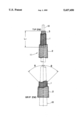
- FIGURE is an elevational view, cut away in part, showing the construction and fiber orientation of the layers, in the tip end and grip end portions, of a golf club shaft according to the present invention.
- a golf club shaft according to one embodiment of the present invention.
- the shaft 11 in this embodiment is illustrated as being wound on a mandrel 10 having an outer diameter gradually increasing from one end adjacent to a tip end of the shaft 10 to the other end adjacent to a grip end of the shaft 10.
- the shaft 11 has an inner tubular layer 1 formed of a hardened, first carbon fiber-reinforced plastic and extending continuously between the tip end and the grip end thereof.
- the inner layer 1 contains a first carbon fiber group oriented at an angle ⁇ in the range of 40 to 50 degrees with respect to the longitudinal axis of the shaft 11.
- the inner layer 1 is formed of two kinds of wound layers each of which has the same filament orientation angle but which have filament orientation directions opposite to each other with respect to the longitudinal axis of the shaft as shown in the FIGURE.
- the orientation angle of the fibers e.g. ⁇ of the first carbon fibers of the inner layer
- ⁇ of 45° indicates either of the positive and negative positions ( ⁇ 45°) relative to the axis of the shaft.
- the first carbon fiber from which the inner layer 1 is formed is a high modulus carbon fiber having a modulus of 29,000 kgf/mm 2 or more, preferably 40,000 kgf/mm 2 or more and a tensile strength of 300 kgf/mm 2 or more, preferably 350 kgf/mm 2 or more.
- the elongation of the first carbon fiber is generally 0.5-1.8%, preferably 0.5-1.0%.
- suitable high modulus carbon fibers are those commercially available under the trade names of T800, M30S, M40J, M46J, M50J, M55J, M60J and M65J (products by Toray Kabushiki Kaisha) and HMS-40, HMS-46, HMS-55 and HMS-63 (products of Tohoh Rayon Kabushiki Kaisha) and IM-400, IM-600, UM-40, UM-46, UM-55, UM-63 and UM-68 (products of Tohoh Rayon Kabushiki Kaisha).
- the inner layer 1 generally has a carbon fiber content of 65-80% by weight, preferably 70-76% by weight. In terms of volumetric percentage, the carbon fiber content is generally 55-75% by volume, preferably 60-70% by volume.
- the plastic material used as a binder or matrix resin for the first carbon fiber is generally a thermosetting resin such as an epoxy resin or an unsaturated polyester resin. An epoxy resin is preferably used.
- the inner layer 1 is formed by a sheet winding method using a prepreg containing the first carbon fibers uniaxially oriented within a matrix of a hardenable resin composition.
- an outer tubular layer 2 extending throughout the length the shaft 11 and formed of a hardened, second carbon fiber-reinforced plastic.
- the outer layer 2 contains a second carbon fiber group oriented at an angle in the range of 5 to 30 degrees with respect to the longitudinal axis of the shaft 11.
- the outer layer 2 is formed of a plurality of wound layers arranged such that the orientation angle the carbon fiber groups of respective layers relative to the longitudinal axis of the shaft is the same but the orientation directions of the fiber groups of each adjacent two layers are opposite to each other with respect to the longitudinal axis of the shaft as shown in the FIGURE.
- the second carbon fiber from which the outer layer 2 is formed is a high modulus and high strength carbon fiber having a modulus of 24,000 kgf/mm 2 or more, preferably 30,000 kgf/mm 2 or more, and a tensile strength of 450 kgf/mm 2 or more, preferably 550 kgf/mm 2 or more.
- the elongation of the second carbon fiber is generally 0.8-2.1%, preferably 1.0-2.1%.
- suitable high modulus carbon fibers are those commercially available under the trade names of T700S, T800, M30S, M35J, M40J and M46J (products by Toray Kabushiki Kaisha) and HMS-40, HMS-46, HMS-55 and HMS-63 (products of Tohoh Rayon Kabushiki Kaisha) and UT-500, IM-400, IM-600, UM-40 and UM-46 (products of Tohoh Rayon Kabushiki Kaisha).
- the outer layer 2 generally has a carbon fiber content of 65-80% by weight, preferably 67-75% by weight. In terms of volumetric percentage, the carbon fiber content is generally 55-70% by volume, preferably 58-67% by volume.
- the plastic material used as a binder or matrix resin for the second carbon fiber is generally a thermosetting resin such as an epoxy resin or an unsaturated polyester resin. An epoxy resin is preferably used.
- the outer layer 2 is formed by a filament winding method using a tow or roving of the second carbon fibers impregnated with a hardenable resin composition.
- Designated as 3 is a tubular reinforcing layer provided inside of the inner layer 1 and extending from the tip end of the shaft through a length L 1 of 50 to 500 mm, preferably 100-300 mm.
- the reinforcing layer 3 is formed of a fiber-reinforced plastic containing reinforcing fiber group oriented at an angle in the range of 0 to 5 degrees with respect to the longitudinal axis of the shaft 11.
- the reinforcing layer 3 serves to improve the bending modulus and impact resistance of the shaft 11.
- the fiber from which the reinforcing layer 3 is formed is a high strength fiber such as a carbon fiber, a boron fiber, titanium fiber, an aromatic polyamide fiber or a polyethylene fiber. These fibers may be used by themselves or as a mixture or in combination of two or more. A carbon fiber is preferably used.
- the reinforcing fiber has a modulus of 20,000 kgf/mm 2 or more, preferably 23,000 kgf/mm 2 or more, and a tensile strength of 400 kgf/mm 2 or more, preferably 500 kgf/mm 2 or more.
- the elongation of the reinforcing fiber is generally 1.5-2.1%, preferably 1.8-2.1%.
- the reinforcing layer 3 generally has a fiber content of 65-76% by weight, preferably 67-70% by weight. In terms of volumetric percentage, the carbon fiber content is generally 55-70% by volume, preferably 58-62% by volume.
- the plastic material used as a binder or matrix resin for the reinforcing fiber is generally a thermosetting resin such as an epoxy resin or an unsaturated polyester resin. An epoxy resin is preferably used.
- the reinforcing layer 3 is formed by a sheet winding method using a prepreg containing the reinforcing fibers uniaxially oriented within a matrix of a hardenable resin composition.
- the weight ratio of the inner layer 1 to the outer layer 3 should be in the range of 20:80 to 55:45, preferably 30:70 to 45:55.
- the thickness ratio of the inner layer 1 to the outer layer 3 should be in the range of 1:3 to 1:1, preferably 2:5 to 2:3.
- a weight ratio in excess of 55:45 or a thickness ratio in excess of 1:1 is undesirable because the weight of the shaft increases and the uniformity of the bending modulus (flexural rigidity) of the shaft in the circumferential direction is lost.
- the weight ratio is smaller than 20:80 or when the thickness ratio is smaller than 1:3, on the other hand, the torsional rigidity, bending modulus and buckling strength of the shaft are lowered.
- the proportion of the reinforcing layer 3 in the shaft 11 is generally 5-25% by weight, preferably 10-25% by weight.
- the total weight of the inner layer 1 and the outer layer 2 is generally 75-95% by weight, preferably 75-90% by weight, based on the weight of the shaft 11.
- the total carbon fiber content of the shaft 11 is generally 65-75% by volume, preferably 65-70% by volume.
- the length of the shaft of the present invention is generally 41-46 inches.
- the tip end of the shaft has an inside diameter of 2-6 mm, preferably 3-4 mm and a wall thickness of 1.2-3.2 mm, preferably 1.7-2.7 mm, while the grip end has an inside diameter of 11.5-14.5 mm, preferably 12.5-13.5 mm and a wall thickness of 0.5-2.0 mm, preferably 0.7-1.5 mm.
- the golf club shaft 11 according to the present invention may be produced by the following method.
- a prepreg sheet (first prepreg) containing uniaxially oriented reinforcing fibers is cut from a stock material for the reinforcing layer 3 to the desired pattern and is wound around an axially elongated mandrel 10 having an outer diameter gradually increasing from one end thereof to the other end thereof.
- the prepreg is cut so that the wound prepreg has an axial length of about 50-500 mm and the reinforcing fibers are oriented at an angle in the range of 0 to 5 degrees with respect to the axis of the mandrel 10.
- the size is determined by the number of convolutions of the material that is to be wound around the mandrel 10.
- the number of convolutions is determined by the weight and the thickness of the reinforcing layer 3 of the ultimate shaft 11.
- a prepreg sheet is cut from a stock material for the inner layer 3 to the desired pattern and is wound the mandrel 10.
- the prepreg is cut so that the wound prepreg has an axial length generally slightly greater than that of the ultimate shaft 11 and the first carbon fibers are oriented, when wound around the mandrel 10, at an angle in the range of 40 to 50 degrees with respect to the axis thereof.
- the size is determined by the number of convolutions of the material that is to be wound around the mandrel 10.
- the inner layer 1 be formed of two different kinds of wound layers.
- two, first and second kinds of prepreg sheets having, for example, ⁇ 45° filament orientations are used.
- the first and second prepregs may be alternately wound each through one complete convolution until the desired thickness is reached.
- the first prepreg (+45°) may be wound through a desired number of convolutions, with the second prepreg (-45°) being subsequently wound through the same number of convolutions.
- first and second wound layers (which are precursors of the reinforcing layer 3 and the inner layer 1, respectively) are then hardened so that the reinforcing layer 3 of the hardened first resin reinforced with the reinforcing fibers and the inner layer 1 of the hardened second resin reinforced with the first carbon fibers are formed around the mandrel 10.
- the hardening is generally performed by heating at a temperature of 120°-150° C. for 2-4 hours. Prior to heating, it is preferred that the wound prepreg layers be held in position around the mandrel 10 by winding a tape, formed of, for example, a polypropylene, polyester or poly(vinyl fluoride) film, in the conventional manner.
- a roving or tow of second carbon fibers impregnated with a hardenable resin is wound by a filament winding method around the hardened inner layer 1 supported by the mandrel 10 to form a third wound layer (a precursor of the outer layer 2) extending to entirely cover the inner layer 1 with the second carbon fibers being oriented at an angle in the range of 5 to 30 degrees with respect to the axis of the mandrel.
- the roving is wound from one end to the other end with an orientation angle in the range of +5° to +30° and then from the other end to the one end at an orientation angle in the range of -5° to -30°.
- Such reciprocal winding operation is continued until the wound layer has the desired thickness.
- the third wound layer thus formed is then hardened in the same manner as the first and second wound layers to form an outer layer of the hardened third resin reinforced with the second carbon fibers.
- the mandrel 10 is removed to leave a shaft composed of the reinforcing layer 3, the inner layer 1 and the outer layer 2.
- the both ends of the shaft are cut to adjust the length thereof to a predetermined value and the outer surface of the shaft is ground to a predetermined diameter, thereby to obtain the ultimate shaft 11.
- a prepreg sheet containing uniaxially aligned carbon fiber filaments impregnated with an epoxy resin composition was then wound on the smaller diameter end portion of the mandrel with the direction of the carbon fiber filament being oriented in substantially parallel with the longitudinal axis of the mandrel (namely, the carbon fibers are oriented at an angle of about 0 degree with respect to the axis of the mandrel) to form a wound reinforcing layer having a length of 250 mm (from the tip end of the shaft).
- the prepreg sheet used was a commercially available one (P3052S-15 manufactured by Toray Kabushiki Kaisha) having a thickness of 0.15 mm, a carbon fiber weight of 150 g/m 2 , a resin content of 33% by weight (fiber content: 67% by weight) and a carbon fiber content of 58% by volume.
- the carbon fiber of the prepreg sheet had a modulus of 23,500 kgf/mm 2 , a tensile strength of 490 kgf/mm 2 and an elongation of 2.1%.
- the prepreg was wound around the mandrel so that the number of the convolutions was 1 (1 ply) at the larger diameter end (250 mm away from the tip end) and was 3.8 (3.8 plies) at the smaller diameter end.
- prepreg sheets A-1 and A-2 Two kinds of prepreg sheets A-1 and A-2 were cut from a prepreg stock (P9055F-08 manufactured by Toray Kabushiki Kaisha) which contained uniaxially aligned carbon fiber filaments impregnated with an epoxy resin composition and which had a thickness of 0.06 mm, a carbon fiber weight of 75 g/m 2 , a resin content of 24% by weight (fiber content: 76% by weight) and a carbon fiber content of 69% by volume.
- the carbon fiber of the prepreg stock had a modulus of 38,500 kgf/mm 2 , a tensile strength of 450 kgf/mm 2 and an elongation of 1.0%.
- the prepreg sheets A-1 and A-2 had the same size but the orientation direction of the carbon fibers were opposite to each other.
- the prepreg sheet A-1 was wound around the mandrel throughout the length thereof with the direction of the carbon fiber filament being oriented at an angle of +45 degrees with respect to the axis of the mandrel and with the number of the convolutions being 2 (2 plies) at the larger diameter end and 3 (3 plies) at the smaller diameter end.
- the prepreg sheet A-2 was wound around the wound A-1 sheet throughout the length thereof with the direction of the carbon fiber filament being oriented at an angle of -45 degrees with respect to the axis of the mandrel and with the number of the convolutions being 2 (2 plies) at the larger diameter end and 3 (3 plies) at the smaller diameter end, thereby to form a wound inner layer.
- a polypropylene film tape was then wound around the inner layer and the resulting assembly was heated at 130° C. for 2 hours to completely cure the reinforcing layer and the inner layer. The polypropylene tape was then removed.
- a tow of carbon fibers (IM-600-12K manufactured by Tohoh Rayon Kabushiki Kaisha, filament number: 12,000, filament diameter: 5 ⁇ m) was impregnated with a hardenable epoxy resin composition and then wound around the hardened inner layer at a winding angle of +10° from the smaller diameter end to the larger diameter end and at a winding angle of -10° from the larger diameter end to the smaller diameter end. Such reciprocal winding was continued until the outer diameters of the resulting outer layer at the smaller and larger diameter ends became slightly larger than 8.5 mm and 15 mm, respectively.
- the tow used had a resin content of 30% by weight (fiber content: 70% by weight) and a carbon fiber content of 61% by volume.
- the carbon fiber of the tow had a modulus of 29,000 kgf/mm 2 , a tensile strength of 590 kgf/mm 2 and an elongation of 2.0%.
- a polypropylene film tape was then wound around the outer layer and the resulting assembly was heated at 130° C. for 2 hours to completely cure the outer layer. After being cooled to room temperature, the mandrel was removed and the polypropylene tape was removed.
- the resulting shaft was sanded to form a golf club shaft having a length of 1143 mm (45 inches), a tip end outside diameter of 8.5 mm and a grip end outside diameter of 15 mm, a weight of 57 g, a weight ratio of the inner layer to the outer layer of 37:63, a thickness ratio of the inner layer to the outer layer of 10:17, a weight of the reinforcing layer of 6% by weight based on the total weight of the shaft and a total fiber content of 65% by volume.
- Example 1 was repeated in the same manner as described except that the outer layer was formed by a sheet winding method in place of the filament winding method.
- a prepreg sheet containing uniaxially aligned carbon fiber filaments impregnated with an epoxy resin composition was wound around the hardened inner layer throughout the length thereof with the direction of the carbon fiber filament being oriented in substantially parallel with the longitudinal axis of the mandrel (namely, the carbon fibers are oriented at an angle of about 0 degree with respect to the axis of the mandrel) to form a wound outer layer.
- the prepreg sheet used was a commercially available one (P3052S-17 manufactured by Yoray Kabushiki Kaisha) having a thickness of 0.17 mm, a carbon fiber weight of 175 g/m 2 resin content of 33% by weight (fiber content: 67% by weight) and a carbon fiber content of 59% by volume.
- the carbon fiber of the prepreg sheet had a modulus of 30,000 kgf/mm 2 , a tensile strength of 560 kgf/mm 2 and an elongation of 1.8%.
- the prepreg was wound around the mandrel so that the number of the convolutions was 3 throughout the length thereof.
- the resulting golf club shaft had a weight of 56 g, a weight ratio of the inner layer to the outer layer of 37:63, a thickness ratio of the inner layer to the outer layer of 10:17, a weight of the reinforcing layer of 6% by weight based on the total weight of the shaft and a total fiber content of 64% by volume.
- Example 1 was repeated in the same manner as described except that the inner layer was formed by a filament winding method in place of the sheet winding method.
- a tow of carbon fibers (UM40-12K manufactured by Tohoh Rayon Kabushiki Kaisha) was impregnated with a hardenable epoxy resin composition and then wound around the hardened inner layer at a winding angle of +45° from the smaller diameter end to the larger diameter end and at a winding angle of -45° from the larger diameter end to the smaller diameter end.
- Such reciprocal winding was continued until the outer diameters of the resulting outer layer at the smaller and larger diameter ends became 4.8 mm and 13.3 mm, respectively.
- the tow used had a resin content of 24% by weight (fiber content: 76% by weight) and a carbon fiber content of 69% by volume.
- the carbon fiber of the tow had a modulus of 39,000 kgf/mm 2 , a tensile strength of 500 kgf/mm 2 and an elongation of 1.2%.
- the resulting golf club shaft had a weight of 57 g, a weight ratio of the inner layer to the outer layer of 37:63, a thickness ratio of the inner layer to the outer layer of 10:17, a weight of the reinforcing layer of 6% by weight based on the total weight of the shaft and a total fiber content of 65% by volume.
- Example 1 was repeated in the same manner as described except that the wound reinforcing layer and the inner layer were not cured before the winding of the outer layer. Thus, the hardening of the reinforcing layer, inner layer and outer layer was simultaneously performed after the winding of the outer layer.
- the resulting golf club shaft had a weight of 56 g, a weight ratio of the inner layer to the outer layer of 37:63, a thickness ratio of the inner layer to the outer layer of 10:17, a weight of the reinforcing layer of 6% by weight based on the total weight of the shaft and a total fiber content of 65% by volume.
- Sample shaft is inserted through a length of 38 mm from the tip end into a horizontally extending hole of a jig having a shape similar to a head hosel and firmly fixed therein, with the grip end being maintained free.
- a load is vertically applied at a rate of 5 mm/cm to the shaft at a position 102 mm away from the fixed point until breakage. The load which has caused breakage is measured.
- Sample shaft is cut at 60 mm from the tip end thereof.
- the cut sample is vertically held by firmly nipping the lower half portion thereof.
- the izod impact strength is measured in accordance with JIS K7110.
- a hammer whose shaft is swingably supported above the sample is allowed to swing from a predetermined height to hit the sample. The loss of the energy of the hammer caused by the hitting of the sample is measured.
- Sample shaft is firmly gripped at both ends (length: 40 mm) with a pair of jigs.
- One of the jig on the tip end side is rotated about the axis of the shaft with the other jig being maintained unmoved. The torque which caused breakage of the shaft is measured.
- Sample shaft is horizontally supported at two positions 15 mm and 180 mm away from the grip end thereof, respectively.
- a load is then vertically applied at a point 925 mm away from the grip end until that point is lowered through a distance of 165 mm.
- the load required for lowering the load-applying point through 165 mm is measured.
- the test is performed at two different positions (0° and 90°) around the circumference of the shaft.
- Sample shaft is firmly secured at a position 83 mm away from the grip end thereof.
- a model head weighing 285 g is fixed to the tip end and excited to freely oscillate.
- the frequency (cycles per minute) is measured using a counter (Precision FM manufactured by Brunswick Inc.). The test is performed at eight different positions (0°, 45°, 90°, 135°, 180°, 225°, 270° and 315°) around the circumference of the shaft.
Landscapes
- Engineering & Computer Science (AREA)
- Chemical & Material Sciences (AREA)
- Composite Materials (AREA)
- Mechanical Engineering (AREA)
- Textile Engineering (AREA)
- Health & Medical Sciences (AREA)
- General Health & Medical Sciences (AREA)
- Physical Education & Sports Medicine (AREA)
- Golf Clubs (AREA)
- Laminated Bodies (AREA)
Applications Claiming Priority (2)
| Application Number | Priority Date | Filing Date | Title |
|---|---|---|---|
| JP5-238964 | 1993-08-31 | ||
| JP5238964A JP3020222B2 (ja) | 1993-08-31 | 1993-08-31 | ゴルフクラブ用シャフト及びその製造方法 |
Publications (1)
| Publication Number | Publication Date |
|---|---|
| US5437450A true US5437450A (en) | 1995-08-01 |
Family
ID=17037918
Family Applications (1)
| Application Number | Title | Priority Date | Filing Date |
|---|---|---|---|
| US08/297,028 Expired - Fee Related US5437450A (en) | 1993-08-31 | 1994-08-29 | Golf club shaft and process of preparing same |
Country Status (2)
| Country | Link |
|---|---|
| US (1) | US5437450A (ja) |
| JP (1) | JP3020222B2 (ja) |
Cited By (51)
| Publication number | Priority date | Publication date | Assignee | Title |
|---|---|---|---|---|
| US5599242A (en) * | 1995-02-13 | 1997-02-04 | Taylor Made Golf Company, Inc. | Golf club shaft and club including such shaft |
| US5721030A (en) * | 1993-09-03 | 1998-02-24 | Shimano, Inc. | Tubular member |
| US5935017A (en) | 1996-06-28 | 1999-08-10 | Cobra Golf Incorporated | Golf club shaft |
| US5961395A (en) * | 1997-03-10 | 1999-10-05 | You; Chin-San | Golf club |
| US5984804A (en) * | 1996-03-01 | 1999-11-16 | True Temper Sports, Inc. | Lightweight shaft and methods of making same |
| USD418566S (en) * | 1997-07-08 | 2000-01-04 | Cobra Golf Incorporated | Lower section of a shaft adapted for use in a golf club shaft |
| US6012777A (en) * | 1997-04-29 | 2000-01-11 | Grammer Automotive Gmbh | Mount for motor-vehicle headrest |
| US6117021A (en) | 1996-06-28 | 2000-09-12 | Cobra Golf, Incorporated | Golf club shaft |
| GB2323043B (en) * | 1997-03-11 | 2001-02-21 | You Chin San | Golf club |
| US6273830B1 (en) * | 1996-04-19 | 2001-08-14 | Nippon Mitsubishi Oil Corporation | Tapered hollow shaft |
| US6302806B1 (en) * | 1999-02-09 | 2001-10-16 | Patrick C. T. Hsu | Shaft of golf club |
| US6354957B1 (en) * | 1997-03-31 | 2002-03-12 | Daiwa Seiko, Inc. | Golf club shaft |
| US6475583B1 (en) * | 2000-06-07 | 2002-11-05 | Patrick Hsu | Structure of tubular product of fiber composite material |
| US20030022728A1 (en) * | 2001-07-11 | 2003-01-30 | Hiroshi Hasegawa | Golf club shaft |
| US6586110B1 (en) | 2000-07-07 | 2003-07-01 | Delphi Technologies, Inc. | Contoured metal structural members and methods for making the same |
| US6602148B2 (en) * | 2001-03-16 | 2003-08-05 | Patrick Hsu | Golf club shaft |
| US20030176237A1 (en) * | 2002-03-15 | 2003-09-18 | Hitoshi Oyama | Golf club shaft |
| US6641893B1 (en) | 1997-03-14 | 2003-11-04 | Massachusetts Institute Of Technology | Functionally-graded materials and the engineering of tribological resistance at surfaces |
| US6666778B2 (en) * | 2000-11-24 | 2003-12-23 | Mizuno Corporation | FRP golf club shaft |
| US20040092330A1 (en) * | 2002-11-12 | 2004-05-13 | Meyer Jeffrey W. | Hybrid golf club shaft |
| US20040092329A1 (en) * | 2002-11-12 | 2004-05-13 | Meyer Jeffrey W. | Hybrid golf club shaft |
| US6821638B2 (en) | 2000-07-07 | 2004-11-23 | Delphi Technologies, Inc. | Shaped contoured crushable structural members and methods for making the same |
| US6827656B1 (en) * | 1997-01-24 | 2004-12-07 | Hd Golf Development, Inc. | Higher overall flex golf shaft |
| US6866593B1 (en) | 2000-06-23 | 2005-03-15 | Harrison Sports, Inc. | Golf club shaft having multiple metal fiber layers |
| US6908401B2 (en) | 2001-02-28 | 2005-06-21 | Michael H. L. Cheng | Shaft for use in golf clubs and other shaft-based instruments and method of making the same |
| US6949282B2 (en) | 2000-07-07 | 2005-09-27 | Delphi Technologies, Inc. | Contoured crushable composite structural members and methods for making the same |
| US20060058111A1 (en) * | 2004-09-14 | 2006-03-16 | Sri Sports Limited | Golf club shaft |
| US20060135282A1 (en) * | 2004-12-17 | 2006-06-22 | Integran Technologies, Inc. | Article comprising a fine-grained metallic material and a polymeric material |
| US20060194643A1 (en) * | 2005-02-28 | 2006-08-31 | Nelson Precision Casting Co., Ltd. | Vibration-absorbing structure for golf club shaft |
| US7771289B2 (en) | 2004-12-17 | 2010-08-10 | Integran Technologies, Inc. | Sports articles formed using nanostructured materials |
| US20100260955A1 (en) * | 2009-04-09 | 2010-10-14 | Hiroshi Hasegawa | Tubular body and manufacturing method thereof |
| US20120295734A1 (en) * | 2011-05-18 | 2012-11-22 | Hiroshi Hasegawa | Golf club shaft |
| US20120295730A1 (en) * | 2011-05-18 | 2012-11-22 | Hiroshi Hasegawa | Golf club |
| US8550564B1 (en) * | 2010-04-01 | 2013-10-08 | The Boeing Company | Composite seat pan structure for a lightweight aircraft seat assembly |
| US20140274447A1 (en) * | 2013-03-14 | 2014-09-18 | Karsten Manufacturing Corporation | Shaft plugs for golf clubs and methods to manufacture golf clubs |
| US20150038254A1 (en) * | 2013-07-31 | 2015-02-05 | Dunlop Sports Co. Ltd. | Golf club shaft |
| DE102016106192B3 (de) * | 2016-04-05 | 2017-06-08 | ACS Schaftmanufaktur Germany GmbH | Golfschlägerschaft |
| CN106891541A (zh) * | 2017-02-23 | 2017-06-27 | 武汉理工大学 | 一种碳纤维缠绕耐外压管的铺层结构 |
| US20170259138A1 (en) * | 2016-03-14 | 2017-09-14 | Dunlop Sports Co. Ltd. | Golf club shaft |
| US20180214751A1 (en) * | 2017-01-31 | 2018-08-02 | Globeride, Inc. | Golf club |
| US10252125B2 (en) * | 2015-05-18 | 2019-04-09 | Sumitomo Rubber Industries, Ltd. | Golf club shaft |
| US20220111276A1 (en) * | 2019-02-07 | 2022-04-14 | True Temper Sports, Inc. | Sports equipment with cut outs formed in outer layer of composite material |
| US11346499B1 (en) | 2021-06-01 | 2022-05-31 | Helicoid Industries Inc. | Containers and methods for protecting pressure vessels |
| US11376812B2 (en) | 2020-02-11 | 2022-07-05 | Helicoid Industries Inc. | Shock and impact resistant structures |
| CN116749602A (zh) * | 2023-06-21 | 2023-09-15 | 宁波江丰复合材料科技有限公司 | 一种碳纤维增强的c型管材及其制备方法和用途 |
| US11852297B2 (en) | 2021-06-01 | 2023-12-26 | Helicoid Industries Inc. | Containers and methods for protecting pressure vessels |
| US11952103B2 (en) | 2022-06-27 | 2024-04-09 | Helicoid Industries Inc. | High impact-resistant, reinforced fiber for leading edge protection of aerodynamic structures |
| US12275227B2 (en) | 2020-02-11 | 2025-04-15 | Helicoid Industries, Inc. | Composite materials and structures |
| CN119952988A (zh) * | 2025-01-23 | 2025-05-09 | 长春长光宇航复合材料有限公司 | 复合材料零膨胀锥形桁架杆制造方法 |
| US12409348B2 (en) * | 2020-12-14 | 2025-09-09 | Larry David Staton | Demolition ram for glazing |
| US12447392B2 (en) * | 2017-03-02 | 2025-10-21 | Roar SKALSTAD | Ski pole |
Families Citing this family (2)
| Publication number | Priority date | Publication date | Assignee | Title |
|---|---|---|---|---|
| JP2006158496A (ja) * | 2004-12-03 | 2006-06-22 | Yokohama Rubber Co Ltd:The | ゴルフクラブ |
| JP6798199B2 (ja) * | 2016-09-06 | 2020-12-09 | 住友ゴム工業株式会社 | 繊維強化プラスチック成形物 |
Citations (8)
| Publication number | Priority date | Publication date | Assignee | Title |
|---|---|---|---|---|
| US3313541A (en) * | 1963-10-11 | 1967-04-11 | Us Fiberglass Company | Golf club including reinforced fiber glass shaft |
| US3998458A (en) * | 1974-07-12 | 1976-12-21 | Hitachi Chemical Company, Ltd. | Golf club shaft |
| US4023801A (en) * | 1974-09-24 | 1977-05-17 | Exxon Research And Engineering Company | Golf shaft and method of making same |
| US4135035A (en) * | 1976-05-20 | 1979-01-16 | Avco Corporation | Laminated composite golf club shaft |
| US4757997A (en) * | 1986-06-06 | 1988-07-19 | Fiber-Speed International, Inc. | Golf club shaft and method of manufacture |
| US5088735A (en) * | 1988-09-05 | 1992-02-18 | Ryobi Limited | Shaft structure of golf club and production method of the shaft |
| US5143374A (en) * | 1990-02-16 | 1992-09-01 | Somar Corporation | Golf club shaft and process for manufacturing same |
| US5156396A (en) * | 1991-08-26 | 1992-10-20 | Somar Corporation | Golf club shaft |
-
1993
- 1993-08-31 JP JP5238964A patent/JP3020222B2/ja not_active Expired - Lifetime
-
1994
- 1994-08-29 US US08/297,028 patent/US5437450A/en not_active Expired - Fee Related
Patent Citations (8)
| Publication number | Priority date | Publication date | Assignee | Title |
|---|---|---|---|---|
| US3313541A (en) * | 1963-10-11 | 1967-04-11 | Us Fiberglass Company | Golf club including reinforced fiber glass shaft |
| US3998458A (en) * | 1974-07-12 | 1976-12-21 | Hitachi Chemical Company, Ltd. | Golf club shaft |
| US4023801A (en) * | 1974-09-24 | 1977-05-17 | Exxon Research And Engineering Company | Golf shaft and method of making same |
| US4135035A (en) * | 1976-05-20 | 1979-01-16 | Avco Corporation | Laminated composite golf club shaft |
| US4757997A (en) * | 1986-06-06 | 1988-07-19 | Fiber-Speed International, Inc. | Golf club shaft and method of manufacture |
| US5088735A (en) * | 1988-09-05 | 1992-02-18 | Ryobi Limited | Shaft structure of golf club and production method of the shaft |
| US5143374A (en) * | 1990-02-16 | 1992-09-01 | Somar Corporation | Golf club shaft and process for manufacturing same |
| US5156396A (en) * | 1991-08-26 | 1992-10-20 | Somar Corporation | Golf club shaft |
Cited By (74)
| Publication number | Priority date | Publication date | Assignee | Title |
|---|---|---|---|---|
| US5721030A (en) * | 1993-09-03 | 1998-02-24 | Shimano, Inc. | Tubular member |
| US5599242A (en) * | 1995-02-13 | 1997-02-04 | Taylor Made Golf Company, Inc. | Golf club shaft and club including such shaft |
| US5984804A (en) * | 1996-03-01 | 1999-11-16 | True Temper Sports, Inc. | Lightweight shaft and methods of making same |
| US6273830B1 (en) * | 1996-04-19 | 2001-08-14 | Nippon Mitsubishi Oil Corporation | Tapered hollow shaft |
| US5935017A (en) | 1996-06-28 | 1999-08-10 | Cobra Golf Incorporated | Golf club shaft |
| US6117021A (en) | 1996-06-28 | 2000-09-12 | Cobra Golf, Incorporated | Golf club shaft |
| US6827656B1 (en) * | 1997-01-24 | 2004-12-07 | Hd Golf Development, Inc. | Higher overall flex golf shaft |
| US5961395A (en) * | 1997-03-10 | 1999-10-05 | You; Chin-San | Golf club |
| GB2323043B (en) * | 1997-03-11 | 2001-02-21 | You Chin San | Golf club |
| US6641893B1 (en) | 1997-03-14 | 2003-11-04 | Massachusetts Institute Of Technology | Functionally-graded materials and the engineering of tribological resistance at surfaces |
| US6354957B1 (en) * | 1997-03-31 | 2002-03-12 | Daiwa Seiko, Inc. | Golf club shaft |
| US6012777A (en) * | 1997-04-29 | 2000-01-11 | Grammer Automotive Gmbh | Mount for motor-vehicle headrest |
| USD418566S (en) * | 1997-07-08 | 2000-01-04 | Cobra Golf Incorporated | Lower section of a shaft adapted for use in a golf club shaft |
| US6302806B1 (en) * | 1999-02-09 | 2001-10-16 | Patrick C. T. Hsu | Shaft of golf club |
| US6475583B1 (en) * | 2000-06-07 | 2002-11-05 | Patrick Hsu | Structure of tubular product of fiber composite material |
| US7497786B2 (en) | 2000-06-23 | 2009-03-03 | Harrison Sports, Inc. | Golf club shaft having multiple metal fiber layers |
| US20060211512A1 (en) * | 2000-06-23 | 2006-09-21 | Cheng Michael H L | Golf club shaft having multiple metal fiber layers |
| US6866593B1 (en) | 2000-06-23 | 2005-03-15 | Harrison Sports, Inc. | Golf club shaft having multiple metal fiber layers |
| US6586110B1 (en) | 2000-07-07 | 2003-07-01 | Delphi Technologies, Inc. | Contoured metal structural members and methods for making the same |
| US6949282B2 (en) | 2000-07-07 | 2005-09-27 | Delphi Technologies, Inc. | Contoured crushable composite structural members and methods for making the same |
| US6893733B2 (en) | 2000-07-07 | 2005-05-17 | Delphi Technologies, Inc. | Modified contoured crushable structural members and methods for making the same |
| US6821638B2 (en) | 2000-07-07 | 2004-11-23 | Delphi Technologies, Inc. | Shaped contoured crushable structural members and methods for making the same |
| US6666778B2 (en) * | 2000-11-24 | 2003-12-23 | Mizuno Corporation | FRP golf club shaft |
| US6908401B2 (en) | 2001-02-28 | 2005-06-21 | Michael H. L. Cheng | Shaft for use in golf clubs and other shaft-based instruments and method of making the same |
| US20060211511A1 (en) * | 2001-02-28 | 2006-09-21 | Cheng Michael H | Shaft for use in golf clubs and other shaft-based instruments and method of making the same |
| US6602148B2 (en) * | 2001-03-16 | 2003-08-05 | Patrick Hsu | Golf club shaft |
| US20030022728A1 (en) * | 2001-07-11 | 2003-01-30 | Hiroshi Hasegawa | Golf club shaft |
| US6875127B2 (en) * | 2001-07-11 | 2005-04-05 | Sumitomo Rubber Industries, Ltd. | Golf club shaft |
| US6926617B2 (en) * | 2002-03-15 | 2005-08-09 | Sri Sports Limited | Golf club shaft |
| US20030176237A1 (en) * | 2002-03-15 | 2003-09-18 | Hitoshi Oyama | Golf club shaft |
| US6805642B2 (en) * | 2002-11-12 | 2004-10-19 | Acushnet Company | Hybrid golf club shaft |
| US20050107182A1 (en) * | 2002-11-12 | 2005-05-19 | Acushnet Company | Hybrid golf club shaft |
| US20040092330A1 (en) * | 2002-11-12 | 2004-05-13 | Meyer Jeffrey W. | Hybrid golf club shaft |
| US20040092329A1 (en) * | 2002-11-12 | 2004-05-13 | Meyer Jeffrey W. | Hybrid golf club shaft |
| US20060058111A1 (en) * | 2004-09-14 | 2006-03-16 | Sri Sports Limited | Golf club shaft |
| US7404771B2 (en) * | 2004-09-14 | 2008-07-29 | Sri Sports Limited | Golf club shaft |
| US7354354B2 (en) | 2004-12-17 | 2008-04-08 | Integran Technologies Inc. | Article comprising a fine-grained metallic material and a polymeric material |
| US20080090066A1 (en) * | 2004-12-17 | 2008-04-17 | Integran Technologies, Inc. | Article comprising a fine-grained metallic material and a polymeric material |
| US20080254310A1 (en) * | 2004-12-17 | 2008-10-16 | Integran Technologies, Inc. | Article comprising a fine-Grained metallic material and a polymeric material |
| US20060135282A1 (en) * | 2004-12-17 | 2006-06-22 | Integran Technologies, Inc. | Article comprising a fine-grained metallic material and a polymeric material |
| US7553553B2 (en) | 2004-12-17 | 2009-06-30 | Integran Technologies, Inc. | Article comprising a fine-grained metallic material and a polymeric material |
| US7771289B2 (en) | 2004-12-17 | 2010-08-10 | Integran Technologies, Inc. | Sports articles formed using nanostructured materials |
| US20060194643A1 (en) * | 2005-02-28 | 2006-08-31 | Nelson Precision Casting Co., Ltd. | Vibration-absorbing structure for golf club shaft |
| US20100260955A1 (en) * | 2009-04-09 | 2010-10-14 | Hiroshi Hasegawa | Tubular body and manufacturing method thereof |
| US8882949B2 (en) * | 2009-04-09 | 2014-11-11 | Sri Sports Limited | Tubular body and manufacturing method thereof |
| US8550564B1 (en) * | 2010-04-01 | 2013-10-08 | The Boeing Company | Composite seat pan structure for a lightweight aircraft seat assembly |
| US8979666B2 (en) * | 2011-05-18 | 2015-03-17 | Sri Sports Limited | Golf club shaft |
| US20120295730A1 (en) * | 2011-05-18 | 2012-11-22 | Hiroshi Hasegawa | Golf club |
| US20120295734A1 (en) * | 2011-05-18 | 2012-11-22 | Hiroshi Hasegawa | Golf club shaft |
| US9079083B2 (en) * | 2011-05-18 | 2015-07-14 | Dunlop Sports Co. Ltd. | Golf club |
| US9216325B2 (en) * | 2013-03-14 | 2015-12-22 | Karsten Manufacturing Corporation | Shaft plugs for golf clubs and methods to manufacture golf clubs |
| US20140274447A1 (en) * | 2013-03-14 | 2014-09-18 | Karsten Manufacturing Corporation | Shaft plugs for golf clubs and methods to manufacture golf clubs |
| US9895580B2 (en) | 2013-03-14 | 2018-02-20 | Karsten Manufacturing Corporation | Shaft plugs for golf clubs and methods to manufacture golf clubs |
| US20150038254A1 (en) * | 2013-07-31 | 2015-02-05 | Dunlop Sports Co. Ltd. | Golf club shaft |
| US9498687B2 (en) * | 2013-07-31 | 2016-11-22 | Dunlop Sports Co. Ltd. | Golf club shaft |
| US10252125B2 (en) * | 2015-05-18 | 2019-04-09 | Sumitomo Rubber Industries, Ltd. | Golf club shaft |
| US20170259138A1 (en) * | 2016-03-14 | 2017-09-14 | Dunlop Sports Co. Ltd. | Golf club shaft |
| US10143901B2 (en) * | 2016-03-14 | 2018-12-04 | Sumitomo Rubber Industries, Ltd. | Golf club shaft |
| DE102016106192B3 (de) * | 2016-04-05 | 2017-06-08 | ACS Schaftmanufaktur Germany GmbH | Golfschlägerschaft |
| WO2017174049A1 (de) | 2016-04-05 | 2017-10-12 | ACS Schaftmanufaktur Germany GmbH | Golfschlägerschaft |
| US10376759B2 (en) * | 2017-01-31 | 2019-08-13 | Globeride, Inc. | Golf club |
| US20180214751A1 (en) * | 2017-01-31 | 2018-08-02 | Globeride, Inc. | Golf club |
| CN106891541A (zh) * | 2017-02-23 | 2017-06-27 | 武汉理工大学 | 一种碳纤维缠绕耐外压管的铺层结构 |
| US12447392B2 (en) * | 2017-03-02 | 2025-10-21 | Roar SKALSTAD | Ski pole |
| US20220111276A1 (en) * | 2019-02-07 | 2022-04-14 | True Temper Sports, Inc. | Sports equipment with cut outs formed in outer layer of composite material |
| US11376812B2 (en) | 2020-02-11 | 2022-07-05 | Helicoid Industries Inc. | Shock and impact resistant structures |
| US12275227B2 (en) | 2020-02-11 | 2025-04-15 | Helicoid Industries, Inc. | Composite materials and structures |
| US12409348B2 (en) * | 2020-12-14 | 2025-09-09 | Larry David Staton | Demolition ram for glazing |
| US12558578B2 (en) | 2020-12-14 | 2026-02-24 | Larry David Staton | Demolishing of glazing at a distance |
| US11346499B1 (en) | 2021-06-01 | 2022-05-31 | Helicoid Industries Inc. | Containers and methods for protecting pressure vessels |
| US11852297B2 (en) | 2021-06-01 | 2023-12-26 | Helicoid Industries Inc. | Containers and methods for protecting pressure vessels |
| US11952103B2 (en) | 2022-06-27 | 2024-04-09 | Helicoid Industries Inc. | High impact-resistant, reinforced fiber for leading edge protection of aerodynamic structures |
| CN116749602A (zh) * | 2023-06-21 | 2023-09-15 | 宁波江丰复合材料科技有限公司 | 一种碳纤维增强的c型管材及其制备方法和用途 |
| CN119952988A (zh) * | 2025-01-23 | 2025-05-09 | 长春长光宇航复合材料有限公司 | 复合材料零膨胀锥形桁架杆制造方法 |
Also Published As
| Publication number | Publication date |
|---|---|
| JP3020222B2 (ja) | 2000-03-15 |
| JPH0767992A (ja) | 1995-03-14 |
Similar Documents
| Publication | Publication Date | Title |
|---|---|---|
| US5437450A (en) | Golf club shaft and process of preparing same | |
| US5156396A (en) | Golf club shaft | |
| JPH09267400A (ja) | Frp曲り管 | |
| GB2254789A (en) | Golf club shaft and process for manufacturing same | |
| US20020034985A1 (en) | Golf club shaft with controllable feel and balance using combination of fiber-reinforced plastics and metal-coated fiber-reinforced plastics | |
| JP3457872B2 (ja) | オーバーホーゼルタイプのゴルフクラブシャフト及びゴルフクラブ | |
| JP3692691B2 (ja) | 繊維強化プラスチック製管状体 | |
| JP3508429B2 (ja) | 繊維強化プラスチック製管状体 | |
| JP3712143B2 (ja) | オーバーホーゼルタイプのゴルフクラブ用シャフトの製造方法 | |
| JPH1015130A (ja) | ゴルフクラブパター用シャフト | |
| JP4583563B2 (ja) | 繊維強化樹脂製管状体 | |
| JP2861447B2 (ja) | テーパ付き管状体 | |
| JP3257238B2 (ja) | 繊維強化プラスチック製円筒体 | |
| KR100361546B1 (ko) | 골프채 샤프트 제조방법 | |
| JP4102487B2 (ja) | 繊維強化プラスチック製ゴルフクラブシャフト | |
| JPH06165844A (ja) | ゴルフクラブシャフト | |
| JPH08217896A (ja) | プリプレグ | |
| JP2000263653A (ja) | 繊維強化複合材料製管状体 | |
| JPH05305164A (ja) | ゴルフシャフト | |
| KR920002103B1 (ko) | 섬유강화 골프샤프트의 제조방법 | |
| JPH05269227A (ja) | ゴルフシャフト | |
| JP2024119264A (ja) | ゴルフクラブシャフト | |
| JPH10272214A (ja) | 軽量ゴルフクラブ用シャフト及びそれを用いたゴルフクラブ | |
| JP2003171483A (ja) | プリプレグおよび繊維強化複合材料 | |
| JP2000051411A (ja) | 繊維強化プラスチック製ゴルフクラブ用シャフト |
Legal Events
| Date | Code | Title | Description |
|---|---|---|---|
| AS | Assignment |
Owner name: SOMAR CORPORATION, JAPAN Free format text: ASSIGNMENT OF ASSIGNORS INTEREST;ASSIGNORS:AKATSUKA, TSUNEO;MOTOKI, YOSHIHIRO;HARADA, TAKASHI;AND OTHERS;REEL/FRAME:007127/0840 Effective date: 19940822 |
|
| FEPP | Fee payment procedure |
Free format text: PAYOR NUMBER ASSIGNED (ORIGINAL EVENT CODE: ASPN); ENTITY STATUS OF PATENT OWNER: LARGE ENTITY |
|
| FEPP | Fee payment procedure |
Free format text: PAYER NUMBER DE-ASSIGNED (ORIGINAL EVENT CODE: RMPN); ENTITY STATUS OF PATENT OWNER: LARGE ENTITY Free format text: PAYOR NUMBER ASSIGNED (ORIGINAL EVENT CODE: ASPN); ENTITY STATUS OF PATENT OWNER: LARGE ENTITY |
|
| FEPP | Fee payment procedure |
Free format text: PAYOR NUMBER ASSIGNED (ORIGINAL EVENT CODE: ASPN); ENTITY STATUS OF PATENT OWNER: LARGE ENTITY Free format text: PAYER NUMBER DE-ASSIGNED (ORIGINAL EVENT CODE: RMPN); ENTITY STATUS OF PATENT OWNER: LARGE ENTITY |
|
| FPAY | Fee payment |
Year of fee payment: 4 |
|
| REMI | Maintenance fee reminder mailed | ||
| LAPS | Lapse for failure to pay maintenance fees | ||
| STCH | Information on status: patent discontinuation |
Free format text: PATENT EXPIRED DUE TO NONPAYMENT OF MAINTENANCE FEES UNDER 37 CFR 1.362 |
|
| FP | Lapsed due to failure to pay maintenance fee |
Effective date: 20030801 |