US5437702A - Hot bottle inspection apparatus and method - Google Patents
Hot bottle inspection apparatus and method Download PDFInfo
- Publication number
- US5437702A US5437702A US08/111,115 US11111593A US5437702A US 5437702 A US5437702 A US 5437702A US 11111593 A US11111593 A US 11111593A US 5437702 A US5437702 A US 5437702A
- Authority
- US
- United States
- Prior art keywords
- bottle
- bottles
- mold
- conveyor
- hot
- Prior art date
- Legal status (The legal status is an assumption and is not a legal conclusion. Google has not performed a legal analysis and makes no representation as to the accuracy of the status listed.)
- Expired - Fee Related
Links
- 238000007689 inspection Methods 0.000 title claims abstract description 52
- 238000000034 method Methods 0.000 title claims description 18
- 238000004519 manufacturing process Methods 0.000 claims abstract description 38
- 239000011521 glass Substances 0.000 claims abstract description 21
- 238000001514 detection method Methods 0.000 claims abstract description 11
- 230000002950 deficient Effects 0.000 claims description 20
- 238000003384 imaging method Methods 0.000 claims description 15
- 238000006073 displacement reaction Methods 0.000 claims description 6
- 239000000356 contaminant Substances 0.000 claims description 5
- 239000012530 fluid Substances 0.000 claims description 5
- 238000012545 processing Methods 0.000 claims description 5
- 238000011109 contamination Methods 0.000 claims description 4
- 238000001816 cooling Methods 0.000 claims description 4
- 239000000463 material Substances 0.000 claims description 3
- 238000012546 transfer Methods 0.000 abstract description 12
- 238000000137 annealing Methods 0.000 description 8
- 230000008569 process Effects 0.000 description 8
- OKTJSMMVPCPJKN-UHFFFAOYSA-N Carbon Chemical compound [C] OKTJSMMVPCPJKN-UHFFFAOYSA-N 0.000 description 4
- 229910052799 carbon Inorganic materials 0.000 description 4
- 239000011248 coating agent Substances 0.000 description 4
- 238000000576 coating method Methods 0.000 description 4
- 230000007547 defect Effects 0.000 description 4
- 238000010586 diagram Methods 0.000 description 4
- 230000003287 optical effect Effects 0.000 description 4
- 238000004458 analytical method Methods 0.000 description 3
- 235000013405 beer Nutrition 0.000 description 3
- 238000005259 measurement Methods 0.000 description 3
- CDBYLPFSWZWCQE-UHFFFAOYSA-L Sodium Carbonate Chemical compound [Na+].[Na+].[O-]C([O-])=O CDBYLPFSWZWCQE-UHFFFAOYSA-L 0.000 description 2
- 230000009471 action Effects 0.000 description 2
- 238000013461 design Methods 0.000 description 2
- 230000007246 mechanism Effects 0.000 description 2
- 238000002844 melting Methods 0.000 description 2
- 230000008018 melting Effects 0.000 description 2
- VNWKTOKETHGBQD-UHFFFAOYSA-N methane Chemical compound C VNWKTOKETHGBQD-UHFFFAOYSA-N 0.000 description 2
- 239000006060 molten glass Substances 0.000 description 2
- 238000012806 monitoring device Methods 0.000 description 2
- 239000002994 raw material Substances 0.000 description 2
- 230000004044 response Effects 0.000 description 2
- 238000005070 sampling Methods 0.000 description 2
- TXUICONDJPYNPY-UHFFFAOYSA-N (1,10,13-trimethyl-3-oxo-4,5,6,7,8,9,11,12,14,15,16,17-dodecahydrocyclopenta[a]phenanthren-17-yl) heptanoate Chemical compound C1CC2CC(=O)C=C(C)C2(C)C2C1C1CCC(OC(=O)CCCCCC)C1(C)CC2 TXUICONDJPYNPY-UHFFFAOYSA-N 0.000 description 1
- 229910021626 Tin(II) chloride Inorganic materials 0.000 description 1
- 238000000429 assembly Methods 0.000 description 1
- 230000000712 assembly Effects 0.000 description 1
- 230000015572 biosynthetic process Effects 0.000 description 1
- 238000004891 communication Methods 0.000 description 1
- 238000007405 data analysis Methods 0.000 description 1
- 238000013500 data storage Methods 0.000 description 1
- 230000001419 dependent effect Effects 0.000 description 1
- 230000005611 electricity Effects 0.000 description 1
- 238000005286 illumination Methods 0.000 description 1
- 238000010191 image analysis Methods 0.000 description 1
- 230000008595 infiltration Effects 0.000 description 1
- 238000001764 infiltration Methods 0.000 description 1
- 239000002184 metal Substances 0.000 description 1
- 239000000203 mixture Substances 0.000 description 1
- 238000012986 modification Methods 0.000 description 1
- 230000004048 modification Effects 0.000 description 1
- 238000012544 monitoring process Methods 0.000 description 1
- 239000003345 natural gas Substances 0.000 description 1
- 238000012856 packing Methods 0.000 description 1
- 238000002360 preparation method Methods 0.000 description 1
- 230000001105 regulatory effect Effects 0.000 description 1
- 238000009877 rendering Methods 0.000 description 1
- 239000004576 sand Substances 0.000 description 1
- 238000007789 sealing Methods 0.000 description 1
- 229910000029 sodium carbonate Inorganic materials 0.000 description 1
- 235000017550 sodium carbonate Nutrition 0.000 description 1
- 229910001220 stainless steel Inorganic materials 0.000 description 1
- 239000010935 stainless steel Substances 0.000 description 1
- 239000001119 stannous chloride Substances 0.000 description 1
- 235000011150 stannous chloride Nutrition 0.000 description 1
- 238000007619 statistical method Methods 0.000 description 1
- 238000003860 storage Methods 0.000 description 1
- 238000005728 strengthening Methods 0.000 description 1
- 238000011144 upstream manufacturing Methods 0.000 description 1
- 238000005303 weighing Methods 0.000 description 1
Images




Classifications
-
- B—PERFORMING OPERATIONS; TRANSPORTING
- B07—SEPARATING SOLIDS FROM SOLIDS; SORTING
- B07C—POSTAL SORTING; SORTING INDIVIDUAL ARTICLES, OR BULK MATERIAL FIT TO BE SORTED PIECE-MEAL, e.g. BY PICKING
- B07C5/00—Sorting according to a characteristic or feature of the articles or material being sorted, e.g. by control effected by devices which detect or measure such characteristic or feature; Sorting by manually actuated devices, e.g. switches
- B07C5/34—Sorting according to other particular properties
- B07C5/3404—Sorting according to other particular properties according to properties of containers or receptacles, e.g. rigidity, leaks, fill-level
- B07C5/3408—Sorting according to other particular properties according to properties of containers or receptacles, e.g. rigidity, leaks, fill-level for bottles, jars or other glassware
-
- C—CHEMISTRY; METALLURGY
- C03—GLASS; MINERAL OR SLAG WOOL
- C03B—MANUFACTURE, SHAPING, OR SUPPLEMENTARY PROCESSES
- C03B9/00—Blowing glass; Production of hollow glass articles
- C03B9/30—Details of blowing glass; Use of materials for the moulds
- C03B9/40—Gearing or controlling mechanisms specially adapted for glass-blowing machines
- C03B9/41—Electric or electronic systems
-
- G—PHYSICS
- G01—MEASURING; TESTING
- G01B—MEASURING LENGTH, THICKNESS OR SIMILAR LINEAR DIMENSIONS; MEASURING ANGLES; MEASURING AREAS; MEASURING IRREGULARITIES OF SURFACES OR CONTOURS
- G01B11/00—Measuring arrangements characterised by the use of optical techniques
-
- G—PHYSICS
- G01—MEASURING; TESTING
- G01B—MEASURING LENGTH, THICKNESS OR SIMILAR LINEAR DIMENSIONS; MEASURING ANGLES; MEASURING AREAS; MEASURING IRREGULARITIES OF SURFACES OR CONTOURS
- G01B11/00—Measuring arrangements characterised by the use of optical techniques
- G01B11/24—Measuring arrangements characterised by the use of optical techniques for measuring contours or curvatures
- G01B11/245—Measuring arrangements characterised by the use of optical techniques for measuring contours or curvatures using a plurality of fixed, simultaneously operating transducers
-
- G—PHYSICS
- G01—MEASURING; TESTING
- G01N—INVESTIGATING OR ANALYSING MATERIALS BY DETERMINING THEIR CHEMICAL OR PHYSICAL PROPERTIES
- G01N21/00—Investigating or analysing materials by the use of optical means, i.e. using sub-millimetre waves, infrared, visible or ultraviolet light
- G01N21/84—Systems specially adapted for particular applications
- G01N21/88—Investigating the presence of flaws or contamination
- G01N21/90—Investigating the presence of flaws or contamination in a container or its contents
-
- G—PHYSICS
- G01—MEASURING; TESTING
- G01N—INVESTIGATING OR ANALYSING MATERIALS BY DETERMINING THEIR CHEMICAL OR PHYSICAL PROPERTIES
- G01N33/00—Investigating or analysing materials by specific methods not covered by groups G01N1/00 - G01N31/00
- G01N33/0078—Testing material properties on manufactured objects
- G01N33/0081—Containers; Packages; Bottles
-
- G—PHYSICS
- G01—MEASURING; TESTING
- G01N—INVESTIGATING OR ANALYSING MATERIALS BY DETERMINING THEIR CHEMICAL OR PHYSICAL PROPERTIES
- G01N21/00—Investigating or analysing materials by the use of optical means, i.e. using sub-millimetre waves, infrared, visible or ultraviolet light
- G01N21/84—Systems specially adapted for particular applications
- G01N21/88—Investigating the presence of flaws or contamination
- G01N21/90—Investigating the presence of flaws or contamination in a container or its contents
- G01N2021/9063—Hot-end container inspection
Definitions
- the present invention relates generally to glass bottle production and, more particularly, to a glass bottle inspection apparatus adapted for use at the hot end of a glass bottle production line.
- the manufacture of glass bottles begins with the preparation of raw materials. Sand and soda ash are measured in precise quantities, mixed together and conveyed to storage silos located over large melting furnaces. The mixed materials are continuously metered into the furnaces to replace molten glass which is dispensed from the furnaces after melting.
- the furnaces are heated by a combination of natural gas and electricity and are operated at a temperature of over 2500 degrees Fahrenheit.
- the melted mixture of raw materials forms molten glass which flows from the furnaces through refractory channels, also known as forehearths, to a position over bottle forming machines.
- a bottle forming machine known in the industry as an "I.S. machine” draws the glass into individual gobs and drops each gob into a blank mold.
- the blank mold forms a bottle preform, also referred to as a parison.
- the preform is transferred to a blow mold where it is blown by compressed air into a bottle.
- Each blow mold cavity typically contains indicia provided on a bottom wall thereof which embosses each bottle with code characters indicating the mold cavity in which it was formed.
- the molds are lubricated by oil born carbon.
- the hot mold vaporizes the oil and some of the carbon immediately upon contact leaving most of the carbon deposited upon the mold.
- the area around the mold is an extremely dirty environment filled with oil and carbon vapors and condensate.
- An I.S. machine typically has between six and sixteen individual sections, with each section having from one to four blow mold cavities. Each section may be capable of manufacturing one to four bottles at time. A typical eight section, triple gob, I.S. machine used in the production of beer bottles may produce 270 beer bottles per minute.
- the bottles After the bottles have been blown, they are transferred from the respective blow mold cavities onto a moving conveyor belt.
- the bottles are positioned on the moving conveyor belt in a single line in a sequence corresponding to the sequence of the blow mold cavities in which the bottles were formed.
- the finished bottles transferred onto the conveyor from the blow mold are still red hot (approximately 1,000 degrees Fahrenheit).
- These hot bottles are conveyed by the conveyor belt through a hot end coating hood where they are chemically treated with a stannous chloride compound for strengthening. Vapors from the hot end coding hood also contribute significantly to the harsh environment found at the "hot end" of the bottle production line.
- the hot bottles After passing through the hot end coating hood, the hot bottles are conveyed through an annealing oven or lehr where they are reheated and then cooled in a controlled manner to eliminate stresses in the glass.
- This annealing process typically takes from 20 to 30 minutes.
- the annealing process is the last process which takes place at the hot end of the production line.
- the portion of the production line downstream from the annealing oven is referred to as the "cold end" of the production line.
- the cold end In contrast to the hot end, the cold end is neither hot nor dirty.
- bottles are conveyed through a series of inspection devices. Typical prior art inspection devices include a squeezer which physically squeezes each bottle to check its sidewall strength.
- T.I.M. total inspection machine
- Emhart Glass having a business address of 123 Day Hill Road, Windsor, Conn. 06095.
- the total inspection machine physically engages each bottle and checks the size of the bottle neck opening and the thickness of the bottle sidewall and reads the code on the bottle bottom wall to determine the mold of origin.
- the T.I.M. also sends bottles off line to be tested for burst strength, weighing, and measuring. Reports generated from the T.I.M. correlate bottle defects with the mold of origin.
- Another typical prior art inspection device is known as a "super scanner" sold by Inex, 13327 U.S. 19 North, Clearwater, Fla. 34624.
- the super scanner operates on each bottle on line. It initially scans a bottle, then engages and rotates the bottle approximately 90 degrees and scans it again.
- the super scanner uses image analysis to perform certain dimensional parameter checks of the bottle.
- defective bottles may be rejected by a cold end rejection device.
- bottles After passing through the cold end inspection stations, bottles are transferred to a case packer machine, placed into a cardboard carton and conveyed to a palletizer machine for being placed in pallets. Loaded pallets are then shipped to a filling facility, such as a brewery.
- a problem experienced with traditional glass bottle manufacturing operations as described above results from the fact that the bottle inspection stations are located at the cold end of the bottle production line. If a particular blow mold cavity begins producing defective bottles, e.g. as a result of a foreign object in the mold, the first defective bottle produced will not be detected until 30 to 40 minutes after its formation in the blow mold. As a result of this detection delay, the defective mold cavity will have continued to produce hundreds of defective bottles during the period between the first defective production and discovery of the first defective bottle. Furthermore, unless the defect is a defect of the type discovered by the T.I.M. machine which also identifies each bottle with a blow mold, the mold causing the problem will not be immediately apparent to the operator.
- the present invention is directed to a glass bottle production line which includes a bottle inspection apparatus located at the hot end of the line, contrary to the conventional wisdom in the art.
- the hot bottle inspection apparatus relies on non-touching inspection techniques and thus, does not damage the surface of the hot bottles.
- the inspection apparatus uses imaging assemblies which are shielded from the harsh environment at the hot end of the production line by a specially adapted housing assembly.
- Optical and electronic components positioned within the housing are cooled by a filtered cooling airflow provided within the housing.
- Clear panels in the housing wall enable imaging devices within the housing to image passing bottles without exposing the optics thereof to the harsh environment of the hot end. Fluid jets provided adjacent to these clear panels prevent contaminants from building up on the surface of the clear panels.
- the imaging data signals generated by the imaging devices are also used as detection signals to determine when a bottle has entered an inspection position on the conveyor. Monitoring signals from the I.S. machine and the bottle conveyor are processed along with the bottle detection signal by data processing apparatus to determine the mold of origin of each bottle which is being imaged, thus obviating the need to read indicia on the surface of a glowing bottle. Image data from each bottle is analyzed to determine whether or not the bottle is defective. A signal may be sent to a remote computer accessible to the operator. The remote computer has a display which indicates the mold of origin of each defective bottle. This information may also be stored by the computer for further analysis and/or display.
- the operator may immediately identify the problem mold cavity and take corrective action. For example, the operator may simply disable the portion of the I.S. machine associated with production of defective bottles and correct the problem or, in the alternative, may terminate operation of the production line and immediately correct the problem with the identified mold cavity. In either case, production of scrap associated with the problem mold cavity is virtually eliminated and production line downtime is significantly reduced.
- FIG. 1 is a schematic diagram of a glass bottle production line
- FIG. 2 is a perspective view of a hot bottle inspection apparatus and a portion of an associated conveyor belt;
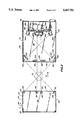
- FIG. 3 is a cross-sectional top plan view of a hot bottle inspection apparatus
- FIG. 4 is a partially cross-sectional elevation view of one face of the housing of a hot bottle inspection apparatus
- FIG. 5 is a schematic diagram illustrating certain optical components used to image a glass bottle
- FIG. 6 is a block diagram of a sensing and control assembly for a hot bottle inspection apparatus.
- FIG. 7 is a diagram of basic operations performed by the sensing and control assembly of FIG. 6.
- the invention may comprise a glass bottle production line 19 comprising bottle mold means 30 having a plurality of mold cavities 32, 34, 36 etc. arranged in a predetermined order for forming bottles 52, 54, 56 from glass parisons and for transferring the bottles to a conveyor means 12 in a predetermined sequence corresponding to the predetermined order of the mold cavities 32, 34, 36, etc.
- the conveyor means 12 has a hot end portion 80 and a cold end portion 82.
- the conveyor means receives the bottles from the bottle mold means 30 at an elevated temperature at the hot end portion 80 and conveys the bottles to the cold end portion 82.
- a hot bottle inspection means 64 is located at a fixed inspection station along the conveyor means 12 at the hot end portion 80 thereof.
- the hot bottle inspection means 64 non-touchingly inspects the bottles as the bottles are conveyed past the inspection station by the conveyor means 12.
- a mold monitoring device 42 generates a signal indicative of the operation of blow mold assembly 30.
- the hot bottle inspection means generates a signal indicative of the detection of a bottle at the inspector's station.
- a data processing assembly 66 processes the mold monitoring device signal and the bottle detection signal to determine the mold cavity which produced each bottle detected at the inspector's station, obviating the need to read indicia on the bottles. Mold cavity of origin information along with the results of inspection may be displayed on an operator readable device such as a cathode ray tube or paper printout to enable an operator to immediately identify a problem mold cavity and take corrective action.
- FIG. 1 is a schematic illustration of a glass bottle production line 10.
- the production line comprises a conveyor 12 which defines a bottle conveyance path.
- the conveyor moves bottles downstream in direction 14.
- a conveyor monitor assembly 16 (sometimes referred to herein as "conveyor sensing means") which may be, for example, a conventional electronic encoder mounted on a conveyor motor shaft, monitors the conveying movement of conveyor 12 and produces a conveyor displacement signal 18 representative thereof.
- the conveyor 12 is mechanically linked to the drive mechanism of the blow mold such that conveyor speed is always directly proportional to the speed of operation of the blow mold.
- any device which monitors mold displacement for example, an incremental encoder mounted on the shaft of the mold drive unit, would also indicate conveyor displacement and is to be considered a conveyor monitor.
- a blow mold assembly 30 comprises a plurality of mold cavity portions 32, 34, 36, etc.
- the blow mold assembly 30 may comprise a portion of a conventional I.S. machine.
- the blow mold assembly 30 is positioned at an upstream end 38 of conveyor 12.
- a mold monitor assembly 42 (sometimes referred to herein as a "mold sensing means") generates a mold transfer signal 44 (sometimes referred to herein as "mold sensing signal” or “mold signal”) each time the blow mold 30 transfers bottles onto conveyor 12.
- Bottles 52, 54, 56, etc. are produced by mold cavity portions 32, 34, 36, etc. and are transferred to conveyor 12 in single file in a sequence corresponding to the sequence of their respective blow mold cavities of origin.
- the bottles 52, 54, 56 may be formed with indicia thereon indicative of the blow mold cavity of origin.
- the bottles 52, 54, 56, etc. are transferred onto the conveyor 12 at an elevated temperature which may be approximately 1000 degrees Fahrenheit such that the bottles are glowing.
- a hot coating hood 62 is positioned at a station along the conveyor 12 a short distance downstream, e.g. 10 feet, from the blow mold 30.
- a hot bottle inspection apparatus also referred to herein as a hot bottle inspector 64
- a hot bottle inspector 64 is positioned at a fixed station along the conveyor which may be a short distance, e.g. two feet, downstream from the hot coating hood 62.
- the hot bottle inspector 64 may thus be located in an extremely hot and dirty environment at the hot end 80 of the production line.
- a remote computer 66 removed from the harsh environment at the hot end of the production line is operably connected to the hot bottle inspector 64 and is accessible to a production line operator.
- a rejection device 68 may be positioned immediately downstream from the hot bottle inspector 64 and is operable to remove bottles from the conveyor in response to commands from the hot bottle inspector 64.
- An annealing oven 70 of a conventional type may be positioned downstream of the rejection device 68 and defines, at its downstream end portion 72, the terminal end portion of the "hot end" 80 of the bottle production line 10.
- the period of time elapsing from the transfer of a bottle onto the conveyor 12 by the blow mold 30 to the exit of that bottle from the downstream end 72 of annealing oven 70 may be thirty minutes.
- the portion of the production line 10 located downstream of the annealing oven exit 72 constitutes the "cold end"82 of the production line.
- the cold end of the production line may comprise conventional cold end inspection devices 84, 86, 88 such as a squeezer, a T.I.M. machine, and a super inspector machine such as previously described in the "Background of the Invention" section of this application.
- the first of these cold end inspectors 84 may be positioned, e.g. 100 feet, downstream from the exit 72 of annealing oven 70.
- a conventional packing assembly 92 such as described above, may be provided downstream from the cold end inspection devices 84, 86, 88.
- the hot bottle inspection apparatus 64 comprises generally, a regular parallelepiped-shaped housing 110 with a generally inverted-U-shaped passage 112 in a central portion thereof dividing the housing into a first box-shaped portion 114, a second box-shaped portion 116 connected by a bridging portion 118.
- a first leg 112 is attached to the bottom of the first box portion and a second leg 124 is attached to the bottom of the second box portion enabling the housing to be positioned above a conveyor belt 12 with the inverted U-shaped opening 112 positioned immediately over the conveyor belt and enabling the passage of bottles 53, etc. therethrough.
- a filtered air supply assembly 126 is operably mounted on top of the second box portion 116 and provides a flow of filtered air through the interior portions of the housing as will be described in further detail below.
- FIG. 3 is a cross-sectional plan view of housing 110.
- first box portion 114 comprises a front wall 130, a first side wall 132, a rear wall 134, a second side wall 136, a bottom wall 138 and a top wall 139 (FIG. 2).
- These housing walls may be constructed from sheet metal such as, for example, .090" thick stainless steel.
- Second box portion 116 may comprise a front wall 140, a first side wall 142, a rear wall 144, a second side wall 146, a bottom wall 148, and a top wall 149 as illustrated in FIGS. 2 and 3.
- first box second side wall 136 comprises four transparent panels 152, 154, 156 and 158, which may be high-strength, heat resistant, glass panels, mounted in sealing relationship over corresponding slots provided in side wall 136.
- second box side wall 142 has transparent panels 162, 164, 166, 168 sealingly positioned over slots in its side wall which are positioned opposite to the slots in side wall 136.
- bridge portion 118 comprises a front wall 170, a rear wall 172, a bottom wall 174 and top wall 176. These walls define a rectangular air passage 178 which ends at openings at the top of side walls 136 and 142 in first and second box portions 114, 116 placing the enclosure of first box portion 114 in fluid communication with the enclosure of second box portion 116.
- the bridge portion comprises first and second horizontal support members 182 and 184 that extend through the upper portions of the first and second box member and are attached thereto to provide structural rigidity to the housing.
- An air inlet orifice (not shown) is positioned in the top wall 149 of the second box portion 116 to enable cool filtered air from the filtered air supply assembly 126 to enter the first box portion.
- An air discharge orifice 186 may be provided near the bottom of side wall 114 and enables discharge of air therefrom. Except for these orifices, the housing may be sealed and thus air from the air supply assembly 126 enters the second box portion 116 and circulates therein, thereafter passes through air passage 178 into first box portion 114 and circulates therein and is finally discharged through orifice 186.
- the filter air supply assembly operates as follows: Plant compressed air is filtered and regulated to 100 psi by a Wilkerson #C040 2000 filter/regulator commercially available from Wilkerson Corp., P.O. Box 1237, Englewood, Colo. 80150.
- the pressurized air is then provided to an air cooler, such as a Vortec #780, which cools the air supplied to the interior of the housing and reduces the pressure to about 1 or 2 psi above atmospheric pressure.
- a second filter/regulator supplies 2-5 psi to the air jets 192, 194, 196, 198 described below.
- the filters of the filter air supply assembly remove any contaminants from the air which is passed through the housing and the pressure of the supply assembly places the interior portions of the housing under a pressure slightly greater than atmospheric, preventing the infiltration of any contaminated air from outside the housing.
- the cooling air may have a temperature of approximately 60 degrees Fahrenheit when it enters the housing and may be provided at a flow rate of approximately 35 cubic feet per second for a housing having a total interior volume of approximately 10 cubic feet.
- a pressurized air conduit 188 is operably connected to the filtered air supply 126 and provides pressurized air to air jet tubes 192, 194, 196, 198 associated with transparent panels 152, 154, 156, 158. Air jets produced by these tubes prevent the build-up of contamination on the transparent panels in the harsh environment in which the inspection apparatus is located. Similar air jet tubes are associated with the transparent panels 162, 164, 166, 168 of the second box portion 116 and are supplied with pressurized air from the filtered air supply unit 126. In an alternative embodiment (not shown), a transparent glass cover panel is positioned over each transparent panel 152, 154, 156, 158 via quick release mechanisms that allow the cover panels to be quickly removed, cleaned and reinstalled.
- Fluorescent bulbs 210, 212, 214, 216 mounted on supports 218, etc. attached to the housing are positioned opposite each of the transparent panels 152, 154, 156, 158 of the first box portion 114.
- the fluorescent bulbs extend the full length of each of the transparent portions and provide light used to image bottles passing through the inspection apparatus.
- Collimating lenses which may comprise conventional Fresnell lenses 222, 224, 226, 228 are mounted on supports 230, etc. within the second box portion of the housing, as illustrated in FIG. 3.
- a first and second mirror 232, 234 are positioned adjacent transparent panels 162, 168 and are mounted on supports 236, etc. attached to the walls of housing second box portion 116.
- Image sensors 242, 244, 246, 248 are mounted in second box portion 116 as illustrated in FIG. 3.
- the image sensors may comprise Model RL0258G available from EG & G Reticon, 2260 Landmeier Road, Suite J, Elk Grove Village, Ill. 60007-2693.
- Each image sensor is connected by conventional cables 250 etc. to a central data processor 252 mounted within the second box portion 116.
- the central data processor 252 may have an input device 254, such as a key pad physically mounted thereon.
- the central data processor 252 may also receive programming input as well as send process data to a remote computer 66 to which it is connected by conventional cables 256.
- the central data processor 252 may also be connected to send commands to a conventional bottle rejection device 68 by conventional cables 258.
- the central data processor 252 is positioned within a separately sealed interior cavity 259 provided by interior wall 260 which separates it from the remainder of second box portion 116 of the housing.
- wall 146 of the housing comprises a hinged door 262.
- the cavity 259 in which the central data processor 252 is located may have a separate inlet (not shown) connecting it with the filtered air supply 126 and may further comprise a separate air discharge outlet (not shown).
- the separate cavity enclosing the central data processor 252 thus receives a cooling filtered airflow therethrough.
- the door 262 must be opened during operation in the harsh environment, contaminants which may enter the chamber in which the central data processor 252 is located will be prevented from entering the portion of the enclosure containing the various optical components.
- the center line of beams of light from the illumination sources which pass through a bottle and thence, through the collimating filters to the various imaging devices, are illustrated by dash lines in FIG. 3.
- the general operation of a collimating lens in passing only parallel rays of light is illustrated schematically in FIG. 5.
- the particular physical parameter of the bottle which is determined by the imaging/data analysis process is the diameter of the bottle at various predetermined positions along the central longitudinal axis LL of the bottle. In one preferred embodiment 16 such diameter measurements are made per imaging device per bottle. It will be seen from FIG. 3 that the bottle is viewed from four different perspectives and thus, any deviation in bottle diameter which might be hidden by viewing the bottle from a single perspective is clearly detected by this multiple perspective arrangement. Thus, the need to rotate the bottle is obviated.
- the measured bottle parameters may be compared with predetermined values and any bottle having parameters exceeding a fixed tolerance from this value are determined by the system to be defective.
- the bottles are allowed to vary from a predetermined value by a variable tolerance amount.
- the value of this variable tolerance at any particular time is dependent upon a standard deviation value which is calculated using normal statistical methods based upon measurement of the subject parameter taken from a preset number of immediately preceding bottles, e.g. 256 bottles.
- the system's central data processor 252 receives and processes image signals from each of the four sensor devices 242, 244, 246, 248.
- the image sensors may be conventional CCD based sensors.
- the data processor 252 also receives and processes signals from conveyor monitor 16 and mold monitor 42.
- an input terminal 254 is provided which may be, for example, a key pad mounted within housing 110.
- the data processor 252 may be provided with a remote input terminal such as a remote computer 66.
- the remote computer 66 may also function as a display and data storage device for displaying information to the operator such as a history of the number of bottle rejects in a particular run, as well as the mold cavity of origin associated with each of the defects.
- the data processor may provide a signal to reject device 68 for removing defective bottles from the conveyor line.
- a separate control panel display (not shown) may also be mounted within housing 210 adjacent to input terminal 254 to enable direct viewing of information by an operator at the inspection station. Such a display could be a conventional LCD display.
- the data processor 252 may comprise hard-wired electronic components or may comprise one or more microprocessors which perform the various computational tasks in software or firmware or the data processor 252 may comprise a combination of such electronic components and programmable microprocessors.
- the basic operations performed by the data processor 252 are as illustrated in FIG. 7. Based upon the mold monitor signal 44 and the conveyor monitor signal 18 which it receives, the data processor 252 continuously monitors the operating cycle of the mold and the displacement of bottles by the conveyor after each mold transfer of bottles to the conveyor. The data processor also continuously monitors the signals from image sensors 242, 244, 246, 248. It uses these image signals to detect the presence or absence of a bottle at the inspection station and thus the image sensors may be referred to herein as "bottle sensing means" and the signals produced by the image sensors may be referred to herein as a “bottle sensing signal” or “bottle detection signal”. It also analyzes the image signals to determine the values of certain pre-selected bottle parameters.
- the parameters comprise a series of diameter measurements at predetermined positions along the bottle central longitudinal axis.
- the data processor compares these determined values of pre-selected bottle parameters to preset design values. If all of the determined values fall within a preset tolerance of the preset design values, then the bottle is determined to be acceptable. If any of the determined values fall outside of the preset tolerance for that value, then the bottle is determined to be defective.
- variations in tolerance may be built in into the acceptability determination based upon a statistical sampling of previously inspected bottles to account for fluctuations due to slight differences in materials, operating conditions, etc.
- the mold and conveyor signals are analyzed to determine the mold cavity of origin of the bottle which is currently detected at the bottle inspection station.
- This information is displayed and stored along with the information from the bottle analysis so as to indicate the mold cavity of origin of each defective bottle and to further identify the parameter deviation which was the source of the rejection determination.
- This information may be displayed on a display screen (not shown) provided within the housing 110 and accessible to an operator through back panel 146 and/or may be provided on the display screen of remote computer 66.
- a rejection signal may be sent to actuate a rejection device 68 such as a conventional air jet rejection device which is operated at an appropriate time based upon conveyor speed to remove a defective bottle as it passes.
- the determination of the cavity of origin of a bottle is based upon conveyor displacement occurring after a mold cavity transfer signal, i.e., since each bottle must travel a know conveyor distance after it is transferred to the conveyor by the blow mold, each mold cavity may be assigned a predetermined distance value measured in conveyor encoder pulses.
- each mold cavity may be assigned a predetermined distance value measured in conveyor encoder pulses.
- the particular mold cavity which produced the bottle currently at the inspector's station may be determined.
- the bottle/mold cavity determination could be a time-based system rather than a distance-based system.
- the number of clock pulses occurring between the first mold transfer signal and the first bottle detection could be stored as a time value to be associated with the first mold cavity.
- Clock pulse time values would also be stored for each succeeding bottle/mold cavity from the first mold transfer upon the detection of subsequent bottles. Thereafter, after each mold transfer signal, these stored time values, with appropriate tolerances, would be compared to current clock pulse counts to associate each bottle detected with its respective mold cavity. If the operating speed of the line were changed, these initially stored time values would be changed proportionately.
- monitor assembly 16 may comprise a clock unit (sometimes referred to herein as "clock means") rather than a distance encoder.
- the pulse signal produced by the clock unit may sometimes referred to herein as a "clock signal”.
- the time between mold machine transfer pulses is divided into equal length intervals or "windows" based upon the number of mold cavities in the mold machine.
- the system correlates bottles to mold cavities based upon the particular time window in which a bottle is sensed.
- the occurrence or each time window is determined by counting clock pulses after a mold transfer signal. Windows are shortened or lengthened in accordance with variations in line speed.
Landscapes
- Chemical & Material Sciences (AREA)
- General Physics & Mathematics (AREA)
- Engineering & Computer Science (AREA)
- Physics & Mathematics (AREA)
- Health & Medical Sciences (AREA)
- Life Sciences & Earth Sciences (AREA)
- Biochemistry (AREA)
- General Health & Medical Sciences (AREA)
- Immunology (AREA)
- Pathology (AREA)
- Analytical Chemistry (AREA)
- Materials Engineering (AREA)
- Manufacturing & Machinery (AREA)
- Mechanical Engineering (AREA)
- Organic Chemistry (AREA)
- Food Science & Technology (AREA)
- Medicinal Chemistry (AREA)
- Blow-Moulding Or Thermoforming Of Plastics Or The Like (AREA)
- Investigating Materials By The Use Of Optical Means Adapted For Particular Applications (AREA)
- Re-Forming, After-Treatment, Cutting And Transporting Of Glass Products (AREA)
Priority Applications (5)
| Application Number | Priority Date | Filing Date | Title |
|---|---|---|---|
| US08/111,115 US5437702A (en) | 1993-08-24 | 1993-08-24 | Hot bottle inspection apparatus and method |
| CA002170129A CA2170129C (fr) | 1993-08-24 | 1994-08-02 | Appareil d'inspection de bouteilles chaudes et methode correspondante |
| PCT/US1994/008728 WO1995005903A1 (fr) | 1993-08-24 | 1994-08-02 | Appareil et procede d'inspection de bouteilles chaudes |
| EP94924110A EP0715548A4 (fr) | 1993-08-24 | 1994-08-02 | Appareil et procede d'inspection de bouteilles chaudes |
| US09/181,832 US6584805B1 (en) | 1993-08-24 | 1998-10-28 | Hot bottle inspection apparatus |
Applications Claiming Priority (1)
| Application Number | Priority Date | Filing Date | Title |
|---|---|---|---|
| US08/111,115 US5437702A (en) | 1993-08-24 | 1993-08-24 | Hot bottle inspection apparatus and method |
Related Child Applications (1)
| Application Number | Title | Priority Date | Filing Date |
|---|---|---|---|
| US41800795A Continuation | 1993-08-24 | 1995-04-06 |
Publications (1)
| Publication Number | Publication Date |
|---|---|
| US5437702A true US5437702A (en) | 1995-08-01 |
Family
ID=22336690
Family Applications (1)
| Application Number | Title | Priority Date | Filing Date |
|---|---|---|---|
| US08/111,115 Expired - Fee Related US5437702A (en) | 1993-08-24 | 1993-08-24 | Hot bottle inspection apparatus and method |
Country Status (4)
| Country | Link |
|---|---|
| US (1) | US5437702A (fr) |
| EP (1) | EP0715548A4 (fr) |
| CA (1) | CA2170129C (fr) |
| WO (1) | WO1995005903A1 (fr) |
Cited By (24)
| Publication number | Priority date | Publication date | Assignee | Title |
|---|---|---|---|---|
| WO1997004887A1 (fr) * | 1995-07-31 | 1997-02-13 | Coors Brewing Company | Appareil et procede d'inspection de bouteilles chaudes |
| US5734467A (en) * | 1995-07-31 | 1998-03-31 | Coors Brewing Company | Inspection apparatus for high temperature environments |
| US5926268A (en) * | 1996-06-04 | 1999-07-20 | Inex, Inc. | System and method for stress detection in a molded container |
| US5928581A (en) * | 1997-04-18 | 1999-07-27 | Owens-Brockway Plastics Products Inc. | Synchronization of parison profile in a plastic container molding system |
| US5935285A (en) * | 1997-12-30 | 1999-08-10 | Coors Brewing Company | Method for inspecting manufactured articles |
| US6025910A (en) * | 1995-09-12 | 2000-02-15 | Coors Brewing Company | Object inspection method utilizing a corrected image to find unknown characteristic |
| US6025919A (en) * | 1996-08-16 | 2000-02-15 | Coors Brewing Company | Method for measurement of light transmittance |
| US6049379A (en) * | 1997-12-30 | 2000-04-11 | Coors Brewing Company | Method for inspecting translucent objects using imaging techniques |
| US6118526A (en) * | 1996-08-16 | 2000-09-12 | Coors Brewing Company | Method for measurement of light transmittance |
| US6165395A (en) * | 1998-11-25 | 2000-12-26 | Thatcher Tubes Llc | Process control method for a machine for manufacturing thermoplastic tubes |
| DE10030649A1 (de) * | 2000-06-29 | 2002-01-10 | Michael Kaufmann | Verfaren zur Erfassung,Diagnose,Überwachung und Regelung von Formgebungseigen- chaften an Glasformmaschinen mit mehreren Stationen |
| US20030101755A1 (en) * | 2001-12-05 | 2003-06-05 | Fenton F. Alan | Glass container forming machine |
| US6620352B1 (en) * | 2000-07-27 | 2003-09-16 | Ball Corporation | Automated material distribution control for stretch blow molded articles |
| US6639166B1 (en) | 2000-01-31 | 2003-10-28 | Owens-Brockway Glass Container Inc. | Method and apparatus for inspection of hot glass containers |
| US20050015208A1 (en) * | 2003-07-18 | 2005-01-20 | Furnas William J. | Multi machine inspection system |
| US20050127572A1 (en) * | 2002-03-26 | 2005-06-16 | Agr International, Inc. | Method and apparatus for monitoring wall thickness of blow-molded plastic containers |
| US20060012804A1 (en) * | 2004-07-17 | 2006-01-19 | Thorsten Wilke | Method and apparatus for contactless optical measurement of the thickness of a hot glass body by optical dispersion |
| US20060283145A1 (en) * | 2005-04-18 | 2006-12-21 | Martin Weisgerber | Beverage bottling plant for filling bottles with a liquid beverage material having an inspection apparatus for inspecting bottles |
| US20090278286A1 (en) * | 2006-09-01 | 2009-11-12 | Agr International, Inc. (A Pennsylvania Corporation) | In-line inspection system for vertically profiling plastic containers using multiple wavelength discrete spectral light sources |
| US10308541B2 (en) * | 2014-11-13 | 2019-06-04 | Gerresheimer Glas Gmbh | Glass forming machine particle filter, a plunger unit, a blow head, a blow head support and a glass forming machine adapted to or comprising said filter |
| DE102019005487B3 (de) | 2019-08-06 | 2020-07-09 | Heye International Gmbh | Verfahren zur Wandstärkenmessung eines Hohlglasartikels |
| US11306016B2 (en) * | 2012-12-13 | 2022-04-19 | Centrum Voor Techishe Informatica B.V. | Method of producing glass products from glass product material and an assembly for performing said method |
| JP2023101949A (ja) * | 2022-01-11 | 2023-07-24 | サントリーホールディングス株式会社 | 検査装置 |
| WO2025061337A1 (fr) * | 2023-09-21 | 2025-03-27 | Krones Ag | Procédé et appareil de surveillance de production et en particulier de commande en temps réel dans un système de production, de remplissage et/ou d'emballage de récipients pour boissons ou produits similaires |
Families Citing this family (3)
| Publication number | Priority date | Publication date | Assignee | Title |
|---|---|---|---|---|
| US7256389B2 (en) * | 2005-11-07 | 2007-08-14 | Emhart Glass Sa | Glass bottle inspection machine |
| CN102519359B (zh) * | 2011-12-12 | 2014-03-19 | 山东明佳包装检测科技有限公司 | 一种pet瓶标签的检测方法 |
| CN107059491A (zh) * | 2017-05-17 | 2017-08-18 | 佛山市顺德区文达创盈包装材料科技有限公司 | 一种新型的自动化纸浆模塑生产线 |
Citations (19)
| Publication number | Priority date | Publication date | Assignee | Title |
|---|---|---|---|---|
| US3387551A (en) * | 1966-07-22 | 1968-06-11 | Pittsburgh Plate Glass Co | Air curtain for observation window |
| US3767374A (en) * | 1971-10-26 | 1973-10-23 | Emhart Corp | Glass ware reject apparatus |
| US3886356A (en) * | 1973-09-10 | 1975-05-27 | Inex Inc | Optical inspection apparatus |
| US4004904A (en) * | 1975-08-04 | 1977-01-25 | Index, Incorporated | Electronic system for article identification |
| US4332606A (en) * | 1980-10-27 | 1982-06-01 | Emhart Industries, Inc. | Ware identifying apparatus for glassware machines and the like |
| US4402721A (en) * | 1977-01-24 | 1983-09-06 | Emhart Industries, Inc. | Computer control for glassware forming machine |
| US4431436A (en) * | 1982-07-21 | 1984-02-14 | Css International Corporation | Glassware rejection apparatus |
| US4494656A (en) * | 1983-04-01 | 1985-01-22 | Powers Manufacturing, Inc. | Down and stuck ware inspection method and apparatus |
| US4500203A (en) * | 1982-09-30 | 1985-02-19 | Owens-Illinois, Inc. | Method and apparatus for inspecting articles |
| US4553217A (en) * | 1981-07-08 | 1985-11-12 | Ball Corporation | Glassware gauging system |
| US4606746A (en) * | 1984-09-28 | 1986-08-19 | Emhart Industries, Inc. | Method of monitoring the position of two movable side portions of a mould of a glassware forming machine |
| US4614531A (en) * | 1984-12-17 | 1986-09-30 | National Can Corporation | Glass ware reject system |
| US4639263A (en) * | 1985-07-16 | 1987-01-27 | Emhart Industries, Inc. | Glassware forming production monitor |
| US4649503A (en) * | 1983-01-18 | 1987-03-10 | Emhart Industries, Inc. | Inspection apparatus for inspecting articles moving on a conveyor |
| US4664521A (en) * | 1985-03-01 | 1987-05-12 | Emhart Industries, Inc. | Birdswing defect detection for glass containers |
| US4675042A (en) * | 1985-06-17 | 1987-06-23 | Vitro Tec Fideicomiso | Automatic glass container rejector |
| US4679075A (en) * | 1985-04-29 | 1987-07-07 | Emhart Industries, Inc. | Glassware inspection using optical streak detection |
| US4691830A (en) * | 1985-08-26 | 1987-09-08 | Owens-Illinois, Inc. | Inspection and sorting of molded containers as a function of mold of origin |
| US4762544A (en) * | 1987-01-02 | 1988-08-09 | Owens-Illinois Glass Container Inc. | Automated control of glass container manufacture |
Family Cites Families (1)
| Publication number | Priority date | Publication date | Assignee | Title |
|---|---|---|---|---|
| US4413738A (en) * | 1981-03-11 | 1983-11-08 | Owens-Illinois, Inc. | Apparatus and method for controlling the inspection of finished products |
-
1993
- 1993-08-24 US US08/111,115 patent/US5437702A/en not_active Expired - Fee Related
-
1994
- 1994-08-02 WO PCT/US1994/008728 patent/WO1995005903A1/fr not_active Ceased
- 1994-08-02 EP EP94924110A patent/EP0715548A4/fr not_active Ceased
- 1994-08-02 CA CA002170129A patent/CA2170129C/fr not_active Expired - Fee Related
Patent Citations (19)
| Publication number | Priority date | Publication date | Assignee | Title |
|---|---|---|---|---|
| US3387551A (en) * | 1966-07-22 | 1968-06-11 | Pittsburgh Plate Glass Co | Air curtain for observation window |
| US3767374A (en) * | 1971-10-26 | 1973-10-23 | Emhart Corp | Glass ware reject apparatus |
| US3886356A (en) * | 1973-09-10 | 1975-05-27 | Inex Inc | Optical inspection apparatus |
| US4004904A (en) * | 1975-08-04 | 1977-01-25 | Index, Incorporated | Electronic system for article identification |
| US4402721A (en) * | 1977-01-24 | 1983-09-06 | Emhart Industries, Inc. | Computer control for glassware forming machine |
| US4332606A (en) * | 1980-10-27 | 1982-06-01 | Emhart Industries, Inc. | Ware identifying apparatus for glassware machines and the like |
| US4553217A (en) * | 1981-07-08 | 1985-11-12 | Ball Corporation | Glassware gauging system |
| US4431436A (en) * | 1982-07-21 | 1984-02-14 | Css International Corporation | Glassware rejection apparatus |
| US4500203A (en) * | 1982-09-30 | 1985-02-19 | Owens-Illinois, Inc. | Method and apparatus for inspecting articles |
| US4649503A (en) * | 1983-01-18 | 1987-03-10 | Emhart Industries, Inc. | Inspection apparatus for inspecting articles moving on a conveyor |
| US4494656A (en) * | 1983-04-01 | 1985-01-22 | Powers Manufacturing, Inc. | Down and stuck ware inspection method and apparatus |
| US4606746A (en) * | 1984-09-28 | 1986-08-19 | Emhart Industries, Inc. | Method of monitoring the position of two movable side portions of a mould of a glassware forming machine |
| US4614531A (en) * | 1984-12-17 | 1986-09-30 | National Can Corporation | Glass ware reject system |
| US4664521A (en) * | 1985-03-01 | 1987-05-12 | Emhart Industries, Inc. | Birdswing defect detection for glass containers |
| US4679075A (en) * | 1985-04-29 | 1987-07-07 | Emhart Industries, Inc. | Glassware inspection using optical streak detection |
| US4675042A (en) * | 1985-06-17 | 1987-06-23 | Vitro Tec Fideicomiso | Automatic glass container rejector |
| US4639263A (en) * | 1985-07-16 | 1987-01-27 | Emhart Industries, Inc. | Glassware forming production monitor |
| US4691830A (en) * | 1985-08-26 | 1987-09-08 | Owens-Illinois, Inc. | Inspection and sorting of molded containers as a function of mold of origin |
| US4762544A (en) * | 1987-01-02 | 1988-08-09 | Owens-Illinois Glass Container Inc. | Automated control of glass container manufacture |
Cited By (38)
| Publication number | Priority date | Publication date | Assignee | Title |
|---|---|---|---|---|
| US6089108A (en) * | 1995-07-31 | 2000-07-18 | Coors Brewing Company | Hot bottle inspection apparatus and method |
| US5734467A (en) * | 1995-07-31 | 1998-03-31 | Coors Brewing Company | Inspection apparatus for high temperature environments |
| WO1997004887A1 (fr) * | 1995-07-31 | 1997-02-13 | Coors Brewing Company | Appareil et procede d'inspection de bouteilles chaudes |
| US6025910A (en) * | 1995-09-12 | 2000-02-15 | Coors Brewing Company | Object inspection method utilizing a corrected image to find unknown characteristic |
| US5926268A (en) * | 1996-06-04 | 1999-07-20 | Inex, Inc. | System and method for stress detection in a molded container |
| US6025919A (en) * | 1996-08-16 | 2000-02-15 | Coors Brewing Company | Method for measurement of light transmittance |
| US6118526A (en) * | 1996-08-16 | 2000-09-12 | Coors Brewing Company | Method for measurement of light transmittance |
| US5928581A (en) * | 1997-04-18 | 1999-07-27 | Owens-Brockway Plastics Products Inc. | Synchronization of parison profile in a plastic container molding system |
| US5935285A (en) * | 1997-12-30 | 1999-08-10 | Coors Brewing Company | Method for inspecting manufactured articles |
| US6049379A (en) * | 1997-12-30 | 2000-04-11 | Coors Brewing Company | Method for inspecting translucent objects using imaging techniques |
| US6165395A (en) * | 1998-11-25 | 2000-12-26 | Thatcher Tubes Llc | Process control method for a machine for manufacturing thermoplastic tubes |
| US6639166B1 (en) | 2000-01-31 | 2003-10-28 | Owens-Brockway Glass Container Inc. | Method and apparatus for inspection of hot glass containers |
| US6743998B2 (en) | 2000-01-31 | 2004-06-01 | Owens-Brockway Glass Container Inc. | Method and apparatus for inspection of hot glass containers |
| DE10030649A1 (de) * | 2000-06-29 | 2002-01-10 | Michael Kaufmann | Verfaren zur Erfassung,Diagnose,Überwachung und Regelung von Formgebungseigen- chaften an Glasformmaschinen mit mehreren Stationen |
| US6620352B1 (en) * | 2000-07-27 | 2003-09-16 | Ball Corporation | Automated material distribution control for stretch blow molded articles |
| US20030101755A1 (en) * | 2001-12-05 | 2003-06-05 | Fenton F. Alan | Glass container forming machine |
| US6807826B2 (en) * | 2001-12-05 | 2004-10-26 | Emhart Glass S.A. | Glass container forming machine |
| US20050127572A1 (en) * | 2002-03-26 | 2005-06-16 | Agr International, Inc. | Method and apparatus for monitoring wall thickness of blow-molded plastic containers |
| US20070029707A1 (en) * | 2002-03-26 | 2007-02-08 | Agr International, Inc. | Method for manufacturing and inspecting blow-molded plastic containers |
| US7374713B2 (en) * | 2002-03-26 | 2008-05-20 | Agr International, Inc. | Method for manufacturing and inspecting blow-molded plastic containers |
| US7378047B2 (en) * | 2002-03-26 | 2008-05-27 | Agr International, Inc. | Method and apparatus for monitoring wall thickness of blow-molded plastic containers |
| US20080197542A1 (en) * | 2002-03-26 | 2008-08-21 | Agr International, Inc. (A Pennsylvania Corporation) | Apparatus and method for manufacturing and inspecting blow-molded plastic containers |
| US20050015208A1 (en) * | 2003-07-18 | 2005-01-20 | Furnas William J. | Multi machine inspection system |
| US20060012804A1 (en) * | 2004-07-17 | 2006-01-19 | Thorsten Wilke | Method and apparatus for contactless optical measurement of the thickness of a hot glass body by optical dispersion |
| DE102004034693A1 (de) * | 2004-07-17 | 2006-02-09 | Schott Ag | Verfahren und Vorrichtung zur berührungslosen optischen Messung der Dicke von heißen Glaskörpern mittels der chromatischen Aberration |
| DE102004034693B4 (de) * | 2004-07-17 | 2006-05-18 | Schott Ag | Verfahren und Vorrichtung zur berührungslosen optischen Messung der Dicke von heißen Glaskörpern mittels der chromatischen Aberration |
| US7414740B2 (en) | 2004-07-17 | 2008-08-19 | Schott Ag | Method and apparatus for contactless optical measurement of the thickness of a hot glass body by optical dispersion |
| US20060283145A1 (en) * | 2005-04-18 | 2006-12-21 | Martin Weisgerber | Beverage bottling plant for filling bottles with a liquid beverage material having an inspection apparatus for inspecting bottles |
| US20090278286A1 (en) * | 2006-09-01 | 2009-11-12 | Agr International, Inc. (A Pennsylvania Corporation) | In-line inspection system for vertically profiling plastic containers using multiple wavelength discrete spectral light sources |
| US7924421B2 (en) | 2006-09-01 | 2011-04-12 | Agr International, Inc. | In-line inspection system for vertically profiling plastic containers using multiple wavelength discrete spectral light sources |
| US8208141B2 (en) | 2006-09-01 | 2012-06-26 | Agr International, Inc. | Inspection systems and methods for blow-molded containers |
| US11306016B2 (en) * | 2012-12-13 | 2022-04-19 | Centrum Voor Techishe Informatica B.V. | Method of producing glass products from glass product material and an assembly for performing said method |
| US10308541B2 (en) * | 2014-11-13 | 2019-06-04 | Gerresheimer Glas Gmbh | Glass forming machine particle filter, a plunger unit, a blow head, a blow head support and a glass forming machine adapted to or comprising said filter |
| DE102019005487B3 (de) | 2019-08-06 | 2020-07-09 | Heye International Gmbh | Verfahren zur Wandstärkenmessung eines Hohlglasartikels |
| EP3772490A1 (fr) * | 2019-08-06 | 2021-02-10 | Heye International GmbH | Procédé de mesure de l'épaisseur de paroi d'un article en verre creux |
| US12123710B2 (en) | 2019-08-06 | 2024-10-22 | Heye International Gmbh | Method for measuring the wall thickness of a hollow glass article |
| JP2023101949A (ja) * | 2022-01-11 | 2023-07-24 | サントリーホールディングス株式会社 | 検査装置 |
| WO2025061337A1 (fr) * | 2023-09-21 | 2025-03-27 | Krones Ag | Procédé et appareil de surveillance de production et en particulier de commande en temps réel dans un système de production, de remplissage et/ou d'emballage de récipients pour boissons ou produits similaires |
Also Published As
| Publication number | Publication date |
|---|---|
| CA2170129C (fr) | 2002-06-11 |
| EP0715548A1 (fr) | 1996-06-12 |
| WO1995005903A1 (fr) | 1995-03-02 |
| CA2170129A1 (fr) | 1995-03-02 |
| EP0715548A4 (fr) | 1996-12-18 |
Similar Documents
| Publication | Publication Date | Title |
|---|---|---|
| CA2170129C (fr) | Appareil d'inspection de bouteilles chaudes et methode correspondante | |
| US6584805B1 (en) | Hot bottle inspection apparatus | |
| US6049379A (en) | Method for inspecting translucent objects using imaging techniques | |
| WO1997004887A1 (fr) | Appareil et procede d'inspection de bouteilles chaudes | |
| US7378047B2 (en) | Method and apparatus for monitoring wall thickness of blow-molded plastic containers | |
| US4413738A (en) | Apparatus and method for controlling the inspection of finished products | |
| US6025910A (en) | Object inspection method utilizing a corrected image to find unknown characteristic | |
| US9671357B2 (en) | System and method for monitoring hot glass containers to enhance their quality and control the forming process | |
| US5734467A (en) | Inspection apparatus for high temperature environments | |
| EP2333502B1 (fr) | Système et procédé de commande de conteneurs de verre chaud pour améliorer leur qualité et contrôler le processus de formation | |
| CA1065436A (fr) | Methode et appareil pour l'inspection video de produits fabriques | |
| US5583337A (en) | Apparatus and method for inspecting hot glass containers | |
| EP0793569B1 (fr) | Verification des bouteilles sur le chemin de transport de la machine a mouler | |
| EP1525469B1 (fr) | Systeme et procede d'analyse pour mesurer et controler un procede de production | |
| EP0643297A1 (fr) | Système analytique pour analyser, contrôler, diagnostiquer et/ou réguler un procédé pour la fabrication de produits d'emballage en verre, dans laquelle l'analyse à lien directement après le procédé du formage du verre | |
| EP3009905B1 (fr) | Machine d'inspection de récipients en verre pourvue d'une interface utilisateur graphique | |
| CN114375383B (zh) | 用于测量玻璃容器的壁厚的设备和方法 | |
| US20250180489A1 (en) | Method and device for inspecting hot glass containers with a view to identifying defects | |
| JP5372612B2 (ja) | ガラス製品検査装置 | |
| WO2013014782A1 (fr) | Procédé et dispositif de surveillance de minutage d'arrivée de paraisons pour appareil de formage is | |
| JP4876143B2 (ja) | ガラス製品のゴブ検査装置 | |
| Dalstra | Application of IR‐Sensors in Container Glass Forming Process |
Legal Events
| Date | Code | Title | Description |
|---|---|---|---|
| AS | Assignment |
Owner name: COORS BREWING COMPANY, COLORADO Free format text: ASSIGNMENT OF ASSIGNORS INTEREST;ASSIGNORS:BURNS, JOHN W.;ERICKSON, DENNIS R.;MCKEEHAN, JACK D.;AND OTHERS;REEL/FRAME:006838/0228 Effective date: 19931015 |
|
| FPAY | Fee payment |
Year of fee payment: 4 |
|
| FPAY | Fee payment |
Year of fee payment: 8 |
|
| AS | Assignment |
Owner name: COORS GLOBAL PROPERTIES, INC., COLORADO Free format text: ASSIGNMENT OF ASSIGNORS INTEREST;ASSIGNOR:COORS BREWING COMPANY;REEL/FRAME:014885/0809 Effective date: 20040105 |
|
| REMI | Maintenance fee reminder mailed | ||
| LAPS | Lapse for failure to pay maintenance fees | ||
| LAPS | Lapse for failure to pay maintenance fees |
Free format text: PATENT EXPIRED FOR FAILURE TO PAY MAINTENANCE FEES (ORIGINAL EVENT CODE: EXP.); ENTITY STATUS OF PATENT OWNER: LARGE ENTITY |
|
| STCH | Information on status: patent discontinuation |
Free format text: PATENT EXPIRED DUE TO NONPAYMENT OF MAINTENANCE FEES UNDER 37 CFR 1.362 |
|
| FP | Lapsed due to failure to pay maintenance fee |
Effective date: 20070801 |