US5444818A - System and method for dynamically configuring synthesizers - Google Patents
System and method for dynamically configuring synthesizers Download PDFInfo
- Publication number
- US5444818A US5444818A US07/984,780 US98478092A US5444818A US 5444818 A US5444818 A US 5444818A US 98478092 A US98478092 A US 98478092A US 5444818 A US5444818 A US 5444818A
- Authority
- US
- United States
- Prior art keywords
- mode
- program
- producing
- dataset
- datastream
- Prior art date
- Legal status (The legal status is an assumption and is not a legal conclusion. Google has not performed a legal analysis and makes no representation as to the accuracy of the status listed.)
- Expired - Lifetime
Links
- 238000000034 method Methods 0.000 title claims abstract description 49
- 230000015572 biosynthetic process Effects 0.000 claims abstract description 38
- 238000003786 synthesis reaction Methods 0.000 claims abstract description 38
- 230000004044 response Effects 0.000 claims abstract description 14
- 230000005236 sound signal Effects 0.000 claims description 30
- 238000005070 sampling Methods 0.000 claims description 17
- 230000008859 change Effects 0.000 claims description 11
- 238000004519 manufacturing process Methods 0.000 claims description 3
- 238000012544 monitoring process Methods 0.000 claims description 2
- 230000001419 dependent effect Effects 0.000 claims 1
- 238000010586 diagram Methods 0.000 description 19
- 238000013459 approach Methods 0.000 description 13
- 230000008901 benefit Effects 0.000 description 9
- 238000003860 storage Methods 0.000 description 8
- 238000013500 data storage Methods 0.000 description 7
- 238000012545 processing Methods 0.000 description 6
- 238000012546 transfer Methods 0.000 description 6
- 230000006870 function Effects 0.000 description 5
- 238000006243 chemical reaction Methods 0.000 description 4
- 230000000737 periodic effect Effects 0.000 description 4
- 230000003321 amplification Effects 0.000 description 3
- PWPJGUXAGUPAHP-UHFFFAOYSA-N lufenuron Chemical compound C1=C(Cl)C(OC(F)(F)C(C(F)(F)F)F)=CC(Cl)=C1NC(=O)NC(=O)C1=C(F)C=CC=C1F PWPJGUXAGUPAHP-UHFFFAOYSA-N 0.000 description 3
- 239000000203 mixture Substances 0.000 description 3
- 238000003199 nucleic acid amplification method Methods 0.000 description 3
- 230000002457 bidirectional effect Effects 0.000 description 2
- 238000004891 communication Methods 0.000 description 2
- 238000013144 data compression Methods 0.000 description 2
- 238000011161 development Methods 0.000 description 2
- 230000018109 developmental process Effects 0.000 description 2
- 230000009977 dual effect Effects 0.000 description 2
- 230000000694 effects Effects 0.000 description 2
- 238000001914 filtration Methods 0.000 description 2
- 230000003068 static effect Effects 0.000 description 2
- 230000002459 sustained effect Effects 0.000 description 2
- 240000007320 Pinus strobus Species 0.000 description 1
- 230000003044 adaptive effect Effects 0.000 description 1
- 230000005540 biological transmission Effects 0.000 description 1
- 230000008878 coupling Effects 0.000 description 1
- 238000010168 coupling process Methods 0.000 description 1
- 238000005859 coupling reaction Methods 0.000 description 1
- 210000005069 ears Anatomy 0.000 description 1
- 238000005516 engineering process Methods 0.000 description 1
- 230000002708 enhancing effect Effects 0.000 description 1
- 238000002955 isolation Methods 0.000 description 1
- 230000008569 process Effects 0.000 description 1
- 238000001308 synthesis method Methods 0.000 description 1
- 230000002194 synthesizing effect Effects 0.000 description 1
Images



Classifications
-
- G—PHYSICS
- G10—MUSICAL INSTRUMENTS; ACOUSTICS
- G10H—ELECTROPHONIC MUSICAL INSTRUMENTS; INSTRUMENTS IN WHICH THE TONES ARE GENERATED BY ELECTROMECHANICAL MEANS OR ELECTRONIC GENERATORS, OR IN WHICH THE TONES ARE SYNTHESISED FROM A DATA STORE
- G10H1/00—Details of electrophonic musical instruments
- G10H1/0091—Means for obtaining special acoustic effects
-
- G—PHYSICS
- G10—MUSICAL INSTRUMENTS; ACOUSTICS
- G10H—ELECTROPHONIC MUSICAL INSTRUMENTS; INSTRUMENTS IN WHICH THE TONES ARE GENERATED BY ELECTROMECHANICAL MEANS OR ELECTRONIC GENERATORS, OR IN WHICH THE TONES ARE SYNTHESISED FROM A DATA STORE
- G10H7/00—Instruments in which the tones are synthesised from a data store, e.g. computer organs
- G10H7/02—Instruments in which the tones are synthesised from a data store, e.g. computer organs in which amplitudes at successive sample points of a tone waveform are stored in one or more memories
Definitions
- the present invention relates in general to the field of digital audio systems and, in particular, to systems which include MIDI synthesizers. Still more particularly the present invention relates to a method and apparatus for outputting digital audio and MIDI synthesized music with efficient memory utilization.
- MIDI the "Musical Instrument Digital Interface” was established as a hardware and software specification which would make it possible to exchange information including musical notes, program changes, expression control, etc. between different musical instruments or other devices such as sequencers, computers, lighting controllers, mixers, etc. This ability to transmit and receive data was originally conceived for live performances, although subsequent developments have had enormous impact in recording studios, audio and video production, and composition environments.
- the hardware portion of the MIDI interface operates at 31.25 KBaud, asynchronous, with a start bit, eight data bits and a stop bit. This makes a total of ten bits for a period of 320 microseconds per serial byte.
- the start bit is a logical zero and the stop bit is a logical one.
- Bytes are transmitted by sending the least significant bit first.
- Data bits are transmitted in the MIDI interface by utilizing a five milliamp current loop. A logical zero is represented by the current being turned on and a logical one is represented by the current being turned off. Rise times and fall times for this current loop are less than two microseconds.
- a five pin DIN connector is utilized to provide a connection for this current loop with only two pins being utilized to transmit the current loop signal.
- an opto-isolator is utilized to provide isolation between devices which are coupled together utilizing a MIDI format.
- MIDI interface Communication utilizing the MIDI interface is achieved through multi-byte "messages" which consist of one status byte followed by one or two data bytes. There are certain exceptions to this rule.
- MIDI messages are sent over any of sixteen channels which may be utilized for a variety of performance information. There are five major types of MIDI messages: Channel Voice; Channel Mode; System Common; System Real-Time; and, System Exclusive.
- a MIDI event is transmitted as a message and consists of one or more bytes.
- a channel message in the MIDI system utilizes four bits in the status byte to address the message to one of sixteen MIDI channels and four bits to define the message. Channel messages are thereby intended for the receivers in a system whose channel number matches the channel number encoded in the status byte.
- An instrument may receive a MIDI message on more than one channel.
- the channel in which it receives its main instructions, such as which program number to be on and what mode to be in, is often referred to as its "Basic Channel.”
- a Voice message is utilized to control an instrument's voices and Voice messages are typically sent over voice channels.
- a Mode message is utilized to define the instrument's response to Voice messages, Mode messages are generally sent over the instrument's Basic Channel.
- System messages within the MIDI system may include Common messages, Real-Time messages, and Exclusive messages.
- Common messages are intended for all receivers in a system regardless of the channel that receiver is associated with.
- Real-Time messages are utilized for synchronization and are intended for all clock based units in a system.
- Real-Time messages contain status bytes only, and do not include data bytes.
- Real-Time messages may be sent at any time, even between bytes of a message which has a different status.
- Exclusive messages may contain any number of data bytes and can be terminated either by an end of exclusive or any other status byte, with the exception of Real-Time messages. An end of exclusive should is sent at the end of a system exclusive message.
- System exclusive messages always include a manufacturer's identification code. If a receiver does not recognize the identification code it will ignore the following data.
- musical compositions may be encoded utilizing the MIDI standard and stored and/or transmitted utilizing substantially less data.
- the MIDI standard permits the use of a serial listing of program status messages and channel messages, such as "note on” and “note off” as control messages.
- musical compositions When utilized in conjunction with various MIDI-controlled sound generated devices or modules, musical compositions may be recorded and played.
- wavetable or subtractive synthesis
- stored wave forms are operated upon by filters, voltage controlled amplifiers, and the like to generate or "synthesize" sound.
- PCM pulse code modulation
- PDM pulse amplitude modulation
- PDM pulse duration modulation
- PPM pulse position modulation
- DPCM Delta Pulse Code Modulation
- speech or an audio signal may be sampled and digitized utilizing straightforward processing and digital-to-analog or analog-to-digital conversion techniques to store or recreate the signal.
- the generated waveform was a combination of a sampled and wavetable-generated waveform. It has been found psychoacoustically that much of the character of a sound is identified in the human ear by the information carried in the attack portion of a waveform. Accordingly, in accordance with this technique, a first attack portion of a waveform was generated by means of playback of an actual sampled attack of the desired instrument, thereby lending the necessary realism to the implementation of the sound.
- Multimedia is an emerging market wherein MIDI capability is a key multimedia element.
- MIDI capability is a key multimedia element.
- a serious problem for low-end systems which may become prevalent in homes and school environments is in maintaining low cost of the system which characteristically results in relatively small memory systems, giving rise to the aforementioned problems.
- MIDI increases as well, it is likely to further increase adoption by low-end users where equipment expenditures in this area are extremely limited.
- techniques are highly sought which will provide for multimedia function to operate on smaller, less expensive systems such as techniques for saving memory.
- Such memory costs in low-end systems may be the critical difference in successfully providing systems in the high volume, low price market.
- a means was needed to provide for MIDI, including sampled sounds on limited hardware while nevertheless providing the highest quality sound possible within these constraints of low price systems.
- a basic set of acceptable sounds was provided (such as the standard 175 general MIDI implementation sounds) implemented with a reasonably cost effective yet pleasing system such as wavetable synthesis, and wherein, if desired, the user might nevertheless upgrade the quality of these sounds to sampled sounds which could be automatically substituted for the corresponding general MIDI wavetable synthesized sounds if available as desired and as the system resources permitted.
- a system and method are provided for improving quality of sound generated by computerized systems having limited memory.
- a wavetable synthesizer is implemented wherein data utilized to synthetically generate acoustic waveforms is stored.
- a plurality of datasets is also generated and stored, each comprised of a digitized acoustic waveform.
- the system determines if an appropriate stored acoustic sample corresponding thereto resides in the system's memory. If so, the system will generate the desired sound utilizing the stored acoustic sample data. If not, the system automatically determines in real time the appropriate wavetable dataset which will generate a sound most closely approximating the acoustic sound. The system thus dynamically reconfigures in real time between wavetable and acoustic sample synthesis, being configured for the former when appropriate acoustic samples are not present.
- FIG. 1 is a block diagram of a computer system which may be utilized to implement the method and apparatus of the present invention
- FIG. 2 is a block diagram illustrating the prior system of sampling synthesis
- FIG. 3 is a block diagram illustrating the prior art system of subtractive synthesis
- FIG. 4 is a block diagram illustrating the prior art system of wavetable synthesis
- FIG. 5 is a block diagram of a dynamically configuring synthesis method and apparatus in accordance with the present invention.
- FIG. 6 is a block diagram of control structures used in the conversion of MIDI events to the selection of voicing parameters and waveforms or samples.
- FIG. 7 is a block diagram illustrating how the ADSRs and LFO are commonly shared between the oscillator, filter, and digitally controlled amplified (DCA).
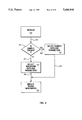
- FIG. 8 is a flowchart of the method and apparatus of the present invention.
- FIG. 9 is a block diagram of a portion of a computer system of FIG. 1 used in implementing the method and apparatus of the present invention, including an audio adapter having a digital signal processor and digital-to-audio and audio-to-digital converters.
- FIG. 1 there is depicted a block diagram of a computer system 1 which may be utilized to implement the method and apparatus of the present invention.
- Related technology for implementing the invention regarding sampling, MIDI, DSP and the like may be found in patent application Ser. Nos. 07/608,111; 07/608,105; 07/608,126; and 07/770,494 which are incorporated herein by reference.
- a computer system 1 is depicted which will implement a dynamically configurable synthesizer generating wavetable synthesized as well as sampled acoustic sound, preferably under MIDI control, in accordance with the teachings of the invention.
- Computer system 1 may be implemented utilizing any state-of-the-art digital computer system having a suitable digital signal processor disposed therein which is capable of implementing a MIDI synthesizer.
- computer system 1 may be implemented utilizing an IBM PS/2 type computer which includes an IBM Audio Capture & Playback Adapter (ACPA).
- ACPA IBM Audio Capture & Playback Adapter
- Display 3 may be utilized, as those skilled in the art will appreciate, to display those command and control features typically utilized in the processing of audio signals within a digital computer system.
- computer keyboard 4 which may be utilized to enter data and select various files stored within computer system 1 in a manner well known in the art.
- a graphical pointing device such as a mouse or light pen, may also be utilized to enter commands or select appropriate files within computer system 1.
- processor 2 is depicted.
- Processor 2 is preferably the central processing unit for computer system 1 and, in the depicted embodiment of the present invention, preferably includes an audio adapter capable of implementing a MIDI synthesizer by utilizing a digital signal processor.
- an audio adapter capable of implementing a MIDI synthesizer by utilizing a digital signal processor.
- One example of such a device is the IBM Audio Capture & Playback Adapter (ACPA).
- MIDI file 6 and digital audio file 7 are both depicted as stored within memory within processor 2. The output of each file may then be coupled to interface/driver circuitry 8.
- Interface/driver circuitry 8 is preferably implemented utilizing any suitable audio application programming interface which permits the accessing of MIDI protocol files or digital audio files and the coupling of those files to an appropriate device driver circuit within interface/driver circuitry 8.
- interface/driver circuitry 8 is coupled to digital signal processor 9.
- Digital signal processor 9 in a manner which will be explained in greater detail herein, is utilized to output digital audio and MIDI synthesized music and to couple that output to audio output device 5.
- Audio output device 5 is preferably an audio speaker or pair of speakers in the case of stereo music files.
- FIG. 2 in order to more fully comprehend the invention it will be helpful to describe a technique referred to as sampling synthesis utilized in the music synthesizer art today in order to generate sounds of existing (as well as non-existent) musical instruments.
- FIG. 2 Depicted in FIG. 2 is a functional block diagram of such an instrument.
- an existing instrument is "tape recorded” in the sense that a single note is played from the instrument, and that note is subsequently digitized for storage in digital memory, shown as sample data 10. Playback of that sound by a "sampler” device is performed in a manner analogous to playing back the original tape.
- Many instruments sounds have variable length durations. The clarinet, for example, will continue to sound as long as the musician continues to blow into the mouthpiece.
- a low frequency oscillator 14 may be provided with an output signal 26 which operates upon the sample data output 24 to modulate the sound from playing back the samples in a desired manner to create a vibrato.
- the interpolating oscillator 12 receiving the sample data output 24 and vibrato data 26 operates upon this data to produce a vibrato modulated audio signal of the desired average pitch.
- yet another technique for enhancing the played-back sample data commonly used in samplers is filtering.
- a filter is utilized to change the tonal quality of the digitized waveform. This is effective in producing the types of changes that occur to sounds that a musical instrument will make when played at different volumes. Generally speaking, for example, a musical instrument will generate a brighter sound when played loudly.
- a filter may therefore be utilized to remove some of the brightness from a waveform when being played quietly.
- such a filter 16 is thereby provided which operates on the output of the interpolating oscillator 28 to generate a filter output 32.
- Yet another desired capability of such a sampler is to control the amplitude of the resulting output 36.
- This may be conveniently effected by means of an amplifier 20 receiving the output of the filter 32, whereby the amplifier, after operating upon the filter output 32 generates the desired output 36.
- ADSR generators 18 and 22 may typically be provided having respective outputs 30 and 34 that operate upon their respective filter 16 or amplifier 20.
- Such an ADSR generator will be easily recognized in the art as being an attack, decay, sustain, and release generator providing an envelope comprised, in sequence, of such an attack, decay, sustain, and release value defining the envelope which will be a voltage value whose magnitude regulates the amount of filtering or amplification provided.
- a shortcoming of the foregoing sampler technique just described is that it requires large amounts of memory 10 to store each digitized sound, even if techniques are employed in an attempt to reduce the requirements of such memory such as the looping technique previously mentioned wherein to obtain a sustained sound the same data is read out over and over and converted into sound rather than having to capture and digitize the entire duration of the desired sound.
- a synthesizer implemented utilizing a DSP attached to a personal computer it may not be possible to guarantee that a given amount of such memory 10 will be available for the storage of musical instrument digital waveforms, e.g. "samples".
- the previously mentioned General MIDI Mode standard nevertheless requires that a base set of 175 musical instruments and special effects sounds be available. This obviously poses a problem if there isn't enough such memory 10 available to hold the samples for all 175 sounds.
- FIG. 3 is a simplified block diagram of yet another type of synthesizer known in the art referred to as a subtractive synthesizer, such subtractive synthesis being popularized during the mid-1970's as for example in the well known Moog synthesizer.
- This type of synthesizer utilizes an oscillator 40 to generate a continuous fixed periodic waveform shown as oscillator output 52.
- a low frequency oscillator 42 may be provided for similar reasons having an output 54 modulating the oscillator 40 to provide a modulated output 52 including vibrato as desired.
- a filter 44 may be provided to modify the harmonic content of the oscillator output 52 in response to an ADSR generator 46 output 58.
- the output 56 of the filter containing the output of the oscillator 52 having its harmonic content modified by the ADSR generator 46 will then preferably be delivered to a voltage controlled amplifier 48 in the manner of the synthesizer depicted in FIG. 2 whereby the envelope of the signal may thereby be shaped by the operation of a second ADSR generator 50, whose output 62 regulates the amount of amplification by the amplified 48 utilized to generate the output 60.
- a wavetable synthesizer which is a derivative of the subtractive synthesizer of FIG. 2 may be shown depicted in a functional block diagram in FIG. 4. This form of synthesizer will be recognized as being quite similar to that of FIG. 3. More particularly, an interpolating oscillator 72 is provided which operates upon sound data 84 in response to a vibrato output 86 from a low frequency oscillator 74, resulting in a modulated output 88 delivered to a filter 76.
- this filter 76 in turn operates on the oscillator output 88 in response to a control signal 92 from an ADSR 78, the resulting filter output 90 thereafter being delivered to a voltage controlled amplified 80.
- a second ADSR generator 82 is provided having a voltage control signal output 96 controlling the magnitude of amplification of the amplifier 80 and thus the output 94.
- FIG. 5 it is a feature of the invention to provide for a system and method for performing the previously described several types of music synthesis within a single sound generation configuration depicted in FIG. 5.
- this allows implementing a full array of musical instrument sounds regardless of the amount of sample memory that is available.
- the invention provides a solution to the aforementioned problem with samplers in having such memory-intensive requirements in that the system and method described herein provides implementation of a synthesizer that can utilize sampling if possible, but which is nevertheless capable of synthesizing a musical instrument sound if a sample is not available due to insufficient memory available to load the sample into memory for example.
- FIG. 2 is effectively combined with the subtractive synthesis of FIG. 3 and, more particularly, a wavetable synthesis of FIG. 4, resulting in the configuration shown in FIG. 5.
- Subtractive synthesis it will be noted, is improved in wavetable synthesis.
- the wavetable parameters may be utilized to construct the sound.
- FIG. 5 the dynamic synthesizer of the present invention will be seen depicted therein in functional block diagram form which may be implemented by the system shown in FIG. 1 and FIG. 9 in more detail.
- an interpolating oscillator 106, low frequency oscillator 108, filter 110, amplifier 114, and ADSR generators 112 and 116 are provided for similar reasons to those described with reference to FIG. 2.
- Each of these functional blocks of course have their respective outputs 126-136.
- a storage 100 for sample data is provided as well as storage for waveform data or parameters, a plurality of which may be seen depicted as waveform data storage 102 and 104.
- waveform data storage 102 and 104 a plurality of which may be seen depicted as waveform data storage 102 and 104.
- a sound could be generated by either deriving sample data from the sample data storage 100 or waveform parameters from the waveform data storages 102, 104, etc. whereby the sound would be generated based upon either the sample data or the waveform data.
- Such a switching function shown conceptually as switch 125 is provided in the dynamic synthesizer of FIG.
- FIG. 5 having an output 124 which may alternatively either be the sample data or waveform data delivered to the interpolating oscillator for conversion into sound.
- the " switch" being multipositional, may be caused in software to "rotate” so as to selectively retrieve on lines 118, 120, 122, etc. respective sample data or waveform data from the sample data storage 100 or waveform data storage 102, 104, respectively.
- FIG. 5 the block diagram of the dynamic synthesizer of the present invention depicted in FIG. 5 is functional and conceptual in nature.
- the switch 125 is intended only schematically to indicate that the system 1 will provide alternatively for the address of either of the hardcoded waveform data 102 and 104, or the address of a large portion of memory containing sample data 100 allocated from system memory at the time that the sample data was load, ed.
- FIG. 6 there is yet another more detailed functional block diagram of the system of the invention for providing dynamic synthesis.
- MIDIBLKs 192, 194, and 196 are used to maintain information regarding the status of MIDI Channels, specifically including currently selected program change number, pitch bend, and volume.
- the program change number from the MIDIBLK 192, 194, or 196 for that MIDI channel (222) is used to select with command 220 a PROGRAM 198 through 202.
- the Note-On key number 190 is used directly to select a DRUMKIT block 204 through 206.
- MIDI channel 10 is used for the drum kit, in such manner that the Note-On key number designates the specific drum sound to produce.
- Each PROGRAM block 198 through 206 contains all the synthesizer parameters needed to control the synthesizer (as depicted in FIG. 7). In addition, it contains an index or pointer 224 into the Sample Table 208.
- the Sample Table 208 contains pointers 226 228 to WAVEFORMBLKs 212 216 for each set of Sample Data 214 218 loaded into the system.
- the WAVEFORMBLKs 212, 216 contain information about the waveforms or samples 214, 218 such as location, length, loop points, and loop type.
- the system may contain voice data 198-206 which utilizes only simple predefined waveforms 212-218, requiring a minimum of system memory 210.
- voice data 198-206 which utilizes only simple predefined waveforms 212-218, requiring a minimum of system memory 210.
- additional entries are created in the Sample Table 208, pointing to new WAVEFORMBLKs 212, 216 which point 230, 232 to dynamically allocated memory into which the sample data is copied 214, 218.
- the PROGRAM 198-206 associated with the newly loaded sample data is updated to reference 224 the newly created Sample Table entry 208.
- FIG. 7 there is depicted therein a functional block diagram illustrating the synthesizer engine used to translate the control information referred to in FIG. 6 into sound.
- This engine utilizes common synthesizer elements as described in FIGS. 2, 3, and 4, and implements the lower 6 blocks of FIG. 6.
- FIG. 6 would be implemented using host system programming to execute on the processor 2 of FIG. 1, while the elements shown on FIG. 7 are implemented on the DSP 9 of FIG. 1. Notice that none of the elements appearing in FIG. 7 require any change whatsoever in order to perform either sampling or wavetable synthesis. That control is performed strictly in the logic illustrated in FIG. 6, and thus requires no reconfiguration of the DSP elements in FIG. 7.
- this figure illustrates that the control signals 258, 260, 261 generated by the ADSRs 240, 242 and the Low Frequency Oscillator (LFO) 244, respectively, are controlled and routed to each of the audio processing blocks 246, 248, 252.
- LFO Low Frequency Oscillator
- a rate and gain signal 254, 256 may be utilized to control the rate and gain of the LFO 244.
- An output of an ADSR 260 may also be utilized to adjust the magnitude of these rate and gain signals, shown conceptually by attenuators 262 and 264 under control of the output 260 of the ADSR 242.
- the precise value of the center frequencies F 0 294 and 300 of oscillator 246 and 248 may be controlled by the magnitude of the control signals 258, 260, and 261. Accordingly, this is shown functionally by provision of attenuators 266-274 intending to indicate variable control of the center frequencies 294 and 300 of the respective oscillator 246 and 248 by the ADSRs and LFO 240-244.
- variable attentuators 276-284 are shown in FIG. 7 under control of a respective ADSR or LFO providing this variable Q signal 302 or gain signal 304 to control the Q or gain of the filter or DCA 250, 252 respectively.
- Connections 296 between oscillator 246 and filter 250 and 298 between filter 250 and 252 are also shown to indicate that the oscillator output 296 is operator upon in a desired manner by the filter 250 and tile resulting output of the filter, 298, thereupon has its amplitude modified by the controllable amplifier 252.
- FIG. 8 there is a simplified block diagram illustrating the operation of a desired software system controlling the system of FIG. 1 and FIG. 9 for achieving the hereinbefore stated objects of the invention. More particularly, this software is intended to execute with the processor 2 of FIG. 1 in a manner to be described. Specifically, as shown at block 310 the processor 2 will detect when a "note on" signal has been generated by the keyboard 4 as signified by a "note on” message 320. The processor 2 will then determine from the note on information 320 whether sample data 100 exists in the memory associated with the processor 2 corresponding to the desired note shown as decisional block 312.
- the processor 2 will then retrieve the desired sample data 100 and associated parameters, 318, whereupon the process proceeds as shown by the path 326 to cause the system 1 to initiate the desired sound generation 316 based upon the sample data and parameters retrieved in block 318.
- the processor 2 under software control, determines that such an appropriate sample data 100 defined by the note on information at 310 is not present in the sample data storage, (as indicated by path 322), the processor 2 will then proceed to effect the selection of appropriate waveform data and parameters, 314, from a respective corresponding waveform data storage 102, 104, etc, such waveform data being retrieved in correspondence with the particular desired note on message generated at block 310.
- This waveform data and parameters will then be utilized as shown at path 324, to initiate sound generation 316 in the manner that such sound generation was generated from block 318, the difference being that in this case the sound generated will be as a result of a waveform lookup table and associated wavetable synthesizer technique of FIG.
- FIG. 9 there is depicted a block diagram of an audio adapter which includes digital signal processor 154 which may be utilized to implement the method and apparatus of the present invention.
- this audio adapter may be simply implemented utilizing the IBM Audio Capture Playback Adapter (ACPA) which is commercially available.
- digital signal processor 154 is provided by utilizing a Texas Instruments TMS 320C25, or other suitable digital signal processor.
- the I/O Bus 140 is a Micro Channel or PC I/O bus which allows the audio subsystem to communicate to a PS/2 or other PC computer.
- the host computer uses the I/O bus to pass information to the audio subsystem employing a common register 144, status register 146, address high byte counter 142, address low byte counter 158, data high byte bidirectional latch 148, and a data low byte bidirectional latch. 150.
- the host command and host status registers are used by the host to issue commands and monitor the status of the audio subsystem.
- the address and data latches are used by the host to access the shred memory 152 which is an 8 K ⁇ 16 bit fast static RAM on the audio subsystem.
- the shared memory 152 is the means for communication between the host (personal computer / PS/2) and the Digital Signal Processor (DSP) 154. This memory is shared in the sense that both the host computer and the DSP 154 can access it.
- a memory arbiter part of the control logic 166, prevents the host and the DSP from accessing the memory at the same time.
- the shared memory 152 can be divided so that part of the information is logic used to control the DSP 154.
- the DSP 154 has its own control registers 156 and status registers 156 for issuing commands and monitoring the status of other parts of the audio subsystem.
- the audio subsystem contains another block of RAM referred to as the sample memory 162.
- the sample memory 130 is 2 K ⁇ 16 bits static RAM which the DSP uses for outgoing sample signals to be played and incoming sample signals of digitized audio for transfer to the host computer for storage.
- the Digital to Analog Converter (DAC) 168 and the Analog to Digital Converter (ADC) 170 are interfaces between the digital world of the host computer and the audio subsystem and the analog world of sound.
- the DAC 168 gets digital samples from the sample memory 162, converts these samples to analog signals, and delivers these signals to the analog output section 172 along analog path 181A.
- the analog output section 172 conditions and sends the signals to the output connectors 188 for transmission via speakers 190 or headsets to the ears of a listener.
- the DAC 168 is multiplexed to give continuous operations to both outputs.
- the ADC 170 is the counterpart of the DAC 168.
- the ADC 170 receives analog signals on lines 181B from the analog input section 174 (which received these signals from the input connectors 184, 186 (microphone, stereo player, mixer . . . )), converts these analog signals to digital samples, and stores them in the sample memory 162.
- the control logic 166 is a block of logic which among other tasks issues interrupts to the host computer after a DSP interrupt request, controls the input selection switch, and issues read, write, and enable strobes to the various latches and the Sample and Shared Memory.
- the host computer informs the DSP 154 through the I/O Bus 10 that the audio adapter should digitize an analog signal.
- the DSP 154 uses its control registers 156 to enable the ADC 170.
- the ADC 170 digitizes the incoming signal and places the samples in the sample memory 162.
- the DSP 154 gets the samples from the sample memory 162 and transfers them to the shared memory 152.
- the DSP 154 then informs the host computer via the I.O bus 140 that digital samples are ready for the host to read.
- the host gets these samples over the I/O bus 140 and stores them in the host computer RAM or disk.
- the control logic 166 prevents the host computer and the DSP 154 from accessing the shared memory 152 at the same time.
- the control logic 166 also prevents the DSP 154 and the DAC 168 from accessing the sample memory 162 at the same time, controls the sampling of the analog signal, and performs other functions.
- the scenario described above is a continuous operation. While the host computer is reading digital samples from the shared memory 152, the DAC 168 is putting new data in the sample memory 162, and the DSP 154 is transferring data from the sample memory 162 to the shared memory 152.
- the host computer informs the DSP 154 that the audio subsystem should play back digitized data.
- the host computer gets code for controlling the DSP 154 and digital audio samples from its memory or disk and transfers them to the shared memory 152 through the I/O bus 140.
- the DSP 154 under the control of the code, takes the samples, converts the samples to integer representations of logarithmically scaled values under the control of the code, and places them in the sample memory 162.
- the DSP 154 then activates the DAC 140 which converts the digitized samples into audio signals.
- the audio play circuitry conditions the audio signals and places them on the output connectors.
- the playing back is also a continuous operation.
- the DSP 154 transfers samples back and forth between sample and shared memory, and the host computer transfers samples back and forth over the I/O bus 140.
- the audio subsystem has the ability to play and record different sounds simultaneously.
- One aspect of the DSP processing is to convert the linear, integer representations of the sound information into logarithmically scaled, integer representation of the sound information for input to the DAC 168 for conversion into a true analog sound signal.
- Analog paths 181, data bus 176, address bus 178, control bus 180 and analog paths 181A, 181B, 184-190 are shown with different lines for clarity in FIG. 9.
- conventional arbitration logic 160, 164 is further provided in a manner shown in the art for arbitrating information on the address and data buses respectively.
- Control logic 166 uses the logic 160, 164 to ensure the processor 2 and DSP 9 do not access either memory simultaneously to avoid memory deadlock or the like.
Landscapes
- Engineering & Computer Science (AREA)
- Physics & Mathematics (AREA)
- Acoustics & Sound (AREA)
- Multimedia (AREA)
- General Engineering & Computer Science (AREA)
- Electrophonic Musical Instruments (AREA)
Priority Applications (4)
| Application Number | Priority Date | Filing Date | Title |
|---|---|---|---|
| US07/984,780 US5444818A (en) | 1992-12-03 | 1992-12-03 | System and method for dynamically configuring synthesizers |
| JP5242670A JP2584185B2 (ja) | 1992-12-03 | 1993-09-29 | オーディオ信号の発生方法及び装置 |
| EP93309216A EP0600639B1 (de) | 1992-12-03 | 1993-11-18 | Vorrichtung und Verfahren zur dynamischen Konfiguration von Synthesizern |
| DE69327639T DE69327639T2 (de) | 1992-12-03 | 1993-11-18 | Vorrichtung und Verfahren zur dynamischen Konfiguration von Synthesizern |
Applications Claiming Priority (1)
| Application Number | Priority Date | Filing Date | Title |
|---|---|---|---|
| US07/984,780 US5444818A (en) | 1992-12-03 | 1992-12-03 | System and method for dynamically configuring synthesizers |
Publications (1)
| Publication Number | Publication Date |
|---|---|
| US5444818A true US5444818A (en) | 1995-08-22 |
Family
ID=25530867
Family Applications (1)
| Application Number | Title | Priority Date | Filing Date |
|---|---|---|---|
| US07/984,780 Expired - Lifetime US5444818A (en) | 1992-12-03 | 1992-12-03 | System and method for dynamically configuring synthesizers |
Country Status (4)
| Country | Link |
|---|---|
| US (1) | US5444818A (de) |
| EP (1) | EP0600639B1 (de) |
| JP (1) | JP2584185B2 (de) |
| DE (1) | DE69327639T2 (de) |
Cited By (12)
| Publication number | Priority date | Publication date | Assignee | Title |
|---|---|---|---|---|
| WO1997007476A3 (en) * | 1995-08-14 | 1997-04-17 | Creative Tech Ltd | Method and apparatus for formatting digital audio data |
| US5680512A (en) * | 1994-12-21 | 1997-10-21 | Hughes Aircraft Company | Personalized low bit rate audio encoder and decoder using special libraries |
| US5890115A (en) * | 1997-03-07 | 1999-03-30 | Advanced Micro Devices, Inc. | Speech synthesizer utilizing wavetable synthesis |
| SG81938A1 (en) * | 1997-09-30 | 2001-07-24 | Yamaha Corp | Tone data making method and device and recording medium |
| US20030046079A1 (en) * | 2001-09-03 | 2003-03-06 | Yasuo Yoshioka | Voice synthesizing apparatus capable of adding vibrato effect to synthesized voice |
| US20040231497A1 (en) * | 2003-05-23 | 2004-11-25 | Mediatek Inc. | Wavetable audio synthesis system |
| US20050188819A1 (en) * | 2004-02-13 | 2005-09-01 | Tzueng-Yau Lin | Music synthesis system |
| US20050204903A1 (en) * | 2004-03-22 | 2005-09-22 | Lg Electronics Inc. | Apparatus and method for processing bell sound |
| US20070014298A1 (en) * | 2005-07-15 | 2007-01-18 | Bloomstein Richard W | Providing quick response to events in interactive audio |
| US20120224733A1 (en) * | 2009-08-02 | 2012-09-06 | Peter John Blamey | Fitting of sound processors using improved sounds |
| CN110534128A (zh) * | 2019-08-09 | 2019-12-03 | 普联技术有限公司 | 一种噪音处理方法、装置、设备及存储介质 |
| US20190392641A1 (en) * | 2018-06-26 | 2019-12-26 | Sony Interactive Entertainment Inc. | Material base rendering |
Families Citing this family (6)
| Publication number | Priority date | Publication date | Assignee | Title |
|---|---|---|---|---|
| DE69630623T2 (de) * | 1995-03-03 | 2004-09-23 | Yamaha Corp., Hamamatsu | Musikrechner bestehend aus vereinbaren Softwaremodulen |
| DE10300001A1 (de) * | 2003-01-02 | 2004-07-22 | Infineon Technologies Ag | Klangsignal-Syntheseeinrichtung und Verfahren zum rechnergestützten Bilden eines Klangsignals |
| EP1646035B1 (de) | 2004-10-05 | 2013-06-19 | Sony Europe Limited | Wiedergabegerät für metadata indexiertes Audiomaterial und hierfür verwendbares Audio Sampling/Sample Verarbeitungssystem |
| DE602005008078D1 (de) * | 2005-11-17 | 2008-08-21 | Research In Motion Ltd | Umwandlung von notenbasiertem Tonformat in PCM-basiertes Tonformat |
| US7467982B2 (en) | 2005-11-17 | 2008-12-23 | Research In Motion Limited | Conversion from note-based audio format to PCM-based audio format |
| CN112610419B (zh) * | 2020-12-16 | 2022-04-29 | 南京工程学院 | 一种基于plc和mscⅱ控制的液压型风电机组 |
Citations (15)
| Publication number | Priority date | Publication date | Assignee | Title |
|---|---|---|---|---|
| US4217802A (en) * | 1977-07-01 | 1980-08-19 | Deforeit Christian J | Polyphonic digital synthesizer |
| US4279186A (en) * | 1978-11-21 | 1981-07-21 | Deforeit Christian J | Polyphonic synthesizer of periodic signals using digital techniques |
| US4527274A (en) * | 1983-09-26 | 1985-07-02 | Gaynor Ronald E | Voice synthesizer |
| US4559602A (en) * | 1983-01-27 | 1985-12-17 | Bates Jr John K | Signal processing and synthesizing method and apparatus |
| US4586905A (en) * | 1985-03-15 | 1986-05-06 | Groff James W | Computer-assisted audio/visual teaching system |
| US4622877A (en) * | 1985-06-11 | 1986-11-18 | The Board Of Trustees Of The Leland Stanford Junior University | Independently controlled wavetable-modification instrument and method for generating musical sound |
| US4636876A (en) * | 1983-04-19 | 1987-01-13 | Compusonics Corporation | Audio digital recording and playback system |
| US4638709A (en) * | 1983-10-27 | 1987-01-27 | Kabushiki Kaisha Kawai Gakki Seisakusho | Electronic musical instrument with temporal variation data generating circuit and interpolation circuit |
| US4649783A (en) * | 1983-02-02 | 1987-03-17 | The Board Of Trustees Of The Leland Stanford Junior University | Wavetable-modification instrument and method for generating musical sound |
| US4677890A (en) * | 1983-02-27 | 1987-07-07 | Commodore Business Machines Inc. | Sound interface circuit |
| US4682248A (en) * | 1983-04-19 | 1987-07-21 | Compusonics Video Corporation | Audio and video digital recording and playback system |
| US4969385A (en) * | 1988-01-19 | 1990-11-13 | Gulbransen, Inc. | Reassignment of digital oscillators according to amplitude |
| US5054360A (en) * | 1990-11-01 | 1991-10-08 | International Business Machines Corporation | Method and apparatus for simultaneous output of digital audio and midi synthesized music |
| US5133010A (en) * | 1986-01-03 | 1992-07-21 | Motorola, Inc. | Method and apparatus for synthesizing speech without voicing or pitch information |
| US5171930A (en) * | 1990-09-26 | 1992-12-15 | Synchro Voice Inc. | Electroglottograph-driven controller for a MIDI-compatible electronic music synthesizer device |
Family Cites Families (4)
| Publication number | Priority date | Publication date | Assignee | Title |
|---|---|---|---|---|
| US4794837A (en) * | 1984-10-17 | 1989-01-03 | Nippon Gakki Seizo Kabushiki Kaisha | Tone signal generator with code converter for converting stored waveshapes of different coding forms into a common coding form |
| JP2513041B2 (ja) * | 1989-10-04 | 1996-07-03 | ヤマハ株式会社 | 楽音信号発生装置 |
| US5340938A (en) * | 1990-04-23 | 1994-08-23 | Casio Computer Co., Ltd. | Tone generation apparatus with selective assignment of one of tone generation processing modes to tone generation channels |
| JP2866439B2 (ja) * | 1990-04-24 | 1999-03-08 | ローランド株式会社 | 音色選択装置 |
-
1992
- 1992-12-03 US US07/984,780 patent/US5444818A/en not_active Expired - Lifetime
-
1993
- 1993-09-29 JP JP5242670A patent/JP2584185B2/ja not_active Expired - Lifetime
- 1993-11-18 DE DE69327639T patent/DE69327639T2/de not_active Expired - Lifetime
- 1993-11-18 EP EP93309216A patent/EP0600639B1/de not_active Expired - Lifetime
Patent Citations (15)
| Publication number | Priority date | Publication date | Assignee | Title |
|---|---|---|---|---|
| US4217802A (en) * | 1977-07-01 | 1980-08-19 | Deforeit Christian J | Polyphonic digital synthesizer |
| US4279186A (en) * | 1978-11-21 | 1981-07-21 | Deforeit Christian J | Polyphonic synthesizer of periodic signals using digital techniques |
| US4559602A (en) * | 1983-01-27 | 1985-12-17 | Bates Jr John K | Signal processing and synthesizing method and apparatus |
| US4649783A (en) * | 1983-02-02 | 1987-03-17 | The Board Of Trustees Of The Leland Stanford Junior University | Wavetable-modification instrument and method for generating musical sound |
| US4677890A (en) * | 1983-02-27 | 1987-07-07 | Commodore Business Machines Inc. | Sound interface circuit |
| US4636876A (en) * | 1983-04-19 | 1987-01-13 | Compusonics Corporation | Audio digital recording and playback system |
| US4682248A (en) * | 1983-04-19 | 1987-07-21 | Compusonics Video Corporation | Audio and video digital recording and playback system |
| US4527274A (en) * | 1983-09-26 | 1985-07-02 | Gaynor Ronald E | Voice synthesizer |
| US4638709A (en) * | 1983-10-27 | 1987-01-27 | Kabushiki Kaisha Kawai Gakki Seisakusho | Electronic musical instrument with temporal variation data generating circuit and interpolation circuit |
| US4586905A (en) * | 1985-03-15 | 1986-05-06 | Groff James W | Computer-assisted audio/visual teaching system |
| US4622877A (en) * | 1985-06-11 | 1986-11-18 | The Board Of Trustees Of The Leland Stanford Junior University | Independently controlled wavetable-modification instrument and method for generating musical sound |
| US5133010A (en) * | 1986-01-03 | 1992-07-21 | Motorola, Inc. | Method and apparatus for synthesizing speech without voicing or pitch information |
| US4969385A (en) * | 1988-01-19 | 1990-11-13 | Gulbransen, Inc. | Reassignment of digital oscillators according to amplitude |
| US5171930A (en) * | 1990-09-26 | 1992-12-15 | Synchro Voice Inc. | Electroglottograph-driven controller for a MIDI-compatible electronic music synthesizer device |
| US5054360A (en) * | 1990-11-01 | 1991-10-08 | International Business Machines Corporation | Method and apparatus for simultaneous output of digital audio and midi synthesized music |
Cited By (18)
| Publication number | Priority date | Publication date | Assignee | Title |
|---|---|---|---|---|
| US5680512A (en) * | 1994-12-21 | 1997-10-21 | Hughes Aircraft Company | Personalized low bit rate audio encoder and decoder using special libraries |
| WO1997007476A3 (en) * | 1995-08-14 | 1997-04-17 | Creative Tech Ltd | Method and apparatus for formatting digital audio data |
| US5763800A (en) * | 1995-08-14 | 1998-06-09 | Creative Labs, Inc. | Method and apparatus for formatting digital audio data |
| US5890115A (en) * | 1997-03-07 | 1999-03-30 | Advanced Micro Devices, Inc. | Speech synthesizer utilizing wavetable synthesis |
| SG81938A1 (en) * | 1997-09-30 | 2001-07-24 | Yamaha Corp | Tone data making method and device and recording medium |
| US7389231B2 (en) * | 2001-09-03 | 2008-06-17 | Yamaha Corporation | Voice synthesizing apparatus capable of adding vibrato effect to synthesized voice |
| US20030046079A1 (en) * | 2001-09-03 | 2003-03-06 | Yasuo Yoshioka | Voice synthesizing apparatus capable of adding vibrato effect to synthesized voice |
| US20040231497A1 (en) * | 2003-05-23 | 2004-11-25 | Mediatek Inc. | Wavetable audio synthesis system |
| US7332668B2 (en) * | 2003-05-23 | 2008-02-19 | Mediatek Inc. | Wavetable audio synthesis system |
| US20050188819A1 (en) * | 2004-02-13 | 2005-09-01 | Tzueng-Yau Lin | Music synthesis system |
| US7276655B2 (en) * | 2004-02-13 | 2007-10-02 | Mediatek Incorporated | Music synthesis system |
| US20050204903A1 (en) * | 2004-03-22 | 2005-09-22 | Lg Electronics Inc. | Apparatus and method for processing bell sound |
| US7427709B2 (en) * | 2004-03-22 | 2008-09-23 | Lg Electronics Inc. | Apparatus and method for processing MIDI |
| US20070014298A1 (en) * | 2005-07-15 | 2007-01-18 | Bloomstein Richard W | Providing quick response to events in interactive audio |
| US20120224733A1 (en) * | 2009-08-02 | 2012-09-06 | Peter John Blamey | Fitting of sound processors using improved sounds |
| US20190392641A1 (en) * | 2018-06-26 | 2019-12-26 | Sony Interactive Entertainment Inc. | Material base rendering |
| CN110534128A (zh) * | 2019-08-09 | 2019-12-03 | 普联技术有限公司 | 一种噪音处理方法、装置、设备及存储介质 |
| CN110534128B (zh) * | 2019-08-09 | 2021-11-12 | 普联技术有限公司 | 一种噪音处理方法、装置、设备及存储介质 |
Also Published As
| Publication number | Publication date |
|---|---|
| DE69327639D1 (de) | 2000-02-24 |
| JPH06222776A (ja) | 1994-08-12 |
| JP2584185B2 (ja) | 1997-02-19 |
| EP0600639B1 (de) | 2000-01-19 |
| EP0600639A2 (de) | 1994-06-08 |
| EP0600639A3 (de) | 1995-01-04 |
| DE69327639T2 (de) | 2000-07-06 |
Similar Documents
| Publication | Publication Date | Title |
|---|---|---|
| EP0600639B1 (de) | Vorrichtung und Verfahren zur dynamischen Konfiguration von Synthesizern | |
| US5281754A (en) | Melody composer and arranger | |
| JP2692768B2 (ja) | ディジタル・オーディオ及びmidi合成音楽を同時に出力する方法及び装置 | |
| US5717153A (en) | Tone information processing device for an electronic musical instrument for generating sounds | |
| US6008446A (en) | Synthesizer system utilizing mass storage devices for real time, low latency access of musical instrument digital samples | |
| US5117726A (en) | Method and apparatus for dynamic midi synthesizer filter control | |
| EP0501483B1 (de) | Mischvorrichtung für Begleitungschor und Karaoke-System mit dieser Vorrichtung | |
| CN1118104A (zh) | 自动伴奏无线卡拉ok麦克风装置 | |
| EP1212747A1 (de) | Gerät und verfahren zum spielen von musikinstrumenten mittels digitaler musikdateien | |
| CN1127400A (zh) | 对一种抽样乐器数字接口音乐合成器的微波形式控制 | |
| US6525256B2 (en) | Method of compressing a midi file | |
| Jaffe et al. | An overview of the sound and music kits for the NeXT computer | |
| JPH06259065A (ja) | 電子楽器 | |
| US5640489A (en) | Audio synthesizer time-sharing its first memory unit between two processors | |
| US20090013858A1 (en) | Sound generator for producing a sound from a new note | |
| US5587547A (en) | Musical sound producing device with pitch change circuit for changing only pitch variable data of pitch variable/invariable data | |
| JPH08314450A (ja) | ミュージックシステムおよび電子楽器 | |
| JP3518716B2 (ja) | 楽音合成装置 | |
| JP3141789B2 (ja) | コンピュータソフトウェアを用いた音源システム | |
| JP2599351B2 (ja) | 波形読み出し装置 | |
| JP2900082B2 (ja) | 楽音発生装置 | |
| JP2584185C (de) | ||
| JP3666346B2 (ja) | 楽音発生装置および記憶媒体 | |
| JP2524056Y2 (ja) | ピッチ変換器 | |
| JP3837994B2 (ja) | 楽譜データ変換装置、及び記録媒体 |
Legal Events
| Date | Code | Title | Description |
|---|---|---|---|
| AS | Assignment |
Owner name: INTERNATIONAL BUSINESS MACHINES CORPORATION, NEW Y Free format text: ASSIGNMENT OF ASSIGNORS INTEREST.;ASSIGNOR:LISLE, RONALD J.;REEL/FRAME:006349/0822 Effective date: 19921125 |
|
| STCF | Information on status: patent grant |
Free format text: PATENTED CASE |
|
| FPAY | Fee payment |
Year of fee payment: 4 |
|
| FPAY | Fee payment |
Year of fee payment: 8 |
|
| FPAY | Fee payment |
Year of fee payment: 12 |