US5469899A - Stabilization of cans with a smaller footprint on a can elevating platform of automatic beverage filling machinery - Google Patents
Stabilization of cans with a smaller footprint on a can elevating platform of automatic beverage filling machinery Download PDFInfo
- Publication number
- US5469899A US5469899A US08/189,956 US18995694A US5469899A US 5469899 A US5469899 A US 5469899A US 18995694 A US18995694 A US 18995694A US 5469899 A US5469899 A US 5469899A
- Authority
- US
- United States
- Prior art keywords
- platform
- wear plate
- piston rod
- fastener
- receiving
- Prior art date
- Legal status (The legal status is an assumption and is not a legal conclusion. Google has not performed a legal analysis and makes no representation as to the accuracy of the status listed.)
- Expired - Lifetime
Links
- 230000003028 elevating effect Effects 0.000 title claims abstract description 26
- 235000013361 beverage Nutrition 0.000 title claims description 26
- 230000006641 stabilisation Effects 0.000 title description 3
- 238000011105 stabilization Methods 0.000 title description 3
- 230000000712 assembly Effects 0.000 description 5
- 238000000429 assembly Methods 0.000 description 5
- 238000005429 filling process Methods 0.000 description 5
- 238000004519 manufacturing process Methods 0.000 description 4
- 229910052751 metal Inorganic materials 0.000 description 4
- 239000002184 metal Substances 0.000 description 4
- 238000000034 method Methods 0.000 description 4
- 239000000945 filler Substances 0.000 description 3
- 238000007789 sealing Methods 0.000 description 3
- 229910001220 stainless steel Inorganic materials 0.000 description 3
- 239000010935 stainless steel Substances 0.000 description 3
- VYZAMTAEIAYCRO-UHFFFAOYSA-N Chromium Chemical compound [Cr] VYZAMTAEIAYCRO-UHFFFAOYSA-N 0.000 description 2
- 229910000831 Steel Inorganic materials 0.000 description 2
- 229910052782 aluminium Inorganic materials 0.000 description 2
- XAGFODPZIPBFFR-UHFFFAOYSA-N aluminium Chemical compound [Al] XAGFODPZIPBFFR-UHFFFAOYSA-N 0.000 description 2
- 230000002708 enhancing effect Effects 0.000 description 2
- 238000004826 seaming Methods 0.000 description 2
- 239000010959 steel Substances 0.000 description 2
- 238000006243 chemical reaction Methods 0.000 description 1
- 238000006073 displacement reaction Methods 0.000 description 1
- 238000005553 drilling Methods 0.000 description 1
- 238000005187 foaming Methods 0.000 description 1
- 238000003197 gene knockdown Methods 0.000 description 1
- 238000007689 inspection Methods 0.000 description 1
- 239000003562 lightweight material Substances 0.000 description 1
- 239000000463 material Substances 0.000 description 1
- 230000009467 reduction Effects 0.000 description 1
- 239000012260 resinous material Substances 0.000 description 1
- 230000000717 retained effect Effects 0.000 description 1
- 239000011435 rock Substances 0.000 description 1
- 238000010079 rubber tapping Methods 0.000 description 1
- 239000007787 solid Substances 0.000 description 1
- 125000006850 spacer group Chemical group 0.000 description 1
- 230000000087 stabilizing effect Effects 0.000 description 1
Images


Classifications
-
- B—PERFORMING OPERATIONS; TRANSPORTING
- B67—OPENING, CLOSING OR CLEANING BOTTLES, JARS OR SIMILAR CONTAINERS; LIQUID HANDLING
- B67C—CLEANING, FILLING WITH LIQUIDS OR SEMILIQUIDS, OR EMPTYING, OF BOTTLES, JARS, CANS, CASKS, BARRELS, OR SIMILAR CONTAINERS, NOT OTHERWISE PROVIDED FOR; FUNNELS
- B67C3/00—Bottling liquids or semiliquids; Filling jars or cans with liquids or semiliquids using bottling or like apparatus; Filling casks or barrels with liquids or semiliquids
- B67C3/02—Bottling liquids or semiliquids; Filling jars or cans with liquids or semiliquids using bottling or like apparatus
- B67C3/22—Details
- B67C3/24—Devices for supporting or handling bottles
Definitions
- the present invention relates generally to can elevating platforms in automatic beverage filling equipment and more particularly to stabilization of smaller footprint cans by use of modified can elevating platforms and/or platform wear plates in automatic beverage filling equipment.
- Can elevating platform assemblies have been used for decades in beverage filling machinery. These can elevating platform assemblies comprise a piston rod extending from a cylinder to which a can platform is non-rotatably mounted using two countersunk screws. Ordinarily, an apertured platform wear plate is superimposed contiguously over the platform and the countersunk screws pass through countersunk apertures in the wear plate as well. A stirrup shoe or contoured centering guide is superimposed upon the top of the wear plate (or platform, if no wear plate is used) against which successive cans are rapidly displaced during the filling process, just prior to upward displacement of the piston rod.
- the beverage filling equipment described above was designed for and worked well with metal cans having a relatively broad bottom base or footprint.
- the beverage industry to save on the quantity of metal, including aluminum, used per can, has progressively reduced the size of the footprint of the can. Through a series of reductions, the diameter of the footprint has gone from 2.600 inches in a size 211 can to 1.875 inches in a size 202 can, which are currently being used.
- the inherent stability of the can during the filling process has been reduced, especially in lightweight aluminum cans and the ease with which the stability of this smaller footprint can is disrupted has greatly increased.
- the smaller footprint can using the older can platform assembly, has been found to de-stabilize as and after as it is shifted across and onto the top apertured surface, as the case may be, resulting in significant damage to the can, filler seal, and packaged cans, frequently requiring significant down time for the beverage filling machinery.
- the can tends to rock as and after it crosses the top apertured surface.
- the smaller footprint when engaging the standard stirrup, the smaller footprint can, especially when formed of lightweight material, tends to tip.
- the can may be cocked or misaligned as it enters the fill valve, which can cut the sealing gasket causing machinery and production line down time.
- the can does not get a nice smooth transfer and is shaken or rocked, it can result in a low fill can, resulting from spillage, or it can cause foaming between the filler and seamer on the transfer, again resulting in a low filled can. Both situations are expensive in lost product, cans, lids, and production line down time.
- the present invention overcomes or substantially alleviates the problems of the prior art mentioned above.
- Components for can elevating platform assemblies are provided which, in normal operation, do not de-stabilize the smaller footprint cans as the cans are successively transferred to a can platform or a wear plate superimposed upon the can platform prior to and during filling.
- a quick, inexpensive and effective solution to the small footprint can instability problem is provided.
- An additional paramount object of the present invention is the provision in automatic beverage filling machinery of novel features in a can elevating platform by which can stability is enhanced during filling.
- a further important object of the present invention is the provision of improvements in can elevating platform assemblies that enhance can stability and thereby reduce the likelihood of damage to the cans, the sealing gaskets, and to packaged cans thus reducing down time for the beverage filling machinery.
- a further valuable object of the present invention is the provision of a novel can-receiving platform and/or platform wear plate by which the stability of small footprint cans is enhanced immediately prior to and during filling.
- An additional significant object is the provision of a novel, stability enhancing stirrup in a can elevating platform assembly of automatic beverage filling machinery.
- An additional dominant object of the present invention is to provide a quick, inexpensive, and effective solution to small footprint can instabilty just before and at the time of filling.
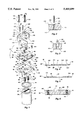
- FIG. 1 is an exploded perspective of one novel can elevating platform assembly in accordance with the present invention
- FIG. 2 is an enlarged fragmentary cross-sectional view taken along lines 2--2 of FIG. 1;
- FIG. 3 is an enlarged fragmentary cross-section taken along lines 3--3 of FIG. 1;
- FIG. 4 is an enlarged cross-section taken along lines 4--4 of FIG. 1;
- FIG. 5 is an enlarged cross-section taken along lines 5--5 of FIG. 1;
- FIG. 6 is an enlarged cross-section taken along lines 6--6 of FIG. 1;
- FIG. 7 is an enlarged cross-section taken along lines 7--7 of FIG. 1;
- FIG. 8 is an enlarged cross-section taken along lines 8--8 of FIG. 1;
- FIG. 9 is an enlarged perspective of the underside of the can platform illustrated in FIG. 1;
- FIG. 10 is a perspective representation of a second can platform embodying the principles of the present invention.
- FIG. 11 is a bottom perspective representation of the can platform of FIG. 10;
- FIG. 12 is an exploded perspective of a third can elevating platform assembly in accordance with the principles of the present invention.
- FIG. 13 is an elevational view of the bottom portion of a beverage can.
- FIG. 13 illustrates the lower portion of a typical beverage can generally designated 21.
- Beverage can 21 comprises a very thin vertical wall 23 and a contoured bottom wall 25, which defines a recess 27.
- Recess 27 comprises a footprint 29.
- the footprint 29 has changed over time from 2.600 inches in diameter (for a number 211 can) to 1.875 inches (for a 202 can, currently being the standard in the industry).
- a first can elevating platform assembly, generally designated 20 is illustrated in FIGS. 1-9.
- the assembly 20 comprises a piston rod 22, which is attached to a can lift cylinder (not shown) of automatic beverage filling machinery, by which the assembly 20 is elevated and lowered to fill a open-top can with beverage in a conventional and well known manner.
- the piston rod 22 comprises a reduced diameter distal end 24 having a blunt transversely-directly distal edge 26.
- Three aligned openings comprising exactly-directed threaded blind bores 28, 30 and 32 are exposed at distal edge 26.
- a shoulder 34 exists between the piston rod 22 and the reduced diameter distal end portion 24 of the piston rod, upon which a shim or spacer 36 is placed.
- Shim 36 is sized and shaped to level the associated can platform.
- the assembly 20 further comprises two threaded studs 38, each comprising a threaded base 40 and a smooth, reduced diameter cylindrical portion or pin 42.
- Threads 40 are sized and shaped so as to accommodate threaded placement in the threaded bores 28 and 32, leaving the smooth cylindrical portion or pin 42 of each extending upwardly above the distal edge 26.
- the assembly 20 further comprises a can platform, generally designated 50.
- Can platform 50 is preferably formed as one-piece from stainless steel and, therefore, comprises a solid body of material, the perimeter of which consists of front edge 52, rear edge 54 and side edges 58.
- Can platform at 50 further comprises a top smooth flat surface 60 and a bottom flat smooth surface 69, each of which, in the assembled condition, is disposed in a horizontal plane.
- Bottom surface 69 is disposed in a horizontal plane when the components of assembly 20 are assembled and operative.
- Surface 60 is interrupted by a pair of threaded bores 62 located near the respective rear corners 63 of can platform 50.
- the maximum depth of can platform 50 is between surfaces 60 and 69.
- can platform 50 comprises two countersunk threaded bores 64 one near each opposed front corners 66. Threaded bores 64 are also disposed in a vertical orientation.
- Countersunk screw 70 is threaded into blind bore 30 of piston rod 20. It is to be appreciated that while aperture 68 is illustrated as being countersunk, it could, under some circumstances, comprise vertical walls, as will be apparent from the following description.
- FIGS. 7 through 9 illustrate the underside or bottom region of can platform 50.
- a central region of the can platform 50, at the underside thereof is machined out to create a cylindrical recess 72.
- Recess 72 is defined by flat, smooth horizontal base surface 74 and an annular vertically-directed surface 76.
- Surface 76 intersects surface 69 at ninety degrees at annular corner 78 and surface 74 at ninety degrees at annular corner 80.
- a relatively large central aperture 68 is located at the diametral center of cylindrical recess 72.
- Base surface of 74 of recess 72 comprises two aligned smooth blind bores 82, sized and shaped to receive male cylindrical portions or pins 42 to cause the can platform 50 to be properly aligned in its assembled condition and to prevent rotation of the can platform 50 in respect to the piston rod 22.
- the assembly 20 further comprises a wear plate, generally designated 90, preferably formed of stainless, hard chrome coated steel. While wear plate 90 is not critically essential, it is preferred normally because it accepts the wear imposed by beverage cans sliding onto and off from the top surface thereof. Conveniently, wear plate 90 after substantial use can be easily replaced without substantial machinery down time, as will be apparent from the following description.
- Wear plate 90 comprises a thin metal plate of uniform thickness, formed to fit precisely and contiguously upon surface 60 of can platform 50.
- Platform 90 comprises a front edge 92, a rear edge 94, and two side edges 96.
- a relatively large countersunk central bore 98 is vertically disposed in plate 90 and is aligned with and matches bore 68. Where the countersunk head of screw 70 is appropriately flat, only bore 98 needs to be countersunk, meaning that bore 68 may be vertically straight. Where the head of screw 70 has a deeper taper, aperture 98 and part of aperture 68 must comprise a continuous taper adapted to receive the longer taper of the head of screw 70.
- Smooth vertically-directed apertures 100 are located near each of the two rear corners of plate 90. Apertures 100 are aligned with and have a diameter compatible with threaded bored 62. Two closely spaced smooth vertically-directed apertures 102 are located in a more central position near rear edge 94, for purposes yet to be explained.
- a countersunk aperture 104 is located near each front corner 106. Apertures 106 are smooth and are aligned with threaded bores 64, having a size compatible therewith, when assembly 20 is put together. A countersunk screw 101 is extended through each aperture 104 and threaded into associated threaded bore 64 until the head of each screw 101 is flush with a slightly below surface 91.
- Wear plate 90 comprises a top smooth horizontal surface 91 and a bottom smooth horizontal surface 93.
- Assembly 20 further comprises a stirrup or stirrup shoe, generally designated 110.
- Stirrup 110 comprises a horse shoe-shaped component comprising a single body 111, preferably of high impact synthetic resinous material, although stainless steel could be used.
- Body 11 comprises spaced legs 112 and 114, which define a mouth 116 therebetween, through which cans ingress and egress.
- Arm 112 is shorter than arm 114.
- Body 112 also comprises a backrest 118, sized and shaped to continuously receive the cylindrical side wall of each can transferred onto wear plate 90 during the filling process.
- the backrest area comprises part of a base 119 from which legs 112 and 114 project, the base 119 defining dowel pin-receiving bores 120 and stepped bores 120 located near each base corner 124.
- One dowel pin bore 120 is best illustrated in FIG. 2, while one stepped bore 122 is best illustrated in FIG. 3.
- Stirrup 110 comprises a generally horizontal flat bottom surface 113 and a generally flat horizontal upper surface 115.
- the overall height of the stirrup 110 is extended a distance greater than is true of a standard stirrup to provide better can stabilization, particularly for light small footprint cans at infeed and discharge.
- An oversized steel dowel pin 130 is force-fit through each bore 120 so that the bottom portion 132 of each pin 130 extends into an aligned aperture 102 to in wear plate 90 to insure correct alignment between the wear plate and the stirrup.
- a flat washer 134 is placed at the base of the larger diameter portion of each stepped bore 122 and a stepped machine screw 136 is extended through each washer 134 and each stepped bore 122, through an aligned aperture 100 in wear plate 90 and threaded into an aligned threaded bore 62 of can platform 50 to assemble the stirrup 110 as part of the can elevating platform assembly 20.
- the head of each screw 136 when tightened is entirely disposed in the enlarged region of the stepped bore 122 with which it is associated.
- can platform 140 has structural features identical to features of previously described can platform 50. These structural features have been correspondingly enumerated in FIGS. 10 and 11 and no further description thereof is deemed necessary.
- Can platform 140 may be used in lieu of both previously described wear plate 90 and can platform 50. Accordingly, the vertical dimension of can platform 140 ordinarily will be the same as the sum of the vertical dimensions of can platform 50 and wear plate 90. Because, using can platform 140, wear plate 90 is eliminated, at least the top region of can platform 140 should be made of extremely hard metal compatible with beverage processing standards, such as stainless steel coated with hard chrome.
- a technician would simply disassemble the prior art can elevating platform assembly, remove the prior art wear plate and the prior art can platform (if both comprise the prior art can platform) or, where no prior art wear plate comprises the prior art assembly, and insert single can platform 140.
- the prior art piston rod is equipped with only threaded blind bores 28 and 32. Therefore, a central blind bore 30 must be formed, using known drilling and tapping techniques, and stabilizing and aligning threaded plugs 38 placed in threaded bore 28 and 32 prior to assembly of the modified can elevating platform assembly using can platform 140.
- FIG. 12 A third embodiment of the present invention is illustrated in FIG. 12 and comprises a can elevating platform assembly, generally designated 150.
- Assembly 150 is illustrated as comprising stirrup 110, fully described above. Accordingly no further description of the stirrup is needed.
- the assembly 150 also comprises previously described dowel pins 130, washers 134 and screws 136.
- the assembly 150 also comprises piston rod 22', which is identical to piston rod 22 heretofore described except that threaded bore 30 does not comprise part of piston rod 22'.
- the assembly 150 also excludes threaded studs 38.
- the assembly 150 comprises a conventional prior art can platform, generally designated 152.
- Can platform 152 comprises two side-by-side relatively large, centrally disposed countersunk apertures 68'.
- the structural features of can platform 152 which are identical to structural features of previously described can platform 50 have been correspondingly enumerated and no further description is deemed needed.
- the can platform 152 is secured at the distal end of piston rod 22' by inserting a countersunk screw 70 through each hole 68' and respectively threading the same into threaded bores 28 and 32 of the piston rod 22'.
- Assembly 150 also comprises a wear plate, generally designated 152.
- the wear plate 152 is of uniform thickness and possesses a substantial number of the structural features also comprising previously described wear plate 90. To the extent the structural features of wear plate 152 are the same of those of wear plate 90, those features have been correspondingly enumerated and no further description thereof is deemed necessary.
- Wear plate 150 is distinguished from wear plate 90 by reason of the fact that top and bottom surfaces 91' and 93' of wear plate 150 are not interrupted by a relatively large central aperture, but has no centrally-disposed aperture of any type.
- Countersunk screws 101 are extended through apertures 104 in plate 152 and threaded into threaded bores 64 of can platform 152 to secure the two components together. When the screws 101 are tightened, the top surface of each is either flush with or slightly below surface 91'.
- the can filling instability problem described above can be substantially solved by disassembling an existing prior art can elevating platform assembly excluding the connections between piston rod 22' and can platform 152, removing the old prior art wear plate, replacing the prior art wear plate with wear plate 152 and reassembling earlier disassembled portion of the can elevating platform assembly, modified as described, for immediate operational resumption of the beverage filling production line.
- the prior art stirrup may be retained, if desired.
- stirrup 110 may be substituted for the prior art stirrup during reassembly of the modified can elevating platform assembly.
Landscapes
- Filling Of Jars Or Cans And Processes For Cleaning And Sealing Jars (AREA)
- Floor Finish (AREA)
- Tea And Coffee (AREA)
- Food Preservation Except Freezing, Refrigeration, And Drying (AREA)
Priority Applications (7)
| Application Number | Priority Date | Filing Date | Title |
|---|---|---|---|
| US08/189,956 US5469899A (en) | 1994-01-31 | 1994-01-31 | Stabilization of cans with a smaller footprint on a can elevating platform of automatic beverage filling machinery |
| AU12551/95A AU675899B2 (en) | 1994-01-31 | 1994-11-14 | Stabilization of cans with a smaller footprint on a can elevating platform of automatic beverage filling machinery |
| DE69423052T DE69423052T2 (de) | 1994-01-31 | 1994-11-14 | Stabilisierung von dosen mit kleinerer bodenfläche |
| CA002176718A CA2176718A1 (en) | 1994-01-31 | 1994-11-14 | Stabilization of cans with smaller footprints |
| EP95903526A EP0741666B1 (de) | 1994-01-31 | 1994-11-14 | Stabilisierung von dosen mit kleinerer bodenfläche |
| AT95903526T ATE189800T1 (de) | 1994-01-31 | 1994-11-14 | Stabilisierung von dosen mit kleinerer bodenfläche |
| PCT/US1994/013057 WO1995020539A1 (en) | 1994-01-31 | 1994-11-14 | Stabilization of cans with smaller footprints |
Applications Claiming Priority (1)
| Application Number | Priority Date | Filing Date | Title |
|---|---|---|---|
| US08/189,956 US5469899A (en) | 1994-01-31 | 1994-01-31 | Stabilization of cans with a smaller footprint on a can elevating platform of automatic beverage filling machinery |
Publications (1)
| Publication Number | Publication Date |
|---|---|
| US5469899A true US5469899A (en) | 1995-11-28 |
Family
ID=22699467
Family Applications (1)
| Application Number | Title | Priority Date | Filing Date |
|---|---|---|---|
| US08/189,956 Expired - Lifetime US5469899A (en) | 1994-01-31 | 1994-01-31 | Stabilization of cans with a smaller footprint on a can elevating platform of automatic beverage filling machinery |
Country Status (7)
| Country | Link |
|---|---|
| US (1) | US5469899A (de) |
| EP (1) | EP0741666B1 (de) |
| AT (1) | ATE189800T1 (de) |
| AU (1) | AU675899B2 (de) |
| CA (1) | CA2176718A1 (de) |
| DE (1) | DE69423052T2 (de) |
| WO (1) | WO1995020539A1 (de) |
Cited By (5)
| Publication number | Priority date | Publication date | Assignee | Title |
|---|---|---|---|---|
| US20040237477A1 (en) * | 2003-05-30 | 2004-12-02 | Mcray Cecil R. | Replacement lock levers and methods |
| US20080236215A1 (en) * | 2007-03-28 | 2008-10-02 | Bevcorp Llc | Beverage filling machine lock lever and methods for use |
| US20080236098A1 (en) * | 2007-03-28 | 2008-10-02 | Bevcorp Llc | Beverage filling machine lock lever and methods for use |
| US20100077700A1 (en) * | 2008-10-01 | 2010-04-01 | Deluca John E | Automated Capping Head |
| US10407289B2 (en) | 2015-12-08 | 2019-09-10 | 764944 Alberta Inc. | Machine for filling bottles, cans and like containers |
Families Citing this family (1)
| Publication number | Priority date | Publication date | Assignee | Title |
|---|---|---|---|---|
| DE102010029641A1 (de) * | 2010-06-02 | 2011-12-08 | Krones Ag | Reinigungsanlage |
Citations (5)
| Publication number | Priority date | Publication date | Assignee | Title |
|---|---|---|---|---|
| US2145765A (en) * | 1933-05-15 | 1939-01-31 | Crown Cork & Seal Co | Filling machine |
| US2656964A (en) * | 1945-08-25 | 1953-10-27 | Detrez Rene | Machine for successively performing operations on vessels or other articles |
| US2896676A (en) * | 1956-01-16 | 1959-07-28 | Chemetron Corp | Container filling machine |
| US3172434A (en) * | 1961-08-08 | 1965-03-09 | Richard C Boucher | Apparatus for filling containers |
| US3245436A (en) * | 1963-11-13 | 1966-04-12 | Aluminum Co Of America | Gripper stirrup for a can filling machine |
Family Cites Families (1)
| Publication number | Priority date | Publication date | Assignee | Title |
|---|---|---|---|---|
| US3050091A (en) * | 1959-02-27 | 1962-08-21 | Meyer Geo J Mfg Co | Can filler stirrup |
-
1994
- 1994-01-31 US US08/189,956 patent/US5469899A/en not_active Expired - Lifetime
- 1994-11-14 CA CA002176718A patent/CA2176718A1/en not_active Abandoned
- 1994-11-14 AU AU12551/95A patent/AU675899B2/en not_active Ceased
- 1994-11-14 DE DE69423052T patent/DE69423052T2/de not_active Expired - Lifetime
- 1994-11-14 AT AT95903526T patent/ATE189800T1/de not_active IP Right Cessation
- 1994-11-14 WO PCT/US1994/013057 patent/WO1995020539A1/en not_active Ceased
- 1994-11-14 EP EP95903526A patent/EP0741666B1/de not_active Expired - Lifetime
Patent Citations (5)
| Publication number | Priority date | Publication date | Assignee | Title |
|---|---|---|---|---|
| US2145765A (en) * | 1933-05-15 | 1939-01-31 | Crown Cork & Seal Co | Filling machine |
| US2656964A (en) * | 1945-08-25 | 1953-10-27 | Detrez Rene | Machine for successively performing operations on vessels or other articles |
| US2896676A (en) * | 1956-01-16 | 1959-07-28 | Chemetron Corp | Container filling machine |
| US3172434A (en) * | 1961-08-08 | 1965-03-09 | Richard C Boucher | Apparatus for filling containers |
| US3245436A (en) * | 1963-11-13 | 1966-04-12 | Aluminum Co Of America | Gripper stirrup for a can filling machine |
Cited By (9)
| Publication number | Priority date | Publication date | Assignee | Title |
|---|---|---|---|---|
| US20040237477A1 (en) * | 2003-05-30 | 2004-12-02 | Mcray Cecil R. | Replacement lock levers and methods |
| US7127870B2 (en) * | 2003-05-30 | 2006-10-31 | Servi-Teck, Inc | Replacement lock lever for an automatic beverage filling machine |
| US20080236215A1 (en) * | 2007-03-28 | 2008-10-02 | Bevcorp Llc | Beverage filling machine lock lever and methods for use |
| US20080236098A1 (en) * | 2007-03-28 | 2008-10-02 | Bevcorp Llc | Beverage filling machine lock lever and methods for use |
| US7938152B2 (en) | 2007-03-28 | 2011-05-10 | Bevcorp, Llc | Beverage filling machine lock lever and methods for use |
| US7967038B2 (en) | 2007-03-28 | 2011-06-28 | Bevcorp Llc | Beverage filling machine lock lever and methods for use |
| US20100077700A1 (en) * | 2008-10-01 | 2010-04-01 | Deluca John E | Automated Capping Head |
| US7765772B2 (en) * | 2008-10-01 | 2010-08-03 | Magnetic Technologies Ltd. | Automated capping head |
| US10407289B2 (en) | 2015-12-08 | 2019-09-10 | 764944 Alberta Inc. | Machine for filling bottles, cans and like containers |
Also Published As
| Publication number | Publication date |
|---|---|
| WO1995020539A1 (en) | 1995-08-03 |
| EP0741666B1 (de) | 2000-02-16 |
| EP0741666A4 (de) | 1997-10-08 |
| DE69423052T2 (de) | 2000-06-21 |
| EP0741666A1 (de) | 1996-11-13 |
| DE69423052D1 (de) | 2000-03-23 |
| AU1255195A (en) | 1995-08-15 |
| AU675899B2 (en) | 1997-02-20 |
| ATE189800T1 (de) | 2000-03-15 |
| CA2176718A1 (en) | 1995-08-03 |
Similar Documents
| Publication | Publication Date | Title |
|---|---|---|
| US5469899A (en) | Stabilization of cans with a smaller footprint on a can elevating platform of automatic beverage filling machinery | |
| US5778633A (en) | Quick change ledge support assembly for filling and capping machines | |
| US5020954A (en) | Screw driving socket | |
| US4398875A (en) | Molding tool for forming a closure shell liner | |
| US20030217479A1 (en) | Tool and method for measuring depth of countersunk portion of a hole | |
| ITMI991224A1 (it) | Dado e prodotto intermedio per lo stesso | |
| CN104227620A (zh) | 一种定位销升降式四角调平夹具 | |
| US4283978A (en) | Notching machine | |
| CN206305512U (zh) | 一种阀盖钻斜内孔夹具 | |
| KR102399276B1 (ko) | 내용물 정량 공급장치 | |
| KR101386455B1 (ko) | 판재의 펀칭을 위한 프레스 기계의 조립식 상부 펀칭 다이 장치 | |
| KR100827357B1 (ko) | 판재의 단차 조정장치 | |
| US11952829B1 (en) | Adjustable door sill | |
| US7127870B2 (en) | Replacement lock lever for an automatic beverage filling machine | |
| US5586379A (en) | Stabilizing of CAM in automated beverage filling machinery | |
| CN220268152U (zh) | 一种新型定位销 | |
| CN209009958U (zh) | 一种防止传动轴脱落的电梯梯级 | |
| CN112605279A (zh) | 一种可调节角度的翻边模具系统 | |
| US2608765A (en) | Squaring tool | |
| CN215243689U (zh) | 一种用于包装袋印刷装置上的连接组件 | |
| CN223057505U (zh) | 一种工装机构 | |
| CN220006186U (zh) | 一种切边圆盘剪重叠量检测装置 | |
| CN224029384U (zh) | 一种气雾剂罐封口机构 | |
| CN218706636U (zh) | 圆柱零件筛选装置 | |
| CN220302325U (zh) | 一种柱塞式流体机械的配流盘 |
Legal Events
| Date | Code | Title | Description |
|---|---|---|---|
| AS | Assignment |
Owner name: SERVI-TECH, INC., UTAH Free format text: ASSIGNMENT OF ASSIGNORS INTEREST;ASSIGNOR:NISH, TERRY E.;REEL/FRAME:006862/0757 Effective date: 19940131 |
|
| STCF | Information on status: patent grant |
Free format text: PATENTED CASE |
|
| FPAY | Fee payment |
Year of fee payment: 4 |
|
| FPAY | Fee payment |
Year of fee payment: 8 |
|
| FPAY | Fee payment |
Year of fee payment: 12 |