US5495542A - Binary to multi-level image restoration using neural network - Google Patents
Binary to multi-level image restoration using neural network Download PDFInfo
- Publication number
- US5495542A US5495542A US08/302,092 US30209294A US5495542A US 5495542 A US5495542 A US 5495542A US 30209294 A US30209294 A US 30209294A US 5495542 A US5495542 A US 5495542A
- Authority
- US
- United States
- Prior art keywords
- image data
- level
- object pixel
- neural network
- level image
- Prior art date
- Legal status (The legal status is an assumption and is not a legal conclusion. Google has not performed a legal analysis and makes no representation as to the accuracy of the status listed.)
- Expired - Fee Related
Links
Images


Classifications
-
- H—ELECTRICITY
- H04—ELECTRIC COMMUNICATION TECHNIQUE
- H04N—PICTORIAL COMMUNICATION, e.g. TELEVISION
- H04N1/00—Scanning, transmission or reproduction of documents or the like, e.g. facsimile transmission; Details thereof
- H04N1/40—Picture signal circuits
- H04N1/40062—Discrimination between different image types, e.g. two-tone, continuous tone
-
- G—PHYSICS
- G06—COMPUTING OR CALCULATING; COUNTING
- G06N—COMPUTING ARRANGEMENTS BASED ON SPECIFIC COMPUTATIONAL MODELS
- G06N3/00—Computing arrangements based on biological models
- G06N3/02—Neural networks
- G06N3/04—Architecture, e.g. interconnection topology
-
- G—PHYSICS
- G06—COMPUTING OR CALCULATING; COUNTING
- G06N—COMPUTING ARRANGEMENTS BASED ON SPECIFIC COMPUTATIONAL MODELS
- G06N3/00—Computing arrangements based on biological models
- G06N3/02—Neural networks
- G06N3/04—Architecture, e.g. interconnection topology
- G06N3/0499—Feedforward networks
-
- G—PHYSICS
- G06—COMPUTING OR CALCULATING; COUNTING
- G06N—COMPUTING ARRANGEMENTS BASED ON SPECIFIC COMPUTATIONAL MODELS
- G06N3/00—Computing arrangements based on biological models
- G06N3/02—Neural networks
- G06N3/08—Learning methods
- G06N3/09—Supervised learning
-
- H—ELECTRICITY
- H04—ELECTRIC COMMUNICATION TECHNIQUE
- H04N—PICTORIAL COMMUNICATION, e.g. TELEVISION
- H04N1/00—Scanning, transmission or reproduction of documents or the like, e.g. facsimile transmission; Details thereof
- H04N1/40—Picture signal circuits
- H04N1/40075—Descreening, i.e. converting a halftone signal into a corresponding continuous-tone signal; Rescreening, i.e. combined descreening and halftoning
Definitions
- This invention relates to image processing using a neural network. More particularly, the invention relates to an image processing method and apparatus for converting an N-level image (N bits per pixel) into M-level image data (M bits per pixel; M>N) such as a method and apparatus for restoring binary (two-level) image data to original multilevel image data.
- the invention further relates to a method and apparatus for subjecting an input image to image discrimination, and to a learning method in a neural network used in the above-described image processing.
- an original multi-level image (e.g., one color, eight bits per pixel) is read by a CCD, subjected to an A/D conversion to reduce the number of bits to a two-level or N-level (N ⁇ 8) bit number, and the resulting data is transmitted or recorded.
- the number of bits may need to be reduced because, for example, the band of the transmission line is too narrow or because only two-level recording is possible on the recording side.
- the original multi-level image can be binary-converted and the resulting binary (two-level) image data can be transmitted after being compressed and, on the receiving side, the received image data can be expanded and the original multi-level image can be estimated and restored in some form from the binary image data obtained.
- Japanese Patent Application Laid-Open No. 61-281676 discloses a method in which an original multi-level image is binary-converted using a dither matrix comprising an N ⁇ M matrix, and the resulting binary image data is converted on the receiving side into multi-level image data by performing pattern matching with a known N ⁇ M matrix.
- the received binary image contains a character area and an image area that contains half tones.
- the image restored by pattern matching with the conventional N ⁇ M matrix is a smoothened image which is blurred and exhibits poor reproduced quality.
- the reason for the above problem is as follows: Since density is not preserved in the inputted binary image data binary-converted by the dither method, the data obtained from this binary image data by estimating the original multiple values contains many errors. As a result, the binary image binary-converted by the dither method readily suffers image degradation at the fine lines of characters and the like. In other words, in essence it is difficult with simple pattern matching to restore a binary image, which is obtained by a binary converting method that essentially involves loss of information, into the original multi-level image. In a case where the original multi-level image is widely divergent in terms of the type and degree of picture quality, the type and degree of the binary image subsequently obtained by binary conversion also are widely divergent. Accordingly, essentially it is necessary to take into consideration this divergence in the restoration method.
- isolated dots are likely to be misjudged as being character portions, because the only values in a binary image are the extremal values "1" and "0" which is different from what is to be expected in a half-tone image.
- An object of the present invention is to provide an image processing method and apparatus capable of performing image restoration which takes the diversity of an input image into account by relying upon "learning" using a neural network not seen in the prior art.
- an image processing method for restoring input N-level image data to M-level image data by estimating an original image comprising the steps of:
- character areas and half-tone image areas are learned using a neural network in order to estimate the original multi-level data, and multi-level image data is estimated using learning parameters.
- character portions are restored to a multi-level image sharply, and tone portions of the image are restored to a multi-level image smoothly with little granularity.
- the method further includes a step of performing image discrimination to discriminate half-tone images and character images.
- Another object of the present invention is to provide an image restoration method having excellent restoration accuracy.
- the area which the first neural network refers to is enlarged. That is, the accuracy of restoration is raised while the scope of the neural network is kept small.
- Still another object of the present invention is to provide an image processing method in which a portion such as a character portion can be reproduced in a form faithful to the original image.
- N-level image data for learning is converted into N-level image data using a density preserving-type N-level conversion method.
- learning of the neural network is performed by a back-propagation method.
- a further object of the present invention is to provide a learning method of a neural network in an image processing apparatus which uses the neural network, in which the learning method reconciles both an improvement in learning efficiency and assured accuracy.
- the neural network is divided into two stages, in which after learning of the neural network of the first stage is performed, learning of the neural network of the second stage is carried out.
- a further object of the present invention is to provide an image discrimination method using a neural network, as well as a learning method of this neural network.
- this object is attained by providing an image discrimination method for separating and detecting a half-tone image area and a character image area in an inputted N-level image, comprising the steps of:
- the number of pixels referred to in order to perform image discrimination is substantially increased to improve the accuracy of the image discrimination.
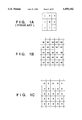
- FIG. 1A is a diagram for describing the structure of a filter for detecting an image area according to the prior art
- FIG. 1B is a diagram illustrating an example of a half-tone image
- FIG. 1C is a diagram illustrating the results of binarizing the image of FIG. 1B by the filter of FIG. 1A;
- FIGS. 2A through 2G are diagrams for describing a problem which arises owing to the filter of FIG. 1A;
- FIG. 3 is a block diagram showing the construction of an embodiment in which the present invention is applied to a facsimile apparatus
- FIG. 4A is a diagram for describing a restoring unit in the embodiment of FIG. 3;
- FIG. 4B is a diagram illustrating, in block form, the construction of a neural network 203 of the restoring unit
- FIG. 5A is a block diagram illustrating the construction of an image discriminator 113 in the apparatus of FIG. 3;
- FIG. 5B is a diagram illustrating, in block form, the construction of two neural networks of the image discriminator 113;
- FIGS. 6A and 6B are diagrams for describing image data used in learning of the neural network of the restoring unit in the apparatus of the embodiment shown in FIG. 3;
- FIG. 7 is a block diagram illustrating the structure of a network in the restoring unit 112;
- FIG. 8 is a graph illustrating an example of the characteristic of a sigmoid function used in learning of a neural network
- FIGS. 9A, 9B, 10A and 10B are diagrams illustrating the structures of image data used in learning by a neural network of the image discriminator 113;
- FIG. 11 is a flowchart illustrating the procedure of learning and restoration processing in the restoring unit
- FIGS. 12A, and 12B are flowcharts illustrating the procedure of learning processing used when many neural networks employed in the apparatus of FIG. 3 are caused to learn;
- FIGS. 13A through 13D illustrate a procedure for creating learning data used in learning of the image discriminator 113
- FIG. 14 is a diagram for describing a quaternary (four-level) conversion in the image discriminator 113;
- FIG. 15 is a flowchart for describing a learning process in the image discriminator 113.
- FIG. 16 is a diagram for describing the manner in which a pixel area referred to by a network 506 is substantially enlarged in the image discriminator 113;
- FIG. 17 is a block diagram illustrating the structure of a selector 114 in the apparatus of FIG. 3;
- FIG. 18 is a block diagram illustrating the construction of another embodiment of the restoring unit.
- FIGS. 19A, 19B, 20A and 20B are diagrams for describing the structure of outputted image data which enters two neural networks 403, 406 in the embodiment of FIG. 18;
- FIG. 21 is a diagram for describing a technique for performing an eight-level conversion in the embodiment of FIG. 18;
- FIGS. 22A through 22C are diagrams for describing a process for creating image data for learning used in the embodiment of FIG. 18;
- FIG. 23 is a flowchart for describing the procedure of a learning process used in the embodiment of FIG. 18;
- FIGS. 24A through 24C are diagrams for describing various variations of the arrangement of reference pixels relating to a modification of restoration.
- FIGS. 25A and 25B are diagrams respectively illustrating error flow and the positions of reference pixels in a case where the binary converting method is an error diffusion method.
- the image processing method of the present invention is achieved by a restoring unit 112 and an image discriminator 113, shown in FIG. 3.
- the method of restoration employed in the restoring unit 112 is characterized by the feature that use is made of a neural network.
- a neural network is used also in the discriminator 113.
- An improved version of the restoring unit 112 will be described later in greater detail.
- FIG. 3 is a block diagram illustrating a facsimile apparatus as one example of the apparatus embodying the present invention.
- an original image has been recorded on an original document 101, which is irradiated by light from a light source 102.
- a CCD 103 for photoelectric conversion is connected to an A/D converter 104 which digitizes an analog signal from the CCD 103.
- eight bits are used in processing of multi-level data.
- a binarizing (two-level conversion) processor 105 employs a density preserving-type error diffusion method (ERD).
- ERD density preserving-type error diffusion method
- a memory 118 stores error diffusion information from a previous cycle of error diffusion.
- the image data binarized by the ERD 105 enters a buffer memory 106 having a capacity of several lines, and the data outputted by the buffer memory 106 is compressed by a compressing circuit (CMP) 107.
- the compressing method is an internationally standardized MR or MMR compressing method, or the like.
- the compressed data is transmitted to the receiving side through a communication unit (CCU) 108 for a digital line, or a modem for an analog line.
- Numeral 109 denotes an ISDN or a public telephone network.
- a CCU 110 on the receiving side is the same as the CCU 108 on the transmitting side and serves as a demodulator.
- a DCMP 111 decompresses (expands) the received compressed data and sends the decompressed data to a restoring unit 112.
- the latter restores multi-level image data from the binary image data stored in buffer 106.
- the restoring unit 112 has two neural networks the construction of which is illustrated in FIG. 4. Of the two neural networks, one is for half-tone images and the other is for character images. More specifically, the restoring unit 112 outputs restored results (multi-level data), obtained by restoring an input image as a half-tone image, and restored results (multi-level data) obtained by restoring an input image as a character image. These results are delivered to a selector 114.
- An image discriminator 113 of FIG. 3 subjects the image data received from the DCMP 111 to image-type discrimination and sends the results of discrimination to the selector 114.
- the selector 114 (the construction of which is shown in FIG. 17) selects one of the two restored results from the restoring unit 112.
- the multi-level data outputted by the selector 114 enters a memory 115 of a CRT 118 capable of a multi-level display, and a memory 116 for a recorder 117 capable of multi-level recording.
- the multi-level images restored for the CRT 118 and printer 117 are displayed and printed in accordance with the data in the memories 115, 116.
- neural networks The concept of a neural network is described in detail in "Using Neural Networks in Pattern Recognition, Signal Processing and Knowledge Processing” (Nikkei Electronics, Aug. 10, 1987), by way of example. In this specification, neural networks will be described in sufficient scope to facilitate an understanding of the invention.
- FIG. 4A illustrates an example of the construction of a neural network in the restoring unit 112.
- the restoring unit 112 has two networks, one for a half-tone image and one for a character image. Since the two networks are identical in construction, that for the half-tone image is illustrated in FIG. 4A.
- FIG. 5A illustrates an example of the construction of a network in the discriminator 113. The network of the restoring unit 112 and that of the discriminator 113 are substantially similar in structure. Accordingly, FIG. 4A will be used in order to describe the structure of the neural networks.
- a neural network 203 shown in FIG. 4A has a line memory 201 for three lines of data in order to restore a multi-level image by referring to a 3 ⁇ 3 window block.
- the three-line buffer 201 stores data in three consecutive lines in the vertical direction of the image.
- items of data from the left end to the right end of the same horizontal position are successively outputted to a delay-element (latch) group 202 in synchronism with a clock.
- the latch group 202 comprises nine latches the output of each of which enters the neural network (NN) 203.
- image data in the form of a pixel at a position (indicated by "*" in FIG. 6B) corresponding to the central pixel of the small block is outputted by the NN 203.
- eight bits per pixel 256 tones
- a 3 ⁇ 3 reference area is set when the multi-level image data is restored from the binary image data.
- the spread of the area which causes dispersion of error at the time of the binarizing processing in the ERD 105 is prearranged to have a size of 3 ⁇ 3.
- FIG. 4B is a block diagram illustrating the construction of an example of the neural network (NN) 203 in the restoring unit 112.
- FIG. 5B is a block diagram illustrating the construction of an example of the neural network in the discriminator 113.
- FIG. 4B will be used in order to describe the neural network in general terms.
- n m ⁇ 1.
- numeral 301 denotes an input layer i, 302 an intermediate layer j, and 303 an output layer k.
- the reference block having the size (3 ⁇ 3) is applied to the apparatus of this embodiment, nine neurons are required as the input layer i.
- the numbers of neurons of the intermediate layer j should be decided in dependence upon the desired accuracy of the multi-level conversion.
- the intermediate layer j comprises a layer of nine neurons.
- One neuron is required in the output layer k.
- the strength of coupling between the input layer i and intermediate layer j is represented by W ji
- the strength of coupling between the intermediate layer j and intermediate layer k is represented by W kj .
- the coupling strengths W ji , W kj are decided by learning, and the accuracy of restoration performed by the neural networks is dependent upon these coupling strengths.
- Each neuron comprises a plurality of adders as well as a multiplier, divider and function operators (tables), not shown. If it is determined that enough learning is performed, the coupling strengths W ji , W kj are decided by learning and the construction of a system is decided in the form of a neural network.
- T 1 through T n indicated at 400 1 through 400 n in FIG. 7 are look-up tables for multiplying input data by a coupling coefficient (W ji or W kj ). These table values are decided by learning, described below.
- the inputs to these tables are the outputs of the neurons ahead of them.
- Numerals 401 through 403 denote adders each of which adds the two inputs applied thereto.
- a look-up table 404 designated T net is a table for normalizing, by means of a sigmoid function, the sum total of the addition operations performed by the adders 401 through 403.
- each neuron is as shown in FIG. 7 and the overall network is constructed as shown in FIGS. 4B and 5B, the hardware structure is simplified and processing speed is high enough for practical use.
- FIG. 8 illustrates an example of the characteristic of the sigmoid function. This function is characterized by the facts that normalization is performed in the range between “0" and “1", and that the values "0" and "1" are difficult to output.
- the construction of the neural network of the discriminator 113 will be described in accordance with FIG. 5A.
- the discriminator 113 differs from the restoring unit 112 in that the two neural networks (503, 506) are connected in series. Providing the discriminator 113 with two networks is advantageous in that the learning speed is raised and image discrimination is made more accurate.
- numeral 501 denotes a three-line memory comprising FIFO memories 501a through 501c.
- the FIFO memories 501a through 501c store data in three consecutive lines in the vertical direction of the image. Items of data from the left end to the right end of the same horizontal position are successively outputted in synchronism with a clock. As a result, data in 3 ⁇ 3 small areas (windows) is latched arranged as a 3 ⁇ 3 array in a data latch 502 in the horizontal and vertical directions.
- This neural network converts the contents of the data latch 502 into four-tone levels.
- Binary image data composed of nine pixels as shown in FIG. 9A is inputted to the conversion table 503, which proceeds to output multi-level image data of a pixel of interest at the position indicated by "*" in FIG. 9B.
- the table 503 also comprises a neural network and therefore requires learning.
- the 2-bit output (four tones) of the conversion table 503 enters line memories 504a through 504e of five lines. Data of five consecutive lines in the vertical direction of the image is stored in these five memories 504a through 504e of the line memory 504. Of the five lines, items of data from the left end to the right end of the same horizontal position are inputted successively. First, third and fifth lines of data are latched in the data latch 505 in synchronism with a clock, and nine items of data consisting of the first, third and fifth items of data are outputted in synchronism with the clock. These nine items of data are the inputs to the neural network 506, which outputs a signal representing the results of image discrimination corresponding to the pixel of interest (the third pixel on the middle of the three lines) among the nine items of data.
- FIG. 10A Four-level image data composed of nine pixels as shown in FIG. 10A is inputted to the neural network 506, which proceeds to output multi-level image data of a pixel of interest at the position indicated by "*" in FIG. 10B.
- the pixel blocks referred to for the purpose of image discrimination are enlarged through the two stage process.
- FIG. 5B is a diagram for describing the neural networks (503, 506) of the discriminator 113.
- Numeral 511 denotes an input layer composed of ii items, and the output (i-out) 514 thereof is delivered to an intermediate layer 512 (composed of j intermediate items).
- the output (j-out) 515 of the intermediate layer 512 is delivered to an output layer 513 (composed of k items).
- Numeral 516 denotes an output (k-out), which indicates the output from the output layer 513.
- Numeral 517 denotes an ideal output (ideal-output), and numerals 518, 519 represent weighting coefficients (W ji , W kj ). These indicates the strengths of the connection relationships (amplification, or attenuation) between the input layer 511 and intermediate layer 512 or between the intermediate layer 512 and the output layer 513.
- This restoration processing comprises a learning process (steps S10, S12) and an actual restoration process (steps S14 through S18).
- the learning process of steps S10 through S16 includes learning by the two neural networks (for half-tone images and character images) of the restoring unit 112 and learning by the two neural networks (503 and 506) of the discriminator 113. If the coupling coefficients (W ji ) of these networks have been decided, these values are fixedly set at step S18. As a result, the characteristics of the networks of the restoring unit 112 and discriminator 113 are decided.
- the binary image of the actual object of restoration is inputted to the restoring unit 112 at step S20.
- the restoring unit 112 outputs a multi-level image (step S22).
- the processing of steps S20, S22 is repeated as long as there is an image which is the object of restoration. ⁇ Learning>
- FIGS. 12A and 12B are flowcharts of the learning procedures of these networks.
- the restoring unit 112 restores multi-level image data from binary image data.
- multi-level image data and binarized data obtained by previously converting this multi-level image data by the ERD method (this method is the binarizing processing method of the transmitting unit in FIG. 3) are necessary in order to perform learning.
- the multi-level image data is used as so-called "ideal output data"
- the binarized image data which has been binarized from the multi-level image data is inputted to the network as "input data" to the network, and a so called “teach signal” is generated.
- the foregoing data is sample data for learning and must be prepared prior to learning.
- the coupling strengths W ji , W kj are initially decided in suitable fashion.
- the above-mentioned binary image data is inputted as learning data to the networks coupled based upon the initial values, and the outputted multi-level image data (kout) is obtained.
- This output and the original multi-level image data serving as the ideal output are compared, and the teach signal is generated based upon the comparison.
- This process is illustrated as the process 1 ⁇ 2 (forward direction) in FIG. 4B.
- the coupling strengths W ji , W kj are corrected while learning is performed in accordance with the back-projection method.
- the coupling strengths W ji , W kj are corrected as being suitable for the binary image data ⁇ multi-level image data conversion (restoration).
- the outputs in accordance with the coupling strengths W ji , W kj determined as the result of learning are stored as table values in the tables T 1 through T n indicated at 400 1 through 400 n in FIG. 7.
- FIGS. 12A and 12B The procedure for learning by the neural network for half-tone image restoration in the restoring unit will be described in detail with reference to FIGS. 12A and 12B.
- the principles of the procedure shown in FIGS. 12A and 12B are applied to learning by the network for the character image in the restoring unit 112 and to learning by the two neural networks in the discriminator 113.
- Step S402 calls for applying initial values to the weighting coefficient W ji indicating the strength of the connection between the input layer and the intermediate layer and to the weighting coefficient W kj indicating the strength of the connection between the intermediate layer and the output layer. Values in the range of from -0.5 to +0.5 are selected as initial values, taking convergence of the learning process into consideration. A pixel at any position is selected as a pixel of interest (the position indicated by "*" in FIG. 6B) from the input data for learning. Steps S404 through S406 represent a procedure for setting the input data and output data of the neural network.
- step S408 multi-level image data (ideal-out) serving as an ideal output corresponding to the pixel of interest is prepared.
- Step S410 indicates a procedure for computing an output kout (k) based upon the given weighting coefficients.
- the i-th item of data iout (i) from the input layer is multiplied by the weighting coefficient W ji of the intermediate layer, and the total sum regarding i is computed as follows: ##EQU1##
- the j-th output jout (j) of the intermediate layer is computed in accordance with ##EQU2## using the sigmoid function in order to obtain this output in a form normalized to 0/1.
- F of Sum Fj means forward.
- the output value kout from the intermediate layer to the output layer is obtained as follows: First, as in (1) above, the total sum of the products of the coefficient W kj of the output layer and the output value jout (j) from the intermediate layer is found, and the value Sum Fk is obtained. ##EQU3## Next, the output kout (k) of the output layer is obtained in accordance with ##EQU4## using the sigmoid function in order to obtain this output in a form normalized to 0/1.
- Step S412 calls for comparing the output value kout, which is computed from the initial values (set at step S402) W ji , W kj in accordance with Eqs. (1)-(4), with the ideal output ideal-out (k) prepared in advance. More specifically, as a result of this comparison, the teach signal teach-k(k) of the output layer is computed in accordance with the following:
- kout (k)* ⁇ 1-kout (k) ⁇ in Eq. (5) has the meaning of a differentiated value of the sigmoid function.
- ⁇ (a stabilizing coefficient) and ⁇ (a learning coefficient) are fixed values. These coefficients are made 0.5 in this embodiment.
- the coefficients ⁇ , ⁇ function to suppress the above-mentioned ⁇ W kj (k,j).
- the coupling coefficient ⁇ W kj (k,j) between the intermediate layer and the output layer is updated, i.e., learned, at step S415 in accordance with the following equation based upon the degree of change ⁇ W kj (k, j):
- the teach signal teach 13 j (j) of the intermediate layer is computed at step S416. Specifically, the contribution in the backward direction from the output layer in each neutral network of the intermediate layer is computed based upon ##EQU5## This contribution is normalized in accordance with the following equation using the differentiated value of the sigmoid function, thereby computing the teach signal teach-j (j) of the intermediate layer:
- step S4108 the degree of change ⁇ Wji (j,i) in the coupling of the intermediate layer is computed using this teach signal teach -- j (j). More specifically, the following operation is performed:
- the degree of coupling W ji (j,i) is updated at step S451. That is, the following operation is performed:
- multi-level image data of one pixel of interest is made an ideal output ideal -- out, and the coupling coefficients Wji, Wkj are learned from the ideal output, the binarized image data corresponding thereto, and the restored multi-level image data obtained from the surrounding nine-pixel binarized image data.
- step S422 Since accuracy is believed to be low if learning regarding all sets of sampled data is performed only once, the processing of steps S404 through S422 is repeated until accuracy is found to be high at the decision of step S424.
- step S404 it is better if the pixel of interest designated at step S404 is designated randomly rather than sequentially.
- the coupling constants in the neural network of the restoring unit 112 of FIG. 3 are decided so as to be optimum for the conversion from the binary image to the multi-level half-tone image, and the tables T1 through Tn are decided in accordance with the values of these coupling constants.
- the coupling constants for the conversion from the binary image to the multi-level character image in the restoring unit also are decided in the same manner as in FIGS. 12A and 12B.
- the sample of the input binary image data used in learning is that obtained by binarizing the multi-level character image, which has been prepared in advance, by means of a predetermined threshold-level matrix.
- the above-mentioned multi-level character image is used as the ideal output.
- FIGS. 13A through 13D are sampled data used in learning for the discriminator 113. First, the creation of these items of sampled data will be described.
- FIG. 13A is a diagram of an original multi-level image, in which an area 600 mainly contains a character image and an area 601 mainly contains a half-tone image.
- FIG. 13B is a diagram in which the multi-level image of FIG. 13A has been converted into a four-level image.
- the density of each pixel in the range 0-255 represented by eight bits is normalized to the range 0.1-0.9 by the sigmoid function of FIG. 8, whereupon the values of 0.1-0.9 are four-level converted according to the correspondence shown in FIG. 14.
- the character-image area 600 of the original image is converted into a four-level image area 602, and the half-tone image area 601 is converted into a four-level image area 603.
- FIG. 13C is the result of binarizing the multi-level image of FIG. 13A using a predetermined matrix.
- different matrices e.g., a fixed threshold-level matrix and a dither matrix
- the character-image area 600 of the original image is converted into a binary image area 604, and the half-tone image area 601 is converted into a binary image area 605.
- FIG. 13D illustrates the distribution of the results of image discrimination ("0" is allotted to the half-tone image and "1" is allotted to the character image) applied to the original image of FIG. 13A.
- the character-image area 600 of the original image is converted into a distribution area 606, and the half-tone image area 601 is converted into a distribution area 607.
- an image suitable for the learning sampled data is an image which always has a location where the density is "0" and a location where the density is "255”, and also possesses an edge portion of a character or the like.
- FIG. 15 is a flowchart illustrating the learning procedure in the discriminator 113.
- Steps S500 through S506 represent a procedure for learning the coupling coefficients of the conversion table 503.
- Steps S510 through S516 represent a procedure for learning the coupling coefficients of the network 506 for image discrimination.
- Step S500 of the flowchart calls for preparation of learning binary image data (i-out) (604, 605 in FIG. 13C) to be applied to the FIFO memory 501 of the discriminator 113.
- Four-level image data (602, 603; FIG. 13B) is prepared as an ideal output (ideal-out) at step S502.
- Learning is performed at step S504 in accordance with the procedure of FIGS. 12A and 12B using the learning data.
- the input of binary image data (604, 605) to the input layer 511 (FIG. 5B) of the neural network 503 is constituted by the nine pixels in the area of size 3 ⁇ 3 shown in FIG. 9A.
- the output signal from the output layer 513 of the network 503 is one pixel (three bits), as shown in FIG. 5B.
- This output signal is contrasted with the ideal output, in which the output corresponding to the position (pixel of interest) illustrated in FIG. 9B of the four-level image data (602, 603) is taken as being the ideal output.
- the coupling constants of the neural network 503 conversion table
- the image block which is inputted to the network 503 has a size of 3 ⁇ 3, as illustrated in FIG. 9A.
- the coupling constants obtained by learning are set in the network 503 at step S508. Learning of the network 506 is performed from step S510 onward.
- step S510 learning four-level image data (602, 603; FIG. 13B) for the network 506 is prepared at step S510.
- Data (606, 607; FIG. 13D) which is the result of image discrimination is prepared as the ideal output at step S512.
- Learning of the network 506 is performed at step S514 in accordance with the procedure of FIGS. 12A and 12B using the learning data. This learning is repeated until the coupling constant converges (step S516).
- the coupling constant which has converged is set in the network 506.
- the discriminator 113 When the binary image which includes the half-tone image and character image is inputted to the discriminator 113 of FIG. 5A, the discriminator 113 functions to discriminate the image and output the results of discrimination from the neural network 506.
- FIG. 17 is a detailed view of the selector 114 and illustrates the connections between the selector 114 and the restoring unit 112 and discriminator 113. Since the amount of delay in the discriminator 113 is greater than that of the restoring unit 112, a timing adjuster 120 adjusts this delay. Depending upon the output of the discriminator 113, a multiplexer 121 selects one of the two outputs (restoration as a half-tone image and restoration as a character image) from the restoring unit 112, whose timing has been adjusted.
- the restoring unit 112 of FIG. 3 restores the multi-level image from the binary image by referring to the 3 ⁇ 3 area.
- the following practical problem arises: With a window size on the order of 3 ⁇ 3, it is possible for all of the binary image data within the window to be "0", even if the density is not "0" when the original multi-level image has 0-255 tones.
- the opposite case is possible, in which all of the binary image data is "1", even if the density of the original multi-level image is not all "255". Accordingly, in the apparatus of the embodiment shown in FIG. 3, restoration accuracy inevitably is low since the size of the window is 3 ⁇ 3, which is small.
- FIG. 18 illustrates the construction of a restoring unit 112' according to this improvement.
- the restoring unit 112' is substantially the same as that of the discriminator 113 in terms of construction.
- the concrete construction of the two networks (403, 406) in FIG. 18 is substantially the same as that of the network in FIG. 4B or FIG. 5B.
- the reproducing unit 112' aims at achieving the same effects, as when the size of the reference area for image discrimination is increased, in apparent terms, by adopting a two-stage structure for the neural networks in the discriminator 113. More specifically, the reproducing unit 112' has two neural networks 403, 406, and the former network 403 refers to the binary image data of the 3 ⁇ 3 area (FIG.
- the network 406 outputs multi-level image data (FIG. 20B) upon referring to the output eight-level image data of network 403 in the vertical and horizontal directions, as shown in FIG. 20A, every other pixel.
- This multi-level image data is the restored image data.
- FIGS. 22A through 22C illustrate the sampled data used in teaching for the reproducing unit 112'
- FIG. 22A is a diagram of an original multi-level image, in which an area 650 mainly contains includes a character image and an area 651 mainly contains a half-tone image.
- FIG. 22B is a diagram in which the multi-level image of FIG. 22A has been converted into an eight-level image.
- the density of each pixel in the range 0-255 represented by eight bits is eight-level converted according to the correspondence shown in FIG. 21.
- the character-image area 650 of the original image is converted into an eight-level image area 652, and the half-tone image area 651 is converted into an eight-level image area 653.
- FIG. 22C is the result of binarizing the multi-level image of FIG. 22A using a predetermined matrix.
- different matrices should be used with regard to the areas 650, 651.
- the character-image area 650 of the original image is converted into a binary image area 654, and the half-tone image area 651 is converted into a binary image area 655.
- FIG. 23 is a flowchart illustrating the learning procedure in the restoring unit 112'.
- Steps S600 through S606 represent a procedure for learning the coupling coefficients of the conversion table 403.
- Steps S610 through S616 represent a procedure for learning the coupling coefficients of the network 406.
- Step S600 of the flowchart calls for preparation of learning binary image data (i-out) (654, 655 in FIG. 22C) to be applied to the FIFO memory 401 of the reproducing unit 112'.
- Eight-level image data (652, 653; FIG. 22B) is prepared as an ideal output (ideal-out) at step S602.
- Learning is performed at step S604 in accordance with the procedure of FIGS. 12A and 12B using the learning data.
- the input of binary image data (654, 655) to the input layer 511 (FIG. 5B) of the neural network 403 is constituted by the nine pixels in the area of size 3 ⁇ 3 shown in FIG. 19A.
- the output signal from the output layer 513 of the network 403 is one pixel (three bits), as shown in FIG. 19B.
- This output signal is contrasted with the ideal output, in which the output corresponding to the position (pixel of interest) illustrated in FIG. 9B of the eight-level image data (652, 653) is taken as being the ideal output.
- the coupling constant W of the neural network 403 (conversion table) is learned and decided.
- the coupling constant obtained by learning is set in the network 403 at step S608. Learning of the network 406 is performed from step S610 onward.
- step S610 learning eight-level image data (652, 653; FIG. 22B) for the network 406 is prepared at step S610.
- Multi-level image data (650, 651; FIG. 22A) is prepared as the ideal output at step S612.
- Learning of the network 406 is performed at step S614 in accordance with the procedure of FIGS. 12A and 121B using the learning data. This learning is repeated until the coupling constant converges (step S616).
- the coupling constant which has converged is set in the network 406.
- the restoring unit 112' When the binary image which includes the half-tone image and character image is inputted to the restoring unit 112' at the end of learning thus performed, the restoring unit 112' functions to restore the multi-level image data and output this data from the neural network 406.
- image discrimination is carried out using a neural network, the image discrimination is accurate and high in speed.
- image discrimination is performed by a neural network having a two-stage construction, as illustrated in FIG. 5A. Therefore, though the number of pixels referred to when image discrimination is performed is small in apparent terms, the number is substantially large to make possible highly accurate image discrimination. Moreover, by adopting the two-stage construction, a small number of input elements in the individual neural networks suffices and, as a result, the time needed for learning of the networks is short.
- the neural network used has a two-stage construction. This greatly increases the number of pixels referred to and furnishes a restored multi-level image having excellent image quality.
- a small number of input elements in the individual neural networks suffices and, as a result, the time needed for learning is short.
- the image discriminator 113 discriminates the image areas of the input binary image data and, in dependence upon the results of the discrimination, the selector 114 selects a multi-level image as the character image or a multi-level image as the half- tone image.
- the technique for the binary level ⁇ multi-level restoration essentially does not require image discrimination. The reason for this is that since both the character-image area and half-tone image area in the image are learned within a certain binary-image area in the learning process, half-tone areas also can be reproduced smoothly without blurring of character portions even in case of multi-level conversion.
- the present method using neural networks is not adaptive processing based upon division into a several stages or steps. Rather, the method of the invention is characterized by stepless adaptive processing referred to as learning (where the number of cases is extremely large, although limited), and therefore the probability of misjudgment is very small.
- the input is 3 ⁇ 3 pixels and the output pixel is one.
- the present invention is not limited to this number, and there is no limitation upon the numbers of inputs and outputs.
- the technique involved is exactly the same as that described above.
- the inputs can be 5 ⁇ 7, and the number of outputs can be 3 ⁇ 3.
- a two-level ⁇ multi-level conversion is described above.
- the image from which the conversion is made is not limited to a binary image. It is self-evident that a conversion from N-level data (where N is less than the multi-level number of the original image) can be realized in the same manner as described above. In addition, it is self-evident that the same arrangement can be adopted even if the multi-level data after conversion is converted into another M level (M>N) and not the same multi-level number of the original image.
- the single-stage eight-level conversion can be replaced by a smoothing filter instead of relying upon two-stage neural network processing.
- tone processing is executed by referring to the pixels at the above-mentioned five locations, it is necessary to select five pixels in dependence upon the binarizing processing method applied to this binary image.
- the present invention can be applied to a case where it is achieved by supplying a program to a system or apparatus.
Landscapes
- Engineering & Computer Science (AREA)
- Theoretical Computer Science (AREA)
- Physics & Mathematics (AREA)
- General Health & Medical Sciences (AREA)
- Computing Systems (AREA)
- Biomedical Technology (AREA)
- Biophysics (AREA)
- Computational Linguistics (AREA)
- Data Mining & Analysis (AREA)
- Evolutionary Computation (AREA)
- Life Sciences & Earth Sciences (AREA)
- Molecular Biology (AREA)
- Artificial Intelligence (AREA)
- General Engineering & Computer Science (AREA)
- General Physics & Mathematics (AREA)
- Mathematical Physics (AREA)
- Software Systems (AREA)
- Health & Medical Sciences (AREA)
- Multimedia (AREA)
- Signal Processing (AREA)
- Facsimile Image Signal Circuits (AREA)
- Image Analysis (AREA)
- Image Processing (AREA)
Priority Applications (2)
| Application Number | Priority Date | Filing Date | Title |
|---|---|---|---|
| US08/302,092 US5495542A (en) | 1990-03-23 | 1994-09-07 | Binary to multi-level image restoration using neural network |
| US08/540,537 US5832132A (en) | 1990-03-23 | 1995-10-06 | Image processing using neural network |
Applications Claiming Priority (9)
| Application Number | Priority Date | Filing Date | Title |
|---|---|---|---|
| JP2072118A JP2891505B2 (ja) | 1990-03-23 | 1990-03-23 | 中間調画像復元方法 |
| JP2-072118 | 1990-03-23 | ||
| JP2-072119 | 1990-03-23 | ||
| JP02072119A JP3136595B2 (ja) | 1990-03-23 | 1990-03-23 | 領域分離方法 |
| JP2153934A JPH0447470A (ja) | 1990-06-14 | 1990-06-14 | ニューラルネットを用いた画像処理方式及び同方式を用いた画像処理装置 |
| JP2-153934 | 1990-06-14 | ||
| US67324091A | 1991-03-20 | 1991-03-20 | |
| US14096293A | 1993-10-25 | 1993-10-25 | |
| US08/302,092 US5495542A (en) | 1990-03-23 | 1994-09-07 | Binary to multi-level image restoration using neural network |
Related Parent Applications (1)
| Application Number | Title | Priority Date | Filing Date |
|---|---|---|---|
| US14096293A Continuation | 1990-03-23 | 1993-10-25 |
Related Child Applications (1)
| Application Number | Title | Priority Date | Filing Date |
|---|---|---|---|
| US08/540,537 Division US5832132A (en) | 1990-03-23 | 1995-10-06 | Image processing using neural network |
Publications (1)
| Publication Number | Publication Date |
|---|---|
| US5495542A true US5495542A (en) | 1996-02-27 |
Family
ID=27300866
Family Applications (2)
| Application Number | Title | Priority Date | Filing Date |
|---|---|---|---|
| US08/302,092 Expired - Fee Related US5495542A (en) | 1990-03-23 | 1994-09-07 | Binary to multi-level image restoration using neural network |
| US08/540,537 Expired - Fee Related US5832132A (en) | 1990-03-23 | 1995-10-06 | Image processing using neural network |
Family Applications After (1)
| Application Number | Title | Priority Date | Filing Date |
|---|---|---|---|
| US08/540,537 Expired - Fee Related US5832132A (en) | 1990-03-23 | 1995-10-06 | Image processing using neural network |
Country Status (3)
| Country | Link |
|---|---|
| US (2) | US5495542A (de) |
| EP (1) | EP0449516B1 (de) |
| DE (1) | DE69123991T2 (de) |
Cited By (20)
| Publication number | Priority date | Publication date | Assignee | Title |
|---|---|---|---|---|
| WO1997039417A3 (en) * | 1996-03-29 | 1998-05-14 | Sarnoff Corp | Method and apparatus for training a neural network to use a fidelity metric |
| US5832132A (en) * | 1990-03-23 | 1998-11-03 | Canon Kabushiki Kaisha | Image processing using neural network |
| US5884296A (en) * | 1995-03-13 | 1999-03-16 | Minolta Co., Ltd. | Network and image area attribute discriminating device and method for use with said neural network |
| US5894546A (en) * | 1992-07-09 | 1999-04-13 | Canon Kabushiki Kaisha | Image processing apparatus for converting multivalued image into binary image and outputting binary image |
| US5995658A (en) * | 1994-04-28 | 1999-11-30 | Ricoh Company, Ltd. | Image processing device and image output device converting binary image into multi-valued image |
| US6026178A (en) * | 1995-09-08 | 2000-02-15 | Canon Kabushiki Kaisha | Image processing apparatus using neural network |
| US6075884A (en) * | 1996-03-29 | 2000-06-13 | Sarnoff Corporation | Method and apparatus for training a neural network to learn and use fidelity metric as a control mechanism |
| US6233365B1 (en) * | 1996-05-27 | 2001-05-15 | Sharp Kabushiki Kaisha | Image-processing method |
| US6259824B1 (en) | 1991-03-12 | 2001-07-10 | Canon Kabushiki Kaisha | Image processing apparatus utilizing a neural network to improve printed image quality |
| US6356361B1 (en) * | 1997-10-30 | 2002-03-12 | Minolta Co., Ltd. | Image processing apparatus and method for processing gradation image data using error diffusion |
| US7099025B2 (en) * | 1997-03-05 | 2006-08-29 | Canon Kabushiki Kaisha | Printing system, printing control method and apparatus printing data in accordance with updated condition information |
| US7496246B1 (en) * | 2003-07-24 | 2009-02-24 | The United States Of America As Represented By The Secretary Of The Navy | Ruggedized fiber optic sound velocity profiler |
| US20100149199A1 (en) * | 2008-12-11 | 2010-06-17 | Nvidia Corporation | System and method for video memory usage for general system application |
| US7916149B1 (en) | 2005-01-04 | 2011-03-29 | Nvidia Corporation | Block linear memory ordering of texture data |
| US7928988B1 (en) | 2004-11-19 | 2011-04-19 | Nvidia Corporation | Method and system for texture block swapping memory management |
| US7961195B1 (en) * | 2004-11-16 | 2011-06-14 | Nvidia Corporation | Two component texture map compression |
| US8078656B1 (en) | 2004-11-16 | 2011-12-13 | Nvidia Corporation | Data decompression with extra precision |
| US9081681B1 (en) | 2003-12-19 | 2015-07-14 | Nvidia Corporation | Method and system for implementing compressed normal maps |
| US20150199595A1 (en) * | 2014-01-14 | 2015-07-16 | Canon Kabushiki Kaisha | Information processing apparatus, information processing method, and storage medium |
| US20170256254A1 (en) * | 2016-03-04 | 2017-09-07 | Microsoft Technology Licensing, Llc | Modular deep learning model |
Families Citing this family (5)
| Publication number | Priority date | Publication date | Assignee | Title |
|---|---|---|---|---|
| JPH04216343A (ja) * | 1990-12-17 | 1992-08-06 | Sony Corp | 信号再生装置および方法 |
| EP0526295B1 (de) * | 1991-07-10 | 2000-09-27 | Fujitsu Limited | Bilderzeugungsgerät |
| JP3438233B2 (ja) * | 1992-05-22 | 2003-08-18 | ソニー株式会社 | 画像変換装置および方法 |
| US6657028B1 (en) | 2002-08-01 | 2003-12-02 | Albemarle Corporation | Anionic polymerization process |
| CN107194361B (zh) * | 2017-05-27 | 2021-04-02 | 成都通甲优博科技有限责任公司 | 二维姿势检测方法及装置 |
Citations (12)
| Publication number | Priority date | Publication date | Assignee | Title |
|---|---|---|---|---|
| JPS61281676A (ja) * | 1985-12-11 | 1986-12-12 | Konishiroku Photo Ind Co Ltd | 画像復元方法 |
| US4803558A (en) * | 1985-11-15 | 1989-02-07 | Konishiroku Photo Industry Co., Ltd. | Halftone image estimation methods for dither images |
| US4803736A (en) * | 1985-11-27 | 1989-02-07 | The Trustees Of Boston University | Neural networks for machine vision |
| US4803436A (en) | 1987-09-16 | 1989-02-07 | General Electric Company | Method and apparatus for evaluating the condition of a gapless metal-oxide varistor lightning arrester used for protecting a distribution transformer |
| US4860026A (en) * | 1987-06-25 | 1989-08-22 | Canon Kabushiki Kaisha | Halftone image recording method using recording data having a plurality of concentrations for one color |
| US4905097A (en) * | 1986-09-20 | 1990-02-27 | Canon Kabushiki Kaisha | Image processing system capable of processing both binary and multivalue image data and having converters for converting each type of image data into the other type of image data |
| US4905294A (en) * | 1984-10-19 | 1990-02-27 | Canon Kabushiki Kaisha | Image processing apparatus |
| US4926268A (en) * | 1986-02-14 | 1990-05-15 | Canon Kabushiki Kaisha | Image processing apparatus which converts m-bit image data to n-bit (n>m) image data |
| US4926180A (en) * | 1988-03-25 | 1990-05-15 | Trustees Of Columbia University In The City Of New York | Analog to digital conversion using correlated quantization and collective optimization |
| US4972187A (en) * | 1989-06-27 | 1990-11-20 | Digital Equipment Corporation | Numeric encoding method and apparatus for neural networks |
| US4995090A (en) * | 1989-02-07 | 1991-02-19 | The University Of Michigan | Optoelectronic pattern comparison system |
| US5005206A (en) * | 1988-11-25 | 1991-04-02 | U.S. Philips Corporation | Method of and arrangement for image data compression by means of a neural network |
Family Cites Families (10)
| Publication number | Priority date | Publication date | Assignee | Title |
|---|---|---|---|---|
| US4554593A (en) * | 1981-01-02 | 1985-11-19 | International Business Machines Corporation | Universal thresholder/discriminator |
| DE3113555A1 (de) * | 1981-04-03 | 1982-10-21 | Siemens AG, 1000 Berlin und 8000 München | Verfahren zum automatischen erkennen von weissbloecken sowie text-, graphik- und/oder graubildbereichen auf druckvorlagen |
| JPS59156070A (ja) * | 1983-02-25 | 1984-09-05 | Canon Inc | 画像処理装置 |
| US4741046A (en) * | 1984-07-27 | 1988-04-26 | Konishiroku Photo Industry Co., Ltd. | Method of discriminating pictures |
| US4577235A (en) * | 1984-08-20 | 1986-03-18 | The Mead Corporation | Text/continuous tone image decision processor |
| JPS62137974A (ja) * | 1985-12-12 | 1987-06-20 | Ricoh Co Ltd | 画像処理方式 |
| EP0358815B1 (de) * | 1988-09-12 | 1993-05-26 | Océ-Nederland B.V. | System und Verfahren für automatische Segmentierung |
| US5101438A (en) * | 1990-02-02 | 1992-03-31 | Ricoh Company, Ltd. | Method of discriminating different kinds of image areas, involving two-dimensional orthogonal transforms |
| EP0449516B1 (de) * | 1990-03-23 | 1997-01-08 | Canon Kabushiki Kaisha | Bildverarbeitung mit neuronalem Netzwerk |
| US5521985A (en) * | 1992-08-13 | 1996-05-28 | International Business Machines Corporation | Apparatus for recognizing machine generated or handprinted text |
-
1991
- 1991-03-21 EP EP91302488A patent/EP0449516B1/de not_active Expired - Lifetime
- 1991-03-21 DE DE69123991T patent/DE69123991T2/de not_active Expired - Fee Related
-
1994
- 1994-09-07 US US08/302,092 patent/US5495542A/en not_active Expired - Fee Related
-
1995
- 1995-10-06 US US08/540,537 patent/US5832132A/en not_active Expired - Fee Related
Patent Citations (12)
| Publication number | Priority date | Publication date | Assignee | Title |
|---|---|---|---|---|
| US4905294A (en) * | 1984-10-19 | 1990-02-27 | Canon Kabushiki Kaisha | Image processing apparatus |
| US4803558A (en) * | 1985-11-15 | 1989-02-07 | Konishiroku Photo Industry Co., Ltd. | Halftone image estimation methods for dither images |
| US4803736A (en) * | 1985-11-27 | 1989-02-07 | The Trustees Of Boston University | Neural networks for machine vision |
| JPS61281676A (ja) * | 1985-12-11 | 1986-12-12 | Konishiroku Photo Ind Co Ltd | 画像復元方法 |
| US4926268A (en) * | 1986-02-14 | 1990-05-15 | Canon Kabushiki Kaisha | Image processing apparatus which converts m-bit image data to n-bit (n>m) image data |
| US4905097A (en) * | 1986-09-20 | 1990-02-27 | Canon Kabushiki Kaisha | Image processing system capable of processing both binary and multivalue image data and having converters for converting each type of image data into the other type of image data |
| US4860026A (en) * | 1987-06-25 | 1989-08-22 | Canon Kabushiki Kaisha | Halftone image recording method using recording data having a plurality of concentrations for one color |
| US4803436A (en) | 1987-09-16 | 1989-02-07 | General Electric Company | Method and apparatus for evaluating the condition of a gapless metal-oxide varistor lightning arrester used for protecting a distribution transformer |
| US4926180A (en) * | 1988-03-25 | 1990-05-15 | Trustees Of Columbia University In The City Of New York | Analog to digital conversion using correlated quantization and collective optimization |
| US5005206A (en) * | 1988-11-25 | 1991-04-02 | U.S. Philips Corporation | Method of and arrangement for image data compression by means of a neural network |
| US4995090A (en) * | 1989-02-07 | 1991-02-19 | The University Of Michigan | Optoelectronic pattern comparison system |
| US4972187A (en) * | 1989-06-27 | 1990-11-20 | Digital Equipment Corporation | Numeric encoding method and apparatus for neural networks |
Non-Patent Citations (8)
| Title |
|---|
| "Image Modification of Color Hard Copies Using Neural Networks" in Image Electronics Engineers of Japan, 1989, pp. 13-18 (PTO Translation). |
| "Using Neural Networks in Pattern Recognition, Signal Processing and Knowledge Processing", in Nikkei Electronics, No. 427, pp. 115-124 (PTO Translation). |
| Image Modification of Color Hard Copies Using Neural Networks in Image Electronics Engineers of Japan, 1989, pp. 13 18 (PTO Translation). * |
| Kolias, S. et al. "Image Halftoning and Reconstruction Using a Neural Network", ICASSP, vol. 3, May 26, 1989, pp. 1787-1790. |
| Kolias, S. et al. Image Halftoning and Reconstruction Using a Neural Network , ICASSP, vol. 3, May 26, 1989, pp. 1787 1790. * |
| Kulkarni, A. D. "Neural Nets for Image Restoration", Annual Computer Science Conference Proceedings, Feb. 22, 1990 pp. 373-378. |
| Kulkarni, A. D. Neural Nets for Image Restoration , Annual Computer Science Conference Proceedings, Feb. 22, 1990 pp. 373 378. * |
| Using Neural Networks in Pattern Recognition, Signal Processing and Knowledge Processing , in Nikkei Electronics, No. 427, pp. 115 124 (PTO Translation). * |
Cited By (28)
| Publication number | Priority date | Publication date | Assignee | Title |
|---|---|---|---|---|
| US5832132A (en) * | 1990-03-23 | 1998-11-03 | Canon Kabushiki Kaisha | Image processing using neural network |
| US6259824B1 (en) | 1991-03-12 | 2001-07-10 | Canon Kabushiki Kaisha | Image processing apparatus utilizing a neural network to improve printed image quality |
| US5894546A (en) * | 1992-07-09 | 1999-04-13 | Canon Kabushiki Kaisha | Image processing apparatus for converting multivalued image into binary image and outputting binary image |
| US5995658A (en) * | 1994-04-28 | 1999-11-30 | Ricoh Company, Ltd. | Image processing device and image output device converting binary image into multi-valued image |
| US5884296A (en) * | 1995-03-13 | 1999-03-16 | Minolta Co., Ltd. | Network and image area attribute discriminating device and method for use with said neural network |
| US6026178A (en) * | 1995-09-08 | 2000-02-15 | Canon Kabushiki Kaisha | Image processing apparatus using neural network |
| US6075884A (en) * | 1996-03-29 | 2000-06-13 | Sarnoff Corporation | Method and apparatus for training a neural network to learn and use fidelity metric as a control mechanism |
| WO1997039417A3 (en) * | 1996-03-29 | 1998-05-14 | Sarnoff Corp | Method and apparatus for training a neural network to use a fidelity metric |
| US6233365B1 (en) * | 1996-05-27 | 2001-05-15 | Sharp Kabushiki Kaisha | Image-processing method |
| US7099025B2 (en) * | 1997-03-05 | 2006-08-29 | Canon Kabushiki Kaisha | Printing system, printing control method and apparatus printing data in accordance with updated condition information |
| US6356361B1 (en) * | 1997-10-30 | 2002-03-12 | Minolta Co., Ltd. | Image processing apparatus and method for processing gradation image data using error diffusion |
| US7496246B1 (en) * | 2003-07-24 | 2009-02-24 | The United States Of America As Represented By The Secretary Of The Navy | Ruggedized fiber optic sound velocity profiler |
| US9081681B1 (en) | 2003-12-19 | 2015-07-14 | Nvidia Corporation | Method and system for implementing compressed normal maps |
| US8918440B2 (en) | 2004-11-16 | 2014-12-23 | Nvidia Corporation | Data decompression with extra precision |
| US7961195B1 (en) * | 2004-11-16 | 2011-06-14 | Nvidia Corporation | Two component texture map compression |
| US8078656B1 (en) | 2004-11-16 | 2011-12-13 | Nvidia Corporation | Data decompression with extra precision |
| US7928988B1 (en) | 2004-11-19 | 2011-04-19 | Nvidia Corporation | Method and system for texture block swapping memory management |
| US7916149B1 (en) | 2005-01-04 | 2011-03-29 | Nvidia Corporation | Block linear memory ordering of texture data |
| US20110169850A1 (en) * | 2005-01-04 | 2011-07-14 | Nvidia Corporation | Block linear memory ordering of texture data |
| US8436868B2 (en) | 2005-01-04 | 2013-05-07 | Nvidia Corporation | Block linear memory ordering of texture data |
| US8456481B2 (en) | 2005-01-04 | 2013-06-04 | Nvidia Corporation | Block linear memory ordering of texture data techniques |
| US8610732B2 (en) | 2008-12-11 | 2013-12-17 | Nvidia Corporation | System and method for video memory usage for general system application |
| US20100149199A1 (en) * | 2008-12-11 | 2010-06-17 | Nvidia Corporation | System and method for video memory usage for general system application |
| US20150199595A1 (en) * | 2014-01-14 | 2015-07-16 | Canon Kabushiki Kaisha | Information processing apparatus, information processing method, and storage medium |
| KR20150084663A (ko) * | 2014-01-14 | 2015-07-22 | 캐논 가부시끼가이샤 | 정보처리장치, 정보처리방법 및 기억매체 |
| US9396418B2 (en) * | 2014-01-14 | 2016-07-19 | Canon Kabushiki Kaisha | Information processing apparatus, information processing method, and storage medium for processing an image and a pattern included in an XOR-and-XOR rendering command set |
| US20170256254A1 (en) * | 2016-03-04 | 2017-09-07 | Microsoft Technology Licensing, Llc | Modular deep learning model |
| US10235994B2 (en) * | 2016-03-04 | 2019-03-19 | Microsoft Technology Licensing, Llc | Modular deep learning model |
Also Published As
| Publication number | Publication date |
|---|---|
| EP0449516B1 (de) | 1997-01-08 |
| US5832132A (en) | 1998-11-03 |
| EP0449516A2 (de) | 1991-10-02 |
| DE69123991D1 (de) | 1997-02-20 |
| EP0449516A3 (en) | 1993-05-19 |
| DE69123991T2 (de) | 1997-05-22 |
Similar Documents
| Publication | Publication Date | Title |
|---|---|---|
| US5495542A (en) | Binary to multi-level image restoration using neural network | |
| EP0414505B1 (de) | Algorithmus zur Fehlerverbreitung mit Randverstärkung und Verfahren für Bildkodierung. | |
| US6686922B2 (en) | Adaptive thresholding using loose gray scale template matching | |
| US4668995A (en) | System for reproducing mixed images | |
| EP0461903B1 (de) | Bildverarbeitungsanlage mit neuronalem Netzwerk | |
| US6373990B1 (en) | Image processing utilizing luminance-density conversion | |
| JPS62216476A (ja) | 画像処理装置 | |
| JP3119371B2 (ja) | 画像処理方法 | |
| JPH0865517A (ja) | 2値印刷装置において、画像データのプレ歪によりトーン補正を行うための改良方法、および装置 | |
| JPH0981723A (ja) | 画像処理装置 | |
| JPH0998290A (ja) | 画像記録装置及び画像記録方法 | |
| US6353687B1 (en) | System and apparatus for single subpixel elimination with local error compensation in an high addressable error diffusion process | |
| JPH0447470A (ja) | ニューラルネットを用いた画像処理方式及び同方式を用いた画像処理装置 | |
| JPH10262151A (ja) | グレースケール画像のハーフトーニング方法、およびグレースケール画像のハーフトーニング手段を有する装置 | |
| JPH0447474A (ja) | ニューラルネットワークを用いた画像処理方式 | |
| JP2851662B2 (ja) | 画像処理装置 | |
| EP0531923A2 (de) | Verfahren und Gerät zur Grautonquantizierung | |
| KR930005131B1 (ko) | 히스토그램 평활화법을 이용한 중간조 화상 추출 방법 | |
| JPH0318177A (ja) | 画像処理装置 | |
| JP2891505B2 (ja) | 中間調画像復元方法 | |
| JPH06164902A (ja) | ニューラルネットワークによる画像の圧縮再生 | |
| JPH09247446A (ja) | 信号処理装置及び方法 | |
| JPH01146486A (ja) | 画像情報処理装置 | |
| JPS62183265A (ja) | 画像デ−タ伝送システム | |
| JPS63312150A (ja) | 濃淡画像2値化回路 |
Legal Events
| Date | Code | Title | Description |
|---|---|---|---|
| CC | Certificate of correction | ||
| FPAY | Fee payment |
Year of fee payment: 4 |
|
| FEPP | Fee payment procedure |
Free format text: PAYOR NUMBER ASSIGNED (ORIGINAL EVENT CODE: ASPN); ENTITY STATUS OF PATENT OWNER: LARGE ENTITY Free format text: PAYER NUMBER DE-ASSIGNED (ORIGINAL EVENT CODE: RMPN); ENTITY STATUS OF PATENT OWNER: LARGE ENTITY |
|
| FPAY | Fee payment |
Year of fee payment: 8 |
|
| REMI | Maintenance fee reminder mailed | ||
| LAPS | Lapse for failure to pay maintenance fees | ||
| STCH | Information on status: patent discontinuation |
Free format text: PATENT EXPIRED DUE TO NONPAYMENT OF MAINTENANCE FEES UNDER 37 CFR 1.362 |
|
| FP | Lapsed due to failure to pay maintenance fee |
Effective date: 20080227 |