US5652427A - Multipole ion guide for mass spectrometry - Google Patents
Multipole ion guide for mass spectrometry Download PDFInfo
- Publication number
- US5652427A US5652427A US08/645,826 US64582696A US5652427A US 5652427 A US5652427 A US 5652427A US 64582696 A US64582696 A US 64582696A US 5652427 A US5652427 A US 5652427A
- Authority
- US
- United States
- Prior art keywords
- ion guide
- ions
- vacuum
- multipole ion
- multipole
- Prior art date
- Legal status (The legal status is an assumption and is not a legal conclusion. Google has not performed a legal analysis and makes no representation as to the accuracy of the status listed.)
- Expired - Lifetime
Links
Images




Classifications
-
- B—PERFORMING OPERATIONS; TRANSPORTING
- B01—PHYSICAL OR CHEMICAL PROCESSES OR APPARATUS IN GENERAL
- B01D—SEPARATION
- B01D59/00—Separation of different isotopes of the same chemical element
- B01D59/44—Separation by mass spectrography
-
- H—ELECTRICITY
- H01—ELECTRIC ELEMENTS
- H01J—ELECTRIC DISCHARGE TUBES OR DISCHARGE LAMPS
- H01J49/00—Particle spectrometers or separator tubes
- H01J49/02—Details
- H01J49/04—Arrangements for introducing or extracting samples to be analysed, e.g. vacuum locks; Arrangements for external adjustment of electron- or ion-optical components
- H01J49/0468—Arrangements for introducing or extracting samples to be analysed, e.g. vacuum locks; Arrangements for external adjustment of electron- or ion-optical components with means for heating or cooling the sample
- H01J49/0481—Arrangements for introducing or extracting samples to be analysed, e.g. vacuum locks; Arrangements for external adjustment of electron- or ion-optical components with means for heating or cooling the sample with means for collisional cooling
-
- H—ELECTRICITY
- H01—ELECTRIC ELEMENTS
- H01J—ELECTRIC DISCHARGE TUBES OR DISCHARGE LAMPS
- H01J49/00—Particle spectrometers or separator tubes
- H01J49/02—Details
- H01J49/06—Electron- or ion-optical arrangements
- H01J49/062—Ion guides
- H01J49/063—Multipole ion guides, e.g. quadrupoles, hexapoles
Definitions
- This invention relates to the configuration and method of using a multipole ion guide to transport and focus ions which enter vacuum from an atmospheric pressure ion source, into a mass analyzer.
- the multipole on guide which begins in one vacuum pumping stage has been configured to extend contiguously through one or more subsequent vacuum stages.
- Multipole ion guides are used to efficiently transfer ions through one or more vacuum stages while allowing the neutral background gas to be pumped away.
- the AC frequency and AC and DC voltages which are applied to the poles of a multipole ion guide can be set so that the multipole ion guide will pass a selected range of ion mass to charge.
- the ion transmission properties of multipole ion guides can be used to enhance performance of specific mass analyzer types which are interfaced to atmospheric pressure ion sources.
- Atmospheric pressure ion sources have become increasingly important as a means for generating ions used in mass analysis.
- Electrospray or nebulization assisted Electrospray (ES), Atmospheric Pressure Chemical Ionization (APCI) and Inductively Coupled Plasma (ICP) ion sources produce ions from analyte species in a region which is approximately at atmospheric pressure. The ions must then be transported into vacuum for mass analysis. A portion of the ions created in the API source are entrained in the bath gas API source chamber and are swept into vacuum along with a the bath or carrier gas through an orifice into vacuum.
- Mass spectrometers generally operate in a vacuum maintained at between 10 -4 to 10 -10 torr depending on the mass analyzer type.
- the gas phase ions entering vacuum from an API source must be separated from the background carrier gas and transported and focused through a single or multiple staged vacuum system into the mass analyzer.
- Variations in vacuum system and associated electrostatic lens configurations have emerged in API/MS systems. Where multiple pumping stages have been employed, the electrostatic lens elements have been configured to serve as restricted orifices between vacuum stages as well as providing ion acceleration and focusing of ion into the mass analyzer. Performance tradeoffs may occur where electrostatic lenses must also accommodate restricting the neutral gas transmission from one pumping stage to the next.
- a skimmer placed between one pumping stage and the next may restrict the neutral gas flow but may also restrict the passage of ions as well due to its relatively small orifice.
- Two types of Electrostatic elements have been used to transport and focus ions in vacuum, particularly where ions are entering vacuum from atmosphere pressure through a free jet expansion. The first is a static voltage lens and the second is a dynamic field ion guide.
- the most effective lens configurations used in API/MS systems employ a judicious combination of both elements which have static and dynamic fields applied.
- the first electrostatic lens type has a fixed or static DC voltage applied during the time an ion is traversing the lenses' field.
- FIG. 1 is a diagrammatic representation of a four pumping stage API/MS system with static voltage electrostatic lenses. Gas emerging from the capillary exit 8 into vacuum expands as a supersonic free jet and a portion of the gas passes through the first 10 and second 14 skimmer. Skimmers between pumping stages typically have small orifices to restrict the neutral gas flow into each downstream vacuum stage. DC voltages are applied to the capillary exit, skimmers and other electrostatic lenses 9, 14, 15, 16 and 17 with values set to maximize the ion transmission into the mass spectrometer.
- Ions entrained in the expanding gas follow trajectories that are driven by a combination of electrostatic and gas dynamic forces. Strong influence from the gas dynamics can extend up to and beyond the second skimmer 13 for the configuration shown in Figure one.
- the efficiency of ion transmission through a static voltage lens set can be reduced by scattering losses due to collisions between ions and the background gas which occur along the ion trajectory. Ions with different m/z may vary their collisional cross sections and hence experience different numbers of background collisions as they are transported through vacuum. For a given electrostatic lens voltage setting the efficiency of ion transport into the mass spectrometer may vary with m/z or the collisional cross section.
- Changing the lens voltage values may optimize transmission for a given ion species but the setting may not be optimal for another ion species transmission.
- static lens configurations used in API/MS applications may not transmit lower molecular mass compounds as efficiently as higher molecular mass compounds.
- the smaller ions may sustain higher transmission losses due to collisional scattering from the background gas than the higher molecular mass compounds.
- the electrostatic energy must be set sufficiently high so that ions can be driven through the background gas.
- Static voltage lens configurations also tend to focus ions of different energy at different focal points. If the focal point is not located at the mass spectrometer entrance transmission losses can occur.
- multipole dynamic field ion guides have been employed to transport ions through vacuum pumping stages in the vacuum region of API/MS systems.
- the dynamic electrostatic fields within a multipole ion guide dominate over the background gas scattering collisions and effectively "trap" the ions while they traverse the length of the multipole ion guide.
- 4,963,736 describes the use of a multipole ion guide in either vacuum pumping stage two of a three stage system or in the first pumping stage of a two stage vacuum system.
- This patent also reports that increasing the background pressure up to 10 millitorr in the vacuum stage where the ion guide was positioned resulted in an increase in ion transmission efficiency and a decrease in ion energy spread of ions transmitted. Ion signal intensity decreased for higher background pressures in the reported quadrupole configuration.
- a commercially available API/MS instrument manufactured by Sciex, a Canadian company incorporates a quadrupole ion guide operated in the AC-only mode located before the quadruple mass filter in a single stage vacuum system.
- Ions and neutral gas flowing into vacuum through an orifice in the API source enter the quadrupole AC-only ion guide.
- the ions are trapped from expanding in the radial direction by the AC quadrupole fields and are transmitted along the quadrupole ion guide rod length as the neutral gas is pumped away through the rod spacing.
- Ions exiting the quadrupole ion guide are focused into a quadrupole mass filter located in the same vacuum chamber.
- Neutral gas is pumped away by a high capacity and relatively expensive cyro pump.
- Multiple quadrupole ion guides have been used to transport ions from API sources through multiple vacuum pumping stages and into a Fourier-Transform Ion Cyclotron Resonance mass analyzer. Beu et. al. (J.
- the type of mass analyzer to which an API source is interfaced places its unique demands on the ion transport lens configurations and vacuum requirements in the ion transport region between atmospheric pressure and the mass analyzer.
- Each mass analyzer type has an acceptable ion energy, ion energy spread and entrance angular divergence which the upstream ion transport lens system must satisfy when delivering ions to the entrance of a mass spectrometer.
- a quadrupole mass analyzer can accept ions with axial translational energy generally below 40 electron volts whereas a magnetic sector mass spectrometer requires ions with thousands of volts of axial translational energy.
- a multipole ion guide is configured to increase the overall sensitivity of an API/MS system while reducing instrument cost and complexity.
- a multipole ion guide is used to transport ions entering vacuum from an API source to non-dispersion type mass analyzers.
- a range of ion mass to charge (m/z) can be efficiently transmitted through a multipole ion guide provided the ion guide operating stability region is set to pass those values of m/z. If an ion with a given mass to charge ratio falls within the operating stability region set for a multipole ion guide, the ion will be effectively trapped from drifting to far in the off axis direction but is free to move in the direction of ion guide axis.
- the ion m/z falls outside the stability region, it will not have a stable trajectory and will be rejected from the ion guide before it reaches the exit end.
- Collisions between an ion and the background gas within the multipole assembly can also effect the ion trajectory and the ion kinetic energy as it passes through the multipole ion guide.
- the background gas if present at high enough pressure, may serve, through collisions, to damp the motion of ions as they pass through the multipole ion guide, cooling their kinetic and thermal energy. This aids in forming an ion beam which exits the multipole ion guide with reduced energy spread for a given ion species within the beam.
- the range of m/z which are transmitted through a multipole ion guide for a given background pressure environment can be varied by adjusting the AC frequency and AC and/or a DC voltage which can be applied with alternate polarity to each adjacent rod.
- the offset potential of the multipole lens that is the DC voltage applied uniformly to all the rods on which the AC and alternate polarity DC rod potentials are floated and referenced is one variable that can to be used to set the energy of ions transmitted through the multipole ion guide.
- Multipole ion guides can be configured to efficiently transport ions through a wide range of vacuum pressures.
- the ability of a multipole ion guide to deliver and ion beam with low energy spread and where the mean energy and m/z range can be adjusted into a mass analyzer can be used to improve the performance of an API/Time-Of-Flight, API/Ion Trap and API/FT-ICR mass spectrometer systems.
- a multiple vacuum pumping stage multipole ion guide is a multipole ion guide which begins in one pumping stage and extends contiguously through one or more additional vacuum pumping stages of a multiple pumping stage system.
- Multipole ion guides which are located in only one vacuum pumping stage of a multiple pumping stage system must deliver the ions exiting the ion guide into an aperture with static voltage applied. If background pressure is high enough to scatter the ions after the multipole ion guide exit or the aperture to the next pumping stage has a smaller diameter than the ion beam cross section, losses in ion transmission can occur.
- ion transmission losses can occur when transferring ions between pumping stages. If fewer pumping stages are used to reduce the ion transmission losses between pumping stages, the total gas flow and hence the total number of ions which can be delivered to vacuum may be compromised. Over 95% ion transmission efficiency can be achieved through multiple vacuum pumping stages using multipole ion guides configured to extend contiguously through two or more vacuum pumping stages. A multiple vacuum stage multipole ion guide must be configured serve as an ion guide with an internal open area small enough to minimize the neutral gas flow from one pumping stage to the next. Xu at. el. (Nuclear Instr.
- a hexapole lens which extends through two vacuum pumping stages to transport ions formed in a helium discharge source operated in a chamber maintained at 75 to 150 torr of pressure through two vacuum pumping stages into a faraday cup detector.
- the discharge ion source delivered ions into a two stage vacuum system through an orifice in the end wall of the source chamber.
- the background pressure in the first vacuum pumping stage was 600 millitorr and the second vacuum stage background pressure was 98 millitorr. Ion transmission efficiencies through the hexapole ion guide beginning in vacuum stage one and extending unbroken into vacuum stage two approached 90% for O 2 + .
- the helium discharge ion source background pressure in this apparatus was 5 to 10 times below atmospheric pressure and helium was used as the background gas.
- Multipole ion guides incorporated into API/MS systems must have the capability of efficiently transmitting ions of various charge states over a wide range of mass to charge. Nitrogen, not helium, is typically used as carrier gas in API sources and the background pressures in API/MS multiple vacuum stage systems are often widely different from the pressures reported in the ion guide apparatus reported by Xu.
- CID Collisional Induced Dissociation
- multiple pumping stage multipole ion guides are configured to maximize performance of API/MS systems while reducing system vacuum pump cost. Increasing signal sensitivity while lowering vacuum pumping cost is achieved by maximizing the ion transfer efficiency from the API source into the mass analyzer while minimizing the amount of neutral gas transferred.
- the rod diameter and rod spacing in the multipole ion guide assembly were configured small enough to minimize the transmission of neutral gas through the ion guide into downstream pumping stages. Acceptable vacuum pressure per pumping stage was be achieved with moderate capacity vacuum pumps.
- the ion guide with a small inner diameter was configured to allow sufficient conduction of neutral gas through the spaces between the rods or poles so the neutral gas was pumped away efficiently in each pumping stage.
- the small multipole ion guide inner diameter produced an ion beam with a proportionally small cross section.
- the smaller cross section ion beam focused into the mass analyzer allowed the reduction of the mass analyzer entrance aperture without compromising ion transmission efficiency. Efficient ion transport, better control of ion energy and energy spread and a small beam diameter is achieved by using a multiple vacuum pumping stage multipole ion guide.
- an Atmospheric Pressure Ion source which includes Electrospray or nebulization assisted Electrospray, Atmospheric Pressure Chemical Ionization and Inductively Coupled Plasma ion sources interfaced to a mass analyzer incorporates a multipole ion guide in the vacuum pumping region between the API source and the mass analyzer.
- the API/MS system includes multiple vacuum pumping stages and a multipole ion guide which begins in one vacuum pumping stage and extends contiguously through two or more vacuum pumping stages.
- the multipole ion guide inner diameter is reduced to minimize the neutral gas conduction between vacuum pumping stages while allowing the efficient transport of ions through the multipole ion guide length.
- At least one portion of a multiple vacuum stage multipole ion guide is subject to background gas pressures which are high enough that the ions traversing the ion guide length are subject to many collisions with neutral background gas molecules. Ion transmission efficiencies through such multipole ion guide assemblies can exceed 95% even with background pressures in a given vacuum pumping stage of hundreds of millitorr.
- Collisions between the ions and the background neutral gas in the multipole ion guide cause cooling of the ion kinetic energy, reducing the ion energy spread.
- the AC field of the multipole ion guide traps ions within a radial cross section and prevents scattering losses of the ions undergoing collisions with the background gas as the ions traverse the ion guide length.
- the energy of the ions exiting the multipole ion guide relative to the mass analyzer entrance aperture potential can be set by varying the multipole ion guide DC offset potential. With sufficient ion kinetic energy cooling in the ion guide, ion energy can be adjusted over a wide range with little change to the ion energy spread for a given m/z.
- Ions with mean energies of a few electron volts or lower can be transmitted into the mass analyzer entrance aperture by using multiple vacuum pumping stage multipole ion guides.
- Lower energy ions with a narrow energy spread transmitted into quadrupole mass analyzers will result in higher sensitivity for a given resolution than can be achieved with higher energy ions.
- Increased sensitivity and resolution can be achieved by using multiple vacuum pumping stage multipole ion guides with reduced vacuum system costs for quadrupole, time-of-flight, ion trap, FT-ICR and magnetic sector mass spectrometers.
- the frequency and voltage levels can be set so that a broad range of m/z ions will be transmitted through the multipole ion guide.
- the AC frequency and AC and DC voltages can also be set to restrict the range of m/z values that will be transmitted through the multipole ion guide for a given background pressure environment. Narrowing the range of m/z values transmitted to the analyzer of a TOF mass spectrometer can be used to increase the duty cycle and hence sensitivity of an API/TOF mass spectrometer instrument.
- Limiting the range of m/z for ions transmitted into an ion trap or the analyzer cell of an FT-ICR mass spectrometer instrument can reduce the effects of space charging in the trap or FT-ICR cell during mass analysis. This can improve the mass measurement accuracy, resolution and dynamic range of the mass analyzer.
- FIG. 1 is a diagram of a four vacuum stage ES/MS quadrupole instrument with a static lens configuration incorporated into vacuum stages 1 through 3.
- FIG. 2 is a diagram of a four vacuum stage ES/MS quadrupole instrument with a multipole ion guide beginning in the second vacuum pumping stage and extending contiguously into the third pumping stage,
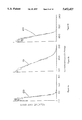
- FIG. 3a shows the transmission efficiency of ions through a two vacuum stage multipole ion guide for/m/z 110 over a range of values for q n .
- FIG. 3b shows the transmission efficiency of ions through a two vacuum stage multipole ion guide for m/z 872 over a range of values for q n .
- FIG. 3c shows the transmission efficiency of ions through a two vacuum stage multipole ion guide for n/z 1743 over a range of values for q n .
- FIG. 4 is a mass spectrum of Glucagon with the two vacuum pumping stage multipole ion guide q n value set to pass a wide range of m/N values.
- FIG. 5a is an Electrospray mass spectrum of Arginine where the multipole ion guide q n value is set to pass a broad range of m/z values.
- FIG. 5b is a mass spectrum of Argine where the multipole ion guide q n value is set so that a low m/z cutoff ion transmission occurs.
- FIG. 6a is an Electrospray mass spectrum of Gramicidin S where the multipole ion guide q n value is set to pass a broad range of m/z values.
- FIG. 6b is a mass spectrum of Gramicidin S where the multipole ion guide q n value is set so that a low m/z cut off ion transmission occurs.
- FIG. 7a is an Electrospray mass spectrum of a mixture of Arginine, Leucine Enkephalin and Gramicidin S where the multipole ion guide q n value is set to pass a broad range of m/z values.
- FIG. 7b is a mass spectrum of a mixture of Arginine, Leucine Enkephalin and Gramicidin S where the multipole ion guide q n value is set so that a high m/z cutoff ion transmission occurs.
- FIG. 8a is a curve of ion signal for m/z 571 versus the multipole ion guide exit lens potential for a multipole ion guide DC offset potential set at 0.1 volts.
- FIG. 8b is a curve of ion signal for m/z 571 versus the multipole ion guide exit lens potential for a multipole ion guide DC offset potential set at 15.3 volts.
- FIG. 8c is a curve of ion signal for m/z 571 versus the multipole ion guide exit lens potential for a multipole ion guide DC offset potential set at 25.1 volts.
- FIG. 9 is a spectrum of a doubly charged Gramicidin S peak scanned with the multipole ion guide off set potential set at 0.1 volt.
- FIG. 10 is a a four vacuum stage ES/MS Time-OF-Flight instrument with orthogonal pulsing including multipole ion guide beginning in the second vacuum pumping stage and extending into the third vacuum pumping stage.
- FIG. 11 is a diagram of a three vacuum stage ES/MS ion trap instrument with a multipole ion guide beginning in the first vacuum stage and extending through the second and into the third vacuum pumping stages.
- FIG. 12 is a cross section of a hexapole ion guide including the electrically insulating mounting bracket.
- FIG. 13 is a diagram of a three vacuum pumping stage API/MS ion trap instrument with a single pumping stage multipole ion guide located in the second vacuum stage.
- FIG. 14 is a diagram four vacuum pumping stage API/orthogonal pulsing TOF mass spectrometer instrument with single vacuum stage multipole ion guides located in the second and third vacuum stages.
- Sample bearing liquid is introduced into atmospheric pressure ionization sources including ES, APCI and ICP sources and gas phase ions are produced from the analyte in solution.
- API/MS systems are available which include from one to over five vacuum pumping stages.
- An Electrospray ion source interfaced to a quadrupole mass spectrometer is diagrammed in FIG. 1.
- the system shown includes four vacuum pumping stages and a static voltage lens configuration to transfer ions through the first three pumping stages and focus them into the entrance of quadrupole mass spectrometer 18.
- sample bearing liquid is introduced through needle 1 and is Electrosprayed into the bath gas in chamber 2.
- Liquid droplets evaporate in chamber 2 or as they are swept into vacuum through capillary 3 and ions are released from the evaporating droplets.
- the charged liquid droplets can be dried by using a countercurrent drying gas 23 and/or a heated Capillary 3.
- a portion of the ions and charged droplets formed in electrospray chamber 2 enter the capillary entrance 4 along with a portion of the background bath gas and are swept into vacuum through the capillary annulus 5.
- the capillary orifice into vacuum could be replaced by a nozzle with appropriate orifice size.
- the bath or carrier gas and entrained ions are swept through the capillary and enter the first vacuum stage 7 after passing through the capillary exit 8.
- the pressure in vacuum stage 7 is generally maintained between 0.4 and 20 torr so the gas exiting the capillary expands in a supersonic free jet.
- the ions entrained in this free jet are accelerated by collisions with the expanding background gas.
- the background gas used is usually nitrogen but may be also be carbon dioxide, oxygen, helium or any number of other gases which suit the analysis requirements and ion source type.
- An electrostatic field is applied between the capillary exit 8, the ring lens 9 and the first skimmer 10 to electrostatically focus and accelerate ions through the skimmer 10 orifice 11 and on into the second vacuum stage 12.
- Vacuum stage 12 is typically operated at a pressure ranging from 5 to 200 millitorr depending on pumping speeds and the size of skimmer orifice 11.
- Electrostatic potentials are maintained between skimmers 10 and 13 and a portion of the ions passing through skimmer 10 are focused through orifice 22 in skimmer 13 into the third vacuum pumping stage 20. Pressure in pumping stage 20 is maintained typically between 1 ⁇ 10 -3 to below 8 ⁇ 10 -5 torr. Potentials are set on electrostatic lens elements 14, 15 and 16 to focus ions through aperture 17 after which they pass into the quadrupole mass filter 18 located in the fourth pumping stage 24.
- the static voltage lens system shown in FIG. 1 transmits and focuses ions through the vacuum stages and into the mass analyzer while allowing the background gas to be pumped away.
- the ion energy relative to the quadrupole mass filter offset voltage is established by a combination of acceleration energy imparted by the expanding carrier gas and the electrostatic potentials applied.
- the capillary exit 8 potential relative to the ring electrode 9 and skimmer electrode 10 can be set high enough to cause Collisional Induced Dissociation (CID) which can affect the energy and energy spread of the parent and fragment ions. Ion transmission losses can occur in each pumping stage due to scattering from background pressure and the inability to electrostatically focus ions through the pumping stage skimmer orifices 11 and 22 and the quadrupole entrance aperture 17.
- skimmer orifice 11 in this configuration would typically have a diameter of 0.8 to 1.5 mm and skimmer orifice 22 may range from 0.8 to 3.0 mm.
- the smaller the skimmer orifice size the fewer the number of ions that can be transmitted through this static lens configuration.
- the static lens configuration shown may exhibit different transmission efficiencies for different m/z values. Also, with static voltage lens systems, ion transmission efficiency drops off rapidly as the ion energy is reduced below 10 electron volts.
- FIG. 2 illustrates a multipole lens assembly 40 which begins in vacuum pumping stage 41 and extends unbroken into vacuum pumping stage 42. Individual rods or poles 45 in assembly 40 are held in place and electrically isolated from the partition between vacuum pumping stage 41 and 42 by insulator 43.
- a cross section of a hexapole ion guide is illustrated in FIG. 12 with insulator 156 serving the dual purpose of holding the six rods or poles 160 in position while minimizing the effective aperture area inside the rods assembly diameter through which neutral gas flows and ions are transmitted from one pumping stage to the next.
- Multipole ion guide assembly 40 consists of parallel electrodes 45 in FIG. 12 shown as round rods 160 equally spaced with a common radius from the centerline.
- An octapole ion guide would have eight equally spaced rods and a quadrupole would have four equally spaced rods or poles.
- multipole ion guide 40 is operated in the AC-only mode, every other rod has the same AC frequency, voltage and phase and every adjacent rod has the same AC frequency and voltage applied but a phase difference of 180 degrees. So for a hexapole ion guide, three rods or poles would be operated with the same AC frequency, voltage and phase and the same AC frequency and voltage with a phase difference of 180 degrees would be applied to the remaining three rods.
- a DC offset voltage is applied to all rods 45 of the multipole ion guide 40 and plays a large role in establishing the ion energy.
- the multipole ion guide DC offset potential is set to focus ions passing through skimmer 47 orifice 48 into the multipole ion guide.
- the kinetic energy of the ions entering multipole ion guide 40 has contributions from the velocity imparted by the expanding gas exiting capillary exit 50, the relative electrostatic DC potentials applied to capillary exit 50, ring lens 51, skimmer 47 and the multipole rod 40 DC offset potential as well as any AC voltage component from fringing fields as ions enter multipole ion guide 40.
- Static voltage lens elements may be added at the exit end 52 of the multipole ion guide to focus ions into the mass analyzer entrance 47.
- Lens 53 is positioned at exit 52 of multipole ion guide 40 to shield the exiting ions from the multipole AC voltage fringing fields and to focus the ions into the mass analyzer entrance aperture 47.
- the efficiency of ion transport through this two pumping stage multipole ion guide 40 is over 95% for a wide range of ion m/z values. Ion transmission efficiencies were determined by measuring the total ion current which passed through skimmer orifice 48 and by measuring the total ion current exiting multipole ion guide 40 for the same electrospray ion source operating conditions.
- the performance characteristics of the two vacuum pumping stage multipole ion guide 40 diagrammed in FIG. 2 will be used as an example although many variations in multiple pumping stage multipole ion guides are possible.
- a hexapole ion guide was configured with rods beginning in vacuum pumping stage 41 and extending contiguously into vacuum pumping stage 42 of a four stage system as diagrammed in FIG. 2.
- the background pressures could be varied in the first and second pumping stages 53 and 41.
- multipole ion guide 40 operated in the AC-only mode the AC frequency and amplitude and the DC offset potentials were varied to map out performance over a range of background pressures.
- a two vacuum stage hexapole ion guide was chosen over a quadrupole or octapole because for this four vacuum stage API/MS system because the hexapole configuration was the most favorable compromise between trapping efficiency, vacuum pumping conduction through the rod spacing and overlap of stability regions for a wide range of m/z values and background pressures.
- Two non-dimensional coefficients a n and q n are commonly used when mapping ion trajectories in multipole ion guides or mass filters by solving the Laplace equation of motion.
- U is the DC potential applied to the rods, every other rod having opposite polarity
- m/z is the mass to charge ratio of the ion traversing the multipole ion guide
- ⁇ is the frequency applied
- V is the zero-to-peak AC potential applied to the rods, every other rod being 180 degrees out of phase
- r 0 is the radius from the assembly centerline.
- the DC rod offset potential applied equally to all rods only effects the ion trajectories entering and leaving the multipole ion guide 40.
- the offset potential should not effect the stability of the ion trajectories once the ions pass into the ion guide and are trapped within the rods other than to influence their initial entrance trajectory.
- the background gas pressure inside the rod assembly varies along the multipole ion guide length and will effect the ion trajectories through the ion guide.
- the cross section of the ions must be known.
- the collisional cross sections of ions generated by API sources are not always known, however.
- the rod AC voltages were ramped for different radio frequency (RF) values using the multipole ion guide configuration diagrammed in FIG. 2, to map the regions of stable q n for all m/z falling within the range of the quadrupole mass spectrometer.
- the background pressure gradient was held constant for each set of ion transmission tests to establish the values of q n where stable and efficient ion trajectories through the two vacuum stage multipole ion guide 40 could be achieved.
- the number of ion to neutral gas collisions that occur as an ion transverses the rod length is a function of the background pressure as well as the rod length. The longer the rods, the more collisions which occur for an ion traversing the rods in a given background pressure.
- the multipole ion guide assembly 40 was constructed with an effective inner diameter smaller than 2.5 millimeters to minimize the neutral gas conduction between vacuum stages 41 and 42.
- the rod length in vacuum stage 41 was 2.9 cm and the rod length in stage 42 was 3.0 cm.
- the AC voltage applied was kept below the point where electrical breakdown occurred between the rods.
- the multipole RF amplitude was ramped for set frequencies ranging from 1 to 10 MHz.
- FIG. 3a, 3b and 3c An example a test series is given in FIG. 3a, 3b and 3c taken with following background pressures: pumping stage 53 was 2 torr, pumping stage 41, 150 millitorr, pumping stage 42, 4 ⁇ 10 -4 torr and pumping stage 54 was 6 ⁇ 10 -6 torr.
- the quadrupole mass filter was scanned from m/z 109.6 to 110.6. The ion signal was measured at each 1 MHz step of the RF frequency varying the RF amplitude to find the maximum signal. At each RF frequency the RF amplitude was ramped from minimum to maximum and then ramped back to its minimum value.
- pumping stage 53 was 2 torr
- pumping stage 41, 150 millitorr pumping stage 42, 4 ⁇ 10 -4 torr
- pumping stage 54 was 6 ⁇ 10 -6 torr.
- the quadrupole mass filter was scanned from m/z 109.6 to 110.6. The ion signal
- the two vacuum stage multipole ion guide is being operated in the AC-only mode with its RF frequency set at 3 MHz and the RF amplitude set low.
- the RF amplitude is ramped to its maximum value at 62, the ion transmission efficiency reaches its maximum at 63 for this frequency and m/z. From 62 the amplitude is ramped down to its original low value at 64 where little or no ion transmission is observed.
- the signal maximum observed at 65 has the same RF amplitude as at 63 as expected since the same value of q 3 occurs at points 63 and 65.
- the RF amplitude is ramped from a minimum value at 66 to a maximum at 67 returning to a minimum at 68.
- FIG. 3b shows the ion transmission efficiency for m/z 872 generated simultaneously with the data shown in FIGS. 3a and 3c.
- the quadrupole mass filter was scanned from m/z 871.7 to 872.7 while applying the same values of RF frequency and amplitude as were run for m/z 110 in FIG. 3a.
- the RF amplitude was set at 1 MHz with a low amplitude at 69. As the RF amplitude was increased from a minimum at 69 to a maximum at 71, the maximum ion transmission occurred at 70.
- FIG. 3c shows the ion transmission efficiency for m/z 1743 (scanned from 1742.5 to 1743.5) over the same RF frequency and amplitude ranges as were used for m/z 110 shown in FIG. 3a.
- FIG. 3 illustrates that for a given background pressure, gradient, varying orders of magnitude over the multipole ion guide length, efficient ion transmission through the ion guide operated in the AC-only mode can be achieved for a broad range of m/z values.
- the RF frequency would be set at 4 MHz and run with an RF amplitude that could fall roughly at the q 3 value indicated at point 76.
- m/z values from less than 110 to over 1743 would be efficiently-transmitted through the multipole ion guide.
- FIG. 4 is a mass spectrum of Glucagon taken with the ion guide q 3 value set at the point indicated by 76 in FIG. 3.
- a solution of 2 picomole/ ⁇ l of Glucagon in 1:1 methanol:water was Electrosprayed using continuous infusion sample introduction in an API/MS instrument as configured in FIG. 2 and the quadrupole mass spectrometer was scanned from 20 to 1900 m/z.
- the (M+4H) +4 , (M+3H) +3 and (M+2H) +2 Glucagon peaks are indicated by 80, 81 and 82 respectively.
- a multiple pumping stage multipole ion guide to transmit and focus ions exiting from a free jet expansion into a mass analyzer allows flexibility in configuring an API/MS instrument without compromising sensitivity. Smaller multiple pumping stage API/MS instruments can be configured with vacuum pumps chosen to minimize instrument cost without compromising performance. Multiple pumping stage multipole ion guides can be configured and operated to allow efficient ion transmission and focusing over a a wide range of pressure gradients. Multipole ion guides can be configured for use with a number of mass analyzer types which may require different operating pressure regimes.
- a quadrupole mass analyzer can operate efficiently at a vacuum pressure of 2 ⁇ 10 -5 torr or below whereas a TOF analyzer requires background pressures in the low 10 -7 torr range or lower to avoid significant numbers of collisions between ions and background gas during the ion flight time.
- a multiple vacuum pumping stage API/MS instrument with a single or a multiple pumping stage multipole ion guide can be configured to maximize ion transmission and focusing yet minimize pumping cost.
- FIG. 3 illustrates that the a n and q n values can be set so that a low or a high m/z cutoff in ion transmission occurs.
- the RF frequency were set at 3 MHz and the RF amplitude operated anywhere from point 79 to 62 then ions with m/z 110 or lower would not be transmitted through the multipole ion guide to the mass analyzer.
- the RF frequency were operated at 7 MHz with the RF amplitude set at the value indicated by 77 then a high m/z cutoff in ion transmission through the ion guide to the mass analyzer would occur.
- FIG. 5a and 5b illustrate operation of the multipole ion guide 40 with the q n value set for passing a broad range of m/z and the q n value set at a point where a low m/z transmission cutoff occurs.
- FIG. 5a is a mass spectrum taken from electrospraying a solution of 2 picomole/ ⁇ l of Arginine in 1:1 methanol:water using continuous infusion with the multipole ion guide 40 q 3 value set to transmit a wide range of m/z values.
- FIG. 5b shows a mass spectrum taken with the same solution being Electrosprayed under identical spray conditions but with the hexapole ion guide q 3 value was set so that a low m/z cutoff occurs. Ion transmission below 100 to 120 m/z has been effectively cut off without reducing the ion transmission efficiency of Arginine 91 or higher m/z values. Mother example of this is illustrated in FIGS.
- FIG. 6a is a mass spectrum of the same Gramicidin S solution Electrosprayed using identical conditions as in FIG. 6a but with the hexapole 40 q 3 value is set so that a low m/z cutoff occurs.
- FIGS. 7a and 7b are a mass spectrum taken where the multipole ion guide 40 q 3 value was set to transmit a wide range of m/z values.
- FIG. 3b is a mass spectrum taken where the same solution is Electrosprayed using identical spray conditions except that the ion guide 40 q 3 value has been set so that the lower m/z ions are transmitted as indicated by peaks 99 but the higher m/z ions are not transmitted through the multipole ion guide 40.
- a valuable feature of multipole ion guides when operated in higher background pressures is that ions traversing the length of the ion guide experience a number of collisions with the background gas resulting in the cooling of the ion kinetic energy.
- the RF or combined RF-DC field effectively traps the ions from dispersing in the radial direction due to collisions with the background gas yet permits movement of ions in the axial direction often driven by the gas dynamics. Ions which experience a number of low energy collisions with the neutral gas within the multipole rod assembly have their kinetic energy reduced resulting in a narrowing of the ion energy spread for those ions which exit the multipole rods.
- the number of collisions an ion experiences as it travels the length of the ion guide is a function of the rod length and the background pressure inside the rods. If the relative voltages of the capillary exit lens 50, ring lens 51, skimmer 47 and the multipole ion guide 40 DC offset potential remain the same then the ions entering the multipole ion guide will have similar energy spreads and will be transmitted to the exit of the multipole ion guide with the same efficiency. With the relative upstream lens potentials held constant with the ion guide DC offset potential, the ion kinetic energy cooling due to collisions will remain consistent as the multipole DC offset potential is adjusted. Consequently, with a multipole ion guide operated in a higher vacuum pressure region where ion collisional cooling occurs, the narrow energy spread of the ions can be maintained independent of changes in the mean ion energy when the ion guide DC offset potential is adjusted.
- FIGS. 8a, b and c show the ion signal of the Gramicidin S protonated doubly charged peak (M+2H) +2 for three different hexapole ion guide 40 DC offset potentials.
- M+2H Gramicidin S protonated doubly charged peak
- FIG. 8a shows the ion signal level 100 at m/z 571.6 for three consecutive voltage ramps of lens 53 from 2 to 8.2 volts. Over ninety percent of the m/z 571.6 ions fall within a one volt window of ion energy.
- FIG. 8b shows the ion signal 101 at m/z 571.6 for three consecutive voltage ramps of lens 53 from 19 to 21.2 volts with the hexapole ion guide 40 DC offset potential set at 15.3 volts. Ninety percent of the 571.6 m/z ions detected have an energy that falls within a one volt window. Similarly, FIG.
- An API/MS system which incorporates a multipole ion guide with a portion of its length operating in a vacuum pressure which is high enough to cause collisional cooling as ions traverse the rod length allows three significant performance features.
- the first is that the ion guide operated in the presence of sufficient background collisions can reduce the ion energy spread without reducing ion transmission efficiency when run with the proper values of a n and q n set.
- the mean ion energy for a given m/z can be adjusted by changing the DC offset potential of the multipole ion guide without causing significant changes in ion energy spread.
- the ion energy can be adjusted by changing the ion guide DC offset potential without reducing the ion transmission efficiency through the multipole ion guide.
- FIG. 9 shows a mass spectrum 103 of a doubly charged protonated Gramicidin S (M+2H) +2 peak with partially resolved isotope peaks.
- the spectrum was taken by electrospraying a 2 picomole/ ⁇ l Grarnicidin S sample in a 1:1 methanol: water solution using an API quadrupole mass spectrometer system as configured in FIG. 2.
- the DC offset potential of hexapole 40 was set to 0.1 volts relative to the ground potential quadrupole entrance aperture 47. With this low ion guide DC offset voltage setting, higher resolution was achievable at comparable sensitivities than could be attained with the hexapole DC offset potential set at 15 volts.
- the performance capabilities of a multipole ion guide operated in a background pressure region where ion kinetic energy cooling occurs can be used to improve the performance of different mass spectrometer types.
- the advantages of improved ion transmission efficiencies when using multiple vacuum pumping stage multipole ion guides in conjunction with quadrupole mass analyzers was illustrated with examples given above.
- the ability to set the mean ion energy by adjusting the multipole DC offset potential without changing the narrow energy spread per m/z value can be used to improve the resolution and sensitivity of scanning and non-dispersion mass analyzers including quadrupole, magnetic sector, TOF, ion trap and FT-ICR mass spectrometers.
- FIG. 10 is a diagram of a four vacuum pumping stage orthogonal pulsing API/MS system with a reflectron Time-Of-Flight mass analyzer.
- an electrospray ion source is shown as the API source although this could alternatively be an APCI or an ICP source as well.
- Sample bearing liquid is introduced through the electrospray needle 110 and is Electrosprayed or nebulization assisted Electrosprayed into chamber 111 as it exits the needle at 112.
- a portion of the ions that enter the first vacuum stage 133 through the capillary exit 114 are focused through the orifice 136 in skimmer 116 with the help of lens 115 and the potential set on the capillary exit 114.
- Ions passing through skimmer orifice 136 enter the multipole ion guide 118.
- the ion guide 118 begins in vacuum pumping stage 117 and extends unbroken into vacuum stage 119.
- the multipole ion guide AC and DC voltages are set to pass ions falling within a range of m/z then ions within that range which enter the multipole ion guide will exit at 121 and are focused with exit lens 120 through the TOF analyzer entrance orifice 122.
- This primary ion beam 134 ion beam passes between electrostatic lenses 123 and 124 located in the fourth pumping stage 126.
- the relative voltages on lenses 123, 124 and 125 are pulsed so that a portion of the ion beam 134 falling in between lenses 123 and 124 is ejected as a packet through grid lens 125 and accelerated down flight tube 127.
- the ions are steered by x and y lens sets diagrammatically illustrated by 128 as they continue their movement down flight tube 127.
- the ion packet is reflected through a reflectron or ion mirror 130 and detected at detector 131.
- ions with different m/z separate in space due to their velocity differences and arrive at the detector at different times.
- orthogonal pulsing in an API/TOF system helps to reduce the ion energy spread of the initial ion packet allowing higher resolution and sensitivity to be achieved.
- the lower the ion energy the more ions that will be present in the pulsing region per pulse. This has a direct impact on the ion signal response that can be achieved per pulse.
- the lower the primary ion beam electrostatic energy the less ion density versus m/z discrimination that will occur in pulsing region 135. This discrimination occurs because the lower m/z ions accelerated electrostatically will move faster than the higher m/z ions and consequently will have less relative density for a similar ion current per m/z in the pulsing region.
- ions accelerated solely by the neutral gas expanding into vacuum in a free jet form an ion beam that is closer to being mono-velocity rather than mono-energetic.
- Electrostatic acceleration in the absence of collisions with background gas will create an ion beam that is closer to being mono-energetic.
- a mono-velocity beam entering pulsing region 135 will reduce the differences in ion density versus m/z for a given ion flux and hence allow generation of a mass spectrum whose relative peak heights are more representative of the relative m/z intensities in the original ion beam 134.
- the translational energy of ions in the primary ion beam 134 will be the sum of the energy imparted by the expanding gas and by electrostatic acceleration.
- Multipole ion guide 118 a portion of which is operated in a higher pressure vacuum region, can deliver an ion beam having low translational energy through the mass analyzer orifice 122 with minimal beam divergence.
- lowering of the ion beam energy generally results in increased beam divergence.
- Beam divergence will not only reduce the ion beam intensity entering aperture 122 but will also increase the beam cross sectional area in pulsing region 135.
- Primary ion beam divergence can result in reduced resolution in an orthogonal pulsed TOF geometry.
- Use of the multipole ion guide 118 to aid in delivering ions to the pulsing region can reduce the degree of ion beam divergence for lower ion beam energies. The net result is improved sensitivity and resolution.
- the effective inner diameter of multipole ion guide 118 is reduced to minimize the neutral gas conduction between vacuum pumping stages 117 and 119 without compromising ion transmission efficiency.
- the effective inner diameter for multipole ion guide 118 is typically 2.5 millimeters or less.
- the ion guide geometry itself places an upper limit on the cross section of the ion beam exiting at 121.
- aperture 122 can be reduced to 2 mm with little or no loss ion transmission efficiency into pulsing region 135. The smaller the aperture 122 size the less neutral gas that will pass into vacuum pumping stage 126, reducing the vacuum pumping speed requirements and lowering instrument cost.
- a narrow ion energy spread is desirable in orthogonal pulsing TOF because the orthogonal component of ion energy which is the initial ion beam energy, translates into sideways movement of ions as they traverse the flight tube.
- operation of a multipole ion guide in a vacuum pressure regime where ion kinetic energy cooling occurs results in narrowing of the ion energy spread and the ability to lower ion energy without reducing the ion transmission efficiency or increasing the ion energy spread.
- the ability to lower ion energy while maintaining a low ion energy spread can help to improve the sensitivity and increase the duty cycle of a TOF mass analyzer. Ions of a given m/z and energy will take time to refill the gap between lenses 123 and 124 after a pulse has occurred. If the length of the gap is roughly 2 cm then an ion at m/z 1000 with 20 volts of energy will take 10.2 ⁇ sec to travel 2 cm and fill the pulsing space. The same ion at 3 volts of energy will take 26.3 ⁇ sec to travel 2 cm and fill the pulsing region. Those ions which are not pulsed into the flight tube are lost as they impact the walls of pulsing region 134 and are neutralized.
- pulsing a 3 volt primary ion beam 134 will improve the duty cycle and consequently the sensitivity by a factor of 2.6 when compared with pulsing a primary ion beam 134 having 20 volts of translational energy.
- the a n and q n values can be selected so that the multipole ion guide will pass a narrower range of m/z.
- Quadrupoles are commonly used in this mode as mass filters in vacuum pressure regimes that are maintained below 2 ⁇ 10 -5 torr where the effects due to ion collisions with the background gas are negligible.
- ⁇ DC is imposed on the multipole rods with considerable background pressure present, the transmission characteristics of each type multipole ion guide or mass filter assembly must tested and qualified. Ion transmission maps of a n and q n may not be the same for multipole ion guides with different numbers of poles and operated in different background pressures.
- One variable which effects duty cycle in a TOF instrument is the repetition rate at which ions are pulsed in the flight tube, accelerated and detected. Assuming that the pulsing region 135 can refill between pulses, that is the primary ion beam 134 energy is set to satisfy this criteria, the pulsing repetition rate will be limited by the fastest flight time of the lowest m/z ion and the slowest flight time of the highest m/z ion in consecutive ion packets traveling through flight tube 127 to the detector. Any overlap of ions from one pulsed packet to the next will increase the difficulty in interpreting the resulting mass spectrum.
- ions of lower or higher m/z were not of interest in a given analysis, those ions could be preventing from entering the pulsing region by selecting an appropriate a n and q n value for the multipole rod 118 operation.
- the time in between pulses can be reduced resulting in an increase in duty cycle.
- Subtracting the slowest from the most rapid flight time of ions present in the pulsed packet will determine the minimum time required in between consecutive pulses to avoid low m/z ions of the trailing pulse catching up with high m/z ions of the leading pulse. If m/z ions ranging from protonated water (m/z 19) to m/z 3000 are present in the pulse ion packets, then a delay of 255 ⁇ sec must be maintained between consecutive pulses allowing approximately 3,921 pulses per second. A primary ion beam 134 with ions of m/z of 3000 and lower and with 3 volts of translational energy will fill the 2 cm pulsing gap 135 length in less than 45 ⁇ sec.
- the multipole ion guide 118 operating a n and q n values could be set to reject ions below 500 m/z.
- the ion packet pulse frequency could be set to over 9500 pulses per second increasing duty for all m/z values transmitted into pulsing region
- MCP Layered Multichannel Plate
- the individual channel recovery time of an MCP channel after an ion hits and causes an electron cascade can be as long as 1 millisecond. If an ion hits the channel before it has recovered then little or no electron cascade will occur and the ion will remain undetected. Lower m/z ions which arrive at the detector first for a given pulsed ion packet could deaden channels for heavier m/z ions which follow.
- the packet pulse rate exceeds 1000 hertz, that is the time between pulses is shorter than the MCP channel recovery time, this could result in reduction in signal intensity as ions arriving at the detector yield reduced secondary electron cascade intensity because ions from preceding pulses have deadened a number of channels.
- detector response can be increased for ions of interest by preventing unwanted m/z values from reaching the detector.
- the multipole ion guide 118 m/z transmission window can be selected to minimize the number of unwanted m/z values from entering the pulsing region 135, eliminating those m/z values from reaching the detector.
- Ion lenses used for deflecting ions are diagrammatically represented by 132 in FIG. 10.
- the use of multipole lens to limit m/z values from entering the TOF pulsing region is a complimentary technique to using deflectors in the flight tube. Deflecting lenses, however, will not aid increasing duty cycle unless they are employed very early in the ion flight path, a region where m/z separation may be poor.
- a linear pulsed API/MS system as reported by Boyle, Whitehouse and Fenn (Rapid Communications in Mass Spectrom. Vol. 5, 400-405, 1991) would have a similar increase in sensitivity and duty cycle by incorporation of a multipole ion guide into the upstream vacuum stages as is achieved in orthogonal pulsing TOF configurations.
- FIG. 11 diagrams a three vacuum pumping stage API/ion trap system where a multipole ion guide begins in vacuum pumping stage 148 and extends continuously through the three vacuum pumping stages.
- An electrospray or nebulizer assisted electrospray ion source is shown interfaced to ion trap mass spectrometer 154.
- Sample bearing liquid is introduced into the electrospray needle entrance 140 and is Electrosprayed or nebulizer assisted Electrosprayed as it emerges from the electrospray needle tip 141.
- the charge liquid droplets produced in the electrospray chamber 142 drift toward the capillary entrance 144 against a flow of countercurrent drying gas 164.
- Ions are produced from the evaporating charged droplets and are swept into vacuum through capillary 145.
- This capillary may be heated by capillary heater 146 which aids in heating the gas expanding through the capillary into vacuum. Ions exiting the capillary at 147 are accelerated into the first vacuum pumping stage 148 by the neutral gas free jet expansion.
- the pressure in vacuum stage 148 can range from 0.5 to 2 torr depending on the capillary 145 inner diameter and length, the vacuum pump size chosen and the temperature at which the capillary heater is run.
- the third pumping stage 151 is usually maintained at a pressure below 5 ⁇ 10 -5 torr to insure proper functioning of the electron multiplier detector 152, however, the internal trap pressure is often set higher than the background pressure in stage 151 by the addition of helium directly into trap 154.
- the pressure in pumping stage 157 is generally maintained at a pressure less than 150 millitorr
- the multipole ion guide 165 has rods or poles 150 which begin in pumping stage 148, continue unbroken through pumping stage 157 and extend into pumping stage 151.
- Insulators and mounting brackets 156 and 158 serve the dual purpose of supporting the multipole rod assembly and partitioning the vacuum chambers to minimize the flow of background gas into downstream pumping stages.
- FIG. 12 illustrates a cross section of a hexapole assembly taken at insulator 156.
- the six rods 160 are held in an equally spaced position and equal radial distance from the centerline by attachment to insulator 156.
- the insulator is configured to minimize the effective cross sectional area of the internal opening without distorting the electrostatic field produced by the hexapole rods during operation inside multipole rod assembly cross section area 161.
- Rod diameters as small as 0.5 mm have been constructed with an inner rod spacing 166 of 2 mm to minimize neutral gas conductance into downstream pumping stages and reduce the size and cost of vacuum pumps required. Increasing the length of insulators 156 and 158 also helps to reduce the neutral gas conductance.
- the multipole ion guide a n and q n value can be set to reduce the m/z range of ions which are transmitted to ion trap 154 through exit lens 162 and ion trap endplate 155. This extends the dynamic range signal response for the m/z values of interest by reducing the effects of space charging from m/z values which are not of interest for a given analysis. For example, the contamination 85, 86 and solvent related peaks 87, 88 observed in the spectrum of FIG.
- FIG. 13 is a diagram representation of a 3 vacuum stage API/ion trap mass spectrometer system where a multipole ion guide 170 is located in vacuum pumping stage 172.
- Ions passing from pumping stage 171 through skimmer orifice 176 are trapped from moving to far off axis in the radial direction and transmitted through ion guide 170.
- the ions exiting ion guide 170 are focused by exit lens 175 into ion trap 177 through endplate 174.
- the ion trap endplate aperture 178 also serves as the orifice into the third vacuum pumping stage 173. Ions can be injected into an ion trap through different gaps or apertures in the ion trap electrodes, however, this configuration is shown as one embodiment.
- FIG. 14 is a diagram of a four vacuum stage API/TOF mass spectrometer system with single vacuum pumping stage multipole ion guides 180 and 181 located in pumping stabes 184 and 185 respectively. Ions in vacuum stage 183 pass through skimmer 190 and enter ion guide 180. The ions which are transported through vacuum stage 184 by ion guide 180 are formed through the aperture 194 by multipole 180 exit lens 187.
- the ions then enter the a second ion guide 181 in vacuum stage 185 and are focused by lens 188 through aperture 189 as they exit the multipole ion guide 181. Ions passing though aperture 189 into vacuum stage 186 are pulsed orthogonally with lens set 191 into the TOF mass analyzer 192.
- the multipole ion guides can be operated with independent values of a n and q n may be set to optimize the TOF duty cycle and sensitivity. Similar to the continuous multiple pumping stage multipole ion guide configuration, the dual multipole ion guide configuration as diagrammed in FIG. 14 can be used reduce the ion energy spread and deliver low energy ions into the mass analyzer. However, with the dual multipole ion guide configuration, losses in ion transmission efficiency may occur in the region of static voltage lenses 187 and 195 between thermo multipole assemblies 180 and 181.
Landscapes
- Chemical & Material Sciences (AREA)
- Analytical Chemistry (AREA)
- Chemical Kinetics & Catalysis (AREA)
- Other Investigation Or Analysis Of Materials By Electrical Means (AREA)
- Electron Tubes For Measurement (AREA)
Priority Applications (8)
| Application Number | Priority Date | Filing Date | Title |
|---|---|---|---|
| US08/645,826 US5652427A (en) | 1994-02-28 | 1996-05-14 | Multipole ion guide for mass spectrometry |
| US08/794,970 US5962851A (en) | 1994-02-28 | 1997-02-05 | Multipole ion guide for mass spectrometry |
| US09/373,337 US6188066B1 (en) | 1994-02-28 | 1999-08-12 | Multipole ion guide for mass spectrometry |
| US09/727,285 US6403953B2 (en) | 1994-02-28 | 2000-11-30 | Multipole ion guide for mass spectrometry |
| US10/164,724 US6744047B2 (en) | 1994-02-28 | 2002-06-07 | Multipole ion guide for mass spectrometry |
| US10/855,235 US6897439B1 (en) | 1994-02-28 | 2004-05-26 | Multipole ion guide for mass spectrometry |
| US13/164,590 US8598519B2 (en) | 1994-02-28 | 2011-06-20 | Multipole ion guide ion trap mass spectrometry with MS/MSN analysis |
| US13/164,617 US8610056B2 (en) | 1994-02-28 | 2011-06-20 | Multipole ion guide ion trap mass spectrometry with MS/MSn analysis |
Applications Claiming Priority (2)
| Application Number | Priority Date | Filing Date | Title |
|---|---|---|---|
| US20250594A | 1994-02-28 | 1994-02-28 | |
| US08/645,826 US5652427A (en) | 1994-02-28 | 1996-05-14 | Multipole ion guide for mass spectrometry |
Related Parent Applications (2)
| Application Number | Title | Priority Date | Filing Date |
|---|---|---|---|
| US20250594A Continuation | 1994-02-28 | 1994-02-28 | |
| US90142801A Continuation | 1994-02-28 | 2001-07-09 |
Related Child Applications (1)
| Application Number | Title | Priority Date | Filing Date |
|---|---|---|---|
| US08/794,970 Continuation US5962851A (en) | 1994-02-23 | 1997-02-05 | Multipole ion guide for mass spectrometry |
Publications (1)
| Publication Number | Publication Date |
|---|---|
| US5652427A true US5652427A (en) | 1997-07-29 |
Family
ID=22750166
Family Applications (6)
| Application Number | Title | Priority Date | Filing Date |
|---|---|---|---|
| US08/645,826 Expired - Lifetime US5652427A (en) | 1994-02-28 | 1996-05-14 | Multipole ion guide for mass spectrometry |
| US08/794,970 Expired - Lifetime US5962851A (en) | 1994-02-23 | 1997-02-05 | Multipole ion guide for mass spectrometry |
| US09/373,337 Expired - Lifetime US6188066B1 (en) | 1994-02-28 | 1999-08-12 | Multipole ion guide for mass spectrometry |
| US09/727,285 Expired - Lifetime US6403953B2 (en) | 1994-02-28 | 2000-11-30 | Multipole ion guide for mass spectrometry |
| US10/164,724 Expired - Lifetime US6744047B2 (en) | 1994-02-23 | 2002-06-07 | Multipole ion guide for mass spectrometry |
| US13/164,590 Expired - Fee Related US8598519B2 (en) | 1994-02-28 | 2011-06-20 | Multipole ion guide ion trap mass spectrometry with MS/MSN analysis |
Family Applications After (5)
| Application Number | Title | Priority Date | Filing Date |
|---|---|---|---|
| US08/794,970 Expired - Lifetime US5962851A (en) | 1994-02-23 | 1997-02-05 | Multipole ion guide for mass spectrometry |
| US09/373,337 Expired - Lifetime US6188066B1 (en) | 1994-02-28 | 1999-08-12 | Multipole ion guide for mass spectrometry |
| US09/727,285 Expired - Lifetime US6403953B2 (en) | 1994-02-28 | 2000-11-30 | Multipole ion guide for mass spectrometry |
| US10/164,724 Expired - Lifetime US6744047B2 (en) | 1994-02-23 | 2002-06-07 | Multipole ion guide for mass spectrometry |
| US13/164,590 Expired - Fee Related US8598519B2 (en) | 1994-02-28 | 2011-06-20 | Multipole ion guide ion trap mass spectrometry with MS/MSN analysis |
Country Status (9)
| Country | Link |
|---|---|
| US (6) | US5652427A (de) |
| EP (3) | EP1533829A3 (de) |
| JP (1) | JP3671354B2 (de) |
| AU (1) | AU1932095A (de) |
| CA (1) | CA2656956C (de) |
| DE (1) | DE69535979D1 (de) |
| DK (1) | DK0748249T3 (de) |
| ES (1) | ES2331494T3 (de) |
| WO (1) | WO1995023018A1 (de) |
Cited By (106)
| Publication number | Priority date | Publication date | Assignee | Title |
|---|---|---|---|---|
| WO1999030351A1 (en) * | 1997-12-04 | 1999-06-17 | University Of Manitoba | Method of and apparatus for selective collision-induced dissociation of ions in a quadrupole ion guide |
| WO1999038193A1 (en) * | 1998-01-23 | 1999-07-29 | Analytica Of Branford, Inc. | Mass spectrometry with multipole ion guide |
| US5962851A (en) * | 1994-02-28 | 1999-10-05 | Analytica Of Branford, Inc. | Multipole ion guide for mass spectrometry |
| US5973322A (en) * | 1998-03-14 | 1999-10-26 | Sensar Corporation | Collisional axialization of ions in a supersonic expansion for ion injection into time of flight mass spectrometers |
| WO1999059187A1 (en) * | 1998-05-14 | 1999-11-18 | Varian Inc | Ion trap mass spectrometer with electrospray ionization |
| WO1999062101A1 (en) | 1998-05-29 | 1999-12-02 | Analytica Of Branford, Inc. | Mass spectrometry with multipole ion guides |
| US6011259A (en) * | 1995-08-10 | 2000-01-04 | Analytica Of Branford, Inc. | Multipole ion guide ion trap mass spectrometry with MS/MSN analysis |
| US6057543A (en) * | 1995-05-19 | 2000-05-02 | Perseptive Biosystems, Inc. | Time-of-flight mass spectrometry analysis of biomolecules |
| US6060706A (en) * | 1997-02-14 | 2000-05-09 | Hitachi, Ltd. | Analytical apparatus using ion trap mass spectrometer |
| US6068749A (en) * | 1996-01-19 | 2000-05-30 | Northeastern University | Subatmospheric, variable pressure sample delivery chamber for electrospray ionization/mass spectrometry and other applications |
| US6194717B1 (en) * | 1999-01-28 | 2001-02-27 | Mds Inc. | Quadrupole mass analyzer and method of operation in RF only mode to reduce background signal |
| DE19937439C1 (de) * | 1999-08-07 | 2001-05-17 | Bruker Daltonik Gmbh | Vorrichtung zum abwechselnden Betrieb mehrerer Ionenquellen |
| US6245227B1 (en) | 1998-09-17 | 2001-06-12 | Kionix, Inc. | Integrated monolithic microfabricated electrospray and liquid chromatography system and method |
| US6417511B1 (en) | 2000-07-17 | 2002-07-09 | Agilent Technologies, Inc. | Ring pole ion guide apparatus, systems and method |
| US20020172619A1 (en) * | 1998-09-17 | 2002-11-21 | Moon James E. | Integrated monolithic microfabricated electrospray and liquid chromatography system and method |
| US6486469B1 (en) | 1999-10-29 | 2002-11-26 | Agilent Technologies, Inc. | Dielectric capillary high pass ion filter |
| WO2002097857A1 (en) | 2001-05-25 | 2002-12-05 | Analytica Of Branford, Inc. | Atmospheric and vacuum pressure maldi ion source |
| US20020185595A1 (en) * | 2001-05-18 | 2002-12-12 | Smith Richard D. | Ionization source utilizing a multi-capillary inlet and method of operation |
| US6528784B1 (en) * | 1999-12-03 | 2003-03-04 | Thermo Finnigan Llc | Mass spectrometer system including a double ion guide interface and method of operation |
| US20030049177A1 (en) * | 2001-08-27 | 2003-03-13 | Smith Chris D. | Method and apparatus for electrostatic dispensing of microdroplets |
| US6596988B2 (en) | 2000-01-18 | 2003-07-22 | Advion Biosciences, Inc. | Separation media, multiple electrospray nozzle system and method |
| US20030155499A1 (en) * | 2000-05-31 | 2003-08-21 | Jan Axelsson | Method and device for performing analyses in parallel |
| US20030160167A1 (en) * | 2002-02-22 | 2003-08-28 | Jean-Luc Truche | Target support and method for ion production enhancement |
| WO2003073461A1 (en) * | 2002-02-22 | 2003-09-04 | Agilent Technologies, Inc. | Apparatus and method for ion production enhancement |
| US6627882B2 (en) | 1999-12-30 | 2003-09-30 | Advion Biosciences, Inc. | Multiple electrospray device, systems and methods |
| US6627883B2 (en) | 2001-03-02 | 2003-09-30 | Bruker Daltonics Inc. | Apparatus and method for analyzing samples in a dual ion trap mass spectrometer |
| US6633031B1 (en) | 1999-03-02 | 2003-10-14 | Advion Biosciences, Inc. | Integrated monolithic microfabricated dispensing nozzle and liquid chromatography-electrospray system and method |
| US6646258B2 (en) | 2001-01-22 | 2003-11-11 | Agilent Technologies, Inc. | Concave electrode ion pipe |
| US6649909B2 (en) | 2002-02-20 | 2003-11-18 | Agilent Technologies, Inc. | Internal introduction of lock masses in mass spectrometer systems |
| WO2003102508A1 (en) | 2002-05-31 | 2003-12-11 | Analytica Of Branford, Inc. | Mass spectrometry with segmented rf multiple ion guides in various pressure regions |
| US6700120B2 (en) * | 2000-11-30 | 2004-03-02 | Mds Inc. | Method for improving signal-to-noise ratios for atmospheric pressure ionization mass spectrometry |
| US20040079878A1 (en) * | 1995-05-19 | 2004-04-29 | Perseptive Biosystems, Inc. | Time-of-flight mass spectrometry analysis of biomolecules |
| US6744040B2 (en) | 2001-06-13 | 2004-06-01 | Bruker Daltonics, Inc. | Means and method for a quadrupole surface induced dissociation quadrupole time-of-flight mass spectrometer |
| US20040108213A1 (en) * | 2002-12-09 | 2004-06-10 | Talasek Robert T. | Plating bath composition control |
| US6753523B1 (en) * | 1998-01-23 | 2004-06-22 | Analytica Of Branford, Inc. | Mass spectrometry with multipole ion guides |
| US20040149902A1 (en) * | 2001-06-15 | 2004-08-05 | Park Melvin A. | Means and method for guiding ions in a mass spectrometer |
| US20040159782A1 (en) * | 1997-05-30 | 2004-08-19 | Park Melvin Andrew | Coaxial multiple reflection time-of-flight mass spectrometer |
| US20040164240A1 (en) * | 2003-02-24 | 2004-08-26 | Hitachi, Ltd. | Mass spectrometer and method of use |
| US6787764B2 (en) | 2000-02-18 | 2004-09-07 | Bruker Daltonics, Inc. | Method and apparatus for automating a matrix-assisted laser desorption/ionization (MALDI) mass spectrometer |
| US6794644B2 (en) | 2000-02-18 | 2004-09-21 | Melvin A. Park | Method and apparatus for automating an atmospheric pressure ionization (API) source for mass spectrometry |
| US20040183007A1 (en) * | 2003-03-21 | 2004-09-23 | Biospect, Inc. | Multiplexed orthogonal time-of-flight mass spectrometer |
| US6797948B1 (en) | 2000-08-10 | 2004-09-28 | Bruker Daltonics, Inc. | Multipole ion guide |
| US20040195503A1 (en) * | 2003-04-04 | 2004-10-07 | Taeman Kim | Ion guide for mass spectrometers |
| US6809312B1 (en) | 2000-05-12 | 2004-10-26 | Bruker Daltonics, Inc. | Ionization source chamber and ion beam delivery system for mass spectrometry |
| US20040236603A1 (en) * | 2003-05-22 | 2004-11-25 | Biospect, Inc. | System of analyzing complex mixtures of biological and other fluids to identify biological state information |
| WO2004013602A3 (en) * | 2002-07-18 | 2005-02-24 | Univ Johns Hopkins | Combined chemical/biological agent detection system and method utilizing mass spectrometry |
| US20050109948A1 (en) * | 2000-02-18 | 2005-05-26 | Park Melvin A. | Method and apparatus for a nanoelectrosprayer for use in mass spectrometry |
| US20050133712A1 (en) * | 2003-12-18 | 2005-06-23 | Predicant Biosciences, Inc. | Scan pipelining for sensitivity improvement of orthogonal time-of-flight mass spectrometers |
| US6911650B1 (en) | 1999-08-13 | 2005-06-28 | Bruker Daltonics, Inc. | Method and apparatus for multiple frequency multipole |
| US20050196286A1 (en) * | 2004-03-04 | 2005-09-08 | Mac Donald Robert G. | Oil well pumping unit and method therefor |
| EP0989586A3 (de) * | 1998-09-24 | 2005-10-05 | Thermo Finnigan Llc | Verfahren und Vorrichtung zur Übertragung von Ionen zwischen einer Atmosphärendruckonenquelle und einem Ionenfallenmassenspektrometer |
| US20050244973A1 (en) * | 2004-04-29 | 2005-11-03 | Predicant Biosciences, Inc. | Biological patterns for diagnosis and treatment of cancer |
| WO2005114705A2 (en) | 2004-05-21 | 2005-12-01 | Whitehouse Craig M | Rf surfaces and rf ion guides |
| US20060006326A1 (en) * | 2004-03-25 | 2006-01-12 | Mikhail Belov | A-priori biomarker knowledge based mass filtering for enhanced biomarker detection |
| US6987264B1 (en) * | 1998-01-23 | 2006-01-17 | Analytica Of Branford, Inc. | Mass spectrometry with multipole ion guides |
| US20060027744A1 (en) * | 2003-05-22 | 2006-02-09 | Stults John T | Systems and methods for discovery and analysis of markers |
| US20060091308A1 (en) * | 2004-11-02 | 2006-05-04 | Boyle James G | Method and apparatus for multiplexing plural ion beams to a mass spectrometer |
| US20060151692A1 (en) * | 2005-01-10 | 2006-07-13 | Applera Corporation | Method and apparatus for improved sensitivity in a mass spectrometer |
| US20060169891A1 (en) * | 2005-01-10 | 2006-08-03 | Applera Corporation | Method and apparatus for improved sensitivity in a mass spectrometer |
| US20060232368A1 (en) * | 2005-04-14 | 2006-10-19 | Makrochem, Ltd. | Permanent magnet structure with axial access for spectroscopy applications |
| US20060232369A1 (en) * | 2005-04-14 | 2006-10-19 | Makrochem, Ltd. | Permanent magnet structure with axial access for spectroscopy applications |
| US7176455B1 (en) * | 1994-02-23 | 2007-02-13 | Analytica Of Branford, Inc. | Multipole ion guide for mass spectrometry |
| US7189967B1 (en) * | 2004-06-16 | 2007-03-13 | Analytica Of Branford, Inc. | Mass spectrometry with multipole ion guides |
| US20080067349A1 (en) * | 2006-05-26 | 2008-03-20 | Science & Engineering Services, Inc. | Multi-channel time-of-flight mass spectrometer |
| EP1949411A1 (de) * | 2005-11-16 | 2008-07-30 | Shimadzu Corporation | Massenspektrometer |
| WO2009038825A2 (en) | 2007-05-31 | 2009-03-26 | Analytica Of Branford, Inc. | Multipole ion guide interface for reduced background noise in mass spectrometry |
| US20100308218A1 (en) * | 2009-06-05 | 2010-12-09 | Mingda Wang | Multipole ion transport apparatus and related methods |
| US7858926B1 (en) * | 2002-05-31 | 2010-12-28 | Perkinelmer Health Sciences, Inc. | Mass spectrometry with segmented RF multiple ion guides in various pressure regions |
| US7928361B1 (en) | 2001-05-25 | 2011-04-19 | Perkinelmer Health Sciences, Inc. | Multiple detection systems |
| US7973277B2 (en) | 2008-05-27 | 2011-07-05 | 1St Detect Corporation | Driving a mass spectrometer ion trap or mass filter |
| WO2011106768A1 (en) * | 2010-02-26 | 2011-09-01 | Perkin Elmer Health Sciences, Inc. | Plasma mass spectrometry with ion suppression |
| EP1268041B1 (de) * | 2000-02-29 | 2012-09-05 | Ionwerks, Inc. | Verbesserter mobilitäts-spektrometer |
| WO2012150351A1 (en) | 2011-05-05 | 2012-11-08 | Shimadzu Research Laboratory (Europe) Limited | Device for manipulating charged particles |
| US20120305759A1 (en) * | 2011-06-03 | 2012-12-06 | Bruker Daltonics, Inc. | Abridged multipole structure for the transport, selection and trapping of ions in a vacuum system |
| US8334506B2 (en) | 2007-12-10 | 2012-12-18 | 1St Detect Corporation | End cap voltage control of ion traps |
| US20130009051A1 (en) * | 2011-07-07 | 2013-01-10 | Bruker Daltonics, Inc. | Abridged ion trap - time of flight mass spectrometer |
| DE102012211587A1 (de) | 2011-07-14 | 2013-01-17 | Bruker Daltonics, Inc. | Massenspektrometer mit präzise ausgerichteten Ionenoptik-Baugruppen |
| US8481929B2 (en) | 2011-07-14 | 2013-07-09 | Bruker Daltonics, Inc. | Lens free collision cell with improved efficiency |
| US20130320229A1 (en) * | 2012-05-31 | 2013-12-05 | Fei Company | Imaging and processing for plasma ion source |
| US8610056B2 (en) | 1994-02-28 | 2013-12-17 | Perkinelmer Health Sciences Inc. | Multipole ion guide ion trap mass spectrometry with MS/MSn analysis |
| CN103534780A (zh) * | 2011-03-28 | 2014-01-22 | 东京毅力科创株式会社 | 离子能量分析仪、在该离子能量分析仪中发电信号的方法及制造和操作该离子能量分析仪的方法 |
| US8680462B2 (en) | 2011-07-14 | 2014-03-25 | Bruker Daltonics, Inc. | Curved heated ion transfer optics |
| US8847157B2 (en) | 1995-08-10 | 2014-09-30 | Perkinelmer Health Sciences, Inc. | Multipole ion guide ion trap mass spectrometry with MS/MSn analysis |
| US8884217B2 (en) | 2010-02-26 | 2014-11-11 | Perkinelmer Health Sciences, Inc. | Multimode cells and methods of using them |
| USRE45386E1 (en) | 1998-09-16 | 2015-02-24 | Thermo Fisher Scientific (Bremen) Gmbh | Means for removing unwanted ions from an ion transport system and mass spectrometer |
| USRE45553E1 (en) | 2002-05-13 | 2015-06-09 | Thermo Fisher Scientific Inc. | Mass spectrometer and mass filters therefor |
| US9184040B2 (en) | 2011-06-03 | 2015-11-10 | Bruker Daltonics, Inc. | Abridged multipole structure for the transport and selection of ions in a vacuum system |
| EP3264443A1 (de) | 2016-06-30 | 2018-01-03 | Bruker Daltonics, Inc. | Massenspektrometer umfassend einen hochfrequenz-ionenleiter mit kontinuierlichen elektroden |
| US20180301328A1 (en) * | 2017-04-12 | 2018-10-18 | Graduate School At Shenzhen, Tsinghua University | Vacuum electro-spray ion source and mass spectrometer |
| EP3462476A1 (de) * | 2017-09-29 | 2019-04-03 | Shimadzu Corporation | Ionenfalle |
| EP3550588A1 (de) * | 2018-04-05 | 2019-10-09 | Technische Universität München | Ionenleiter mit elektrodendrähten und ionenstrahlabscheidungssystem |
| WO2019193171A1 (en) * | 2018-04-05 | 2019-10-10 | Technische Universität München | Ion guide comprising electrode wires and ion beam deposition system |
| WO2020021255A1 (en) | 2018-07-27 | 2020-01-30 | Micromass Uk Limited | Ion transfer interace for tof ms |
| WO2020121256A1 (en) * | 2018-12-13 | 2020-06-18 | Dh Technologies Development Pte. Ltd. | Automated ion optics charging compensation |
| US10804088B1 (en) | 2019-05-30 | 2020-10-13 | Thermo Finnigan Llc | Methods and system for optimizing ion transmission through a mass spectrometer |
| US10964521B2 (en) | 2017-07-18 | 2021-03-30 | Shimadzu Corporation | Mass spectrometer |
| CN113345792A (zh) * | 2020-03-02 | 2021-09-03 | 塞莫费雪科学(不来梅)有限公司 | 飞行时间质谱仪和质谱分析方法 |
| CN115315777A (zh) * | 2020-03-24 | 2022-11-08 | Dh科技发展私人贸易有限公司 | 在第三级具有额外去簇的三级大气到真空质谱仪入口 |
| US11587779B2 (en) | 2018-06-28 | 2023-02-21 | Micromass Uk Limited | Multi-pass mass spectrometer with high duty cycle |
| US11621156B2 (en) | 2018-05-10 | 2023-04-04 | Micromass Uk Limited | Multi-reflecting time of flight mass analyser |
| US11756782B2 (en) | 2017-08-06 | 2023-09-12 | Micromass Uk Limited | Ion mirror for multi-reflecting mass spectrometers |
| US11817303B2 (en) | 2017-08-06 | 2023-11-14 | Micromass Uk Limited | Accelerator for multi-pass mass spectrometers |
| US11881387B2 (en) | 2018-05-24 | 2024-01-23 | Micromass Uk Limited | TOF MS detection system with improved dynamic range |
| US11906526B2 (en) | 2019-08-05 | 2024-02-20 | Seer, Inc. | Systems and methods for sample preparation, data generation, and protein corona analysis |
| US12205813B2 (en) | 2019-03-20 | 2025-01-21 | Micromass Uk Limited | Multiplexed time of flight mass spectrometer |
| US12618851B2 (en) | 2024-01-08 | 2026-05-05 | Seer, Inc. | Systems and methods for sample preparation, data generation, and protein corona analysis |
Families Citing this family (70)
| Publication number | Priority date | Publication date | Assignee | Title |
|---|---|---|---|---|
| US6897439B1 (en) * | 1994-02-28 | 2005-05-24 | Analytica Of Branford, Inc. | Multipole ion guide for mass spectrometry |
| US7019285B2 (en) * | 1995-08-10 | 2006-03-28 | Analytica Of Branford, Inc. | Ion storage time-of-flight mass spectrometer |
| US5689111A (en) * | 1995-08-10 | 1997-11-18 | Analytica Of Branford, Inc. | Ion storage time-of-flight mass spectrometer |
| JP3274302B2 (ja) * | 1994-11-28 | 2002-04-15 | 株式会社日立製作所 | 質量分析計 |
| GB2301704A (en) * | 1995-06-02 | 1996-12-11 | Bruker Franzen Analytik Gmbh | Introducing ions into a high-vacuum chamber, e.g. of a mass spectrometer |
| DE19520319A1 (de) * | 1995-06-02 | 1996-12-12 | Bruker Franzen Analytik Gmbh | Verfahren und Vorrichtung für die Einführung von Ionen in Quadrupol-Ionenfallen |
| DE19520276C2 (de) * | 1995-06-02 | 1999-08-26 | Bruker Daltonik Gmbh | Vorrichtung für die Einführung von Ionen in ein Massenspektrometer |
| US5672868A (en) * | 1996-02-16 | 1997-09-30 | Varian Associates, Inc. | Mass spectrometer system and method for transporting and analyzing ions |
| WO1997043036A1 (en) * | 1996-05-14 | 1997-11-20 | Analytica Of Branford, Inc. | Ion transfer from multipole ion guides into multipole ion guides and ion traps |
| GB9612070D0 (en) | 1996-06-10 | 1996-08-14 | Micromass Ltd | Plasma mass spectrometer |
| JPH1097838A (ja) * | 1996-07-30 | 1998-04-14 | Yokogawa Analytical Syst Kk | 誘導結合プラズマ質量分析装置 |
| US5726448A (en) * | 1996-08-09 | 1998-03-10 | California Institute Of Technology | Rotating field mass and velocity analyzer |
| JP2001516140A (ja) * | 1997-09-12 | 2001-09-25 | アナリティカ オブ ブランフォード インコーポレーテッド | 多重試料導入質量分光測定法 |
| US6331702B1 (en) | 1999-01-25 | 2001-12-18 | University Of Manitoba | Spectrometer provided with pulsed ion source and transmission device to damp ion motion and method of use |
| USRE39099E1 (en) * | 1998-01-23 | 2006-05-23 | University Of Manitoba | Spectrometer provided with pulsed ion source and transmission device to damp ion motion and method of use |
| US6222186B1 (en) * | 1998-06-25 | 2001-04-24 | Agilent Technologies, Inc. | Power-modulated inductively coupled plasma spectrometry |
| US6410914B1 (en) | 1999-03-05 | 2002-06-25 | Bruker Daltonics Inc. | Ionization chamber for atmospheric pressure ionization mass spectrometry |
| JP3137953B2 (ja) * | 1999-03-30 | 2001-02-26 | 科学技術振興事業団 | エレクトロスプレー質量分析方法及びその装置 |
| US6586731B1 (en) * | 1999-04-12 | 2003-07-01 | Mds Inc. | High intensity ion source apparatus for mass spectrometry |
| AU2001239076A1 (en) * | 2000-03-14 | 2001-09-24 | National Research Council Canada | Tandem high field asymmetric waveform ion mobility spectrometry (faims)/ion mobility spectrometry |
| US6593570B2 (en) * | 2000-05-24 | 2003-07-15 | Agilent Technologies, Inc. | Ion optic components for mass spectrometers |
| US6660999B2 (en) * | 2000-10-11 | 2003-12-09 | Pfizer Inc. | Helium droplet mass spectrometry (HDMS) |
| US6642514B2 (en) * | 2000-11-29 | 2003-11-04 | Micromass Limited | Mass spectrometers and methods of mass spectrometry |
| US6683301B2 (en) * | 2001-01-29 | 2004-01-27 | Analytica Of Branford, Inc. | Charged particle trapping in near-surface potential wells |
| US6649907B2 (en) * | 2001-03-08 | 2003-11-18 | Wisconsin Alumni Research Foundation | Charge reduction electrospray ionization ion source |
| US7041967B2 (en) * | 2001-05-25 | 2006-05-09 | Mds Inc. | Method of mass spectrometry, to enhance separation of ions with different charges |
| US7586088B2 (en) * | 2001-06-21 | 2009-09-08 | Micromass Uk Limited | Mass spectrometer and method of mass spectrometry |
| CA2391140C (en) * | 2001-06-25 | 2008-10-07 | Micromass Limited | Mass spectrometer |
| US6649908B2 (en) | 2001-09-20 | 2003-11-18 | Agilent Technologies, Inc. | Multiplexing capillary array for atmospheric pressure ionization-mass spectrometry |
| US6717135B2 (en) | 2001-10-12 | 2004-04-06 | Agilent Technologies, Inc. | Ion mirror for time-of-flight mass spectrometer |
| US6797950B2 (en) * | 2002-02-04 | 2004-09-28 | Thermo Finnegan Llc | Two-dimensional quadrupole ion trap operated as a mass spectrometer |
| US7132670B2 (en) * | 2002-02-22 | 2006-11-07 | Agilent Technologies, Inc. | Apparatus and method for ion production enhancement |
| US7372043B2 (en) * | 2002-02-22 | 2008-05-13 | Agilent Technologies, Inc. | Apparatus and method for ion production enhancement |
| US7135689B2 (en) * | 2002-02-22 | 2006-11-14 | Agilent Technologies, Inc. | Apparatus and method for ion production enhancement |
| US6777699B1 (en) | 2002-03-25 | 2004-08-17 | George H. Miley | Methods, apparatus, and systems involving ion beam generation |
| US7405397B2 (en) * | 2002-03-28 | 2008-07-29 | Mds Sciex Inc. | Laser desorption ion source with ion guide coupling for ion mass spectroscopy |
| JP2003340386A (ja) * | 2002-05-23 | 2003-12-02 | Toshiba Corp | 超音波洗浄装置及び超音波洗浄方法 |
| JP3971958B2 (ja) * | 2002-05-28 | 2007-09-05 | 株式会社日立ハイテクノロジーズ | 質量分析装置 |
| US7095013B2 (en) * | 2002-05-30 | 2006-08-22 | Micromass Uk Limited | Mass spectrometer |
| US6800846B2 (en) | 2002-05-30 | 2004-10-05 | Micromass Uk Limited | Mass spectrometer |
| US6794641B2 (en) | 2002-05-30 | 2004-09-21 | Micromass Uk Limited | Mass spectrometer |
| US20070164209A1 (en) * | 2002-05-31 | 2007-07-19 | Balogh Michael P | High speed combination multi-mode ionization source for mass spectrometers |
| US6791078B2 (en) * | 2002-06-27 | 2004-09-14 | Micromass Uk Limited | Mass spectrometer |
| US6884995B2 (en) * | 2002-07-03 | 2005-04-26 | Micromass Uk Limited | Mass spectrometer |
| US7071467B2 (en) * | 2002-08-05 | 2006-07-04 | Micromass Uk Limited | Mass spectrometer |
| JP3791479B2 (ja) * | 2002-09-17 | 2006-06-28 | 株式会社島津製作所 | イオンガイド |
| US6914242B2 (en) * | 2002-12-06 | 2005-07-05 | Agilent Technologies, Inc. | Time of flight ion trap tandem mass spectrometer system |
| US6794647B2 (en) | 2003-02-25 | 2004-09-21 | Beckman Coulter, Inc. | Mass analyzer having improved mass filter and ion detection arrangement |
| CA2431603C (en) * | 2003-06-10 | 2012-03-27 | Micromass Uk Limited | Mass spectrometer |
| US7057166B2 (en) * | 2003-06-27 | 2006-06-06 | Ionalytics Corporation | Method of separating ions |
| US7015466B2 (en) * | 2003-07-24 | 2006-03-21 | Purdue Research Foundation | Electrosonic spray ionization method and device for the atmospheric ionization of molecules |
| US7186972B2 (en) | 2003-10-23 | 2007-03-06 | Beckman Coulter, Inc. | Time of flight mass analyzer having improved mass resolution and method of operating same |
| JP4193734B2 (ja) | 2004-03-11 | 2008-12-10 | 株式会社島津製作所 | 質量分析装置 |
| WO2005106921A1 (en) * | 2004-05-05 | 2005-11-10 | Mds Inc. Doing Business Through Its Mds Sciex Division | Ion guide for mass spectrometer |
| GB0424426D0 (en) | 2004-11-04 | 2004-12-08 | Micromass Ltd | Mass spectrometer |
| US7166836B1 (en) | 2005-09-07 | 2007-01-23 | Agilent Technologies, Inc. | Ion beam focusing device |
| US7518108B2 (en) * | 2005-11-10 | 2009-04-14 | Wisconsin Alumni Research Foundation | Electrospray ionization ion source with tunable charge reduction |
| WO2007079589A1 (en) * | 2006-01-11 | 2007-07-19 | Mds Inc., Doing Business Through Its Mds Sciex Division | Fragmenting ions in mass spectrometry |
| CA2660335C (en) * | 2006-09-28 | 2016-04-12 | Mds Analytical Technologies, A Business Unit Of Mds Inc., Doing Business Through Its Sciex Division | Method for axial ejection and in-trap fragmentation using auxiliary electrodes in a multipole mass spectrometer |
| JP4730439B2 (ja) * | 2006-10-11 | 2011-07-20 | 株式会社島津製作所 | 四重極型質量分析装置 |
| GB0626025D0 (en) | 2006-12-29 | 2007-02-07 | Thermo Electron Bremen Gmbh | Ion trap |
| GB2454962B (en) | 2008-07-25 | 2009-10-28 | Kratos Analytical Ltd | Method and apparatus for ion axial spatial distribution focusing |
| US9105457B2 (en) * | 2010-02-24 | 2015-08-11 | Perkinelmer Health Sciences, Inc. | Cone-shaped orifice arrangement for inductively coupled plasma sample introduction system |
| US20110260048A1 (en) * | 2010-04-22 | 2011-10-27 | Wouters Eloy R | Ion Transfer Tube for a Mass Spectrometer Having a Resistive Tube Member and a Conductive Tube Member |
| US8461524B2 (en) * | 2011-03-28 | 2013-06-11 | Thermo Finnigan Llc | Ion guide with improved gas dynamics and combined noise reduction device |
| CN103219220B (zh) * | 2013-03-26 | 2016-01-20 | 复旦大学 | 用于产生等离子体与离子间反应的质谱装置及方法 |
| US10794861B2 (en) * | 2018-02-23 | 2020-10-06 | Bruker Scientific Llc | Tandem ion mobility spectrometer |
| US11845099B2 (en) * | 2018-03-01 | 2023-12-19 | Dh Technologies Development Pte. Ltd. | Integrated electrospray emitter and methods for making same |
| US12163920B2 (en) | 2020-04-06 | 2024-12-10 | MOBILion Systems, Inc. | Systems and methods for two-dimensional mobility based filtering of ions |
| WO2023091594A1 (en) * | 2021-11-19 | 2023-05-25 | MOBILion Systems, Inc. | Systems and methods for two-dimensional mobility based filtering of ions |
Citations (13)
| Publication number | Priority date | Publication date | Assignee | Title |
|---|---|---|---|---|
| US4234791A (en) * | 1978-11-13 | 1980-11-18 | Research Corporation | Tandem quadrupole mass spectrometer for selected ion fragmentation studies and low energy collision induced dissociator therefor |
| US4328420A (en) * | 1980-07-28 | 1982-05-04 | French John B | Tandem mass spectrometer with open structure AC-only rod sections, and method of operating a mass spectrometer system |
| US4480187A (en) * | 1981-07-29 | 1984-10-30 | Esco Co., Ltd. | Mass spectrometer |
| US4486664A (en) * | 1981-07-31 | 1984-12-04 | Hermann Wollnik | Arrangement and process for adjusting imaging systems |
| US4535235A (en) * | 1983-05-06 | 1985-08-13 | Finnigan Corporation | Apparatus and method for injection of ions into an ion cyclotron resonance cell |
| US4746794A (en) * | 1985-10-24 | 1988-05-24 | Mds Health Group Limited | Mass analyzer system with reduced drift |
| US4842701A (en) * | 1987-04-06 | 1989-06-27 | Battelle Memorial Institute | Combined electrophoretic-separation and electrospray method and system |
| US4885076A (en) * | 1987-04-06 | 1989-12-05 | Battelle Memorial Institute | Combined electrophoresis-electrospray interface and method |
| US4963736A (en) * | 1988-12-12 | 1990-10-16 | Mds Health Group Limited | Mass spectrometer and method and improved ion transmission |
| US5157260A (en) * | 1991-05-17 | 1992-10-20 | Finnian Corporation | Method and apparatus for focusing ions in viscous flow jet expansion region of an electrospray apparatus |
| US5160840A (en) * | 1991-10-25 | 1992-11-03 | Vestal Marvin L | Time-of-flight analyzer and method |
| US5179278A (en) * | 1991-08-23 | 1993-01-12 | Mds Health Group Limited | Multipole inlet system for ion traps |
| US5349186A (en) * | 1993-06-25 | 1994-09-20 | The Governors Of The University Of Alberta | Electrospray interface for mass spectrometer and method of supplying analyte to a mass spectrometer |
Family Cites Families (25)
| Publication number | Priority date | Publication date | Assignee | Title |
|---|---|---|---|---|
| US3334225A (en) | 1964-04-24 | 1967-08-01 | California Inst Res Found | Quadrupole mass filter with means to generate a noise spectrum exclusive of the resonant frequency of the desired ions to deflect stable ions |
| US4542293A (en) | 1983-04-20 | 1985-09-17 | Yale University | Process and apparatus for changing the energy of charged particles contained in a gaseous medium |
| JPH0678271B2 (ja) * | 1986-07-12 | 1994-10-05 | 三菱油化株式会社 | シユウ酸銀の製造法 |
| US4731533A (en) | 1986-10-15 | 1988-03-15 | Vestec Corporation | Method and apparatus for dissociating ions by electron impact |
| US4861988A (en) | 1987-09-30 | 1989-08-29 | Cornell Research Foundation, Inc. | Ion spray apparatus and method |
| WO1989006044A1 (en) * | 1987-12-24 | 1989-06-29 | Unisearch Limited | Mass spectrometer |
| US5026987A (en) | 1988-06-02 | 1991-06-25 | Purdue Research Foundation | Mass spectrometer with in-line collision surface means |
| US4851669A (en) * | 1988-06-02 | 1989-07-25 | The Regents Of The University Of California | Surface-induced dissociation for mass spectrometry |
| US4988869A (en) * | 1989-08-21 | 1991-01-29 | The Regents Of The University Of California | Method and apparatus for electron-induced dissociation of molecular species |
| US4977320A (en) * | 1990-01-22 | 1990-12-11 | The Rockefeller University | Electrospray ionization mass spectrometer with new features |
| US5073713A (en) * | 1990-05-29 | 1991-12-17 | Battelle Memorial Institute | Detection method for dissociation of multiple-charged ions |
| US5070240B1 (en) * | 1990-08-29 | 1996-09-10 | Univ Brigham Young | Apparatus and methods for trace component analysis |
| US5134286A (en) | 1991-02-28 | 1992-07-28 | Teledyne Cme | Mass spectrometry method using notch filter |
| US5663560A (en) | 1993-09-20 | 1997-09-02 | Hitachi, Ltd. | Method and apparatus for mass analysis of solution sample |
| US5689111A (en) | 1995-08-10 | 1997-11-18 | Analytica Of Branford, Inc. | Ion storage time-of-flight mass spectrometer |
| US6011259A (en) | 1995-08-10 | 2000-01-04 | Analytica Of Branford, Inc. | Multipole ion guide ion trap mass spectrometry with MS/MSN analysis |
| AU1932095A (en) * | 1994-02-28 | 1995-09-11 | Analytica Of Branford, Inc. | Multipole ion guide for mass spectrometry |
| US5420425A (en) | 1994-05-27 | 1995-05-30 | Finnigan Corporation | Ion trap mass spectrometer system and method |
| US5572022A (en) | 1995-03-03 | 1996-11-05 | Finnigan Corporation | Method and apparatus of increasing dynamic range and sensitivity of a mass spectrometer |
| DE19523859C2 (de) | 1995-06-30 | 2000-04-27 | Bruker Daltonik Gmbh | Vorrichtung für die Reflektion geladener Teilchen |
| DE19511333C1 (de) | 1995-03-28 | 1996-08-08 | Bruker Franzen Analytik Gmbh | Verfahren und Vorrichtung für orthogonalen Einschuß von Ionen in ein Flugzeit-Massenspektrometer |
| DE19608963C2 (de) | 1995-03-28 | 2001-03-22 | Bruker Daltonik Gmbh | Verfahren zur Ionisierung schwerer Moleküle bei Atmosphärendruck |
| AU6653296A (en) | 1995-08-11 | 1997-03-12 | Mds Health Group Limited | Spectrometer with axial field |
| US5576540A (en) | 1995-08-11 | 1996-11-19 | Mds Health Group Limited | Mass spectrometer with radial ejection |
| US5672868A (en) | 1996-02-16 | 1997-09-30 | Varian Associates, Inc. | Mass spectrometer system and method for transporting and analyzing ions |
-
1995
- 1995-02-27 AU AU19320/95A patent/AU1932095A/en not_active Abandoned
- 1995-02-27 JP JP52250195A patent/JP3671354B2/ja not_active Expired - Lifetime
- 1995-02-27 EP EP04025967A patent/EP1533829A3/de not_active Withdrawn
- 1995-02-27 ES ES95911939T patent/ES2331494T3/es not_active Expired - Lifetime
- 1995-02-27 WO PCT/US1995/002378 patent/WO1995023018A1/en not_active Ceased
- 1995-02-27 DE DE69535979T patent/DE69535979D1/de not_active Expired - Lifetime
- 1995-02-27 DK DK95911939T patent/DK0748249T3/da active
- 1995-02-27 EP EP95911939A patent/EP0748249B1/de not_active Expired - Lifetime
- 1995-02-27 EP EP04025968A patent/EP1533830A3/de not_active Withdrawn
- 1995-02-27 CA CA2656956A patent/CA2656956C/en not_active Expired - Lifetime
-
1996
- 1996-05-14 US US08/645,826 patent/US5652427A/en not_active Expired - Lifetime
-
1997
- 1997-02-05 US US08/794,970 patent/US5962851A/en not_active Expired - Lifetime
-
1999
- 1999-08-12 US US09/373,337 patent/US6188066B1/en not_active Expired - Lifetime
-
2000
- 2000-11-30 US US09/727,285 patent/US6403953B2/en not_active Expired - Lifetime
-
2002
- 2002-06-07 US US10/164,724 patent/US6744047B2/en not_active Expired - Lifetime
-
2011
- 2011-06-20 US US13/164,590 patent/US8598519B2/en not_active Expired - Fee Related
Patent Citations (14)
| Publication number | Priority date | Publication date | Assignee | Title |
|---|---|---|---|---|
| US4234791A (en) * | 1978-11-13 | 1980-11-18 | Research Corporation | Tandem quadrupole mass spectrometer for selected ion fragmentation studies and low energy collision induced dissociator therefor |
| US4328420A (en) * | 1980-07-28 | 1982-05-04 | French John B | Tandem mass spectrometer with open structure AC-only rod sections, and method of operating a mass spectrometer system |
| US4480187A (en) * | 1981-07-29 | 1984-10-30 | Esco Co., Ltd. | Mass spectrometer |
| US4486664A (en) * | 1981-07-31 | 1984-12-04 | Hermann Wollnik | Arrangement and process for adjusting imaging systems |
| US4535235A (en) * | 1983-05-06 | 1985-08-13 | Finnigan Corporation | Apparatus and method for injection of ions into an ion cyclotron resonance cell |
| US4746794A (en) * | 1985-10-24 | 1988-05-24 | Mds Health Group Limited | Mass analyzer system with reduced drift |
| US4842701A (en) * | 1987-04-06 | 1989-06-27 | Battelle Memorial Institute | Combined electrophoretic-separation and electrospray method and system |
| US4885076A (en) * | 1987-04-06 | 1989-12-05 | Battelle Memorial Institute | Combined electrophoresis-electrospray interface and method |
| US4963736A (en) * | 1988-12-12 | 1990-10-16 | Mds Health Group Limited | Mass spectrometer and method and improved ion transmission |
| US4963736B1 (en) * | 1988-12-12 | 1999-05-25 | Mds Inc | Mass spectrometer and method and improved ion transmission |
| US5157260A (en) * | 1991-05-17 | 1992-10-20 | Finnian Corporation | Method and apparatus for focusing ions in viscous flow jet expansion region of an electrospray apparatus |
| US5179278A (en) * | 1991-08-23 | 1993-01-12 | Mds Health Group Limited | Multipole inlet system for ion traps |
| US5160840A (en) * | 1991-10-25 | 1992-11-03 | Vestal Marvin L | Time-of-flight analyzer and method |
| US5349186A (en) * | 1993-06-25 | 1994-09-20 | The Governors Of The University Of Alberta | Electrospray interface for mass spectrometer and method of supplying analyte to a mass spectrometer |
Non-Patent Citations (12)
| Title |
|---|
| Beu, S.C., Senko M.W., et al., Fourier Transform Electrospray . . . , J. Am. Soc. Mass Spectrom., vol. 4, pp. 557 565 (1993). * |
| Beu, S.C., Senko M.W., et al., Fourier Transform Electrospray . . . , J. Am. Soc. Mass Spectrom., vol. 4, pp. 557-565 (1993). |
| Boyle J., Whitehouse, C.M. and Fenn, J.B., An Ion Storage Time of Flight Mass Spectrometer . . . , Rapid Commun. in Mass Spectrom., vol. 5, pp. 400 405 (1991). * |
| Boyle J., Whitehouse, C.M. and Fenn, J.B., An Ion Storage Time-of-Flight Mass Spectrometer . . . , Rapid Commun. in Mass Spectrom., vol. 5, pp. 400-405 (1991). |
| McIver R.T., Li Y., Hunter R.L., Matrix Assisted Laser Desorption/Ionization with an External Ion Source Fourier Transform Mass Spectrometer, Rapid Communications in Mass Spectrometry, vol. 8, No. 3, p. 237 241 (1994). * |
| McIver R.T., Li Y., Hunter R.L., Matrix Assisted Laser Desorption/Ionization with an External Ion Source Fourier-Transform Mass Spectrometer, Rapid Communications in Mass Spectrometry, vol. 8, No. 3, p. 237-241 (1994). |
| Olivares, J.A., Nguyen N.T., et. al., On Line Mass Spectrometric Detection . . . , Analyt. Chem., vol. 5 pp. 1230 1232 (1987). * |
| Olivares, J.A., Nguyen N.T., et. al., On-Line Mass Spectrometric Detection . . . , Analyt. Chem., vol. 5 pp. 1230-1232 (1987). |
| Smith R.D., Olivares J.A., et al, Capillary Zone Electrophoresis . . . , Analyt, Chem., vol 60, pp. 436 441 (1988). * |
| Smith R.D., Olivares J.A., et al, Capillary Zone Electrophoresis . . . , Analyt, Chem., vol 60, pp. 436-441 (1988). |
| Xu, H.J., Wada M., et al., A new cooling and focusing device for ion guide, Nuclear Instruments and Methods in Physics Research, vol. 333, pp. 274 282 (1993). * |
| Xu, H.J., Wada M., et al., A new cooling and focusing device for ion guide, Nuclear Instruments and Methods in Physics Research, vol. 333, pp. 274-282 (1993). |
Cited By (227)
| Publication number | Priority date | Publication date | Assignee | Title |
|---|---|---|---|---|
| US7176455B1 (en) * | 1994-02-23 | 2007-02-13 | Analytica Of Branford, Inc. | Multipole ion guide for mass spectrometry |
| US6188066B1 (en) * | 1994-02-28 | 2001-02-13 | Analytica Of Branford, Inc. | Multipole ion guide for mass spectrometry |
| US8610056B2 (en) | 1994-02-28 | 2013-12-17 | Perkinelmer Health Sciences Inc. | Multipole ion guide ion trap mass spectrometry with MS/MSn analysis |
| US5962851A (en) * | 1994-02-28 | 1999-10-05 | Analytica Of Branford, Inc. | Multipole ion guide for mass spectrometry |
| US8598519B2 (en) | 1994-02-28 | 2013-12-03 | Perkinelmer Health Sciences Inc. | Multipole ion guide ion trap mass spectrometry with MS/MSN analysis |
| US6403953B2 (en) * | 1994-02-28 | 2002-06-11 | Analytica Of Branford, Inc. | Multipole ion guide for mass spectrometry |
| US6744047B2 (en) * | 1994-02-28 | 2004-06-01 | Analytica Of Branford, Inc. | Multipole ion guide for mass spectrometry |
| US6281493B1 (en) | 1995-05-19 | 2001-08-28 | Perseptive Biosystems, Inc. | Time-of-flight mass spectrometry analysis of biomolecules |
| US6057543A (en) * | 1995-05-19 | 2000-05-02 | Perseptive Biosystems, Inc. | Time-of-flight mass spectrometry analysis of biomolecules |
| US20040079878A1 (en) * | 1995-05-19 | 2004-04-29 | Perseptive Biosystems, Inc. | Time-of-flight mass spectrometry analysis of biomolecules |
| US6011259A (en) * | 1995-08-10 | 2000-01-04 | Analytica Of Branford, Inc. | Multipole ion guide ion trap mass spectrometry with MS/MSN analysis |
| US8847157B2 (en) | 1995-08-10 | 2014-09-30 | Perkinelmer Health Sciences, Inc. | Multipole ion guide ion trap mass spectrometry with MS/MSn analysis |
| US6068749A (en) * | 1996-01-19 | 2000-05-30 | Northeastern University | Subatmospheric, variable pressure sample delivery chamber for electrospray ionization/mass spectrometry and other applications |
| US6060706A (en) * | 1997-02-14 | 2000-05-09 | Hitachi, Ltd. | Analytical apparatus using ion trap mass spectrometer |
| US20040159782A1 (en) * | 1997-05-30 | 2004-08-19 | Park Melvin Andrew | Coaxial multiple reflection time-of-flight mass spectrometer |
| WO1999030351A1 (en) * | 1997-12-04 | 1999-06-17 | University Of Manitoba | Method of and apparatus for selective collision-induced dissociation of ions in a quadrupole ion guide |
| US6512226B1 (en) | 1997-12-04 | 2003-01-28 | University Of Manitoba | Method of and apparatus for selective collision-induced dissociation of ions in a quadrupole ion guide |
| EP1057209A4 (de) * | 1998-01-23 | 2006-02-01 | Analytica Of Branford Inc | Massen spektrometrie mit multipolarer ionen führungmittel |
| US6987264B1 (en) * | 1998-01-23 | 2006-01-17 | Analytica Of Branford, Inc. | Mass spectrometry with multipole ion guides |
| US6753523B1 (en) * | 1998-01-23 | 2004-06-22 | Analytica Of Branford, Inc. | Mass spectrometry with multipole ion guides |
| WO1999038193A1 (en) * | 1998-01-23 | 1999-07-29 | Analytica Of Branford, Inc. | Mass spectrometry with multipole ion guide |
| US5973322A (en) * | 1998-03-14 | 1999-10-26 | Sensar Corporation | Collisional axialization of ions in a supersonic expansion for ion injection into time of flight mass spectrometers |
| WO1999059187A1 (en) * | 1998-05-14 | 1999-11-18 | Varian Inc | Ion trap mass spectrometer with electrospray ionization |
| US6069355A (en) * | 1998-05-14 | 2000-05-30 | Varian, Inc. | Ion trap mass pectrometer with electrospray ionization |
| WO1999062101A1 (en) | 1998-05-29 | 1999-12-02 | Analytica Of Branford, Inc. | Mass spectrometry with multipole ion guides |
| USRE45386E1 (en) | 1998-09-16 | 2015-02-24 | Thermo Fisher Scientific (Bremen) Gmbh | Means for removing unwanted ions from an ion transport system and mass spectrometer |
| US6855251B2 (en) | 1998-09-17 | 2005-02-15 | Advion Biosciences, Inc. | Microfabricated electrospray device |
| US6245227B1 (en) | 1998-09-17 | 2001-06-12 | Kionix, Inc. | Integrated monolithic microfabricated electrospray and liquid chromatography system and method |
| US6464866B2 (en) | 1998-09-17 | 2002-10-15 | Kionix, Inc. | Integrated monolithic microfabricated electrospray and liquid chromatography system and method |
| US6790354B1 (en) | 1998-09-17 | 2004-09-14 | Advion Biosciences, Inc. | Integrated monolithic microfabricated electrospray and liquid chromatography system and method |
| US6461516B2 (en) | 1998-09-17 | 2002-10-08 | Kionix, Inc. | Integrated monolithic microfabricated electrospray and liquid chromatography system and method |
| US6454938B2 (en) | 1998-09-17 | 2002-09-24 | Kionix, Inc. | Integrated monolithic microfabricated electrospray and liquid chromatography system and method |
| US6563111B1 (en) | 1998-09-17 | 2003-05-13 | James E. Moon | Integrated monolithic microfabricated electrospray and liquid chromatography system and method |
| US6569324B1 (en) | 1998-09-17 | 2003-05-27 | James E. Moon | Integrated monolithic microfabricated electrospray and liquid chromatography system and method |
| US6579452B1 (en) | 1998-09-17 | 2003-06-17 | Advion Biosciences, Inc. | Integrated monolithic microfabricated electrospray and liquid chromatography system and method |
| US6432311B2 (en) | 1998-09-17 | 2002-08-13 | Kionix, Inc. | Integrated monolithic microfabricated electrospray and liquid chromatography system and method |
| US6417510B2 (en) | 1998-09-17 | 2002-07-09 | Kionix, Inc. | Integrated monolithic microfabricated electrospray and liquid chromatography system and method |
| US20040182818A1 (en) * | 1998-09-17 | 2004-09-23 | Moon James E. | Electrospray nozzle and monolithic substrate |
| US6858842B2 (en) | 1998-09-17 | 2005-02-22 | Advion Biosciences, Inc. | Electrospray nozzle and monolithic substrate |
| US6394942B2 (en) | 1998-09-17 | 2002-05-28 | Kionix, Inc. | Integrated monolithic microfabricated electrospray and liquid chromatography system and method |
| US20040155182A1 (en) * | 1998-09-17 | 2004-08-12 | Moon James E. | Microfabricated electrospray device |
| US20020172619A1 (en) * | 1998-09-17 | 2002-11-21 | Moon James E. | Integrated monolithic microfabricated electrospray and liquid chromatography system and method |
| US6780313B1 (en) | 1998-09-17 | 2004-08-24 | Advion Biosciences, Inc. | Integrated monolithic microfabricated electrospray and liquid chromatography system and method |
| US6800202B2 (en) | 1998-09-17 | 2004-10-05 | Kionix, Inc. | Integrated monolithic microfabricated electrospray and liquid chromatography system and method |
| US6800198B2 (en) | 1998-09-17 | 2004-10-05 | Kionix, Inc. | Integrated monolithic microfabricated electrospray and liquid chromatography system and method |
| EP0989586A3 (de) * | 1998-09-24 | 2005-10-05 | Thermo Finnigan Llc | Verfahren und Vorrichtung zur Übertragung von Ionen zwischen einer Atmosphärendruckonenquelle und einem Ionenfallenmassenspektrometer |
| US6194717B1 (en) * | 1999-01-28 | 2001-02-27 | Mds Inc. | Quadrupole mass analyzer and method of operation in RF only mode to reduce background signal |
| US6633031B1 (en) | 1999-03-02 | 2003-10-14 | Advion Biosciences, Inc. | Integrated monolithic microfabricated dispensing nozzle and liquid chromatography-electrospray system and method |
| US6787766B2 (en) | 1999-03-02 | 2004-09-07 | Advion Biosciences, Inc. | Integrated monolithic microfabricated dispensing nozzle and liquid chromatography-electrospray system and method |
| US20040016878A1 (en) * | 1999-03-02 | 2004-01-29 | Schultz Gary A. | Integrated monolithic microfabricated dispensing nozzle and liquid chromatography-electrospray system and method |
| US6822231B2 (en) | 1999-03-02 | 2004-11-23 | Advion Biosciences, Inc. | Integrated monolithic microfabricated dispensing nozzle and liquid chromatography-electrospray system and method |
| US20050006502A1 (en) * | 1999-03-02 | 2005-01-13 | Schultz Gary A. | Integrated monolithic microfabricated dispensing nozzle and liquid chromatography-electrospray system and method |
| US6768107B2 (en) | 1999-03-02 | 2004-07-27 | Advion Biosciences, Inc. | Integrated monolithic microfabricated dispensing nozzle and liquid chromatography-electrospray system and method |
| DE19937439C1 (de) * | 1999-08-07 | 2001-05-17 | Bruker Daltonik Gmbh | Vorrichtung zum abwechselnden Betrieb mehrerer Ionenquellen |
| US6515279B1 (en) | 1999-08-07 | 2003-02-04 | Bruker Daltonik Gmbh | Device and method for alternating operation of multiple ion sources |
| US20060016981A1 (en) * | 1999-08-13 | 2006-01-26 | Park Melvin A | Method and apparatus for multiple frequency multipole |
| US7126118B2 (en) | 1999-08-13 | 2006-10-24 | Bruker Daltonics, Inc. | Method and apparatus for multiple frequency multipole |
| US6911650B1 (en) | 1999-08-13 | 2005-06-28 | Bruker Daltonics, Inc. | Method and apparatus for multiple frequency multipole |
| US6486469B1 (en) | 1999-10-29 | 2002-11-26 | Agilent Technologies, Inc. | Dielectric capillary high pass ion filter |
| US6661003B2 (en) | 1999-10-29 | 2003-12-09 | Agilent Technologies, Inc. | Dielectric capillary high pass ion filter |
| EP1109198A3 (de) * | 1999-12-03 | 2005-11-16 | Thermo Finnigan LLC | Massenspektrometer mit doppelter Ionenleiterschnittstelle und Vorrichtung zur Verwendung desselben |
| EP2302660A1 (de) | 1999-12-03 | 2011-03-30 | Thermo Finnigan Llc | Massenspektrometer mit doppelter Ionenleiterschnittstelle und Vorrichtung zur Verwendung desselben |
| USRE40632E1 (en) | 1999-12-03 | 2009-02-03 | Thermo Finnigan Llc. | Mass spectrometer system including a double ion guide interface and method of operation |
| US6528784B1 (en) * | 1999-12-03 | 2003-03-04 | Thermo Finnigan Llc | Mass spectrometer system including a double ion guide interface and method of operation |
| US6723985B2 (en) | 1999-12-30 | 2004-04-20 | Advion Biosciences, Inc. | Multiple electrospray device, systems and methods |
| US6627882B2 (en) | 1999-12-30 | 2003-09-30 | Advion Biosciences, Inc. | Multiple electrospray device, systems and methods |
| US6956207B2 (en) | 2000-01-18 | 2005-10-18 | Advion Bioscience, Inc. | Separation media, multiple electrospray nozzle system and method |
| US6596988B2 (en) | 2000-01-18 | 2003-07-22 | Advion Biosciences, Inc. | Separation media, multiple electrospray nozzle system and method |
| US20030201390A1 (en) * | 2000-01-18 | 2003-10-30 | Corso Thomas N. | Separation media, multiple electrospray nozzle system and method |
| US7109478B2 (en) | 2000-02-18 | 2006-09-19 | Bruker Daltonics, Inc. | Method and apparatus for automating an atmospheric pressure ionization (API) source for mass spectrometry |
| US7126115B2 (en) * | 2000-02-18 | 2006-10-24 | Bruker Daltonics, Inc. | Method and apparatus for a nanoelectrosprayer for use in mass spectrometry |
| US20050116163A1 (en) * | 2000-02-18 | 2005-06-02 | Park Melvin A. | Method and apparatus for automating an atmospheric pressure ionization (API) source for mass spectrometry |
| US20050109948A1 (en) * | 2000-02-18 | 2005-05-26 | Park Melvin A. | Method and apparatus for a nanoelectrosprayer for use in mass spectrometry |
| US6794644B2 (en) | 2000-02-18 | 2004-09-21 | Melvin A. Park | Method and apparatus for automating an atmospheric pressure ionization (API) source for mass spectrometry |
| US6787764B2 (en) | 2000-02-18 | 2004-09-07 | Bruker Daltonics, Inc. | Method and apparatus for automating a matrix-assisted laser desorption/ionization (MALDI) mass spectrometer |
| EP1268041B1 (de) * | 2000-02-29 | 2012-09-05 | Ionwerks, Inc. | Verbesserter mobilitäts-spektrometer |
| US6809312B1 (en) | 2000-05-12 | 2004-10-26 | Bruker Daltonics, Inc. | Ionization source chamber and ion beam delivery system for mass spectrometry |
| US20030155499A1 (en) * | 2000-05-31 | 2003-08-21 | Jan Axelsson | Method and device for performing analyses in parallel |
| US6833545B2 (en) * | 2000-05-31 | 2004-12-21 | Amersham Biosciences Ab | Method and device for performing analyses in parallel |
| US6417511B1 (en) | 2000-07-17 | 2002-07-09 | Agilent Technologies, Inc. | Ring pole ion guide apparatus, systems and method |
| US6797948B1 (en) | 2000-08-10 | 2004-09-28 | Bruker Daltonics, Inc. | Multipole ion guide |
| US6700120B2 (en) * | 2000-11-30 | 2004-03-02 | Mds Inc. | Method for improving signal-to-noise ratios for atmospheric pressure ionization mass spectrometry |
| EP1225619A3 (de) * | 2001-01-22 | 2005-03-16 | Agilent Technologies, Inc. (a Delaware corporation) | Ionenleiter mit konkaver Elektrode |
| US6646258B2 (en) | 2001-01-22 | 2003-11-11 | Agilent Technologies, Inc. | Concave electrode ion pipe |
| US6627883B2 (en) | 2001-03-02 | 2003-09-30 | Bruker Daltonics Inc. | Apparatus and method for analyzing samples in a dual ion trap mass spectrometer |
| US20060016979A1 (en) * | 2001-03-02 | 2006-01-26 | Wang Yang | Apparatus and method for analyzing samples in a dual ion trap mass spectrometer |
| US7449686B2 (en) | 2001-03-02 | 2008-11-11 | Bruker Daltonics, Inc. | Apparatus and method for analyzing samples in a dual ion trap mass spectrometer |
| US20020185595A1 (en) * | 2001-05-18 | 2002-12-12 | Smith Richard D. | Ionization source utilizing a multi-capillary inlet and method of operation |
| US6803565B2 (en) * | 2001-05-18 | 2004-10-12 | Battelle Memorial Institute | Ionization source utilizing a multi-capillary inlet and method of operation |
| US7928361B1 (en) | 2001-05-25 | 2011-04-19 | Perkinelmer Health Sciences, Inc. | Multiple detection systems |
| WO2002097857A1 (en) | 2001-05-25 | 2002-12-05 | Analytica Of Branford, Inc. | Atmospheric and vacuum pressure maldi ion source |
| US6744040B2 (en) | 2001-06-13 | 2004-06-01 | Bruker Daltonics, Inc. | Means and method for a quadrupole surface induced dissociation quadrupole time-of-flight mass spectrometer |
| US6956205B2 (en) | 2001-06-15 | 2005-10-18 | Bruker Daltonics, Inc. | Means and method for guiding ions in a mass spectrometer |
| EP1267387A3 (de) * | 2001-06-15 | 2005-04-27 | Bruker Daltonics, Inc. | Vorrichtung und Verfahren um Ionen zu leiten in einen Massenspektrometer |
| US20040149902A1 (en) * | 2001-06-15 | 2004-08-05 | Park Melvin A. | Means and method for guiding ions in a mass spectrometer |
| US6995024B2 (en) | 2001-08-27 | 2006-02-07 | Sri International | Method and apparatus for electrostatic dispensing of microdroplets |
| US20030049177A1 (en) * | 2001-08-27 | 2003-03-13 | Smith Chris D. | Method and apparatus for electrostatic dispensing of microdroplets |
| US6649909B2 (en) | 2002-02-20 | 2003-11-18 | Agilent Technologies, Inc. | Internal introduction of lock masses in mass spectrometer systems |
| US6858841B2 (en) | 2002-02-22 | 2005-02-22 | Agilent Technologies, Inc. | Target support and method for ion production enhancement |
| US20050098722A1 (en) * | 2002-02-22 | 2005-05-12 | Jean-Luc Truche | Target support and method for ion production enhancement |
| US20030160167A1 (en) * | 2002-02-22 | 2003-08-28 | Jean-Luc Truche | Target support and method for ion production enhancement |
| WO2003073461A1 (en) * | 2002-02-22 | 2003-09-04 | Agilent Technologies, Inc. | Apparatus and method for ion production enhancement |
| WO2003094206A3 (en) * | 2002-04-29 | 2004-02-05 | Agilent Technologies Inc | Target support and method for ion production enhancement |
| USRE45553E1 (en) | 2002-05-13 | 2015-06-09 | Thermo Fisher Scientific Inc. | Mass spectrometer and mass filters therefor |
| WO2003102508A1 (en) | 2002-05-31 | 2003-12-11 | Analytica Of Branford, Inc. | Mass spectrometry with segmented rf multiple ion guides in various pressure regions |
| EP2421023A1 (de) | 2002-05-31 | 2012-02-22 | PerkinElmer Health Sciences, Inc. | Massenspektrometrie mit segmentierten hf-mehrfachionenführungen in verschiedenen druckregionen |
| US7858926B1 (en) * | 2002-05-31 | 2010-12-28 | Perkinelmer Health Sciences, Inc. | Mass spectrometry with segmented RF multiple ion guides in various pressure regions |
| WO2004013602A3 (en) * | 2002-07-18 | 2005-02-24 | Univ Johns Hopkins | Combined chemical/biological agent detection system and method utilizing mass spectrometry |
| US20040108213A1 (en) * | 2002-12-09 | 2004-06-10 | Talasek Robert T. | Plating bath composition control |
| US20040164240A1 (en) * | 2003-02-24 | 2004-08-26 | Hitachi, Ltd. | Mass spectrometer and method of use |
| EP1467397A3 (de) * | 2003-02-24 | 2006-03-22 | Hitachi, Ltd. | Massenspektrometervorrichtung und -verfahren. |
| US7034287B2 (en) * | 2003-02-24 | 2006-04-25 | Hitachi, Ltd. | Mass spectrometer and method of use |
| US20050001163A1 (en) * | 2003-03-21 | 2005-01-06 | Biospect, Inc. | Multiplexed orthogonal time-of-flight mass spectrometer |
| US6900431B2 (en) * | 2003-03-21 | 2005-05-31 | Predicant Biosciences, Inc. | Multiplexed orthogonal time-of-flight mass spectrometer |
| US20040183007A1 (en) * | 2003-03-21 | 2004-09-23 | Biospect, Inc. | Multiplexed orthogonal time-of-flight mass spectrometer |
| US20040195503A1 (en) * | 2003-04-04 | 2004-10-07 | Taeman Kim | Ion guide for mass spectrometers |
| US20090127455A1 (en) * | 2003-04-04 | 2009-05-21 | Bruker Daltonics, Inc. | Ion guide for mass spectrometers |
| US7851752B2 (en) | 2003-04-04 | 2010-12-14 | Bruker Daltonics, Inc. | Ion guide for mass spectrometers |
| US20040211897A1 (en) * | 2003-04-04 | 2004-10-28 | Taeman Kim | Ion guide for mass spectrometers |
| US20060027744A1 (en) * | 2003-05-22 | 2006-02-09 | Stults John T | Systems and methods for discovery and analysis of markers |
| US20040236603A1 (en) * | 2003-05-22 | 2004-11-25 | Biospect, Inc. | System of analyzing complex mixtures of biological and other fluids to identify biological state information |
| US20040235052A1 (en) * | 2003-05-22 | 2004-11-25 | Biospect, Inc. | Assay customization |
| US7425700B2 (en) | 2003-05-22 | 2008-09-16 | Stults John T | Systems and methods for discovery and analysis of markers |
| US10466230B2 (en) | 2003-05-22 | 2019-11-05 | Seer, Inc. | Systems and methods for discovery and analysis of markers |
| US12590948B2 (en) | 2003-05-22 | 2026-03-31 | Seer, Inc. | Systems and methods for discovery and analysis of markers |
| US7906758B2 (en) | 2003-05-22 | 2011-03-15 | Vern Norviel | Systems and method for discovery and analysis of markers |
| US20090057550A1 (en) * | 2003-05-22 | 2009-03-05 | Stults John T | Systems and methods for discovery and analysis of markers |
| US20050133712A1 (en) * | 2003-12-18 | 2005-06-23 | Predicant Biosciences, Inc. | Scan pipelining for sensitivity improvement of orthogonal time-of-flight mass spectrometers |
| US20050196286A1 (en) * | 2004-03-04 | 2005-09-08 | Mac Donald Robert G. | Oil well pumping unit and method therefor |
| US20060006326A1 (en) * | 2004-03-25 | 2006-01-12 | Mikhail Belov | A-priori biomarker knowledge based mass filtering for enhanced biomarker detection |
| US20050244973A1 (en) * | 2004-04-29 | 2005-11-03 | Predicant Biosciences, Inc. | Biological patterns for diagnosis and treatment of cancer |
| WO2005114705A2 (en) | 2004-05-21 | 2005-12-01 | Whitehouse Craig M | Rf surfaces and rf ion guides |
| US20080296495A1 (en) * | 2004-05-21 | 2008-12-04 | Whitehouse Craig M | RF Surfaces and RF Ion Guides |
| US7786435B2 (en) | 2004-05-21 | 2010-08-31 | Perkinelmer Health Sciences, Inc. | RF surfaces and RF ion guides |
| US7189967B1 (en) * | 2004-06-16 | 2007-03-13 | Analytica Of Branford, Inc. | Mass spectrometry with multipole ion guides |
| US7217919B2 (en) | 2004-11-02 | 2007-05-15 | Analytica Of Branford, Inc. | Method and apparatus for multiplexing plural ion beams to a mass spectrometer |
| US20060091308A1 (en) * | 2004-11-02 | 2006-05-04 | Boyle James G | Method and apparatus for multiplexing plural ion beams to a mass spectrometer |
| US20060169891A1 (en) * | 2005-01-10 | 2006-08-03 | Applera Corporation | Method and apparatus for improved sensitivity in a mass spectrometer |
| US7256395B2 (en) | 2005-01-10 | 2007-08-14 | Applera Corporation | Method and apparatus for improved sensitivity in a mass spectrometer |
| US7259371B2 (en) | 2005-01-10 | 2007-08-21 | Applera Corporation | Method and apparatus for improved sensitivity in a mass spectrometer |
| US20060151692A1 (en) * | 2005-01-10 | 2006-07-13 | Applera Corporation | Method and apparatus for improved sensitivity in a mass spectrometer |
| US20060232368A1 (en) * | 2005-04-14 | 2006-10-19 | Makrochem, Ltd. | Permanent magnet structure with axial access for spectroscopy applications |
| US20060232369A1 (en) * | 2005-04-14 | 2006-10-19 | Makrochem, Ltd. | Permanent magnet structure with axial access for spectroscopy applications |
| US7535329B2 (en) | 2005-04-14 | 2009-05-19 | Makrochem, Ltd. | Permanent magnet structure with axial access for spectroscopy applications |
| EP1949411A1 (de) * | 2005-11-16 | 2008-07-30 | Shimadzu Corporation | Massenspektrometer |
| US20080067349A1 (en) * | 2006-05-26 | 2008-03-20 | Science & Engineering Services, Inc. | Multi-channel time-of-flight mass spectrometer |
| EP2150967A4 (de) * | 2007-05-31 | 2012-12-05 | Perkinelmer Health Sci Inc | Mehrpolige ionenführungsschnittstelle für minimiertes hintergrundrauschen in der massenspektrometrie |
| US8507850B2 (en) | 2007-05-31 | 2013-08-13 | Perkinelmer Health Sciences, Inc. | Multipole ion guide interface for reduced background noise in mass spectrometry |
| US20090218486A1 (en) * | 2007-05-31 | 2009-09-03 | Whitehouse Craig M | Multipole ion guide interface for reduced background noise in mass spectrometry |
| US8723107B2 (en) | 2007-05-31 | 2014-05-13 | Perkinelmer Health Sciences, Inc. | Multipole ion guide interface for reduced background noise in mass spectrometry |
| WO2009038825A2 (en) | 2007-05-31 | 2009-03-26 | Analytica Of Branford, Inc. | Multipole ion guide interface for reduced background noise in mass spectrometry |
| US8334506B2 (en) | 2007-12-10 | 2012-12-18 | 1St Detect Corporation | End cap voltage control of ion traps |
| US8704168B2 (en) | 2007-12-10 | 2014-04-22 | 1St Detect Corporation | End cap voltage control of ion traps |
| US7973277B2 (en) | 2008-05-27 | 2011-07-05 | 1St Detect Corporation | Driving a mass spectrometer ion trap or mass filter |
| US20100308218A1 (en) * | 2009-06-05 | 2010-12-09 | Mingda Wang | Multipole ion transport apparatus and related methods |
| US8124930B2 (en) | 2009-06-05 | 2012-02-28 | Agilent Technologies, Inc. | Multipole ion transport apparatus and related methods |
| WO2011106768A1 (en) * | 2010-02-26 | 2011-09-01 | Perkin Elmer Health Sciences, Inc. | Plasma mass spectrometry with ion suppression |
| US8426804B2 (en) * | 2010-02-26 | 2013-04-23 | Perkinelmer Health Sciences, Inc. | Multimode cells and methods of using them |
| AU2011220352B2 (en) * | 2010-02-26 | 2015-10-22 | Perkinelmer U.S. Llc | Plasma mass spectrometry with ion suppression |
| US20120091331A1 (en) * | 2010-02-26 | 2012-04-19 | Perkinelmer Health Sciences, Inc. | Multimode cells and methods of using them |
| US8884217B2 (en) | 2010-02-26 | 2014-11-11 | Perkinelmer Health Sciences, Inc. | Multimode cells and methods of using them |
| CN103534780B (zh) * | 2011-03-28 | 2016-07-06 | 东京毅力科创株式会社 | 离子能量分析仪、在该离子能量分析仪中发电信号的方法及制造和操作该离子能量分析仪的方法 |
| CN103534780A (zh) * | 2011-03-28 | 2014-01-22 | 东京毅力科创株式会社 | 离子能量分析仪、在该离子能量分析仪中发电信号的方法及制造和操作该离子能量分析仪的方法 |
| US10431443B2 (en) | 2011-05-05 | 2019-10-01 | Shimadzu Research Laboratory (Europe) Ltd. | Device for manipulating charged particles |
| US10186407B2 (en) | 2011-05-05 | 2019-01-22 | Shimadzu Research Laboratory (Europe) Ltd. | Device for manipulating charged particles |
| WO2012150351A1 (en) | 2011-05-05 | 2012-11-08 | Shimadzu Research Laboratory (Europe) Limited | Device for manipulating charged particles |
| US20140061457A1 (en) * | 2011-05-05 | 2014-03-06 | Shimadzu Research Laboratory (Europe) Ltd. | Device for manipulating charged particles |
| US9536721B2 (en) * | 2011-05-05 | 2017-01-03 | Shimadzu Research Laboratory (Europe) Ltd. | Device for manipulating charged particles via field with pseudopotential having one or more local maxima along length of channel |
| US20170140911A1 (en) * | 2011-05-05 | 2017-05-18 | Shimadzu Research Laboratory (Europe) Ltd. | Device for manipulating charged particles |
| US9812308B2 (en) * | 2011-05-05 | 2017-11-07 | Shimadzu Research Laboratory (Europe) Ltd. | Device for manipulating charged particles |
| US10559454B2 (en) | 2011-05-05 | 2020-02-11 | Shimadzu Research Laboratory (Europe) Ltd. | Device for manipulating charged particles |
| US8927940B2 (en) * | 2011-06-03 | 2015-01-06 | Bruker Daltonics, Inc. | Abridged multipole structure for the transport, selection and trapping of ions in a vacuum system |
| US20120305759A1 (en) * | 2011-06-03 | 2012-12-06 | Bruker Daltonics, Inc. | Abridged multipole structure for the transport, selection and trapping of ions in a vacuum system |
| US9184040B2 (en) | 2011-06-03 | 2015-11-10 | Bruker Daltonics, Inc. | Abridged multipole structure for the transport and selection of ions in a vacuum system |
| US20130009051A1 (en) * | 2011-07-07 | 2013-01-10 | Bruker Daltonics, Inc. | Abridged ion trap - time of flight mass spectrometer |
| US8969798B2 (en) * | 2011-07-07 | 2015-03-03 | Bruker Daltonics, Inc. | Abridged ion trap-time of flight mass spectrometer |
| US8680462B2 (en) | 2011-07-14 | 2014-03-25 | Bruker Daltonics, Inc. | Curved heated ion transfer optics |
| US8618473B2 (en) | 2011-07-14 | 2013-12-31 | Bruker Daltonics, Inc. | Mass spectrometer with precisely aligned ion optic assemblies |
| US8481929B2 (en) | 2011-07-14 | 2013-07-09 | Bruker Daltonics, Inc. | Lens free collision cell with improved efficiency |
| DE102012211587A1 (de) | 2011-07-14 | 2013-01-17 | Bruker Daltonics, Inc. | Massenspektrometer mit präzise ausgerichteten Ionenoptik-Baugruppen |
| DE102012211587B4 (de) | 2011-07-14 | 2019-03-21 | Bruker Daltonik Gmbh | Massenspektrometer mit präzise ausgerichteten Ionenoptik-Baugruppen |
| CN103456588B (zh) * | 2012-05-31 | 2016-09-07 | Fei公司 | 聚焦离子束系统及改进聚焦粒子束加工的方法 |
| US20150380204A1 (en) * | 2012-05-31 | 2015-12-31 | Fei Company | Imaging and processing for plasma ion source |
| US9691583B2 (en) * | 2012-05-31 | 2017-06-27 | Fei Company | Imaging and processing for plasma ion source |
| US9105438B2 (en) * | 2012-05-31 | 2015-08-11 | Fei Company | Imaging and processing for plasma ion source |
| CN103456588A (zh) * | 2012-05-31 | 2013-12-18 | Fei公司 | 用于等离子体离子源的改进的成像和加工 |
| US20130320229A1 (en) * | 2012-05-31 | 2013-12-05 | Fei Company | Imaging and processing for plasma ion source |
| CN107564796A (zh) * | 2016-06-30 | 2018-01-09 | 布鲁克·道尔顿公司 | 包括具有连续电极的射频离子导向器的质谱仪 |
| US9899199B2 (en) | 2016-06-30 | 2018-02-20 | Bruker Daltonics, Inc. | Mass spectrometer comprising a radio frequency ion guide having continuous electrodes |
| EP3264443A1 (de) | 2016-06-30 | 2018-01-03 | Bruker Daltonics, Inc. | Massenspektrometer umfassend einen hochfrequenz-ionenleiter mit kontinuierlichen elektroden |
| US20180301328A1 (en) * | 2017-04-12 | 2018-10-18 | Graduate School At Shenzhen, Tsinghua University | Vacuum electro-spray ion source and mass spectrometer |
| US10475634B2 (en) * | 2017-04-12 | 2019-11-12 | Graduate School At Shenzhen, Tsinghua University | Vacuum electro-spray ion source and mass spectrometer |
| US10964521B2 (en) | 2017-07-18 | 2021-03-30 | Shimadzu Corporation | Mass spectrometer |
| US11817303B2 (en) | 2017-08-06 | 2023-11-14 | Micromass Uk Limited | Accelerator for multi-pass mass spectrometers |
| US11756782B2 (en) | 2017-08-06 | 2023-09-12 | Micromass Uk Limited | Ion mirror for multi-reflecting mass spectrometers |
| US10600631B2 (en) * | 2017-09-29 | 2020-03-24 | Shimadzu Corporation | Ion trap |
| US20190103263A1 (en) * | 2017-09-29 | 2019-04-04 | Shimadzu Corporation | Ion trap |
| CN109585257A (zh) * | 2017-09-29 | 2019-04-05 | 株式会社岛津制作所 | 离子阱和质量分析设备 |
| CN109585257B (zh) * | 2017-09-29 | 2020-11-27 | 株式会社岛津制作所 | 离子阱和质量分析设备 |
| EP3462476A1 (de) * | 2017-09-29 | 2019-04-03 | Shimadzu Corporation | Ionenfalle |
| EP3550588A1 (de) * | 2018-04-05 | 2019-10-09 | Technische Universität München | Ionenleiter mit elektrodendrähten und ionenstrahlabscheidungssystem |
| US11264226B2 (en) | 2018-04-05 | 2022-03-01 | Technische Universität München | Partly sealed ion guide and ion beam deposition system |
| WO2019193171A1 (en) * | 2018-04-05 | 2019-10-10 | Technische Universität München | Ion guide comprising electrode wires and ion beam deposition system |
| US11222777B2 (en) | 2018-04-05 | 2022-01-11 | Technische Universität München | Ion guide comprising electrode wires and ion beam deposition system |
| US11621156B2 (en) | 2018-05-10 | 2023-04-04 | Micromass Uk Limited | Multi-reflecting time of flight mass analyser |
| US11881387B2 (en) | 2018-05-24 | 2024-01-23 | Micromass Uk Limited | TOF MS detection system with improved dynamic range |
| US11587779B2 (en) | 2018-06-28 | 2023-02-21 | Micromass Uk Limited | Multi-pass mass spectrometer with high duty cycle |
| GB2605116B (en) * | 2018-07-27 | 2023-02-08 | Micromass Ltd | Ion transfer interace for TOF MS |
| WO2020021255A1 (en) | 2018-07-27 | 2020-01-30 | Micromass Uk Limited | Ion transfer interace for tof ms |
| GB2605116A (en) * | 2018-07-27 | 2022-09-21 | Micromass Ltd | Ion transfer interace for TOF MS |
| US11887831B2 (en) * | 2018-12-13 | 2024-01-30 | Dh Technologies Development Pte. Ltd. | Automated ion optics charging compensation |
| CN113196446B (zh) * | 2018-12-13 | 2024-06-04 | Dh科技发展私人贸易有限公司 | 用于优化质谱仪的性能的方法和质谱仪 |
| US20220059334A1 (en) * | 2018-12-13 | 2022-02-24 | Dh Technologies Development Pte. Ltd. | Automated Ion Optics Charging Compensation |
| WO2020121256A1 (en) * | 2018-12-13 | 2020-06-18 | Dh Technologies Development Pte. Ltd. | Automated ion optics charging compensation |
| JP2022512411A (ja) * | 2018-12-13 | 2022-02-03 | ディーエイチ テクノロジーズ デベロップメント プライベート リミテッド | 自動化イオン光学系荷電補償 |
| CN113196446A (zh) * | 2018-12-13 | 2021-07-30 | Dh科技发展私人贸易有限公司 | 自动化离子光学器件充电补偿 |
| US12205813B2 (en) | 2019-03-20 | 2025-01-21 | Micromass Uk Limited | Multiplexed time of flight mass spectrometer |
| US10804088B1 (en) | 2019-05-30 | 2020-10-13 | Thermo Finnigan Llc | Methods and system for optimizing ion transmission through a mass spectrometer |
| US12345715B2 (en) | 2019-08-05 | 2025-07-01 | Seer, Inc. | Systems and methods for sample preparation, data generation, and protein corona analysis |
| US11906526B2 (en) | 2019-08-05 | 2024-02-20 | Seer, Inc. | Systems and methods for sample preparation, data generation, and protein corona analysis |
| US12050222B2 (en) | 2019-08-05 | 2024-07-30 | Seer, Inc. | Systems and methods for sample preparation, data generation, and protein corona analysis |
| US12241899B2 (en) | 2019-08-05 | 2025-03-04 | Seer, Inc. | Systems and methods for sample preparation, data generation, and protein corona analysis |
| CN113345792A (zh) * | 2020-03-02 | 2021-09-03 | 塞莫费雪科学(不来梅)有限公司 | 飞行时间质谱仪和质谱分析方法 |
| CN115315777A (zh) * | 2020-03-24 | 2022-11-08 | Dh科技发展私人贸易有限公司 | 在第三级具有额外去簇的三级大气到真空质谱仪入口 |
| US12394613B2 (en) * | 2020-03-24 | 2025-08-19 | Dh Technologies Development Pte. Ltd. | Three stage atmosphere to vacuum mass spectrometer inlet with additional declustering in the third stage |
| US20230118135A1 (en) * | 2020-03-24 | 2023-04-20 | Dh Technologies Development Pte. Ltd. | Three stage atmosphere to vacuum mass spectrometer inlet with additional declustering in the third stage |
| US12618851B2 (en) | 2024-01-08 | 2026-05-05 | Seer, Inc. | Systems and methods for sample preparation, data generation, and protein corona analysis |
Also Published As
| Publication number | Publication date |
|---|---|
| US6188066B1 (en) | 2001-02-13 |
| US5962851A (en) | 1999-10-05 |
| EP0748249A1 (de) | 1996-12-18 |
| CA2656956A1 (en) | 1995-08-31 |
| AU1932095A (en) | 1995-09-11 |
| EP0748249B1 (de) | 2009-07-08 |
| CA2656956C (en) | 2011-10-11 |
| US8598519B2 (en) | 2013-12-03 |
| EP1533829A2 (de) | 2005-05-25 |
| WO1995023018A1 (en) | 1995-08-31 |
| EP1533830A3 (de) | 2006-06-07 |
| DK0748249T3 (da) | 2009-11-09 |
| JPH09509781A (ja) | 1997-09-30 |
| EP1533830A2 (de) | 2005-05-25 |
| EP1533829A3 (de) | 2006-06-07 |
| US20110303840A1 (en) | 2011-12-15 |
| JP3671354B2 (ja) | 2005-07-13 |
| US6744047B2 (en) | 2004-06-01 |
| ES2331494T3 (es) | 2010-01-05 |
| US20010038069A1 (en) | 2001-11-08 |
| DE69535979D1 (de) | 2009-08-20 |
| EP0748249A4 (de) | 1997-05-02 |
| US20030034451A1 (en) | 2003-02-20 |
| US6403953B2 (en) | 2002-06-11 |
Similar Documents
| Publication | Publication Date | Title |
|---|---|---|
| US5652427A (en) | Multipole ion guide for mass spectrometry | |
| US7151255B2 (en) | Travelling field for packaging ion beams | |
| CA2448335C (en) | Atmospheric and vacuum pressure maldi ion source | |
| US6753523B1 (en) | Mass spectrometry with multipole ion guides | |
| US8969798B2 (en) | Abridged ion trap-time of flight mass spectrometer | |
| US6987264B1 (en) | Mass spectrometry with multipole ion guides | |
| US8115167B2 (en) | Multi-beam ion mobility time-of-flight mass spectrometry with multi-channel data recording | |
| US7888635B2 (en) | Ion funnel ion trap and process | |
| US7838826B1 (en) | Apparatus and method for parallel flow ion mobility spectrometry combined with mass spectrometry | |
| US7189967B1 (en) | Mass spectrometry with multipole ion guides | |
| EP1057209B1 (de) | Massenspektrometrie mit multipol ionen leitvorrichtung | |
| US20060108520A1 (en) | Ion guide for mass spectrometers | |
| US7176455B1 (en) | Multipole ion guide for mass spectrometry | |
| US6897439B1 (en) | Multipole ion guide for mass spectrometry | |
| CA2837873C (en) | Abridged multipole structure for the transport, selection and trapping of ions in a vacuum system | |
| CA2526197C (en) | Multipole ion guide for mass spectrometry | |
| CA2184346C (en) | Multipole ion guide for mass spectrometry |
Legal Events
| Date | Code | Title | Description |
|---|---|---|---|
| STCF | Information on status: patent grant |
Free format text: PATENTED CASE |
|
| CC | Certificate of correction | ||
| FPAY | Fee payment |
Year of fee payment: 4 |
|
| SULP | Surcharge for late payment | ||
| FPAY | Fee payment |
Year of fee payment: 8 |
|
| FPAY | Fee payment |
Year of fee payment: 12 |
|
| AS | Assignment |
Owner name: PERKINELMER HEALTH SCIENCES, INC.,MASSACHUSETTS Free format text: MERGER;ASSIGNOR:ANALYTICA OF BRANFORD, INC.;REEL/FRAME:023973/0403 Effective date: 20090629 Owner name: ANALYTICA OF BRANFORD, INC.,CONNECTICUT Free format text: ASSIGNMENT OF ASSIGNORS INTEREST;ASSIGNORS:WHITEHOUSE, CRAIG M.;GULCICEK, EROL;REEL/FRAME:023973/0389 Effective date: 20010104 |
|
| RR | Request for reexamination filed |
Effective date: 20100402 |
|
| B1 | Reexamination certificate first reexamination |
Free format text: CLAIMS 47, 48, 55, 124 AND 131 ARE CANCELLED. CLAIMS 35, 85, 125-130 AND 132-135 ARE DETERMINED TO BE PATENTABLE AS AMENDED. CLAIMS 36-46, 49-54, 86-103, 145, DEPENDENT ON AN AMENDED CLAIM, ARE DETERMINED TO BE PATENTABLE. NEW CLAIMS 148-150 ARE ADDED AND DETERMINED TO BE PATENTABLE. CLAIMS 1-34, 56-84, 104-123, 136-144, 146 AND 147 WERE NOT REEXAMINED. |
|
| CC | Certificate of correction |