US5894090A - Silicon bulk micromachined, symmetric, degenerate vibratorygyroscope, accelerometer and sensor and method for using the same - Google Patents
Silicon bulk micromachined, symmetric, degenerate vibratorygyroscope, accelerometer and sensor and method for using the same Download PDFInfo
- Publication number
- US5894090A US5894090A US08/657,685 US65768596A US5894090A US 5894090 A US5894090 A US 5894090A US 65768596 A US65768596 A US 65768596A US 5894090 A US5894090 A US 5894090A
- Authority
- US
- United States
- Prior art keywords
- symmetric
- resonator
- rim
- leaf structure
- clover
- Prior art date
- Legal status (The legal status is an assumption and is not a legal conclusion. Google has not performed a legal analysis and makes no representation as to the accuracy of the status listed.)
- Expired - Fee Related
Links
- 238000000034 method Methods 0.000 title claims description 23
- XUIMIQQOPSSXEZ-UHFFFAOYSA-N Silicon Chemical compound [Si] XUIMIQQOPSSXEZ-UHFFFAOYSA-N 0.000 title abstract description 35
- 229910052710 silicon Inorganic materials 0.000 title abstract description 35
- 239000010703 silicon Substances 0.000 title abstract description 35
- 241000219793 Trifolium Species 0.000 claims abstract description 86
- 230000033001 locomotion Effects 0.000 claims abstract description 20
- 230000004044 response Effects 0.000 claims description 15
- 230000008878 coupling Effects 0.000 claims description 4
- 238000010168 coupling process Methods 0.000 claims description 4
- 238000005859 coupling reaction Methods 0.000 claims description 4
- 230000005484 gravity Effects 0.000 abstract description 3
- 241000736305 Marsilea quadrifolia Species 0.000 abstract description 2
- 229920003266 Leaf® Polymers 0.000 description 64
- VYPSYNLAJGMNEJ-UHFFFAOYSA-N silicon dioxide Inorganic materials O=[Si]=O VYPSYNLAJGMNEJ-UHFFFAOYSA-N 0.000 description 27
- 235000012239 silicon dioxide Nutrition 0.000 description 23
- 238000004519 manufacturing process Methods 0.000 description 21
- 239000010453 quartz Substances 0.000 description 19
- 230000001133 acceleration Effects 0.000 description 18
- 238000013461 design Methods 0.000 description 15
- 238000012546 transfer Methods 0.000 description 14
- 230000003287 optical effect Effects 0.000 description 10
- 230000035945 sensitivity Effects 0.000 description 10
- 230000010355 oscillation Effects 0.000 description 8
- 238000006073 displacement reaction Methods 0.000 description 7
- 230000003321 amplification Effects 0.000 description 6
- 229910052751 metal Inorganic materials 0.000 description 6
- 239000002184 metal Substances 0.000 description 6
- 238000003199 nucleic acid amplification method Methods 0.000 description 6
- 230000003534 oscillatory effect Effects 0.000 description 6
- 238000001514 detection method Methods 0.000 description 5
- 239000000463 material Substances 0.000 description 5
- 230000003071 parasitic effect Effects 0.000 description 5
- 239000004065 semiconductor Substances 0.000 description 5
- 239000004593 Epoxy Substances 0.000 description 4
- KRHYYFGTRYWZRS-UHFFFAOYSA-N Fluorane Chemical compound F KRHYYFGTRYWZRS-UHFFFAOYSA-N 0.000 description 4
- 239000013078 crystal Substances 0.000 description 4
- 238000010586 diagram Methods 0.000 description 4
- 238000005516 engineering process Methods 0.000 description 4
- 239000000377 silicon dioxide Substances 0.000 description 4
- 239000011651 chromium Substances 0.000 description 3
- 230000002596 correlated effect Effects 0.000 description 3
- 230000001419 dependent effect Effects 0.000 description 3
- 239000010931 gold Substances 0.000 description 3
- 230000008569 process Effects 0.000 description 3
- 238000012545 processing Methods 0.000 description 3
- 230000035939 shock Effects 0.000 description 3
- 229910001369 Brass Inorganic materials 0.000 description 2
- VYZAMTAEIAYCRO-UHFFFAOYSA-N Chromium Chemical compound [Cr] VYZAMTAEIAYCRO-UHFFFAOYSA-N 0.000 description 2
- 239000010951 brass Substances 0.000 description 2
- 239000000919 ceramic Substances 0.000 description 2
- 229910052804 chromium Inorganic materials 0.000 description 2
- 230000000875 corresponding effect Effects 0.000 description 2
- 238000013016 damping Methods 0.000 description 2
- 230000000694 effects Effects 0.000 description 2
- 238000005530 etching Methods 0.000 description 2
- 239000007789 gas Substances 0.000 description 2
- 229910052737 gold Inorganic materials 0.000 description 2
- 238000005259 measurement Methods 0.000 description 2
- 238000001465 metallisation Methods 0.000 description 2
- 238000005459 micromachining Methods 0.000 description 2
- 238000012986 modification Methods 0.000 description 2
- 230000004048 modification Effects 0.000 description 2
- 238000012544 monitoring process Methods 0.000 description 2
- 239000004033 plastic Substances 0.000 description 2
- 230000006641 stabilisation Effects 0.000 description 2
- 238000011105 stabilization Methods 0.000 description 2
- 239000000758 substrate Substances 0.000 description 2
- 239000000725 suspension Substances 0.000 description 2
- 238000007514 turning Methods 0.000 description 2
- 238000012800 visualization Methods 0.000 description 2
- ZOXJGFHDIHLPTG-UHFFFAOYSA-N Boron Chemical compound [B] ZOXJGFHDIHLPTG-UHFFFAOYSA-N 0.000 description 1
- 235000009754 Vitis X bourquina Nutrition 0.000 description 1
- 235000012333 Vitis X labruscana Nutrition 0.000 description 1
- 240000006365 Vitis vinifera Species 0.000 description 1
- 235000014787 Vitis vinifera Nutrition 0.000 description 1
- 241000607479 Yersinia pestis Species 0.000 description 1
- 230000004075 alteration Effects 0.000 description 1
- 230000003466 anti-cipated effect Effects 0.000 description 1
- 229910052785 arsenic Inorganic materials 0.000 description 1
- RQNWIZPPADIBDY-UHFFFAOYSA-N arsenic atom Chemical compound [As] RQNWIZPPADIBDY-UHFFFAOYSA-N 0.000 description 1
- 238000010923 batch production Methods 0.000 description 1
- 229910052796 boron Inorganic materials 0.000 description 1
- 239000003990 capacitor Substances 0.000 description 1
- 230000005602 coriolis coupling Effects 0.000 description 1
- 238000009826 distribution Methods 0.000 description 1
- 230000007613 environmental effect Effects 0.000 description 1
- 239000012530 fluid Substances 0.000 description 1
- 238000005247 gettering Methods 0.000 description 1
- BHEPBYXIRTUNPN-UHFFFAOYSA-N hydridophosphorus(.) (triplet) Chemical compound [PH] BHEPBYXIRTUNPN-UHFFFAOYSA-N 0.000 description 1
- 238000013101 initial test Methods 0.000 description 1
- 238000002347 injection Methods 0.000 description 1
- 239000007924 injection Substances 0.000 description 1
- 230000010354 integration Effects 0.000 description 1
- 238000003754 machining Methods 0.000 description 1
- 230000000873 masking effect Effects 0.000 description 1
- 230000007246 mechanism Effects 0.000 description 1
- 239000002245 particle Substances 0.000 description 1
- 238000011084 recovery Methods 0.000 description 1
- 238000011160 research Methods 0.000 description 1
- 239000011435 rock Substances 0.000 description 1
- 238000004335 scaling law Methods 0.000 description 1
- 238000007789 sealing Methods 0.000 description 1
- 238000000926 separation method Methods 0.000 description 1
- 238000006467 substitution reaction Methods 0.000 description 1
- 238000012360 testing method Methods 0.000 description 1
Images


Classifications
-
- G—PHYSICS
- G01—MEASURING; TESTING
- G01C—MEASURING DISTANCES, LEVELS OR BEARINGS; SURVEYING; NAVIGATION; GYROSCOPIC INSTRUMENTS; PHOTOGRAMMETRY OR VIDEOGRAMMETRY
- G01C19/00—Gyroscopes; Turn-sensitive devices using vibrating masses; Turn-sensitive devices without moving masses; Measuring angular rate using gyroscopic effects
- G01C19/56—Turn-sensitive devices using vibrating masses, e.g. vibratory angular rate sensors based on Coriolis forces
- G01C19/5719—Turn-sensitive devices using vibrating masses, e.g. vibratory angular rate sensors based on Coriolis forces using planar vibrating masses driven in a translation vibration along an axis
-
- G—PHYSICS
- G01—MEASURING; TESTING
- G01P—MEASURING LINEAR OR ANGULAR SPEED, ACCELERATION, DECELERATION, OR SHOCK; INDICATING PRESENCE, ABSENCE, OR DIRECTION, OF MOVEMENT
- G01P15/00—Measuring acceleration; Measuring deceleration; Measuring shock, i.e. sudden change of acceleration
- G01P15/02—Measuring acceleration; Measuring deceleration; Measuring shock, i.e. sudden change of acceleration by making use of inertia forces using solid seismic masses
- G01P15/08—Measuring acceleration; Measuring deceleration; Measuring shock, i.e. sudden change of acceleration by making use of inertia forces using solid seismic masses with conversion into electric or magnetic values
- G01P15/125—Measuring acceleration; Measuring deceleration; Measuring shock, i.e. sudden change of acceleration by making use of inertia forces using solid seismic masses with conversion into electric or magnetic values by capacitive pick-up
-
- G—PHYSICS
- G01—MEASURING; TESTING
- G01P—MEASURING LINEAR OR ANGULAR SPEED, ACCELERATION, DECELERATION, OR SHOCK; INDICATING PRESENCE, ABSENCE, OR DIRECTION, OF MOVEMENT
- G01P15/00—Measuring acceleration; Measuring deceleration; Measuring shock, i.e. sudden change of acceleration
- G01P15/14—Measuring acceleration; Measuring deceleration; Measuring shock, i.e. sudden change of acceleration by making use of gyroscopes
-
- G—PHYSICS
- G01—MEASURING; TESTING
- G01P—MEASURING LINEAR OR ANGULAR SPEED, ACCELERATION, DECELERATION, OR SHOCK; INDICATING PRESENCE, ABSENCE, OR DIRECTION, OF MOVEMENT
- G01P15/00—Measuring acceleration; Measuring deceleration; Measuring shock, i.e. sudden change of acceleration
- G01P15/18—Measuring acceleration; Measuring deceleration; Measuring shock, i.e. sudden change of acceleration in two or more dimensions
-
- G—PHYSICS
- G01—MEASURING; TESTING
- G01P—MEASURING LINEAR OR ANGULAR SPEED, ACCELERATION, DECELERATION, OR SHOCK; INDICATING PRESENCE, ABSENCE, OR DIRECTION, OF MOVEMENT
- G01P15/00—Measuring acceleration; Measuring deceleration; Measuring shock, i.e. sudden change of acceleration
- G01P15/02—Measuring acceleration; Measuring deceleration; Measuring shock, i.e. sudden change of acceleration by making use of inertia forces using solid seismic masses
- G01P15/08—Measuring acceleration; Measuring deceleration; Measuring shock, i.e. sudden change of acceleration by making use of inertia forces using solid seismic masses with conversion into electric or magnetic values
- G01P2015/0805—Measuring acceleration; Measuring deceleration; Measuring shock, i.e. sudden change of acceleration by making use of inertia forces using solid seismic masses with conversion into electric or magnetic values being provided with a particular type of spring-mass-system for defining the displacement of a seismic mass due to an external acceleration
- G01P2015/0822—Measuring acceleration; Measuring deceleration; Measuring shock, i.e. sudden change of acceleration by making use of inertia forces using solid seismic masses with conversion into electric or magnetic values being provided with a particular type of spring-mass-system for defining the displacement of a seismic mass due to an external acceleration for defining out-of-plane movement of the mass
- G01P2015/084—Measuring acceleration; Measuring deceleration; Measuring shock, i.e. sudden change of acceleration by making use of inertia forces using solid seismic masses with conversion into electric or magnetic values being provided with a particular type of spring-mass-system for defining the displacement of a seismic mass due to an external acceleration for defining out-of-plane movement of the mass the mass being suspended at more than one of its sides, e.g. membrane-type suspension, so as to permit multi-axis movement of the mass
-
- G—PHYSICS
- G01—MEASURING; TESTING
- G01P—MEASURING LINEAR OR ANGULAR SPEED, ACCELERATION, DECELERATION, OR SHOCK; INDICATING PRESENCE, ABSENCE, OR DIRECTION, OF MOVEMENT
- G01P15/00—Measuring acceleration; Measuring deceleration; Measuring shock, i.e. sudden change of acceleration
- G01P15/02—Measuring acceleration; Measuring deceleration; Measuring shock, i.e. sudden change of acceleration by making use of inertia forces using solid seismic masses
- G01P15/08—Measuring acceleration; Measuring deceleration; Measuring shock, i.e. sudden change of acceleration by making use of inertia forces using solid seismic masses with conversion into electric or magnetic values
- G01P2015/0805—Measuring acceleration; Measuring deceleration; Measuring shock, i.e. sudden change of acceleration by making use of inertia forces using solid seismic masses with conversion into electric or magnetic values being provided with a particular type of spring-mass-system for defining the displacement of a seismic mass due to an external acceleration
- G01P2015/0822—Measuring acceleration; Measuring deceleration; Measuring shock, i.e. sudden change of acceleration by making use of inertia forces using solid seismic masses with conversion into electric or magnetic values being provided with a particular type of spring-mass-system for defining the displacement of a seismic mass due to an external acceleration for defining out-of-plane movement of the mass
- G01P2015/084—Measuring acceleration; Measuring deceleration; Measuring shock, i.e. sudden change of acceleration by making use of inertia forces using solid seismic masses with conversion into electric or magnetic values being provided with a particular type of spring-mass-system for defining the displacement of a seismic mass due to an external acceleration for defining out-of-plane movement of the mass the mass being suspended at more than one of its sides, e.g. membrane-type suspension, so as to permit multi-axis movement of the mass
- G01P2015/0842—Measuring acceleration; Measuring deceleration; Measuring shock, i.e. sudden change of acceleration by making use of inertia forces using solid seismic masses with conversion into electric or magnetic values being provided with a particular type of spring-mass-system for defining the displacement of a seismic mass due to an external acceleration for defining out-of-plane movement of the mass the mass being suspended at more than one of its sides, e.g. membrane-type suspension, so as to permit multi-axis movement of the mass the mass being of clover leaf shape
Definitions
- the invention relates to silicon bulk micromachined transducers and in particular vibratory symmetric transducers usable as gyroscopes, sensors and accelerometers.
- optical gyroscopes such as ring laser gyroscopes, and fiberoptic gyroscopes as well as vibratory gyroscopes such as hemispherical resonator gyroscopes, tuning fork gyroscopes, and silicon micromachined vibratory gyroscopes.
- optical gyroscopes include high dynamic range, high band width, rapid start up, little acceleration sensitivity at least to the first order, good day-to-day drift stability and a stable linear scale factor.
- the ring laser gyroscope and fiberoptic gyroscopes in particular have excellent stability over periods of hours, but are noisy during short term intervals of the duration of several seconds, where they act as white noise generators.
- High performance optical gyroscopes also require complex electronics support, a path link controller, a high voltage power supply, mechanical dithering, optical modulators, thermoelectric coolers, signal processing, high order modeling, precision optical components and complicated and delicate assembly and manufacturing processes. Each of these requirements increases the cost and power requirements of high performance optical gyroscopes.
- optical gyroscope depends directly with the area enclosed within its optical path. Apart from various technical difficulties encountered in attempting to reduce fiberoptic gyroscopes and ring laser gyroscopes to millimeter dimensions, this fundamental scaling law makes it effectively impossible to realize small, high performance optical gyroscopes.
- the Coriolis effect induces energy transfer from the driver input vibratory mode to another mode which is sensed or output during rotation of the gyroscope.
- An example of such a high performance vibratory gyroscope is the hemispherical resonator gyroscope.
- the hemispherical resonator gyroscope is made of quartz and has a shell resonator design. It is immune to external vibration and is capable of standing high g shocks. However, it requires precise machining of the resonator and housing, high vacuum sealing and gettering, and computer support.
- the hemispherical resonator gyroscope is very large, difficult to manufacture, expensive and consumes a large amount of power.
- Another type of vibratory gyroscope is the quartz tuning fork vibratory gyroscope.
- This type of gyroscope is insensitive to linear vibration, has low mechanical loss, and is capable of standing high g shock.
- the quartz tuning fork microscope has low responsitivity, high temperature sensitivity, and is not integratable with silicon electronics.
- Silicon micromachined vibratory gyroscopes are integratable with silicon electronics. These devices are capable of achieving high Q factors, can withstand high g shocks due to their small masses, are insensitive to linear vibration and consume little power. However, most of these micromachined gyroscopes have a very small rotation response, since their input and output vibration modes have different mode shapes and resonant frequencies. The use of different resonant modes also makes these devices very temperature sensitive due to the different temperature dependency of each of the modes. These devices usually have very high resonant frequencies resulting in low responsitivity, since the Coriolis induced response is inversely proportional to the resonant frequency of the structure.
- micromachined vibratory gyroscopes have not been used for spacecraft navigation and attitude control applications, but have been employed primarily for automotive applications in which extreme low cost is a major driving factor and performance is set at a lower premium.
- silicon micromachined vibratory gyroscope that:
- (1) has a much larger mass than other micromachined microgyroscopes therefore providing a much lower mechanical resonance and lower thermal noise limit;
- (2) has a design which reduces fabrication complexity, is adaptable for batch production and avoids temperature sensitivity while providing a high rotational response;
- (6) can be fabricated using silicon bulk micromachined techniques to reduce cost of fabrication complexity, to provide high reproducibility in the mechanical characteristics while retaining low cost, overall low mass, and low power.
- the invention is a micromachined resonator comprising a micromachined symmetric leaf structure having a plurality of symmetrically disposed leaves about a defined center. At least one micromachined spring is symmetrically disposed with respect to the symmetric leaf structure and supports the symmetrical leaf structure.
- a rim/base structure is coupled to the spring.
- the rim/base structure includes a plurality of sensing and drive electrodes.
- a circuit is electrically coupled to the electrodes included within the rim/base structure. The circuit provides drive signals to the drive electrodes to oscillate the symmetric leaf structure and to receive a sensing signal from the sensing electrodes to detect response of the oscillating symmetric leaf structure to exterior physical phenomena. As a result, a rugged, small, low cost, high performance vibratory sensor is provided.
- the resonator employs a plurality of the springs for coupling and supporting the symmetric leaf structure to the rim/base structure.
- the plurality of springs are symmetrically disposed with respect to the symmetric leaf structure.
- the symmetric leaf structure and plurality of springs are symmetric about at least two separate axes.
- the axis of symmetry of the symmetric leaf structure and the plurality of springs are orthogonal to each other.
- the resonator further comprises a mass element rigidly connected to the symmetric leaf structure.
- the mass element is symmetrically disposed at the center of the symmetric leaf structure.
- the symmetric leaf structure is substantially defined in a plane and the mass element extends in a direction including a substantial perpendicular component to the plane of the symmetric leaf structure.
- the mass element is a cylinder disposed through the center of mass of the symmetric leaf structure.
- the mass element is disposed perpendicular to the plane of the symmetric leaf structure and substantially on one side thereof, it is usable as the electromechanical portion of an accelerometer. It is also within the scope of the invention that the mass element is disposed asymmetrically disposed on both sides of the plane in which case is usable as a combined microgyroscope and accelerometer.
- the symmetric leaf structure is a clover leaf pattern comprised of four leaves symmetrically disposed about the center and wherein the clover leave pattern is disposed within a plane.
- the resonator further comprises four springs connected to the clover leaf pattern and symmetrically disposed between each of the four clover leaves to connect the center with the rim/base and to support the clover leaf pattern relative to the rim/base structure.
- the rim/base structure comprises a rim disposed in the plane of the clover leaf pattern and a base disposed beneath the rim and coupled thereto.
- the electrodes provided within the rim/base structure are provided on the base. Two electrodes are provided as the drive electrodes and two electrodes are provided as the sensing electrodes.
- the driving and sensing electrodes are positioned on the base opposite corresponding one of the leaves in the clover leaf pattern.
- the rim is symmetric with the clover leaf pattern and the springs.
- the symmetric leaf structure and spring are micromachined from a single crystal semiconductor having a crystalline structure.
- the crystalline structure is aligned with the symmetric leaf structure and spring so that each primary defining surface of the spring and symmetric leaf structure lies parallel to a crystallographic plane of the semiconductor.
- the circuit differentially senses the sensing signal from the sensing electrodes to reject common mode signals therefrom.
- the symmetric leaf structure has two resonant modes so that the symmetry of the symmetric leaf structure causes the two resonant modes to be matched in frequency.
- the circuit drives the drive electrodes and senses the sensing electrodes to operate the resonator as a microgyroscope, or in another embodiment drives the drive electrode and senses the sensing electrodes to operate the resonator as an accelerometer.
- the normal modes of concern are the resonant modes which rock the leaf structure about an axis in the cloverleaf plane.
- the symmetry causes the two resonant modes to be matched or degenerate in frequency.
- the invention includes the concept that the resonator or leaf structure may be configured and arranged according to the teachings herein to have an n-fold symmetry and n resonant modes if desired, all of which would be degenerate.
- the drive voltage is applied to two adjacent electrodes to cause a rocking-like motion of opposing clover leaves about a null axis along the supporting springs.
- the motion is sensed by current differential measurements between the opposing clover leaves.
- the resonating structure can operate as an accelerometer.
- the normal modes of concern for the accelerometer are the up-and-down, in-phase correlated motion of all the clover leaves and one rocking mode.
- the sensing as always, is performed by using differential measurements.
- the driver excites the normal mode that involves the in-phase correlated up-and-down vibrations of all four clover leaves, and the sensing circuit senses the tilt of the clover leaves induced by the linear acceleration applied to the central mass element.
- the driver excites the rocking mode similarly as for the gyroscope, and the sensing circuit detects the acceleration induced in-phase correlated motion of the clover leaves.
- the driver For sensing acceleration in the x-y plane, the driver also excites the rocking mode and the differential signal between the sense electrodes are sensed.
- an asymmetric post is provided and under linear acceleration the post tilts.
- the tilting is sensed using lock-in amplification, the use of which amplification technique is the reason for oscillation of the leaf structure, namely to provide a frequency which can be used for lock-in detection.
- the electrodes of the symmetric leaf structure on one hand and the sensing and drive electrodes of the rim/base structure on the other hand define enlarged coplanar opposing surfaces from each other for increased drive and sensing.
- the invention is also defined as a method of operating a vibratory micromachined resonator comprising the steps of oscillating a micromachined symmetric leaf structure having a plurality of symmetrically disposed leaves about a center.
- the symmetric leaf structure includes at least one micromachined spring symmetrically disposed with respect to the symmetric leaf structure and supporting the symmetrical leaf structure for providing a restoring force to the symmetric leaf structure.
- Coriolis induced perturbations in the oscillating symmetric leaf structure are then sensed to detect motion or rotation of the resonator as a whole. As a result, sensing of motion is detected in a rugged, small, low cost. cost, high performance vibratory sensor.
- the invention is also a method of fabricating a resonator, which includes a symmetric leaf structure and spring, comprising the step of micromachining the symmetric leaf structure and spring from a single crystal semiconductor having a crystalline structure.
- the crystalline structure is aligned with the symmetric leaf structure and spring so that each primary defining surface of the spring and symmetric leaf structure lies parallel to a crystallographic plane of the semiconductor.
- the method further comprises the step of fabricating an integrated circuit design for detecting motion of the symmetric leaf structure within the single crystal semiconductor from which the resonator is micromachined.
- FIG. 1 is a perspective view of the symmetric leaf structure, springs, rim and post of the invention when employed as a microgyroscope.
- FIG. 2 is an exploded perspective view of the microgyroscope of FIG. 1 also showing a quartz base plate.
- FIG. 3 is a block diagram of the circuitry for driving and sensing signals from the gyroscope of FIGS. 1 and 2.
- FIGS. 4a-d are cross-sectional side views of the fabrication steps of the gyroscope of FIGS. 1 and 2.
- FIGS. 5a and b are cross-sectional side views of the fabrication steps of the base plate of the gyroscope of FIGS. 1 and 2 as shown in FIG. 2
- FIG. 6 is a circuit model of the dynamic performance of a pair of leaves of the type shown in FIGS. 1 and 2.
- FIG. 7 is a graph of the excitation-to-output transfer function of the device modeled by the circuit of FIG. 6 as a function of frequency.
- FIG. 8 is an actual measured graph of the excitation-to-output transfer function of the gyroscope of FIGS. 1 and 2 as a function of frequency.
- FIG. 9 is a circuit model of the dynamic performance of two pair of leaves of the gyroscope of FIGS. 1 and 2.
- FIG. 10 is a graph of the excitation-to-output transfer function of the device modeled by the circuit of FIG. 9 as a function of frequency.
- FIG. 11 is a graph of the measured rotation rate responsitivity of the gyroscope of FIGS. 1 and 2.
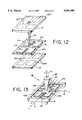
- FIG. 12 is an exploded perspective view of another embodiment of the invention when employed as an accelerometer.
- FIG. 13 is a perspective view of a third embodiment of the invention when used as a hybrid gyroscope and accelerometer.
- FIG. 14 is a perspective view of a fourth embodiment of the invention when used as a vibratory sensor.
- Microgyroscopes that are compact and cost effective with low power consumption for attitude and maneuver control, tumble recovery, stabilization and pointing of instruments such as cameras, antennas, detectors and solar panels.
- Microgyroscopes with 0.1 to 10 degree per hour biased stability performance will also find application in inertial reference systems and in external inertial reference systems such as in the global positioning system (GPS), as sun sensors, or star trackers.
- GPS global positioning system
- a sun sensor cannot be used during an eclipse, during periods of several minutes between star sightings within the narrow field of view star tracker, or when a GPS navigation signal suffers short term dropouts due to inadequate antenna coverage or physical electromagnetic interference.
- the disclosed microgyroscopes therefore, will not only be useful for various extraterrestrial missions such as planetary or interplanetary astrophysical research, but also will have substantial terrestrial applications in automotive navigational systems, autonomous control of underwater and land vehicles, platform stabilization, a smart guidance for munitions, missiles and robotics.
- the gyroscope of the invention can be used in a small handheld mobile navigation system in conjunction with and integrated with conventional GPS.
- the Q factor of microgyroscope 10 increases from about 10 at one atmosphere pressure to greater than 10,000 at less than one miliTorr. It is larger due to the low mechanical losses.
- the circuitry actively tracks frequency drifts in the drive resonance due to temperature changes and adjusts the drive frequency to always match the frequency of mechanical resonance.
- the circuit also actively detects and tracks the amplitude of the driven oscillation and actively corrects and maintains a constant drive amplitude.
- microgyroscope offers several technical features which include, but are not limited to:
- the gyroscope utilizes energy transfer between two degenerate modes to sense rotation rate
- vibratory gyroscopes in general, there is a rotation sensing mechanical element which is initially driven to oscillate in a first mode, typically termed an input or drive mode. Under rotation, Coriolis acceleration induces energy transfer from the input mode to a second oscillatory mode, typically termed an output or sense mode, which causes the sensing element to be excited.
- a second oscillatory mode typically termed an output or sense mode
- the best performance for a vibratory gyroscope is obtained when the oscillatory modes, the drive and sense modes, have the same resonant frequency and a high quality or Q factor.
- the response to the Coriolis acceleration is then mechanically amplified by the Q factor of the resonance and results in improved sensor performance.
- FIG. 1 A simplified perspective view of a portion of the microgyroscope of the invention is depicted in the perspective view of FIG. 1.
- the microgyroscope generally denoted by reference numeral 10, in the illustrated embodiment is comprised of a 4-leaf clover, generally denoted by reference numeral 12, suspended by four wires or springs 14 extending between clover 12 and rim 16.
- a two-fold symmetric clover leaf pattern with square leaves 22a-d is used, but any symmetric, planar pattern may be substituted if desired.
- six or eight leaf clover pattern could be used or even more complex symmetric patterns chosen if desired.
- Rim 16 clover structure 12 and springs 14 are micromachined from a single crystal of silicon.
- a metal or brass post 18 is rigidly attached through a center 20 of clover structure 12 in a direction perpendicular to the plane of clover leaves 22a-d.
- Four silicon suspension springs 14 provide mechanical support and a restoring spring force for the oscillatory motion of microgyroscope 10.
- Clover leaf structure 12 and metal post 18 have a combined mass in the illustrated embodiment of about 10 -5 kg.
- Microgyroscope 10 is shown as best measuring the rate of rotation about the inertial Z axis parallel to the post. Three of such microgyroscopes each oriented in a different orthogonal direction will thus provide three axis sense rotation.
- the mechanical resonant frequency of the microgyroscope in the illustrated embodiment of FIGS. 1 and 2 varies according to its design in the range of 200 to 1000 Hz.
- the resonant frequency may be chosen at any frequency consistent with the teachings of the present invention.
- the low resonant frequency in the illustrated embodiment as compared to prior art vibratory gyroscopes is due to a large mass of post 18 and the softness of suspension springs 14. Since the Coriolis response of gyroscope 10 is inversely proportional to its resonant frequency, a low resonant frequency increases the device responsitivity.
- Silicon clover leaf structure 10 with post 18 is bonded to a quartz base plate 24, as best depicted in the exploded perspective view of FIG. 2. Quartz base plate 24 is patterned with Cr/Au electrodes 26a and b. The large planar overlap of clover leaves 22a-d to electrodes 26a and b provides large areas for electrostatic driving and capacitive sensing. Each of electrodes 26a and b are coupled through metalizations (not shown) leading to silicon electronics as shown in FIG. 3. In the preferred embodiment gyroscope 10 and its associated electronics are integrally fabricated by using conventional silicon integrated circuit processing technology.
- the resonator combination of electrodes 26a and b and clover leaves 22a-d is excited by applying an AC voltage from an automatic gain control amplifier 28, symbolically representing the transfer function of all the electronics, to electrodes 26a, which are associated with leaves 22b and c.
- This excites a rotation of leaves 22b and c around the X-axis 30 as depicted in FIG. 1. Since the resonator of gyroscope 10 is symmetric, that is each of the elements comprising any part of the oscillating elements within gyroscope 10 has mirror symmetry about both the X and Y axes, the resonance modes about the X axis 30 and Y axis 32 are matched in frequency with a rocking-like displacement of clover leaves 22a-d.
- the Q factor amplification of the drive and sense motion also reduces the drive voltage needed from agc amplifier 28 and increases the sensitivity of output provided to the differential amplifier 34.
- the Q factor of this symmetric resonator structure can be very high, since the structure can be perfectly balanced as described below with a fixed center of gravity largely defined by the placement of metal post 18 with its center of gravity at or very near the geometric center of the plane of clover leafs structure 12. The linear forces and moments resulting from vibration modes thus can be zero or very near zero.
- Post 18 thus provides a large Coriolis coupling which transfers energy between the two orthogonal rocking modes about X axis 32 aligned with springs 14 extending between clover leaves 22a and b on one hand and clover leaves 22c and d on the other, and springs 14 aligned with X axis 30 extending between clover leaves 22a and d on one hand and clover leaves 22b and c on the other.
- the structure of silicon microgyroscope 10 shown in FIG. 2 can be characterized as a quartz based plate 24 patterned with metal electrodes 26a and b and a silicon clover leaf resonating structure 12 suspended inside a silicon rim 16. Quartz base plate 24 and silicon rim 16 can be bonded together by several methods, for example by using low shrinkage ultraviolet curable epoxy or other methods of equivalent bonding such as by conductive epoxy or wafer bonding.
- the overall dimension of mechanical resonator 12 is 7 ⁇ 7 mm and the dimension of each clover leaf 22a-d is about 1.1 mm by 1.1 mm.
- Post 18 is 500 microns in diameter and 5 mm in length.
- Quartz base plate 24 is a square 1 cm by 1 cm and approximately 400 microns thick.
- the sensing capacitors of microgyroscope 10 are formed between the chromium/gold electrodes 26b on quartz base plate 24 and silicon clover leaves 22a and d.
- the gap between base electrodes 26b and clover leaves 22a and d is typically in the range of 10 to 20 microns.
- FIGS. 4a-d are a simplified cross-sectional diagrams of the fabrication process
- the fabrication methodology begins with a standard n-type or phosphorous or arsenic doped, ⁇ 100>, double-sided polished silicon wafer 38 that has two epitaxial silicon layers 40 and 42 disposed thereon.
- the first epitaxial layer 40 is a p+ etch-stop layer, which in the illustrated embodiment is a 10 20 boron doped layer.
- Upper layer 42 is a 26 micron n-type silicon epilayer.
- a silicon dioxide layer 44 is thermally grown on the wafer and then patterned with the clover leaf pattern depicted in FIGS.
- This patterned oxide layer 44 is used as a mask for EDP etching of silicon layer 42 down to etch-stop layer 40, resulting in the fabricated pattern as shown in the cross-sectional view of FIG. 4a.
- the longitudinal axis of spring 14 and their etched surfaces, the edges of clover leaves 22a-d, and all of the features of the resonator comprising the geometry of rim 16, clover leaves 22a-d and springs 14 are aligned with the crystallographic axis of wafer 38 so that their edge surfaces are extremely smooth and lie along defined crystalline planes. Therefore, very precise dimensions and shapes for springs 14 as well as each of the other edges are provided by the anisotropic EDP etch.
- Thermal oxide mask 44 is stripped off with a wet, buffered hydrofluoric etch and is then followed by 300 angstrom thick thermal silicon dioxide layer 46 resulting in the structure of FIG. 4b.
- Silicon dioxide layer 46 on the back of microgyroscope 10 is patterned as shown in FIG. 4b and then etched to remove almost all of the silicon substrate 36 down to etch-stop layer 40 as shown in the resulting structure in FIG. 4c.
- wafer 38 is cleaved into individual devices and separated. The cleaved devices are then etched in hydrofluoric acid until stop-etch layer 40 is removed resulting in the structure as shown in FIG. 4d. Removal of both etch-stop layer 40 and silicon dioxide layers 46 removes any stress gradients which might otherwise tend to cause warpage of the suspended clover leaf structure 22a-d and hence loss of symmetry.
- FIGS. 5a and b The fabrication process for quartz based plate 24 is depicted in FIGS. 5a and b, which again show the fabrication steps in side cross-sectional view.
- Quartz plate 48 is first drilled to define a bore 50 for post 18. Plate 48 is then patterned and etched to a depth of approximately 10 to 20 microns using hydrofluoric acid to define a well 52. Well 52 provides a spacing gap that separates silicon clover leaves 22a-d and electrodes 26a and b on quartz base plate 24. Next a chromium/gold metalization is evaporated onto quartz plate 48 as shown in FIG. 5b to define electrodes 26a and b. Quartz plate 48 is then diced into individual devices to define individual device quartz base plates 24 and are bonded to the silicon resonator structure described in connection with FIGS.
- metal post 18 is then epoxied into a central bore 54 as shown in FIG. 2 defined in clover leaf resonator 22a-d.
- FIG. 6 an electrical model of gyroscope 10 is depicted in FIG. 6 into which the more significant parasitic effects are inserted such as interplate capacitances and the mechanical coupling between the orthogonal modes under no rotation.
- FIG. 6 an electrical model of gyroscope 10 is depicted in FIG. 6 into which the more significant parasitic effects are inserted such as interplate capacitances and the mechanical coupling between the orthogonal modes under no rotation.
- FIG. 6 shows a basic electrical model which gives the excitation-to-sense transfer function V 2 /V 1 or V 3 /V 4 , of microgyroscope 10 taking each pair of opposite plates at a time, wherein the voltages V 1 -V 4 correspond to the angular displacements of clover leaves 22a-d respectively.
- the mechanical resonance of silicon clover leaf resonator 22a-d is modeled by series resonant circuit 58 comprised of L ⁇ C ⁇ R ⁇ which is excited by dependent voltage sources 64 and 66 denoted as ⁇ V 1 and ⁇ V 2 respectively, which communicate with port voltages 60 and 62, denoted at V 1 and V 2 respectively.
- the ⁇ representation signifies the deflection per volt in plates 22a-d at zero frequency.
- the effective mechanical motion on electrical ports 60 and 62 in turn is given by dependent sources 68 and 70, denoted as a.sub. ⁇ i.sub. ⁇ .
- the interplate parasitic resistance and capacitance is modeled by parallel RC circuit 72, Rp and Cp.
- Dependent source 74, ⁇ .sub. ⁇ V c ⁇ is the Coriolis induced term described below.
- FIG. 7 shows a transfer functions V 2 /V 1 or V 3 /V 4 in the vertical axis in a logarithmic scale with frequency graphed along the horizontal access.
- An actual experimental transfer function as measured is shown in FIG. 8 of each pair of opposite plates of microgyroscope 10 with drive and sense resonant modes at 445 Hz and 435 Hz respectively.
- the departure of each of these transfer functions from the predicted function of FIG. 7 for a pair of single plates is primarily caused by parasitic electrical and mechanical coupling between the two orthogonal modes when gyroscope 10 is at rest and by a slight difference between the ⁇ and ⁇ .sub. ⁇ for each pair of plates.
- the model of FIG. 6 is a model for only a single pair of plates.
- the complete electrical model for gyroscope 10 is shown in FIG. 9, where the subscripts 1-4 refer respectively to the performance parameters of clover leaves 22a-d respectively in analogy with the same designations discussed above in connection with FIG. 6.
- the transfer functions for the model of FIG. 9 again are depicted in FIG. 10 and correspond substantially to those measured in FIG. 8.
- the actuation or drive circuitry is realized by designing agc amplifier 28 so that it locks into the drive resonance mode.
- the driving voltage of microgyroscope 10 from agc amplifier 28 varies from approximately 0.5 to 10 volts peak to peak depending on the device design and Q factor with the snap down voltage at approximately 20 volts, i.e. the voltage necessary to retain clover leaves 22a-d in a down position against the restorative force of springs 14.
- the diagram of FIG. 3 shows clover leaves 22a-d exposed above and covering underlying electrodes 26a and b so that is should be understood that the conductive lines shown in the circuitry of FIG. 3 are not directly electrically coupled to clover leaves 22a-d, but to their underlying electrodes.
- the signals from electrodes 26b, the sensing electrodes are both differenced in differential amplifier 34 and summed in summing amplifier 78.
- the purpose of summing sense signals from electrodes 26b is to remove the difference signal between them and hence the response of the sensed resonance from the feedback loop.
- the output of summing circuit 78 is fed back to agc amplifier 28 to provide a feedback signal to agc amplifier 28 independent of the sensed response.
- the sense circuit subtracts the sensed signals from electrodes 26b in order to remove the common mode drive signal.
- a lock-in amplifier 80 is used to detect the differential signal caused by the rotation of gyroscope 10 about the z axis.
- the output of agc amplifier 28 is also provided as the reference signal to lock in amplifier 80.
- the resonant frequency of the drive mode has been measured at 452 Hz and the sense mode at 447 Hz with Q factors for both modes at approximately 500.
- the resonant modes are rocking modes of modal lines along the spring directions, i.e. the longitudinal directions of springs 14.
- the separation between the resonant frequencies in the sense and drive modes was primarily due to stress from the bonding of silicon clover leaf structure 22a-d and rim 16 to quartz base plate 24 and to small fabrication errors.
- the frequency split between the sense and drive modes has been substantially narrowed in later fabricated microgyroscopes and has resulted in significant Q factor amplification of the sense mode displacement.
- the output voltage, V out for the initially fabricated microgyroscope and circuitry of FIG. 3, is graphed against rotation rate measured in degrees per hour as depicted in FIG. 11.
- the measured responsitivity or scale factor of gyroscope 10 is linear and was measured at 10.4 millivolts per degree per second with a nonlinearity of at less than 1% at an integration time of one second. Closed circuitry may be employed to improve the sensitivity of microgyroscope 10 by lowering noise and reducing drift.
- the microgyroscope of the invention is capable of detecting rotation rates of less than one degree per hour with rotation rates of 90 degrees per hour currently being realized. While the illustrated embodiment shows resonant frequencies between 400 and 500 Hz, it is anticipated that resonant frequencies between approximate 0.1 to 10 kHz can be realized by design selection. Because of the increased sensitivity of the design it may also be driven off resonance thereby eliminating the need for mechanical matching between the sensed and driven modes.
- FIG. 12 A modification of the microgyroscope 10 as diagrammatically depicted in FIG. 12 provides for a three axis accelerometer denoted generally by reference numeral 82.
- the elements of accelerometer 82 are identical with those of gyroscope 10 with the exception that post 18, which has its mass symmetrically disposed with respect to clover leaves 22a-d in the embodiment of FIGS.
- Post 84 is also shown as a square pest as opposed to a rod.
- the cross-sectional configuration of post 84 is largely a matter of design choice and fabrication convenience.
- Each of the elements in FIG. 12 coact substantially as indicated above with the exception that a second identical base plate 24' is shown in the exploded perspective view of FIG. 12.
- accelerometer 82 is symmetrical in the X-Y plane, it is capable of sensing both accelerations in the X and Y direction. Acceleration in the Z direction can also be detected by monitoring capacitances associated with each of the four clover leaves 22a-d. Under accelerations in the Z direction, all four clover leaves 22a-d will move up or down depending on the direction of acceleration superimposed upon the drive oscillation.
- the accelerometer FIG. 12 may be combined with a microgyroscope of FIGS. 1-11.
- a hybrid device generally denoted by reference numeral 86, having essentially the same elements as FIGS. 1-12, is provided wherein post 18 and 84 is replaced by an asymmetric post 88.
- An illustrated embodiment post 88 is shaped as cylindrical rod in its lower portion 90, while it has a conical shape on its upper portion 92. The asymmetric distribution of mass within rod 88 thus combines the gyroscopic response of the embodiment of FIGS. 1-11 with the accelerometer response of FIG. 12.
- the drive mechanism also becomes a superposition of Z oscillation of accelerometer 82 combined with the rotational drive of the gyroscope of FIGS. 1 and 2.
- the operational responses are then decoded or separated from each other in the output circuitry which includes algorithmically controlled data signal processing for this purpose.
- FIG. 14 is a perspective view of another embodiment of the invention wherein clover leaves 22a-d are utilized together with rim 16 and springs 14 in combination with an electrode base substrate 24 in the absence of any central mass or bar 18, 84 or 88.
- This embodiment device is used as a resonator, generally denoted by reference numeral 94, in substantially the same manner as described in connection with gyroscope 10 in FIGS. 1-11.
- the Q factor of resonator 94 is expected to exceed 50,000 when driven at its resonant frequency.
- Each of the advantages utilized in microgyroscope 10 arising from the symmetry of springs 14, clover leaves 22a-d and rim 16 are also realized in resonator 94 of FIG. 14. This includes frequency matching of resonant frequencies for both input and output vibrational modes and differential temperature dependence between the two oscillatory modes. The high Q factor could thus be utilized in any type of transducer of physical phenomena for producing an output signal.
- the illustrated embodiment has been described as micromachined from silicon with a quartz base plate and brass post, the entire the device could be made from silicon, metal, plastic, ceramic, any other crystalline or noncrystalline material or combinations of the same.
- the quartz base plate and post are currently contemplated as being replaced by a silicon ones or versions made from plastic, ceramic, any other crystalline or noncrystalline material.
- micromaching is the preferred mode of manufacturing, manufacturing of the element by mold injection or any other means now known or later devised is equivalent.
- the invention has largely been illustrated in terms of a gyroscope, its application in an accelerometer has also be briefly described. It could also be included in a vibration sensor, a seismometer, a pressure sensor, an actuator for the displacement of fluids, gases and particles, an optical beam deflector, steerer and mirror, a resonator reference or oscillator, and an oscillator for use in electromechanical apparatus.
- the invention can be employed in each of the above applications with oscillation.
- the leaf structure is oscillated primarily to enhance the signal-to-noise ratios by the use of lock-in detection, and secondarily to operate as a vibratory gyroscope. In nongyroscopic applications or applications where lower signal-to-noise ratios can be tolerated, oscillation of the leaf structure is not required.
Landscapes
- Physics & Mathematics (AREA)
- General Physics & Mathematics (AREA)
- Engineering & Computer Science (AREA)
- Radar, Positioning & Navigation (AREA)
- Remote Sensing (AREA)
- Gyroscopes (AREA)
Priority Applications (5)
| Application Number | Priority Date | Filing Date | Title |
|---|---|---|---|
| US08/657,685 US5894090A (en) | 1996-05-31 | 1996-05-31 | Silicon bulk micromachined, symmetric, degenerate vibratorygyroscope, accelerometer and sensor and method for using the same |
| EP97928679A EP0902875B1 (de) | 1996-05-31 | 1997-05-30 | Aus silizium in mikrotechnologie hergestellter symmetrischer vibrationskreiselsensor |
| PCT/US1997/009021 WO1997045702A1 (en) | 1996-05-31 | 1997-05-30 | Silicon macromachined symmetric vibratory gyroscope sensor |
| AU32880/97A AU3288097A (en) | 1996-05-31 | 1997-05-30 | Silicon macromachined symmetric vibratory gyroscope sensor |
| DE69731742T DE69731742T2 (de) | 1996-05-31 | 1997-05-30 | Aus silizium in mikrotechnologie hergestellter symmetrischer vibrationskreiselsensor |
Applications Claiming Priority (1)
| Application Number | Priority Date | Filing Date | Title |
|---|---|---|---|
| US08/657,685 US5894090A (en) | 1996-05-31 | 1996-05-31 | Silicon bulk micromachined, symmetric, degenerate vibratorygyroscope, accelerometer and sensor and method for using the same |
Publications (1)
| Publication Number | Publication Date |
|---|---|
| US5894090A true US5894090A (en) | 1999-04-13 |
Family
ID=24638237
Family Applications (1)
| Application Number | Title | Priority Date | Filing Date |
|---|---|---|---|
| US08/657,685 Expired - Fee Related US5894090A (en) | 1996-05-31 | 1996-05-31 | Silicon bulk micromachined, symmetric, degenerate vibratorygyroscope, accelerometer and sensor and method for using the same |
Country Status (5)
| Country | Link |
|---|---|
| US (1) | US5894090A (de) |
| EP (1) | EP0902875B1 (de) |
| AU (1) | AU3288097A (de) |
| DE (1) | DE69731742T2 (de) |
| WO (1) | WO1997045702A1 (de) |
Cited By (104)
| Publication number | Priority date | Publication date | Assignee | Title |
|---|---|---|---|---|
| US6044708A (en) * | 1998-03-04 | 2000-04-04 | Alps Electric Co., Ltd. | Oscillation type gyroscope |
| US6079282A (en) * | 1998-06-26 | 2000-06-27 | Bossard Technologies Ag | Capacitive force sensor |
| US6079272A (en) * | 1997-08-13 | 2000-06-27 | California Institute Of Technology | Gyroscopes and compensation |
| US6117701A (en) * | 1996-08-09 | 2000-09-12 | Robert Bosch Gmbh | Method for manufacturing a rate-of-rotation sensor |
| US6164134A (en) * | 1999-01-29 | 2000-12-26 | Hughes Electronics Corporation | Balanced vibratory gyroscope and amplitude control for same |
| WO2001001153A1 (en) * | 1999-06-29 | 2001-01-04 | California Institute Of Technology | Z-axis vibratory gyroscope |
| US6289733B1 (en) * | 1999-05-12 | 2001-09-18 | Hughes Electronics Corporation | Planar vibratory gyroscopes |
| US6308567B1 (en) * | 1998-12-10 | 2001-10-30 | Denso Corporation | Angular velocity sensor |
| US6367786B1 (en) | 1999-06-07 | 2002-04-09 | California Institute Of Technology | Micromachined double resonator |
| WO2002010684A3 (en) * | 2000-08-01 | 2002-04-25 | Hrl Lab Llc | Three-axes sensor and a method of making same |
| US6418789B1 (en) * | 1999-02-26 | 2002-07-16 | Murata Manufacturing Co., Ltd. | Vibrating gyroscope |
| US6487907B1 (en) * | 1999-07-08 | 2002-12-03 | California Institute Of Technology | Microgyroscope with integrated vibratory element |
| US6513380B2 (en) * | 2001-06-19 | 2003-02-04 | Microsensors, Inc. | MEMS sensor with single central anchor and motion-limiting connection geometry |
| WO2003023414A1 (en) * | 2001-09-04 | 2003-03-20 | Tokyo Electron Limited | Microstructure with movable mass |
| US20030057447A1 (en) * | 2001-09-26 | 2003-03-27 | Hitachi Metals, Ltd. | Acceleration sensor |
| US6555404B1 (en) | 2000-08-01 | 2003-04-29 | Hrl Laboratories, Llc | Method of manufacturing a dual wafer tunneling gyroscope |
| US6563184B1 (en) | 2000-08-01 | 2003-05-13 | Hrl Laboratories, Llc | Single crystal tunneling sensor or switch with silicon beam structure and a method of making same |
| US20030101792A1 (en) * | 2001-08-10 | 2003-06-05 | Kubena Randall L. | Microgyro tuning using focused ion beams |
| US6580138B1 (en) | 2000-08-01 | 2003-06-17 | Hrl Laboratories, Llc | Single crystal, dual wafer, tunneling sensor or switch with silicon on insulator substrate and a method of making same |
| US6582985B2 (en) | 2000-12-27 | 2003-06-24 | Honeywell International Inc. | SOI/glass process for forming thin silicon micromachined structures |
| US6584845B1 (en) | 1999-02-10 | 2003-07-01 | California Institute Of Technology | Inertial sensor and method of use |
| WO2003025500A3 (en) * | 2001-08-17 | 2003-09-18 | Boeing Co | Microgyroscope with electronic alignment and tuning |
| US6630367B1 (en) | 2000-08-01 | 2003-10-07 | Hrl Laboratories, Llc | Single crystal dual wafer, tunneling sensor and a method of making same |
| US6629460B2 (en) | 2001-08-10 | 2003-10-07 | The Boeing Company | Isolated resonator gyroscope |
| US6636819B1 (en) * | 1999-10-05 | 2003-10-21 | L-3 Communications Corporation | Method for improving the performance of micromachined devices |
| US20030205087A1 (en) * | 2001-08-10 | 2003-11-06 | The Boeing Company | Isolated resonator gyroscope with compact flexures |
| US20030209076A1 (en) * | 2000-10-16 | 2003-11-13 | Institute Of Microelectronics | Z-axis accelerometer |
| US6672161B2 (en) * | 2000-07-21 | 2004-01-06 | Denso Corporation | Semiconductor dynamic quantity sensor |
| US20040017620A1 (en) * | 2002-07-24 | 2004-01-29 | Shinji Kaneko | Optical unit provided with an actuator |
| US20040055380A1 (en) * | 2002-08-12 | 2004-03-25 | Shcheglov Kirill V. | Isolated planar gyroscope with internal radial sensing and actuation |
| US20040055381A1 (en) * | 2002-08-12 | 2004-03-25 | Shcheglov Kirill V. | Integral resonator gyroscope |
| US20040085159A1 (en) * | 2002-11-01 | 2004-05-06 | Kubena Randall L. | Micro electrical mechanical system (MEMS) tuning using focused ion beams |
| US20040088127A1 (en) * | 2002-06-25 | 2004-05-06 | The Regents Of The University Of California | Integrated low power digital gyro control electronics |
| RU2234679C2 (ru) * | 2003-03-21 | 2004-08-20 | Открытое акционерное общество Арзамасское научно-производственное предприятие "Темп-Авиа" | Микромеханический датчик угловой скорости |
| US20040168134A1 (en) * | 2003-02-21 | 2004-08-26 | Infineon Technologies North America Corp. | Clock gating approach to accommodate infrequent additional processing latencies |
| US6808956B2 (en) | 2000-12-27 | 2004-10-26 | Honeywell International Inc. | Thin micromachined structures |
| US20040226370A1 (en) * | 2002-04-26 | 2004-11-18 | California Institute Of Technology | Electrostatic spring softening in redundant degree of freedom resonators |
| US20040237626A1 (en) * | 2001-08-09 | 2004-12-02 | Challoner A. Dorian | Cloverleaf microgyroscope with electrostatic alignment and tuning |
| US20050017329A1 (en) * | 2003-06-10 | 2005-01-27 | California Institute Of Technology | Multiple internal seal ring micro-electro-mechanical system vacuum package |
| US6876124B1 (en) * | 2001-12-06 | 2005-04-05 | Tera Fiberoptics | Method and system for securing and controlling an electro-statically driven micro-mirror |
| RU2251702C1 (ru) * | 2004-07-02 | 2005-05-10 | Государственное образовательное учреждение высшего профессионального образования "Московский государственный институт электронной техники (технический университет)" (МИЭТ) | Микромеханический акселерометр |
| US20050172714A1 (en) * | 2002-08-12 | 2005-08-11 | California Institute Of Technology | Isolated planar mesogyroscope |
| US20050284222A1 (en) * | 2004-06-29 | 2005-12-29 | Johnson Burgess R | MEMS gyroscope with horizontally oriented drive electrodes |
| US6990863B2 (en) | 2001-08-10 | 2006-01-31 | The Boeing Company | Isolated resonator gyroscope with isolation trimming using a secondary element |
| US20060037417A1 (en) * | 2004-07-29 | 2006-02-23 | The Boeing Company | Parametrically disciplined operation of a vibratory gyroscope |
| US7015060B1 (en) | 2004-12-08 | 2006-03-21 | Hrl Laboratories, Llc | Cloverleaf microgyroscope with through-wafer interconnects and method of manufacturing a cloverleaf microgyroscope with through-wafer interconnects |
| US7017410B2 (en) | 2001-08-10 | 2006-03-28 | The Boeing Company | Isolated resonator gyroscope with a drive and sense plate |
| JP2006105798A (ja) * | 2004-10-06 | 2006-04-20 | Oki Electric Ind Co Ltd | 半導体加速度センサおよびその製造方法 |
| US20070017287A1 (en) * | 2005-07-20 | 2007-01-25 | The Boeing Company | Disc resonator gyroscopes |
| US7202100B1 (en) | 2004-09-03 | 2007-04-10 | Hrl Laboratories, Llc | Method of manufacturing a cloverleaf microgyroscope and cloverleaf microgyroscope |
| US7232700B1 (en) | 2004-12-08 | 2007-06-19 | Hrl Laboratories, Llc | Integrated all-Si capacitive microgyro with vertical differential sense and control and process for preparing an integrated all-Si capacitive microgyro with vertical differential sense |
| RU2301969C1 (ru) * | 2005-10-10 | 2007-06-27 | Открытое акционерное общество Арзамасское научно-производственное предприятие "ТЕМП-АВИА" (ОАО АНПП "ТЕМП-АВИА") | Чувствительный элемент микромеханического гироскопа |
| US20070180909A1 (en) * | 2006-02-07 | 2007-08-09 | Takeshi Uchiyama | Angular velocity sensor |
| EP2028440A2 (de) | 2007-07-31 | 2009-02-25 | The Boeing Company | Integralträgheitsmesseinheit für Scheibenresonator |
| US20090165558A1 (en) * | 2007-12-28 | 2009-07-02 | Schultz Peter S | Caddie-corner single proof mass xyz mems transducer |
| US7640803B1 (en) | 2004-05-26 | 2010-01-05 | Siimpel Corporation | Micro-electromechanical system inertial sensor |
| US20100103777A1 (en) * | 2008-10-23 | 2010-04-29 | Hon Hai Precision Industry Co., Ltd. | Seismograph system |
| US20100251817A1 (en) * | 2009-04-01 | 2010-10-07 | The Boeing Company | Thermal mechanical isolator for vacuum packaging of a disc resonator gyroscope |
| EP2246662A2 (de) | 2009-05-01 | 2010-11-03 | The Board of Trustees of The Leland Stanford Junior University | MEMS und optische Abtastung verwendendes Gyroskop |
| US20100300202A1 (en) * | 2009-06-01 | 2010-12-02 | Joyce Richard J | Gyroscope packaging assembly |
| US20110048130A1 (en) * | 2008-03-03 | 2011-03-03 | Ramot At Tel-Aviv University Ltd. | Micro Scale Mechanical Rate Sensors |
| US20110296915A1 (en) * | 2010-06-07 | 2011-12-08 | Bin Yang | Multi-axis capacitive accelerometer |
| US8138016B2 (en) | 2006-08-09 | 2012-03-20 | Hrl Laboratories, Llc | Large area integration of quartz resonators with electronics |
| US8151640B1 (en) | 2008-02-05 | 2012-04-10 | Hrl Laboratories, Llc | MEMS on-chip inertial navigation system with error correction |
| US20120101729A1 (en) * | 2010-10-24 | 2012-04-26 | Takamune Cho | Method and system for detecting ground displacement |
| US8176607B1 (en) | 2009-10-08 | 2012-05-15 | Hrl Laboratories, Llc | Method of fabricating quartz resonators |
| US8187902B2 (en) | 2008-07-09 | 2012-05-29 | The Charles Stark Draper Laboratory, Inc. | High performance sensors and methods for forming the same |
| CN102507982A (zh) * | 2011-11-02 | 2012-06-20 | 重庆理工大学 | 一种基于光热效应的硅微谐振式二维加速度传感器 |
| CN102507980A (zh) * | 2011-11-02 | 2012-06-20 | 重庆理工大学 | 一种基于自谐振技术的硅微二维加速度传感器 |
| US20120227495A1 (en) * | 2010-03-31 | 2012-09-13 | Honeywell International Inc. | Methods for making a sensitive resonating beam accelerometer |
| US8327526B2 (en) | 2009-05-27 | 2012-12-11 | The Boeing Company | Isolated active temperature regulator for vacuum packaging of a disc resonator gyroscope |
| US20130000405A1 (en) * | 2010-03-23 | 2013-01-03 | Vincent Ragot | Method of angular measurement by means of a vibrating sensor to which modulated controls are applied |
| US8393212B2 (en) | 2009-04-01 | 2013-03-12 | The Boeing Company | Environmentally robust disc resonator gyroscope |
| CN103250057A (zh) * | 2010-11-26 | 2013-08-14 | 意法半导体股份有限公司 | 微机电类型的谐振双轴加速度计结构 |
| US20130233077A1 (en) * | 2012-03-08 | 2013-09-12 | Industrial Technology Research Institute | Electrostatic force generator and force measurement system and accelerometer having the same |
| US20140013845A1 (en) * | 2012-07-13 | 2014-01-16 | Robert E. Stewart | Class ii coriolis vibratory rocking mode gyroscope with central fixed post |
| US8766745B1 (en) | 2007-07-25 | 2014-07-01 | Hrl Laboratories, Llc | Quartz-based disk resonator gyro with ultra-thin conductive outer electrodes and method of making same |
| US8769802B1 (en) | 2008-02-21 | 2014-07-08 | Hrl Laboratories, Llc | Method of fabrication an ultra-thin quartz resonator |
| US8782876B1 (en) | 2008-11-10 | 2014-07-22 | Hrl Laboratories, Llc | Method of manufacturing MEMS based quartz hybrid filters |
| US8912711B1 (en) | 2010-06-22 | 2014-12-16 | Hrl Laboratories, Llc | Thermal stress resistant resonator, and a method for fabricating same |
| US9041463B2 (en) | 2011-12-16 | 2015-05-26 | Analog Devices, Inc. | Low noise amplifier for multiple channels |
| US9250074B1 (en) | 2013-04-12 | 2016-02-02 | Hrl Laboratories, Llc | Resonator assembly comprising a silicon resonator and a quartz resonator |
| US9309106B2 (en) | 2013-07-08 | 2016-04-12 | Motion Engine Inc. | 3D MEMS device and method of manufacturing |
| CN105606201A (zh) * | 2016-01-28 | 2016-05-25 | 中北大学 | 复合式mems仿生水听器 |
| US20160202366A1 (en) * | 2013-03-14 | 2016-07-14 | Pgs Geophysical As | Force feedback electrodes in mems accelerometer |
| US9599470B1 (en) | 2013-09-11 | 2017-03-21 | Hrl Laboratories, Llc | Dielectric high Q MEMS shell gyroscope structure |
| US9605964B2 (en) | 2014-01-03 | 2017-03-28 | The Boeing Company | Gyro quadrature stabalization with demodulation phase error nulling |
| JP2017203683A (ja) * | 2016-05-11 | 2017-11-16 | 内外ゴム株式会社 | 静電容量型の3軸加速度センサ |
| US9977097B1 (en) | 2014-02-21 | 2018-05-22 | Hrl Laboratories, Llc | Micro-scale piezoelectric resonating magnetometer |
| US9991863B1 (en) | 2014-04-08 | 2018-06-05 | Hrl Laboratories, Llc | Rounded and curved integrated tethers for quartz resonators |
| US10031191B1 (en) | 2015-01-16 | 2018-07-24 | Hrl Laboratories, Llc | Piezoelectric magnetometer capable of sensing a magnetic field in multiple vectors |
| US10110198B1 (en) | 2015-12-17 | 2018-10-23 | Hrl Laboratories, Llc | Integrated quartz MEMS tuning fork resonator/oscillator |
| US10175307B1 (en) | 2016-01-15 | 2019-01-08 | Hrl Laboratories, Llc | FM demodulation system for quartz MEMS magnetometer |
| US10214414B2 (en) | 2014-01-09 | 2019-02-26 | Motion Engine, Inc. | Integrated MEMS system |
| US10266398B1 (en) | 2007-07-25 | 2019-04-23 | Hrl Laboratories, Llc | ALD metal coatings for high Q MEMS structures |
| US10273147B2 (en) | 2013-07-08 | 2019-04-30 | Motion Engine Inc. | MEMS components and method of wafer-level manufacturing thereof |
| US10308505B1 (en) | 2014-08-11 | 2019-06-04 | Hrl Laboratories, Llc | Method and apparatus for the monolithic encapsulation of a micro-scale inertial navigation sensor suite |
| US10407299B2 (en) | 2015-01-15 | 2019-09-10 | Motion Engine Inc. | 3D MEMS device with hermetic cavity |
| US10768065B2 (en) | 2014-04-10 | 2020-09-08 | Mei Micro, Inc. | MEMS pressure sensor |
| CN111766405A (zh) * | 2020-05-14 | 2020-10-13 | 东南大学 | 一种基于谐振器能量局部化效应的双轴硅微加速度计 |
| US11237000B1 (en) | 2018-05-09 | 2022-02-01 | Hrl Laboratories, Llc | Disk resonator gyroscope with out-of-plane electrodes |
| US11287486B2 (en) | 2014-12-09 | 2022-03-29 | Motion Engine, Inc. | 3D MEMS magnetometer and associated methods |
| US11674803B2 (en) | 2014-06-02 | 2023-06-13 | Motion Engine, Inc. | Multi-mass MEMS motion sensor |
| US11852481B2 (en) | 2013-08-02 | 2023-12-26 | Motion Engine Inc. | MEMS motion sensor and method of manufacturing |
Families Citing this family (8)
| Publication number | Priority date | Publication date | Assignee | Title |
|---|---|---|---|---|
| JP3206551B2 (ja) | 1998-06-12 | 2001-09-10 | 株式会社村田製作所 | 振動子およびそれを用いた振動ジャイロ |
| AU5241599A (en) * | 1998-07-31 | 2000-02-21 | Litton Systems, Incorporated | Micromachined rotation sensor with modular sensor elements |
| JP2002350138A (ja) * | 2001-05-28 | 2002-12-04 | Wacoh Corp | 加速度と角速度との双方を検出する装置 |
| US7959550B2 (en) | 2004-12-28 | 2011-06-14 | Shlomo Laniado | Method and apparatus for potentiating penile erection utilizing ultraweak electromagnetic field of very low frequency |
| DE102009033191A1 (de) * | 2009-07-07 | 2011-01-13 | Technische Universität Dresden | Reduzierung der dynamischen Deformation von Translationsspiegeln mit Hilfe von trägen Massen |
| GB2505875A (en) * | 2012-09-04 | 2014-03-19 | Cambridge Entpr Ltd | Dual and triple axis inertial sensors and methods of inertial sensing |
| CN104197919B (zh) * | 2014-08-08 | 2017-06-13 | 上海交通大学 | 上下贯通支撑的玻璃金属半球谐振微陀螺 |
| CN112325869A (zh) * | 2019-08-02 | 2021-02-05 | 北京小米移动软件有限公司 | 陀螺仪电路、陀螺仪电路的工作方法及移动终端 |
Citations (5)
| Publication number | Priority date | Publication date | Assignee | Title |
|---|---|---|---|---|
| US5001940A (en) * | 1988-11-09 | 1991-03-26 | Aisin Seiki Kabushiki Kaisha | Gyro for detecting signals along two axes |
| US5134881A (en) * | 1986-06-22 | 1992-08-04 | Triton Technologies, Inc. | Micro-machined accelerometer with composite material springs |
| US5203208A (en) * | 1991-04-29 | 1993-04-20 | The Charles Stark Draper Laboratory | Symmetrical micromechanical gyroscope |
| US5313835A (en) * | 1991-12-19 | 1994-05-24 | Motorola, Inc. | Integrated monolithic gyroscopes/accelerometers with logic circuits |
| US5377544A (en) * | 1991-12-19 | 1995-01-03 | Motorola, Inc. | Rotational vibration gyroscope |
Family Cites Families (2)
| Publication number | Priority date | Publication date | Assignee | Title |
|---|---|---|---|---|
| US5083466A (en) * | 1988-07-14 | 1992-01-28 | University Of Hawaii | Multidimensional force sensor |
| JP2776142B2 (ja) * | 1992-05-15 | 1998-07-16 | 株式会社日立製作所 | 加速度センサ |
-
1996
- 1996-05-31 US US08/657,685 patent/US5894090A/en not_active Expired - Fee Related
-
1997
- 1997-05-30 WO PCT/US1997/009021 patent/WO1997045702A1/en not_active Ceased
- 1997-05-30 EP EP97928679A patent/EP0902875B1/de not_active Expired - Lifetime
- 1997-05-30 AU AU32880/97A patent/AU3288097A/en not_active Abandoned
- 1997-05-30 DE DE69731742T patent/DE69731742T2/de not_active Expired - Lifetime
Patent Citations (6)
| Publication number | Priority date | Publication date | Assignee | Title |
|---|---|---|---|---|
| US5134881A (en) * | 1986-06-22 | 1992-08-04 | Triton Technologies, Inc. | Micro-machined accelerometer with composite material springs |
| US5001940A (en) * | 1988-11-09 | 1991-03-26 | Aisin Seiki Kabushiki Kaisha | Gyro for detecting signals along two axes |
| US5203208A (en) * | 1991-04-29 | 1993-04-20 | The Charles Stark Draper Laboratory | Symmetrical micromechanical gyroscope |
| US5313835A (en) * | 1991-12-19 | 1994-05-24 | Motorola, Inc. | Integrated monolithic gyroscopes/accelerometers with logic circuits |
| US5377544A (en) * | 1991-12-19 | 1995-01-03 | Motorola, Inc. | Rotational vibration gyroscope |
| US5511419A (en) * | 1991-12-19 | 1996-04-30 | Motorola | Rotational vibration gyroscope |
Cited By (175)
| Publication number | Priority date | Publication date | Assignee | Title |
|---|---|---|---|---|
| US6117701A (en) * | 1996-08-09 | 2000-09-12 | Robert Bosch Gmbh | Method for manufacturing a rate-of-rotation sensor |
| US6079272A (en) * | 1997-08-13 | 2000-06-27 | California Institute Of Technology | Gyroscopes and compensation |
| US6044708A (en) * | 1998-03-04 | 2000-04-04 | Alps Electric Co., Ltd. | Oscillation type gyroscope |
| US6079282A (en) * | 1998-06-26 | 2000-06-27 | Bossard Technologies Ag | Capacitive force sensor |
| US6308567B1 (en) * | 1998-12-10 | 2001-10-30 | Denso Corporation | Angular velocity sensor |
| US6164134A (en) * | 1999-01-29 | 2000-12-26 | Hughes Electronics Corporation | Balanced vibratory gyroscope and amplitude control for same |
| US6584845B1 (en) | 1999-02-10 | 2003-07-01 | California Institute Of Technology | Inertial sensor and method of use |
| US6418789B1 (en) * | 1999-02-26 | 2002-07-16 | Murata Manufacturing Co., Ltd. | Vibrating gyroscope |
| US6289733B1 (en) * | 1999-05-12 | 2001-09-18 | Hughes Electronics Corporation | Planar vibratory gyroscopes |
| US6367786B1 (en) | 1999-06-07 | 2002-04-09 | California Institute Of Technology | Micromachined double resonator |
| US6539801B1 (en) | 1999-06-29 | 2003-04-01 | California Institute Of Technology | Z-axis vibratory gyroscope |
| WO2001001153A1 (en) * | 1999-06-29 | 2001-01-04 | California Institute Of Technology | Z-axis vibratory gyroscope |
| US6758093B2 (en) * | 1999-07-08 | 2004-07-06 | California Institute Of Technology | Microgyroscope with integrated vibratory element |
| US6487907B1 (en) * | 1999-07-08 | 2002-12-03 | California Institute Of Technology | Microgyroscope with integrated vibratory element |
| US20030074967A1 (en) * | 1999-07-08 | 2003-04-24 | California Institute Of Technology | Microgyroscope with integrated vibratory element |
| US6636819B1 (en) * | 1999-10-05 | 2003-10-21 | L-3 Communications Corporation | Method for improving the performance of micromachined devices |
| US6672161B2 (en) * | 2000-07-21 | 2004-01-06 | Denso Corporation | Semiconductor dynamic quantity sensor |
| US6555404B1 (en) | 2000-08-01 | 2003-04-29 | Hrl Laboratories, Llc | Method of manufacturing a dual wafer tunneling gyroscope |
| US20030141562A1 (en) * | 2000-08-01 | 2003-07-31 | Hrl Laboratories, Llc | Single crystal, dual wafer, tunneling sensor or switch with silicon on insulator substrate and a method of making same |
| US6563184B1 (en) | 2000-08-01 | 2003-05-13 | Hrl Laboratories, Llc | Single crystal tunneling sensor or switch with silicon beam structure and a method of making same |
| US6841838B2 (en) | 2000-08-01 | 2005-01-11 | Hrl Laboratories, Llc | Microelectromechanical tunneling gyroscope and an assembly for making a microelectromechanical tunneling gyroscope therefrom |
| US6580138B1 (en) | 2000-08-01 | 2003-06-17 | Hrl Laboratories, Llc | Single crystal, dual wafer, tunneling sensor or switch with silicon on insulator substrate and a method of making same |
| US6730978B2 (en) | 2000-08-01 | 2004-05-04 | Hrl Laboratories, Llc | Single crystal, dual wafer, tunneling sensor and a method of making same |
| US6975009B2 (en) | 2000-08-01 | 2005-12-13 | Hrl Laboratories, Llc | Dual-wafer tunneling gyroscope and an assembly for making same |
| US6674141B1 (en) | 2000-08-01 | 2004-01-06 | Hrl Laboratories, Llc | Single crystal, tunneling and capacitive, three-axes sensor using eutectic bonding and a method of making same |
| US6835587B2 (en) | 2000-08-01 | 2004-12-28 | Hrl Laboratories, Llc | Single crystal, tunneling and capacitive, three-axes sensor using eutectic bonding and a method of making same |
| US6630367B1 (en) | 2000-08-01 | 2003-10-07 | Hrl Laboratories, Llc | Single crystal dual wafer, tunneling sensor and a method of making same |
| WO2002010684A3 (en) * | 2000-08-01 | 2002-04-25 | Hrl Lab Llc | Three-axes sensor and a method of making same |
| US6982185B2 (en) | 2000-08-01 | 2006-01-03 | Hrl Laboratories, Llc | Single crystal, dual wafer, tunneling sensor or switch with silicon on insulator substrate and a method of making same |
| US20040217388A1 (en) * | 2000-08-01 | 2004-11-04 | Hrl Laboratories, Llc | A dual-wafer tunneling gyroscope and an assembly for making same |
| US20040048403A1 (en) * | 2000-08-01 | 2004-03-11 | Hrl Laboratories, Llc | Single crystal, tunneling and capacitive, three-axes sensor using eutectic bonding and a method of making same |
| US20030209076A1 (en) * | 2000-10-16 | 2003-11-13 | Institute Of Microelectronics | Z-axis accelerometer |
| US6662654B2 (en) * | 2000-10-16 | 2003-12-16 | Institute Of Microelectronics | Z-axis accelerometer |
| US6808956B2 (en) | 2000-12-27 | 2004-10-26 | Honeywell International Inc. | Thin micromachined structures |
| US6582985B2 (en) | 2000-12-27 | 2003-06-24 | Honeywell International Inc. | SOI/glass process for forming thin silicon micromachined structures |
| US6513380B2 (en) * | 2001-06-19 | 2003-02-04 | Microsensors, Inc. | MEMS sensor with single central anchor and motion-limiting connection geometry |
| US20040237626A1 (en) * | 2001-08-09 | 2004-12-02 | Challoner A. Dorian | Cloverleaf microgyroscope with electrostatic alignment and tuning |
| US20040200280A1 (en) * | 2001-08-10 | 2004-10-14 | The Boeing Company | Isolated resonator gyroscope |
| US6955084B2 (en) | 2001-08-10 | 2005-10-18 | The Boeing Company | Isolated resonator gyroscope with compact flexures |
| US7017410B2 (en) | 2001-08-10 | 2006-03-28 | The Boeing Company | Isolated resonator gyroscope with a drive and sense plate |
| US6698287B2 (en) | 2001-08-10 | 2004-03-02 | The Boeing Company | Microgyro tuning using focused ion beams |
| US20030101792A1 (en) * | 2001-08-10 | 2003-06-05 | Kubena Randall L. | Microgyro tuning using focused ion beams |
| US6629460B2 (en) | 2001-08-10 | 2003-10-07 | The Boeing Company | Isolated resonator gyroscope |
| US6990863B2 (en) | 2001-08-10 | 2006-01-31 | The Boeing Company | Isolated resonator gyroscope with isolation trimming using a secondary element |
| US7100444B2 (en) * | 2001-08-10 | 2006-09-05 | The Boeing Company | Isolated resonator gyroscope |
| US7093486B2 (en) | 2001-08-10 | 2006-08-22 | The Boeing Company | Isolated resonator gyroscope with a drive and sense plate |
| US20060070440A1 (en) * | 2001-08-10 | 2006-04-06 | The Boeing Company | Isolated resonator gyroscope with a drive and sense plate |
| US20030205087A1 (en) * | 2001-08-10 | 2003-11-06 | The Boeing Company | Isolated resonator gyroscope with compact flexures |
| US6675630B2 (en) * | 2001-08-17 | 2004-01-13 | The Boeing Company | Microgyroscope with electronic alignment and tuning |
| WO2003025500A3 (en) * | 2001-08-17 | 2003-09-18 | Boeing Co | Microgyroscope with electronic alignment and tuning |
| US20050016271A1 (en) * | 2001-09-04 | 2005-01-27 | Hiroyuki Hashimoto | Microstructure with movable mass |
| US6931928B2 (en) | 2001-09-04 | 2005-08-23 | Tokyo Electron Limited | Microstructure with movable mass |
| WO2003023414A1 (en) * | 2001-09-04 | 2003-03-20 | Tokyo Electron Limited | Microstructure with movable mass |
| US20030057447A1 (en) * | 2001-09-26 | 2003-03-27 | Hitachi Metals, Ltd. | Acceleration sensor |
| EP1298442A1 (de) * | 2001-09-26 | 2003-04-02 | Hitachi Metals, Ltd. | Beschleunigungssensor |
| US6876124B1 (en) * | 2001-12-06 | 2005-04-05 | Tera Fiberoptics | Method and system for securing and controlling an electro-statically driven micro-mirror |
| US6823734B1 (en) | 2002-04-26 | 2004-11-30 | California Institute Of Technology | Electrostatic spring softening in redundant degree of freedom resonators |
| US20040226370A1 (en) * | 2002-04-26 | 2004-11-18 | California Institute Of Technology | Electrostatic spring softening in redundant degree of freedom resonators |
| US6915215B2 (en) | 2002-06-25 | 2005-07-05 | The Boeing Company | Integrated low power digital gyro control electronics |
| US20040088127A1 (en) * | 2002-06-25 | 2004-05-06 | The Regents Of The University Of California | Integrated low power digital gyro control electronics |
| US20040017620A1 (en) * | 2002-07-24 | 2004-01-29 | Shinji Kaneko | Optical unit provided with an actuator |
| US7170665B2 (en) * | 2002-07-24 | 2007-01-30 | Olympus Corporation | Optical unit provided with an actuator |
| US20050274183A1 (en) * | 2002-08-12 | 2005-12-15 | The Boeing Company | Integral resonator gyroscope |
| US7168318B2 (en) | 2002-08-12 | 2007-01-30 | California Institute Of Technology | Isolated planar mesogyroscope |
| US7040163B2 (en) | 2002-08-12 | 2006-05-09 | The Boeing Company | Isolated planar gyroscope with internal radial sensing and actuation |
| US20050172714A1 (en) * | 2002-08-12 | 2005-08-11 | California Institute Of Technology | Isolated planar mesogyroscope |
| US20040055380A1 (en) * | 2002-08-12 | 2004-03-25 | Shcheglov Kirill V. | Isolated planar gyroscope with internal radial sensing and actuation |
| US20070084042A1 (en) * | 2002-08-12 | 2007-04-19 | California Institute Of Technology | Isolated planar mesogyroscope |
| US20040055381A1 (en) * | 2002-08-12 | 2004-03-25 | Shcheglov Kirill V. | Integral resonator gyroscope |
| US7347095B2 (en) * | 2002-08-12 | 2008-03-25 | The Boeing Company | Integral resonator gyroscope |
| US6944931B2 (en) | 2002-08-12 | 2005-09-20 | The Boeing Company | Method of producing an integral resonator sensor and case |
| US7624494B2 (en) | 2002-08-12 | 2009-12-01 | California Institute Of Technology | Method of fabricating a mesoscaled resonator |
| US7282834B2 (en) | 2002-11-01 | 2007-10-16 | Hrl Laboratories, Llc | Micro electrical mechanical system (MEMS) tuning using focused ion beams |
| US20040085159A1 (en) * | 2002-11-01 | 2004-05-06 | Kubena Randall L. | Micro electrical mechanical system (MEMS) tuning using focused ion beams |
| US6922118B2 (en) | 2002-11-01 | 2005-07-26 | Hrl Laboratories, Llc | Micro electrical mechanical system (MEMS) tuning using focused ion beams |
| US20050269901A1 (en) * | 2002-11-01 | 2005-12-08 | Hrl Laboratories, Llc | Micro electrical mechanical system (MEMS) tuning using focused ion beams |
| US20040168134A1 (en) * | 2003-02-21 | 2004-08-26 | Infineon Technologies North America Corp. | Clock gating approach to accommodate infrequent additional processing latencies |
| RU2234679C2 (ru) * | 2003-03-21 | 2004-08-20 | Открытое акционерное общество Арзамасское научно-производственное предприятие "Темп-Авиа" | Микромеханический датчик угловой скорости |
| US9046541B1 (en) | 2003-04-30 | 2015-06-02 | Hrl Laboratories, Llc | Method for producing a disk resonator gyroscope |
| US7285844B2 (en) | 2003-06-10 | 2007-10-23 | California Institute Of Technology | Multiple internal seal right micro-electro-mechanical system vacuum package |
| US20050017329A1 (en) * | 2003-06-10 | 2005-01-27 | California Institute Of Technology | Multiple internal seal ring micro-electro-mechanical system vacuum package |
| US7640803B1 (en) | 2004-05-26 | 2010-01-05 | Siimpel Corporation | Micro-electromechanical system inertial sensor |
| US7036373B2 (en) * | 2004-06-29 | 2006-05-02 | Honeywell International, Inc. | MEMS gyroscope with horizontally oriented drive electrodes |
| US20050284222A1 (en) * | 2004-06-29 | 2005-12-29 | Johnson Burgess R | MEMS gyroscope with horizontally oriented drive electrodes |
| RU2251702C1 (ru) * | 2004-07-02 | 2005-05-10 | Государственное образовательное учреждение высшего профессионального образования "Московский государственный институт электронной техники (технический университет)" (МИЭТ) | Микромеханический акселерометр |
| US20060037417A1 (en) * | 2004-07-29 | 2006-02-23 | The Boeing Company | Parametrically disciplined operation of a vibratory gyroscope |
| US7437253B2 (en) | 2004-07-29 | 2008-10-14 | The Boeing Company | Parametrically disciplined operation of a vibratory gyroscope |
| US7202100B1 (en) | 2004-09-03 | 2007-04-10 | Hrl Laboratories, Llc | Method of manufacturing a cloverleaf microgyroscope and cloverleaf microgyroscope |
| JP2006105798A (ja) * | 2004-10-06 | 2006-04-20 | Oki Electric Ind Co Ltd | 半導体加速度センサおよびその製造方法 |
| US7232700B1 (en) | 2004-12-08 | 2007-06-19 | Hrl Laboratories, Llc | Integrated all-Si capacitive microgyro with vertical differential sense and control and process for preparing an integrated all-Si capacitive microgyro with vertical differential sense |
| US7671431B1 (en) | 2004-12-08 | 2010-03-02 | Hrl Laboratories, Llc | Cloverleaf microgyroscope with through-wafer interconnects and method of manufacturing a cloverleaf microgyroscope with through-wafer interconnects |
| US7015060B1 (en) | 2004-12-08 | 2006-03-21 | Hrl Laboratories, Llc | Cloverleaf microgyroscope with through-wafer interconnects and method of manufacturing a cloverleaf microgyroscope with through-wafer interconnects |
| US20070017287A1 (en) * | 2005-07-20 | 2007-01-25 | The Boeing Company | Disc resonator gyroscopes |
| US7581443B2 (en) | 2005-07-20 | 2009-09-01 | The Boeing Company | Disc resonator gyroscopes |
| RU2301969C1 (ru) * | 2005-10-10 | 2007-06-27 | Открытое акционерное общество Арзамасское научно-производственное предприятие "ТЕМП-АВИА" (ОАО АНПП "ТЕМП-АВИА") | Чувствительный элемент микромеханического гироскопа |
| US7444870B2 (en) * | 2006-02-07 | 2008-11-04 | Seiko Instruments Inc. | Angular velocity sensor having one amplifying circuit for amplifying plural detection signals |
| US20070180909A1 (en) * | 2006-02-07 | 2007-08-09 | Takeshi Uchiyama | Angular velocity sensor |
| US8138016B2 (en) | 2006-08-09 | 2012-03-20 | Hrl Laboratories, Llc | Large area integration of quartz resonators with electronics |
| US8766745B1 (en) | 2007-07-25 | 2014-07-01 | Hrl Laboratories, Llc | Quartz-based disk resonator gyro with ultra-thin conductive outer electrodes and method of making same |
| US10266398B1 (en) | 2007-07-25 | 2019-04-23 | Hrl Laboratories, Llc | ALD metal coatings for high Q MEMS structures |
| US20100024546A1 (en) * | 2007-07-31 | 2010-02-04 | The Boeing Company | Disc resonator integral inertial measurement unit |
| US7836765B2 (en) * | 2007-07-31 | 2010-11-23 | The Boeing Company | Disc resonator integral inertial measurement unit |
| EP2028440A2 (de) | 2007-07-31 | 2009-02-25 | The Boeing Company | Integralträgheitsmesseinheit für Scheibenresonator |
| US7793542B2 (en) * | 2007-12-28 | 2010-09-14 | Freescale Semiconductor, Inc. | Caddie-corner single proof mass XYZ MEMS transducer |
| US20090165558A1 (en) * | 2007-12-28 | 2009-07-02 | Schultz Peter S | Caddie-corner single proof mass xyz mems transducer |
| US8151640B1 (en) | 2008-02-05 | 2012-04-10 | Hrl Laboratories, Llc | MEMS on-chip inertial navigation system with error correction |
| US8522612B1 (en) | 2008-02-05 | 2013-09-03 | Hrl Laboratories, Llc | MEMS on-chip inertial navigation system with error correction |
| US8769802B1 (en) | 2008-02-21 | 2014-07-08 | Hrl Laboratories, Llc | Method of fabrication an ultra-thin quartz resonator |
| US20110048130A1 (en) * | 2008-03-03 | 2011-03-03 | Ramot At Tel-Aviv University Ltd. | Micro Scale Mechanical Rate Sensors |
| US8479574B2 (en) | 2008-03-03 | 2013-07-09 | Ramot At Tel-Aviv University Ltd. | Micro scale mechanical rate sensors |
| US8187902B2 (en) | 2008-07-09 | 2012-05-29 | The Charles Stark Draper Laboratory, Inc. | High performance sensors and methods for forming the same |
| US7990806B2 (en) * | 2008-10-23 | 2011-08-02 | Hon Hai Precision Industry Co., Ltd. | Seismograph system |
| US20100103777A1 (en) * | 2008-10-23 | 2010-04-29 | Hon Hai Precision Industry Co., Ltd. | Seismograph system |
| US8782876B1 (en) | 2008-11-10 | 2014-07-22 | Hrl Laboratories, Llc | Method of manufacturing MEMS based quartz hybrid filters |
| US8322028B2 (en) | 2009-04-01 | 2012-12-04 | The Boeing Company | Method of producing an isolator for a microelectromechanical system (MEMS) die |
| US8393212B2 (en) | 2009-04-01 | 2013-03-12 | The Boeing Company | Environmentally robust disc resonator gyroscope |
| US20100251817A1 (en) * | 2009-04-01 | 2010-10-07 | The Boeing Company | Thermal mechanical isolator for vacuum packaging of a disc resonator gyroscope |
| US20100309474A1 (en) * | 2009-05-01 | 2010-12-09 | Onur Kilic | Gyroscope utilizing mems and optical sensing |
| EP2246662A3 (de) * | 2009-05-01 | 2012-02-22 | The Board of Trustees of The Leland Stanford Junior University | MEMS und optische Abtastung verwendendes Gyroskop |
| US8885170B2 (en) | 2009-05-01 | 2014-11-11 | The Board Of Trustees Of The Leland Stanford Junior University | Gyroscope utilizing torsional springs and optical sensing |
| EP2246662A2 (de) | 2009-05-01 | 2010-11-03 | The Board of Trustees of The Leland Stanford Junior University | MEMS und optische Abtastung verwendendes Gyroskop |
| US8269976B2 (en) | 2009-05-01 | 2012-09-18 | The Board Of Trustees Of The Leland Stanford Junior University | Gyroscope utilizing MEMS and optical sensing |
| US8711363B2 (en) | 2009-05-01 | 2014-04-29 | The Board Of Trustees Of The Leland Stanford Junior University | Gyroscope utilizing torsional springs and optical sensing |
| US8327526B2 (en) | 2009-05-27 | 2012-12-11 | The Boeing Company | Isolated active temperature regulator for vacuum packaging of a disc resonator gyroscope |
| US20100300202A1 (en) * | 2009-06-01 | 2010-12-02 | Joyce Richard J | Gyroscope packaging assembly |
| US8418554B2 (en) * | 2009-06-01 | 2013-04-16 | The Boeing Company | Gyroscope packaging assembly |
| US8593037B1 (en) | 2009-10-08 | 2013-11-26 | Hrl Laboratories, Llc | Resonator with a fluid cavity therein |
| US8176607B1 (en) | 2009-10-08 | 2012-05-15 | Hrl Laboratories, Llc | Method of fabricating quartz resonators |
| US20130000405A1 (en) * | 2010-03-23 | 2013-01-03 | Vincent Ragot | Method of angular measurement by means of a vibrating sensor to which modulated controls are applied |
| US8997567B2 (en) * | 2010-03-23 | 2015-04-07 | Sagem Defense Securite | Method of angular measurement by means of a vibrating sensor to which modulated controls are applied |
| US9784758B2 (en) | 2010-03-31 | 2017-10-10 | Honeywell International Inc. | Resonating beam accelerometer |
| US9009947B2 (en) * | 2010-03-31 | 2015-04-21 | Honeywell International Inc. | Methods for making a sensitive resonating beam accelerometer |
| US20120227495A1 (en) * | 2010-03-31 | 2012-09-13 | Honeywell International Inc. | Methods for making a sensitive resonating beam accelerometer |
| US20110296915A1 (en) * | 2010-06-07 | 2011-12-08 | Bin Yang | Multi-axis capacitive accelerometer |
| US8912711B1 (en) | 2010-06-22 | 2014-12-16 | Hrl Laboratories, Llc | Thermal stress resistant resonator, and a method for fabricating same |
| US20120101729A1 (en) * | 2010-10-24 | 2012-04-26 | Takamune Cho | Method and system for detecting ground displacement |
| CN103250057B (zh) * | 2010-11-26 | 2016-04-27 | 意法半导体股份有限公司 | 微机电类型的谐振双轴加速度计结构 |
| CN103250057A (zh) * | 2010-11-26 | 2013-08-14 | 意法半导体股份有限公司 | 微机电类型的谐振双轴加速度计结构 |
| CN102507982A (zh) * | 2011-11-02 | 2012-06-20 | 重庆理工大学 | 一种基于光热效应的硅微谐振式二维加速度传感器 |
| CN102507980A (zh) * | 2011-11-02 | 2012-06-20 | 重庆理工大学 | 一种基于自谐振技术的硅微二维加速度传感器 |
| CN102507982B (zh) * | 2011-11-02 | 2013-09-04 | 重庆理工大学 | 一种基于光热效应的硅微谐振式二维加速度传感器 |
| US9041463B2 (en) | 2011-12-16 | 2015-05-26 | Analog Devices, Inc. | Low noise amplifier for multiple channels |
| US9531330B2 (en) | 2011-12-16 | 2016-12-27 | Analog Devices, Inc. | Low noise amplifier for multiple channels |
| US20130233077A1 (en) * | 2012-03-08 | 2013-09-12 | Industrial Technology Research Institute | Electrostatic force generator and force measurement system and accelerometer having the same |
| US8800371B2 (en) * | 2012-03-08 | 2014-08-12 | Industrial Technology Research Institute | Electrostatic force generator and force measurement system and accelerometer having the same |
| US20140013845A1 (en) * | 2012-07-13 | 2014-01-16 | Robert E. Stewart | Class ii coriolis vibratory rocking mode gyroscope with central fixed post |
| US9945968B2 (en) * | 2013-03-14 | 2018-04-17 | Pgs Geophysical As | Force feedback electrodes in MEMS accelerometer |
| US20160202366A1 (en) * | 2013-03-14 | 2016-07-14 | Pgs Geophysical As | Force feedback electrodes in mems accelerometer |
| US9250074B1 (en) | 2013-04-12 | 2016-02-02 | Hrl Laboratories, Llc | Resonator assembly comprising a silicon resonator and a quartz resonator |
| US10273147B2 (en) | 2013-07-08 | 2019-04-30 | Motion Engine Inc. | MEMS components and method of wafer-level manufacturing thereof |
| US9309106B2 (en) | 2013-07-08 | 2016-04-12 | Motion Engine Inc. | 3D MEMS device and method of manufacturing |
| US11852481B2 (en) | 2013-08-02 | 2023-12-26 | Motion Engine Inc. | MEMS motion sensor and method of manufacturing |
| US9599470B1 (en) | 2013-09-11 | 2017-03-21 | Hrl Laboratories, Llc | Dielectric high Q MEMS shell gyroscope structure |
| US9605964B2 (en) | 2014-01-03 | 2017-03-28 | The Boeing Company | Gyro quadrature stabalization with demodulation phase error nulling |
| US10214414B2 (en) | 2014-01-09 | 2019-02-26 | Motion Engine, Inc. | Integrated MEMS system |
| US9977097B1 (en) | 2014-02-21 | 2018-05-22 | Hrl Laboratories, Llc | Micro-scale piezoelectric resonating magnetometer |
| US9991863B1 (en) | 2014-04-08 | 2018-06-05 | Hrl Laboratories, Llc | Rounded and curved integrated tethers for quartz resonators |
| US11579033B2 (en) | 2014-04-10 | 2023-02-14 | Mei Micro, Inc. | MEMS pressure sensor |
| US10768065B2 (en) | 2014-04-10 | 2020-09-08 | Mei Micro, Inc. | MEMS pressure sensor |
| US11674803B2 (en) | 2014-06-02 | 2023-06-13 | Motion Engine, Inc. | Multi-mass MEMS motion sensor |
| US12560432B2 (en) | 2014-06-02 | 2026-02-24 | Motion Engine, Inc. | Multi-mass MEMS motion sensor |
| US11117800B2 (en) | 2014-08-11 | 2021-09-14 | Hrl Laboratories, Llc | Method and apparatus for the monolithic encapsulation of a micro-scale inertial navigation sensor suite |
| US10308505B1 (en) | 2014-08-11 | 2019-06-04 | Hrl Laboratories, Llc | Method and apparatus for the monolithic encapsulation of a micro-scale inertial navigation sensor suite |
| US11287486B2 (en) | 2014-12-09 | 2022-03-29 | Motion Engine, Inc. | 3D MEMS magnetometer and associated methods |
| US10407299B2 (en) | 2015-01-15 | 2019-09-10 | Motion Engine Inc. | 3D MEMS device with hermetic cavity |
| USRE50807E1 (en) | 2015-01-15 | 2026-02-24 | Motion Engine Inc. | 3D mems device with hermetic cavity |
| US10031191B1 (en) | 2015-01-16 | 2018-07-24 | Hrl Laboratories, Llc | Piezoelectric magnetometer capable of sensing a magnetic field in multiple vectors |
| US10581402B1 (en) | 2015-12-17 | 2020-03-03 | Hrl Laboratories, Llc | Integrated quartz MEMS tuning fork resonator/oscillator |
| US10110198B1 (en) | 2015-12-17 | 2018-10-23 | Hrl Laboratories, Llc | Integrated quartz MEMS tuning fork resonator/oscillator |
| US10175307B1 (en) | 2016-01-15 | 2019-01-08 | Hrl Laboratories, Llc | FM demodulation system for quartz MEMS magnetometer |
| CN105606201A (zh) * | 2016-01-28 | 2016-05-25 | 中北大学 | 复合式mems仿生水听器 |
| JP2017203683A (ja) * | 2016-05-11 | 2017-11-16 | 内外ゴム株式会社 | 静電容量型の3軸加速度センサ |
| US11237000B1 (en) | 2018-05-09 | 2022-02-01 | Hrl Laboratories, Llc | Disk resonator gyroscope with out-of-plane electrodes |
| CN111766405A (zh) * | 2020-05-14 | 2020-10-13 | 东南大学 | 一种基于谐振器能量局部化效应的双轴硅微加速度计 |
| CN111766405B (zh) * | 2020-05-14 | 2022-03-11 | 东南大学 | 一种基于谐振器能量局部化效应的双轴硅微加速度计 |
Also Published As
| Publication number | Publication date |
|---|---|
| EP0902875A4 (de) | 2000-11-15 |
| WO1997045702A1 (en) | 1997-12-04 |
| DE69731742D1 (de) | 2004-12-30 |
| AU3288097A (en) | 1998-01-05 |
| DE69731742T2 (de) | 2005-12-15 |
| EP0902875B1 (de) | 2004-11-24 |
| EP0902875A1 (de) | 1999-03-24 |
Similar Documents
| Publication | Publication Date | Title |
|---|---|---|
| US5894090A (en) | Silicon bulk micromachined, symmetric, degenerate vibratorygyroscope, accelerometer and sensor and method for using the same | |
| US6651027B2 (en) | Processing method for motion measurement | |
| US7100444B2 (en) | Isolated resonator gyroscope | |
| US7093486B2 (en) | Isolated resonator gyroscope with a drive and sense plate | |
| Tang et al. | Silicon bulk micromachined vibratory gyroscope for microspacecraft | |
| US7624494B2 (en) | Method of fabricating a mesoscaled resonator | |
| US7836765B2 (en) | Disc resonator integral inertial measurement unit | |
| US6494093B2 (en) | Method of measuring motion | |
| US6474162B1 (en) | Micromechanical rate of rotation sensor (DRS) | |
| US6990863B2 (en) | Isolated resonator gyroscope with isolation trimming using a secondary element | |
| US7434465B1 (en) | Ring resonator gyroscope with cylindrical ring suspension | |
| US6955084B2 (en) | Isolated resonator gyroscope with compact flexures | |
| Kim et al. | A gyroscope array with linked-beam structure | |
| US6405594B1 (en) | Silicon base plate with low parasitic electrical interference for sensors | |
| EP1754953B1 (de) | Ringresonatorkreisel mit Zylinderringaufhängung | |
| WO2005100237A1 (en) | Isolated planar mesogyroscope | |
| Hayworth et al. | Electrostatic spring softening in redundant degree of freedom resonators | |
| Tang et al. | High performance microgyros for space applications | |
| Challoner et al. | Isolated post resonator mesogyroscope | |
| Challoner et al. | Isolated resonator gyroscope with a drive and sense plate |
Legal Events
| Date | Code | Title | Description |
|---|---|---|---|
| AS | Assignment |
Owner name: CALIFORNIA INSTITUTE OF TECHNOLOGY, CALIFORNIA Free format text: ASSIGNMENT OF ASSIGNORS INTEREST;ASSIGNORS:TANG, TONY K.;KAISER, WILLIAM J.;BARTMAN, RANDALL K.;AND OTHERS;REEL/FRAME:008045/0385;SIGNING DATES FROM 19960610 TO 19960611 |
|
| AS | Assignment |
Owner name: NATIONAL AERO. AND SPACE ADMINISTRATION, DISTRICT Free format text: CONFIRMATORY LICENSE;ASSIGNOR:CALIFORNIA INST. OF TECHNOLOGY;REEL/FRAME:008228/0276 Effective date: 19960905 |
|
| FPAY | Fee payment |
Year of fee payment: 4 |
|
| REMI | Maintenance fee reminder mailed | ||
| FPAY | Fee payment |
Year of fee payment: 8 |
|
| SULP | Surcharge for late payment |
Year of fee payment: 7 |
|
| REMI | Maintenance fee reminder mailed | ||
| LAPS | Lapse for failure to pay maintenance fees | ||
| STCH | Information on status: patent discontinuation |
Free format text: PATENT EXPIRED DUE TO NONPAYMENT OF MAINTENANCE FEES UNDER 37 CFR 1.362 |
|
| FP | Lapsed due to failure to pay maintenance fee |
Effective date: 20110413 |