US5924065A - Environmently compensated speech processing - Google Patents
Environmently compensated speech processing Download PDFInfo
- Publication number
- US5924065A US5924065A US08/876,601 US87660197A US5924065A US 5924065 A US5924065 A US 5924065A US 87660197 A US87660197 A US 87660197A US 5924065 A US5924065 A US 5924065A
- Authority
- US
- United States
- Prior art keywords
- vectors
- speech
- vector
- dirty
- corrected
- Prior art date
- Legal status (The legal status is an assumption and is not a legal conclusion. Google has not performed a legal analysis and makes no representation as to the accuracy of the status listed.)
- Expired - Lifetime
Links
- 238000012545 processing Methods 0.000 title claims abstract description 28
- 239000013598 vector Substances 0.000 claims abstract description 153
- 238000000034 method Methods 0.000 claims abstract description 83
- 230000008569 process Effects 0.000 claims description 29
- 230000007613 environmental effect Effects 0.000 claims description 18
- 238000010845 search algorithm Methods 0.000 claims description 2
- 238000009826 distribution Methods 0.000 description 10
- 230000000694 effects Effects 0.000 description 10
- 238000001228 spectrum Methods 0.000 description 9
- 238000012937 correction Methods 0.000 description 8
- 238000012549 training Methods 0.000 description 8
- 238000010586 diagram Methods 0.000 description 7
- 238000007476 Maximum Likelihood Methods 0.000 description 5
- 230000001419 dependent effect Effects 0.000 description 5
- 239000000203 mixture Substances 0.000 description 5
- 230000003190 augmentative effect Effects 0.000 description 4
- 230000008901 benefit Effects 0.000 description 4
- 230000006870 function Effects 0.000 description 4
- 230000009466 transformation Effects 0.000 description 4
- 230000008859 change Effects 0.000 description 3
- 238000004891 communication Methods 0.000 description 3
- 239000011159 matrix material Substances 0.000 description 3
- 238000012986 modification Methods 0.000 description 3
- 230000004048 modification Effects 0.000 description 3
- 238000010606 normalization Methods 0.000 description 3
- 239000000654 additive Substances 0.000 description 2
- 230000000996 additive effect Effects 0.000 description 2
- 238000004458 analytical method Methods 0.000 description 2
- 238000013459 approach Methods 0.000 description 2
- 230000001413 cellular effect Effects 0.000 description 2
- 230000007423 decrease Effects 0.000 description 2
- 238000001914 filtration Methods 0.000 description 2
- 230000006872 improvement Effects 0.000 description 2
- 230000003595 spectral effect Effects 0.000 description 2
- 238000013179 statistical model Methods 0.000 description 2
- 230000002123 temporal effect Effects 0.000 description 2
- 238000012935 Averaging Methods 0.000 description 1
- XOJVVFBFDXDTEG-UHFFFAOYSA-N Norphytane Natural products CC(C)CCCC(C)CCCC(C)CCCC(C)C XOJVVFBFDXDTEG-UHFFFAOYSA-N 0.000 description 1
- 230000003044 adaptive effect Effects 0.000 description 1
- 238000013528 artificial neural network Methods 0.000 description 1
- 230000001934 delay Effects 0.000 description 1
- 230000003111 delayed effect Effects 0.000 description 1
- 238000002592 echocardiography Methods 0.000 description 1
- 238000002474 experimental method Methods 0.000 description 1
- 238000012544 monitoring process Methods 0.000 description 1
- 238000003672 processing method Methods 0.000 description 1
- 239000007787 solid Substances 0.000 description 1
- 230000005236 sound signal Effects 0.000 description 1
Images




Classifications
-
- G—PHYSICS
- G10—MUSICAL INSTRUMENTS; ACOUSTICS
- G10L—SPEECH ANALYSIS TECHNIQUES OR SPEECH SYNTHESIS; SPEECH RECOGNITION; SPEECH OR VOICE PROCESSING TECHNIQUES; SPEECH OR AUDIO CODING OR DECODING
- G10L21/00—Speech or voice signal processing techniques to produce another audible or non-audible signal, e.g. visual or tactile, in order to modify its quality or its intelligibility
- G10L21/02—Speech enhancement, e.g. noise reduction or echo cancellation
- G10L21/0208—Noise filtering
-
- G—PHYSICS
- G10—MUSICAL INSTRUMENTS; ACOUSTICS
- G10L—SPEECH ANALYSIS TECHNIQUES OR SPEECH SYNTHESIS; SPEECH RECOGNITION; SPEECH OR VOICE PROCESSING TECHNIQUES; SPEECH OR AUDIO CODING OR DECODING
- G10L19/00—Speech or audio signals analysis-synthesis techniques for redundancy reduction, e.g. in vocoders; Coding or decoding of speech or audio signals, using source filter models or psychoacoustic analysis
- G10L2019/0001—Codebooks
Definitions
- the present invention relates generally to speech processing, and more particularly to compensating digitized speech signals with data derived from the acoustic environment in which the speech signals are generated and communicated.
- speech is expected to become one of the most used input modalities for interacting with computer systems.
- speech can improve the way that users interact with computerized systems.
- Processed speech can be recognized to discern what we say, and even who we are.
- Speech signals are increasingly being used to gain access to computer systems, and to operate the systems using voiced commands and information.
- the task of processing the signals to produce good results is relatively straightforward.
- speech in a larger variety of different environments to interact with systems, for example, offices, homes, roadside telephones, or for that matter anywhere where we can carry a cellular phone, compensating for acoustical differences in these environments becomes a dominant problem in order to provide robust speech processing.
- the first effect is distortion of the speech signals themselves.
- the acoustic environment can distort audio signals in an innumerable number of ways. Signals can unpredictably be delayed, advanced, duplicated to produce echoes, change in frequency and amplitude, and so forth.
- different types of telephones, microphones and communication lines can introduce yet another set of different distortions.
- Noise is due to additional signals in the speech frequency spectrum that are not part of the original speech. Noise can be introduced by other people talking in the background, office equipment, cars, planes, the wind, and so forth. Thermal noise in the communications channels can also add to the speech signals. The problem of processing dirty speech is compounded by the fact that the distortions and noise can change dynamically over time.
- robust speech processing includes the following steps.
- digitized speech signals are partitioned into time aligned portions (frames) where acoustic features can generally be represented by linear predictive coefficient (LPC) "feature" vectors.
- LPC linear predictive coefficient
- the vectors can be cleaned up using environmental acoustic data. That is, processes are applied to the vectors representing dirty speech signals so that a substantial amount of the noise and distortion is removed.
- the cleaned-up vectors using statistical comparison methods, more closely resemble similar speech produced in a clean environment.
- the cleaned feature vectors can be presented to a speech processing engine which determines how the speech is going to be used.
- the processing relies on the use of statistical models or neural networks to analyze and identify speech signal patterns.
- the feature vectors remain dirty.
- the pre-stored statistical models or networks which will be used to process the speech are modified to resemble the characteristics of the feature vectors of dirty speech. This way a mismatch between clean and dirty speech, or their representative feature vectors can be reduced.
- the speech analysis can be configured to solve a generalized maximum likelihood problem where the maximization is over both the speech signals and the environmental parameters.
- generalized processes have improved performance, computationally, they tend to be more intensive. Consequently, prior art applications requiring real-time processing of dirty speech signals are more inclined to condition the signal, instead of the processes, leading to less than satisfactory results.
- CNN ceptral mean normalization
- RASTA relative spectral
- Both the CMN and the RASTA methods compensate directly for differences in channels characteristics resulting in improved performance. Because both methods use a relatively simple implementation, they are frequently used in many speech processing systems.
- a second class of efficient compensation methods relies on stereo recordings.
- One recording is taken with a high performance microphone for which the speech processing system has already been trained, another recording is taken with a target microphone to be adapted to the system.
- This approach can be used to provide a boot-strap estimate of speech statistics for retraining.
- Stereo-pair methods that are based on simultaneous recordings of both the clean and dirty speech are very useful for this problem.
- VQ vector codebook
- MFCC mel-frequency ceptral coefficients
- FCDCN Fixed Codeword Dependent Ceptral Normalization
- FCDCN Fixed Codeword Dependent Ceptral Normalization
- This method computes codeword dependent correction vectors based on simultaneously recorded speech.
- this method does not require a modeling of the transformation from clean to dirty speech.
- stereo recording is required.
- CDCN Codeword Dependent Ceptral Normalization
- MMSE minimum mean squared estimation
- the method typically works on a sentence-by-sentence or batch basis, and, therefore, needs fairly long samples (e.g., a couple of seconds) of speech to estimate the environmental parameters. Because of the latencies introduced by the batching process, this method is not well suited for real-time processing of continuous speech signals.
- a parallel combination method assumes the same models of the environment as used in the CDCN method. Assuming perfect knowledge of the noise and channel distortion vectors, the method tries to transform the mean vectors and the covariance matrices of the acoustical distribution of hidden Markov models (HHM) to make the HHM more similar to an ideal distribution of the ceptra of dirty speech.
- HHM hidden Markov models
- VTS vector Taylor series
- VTS the speech is modeled using a mixture of Gaussian distributions.
- the covariance of each individual Gaussian is smaller than the covariance of the entire speech.
- the mixture model is necessary to solve the maximization step. This is related to the concept of sufficient richness for parameter estimation.
- the best known compensation methods base their representations for the probability density function p(x) of clean speech feature vectors on a mixture of Gaussian distributions.
- the methods work in batch mode, i.e., the methods needs to "hear" a substantial amount of signal before any processing can be done.
- the methods usually assume that the environmental parameters are deterministic, and therefore, are not represented by a probability density function.
- the methods do not provide for an easy way to estimate the covariance of the noise. This means that the covariance must first be learned by heuristic methods which are not always guaranteed to converge.
- the system should work as a filter so that continuous speech can be processed as it is received without undue delays.
- the filter should adapt itself as environmental parameters which turn clean speech dirty change over time.
- first feature vectors representing clean speech signals are stored in a vector codebook.
- Second vectors are determined for dirty speech signals including noise and distortion parameterized by Q, H, and ⁇ n .
- the noise and distortion parameters are estimated from the second vectors.
- third vectors are estimated.
- the third vectors are applied to the second vectors to produce corrected vectors which can be statistically compared to the first vectors to identify first vectors which best resemble the corrected vectors.
- the third vectors can be stored in the vector codebook.
- a distance between a particular corrected vectors and a corresponding first vectors can be determined. The distance represents a likelihood that the first vector resembles the corrected vector. Furthermore, the likelihood that the particular corrected vector resembles the coresponding first vector is maximized.
- the corrected vectors can be used to determine the phonetic content of the dirty speech to perform speech recognition.
- the corrected vectors can be used to determine the identity of an unknown speaker producing the dirty speech signals.
- the third vectors are dynamically adapted as the noise and distortion parameters alter the dirty speech signals over time.
- FIG. 1 is a flow diagram of a speech processing system according to the invention
- FIG. 2 is a flow diagram of a process to extract feature vectors from continuous speech signals
- FIG. 3 is a flow diagram for an estimation maximization process
- FIG. 4 is a flow diagram for predicting vectors
- FIG. 5 is a flow diagram for determining differences between vectors
- FIG. 6 is a flow diagram for a process for recognizing speech
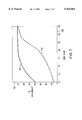
- FIG. 7 is a graph comparing the accuracy of speech recognition methods
- FIG. 8 is a flow diagram of a process for recognizing speakers.
- FIG. 9 is a graph comparing the accuracy of speaker recognition methods.
- FIG. 1 is an overview of an adaptive compensated speech processing system 100 according to a preferred embodiment of the invention.
- clean speech signals 101 are measured by a microphone (not shown).
- clean speech means speech which is free of noise and distortion.
- the clean speech 101 is digitized 102, measured 103, and statistically modeled 104.
- the modeling statistics p(x) 105 that are representative of the clean speech 101 are stored in a memory as entries of a vector codebook (VQ) 106 for use by a speech processing engine 110. After training, the system 100 can be used to process dirty speech signals.
- VQ vector codebook
- speech signals x(t) 121 are measured using a microphone which has a power spectrum Q( ⁇ ) 122 relative to the microphone used during the above training phase. Due to environmental conditions extant during actual use, the speech x(t) 121 is dirtied by unknown additive stationary noise and unknown linear filtering, e.g., distortion n(t) 123. These additive signals can be modeled as white noise passing through a filter with a power spectrum H( ⁇ ) 124.
- DSP digital signal processor
- FIG. 2 shows the details of the DSP 200.
- the DSP 200 selects (210) time-aligned portions of the dirty signals z(t) 126, and multiplies the portion by a well known window function, e.g., a Hamming window.
- a fast Fourier transform (FFT) is applied to windowed portions 220 in step 230 to produce "frames" 231.
- the selected digitized portions include 410 samples to which a 410 point Hamming window is applied to yield 512 point FFT frames 231.
- the frequency power spectrum statistics for the frames 231 are determined in step 240 by taking the square magnitude of the FFT result.
- Half of the FFT terms can be dropped because they are redundant leaving 256 point power spectrum estimates.
- the spectrum estimates are rotated into a mel-frequency domain by multiplying the estimates by a mel-frequency rotation matrix.
- Step 260 takes the logarithm of the rotated estimates to yield a feature vector representation 261 for each of the frames 231.
- step 270 can include applying a discrete cosine transform (DCT) to the mel-frequency log spectrum to determine the mel cepstrum.
- DCT discrete cosine transform
- the mel frequency transformation is optional, without it, the result of the DCT is simply termed the cepstrum.
- the window function moves along the measured dirty signals z(t) 126.
- the steps of the DSP 200 are applied to the signals at each new location of the Hamming window.
- the net result is a sequence of feature vectors z( ⁇ , T) 128.
- the vectors 128 can be processed by the engine 110 of FIG. 1.
- the vectors 128 are statistically compared with entries of the VQ 107 to produce results 199.
- x( ⁇ ,T) are the underlying clean vectors that would have been measured without noise and channel distortion
- n( ⁇ ,T) are the statistics if only the noise and distortion were present.
- the power spectrum Q( ⁇ ) 122 of the channel produces a linear distortion on the measured signals x(t) 121.
- the noise n(t) 123 is linearly distorted in the power spectrum domain, but non-linearly in the log spectral domain.
- the engine 110 has access to a statistical representation of x( ⁇ ,T), e.g., VQ 107. The present invention uses this information to estimate the noise and distortion.
- Equation 1 The effect of the noise and distortion on the speech statistics can be determined by expanding Equation 1 about the mean of the clean speech vectors using a first order Taylor series expansion of:
- Equations 2 and 3 show that the channel linearly shifts the mean of the measured statistics, decreases the signal-to-noise ratio, and decreases the covariance of the measured speech because the covariance of the noise is smaller than the covariance of the speech.
- the present invention uniquely combines the prior art methods of VTS and PMC, described above, to enable a compensated speech processing method which adapts to dynamically changing environmental parameters that can dirty speech.
- the invention uses the idea that the training speech can naturally be represented by itself as vectors p(x) 105 for the purpose of environmental compensation. Accordingly, all speech is represented by the training speech vector codebook (VQ) 107.
- VQ training speech vector codebook
- differences between clean training speech and actual dirty speech are determined using an Expectation Maximization (EM) process. In the EM process described below, an expectation step and a maximization step are iteratively performed to converge towards an optimal result during a gradient ascent.
- EM Expectation Maximization
- the stored training speech p(x) 105 can be expressed as: ##EQU1## where the collection ⁇ v i ⁇ represents the codebook for all possible speech vectors, and P i is the prior probability that the speech was produced by the corresponding vector.
- the compensation process 300 comprises three major stages.
- a first stage 310 using the EM process parameters of the noise and (channel) distortion are determined so that when the parameters are applied to the vector codebook 107, the codebook maximizes the likelihood that the transformed codebook best represents the dirty speech.
- a transformation of the codebook vector 107 is predicted given the estimated environmental parameters.
- the transformation can be expressed as a set of correction vectors.
- the corrected vectors are applied to the feature vectors 128 of the incoming dirty speech to make them more similar, in a minimum mean square error (MMSE) sense, to the clean vectors stored in the VQ 107.
- MMSE minimum mean square error
- the present compensation process 300 is independent of the processing engine 110, that is, the compensation process operates on the dirty feature vectors, correcting the vectors so that they closely resemble vectors derived from clean speech not soiled by noise and distortion in the environment.
- the EM stage iteratively determines the three parameters ⁇ Q, H, ⁇ n ⁇ that specify the environment.
- the first step 410 is a predictive step.
- the current values of ⁇ Q, H, ⁇ n ⁇ are used to map each vector in the codebook 107 to a predicted correction vector V' i using Equation 1, for each: ##EQU2##
- the value E n! has been absorbed in the value of H.
- the first derivative of this relationship with respect to noise is: ##EQU3## where ⁇ (i-j) is the Kronker delta.
- Each predicted codeword vector V' i is then extended 420 by its prior which is transformed as: ##EQU4##
- Each dirty speech vector is also augmented 430 by a zero. In this way, it is possible to directly compare augmented dirty vectors and augmented V' i codewords.
- the fully extended vector V' i has the form: ##EQU5## and the augmented dirty vector has the form: ##EQU6##
- the resulting set of extended correction vectors can then be stored (440) in the vector codebook VQ.
- each entry of the codebook can have a current associated extended correction vector reflecting the current state of the acoustic environment.
- the extended correction vectors have the property that -1/2 times the distance between a codebook vector and a corresponding dirty speech vector 128 can be used as the likelihood that a dirty vector z t is represented a codeword vector v i .
- FIG. 5 shows the steps 500 of the expectation stage in greater detail.
- the best match between one of the incoming dirty vectors 128 and a (corrected) codebook vector is determined, and statistics needed for the maximization stage are accumulated.
- the process begins by initializing variables L, N, n, Q, A, and B to zero in step 501.
- step 502 determine an entry in the new vector codebook VQ(z e ) which best resembles the transformed vector. Note, that the intial correction vectors in the codebook associated with the clean vectors can be zero, or estimated.
- the index to this entry can be expressed as:
- the squared distance (d(z' i ) ) between the best codebook vector and the incoming vector is also returned in step 503. This distance, a statistical difference between the selected codebook vector and the dirty vector, is used to determine likelihood of the measured vector as:
- the resulting likelihood is the posterior probability that the measured dirty vector is in fact represented by the codebook vector.
- the likelihood l(z i ) is accumulated(504) as:
- step 506 the residual is whitened with a Gaussian distribution.
- step (507) are computed the product of the residual, and the first derivative with respect to the noise ⁇ F(j(i))v.
- This operation can be done using a point-wise multiplication since F(j(i)) is a diagonal matrix.
- n is the total number of measured vectors used so far during the iterations.
- the products determined in step 507 are accumulated in step 509.
- the differences between the products of step 509, and the residual are accumulated in step 510 as:
- step 511 the covariance of the noise is re-estimated.
- step 512 the variable A is accumulated as:
- variable B as:
- the accumulated variables of the current estimation iteration are then used in the maximization stage.
- the maximization involves solving the set of linear equations: ##EQU7## where ⁇ Q and ⁇ N represent a priori covariances assigned to the Q and N parameters.
- the resulting value is then added to the current estimation of the environmental parameters.
- the final two phases can be performed depending on the desired speech processing application.
- the first step predicts the statistics of the dirty speech given the estimated parameters of the environment from the EM process. This is equivalent to the prediction step of the EM process.
- the second step uses the predicted statistics to estimate the MMSE correction factors.
- a first application where environmentally compensated speech can be used is in a speech recognition engine.
- This application would be useful to recognize speech acquired over a cellular phone network where noise and distortion tend to be higher than in plain old telephone services (POTS).
- POTS plain old telephone services
- This application can also be used in speech acquired over the World Wide Web where the speech can be generated in environments all over the world using many different types of hardware systems and communications lines.
- dirty speech signals 601 are digitally processed (610) to generate a temporal sequence of dirty feature vectors 602.
- Each vector statistically represents a set of acoustic features found in a segment of the continuous speech signals.
- the dirty vectors are cleaned to produce "cleaned" vectors 603 as described above. That is the invention is used to remove any effect the environment could have on the dirty vectors.
- the speech signals to be processed here are continuous. Unlike in batched speech processing, operating on short bursts of speech, here the compensation process needs to behave as a filter.
- a speech recognition engine 630 matches the cleaned vectors 603 against a sequence of possible statistical parameters representing known phonemes 605. The matching can be done in an efficient manner using an optimal search algorithm such as a Viterbi decoder that explores several possible hypotheses of phoneme sequences. A hypothesis sequence of phonemes closest in a statistical sense to the sequence of observed vectors is chosen as the uttered speech.
- an optimal search algorithm such as a Viterbi decoder that explores several possible hypotheses of phoneme sequences.
- a hypothesis sequence of phonemes closest in a statistical sense to the sequence of observed vectors is chosen as the uttered speech.
- the y-axis 701 indicates the percentage of accuracy in hypothesizing the correct speech
- the x-axis 702 indicates that relative level of noise (SNR).
- Broken curve 710 is for uncompensated speech recognition
- solid curve 720 is for compensated speech recognition. As can be seen, there is a significant improvement at all SNR below about 25 dB, which is typical for an office environment.
- dirty speech signals 801 of an unknown speaker are processed to extract vectors 810.
- the vectors 810 are compensated (820) to produce cleaned vectors 803.
- the vectors 803 are compared against models 805 of known speakers to produce an identification (ID) 804.
- the models 805 can be acquired during training sessions.
- the noisy speech statistics are first predicted given the values of the environmental parameters estimated in the expectation maximization phase. Then, the predicted statistics are mapped into final statistics to perform the required processing on the speech.
- the mean and covariance are determined for the predicted statistics. Then, the likelihood that an arbitrary utterance was generated by a particular speaker can be measured as the arithmetic harmonic sphericity (AHS) or the maximum likelihood (ML) distance.
- AHS arithmetic harmonic sphericity
- ML maximum likelihood
- Another possible technique uses the likelihood determined by the EM process. In this case, no further computations are necessary after the EM process converges.
- the y-axis 901 is the percentage of accuracy for correctly identifying speakers, and the x-axis indicates different levels of SNR.
- the curve 910 is for uncompensated speech using ML distance metrics and models trained with clean speech.
- the curve 920 is for compensated speech at a given measured SNR. For environments with a SNR less than 25 dB as is typically found in homes and offices, there is a marked improvement.
Landscapes
- Engineering & Computer Science (AREA)
- Computational Linguistics (AREA)
- Quality & Reliability (AREA)
- Signal Processing (AREA)
- Health & Medical Sciences (AREA)
- Audiology, Speech & Language Pathology (AREA)
- Human Computer Interaction (AREA)
- Physics & Mathematics (AREA)
- Acoustics & Sound (AREA)
- Multimedia (AREA)
- Compression, Expansion, Code Conversion, And Decoders (AREA)
- Machine Translation (AREA)
Priority Applications (5)
| Application Number | Priority Date | Filing Date | Title |
|---|---|---|---|
| US08/876,601 US5924065A (en) | 1997-06-16 | 1997-06-16 | Environmently compensated speech processing |
| CA002239357A CA2239357A1 (fr) | 1997-06-16 | 1998-06-02 | Traitement de signaux vocaux avec compensation environnementale |
| DE69831288T DE69831288T2 (de) | 1997-06-16 | 1998-06-05 | An Umgebungsgeräusche angepasste Sprachverarbeitung |
| EP98110330A EP0886263B1 (fr) | 1997-06-16 | 1998-06-05 | Traitement de la parole adapté aux bruits environmentaux |
| JP10163354A JPH1115491A (ja) | 1997-06-16 | 1998-06-11 | 環境的に補償されたスピーチ処理方法 |
Applications Claiming Priority (1)
| Application Number | Priority Date | Filing Date | Title |
|---|---|---|---|
| US08/876,601 US5924065A (en) | 1997-06-16 | 1997-06-16 | Environmently compensated speech processing |
Publications (1)
| Publication Number | Publication Date |
|---|---|
| US5924065A true US5924065A (en) | 1999-07-13 |
Family
ID=25368118
Family Applications (1)
| Application Number | Title | Priority Date | Filing Date |
|---|---|---|---|
| US08/876,601 Expired - Lifetime US5924065A (en) | 1997-06-16 | 1997-06-16 | Environmently compensated speech processing |
Country Status (5)
| Country | Link |
|---|---|
| US (1) | US5924065A (fr) |
| EP (1) | EP0886263B1 (fr) |
| JP (1) | JPH1115491A (fr) |
| CA (1) | CA2239357A1 (fr) |
| DE (1) | DE69831288T2 (fr) |
Cited By (52)
| Publication number | Priority date | Publication date | Assignee | Title |
|---|---|---|---|---|
| US6038528A (en) * | 1996-07-17 | 2000-03-14 | T-Netix, Inc. | Robust speech processing with affine transform replicated data |
| US6067513A (en) * | 1997-10-23 | 2000-05-23 | Pioneer Electronic Corporation | Speech recognition method and speech recognition apparatus |
| US20020042712A1 (en) * | 2000-09-29 | 2002-04-11 | Pioneer Corporation | Voice recognition system |
| US20020065584A1 (en) * | 2000-08-23 | 2002-05-30 | Andreas Kellner | Method of controlling devices via speech signals, more particularly, in motorcars |
| US20020143528A1 (en) * | 2001-03-14 | 2002-10-03 | Ibm Corporation | Multi-channel codebook dependent compensation |
| US20020165681A1 (en) * | 2000-09-06 | 2002-11-07 | Koji Yoshida | Noise signal analyzer, noise signal synthesizer, noise signal analyzing method, and noise signal synthesizing method |
| US20020173953A1 (en) * | 2001-03-20 | 2002-11-21 | Frey Brendan J. | Method and apparatus for removing noise from feature vectors |
| US20020173959A1 (en) * | 2001-03-14 | 2002-11-21 | Yifan Gong | Method of speech recognition with compensation for both channel distortion and background noise |
| US20020177998A1 (en) * | 2001-03-28 | 2002-11-28 | Yifan Gong | Calibration of speech data acquisition path |
| US20020198706A1 (en) * | 2001-05-07 | 2002-12-26 | Yu-Hung Kao | Implementing a high accuracy continuous speech recognizer on a fixed-point processor |
| US20030033143A1 (en) * | 2001-08-13 | 2003-02-13 | Hagai Aronowitz | Decreasing noise sensitivity in speech processing under adverse conditions |
| US20030061037A1 (en) * | 2001-09-27 | 2003-03-27 | Droppo James G. | Method and apparatus for identifying noise environments from noisy signals |
| US20030115055A1 (en) * | 2001-12-12 | 2003-06-19 | Yifan Gong | Method of speech recognition resistant to convolutive distortion and additive distortion |
| US20030135362A1 (en) * | 2002-01-15 | 2003-07-17 | General Motors Corporation | Automated voice pattern filter |
| US20030182110A1 (en) * | 2002-03-19 | 2003-09-25 | Li Deng | Method of speech recognition using variables representing dynamic aspects of speech |
| US20030191638A1 (en) * | 2002-04-05 | 2003-10-09 | Droppo James G. | Method of noise reduction using correction vectors based on dynamic aspects of speech and noise normalization |
| US20030191641A1 (en) * | 2002-04-05 | 2003-10-09 | Alejandro Acero | Method of iterative noise estimation in a recursive framework |
| US6633842B1 (en) * | 1999-10-22 | 2003-10-14 | Texas Instruments Incorporated | Speech recognition front-end feature extraction for noisy speech |
| US6633839B2 (en) * | 2001-02-02 | 2003-10-14 | Motorola, Inc. | Method and apparatus for speech reconstruction in a distributed speech recognition system |
| US20030216914A1 (en) * | 2002-05-20 | 2003-11-20 | Droppo James G. | Method of pattern recognition using noise reduction uncertainty |
| US20030216911A1 (en) * | 2002-05-20 | 2003-11-20 | Li Deng | Method of noise reduction based on dynamic aspects of speech |
| US6658385B1 (en) * | 1999-03-12 | 2003-12-02 | Texas Instruments Incorporated | Method for transforming HMMs for speaker-independent recognition in a noisy environment |
| US20030225577A1 (en) * | 2002-05-20 | 2003-12-04 | Li Deng | Method of determining uncertainty associated with acoustic distortion-based noise reduction |
| US20040002867A1 (en) * | 2002-06-28 | 2004-01-01 | Canon Kabushiki Kaisha | Speech recognition apparatus and method |
| US20040052383A1 (en) * | 2002-09-06 | 2004-03-18 | Alejandro Acero | Non-linear observation model for removing noise from corrupted signals |
| KR100435441B1 (ko) * | 2002-03-18 | 2004-06-10 | 정희석 | 사용자 이동성을 고려한 화자 인식에서의 채널 불일치보상 장치 및 그 방법 |
| US20040111261A1 (en) * | 2002-12-10 | 2004-06-10 | International Business Machines Corporation | Computationally efficient method and apparatus for speaker recognition |
| US6766280B2 (en) * | 1998-06-18 | 2004-07-20 | Nec Corporation | Device, method, and medium for predicting a probability of an occurrence of a data |
| US20040190732A1 (en) * | 2003-03-31 | 2004-09-30 | Microsoft Corporation | Method of noise estimation using incremental bayes learning |
| US20040199384A1 (en) * | 2003-04-04 | 2004-10-07 | Wei-Tyng Hong | Speech model training technique for speech recognition |
| US20050114117A1 (en) * | 2003-11-26 | 2005-05-26 | Microsoft Corporation | Method and apparatus for high resolution speech reconstruction |
| US20050149325A1 (en) * | 2000-10-16 | 2005-07-07 | Microsoft Corporation | Method of noise reduction using correction and scaling vectors with partitioning of the acoustic space in the domain of noisy speech |
| US20050182624A1 (en) * | 2004-02-16 | 2005-08-18 | Microsoft Corporation | Method and apparatus for constructing a speech filter using estimates of clean speech and noise |
| US20050256714A1 (en) * | 2004-03-29 | 2005-11-17 | Xiaodong Cui | Sequential variance adaptation for reducing signal mismatching |
| US20060056647A1 (en) * | 2004-09-13 | 2006-03-16 | Bhiksha Ramakrishnan | Separating multiple audio signals recorded as a single mixed signal |
| US20060111897A1 (en) * | 2002-12-23 | 2006-05-25 | Roberto Gemello | Method of optimising the execution of a neural network in a speech recognition system through conditionally skipping a variable number of frames |
| US20060184362A1 (en) * | 2005-02-15 | 2006-08-17 | Bbn Technologies Corp. | Speech analyzing system with adaptive noise codebook |
| USH2172H1 (en) * | 2002-07-02 | 2006-09-05 | The United States Of America As Represented By The Secretary Of The Air Force | Pitch-synchronous speech processing |
| US20070055502A1 (en) * | 2005-02-15 | 2007-03-08 | Bbn Technologies Corp. | Speech analyzing system with speech codebook |
| US20070129941A1 (en) * | 2005-12-01 | 2007-06-07 | Hitachi, Ltd. | Preprocessing system and method for reducing FRR in speaking recognition |
| US20070129945A1 (en) * | 2005-12-06 | 2007-06-07 | Ma Changxue C | Voice quality control for high quality speech reconstruction |
| US20070198255A1 (en) * | 2004-04-08 | 2007-08-23 | Tim Fingscheidt | Method For Noise Reduction In A Speech Input Signal |
| US7280961B1 (en) * | 1999-03-04 | 2007-10-09 | Sony Corporation | Pattern recognizing device and method, and providing medium |
| US20080175423A1 (en) * | 2006-11-27 | 2008-07-24 | Volkmar Hamacher | Adjusting a hearing apparatus to a speech signal |
| US20100076758A1 (en) * | 2008-09-24 | 2010-03-25 | Microsoft Corporation | Phase sensitive model adaptation for noisy speech recognition |
| US20120307980A1 (en) * | 2011-06-03 | 2012-12-06 | Apple Inc. | Audio quality and double talk preservation in echo control for voice communications |
| US20150179184A1 (en) * | 2013-12-20 | 2015-06-25 | International Business Machines Corporation | Compensating For Identifiable Background Content In A Speech Recognition Device |
| US20150373453A1 (en) * | 2014-06-18 | 2015-12-24 | Cypher, Llc | Multi-aural mmse analysis techniques for clarifying audio signals |
| US20160005414A1 (en) * | 2014-07-02 | 2016-01-07 | Nuance Communications, Inc. | System and method for compressed domain estimation of the signal to noise ratio of a coded speech signal |
| WO2017111634A1 (fr) * | 2015-12-22 | 2017-06-29 | Intel Corporation | Réglage automatique de paramètres de reconnaissance vocale |
| US20180211671A1 (en) * | 2017-01-23 | 2018-07-26 | Qualcomm Incorporated | Keyword voice authentication |
| CN110297616A (zh) * | 2019-05-31 | 2019-10-01 | 百度在线网络技术(北京)有限公司 | 话术的生成方法、装置、设备以及存储介质 |
Families Citing this family (7)
| Publication number | Priority date | Publication date | Assignee | Title |
|---|---|---|---|---|
| JP3979562B2 (ja) | 2000-09-22 | 2007-09-19 | パイオニア株式会社 | 光ピックアップ装置 |
| US7499686B2 (en) * | 2004-02-24 | 2009-03-03 | Microsoft Corporation | Method and apparatus for multi-sensory speech enhancement on a mobile device |
| US7680656B2 (en) * | 2005-06-28 | 2010-03-16 | Microsoft Corporation | Multi-sensory speech enhancement using a speech-state model |
| JP4316583B2 (ja) | 2006-04-07 | 2009-08-19 | 株式会社東芝 | 特徴量補正装置、特徴量補正方法および特徴量補正プログラム |
| GB2471875B (en) | 2009-07-15 | 2011-08-10 | Toshiba Res Europ Ltd | A speech recognition system and method |
| DE102012206313A1 (de) * | 2012-04-17 | 2013-10-17 | Fraunhofer-Gesellschaft zur Förderung der angewandten Forschung e.V. | Konzept zum Erkennen eines akustischen Ereignisses in einer Audiosequenz |
| CN116612777A (zh) * | 2023-06-28 | 2023-08-18 | 歌尔智能科技有限公司 | 噪声协方差确定方法、装置、设备及存储介质 |
Citations (8)
| Publication number | Priority date | Publication date | Assignee | Title |
|---|---|---|---|---|
| US5008941A (en) * | 1989-03-31 | 1991-04-16 | Kurzweil Applied Intelligence, Inc. | Method and apparatus for automatically updating estimates of undesirable components of the speech signal in a speech recognition system |
| US5148489A (en) * | 1990-02-28 | 1992-09-15 | Sri International | Method for spectral estimation to improve noise robustness for speech recognition |
| US5377301A (en) * | 1986-03-28 | 1994-12-27 | At&T Corp. | Technique for modifying reference vector quantized speech feature signals |
| US5469529A (en) * | 1992-09-24 | 1995-11-21 | France Telecom Establissement Autonome De Droit Public | Process for measuring the resemblance between sound samples and apparatus for performing this process |
| US5598505A (en) * | 1994-09-30 | 1997-01-28 | Apple Computer, Inc. | Cepstral correction vector quantizer for speech recognition |
| US5727124A (en) * | 1994-06-21 | 1998-03-10 | Lucent Technologies, Inc. | Method of and apparatus for signal recognition that compensates for mismatching |
| US5745872A (en) * | 1996-05-07 | 1998-04-28 | Texas Instruments Incorporated | Method and system for compensating speech signals using vector quantization codebook adaptation |
| US5768474A (en) * | 1995-12-29 | 1998-06-16 | International Business Machines Corporation | Method and system for noise-robust speech processing with cochlea filters in an auditory model |
-
1997
- 1997-06-16 US US08/876,601 patent/US5924065A/en not_active Expired - Lifetime
-
1998
- 1998-06-02 CA CA002239357A patent/CA2239357A1/fr not_active Abandoned
- 1998-06-05 EP EP98110330A patent/EP0886263B1/fr not_active Expired - Lifetime
- 1998-06-05 DE DE69831288T patent/DE69831288T2/de not_active Expired - Lifetime
- 1998-06-11 JP JP10163354A patent/JPH1115491A/ja active Pending
Patent Citations (8)
| Publication number | Priority date | Publication date | Assignee | Title |
|---|---|---|---|---|
| US5377301A (en) * | 1986-03-28 | 1994-12-27 | At&T Corp. | Technique for modifying reference vector quantized speech feature signals |
| US5008941A (en) * | 1989-03-31 | 1991-04-16 | Kurzweil Applied Intelligence, Inc. | Method and apparatus for automatically updating estimates of undesirable components of the speech signal in a speech recognition system |
| US5148489A (en) * | 1990-02-28 | 1992-09-15 | Sri International | Method for spectral estimation to improve noise robustness for speech recognition |
| US5469529A (en) * | 1992-09-24 | 1995-11-21 | France Telecom Establissement Autonome De Droit Public | Process for measuring the resemblance between sound samples and apparatus for performing this process |
| US5727124A (en) * | 1994-06-21 | 1998-03-10 | Lucent Technologies, Inc. | Method of and apparatus for signal recognition that compensates for mismatching |
| US5598505A (en) * | 1994-09-30 | 1997-01-28 | Apple Computer, Inc. | Cepstral correction vector quantizer for speech recognition |
| US5768474A (en) * | 1995-12-29 | 1998-06-16 | International Business Machines Corporation | Method and system for noise-robust speech processing with cochlea filters in an auditory model |
| US5745872A (en) * | 1996-05-07 | 1998-04-28 | Texas Instruments Incorporated | Method and system for compensating speech signals using vector quantization codebook adaptation |
Non-Patent Citations (26)
| Title |
|---|
| Acero, A. & Stern, R., "Robust Speech Recognition by Normalization of the Acoustic Space," Department of Electrical and Computer Engineering and School of Computer Science. |
| Acero, A. & Stern, R., Robust Speech Recognition by Normalization of the Acoustic Space, Department of Electrical and Computer Engineering and School of Computer Science. * |
| Acero, A., "Acoustical and Environmental Robustness in Automatic Speech Recognition," Ph.D. Thesis, CMU, Dept. of EECS, 1990. |
| Acero, A., Acoustical and Environmental Robustness in Automatic Speech Recognition, Ph.D. Thesis, CMU, Dept. of EECS, 1990. * |
| Bimbot F., "Text-Free Speaker Recognition Using an Arithmetic-Harmonic Sphericity Measure," in Proc. Eurospeech 93, vol. 1, pp. 169-172, Sep. 1993. |
| Bimbot F., Text Free Speaker Recognition Using an Arithmetic Harmonic Sphericity Measure, in Proc. Eurospeech 93, vol. 1, pp. 169 172, Sep. 1993. * |
| Dempster, A., Laird, N.M., Rubin, D.B., "Maximum Likelihood from Incomplete Data via the EM Algorithm," Harvard University and Educational Testing Service, Dec. 8, 1976. |
| Dempster, A., Laird, N.M., Rubin, D.B., Maximum Likelihood from Incomplete Data via the EM Algorithm, Harvard University and Educational Testing Service, Dec. 8, 1976. * |
| Gales, J.F., & Young, S.J., "Parallel Model Combination for Speech Recognition in Noise," Cambridge University Engineering Department, Jun. 1993. |
| Gales, J.F., & Young, S.J., Parallel Model Combination for Speech Recognition in Noise, Cambridge University Engineering Department, Jun. 1993. * |
| Gales, J.R., & Young, S.J., "Robust Continuous Speech Recognition Using Parallel Model Combination," Cambridge University Engineering Department, Mar. 1994. |
| Gales, J.R., & Young, S.J., Robust Continuous Speech Recognition Using Parallel Model Combination, Cambridge University Engineering Department, Mar. 1994. * |
| Gauvain, L., Lamel, L., Adda, G., & Matrouf, D., "Developments in Continuous Speech Dictation using the 1995 ARPA NAB News Task," In Proceedings: ICASSP 96, 1996 Int. Conf. on Acoustics, Speech, and Signal Processing, 1996. |
| Gauvain, L., Lamel, L., Adda, G., & Matrouf, D., Developments in Continuous Speech Dictation using the 1995 ARPA NAB News Task, In Proceedings: ICASSP 96, 1996 Int. Conf. on Acoustics, Speech, and Signal Processing, 1996. * |
| Gish, H. and Schmidt, M., "Text-Independent Speaker Identification," IEEE Signal Pocessing Magazine, Oct. 1994. |
| Gish, H. and Schmidt, M., Text Independent Speaker Identification, IEEE Signal Pocessing Magazine, Oct. 1994. * |
| Leggetter, C.J. & Woodland, P.C., "Speaker Adaptation of HMMS Using Linear Regression," Cambridge University Engineering Department, Jun. 1994. |
| Leggetter, C.J. & Woodland, P.C., Speaker Adaptation of HMMS Using Linear Regression, Cambridge University Engineering Department, Jun. 1994. * |
| Liu, F., Acero, A. & Stern, R., "Efficient Joint Compensation of Speech for the Effects of Additive Noise and Linear Filtering," In Proc: ICASSP 92, 1992 Int. Conf. on Acoustics, Speech, and Signal Processing, vol. I, pp. 257-260, Mar. 1992. |
| Liu, F., Acero, A. & Stern, R., Efficient Joint Compensation of Speech for the Effects of Additive Noise and Linear Filtering, In Proc: ICASSP 92, 1992 Int. Conf. on Acoustics, Speech, and Signal Processing, vol. I, pp. 257 260, Mar. 1992. * |
| Moreno, P., Raj, B., and Stern, R., "A Vector Taylor Series Approach for Environment-Independent Speech Recognition," Department of Electrical and Computer Engineering & School of Computer Science. |
| Moreno, P., Raj, B., and Stern, R., A Vector Taylor Series Approach for Environment Independent Speech Recognition, Department of Electrical and Computer Engineering & School of Computer Science. * |
| Neumeyer, L. and Weintraub, M., "Probabilistic Optimum Filtering for Robust Speech Recognition," In Proc: ICASSP 94, 1994 Int. Conf. on Acoustics, Speech, and Signal Processing, vol. I, pp. 417-420, May 1994. |
| Neumeyer, L. and Weintraub, M., Probabilistic Optimum Filtering for Robust Speech Recognition, In Proc: ICASSP 94, 1994 Int. Conf. on Acoustics, Speech, and Signal Processing, vol. I, pp. 417 420, May 1994. * |
| Zhang, X. & Mammone, R., "Channel and Noise Normalization Using Affine Transformed Cepstrum," In Int. Conf. on Speech and Language Processing, 1996. |
| Zhang, X. & Mammone, R., Channel and Noise Normalization Using Affine Transformed Cepstrum, In Int. Conf. on Speech and Language Processing, 1996. * |
Cited By (104)
| Publication number | Priority date | Publication date | Assignee | Title |
|---|---|---|---|---|
| US6038528A (en) * | 1996-07-17 | 2000-03-14 | T-Netix, Inc. | Robust speech processing with affine transform replicated data |
| US6067513A (en) * | 1997-10-23 | 2000-05-23 | Pioneer Electronic Corporation | Speech recognition method and speech recognition apparatus |
| US6766280B2 (en) * | 1998-06-18 | 2004-07-20 | Nec Corporation | Device, method, and medium for predicting a probability of an occurrence of a data |
| US7280961B1 (en) * | 1999-03-04 | 2007-10-09 | Sony Corporation | Pattern recognizing device and method, and providing medium |
| US6658385B1 (en) * | 1999-03-12 | 2003-12-02 | Texas Instruments Incorporated | Method for transforming HMMs for speaker-independent recognition in a noisy environment |
| US6633842B1 (en) * | 1999-10-22 | 2003-10-14 | Texas Instruments Incorporated | Speech recognition front-end feature extraction for noisy speech |
| US20020065584A1 (en) * | 2000-08-23 | 2002-05-30 | Andreas Kellner | Method of controlling devices via speech signals, more particularly, in motorcars |
| US7165027B2 (en) * | 2000-08-23 | 2007-01-16 | Koninklijke Philips Electronics N.V. | Method of controlling devices via speech signals, more particularly, in motorcars |
| US20020165681A1 (en) * | 2000-09-06 | 2002-11-07 | Koji Yoshida | Noise signal analyzer, noise signal synthesizer, noise signal analyzing method, and noise signal synthesizing method |
| US6934650B2 (en) * | 2000-09-06 | 2005-08-23 | Panasonic Mobile Communications Co., Ltd. | Noise signal analysis apparatus, noise signal synthesis apparatus, noise signal analysis method and noise signal synthesis method |
| US20020042712A1 (en) * | 2000-09-29 | 2002-04-11 | Pioneer Corporation | Voice recognition system |
| US7065488B2 (en) * | 2000-09-29 | 2006-06-20 | Pioneer Corporation | Speech recognition system with an adaptive acoustic model |
| US7254536B2 (en) | 2000-10-16 | 2007-08-07 | Microsoft Corporation | Method of noise reduction using correction and scaling vectors with partitioning of the acoustic space in the domain of noisy speech |
| US20050149325A1 (en) * | 2000-10-16 | 2005-07-07 | Microsoft Corporation | Method of noise reduction using correction and scaling vectors with partitioning of the acoustic space in the domain of noisy speech |
| US7003455B1 (en) * | 2000-10-16 | 2006-02-21 | Microsoft Corporation | Method of noise reduction using correction and scaling vectors with partitioning of the acoustic space in the domain of noisy speech |
| US6633839B2 (en) * | 2001-02-02 | 2003-10-14 | Motorola, Inc. | Method and apparatus for speech reconstruction in a distributed speech recognition system |
| US20080059180A1 (en) * | 2001-03-14 | 2008-03-06 | International Business Machines Corporation | Multi-channel codebook dependent compensation |
| US20020173959A1 (en) * | 2001-03-14 | 2002-11-21 | Yifan Gong | Method of speech recognition with compensation for both channel distortion and background noise |
| US20020143528A1 (en) * | 2001-03-14 | 2002-10-03 | Ibm Corporation | Multi-channel codebook dependent compensation |
| US8041561B2 (en) | 2001-03-14 | 2011-10-18 | Nuance Communications, Inc. | Multi-channel codebook dependent compensation |
| US7319954B2 (en) * | 2001-03-14 | 2008-01-15 | International Business Machines Corporation | Multi-channel codebook dependent compensation |
| US7062433B2 (en) * | 2001-03-14 | 2006-06-13 | Texas Instruments Incorporated | Method of speech recognition with compensation for both channel distortion and background noise |
| US6985858B2 (en) * | 2001-03-20 | 2006-01-10 | Microsoft Corporation | Method and apparatus for removing noise from feature vectors |
| US20050273325A1 (en) * | 2001-03-20 | 2005-12-08 | Microsoft Corporation | Removing noise from feature vectors |
| US7451083B2 (en) | 2001-03-20 | 2008-11-11 | Microsoft Corporation | Removing noise from feature vectors |
| US7310599B2 (en) | 2001-03-20 | 2007-12-18 | Microsoft Corporation | Removing noise from feature vectors |
| US20050256706A1 (en) * | 2001-03-20 | 2005-11-17 | Microsoft Corporation | Removing noise from feature vectors |
| US20020173953A1 (en) * | 2001-03-20 | 2002-11-21 | Frey Brendan J. | Method and apparatus for removing noise from feature vectors |
| US6912497B2 (en) * | 2001-03-28 | 2005-06-28 | Texas Instruments Incorporated | Calibration of speech data acquisition path |
| US20020177998A1 (en) * | 2001-03-28 | 2002-11-28 | Yifan Gong | Calibration of speech data acquisition path |
| US20020198706A1 (en) * | 2001-05-07 | 2002-12-26 | Yu-Hung Kao | Implementing a high accuracy continuous speech recognizer on a fixed-point processor |
| US7103547B2 (en) * | 2001-05-07 | 2006-09-05 | Texas Instruments Incorporated | Implementing a high accuracy continuous speech recognizer on a fixed-point processor |
| US20030033143A1 (en) * | 2001-08-13 | 2003-02-13 | Hagai Aronowitz | Decreasing noise sensitivity in speech processing under adverse conditions |
| US20030061037A1 (en) * | 2001-09-27 | 2003-03-27 | Droppo James G. | Method and apparatus for identifying noise environments from noisy signals |
| US20050071157A1 (en) * | 2001-09-27 | 2005-03-31 | Microsoft Corporation | Method and apparatus for identifying noise environments from noisy signals |
| US7266494B2 (en) * | 2001-09-27 | 2007-09-04 | Microsoft Corporation | Method and apparatus for identifying noise environments from noisy signals |
| US6959276B2 (en) * | 2001-09-27 | 2005-10-25 | Microsoft Corporation | Including the category of environmental noise when processing speech signals |
| US20030115055A1 (en) * | 2001-12-12 | 2003-06-19 | Yifan Gong | Method of speech recognition resistant to convolutive distortion and additive distortion |
| US7165028B2 (en) * | 2001-12-12 | 2007-01-16 | Texas Instruments Incorporated | Method of speech recognition resistant to convolutive distortion and additive distortion |
| US7003458B2 (en) * | 2002-01-15 | 2006-02-21 | General Motors Corporation | Automated voice pattern filter |
| US20030135362A1 (en) * | 2002-01-15 | 2003-07-17 | General Motors Corporation | Automated voice pattern filter |
| KR100435441B1 (ko) * | 2002-03-18 | 2004-06-10 | 정희석 | 사용자 이동성을 고려한 화자 인식에서의 채널 불일치보상 장치 및 그 방법 |
| US7346510B2 (en) | 2002-03-19 | 2008-03-18 | Microsoft Corporation | Method of speech recognition using variables representing dynamic aspects of speech |
| US20030182110A1 (en) * | 2002-03-19 | 2003-09-25 | Li Deng | Method of speech recognition using variables representing dynamic aspects of speech |
| US7181390B2 (en) * | 2002-04-05 | 2007-02-20 | Microsoft Corporation | Noise reduction using correction vectors based on dynamic aspects of speech and noise normalization |
| US7542900B2 (en) | 2002-04-05 | 2009-06-02 | Microsoft Corporation | Noise reduction using correction vectors based on dynamic aspects of speech and noise normalization |
| US20030191641A1 (en) * | 2002-04-05 | 2003-10-09 | Alejandro Acero | Method of iterative noise estimation in a recursive framework |
| US7139703B2 (en) | 2002-04-05 | 2006-11-21 | Microsoft Corporation | Method of iterative noise estimation in a recursive framework |
| US7117148B2 (en) * | 2002-04-05 | 2006-10-03 | Microsoft Corporation | Method of noise reduction using correction vectors based on dynamic aspects of speech and noise normalization |
| US20030191638A1 (en) * | 2002-04-05 | 2003-10-09 | Droppo James G. | Method of noise reduction using correction vectors based on dynamic aspects of speech and noise normalization |
| US7107210B2 (en) | 2002-05-20 | 2006-09-12 | Microsoft Corporation | Method of noise reduction based on dynamic aspects of speech |
| US20080281591A1 (en) * | 2002-05-20 | 2008-11-13 | Microsoft Corporation | Method of pattern recognition using noise reduction uncertainty |
| US7289955B2 (en) | 2002-05-20 | 2007-10-30 | Microsoft Corporation | Method of determining uncertainty associated with acoustic distortion-based noise reduction |
| US7769582B2 (en) | 2002-05-20 | 2010-08-03 | Microsoft Corporation | Method of pattern recognition using noise reduction uncertainty |
| US20060206322A1 (en) * | 2002-05-20 | 2006-09-14 | Microsoft Corporation | Method of noise reduction based on dynamic aspects of speech |
| US20030216914A1 (en) * | 2002-05-20 | 2003-11-20 | Droppo James G. | Method of pattern recognition using noise reduction uncertainty |
| US20030225577A1 (en) * | 2002-05-20 | 2003-12-04 | Li Deng | Method of determining uncertainty associated with acoustic distortion-based noise reduction |
| US7617098B2 (en) | 2002-05-20 | 2009-11-10 | Microsoft Corporation | Method of noise reduction based on dynamic aspects of speech |
| US7103540B2 (en) * | 2002-05-20 | 2006-09-05 | Microsoft Corporation | Method of pattern recognition using noise reduction uncertainty |
| US20030216911A1 (en) * | 2002-05-20 | 2003-11-20 | Li Deng | Method of noise reduction based on dynamic aspects of speech |
| US7174292B2 (en) | 2002-05-20 | 2007-02-06 | Microsoft Corporation | Method of determining uncertainty associated with acoustic distortion-based noise reduction |
| US7460992B2 (en) | 2002-05-20 | 2008-12-02 | Microsoft Corporation | Method of pattern recognition using noise reduction uncertainty |
| US20040002867A1 (en) * | 2002-06-28 | 2004-01-01 | Canon Kabushiki Kaisha | Speech recognition apparatus and method |
| US7337113B2 (en) * | 2002-06-28 | 2008-02-26 | Canon Kabushiki Kaisha | Speech recognition apparatus and method |
| USH2172H1 (en) * | 2002-07-02 | 2006-09-05 | The United States Of America As Represented By The Secretary Of The Air Force | Pitch-synchronous speech processing |
| US7047047B2 (en) * | 2002-09-06 | 2006-05-16 | Microsoft Corporation | Non-linear observation model for removing noise from corrupted signals |
| US20040052383A1 (en) * | 2002-09-06 | 2004-03-18 | Alejandro Acero | Non-linear observation model for removing noise from corrupted signals |
| US6772119B2 (en) * | 2002-12-10 | 2004-08-03 | International Business Machines Corporation | Computationally efficient method and apparatus for speaker recognition |
| US20040111261A1 (en) * | 2002-12-10 | 2004-06-10 | International Business Machines Corporation | Computationally efficient method and apparatus for speaker recognition |
| US20060111897A1 (en) * | 2002-12-23 | 2006-05-25 | Roberto Gemello | Method of optimising the execution of a neural network in a speech recognition system through conditionally skipping a variable number of frames |
| US7769580B2 (en) * | 2002-12-23 | 2010-08-03 | Loquendo S.P.A. | Method of optimising the execution of a neural network in a speech recognition system through conditionally skipping a variable number of frames |
| US7165026B2 (en) | 2003-03-31 | 2007-01-16 | Microsoft Corporation | Method of noise estimation using incremental bayes learning |
| US20040190732A1 (en) * | 2003-03-31 | 2004-09-30 | Microsoft Corporation | Method of noise estimation using incremental bayes learning |
| US20040199384A1 (en) * | 2003-04-04 | 2004-10-07 | Wei-Tyng Hong | Speech model training technique for speech recognition |
| US20050114117A1 (en) * | 2003-11-26 | 2005-05-26 | Microsoft Corporation | Method and apparatus for high resolution speech reconstruction |
| US7596494B2 (en) | 2003-11-26 | 2009-09-29 | Microsoft Corporation | Method and apparatus for high resolution speech reconstruction |
| US20050182624A1 (en) * | 2004-02-16 | 2005-08-18 | Microsoft Corporation | Method and apparatus for constructing a speech filter using estimates of clean speech and noise |
| US7725314B2 (en) | 2004-02-16 | 2010-05-25 | Microsoft Corporation | Method and apparatus for constructing a speech filter using estimates of clean speech and noise |
| US20050256714A1 (en) * | 2004-03-29 | 2005-11-17 | Xiaodong Cui | Sequential variance adaptation for reducing signal mismatching |
| US20070198255A1 (en) * | 2004-04-08 | 2007-08-23 | Tim Fingscheidt | Method For Noise Reduction In A Speech Input Signal |
| US7454333B2 (en) * | 2004-09-13 | 2008-11-18 | Mitsubishi Electric Research Lab, Inc. | Separating multiple audio signals recorded as a single mixed signal |
| US20060056647A1 (en) * | 2004-09-13 | 2006-03-16 | Bhiksha Ramakrishnan | Separating multiple audio signals recorded as a single mixed signal |
| US8219391B2 (en) | 2005-02-15 | 2012-07-10 | Raytheon Bbn Technologies Corp. | Speech analyzing system with speech codebook |
| US20070055502A1 (en) * | 2005-02-15 | 2007-03-08 | Bbn Technologies Corp. | Speech analyzing system with speech codebook |
| US7797156B2 (en) * | 2005-02-15 | 2010-09-14 | Raytheon Bbn Technologies Corp. | Speech analyzing system with adaptive noise codebook |
| US20060184362A1 (en) * | 2005-02-15 | 2006-08-17 | Bbn Technologies Corp. | Speech analyzing system with adaptive noise codebook |
| US20070129941A1 (en) * | 2005-12-01 | 2007-06-07 | Hitachi, Ltd. | Preprocessing system and method for reducing FRR in speaking recognition |
| US20070129945A1 (en) * | 2005-12-06 | 2007-06-07 | Ma Changxue C | Voice quality control for high quality speech reconstruction |
| US20080175423A1 (en) * | 2006-11-27 | 2008-07-24 | Volkmar Hamacher | Adjusting a hearing apparatus to a speech signal |
| US8214215B2 (en) | 2008-09-24 | 2012-07-03 | Microsoft Corporation | Phase sensitive model adaptation for noisy speech recognition |
| US20100076758A1 (en) * | 2008-09-24 | 2010-03-25 | Microsoft Corporation | Phase sensitive model adaptation for noisy speech recognition |
| US20120307980A1 (en) * | 2011-06-03 | 2012-12-06 | Apple Inc. | Audio quality and double talk preservation in echo control for voice communications |
| US8600037B2 (en) * | 2011-06-03 | 2013-12-03 | Apple Inc. | Audio quality and double talk preservation in echo control for voice communications |
| US9466310B2 (en) * | 2013-12-20 | 2016-10-11 | Lenovo Enterprise Solutions (Singapore) Pte. Ltd. | Compensating for identifiable background content in a speech recognition device |
| US20150179184A1 (en) * | 2013-12-20 | 2015-06-25 | International Business Machines Corporation | Compensating For Identifiable Background Content In A Speech Recognition Device |
| US20150373453A1 (en) * | 2014-06-18 | 2015-12-24 | Cypher, Llc | Multi-aural mmse analysis techniques for clarifying audio signals |
| US10149047B2 (en) * | 2014-06-18 | 2018-12-04 | Cirrus Logic Inc. | Multi-aural MMSE analysis techniques for clarifying audio signals |
| US20160005414A1 (en) * | 2014-07-02 | 2016-01-07 | Nuance Communications, Inc. | System and method for compressed domain estimation of the signal to noise ratio of a coded speech signal |
| US9361899B2 (en) * | 2014-07-02 | 2016-06-07 | Nuance Communications, Inc. | System and method for compressed domain estimation of the signal to noise ratio of a coded speech signal |
| WO2017111634A1 (fr) * | 2015-12-22 | 2017-06-29 | Intel Corporation | Réglage automatique de paramètres de reconnaissance vocale |
| US20180211671A1 (en) * | 2017-01-23 | 2018-07-26 | Qualcomm Incorporated | Keyword voice authentication |
| US10720165B2 (en) * | 2017-01-23 | 2020-07-21 | Qualcomm Incorporated | Keyword voice authentication |
| CN110297616A (zh) * | 2019-05-31 | 2019-10-01 | 百度在线网络技术(北京)有限公司 | 话术的生成方法、装置、设备以及存储介质 |
| CN110297616B (zh) * | 2019-05-31 | 2023-06-02 | 百度在线网络技术(北京)有限公司 | 话术的生成方法、装置、设备以及存储介质 |
Also Published As
| Publication number | Publication date |
|---|---|
| EP0886263A2 (fr) | 1998-12-23 |
| EP0886263A3 (fr) | 1999-08-11 |
| CA2239357A1 (fr) | 1998-12-16 |
| DE69831288D1 (de) | 2005-09-29 |
| EP0886263B1 (fr) | 2005-08-24 |
| DE69831288T2 (de) | 2006-06-08 |
| JPH1115491A (ja) | 1999-01-22 |
Similar Documents
| Publication | Publication Date | Title |
|---|---|---|
| US5924065A (en) | Environmently compensated speech processing | |
| Acero et al. | Robust speech recognition by normalization of the acoustic space. | |
| EP0689194B1 (fr) | Procédé et appareil pour la reconnaissance de signaux en compensant la désadaptation | |
| US5864806A (en) | Decision-directed frame-synchronous adaptive equalization filtering of a speech signal by implementing a hidden markov model | |
| US5806029A (en) | Signal conditioned minimum error rate training for continuous speech recognition | |
| EP0788089B1 (fr) | Procédé et dispositif pour supprimer de la musique ou du bruit de fond d'un signal d'entrée d'un appareil de reconnaissance de la parole | |
| US5943429A (en) | Spectral subtraction noise suppression method | |
| US6157909A (en) | Process and device for blind equalization of the effects of a transmission channel on a digital speech signal | |
| US6151573A (en) | Source normalization training for HMM modeling of speech | |
| JP3154487B2 (ja) | 音声認識の際の雑音のロバストネスを改善するためにスペクトル的推定を行う方法 | |
| Stern et al. | Compensation for environmental degradation in automatic speech recognition | |
| Stern et al. | Signal processing for robust speech recognition | |
| CN108172231A (zh) | 一种基于卡尔曼滤波的去混响方法及系统 | |
| Sehr et al. | Reverberation model-based decoding in the logmelspec domain for robust distant-talking speech recognition | |
| WO1997010587A9 (fr) | Apprentissage a taux d'erreur minimal par conditionnement du signal applique a la reconnaissance vocale continue | |
| US7552049B2 (en) | Noise adaptation system of speech model, noise adaptation method, and noise adaptation program for speech recognition | |
| CN110998723A (zh) | 使用神经网络的信号处理装置、使用神经网络的信号处理方法以及信号处理程序 | |
| US7120580B2 (en) | Method and apparatus for recognizing speech in a noisy environment | |
| US20060165202A1 (en) | Signal processor for robust pattern recognition | |
| CA2281746A1 (fr) | Systeme d'analyse de la parole | |
| Hirsch | HMM adaptation for applications in telecommunication | |
| Tashev et al. | Unified framework for single channel speech enhancement | |
| KR20070061216A (ko) | Gmm을 이용한 음질향상 시스템 | |
| JP5885686B2 (ja) | 音響モデル適応化装置、音響モデル適応化方法、プログラム | |
| Zhao | Spectrum estimation of short-time stationary signals in additive noise and channel distortion |
Legal Events
| Date | Code | Title | Description |
|---|---|---|---|
| AS | Assignment |
Owner name: DIGITAL EQUIPMENT CORPORATION, MASSACHUSETTS Free format text: ASSIGNMENT OF ASSIGNORS INTEREST;ASSIGNORS:EBERMAN, BRIAN S.;MORENO, PEDRO J.;REEL/FRAME:008640/0911 Effective date: 19970528 |
|
| FEPP | Fee payment procedure |
Free format text: PAYOR NUMBER ASSIGNED (ORIGINAL EVENT CODE: ASPN); ENTITY STATUS OF PATENT OWNER: LARGE ENTITY |
|
| STCF | Information on status: patent grant |
Free format text: PATENTED CASE |
|
| AS | Assignment |
Owner name: COMPAQ INFORMATION TECHNOLOGIES GROUP, L.P., TEXAS Free format text: ASSIGNMENT OF ASSIGNORS INTEREST;ASSIGNORS:DIGITAL EQUIPMENT CORPORATION;COMPAQ COMPUTER CORPORATION;REEL/FRAME:012447/0903;SIGNING DATES FROM 19991209 TO 20010620 |
|
| FPAY | Fee payment |
Year of fee payment: 4 |
|
| AS | Assignment |
Owner name: HEWLETT-PACKARD DEVELOPMENT COMPANY, L.P., TEXAS Free format text: CHANGE OF NAME;ASSIGNOR:COMPAQ INFORMANTION TECHNOLOGIES GROUP LP;REEL/FRAME:014102/0224 Effective date: 20021001 |
|
| FEPP | Fee payment procedure |
Free format text: PAYER NUMBER DE-ASSIGNED (ORIGINAL EVENT CODE: RMPN); ENTITY STATUS OF PATENT OWNER: LARGE ENTITY Free format text: PAYOR NUMBER ASSIGNED (ORIGINAL EVENT CODE: ASPN); ENTITY STATUS OF PATENT OWNER: LARGE ENTITY |
|
| FEPP | Fee payment procedure |
Free format text: PAYER NUMBER DE-ASSIGNED (ORIGINAL EVENT CODE: RMPN); ENTITY STATUS OF PATENT OWNER: LARGE ENTITY Free format text: PAYOR NUMBER ASSIGNED (ORIGINAL EVENT CODE: ASPN); ENTITY STATUS OF PATENT OWNER: LARGE ENTITY |
|
| FPAY | Fee payment |
Year of fee payment: 8 |
|
| FPAY | Fee payment |
Year of fee payment: 12 |