US5981430A - Thermal printing sheet - Google Patents
Thermal printing sheet Download PDFInfo
- Publication number
- US5981430A US5981430A US09/041,690 US4169098A US5981430A US 5981430 A US5981430 A US 5981430A US 4169098 A US4169098 A US 4169098A US 5981430 A US5981430 A US 5981430A
- Authority
- US
- United States
- Prior art keywords
- acid ester
- fatty acid
- thermal printing
- printing sheet
- heat resistant
- Prior art date
- Legal status (The legal status is an assumption and is not a legal conclusion. Google has not performed a legal analysis and makes no representation as to the accuracy of the status listed.)
- Expired - Lifetime
Links
Images


Classifications
-
- B—PERFORMING OPERATIONS; TRANSPORTING
- B41—PRINTING; LINING MACHINES; TYPEWRITERS; STAMPS
- B41M—PRINTING, DUPLICATING, MARKING, OR COPYING PROCESSES; COLOUR PRINTING
- B41M5/00—Duplicating or marking methods; Sheet materials for use therein
- B41M5/26—Thermography ; Marking by high energetic means, e.g. laser otherwise than by burning, and characterised by the material used
- B41M5/40—Thermography ; Marking by high energetic means, e.g. laser otherwise than by burning, and characterised by the material used characterised by the base backcoat, intermediate, or covering layers, e.g. for thermal transfer dye-donor or dye-receiver sheets; Heat, radiation filtering or absorbing means or layers; combined with other image registration layers or compositions; Special originals for reproduction by thermography
- B41M5/42—Intermediate, backcoat, or covering layers
-
- B—PERFORMING OPERATIONS; TRANSPORTING
- B41—PRINTING; LINING MACHINES; TYPEWRITERS; STAMPS
- B41M—PRINTING, DUPLICATING, MARKING, OR COPYING PROCESSES; COLOUR PRINTING
- B41M2205/00—Printing methods or features related to printing methods; Location or type of the layers
- B41M2205/02—Dye diffusion thermal transfer printing (D2T2)
-
- B—PERFORMING OPERATIONS; TRANSPORTING
- B41—PRINTING; LINING MACHINES; TYPEWRITERS; STAMPS
- B41M—PRINTING, DUPLICATING, MARKING, OR COPYING PROCESSES; COLOUR PRINTING
- B41M5/00—Duplicating or marking methods; Sheet materials for use therein
- B41M5/26—Thermography ; Marking by high energetic means, e.g. laser otherwise than by burning, and characterised by the material used
- B41M5/40—Thermography ; Marking by high energetic means, e.g. laser otherwise than by burning, and characterised by the material used characterised by the base backcoat, intermediate, or covering layers, e.g. for thermal transfer dye-donor or dye-receiver sheets; Heat, radiation filtering or absorbing means or layers; combined with other image registration layers or compositions; Special originals for reproduction by thermography
- B41M5/42—Intermediate, backcoat, or covering layers
- B41M5/423—Intermediate, backcoat, or covering layers characterised by non-macromolecular compounds, e.g. waxes
-
- B—PERFORMING OPERATIONS; TRANSPORTING
- B41—PRINTING; LINING MACHINES; TYPEWRITERS; STAMPS
- B41M—PRINTING, DUPLICATING, MARKING, OR COPYING PROCESSES; COLOUR PRINTING
- B41M5/00—Duplicating or marking methods; Sheet materials for use therein
- B41M5/26—Thermography ; Marking by high energetic means, e.g. laser otherwise than by burning, and characterised by the material used
- B41M5/40—Thermography ; Marking by high energetic means, e.g. laser otherwise than by burning, and characterised by the material used characterised by the base backcoat, intermediate, or covering layers, e.g. for thermal transfer dye-donor or dye-receiver sheets; Heat, radiation filtering or absorbing means or layers; combined with other image registration layers or compositions; Special originals for reproduction by thermography
- B41M5/42—Intermediate, backcoat, or covering layers
- B41M5/426—Intermediate, backcoat, or covering layers characterised by inorganic compounds, e.g. metals, metal salts, metal complexes
-
- B—PERFORMING OPERATIONS; TRANSPORTING
- B41—PRINTING; LINING MACHINES; TYPEWRITERS; STAMPS
- B41M—PRINTING, DUPLICATING, MARKING, OR COPYING PROCESSES; COLOUR PRINTING
- B41M5/00—Duplicating or marking methods; Sheet materials for use therein
- B41M5/26—Thermography ; Marking by high energetic means, e.g. laser otherwise than by burning, and characterised by the material used
- B41M5/40—Thermography ; Marking by high energetic means, e.g. laser otherwise than by burning, and characterised by the material used characterised by the base backcoat, intermediate, or covering layers, e.g. for thermal transfer dye-donor or dye-receiver sheets; Heat, radiation filtering or absorbing means or layers; combined with other image registration layers or compositions; Special originals for reproduction by thermography
- B41M5/42—Intermediate, backcoat, or covering layers
- B41M5/44—Intermediate, backcoat, or covering layers characterised by the macromolecular compounds
-
- Y—GENERAL TAGGING OF NEW TECHNOLOGICAL DEVELOPMENTS; GENERAL TAGGING OF CROSS-SECTIONAL TECHNOLOGIES SPANNING OVER SEVERAL SECTIONS OF THE IPC; TECHNICAL SUBJECTS COVERED BY FORMER USPC CROSS-REFERENCE ART COLLECTIONS [XRACs] AND DIGESTS
- Y10—TECHNICAL SUBJECTS COVERED BY FORMER USPC
- Y10S—TECHNICAL SUBJECTS COVERED BY FORMER USPC CROSS-REFERENCE ART COLLECTIONS [XRACs] AND DIGESTS
- Y10S428/00—Stock material or miscellaneous articles
- Y10S428/913—Material designed to be responsive to temperature, light, moisture
-
- Y—GENERAL TAGGING OF NEW TECHNOLOGICAL DEVELOPMENTS; GENERAL TAGGING OF CROSS-SECTIONAL TECHNOLOGIES SPANNING OVER SEVERAL SECTIONS OF THE IPC; TECHNICAL SUBJECTS COVERED BY FORMER USPC CROSS-REFERENCE ART COLLECTIONS [XRACs] AND DIGESTS
- Y10—TECHNICAL SUBJECTS COVERED BY FORMER USPC
- Y10S—TECHNICAL SUBJECTS COVERED BY FORMER USPC CROSS-REFERENCE ART COLLECTIONS [XRACs] AND DIGESTS
- Y10S428/00—Stock material or miscellaneous articles
- Y10S428/914—Transfer or decalcomania
Definitions
- the present invention relates to a thermal printing sheet and in particular, to a thermal printing sheet having a superior running feature and a superior preservation stability.
- the thermal method using sublimating dyes transfers a plenty of color dots by heating within a significantly short time so as to express a full color image using the color dots of various colors.
- thermo printing sheet a so-called sublimating heat-transfer sheet consisting of a substrate sheet made from a polyester film or the like, on one side of which are formed dye layers made from sublimating dyes and binder.
- the thermal printing sheet is heated from its back by a thermal head according to the image information, so as to transfer the dye from the dye layers onto a printing paper, forming an image.
- the thermal printing sheet When carrying out a printing on a printing paper by using the thermal printing sheet, a heat is applied to the heat resistant slide layer from the thermal head so as to transfer dye from the dye layers of the thermal printing sheet onto the printing paper, the color formation concentration is in proportion to the heat quantity, according to which the surface temperature of the thermal head varies by several hundred degrees. For this, while the thermal printing sheet moves along the thermal head, the friction coefficient between the thermal head and the heat resistant slide layer is easily changed according to the temperature change. If the friction coefficient between the thermal head and the heat resistant slide layer changes, the thermal printing sheet cannot travel at a constant velocity, disabling to obtain a clear image.
- the thermal printing sheet temporarily moves at a reduced speed, for which portion the concentration is increased, causing a so-called sticking (line-shaped printing disorder).
- the phosphoric ester is a strong acid and the use of this phosphoric ester in the heat resistant slide layer causes various troubles are caused.
- the dye layers are brought into contact with the heat resistant layer, and especially when preserved at a high temperature, the phosphoric ester dissolves a portion of the dye from the dye layers, causing a concentration decrease during a printing as well as a printing unevenness.
- a lubricant of a strong acidity such as phosphoric ester when used, a dye which is easily subjected to a chemical reaction including decomposition in an acid environment such as indoaniline pigment is easily deteriorated, causing a color formation change and decreasing the transfer concentration.
- the thermal printing sheet according to the present invention includes a substrate sheet, on one side of which are formed thermal dye layers and on the other side of which is formed a heat resistant slide layer containing polyoxyalkylene sorbite fatty acid ester.
- the polyoxyalkylene sorbite fatty acid ester exhibits a superior lubrication and enables to obtain a low friction coefficient even under a high temperature.
- polyoxyalkylene sorbite fatty acid ester is neutral, not showing an adverse affect to the dye layers.
- FIG. 1 is a cross sectional view showing an example of a thermal printing sheet.
- FIG. 2 is a plan view showing an example of a thermal printing sheet.
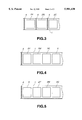
- FIG. 3 is a plan view showing an example of a thermal printing sheet having a detection mark between the dye layers.
- FIG. 4 is a plan view showing an example of a thermal printing sheet having a protection layer.
- FIG. 5 is a plan view showing an example of a thermal printing sheet having a reception layer.
- FIG. 6 is a schematic view showing configuration of a friction measuring apparatus.
- FIG. 1 shows a thermal printing sheet according to an embodiment of the present invention, including a substrate sheet 1 having thermal dye layers 2 formed on one side of the substrate sheet 1 and a heat resistant slide layer 3 formed on the other side of the substrate sheet 1.
- the substrate sheet may be made from a conventional substrate material such as a polyester film, a polystyrene film, polypropylene film, a polysulfone film, a polycarbonate film, a polyimide film, an aramide film, and the like.
- the substrate sheet may have a arbitrary thickness, for example, 1 to 30 ⁇ m, but preferably, 2 to 10 ⁇ m.
- the thermal dye layers 2 On one side of the substrate sheet 1 facing to a printing paper is formed the thermal dye layers 2, which are formed as a single continuous layer over the entire surface of the substrate sheet 1 in a case of a single color. In order to obtain a full color image, Yellow, Magenta, and Cyan dye layers 2 are successively formed, separately from one another.
- FIG. 2 shows an example of the thermal printing sheet having a detection mark 4, a Yellow dye layer 2Y, a Magenta dye layer 2M, a Cyan dye layer 2C which are formed repeatedly.
- the Yellow, Magenta, and Cyan layers may be formed in an order other than the aforementioned. Moreover, it is possible to repeat four colors of Yellow, Magenta, Cyan, and Black. Furthermore, as shown in FIG. 3, the detection mark 4 may be provided between each two dye layers 2.
- thermo dye layers 2 after the repetition of the thermal dye layers 2, it is possible to provide a transparent protection layer 5 for protecting a printing surface after printing.
- a thermal reception layer 6 for forming a reception layer on an ordinary paper prior to transfer of the thermal dye layers 2 when printing on an ordinary paper.
- the aforementioned thermal dye layer 2 consists of at least a color dye and binder.
- the binder may be selected from conventional binders: a water-soluble resin such as cellulose, acrylic acid, starch, and the like; an organic solvent soluble resin such as acrylate resin, polyphenylene oxide, polysulfone, polyethersulfone, acetylcellulose, or a resin soluble in water, and the like.
- the thermal deformation temperature be 70 to 150° C.
- polystyrene polystyrene, polyvinyl butyral, polycarbonate, methacrylic resin, acrylonitrile ⁇ styrene copolymer, polyester resin, urethane resin, polyethylene chloride, and the like.
- the dye also may be an arbitrary one.
- the Yellow dye may be azo, disazo, methine, pyridone azo, and the like as a single substance or in combination
- the Magenta dye may be azo, anthraquinone, styryl, heterocyclic azo pigment as a single substance or in combination
- the Cyan dye may be indoaniline, anthraquinone, naphthoquinone, heterocyclic azo pigment as a single substance or in combination.
- the heat resistant slide layer 3 is provided on the other side of the substrate sheet 1 for running in contact with a thermal head.
- the present invention is characterized in that this heat resistant slide layer 3 contains polyoxyalkylene sorbite fatty acid ester.
- the polyoxyalkylene sorbite fatty acid ester is a compound expressed by Chemical Formula 3.
- R 1 , R 3 , R 5 , R 7 , R 9 , and R 11 represent straight chain or branched chain alkyl groups of C 2 to C 10 ;
- R 2 , R 4 , R 6 , R 8 , R 10 , and R 12 represent straight chain acyl groups of C 12 to C 30 ;
- l, m, n, p, q, and r are integers from 0 to 100 excluding a case when all of l, m, n, o, p, q, and r are zero.
- the aforementioned polyoxyalkylene sorbite fatty acid ester is preferably added within 5 to 50 weight %. If this content is below 5 weight %, it is impossible to obtain a sufficient effect and the friction reduction effect is insufficient. On the contrary, if the content exceeds 50 weight %, it becomes difficult to maintain the coating characteristic of the heat resistant slide layer 3 and this may adversely affect the dye preservation stability as well.
- the aforementioned heat resistant slide layer 3 may contain, in addition to the aforementioned polyoxyalkylene sorbite fatty acid ester, polyglycerin fatty acid ester expressed by Chemical Formula 5 below. Addition of this compound further reduces the friction coefficient.
- polyglycerin fatty acid ester there can be exemplified dioleic acid diglyceryl, pentastearic acid tetraglyceryl, monolauric acid decaglyceryl, and the like.
- the amount of this polyglycerin fatty acid ester to be added is preferably equal to or below 50% of the content of the total of the fatty acid esters (total of the polyoxyalkylene sorbite fatty acid ester and the polyglycerine fatty acid ester). If the content of the polyglycerine fatty acid ester exceeds 50%, the ratio of the polyoxyalkylene sorbite fatty acid ester is decreased and the friction coefficient at a higher temperature is increased. It should be noted that when both of the polyoxyalkylene sorbite fatty acid ester and the polyglycerin fatty acid ester are added, the total amount of these fatty acid esters is preferably equal to or below 50 weight %.
- the aforementioned heat resistant slide layer 3 may be added with a mixture of the aforementioned polyoxyalkylene sorbite fatty acid ester and metallic soap expressed by Chemical Formula 6 given below. The addition of this mixture further reduces the friction coefficient.
- R 13 represent a straight chain or branched chain alkyl group of C 6 to C 29 or alkyl group partially replaced by a hydroxyl group, amine, halogen group; n is an integer 1 to 4; M is a divalent to tetravalent metal; and X is an integer 0 to 4.
- the aforementioned mixture of the polyoxylalkylen sorbite fatty acid ester (a) and the metallic soap (b) preferably has a mixing ratio (a:b) of 10:0.01 to 1:1 in weight ratio. If the metallic soap has a higher mixing ratio, the solubility in an organic solvent is decreased and the external view of the coating is deteriorated.
- the mixture within the aforementioned mixing ratio is uniformly solved in an organic solvent such as toluene, xylene , methylethyl ketone, and the like, after which the solvent is removed.
- an organic solvent such as toluene, xylene , methylethyl ketone, and the like.
- the metallic soap expressed by the aforementioned Chemical Formula 6 is a hydrate or anyhydride.
- the fatty acid (R 13 COO) is a higher fatty acid such as lauric acid, palmitylic acid, stearic acid, oleic acid, arachic acid, behenic acid, and melissic acid, or a fatty acid having a long chain alkyl group partially replaced by a hydroxyl group or amine, or a fatty acid having a branched long alkyl.
- the metal salt of the aforementioned metallic soap there can be exemplified a divalent metal such as Cu, Be, Mg, Ca, Sr, Ba, Zn, Cd, Fe, Pb, Cr, Mn, Co, Ni, and the like; a trivalent metal such as Al, Ce, Fe, and the like; or a tetravalent metal such as Ti, Zr, and the like. Any one of these can be used as a single substance or it is also possible to use some of them in combination.
- a divalent metal such as Cu, Be, Mg, Ca, Sr, Ba, Zn, Cd, Fe, Pb, Cr, Mn, Co, Ni, and the like
- a trivalent metal such as Al, Ce, Fe, and the like
- a tetravalent metal such as Ti, Zr, and the like. Any one of these can be used as a single substance or it is also possible to use some of them in combination.
- a stearic acid metal having a functional group R 13 expressed by C 17 H 35 [(C 17 H 35 COO) n M.xH 2 O] such as iron stearate, aluminium stearate, cerium stearate, and titanium stearate.
- the aforementioned metallic soap preferably has a melting point of 60 to 200° C. both for a single substance or a combination of several substances.
- a total amount of the mixture of the polyoxyalkylene sorbite fatty acid ester and the metallic soap to be added is preferably 5 to 50 weight %.
- polyglycerin fatty acid it is possible to further add polyglycerin fatty acid.
- the aforementioned heat resistant slide layer 3 is a layer containing as a main content a binder having an excellent heat resistance, to which the aforementioned fatty acid ester is added.
- a binder any of the conventional known ones can be used such as cellulose acetate, polyvinyl acetal, acrylic resin, and the like.
- this binder is preferably bridged by a polyisocyanate compound. Especially by simultaneously bridging the aforementioned polyoxyalkylene sorbite fatty acid ester and the polyglycerin fatty acid ester, it is possible to form the heat resistant slide layer 3 capable of exhibiting a significantly stable lubrication effect.
- polyisocyanate compound it is possible to use isocyanate compound having at least two isocyanate groups in a molecule, such as tolylendiisocyanate, 4, r'-diphenylmethanediisocyanate, 4,4'-xylenediisocyanate, hexamethylenediisocyanate, 4,4'-methylenebis (cyclohexylisocyanate), methylcyclohexane-2,4-diisocyanate, methylcyclohexane-2,6-diisocyanate, 1,3-di(isocyanatemethyl)cyclohexane, isophoronediisocyanate, trimethyl ⁇ hexamethylenediisocyanate, and the like, or an adduct (polyisocyanateprepolymer) obtained by a partial reaction between diisocyanate and polyol, such as an adduct obtained by a reaction between tolylendiisocyanate and tri
- the aforementioned heat resistance slide layer 3 in addition to the aforementioned binder, may contain various lubricants and bulking agents.
- inorganic bulking agents such as silica, talc, clay, zeolite, titanium oxide, zinc oxide, carbon, and the like
- organic bulking agents such as silicone resin, teflon resin, benzoguanamine resin, and the like.
- a thermal printing sheet was prepared by a procedure as follows.
- a polyester film of 6 ⁇ m thickness (trade name: Lumiller produced by Toray Co., Ltd.) was used as the substrate sheet, one side of which was coated with an ink having a composition described below, so as to have a thickness of 1 ⁇ m after dried.
- a heat resistant slide layer having a composition described below was applied to the other side of the substrate sheet not having the aforementioned dye layers, so as to have a thickness of 1 ⁇ m after dried, thus obtaining a thermal printing sheet.
- the type and quantity of polyoxyalkylene sorbite fatty acid ester shown in Table 1 was added to be mixed.
- the quantity of the aforementioned composition was adjusted so as to have a total of 100 weight parts.
- the mixture was applied to the substrate sheet.
- Nikkol GS-6 (trade name) produced by Nikko Chemicals Co., Ltd. was used as the hexastearic acid polyoxyethylene (6) sorbite
- Nikkol GS- 460 (trade name) produced by Nikko Chemicals Co., Ltd. was used as the hexastearic acid polyoxyethylene (60) sorbite
- the other polyoxyalkylene sorbite fatty acid esters were prepared by our.
- Example 1 used myristic acid (Lunac MY-98 produced by Kao Co., Ltd.);
- Example 2 used stearic acid butyl (Nikkol BS produced by Nikko Chemicals Co., Ltd.);
- Example 3 used pentastearic acid hexaglyceryl (Nikkol Hexaglyn-55 produced by Nikko Chemicals Co., Ltd.);
- Example 4 used phosphoric acid ester (Phosphanol RL-210 produced by Toho Kagaku Kogyo Co., Ltd.); and
- Example 5 used phosphoric acid ester (Phosphanol RL-710 produced by Toho Kagaku Kogyou Co., Ltd.).
- each of the thermal printing sheets obtained was mounted on a full color printer (trade name: UP-D7000) produced by Sony Co., Ltd. and printing was carried out (with 16 gradation steps) on a printing paper (trade name: UPC7010 produced by Sony Co., Ltd. Visual check was made to determine the running smoothness (printing uniformity, wrinkle generation, slipped printing) and sticking.
- the running smoothness was evaluated by a circle (o) if preferable and by a cross (x) if wrinkles were generated.
- Sticking was evaluated by a circle (o) if no sticking was caused and by a cross (x) if sticking was caused.
- the dye preservation stability was checked as follows.
- a thermal printing sheet obtained (20 cm ⁇ 20 cm) was placed on another thermal printing sheet obtained so that the dye layers of one sheet face the heat resistant slide layer of the other and the two sheets were sandwiched between two glass plates, which were pressed downward by a 5 kg load from above and preserved in an oven at 50° C. for 48 hours.
- the thermal printing sheets before and after the preservation were mounted on the full color printer produced by Sony Co., Ltd. (trade name: UP-D7000) and printing was carried out (with 16 gradation steps) on a printing paper and a Macbeth illuminometer (trade name: TR-924) was used to determine the maximum concentration of the respective colors.
- a calculation was made to determine the Maximum concentration after preservation/Maximum concentration before preservation ⁇ 100 (%) so as to evaluate the dye preservation stability. Table 1 shows the results.
- the samples (Examples 1 to 10) using the polyoxyalkylene sorbite fatty acid ester exhibit preferable running smoothness, causing no sticking due to friction increase, enabling to obtain clear images.
- the dye preservation of 95% or above was reached by most of the samples, which has no problem in practice. If the dye preservation is lowered, the color formation is changed, leading to decrease of the transfer concentration. In order to obtain a high quality image, the dye preservation is required to be at least in the order of 90%, and it is preferable to be 95% or above.
- Examples 11 to 13 used the polyoxyalkylene sorbite fatty acid ester in combination with the polyglycerin fatty acid ester.
- the heat resistant slide layer was replaced by the composition as described below to prepare thermal printing sheets in the same way, retaining the other conditions unchanged.
- polyoxyalkylene sorbite fatty acid ester used here is the hexastearic acid polyoxy ethylene (6) soribite (trade name: Nikkol GS-6 produced by Nikko Chemicals, Co., Ltd.) and the polyglycerin fatty acid ester is Nikkol Decaglyn-10S (trade name) produced by Nikko Chemicals Co., Ltd.
- polyglycerin fatty ester instead of the polyoxyalkylene sorbite fatty acid ester in combination with the polyglycerin fatty acid ester, polyglycerin fatty ester as a single substance or in combination with phosphoric acid ester was used to prepare the thermal printing sheets in the same way as in Examples 11 to 13.
- Comparative Example used polyglycerin fatty acid ester (trade name: Nikkol Decaglyn-10S produced by Nikko Chemicals Co., Ltd.); Comparative Example 7 used phosphoric acid ester (trade name: A208S produced by Daiichi Kogyo Seiyaku Co., Ltd.); and Comparative Example 8 used phosphoric ester (trade name: Phosphanol RD-720 produced by Toho Kagaku Kogyo Co., Ltd.).
- the friction coefficient and the preservation stability were determined. Note that the friction coefficient was determined by using a friction measuring apparatus shown in FIG. 6. For measurement using this apparatus, a thermal printing sheet and a printing paper R were sandwiched with a thermal head 11 and a platen roll 12, and a tension gauge 13 pulls up the thermal printing sheet and the printing paper R so as to determine the tension. The measurement conditions are described below.
- the maximum value of the friction coefficient is reduced in comparison to a case (Example 6) using the polyglycerin fatty acid ester as a single substance. Moreover, the preservation stability is also preferable. However, if a too much quantity of polyglycerin fatty acid is added (Example 15), the friction coefficient is slightly increased.
- the examples 14 to 23 used mixtures of the polyoxyalkylene sorbite fatty acid ester and the metallic soap.
- composition of the heat resistant slide layer was replaced by the following to prepare thermal printing sheets in the same way as in Example 1, maintaining the other conditions unchanged.
- the polyoxyethylene sorbite fatty acid ester was mixed with the metallic soap according to a method as follows. Firstly, a necessary quantity of each substance was measured out, and the polyoxyethylene sorbite fatty acid ester (having a lower melting point) was agitated and heated in a N 2 atmosphere so as to be solved uniformly. Next, the metallic soap was added to this solution little by little and agitated and heated up to the melting point of the metallic soap so as to be solved uniformly. After this, the mixture solution was cooled down to a room temperature for use as the mixture.
- polyoxyethylene sorbite fatty acid ester used here is the hexastearic acid polyoxyethylene (6) sorbite (trade name: Nikkol GS-6 produced by Nikko Chemicals Co., Ltd.).
- Comparative Example 13 used as the pentastearic acid hexaglyceryl, Nikkol Hexaglyn-55 (trade name) produced by Nikko Chemicals Co., Ltd.; Comparative Example 14 used as the phosphoric acid ester Phosphanol RD-210 (trade name) produced by Toho Kagaku Kogyo Co., Ltd.; and Comparative Example 15 used as the phosphoric ester, Phosphanol RD-710 (trade name) produced by Toho Chemical Co., Ltd.
- Table 3 shows that the samples using the mixture of the polyoxyethylene sorbite fatty acid ester and the metallic soap (Examples 14 to 23) exhibited preferable running smoothness without sticking due to friction increase, enabling to obtain clear images. Especially in the cases using the mixture (Examples 14 to 23), it was possible to reduce the friction coefficient in both of the maximum value (higher gradation steps) and the minimum value (lower gradation steps) without any difference between them, enabling to obtain a stable running.
- the use of polyoxyalkylene sorbite fatty acid ester in the heat resistant slide layer enables to obtain a thermal printing sheet exhibiting a superior running smoothness and dye preservation stability, enabling to obtain a clear image.
Landscapes
- Physics & Mathematics (AREA)
- Optics & Photonics (AREA)
- Thermal Transfer Or Thermal Recording In General (AREA)
- Decoration By Transfer Pictures (AREA)
Applications Claiming Priority (4)
| Application Number | Priority Date | Filing Date | Title |
|---|---|---|---|
| JPP09-061482 | 1997-03-14 | ||
| JP6148297 | 1997-03-14 | ||
| JP22410097A JP3760584B2 (ja) | 1997-03-14 | 1997-08-20 | 熱転写シート |
| JPP09-224100 | 1997-08-20 |
Publications (1)
| Publication Number | Publication Date |
|---|---|
| US5981430A true US5981430A (en) | 1999-11-09 |
Family
ID=26402527
Family Applications (1)
| Application Number | Title | Priority Date | Filing Date |
|---|---|---|---|
| US09/041,690 Expired - Lifetime US5981430A (en) | 1997-03-14 | 1998-03-13 | Thermal printing sheet |
Country Status (3)
| Country | Link |
|---|---|
| US (1) | US5981430A (ja) |
| JP (1) | JP3760584B2 (ja) |
| DE (1) | DE19810805B4 (ja) |
Families Citing this family (5)
| Publication number | Priority date | Publication date | Assignee | Title |
|---|---|---|---|---|
| JP4333002B2 (ja) * | 2000-06-30 | 2009-09-16 | ソニー株式会社 | 熱転写シート |
| JP4380575B2 (ja) * | 2005-03-31 | 2009-12-09 | ソニー株式会社 | 熱転写シート |
| JP5471122B2 (ja) * | 2009-07-27 | 2014-04-16 | 大日本印刷株式会社 | 熱転写シート |
| JP6075085B2 (ja) * | 2013-01-28 | 2017-02-08 | 大日本印刷株式会社 | 熱転写シート |
| CN114290846A (zh) * | 2021-12-31 | 2022-04-08 | 东莞市新锦诚镭射包装材料有限公司 | 一种高亮、高耐磨的镭射皮革转移膜及其制备方法 |
Citations (1)
| Publication number | Priority date | Publication date | Assignee | Title |
|---|---|---|---|---|
| US4981748A (en) * | 1988-02-17 | 1991-01-01 | Mitsubishi Kasei Corporation | Heat transfer recording sheet |
-
1997
- 1997-08-20 JP JP22410097A patent/JP3760584B2/ja not_active Expired - Fee Related
-
1998
- 1998-03-12 DE DE19810805A patent/DE19810805B4/de not_active Expired - Fee Related
- 1998-03-13 US US09/041,690 patent/US5981430A/en not_active Expired - Lifetime
Patent Citations (1)
| Publication number | Priority date | Publication date | Assignee | Title |
|---|---|---|---|---|
| US4981748A (en) * | 1988-02-17 | 1991-01-01 | Mitsubishi Kasei Corporation | Heat transfer recording sheet |
Also Published As
| Publication number | Publication date |
|---|---|
| DE19810805B4 (de) | 2008-09-11 |
| JP3760584B2 (ja) | 2006-03-29 |
| JPH10315638A (ja) | 1998-12-02 |
| DE19810805A1 (de) | 1998-09-17 |
Similar Documents
| Publication | Publication Date | Title |
|---|---|---|
| EP0623476B1 (en) | Sheet material for heat transfer printing | |
| EP0316926B1 (en) | Resin-coated paper support for receiving element used in thermal dye transfer | |
| US5529972A (en) | Thermal dye transfer receptors | |
| US8541340B2 (en) | Thermal transfer sheet | |
| US8680009B2 (en) | Thermal transfer sheet | |
| JP2911517B2 (ja) | 熱転写シート | |
| US5627127A (en) | Thermal transfer sheet | |
| US5286706A (en) | Sublimation-type thermal image transfer recording medium | |
| JP3760585B2 (ja) | 熱転写シート | |
| JP3760584B2 (ja) | 熱転写シート | |
| US5576266A (en) | Magnetic layer in dye-donor element for thermal dye transfer | |
| JP3760554B2 (ja) | 熱転写シート | |
| US5714434A (en) | Thermal transfer sheet | |
| JP3384113B2 (ja) | 熱転写シート | |
| EP0556796B1 (en) | Thermal dye transfer receiving element with backing layer | |
| JP3697777B2 (ja) | 熱転写シート | |
| US6066593A (en) | Thermal transfer sheet | |
| EP0854053B1 (en) | Thermal transfer sheet and method for manufacturing same | |
| JP2012153019A (ja) | 熱転写シート | |
| EP0644061B1 (en) | Antistatic subbing layer for slipping layer in dye-donor element used in thermal dye transfer | |
| EP0368552B1 (en) | Thermal transfer dyesheet | |
| JP2000229483A (ja) | 熱転写シートおよびその製造方法 | |
| US8298988B2 (en) | Thermal transfer sheet | |
| JP2010052364A (ja) | 熱転写シート | |
| JPH06247065A (ja) | 熱転写シート |
Legal Events
| Date | Code | Title | Description |
|---|---|---|---|
| AS | Assignment |
Owner name: SONY CORPORATION, JAPAN Free format text: ASSIGNMENT OF ASSIGNORS INTEREST;ASSIGNORS:SAM, HUY;ISAGO, MASAYOSHI;OBATA, KEI;AND OTHERS;REEL/FRAME:009280/0516;SIGNING DATES FROM 19980610 TO 19980612 |
|
| STCF | Information on status: patent grant |
Free format text: PATENTED CASE |
|
| FPAY | Fee payment |
Year of fee payment: 4 |
|
| FPAY | Fee payment |
Year of fee payment: 8 |
|
| FEPP | Fee payment procedure |
Free format text: PAYER NUMBER DE-ASSIGNED (ORIGINAL EVENT CODE: RMPN); ENTITY STATUS OF PATENT OWNER: LARGE ENTITY Free format text: PAYOR NUMBER ASSIGNED (ORIGINAL EVENT CODE: ASPN); ENTITY STATUS OF PATENT OWNER: LARGE ENTITY |
|
| FPAY | Fee payment |
Year of fee payment: 12 |