US6033709A - Process for the production of partially gelatinized rice flour - Google Patents
Process for the production of partially gelatinized rice flour Download PDFInfo
- Publication number
- US6033709A US6033709A US09/137,923 US13792398A US6033709A US 6033709 A US6033709 A US 6033709A US 13792398 A US13792398 A US 13792398A US 6033709 A US6033709 A US 6033709A
- Authority
- US
- United States
- Prior art keywords
- rice flour
- flour
- blend
- cereal component
- recited
- Prior art date
- Legal status (The legal status is an assumption and is not a legal conclusion. Google has not performed a legal analysis and makes no representation as to the accuracy of the status listed.)
- Expired - Fee Related
Links
Images
Classifications
-
- A—HUMAN NECESSITIES
- A23—FOODS OR FOODSTUFFS; TREATMENT THEREOF, NOT COVERED BY OTHER CLASSES
- A23L—FOODS, FOODSTUFFS OR NON-ALCOHOLIC BEVERAGES, NOT OTHERWISE PROVIDED FOR; PREPARATION OR TREATMENT THEREOF
- A23L7/00—Cereal-derived products; Malt products; Preparation or treatment thereof
- A23L7/10—Cereal-derived products
- A23L7/198—Dry unshaped finely divided cereal products, not provided for in groups A23L7/117 - A23L7/196 and A23L29/00, e.g. meal, flour, powder, dried cereal creams or extracts
Definitions
- the present invention relates to the making of dough from rice flour. More particularly, this invention is directed to the production of partially gelatinized flour and dough which is made by blending the flour with water, hydrating the flour, tempering the hydrated flour and cooking the tempered flour to partially gelatinize the starch in the flour.
- Using and completely cooking rice flour limits flexibility for any process where food products are customized snack foods and the like which require a combination of rice flour or dough with other types of flour and dough, such as masa dough or wheat dough.
- Providing partially gelatinized rice flour using the process of the invention described herein permits customization of a dough which includes rice dough to a particular product using a continuous process without extensive shut down times.
- An object of this invention is to provide a new flexible process for the production of partially gelatinized rice flour and dough.
- This invention is directed to a continuous process for the production of partially gelatinized rice flour and dough.
- rice flour or a blend of rice flour with other components of one or more other cereal grains is hydrated to provide a hydrated rice flour (or blend of rice flour and one or more additional cereal components) which has a moisture content of at least 20 weight percent.
- the additional cereal components may include flour from other cereals, such as wheat flour and oat flour.
- the rice flour is mixed with water having a temperature of at least about 10° C., but not at a temperature that would substantially gelatinize the starch in the flour.
- the temperature of the water/flour blend should not exceed about 60° C.
- the mixing of the water/flour blend should be effective to substantially, uniformly distribute water throughout the blend to the moisture level of the at least about 20 weight percent.
- the hydrated rice flour blend has a moisture content of from about 26 to about 30 weight percent water, based upon the weight of the rice flour and water.
- the hydrated rice flour is tempered for a time to equally distribute moisture throughout the flour. Generally, tempering times range from about 30 seconds to about 12 minutes, depending upon the type and the particle size of the flour in the hydrated flour.
- the tempered flour After tempering, the tempered flour enters a cooker to cook it in a cooking process which utilizes direct and indirect heat.
- the indirect heat keeps the cooker and dough at an elevated temperature which is effective for keeping the cooker clean of partially cooked residual dough.
- the direct heat such as from the injection of steam into the tempered product, cooks the dough in combination with the indirect heat.
- the combination of indirect and direct heat brings the temperature of the tempered product to a temperature of at least about 165° F. as it leaves the cooker and partially gelatinizes the starch in the flour and starch in any other cereal components with which the rice flour may be blended or mixed.
- not more than about 90 weight percent of the starch in the rice flour or rice flour blend is gelatinized, and in an important aspect, not more than about 70 weight percent of the starch in the rice flour or blend is gelatinized.
- the tempered product is directly exposed to steam for about 1 to about 10 minutes, and preferably from about 1 to about 2 minutes, with the cooking temperature also potentially being affected by a subsequent drying step.
- the rice flour may be dried to a moisture content of not more than about 15 weight percent at a temperature which is effective for not heat damaging or burning the product. Generally, during drying the product temperature should not exceed 95° F.
- After drying the dried rice flour or blend is sized, such as by milling and sifting to a particle size of from about 16 to about 65 mesh, depending upon what type of food product will be made with the component blend.
- the process of the invention is effective for hydrating, tempering and cooking the rice flour or component blend, such that waste water is not created and process may be carried out without water being removed from the rice flour or component blend after hydrating, tempering or cooking. Moreover, the process is effective for providing a product which does not require washing after the hydration or cooking steps.
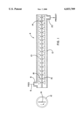
- FIG. 1 is a schematic illustration of a cooker used in the process of the invention.
- the process includes hydrating rice flour and/or hydrating rice flour with other components, such as components from other cereals, such as corn.
- these components include (1) corn germ, or (2) corn grits and corn germ, or (3) corn grits, corn germ and corn bran, or (4) corn germ and corn bran, or (5) corn bran, or (6) corn grits and corn bran, or (7) ground whole corn to provide a rice flour or a rice flour component blend.
- the rice flour or component blend may be mixed dry and then mixed with water for hydration of the blend or may be separately mixed into water for hydration of the blend.
- the rice flour or component blend is hydrated with water to provide a hydrated corn component blend which has a moisture content of at least about 20 weight percent.
- the process includes tempering the hydrated rice flour or component blend to provide a tempered rice flour or component blend, cooking the tempered rice flour or component blend with indirect heat and direct steam.
- the cooked product with the partially gelatinized starch may be used as a dough. In an important aspect, however, this cooked product is dried and optionally milled and sized.
- the rice flour or rice flour component blend is mixed with water in a high-speed mixer.
- the temperature of the hydrating water varies between about 10° C. to about 60° C.
- the temperature of the hydrating water depends on the time required for full hydration, and also on the size of the particles in the blend.
- the time for the hydration can vary between 5 minutes and 4 hours.
- the temperature of the hydrating water varies between about 10° C. and about 60° C., and preferably from about 25° C. to about 60° C. Higher temperatures can be used, but they are not advisable because during the mixing, heating can occur. Any heating which results in substantial gelatinization of the starch in the flour or in any component of the blend should be avoided because such gelatinization will not provide a uniform final product for the cooking step. In this respect, substantial gelatinization means the starch granule structure is not disrupted and there is no loss of bifringency prior to cooking, such as more than about 5 percent weight percent of the starch in the flour or blend is gelatinized.
- the preferred mixer for the process is a turbulizer as supplied by Hosokawa Bepex, but other high-speed mixers available can be used. Mixing during hydration is important to substantially uniformly distribute water throughout the whole raw mix. Time is not critical as long as the moisture is substantially evenly distributed throughout the rice flour or component blend to a moisture level of at least about 20 weight percent, in an important aspect, in a range of from about 23 to about 34 weight percent, and preferably about 26 to about 30 weight percent, based upon the weight of the hydrated blend.
- the hydrated rice flour or component blend is kept or tempered for a few minutes to make sure the moisture is equally distributed throughout all of the flour or component particles.
- This can be done by methods including the use of a standard transport screw or a tempering vessel. It is not essential, but advisable, to maintain a constant temperature during that process. Tempering times can vary between about 30 seconds and about 12 minutes. Long tempering times are not advisable as microbial growth can occur. Long tempering times are not required as the rice flour particles are small enough to make sure all the water is equally distributed throughout the product and a uniform mixture is obtained for the cooking.
- the cooker cooks with indirect and direct heat, such as a screw-type cooker and partially gelatinizes the starch in the rice flour or component blend.
- This cooker as shown in FIG. 1, is a elongated heating device which has a heat jacket surrounding a channel through which the tempered product is conveyed.
- the hydrated and tempered product is moved forward down the cooker by means of paddles on a hollow rotor in the device.
- the rotor is connected to a steam source to transmit steam to the paddles which are hollow and are open to receive steam from the rotor.
- Steam enters the rotor and is conveyed therethrough into the paddles which have one or more holes from which the steam is injected into the tempered product.
- the paddles uniformly distribute the steam in the product being cooked.
- Indirect heat is applied from the jacket of the device.
- the direct heat brings the tempered product to temperature, partially gelatinizing starch while the indirect heat keeps the cooker and dough at an elevated temperature which is effective for keeping the cooker clean of partially cooked residual dough.
- Cooking conditions are controlled through selection of a specific length for the device, the number of open steam holes in the paddles, the amount of indirect heat being applied and the rate the tempered product is conveyed through the cooker.
- the tempered product is fed into a elongated heating device 4 shown in FIG. 1.
- the tempered product is fed into the heating device feed aperture 8 into channel 10.
- the tempered product is conveyed down channel 10 in the y direction.
- Channel 10 is surrounded by a steam jacket 12 through which steam is circulated.
- a hollow rod 14 extends longitudinally down the center of the channel.
- a plurality of paddles 16 are mounted on the rod 14 down its longitudinal length. The rod 14 is rotated and the paddles are angled such that as the rod rotates the paddles, mix the tempered product and push the product down channel 10.
- the paddles have openings 18 which extend through the paddles to the hollow center of rod 14.
- openings are to transmit steam going through the rod and paddles so that the steam may be injected into the particulate food product being transmitted down channel 10.
- the openings in the paddles may be opened or closed to control steam injection into the product being transmitted down the channel.
- the amount of steam injected is effective for heating and cooking the product such that a product with partially gelatinized starch is obtained. Additional indirect heating of the tempered product and the cooking channel is done by using indirect heat from the jacket of the device.
- Enough steam is injected to cook the tempered product and gelatinize the starch therein and to provide the cooked product with a temperature of at least about 165° F.
- a device which can be used to cook the tempered product as described herein is available as a Solidaire Model SJCS 8-4 from the Hosokawa Bepex Corporation, 333 N.E. Taft Street, Minneapolis, Minn. 55413.
- the direct heat such as from the injection of steam into the tempered product, cooks the dough in combination with the indirect heat.
- the indirect heat may be provided by steam or oil.
- the combination of indirect and direct heat brings the temperature of the tempered product to a temperature of at least about 165° F. as it leaves the cooker.
- the tempered product is directly exposed to steam for about 1 to about 10 minutes, and preferably from about 1 to about 2 minutes, with the cooking time and temperature also potentially being affected by the temperature in the subsequent drying step. When lower temperatures are used during drying, higher temperatures are used during cooking and vice versa.
- the cooking temperature as measured by the temperature of the product as it leaves the cooker is a function of the type of the product that is desired and the drying temperatures which are subsequent to the cooking step.
- lower drying temperatures such as when the inlet temperature of the drier is 370° F.
- significant cooking in the dryer does not occur.
- the temperature of the cooked product as it leaves the cooker is in the higher end of the range of from about 185° F. to about 210° F.
- higher temperatures such as about 500° F. for inlet air temperature, and the temperature of the dried product exceeds 85° C.
- the cooked product leaves the cooker at the lower end of the latter range, about 160° F. to about 200° F. Overcooking will result in a sticky dough when further processing it.
- cooked product may be used directly in further processing and cooking, such as in snack foods.
- cooked product is dried to provide a product with partially gelatinized starch.
- a flashdryer or belt dryer can be used for drying the cooked mixture to provide a product with partially gelatinized starch and a product with a moisture level of not more than about 15 weight percent.
- a Micron dryer as supplied by Hosokawa Bepex, or a flash dryer may be used.
- this system there is also a classifier system which mills the cooked product in such a manner that the right final granulation of the dried flour is obtained for specific applications. For applications where a coarser granulation is required, this air-classification system can be reduced to a minimal level to make sure that still the required coarse particles are present.
- the temperatures used during the drying depend upon the temperatures and moisture used during cooking stage. If a high temperature is used during the cooking, a lower temperature can be used during the drying process. If lower temperature and lower moisture levels are used during the cooking, higher temperatures are used during the drying stage to make sure that some cooking is obtained during the drying step. However, a fine balance is kept to prevent the product from heat damage during the drying process. Such heat damage will result in a masa which does not form a proper cohesive dough and which is discolored.
- the dried rice product is sifted on a standard sieve to obtain the right granulation. Coarse fractions can be removed and milled to a smaller granulation. Too fine product can be removed if necessary.
- Rice flour is hydrated by mixing with water using a turbulizer.
- the hydrated product then is heated in a Solidaire 6 from Hosokawa Bepex Corporation, paddles open for steam injection.
- the cooked product then is dried.
Landscapes
- Health & Medical Sciences (AREA)
- Nutrition Science (AREA)
- Life Sciences & Earth Sciences (AREA)
- Chemical & Material Sciences (AREA)
- Engineering & Computer Science (AREA)
- Food Science & Technology (AREA)
- Polymers & Plastics (AREA)
- Cereal-Derived Products (AREA)
Priority Applications (5)
| Application Number | Priority Date | Filing Date | Title |
|---|---|---|---|
| US09/137,923 US6033709A (en) | 1998-08-20 | 1998-08-20 | Process for the production of partially gelatinized rice flour |
| EP99941240A EP1105000A4 (de) | 1998-08-20 | 1999-08-19 | Verfahren zur herstellung von teilweise gelatiniertem reismehl |
| PCT/US1999/019002 WO2000010406A1 (en) | 1998-08-20 | 1999-08-19 | Process for the production of partially gelatinized rice flour |
| CA002341237A CA2341237A1 (en) | 1998-08-20 | 1999-08-19 | Process for the production of partially gelatinized rice flour |
| AU54932/99A AU5493299A (en) | 1998-08-20 | 1999-08-19 | Process for the production of partially gelatinized rice flour |
Applications Claiming Priority (1)
| Application Number | Priority Date | Filing Date | Title |
|---|---|---|---|
| US09/137,923 US6033709A (en) | 1998-08-20 | 1998-08-20 | Process for the production of partially gelatinized rice flour |
Publications (1)
| Publication Number | Publication Date |
|---|---|
| US6033709A true US6033709A (en) | 2000-03-07 |
Family
ID=22479646
Family Applications (1)
| Application Number | Title | Priority Date | Filing Date |
|---|---|---|---|
| US09/137,923 Expired - Fee Related US6033709A (en) | 1998-08-20 | 1998-08-20 | Process for the production of partially gelatinized rice flour |
Country Status (5)
| Country | Link |
|---|---|
| US (1) | US6033709A (de) |
| EP (1) | EP1105000A4 (de) |
| AU (1) | AU5493299A (de) |
| CA (1) | CA2341237A1 (de) |
| WO (1) | WO2000010406A1 (de) |
Cited By (2)
| Publication number | Priority date | Publication date | Assignee | Title |
|---|---|---|---|---|
| US20100151108A1 (en) * | 2008-12-17 | 2010-06-17 | Mark Gorris | Food-based Supplement Delivery System |
| US20120021113A1 (en) * | 2010-07-20 | 2012-01-26 | Maria Dolores Martinez-Serna Villagran | Rice Flour Compositions |
Families Citing this family (1)
| Publication number | Priority date | Publication date | Assignee | Title |
|---|---|---|---|---|
| ITMI20072438A1 (it) | 2007-12-27 | 2009-06-28 | Fava S P A | Procedimento e impianto per la produzione di sfarinati precotti e gelatinizzati per prodotti alimentari |
Citations (41)
| Publication number | Priority date | Publication date | Assignee | Title |
|---|---|---|---|---|
| US31513A (en) * | 1861-02-19 | haasz | ||
| US198192A (en) * | 1877-12-18 | Improvement in processes and apparatus for disintegrating cereals | ||
| US1010202A (en) * | 1908-07-02 | 1911-11-28 | Simon Ltd Henry | Art of milling and conditioning flour from wheat. |
| US1574210A (en) * | 1924-10-29 | 1926-02-23 | Horace R Spaulding | Method and apparatus for steaming grain and the like |
| US2704257A (en) * | 1952-10-01 | 1955-03-15 | Process Millers Inc | Method of producing corn tortilla flour |
| US3035918A (en) * | 1959-06-01 | 1962-05-22 | Battalle Dev Corp | Process for treating food |
| US3159493A (en) * | 1962-12-31 | 1964-12-01 | Procter & Gamble | Method of sterilizing flour with minimum physicochemical change |
| US3159494A (en) * | 1962-12-31 | 1964-12-01 | Procter & Gamble | Treatment of flour to reduce microbiological contamination |
| US3194664A (en) * | 1960-05-19 | 1965-07-13 | Frito Company | Method for continuously producing nixtamal |
| US3212904A (en) * | 1963-02-04 | 1965-10-19 | Quaker Oats Co | Process for preparing a precooked corn flour |
| US3368902A (en) * | 1967-03-22 | 1968-02-13 | Isadore A. Berg | Corn chip |
| US3404986A (en) * | 1966-07-18 | 1968-10-08 | Krause Milling Co | Process for manufacturing corn flour |
| US3554772A (en) * | 1967-01-30 | 1971-01-12 | Borden Inc | Method of pasteurizing flour |
| US3653915A (en) * | 1970-06-08 | 1972-04-04 | Manuel Jesus Rubio | Tortilla and process using mono-or diglyceride |
| US3655385A (en) * | 1970-06-08 | 1972-04-11 | Roberto Gonzalez Barrera | Tortilla and process using edible hydrophilic gum |
| US3859452A (en) * | 1972-07-03 | 1975-01-07 | Fausto Celorio Mendoza | Method for obtaining nixtamalized flours |
| US4221340A (en) * | 1979-01-11 | 1980-09-09 | Beehive Machinery, Inc. | Method and apparatus for producing a masa product |
| US4255459A (en) * | 1978-02-10 | 1981-03-10 | Glen Donald H G | Blanching, pasteurizing and sterilizing process and apparatus suitable therefor |
| US4329371A (en) * | 1976-10-04 | 1982-05-11 | Seven-H Corporation | Method of processing grain |
| US4385074A (en) * | 1981-09-02 | 1983-05-24 | NS Apothekernes Laboratorium for Specialpraeparater | Quick cooking rice and process for making the same |
| US4543263A (en) * | 1983-06-07 | 1985-09-24 | Campbell Soup Company | Heating and cooling foods at high pressure in a continuous sterilization system |
| US4547383A (en) * | 1983-06-07 | 1985-10-15 | Campbell Soup Company | Continuous food sterilization system with hydrostatic sealed treatment chamber |
| US4555409A (en) * | 1984-04-09 | 1985-11-26 | Hart Edwin R | Cereal processing |
| US4594260A (en) * | 1984-09-21 | 1986-06-10 | Imit, A.C. | Process for producing nixtamalized corn flour |
| EP0196464A2 (de) * | 1985-02-28 | 1986-10-08 | Kikkoman Corporation | Hitzebehandlungsverfahren für pulveriges und/oder körniges Gut und Anlage zu diesem Zweck |
| US4770891A (en) * | 1986-01-20 | 1988-09-13 | Willard Miles J | Method for preparing sheeted fried snack products |
| US4844937A (en) * | 1987-04-13 | 1989-07-04 | J. R. Scott Milling Company | Method for making puffable food products from corn and products produced therefrom |
| US4882188A (en) * | 1985-02-22 | 1989-11-21 | Nakamura & Partners | Process for preparing heat treated granular solid food |
| US4985269A (en) * | 1990-06-12 | 1991-01-15 | Borden, Inc. | Continuous extrusion for tortilla chip production |
| US4996063A (en) * | 1989-06-30 | 1991-02-26 | The United States Of America, As Represented By The Secretary Of Agriculture | Method for making a soluble dietary fiber composition from oats |
| US5176931A (en) * | 1992-03-13 | 1993-01-05 | Wenger Manufacturing, Inc. | Preparation of masa flour |
| US5225224A (en) * | 1992-07-15 | 1993-07-06 | Vannortwick H Christian | Process for forming corn grit food products |
| US5296253A (en) * | 1992-05-28 | 1994-03-22 | Texas A&M University | Intermediate moisture legume and cereal food product and method of producing |
| US5505978A (en) * | 1994-05-16 | 1996-04-09 | Apv Baker, Inc. | Baked corn-based product and process |
| US5532013A (en) * | 1993-10-21 | 1996-07-02 | Centro De Investigacion Y De Estudios Avanzados Del I.P.N. | Method for the preparation of instant fresh corn dough or masa |
| US5558886A (en) * | 1993-10-21 | 1996-09-24 | Centro De Investigacion Y De Estudios Avanzados Del I.P.N. | Extrusion apparatus for the preparation of instant fresh corn dough or masa |
| US5558898A (en) * | 1994-09-20 | 1996-09-24 | Wenger Manufacturing Inc. | Continuous method of producing masa flour |
| US5589214A (en) * | 1989-01-27 | 1996-12-31 | Alfa-Laval Food Engineering Ab | Process for heat treatment of particulate materials such as food |
| US5652010A (en) * | 1984-12-14 | 1997-07-29 | Nabisco, Inc. | Production of masa corn-based products |
| WO1997029647A1 (en) * | 1996-02-20 | 1997-08-21 | Conagra, Inc. | Method for producing a masa flour |
| US5700505A (en) * | 1995-12-28 | 1997-12-23 | Mei Research, Inc. | Method of improving head rice yield |
Family Cites Families (6)
| Publication number | Priority date | Publication date | Assignee | Title |
|---|---|---|---|---|
| US2998317A (en) * | 1959-12-28 | 1961-08-29 | Gen Foods Corp | Method of producing cereal flakes |
| JPS57125656A (en) * | 1981-01-27 | 1982-08-05 | Morinaga & Co Ltd | Preparation of hollow snack |
| US4438150A (en) * | 1982-09-09 | 1984-03-20 | The Quaker Oats Company | Process for preparing an instant baby cereal porridge product |
| JPS6027350A (ja) * | 1983-07-25 | 1985-02-12 | Takara Shuzo Co Ltd | 蒸し穀粉の製造法 |
| EP0450310B1 (de) * | 1990-04-03 | 1993-07-07 | Societe Des Produits Nestle S.A. | Reisteigware |
| SG63519A1 (en) * | 1995-04-22 | 1999-03-30 | Nestle Sa | Noodle preparation |
-
1998
- 1998-08-20 US US09/137,923 patent/US6033709A/en not_active Expired - Fee Related
-
1999
- 1999-08-19 WO PCT/US1999/019002 patent/WO2000010406A1/en not_active Ceased
- 1999-08-19 AU AU54932/99A patent/AU5493299A/en not_active Abandoned
- 1999-08-19 CA CA002341237A patent/CA2341237A1/en not_active Abandoned
- 1999-08-19 EP EP99941240A patent/EP1105000A4/de not_active Withdrawn
Patent Citations (42)
| Publication number | Priority date | Publication date | Assignee | Title |
|---|---|---|---|---|
| US31513A (en) * | 1861-02-19 | haasz | ||
| US198192A (en) * | 1877-12-18 | Improvement in processes and apparatus for disintegrating cereals | ||
| US1010202A (en) * | 1908-07-02 | 1911-11-28 | Simon Ltd Henry | Art of milling and conditioning flour from wheat. |
| US1574210A (en) * | 1924-10-29 | 1926-02-23 | Horace R Spaulding | Method and apparatus for steaming grain and the like |
| US2704257A (en) * | 1952-10-01 | 1955-03-15 | Process Millers Inc | Method of producing corn tortilla flour |
| US3035918A (en) * | 1959-06-01 | 1962-05-22 | Battalle Dev Corp | Process for treating food |
| US3194664A (en) * | 1960-05-19 | 1965-07-13 | Frito Company | Method for continuously producing nixtamal |
| US3159494A (en) * | 1962-12-31 | 1964-12-01 | Procter & Gamble | Treatment of flour to reduce microbiological contamination |
| US3159493A (en) * | 1962-12-31 | 1964-12-01 | Procter & Gamble | Method of sterilizing flour with minimum physicochemical change |
| US3212904A (en) * | 1963-02-04 | 1965-10-19 | Quaker Oats Co | Process for preparing a precooked corn flour |
| US3404986A (en) * | 1966-07-18 | 1968-10-08 | Krause Milling Co | Process for manufacturing corn flour |
| US3554772A (en) * | 1967-01-30 | 1971-01-12 | Borden Inc | Method of pasteurizing flour |
| US3368902A (en) * | 1967-03-22 | 1968-02-13 | Isadore A. Berg | Corn chip |
| US3653915A (en) * | 1970-06-08 | 1972-04-04 | Manuel Jesus Rubio | Tortilla and process using mono-or diglyceride |
| US3655385A (en) * | 1970-06-08 | 1972-04-11 | Roberto Gonzalez Barrera | Tortilla and process using edible hydrophilic gum |
| US3859452A (en) * | 1972-07-03 | 1975-01-07 | Fausto Celorio Mendoza | Method for obtaining nixtamalized flours |
| US4329371A (en) * | 1976-10-04 | 1982-05-11 | Seven-H Corporation | Method of processing grain |
| USRE31513E (en) | 1978-02-10 | 1984-01-31 | Blanching, pasteurizing and sterilizing process and apparatus suitable therefor | |
| US4255459A (en) * | 1978-02-10 | 1981-03-10 | Glen Donald H G | Blanching, pasteurizing and sterilizing process and apparatus suitable therefor |
| US4221340A (en) * | 1979-01-11 | 1980-09-09 | Beehive Machinery, Inc. | Method and apparatus for producing a masa product |
| US4385074A (en) * | 1981-09-02 | 1983-05-24 | NS Apothekernes Laboratorium for Specialpraeparater | Quick cooking rice and process for making the same |
| US4543263A (en) * | 1983-06-07 | 1985-09-24 | Campbell Soup Company | Heating and cooling foods at high pressure in a continuous sterilization system |
| US4547383A (en) * | 1983-06-07 | 1985-10-15 | Campbell Soup Company | Continuous food sterilization system with hydrostatic sealed treatment chamber |
| US4555409A (en) * | 1984-04-09 | 1985-11-26 | Hart Edwin R | Cereal processing |
| US4594260A (en) * | 1984-09-21 | 1986-06-10 | Imit, A.C. | Process for producing nixtamalized corn flour |
| US5652010A (en) * | 1984-12-14 | 1997-07-29 | Nabisco, Inc. | Production of masa corn-based products |
| US4882188A (en) * | 1985-02-22 | 1989-11-21 | Nakamura & Partners | Process for preparing heat treated granular solid food |
| EP0196464A2 (de) * | 1985-02-28 | 1986-10-08 | Kikkoman Corporation | Hitzebehandlungsverfahren für pulveriges und/oder körniges Gut und Anlage zu diesem Zweck |
| US4770891A (en) * | 1986-01-20 | 1988-09-13 | Willard Miles J | Method for preparing sheeted fried snack products |
| US4844937A (en) * | 1987-04-13 | 1989-07-04 | J. R. Scott Milling Company | Method for making puffable food products from corn and products produced therefrom |
| US5589214A (en) * | 1989-01-27 | 1996-12-31 | Alfa-Laval Food Engineering Ab | Process for heat treatment of particulate materials such as food |
| US4996063A (en) * | 1989-06-30 | 1991-02-26 | The United States Of America, As Represented By The Secretary Of Agriculture | Method for making a soluble dietary fiber composition from oats |
| US4985269A (en) * | 1990-06-12 | 1991-01-15 | Borden, Inc. | Continuous extrusion for tortilla chip production |
| US5176931A (en) * | 1992-03-13 | 1993-01-05 | Wenger Manufacturing, Inc. | Preparation of masa flour |
| US5296253A (en) * | 1992-05-28 | 1994-03-22 | Texas A&M University | Intermediate moisture legume and cereal food product and method of producing |
| US5225224A (en) * | 1992-07-15 | 1993-07-06 | Vannortwick H Christian | Process for forming corn grit food products |
| US5532013A (en) * | 1993-10-21 | 1996-07-02 | Centro De Investigacion Y De Estudios Avanzados Del I.P.N. | Method for the preparation of instant fresh corn dough or masa |
| US5558886A (en) * | 1993-10-21 | 1996-09-24 | Centro De Investigacion Y De Estudios Avanzados Del I.P.N. | Extrusion apparatus for the preparation of instant fresh corn dough or masa |
| US5505978A (en) * | 1994-05-16 | 1996-04-09 | Apv Baker, Inc. | Baked corn-based product and process |
| US5558898A (en) * | 1994-09-20 | 1996-09-24 | Wenger Manufacturing Inc. | Continuous method of producing masa flour |
| US5700505A (en) * | 1995-12-28 | 1997-12-23 | Mei Research, Inc. | Method of improving head rice yield |
| WO1997029647A1 (en) * | 1996-02-20 | 1997-08-21 | Conagra, Inc. | Method for producing a masa flour |
Non-Patent Citations (14)
| Title |
|---|
| Bazua, C.D. et al., Extruded Corn as an Alternative to Lime Heated Corn Flour for Tortilla Preparation, Inst. Food Technologists, 1979. * |
| Bazua, C.D. et al., Extruded Corn as an Alternative to Lime-Heated Corn Flour for Tortilla Preparation, Inst. Food Technologists, 1979. |
| Bedolla, S. et al., "Cooking Maize for Masa Production", Cereal Foods World, 27:219-221, 1982. |
| Bedolla, S. et al., Cooking Maize for Masa Production , Cereal Foods World, 27:219 221, 1982. * |
| Khan, M.N. et al., "Corn Tortillas: Evaluation of Corn Cooking Procedures", Cereal Chem., 59:279-284, 1982. |
| Khan, M.N. et al., Corn Tortillas: Evaluation of Corn Cooking Procedures , Cereal Chem., 59:279 284, 1982. * |
| Martinez et al., "Caracteristicas quimicas y usos de harina instantanea de maiz II.", Archivos Latinoamericanos de Nutricion 1993, 43, 316-320. |
| Martinez et al., Caracteristicas quimicas y usos de harina instantanea de maiz II. , Archivos Latinoamericanos de Nutricion 1993, 43, 316 320. * |
| Mensah Agyapong, J. et al.. Nixtamalization of Maize (zea mays L) Using a Single Screw Cook Extrusion Process on Lime Treated Grits , J. Sci. Food Agric., 60:509 514, 1992. * |
| Mensah-Agyapong, J. et al.. "Nixtamalization of Maize (zea mays L) Using a Single Screw Cook-Extrusion Process on Lime-Treated Grits", J. Sci. Food Agric., 60:509-514, 1992. |
| Parades Lopez, O. et al., Maize, A revies of tortilla production technology , Bakers Digest, Sep. 13, 1983, pp. 16 25. * |
| Parades-Lopez, O. et al., "Maize, A revies of tortilla production technology", Bakers Digest, Sep. 13, 1983, pp. 16-25. |
| Watson, S.A., in "Corn: Chemistry and Technology", 1987. Am. Assoc. Cereal Chemists, pp. 410-429. |
| Watson, S.A., in Corn: Chemistry and Technology , 1987. Am. Assoc. Cereal Chemists, pp. 410 429. * |
Cited By (3)
| Publication number | Priority date | Publication date | Assignee | Title |
|---|---|---|---|---|
| US20100151108A1 (en) * | 2008-12-17 | 2010-06-17 | Mark Gorris | Food-based Supplement Delivery System |
| US9918489B2 (en) * | 2008-12-17 | 2018-03-20 | Mark Gorris | Food-based supplement delivery system |
| US20120021113A1 (en) * | 2010-07-20 | 2012-01-26 | Maria Dolores Martinez-Serna Villagran | Rice Flour Compositions |
Also Published As
| Publication number | Publication date |
|---|---|
| CA2341237A1 (en) | 2000-03-02 |
| AU5493299A (en) | 2000-03-14 |
| EP1105000A4 (de) | 2004-06-09 |
| EP1105000A1 (de) | 2001-06-13 |
| WO2000010406A1 (en) | 2000-03-02 |
Similar Documents
| Publication | Publication Date | Title |
|---|---|---|
| US6068873A (en) | Process for the production of masa flour | |
| Bhattacharya et al. | Kinetics of starch gelatinization during extrusion cooking | |
| US6383545B1 (en) | Method and apparatus for producing a pre-gelled starch product and normally sticky extrudates with minimal or no surfactant | |
| Badrie et al. | Effect of extrusion variables on cassava extrudates | |
| US5334407A (en) | Couscous | |
| Onwulata et al. | Physical properties of extruded products as affected by cheese whey | |
| US4463022A (en) | Method of grinding and cooking whole grain | |
| US20120009323A1 (en) | Stablized whole grain flour | |
| CA2737782C (en) | Expansion of extruded cereals with good source of fiber | |
| CA2571950A1 (en) | Waxy corn starch and whole grain cereals | |
| Bolade et al. | Influence of hydrothermal treatment of maize grains on the quality and acceptability of tuwon masara (traditional maize gel) | |
| US6033709A (en) | Process for the production of partially gelatinized rice flour | |
| US20040142079A1 (en) | Process for the production of Masa flour and dough | |
| JP7104455B2 (ja) | でんぷん含有固形状組成物及びその製造方法 | |
| MXPA01001867A (es) | Proceso para la produccion de harina de arroz parcialmente gelatinizada | |
| JPS6357024B2 (de) | ||
| Akingbala et al. | Changes in the physical and biochemical properties of pearl millet (Pennisetum americanum) on conversion to ogi | |
| RU2375934C2 (ru) | Способ производства формованного продукта, установка для производства формованного продукта и формованный продукт | |
| US12156531B1 (en) | Grain-based infant cereal and method of making same | |
| RU2812835C1 (ru) | Способ производства экструдированной комбинированной добавки из амаранта | |
| Hussain et al. | Cooking behaviour of re-fabricated rice as affected by extrusion: A response surface analysis. | |
| JP3128707B2 (ja) | ルウ用小麦粉及びその製造方法 | |
| MXPA01001866A (en) | Process for the production of masa flour | |
| HK40101463B (zh) | 含有淀粉的固体状组合物及其制造方法 | |
| SAVIO | III III 11111 |
Legal Events
| Date | Code | Title | Description |
|---|---|---|---|
| AS | Assignment |
Owner name: CARGILL, INCORPORATED, MINNESOTA Free format text: ASSIGNMENT OF ASSIGNORS INTEREST;ASSIGNORS:DELRUE, RITA M.;CHAMBERLAND, LAURIE W.;REEL/FRAME:009632/0740;SIGNING DATES FROM 19981019 TO 19981023 |
|
| FEPP | Fee payment procedure |
Free format text: PAYOR NUMBER ASSIGNED (ORIGINAL EVENT CODE: ASPN); ENTITY STATUS OF PATENT OWNER: LARGE ENTITY |
|
| FPAY | Fee payment |
Year of fee payment: 4 |
|
| REMI | Maintenance fee reminder mailed | ||
| LAPS | Lapse for failure to pay maintenance fees | ||
| STCH | Information on status: patent discontinuation |
Free format text: PATENT EXPIRED DUE TO NONPAYMENT OF MAINTENANCE FEES UNDER 37 CFR 1.362 |
|
| FP | Lapsed due to failure to pay maintenance fee |
Effective date: 20080307 |