US6143683A - Metallocene catalyst and catalyst system for polymerizing an olefin having at least 3 carbon atoms - Google Patents
Metallocene catalyst and catalyst system for polymerizing an olefin having at least 3 carbon atoms Download PDFInfo
- Publication number
- US6143683A US6143683A US08/835,618 US83561897A US6143683A US 6143683 A US6143683 A US 6143683A US 83561897 A US83561897 A US 83561897A US 6143683 A US6143683 A US 6143683A
- Authority
- US
- United States
- Prior art keywords
- sub
- catalyst
- radical
- component
- carbon atoms
- Prior art date
- Legal status (The legal status is an assumption and is not a legal conclusion. Google has not performed a legal analysis and makes no representation as to the accuracy of the status listed.)
- Expired - Lifetime
Links
- 239000003054 catalyst Substances 0.000 title claims abstract description 137
- 125000004432 carbon atom Chemical group C* 0.000 title claims abstract description 43
- 239000012968 metallocene catalyst Substances 0.000 title claims abstract description 43
- 150000001336 alkenes Chemical class 0.000 title claims abstract description 10
- JRZJOMJEPLMPRA-UHFFFAOYSA-N olefin Natural products CCCCCCCC=C JRZJOMJEPLMPRA-UHFFFAOYSA-N 0.000 title abstract description 5
- 230000000379 polymerizing effect Effects 0.000 title description 2
- 238000000034 method Methods 0.000 claims abstract description 40
- 238000006116 polymerization reaction Methods 0.000 claims abstract description 27
- 239000002841 Lewis acid Substances 0.000 claims abstract description 7
- 150000007517 lewis acids Chemical class 0.000 claims abstract description 7
- -1 hydrocarbyl radical Chemical group 0.000 claims description 107
- 239000000203 mixture Substances 0.000 claims description 55
- 229920000642 polymer Polymers 0.000 claims description 44
- YBYIRNPNPLQARY-UHFFFAOYSA-N 1H-indene Natural products C1=CC=C2CC=CC2=C1 YBYIRNPNPLQARY-UHFFFAOYSA-N 0.000 claims description 26
- 125000003454 indenyl group Chemical group C1(C=CC2=CC=CC=C12)* 0.000 claims description 26
- 238000004519 manufacturing process Methods 0.000 claims description 20
- 229910052782 aluminium Inorganic materials 0.000 claims description 17
- IJGRMHOSHXDMSA-UHFFFAOYSA-N Atomic nitrogen Chemical compound N#N IJGRMHOSHXDMSA-UHFFFAOYSA-N 0.000 claims description 15
- 229910052736 halogen Inorganic materials 0.000 claims description 14
- 229910052751 metal Inorganic materials 0.000 claims description 12
- 239000002184 metal Substances 0.000 claims description 12
- 229910052710 silicon Inorganic materials 0.000 claims description 11
- 239000010703 silicon Substances 0.000 claims description 11
- 125000000058 cyclopentadienyl group Chemical group C1(=CC=CC1)* 0.000 claims description 10
- XUIMIQQOPSSXEZ-UHFFFAOYSA-N Silicon Chemical compound [Si] XUIMIQQOPSSXEZ-UHFFFAOYSA-N 0.000 claims description 9
- 239000001257 hydrogen Substances 0.000 claims description 9
- 229910052739 hydrogen Inorganic materials 0.000 claims description 9
- XAGFODPZIPBFFR-UHFFFAOYSA-N aluminium Chemical compound [Al] XAGFODPZIPBFFR-UHFFFAOYSA-N 0.000 claims description 8
- 239000003795 chemical substances by application Substances 0.000 claims description 8
- 229910052757 nitrogen Inorganic materials 0.000 claims description 8
- 125000004805 propylene group Chemical group [H]C([H])([H])C([H])([*:1])C([H])([H])[*:2] 0.000 claims description 8
- 229910052796 boron Inorganic materials 0.000 claims description 6
- 229910052799 carbon Inorganic materials 0.000 claims description 6
- 229910052732 germanium Inorganic materials 0.000 claims description 6
- 230000000737 periodic effect Effects 0.000 claims description 6
- 229910052698 phosphorus Inorganic materials 0.000 claims description 6
- 239000011574 phosphorus Substances 0.000 claims description 6
- OKTJSMMVPCPJKN-UHFFFAOYSA-N Carbon Chemical compound [C] OKTJSMMVPCPJKN-UHFFFAOYSA-N 0.000 claims description 5
- GNPVGFCGXDBREM-UHFFFAOYSA-N germanium atom Chemical compound [Ge] GNPVGFCGXDBREM-UHFFFAOYSA-N 0.000 claims description 5
- 150000003254 radicals Chemical class 0.000 claims description 5
- 229910052723 transition metal Inorganic materials 0.000 claims description 5
- 150000003624 transition metals Chemical class 0.000 claims description 5
- ZOXJGFHDIHLPTG-UHFFFAOYSA-N Boron Chemical compound [B] ZOXJGFHDIHLPTG-UHFFFAOYSA-N 0.000 claims description 4
- OAICVXFJPJFONN-UHFFFAOYSA-N Phosphorus Chemical compound [P] OAICVXFJPJFONN-UHFFFAOYSA-N 0.000 claims description 4
- QCWXUUIWCKQGHC-UHFFFAOYSA-N Zirconium Chemical group [Zr] QCWXUUIWCKQGHC-UHFFFAOYSA-N 0.000 claims description 4
- ZSWFCLXCOIISFI-UHFFFAOYSA-N endo-cyclopentadiene Natural products C1C=CC=C1 ZSWFCLXCOIISFI-UHFFFAOYSA-N 0.000 claims description 4
- 229910052726 zirconium Inorganic materials 0.000 claims description 4
- VGGSQFUCUMXWEO-UHFFFAOYSA-N Ethene Chemical compound C=C VGGSQFUCUMXWEO-UHFFFAOYSA-N 0.000 claims description 3
- 125000004435 hydrogen atom Chemical group [H]* 0.000 claims description 3
- WCYWZMWISLQXQU-UHFFFAOYSA-N methyl Chemical compound [CH3] WCYWZMWISLQXQU-UHFFFAOYSA-N 0.000 claims description 3
- 239000004711 α-olefin Substances 0.000 claims description 3
- 125000005843 halogen group Chemical group 0.000 claims 6
- 125000004980 cyclopropylene group Chemical group 0.000 claims 2
- 125000003983 fluorenyl group Chemical group C1(=CC=CC=2C3=CC=CC=C3CC12)* 0.000 claims 2
- 229920000098 polyolefin Polymers 0.000 abstract description 13
- 101100233255 Mus musculus Ipp gene Proteins 0.000 description 64
- 101100513472 Mus musculus Minpp1 gene Proteins 0.000 description 64
- 239000004743 Polypropylene Substances 0.000 description 40
- 229920001155 polypropylene Polymers 0.000 description 40
- YXFVVABEGXRONW-UHFFFAOYSA-N Toluene Chemical compound CC1=CC=CC=C1 YXFVVABEGXRONW-UHFFFAOYSA-N 0.000 description 21
- 239000007787 solid Substances 0.000 description 13
- VYPSYNLAJGMNEJ-UHFFFAOYSA-N Silicium dioxide Chemical compound O=[Si]=O VYPSYNLAJGMNEJ-UHFFFAOYSA-N 0.000 description 12
- 229920001576 syndiotactic polymer Polymers 0.000 description 12
- 238000002360 preparation method Methods 0.000 description 11
- 125000002496 methyl group Chemical group [H]C([H])([H])* 0.000 description 9
- 125000001424 substituent group Chemical group 0.000 description 9
- 238000002425 crystallisation Methods 0.000 description 8
- 230000008025 crystallization Effects 0.000 description 8
- 150000002367 halogens Chemical group 0.000 description 8
- 229920001580 isotactic polymer Polymers 0.000 description 8
- 230000006835 compression Effects 0.000 description 7
- 238000007906 compression Methods 0.000 description 7
- 238000002844 melting Methods 0.000 description 7
- 230000008018 melting Effects 0.000 description 7
- 239000000178 monomer Substances 0.000 description 7
- QQONPFPTGQHPMA-UHFFFAOYSA-N propylene Natural products CC=C QQONPFPTGQHPMA-UHFFFAOYSA-N 0.000 description 7
- UFHFLCQGNIYNRP-UHFFFAOYSA-N Hydrogen Chemical compound [H][H] UFHFLCQGNIYNRP-UHFFFAOYSA-N 0.000 description 6
- OKKJLVBELUTLKV-UHFFFAOYSA-N Methanol Chemical compound OC OKKJLVBELUTLKV-UHFFFAOYSA-N 0.000 description 6
- 238000006243 chemical reaction Methods 0.000 description 6
- 230000008569 process Effects 0.000 description 6
- 239000000377 silicon dioxide Substances 0.000 description 6
- CTQNGGLPUBDAKN-UHFFFAOYSA-N O-Xylene Chemical compound CC1=CC=CC=C1C CTQNGGLPUBDAKN-UHFFFAOYSA-N 0.000 description 5
- 150000001768 cations Chemical class 0.000 description 5
- 238000000113 differential scanning calorimetry Methods 0.000 description 5
- 230000000694 effects Effects 0.000 description 5
- 239000000463 material Substances 0.000 description 5
- 239000000047 product Substances 0.000 description 5
- 239000008096 xylene Substances 0.000 description 5
- XKRFYHLGVUSROY-UHFFFAOYSA-N Argon Chemical compound [Ar] XKRFYHLGVUSROY-UHFFFAOYSA-N 0.000 description 4
- 238000005481 NMR spectroscopy Methods 0.000 description 4
- 150000001450 anions Chemical class 0.000 description 4
- 230000009977 dual effect Effects 0.000 description 4
- 239000002685 polymerization catalyst Substances 0.000 description 4
- 238000001953 recrystallisation Methods 0.000 description 4
- 239000000243 solution Substances 0.000 description 4
- 230000003319 supportive effect Effects 0.000 description 4
- UHOVQNZJYSORNB-UHFFFAOYSA-N Benzene Chemical compound C1=CC=CC=C1 UHOVQNZJYSORNB-UHFFFAOYSA-N 0.000 description 3
- 239000011954 Ziegler–Natta catalyst Substances 0.000 description 3
- 239000003963 antioxidant agent Substances 0.000 description 3
- 238000013459 approach Methods 0.000 description 3
- 238000001938 differential scanning calorimetry curve Methods 0.000 description 3
- 238000009826 distribution Methods 0.000 description 3
- 150000002500 ions Chemical class 0.000 description 3
- 239000000155 melt Substances 0.000 description 3
- 238000002156 mixing Methods 0.000 description 3
- VLKZOEOYAKHREP-UHFFFAOYSA-N n-Hexane Chemical compound CCCCCC VLKZOEOYAKHREP-UHFFFAOYSA-N 0.000 description 3
- 230000000704 physical effect Effects 0.000 description 3
- 239000011541 reaction mixture Substances 0.000 description 3
- 239000002002 slurry Substances 0.000 description 3
- 239000002904 solvent Substances 0.000 description 3
- 238000002834 transmittance Methods 0.000 description 3
- ZAMOUSCENKQFHK-UHFFFAOYSA-N Chlorine atom Chemical compound [Cl] ZAMOUSCENKQFHK-UHFFFAOYSA-N 0.000 description 2
- CPLXHLVBOLITMK-UHFFFAOYSA-N Magnesium oxide Chemical compound [Mg]=O CPLXHLVBOLITMK-UHFFFAOYSA-N 0.000 description 2
- IMNFDUFMRHMDMM-UHFFFAOYSA-N N-Heptane Chemical compound CCCCCCC IMNFDUFMRHMDMM-UHFFFAOYSA-N 0.000 description 2
- 239000004698 Polyethylene Substances 0.000 description 2
- GWEVSGVZZGPLCZ-UHFFFAOYSA-N Titan oxide Chemical compound O=[Ti]=O GWEVSGVZZGPLCZ-UHFFFAOYSA-N 0.000 description 2
- MCMNRKCIXSYSNV-UHFFFAOYSA-N Zirconium dioxide Chemical compound O=[Zr]=O MCMNRKCIXSYSNV-UHFFFAOYSA-N 0.000 description 2
- 125000000217 alkyl group Chemical group 0.000 description 2
- 229910052786 argon Inorganic materials 0.000 description 2
- 229920001585 atactic polymer Polymers 0.000 description 2
- 238000009835 boiling Methods 0.000 description 2
- 239000000460 chlorine Substances 0.000 description 2
- 229910052801 chlorine Inorganic materials 0.000 description 2
- 229910000365 copper sulfate Inorganic materials 0.000 description 2
- ARUVKPQLZAKDPS-UHFFFAOYSA-L copper(II) sulfate Chemical compound [Cu+2].[O-][S+2]([O-])([O-])[O-] ARUVKPQLZAKDPS-UHFFFAOYSA-L 0.000 description 2
- 239000003446 ligand Substances 0.000 description 2
- 238000011068 loading method Methods 0.000 description 2
- 150000002736 metal compounds Chemical class 0.000 description 2
- VNWKTOKETHGBQD-UHFFFAOYSA-N methane Chemical compound C VNWKTOKETHGBQD-UHFFFAOYSA-N 0.000 description 2
- 239000002480 mineral oil Substances 0.000 description 2
- 235000010446 mineral oil Nutrition 0.000 description 2
- 239000008188 pellet Substances 0.000 description 2
- 229920000573 polyethylene Polymers 0.000 description 2
- 238000010992 reflux Methods 0.000 description 2
- 239000011347 resin Substances 0.000 description 2
- 229920005989 resin Polymers 0.000 description 2
- 230000004044 response Effects 0.000 description 2
- 239000003381 stabilizer Substances 0.000 description 2
- 239000006228 supernatant Substances 0.000 description 2
- 229920000576 tactic polymer Polymers 0.000 description 2
- 150000003623 transition metal compounds Chemical class 0.000 description 2
- JLTRXTDYQLMHGR-UHFFFAOYSA-N trimethylaluminium Chemical compound C[Al](C)C JLTRXTDYQLMHGR-UHFFFAOYSA-N 0.000 description 2
- RNFJDJUURJAICM-UHFFFAOYSA-N 2,2,4,4,6,6-hexaphenoxy-1,3,5-triaza-2$l^{5},4$l^{5},6$l^{5}-triphosphacyclohexa-1,3,5-triene Chemical compound N=1P(OC=2C=CC=CC=2)(OC=2C=CC=CC=2)=NP(OC=2C=CC=CC=2)(OC=2C=CC=CC=2)=NP=1(OC=1C=CC=CC=1)OC1=CC=CC=C1 RNFJDJUURJAICM-UHFFFAOYSA-N 0.000 description 1
- YJLUBHOZZTYQIP-UHFFFAOYSA-N 2-[5-[2-(2,3-dihydro-1H-inden-2-ylamino)pyrimidin-5-yl]-1,3,4-oxadiazol-2-yl]-1-(2,4,6,7-tetrahydrotriazolo[4,5-c]pyridin-5-yl)ethanone Chemical compound C1C(CC2=CC=CC=C12)NC1=NC=C(C=N1)C1=NN=C(O1)CC(=O)N1CC2=C(CC1)NN=N2 YJLUBHOZZTYQIP-UHFFFAOYSA-N 0.000 description 1
- HPYIUKIBUJFXII-UHFFFAOYSA-N Cyclopentadienyl radical Chemical compound [CH]1C=CC=C1 HPYIUKIBUJFXII-UHFFFAOYSA-N 0.000 description 1
- 239000005977 Ethylene Substances 0.000 description 1
- VCUFZILGIRCDQQ-KRWDZBQOSA-N N-[[(5S)-2-oxo-3-(2-oxo-3H-1,3-benzoxazol-6-yl)-1,3-oxazolidin-5-yl]methyl]-2-[[3-(trifluoromethoxy)phenyl]methylamino]pyrimidine-5-carboxamide Chemical compound O=C1O[C@H](CN1C1=CC2=C(NC(O2)=O)C=C1)CNC(=O)C=1C=NC(=NC=1)NCC1=CC(=CC=C1)OC(F)(F)F VCUFZILGIRCDQQ-KRWDZBQOSA-N 0.000 description 1
- 101100386054 Saccharomyces cerevisiae (strain ATCC 204508 / S288c) CYS3 gene Proteins 0.000 description 1
- RTAQQCXQSZGOHL-UHFFFAOYSA-N Titanium Chemical group [Ti] RTAQQCXQSZGOHL-UHFFFAOYSA-N 0.000 description 1
- 239000000853 adhesive Substances 0.000 description 1
- 230000001070 adhesive effect Effects 0.000 description 1
- 125000003342 alkenyl group Chemical group 0.000 description 1
- 125000005234 alkyl aluminium group Chemical group 0.000 description 1
- 125000002877 alkyl aryl group Chemical group 0.000 description 1
- PNEYBMLMFCGWSK-UHFFFAOYSA-N aluminium oxide Inorganic materials [O-2].[O-2].[O-2].[Al+3].[Al+3] PNEYBMLMFCGWSK-UHFFFAOYSA-N 0.000 description 1
- 125000003277 amino group Chemical group 0.000 description 1
- 229920006125 amorphous polymer Polymers 0.000 description 1
- 238000004458 analytical method Methods 0.000 description 1
- 125000000129 anionic group Chemical group 0.000 description 1
- 125000003118 aryl group Chemical group 0.000 description 1
- 125000004429 atom Chemical group 0.000 description 1
- 230000004888 barrier function Effects 0.000 description 1
- 125000000484 butyl group Chemical group [H]C([*])([H])C([H])([H])C([H])([H])C([H])([H])[H] 0.000 description 1
- 239000006227 byproduct Substances 0.000 description 1
- 150000001721 carbon Chemical group 0.000 description 1
- 238000001460 carbon-13 nuclear magnetic resonance spectrum Methods 0.000 description 1
- 230000003197 catalytic effect Effects 0.000 description 1
- 125000002091 cationic group Chemical group 0.000 description 1
- 239000003426 co-catalyst Substances 0.000 description 1
- 239000011248 coating agent Substances 0.000 description 1
- 238000000576 coating method Methods 0.000 description 1
- 238000013329 compounding Methods 0.000 description 1
- 150000001875 compounds Chemical class 0.000 description 1
- 238000000748 compression moulding Methods 0.000 description 1
- 229920001577 copolymer Polymers 0.000 description 1
- 125000004122 cyclic group Chemical group 0.000 description 1
- 230000007423 decrease Effects 0.000 description 1
- 230000003247 decreasing effect Effects 0.000 description 1
- 125000002704 decyl group Chemical group [H]C([H])([H])C([H])([H])C([H])([H])C([H])([H])C([H])([H])C([H])([H])C([H])([H])C([H])([H])C([H])([H])C([H])([H])* 0.000 description 1
- 125000001495 ethyl group Chemical group [H]C([H])([H])C([H])([H])* 0.000 description 1
- 238000011156 evaluation Methods 0.000 description 1
- 238000001125 extrusion Methods 0.000 description 1
- 239000000706 filtrate Substances 0.000 description 1
- 238000001914 filtration Methods 0.000 description 1
- 239000003063 flame retardant Substances 0.000 description 1
- 239000007789 gas Substances 0.000 description 1
- 229910052735 hafnium Chemical group 0.000 description 1
- VBJZVLUMGGDVMO-UHFFFAOYSA-N hafnium atom Chemical group [Hf] VBJZVLUMGGDVMO-UHFFFAOYSA-N 0.000 description 1
- 238000010438 heat treatment Methods 0.000 description 1
- 125000003187 heptyl group Chemical group [H]C([*])([H])C([H])([H])C([H])([H])C([H])([H])C([H])([H])C([H])([H])C([H])([H])[H] 0.000 description 1
- 125000004051 hexyl group Chemical group [H]C([H])([H])C([H])([H])C([H])([H])C([H])([H])C([H])([H])C([H])([H])* 0.000 description 1
- 229920005669 high impact polystyrene Polymers 0.000 description 1
- 239000004797 high-impact polystyrene Substances 0.000 description 1
- 238000011065 in-situ storage Methods 0.000 description 1
- 230000006698 induction Effects 0.000 description 1
- 238000001746 injection moulding Methods 0.000 description 1
- 229910052809 inorganic oxide Inorganic materials 0.000 description 1
- 125000000959 isobutyl group Chemical group [H]C([H])([H])C([H])(C([H])([H])[H])C([H])([H])* 0.000 description 1
- 238000006317 isomerization reaction Methods 0.000 description 1
- 125000001972 isopentyl group Chemical group [H]C([H])([H])C([H])(C([H])([H])[H])C([H])([H])C([H])([H])* 0.000 description 1
- 125000001449 isopropyl group Chemical group [H]C([H])([H])C([H])(*)C([H])([H])[H] 0.000 description 1
- 239000007788 liquid Substances 0.000 description 1
- 239000007791 liquid phase Substances 0.000 description 1
- 239000000395 magnesium oxide Substances 0.000 description 1
- 230000007246 mechanism Effects 0.000 description 1
- 229910044991 metal oxide Inorganic materials 0.000 description 1
- 150000004706 metal oxides Chemical class 0.000 description 1
- 238000012986 modification Methods 0.000 description 1
- 230000004048 modification Effects 0.000 description 1
- 238000000465 moulding Methods 0.000 description 1
- 125000000740 n-pentyl group Chemical group [H]C([H])([H])C([H])([H])C([H])([H])C([H])([H])C([H])([H])* 0.000 description 1
- 125000001400 nonyl group Chemical group [H]C([*])([H])C([H])([H])C([H])([H])C([H])([H])C([H])([H])C([H])([H])C([H])([H])C([H])([H])C([H])([H])[H] 0.000 description 1
- 125000002347 octyl group Chemical group [H]C([*])([H])C([H])([H])C([H])([H])C([H])([H])C([H])([H])C([H])([H])C([H])([H])C([H])([H])[H] 0.000 description 1
- 125000001997 phenyl group Chemical group [H]C1=C([H])C([H])=C(*)C([H])=C1[H] 0.000 description 1
- 239000002574 poison Substances 0.000 description 1
- 231100000614 poison Toxicity 0.000 description 1
- 239000011148 porous material Substances 0.000 description 1
- 239000002244 precipitate Substances 0.000 description 1
- 125000001436 propyl group Chemical group [H]C([*])([H])C([H])([H])C([H])([H])[H] 0.000 description 1
- 238000010926 purge Methods 0.000 description 1
- 238000010791 quenching Methods 0.000 description 1
- 239000011342 resin composition Substances 0.000 description 1
- 239000012260 resinous material Substances 0.000 description 1
- 229910001220 stainless steel Inorganic materials 0.000 description 1
- 239000010935 stainless steel Substances 0.000 description 1
- 238000003756 stirring Methods 0.000 description 1
- 101150035983 str1 gene Proteins 0.000 description 1
- 238000005482 strain hardening Methods 0.000 description 1
- 239000000454 talc Substances 0.000 description 1
- 229910052623 talc Inorganic materials 0.000 description 1
- 238000012360 testing method Methods 0.000 description 1
- 229910052719 titanium Inorganic materials 0.000 description 1
- 239000010936 titanium Substances 0.000 description 1
- VOITXYVAKOUIBA-UHFFFAOYSA-N triethylaluminium Chemical compound CC[Al](CC)CC VOITXYVAKOUIBA-UHFFFAOYSA-N 0.000 description 1
- MCULRUJILOGHCJ-UHFFFAOYSA-N triisobutylaluminium Chemical compound CC(C)C[Al](CC(C)C)CC(C)C MCULRUJILOGHCJ-UHFFFAOYSA-N 0.000 description 1
- 238000013022 venting Methods 0.000 description 1
- XLYOFNOQVPJJNP-UHFFFAOYSA-N water Substances O XLYOFNOQVPJJNP-UHFFFAOYSA-N 0.000 description 1
Images


Classifications
-
- C—CHEMISTRY; METALLURGY
- C08—ORGANIC MACROMOLECULAR COMPOUNDS; THEIR PREPARATION OR CHEMICAL WORKING-UP; COMPOSITIONS BASED THEREON
- C08F—MACROMOLECULAR COMPOUNDS OBTAINED BY REACTIONS ONLY INVOLVING CARBON-TO-CARBON UNSATURATED BONDS
- C08F10/00—Homopolymers and copolymers of unsaturated aliphatic hydrocarbons having only one carbon-to-carbon double bond
- C08F10/04—Monomers containing three or four carbon atoms
- C08F10/06—Propene
-
- C—CHEMISTRY; METALLURGY
- C08—ORGANIC MACROMOLECULAR COMPOUNDS; THEIR PREPARATION OR CHEMICAL WORKING-UP; COMPOSITIONS BASED THEREON
- C08F—MACROMOLECULAR COMPOUNDS OBTAINED BY REACTIONS ONLY INVOLVING CARBON-TO-CARBON UNSATURATED BONDS
- C08F110/00—Homopolymers of unsaturated aliphatic hydrocarbons having only one carbon-to-carbon double bond
- C08F110/04—Monomers containing three or four carbon atoms
- C08F110/06—Propene
-
- C—CHEMISTRY; METALLURGY
- C08—ORGANIC MACROMOLECULAR COMPOUNDS; THEIR PREPARATION OR CHEMICAL WORKING-UP; COMPOSITIONS BASED THEREON
- C08F—MACROMOLECULAR COMPOUNDS OBTAINED BY REACTIONS ONLY INVOLVING CARBON-TO-CARBON UNSATURATED BONDS
- C08F4/00—Polymerisation catalysts
- C08F4/42—Metals; Metal hydrides; Metallo-organic compounds; Use thereof as catalyst precursors
- C08F4/44—Metals; Metal hydrides; Metallo-organic compounds; Use thereof as catalyst precursors selected from light metals, zinc, cadmium, mercury, copper, silver, gold, boron, gallium, indium, thallium, rare earths or actinides
- C08F4/60—Metals; Metal hydrides; Metallo-organic compounds; Use thereof as catalyst precursors selected from light metals, zinc, cadmium, mercury, copper, silver, gold, boron, gallium, indium, thallium, rare earths or actinides together with refractory metals, iron group metals, platinum group metals, manganese, rhenium technetium or compounds thereof
- C08F4/62—Refractory metals or compounds thereof
- C08F4/64—Titanium, zirconium, hafnium or compounds thereof
- C08F4/659—Component covered by group C08F4/64 containing a transition metal-carbon bond
- C08F4/65912—Component covered by group C08F4/64 containing a transition metal-carbon bond in combination with an organoaluminium compound
-
- C—CHEMISTRY; METALLURGY
- C08—ORGANIC MACROMOLECULAR COMPOUNDS; THEIR PREPARATION OR CHEMICAL WORKING-UP; COMPOSITIONS BASED THEREON
- C08F—MACROMOLECULAR COMPOUNDS OBTAINED BY REACTIONS ONLY INVOLVING CARBON-TO-CARBON UNSATURATED BONDS
- C08F4/00—Polymerisation catalysts
- C08F4/42—Metals; Metal hydrides; Metallo-organic compounds; Use thereof as catalyst precursors
- C08F4/44—Metals; Metal hydrides; Metallo-organic compounds; Use thereof as catalyst precursors selected from light metals, zinc, cadmium, mercury, copper, silver, gold, boron, gallium, indium, thallium, rare earths or actinides
- C08F4/60—Metals; Metal hydrides; Metallo-organic compounds; Use thereof as catalyst precursors selected from light metals, zinc, cadmium, mercury, copper, silver, gold, boron, gallium, indium, thallium, rare earths or actinides together with refractory metals, iron group metals, platinum group metals, manganese, rhenium technetium or compounds thereof
- C08F4/62—Refractory metals or compounds thereof
- C08F4/64—Titanium, zirconium, hafnium or compounds thereof
- C08F4/659—Component covered by group C08F4/64 containing a transition metal-carbon bond
- C08F4/6592—Component covered by group C08F4/64 containing a transition metal-carbon bond containing at least one cyclopentadienyl ring, condensed or not, e.g. an indenyl or a fluorenyl ring
- C08F4/65922—Component covered by group C08F4/64 containing a transition metal-carbon bond containing at least one cyclopentadienyl ring, condensed or not, e.g. an indenyl or a fluorenyl ring containing at least two cyclopentadienyl rings, fused or not
- C08F4/65927—Component covered by group C08F4/64 containing a transition metal-carbon bond containing at least one cyclopentadienyl ring, condensed or not, e.g. an indenyl or a fluorenyl ring containing at least two cyclopentadienyl rings, fused or not two cyclopentadienyl rings being mutually bridged
-
- Y—GENERAL TAGGING OF NEW TECHNOLOGICAL DEVELOPMENTS; GENERAL TAGGING OF CROSS-SECTIONAL TECHNOLOGIES SPANNING OVER SEVERAL SECTIONS OF THE IPC; TECHNICAL SUBJECTS COVERED BY FORMER USPC CROSS-REFERENCE ART COLLECTIONS [XRACs] AND DIGESTS
- Y02—TECHNOLOGIES OR APPLICATIONS FOR MITIGATION OR ADAPTATION AGAINST CLIMATE CHANGE
- Y02P—CLIMATE CHANGE MITIGATION TECHNOLOGIES IN THE PRODUCTION OR PROCESSING OF GOODS
- Y02P20/00—Technologies relating to chemical industry
- Y02P20/50—Improvements relating to the production of bulk chemicals
- Y02P20/52—Improvements relating to the production of bulk chemicals using catalysts, e.g. selective catalysts
-
- Y—GENERAL TAGGING OF NEW TECHNOLOGICAL DEVELOPMENTS; GENERAL TAGGING OF CROSS-SECTIONAL TECHNOLOGIES SPANNING OVER SEVERAL SECTIONS OF THE IPC; TECHNICAL SUBJECTS COVERED BY FORMER USPC CROSS-REFERENCE ART COLLECTIONS [XRACs] AND DIGESTS
- Y10—TECHNICAL SUBJECTS COVERED BY FORMER USPC
- Y10S—TECHNICAL SUBJECTS COVERED BY FORMER USPC CROSS-REFERENCE ART COLLECTIONS [XRACs] AND DIGESTS
- Y10S526/00—Synthetic resins or natural rubbers -- part of the class 520 series
- Y10S526/943—Polymerization with metallocene catalysts
Definitions
- the present invention relates to a polymerization catalyst component, method of making such a component, to a catalyst system made therefrom, to a method of making such a catalyst system, to polymerization with such a catalyst and to polymer and products made therefrom.
- the present invention relates to olefin polymerization catalyst components, to a method of making such a component, to a catalyst system made therefrom, to a method of making such a catalyst system, to polymerization with such a catalyst and to polymer and products made therefrom.
- the present invention relates to a polymerization catalyst component for making polyethylene, to a method of making such a component, to a catalyst system made therefrom, to a method of making such a catalyst system, to polymerization with such a catalyst and to polymer and products made therefrom.
- the present invention relates to a polymerization catalyst component useful for making propylene blends comprising iso- and syndio-tactic polypropylene, to a method of making such a component, to a catalyst system made therefrom, to a method of making such a catalyst system, to polymerization with such a catalyst, and to polymer and products made therefrom.
- the traditional Ziegler-Natta catalyst systems utilize a transition metal compound cocatalyzed by an aluminum alkyl.
- Metallocene catalysts for olefin polymerization comprising a metallocene and an aluminum alkyl component were first proposed in the 1950s.
- the transition metal compound has two or more cyclopentadienyl ring ligands. Accordingly, titanocenes, zirconocenes and hafnocenes have all been utilized as the transition metal component in such "metallocene” containing catalyst systems for the production of polyolefins.
- the catalytic activity of such metallocene catalyst system is generally too low to be of any commerical interest.
- metallocenes may be cocatalyzed with an alumoxane, rather than an aluminum alkyl, to provide a metallocene catalyst system of high activity for the production of polyolefins.
- Polypropylene has long been known to exist in several forms.
- iPP isotactic propylene
- sPP syndiotactic polypropylene
- U.S. Pat. No. 4,939,202 issued Jul. 3, 1990 to Maletsky et al. discloses a barrier guard moisture-proof adhesive coating comprising isotactic and syndiotactic polypropylene.
- the amorphous polypropylene is said to be formed in minor amounts during the production of crystalline propylene using known sterospecific catalysts.
- U.S. Pat. No. 5,269,807 issued Dec. 14, 1993 to Liu discloses a suture fabricated from a blend comprising syndiotactic and isotactic polypropylene.
- E.P. Patent Application No. 0 650 816 A1 published May 3, 1995, discloses injection molding blends of syndiotactic polypropylene and isotactic polypropylene.
- the blend is made by melt blending syndiotactic polypropylene and isotactic polypropylene.
- E.P. Patent Application No. 0 615 818 A2 published May 3, 1995, discloses a method of forming a film by tubular film extrusion of a polypropylene resin composition comprising syndiotactic polypropylene and isotactic polypropylene.
- the blend is made by melt blending syndiotactic polypropylene and isotactic polypropylene.
- U.S. Pat. No. 5,444,125 issued Aug. 22, 1995 to Tomita et al. discloses laminated olefin polymers obtained by introducing an amino group into the terminal unsaturated isotactic or syndiotactic alpha-olefin polymer having an olefinic unsaturated bond at its terminus.
- U.S. Pat. No. 5,455,305 issued Oct. 3, 1995 to Galambos discloses yarn made from blends of syndiotactic polypropylene and isotactic polypropylene.
- U.S. Pat. No. 5,459,117 issued Oct. 17, 1995 to Ewen discloses doubly-conformationally locked, stereorigid catalysts for the preparation of tactiospecific polymers.
- a double-conformationally locked metallocene i.e., the chain-end is locked conformationally by two sterically different substituents at the distal ring carbon atoms of the cyclopentadienyl radical.
- the catalysts can be designed to impart any degree of tacticity to the resulting polymers by varying the substituents at the distal ring carbon atoms.
- Ethylene is a typical comonomer for polypropylene, with various weight percentages incorporated into polypropylene depending upon the application and manufacturing process.
- a polyolefin metallocene catalyst component which can generally be described as having two different sterospecific sites, syndiospecific and isospecific.
- This metallocene catalyst component first includes a catalyst support.
- the catalyst system further includes two metallocene components, a stereorigid isospecific metallocene catalyst component and a stereorigid syndiospecific metallocene catalyst component, both of which are supported upon the support.
- each R and R' is a hydrogen or a hydrocarbyl radical having 1-20 carbon atoms, each R being the same or different, each R' also being the same or different, one R and R' being a hydrocarbyl radical having 1-20 carbon atoms in a proximal position adjacent to the bridgehead carbon of the indenyl rings;
- R" is a structural bridge between the two indenyl rings imparting stereorigidity to the indenyl rings;
- M is a transition metal; and each Q is a hydrocarbyl radical or is a halogen;
- stereorigid syndiospecific metallocene catalyst component is desribed by the formula:
- each Cp is a cyclopentadienyl or substituted cyclopentadienyl ring
- R n and R' m are hydrocarbyl radicals having 1-20 carbon atoms, each R n may be the same or different, and each R' m also may be the same or different
- R" is a structural bridge between the two Cp rings imparting stereorigidity to the Cp rings within the catalyst component, and R" is preferably selected from the group consisting of an alkyl radical having 1-4 carbon atoms or a hydrocarbyl radical containing silicon, germanium, phosphorus, nitrogen, boron, or aluminum
- M is a group 4, 5, or 6 metal from the Periodic Table of Elements
- each Q is a hydrocarbyl radical having 1-20 carbon atoms or is a halogen
- R' m is selected such that (CpR' m ) is a substantially different substitute
- the method generally includes contacting the two above described metallocene components, that is, the stereorigid isospecific metallocene catalyst component and the stereorigid syndiospecific metallocene catalyst component, with a support.
- a catalyst system comprising the above described catalyst component and a cocatalyst or Lewis acid.
- the method includes contacting the polyolefin metallocene catalyst component with a cocatalyst or Lewis acid.
- a method for polymerizing of olefins with at least three carbon atoms includes contacting olefins of at least three carbons with a catalyst system under polymerization conditions to form a blend of isotactic and syndiotactic polymer of high molecular weight and crystallinity, wherein the catalyst system is as described above.
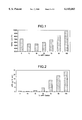
- FIG. 1 shows the activity of the dual characteristic catalyst of the present invention.
- FIG. 2 shows the MFR of polymer produced with the catalyst of the present invention.
- FIG. 3 shows DSC Thermograms of (a) sPP, (b)10% miPP, (c) 30% miPP, (d) 50% miPP, (e) 70% miPP, (f) 90% miPP, (g) 100% miPP.
- FIG. 4 shows DSC Thermograms of miPP (a) without and (b) with Nucleator.
- FIG. 5 shows dynamic crystallization of sPP, miPP and their reactor blends cooled from the melt (210° C.) @ the rate of 10° C./min.
- FIG. 6 shows tensile modulus and Izod impact of reactor blends of the present invention.
- FIG. 7 shows tensile strength of reactor blends of the present invention.
- FIG. 8 shows tensile elongation of reactor blends of the present invention.
- FIG. 9 shows transmittance of reactor blends of the present invention.
- the catalyst utilized in the present invention can be generally described as having both isospecific and syndiospecific metallocene components, supported upon a common supportive material.
- isospecific metallocene catalyst components are described as those which produce predominantly isotactic polyolefin.
- a catalyst component will produce at least about 70 weight percent isotactic polymer, preferably at least about 90 weight percent isotactic polymer, more preferably at least about 95 weight percent isotactic polymer, and even more preferably at least about 99 weight percent isotactic polymer, all based on the total weight of polymer catalyzed by the component.
- Syndiospecific metallocene catalyst components are described as those which produce predominantly syndiotactic polyolefins. Generally such a catalyst will component produce at least about 70 weight percent syndiotactic polymer, preferably at least about 90 weight percent syndiotactic polymer, more preferably at least about 95 weight percent syndiotactic polymer, and even more preferably at least about 99 weight percent syndiotactic polymer, all based on the total weight of polymer catalyzed by the syndiotactic specific component.
- the isotactic structure is typically described as having the methyl groups attached to the tertiary carbon atoms of successive monomeric units on the same side of a hypothetical plane through the main chain of the polymer, e.g., the methyl groups are all above or all below the plane.
- the stereochemical sequence of isotactic polypropylene is described as follows: ##STR1##
- Bovey's NMR nomenclature for an isotactic pentad is . . . mmmm . . . with each "m” representing a "meso" dyad or successive methyl groups on the same side in the plane.
- any deviation or inversion in the structure of the chain lowers the degree of isotacticity and crystallinity of the polymer.
- Syndiotactic polymers in contrast to the isotactic structure, are those in which the methyl groups attached to the tertiary carbon atoms of successive monomeric units in the chain lie on alternate sides of the plane of the polymer.
- Fischer projection formula the structure of a syndiotactic polymer is designated as: ##STR2##
- this pentad is described as . . . rrrr . . . in which each "r” represents a "racemic" dyad, i.e., successive methyl group on alternate sides of the plane.
- the percentage of r dyads in the chain determines the degree of syndiotacticity of the polymer.
- Syndiotactic polymers are crystalline and, like the isotactic polymers, are insoluble in xylene. This crystallinity distinguishes both syndiotactic and isotactic polymers from an atactic polymer which is soluble in xylene.
- Atactic polymer exhibits no regular order of repeating unit configurations in the polymer chain and forms essentially a waxy product.
- Metallocene catalyst components which produce predominantly isotactic polyolefins are disclosed in European Patent Application No. 87870132.5 (Publication No. 0 284 708 published Oct. 5, 1988), U.S. Pat. Nos. 4,794,096 and 4,975,403, and U.S. patent application Ser. No. 07/911,634, filed Jul. 10, 1992, all of which are herein incorporated by reference.
- each (CpR 2 C 4 R 4 ) and (CpR' 2 C 4 R' 4 ) are substituted indenyl rings;
- R and R' are hydrogen or a hydrocarbyl radical having 1-20 carbon atoms, each R may be the same or different, each R' also may be the same or different, one R and R' is a proximal substituent which is a hydrocarbyl radical from 1-20 carbon atoms, preferably is an alkyl radical of 1-4 carbon atoms and, most preferably, is a methyl radical, where proximal refers to position 2 of the indenyl ring relative to the carbon attached to R" (position 1), i.e., adjacent to the bridgehead carbon, the R and R' proximal substitutents being the same or different, but preferably are the same, and the remaining R and R' substituents are preferably hydrogen;
- R" is a structural bridge between the two indenyl rings imparting stereorigidity to the indenyl rings within
- Preferred syndiotactic metallocene components useful in the practice of the present invention include those disclosed and described in U.S. Pat. No. 4,892,851, issued Jan. 9, 1990, to Ewen et al., herein incorporated by reference.
- the preferred syndiotactic metallocene components may be described by the formula R"(CpR n ) (CpR' m )MQ k wherein each Cp is a cyclopentadienyl or substituted cyclopentadienyl ring; R n and R' m are hydrocarbyl radicals having 1-20 carbon atoms, each R n may be the same or different, and each R' m also may be the same or different; R" is a structural bridge between the two Cp rings imparting stereorigidity to the Cp rings within the catalyst, and R" is preferably selected from the group consisting of an alkyl radical having 1-4 carbon atoms or a hydrocarbyl radical containing silicon, germanium, phosphorus, nitrogen, boron, or aluminum; M is a group 4, 5, or 6 metal from the Periodic Table of Elements; each Q is a hydrocarbyl radical having 1-20 carbon atoms or is a halogen; 0 ⁇ k ⁇
- M is titanium, zirconium or hafnium;
- Q is preferably a halogen, and it is most preferably chlorine; and
- k is preferably 2, but it may vary with the valence of the metal atom.
- exemplary hydrocarbyl radicals include methyl, ethyl, propyl, isopropyl, butyl, isobutyl, amyl, isoamyl, hexyl, heptyl, octyl, nonyl, decyl, cetryl, phenyl, and the like.
- hydrocarbyl radicals useful in the preferred syndiospecific metallocene component include other alkyl, aryl, alkenyl, alkylaryl or arylalkyl radicals.
- R n and R' m may comprise hydrocarbyl radicals attached to a single carbon atom in the Cp ring as well as radicals that are bonded to two carbon atoms in the ring.
- the isospecific metallocene catalyst component and the syndiospecific metallocene catalyst component are supported on the same supportive material.
- the support can be any solid which is chemically inert and unreactive with both metallocene components and the other catalyst components.
- Non-limiting examples of support material are porous materials such as talc; inorganic oxides, such as Group 2, 13, 14 or 4 metal oxides, specifically, silica, alumina, magnesia, titania, zirconia, and mixtures thereof; and resinous materials, such as polyolefins, specifically, finely divided polyethylene, as disclosed in U.S. Pat. No. 4,701,432, hereby incorporated by reference.
- the iso- and syndio- specific metallocene catalyst components may each be prepared by any method known in the art. It is important that the catalyst complex be "clean" as usually low molecular weight, amorphous polymer is produced by impure catalysts. Non-limiting examples of two useful methods of preparing the catalyst are discussed below. Generally, the preparation of the catalyst complex consists of forming and isolating the substituted indenyl ligands, the anions of which are then reacted with a halogenated metal to form the complex.
- One non-limiting example of a process for preparing a bridged metallocene catalyst component comprises contacting a substituted indene having a proximal substituent on the indenyl ring with the same or another substituted indene having a proximal substituent under reaction conditions sufficient to produce a bridged substituted diindene.
- the process further comprises contacting the anionic form of the bridged substituted diindene with a metal compound of the formula MQ v , wherein M is a Group 3, 4, 5 or 6 metal from the Periodic Table of Elements, each Q is a hydrocarbyl radical having 1-20 carbon atoms or is a halogen and v is the valence of M, under reaction conditions sufficient to complex the bridged diindene to produce a bridged metallocene.
- the process step of contacting the bridged substituted diindene with a metal compound can be performed in a chlorinated solvent.
- Another non-limiting example of a process for preparing a bridged metallocene catalyst component comprises contacting a substituted indene having proximal substituents on the indenyl ring with an alkylsilylchloride of the formula R 2 SiX 2 where R is a hydrocarbyl radical having 1-20 carbon atoms and X is an halogen.
- R is a hydrocarbyl radical having 1-20 carbon atoms and X is an halogen.
- a second equivalent of the same or another substituted indene having proximal substituents on the indenyl ring is added to produce a silicon bridged disubstituted indene.
- the subsequent steps are similar to those above for producing a bridged disubstituted indene coordinated to a metal.
- the metallocene catalyst components of the present invention are useful in many of the polymerization processes known in the art including many of those disclosed for the preparation of iso- or syndio- tactic polypropylene. When the iso- and syndio- specific catalyst components of the present invention are used in these types of processes, the processes produce a blend of iso- and syndio- tactic polymers. Further examples of polymerization processes useful in the practice of the present invention include those disclosed in U.S. Pat. No. 4,767,735, U.S. Pat. No. 4,892,851, and U.S. Pat. No. 4,975,403, the disclosures of which are hereby incorporated herein by reference. These preferred polymerization procedures include the step of prepolymerizing the catalyst components by contacting the catalyst components with a cocatalyst and an olefin monomer prior to introduction into a reaction zone at a temperature below that of polymerization.
- the catalyst components of the present invention are particularly useful in combination with a cocatalyst, preferably an alumoxane, an alkyl aluminum, or other Lewis acids or a mixture thereof to form an active catalyst.
- a complex may be isolated between the iso- and syndio- specific metallocene catalyst components as described herein and an aluminum cocatalyst in accordance with the disclosure of U.S. Pat. Nos. 4,752,597 and 4,791,180.
- metallocene is reacted with an excess of alumoxane in the presence of a suitable solvent.
- a complex of the iso- and syndio- specific metallocene and alumoxane may be isolated and used as a catalyst in the present invention.
- the alumoxanes useful in combination with the catalyst components of the present invention may be represented by the general formula (R--Al--O--) n in the cyclic form and R(R--Al--O)-- n --AlR 2 in the linear form wherein R is an alkyl group with one to five carbon atoms and n is an integer from 1 to about 20. Most preferably, R is a methyl group.
- R is a methyl group.
- they are prepared by contacting water with a solution of trialkyl aluminum, such as, trimethyl aluminum, in a suitable solvent such as benzene.
- a solution of trialkyl aluminum such as, trimethyl aluminum
- a suitable solvent such as benzene.
- Another preferred method includes the preparation of alumoxane in the presence of a hydrated copper sulfate as described in U.S. Pat. No. 4,404,344, the disclosure of which is hereby incorporated by reference. This method comprises treating a dilute solution of trimethyl aluminum in toluene with copper sulfate.
- the preparation of other aluminum cocatalysts useful in the present invention may be prepared by methods known to those skilled in the art.
- MAO co-catalyst is a catalyst system of the iso- and syndio- specific metallocenes, a Lewis acid ionic ionizing agent and, optionally, an aluminum alkyl.
- Methods for preparing a cationic metallocene catalyst system are disclosed in European Patent Application Nos. 90870174.1, 90870175.8 and 90870176.6 (Publication Nos. 0 426 637 A2, 0 426 638 A2 and 0 427 697 A2, published on May 8, 1991; May 8, 1991 and May 15, 1991, respectively), which are hereby incorporated by reference.
- the ionizing agent which is an ion pair ionizes the metallocenes to a cation.
- the metallocene cation forms an ion pair with the anion component of the ionizing agent.
- the segment of the metallocene compound removed by ionization forms an anion which associates with the cation component of the ionizing agent.
- the ion pair formed from the anion of the segment of metallocene and the cation of ionizing agent is chemically inert and non-reactive with regard to the metallocene cation and the metallocene cation-ionizing agent anion ion pair which is an active catalyst for polymerization of olefins.
- An aluminum alkyl such as triethyl aluminum, is useful in such an ionic catalyst system to improve yields. It is believed that aluminum alkyl acts to enhance the ionizing process and to scavenge catalyst poisons.
- Examples 1-7 show the preparation of catalysts having various compositions of syndio- and iso- stereospecificity prepared by placing both sPP and iPP metallocene catalysts on a common supportive material.
- Examples 8-14 show the preparation of reactor blends of syndiotactic polypropylene (sPP) and isotactic polypropylene (iPP) utilizing the catalysts of Examples 1-7. The characteristics of these produced blends were evaluated on compression molded samples.
- silica 40 grams was transferred into a 1.0 L, 3-neck, round bottom flask under nitrogen purge. The flask was then equipped with a reflux condenser that was capped with a gas inlet adapter, a 125 mL pressure equalized addition funnel which was capped with a rubber septum, and the last neck was capped with a rubber septum.
- the silica was slurried in 250 mL of toluene at room temperature. Next, 135.2 mL of a 30% MAO solution in toluene was added to the reaction mixture at room temperature. The reaction is exothermic with methane produced as a byproduct. The reaction mixture was then stirred at reflux for four hours under argon.
- Example 2 The procedure of Example 1 was followed except that a 1:2.33 isospecific to syndiospecific metallocene ratio was utilized. The resulting supported catalyst obtained was a light purple solid.
- Example 2 The procedure of Example 1 was followed except that a 1:1 isospecific to syndiospecific metallocene ratio was utilized.
- the resulting supported catalyst obtained was a light purple-pink solid.
- Example 2 The procedure of Example 1 was followed except that a 2.33:1 isospecific to syndiospecific metallocene ratio was utilized. The resulting supported catalyst obtained was a tan solid.
- Example 1 The procedure of Example 1 was followed except that a 9:1 isospecific to syndiospecific metallocene ratio was utilized. The resulting supported catalyst obtained was a beige solid.
- Example 1 The procedure of Example 1 was followed except that a 0:1 isospecific to syndiospecific metallocene ratio was utilized. The resulting supported catalyst obtained was a purple solid.
- Example 2 The procedure of Example 1 was followed except that a 1:2.33 isospecific to syndiospecific metallocene ratio was utilized. The resulting supported catalyst obtained was a tan solid.
- Polypropylene was prepared using the 10:90 miPP/msPP catalyst of Example 1.
- Polymerization was conducted in a 2.0L stainless steel laboratory autoclave (Zipperclave) liquid phase batch reactor. The reactor was cleaned, dried and throughly dried with warm dry nitrogen. The autoclave reactor was then charged with 1.4 liters of liquid propylene and 16 mmoles of gaseous hydrogen. Next, 72 mg of catalyst and 108 mg of TiBAl were mixed in mineral oil and placed in a bomb. The mineral oil slurry was precontacted with a small amount of dry propylene at room temperature for about five seconds to allow for some prepolymerization prior to charging into the reactor. The mixture was then heated to 60° C., and stirred at that temperature for 60 minutes. At the end of this time, polymerization was terminated by rapidly venting the unreacted propylene out of the reactor. The resulting polymer was then separated, dried at 80° C. and submitted for analysis.
- Polypropylene was prepared according to the procedure of Example 8, except that the 30:70 miPP/msPP catalyst of Example 2 was utilized.
- Polypropylene was prepared according to the procedure of Example 8, except that the 50:50 miPP/msPP catalyst of Example 3 was utilized.
- Polypropylene was prepared according to the procedure of Example 8, except that the 70:30 miPP/msPP catalyst of Example 4 was utilized.
- Polypropylene was prepared according to the procedure of Example 8, except that the 90:10 miPP/msPP catalyst of Example 5 was utilized.
- Polypropylene was prepared according to the procedure of Example 8, except that the 0:100 miPP/msPP catalyst of Example 6 was utilized.
- Polypropylene was prepared according to the procedure of Example 8, except that the 100:0 miPP/msPP catalyst of Example 7 was utilized.
- Polymer fluff was prepared by dissolving the prepared polypropylene in boiling xylene (80ml/1 g polymer) and then the polymer was precipitated in methanol by adding xylene solution dropwise into methanol while stirring. The precipitates were collected by filtration. Then, the filtrate was extracted with boiling heptane in a Soxhlet extractor overnight. The insoluble were dried in a vacuum oven at 60° C.
- standard antioxidants such as I-1076 (resin stabilizer antioxidants) and Irg-1076 (resin stabilizer antioxidants)
- the thermal characteristics via dynamic crystallizations and melting were determined by DSC. Five to ten mgs of the prepared polypropylene polymer pellet was placed in a DSC aluminum pan and melted at 210° C. for 10 minutes, and then cooled to 25° C. at the rate of 10° C./min for dynamic crystallization while recording a recrystallization exotherm, followed by heating to 190° C. at the same rate to record a melting endotherm.
- Polypropylene polymer pellets were compression molded into 6" ⁇ 8" ⁇ 0.05" plaques. Forty to fifty grams polymer was placed in a 3 piece "window” mold. One ton pressure was applied to the mold at 450° F. (232° C.) for 3 minutes and then, the pressure was increased to 2.5, 5, 10 and 30 tons at one minute intervals. After holding at 30 tons for 1 minute, the mold was moved to the cold stage (5-10° C.) to quench the polymer. The molding was completed after the mold was held in the press under contact pressure for 15-20 minutes.
- Type IV tensile bars were stamped out of the compression molded plaques. Five tensile bars per each blend were tested using Instron under the condition prescribed in ASTM D638.
- Rectangular flexural bars (12.7 mm ⁇ 127 mm ⁇ 1.2 mm) were stamped out of the compression molded plaques. Five bars (12.7 mm ⁇ 50.8 mm ⁇ 1.2 mm) per each plaque were prepared and tested under the condition prescribed in ASTM D790; 25.4 mm span length, 0.85 mm/min cross head speed.
- Rectangular bars were compression molded and then Izod bars were prepared as prescribed in ASTM D256. Izod impact resistance was determined on the notched samples.
- the percent transmittance was measured on the compression molded plaque (0.05" thick) before cut into the desired test geometries.
- the characteristics of polymers produced in Examples 8-14 with the catalysts of Examples 1-7 having various syndio-and iso-specificity ratios are given in Table II and FIGS. 1-2.
- the miPP catalyst showed approximately 30% higher activity than sPP catalyst.
- the dual catalyst exhibited a minimum activity when the catalyst was composed of less than 50% miPP catalyst.
- the amounts of xylene solubles for all the blends were less than 1%.
- sPP shows dual melting endotherms and crystallizes at a significantly lower temperature than miPP (70 vs 107° C.).
- T c 80-95° C.
- the rates of dynamic crystallization for sPP, miPP and their reactor blends were determined by plotting exothermic heat generated during recrystallization with time elapsed from the melt (210° C.), where the raw data are given in Table V.
- the crystallization rate in terms of the slope of the curve, significantly increases with increasing amount of miPP.
- the induction period for crystallization decreases with increasing amount of miPP.
- the physical properties of the melt blends determined on the compression molded samples, are given in Table VI.
- Tensile modulus and Izod impact of the reactor blends are shown in FIG. 6, while other tensile properties are presented in FIGS. 7 and 8.
- the moduli of sPP blends were enhanced by increasing amounts of miPP, which can be attributed to increases in crystallinity.
- the impact property increased with increasing amounts of sPP.
- the blend of 50/50 sPP and miPP has Izod impact similar to normal high impact polystyrene (100 J/m).
Landscapes
- Chemical & Material Sciences (AREA)
- Health & Medical Sciences (AREA)
- Chemical Kinetics & Catalysis (AREA)
- Medicinal Chemistry (AREA)
- Polymers & Plastics (AREA)
- Organic Chemistry (AREA)
- Transition And Organic Metals Composition Catalysts For Addition Polymerization (AREA)
Priority Applications (8)
| Application Number | Priority Date | Filing Date | Title |
|---|---|---|---|
| US08/835,618 US6143683A (en) | 1997-04-09 | 1997-04-09 | Metallocene catalyst and catalyst system for polymerizing an olefin having at least 3 carbon atoms |
| JP10111392A JPH10338703A (ja) | 1997-04-09 | 1998-04-08 | イソ−およびシンジオ−タクテイツクポリプロピレンのポリプロピレンブレンド物を製造するためのメタロセン触媒および触媒系 |
| EP98201086A EP0870779B1 (de) | 1997-04-09 | 1998-04-09 | Metallocenkatalysator und Katalysatorsystem für die Herstellung von Polypropylenemischungen aus iso- und syndiotaktischem Polypropylene |
| DE69828543T DE69828543T2 (de) | 1997-04-09 | 1998-04-09 | Metallocenkatalysator und Katalysatorsystem für die Herstellung von Polypropylenmischungen aus iso- und syndiotaktischem Polypropylen |
| ES98201086T ES2236863T3 (es) | 1997-04-09 | 1998-04-09 | Catalizador de metaloceno y sistema catalitico para la produccion de mezcla de polipropileno iso- y sindiotactico. |
| AT98201086T ATE286919T1 (de) | 1997-04-09 | 1998-04-09 | Metallocenkatalysator und katalysatorsystem für die herstellung von polypropylenemischungen aus iso- und syndiotaktischem polypropylene |
| US09/576,405 US6362125B1 (en) | 1997-04-09 | 2000-05-22 | Metallocene catalyst and catalyst system for producing polypropylene blend of iso and syndio-tactic polypropylene |
| US09/653,821 US6518377B1 (en) | 1997-04-09 | 2000-09-01 | Metallocene catalyst and catalyst system for producing polypropylene blend of iso- and syndio-tactic polypropylene |
Applications Claiming Priority (1)
| Application Number | Priority Date | Filing Date | Title |
|---|---|---|---|
| US08/835,618 US6143683A (en) | 1997-04-09 | 1997-04-09 | Metallocene catalyst and catalyst system for polymerizing an olefin having at least 3 carbon atoms |
Related Child Applications (1)
| Application Number | Title | Priority Date | Filing Date |
|---|---|---|---|
| US09/576,405 Division US6362125B1 (en) | 1997-04-09 | 2000-05-22 | Metallocene catalyst and catalyst system for producing polypropylene blend of iso and syndio-tactic polypropylene |
Publications (1)
| Publication Number | Publication Date |
|---|---|
| US6143683A true US6143683A (en) | 2000-11-07 |
Family
ID=25269989
Family Applications (3)
| Application Number | Title | Priority Date | Filing Date |
|---|---|---|---|
| US08/835,618 Expired - Lifetime US6143683A (en) | 1997-04-09 | 1997-04-09 | Metallocene catalyst and catalyst system for polymerizing an olefin having at least 3 carbon atoms |
| US09/576,405 Expired - Lifetime US6362125B1 (en) | 1997-04-09 | 2000-05-22 | Metallocene catalyst and catalyst system for producing polypropylene blend of iso and syndio-tactic polypropylene |
| US09/653,821 Expired - Lifetime US6518377B1 (en) | 1997-04-09 | 2000-09-01 | Metallocene catalyst and catalyst system for producing polypropylene blend of iso- and syndio-tactic polypropylene |
Family Applications After (2)
| Application Number | Title | Priority Date | Filing Date |
|---|---|---|---|
| US09/576,405 Expired - Lifetime US6362125B1 (en) | 1997-04-09 | 2000-05-22 | Metallocene catalyst and catalyst system for producing polypropylene blend of iso and syndio-tactic polypropylene |
| US09/653,821 Expired - Lifetime US6518377B1 (en) | 1997-04-09 | 2000-09-01 | Metallocene catalyst and catalyst system for producing polypropylene blend of iso- and syndio-tactic polypropylene |
Country Status (6)
| Country | Link |
|---|---|
| US (3) | US6143683A (de) |
| EP (1) | EP0870779B1 (de) |
| JP (1) | JPH10338703A (de) |
| AT (1) | ATE286919T1 (de) |
| DE (1) | DE69828543T2 (de) |
| ES (1) | ES2236863T3 (de) |
Cited By (13)
| Publication number | Priority date | Publication date | Assignee | Title |
|---|---|---|---|---|
| US6362125B1 (en) * | 1997-04-09 | 2002-03-26 | Fina Technology, Inc. | Metallocene catalyst and catalyst system for producing polypropylene blend of iso and syndio-tactic polypropylene |
| US6470824B2 (en) | 1999-03-10 | 2002-10-29 | Tokyo Electron Limited | Semiconductor manufacturing apparatus |
| US6608000B1 (en) * | 1992-04-09 | 2003-08-19 | Exxonmobil Chemical Patents Inc. | Polymerization catalysts, their production and use |
| US20030236365A1 (en) * | 2002-06-24 | 2003-12-25 | Fina Technology, Inc. | Polyolefin production with a high performance support for a metallocene catalyst system |
| US20050119425A1 (en) * | 2001-09-27 | 2005-06-02 | Abbas Razavi | Catalyst system comprising a mixture of catalyst components for producing a polyolefin blend |
| US20060094836A1 (en) * | 2002-09-27 | 2006-05-04 | Abbas Razavi | Polyolefin production |
| US7223822B2 (en) | 2002-10-15 | 2007-05-29 | Exxonmobil Chemical Patents Inc. | Multiple catalyst and reactor system for olefin polymerization and polymers produced therefrom |
| US7294681B2 (en) | 2002-10-15 | 2007-11-13 | Exxonmobil Chemical Patents Inc. | Mutliple catalyst system for olefin polymerization and polymers produced therefrom |
| US20090118447A1 (en) * | 2005-09-02 | 2009-05-07 | Abbas Razavi | Impact Copolymer in Single Reactor |
| US7541402B2 (en) | 2002-10-15 | 2009-06-02 | Exxonmobil Chemical Patents Inc. | Blend functionalized polyolefin adhesive |
| US7550528B2 (en) | 2002-10-15 | 2009-06-23 | Exxonmobil Chemical Patents Inc. | Functionalized olefin polymers |
| US7700707B2 (en) | 2002-10-15 | 2010-04-20 | Exxonmobil Chemical Patents Inc. | Polyolefin adhesive compositions and articles made therefrom |
| WO2023081010A1 (en) | 2021-11-05 | 2023-05-11 | Exxonmobil Chemical Patents Inc. | Polypropylene viscosity modifiers and lubricating oils thereof |
Families Citing this family (23)
| Publication number | Priority date | Publication date | Assignee | Title |
|---|---|---|---|---|
| US6245857B1 (en) * | 1999-02-22 | 2001-06-12 | Fina Technology, Inc. | Compositions useful for tough, high crystallinity films |
| EP1031582A1 (de) * | 1999-02-26 | 2000-08-30 | Fina Research S.A. | Verwendung und Herstellung von Polypropylen |
| EP1041180A1 (de) | 1999-03-30 | 2000-10-04 | Fina Research S.A. | Polypropylenfasern |
| JP4837879B2 (ja) * | 2001-01-16 | 2011-12-14 | エクソンモービル・ケミカル・パテンツ・インク | 混合触媒組成物による重合法 |
| US6777367B2 (en) * | 2001-02-13 | 2004-08-17 | Fina Technology, Inc. | Method for the preparation of metallocene catalysts |
| US6777366B2 (en) | 2001-02-13 | 2004-08-17 | Fina Technology, Inc. | Method for the preparation of metallocene catalysts |
| AU2003226284A1 (en) * | 2002-04-12 | 2003-10-27 | Milliken And Company | Highly nucleated syndiotactic polypropylene |
| AU2003247735B2 (en) | 2002-06-26 | 2010-03-11 | Avery Dennison Corporation | Oriented films comprising polypropylene / olefin elastomer blends |
| EP1493778A1 (de) * | 2003-07-04 | 2005-01-05 | Total Petrochemicals Research Feluy | Herstellung von Polyolefinen |
| MX2007011337A (es) * | 2005-03-17 | 2007-10-02 | Dow Global Technologies Inc | Composicion de catalizador que comprende un agente de transporte para la formacion de copolimero de bloques multiples tactico/atactico. |
| US9410009B2 (en) | 2005-03-17 | 2016-08-09 | Dow Global Technologies Llc | Catalyst composition comprising shuttling agent for tactic/ atactic multi-block copolymer formation |
| US7413812B2 (en) | 2005-04-26 | 2008-08-19 | Fina Technology, Inc. | Polypropylene article and method of preparing polypropylene article |
| US20070040292A1 (en) * | 2005-08-22 | 2007-02-22 | Fina Technology, Inc. | Polypropylene composition for high gloss retention |
| US8003739B2 (en) * | 2007-10-17 | 2011-08-23 | Fina Technology, Inc. | Multi-component catalyst systems and polymerization processes for forming in-situ heterophasic copolymers and/or varying the xylene solubles content of polyolefins |
| ES2398725T3 (es) | 2006-06-14 | 2013-03-21 | Avery Dennison Corporation | Material para etiquetas orientado en la dirección longitudinal que se puede conformar y cortar con troquel y etiquetas y proceso para su preparación |
| BRPI0713492A2 (pt) * | 2006-06-20 | 2012-01-24 | Avery Dennison Corp | filme polimérico de multi-camadas para rotulagem de adesivos de derretimento a quente e etiqueta e rótulo dos mesmos |
| US7589138B2 (en) * | 2006-12-05 | 2009-09-15 | Fina Technology, Inc. | Injection molding process |
| US20140051816A9 (en) * | 2007-10-17 | 2014-02-20 | Fina Technology, Inc. | Multi-component catalyst systems for the production of reactor blends of polypropylene |
| US20130023755A1 (en) | 2010-02-15 | 2013-01-24 | Schrader Eugene F | Syringe Products and Related Methods and Uses |
| TW201313762A (zh) * | 2011-06-16 | 2013-04-01 | Fina Technology | 用於在反應器中產製聚丙烯摻合物之多組份二茂金屬觸媒系統 |
| TW201313761A (zh) * | 2011-06-16 | 2013-04-01 | Fina Technology | 用於在反應器中產製聚丙烯摻合物之多組份觸媒系統 |
| US9676532B2 (en) | 2012-08-15 | 2017-06-13 | Avery Dennison Corporation | Packaging reclosure label for high alcohol content products |
| JP2017520642A (ja) | 2014-06-02 | 2017-07-27 | アベリー・デニソン・コーポレイションAvery Dennison Corporation | 耐スカッフ性、透明性、及び順応性が改善されたフィルム |
Citations (22)
| Publication number | Priority date | Publication date | Assignee | Title |
|---|---|---|---|---|
| US4530914A (en) * | 1983-06-06 | 1985-07-23 | Exxon Research & Engineering Co. | Process and catalyst for producing polyethylene having a broad molecular weight distribution |
| US4939202A (en) * | 1988-03-09 | 1990-07-03 | The International Group, Inc. | Barrier guard moisture-proof adhesive |
| US4939217A (en) * | 1987-04-03 | 1990-07-03 | Phillips Petroleum Company | Process for producing polyolefins and polyolefin catalysts |
| US4975403A (en) * | 1987-09-11 | 1990-12-04 | Fina Technology, Inc. | Catalyst systems for producing polyolefins having a broad molecular weight distribution |
| US5064797A (en) * | 1987-04-03 | 1991-11-12 | Phillips Petroleum Company | Process for producing polyolefins and polyolefin catalysts |
| US5124404A (en) * | 1990-08-21 | 1992-06-23 | Great Lakes Chemical Corp. | Flame retardant polypropylene molding compositions |
| WO1993009148A1 (en) * | 1991-11-07 | 1993-05-13 | Exxon Chemical Patents Inc. | Process for producing polyolefin |
| US5269807A (en) * | 1992-08-27 | 1993-12-14 | United States Surgical Corporation | Suture fabricated from syndiotactic polypropylene |
| EP0581754A1 (de) * | 1992-07-10 | 1994-02-02 | Fina Technology, Inc. | Verfahren und Katalysator für Herstellung isotaktischen Polyolefinen |
| EP0622410A1 (de) * | 1993-04-30 | 1994-11-02 | Becton, Dickinson and Company | Medizinische Artikel und Verfahren dafür |
| WO1994028034A1 (en) * | 1993-05-25 | 1994-12-08 | Exxon Chemical Patents Inc. | Supported metallocene catalyst systems for the polymerization of olefins, preparation and use thereof |
| US5372980A (en) * | 1993-06-03 | 1994-12-13 | Polysar | Bimetallic metallocene alumoxane catalyst system and its use in the preparation of ethylene-alpha olefin and ethylene-alpha olefin-non-conjugated diolefin elastomers |
| EP0650816A1 (de) * | 1993-10-28 | 1995-05-03 | Mitsui Toatsu Chemicals, Incorporated | Verfahren zum Spritzgiessen von Mischungen aus syndiotaktischem Polypropylen und isotaktischem Polypropylen und damit erzeugte Produkte |
| JPH07145202A (ja) * | 1993-11-22 | 1995-06-06 | Mitsui Toatsu Chem Inc | ポリ−α−オレフィンの製造方法 |
| US5444125A (en) * | 1991-04-30 | 1995-08-22 | Mitsubishi Petrochemical Company Limited | Aminated olefin polymers |
| US5455305A (en) * | 1993-07-12 | 1995-10-03 | Montell North America Inc. | Propylene polymer yarn and articles made therefrom |
| US5459117A (en) * | 1993-08-27 | 1995-10-17 | Ewen; John A. | Doubly-conformationally locked, stereorigid catalysts for the preparation of tactiospecific polymers |
| WO1995033777A1 (en) * | 1994-06-02 | 1995-12-14 | W.R. Grace & Co.-Conn. | Use of glycol ether compounds for the production of polyolefin catalysts and supports |
| EP0747403A1 (de) * | 1995-06-07 | 1996-12-11 | Fina Technology, Inc. | Verfahren zur Herstellung einer isotaktischen/syndiotaktischen Polymermischung in einem einzigen Reaktor |
| US5616752A (en) * | 1991-05-09 | 1997-04-01 | Phillips Petroleum Company | Metallocenes and processes therefor and therewith |
| US5786291A (en) * | 1996-02-23 | 1998-07-28 | Exxon Chemical Patents, Inc. | Engineered catalyst systems and methods for their production and use |
| US5892079A (en) * | 1997-10-17 | 1999-04-06 | Sri International | Metallocene catalysts and associated methods of preparation and use |
Family Cites Families (6)
| Publication number | Priority date | Publication date | Assignee | Title |
|---|---|---|---|---|
| KR100197327B1 (ko) * | 1988-07-15 | 1999-06-15 | 치어즈 엠. 노우드 | 신디오택틱 폴리프로필렌 |
| US5191132A (en) * | 1991-05-09 | 1993-03-02 | Phillips Petroleum Company | Cyclopentadiene type compounds and method for making |
| EP0702030B1 (de) * | 1991-05-27 | 2001-03-21 | TARGOR GmbH | Verfahren zur Herstellung von Polyolefinen mit breiter Molmassenverteilung |
| US5631202A (en) * | 1993-09-24 | 1997-05-20 | Montell Technology Company B.V. | Stereospecific metallocene catalysts with stereolocking α-CP substituents |
| US6143683A (en) * | 1997-04-09 | 2000-11-07 | Fina Technology, Inc. | Metallocene catalyst and catalyst system for polymerizing an olefin having at least 3 carbon atoms |
| US6207606B1 (en) * | 1998-05-15 | 2001-03-27 | Univation Technologies, Llc | Mixed catalysts and their use in a polymerization process |
-
1997
- 1997-04-09 US US08/835,618 patent/US6143683A/en not_active Expired - Lifetime
-
1998
- 1998-04-08 JP JP10111392A patent/JPH10338703A/ja not_active Withdrawn
- 1998-04-09 EP EP98201086A patent/EP0870779B1/de not_active Expired - Lifetime
- 1998-04-09 DE DE69828543T patent/DE69828543T2/de not_active Expired - Fee Related
- 1998-04-09 ES ES98201086T patent/ES2236863T3/es not_active Expired - Lifetime
- 1998-04-09 AT AT98201086T patent/ATE286919T1/de not_active IP Right Cessation
-
2000
- 2000-05-22 US US09/576,405 patent/US6362125B1/en not_active Expired - Lifetime
- 2000-09-01 US US09/653,821 patent/US6518377B1/en not_active Expired - Lifetime
Patent Citations (22)
| Publication number | Priority date | Publication date | Assignee | Title |
|---|---|---|---|---|
| US4530914A (en) * | 1983-06-06 | 1985-07-23 | Exxon Research & Engineering Co. | Process and catalyst for producing polyethylene having a broad molecular weight distribution |
| US4939217A (en) * | 1987-04-03 | 1990-07-03 | Phillips Petroleum Company | Process for producing polyolefins and polyolefin catalysts |
| US5064797A (en) * | 1987-04-03 | 1991-11-12 | Phillips Petroleum Company | Process for producing polyolefins and polyolefin catalysts |
| US4975403A (en) * | 1987-09-11 | 1990-12-04 | Fina Technology, Inc. | Catalyst systems for producing polyolefins having a broad molecular weight distribution |
| US4939202A (en) * | 1988-03-09 | 1990-07-03 | The International Group, Inc. | Barrier guard moisture-proof adhesive |
| US5124404A (en) * | 1990-08-21 | 1992-06-23 | Great Lakes Chemical Corp. | Flame retardant polypropylene molding compositions |
| US5444125A (en) * | 1991-04-30 | 1995-08-22 | Mitsubishi Petrochemical Company Limited | Aminated olefin polymers |
| US5616752A (en) * | 1991-05-09 | 1997-04-01 | Phillips Petroleum Company | Metallocenes and processes therefor and therewith |
| WO1993009148A1 (en) * | 1991-11-07 | 1993-05-13 | Exxon Chemical Patents Inc. | Process for producing polyolefin |
| EP0581754A1 (de) * | 1992-07-10 | 1994-02-02 | Fina Technology, Inc. | Verfahren und Katalysator für Herstellung isotaktischen Polyolefinen |
| US5269807A (en) * | 1992-08-27 | 1993-12-14 | United States Surgical Corporation | Suture fabricated from syndiotactic polypropylene |
| EP0622410A1 (de) * | 1993-04-30 | 1994-11-02 | Becton, Dickinson and Company | Medizinische Artikel und Verfahren dafür |
| WO1994028034A1 (en) * | 1993-05-25 | 1994-12-08 | Exxon Chemical Patents Inc. | Supported metallocene catalyst systems for the polymerization of olefins, preparation and use thereof |
| US5372980A (en) * | 1993-06-03 | 1994-12-13 | Polysar | Bimetallic metallocene alumoxane catalyst system and its use in the preparation of ethylene-alpha olefin and ethylene-alpha olefin-non-conjugated diolefin elastomers |
| US5455305A (en) * | 1993-07-12 | 1995-10-03 | Montell North America Inc. | Propylene polymer yarn and articles made therefrom |
| US5459117A (en) * | 1993-08-27 | 1995-10-17 | Ewen; John A. | Doubly-conformationally locked, stereorigid catalysts for the preparation of tactiospecific polymers |
| EP0650816A1 (de) * | 1993-10-28 | 1995-05-03 | Mitsui Toatsu Chemicals, Incorporated | Verfahren zum Spritzgiessen von Mischungen aus syndiotaktischem Polypropylen und isotaktischem Polypropylen und damit erzeugte Produkte |
| JPH07145202A (ja) * | 1993-11-22 | 1995-06-06 | Mitsui Toatsu Chem Inc | ポリ−α−オレフィンの製造方法 |
| WO1995033777A1 (en) * | 1994-06-02 | 1995-12-14 | W.R. Grace & Co.-Conn. | Use of glycol ether compounds for the production of polyolefin catalysts and supports |
| EP0747403A1 (de) * | 1995-06-07 | 1996-12-11 | Fina Technology, Inc. | Verfahren zur Herstellung einer isotaktischen/syndiotaktischen Polymermischung in einem einzigen Reaktor |
| US5786291A (en) * | 1996-02-23 | 1998-07-28 | Exxon Chemical Patents, Inc. | Engineered catalyst systems and methods for their production and use |
| US5892079A (en) * | 1997-10-17 | 1999-04-06 | Sri International | Metallocene catalysts and associated methods of preparation and use |
Cited By (23)
| Publication number | Priority date | Publication date | Assignee | Title |
|---|---|---|---|---|
| US6608000B1 (en) * | 1992-04-09 | 2003-08-19 | Exxonmobil Chemical Patents Inc. | Polymerization catalysts, their production and use |
| US6362125B1 (en) * | 1997-04-09 | 2002-03-26 | Fina Technology, Inc. | Metallocene catalyst and catalyst system for producing polypropylene blend of iso and syndio-tactic polypropylene |
| US6470824B2 (en) | 1999-03-10 | 2002-10-29 | Tokyo Electron Limited | Semiconductor manufacturing apparatus |
| US7396888B2 (en) * | 2001-09-27 | 2008-07-08 | Total Petrochemicals Research Feluy | Catalyst system comprising a mixture of catalyst components for producing a polyolefin blend |
| US20050119425A1 (en) * | 2001-09-27 | 2005-06-02 | Abbas Razavi | Catalyst system comprising a mixture of catalyst components for producing a polyolefin blend |
| CN1304432C (zh) * | 2001-09-27 | 2007-03-14 | 阿托菲纳研究公司 | 生产聚烯烃共混物用的含催化剂组分混合物的催化剂体系 |
| US20030236365A1 (en) * | 2002-06-24 | 2003-12-25 | Fina Technology, Inc. | Polyolefin production with a high performance support for a metallocene catalyst system |
| US7449527B2 (en) | 2002-09-27 | 2008-11-11 | Total Petrochemicals Research Feluy | Polyolefin production |
| US20060094836A1 (en) * | 2002-09-27 | 2006-05-04 | Abbas Razavi | Polyolefin production |
| US20090105068A1 (en) * | 2002-09-27 | 2009-04-23 | Total Petrochemicals Research Feluy | Polyolefin production |
| US7541402B2 (en) | 2002-10-15 | 2009-06-02 | Exxonmobil Chemical Patents Inc. | Blend functionalized polyolefin adhesive |
| US7223822B2 (en) | 2002-10-15 | 2007-05-29 | Exxonmobil Chemical Patents Inc. | Multiple catalyst and reactor system for olefin polymerization and polymers produced therefrom |
| US7524910B2 (en) | 2002-10-15 | 2009-04-28 | Exxonmobil Chemical Patents Inc. | Polyolefin adhesive compositions and articles made therefrom |
| US7294681B2 (en) | 2002-10-15 | 2007-11-13 | Exxonmobil Chemical Patents Inc. | Mutliple catalyst system for olefin polymerization and polymers produced therefrom |
| US7550528B2 (en) | 2002-10-15 | 2009-06-23 | Exxonmobil Chemical Patents Inc. | Functionalized olefin polymers |
| US7700707B2 (en) | 2002-10-15 | 2010-04-20 | Exxonmobil Chemical Patents Inc. | Polyolefin adhesive compositions and articles made therefrom |
| US8071687B2 (en) | 2002-10-15 | 2011-12-06 | Exxonmobil Chemical Patents Inc. | Multiple catalyst system for olefin polymerization and polymers produced therefrom |
| US8088867B2 (en) | 2002-10-15 | 2012-01-03 | Exxonmobil Chemical Patents Inc. | Multiple catalyst system for olefin polymerization and polymers produced therefrom |
| US8957159B2 (en) | 2002-10-15 | 2015-02-17 | Exxonmobil Chemical Patents Inc. | Multiple catalyst system for olefin polymerization and polymers produced therefrom |
| US20090118447A1 (en) * | 2005-09-02 | 2009-05-07 | Abbas Razavi | Impact Copolymer in Single Reactor |
| US8426534B2 (en) | 2005-09-02 | 2013-04-23 | Total Research & Technology Feluy | Impact copolymer in single reactor |
| WO2023081010A1 (en) | 2021-11-05 | 2023-05-11 | Exxonmobil Chemical Patents Inc. | Polypropylene viscosity modifiers and lubricating oils thereof |
| US12378497B2 (en) | 2021-11-05 | 2025-08-05 | Exxonmobil Chemicals Patents Inc. | Polypropylene viscosity modifiers and lubricating oils thereof |
Also Published As
| Publication number | Publication date |
|---|---|
| US6362125B1 (en) | 2002-03-26 |
| ATE286919T1 (de) | 2005-01-15 |
| DE69828543T2 (de) | 2006-04-13 |
| US6518377B1 (en) | 2003-02-11 |
| JPH10338703A (ja) | 1998-12-22 |
| ES2236863T3 (es) | 2005-07-16 |
| EP0870779A1 (de) | 1998-10-14 |
| EP0870779B1 (de) | 2005-01-12 |
| DE69828543D1 (de) | 2005-02-17 |
Similar Documents
| Publication | Publication Date | Title |
|---|---|---|
| US6143683A (en) | Metallocene catalyst and catalyst system for polymerizing an olefin having at least 3 carbon atoms | |
| US5597881A (en) | Polyolefin molding composition for the production of molding of high rigidity and transparency by injection molding | |
| JP5398626B2 (ja) | プロピレン系エラストマー | |
| US6248829B1 (en) | Polymers of propene | |
| US6881493B2 (en) | Polyolefins and uses thereof | |
| JP5121108B2 (ja) | 二軸延伸ポリプロピレンフィルム製造用の半結晶性プロピレンポリマー組成物 | |
| EP1002809A1 (de) | Statistisches propylen/ethylen copolymer, formmaterial und geformtes gegenstand | |
| JP3946282B2 (ja) | プロピレンのエチレンとのアモルファスコポリマー | |
| JPWO1999009079A1 (ja) | プロピレン/エチレン・ランダム共重合体、成形材料および成形品 | |
| KR20000068428A (ko) | 배향 필름용의 개선된 프로필렌 중합체 | |
| RU2754212C1 (ru) | Композиция гетерофазного полипропилена с высокой гибкостью и мягкостью | |
| JPWO1999014270A1 (ja) | ポリプロピレン組成物 | |
| KR100663788B1 (ko) | 폴리올레핀의 제조 방법 | |
| JPWO1999007747A1 (ja) | オレフィン(共)重合体の製造方法およびオレフィン(共)重合体ならびにその応用 | |
| US20040249094A1 (en) | Use and production of polypropylene | |
| EP1572762B1 (de) | Verfahren zur herstellung von hochmolekularem polypropylen | |
| US11345767B2 (en) | Propylene copolymer resin composition and method for preparing the same | |
| EP0890590B1 (de) | Propylen/ethylen copolymer, herstellungsverfahren dafür und formteile daraus | |
| EP3733765B1 (de) | Harzzusammensetzung für bi-komponentenfaser | |
| JPH03121106A (ja) | シンジオタクチック構造を有するα―オレフィンポリマー | |
| JP2006523753A (ja) | プロピレン・コポリマー用触媒 | |
| EP1179553B1 (de) | Polyolefinherstellung | |
| JP2003192851A (ja) | ポリプロピレン系樹脂 | |
| JP2000336123A (ja) | 易加工性プロピレン−環状オレフィン共重合体およびその製造方法 |
Legal Events
| Date | Code | Title | Description |
|---|---|---|---|
| AS | Assignment |
Owner name: FINA TECHNOLOGY, INC., TEXAS Free format text: ASSIGNMENT OF ASSIGNORS INTEREST;ASSIGNORS:SHAMSHOUM, EDWAR S.;LOPEZ, MARGARITO;HARRIS, TED G. III;REEL/FRAME:008507/0630;SIGNING DATES FROM 19970407 TO 19970408 |
|
| AS | Assignment |
Owner name: FINA TECHNOLOGY, INC., TEXAS Free format text: ASSIGNMENT OF ASSIGNORS INTEREST;ASSIGNORS:SHAMSHOUM, EDWAR S.;LOPEZ, MARGARITA;HARRIS, TED G.;AND OTHERS;REEL/FRAME:009409/0979 Effective date: 19980611 |
|
| STCF | Information on status: patent grant |
Free format text: PATENTED CASE |
|
| FPAY | Fee payment |
Year of fee payment: 4 |
|
| FPAY | Fee payment |
Year of fee payment: 8 |
|
| FPAY | Fee payment |
Year of fee payment: 12 |