US6150818A - Low eddy current and low hysteresis magnet pole faces in MR imaging - Google Patents
Low eddy current and low hysteresis magnet pole faces in MR imaging Download PDFInfo
- Publication number
- US6150818A US6150818A US09/143,960 US14396098A US6150818A US 6150818 A US6150818 A US 6150818A US 14396098 A US14396098 A US 14396098A US 6150818 A US6150818 A US 6150818A
- Authority
- US
- United States
- Prior art keywords
- blocks
- magnetic flux
- open
- imaging system
- magnetic
- Prior art date
- Legal status (The legal status is an assumption and is not a legal conclusion. Google has not performed a legal analysis and makes no representation as to the accuracy of the status listed.)
- Expired - Lifetime
Links
Images

Classifications
-
- A—HUMAN NECESSITIES
- A61—MEDICAL OR VETERINARY SCIENCE; HYGIENE
- A61B—DIAGNOSIS; SURGERY; IDENTIFICATION
- A61B5/00—Measuring for diagnostic purposes; Identification of persons
-
- H—ELECTRICITY
- H01—ELECTRIC ELEMENTS
- H01F—MAGNETS; INDUCTANCES; TRANSFORMERS; SELECTION OF MATERIALS FOR THEIR MAGNETIC PROPERTIES
- H01F7/00—Magnets
- H01F7/06—Electromagnets; Actuators including electromagnets
- H01F7/20—Electromagnets; Actuators including electromagnets without armatures
- H01F7/202—Electromagnets for high magnetic field strength
-
- G—PHYSICS
- G01—MEASURING; TESTING
- G01R—MEASURING ELECTRIC VARIABLES; MEASURING MAGNETIC VARIABLES
- G01R33/00—Arrangements or instruments for measuring magnetic variables
- G01R33/20—Arrangements or instruments for measuring magnetic variables involving magnetic resonance
- G01R33/28—Details of apparatus provided for in groups G01R33/44 - G01R33/64
- G01R33/38—Systems for generation, homogenisation or stabilisation of the main or gradient magnetic field
- G01R33/383—Systems for generation, homogenisation or stabilisation of the main or gradient magnetic field using permanent magnets
-
- G—PHYSICS
- G01—MEASURING; TESTING
- G01R—MEASURING ELECTRIC VARIABLES; MEASURING MAGNETIC VARIABLES
- G01R33/00—Arrangements or instruments for measuring magnetic variables
- G01R33/20—Arrangements or instruments for measuring magnetic variables involving magnetic resonance
- G01R33/44—Arrangements or instruments for measuring magnetic variables involving magnetic resonance using nuclear magnetic resonance [NMR]
- G01R33/48—NMR imaging systems
- G01R33/54—Signal processing systems, e.g. using pulse sequences ; Generation or control of pulse sequences; Operator console
- G01R33/56—Image enhancement or correction, e.g. subtraction or averaging techniques, e.g. improvement of signal-to-noise ratio and resolution
- G01R33/565—Correction of image distortions, e.g. due to magnetic field inhomogeneities
- G01R33/56518—Correction of image distortions, e.g. due to magnetic field inhomogeneities due to eddy currents, e.g. caused by switching of the gradient magnetic field
Definitions
- This invention relates to Magnetic Resonance (MR) imaging, and more specifically, pole faces of open magnets used in MR imaging.
- MR Magnetic Resonance
- MR magnetic resonance
- ⁇ Open ⁇ magnets have been employed to allow access to the patient during imaging. These however, suffer from the problems of creating a strong, uniform, homogeneous magnetic field over an imaging volume, especially when time-changing magnetic field gradients are applied.
- the surface of the open magnet emanating the magnetic field is called a pole face. It receives magnetic flux from a magnetic source attached to it.
- the magnetic sources may, or may not be connected with a low reluctance (high magnetic permeability) ferromagnetic flux closure, completing a "C" shaped flux path.
- pole faces are constructed of electrically conducting materials, eddy currents are created, which in turn, create magnetic fields that oppose the applied magnetic field.
- time-changing magnetic field also causes a secondary, residual, magnetic field to be created in the pole face material, which remains after an applied magnetic field is removed. This is described by the hysteresis of the material.
- Sakurai also constructed each block of laminate sheets aligned parallel to the induced time-changing magnetic field. This allowed greater permeability of the magnetic flux in a direction parallel to the laminate sheets.
- Sakurai's construction did reduce eddy currents and residual magnetization, however, these effects may be further reduced, and further improve imaging.
- An open magnetic resonance (MR) imaging system which exhibits reduced artifacts due to the reduction in eddy currents and residual magnetization. It is comprised of ferromagnetic pole pieces each having a pole face which bound an imaging volume. These faces are substantially parallel to each other. Since rapidly time-changing magnetic fields are applied by gradient coils to alter the applied static magnetic field, there are eddy currents which are induced in the conducting material of the pole pieces. Also since the material used exhibits residual magnetization, the magnetic flux does not follow exactly the applied gradient field. To correct these problems, the pole pieces are constructed of a plurality of blocks which are comprised of laminate sheets. Each of these sheets is separated by and held together with a non-conductive substrate.
- the sheets are aligned substantially parallel to the pole faces such that the majority of the magnetic flux which flows parallel to the pole face will be least impeded by eddy currents in the conductive material. This part of the applied magnetic field gradient will produce eddy currents which circle through the thickness of each of the laminate sheets. Due to the smaller path of the eddy currents, the time constants for their dissipation are greatly reduced and therefore the eddy currents dissipate much more rapidly than do a pole piece which does not use laminate sheets.
- That part of the applied magnetic field gradient perpendicular to the sheet will produce eddy currents which circle around the perimeter of each of the laminate sheets.
- the eddy current the time constants for their dissipation are determined by the dimensions of the surface of the block, smaller blocks permit the eddy currents to dissipate much more rapidly than do a pole piece constructed of continuous sheets.
- a plurality of layers of blocks may be employed.
- the spacing between layers is also important in effecting the magnetic flux through the pole pieces. The larger the spacing between layers less the magnetic flux perpendicular to the layers.
- Fe--B (example Fe 80 B 20 ), Fe--B--Si, Fe--B--Si--C, Fe--Ni--B may be used along with other known amorphous ferromagnetic materials as the laminate sheets of each of the blocks of the pole pieces.
- This region will also have a coercive field usually greater than that of the laminations. If the time-varying field of the gradient is sufficiently strong to penetrate through the lamination layer (pole face), then the residual magnetization state of this pole piece can change. This residual magnetization, in turn, will lead to a bias magnetic field and result in an additional contribution to image distortion. Control of the magnetic properties of this substrate material is also important to insure imaging quality.
- Another object of the present invention is to provide an MR imaging system which produces higher-quality images than conventional systems.
- Another object of the present invention is to provide a pole face for an open MR imaging system exhibiting reduced eddy currents.
- Another object of the present invention is to provide a pole face for an open MR imaging system exhibiting reduced residual magnetization.
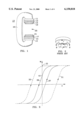
- FIG. 1 is a schematic illustration of a portion of and ⁇ open ⁇ magnetic resonance (MR) imaging system compatible with the present invention.
- MR magnetic resonance
- FIG. 2 is a perspective illustration of eddy currents induced in a prior art pole face.
- FIG. 3 is an graphical representation of hysteresis of various materials, exhibiting residual magnetization.
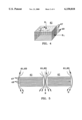
- FIG. 4 illustrates the effect of the direction of magnetic flux on a laminate block.
- FIG. 5 illustrates magnetic flux around blocks according to the present invention.
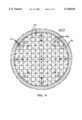
- FIG. 6 is a plan view of one embodiment of a pole face constructed according to the present invention.
- FIG. 7 is an elevational view of one embodiment of a pole face constructed according to the present invention.
- FIG. 1 an ⁇ open ⁇ magnet of a magnetic resonance (MR) imaging system 10 is shown. It includes magnetic excitation means 16, 18 having at least one excitation coil 22, 24 providing magnetic flux into adjacent pole pieces 11, 13. This magnetic flux passes into pole faces 15, 17. Excitation means 16, 18 creates a magnetic field which creates magnetic flux B 0 which flows through pole faces 15 and 17.
- MR magnetic resonance
- a set of gradient coils 19 and 21 produce a time-changing magnetic field B which, when combined with the static main field B 0 , create a magnetic field gradient over an imaging volume 23.
- Magnetic flux B 0 after passing through imaging volume 23, then may pass through a flux return structure 25 which connects the two sides of the open magnet.
- FIG. 2 an illustration is shown of pole face 15 and a gradient coil 19 having a current running I through it in the direction marked.
- current I creates a magnetic flux B which passes through the center of the loop as shown in the figure.
- This magnetic flux thereby induces an eddy current I' as shown by the dotted line.
- Eddy current I' produces another magnetic field which opposes magnetic flux B'. This reduces the effect of magnetic field B and therefore causes disturbances in the imaging magnetic field and the magnetic field gradient.
- the eddy currents redistribute and decay with time. This, therefore, causes artifacts in the image which depends upon a homogeneous magnetic field gradient. The larger the surface area, the longer the decay time by the square of the smallest dimension.
- FIG. 3 an illustration is shown of the hysteresis effects of various materials.
- an magnetic field H acts upon a material, it causes some degree of magnetization M.
- a material such as a permanent magnet
- the resulting magnetism M is shown in a forward direction by path 31.
- magnetization M follows path 33.
- the degree of magnetization M of a material when it crosses the M axis is called the ⁇ residual magnetization ⁇ . This material is marked by point 35.
- Paths 37 and 39 exhibit a lower residual magnetization 41.
- paths 31, 33 traces out a ⁇ hard ⁇ magnetic material, as compared with paths 37, 39.
- the residual magnetization is a result of coercive effects in the magnetic material. These coercive effects become very important with rapidly changing applied magnetic fields that also change in polarity. They also control the magnetization's relaxation to equilibrium when a field component is removed.
- any region of a ferromagnetic material the local magnetization is at it maximum or "saturated" value. These local regions where the magnetization is all parallel are called “domains”.
- domains The thin dividing region between domains where the magnetization direction differs is called a “domain wall”.
- the change in average magnetization as a result of applied field is due to the motion of these domain walls.
- the motion of these walls are impeded by defects in the material such as holes, inclusions, and the boundaries of small crystallites.
- the field required to move these walls is characterized by an equivalent "coercive" field usually represented by H c .
- the wall impediment leads to hysteresis after a change of the magnetic field with the result that the "residual magnetization" state in which the average magnetization is left after a field change depends upon the initial magnetization and the time history of the magnetic field.
- the external magnetic field produced by this residual magnetization can perturb the imaging field in an MR imaging system from its desired value resulting in imaging artifacts.
- One of the main goals in open MR imaging is to reduce the residual magnetization such that these gradients may be applied accurately and quickly.
- FIG. 4 illustrates a laminate block 41 constructed from a stack of laminate sheets 47 each separated by, and held together with, a non-conductive substrate 49.
- This non-conductive substrate may be an epoxy, or other commonly used electrical insulator.
- the percentage of the block constructed of laminate sheets 47 relative to the total mass of the block 41, is referred to as a ⁇ filing factor ⁇ .
- the filling factor may be adjusted, taking into account the dielectric constant of both sheet 47 material and substrate 49 material to design a block having a desired permeability. This may be described by the materials and the filling factor.
- a filling factor typically, using epoxy as substrate 49 and iron boron silicon (Fe--B--Si) for sheets 47, a filling factor of about 84% produces good results.
- a magnetic field flux B is applied normal to sheets 47 of block 41.
- an eddy current I e is induced which flows as shown in the figure.
- the amount of induced current I e is near a maximum for this geometry.
- each of the sheets 47 of block 41 are constructed of a material which has very small, or no crystalline structure, there is less of a gross magnetic alignment effect as would be the case in a material which is comprised of large, random crystals.
- the small, random crystal orientation is referred to as amorphous.
- Amorphous materials due to their nature, reduce both the effect of eddy currents and that of residual magnetization.
- the material employed should be an amorphous material and several which show excellent capability are iron boron silicon, Fe--B--Si, iron boron phosphorous, Fe--B--P, and iron phosphorous carbon (Fe--P--C). These may be considered amorphous since they have very small, or no crystalline structure and have very low coercive effects. Amorphous materials are also used since they may be used to easily construct very thin laminate sheets.
- Amorphous materials also have other desirable properties. There electrical resistance is usually higher than closely related crystalline alloys thereby further dampening eddy currents.
- the blocks 41 of the pole faces are designed such that they have an anisotropic response to magnetic flux in a direction parallel to the laminate sheets 47 and have a different magnetic flux response perpendicular to each of the laminate sheets 47. They have an anisotropic frequency response to magnetic flux in a direction parallel to the laminate sheets 47 and a magnetic flux perpendicular to each of the sheets of laminate sheets 47. This is done by creating laminate sheets having a skin thickness in material designed such that the overall or gross properties are consistent with desired ranges.
- the effective dielectric and the effective permeability are dependent upon not only the thickness of the laminate sheets 47, but the material of the laminate sheets 47 and the dielectric of the substrate material between the laminate sheets. This may be described in terms of the filling factor which is the percentage of laminate sheets relative to the total and the amount of substrate being the remainder of the percentage.
- the laminate sheet thickness should be less than the ⁇ skin depth ⁇ .
- a skin depth is determined by the maximum desired operating frequency associated with waveforms of the time-changing magnetic field gradients used in MR imaging. The skin depth is proportional to the square root of the frequency. For example, a skin depth may be 0.005 inches.
- the maximum frequency is related to the shape and steepness of a desired magnetic field gradients applied.
- the highest Fourier frequency components which make up magnetic gradient waveforms determine the maximum frequency, and hence the skin depth. If corners of the waveform need not be very sharp, the maximum operating frequencies will be lower. The higher the frequency, the thinner the laminate sheets should be.
- Typical MRI imaging frequencies would be on the order of 10 kHz.
- Typical materials used for the substrate may be an epoxy with a dielectric constant of 3.
- Blocks 41 are then aligned such that the majority of the changing magnetic field flux is parallel to each of the sheets.
- blocks 41 are important, but also the size and spacing of the blocks become important in maximizing flux through the pole faces of the open magnet.
- two blocks 41 are shown adjacent to each other with spaces between them 61, 63.
- smaller blocks result in a larger number of blocks with more gaps between them. Since air gaps have a larger reluctance that the blocks, there is larger reluctance to magnetic flux and a smaller permeability.
- each block should have a length, width (X, Y dimensions) which is less than a quarter wavelength of the maximum desired operating frequency. The same is true of the overall laminate sheet region when the dielectric constant and reluctance between blocks 41 is taken into account.
- the materials chosen are also of a nature which reduces eddy currents and residual magnetization. There may be a tradeoff between selecting materials having further resistivity and exhibiting higher permeability since they may run opposite each other.
- FIG. 6 shows a plan view of a pole face according to the present invention.
- Each of the blocks 41 is shown here as a square block, however, they may be rectangular or other shape.
- the spacing between the blocks 61 and 63 are important in creating the appropriate magnetic flux in directions both normal to the face of the block and along the direction of the block.
- FIG. 7 shows an elevational view shows an excitation means 16, 18 having excitation coils 22, 24 and pole piece 11, 13 which are adjacent to rows of blocks 41.
- Gradient coils 19, 21 are at a location closer to imaging volume 23 than pole faces 15, 17.
- Blocks 41 may be arranged in a plurality of layers 73. Spacing between layers 73 of blocks 41 also is important in creating a proper flux parallel to laminate sheets 47 of blocks 41.
- This is preferably an annealed solid piece of silicon iron.
- the purpose of shield 12, 14 is to minimize the gradient flux (the time-changing magnetic field) from the MR gradient coils, from entering pole pieces 11, 13. This causes a biasing of the material in pole pieces 11, 13 to minimize the residual magnetization of pole pieces 11, 13.
- One common material is Vanadium PermendurTM manufactured by the Allegheny Ludlum Corporation of Brackenridge, Pa. Since it is desirable to have the same permeability for the X and Y directions, the block size and spacing in those directions typically are the same, as shown in FIGS. 6, 7, however, they may be different in some applications.
- a major result of the present invention is to provide a pole face having a desired magnetic permeability in each direction by using a different filling factor, different laminate sheets 47 and substrate 49 materials, having different spaces 61, 63 between adjacent blocks 41, and spacing 71 between layers of blocks 41. This pole face may then preferentially direct the magnetic flux.
Landscapes
- Physics & Mathematics (AREA)
- Electromagnetism (AREA)
- Engineering & Computer Science (AREA)
- Power Engineering (AREA)
- Health & Medical Sciences (AREA)
- Life Sciences & Earth Sciences (AREA)
- Condensed Matter Physics & Semiconductors (AREA)
- General Physics & Mathematics (AREA)
- Biomedical Technology (AREA)
- Pathology (AREA)
- Biophysics (AREA)
- Heart & Thoracic Surgery (AREA)
- Medical Informatics (AREA)
- Molecular Biology (AREA)
- Surgery (AREA)
- Animal Behavior & Ethology (AREA)
- General Health & Medical Sciences (AREA)
- Public Health (AREA)
- Veterinary Medicine (AREA)
- Magnetic Resonance Imaging Apparatus (AREA)
Priority Applications (6)
| Application Number | Priority Date | Filing Date | Title |
|---|---|---|---|
| US09/143,960 US6150818A (en) | 1998-08-31 | 1998-08-31 | Low eddy current and low hysteresis magnet pole faces in MR imaging |
| JP23487599A JP4481395B2 (ja) | 1998-08-31 | 1999-08-23 | 開放型磁気共鳴イメージング・システム |
| EP99306780A EP0984461B1 (de) | 1998-08-31 | 1999-08-26 | Magnetpolfläche mit niedrigen Wirbelströmen und reduzierter Hysterese in Magnetresonanzabbildungsverfahren |
| DE69929857T DE69929857T2 (de) | 1998-08-31 | 1999-08-26 | Magnetpolfläche mit niedrigen Wirbelströmen und reduzierter Hysterese in Magnetresonanzabbildungsverfahren |
| KR1019990036354A KR20000017646A (ko) | 1998-08-31 | 1999-08-30 | 개방형 자기 공명 촬상 시스템 및 자속 콘딧 |
| CN99118614A CN1252977A (zh) | 1998-08-31 | 1999-08-31 | 磁共振成像中的低涡流和低磁滞的磁极面 |
Applications Claiming Priority (1)
| Application Number | Priority Date | Filing Date | Title |
|---|---|---|---|
| US09/143,960 US6150818A (en) | 1998-08-31 | 1998-08-31 | Low eddy current and low hysteresis magnet pole faces in MR imaging |
Publications (1)
| Publication Number | Publication Date |
|---|---|
| US6150818A true US6150818A (en) | 2000-11-21 |
Family
ID=22506461
Family Applications (1)
| Application Number | Title | Priority Date | Filing Date |
|---|---|---|---|
| US09/143,960 Expired - Lifetime US6150818A (en) | 1998-08-31 | 1998-08-31 | Low eddy current and low hysteresis magnet pole faces in MR imaging |
Country Status (6)
| Country | Link |
|---|---|
| US (1) | US6150818A (de) |
| EP (1) | EP0984461B1 (de) |
| JP (1) | JP4481395B2 (de) |
| KR (1) | KR20000017646A (de) |
| CN (1) | CN1252977A (de) |
| DE (1) | DE69929857T2 (de) |
Cited By (9)
| Publication number | Priority date | Publication date | Assignee | Title |
|---|---|---|---|---|
| US6586936B2 (en) * | 2000-06-15 | 2003-07-01 | Esaote, S.P.A. | Process for manufacturing magnetic field generating devices in nuclear magnetic resonance imaging apparatuses and image generating device according to said process |
| US20040263301A1 (en) * | 2003-03-31 | 2004-12-30 | Esaote S.P.A. | Magnet structure for nuclear magnetic resonance imaging apparatus |
| US20050093542A1 (en) * | 2003-10-31 | 2005-05-05 | Barber William D. | Systems and methods for fabricating pole pieces for magnetic resonance imaging systems |
| US20050253585A1 (en) * | 2002-04-01 | 2005-11-17 | Shenyang Neusoft Bopu Nmr Tech Co., Ltd. | Permanent magnet for magnet resonance |
| US20060113997A1 (en) * | 2004-11-30 | 2006-06-01 | Ge Medical Systems Global Technology Company, Llc | Magnet system and MRI system |
| DE202011000656U1 (de) | 2010-03-24 | 2011-06-09 | Aspect Magnet Technologies Ltd. | Verbesserter Polschuh für MRI Systeme mit Permanentmagneten |
| JP2016096829A (ja) * | 2014-11-18 | 2016-05-30 | 株式会社日立製作所 | 磁気共鳴イメージング装置 |
| US20220196775A1 (en) * | 2020-12-22 | 2022-06-23 | Bruker Biospin Gmbh | Epr spectrometer with at least one pole piece made at least partially of a function material |
| US12099104B2 (en) | 2023-01-20 | 2024-09-24 | Fujifilm Healthcare Americas Corporation | Passive shield for magnetic resonance imaging gradient coils |
Families Citing this family (14)
| Publication number | Priority date | Publication date | Assignee | Title |
|---|---|---|---|---|
| US6348275B1 (en) | 1998-11-06 | 2002-02-19 | Honeywell International Inc. | Bulk amorphous metal magnetic component |
| US6346337B1 (en) | 1998-11-06 | 2002-02-12 | Honeywell International Inc. | Bulk amorphous metal magnetic component |
| US6331363B1 (en) | 1998-11-06 | 2001-12-18 | Honeywell International Inc. | Bulk amorphous metal magnetic components |
| US6552639B2 (en) | 2000-04-28 | 2003-04-22 | Honeywell International Inc. | Bulk stamped amorphous metal magnetic component |
| CN2542205Y (zh) * | 2002-04-01 | 2003-04-02 | 沈阳东软数字医疗系统股份有限公司 | 两立柱开放式c型永磁型磁共振磁体 |
| US6737951B1 (en) | 2002-11-01 | 2004-05-18 | Metglas, Inc. | Bulk amorphous metal inductive device |
| US6873239B2 (en) | 2002-11-01 | 2005-03-29 | Metglas Inc. | Bulk laminated amorphous metal inductive device |
| US7235910B2 (en) | 2003-04-25 | 2007-06-26 | Metglas, Inc. | Selective etching process for cutting amorphous metal shapes and components made thereof |
| ITSV20040016A1 (it) * | 2004-04-13 | 2004-07-13 | Esaote Spa | Macchina per risonanza magnetico nucleare |
| CN101256221B (zh) * | 2007-02-28 | 2010-09-29 | 西门子(中国)有限公司 | 一种减小梯度磁场导致的涡流的方法 |
| JP2014236827A (ja) * | 2013-06-07 | 2014-12-18 | 株式会社日立メディコ | 磁気共鳴イメージング装置 |
| CN103892834B (zh) * | 2014-03-21 | 2016-05-25 | 沈阳中北真空磁电科技有限公司 | 一种用于核磁共振成像仪的永磁体 |
| CN103860178B (zh) * | 2014-03-21 | 2016-04-06 | 沈阳中北真空磁电科技有限公司 | 一种用于核磁共振成像仪的永磁体 |
| CN104407314A (zh) * | 2014-11-26 | 2015-03-11 | 江苏美时医疗技术有限公司 | 一种永磁体抗涡流组件 |
Citations (8)
| Publication number | Priority date | Publication date | Assignee | Title |
|---|---|---|---|---|
| US2951247A (en) * | 1946-02-19 | 1960-08-30 | Halpern Otto | Isotropic absorbing layers |
| US4675609A (en) * | 1985-09-18 | 1987-06-23 | Fonar Corporation | Nuclear magnetic resonance apparatus including permanent magnet configuration |
| US4827235A (en) * | 1986-07-18 | 1989-05-02 | Kabushiki Kaisha Toshiba | Magnetic field generator useful for a magnetic resonance imaging instrument |
| US5061897A (en) * | 1990-03-23 | 1991-10-29 | Fonar Corporation | Eddy current control in magnetic resonance imaging |
| US5252924A (en) * | 1991-11-18 | 1993-10-12 | Sumitomo Special Metals Co., Ltd. | Magnetic field generating apparatus for MRI |
| US5283544A (en) * | 1990-09-29 | 1994-02-01 | Sumitomo Special Metals Co., Ltd. | Magnetic field generating device used for MRI |
| US5555251A (en) * | 1993-06-08 | 1996-09-10 | Picker Nordstar Inc. | Arrangement to minimize eddy currents in MR imagers |
| US5592089A (en) * | 1993-01-19 | 1997-01-07 | Fonar Corporation | Eddy current control in NMR imaging system |
Family Cites Families (3)
| Publication number | Priority date | Publication date | Assignee | Title |
|---|---|---|---|---|
| JPH01142028A (ja) * | 1987-11-30 | 1989-06-02 | Kawasaki Steel Corp | 磁気特性の優れた厚肉鋼材の製造方法 |
| US5470646A (en) * | 1992-06-11 | 1995-11-28 | Kabushiki Kaisha Toshiba | Magnetic core and method of manufacturing core |
| GB9320043D0 (en) * | 1993-09-29 | 1993-11-17 | Oxford Magnet Rechnology Limit | Improvements in or relating to mri magnets |
-
1998
- 1998-08-31 US US09/143,960 patent/US6150818A/en not_active Expired - Lifetime
-
1999
- 1999-08-23 JP JP23487599A patent/JP4481395B2/ja not_active Expired - Fee Related
- 1999-08-26 EP EP99306780A patent/EP0984461B1/de not_active Expired - Lifetime
- 1999-08-26 DE DE69929857T patent/DE69929857T2/de not_active Expired - Fee Related
- 1999-08-30 KR KR1019990036354A patent/KR20000017646A/ko not_active Withdrawn
- 1999-08-31 CN CN99118614A patent/CN1252977A/zh active Pending
Patent Citations (8)
| Publication number | Priority date | Publication date | Assignee | Title |
|---|---|---|---|---|
| US2951247A (en) * | 1946-02-19 | 1960-08-30 | Halpern Otto | Isotropic absorbing layers |
| US4675609A (en) * | 1985-09-18 | 1987-06-23 | Fonar Corporation | Nuclear magnetic resonance apparatus including permanent magnet configuration |
| US4827235A (en) * | 1986-07-18 | 1989-05-02 | Kabushiki Kaisha Toshiba | Magnetic field generator useful for a magnetic resonance imaging instrument |
| US5061897A (en) * | 1990-03-23 | 1991-10-29 | Fonar Corporation | Eddy current control in magnetic resonance imaging |
| US5283544A (en) * | 1990-09-29 | 1994-02-01 | Sumitomo Special Metals Co., Ltd. | Magnetic field generating device used for MRI |
| US5252924A (en) * | 1991-11-18 | 1993-10-12 | Sumitomo Special Metals Co., Ltd. | Magnetic field generating apparatus for MRI |
| US5592089A (en) * | 1993-01-19 | 1997-01-07 | Fonar Corporation | Eddy current control in NMR imaging system |
| US5555251A (en) * | 1993-06-08 | 1996-09-10 | Picker Nordstar Inc. | Arrangement to minimize eddy currents in MR imagers |
Non-Patent Citations (16)
| Title |
|---|
| "Gradient Coil Design Considerations for Iron Core Interventional Magnets", A. Ersahin, M.J. Bronskill, R.M. Henkelman, B. Collick, R.S. HinksThe Scott Hinks Publication (attached) Abstract submitted, but not yet published, pp. 1-21, Figs. 1A-10 (1996-1997). |
| Bloch, F.W., W. Hansen and M. Packard, "The Nuclear Introduction Experiment", Phy. Rev. 70, 474-485, 1946. |
| Bloch, F.W., W. Hansen and M. Packard, The Nuclear Introduction Experiment , Phy. Rev. 70, 474 485, 1946. * |
| Experimental Use Abstract Sheet Low Eddy Current and Low Hysteresis Magnet Pole Faces in MR Imaging by W. Barber. * |
| Experimental Use--Abstract Sheet "Low Eddy Current and Low Hysteresis Magnet Pole Faces in MR Imaging" by W. Barber. |
| Gradient Coil Design Considerations for Iron Core Interventional Magnets , A. Ersahin, M.J. Bronskill, R.M. Henkelman, B. Collick, R.S. HinksThe Scott Hinks Publication (attached) Abstract submitted, but not yet published, pp. 1 21, Figs. 1A 10 (1996 1997). * |
| Proceedings of the International Society for Magnetic Resonance In Medicine Fifth Scientific Meeting and Exhibition, Apr. 12 18, 1997, vol. 1, p. 1466. * |
| Proceedings of the International Society for Magnetic Resonance in Medicine Fourth Scientific Meeting and Exhibition, Apr. 27 May 3, 1996, vol.. 3, p. 124. * |
| Proceedings of the International Society for Magnetic Resonance In Medicine--Fifth Scientific Meeting and Exhibition, Apr. 12-18, 1997, vol. 1, p. 1466. |
| Proceedings of the International Society for Magnetic Resonance in Medicine--Fourth Scientific Meeting and Exhibition, Apr. 27-May 3, 1996, vol.. 3, p. 124. |
| Rytov, S.M., "The Electromagnetic Properties of a Finely Layered Medium", J. Exptl. Theoret. Phys., USSR, 29, 605-616, 1955 (pp. 466-475). |
| Rytov, S.M., The Electromagnetic Properties of a Finely Layered Medium , J. Exptl. Theoret. Phys., USSR, 29, 605 616, 1955 (pp. 466 475). * |
| West, D.H., "Computer-assisted Magnet Shimming", Rev. Sci. Instruments, 52(12), 1910-1912, 1981. |
| West, D.H., Computer assisted Magnet Shimming , Rev. Sci. Instruments, 52(12), 1910 1912, 1981. * |
| Yamashita, H., N. Ono, Y. Hashimoto, K. Ishino, M. Inoue, and K. Akita, "Electromagnetic Absorbing Wall for TV Ghost Suppression", Trans. IECE, Japan, E61(8), 657, 1978. |
| Yamashita, H., N. Ono, Y. Hashimoto, K. Ishino, M. Inoue, and K. Akita, Electromagnetic Absorbing Wall for TV Ghost Suppression , Trans. IECE, Japan, E61(8), 657, 1978. * |
Cited By (17)
| Publication number | Priority date | Publication date | Assignee | Title |
|---|---|---|---|---|
| US6586936B2 (en) * | 2000-06-15 | 2003-07-01 | Esaote, S.P.A. | Process for manufacturing magnetic field generating devices in nuclear magnetic resonance imaging apparatuses and image generating device according to said process |
| US20050253585A1 (en) * | 2002-04-01 | 2005-11-17 | Shenyang Neusoft Bopu Nmr Tech Co., Ltd. | Permanent magnet for magnet resonance |
| US7084632B2 (en) * | 2002-04-01 | 2006-08-01 | Shenyang Neusoft Bopu Nmr Tech Co., Ltd. | Permanent magnet for magnet resonance |
| US7158000B2 (en) * | 2003-03-31 | 2007-01-02 | Esaote, S.P.A. | Magnet structure for nuclear magnetic resonance imaging apparatus |
| US7772949B2 (en) | 2003-03-31 | 2010-08-10 | Esaote S.P.A. | Magnet structure for nuclear magnetic resonance imaging apparatus |
| US20040263301A1 (en) * | 2003-03-31 | 2004-12-30 | Esaote S.P.A. | Magnet structure for nuclear magnetic resonance imaging apparatus |
| US20060267334A1 (en) * | 2003-03-31 | 2006-11-30 | Esaote S.P.A. | Magnet Structure For Nuclear Magnetic Resonance Imaging Apparatus |
| US20050093542A1 (en) * | 2003-10-31 | 2005-05-05 | Barber William D. | Systems and methods for fabricating pole pieces for magnetic resonance imaging systems |
| US6937018B2 (en) | 2003-10-31 | 2005-08-30 | General Electric Company | Systems and methods for fabricating pole pieces for magnetic resonance imaging systems |
| US20060113997A1 (en) * | 2004-11-30 | 2006-06-01 | Ge Medical Systems Global Technology Company, Llc | Magnet system and MRI system |
| US7205766B2 (en) * | 2004-11-30 | 2007-04-17 | Ge Medical Systems Global Technology Company, Llc | Magnet system and MRI system |
| DE202011000656U1 (de) | 2010-03-24 | 2011-06-09 | Aspect Magnet Technologies Ltd. | Verbesserter Polschuh für MRI Systeme mit Permanentmagneten |
| US20110234347A1 (en) * | 2010-03-24 | 2011-09-29 | Aspect Magnet Technologies Ltd. | Pole piece for permanent magnet mri systems |
| JP2016096829A (ja) * | 2014-11-18 | 2016-05-30 | 株式会社日立製作所 | 磁気共鳴イメージング装置 |
| US20220196775A1 (en) * | 2020-12-22 | 2022-06-23 | Bruker Biospin Gmbh | Epr spectrometer with at least one pole piece made at least partially of a function material |
| US12072401B2 (en) * | 2020-12-22 | 2024-08-27 | Bruker Biospin Gmbh | EPR spectrometer with at least one pole piece made at least partially of a function material |
| US12099104B2 (en) | 2023-01-20 | 2024-09-24 | Fujifilm Healthcare Americas Corporation | Passive shield for magnetic resonance imaging gradient coils |
Also Published As
| Publication number | Publication date |
|---|---|
| EP0984461B1 (de) | 2006-02-15 |
| CN1252977A (zh) | 2000-05-17 |
| JP4481395B2 (ja) | 2010-06-16 |
| EP0984461A3 (de) | 2000-12-06 |
| JP2000083925A (ja) | 2000-03-28 |
| EP0984461A2 (de) | 2000-03-08 |
| DE69929857D1 (de) | 2006-04-20 |
| KR20000017646A (ko) | 2000-03-25 |
| DE69929857T2 (de) | 2006-11-02 |
Similar Documents
| Publication | Publication Date | Title |
|---|---|---|
| US6150818A (en) | Low eddy current and low hysteresis magnet pole faces in MR imaging | |
| EP0645641B1 (de) | Verbesserungen an Magneten der Bilderzeugung mittels magnetischer Resonanz | |
| US5631616A (en) | Magnetic field generating device for use in MRI | |
| US5061897A (en) | Eddy current control in magnetic resonance imaging | |
| EP0192331B1 (de) | Elektromagnet | |
| JPS62194842A (ja) | 勾配コイル装置 | |
| US5049848A (en) | High field strength magnet, preferably having remote shimming of field | |
| JP3016544B2 (ja) | 永久磁石磁気回路 | |
| EP0764853B1 (de) | Magnetanordnung in einem Gerät für die bildgebende magnetische Resonanz | |
| US6111410A (en) | Nuclear magnetic resonance imaging apparatus | |
| JP2649436B2 (ja) | Mri用磁界発生装置 | |
| US12072401B2 (en) | EPR spectrometer with at least one pole piece made at least partially of a function material | |
| US6937018B2 (en) | Systems and methods for fabricating pole pieces for magnetic resonance imaging systems | |
| WO2004104612A1 (en) | Magnetic field generating system applicable to nuclear magnetic resonance device | |
| JP3866498B2 (ja) | 磁気インピーダンス効果素子及びその製造方法 | |
| JP2744945B2 (ja) | 磁性多層膜 | |
| JP2002102205A (ja) | 磁気共鳴イメージング装置 | |
| JPH05144628A (ja) | 磁場発生装置 | |
| JP3445303B2 (ja) | Mri用磁界発生装置 | |
| JPH0371891B2 (de) | ||
| KR100319929B1 (ko) | 자기공명영상장치용 영구자석의 자극 구조체 및 이를 이용한 자계발생장치 | |
| JP2005065752A (ja) | Mri用磁場発生装置 | |
| JP2022040955A (ja) | 磁気センサ | |
| JPH01208815A (ja) | 静磁場発生装置 | |
| JPH05267047A (ja) | Mri用磁界発生装置 |
Legal Events
| Date | Code | Title | Description |
|---|---|---|---|
| AS | Assignment |
Owner name: GENERAL ELECTRIC COMPANY, NEW YORK Free format text: ASSIGNMENT OF ASSIGNORS INTEREST;ASSIGNOR:BARBER, WILLIAM DANIEL;REEL/FRAME:009432/0001 Effective date: 19980825 |
|
| STCF | Information on status: patent grant |
Free format text: PATENTED CASE |
|
| FEPP | Fee payment procedure |
Free format text: PAYOR NUMBER ASSIGNED (ORIGINAL EVENT CODE: ASPN); ENTITY STATUS OF PATENT OWNER: LARGE ENTITY |
|
| FPAY | Fee payment |
Year of fee payment: 4 |
|
| FPAY | Fee payment |
Year of fee payment: 8 |
|
| FPAY | Fee payment |
Year of fee payment: 12 |