US617422A - Process of restoring worn rolled or drawn metallic articles - Google Patents
Process of restoring worn rolled or drawn metallic articles Download PDFInfo
- Publication number
- US617422A US617422A US617422DA US617422A US 617422 A US617422 A US 617422A US 617422D A US617422D A US 617422DA US 617422 A US617422 A US 617422A
- Authority
- US
- United States
- Prior art keywords
- articles
- cross
- rolled
- article
- section
- Prior art date
- Legal status (The legal status is an assumption and is not a legal conclusion. Google has not performed a legal analysis and makes no representation as to the accuracy of the status listed.)
- Expired - Lifetime
Links
Images
Classifications
-
- B—PERFORMING OPERATIONS; TRANSPORTING
- B21—MECHANICAL METAL-WORKING WITHOUT ESSENTIALLY REMOVING MATERIAL; PUNCHING METAL
- B21J—FORGING; HAMMERING; PRESSING METAL; RIVETING; FORGE FURNACES
- B21J5/00—Methods for forging, hammering, or pressing; Special equipment or accessories therefor
-
- C—CHEMISTRY; METALLURGY
- C21—METALLURGY OF IRON
- C21D—MODIFYING THE PHYSICAL STRUCTURE OF FERROUS METALS; GENERAL DEVICES FOR HEAT TREATMENT OF FERROUS OR NON-FERROUS METALS OR ALLOYS; MAKING METAL MALLEABLE, e.g. BY DECARBURISATION OR TEMPERING
- C21D8/00—Modifying the physical properties of ferrous metals or ferrous alloys by deformation combined with, or followed by, heat treatment
- C21D8/06—Modifying the physical properties of ferrous metals or ferrous alloys by deformation combined with, or followed by, heat treatment during manufacturing of rods or wires
Definitions
- the object of my invention is to provide an inexpensive process by means of which old worn-out rails, trolley-wires, and analogous articles may Without remelting have their defects of form removed, their average crosssectional areas increased, and the strength of the metal therein made as great or greater than it was originally.
- I accomplish this object by the process hereinafter described, which consists, essentially, in first increasing the average cross-sectional area of the article or that portion of the article to be renewed and then reducing the portion of the article to be renewed and used again to a substantially uniform cross-sectional area greater than it possessed before being treated and to a substantially uniform shape in cross-section throughout its length.
- the article treated is preferably renewed throughout its length; but in some cases the metal used in increasing the average cross-sectional area of a renewed portion is taken from a part which is not renewed; but in such cases the portion not renewed is ultimately out OK or out of the article and thrown into the scrap-pile for remelting.
- suitable mechanism is used, and for different kinds of articles the mechanism used preferably difiers somewhat in its mode of operation.
- the mechanism used preferably difiers somewhat in its mode of operation.
- the preferred mechanism used for exerting the transverse pressure necessary to give the article treated its final shape and size also diifers in articles of different kinds.
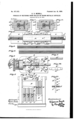
- FIG. 1 is a vertical cross-section on line 1 2, Fig. 8, on an enlarged scale, showing a die with a worn rail therein.
- Fig. 2 is a similar View showing the same rail enlarged transversely, so as to fill said cavity.
- Fig. 3 is a plan View, parts being broken away, of a die with a rail in place, which has been com pressed longitudinally between a pair of pistons.
- Fig. 4 is a side elevation of a worn rail before treatment.
- Fig. 5 is a side elevation of a train of rolls.
- Fig. 6 is a side elevation of a renewed rail.
- Fig. 7 represents a section of worn trolley-wire.
- FIG. 8 is a plan view of an apparatus for enlarging the average crosssection of a trolley-wire.
- Fig. 9 represents a vertcal cross-section on line 9 9, Fig. 8.
- Fig. 10 represents a section of trolley-wire that has been passed through said apparatus; and
- Fig. 11 represents a vertical cross-section, on a reduced scale, of a draw-plate with a trolleywire passing through it, whose average cross sectional area has been enlarged bypassing it through the apparatus shown in Figs. 8 and 9.
- A, Figs. 1, 2, and 3 represents a die consisting of a lower member ca and an upper member a and containing a cavity a for the reception of a rail 13.
- the members of the die are preferably separated for the introduction and withdrawal of rails and may be held together when the die is closed by clamps a and wedges a or other suitable means.
- the worn rail B to be treated is preferably heated to or above a red heat before being inserted in the die and after being inserted is compressed longitudinally by means of plungerheads 0, preferably substantially conforming in cross-section to the cavity in the die and connected to plunger-rods 0, through which they receive their motion from suitable sources of power.
- the rail or analogous article has its cross-sectional area increased throughout to that of the cavity a in the die A and is thus made somewhat larger in cross-section and shorter than it is when finished. It is next passed through one or more sets of rolls D and is preferably passed through them several times and in that way compressed, lengthened, and straightened and given its final shape and size in cross-section. After being rolled the ends of the rail are preferably trimmed. The result is a perfect rail 13, somewhat shorter than it was before being subjected to my process, but larger in cross-sectional area and with the metal thereinstronger than it was when the rail was new.
- Figs. l and 6 are not drawn to a scale, but give a general idea of the change of form wrought in a worn rail by my process.
- FIG. 8 An apparatus adapted to create a series of enlargements in trolley-wire and other articles treated by my process is represented in Figs. 8 and 9.
- E represents a table; e, the table-top; e, an opening in the table-top; 6 Fig. 9, opposite dovetailed grooves in which a cross-head F reciprocates; a a pair of retainers attached to the top 6; G, eccentric clamps secured to the stationary table-top e by means of pivots g; G", similar clamps secured to the cross-head F by means of pivots g, and g levers for operating said clamps.
- the cross-head F is attached to a piston-rod II, whose inner end is secured to a piston-head II, reciprocating in a cylinder I.
- Water is forced into said cylinder by means of suitable mechanism (not shown) through the inlet-pipe I and escapes through the same pipe and the outlet 1*. Its admission and escape are governed by the two-way valve 1
- the piston is forced backward and the water in the cylinder I forced out by means of the coiled spring H". Large articles may be treated by means of this apparatus; but I have shown it in use for creating a series of enlargements 7.2 in a trolley-wire K. The wire is laid between the retainers e and secured between the clamps G and G.
- the wire is preferably heated to a red heat, a section at a time, before being compressed longitudinally and after passing through the apparatus assumes an appearance approximately like that shown in Fig. 10.
- the next step in the case of wire is to pass it through an opening L in a draw-plate L, from which it issues in the form of section 712 Fig. 11.
- Fig. 11 being upon a reduced scale, does not indicate the size of the finished section 76 as compared with that of the wornout wire shown in Fig. 7.
- the wire is enlarged in cross-section by the treatment, but
Landscapes
- Engineering & Computer Science (AREA)
- Chemical & Material Sciences (AREA)
- Mechanical Engineering (AREA)
- Manufacturing & Machinery (AREA)
- Physics & Mathematics (AREA)
- Thermal Sciences (AREA)
- Crystallography & Structural Chemistry (AREA)
- Materials Engineering (AREA)
- Metallurgy (AREA)
- Organic Chemistry (AREA)
- Heat Treatment Of Strip Materials And Filament Materials (AREA)
Description
No. 6l7,422. Patented Ian. I0, 1899.
a. s. MERRILL. v PROCESS OF RESTORING WORN ROLLED 0R DRAWN METALLIC ARTICLES.
(Application filed Jan. 29, 1898.)
(No Model.) r
R2 1 lizgngr a 1&9 --(g a I a a Egnfij l frat/P12410 M m r WW UNITED STATES PATENT EFICE.
GEORGE SPENCER MERRILL, OF BELOIT, I/VISOONSIN.
PROCESS OF RESTORING WORN ROLLED 0R DRAWN METALLIC ARTICLES.
SPECIFICATION forming part of Letters Patent No. 617,422, dated January 10, 1899.
Application filed January 29, 1898. Serial No. 668.512. (No specimens.)
T0 at whom it may concern:
' Be it known that I, GEORGE SPENCER MER- RILL, a citizen of the United States, residing at Beloit, Rock county, and State of Wisconsin, have invented a new and useful Improvement in Metal Working, of which the following is a specification.
As is well known, steel rails, copper trolley-Wire, and other rolled or drawn metallic articles of manufacture which are subjected in use to the abrading and pounding action of running wheels become more or less worn and weakened in time and unfit for use. Such articles have their average cross-sectional areas and their strength diminished .by the wearing away of the surface directly acted upon and by the chipping away of small pieces of metal by blows delivered by passing wheels. The hammer-blows delivered by the wheels also cause such articles to become irregular in shape and in that way weaken them and otherwise diminish their usefulness, and such articles also suffer a loss of strength in consequence of a weakening of the metal composing them, which results from use. This deterioration of the metal has sometimes been attributed to a crystallization supposed by some to result from constant jarring, and sometimes it has been attributed to the formation of innumerable minute flaws or cracks supposed to result from the same cause; but whatever the true theory may be the strength of the metal in articles of the class mentioned unquestionably becomes less after such articles have been used for some time.
To replace Wornout rails, trolley-Wires, and analogous articles by new ones is expensive; but to renew the strength of the metal in the old ones and at the same time increase their average cross-sectional areas has heretofore been thought impracticable except by remelting and making them over again,which amounts to a virtual replacement. In order to renew the usefulness of such articles, however, it is very desirable to not only renew and, if possible, improve the strength of the metal therein and remove defects of form, but also to give the old articles a cross-sea tional area as great or greater than that originally possessed, for the constantly-increasing weight and speed of locomotives, street-cars, and analogous machines forbids the weakening of rails, trolley-wires, and the like, and in practice a substitution of stronger for weaker ones is steadily going on. 5 5
The object of my invention is to provide an inexpensive process by means of which old worn-out rails, trolley-wires, and analogous articles may Without remelting have their defects of form removed, their average crosssectional areas increased, and the strength of the metal therein made as great or greater than it was originally. I accomplish this object by the process hereinafter described, which consists, essentially, in first increasing the average cross-sectional area of the article or that portion of the article to be renewed and then reducing the portion of the article to be renewed and used again to a substantially uniform cross-sectional area greater than it possessed before being treated and to a substantially uniform shape in cross-section throughout its length. The article treated is preferably renewed throughout its length; but in some cases the metal used in increasing the average cross-sectional area of a renewed portion is taken from a part which is not renewed; but in such cases the portion not renewed is ultimately out OK or out of the article and thrown into the scrap-pile for remelting.
Rolled and drawn articles can be renewed again and again by my process, for when such articles as rails become too short in consequence of repeated renewals the difficulty can be overcome by welding two or more pieces together before taking the steps necessary to increase their cross-sectional areas.
I secure the requisite preliminary enlargement in cross-section of the article treated by means of what may be termed longitudinal pressure, and I secure the final shape and size in cross-section by means of transverse pressure, and this reworking of the metal in the article makes it stronger than it was when the article treated was new. I preferably heat the article to be treated to a heat not lower than a red heat and not high enough to injure the metal therein. 7
Where I- speak of the article being submitted to longitudinal pressure,I do not mean that all the metal therein is necessarily submitted to such a pressure or that all portions submitted to a longitudinal pressure are treat* ed simultaneously. In some cases the longitudinal pressure is only applied to certain portions of the metal-as, for instance, parts near the surface of the article or particular sectionsand though the portions acted upon may be submitted to the necessary pressure simultaneously that is not an essential feature of my process. So, also, the transverse pressure may be exerted along the entire length of the article at once or upon one portion after another, and the latter is the preferred method in all cases.
In practicing my invention suitable mechanism is used, and for different kinds of articles the mechanism used preferably difiers somewhat in its mode of operation. Thus, for instance, in treating such articles as worn-out rails I prefer to place the article after heating it in a suitable die and to then increase its average cross-sectional area throughout bya suitable longitudinal pressure exerted upon one or both ends by means of a piston or pistons, or one or more power-hammers, the steady pressure of a pair of pistons operated by hydraulic or other power being preferred. In the case of articles of great length and small diameter, such as wire, I prefer to secure the necessary preliminary enlargement in average cross-section of the part to be renewed by means of mechanism so constructed as to enable it to create a series of enlargements in the article by subjecting one section of it after another to longitudinal pressure.
The preferred mechanism used for exerting the transverse pressure necessary to give the article treated its final shape and size also diifers in articles of different kinds. In treating wire I prefer to use a draw-plate, and in treating rolled articles I prefer to use rolls.
I do not limit myself to the use of any particular kinds of mechanism in carrying out my process. However, any mechanism adapted for use in my process may be used without departing from the essence of my invention.
Different modes of practicing my invention are illustrated in the annexed drawings, in which- Figure l is a vertical cross-section on line 1 2, Fig. 8, on an enlarged scale, showing a die with a worn rail therein. Fig. 2 is a similar View showing the same rail enlarged transversely, so as to fill said cavity. Fig. 3 is a plan View, parts being broken away, of a die with a rail in place, which has been com pressed longitudinally between a pair of pistons. Fig. 4 is a side elevation of a worn rail before treatment. Fig. 5 is a side elevation of a train of rolls. Fig. 6 is a side elevation of a renewed rail. Fig. 7 represents a section of worn trolley-wire. Fig. 8 is a plan view of an apparatus for enlarging the average crosssection of a trolley-wire. Fig. 9 represents a vertcal cross-section on line 9 9, Fig. 8. Fig. 10 represents a section of trolley-wire that has been passed through said apparatus; and Fig. 11 represents a vertical cross-section, on a reduced scale, of a draw-plate with a trolleywire passing through it, whose average cross sectional area has been enlarged bypassing it through the apparatus shown in Figs. 8 and 9.
Similar letters refer to similar parts throughout the several views.
A, Figs. 1, 2, and 3, represents a die consisting of a lower member ca and an upper member a and containing a cavity a for the reception of a rail 13. The members of the die are preferably separated for the introduction and withdrawal of rails and may be held together when the die is closed by clamps a and wedges a or other suitable means. The worn rail B to be treated is preferably heated to or above a red heat before being inserted in the die and after being inserted is compressed longitudinally by means of plungerheads 0, preferably substantially conforming in cross-section to the cavity in the die and connected to plunger-rods 0, through which they receive their motion from suitable sources of power. (Not shown.) By this device the rail or analogous article has its cross-sectional area increased throughout to that of the cavity a in the die A and is thus made somewhat larger in cross-section and shorter than it is when finished. It is next passed through one or more sets of rolls D and is preferably passed through them several times and in that way compressed, lengthened, and straightened and given its final shape and size in cross-section. After being rolled the ends of the rail are preferably trimmed. The result is a perfect rail 13, somewhat shorter than it was before being subjected to my process, but larger in cross-sectional area and with the metal thereinstronger than it was when the rail was new. Figs. l and 6 are not drawn to a scale, but give a general idea of the change of form wrought in a worn rail by my process.
An apparatus adapted to create a series of enlargements in trolley-wire and other articles treated by my process is represented in Figs. 8 and 9. In that apparatus, E represents a table; e, the table-top; e, an opening in the table-top; 6 Fig. 9, opposite dovetailed grooves in which a cross-head F reciprocates; a a pair of retainers attached to the top 6; G, eccentric clamps secured to the stationary table-top e by means of pivots g; G", similar clamps secured to the cross-head F by means of pivots g, and g levers for operating said clamps. The cross-head F is attached to a piston-rod II, whose inner end is secured to a piston-head II, reciprocating in a cylinder I. Water is forced into said cylinder by means of suitable mechanism (not shown) through the inlet-pipe I and escapes through the same pipe and the outlet 1*. Its admission and escape are governed by the two-way valve 1 The piston is forced backward and the water in the cylinder I forced out by means of the coiled spring H". Large articles may be treated by means of this apparatus; but I have shown it in use for creating a series of enlargements 7.2 in a trolley-wire K. The wire is laid between the retainers e and secured between the clamps G and G. WVater is then forced into the cylinder I and the cross-head F forced inward toward the retainers c and an enlargement 7c is thus formed in the wire K, The water in the cylinder I is then allowed to escape, the clamps G and G loosened, and the wire moved forward, after which a fresh section is operated upon. The wire is preferably heated to a red heat, a section at a time, before being compressed longitudinally and after passing through the apparatus assumes an appearance approximately like that shown in Fig. 10. The next step in the case of wire is to pass it through an opening L in a draw-plate L, from which it issues in the form of section 712 Fig. 11. Fig. 11, being upon a reduced scale, does not indicate the size of the finished section 76 as compared with that of the wornout wire shown in Fig. 7. The wire is enlarged in cross-section by the treatment, but
made'somewhat shorter. All imperfections are removed and the quality of the wire made better than it was originally.
claimed in applications to be filed hereafter I claim- The process of renewing old, worn, rolled or drawn metallic articles in whole or in part, and increasing the average cross-sectional area of the part renewed, consisting in first heating the article, treated to a heat not lower than a red heat and not high enough to injure the metal therein, then enlarging the average cross-sectional area of the part to be used again beyond the ultimate cross-sectional area desired, and next giving the part whose average cross-sectional area has been en larged, the desired shape and a uniform crosssectional area throughout,
G. SPENCER MERRILL.
Witnesses:
J. W. MERRILL, F. F. LIVERMORE.
Publications (1)
| Publication Number | Publication Date |
|---|---|
| US617422A true US617422A (en) | 1899-01-10 |
Family
ID=2686031
Family Applications (1)
| Application Number | Title | Priority Date | Filing Date |
|---|---|---|---|
| US617422D Expired - Lifetime US617422A (en) | Process of restoring worn rolled or drawn metallic articles |
Country Status (1)
| Country | Link |
|---|---|
| US (1) | US617422A (en) |
-
0
- US US617422D patent/US617422A/en not_active Expired - Lifetime
Similar Documents
| Publication | Publication Date | Title |
|---|---|---|
| US617422A (en) | Process of restoring worn rolled or drawn metallic articles | |
| US1989186A (en) | Method of forming rolls | |
| EP1641978A1 (en) | Steel rails | |
| CZ284401B6 (en) | Continuous, steel railway rail, process for producing thereof and apparatus for making the same | |
| US356974A (en) | Manufacture of steel forgings | |
| EP0389078B1 (en) | Method of making pressurised-gas bottles | |
| SU1563920A1 (en) | Method of resistance butt welding of rails | |
| US590855A (en) | Machine for rolling railway-car axles or similar bars | |
| DE602004004683T2 (en) | Method for producing a bimetallic tongue for railway turnouts | |
| US1467166A (en) | Method oe porting pipe balls | |
| US446497A (en) | Method of rolling wire | |
| US664091A (en) | Art of working metal. | |
| RU2131800C1 (en) | Part rebuilding method | |
| US277311A (en) | Mode of constructing anvils | |
| US1966602A (en) | Process of manufacturing hollow objects from ingots having big dimensions | |
| US309507A (en) | Samuel johnstos | |
| US758041A (en) | Process of forming twist-drills. | |
| US352972A (en) | John q | |
| US1687825A (en) | Die block and method of treating steel for use in the manufacture thereof | |
| RU2264281C1 (en) | Steel part worn surface restoration method | |
| US666851A (en) | Method of making articles of varying cross-section. | |
| US1003654A (en) | Machine for making step-joints. | |
| USRE6484E (en) | Improvement in rolls for utilizing the fag-ends of railroad-rails | |
| US219335A (en) | Improvement in the manufacture of end pieces for cross-bars of truck-frames | |
| US367289A (en) | Half to pillans scarth stevenson |