US6188900B1 - Mobile device assisted handoff system for code division multiple access and wideband code division multiple access networks - Google Patents
Mobile device assisted handoff system for code division multiple access and wideband code division multiple access networks Download PDFInfo
- Publication number
- US6188900B1 US6188900B1 US09/143,712 US14371298A US6188900B1 US 6188900 B1 US6188900 B1 US 6188900B1 US 14371298 A US14371298 A US 14371298A US 6188900 B1 US6188900 B1 US 6188900B1
- Authority
- US
- United States
- Prior art keywords
- circuitry
- operating
- frequency
- communication
- normally
- Prior art date
- Legal status (The legal status is an assumption and is not a legal conclusion. Google has not performed a legal analysis and makes no representation as to the accuracy of the status listed.)
- Expired - Lifetime
Links
Images


Classifications
-
- H—ELECTRICITY
- H03—ELECTRONIC CIRCUITRY
- H03L—AUTOMATIC CONTROL, STARTING, SYNCHRONISATION OR STABILISATION OF GENERATORS OF ELECTRONIC OSCILLATIONS OR PULSES
- H03L7/00—Automatic control of frequency or phase; Synchronisation
- H03L7/06—Automatic control of frequency or phase; Synchronisation using a reference signal applied to a frequency- or phase-locked loop
- H03L7/16—Indirect frequency synthesis, i.e. generating a desired one of a number of predetermined frequencies using a frequency- or phase-locked loop
- H03L7/18—Indirect frequency synthesis, i.e. generating a desired one of a number of predetermined frequencies using a frequency- or phase-locked loop using a frequency divider or counter in the loop
-
- H—ELECTRICITY
- H04—ELECTRIC COMMUNICATION TECHNIQUE
- H04W—WIRELESS COMMUNICATION NETWORKS
- H04W36/00—Hand-off or reselection arrangements
- H04W36/34—Reselection control
- H04W36/36—Reselection control by user or terminal equipment
- H04W36/362—Conditional handover
-
- H—ELECTRICITY
- H03—ELECTRONIC CIRCUITRY
- H03L—AUTOMATIC CONTROL, STARTING, SYNCHRONISATION OR STABILISATION OF GENERATORS OF ELECTRONIC OSCILLATIONS OR PULSES
- H03L7/00—Automatic control of frequency or phase; Synchronisation
- H03L7/06—Automatic control of frequency or phase; Synchronisation using a reference signal applied to a frequency- or phase-locked loop
- H03L7/08—Details of the phase-locked loop
- H03L7/085—Details of the phase-locked loop concerning mainly the frequency- or phase-detection arrangement including the filtering or amplification of its output signal
- H03L7/093—Details of the phase-locked loop concerning mainly the frequency- or phase-detection arrangement including the filtering or amplification of its output signal using special filtering or amplification characteristics in the loop
-
- H—ELECTRICITY
- H03—ELECTRONIC CIRCUITRY
- H03L—AUTOMATIC CONTROL, STARTING, SYNCHRONISATION OR STABILISATION OF GENERATORS OF ELECTRONIC OSCILLATIONS OR PULSES
- H03L7/00—Automatic control of frequency or phase; Synchronisation
- H03L7/06—Automatic control of frequency or phase; Synchronisation using a reference signal applied to a frequency- or phase-locked loop
- H03L7/08—Details of the phase-locked loop
- H03L7/085—Details of the phase-locked loop concerning mainly the frequency- or phase-detection arrangement including the filtering or amplification of its output signal
- H03L7/095—Details of the phase-locked loop concerning mainly the frequency- or phase-detection arrangement including the filtering or amplification of its output signal using a lock detector
Definitions
- This invention relates to a method and circuitry for a mobile device assisted handoff system for code division multiple access and wideband code division multiple access networks.
- CDMA networks are full duplex systems which are capable of simultaneous transmission and reception.
- CDMA mobile systems transmit to and receive from different base stations as they move about, the particular base station utilized at any point in time generally being related to signal strength and/or signal integrity from the base station, this generally being related to geography (i.e., the closest base station to the mobile unit at a given point in time).
- the delta f or frequency difference between the transmit frequency and the receive frequency is always the same constant for a given mobile device. As the mobile unit moves away from one base station and toward other base stations, the mobile unit will ultimately change base stations with which it is in contact, the change again generally being related to signal strength and/or signal integrity of the base station signal.
- This base station change requires a change in frequency of transmission and/or reception and is referred to in the art as “hard handoff”.
- CDMA radio networks of the prior art have placed the burden of coordinating hard handoff (switching radio frequencies as the mobile device moves from base station to base station or from cell to cell) on the base station alone.
- the frequency synthesizer in the mobile device tunes to the new frequency and the data transmission/telephone call resumes only after the synthesizer in the mobile device settles at the new frequency.
- This frequency tuning and locking processing based upon present synthesizer topologies, requires on the order of 5 milliseconds in CDMA mobile devices. The result of failure to provide proper handoff is often a dropped call with the apparent consequences thereof, both when voice information as well as data are being transmitted.
- new CDMA and wideband CDMA (W-CDMA) networks are being standardized to require that the mobile device participate actively along with the base station in the hard handoff process to simultaneously reduce the settling time of the synthesizer in the mobile device providing the operating frequency by up to an order of magnitude.
- This requires that the mobile unit continue to operate at the serving frequency while constantly being on the lookout by sampling for superior candidate channels which operate at a different frequency so that handoff can take place, when required, to the best available base station.
- the problem arises that the presently used integer-N synthesizer topology is incapable of simultaneously providing the required very fast frequency settling time while meeting increasingly stringent phase noise requirements.
- This problem increases in the case of W-CDMA networks which operate at even higher data rates since even the faster state of the art fractional-N synthesizer topology is inadequate for the same reasons as in CDMA.
- the synthesizer topology in accordance with the present invention takes advantage of the classic integer-N synthesizer in combination with a direct digital synthesizer (DDS) which is clocked from the output frequency of another of the synthesizers in the CDMA mobile device.
- DDS direct digital synthesizer
- Programming of the DDS output frequency and integer-N synthesizer is achieved using information provided by the CDMA base station as part of the mobile assisted handoff (MAHO).
- MAHO mobile assisted handoff
- the DDS is powered up and tuned to the candidate frequency instead of the output from the integer-N synthesizer.
- a two input selector toggles to select the mixed output from the DDS at the target frequency.
- the sub 100 microsecond tuning time of the DDS allows the CDMA receiver to begin its time-consuming pilot search as well as data and clock resynchronization almost immediately. Signal strength measurements are made at the “candidate frequency” provided by the DDS. If MAHO occurs, the DDS maintains its frequency while the synthesizer is programmed and begins to tune to the candidate frequency. As the integer-N synthesizer begins to settle at the target frequency a short time later (several milliseconds), the out of lock indicator is disabled, toggling the two input selector and selecting the low phase noise output from the integer-N oscillator again, while powering down the DDS.
- a benefit derived from the invention are significantly reduced probability of “call dropping” at CDMA hard handoff “in network” and especially during hard handoff between cells operated by different network providers (due to inadequate time for hard hand off tuning and call processing).
- high speed tuning is achieved without consuming large amounts of power (the DDS is powered up only briefly prior to hard handoff).
- the DDS technology can be integrated directly into semiconductor integrated circuits.
- Existing CDMA mobile radio architectures can easily adapt to the above described technology by adding minimal components to the mobile device. This approach is directly scalable to W-CDMA networks (e.g., future CDMA networks, such as 3rd generation GSM).
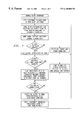
- FIG. 1 is a flow chart of the operation of a mobile system in accordance with the present invention
- FIG. 2 is a block diagram of a mobile device in accordance with the present invention.
- FIG. 3 is a graphic illustration of the candidate and serving frequencies concept in accordance with the present invention.
- FIG. 1 there is shown a flow chart of the operation of a mobile system in accordance with the present invention 2 during mobile assisted handoff (see FIG. 3) in a CDMA system with full duplex operation.
- the procedure of FIG. 1 is repeated every x th frame corresponding to about 10 to 20 milliseconds, for example.
- a frame is a window having a known time duration during which data is received and/or transmitted.
- the system is measuring signal strength and/or signal integrity to be ready for handoff to another channel when appropriate.
- the mobile device stops listening to data entering the mobile unit through its receive path as shown in box ( 2 ) and tunes the receiver in the mobile device from the serving frequency to a candidate frequency using a direct digital synthesizer (DDS) which is capable of switching to the candidate frequency much more rapidly than can the phase locked loop (PLL) which is the standard mobile device synthesizer as shown in box ( 3 ).
- DDS direct digital synthesizer
- PLL phase locked loop
- the received signals at the candidate frequency are then measured as to strength, integrity and whatever other measurements may be appropriate under the circumstances as shown in box ( 4 ).
- the system returns to the serving frequency for operation at that frequency during the following frame under control of the PLL when the mobile device will again be in a mode to receive from the serving base station as shown in boxes ( 5 ) and ( 6 ).
- the candidate frequency is superior to the serving frequency, that frequency is stored in a table for present or later use as shown in box ( 8 ) and a determination is made whether to make a change in frequency at that time by providing a mobile assisted handoff as shown in box ( 9 ). If no handoff is to take place, the system is returned to the serving frequency under control of the PLL as shown in box 7 and normal operation resumes since the PLL is still operating at the serving frequency.
- the synthesizer or PLL commences change to the new frequency and operation at the new frequency is commenced after the very short tuning period required by the direct digital synthesizer (DDS) and using the DDS in place of the PLL as shown in box ( 10 ).
- the frequency and phase of the DDS and the PLL are compared as shown in box ( 11 ) and, if the two are not phase and frequency locked, operation continues using the DDS.
- the PLL takes over for the DDS and the DDS is powered down as shown in box ( 12 ).
- Reception at the new frequency is commenced with the onset of operation of the DDS after the short tuning period with continued reception continuing uninterrupted when the PLL takes over for the DDS as shown in box ( 13 ).
- the reason for the use of the DDS as noted in the above mentioned copending application is that the PLL requires a much greater tuning time than does the DDS, the DDS being used when the greater tuning time required by the PLL cannot be tolerated.
- FIG. 2 there is shown a block diagram of a mobile device in accordance with a preferred embodiment of the present invention.
- the circuit includes a PLL of standard design under control of a reference frequency oscillator (f ref ) and a voltage controlled oscillator (VCO) controlled by the PLL.
- f ref reference frequency oscillator
- VCO voltage controlled oscillator
- DDS the output of which is applied to a mixer along with the output of a separate synthesizer to provide an output frequency from the mixer higher than is available from the DDS, this output frequency being filtered in a low pass filter (LPF) to provide a single tone at the candidate frequency.
- LPF low pass filter
- FIG. 2 presents a block diagram of the radio frequency (RF)-to-baseband downconversion process.
- a microcontroller or microprocessor programs the direct digital synthesizer (DDS) and other synthesizers, controls and evaluates results of baseband processing, toggles a switch used in determining which of the sources (i.e., DDS vs. conventional synthesizer) is used in the IF-to-baseband downconversion, and also controls other electronics (user display, audio volume, etc.).
- DDS direct digital synthesizer
- the RF output from the synthesizer (composed of the reference oscillator (f ref ), divide by M circuit, divide by N circuit, phase detector, low pass filter and voltage controlled oscillator (VCO) is selected by a switch to be used for downconversion of a signal at an intermediate frequency (IF) to baseband.
- the switch instead selects a signal which is generated from the mixing of the direct digital synthesizer (DDS) output frequency and a higher order harmonic of an additional synthesizer.
- DDS direct digital synthesizer
- the mobile device is typically moving within a network of base stations, the mobile station communication with one of the base stations and periodically moving away from that base station and toward one or more other base stations.
- the base stations in the network send out a list of candidate frequencies and the mobile device tunes to a candidate frequency (f candidate ) and makes a signal strength measurement.
- the mobile device then tunes back to the serving frequency (f serving ) If the serving base station provides the appropriate response, the mobile device may switch to the new frequency whereby f candidate now becomes the serving frequency and communication is with that base station.
- the serving base station sends a list of candidate frequencies to the mobile station.
- the mobile station tunes to the candidate frequency (e.g., f candidate ) and makes a signal strength measurement at that frequency.
- the mobile station then tunes back to the serving base station frequency (e.g., F serving ). If the serving base station provides the appropriate signal, the mobile station can switch to the new frequency and F candidate .
Landscapes
- Engineering & Computer Science (AREA)
- Computer Networks & Wireless Communication (AREA)
- Signal Processing (AREA)
- Mobile Radio Communication Systems (AREA)
Priority Applications (5)
| Application Number | Priority Date | Filing Date | Title |
|---|---|---|---|
| US09/143,712 US6188900B1 (en) | 1998-08-31 | 1998-08-31 | Mobile device assisted handoff system for code division multiple access and wideband code division multiple access networks |
| AT99202759T ATE413074T1 (de) | 1998-08-31 | 1999-08-26 | Mobilunterstütztes weiterreichen für cdma und breitband cdma netzwerke |
| EP99202759A EP0984648B1 (de) | 1998-08-31 | 1999-08-26 | Mobilunterstütztes Weiterreichen für CDMA und breitband CDMA Netzwerke |
| DE69939800T DE69939800D1 (de) | 1998-08-31 | 1999-08-26 | Mobilunterstütztes Weiterreichen für CDMA und breitband CDMA Netzwerke |
| JP11245423A JP2000092550A (ja) | 1998-08-31 | 1999-08-31 | 符号分割多重アクセス・ネットワ―ク及び広帯域符号分割多重アクセス・ネットワ―クのための移動体デバイス補助型ハンドオフ・システム |
Applications Claiming Priority (1)
| Application Number | Priority Date | Filing Date | Title |
|---|---|---|---|
| US09/143,712 US6188900B1 (en) | 1998-08-31 | 1998-08-31 | Mobile device assisted handoff system for code division multiple access and wideband code division multiple access networks |
Publications (1)
| Publication Number | Publication Date |
|---|---|
| US6188900B1 true US6188900B1 (en) | 2001-02-13 |
Family
ID=22505259
Family Applications (1)
| Application Number | Title | Priority Date | Filing Date |
|---|---|---|---|
| US09/143,712 Expired - Lifetime US6188900B1 (en) | 1998-08-31 | 1998-08-31 | Mobile device assisted handoff system for code division multiple access and wideband code division multiple access networks |
Country Status (5)
| Country | Link |
|---|---|
| US (1) | US6188900B1 (de) |
| EP (1) | EP0984648B1 (de) |
| JP (1) | JP2000092550A (de) |
| AT (1) | ATE413074T1 (de) |
| DE (1) | DE69939800D1 (de) |
Cited By (15)
| Publication number | Priority date | Publication date | Assignee | Title |
|---|---|---|---|---|
| US20030045291A1 (en) * | 2001-08-29 | 2003-03-06 | Nec Corporation | Mobile communications system, mobile station, control method and recording medium |
| US6587446B2 (en) * | 1999-02-11 | 2003-07-01 | Qualcomm Incorporated | Handoff in a wireless communication system |
| US6594242B1 (en) * | 1999-01-14 | 2003-07-15 | Ericsson, Inc. | Broadcasting of two generation cellular system control channel information over a three generation control channel to support roaming and handover to two generation cellular networks |
| US6671265B1 (en) * | 1998-02-17 | 2003-12-30 | Samsung Electronics Co., Ltd. | Method for optimizing hard handoffs in CDMA network |
| US20040224639A1 (en) * | 1999-09-29 | 2004-11-11 | Juan Melero | Estimating an indicator for a communication path |
| US20050190782A1 (en) * | 2004-02-27 | 2005-09-01 | Research In Motion Limited | Method and system for wireless channel selection by a mobile device |
| US20060097796A1 (en) * | 2001-03-20 | 2006-05-11 | Gomez Ramon A | Apparatus and method for phase lock loop gain control using unit current sources |
| US7164916B1 (en) * | 1999-09-06 | 2007-01-16 | Nokia Corporation | Method for quality measurement in a mobile telecommunications system |
| US20070207399A1 (en) * | 2006-03-06 | 2007-09-06 | Takuya Kadota | Toner and image forming method |
| US20070213063A1 (en) * | 1998-02-13 | 2007-09-13 | Qualcomm Incorporated | Method and system for performing a handoff in a wireless communication system, such as a hard handoff |
| US20080186938A1 (en) * | 2005-02-14 | 2008-08-07 | Mitsubishi Electric Corporation | Frequency Sharing Method, Receiving Station and Transmitting Station |
| US20080220807A1 (en) * | 2007-03-09 | 2008-09-11 | Mbit Wireless, Inc. | Multiple radio receive chain wireless communication devices |
| US20080287082A1 (en) * | 2007-05-17 | 2008-11-20 | Mbit Wireless, Inc | Method and apparatus to improve network acquisition |
| US7653157B2 (en) | 1998-05-21 | 2010-01-26 | Qualcomm Incorporated | Method and apparatus for coordinating transmission of short messages with hard handoff searches in a wireless communications system |
| US20100118695A1 (en) * | 2008-11-10 | 2010-05-13 | Qualcomm Incorporated | Spectrum sensing of bluetooth using a sequence of energy detection measurements |
Families Citing this family (3)
| Publication number | Priority date | Publication date | Assignee | Title |
|---|---|---|---|---|
| KR100369796B1 (ko) * | 2000-05-24 | 2003-01-30 | 삼성전자 주식회사 | 무선이동통신시스템의 이동국 셀 이탈 알림 방법 |
| US7729698B2 (en) | 2001-09-27 | 2010-06-01 | Qualcomm Incorporated | Communication system receiver and method for concurrent receiving of multiple channels |
| CN1953489B (zh) * | 2005-10-17 | 2010-04-21 | 光宝科技股份有限公司 | 数据包传递路径控制方法、网络电话系统及无线网络话机 |
Citations (5)
| Publication number | Priority date | Publication date | Assignee | Title |
|---|---|---|---|---|
| US5504783A (en) * | 1992-11-20 | 1996-04-02 | Ntt Mobile Communication Network Inc. | Frequency diversity transmitter and receiver |
| US5701598A (en) * | 1990-09-14 | 1997-12-23 | Atkinson; Noel D. | Scanning receiver with direct digital frequency synthesis and digital signal processing |
| US5999816A (en) * | 1997-02-18 | 1999-12-07 | Qualcomm Incorporated | Method and apparatus for performing mobile assisted hard handoff between communication systems |
| US6075989A (en) * | 1998-01-20 | 2000-06-13 | Motorola, Inc. | Method and apparatus for determining a need to handoff a mobile communication signal in a wireless communication system |
| US6078570A (en) * | 1997-08-21 | 2000-06-20 | Nokia Mobile Phones Limited | Mobile assisted hard hand-off for a code division multiple access (CDMA) system |
Family Cites Families (2)
| Publication number | Priority date | Publication date | Assignee | Title |
|---|---|---|---|---|
| GB2254971B (en) * | 1991-03-07 | 1994-12-21 | Ericsson Telefon Ab L M | Mobile radio communications stations |
| JP3193803B2 (ja) * | 1993-03-12 | 2001-07-30 | 株式会社半導体エネルギー研究所 | 半導体素子の作製方法 |
-
1998
- 1998-08-31 US US09/143,712 patent/US6188900B1/en not_active Expired - Lifetime
-
1999
- 1999-08-26 DE DE69939800T patent/DE69939800D1/de not_active Expired - Lifetime
- 1999-08-26 AT AT99202759T patent/ATE413074T1/de not_active IP Right Cessation
- 1999-08-26 EP EP99202759A patent/EP0984648B1/de not_active Expired - Lifetime
- 1999-08-31 JP JP11245423A patent/JP2000092550A/ja not_active Abandoned
Patent Citations (5)
| Publication number | Priority date | Publication date | Assignee | Title |
|---|---|---|---|---|
| US5701598A (en) * | 1990-09-14 | 1997-12-23 | Atkinson; Noel D. | Scanning receiver with direct digital frequency synthesis and digital signal processing |
| US5504783A (en) * | 1992-11-20 | 1996-04-02 | Ntt Mobile Communication Network Inc. | Frequency diversity transmitter and receiver |
| US5999816A (en) * | 1997-02-18 | 1999-12-07 | Qualcomm Incorporated | Method and apparatus for performing mobile assisted hard handoff between communication systems |
| US6078570A (en) * | 1997-08-21 | 2000-06-20 | Nokia Mobile Phones Limited | Mobile assisted hard hand-off for a code division multiple access (CDMA) system |
| US6075989A (en) * | 1998-01-20 | 2000-06-13 | Motorola, Inc. | Method and apparatus for determining a need to handoff a mobile communication signal in a wireless communication system |
Cited By (31)
| Publication number | Priority date | Publication date | Assignee | Title |
|---|---|---|---|---|
| US20070213063A1 (en) * | 1998-02-13 | 2007-09-13 | Qualcomm Incorporated | Method and system for performing a handoff in a wireless communication system, such as a hard handoff |
| US7603123B2 (en) | 1998-02-13 | 2009-10-13 | Qualcomm Incorporated | Method and system for performing a handoff in a wireless communication system, such as a hard handoff |
| US8170558B2 (en) | 1998-02-13 | 2012-05-01 | Qualcomm Incorporated | Method and system for performing a handoff in a wireless communication system, such as a hard handoff |
| US20100046478A1 (en) * | 1998-02-13 | 2010-02-25 | Qualcomm Incorporated | Method and system for performing a handoff in a wireless communication system, such as a hard handoff |
| US6671265B1 (en) * | 1998-02-17 | 2003-12-30 | Samsung Electronics Co., Ltd. | Method for optimizing hard handoffs in CDMA network |
| US7664209B2 (en) | 1998-05-21 | 2010-02-16 | Qualcomm Incorporated | Method and apparatus for coordinating transmission of short messages with hard handoff searches in a wireless communications system |
| US7653157B2 (en) | 1998-05-21 | 2010-01-26 | Qualcomm Incorporated | Method and apparatus for coordinating transmission of short messages with hard handoff searches in a wireless communications system |
| US6594242B1 (en) * | 1999-01-14 | 2003-07-15 | Ericsson, Inc. | Broadcasting of two generation cellular system control channel information over a three generation control channel to support roaming and handover to two generation cellular networks |
| US6587446B2 (en) * | 1999-02-11 | 2003-07-01 | Qualcomm Incorporated | Handoff in a wireless communication system |
| US8199716B2 (en) | 1999-08-11 | 2012-06-12 | Qualcomm Incorporated | Method and system for performing handoff in wireless communication systems |
| US7164916B1 (en) * | 1999-09-06 | 2007-01-16 | Nokia Corporation | Method for quality measurement in a mobile telecommunications system |
| US6928267B2 (en) * | 1999-09-29 | 2005-08-09 | Nokia Corporation | Estimating an indicator for a communication path |
| US20040224639A1 (en) * | 1999-09-29 | 2004-11-11 | Juan Melero | Estimating an indicator for a communication path |
| US7443248B2 (en) * | 2001-03-20 | 2008-10-28 | Broadcom Corporation | Apparatus and method for phase lock loop gain control using unit current sources |
| US20090058536A1 (en) * | 2001-03-20 | 2009-03-05 | Broadcom Corporation | Apparatus and method for phase lock loop gain control using unit current sources |
| US20060097796A1 (en) * | 2001-03-20 | 2006-05-11 | Gomez Ramon A | Apparatus and method for phase lock loop gain control using unit current sources |
| US7948325B2 (en) | 2001-03-20 | 2011-05-24 | Broadcom Corporation | Apparatus and method for phase lock loop gain control using unit current sources |
| US6947746B2 (en) * | 2001-08-29 | 2005-09-20 | Nec Corporation | Mobile communications system, mobile station, control method and recording medium |
| US20030045291A1 (en) * | 2001-08-29 | 2003-03-06 | Nec Corporation | Mobile communications system, mobile station, control method and recording medium |
| US20050190782A1 (en) * | 2004-02-27 | 2005-09-01 | Research In Motion Limited | Method and system for wireless channel selection by a mobile device |
| US7596119B2 (en) | 2004-02-27 | 2009-09-29 | Research In Motion Limited | Method and system for wireless channel selection by a mobile device |
| US8036676B2 (en) * | 2005-02-14 | 2011-10-11 | Mitsubishi Electric Corporation | Frequency sharing method, receiving station and transmitting station |
| US20080186938A1 (en) * | 2005-02-14 | 2008-08-07 | Mitsubishi Electric Corporation | Frequency Sharing Method, Receiving Station and Transmitting Station |
| US20070207399A1 (en) * | 2006-03-06 | 2007-09-06 | Takuya Kadota | Toner and image forming method |
| US8095099B2 (en) * | 2007-03-09 | 2012-01-10 | Bhaskar Patel | Multiple radio receive chain wireless communication devices |
| US20080220807A1 (en) * | 2007-03-09 | 2008-09-11 | Mbit Wireless, Inc. | Multiple radio receive chain wireless communication devices |
| US8260231B2 (en) | 2007-03-09 | 2012-09-04 | Bhaskar Patel | Method and apparatus for multiple radio receive chains in wireless communication systems |
| US8036658B2 (en) | 2007-05-17 | 2011-10-11 | Arumugam Govindswamy | Method and apparatus to improve network acquisition |
| US20080287082A1 (en) * | 2007-05-17 | 2008-11-20 | Mbit Wireless, Inc | Method and apparatus to improve network acquisition |
| US20100118695A1 (en) * | 2008-11-10 | 2010-05-13 | Qualcomm Incorporated | Spectrum sensing of bluetooth using a sequence of energy detection measurements |
| US8964692B2 (en) | 2008-11-10 | 2015-02-24 | Qualcomm Incorporated | Spectrum sensing of bluetooth using a sequence of energy detection measurements |
Also Published As
| Publication number | Publication date |
|---|---|
| EP0984648A3 (de) | 2000-08-30 |
| EP0984648B1 (de) | 2008-10-29 |
| ATE413074T1 (de) | 2008-11-15 |
| EP0984648A2 (de) | 2000-03-08 |
| DE69939800D1 (de) | 2008-12-11 |
| JP2000092550A (ja) | 2000-03-31 |
Similar Documents
| Publication | Publication Date | Title |
|---|---|---|
| US6188900B1 (en) | Mobile device assisted handoff system for code division multiple access and wideband code division multiple access networks | |
| US6466803B1 (en) | Multi-mode communications system with efficient oscillator synchronization | |
| US5983081A (en) | Method for generating frequencies in a direct conversion transceiver of a dual band radio communication system, a direct conversion transceiver of a dual band radio communication system and the use of this method and apparatus in a mobile station | |
| CN100464505C (zh) | 用于在无线移动终端内在无线收发信机与全球定位系统接收机之间共享基准频率信号的系统和方法 | |
| KR100224102B1 (ko) | 이중 대역 셀룰러 전화에 이용되는 중간주파수 선택장치 및 방법 | |
| EP2258048B1 (de) | Dynamische referenzfrequenz für einen n-fraktionalen phasenregelkreis | |
| JP4484321B2 (ja) | 送受信機 | |
| US7082292B2 (en) | Mobile communications device with GPS receiver and common clock source | |
| KR100819363B1 (ko) | 다채널 수신기들에서의 자동 주파수 제어 프로세싱 | |
| KR0178619B1 (ko) | 위상 고정 방식 주파수 합성기를 무선 주파수의 채널 간격에 따라 동작시키는 장치 및 방법 | |
| JPH10190507A (ja) | 無線受信機および無線送信機 | |
| EP1277286B9 (de) | Persönliche kommunikationsanlage mit gps empfänger und gemeinsamer taktquelle | |
| US6564039B1 (en) | Frequency generation circuit and method of operating a tranceiver | |
| US6484014B1 (en) | Reduced component frequency plan architecture for dual band transceiver | |
| US5526527A (en) | Method and apparatus for frequency synthesization in digital cordless telephones | |
| EP1656741B1 (de) | Bereitstellung von lokalen oszillatorsignalen | |
| US6870428B2 (en) | Mobile radio communications device having a PLL that phase locks with two crystal oscillators | |
| JP3203119B2 (ja) | 周波数シンセサイザ回路 | |
| US6556545B1 (en) | Frequency generation for CDMA terminal with slotted receive mode | |
| KR100584322B1 (ko) | 듀얼모드 단말기의 통합 고주파 인터페이스 장치 | |
| KR100256950B1 (ko) | 위상 동기 루프를 이용한 개인휴대통신 대역 송수신 주파수변환기 구동 방법 | |
| JPS60214119A (ja) | 周波数シンセサイザ | |
| JP2000165279A (ja) | Fm受信回路における受信トラッキング補正回路 | |
| KR20020011721A (ko) | 이중모드 이동통신단말기의 아날로그 복조 장치 | |
| JPS644697B2 (de) |
Legal Events
| Date | Code | Title | Description |
|---|---|---|---|
| AS | Assignment |
Owner name: TEXAS INSTRUMENTS INCORPORATED, TEXAS Free format text: ASSIGNMENT OF ASSIGNORS INTEREST;ASSIGNORS:RUIZ, EVERARDO D.;HENWOOD, ANDREW M.;REEL/FRAME:009429/0084 Effective date: 19980828 |
|
| STCF | Information on status: patent grant |
Free format text: PATENTED CASE |
|
| FPAY | Fee payment |
Year of fee payment: 4 |
|
| FPAY | Fee payment |
Year of fee payment: 8 |
|
| FPAY | Fee payment |
Year of fee payment: 12 |