US6232598B1 - Process and devices for characterizing ground water measurement points by distinguishing ground water from subterranean water accumulation - Google Patents
Process and devices for characterizing ground water measurement points by distinguishing ground water from subterranean water accumulation Download PDFInfo
- Publication number
- US6232598B1 US6232598B1 US09/180,706 US18070698A US6232598B1 US 6232598 B1 US6232598 B1 US 6232598B1 US 18070698 A US18070698 A US 18070698A US 6232598 B1 US6232598 B1 US 6232598B1
- Authority
- US
- United States
- Prior art keywords
- radon
- groundwater
- activity concentration
- measuring
- concentration
- Prior art date
- Legal status (The legal status is an assumption and is not a legal conclusion. Google has not performed a legal analysis and makes no representation as to the accuracy of the status listed.)
- Expired - Fee Related
Links
Images


Classifications
-
- G—PHYSICS
- G01—MEASURING; TESTING
- G01N—INVESTIGATING OR ANALYSING MATERIALS BY DETERMINING THEIR CHEMICAL OR PHYSICAL PROPERTIES
- G01N33/00—Investigating or analysing materials by specific methods not covered by groups G01N1/00 - G01N31/00
- G01N33/0004—Gaseous mixtures, e.g. polluted air
- G01N33/0009—General constructional details of gas analysers, e.g. portable test equipment
- G01N33/0027—General constructional details of gas analysers, e.g. portable test equipment concerning the detector
- G01N33/0036—General constructional details of gas analysers, e.g. portable test equipment concerning the detector specially adapted to detect a particular component
- G01N33/0055—Radionuclides
-
- E—FIXED CONSTRUCTIONS
- E21—EARTH OR ROCK DRILLING; MINING
- E21B—EARTH OR ROCK DRILLING; OBTAINING OIL, GAS, WATER, SOLUBLE OR MELTABLE MATERIALS OR A SLURRY OF MINERALS FROM WELLS
- E21B47/00—Survey of boreholes or wells
- E21B47/10—Locating fluid leaks, intrusions or movements
- E21B47/11—Locating fluid leaks, intrusions or movements using tracers; using radioactivity
-
- E—FIXED CONSTRUCTIONS
- E21—EARTH OR ROCK DRILLING; MINING
- E21B—EARTH OR ROCK DRILLING; OBTAINING OIL, GAS, WATER, SOLUBLE OR MELTABLE MATERIALS OR A SLURRY OF MINERALS FROM WELLS
- E21B47/00—Survey of boreholes or wells
- E21B47/10—Locating fluid leaks, intrusions or movements
- E21B47/113—Locating fluid leaks, intrusions or movements using electrical indications; using light radiations
-
- G—PHYSICS
- G01—MEASURING; TESTING
- G01N—INVESTIGATING OR ANALYSING MATERIALS BY DETERMINING THEIR CHEMICAL OR PHYSICAL PROPERTIES
- G01N1/00—Sampling; Preparing specimens for investigation
- G01N1/02—Devices for withdrawing samples
- G01N1/10—Devices for withdrawing samples in the liquid or fluent state
- G01N1/14—Suction devices, e.g. pumps; Ejector devices
-
- G—PHYSICS
- G01—MEASURING; TESTING
- G01N—INVESTIGATING OR ANALYSING MATERIALS BY DETERMINING THEIR CHEMICAL OR PHYSICAL PROPERTIES
- G01N1/00—Sampling; Preparing specimens for investigation
- G01N1/02—Devices for withdrawing samples
- G01N1/22—Devices for withdrawing samples in the gaseous state
-
- G—PHYSICS
- G01—MEASURING; TESTING
- G01N—INVESTIGATING OR ANALYSING MATERIALS BY DETERMINING THEIR CHEMICAL OR PHYSICAL PROPERTIES
- G01N1/00—Sampling; Preparing specimens for investigation
- G01N1/02—Devices for withdrawing samples
- G01N1/22—Devices for withdrawing samples in the gaseous state
- G01N1/2226—Sampling from a closed space, e.g. food package, head space
- G01N2001/2229—Headspace sampling, i.e. vapour over liquid
- G01N2001/2232—Headspace sampling, i.e. vapour over liquid using a membrane, i.e. pervaporation
Definitions
- the invention relates to a method and apparatuses for characterizing groundwater measuring sites by differentiating between groundwater and static water by determining groundwater parameters at measuring sites and can be used for the on-site determination of the optimum sampling time, for the determination of the pumping-out times optimum for investigations of the representative condition and for monitoring groundwater measuring sites for defects.
- the invention can be used, in particular, within the scope of investigating the condition of groundwater.
- groundwater observation pipes and groundwater measuring sites were and are being set up in order to sample the groundwater.
- analytical methods for determining the components of the water were refined and the spectrum of individual materials detectable was expanded. Both led to new demands for the quality of groundwater samples.
- the high requirements of analysis and the financial expense involved in obtaining groundwater samples likewise require a careful depth-oriented and representative sampling. A prerequisite for this is the correct selection of measurement site type, sampling techniques and sampling technology.
- the DE 42 17 263 A1 discloses a method, with which gaseous components are also monitored for the sampling.
- this method is concerned not with using gas for establishing the sampling time but with a method of gas sampling, which is similar to the groundwater sampling.
- radon is described as a natural tracer in groundwater for determining residence times of riverbank filtrate, that is, the time is determined, which the water, infiltrated in a stream, requires (to reach) a groundwater measuring site.
- the basic idea here is that river water with a low radon content, as it passes through the aquifer, takes up radon, until a saturation concentration is reached. Radon was not used to determine the pumping-out time in the groundwater measuring site.
- a special advantage of the invention consists therein that the optimum pumping-out times and the optimum times for the sampling are determined with very high accuracy and reproducibility, in that water samples are taken at defined, consecutive times during the pumping-out process, the radon activity concentration of the samples taken is measured and the attainment of a radon activity concentration, which remains essentially constant, signals the optimum time for representative sampling.
- a further advantage of the invention lies therein that the groundwater measuring site parameters can be determined without a delay of time, in that the radon activity concentration and/or the total activity concentration are determined and evaluated spectrometrically and/or by diffusion into an air volume or degassing by subsequent measurement in situ directly from the groundwater that is to be investigated.
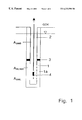
- FIG. 1 shows the distribution of the radon activity concentration at a groundwater observation pipe
- FIG. 2 shows a diagrammatic representation of the sampling vessel with inlet pipe
- FIG. 3 shows a diagram of the measured radon activity concentration and electrical conductivity during a pumping-out experiment with the pump directly under the groundwater surface
- FIG. 4 shows a diagram of the measured radon activity concentration and electrical conductivity during a pumping-out trial with the pump in the filter region.
- radon activity concentrations occur in the groundwater in the region of a groundwater observation pipe.
- the grain framework of the aquifer produces a basic activity A GWL .
- the incorporated filtering gravel 1 of foreign origin and larger grain diameter produces its own radon activity concentration A Filter .
- the activity A GWBR in the non-filtered standpipe 2 of the groundwater observation pipe is zero. Water flows through the pore space of the filtering gravel 1 below the clay obstruction 3 and through the filter pipe 1 a of the groundwater observation pipe with the activity A GWL .
- a t radon activity at time t
- radon is an ideal parameter for determining the proportion of static water in a groundwater sample. If the radon activity concentration of the water, which is pumped away, is measured, then this activity commences at zero and approaches a plateau value corresponding to the mixing ratio of groundwater and static water. By means of such a curve, the time for a representative sampling can be determined exactly as a function of the exchange volumes of the groundwater observation pipe.
- the pump 4 can be installed one meter below the upper edge of the filter or in the center of the filter or, if the groundwater observation pipes are deep and the pump technology required for such pipes is lacking, the pump 4 can be installed one meter below the groundwater surface. Continuously filtered groundwater observation pipes are excluded from the following considerations.
- Radon is a radioactive noble gas and has three isotopes with mass numbers of 219, 220 and 222. They are products of the natural decay series of 238 U, 232 Th and 235 U. The occurrence and distribution of the three radioisotopes in water is determined by their half-life times. If they are too short, the isotopes decompose at the site of their formation. Accordingly, thoron ( 220 Rn), with a half-life time of 56 seconds, and actinon ( 219 Rn), with a half-life time of 4 seconds, reach the moved liquid phase hardly or not at all. Radon-222, with a half-life time of 3.8 days, and its decay products are therefore the main sources of natural radiation in groundwater.
- Radon-222 (referred to in the following as radon) is formed from radium-226, a decay product of 238 U.
- the decay products of radon are isotopes of the elements polonium, bismuth and lead.
- the decay of radon to 214 Po takes place through three alpha and two beta decays.
- the equilibrium between radon and its decay products is attained after about 3 hours.
- radon emerges during alpha decay from solid and loose rock or reaches the liquid phase through diffusion at the grain surface. Because of the short half-life time, this is followed by a limited transport process due to diffusion and groundwater flow (migration).
- the grain structure of the aquifer permanently produces radon and releases this to the liquid phase.
- the sampling vessel 5 is constructed so that the very mobile radon cannot escape during the filling and the subsequent transport. Above all, the water sample must not come into contact with air.
- the groundwater sample 11 is layered with little turbulence below the cocktail 14 .
- an inlet tube 6 is disposed with a ground glass core in an attachment 9 , which also has a venting tube 10 , the inlet tube 6 extending into the sampling vessel 5 as far as a short distance above the bottom 7 of the sampling vessel and the end of the inlet tube 6 being below the surface of a toluene scintillator.
- the sampling vessel 5 is held inclined in such a manner, that the cocktail 14 collects at the end of the inlet tube 6 . At the same time, it is ensured that there is a sufficient layer above the inflowing groundwater sample even during the initial turbulence.
- the sample volume amounts to one liter.
- the inlet tube 6 is removed from the sampling vessel 5 and the sampling vessel 5 is closed off tightly with a polyethylene stopper. In addition, Teflon seals are placed between the stopper and the neck 5 a .
- the cocktail 14 floating in the narrow neck 5 a of the sampling vessel 5 , forms a reliable protection against loss of radon during the transport of the sample.
- a second tube coupling can be used in such a way, that the inlet tube 6 remains firmly connected with a piece of tubing over the tube coupling 13 and the polyethylene tubing 12 is coupled and separated over a second tube coupling. The sampling thus takes place with little turbulence and without bubbles.
- the water sample obtained with the underwater motor pump 4 , is pumped over a bypass and an inlet pipe without bubbles and without contact with air into a 1 liter measuring flask 5 .
- this measuring flask 5 there are 20 mL of a toluene scintillator (cocktail, toluene scintillator made by Packard, 5 g of PPO and 0.1 g of POPOP per liter of toluene), below which the groundwater sample is layered.
- the radon is extracted by shaking the measuring flask 5 and the cocktail, pipetted off, is transferred into vials.
- the vials are measured in a Packard TRI-CARB 2550 TR/AB liquid scintillation spectrometer.
- the alpha/beta discrimination can be used to evaluate the correctness of the results of the measurements.
- the radon concentration at the time of the sampling is measured by regression from repeated measurements of a vial.
- the radon concentrations, determined in the liquid scintillation spectrometer, are expressed in cpm (counts per minute).
- Measurement probes and a flow-through measurement cell are used to measure the electrical conductivity and optionally the pH and the temperature.
- the pumped stream of groundwater is divided over a bypass into two partial streams for obtaining the groundwater samples and for flowing through the flow-through measurement cell. During the sampling, the pumped stream is not restricted, since the radon activity concentration is independent of the pumped stream.
- the two sampled groundwater observation pipes were of equal construction. They had a pipe diameter of 4.5′′ and a hole diameter of 13′′ and were equipped with a 1 m long stainless steel, wound filter.
- the grain size of the filtering gravel was 2-8 mm and the porosity was assumed to be 0.25.
- the exchange volume is defined as the capacity of the groundwater observation pipe, including the pre space of the gravel filtering fill.
- experiment A the pump 4 was installed one meter below the surface of the groundwater (installed depth 6 m) in the groundwater observation pipe with a vertical water column up to the lower edge of the filter of 39 m.
- the filtering gravel fill was 5.5 m thick.
- samples for determining the radon activity concentration were taken at three minute intervals.
- the electrical conductivity was recorded every minute. The experiment lasted 120 minutes (FIG. 3 ).
- the relative amplitude change of the radon activity concentration in the two experiments was three times larger than that of the electrical conductivity (100% to 32% in experiment A and 18% to 6% in experiment B).
- the measurement of the radon activity concentration during the pumping-out process permits the ratio of groundwater to static water in a groundwater sample to be determined reliably.
- the cause is the rapid decay of the radon in the static water of a groundwater observation pipe because of its short half-life time in conjunction with the steady emanation of radon in the grain structure of the aquifer. With that, the possibility exists of investigating the pumping-out behavior of groundwater observation pipes generally, regardless of where the pump is installed.
- a scooped sample can be taken from the region of the filter. If the radon activity concentration of this sample is zero, groundwater is no longer flowing through the filter. If, after the scooped sample is taken, a pumping-out experiment is carried out and the radon activity concentration is measured during the pumping-out trial, conclusions concerning the flow through the filter can be drawn from the ratio of the radon activity concentration of the scooped sample to the plateau value of the trial.
- the radon activity concentration it is possible to measure the total activity concentration instead of the radon activity concentration, the radon activity concentration making a large contribution to the total activity concentration and other nuclides with a longer half life not interfering with the method. Likewise, it is possible to measure the radon activity concentration online.
- radionuclides are the short-lived products of the natural decay of radon-222: Po-218, Pb-214, Bi-214 and Po-214.
- an air-filled tube consisting of a membrane that is permeable by diffusion, is installed in the form of a coil in the stream produced by the pump.
- the radon diffuses out of the water through the tube into the air and can be measured online in a measurement cell, such as a Lucas cell (SURBECK, 1996).
- a measurement cell such as a Lucas cell (SURBECK, 1996).
- SURBECK Lucas cell
- a further reduction in the measurement time to one minute depends on whether the accuracy, which can still be achieved then, is adequate for the proposed method of determining the pumping-out times.
- a new flow-through measurement cell which, aside from measuring the natural radon activity concentration, also measures the flow rate and the traditional guiding characteristic values, such as electrical conductivity, temperature and pH. All guiding characteristic values are shown and documented online by an appropriate software program as a function of the pumping-out volume. The evaluation of the curves recorded and, in particular, the determination of the plateau values of all guiding parameters, as well as a proposal for an optimum time for taking representative samples also belongs to the operational extent of this software. With such a flow-through measurement cell, sampling from groundwater measuring sites can be objectified, the representativeness of the groundwater samples increased and, at the same time, the pumping-out times reduced, the costs of the sampling thus being lowered.
- a further proposed apparatus is a borehole probe for the online detection of guiding characteristic values in groundwater measuring sites.
- This method can be used in tubed boreholes for localizing short-circuited flows through defective sleeves, leaking pipes, non-functioning packers or in repeatedly filtered measuring sites and is also suitable for localizing water entries in boreholes that are not piped.
- the above-proposed borehole probe measures the radon activity concentration in the static water of a measuring site during an online examination.
Landscapes
- Life Sciences & Earth Sciences (AREA)
- Physics & Mathematics (AREA)
- Engineering & Computer Science (AREA)
- Geology (AREA)
- Chemical & Material Sciences (AREA)
- Mining & Mineral Resources (AREA)
- Health & Medical Sciences (AREA)
- Immunology (AREA)
- General Health & Medical Sciences (AREA)
- Geochemistry & Mineralogy (AREA)
- Biochemistry (AREA)
- Pathology (AREA)
- Geophysics (AREA)
- Fluid Mechanics (AREA)
- General Physics & Mathematics (AREA)
- General Life Sciences & Earth Sciences (AREA)
- Analytical Chemistry (AREA)
- Environmental & Geological Engineering (AREA)
- Medicinal Chemistry (AREA)
- Food Science & Technology (AREA)
- Combustion & Propulsion (AREA)
- Hydrology & Water Resources (AREA)
- Measurement Of Radiation (AREA)
- Geophysics And Detection Of Objects (AREA)
- Sampling And Sample Adjustment (AREA)
- Investigation Of Foundation Soil And Reinforcement Of Foundation Soil By Compacting Or Drainage (AREA)
Priority Applications (3)
| Application Number | Priority Date | Filing Date | Title |
|---|---|---|---|
| US10/009,451 US6847033B2 (en) | 1998-11-13 | 2001-03-07 | Method and device for quickly and continually detecting changes in the concentration of radon gas that is dissolved in water |
| PCT/EP2001/002566 WO2001066227A2 (de) | 1998-11-13 | 2001-03-07 | Verfahren und vorrichtung zur schnellen und kontinuierlichen erfassung von änderungen der konzentration von in wasser gelöstem radon-gas |
| US09/809,679 US6498341B2 (en) | 1996-05-14 | 2001-03-15 | Method for characterizing ground water measurement points by distinguishing ground water from subterranean water accumulation |
Applications Claiming Priority (5)
| Application Number | Priority Date | Filing Date | Title |
|---|---|---|---|
| DE19621158 | 1996-05-14 | ||
| DE19621158A DE19621158C1 (de) | 1996-05-14 | 1996-05-14 | Verfahren zur Bestimmung der optimalen Abpumpzeiten von Grundwasserbeobachtungsrohren |
| DE19711110 | 1997-03-06 | ||
| DE19711110 | 1997-03-06 | ||
| PCT/EP1997/002450 WO1997043637A1 (de) | 1996-05-14 | 1997-05-14 | Verfahren und vorrichtungen zur charakterisierung von grundwassermessstellen durch unterscheidung von grundwasser und standwasser |
Related Parent Applications (1)
| Application Number | Title | Priority Date | Filing Date |
|---|---|---|---|
| PCT/EP1997/002450 A-371-Of-International WO1997043637A1 (de) | 1996-05-14 | 1997-05-14 | Verfahren und vorrichtungen zur charakterisierung von grundwassermessstellen durch unterscheidung von grundwasser und standwasser |
Related Child Applications (2)
| Application Number | Title | Priority Date | Filing Date |
|---|---|---|---|
| US10009451 Continuation-In-Part | 2001-03-07 | ||
| US09/809,679 Division US6498341B2 (en) | 1996-05-14 | 2001-03-15 | Method for characterizing ground water measurement points by distinguishing ground water from subterranean water accumulation |
Publications (1)
| Publication Number | Publication Date |
|---|---|
| US6232598B1 true US6232598B1 (en) | 2001-05-15 |
Family
ID=26026044
Family Applications (2)
| Application Number | Title | Priority Date | Filing Date |
|---|---|---|---|
| US09/180,706 Expired - Fee Related US6232598B1 (en) | 1996-05-14 | 1997-05-14 | Process and devices for characterizing ground water measurement points by distinguishing ground water from subterranean water accumulation |
| US09/809,679 Expired - Fee Related US6498341B2 (en) | 1996-05-14 | 2001-03-15 | Method for characterizing ground water measurement points by distinguishing ground water from subterranean water accumulation |
Family Applications After (1)
| Application Number | Title | Priority Date | Filing Date |
|---|---|---|---|
| US09/809,679 Expired - Fee Related US6498341B2 (en) | 1996-05-14 | 2001-03-15 | Method for characterizing ground water measurement points by distinguishing ground water from subterranean water accumulation |
Country Status (11)
| Country | Link |
|---|---|
| US (2) | US6232598B1 (de) |
| EP (1) | EP0901625B1 (de) |
| AT (1) | ATE246354T1 (de) |
| AU (1) | AU2954197A (de) |
| CA (1) | CA2254792C (de) |
| CZ (1) | CZ294489B6 (de) |
| DE (1) | DE19780447C1 (de) |
| HU (1) | HUP9901318A3 (de) |
| PL (1) | PL191617B1 (de) |
| SK (1) | SK285033B6 (de) |
| WO (1) | WO1997043637A1 (de) |
Cited By (6)
| Publication number | Priority date | Publication date | Assignee | Title |
|---|---|---|---|---|
| US20110153392A1 (en) * | 2009-12-22 | 2011-06-23 | Pallad Steven T | Systems and methods for scheduling a periodic collection of environmental samples |
| US20190011596A1 (en) * | 2010-09-02 | 2019-01-10 | Baker Hughes, A Ge Company, Llc | Water saturation determination using an oxygen estimate and formation lithology |
| US10288534B1 (en) * | 2018-05-01 | 2019-05-14 | Frederick Matthew Thyng | Method of fluid sampling and device thereof |
| CN113109535A (zh) * | 2021-04-15 | 2021-07-13 | 天津市地质研究和海洋地质中心 | 一种洲滩地下水和地表水取样装置及相互作用监测方法 |
| CN115290390A (zh) * | 2022-07-11 | 2022-11-04 | 攀钢集团西昌钒制品科技有限公司 | 一种用于钒合金冶炼的物料自动分层采样装置及系统 |
| US11624682B2 (en) | 2020-08-24 | 2023-04-11 | Mitsubishi Heavy Industries, Ltd. | Sampling system and sampling method |
Families Citing this family (9)
| Publication number | Priority date | Publication date | Assignee | Title |
|---|---|---|---|---|
| DE10010558B4 (de) * | 2000-03-08 | 2008-02-21 | Ufz-Umweltforschungszentrum Leipzig-Halle Gmbh | Verfahren und Vorrichtung zur kontinuierlichen und schnellen Erfassung von Änderungen der Konzentration von in ständig neu zugeführtem Wasser gelöstem Radon-Gas |
| US6847033B2 (en) | 1998-11-13 | 2005-01-25 | Ufz Umweltforschungszentrum Leipzing-Halle Gmbh | Method and device for quickly and continually detecting changes in the concentration of radon gas that is dissolved in water |
| US7196786B2 (en) * | 2003-05-06 | 2007-03-27 | Baker Hughes Incorporated | Method and apparatus for a tunable diode laser spectrometer for analysis of hydrocarbon samples |
| US8074487B2 (en) * | 2009-03-05 | 2011-12-13 | Durridge Company Inc. | Method of calibrating an apparatus for measuring radon and/or its progeny in an air sample |
| CN102830417B (zh) * | 2012-08-30 | 2014-12-10 | 衡阳师范学院 | 利用218Po、214Po总计数闭环式测量氡析出率的方法 |
| US10208585B2 (en) | 2015-08-11 | 2019-02-19 | Intrasen, LLC | Groundwater monitoring system and method |
| CN109001790A (zh) * | 2018-09-19 | 2018-12-14 | 衡阳师范学院 | 一种连续式水氡测量装置及方法 |
| JP7372706B2 (ja) | 2019-10-10 | 2023-11-01 | アルファ タウ メディカル リミテッド | 放射線治療源の湿式調製 |
| CN113625328B (zh) * | 2021-07-27 | 2024-06-21 | 衡阳师范学院 | 冒泡法测量水氡浓度的装置及方法 |
Citations (2)
| Publication number | Priority date | Publication date | Assignee | Title |
|---|---|---|---|---|
| US5744730A (en) * | 1997-02-14 | 1998-04-28 | Ballard; John H. | Subsurface in-situ radon gas detection/penetrometer system |
| US6021664A (en) * | 1998-01-29 | 2000-02-08 | The United States Of America As Represented By The Secretary Of The Interior | Automated groundwater monitoring system and method |
Family Cites Families (7)
| Publication number | Priority date | Publication date | Assignee | Title |
|---|---|---|---|---|
| US4844839A (en) * | 1984-09-04 | 1989-07-04 | Manchak Frank | In situ treatment and analysis of wastes |
| DD282770A5 (de) * | 1985-02-15 | 1990-09-19 | Freiberg Bergakademie | Verfahren zur ermittlung der grundwasserneubildung in lockergesteinen |
| DE3911366A1 (de) * | 1989-04-07 | 1990-10-11 | Grundfos Int | Verfahren und vorrichtung zur probennahme an einer grundwassermessstelle |
| DE4217236C2 (de) * | 1992-05-20 | 1996-10-31 | Stuckenbrock Medizintechnik Gm | Platten-Schrauben-Implantat |
| DE4217263C2 (de) * | 1992-05-25 | 1994-05-19 | Umwelt Control Luenen Gmbh | Verfahren zum Ziehen von Bodenporengasproben |
| JPH07117599B2 (ja) * | 1993-05-13 | 1995-12-18 | 株式会社日さく | 地下水の短距離追跡法 |
| DE19621158C1 (de) * | 1996-05-14 | 1997-09-11 | Ufz Leipzighalle Gmbh | Verfahren zur Bestimmung der optimalen Abpumpzeiten von Grundwasserbeobachtungsrohren |
-
1997
- 1997-05-14 DE DE19780447A patent/DE19780447C1/de not_active Expired - Fee Related
- 1997-05-14 AU AU29541/97A patent/AU2954197A/en not_active Abandoned
- 1997-05-14 HU HU9901318A patent/HUP9901318A3/hu unknown
- 1997-05-14 CA CA002254792A patent/CA2254792C/en not_active Expired - Fee Related
- 1997-05-14 WO PCT/EP1997/002450 patent/WO1997043637A1/de not_active Ceased
- 1997-05-14 SK SK1473-98A patent/SK285033B6/sk unknown
- 1997-05-14 US US09/180,706 patent/US6232598B1/en not_active Expired - Fee Related
- 1997-05-14 EP EP97923885A patent/EP0901625B1/de not_active Expired - Lifetime
- 1997-05-14 CZ CZ19983647A patent/CZ294489B6/cs not_active IP Right Cessation
- 1997-05-14 AT AT97923885T patent/ATE246354T1/de not_active IP Right Cessation
- 1997-05-14 PL PL329879A patent/PL191617B1/pl not_active IP Right Cessation
-
2001
- 2001-03-15 US US09/809,679 patent/US6498341B2/en not_active Expired - Fee Related
Patent Citations (2)
| Publication number | Priority date | Publication date | Assignee | Title |
|---|---|---|---|---|
| US5744730A (en) * | 1997-02-14 | 1998-04-28 | Ballard; John H. | Subsurface in-situ radon gas detection/penetrometer system |
| US6021664A (en) * | 1998-01-29 | 2000-02-08 | The United States Of America As Represented By The Secretary Of The Interior | Automated groundwater monitoring system and method |
Cited By (8)
| Publication number | Priority date | Publication date | Assignee | Title |
|---|---|---|---|---|
| US20110153392A1 (en) * | 2009-12-22 | 2011-06-23 | Pallad Steven T | Systems and methods for scheduling a periodic collection of environmental samples |
| US20190011596A1 (en) * | 2010-09-02 | 2019-01-10 | Baker Hughes, A Ge Company, Llc | Water saturation determination using an oxygen estimate and formation lithology |
| US10725200B2 (en) * | 2010-09-02 | 2020-07-28 | Baker Hughes, A Ge Company, Llc | Water saturation determination using an oxygen estimate and formation lithology |
| US10288534B1 (en) * | 2018-05-01 | 2019-05-14 | Frederick Matthew Thyng | Method of fluid sampling and device thereof |
| US11624682B2 (en) | 2020-08-24 | 2023-04-11 | Mitsubishi Heavy Industries, Ltd. | Sampling system and sampling method |
| CN113109535A (zh) * | 2021-04-15 | 2021-07-13 | 天津市地质研究和海洋地质中心 | 一种洲滩地下水和地表水取样装置及相互作用监测方法 |
| CN113109535B (zh) * | 2021-04-15 | 2023-04-14 | 天津市地质研究和海洋地质中心 | 一种洲滩地下水和地表水取样装置及相互作用监测方法 |
| CN115290390A (zh) * | 2022-07-11 | 2022-11-04 | 攀钢集团西昌钒制品科技有限公司 | 一种用于钒合金冶炼的物料自动分层采样装置及系统 |
Also Published As
| Publication number | Publication date |
|---|---|
| WO1997043637A1 (de) | 1997-11-20 |
| HUP9901318A3 (en) | 2002-11-28 |
| AU2954197A (en) | 1997-12-05 |
| DE19780447C1 (de) | 2001-06-28 |
| EP0901625B1 (de) | 2003-07-30 |
| US6498341B2 (en) | 2002-12-24 |
| CA2254792A1 (en) | 1997-11-20 |
| HUP9901318A2 (hu) | 1999-08-30 |
| US20010019106A1 (en) | 2001-09-06 |
| PL329879A1 (en) | 1999-04-12 |
| ATE246354T1 (de) | 2003-08-15 |
| CZ294489B6 (cs) | 2005-01-12 |
| CZ364798A3 (cs) | 1999-06-16 |
| CA2254792C (en) | 2002-09-17 |
| EP0901625A1 (de) | 1999-03-17 |
| PL191617B1 (pl) | 2006-06-30 |
| SK147398A3 (en) | 1999-06-11 |
| SK285033B6 (sk) | 2006-05-04 |
Similar Documents
| Publication | Publication Date | Title |
|---|---|---|
| US6232598B1 (en) | Process and devices for characterizing ground water measurement points by distinguishing ground water from subterranean water accumulation | |
| Rudolph et al. | Groundwater flow and solute transport in fractured lacustrine clay near Mexico City | |
| Freyer et al. | Sampling and measurement of radon-222 in water | |
| Payne | Isotope hydrology | |
| KR101974503B1 (ko) | 라돈 및/또는 토론을 포함하는 방사성 기체 채취장치 및 그 측정방법 | |
| Bem et al. | A fast method for the simultaneous determination of soil radon (222Rn) and thoron (220Rn) concentrations by liquid scintillation counting | |
| CN117147230A (zh) | 一种用于水文地热地球化学抽水取样装置 | |
| Lewis et al. | Tracer dilution sampling technique to determine hydraulic conductivity of fractured rock | |
| Wilson | Monitoring in the vadose zone: a review of technical elements and methods | |
| Gillham et al. | A device for in situ determination of geochemical transport parameters 1. Retardation | |
| Gilfedder et al. | Novel instruments for in situ continuous Rn-222 measurement in groundwater and the application to river bank infiltration | |
| Ohlsson et al. | Diffusion data in granite. Recommended values | |
| Carlo et al. | Testing the radon-in-water probe set-up for the measurement of radon in water bodies | |
| Kies et al. | Using 222 Rn for hydrograph separationin a micro basin (Luxembourg) | |
| CN119984669A (zh) | 一种基于硼同位素示踪剂的盐湖渗漏监测方法 | |
| HAMADA | Analysis of the interaction between surface water and groundwater using Radon-222 | |
| Ohta et al. | Separation of dissolved Kr from a water sample by means of a hollow fiber membrane | |
| Grolander | Radon as a groundwater tracer in Forsmark and Laxemar | |
| Momoshima et al. | Application of 85 Kr dating to groundwater in volcanic aquifer of Kumamoto Area, Japan | |
| Haji-Djafari et al. | Toxic Elements by In Situ Soils at a Uranium Tailings Pond in Central Wyoming | |
| Harpaz et al. | The place of isotope methods in groundwater research | |
| Frus et al. | A Comparison of Groundwater Sampling Technologies, Including Passive Diffusion Sampling, for Radionuclide Contamination-20205 | |
| Fukui | Continuous monitoring of 222Rn concentration in unconfined groundwater | |
| CN120760954A (zh) | 一种基于锂同位素的盐湖渗漏示踪方法 | |
| Saadi et al. | Setting up a continuous monitor for the control of temporal variability of 222Rn in groundwater: Application to samples from Tadla Basin, Morocco |
Legal Events
| Date | Code | Title | Description |
|---|---|---|---|
| AS | Assignment |
Owner name: UFZ-UMWELTFORSCHUNGSZENTRUM LEIPZIG-HALLE GMBH, GE Free format text: ASSIGNMENT OF ASSIGNORS INTEREST;ASSIGNORS:DEHNERT, JOERG;FREYER, KLAUS;NESTLER, WOLFGANG;AND OTHERS;REEL/FRAME:009852/0530 Effective date: 19981106 |
|
| CC | Certificate of correction | ||
| REMI | Maintenance fee reminder mailed | ||
| LAPS | Lapse for failure to pay maintenance fees | ||
| STCH | Information on status: patent discontinuation |
Free format text: PATENT EXPIRED DUE TO NONPAYMENT OF MAINTENANCE FEES UNDER 37 CFR 1.362 |
|
| FP | Lapsed due to failure to pay maintenance fee |
Effective date: 20050515 |