US6406592B2 - Process for preparing base paper for fine paper - Google Patents
Process for preparing base paper for fine paper Download PDFInfo
- Publication number
- US6406592B2 US6406592B2 US09/154,157 US15415798A US6406592B2 US 6406592 B2 US6406592 B2 US 6406592B2 US 15415798 A US15415798 A US 15415798A US 6406592 B2 US6406592 B2 US 6406592B2
- Authority
- US
- United States
- Prior art keywords
- pulp
- paper
- chemical
- produced
- mechanical
- Prior art date
- Legal status (The legal status is an assumption and is not a legal conclusion. Google has not performed a legal analysis and makes no representation as to the accuracy of the status listed.)
- Expired - Fee Related
Links
- 238000004519 manufacturing process Methods 0.000 title abstract description 9
- 229920001131 Pulp (paper) Polymers 0.000 claims abstract description 70
- 238000000034 method Methods 0.000 claims abstract description 39
- 239000011122 softwood Substances 0.000 claims abstract description 21
- 238000000149 argon plasma sintering Methods 0.000 claims abstract description 17
- 239000000203 mixture Substances 0.000 claims abstract description 11
- 238000010411 cooking Methods 0.000 claims description 25
- 239000011248 coating agent Substances 0.000 claims description 22
- 238000000576 coating method Methods 0.000 claims description 22
- 241000183024 Populus tremula Species 0.000 claims description 20
- 150000002978 peroxides Chemical class 0.000 claims description 8
- 238000001035 drying Methods 0.000 claims description 7
- 239000002994 raw material Substances 0.000 claims description 7
- CBENFWSGALASAD-UHFFFAOYSA-N Ozone Chemical compound [O-][O+]=O CBENFWSGALASAD-UHFFFAOYSA-N 0.000 claims description 6
- 240000004923 Populus tremuloides Species 0.000 claims description 5
- 125000002843 carboxylic acid group Chemical group 0.000 claims description 5
- ZAMOUSCENKQFHK-UHFFFAOYSA-N Chlorine atom Chemical compound [Cl] ZAMOUSCENKQFHK-UHFFFAOYSA-N 0.000 claims description 4
- 241000219000 Populus Species 0.000 claims description 4
- 239000000460 chlorine Substances 0.000 claims description 4
- 229910052801 chlorine Inorganic materials 0.000 claims description 4
- 238000007606 doctor blade method Methods 0.000 claims description 4
- 241000161288 Populus candicans Species 0.000 claims description 3
- 241000768229 Populus heterophylla Species 0.000 claims description 3
- 241000218976 Populus trichocarpa Species 0.000 claims description 3
- 239000011121 hardwood Substances 0.000 claims description 3
- 239000000463 material Substances 0.000 claims description 2
- 239000002023 wood Substances 0.000 claims 3
- 244000283070 Abies balsamea Species 0.000 claims 2
- 239000000126 substance Substances 0.000 abstract description 14
- 239000000123 paper Substances 0.000 description 84
- 239000002585 base Substances 0.000 description 28
- 238000010009 beating Methods 0.000 description 17
- 238000004061 bleaching Methods 0.000 description 14
- 239000000835 fiber Substances 0.000 description 14
- 238000007639 printing Methods 0.000 description 10
- 230000000052 comparative effect Effects 0.000 description 5
- VTYYLEPIZMXCLO-UHFFFAOYSA-L Calcium carbonate Chemical compound [Ca+2].[O-]C([O-])=O VTYYLEPIZMXCLO-UHFFFAOYSA-L 0.000 description 4
- XLYOFNOQVPJJNP-UHFFFAOYSA-N water Substances O XLYOFNOQVPJJNP-UHFFFAOYSA-N 0.000 description 4
- 239000002253 acid Substances 0.000 description 3
- 239000003086 colorant Substances 0.000 description 3
- 238000005259 measurement Methods 0.000 description 3
- 230000001590 oxidative effect Effects 0.000 description 3
- 239000002245 particle Substances 0.000 description 3
- 239000000049 pigment Substances 0.000 description 3
- 235000008331 Pinus X rigitaeda Nutrition 0.000 description 2
- 235000011613 Pinus brutia Nutrition 0.000 description 2
- 241000018646 Pinus brutia Species 0.000 description 2
- QVGXLLKOCUKJST-UHFFFAOYSA-N atomic oxygen Chemical compound [O] QVGXLLKOCUKJST-UHFFFAOYSA-N 0.000 description 2
- 229910000019 calcium carbonate Inorganic materials 0.000 description 2
- 238000009826 distribution Methods 0.000 description 2
- 239000000945 filler Substances 0.000 description 2
- 238000007645 offset printing Methods 0.000 description 2
- 239000001301 oxygen Substances 0.000 description 2
- 229910052760 oxygen Inorganic materials 0.000 description 2
- 239000011087 paperboard Substances 0.000 description 2
- 238000004537 pulping Methods 0.000 description 2
- 241000894007 species Species 0.000 description 2
- 235000018185 Betula X alpestris Nutrition 0.000 description 1
- 235000018212 Betula X uliginosa Nutrition 0.000 description 1
- BVKZGUZCCUSVTD-UHFFFAOYSA-L Carbonate Chemical compound [O-]C([O-])=O BVKZGUZCCUSVTD-UHFFFAOYSA-L 0.000 description 1
- 102000004190 Enzymes Human genes 0.000 description 1
- 108090000790 Enzymes Proteins 0.000 description 1
- 241000202951 Populus grandidentata Species 0.000 description 1
- 235000011263 Populus tremuloides Nutrition 0.000 description 1
- QAOWNCQODCNURD-UHFFFAOYSA-L Sulfate Chemical compound [O-]S([O-])(=O)=O QAOWNCQODCNURD-UHFFFAOYSA-L 0.000 description 1
- 239000000654 additive Substances 0.000 description 1
- 239000003513 alkali Substances 0.000 description 1
- 238000004458 analytical method Methods 0.000 description 1
- 239000011230 binding agent Substances 0.000 description 1
- 230000015572 biosynthetic process Effects 0.000 description 1
- 238000003490 calendering Methods 0.000 description 1
- 150000001720 carbohydrates Chemical class 0.000 description 1
- 235000014633 carbohydrates Nutrition 0.000 description 1
- 239000007795 chemical reaction product Substances 0.000 description 1
- 239000011247 coating layer Substances 0.000 description 1
- 239000008139 complexing agent Substances 0.000 description 1
- 238000001816 cooling Methods 0.000 description 1
- 230000001186 cumulative effect Effects 0.000 description 1
- 230000007423 decrease Effects 0.000 description 1
- 230000001419 dependent effect Effects 0.000 description 1
- 238000005516 engineering process Methods 0.000 description 1
- 230000001747 exhibiting effect Effects 0.000 description 1
- 239000002657 fibrous material Substances 0.000 description 1
- 150000004678 hydrides Chemical class 0.000 description 1
- 230000001771 impaired effect Effects 0.000 description 1
- 229920005610 lignin Polymers 0.000 description 1
- 238000002156 mixing Methods 0.000 description 1
- 230000003287 optical effect Effects 0.000 description 1
- 239000000047 product Substances 0.000 description 1
- 238000005086 pumping Methods 0.000 description 1
- 239000002904 solvent Substances 0.000 description 1
- 239000007858 starting material Substances 0.000 description 1
- 229910021653 sulphate ion Inorganic materials 0.000 description 1
- 239000000725 suspension Substances 0.000 description 1
Images


Classifications
-
- D—TEXTILES; PAPER
- D21—PAPER-MAKING; PRODUCTION OF CELLULOSE
- D21H—PULP COMPOSITIONS; PREPARATION THEREOF NOT COVERED BY SUBCLASSES D21C OR D21D; IMPREGNATING OR COATING OF PAPER; TREATMENT OF FINISHED PAPER NOT COVERED BY CLASS B31 OR SUBCLASS D21G; PAPER NOT OTHERWISE PROVIDED FOR
- D21H11/00—Pulp or paper, comprising cellulose or lignocellulose fibres of natural origin only
- D21H11/10—Mixtures of chemical and mechanical pulp
-
- D—TEXTILES; PAPER
- D21—PAPER-MAKING; PRODUCTION OF CELLULOSE
- D21H—PULP COMPOSITIONS; PREPARATION THEREOF NOT COVERED BY SUBCLASSES D21C OR D21D; IMPREGNATING OR COATING OF PAPER; TREATMENT OF FINISHED PAPER NOT COVERED BY CLASS B31 OR SUBCLASS D21G; PAPER NOT OTHERWISE PROVIDED FOR
- D21H19/00—Coated paper; Coating material
- D21H19/36—Coatings with pigments
- D21H19/38—Coatings with pigments characterised by the pigments
- D21H19/385—Oxides, hydroxides or carbonates
-
- D—TEXTILES; PAPER
- D21—PAPER-MAKING; PRODUCTION OF CELLULOSE
- D21H—PULP COMPOSITIONS; PREPARATION THEREOF NOT COVERED BY SUBCLASSES D21C OR D21D; IMPREGNATING OR COATING OF PAPER; TREATMENT OF FINISHED PAPER NOT COVERED BY CLASS B31 OR SUBCLASS D21G; PAPER NOT OTHERWISE PROVIDED FOR
- D21H19/00—Coated paper; Coating material
- D21H19/80—Paper comprising more than one coating
- D21H19/82—Paper comprising more than one coating superposed
- D21H19/822—Paper comprising more than one coating superposed two superposed coatings, both being pigmented
-
- D—TEXTILES; PAPER
- D21—PAPER-MAKING; PRODUCTION OF CELLULOSE
- D21H—PULP COMPOSITIONS; PREPARATION THEREOF NOT COVERED BY SUBCLASSES D21C OR D21D; IMPREGNATING OR COATING OF PAPER; TREATMENT OF FINISHED PAPER NOT COVERED BY CLASS B31 OR SUBCLASS D21G; PAPER NOT OTHERWISE PROVIDED FOR
- D21H23/00—Processes or apparatus for adding material to the pulp or to the paper
- D21H23/02—Processes or apparatus for adding material to the pulp or to the paper characterised by the manner in which substances are added
- D21H23/22—Addition to the formed paper
- D21H23/70—Multistep processes; Apparatus for adding one or several substances in portions or in various ways to the paper, not covered by another single group of this main group
- D21H23/72—Plural serial stages only
Definitions
- the present invention concerns a process for preparing a base paper that can be used as base paper in particular for manufacturing coated fine papers or printing paperboards.
- a paper or paperboard of this kind comprises bleached chemical pulp.
- the present invention also concerns a base paper for fine papers and a process for manufacturing fine paper.
- the special problem of coated, in particular double-coated, fine papers is that the paper web tends to split in the dryer of the printing machine when water from the printing colour and similar solvents are removed by drying.
- the problem is caused by the fact that double-coating forms on the source of the paper a very dense coating layer which cannot be penetrated by steam vapourizmg from the base paper.
- the steam primarily stems from the normal 4 to 5% moisture content of paper and the bubbles formed from the moisture break the paper, if the strength properties of the base paper are not sufficient for resisting this steam pressure.
- the aforedescribed problem is called blistering and the required internal bond strength (z-directional strength) of the paper is measured by the ScottBond value.
- the present invention is based on the idea of forming the base paper from a mixture of mechanical and chemical pulp, the chemical pulp used comprising a chemical softwood pulp incorporating in combination a large ScottBond strength and a elastic modulus which is relatively small for chemical softwood pulp.
- the elastic modulus is less than 6000 N/mm 2 , when the ScottBond-strength of the chemical pulp is 400 J/m 2 .
- the solution according to the present invention is a process for producing base paper for fine paper, wherein the base paper is produced from a mixture of mechanical pulp and chemical pulp, whereby the chemical pulp used comprises softwood pulp having an elastic modulus which is close to the elastic modulus of elasticity of the mechanical pulp and exhibiting a large bonding strength.
- the pulp produced according to the invention has at the same amount of surface bonding, i.e. at the same light scattering, a better bonding strength than comparative pulps.
- the present base paper can therefore be used for production of double-coated fine papers which in particular require greater bonding strength of the base paper.
- Other fiber components whose internal bond strength in itself is not sufficient can be incorporated into the base paper.
- the technical solution according to the present invention comprises using a chemical pulp which has been produced by chemical pulping which will protect the fibers, whereby their strength remains good.
- the cooking should be selective in the sense that it selectively removes lignin and spares the carbohydrates of the fiber.
- SuperBatchTM cooking (Trademark of Sunds Defibrator).
- the superbatch method is a modified batch method in which one or more SuperBatchTM digesters are used to prepare pulp.
- the superbatch method is a method in which hot cooking liquor is fed to the chips from the bottom of the digester.
- the hot cooking liquor is then circulated, with or without a heat exchanger, and steam is added to the liquor to raise the temperature thereof. After the desired defibration point is reached, the hot cooking liquor is displaced by warm liquor.
- the digested pulp is discharged from the SuperBatchTM digester by pumping.
- the pulping method is not as such a sufficient criterion, but the chemical pulp produced according to the invention should have enough bonds between the fibers.
- TCF chlorine free
- the chemical pulp used for preparing a base paper is produced by a cooking method known as a modified batch-type cook (SuperBathTM Cook).
- a modified batch-type cook (SuperBathTM Cook).
- This cook is described in the literature [cf. for example Malinen, R. Paperi ja Puu (Paper and Timber), 75 (1993) 14-18].
- the cook in question is a modified cooking method which utilizes an alkaline cooking liquor just as the sulphate cook, but wherein delignification has been enhanced so that the kappa number of the chemical pulp is lowered without a significant reduction of viscosity.
- pulp is cooked to a kappa number of 20 or less.
- a softwood pulp produced by batch cooking is bleached with TCF bleaching.
- TCF bleaching sequences can be mentioned:
- An acid pretreatment at elevated temperature can be performed between the oxygen delignification (O-stage) and a bleaching step carried out with an oxidizing chemical (i.e. a Z-stage).
- a pulp is obtained having an internal bond strength which is better than that of comparative pulps. It typically contains at least 40 mmol carboxylic acid groups/kg dry pulp.
- the elastic modulus of the chemical pulp used according to the present invention is below 6000 N/mm 2 , in particular below 5000 N/mm 2 when ScottBond strength is 400 J/m 2 .
- the base paper can be produced from chemical pulp by combining it with aspen groundwood, by slushing the obtained fibrous base material, by forming a web from the stock and by drying the web on a paper machine in order to form a base paper.
- the pulp can be produced from any mechanical pulp made of a tree of the Populas family. Suitable species are, for example, P. tremula, P. tremuloides, P balsamea, P. balsamifera, P. trichocarpa and P. heterophylla .
- a preferred embodiment comprises using aspen (trembling aspen, P. tremula ; an aspen known as Canadian aspen, P.
- tremuloides or aspen varieties known as hybride aspens produced from different base aspens by hybridizing as well as other species produced by recombinant technology, or poplar. It is preferred to use groundwood (GW), pressure groundwood (PGW) or thermomechanical pulp (TMP) manufactured from aspen, hydride aspen or poplar.
- GW groundwood
- PGW pressure groundwood
- TMP thermomechanical pulp
- the mechanical aspen pulp contains about 10 to 20% of +20 . . . +48 mesh fibers, which confer mechanical strength to the pulp.
- the portion of +100, +200 and ⁇ 200 fractions should be as large as possible.
- their proportion of the whole pulp is over 70%, preferably over 80%.
- the amount of the smallest fraction, i.e. the ⁇ 200 mesh should not be too large, because then dewatering on the paper machine would become more difficult.
- the proportion of this fraction is smaller than 50%, in particular 45% or less
- the proportion of the mechanical pulp can be even up to 70 weight-% of the dry matter of the stock without the strength of the paper essentially suffering. Typicaly, the proportion of the mechanical pulp is at least 20% and in particular it is 30 to 60 weight-%.
- the composition of a particularly preferred base paper is the following: 30 to 60 weight-% of the fibrous matter comprises mechanical pulp produced from aspen and 70 to 40 weight-% comprises softwood chemical pulp.
- the ScottBond strength of the chemical softwood (in particular pine) pulp is at least 400 J/m 2 at a light scattering coefficient of 22 m 2 /kg and it contains at least 40 mmol carboxylic acid groups/kg dry pulp.
- the base paper according to the present invention it is possible to produce high-quality fine paper by coating it preferably twice, the first coating for example being carried out by a method known as the film press method, and the second coating is performed by blade coating.
- the amount of coating colour applied to the web by the film press method is typically about 5 to 50 g coating colour/m 2 , whereas the corresponding amount for doctor blade coating is 10 to 60 g coating colour/m 2 .
- the indicated amounts of coating have been calculated from the dry matter of the coating colour.
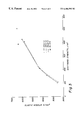
- FIG. 1 compares the pulps disclosed in the examples; the ScottBond strength is indicated on the y axis as a function of the light scattering coefficient,
- FIG. 2 indicates the ScottBond strengths of three mixed sheets as a function of the light scattering coefficient
- FIG. 3 contains a comparison of the elastic moduli of four chemical pulps as a function of internal bond strength.
- the sheet was prepared and the drying was carried out according to standard SCAN-C 26.
- the ScottBond strength of sheet produced from softwood chemical pulp is influenced by the extent of bonding surface between the fibres and the strength of the bonds.
- the amount of the bonding surface is, on its part, strongly dependent on the degree of beating of the chemical pulp used in sheetmaking. When beating is increased the bonding area and at the same time the bonding strength are increased.
- the internal bond strengths of different chemical pulps are compared by examining them as a function of the light scattering coefficient in the same way as in the article by Barzyk et al. Journal of Pulp and Paper Science, 23 (1997) J59-J61, FIGS. 3 and 4, already referred to above. It is conceivable that with chemical softwood pulps the light scattering coefficient is a measure of the amount of bonding surface of the fibers, the greater the amount of bonding surface the smaller the light scattering coefficient.
- Graphs 1 to 3 depict cellulosic pulps produced by a continued batch cooking (Super-Batch) which have been subjected to chlorine-free bleaching (TCF) by using two ozone and two peroxide stages (ZPZP).
- Graphs 4 and 5 depict a pulp produced by a continuous cooking method, which also has been subjected to chlorine-free bleaching (TCF) by using one ozone and one peroxide stage (ZP).
- the cooking result is, compared to the above mentioned batch cooking, more hetrogenous and weaker fibers are produced. The fiber collapses more easily, and it looses its light scattering coefficient which moves the curve to the left.
- the pulps produced by both methods 1 to 3 and 4 and 5 contain at least approximately an equal amounts of carboxylic acid groups (41-47 mekv./kg and 42-46 mekv./kg, respectively).
- Graphs 6 to 9 show pulps which have been subjected to a bleaching without elemental chlorine (ECF bleaching).
- the starting material of cooking 6 was a raw material obtainable in the north of Finland. It comprises small size fibers which give a large specific surface (m 2 /g fiber) and, therefore, it light scattering coefficient is good.
- the concentration of carboxylic acid groups was 34 mekv./kg.
- the raw material of cooking 7 was obtained from Eastern Finland and the chemical pulp had been produced by batch cooking, Graphs 8 and 9 represent the internal bonding strength of pulps produced by continuous cooking and bleached by ECF bleaching.
- the concentration of caboxylic groups was 27 to 34 mekv./kg.
- the graphs show that pulps 1 to 3 give greater values for the bonding strength than the other pulps at the same light scattering coefficient. The differences become more pronounced when the pulp have been subjected to extended beating.
- pulp A corresponded to pulps 1 to 3
- pulp B corresponded to pulp 6
- pulp C corresponded to pulp 7 .
- the pulps were refined in a laboratory Valley beater so that the degree of beating (drainage) was CSF 380 ml.
- sheets were produced from the pulps so that in each test point the sheets contained 60% chemical pulp and 40% aspen PGW pulp (aspen of Populus family).
- pulp A according to the invention gives a smaller elastic modulus than D and, accordingly, that a paper produced from pulp A is less brittle.
- the paper is tougher than a paper made from pulp D.
- the superiority of pulp A is pronounced when the pulps are beaten to a high degree of beating in order to obtain good ScottBond strength.
- a base paper was produced from a mechanical aspen pulp (GW) and chemical pine pulp, which were mixed at a weight ratio of 40 to 60.
- Ground calcium carbonate was added as a filler to the suspension in an amount of about 10% of the fibrous material.
- the base paper was produced on a gap former.
- the properties of the base paper were the following:
- Comparative test carried out in connection with the invention have shown that the grammage of the base paper is at least 10% smaller than that of a base paper produced entirely from a bleached chemical pulp and having the corresponding opacity and brightness.
- a calcium carbonate pigment having the particle size distribution shown in Table 1 was used in the coating colours:
- the coating colour was produced in a manner known per se by mixing together the pigment, the binder and the other additives.
- the dry matter content of the precoating colour was 60% and of the surface coating colour 61%.
- the above described colours were used for coating the afore-mentioned base paper in the following conditions:
- Precoating by the film press method 9 g/m 2 per side; and the surface coating at a doctor blade station: 10.5 g/m 2 per side at a speed of 1500 m/min.
- the coated paper was super-calendered.
- Table 2 shows that the properties of a fine paper produced by the invention are better in all respects than those of comparative papers having corresponding bulk and grammage. Thus the yield gain on equal level of opacity is over 20%.
- the ScottBond bonding strength of the fine paper prepared according to the Example was 306 J/m 2 . This is also fully comparable to the strength of a traditional fine paper comprising only chemical pulp. Even if the internal bonding strength of aspen PGW is inferior to that of e.g. chemical birch pulp, the present invention has provided a paper which is strong enough for use as a fine paper.
Landscapes
- Paper (AREA)
- Measurement And Recording Of Electrical Phenomena And Electrical Characteristics Of The Living Body (AREA)
- Ultra Sonic Daignosis Equipment (AREA)
- Treating Waste Gases (AREA)
Applications Claiming Priority (2)
| Application Number | Priority Date | Filing Date | Title |
|---|---|---|---|
| FI973706A FI107274B (fi) | 1997-09-16 | 1997-09-16 | Menetelmä hienopaperin pohjapaperin valmistamiseksi |
| FI973706 | 1997-09-16 |
Publications (2)
| Publication Number | Publication Date |
|---|---|
| US20010008178A1 US20010008178A1 (en) | 2001-07-19 |
| US6406592B2 true US6406592B2 (en) | 2002-06-18 |
Family
ID=8549544
Family Applications (1)
| Application Number | Title | Priority Date | Filing Date |
|---|---|---|---|
| US09/154,157 Expired - Fee Related US6406592B2 (en) | 1997-09-16 | 1998-09-16 | Process for preparing base paper for fine paper |
Country Status (10)
| Country | Link |
|---|---|
| US (1) | US6406592B2 (da) |
| EP (1) | EP0908558B1 (da) |
| JP (1) | JP3085937B2 (da) |
| AT (1) | ATE259915T1 (da) |
| CA (1) | CA2247542A1 (da) |
| DE (1) | DE69821702T2 (da) |
| DK (1) | DK0908558T3 (da) |
| ES (1) | ES2214693T3 (da) |
| FI (1) | FI107274B (da) |
| PT (1) | PT908558E (da) |
Cited By (11)
| Publication number | Priority date | Publication date | Assignee | Title |
|---|---|---|---|---|
| US20030056915A1 (en) * | 2000-01-28 | 2003-03-27 | Soili Hietanen | Calendered paper product and method of producing a calendered paper web |
| US20030204988A1 (en) * | 2001-06-01 | 2003-11-06 | Bransby David I. | Process for propagation and utilization of mimosa |
| US20040007340A1 (en) * | 2000-12-09 | 2004-01-15 | Watson Mark Victor | Security paper |
| US20040065424A1 (en) * | 2000-01-26 | 2004-04-08 | Mohan Kosaraju Krishna | Low density paperboard articles |
| US20040104003A1 (en) * | 2000-11-28 | 2004-06-03 | Biopulping International, Inc. | Eucalyptus biokraft pulping process |
| US20040154762A1 (en) * | 2001-06-01 | 2004-08-12 | Masood Akhtar | Eucalyptus biomechanical pulping process |
| US20040238134A1 (en) * | 2001-11-09 | 2004-12-02 | Masood Akhtar | Microwave pre-treatment of logs for use in making paper and other wood products |
| US20050098286A1 (en) * | 2000-01-26 | 2005-05-12 | International Paper Company | Cut resistant paper and paper articles and method for making same |
| US8377526B2 (en) | 2005-03-11 | 2013-02-19 | International Paper Company | Compositions containing expandable microspheres and an ionic compound, as well as methods of making and using the same |
| US8382945B2 (en) | 2008-08-28 | 2013-02-26 | International Paper Company | Expandable microspheres and methods of making and using the same |
| US8460512B2 (en) | 2002-09-13 | 2013-06-11 | International Paper Company | Paper with improved stiffness and bulk and method for making same |
Families Citing this family (10)
| Publication number | Priority date | Publication date | Assignee | Title |
|---|---|---|---|---|
| FI104502B (fi) | 1997-09-16 | 2000-02-15 | Metsae Serla Oyj | Menetelmä paperirainan valmistamiseksi |
| FI108950B (fi) | 1998-03-13 | 2002-04-30 | M Real Oyj | Menetelmä päällystetyn puuvapaan paperin valmistamiseksi |
| FI111649B (fi) | 1998-05-11 | 2003-08-29 | M Real Oyj | Kalsiumoksalaatista valmistetun kalsiumkarbonaatin käyttö pigmenttinä |
| JP3871107B2 (ja) * | 1999-12-17 | 2007-01-24 | 日本製紙株式会社 | 柔軟性印刷用紙 |
| JP4799774B2 (ja) * | 2001-08-03 | 2011-10-26 | 日本製紙株式会社 | 印刷用紙 |
| JP4814448B2 (ja) * | 2001-08-06 | 2011-11-16 | 日本製紙株式会社 | 印刷用塗工紙 |
| CA2471935A1 (en) * | 2002-01-29 | 2003-08-07 | Metso Paper, Inc. | Processing device for processing a coated or uncoated fibrous web |
| CN102330378A (zh) * | 2011-09-16 | 2012-01-25 | 衢州五洲特种纸业有限公司 | 一种装饰原纸的生产工艺 |
| CN109554952A (zh) * | 2018-11-23 | 2019-04-02 | 福建省青山纸业股份有限公司 | 一种木砂原纸生产方法 |
| WO2021002361A1 (ja) * | 2019-07-01 | 2021-01-07 | 日本製紙株式会社 | セルロースナノファイバーを含有する紙 |
Citations (14)
| Publication number | Priority date | Publication date | Assignee | Title |
|---|---|---|---|---|
| US1624492A (en) * | 1925-03-30 | 1927-04-12 | Little Inc A | Paper manufacture |
| US1824837A (en) * | 1929-11-15 | 1931-09-29 | Brown Co | Papermaking composition |
| GB496775A (en) | 1937-11-25 | 1938-12-06 | Kurt Schwabe | Improvements in and relating to coating compositions for making coated papers |
| GB1001778A (en) | 1962-09-04 | 1965-08-18 | Du Pont | Improvements in and relating to pigmented compositions |
| GB1030195A (en) | 1962-07-05 | 1966-05-18 | Monsanto Co | Improvements in and relating to adhesives |
| US4388150A (en) * | 1980-05-28 | 1983-06-14 | Eka Aktiebolag | Papermaking and products made thereby |
| FI884196L (fi) | 1987-09-15 | 1989-03-16 | Basf Ag | Foerfarande foer foerbaettring av tryckbarheten hos papper. |
| US5118533A (en) | 1988-09-14 | 1992-06-02 | Kanazaki Paper Mfg. Co., Ltd. | Method of manufacturing coated paper |
| EP0496269A2 (en) | 1991-01-24 | 1992-07-29 | Aqualon Company | Process for preparing fluid suspensions of polysaccharide mixtures |
| US5158806A (en) | 1989-05-10 | 1992-10-27 | Neste Oy | Method and apparatus for manufacturing fibre-reinforcing material |
| GB2262542A (en) | 1991-12-13 | 1993-06-23 | Ecc Int Ltd | Paper coating |
| DE4411987A1 (de) | 1994-04-08 | 1995-10-12 | Feldmuehle Ag Stora | Beidseitig gestrichenes Rollendruckpapier und Verfahren zu seiner Herstellung |
| WO1995028522A1 (en) | 1994-04-19 | 1995-10-26 | Valmet Corporation | Method and equipment for two-sided coating of a printing-paper web |
| FI961026L (fi) | 1996-03-06 | 1997-09-07 | Valmet Corp | Menetelmä ja sovitelma liikkuvan radan päällystämiseksi |
Family Cites Families (3)
| Publication number | Priority date | Publication date | Assignee | Title |
|---|---|---|---|---|
| JPS55152895A (en) * | 1979-05-11 | 1980-11-28 | Kanzaki Paper Mfg Co Ltd | Production of medium grade coat paper for graphic wheel |
| FI75199C (fi) * | 1986-04-30 | 1988-05-09 | Yhtyneet Paperitehtaat Oy | Belagt papper, kartong eller dylikt samt foerfarande och anlaeggning foer tillverkning av detsamma. |
| US5340611A (en) * | 1989-07-25 | 1994-08-23 | J. M. Voith Gmbh | Process for coating travelling webs |
-
1997
- 1997-09-16 FI FI973706A patent/FI107274B/fi active
-
1998
- 1998-09-16 JP JP10262006A patent/JP3085937B2/ja not_active Expired - Fee Related
- 1998-09-16 US US09/154,157 patent/US6406592B2/en not_active Expired - Fee Related
- 1998-09-16 DK DK98660095T patent/DK0908558T3/da active
- 1998-09-16 CA CA002247542A patent/CA2247542A1/en not_active Abandoned
- 1998-09-16 EP EP98660095A patent/EP0908558B1/en not_active Expired - Lifetime
- 1998-09-16 DE DE69821702T patent/DE69821702T2/de not_active Expired - Fee Related
- 1998-09-16 AT AT98660095T patent/ATE259915T1/de not_active IP Right Cessation
- 1998-09-16 ES ES98660095T patent/ES2214693T3/es not_active Expired - Lifetime
- 1998-09-16 PT PT98660095T patent/PT908558E/pt unknown
Patent Citations (14)
| Publication number | Priority date | Publication date | Assignee | Title |
|---|---|---|---|---|
| US1624492A (en) * | 1925-03-30 | 1927-04-12 | Little Inc A | Paper manufacture |
| US1824837A (en) * | 1929-11-15 | 1931-09-29 | Brown Co | Papermaking composition |
| GB496775A (en) | 1937-11-25 | 1938-12-06 | Kurt Schwabe | Improvements in and relating to coating compositions for making coated papers |
| GB1030195A (en) | 1962-07-05 | 1966-05-18 | Monsanto Co | Improvements in and relating to adhesives |
| GB1001778A (en) | 1962-09-04 | 1965-08-18 | Du Pont | Improvements in and relating to pigmented compositions |
| US4388150A (en) * | 1980-05-28 | 1983-06-14 | Eka Aktiebolag | Papermaking and products made thereby |
| FI884196L (fi) | 1987-09-15 | 1989-03-16 | Basf Ag | Foerfarande foer foerbaettring av tryckbarheten hos papper. |
| US5118533A (en) | 1988-09-14 | 1992-06-02 | Kanazaki Paper Mfg. Co., Ltd. | Method of manufacturing coated paper |
| US5158806A (en) | 1989-05-10 | 1992-10-27 | Neste Oy | Method and apparatus for manufacturing fibre-reinforcing material |
| EP0496269A2 (en) | 1991-01-24 | 1992-07-29 | Aqualon Company | Process for preparing fluid suspensions of polysaccharide mixtures |
| GB2262542A (en) | 1991-12-13 | 1993-06-23 | Ecc Int Ltd | Paper coating |
| DE4411987A1 (de) | 1994-04-08 | 1995-10-12 | Feldmuehle Ag Stora | Beidseitig gestrichenes Rollendruckpapier und Verfahren zu seiner Herstellung |
| WO1995028522A1 (en) | 1994-04-19 | 1995-10-26 | Valmet Corporation | Method and equipment for two-sided coating of a printing-paper web |
| FI961026L (fi) | 1996-03-06 | 1997-09-07 | Valmet Corp | Menetelmä ja sovitelma liikkuvan radan päällystämiseksi |
Non-Patent Citations (11)
| Title |
|---|
| Abstract for Karenlampi, P., "Tensile Strength of a Mixture of Two Pulps," J. Pulp Pap. Sci. 21(12):J432-436 (1995). |
| Barzyk, D., et al., "Acidic Group Topochemistry and Fibre-to-Fibre Specific Bond Strength," J. Pulp Paper Sci. 23(2):J59-J61 (Feb. 1997). |
| Dahlvik, P., et al., "Interactions in Coating Colors Induced by Temperature-Sensitive Cellulosic Polymer," Intl. Paper and Coating Chem. Symp., Ottawa, Canada, pp. 155-162 (Jun. 1996). |
| Dialog File 351 (World Patents Index) English language abstract of FI 884196, WPI Accession No. 89-087231/12. |
| English language Abstract of DE 44 11 987 A1 (Document A02). |
| English language Abstract of FI 961026 (Document AN2). |
| European Search Report for European Application No. EP 98 66 0001.3. |
| Malinen, R., "Recent trends in kraft pulping in Finland," Paper and Timber 75(1-2):14-19 (1993). |
| Patent for Inventions, Abridgments of Specifications, Herlad Printing Works, York, 1954, Abstract for U.K. Patent No. 609,927, pp. 141-142. |
| Patent for Inventions, Abridgments of Specifications, Herlad Printing Works, York, 1954, Abstract for U.K. Patent No. 623,357, p. 39. |
| Sundberg, K., et al., "Interactions between simple electrolytes and dissolved and colloidal substances in mechanical pulp," Pulp Paper Res. J. 9(2):125-128 (1994). |
Cited By (26)
| Publication number | Priority date | Publication date | Assignee | Title |
|---|---|---|---|---|
| US20100252216A1 (en) * | 2000-01-26 | 2010-10-07 | Intemational Paper Company | Low density paperboard articles |
| US20110036526A1 (en) * | 2000-01-26 | 2011-02-17 | International Paper Company | Cut resistant paper and paper articles and method for making same |
| US8317976B2 (en) | 2000-01-26 | 2012-11-27 | International Paper Company | Cut resistant paper and paper articles and method for making same |
| US20040065424A1 (en) * | 2000-01-26 | 2004-04-08 | Mohan Kosaraju Krishna | Low density paperboard articles |
| US20080163992A1 (en) * | 2000-01-26 | 2008-07-10 | Kosaraju Krishna Mohan | Low density paperboard articles |
| US7482046B2 (en) | 2000-01-26 | 2009-01-27 | International Paper Company | Cut resistant paper and paper articles and method for making same |
| US7790251B2 (en) | 2000-01-26 | 2010-09-07 | International Paper Company | Cut resistant paper and paper articles and method for making same |
| US20050098286A1 (en) * | 2000-01-26 | 2005-05-12 | International Paper Company | Cut resistant paper and paper articles and method for making same |
| US7740740B2 (en) | 2000-01-26 | 2010-06-22 | International Paper Company | Low density paperboard articles |
| US7682486B2 (en) | 2000-01-26 | 2010-03-23 | International Paper Company | Low density paperboard articles |
| US7335279B2 (en) * | 2000-01-26 | 2008-02-26 | International Paper Company | Low density paperboard articles |
| US20030056915A1 (en) * | 2000-01-28 | 2003-03-27 | Soili Hietanen | Calendered paper product and method of producing a calendered paper web |
| US6908531B2 (en) * | 2000-01-28 | 2005-06-21 | M-Real Oyj | Calendered paper product and method of producing a calendered paper web |
| US20040104003A1 (en) * | 2000-11-28 | 2004-06-03 | Biopulping International, Inc. | Eucalyptus biokraft pulping process |
| US20040007340A1 (en) * | 2000-12-09 | 2004-01-15 | Watson Mark Victor | Security paper |
| US7431798B2 (en) * | 2000-12-09 | 2008-10-07 | Arjo Wiggins Fine Papers Ltd. | Security paper |
| US7008505B2 (en) * | 2001-06-01 | 2006-03-07 | Biopulping International, Inc. | Eucalyptus biomechanical pulping process |
| US20030204988A1 (en) * | 2001-06-01 | 2003-11-06 | Bransby David I. | Process for propagation and utilization of mimosa |
| US20040154762A1 (en) * | 2001-06-01 | 2004-08-12 | Masood Akhtar | Eucalyptus biomechanical pulping process |
| US20060243403A1 (en) * | 2001-11-09 | 2006-11-02 | Biopulping International, Inc. | Microwave pretreatment of logs for use in making paper and other wood products |
| US20040238134A1 (en) * | 2001-11-09 | 2004-12-02 | Masood Akhtar | Microwave pre-treatment of logs for use in making paper and other wood products |
| US8460512B2 (en) | 2002-09-13 | 2013-06-11 | International Paper Company | Paper with improved stiffness and bulk and method for making same |
| US8790494B2 (en) | 2002-09-13 | 2014-07-29 | International Paper Company | Paper with improved stiffness and bulk and method for making same |
| US8377526B2 (en) | 2005-03-11 | 2013-02-19 | International Paper Company | Compositions containing expandable microspheres and an ionic compound, as well as methods of making and using the same |
| US8382945B2 (en) | 2008-08-28 | 2013-02-26 | International Paper Company | Expandable microspheres and methods of making and using the same |
| US8679294B2 (en) | 2008-08-28 | 2014-03-25 | International Paper Company | Expandable microspheres and methods of making and using the same |
Also Published As
| Publication number | Publication date |
|---|---|
| DE69821702D1 (de) | 2004-03-25 |
| PT908558E (pt) | 2004-06-30 |
| EP0908558B1 (en) | 2004-02-18 |
| DE69821702T2 (de) | 2005-01-05 |
| EP0908558A1 (en) | 1999-04-14 |
| JP3085937B2 (ja) | 2000-09-11 |
| US20010008178A1 (en) | 2001-07-19 |
| DK0908558T3 (da) | 2004-06-28 |
| ES2214693T3 (es) | 2004-09-16 |
| CA2247542A1 (en) | 1999-03-16 |
| JPH11315489A (ja) | 1999-11-16 |
| ATE259915T1 (de) | 2004-03-15 |
| FI973706A0 (fi) | 1997-09-16 |
| FI973706L (fi) | 1999-03-17 |
| FI107274B (fi) | 2001-06-29 |
Similar Documents
| Publication | Publication Date | Title |
|---|---|---|
| EP0908558B1 (en) | Base paper for coated fine paper | |
| US6391154B1 (en) | Paper web and a method for the production thereof | |
| US6436238B1 (en) | Process for preparing a paper web | |
| US4152197A (en) | Process for preparing high-yield cellulose pulps by vapor phase pulping an unpulped portion of lignocellulosic material and a partially chemically pulped portion | |
| EP3059344B1 (en) | A method for manufacturing paper comprising bleached chemithermo-mechanical pulp suitable for a release liner and products and uses thereof | |
| AU777250B2 (en) | Process and coating composition for coating a paper web | |
| JP6403788B2 (ja) | 紙製品及びその製造方法 | |
| EP3870755B1 (en) | Release liner | |
| US12084563B2 (en) | Refined cellulose fiber composition | |
| CN104911938A (zh) | 高得率和提高性能的纤维 | |
| US6878236B2 (en) | Raw material for printing paper, a method for producing said raw material and a printing paper | |
| US20260015794A1 (en) | Translucent paper products | |
| Franco et al. | Assessing bleached bamboo fibers as a hardwood replacement via kraft co-cooking for paperboard applications | |
| US20080295986A1 (en) | Method of Producing Paper and Cardboard | |
| EP2723944A1 (en) | A printing paper product, as well as a method and a system for manufacturing a printing paper product | |
| US4836892A (en) | Pulp blends for linerboards | |
| Asikainen | Applicability of fractionation of softwood and hardwood kraft pulp and utilisation of the fractions | |
| CN101691708B (zh) | 一种色相、不透明度和游离度改善且性能稳定的本色草浆 | |
| Yuan et al. | Evaluation of various mechanical pulping processes for mature and juvenile loblolly pine in lightweight coated paper | |
| Asikainen | fractionation ofsoftwood and hardwood kraft pulp and utilisation ofthe fractions | |
| AIi et al. | Chemi-Thermo Mechanical Pulping of Non-Wood Fibres | |
| WO1996027047A1 (en) | Kraft-substitute bristol paper products |
Legal Events
| Date | Code | Title | Description |
|---|---|---|---|
| AS | Assignment |
Owner name: METSA-SERLA OYJ, FINLAND Free format text: ASSIGNMENT OF ASSIGNORS INTEREST;ASSIGNORS:LESKELA, MARKKU;NISKANEN, KAARLO JOHANNES;NYGARD, STINA;AND OTHERS;REEL/FRAME:009616/0261 Effective date: 19981112 |
|
| AS | Assignment |
Owner name: M-REAL OYJ, FINLAND Free format text: CHANGE OF NAME;ASSIGNOR:OYJ, METSA-SERLA;REEL/FRAME:012098/0458 Effective date: 20010405 |
|
| FPAY | Fee payment |
Year of fee payment: 4 |
|
| FEPP | Fee payment procedure |
Free format text: PAYOR NUMBER ASSIGNED (ORIGINAL EVENT CODE: ASPN); ENTITY STATUS OF PATENT OWNER: LARGE ENTITY |
|
| REMI | Maintenance fee reminder mailed | ||
| FPAY | Fee payment |
Year of fee payment: 8 |
|
| SULP | Surcharge for late payment |
Year of fee payment: 7 |
|
| REMI | Maintenance fee reminder mailed | ||
| LAPS | Lapse for failure to pay maintenance fees | ||
| STCH | Information on status: patent discontinuation |
Free format text: PATENT EXPIRED DUE TO NONPAYMENT OF MAINTENANCE FEES UNDER 37 CFR 1.362 |
|
| FP | Lapsed due to failure to pay maintenance fee |
Effective date: 20140618 |